Marion County contains five incorporated municipalities entirely within its borders and shares a sixth with two neighboring counties. Each operates its own mayor and board of aldermen (or commissioners), separate from the county commission that governs the unincorporated areas. The towns span nearly the full arc of the county's history: Jasper was chartered as the county seat in 1820, South Pittsburg was incorporated in 1887 as a planned industrial city, and New Hope incorporated as recently as 1974. Together they represent the civic life of the valley floor, the industrial river corridor, and the plateau crossroads.
Tennessee municipalities operate under one of three charter types: general law mayor-aldermanic, general law city manager-commission, or private act. Most of Marion County's towns use a general law mayor-aldermanic charter, in which a mayor and a small board of aldermen serve as the legislative body. South Pittsburg is the exception, operating under a private act charter granted by the General Assembly.
Jasper
Jasper is the oldest incorporated town in Marion County and has served as the county seat since 1819, when commissioners purchased forty acres from Betsy Pack for one dollar. The town was incorporated under the Private Acts of 1851-52, Chapter 253 (though local tradition dates the original charter to 1820, the year the first courthouse was built). Today Jasper operates under a General Law Mayor-Aldermanic charter. The Board of Mayor and Aldermen consists of a mayor and four aldermen elected at-large, and meets on the second Monday of each month at 6:00 p.m. at City Hall.
Jasper's municipal government has historically been small, focused on basic services for a county-seat town whose economy centers on county government, professional offices, and small businesses rather than heavy industry. The town's identity is inseparable from the courthouse square and its role as the administrative hub for the surrounding valley.
Jason Turner is the current mayor of Jasper.
South Pittsburg
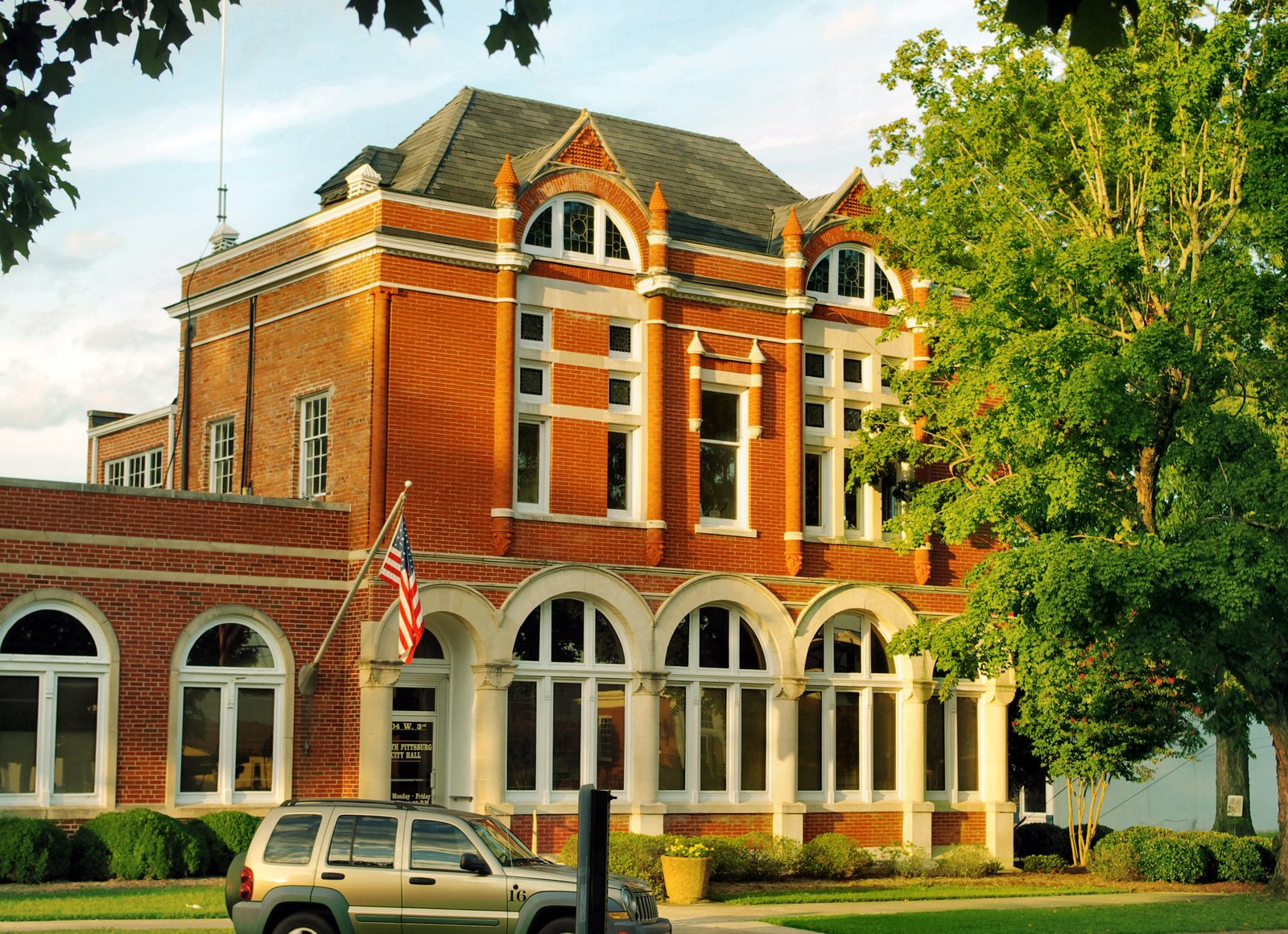
South Pittsburg's incorporation in November 1887 was the formal act of a planned industrial city that had been taking shape since the mid-1870s. British investors in the Southern States Coal, Iron and Land Company, a syndicate organized in 1873 around Welsh metallurgist Thomas Whitwell, had financed blast furnaces and rail connections along the Tennessee River; Nashville banker William M. Duncan purchased the townsite in 1886 and organized the South Pittsburg City Company; and F. P. Clute platted the grid of streets that still defines the downtown. When the charter was granted, John G. Kelly was elected the city's first mayor (per the South Pittsburg Historic Preservation Society's history of South Pittsburg).
Kelly's own career illustrates how intertwined town and county governance were in the early industrial era. After serving as South Pittsburg's first mayor, Kelly was elected county judge in 1894. The Kelly family's prominence in both municipal and county affairs was a pattern repeated across the small towns: a handful of families, many of them connected to the foundries, the railroad, or the courthouse, rotated through civic roles.
Though incorporated in 1887, South Pittsburg's current governing structure is a Private Act charter rooted in Private Acts 1901, Chapter 360, and reshaped by a series of subsequent General Assembly acts through Private Acts 1992, Chapter 213 (per the MTAS South Pittsburg profile). A private act charter means the city's structure is set by specific acts of the Tennessee General Assembly rather than by the state's general municipal code; amendments require the city's legislative delegation to introduce a bill in the General Assembly, followed by local ratification. The city is governed by a mayor and board of aldermen, meeting on the second Tuesday of each month at 6:00 p.m.
South Pittsburg annexed the former company town of Richard City in 1985, absorbing its residential area while the Richard City Special School District continued to operate independently. The city today is home to Lodge Cast Iron, the National Cornbread Festival, and the active preservation work of the South Pittsburg Historic Preservation Society.
The current mayor is Shawn Henson, with a term running through 2028.
Whitwell
Whitwell occupies a distinctive place in Marion County's civic history. The site, the pre-1877 Sequatchie Valley settlement known as Cheekville, hosted the county's first court in 1817 at the home of John Shropshire, making it the original seat of county government before the move to Jasper in 1819. Despite this early civic role, Whitwell did not formally incorporate until 1956, more than a century after Jasper and nearly seventy years after South Pittsburg.
Through the late nineteenth and early twentieth centuries, Whitwell was a coal-mining community whose civic life was shaped more by the mine operators and the railroad schedule than by a municipal charter. Stores, churches, lodges, and a bank served the community without formal municipal government. When incorporation came in 1956 under a Home Rule charter, it reflected the shift from company-town governance to self-determination that was happening across Appalachian coal communities in the postwar era.
Today Whitwell operates under a board of mayor and commissioners, meeting on the second Thursday of each month at 6:00 p.m. The city provides basic municipal services and is best known internationally as the home of the Children's Holocaust Memorial at Whitwell Middle School.
The city's current mayor is Sandra Crabtree (per the MTAS Whitwell profile and the Marion County Election Commission officials roster). Mike Dillon serves as vice mayor and Lonnie Cleek as city manager.
Kimball
Kimball was platted in 1890 as a model industrial city backed by Hannibal Kimball and the British Anglo-American Company, Limited (per Wikipedia's entry on Kimball, Tennessee). The grand plan collapsed in the Panic of 1893, and the would-be industrial hub dwindled into an unincorporated community with no formal municipal government for the next seven decades.
The town's rebirth came with the interstate highway era. When Interstate 24 was built through southern Marion County, Kimball's location at the I-24/U.S. 72 interchange made it a natural commercial cluster. The town formally incorporated effective February 1, 1962, adopting a General Law Mayor-Aldermanic charter. The Board of Mayor and Aldermen meets on the first Thursday of each month at 6:00 p.m. at Town Hall.
Kimball has since become the retail center for the county, with chain restaurants, gas stations, and commercial services strung along the U.S. 72 corridor. The town's municipal government focuses on zoning, road maintenance, and managing the commercial growth that the interstate continues to generate.
The current mayor is Rex Pesnell, with a term running through 2028.
New Hope
New Hope is the youngest incorporated municipality in Marion County, incorporating on February 1, 1974 in response to a long-standing concern over annexation pressure from neighboring South Pittsburg. The town's name comes from a local church and cemetery. Incorporation gave the community its own municipal government and the ability to control its own land-use decisions.
New Hope operates under a General Law Mayor-Aldermanic charter. The Board of Mayor and Aldermen meets on the fourth Monday of each month at 5:00 p.m. at the Firehall. The town has a staff of two employees and maintains basic services. As of 2025, the certified population was 987, down from 1,082 in 2010 (per the MTAS New Hope profile).
New Hope sits on the Tennessee River across the water from South Pittsburg and remains closely linked to its larger neighbor socially and economically, even as its independent municipal status preserves the local governance its founders sought.
Monteagle (Marion County portion)
Monteagle straddles three counties: Grundy (where the majority of residents live), Franklin, and Marion. The town incorporated effective February 1, 1962 under a General Law Mayor-Aldermanic charter. The Board of Mayor and Aldermen meets on the last Tuesday of each month at 6:00 p.m. at Town Hall. As of 2025, the certified population was 1,393 with thirty-four municipal employees (per the MTAS Monteagle profile).
Marion County's portion of Monteagle lies along the western edge of the plateau where I-24 makes the climb that truckers nationwide know as "Monteagle Mountain." The town's identity is shaped by the Monteagle Sunday School Assembly, the Chautauqua community established on the mountain in 1882, and by its role as the I-24 service corridor between Chattanooga and Nashville.
Because Monteagle's government serves all three county portions as a single municipality, Marion County residents of Monteagle vote in town elections alongside their Grundy and Franklin County neighbors. The current mayor is Greg Maloof, with a term through 2026.
Patterns across the towns
Several threads run through the history of municipal government in Marion County. The towns incorporated in waves that tracked the county's economic transitions: Jasper with the formation of the county seat in the 1820s; South Pittsburg with the industrial boom of the 1880s; Kimball, Whitwell, and Monteagle in the postwar era of highway-driven growth and community self-determination; and New Hope in the 1970s as a defensive incorporation against annexation.
The general law mayor-aldermanic charter is the standard structure, with South Pittsburg's private act charter the notable exception. In all cases the boards are small (typically a mayor and four to five aldermen or commissioners), meetings are monthly, and the scope of municipal government is modest: streets, water, sewer, zoning, and basic public safety. The larger questions of schools, law enforcement, and courts fall to the county commission and the sheriff's office.
The unincorporated communities that make up much of the county, from Battle Creek to Sequatchie to Powell's Crossroads, have no municipal government at all. Their residents are governed directly by the county commission and served by the county sheriff. This two-tier structure, incorporated towns with their own mayors alongside unincorporated communities governed only by the county, is the standard Tennessee model and has been the pattern in Marion County since the first town charter.
Related pages
- Elections and County Commission – the county-level legislative body and executive
- The Marion County Courthouse – the physical seat of county government in Jasper
- The Marion County Sheriff – law enforcement across the county
- Jasper – the county seat since 1819
- South Pittsburg – the planned industrial city on the Tennessee River
- Whitwell – coal town turned Holocaust memorial community
- Kimball – the I-24 retail corridor
- Monteagle – the three-county Chautauqua crossroads
Sources
- Jasper – Municipal Technical Advisory Service (MTAS)
- South Pittsburg – MTAS
- Whitwell – MTAS
- Kimball – MTAS
- New Hope – MTAS
- Monteagle – MTAS
- Jasper, Tennessee – Wikipedia
- South Pittsburg, Tennessee – Wikipedia
- Whitwell, Tennessee – Wikipedia
- Kimball, Tennessee – Wikipedia
- New Hope, Tennessee – Wikipedia
- Monteagle, Tennessee – Wikipedia
- South Pittsburg History – South Pittsburg Historic Preservation Society (legacy site)
- Marion County Officials 1820-1995 – RootsWeb / TNGenWeb Marion County
- County and Municipal Officials – Marion County TN Election Commission
- Marion County – Tennessee Encyclopedia