Last updated: May 13, 2026
- Type: Census-designated place (CDP)
- 2020 population: 622
- Elevation: 656 ft
- Area: 1.03 sq mi
- Note: Not to be confused with Sequatchie County (a separate, neighboring county to the north)
The small community named Sequatchie sits in Marion County's portion of the Sequatchie Valley, along the Little Sequatchie River and Valley View Highway. It shares its name with the valley itself and with Sequatchie County, which was carved in December 1857 out of two districts of Marion County plus one district of Bledsoe County. The county seat of Sequatchie County is Dunlap, well to the north; the Marion County community called Sequatchie is a smaller, quieter place between Jasper and Whitwell.
Setting
The community of Sequatchie occupies the valley floor in north-central Marion County, roughly midway between Jasper and Whitwell along U.S. 41 and Valley View Highway. The Cumberland Plateau escarpment rises close on both sides of the valley here, with Coppinger Cove opening west into the plateau above the community. The Little Sequatchie River, which drains Coppinger Cove and the plateau rim behind it, runs through the settlement before joining the main Sequatchie River to the south. At about 656 feet of elevation, the valley floor is flat, its soils deep and heavy, and the farms along the river bottom are some of the oldest continuously worked in the county. The community's name comes from a Cherokee word for the valley; it should not be confused with Sequatchie County, whose seat is in Dunlap in the next county to the north.
The valley floor here carried Indigenous use for thousands of years before any of these farms were recorded. Archaeological sites along the Little Sequatchie and the main Sequatchie document Archaic and Woodland occupation (roughly 8000 BC to AD 900), and the deep bottomlands fell within the Mississippian agricultural world between about AD 900 and 1600. By the late 18th century the valley was part of the Cherokee homeland, and the Chickamauga (Lower) Cherokee used the Sequatchie corridor as a travel and hunting route linking the Lower Towns on the Tennessee River to the Overhill country to the northeast. After the 1794 Nickajack Expedition, Cherokee households continued to hold land in the valley; under the Treaty of 1819, several took 640-acre reservations on Battle Creek and near Jasper, and the remaining Cherokee community was forcibly removed along the Trail of Tears in 1838. The Cherokee Nation, today a sovereign nation headquartered in Oklahoma, traces a portion of its ancestry through the families who once worked this valley floor.
Name origin
The name Sequatchie comes from a Cherokee word (variously rendered Siquatchi or Se-qua-cha-ha-hok), generally interpreted as meaning "opossum" or referring to "hog" or describing the river's meandering path. It was the Cherokee name for the valley and the river that drains it.
The county split (1857)
Sequatchie County was created in 1857 because residents of the central valley felt that Jasper, well to the south, was too distant to serve as their effective county seat. The state legislature agreed and peeled off portions of Marion and Bledsoe to form the new county. The Marion County community called Sequatchie is in the remaining Marion portion of the valley.
The Little Sequatchie River
The Little Sequatchie River runs roughly 19.6 miles from springs near the Grundy County line on the Cumberland Plateau, through Coppinger Cove, and past the Sequatchie community before joining the main Sequatchie River. Its drainage area covers about 116 square miles. The USGS has operated a stream monitoring station near the community since the 1960s. The river and its bottomland soils have shaped the community's agricultural character from the earliest Anglo-American settlement.
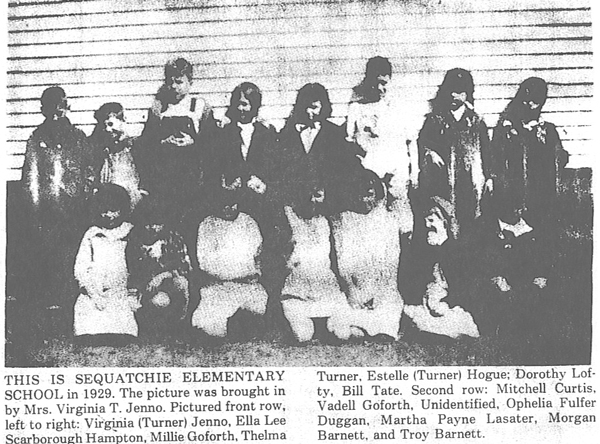
Post office and the founding of the community
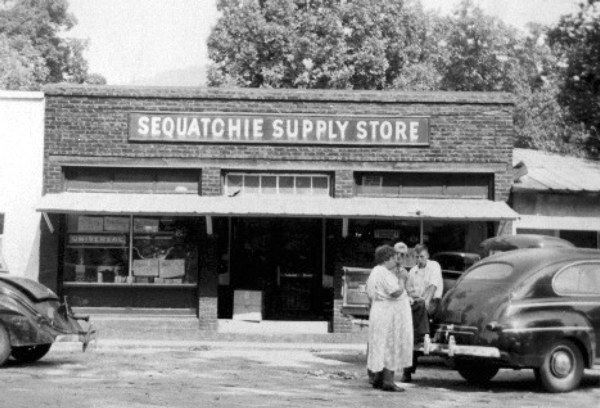
The Sequatchie post office opened in 1890 and has operated continuously since, with the current ZIP code 37374 covering the community and Coppinger Cove to the west. The post-office date lines up almost exactly with the arrival of the New England syndicate that named the place: Glancy Sherman came to Sequatchie in 1889 as the syndicate's local agent, built the Sequatchie Supply Store in 1890, and stayed for the rest of his life. Until 1890, the place between Jasper and Whitwell on the valley floor had no separate post office of its own; the 1890 date is the first year Sequatchie is recognized as a distinct named community in U.S. Post Office records.
Railroad
The Nashville, Chattanooga & St. Louis Railway extended a branch line up the Sequatchie Valley in the late 1880s, reaching Whitwell in 1887 and Dunlap in 1888. Sequatchie was listed as a named stop on the line between Jasper and Whitwell, giving the community a direct connection to the rail network that carried coal, timber, and agricultural goods out of the valley. The Little Sequatchie River Bridge, where the line crossed the river just below the community, is one of the engineering features Dennis Lambert singles out in his SPHPS pictorial history of the Sequatchie Valley Railroad; the same line also crossed Battle Creek on a long trestle to the south. The Pikeville extension was completed in 1891, and the rails north of Jasper were pulled up in the mid-1990s after coal traffic in the upper valley collapsed; the surviving portion of the line below Jasper still operates today.
Agriculture
The Sequatchie Valley's deep alluvial bottomland supported corn and livestock farming from the earliest Euro-American settlement. After the coal industry declined in the mid-20th century, subsistence farming remained the primary livelihood for many valley families. In more recent years, the community has seen a revival of small-scale agriculture. Sequatchie Cove Farm, a 300-acre diversified operation established in 1996 on Dixon Cove Road along the Little Sequatchie River, produces grass-fed meats, organic vegetables, and farmstead cheese, drawing regional attention to the area's agricultural potential.
The farm's cheese operation, Sequatchie Cove Creamery, was licensed in March 2010 by Nathan and Padgett Arnold, who had managed Crabtree Farm in Chattanooga from 2000 and developed their cheesemaking practice through travel to France, Vermont, and Wisconsin between 2005 and 2006. Working with a single herd of grass-fed Jerseys and Savoie-inspired Alpine recipes, the creamery has won American Cheese Society awards seven times, including a first-in-category prize in 2012 for its flagship Cumberland tomme. The creamery and farm are widely cited in southern food-journalism coverage of the region and have made Sequatchie a destination stop for farm-to-table chefs in Chattanooga, Nashville, and Atlanta.
Glancy Sherman and the Sherman Mansion
No figure shaped the community of Sequatchie more than Glancy Sherman (October 10, 1862, Wellsburg, Pennsylvania, to October 17, 1935, Sequatchie, Tennessee). The son of Harley Sherman, Jr. and Ellen Lick Sherman, he was raised in the fruit-raising country of Erie County, Pennsylvania, where he built up a nursery-stock business supplying orchards and vineyards across the state before turning his attention to real estate and timber prospects in the rising South. He arrived in Sequatchie in 1889 as an agent of New England businessmen who had come to extract the area's timber and mineral resources. He became attached to the place and its people and stayed for the rest of his life, investing in the community rather than stripping it.
Sherman led a structured development of the community through the Sequatchie Town and Improvement Company and the Sequatchie Coal and Iron Company, the syndicate corporations he helped organize to hold and develop the New Englanders' valley property. He tapped the everlasting springs on the mountainside above the village through his Sequatchie Water Works to supply the community with fresh water, constructed dams to deliver electricity and control flooding before the Tennessee Valley Authority's arrival, built roads, and cultivated extensive agriculture on his property along the Little Sequatchie River. On the Cumberland Mountain slopes above Sequatchie Cave, the karst feature on the valley's western flank that is today a Tennessee State Natural Area, he planted a vineyard of ten thousand white Niagara grape vines and shipped the harvest to eastern markets; his grapes received high honors at the 1904 World's Fair in St. Louis. He built the Sequatchie Supply Store in 1890 and led the establishment of the Sequatchie Handle Works by 1899, serving as its president, general manager, and treasurer for the rest of his life. What began as a small sawmill grew into a large, internationally exporting handle-manufacturing operation that employed many in the community; through the Depression he kept the plant operating at a loss to provide a livelihood for his employees, and Bertha Sherman managed the works after her husband's death.
Sherman also bought up considerable farmland along the Little Sequatchie, acquired several thousand acres of mountain land laced with coal and other minerals, and served as a director of the Mount Eagle Hotel Company on the Cumberland Plateau. Within two decades he was considered Marion County's wealthiest landowner and industrialist. In 1925 he built the Sherman Filling Station to serve the increasing number of automobiles on Valley View Highway. He belonged to the Mountain City Club and the Automobile Club of Chattanooga and to the Knights of Pythias, and bought more Liberty Bonds than anyone in his district during the First World War.
On January 3, 1906, in Chattanooga, Sherman married Bertha Alice Tower, daughter of Herbert Bascom Tower and Alice (Hart) Tower of Ashtabula, Ohio. Her father was an Ohio merchant and industrialist and a Union Army veteran who served under General William T. Sherman on the march to the sea. After their honeymoon the couple settled at Sherman's residence on Alabama Avenue in Sequatchie. Their only child, a daughter named Earline, died at birth on February 17, 1907; the Shermans never had another child.
In 1927, Sherman built his wife a stone mansion on 30 acres of land in Sequatchie, now known as Glancy Manor (4275 Valley View Highway). The home was shaped like a castle, built from stone hauled from Sewanee, and its grounds were laid out with statues and ornaments. For decades the mansion was considered the most impressive private residence in Marion County, and Bertha Sherman's reputation as a generous hostess spread across the region.
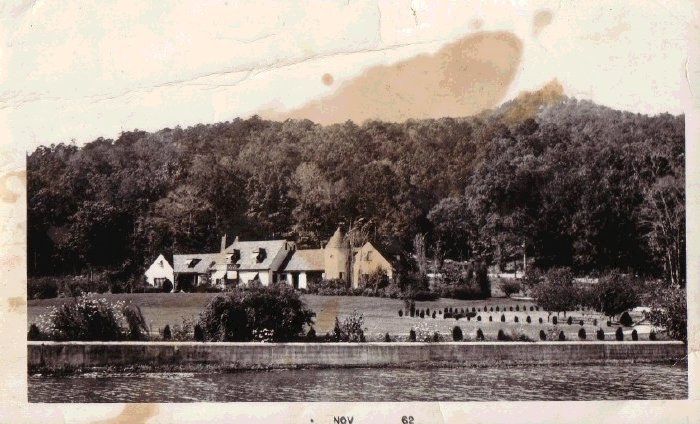
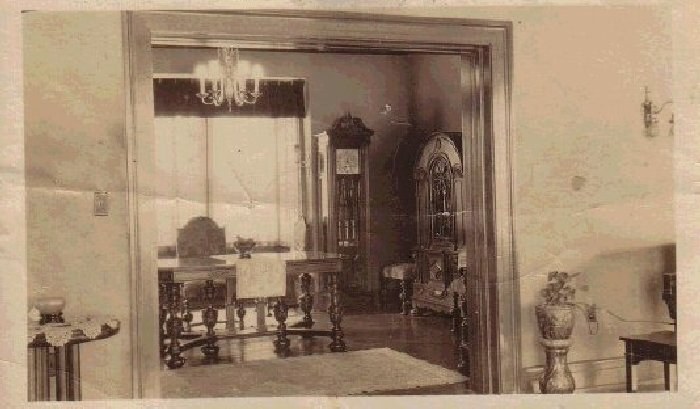
Sherman's philanthropy extended well beyond his business ventures. He gave away acres of land to both the Girl Scout and Boy Scout programs, set up tents on his lawn to shelter people during the Depression, and held punch and ice cream socials to bring the community together. He and Bertha deeded 27 acres along the Little Sequatchie River between Whitwell and Jasper to the Chattanooga area Girl Scout Council, creating Camp Glancy, which operated as a Girl Scout camp from 1929 through 1942. After the Girl Scouts left the property, Bertha Sherman deeded it to the Chattanooga Presbytery of the Cumberland Presbyterian Church, which continues to operate the tract today as a Christian camp and retreat center.
Sherman is buried at Pine Grove Cemetery in Jasper. Bertha Sherman lived until March 21, 1967. The mansion passed through several owners, including Judge Clifford Layne. In 2023, Sequatchie native John Anthony Smith, founder of the Chattanooga cybersecurity firm Conversant Group, returned to Sequatchie with his family to restore the mansion, maintain its grounds, and rally the community around what Smith called "restoring Sequatchie in the spirit of Glancy Sherman." Smith's nonprofit Glancy Community Development, Inc. is organized around the mansion. The Sequatchie Handle Works, Sherman's industrial legacy, was later sold to O.P. Link and subsequently acquired by Seymour (now Seymour-Midwest), which still operates the mill.
The Sequachee Valley News (1891–1952)
Sequatchie was also the publishing seat of one of Marion County's longest-running newspapers. Thomas H. Hill, employed in the syndicate's early years to oversee its valley property, founded the Sequachee News in 1891, renaming it the Sequachee Valley News in July 1896. Accounts differ on where the paper began: Raulston and Livingood record that it was organized and first published at Whitwell before settling at Sequatchie, while other records place it at Sequatchie from the start. Hill and his son William C. Hill ran the paper jointly until the elder Hill's death in 1915; William continued as publisher and editor until his own death in 1952. The paper was published from Sequatchie for most of its run, with brief moves to Whitwell in the spring of 1897 and to South Pittsburg in late 1898 before returning to its valley base. The staunchly Republican weekly was credited with a continuous operation of sixty-one years without missing an issue, and the run is preserved in the Library of Congress's Chronicling America program. The Hill family also held that the valley's name should properly be rendered Sequachee, the older spelling that appeared on the masthead rather than the form that came into use elsewhere.
Big Hill Fire Lookout Tower
On the ridge above the community stands the Big Hill Fire Lookout Tower, a 60-foot steel tower built around 1947 by the Tennessee Division of Forestry as part of the state's mid-20th-century wildfire-detection network. Sited at 2,032 feet of elevation for an all-around view of the surrounding plateau forest, the tower is believed to be an Aeromotor MC-39 model, the workhorse design for many of Tennessee's fire towers, and was permanently staffed during its operating years. It was added to the National Register of Historic Places in 2021, listed with its operator's cabin, utility building, and crew house at 1657 Lower Fire Tower Road. Big Hill is one of three Tennessee fire lookout towers added to the National Register that year and one of only three lookout towers still standing in Marion County, alongside Prentice Cooper and Cave Spring.
Fire department
Fire protection for Sequatchie is provided by the Sequatchie Volunteer Fire Department, a 501(c)(3) nonprofit incorporated in 2003 as the Sequatchie Area Volunteer Fire Association, Inc. The department operates two stations covering central Marion County: its main station at 135 Sequatchie Lane in the community, and a second station at 1735 West Francis Spring Road north toward Whitwell. The department fields about a dozen volunteer firefighters and responds to structure fires, motor-vehicle accidents, and medical calls along the Valley View Highway corridor and back into the coves.
Present day
Sequatchie remains a rural community of scattered homes, farms, and small businesses along Valley View Highway. It functions as a census-designated place and local identity rather than a formal municipality, so it has no mayor, board of aldermen, or municipal police of its own; fire protection runs through the local volunteer department, county sheriff patrols cover law enforcement, and the Marion County school district operates Jasper Middle School and Marion County High School for Sequatchie children. A post office operates at 3670 Valley View Highway, and the community's social life centers on local churches, the farms along Dixon Cove Road, and the broader Valley View Highway corridor. The community sits between the larger towns of Jasper to the south and Whitwell to the north, connected to both by the highway that follows the valley floor.
Landmarks and features
- Little Sequatchie River
- Sequatchie Cove Farm (Dixon Cove Road)
- Sequatchie Post Office, established 1890, 3670 Valley View Highway
- Sequatchie Supply Store (Sherman, 1890; mid-century commercial anchor)
- Glancy Manor / Sherman Mansion (4275 Valley View Highway, 1927)
- Sequatchie Handle Works site (founded 1899; now operated by Seymour-Midwest)
- Sequatchie Volunteer Fire Department, 135 Sequatchie Lane (incorporated 2003)
- Big Hill Fire Lookout Tower, 1657 Lower Fire Tower Road (c. 1947; NRHP-listed 2021)
Related
Coppinger Cove →
The Sequatchie Valley →
Sources
- Wikipedia: Sequatchie, Tennessee
- Wikipedia: Sequatchie County, Tennessee
- Wikipedia: Sequatchie Valley Railroad
- USGS: Little Sequatchie River monitoring station
- Sequatchie Cove Farm
- Sequatchie Cove Creamery: Our Story
- The Cheese Professor: Sequatchie Cove Creamery
- Tennessee Encyclopedia: Marion County
- Wikipedia: NRHP Listings in Marion County, Tennessee
- Chattanoogan: The Difference One Man Can Make: Remembering (And Reviving) The Spirit Of Glancy Sherman (October 3, 2023)
- Chattanoogan: John Anthony Smith To Throw Open Doors at 1st Annual Glancy Harvest Festival (September 7, 2023)
- TNGenWeb Marion County: Glancy Sherman
- TNGenWeb Marion County: Sherman Home
- TNGenWeb Marion County: Sequatchie Supply Store
- Find a Grave: Glancy Sherman (1862-1935), Pine Grove Cemetery, Jasper
- TNGenWeb Marion County: Post Offices (Sequatchie post office, opened 1890)
- SPHPS: Dennis Lambert, pictorial history of the Sequatchie Valley Railroad (depot, bridges)
- Library of Congress Chronicling America: About the Sequachee Valley News (Sequatchie, Tenn.) 1896–1952
- Library of Congress: Sequachee Valley News (Sequatchie, Tenn.) 1896–1952 catalog record
- Library of Congress: The Sequachee News (Sequatchie, Tenn.) 189?–1896
- Bledsoe County TNGenWeb: Sequachee Valley News (historic newspaper)
- J. Leonard Raulston and James W. Livingood, Sequatchie: A Story of the Southern Cumberlands (Knoxville: University of Tennessee Press, 1974), p. 168 (founding of the Sequachee News in 1891, first publication at Whitwell, the Hill family succession, and the sixty-one-year continuous run)
- Community contribution via the Glancy Manor, LLC Facebook page (2026), citing A History of South Pittsburg, TN: The First 100 Years for the Sequatchie Town and Improvement Company, the Sequatchie Cave vineyard of white Niagara grapes, the coal-and-iron operation, and Bertha Sherman's deed of Camp Glancy to the Chattanooga Presbytery of the Cumberland Presbyterian Church
- Wikipedia — NRHP listings in Marion County, Tennessee (Big Hill Fire Lookout Tower, listed June 28, 2021, NRIS #100006708)
- WDEF: Marion Fire Tower Makes National Register of Historic Places (2021)
- FireCARES: Sequatchie Volunteer Fire Department community assessment