Last updated: April 23, 2026
- Type: Town
- Founded: 1890 (as a planned city); incorporated 1962
- 2020 population: 1,545
- Elevation: 676 ft
- Area: 5.31 sq mi
- Named for: Hannibal Ingalls Kimball (1832, 1895), Atlanta entrepreneur
Kimball sits in the Sequatchie Valley between Jasper (about 3 miles northeast) and South Pittsburg (about 5 miles southwest) along U.S. 72. Today it functions as Marion County's primary retail and service hub, anchored by the I-24 / U.S. 72 interchange (Exit 152). But Kimball was not always a commercial center. It began as one of the most ambitious planned-city projects of the 1890s Sequatchie Valley boom, and it failed spectacularly.
Setting
Kimball occupies the lower Sequatchie Valley floor between Jasper and South Pittsburg, with the Cumberland Plateau escarpment climbing sharply to the west and the Tennessee River bending around the eastern edge of the town. The original 1890 plat claimed three miles of river frontage and was modeled on Colorado Springs, a comparison that still fits the wide flat ground and broad sightlines across the valley to the plateau rim. Interstate 24 cuts through the southern end of town, meeting U.S. 72 at Exit 152 to form the commercial crossroads that defines modern Kimball. At 676 feet of elevation, the town sits only a few feet above the neighboring lowland cities of Jasper and South Pittsburg. The name comes from Atlanta entrepreneur Hannibal Ingalls Kimball, builder of the Kimball House hotel; earlier names for the same ground were Ino (by the mid-1880s) and Wallview (from March 1887).
Long before Ino or Wallview, this ground fell within the arc of Indigenous use that reached along the lower Sequatchie and the Tennessee River bend to the south. Archaeological sites at Shellmound, on Battle Creek, and at the river bottoms near South Pittsburg document Archaic, Woodland, and Mississippian occupation (roughly 8000 BC to AD 1600), and the Chickamauga (Lower) Cherokee held this portion of the valley through the late 18th century. Cherokee households took 640-acre reservations nearby on Battle Creek under the Treaty of 1819; the remaining Cherokee community was forcibly removed along the Trail of Tears in 1838. The Cherokee Nation, today a sovereign nation headquartered in Oklahoma, traces ancestry through the families who once lived on this stretch of the valley floor.
Before Kimball: Ino and Wallview (1887, 1889)
The area was originally a farming community called Ino, established around 1887. It was renamed Wallview in March 1887 after Major J. C. Wall, a railroad contractor from Stevenson, Alabama, who became president of the Pine Mountain Coal, Iron, Land, Railroad & Manufacturing Company. The company mined coal and iron ore from the surrounding mountains. In December 1889, the company sold its 64,000-acre Wallview interest for $2.5 million to an English syndicate.
The 1890 "model city" that failed
Two entities split the work: the Anglo-American Corporation, Limited (London) would handle heavy industry, and the Kimball Town Company (American investors) would build the city. The town was named for Hannibal Ingalls Kimball (1832, 1895), a Maine-born entrepreneur who built Atlanta's Kimball House hotel and helped move Georgia's capital from Milledgeville to Atlanta.
Ground was broken on May 24, 1890, with Governor Robert L. Taylor and Professor Edward Hull, Ireland's state geologist, speaking at the ceremony. The plan was modeled on Colorado Springs: wide boulevards, parks, varied lot sizes, Tennessee River frontage, and NC&StL Railway connections. But the venture collapsed, likely in the Panic of 1893. Kimball died in 1895 in Massachusetts, and the company is believed to have filed bankruptcy. The railroad depot closed around 1913 and the post office shut down in 1918.
Reincarnation as a retail town (1960s to present)
Kimball rebounded in the second half of the 20th century as Interstate 24 reshaped southern Marion County. The I-24 / U.S. 72 interchange at Exit 152 made Kimball a natural commercial cluster for the county and for travelers between Chattanooga and Nashville. The town formally incorporated on November 5, 1962, under a General Law Mayor-Aldermanic charter.
Population grew rapidly: from 807 in 1970 to 1,220 by 1980, a gain of more than 50%. Growth continued steadily to 1,545 by the 2020 census. The commercial strip along U.S. 72 now includes a Walmart Supercenter (anchoring the Kimball Crossing shopping center), fast food restaurants, gas stations, hotels, and various retailers serving residents from across the county and the adjacent corners of Alabama and Georgia.
Education
A Chattanooga State Community College satellite campus opened in Kimball in 1993. The Marion County Regional Institute for Higher Education opened on Main Street in 2014, and Polytech Academy at Kimball opened in 2017 as a joint high school and dual-enrollment partnership.
Municipal services and civic life
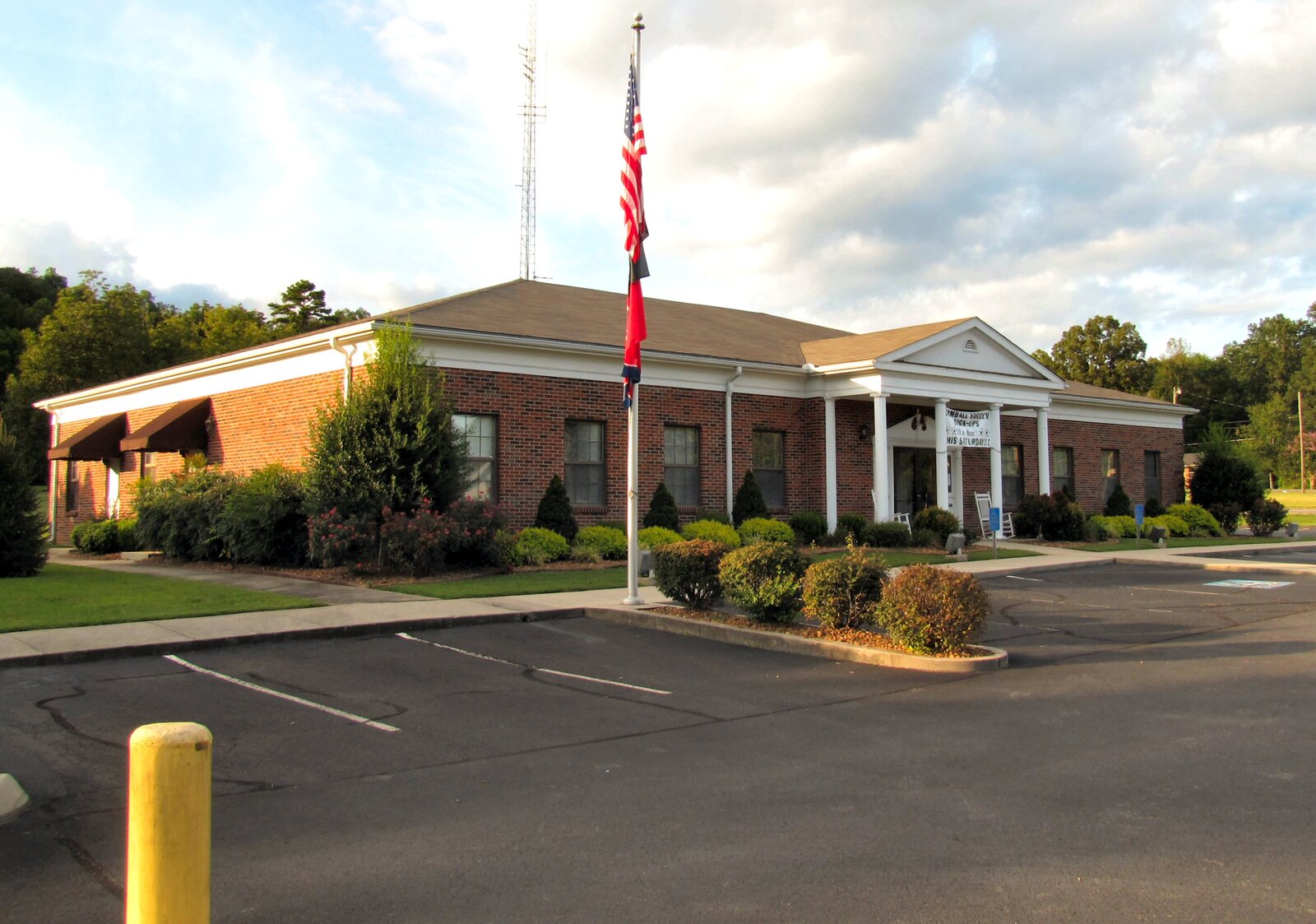
Kimball operates under a General Law Mayor-Aldermanic charter with a mayor and four aldermen, meeting monthly at Town Hall. The Kimball Volunteer Fire Department, an all-volunteer force of roughly twenty firefighters and six auxiliary members, moved into a purpose-built fire and rescue hall at 925 Main Street that opened with a public dedication on August 10, 2001. Before that, the department had operated out of a smaller building on the same corridor. The town also maintains its own police department, overseeing traffic enforcement and commercial-district patrols along the busy U.S. 72 and Kimball Crossing frontages.
Civic life in Kimball is less defined by fraternal lodges or historic downtown clubs than in Jasper, South Pittsburg, or Whitwell, a consequence of the town's late-20th-century commercial reincarnation rather than continuity with the failed 1890 plan. Most community events, such as fall festivals, Christmas tree lightings, and back-to-school drives, operate through the town government, Kimball Elementary School, and churches rather than through civic clubs. The Marion County Chamber of Commerce in Jasper represents Kimball businesses.
Present day
Kimball today is a town of 1,545 (2020 census) and growing. Its identity is commercial rather than historic: unlike Jasper or South Pittsburg, it has few surviving 19th-century buildings. What it offers is convenience. The I-24 interchange and U.S. 72 corridor make it the place where Marion County residents shop, and where travelers stop. On November 14, 2007, an EF2 tornado struck the town, injuring nine people and cutting a two-mile damage path; Kimball Baptist Church, where Wednesday-night services were under way, took heavy roof damage.
Population
| Year | Population |
|---|---|
| 1970 | 807 |
| 1980 | 1,220 |
| 1990 | 1,243 |
| 2000 | 1,312 |
| 2010 | 1,395 |
| 2020 | 1,545 |
Landmarks
- I-24 / U.S. 72 commercial strip and Kimball Crossing shopping center
- Kimball Town Hall
- Chattanooga State satellite campus and Polytech Academy
- Cumberland View Cemetery, with about 3,000 documented memorials on Find a Grave the most-documented cemetery in Marion County, and the burial place of Judge John T. Raulston (1868, 1956), who presided over the 1925 Scopes "Monkey" Trial, and of Master Sergeant Raymond H. Cooley (1916–1947), Medal of Honor recipient who entered service from nearby Richard City
Related
South Pittsburg →
Jasper →
Transportation & railroads →
Town Governments (mayors and boards of Marion County's incorporated towns) →
Wars and military service (Raymond Cooley, Medal of Honor, from Richard City) →
The modern era (I-24 corridor and Kimball's growth) →
Sources
- Wikipedia: Kimball, Tennessee
- Wikipedia: Hannibal Kimball
- Historic South Pittsburg Preservation Society: Kimball
- Historic South Pittsburg Preservation Society: Kimball (Part 2)
- MTAS: Kimball city profile
- Wikipedia: John T. Raulston
- Town of Kimball, Tennessee: official municipal site
- Town of Kimball: Fire Department