Last updated: September 22, 2026
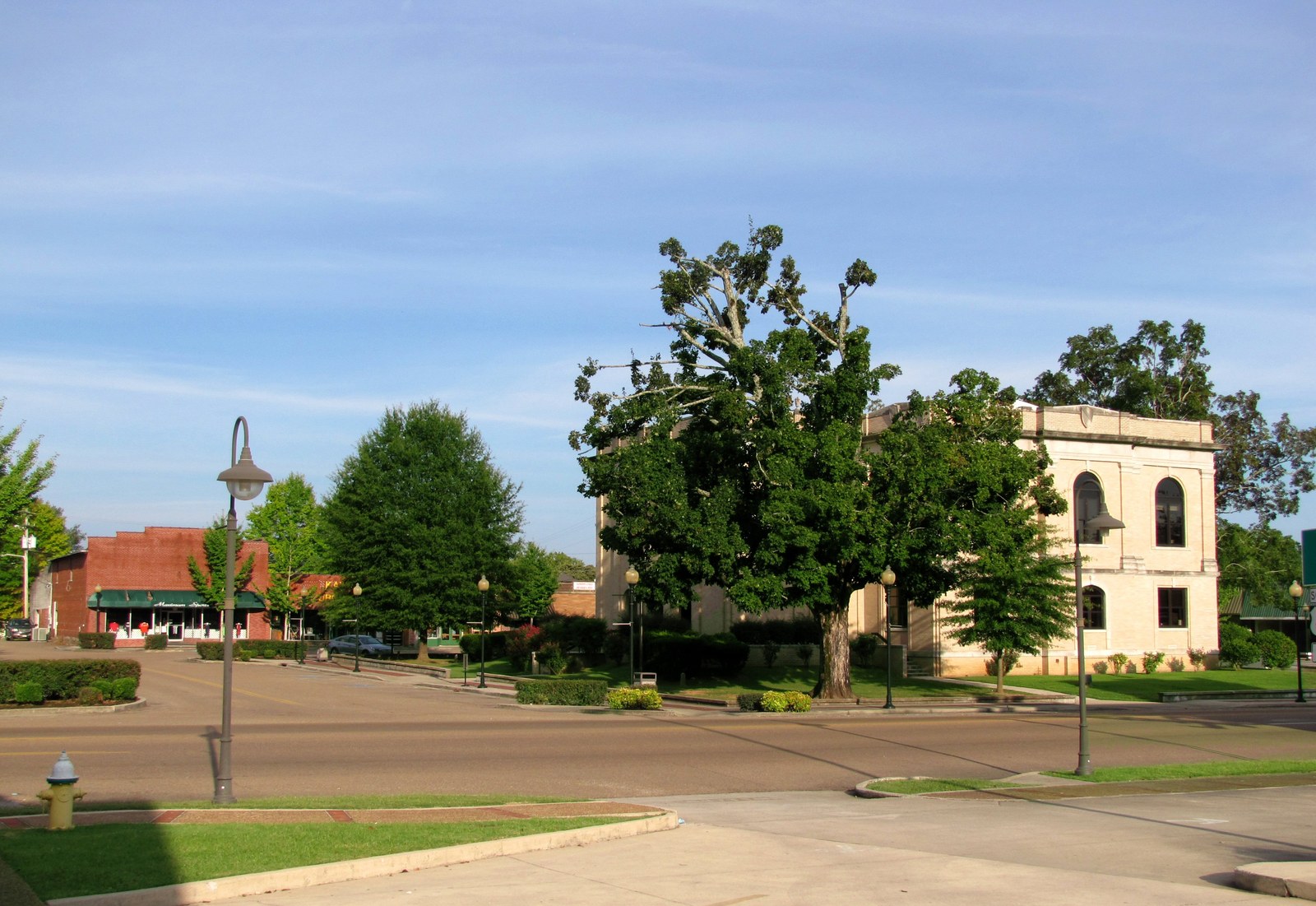
Marion County's governing structure has evolved across three distinct eras. From the county's creation in 1817 through the late 19th century, the quarterly court, a body of elected justices of the peace meeting in quarterly sessions at the courthouse in Jasper, served as both the legislative and administrative arm of county government. By the 1890s, a county judge had emerged as the presiding officer with growing executive authority. Then, in 1978, Tennessee's statewide constitutional reform abolished the county judge, replaced the quarterly court with a formal county commission, and created the office of county executive, later renamed county mayor. That three-part structure, an elected mayor, a fifteen-member commission, and separately elected constitutional officers, governs Marion County today.
The quarterly court era (1817 to the 1890s)
Tennessee counties in their first century operated under the quarterly court system. Voters in each civil district elected justices of the peace (also called magistrates or squires), who met at the county seat four times a year as the "court of pleas and quarter sessions." This body levied taxes, approved road projects, appointed minor officials, and conducted the routine business of county government. The quarterly court had no single chief executive; its presiding officer, the chairman, was elected from among the justices.
Marion County's quarterly court first met in 1817 at the house of John Shropshire in what is now Whitwell, then briefly at Cheekville, before settling at Jasper after the county seat moved there in 1819. The first county officials recorded on the TNGenWeb officials roster for 1820 were Amos Griffith (Register), Jesse Beene (Circuit Court Clerk), James Jones (Sheriff), and John Kelly (Clerk of the Court). These were the constitutional officers who worked alongside the quarterly court; the court itself was composed of the justices of the peace from each civil district, whose individual names do not survive in the available rosters.
Because the quarterly court left few records that survived the 1922 courthouse fire, the early governance of Marion County is documented primarily through the names of the constitutional officers rather than through the deliberations of the court itself. The Tennessee State Library and Archives notes that the earliest surviving county court minutes on microfilm date only to 1842.
The county judge era (1890s to 1978)
By the late 19th century, Tennessee counties had developed a more centralized executive through the office of county judge. The county judge presided over the quarterly court, exercised administrative authority over the county budget and operations, and in some cases also performed judicial duties in county court. The role accumulated power gradually rather than through a single legislative act, and the balance between the county judge and the quarterly court varied from county to county.
The TNGenWeb roster of Marion County officials, compiled by Euline Harris, records the following county judges:
| Year on roster | Name | Title as recorded |
|---|---|---|
| 1892 | William Patton | Judge |
| 1894 | J. G. Kelly | Judge |
| 1902 | Russell Pryor | Judge |
| 1910 | C. T. Williamson | Judge |
| 1917 | L. P. Brewer | Judge |
| 1926 | C. T. Williamson | Judge (returned) |
| 1934 | William Ables | Judge |
| 1938 | L. R. Darr | Judge |
| 1942 | J. V. Barker | Judge |
| 1946 | Vance Barker | County Judge |
| 1950 | J. Vance Barker | County Judge |
Source: Marion County Officials, 1820–1995, RootsWeb / TNGenWeb Marion County (compiled by Euline Harris, posted June 18, 2004).
Several patterns stand out. C. T. Williamson served two nonconsecutive terms (1910 and 1926), spanning the period that included the 1922 courthouse fire and the construction of the current courthouse. J. Vance Barker had the longest documented tenure, holding office from at least 1942 through 1950 under the title "County Judge." The TNGenWeb roster lists no further county judge between Barker's 1950 entry and the 1978 statewide reform that abolished the office.
Party machinery: the county Democratic convention of 1912
One session of the county Democratic party's nominating process is documented in unusual detail. On Saturday, April 27, 1912, the county's Democrats met in convention at the courthouse in Jasper, called to order at one o'clock by W. M. Cameron, chairman of the County Democratic Executive Committee. The convention elected A. L. Roberson chairman and L. R. Darr secretary, both temporary and permanent, and the South Pittsburg Hustler of the following Friday carried the proceedings in full on its front page. Darr would sit as county judge himself in 1938, and C. T. Williamson, twice county judge, sat among the delegates.
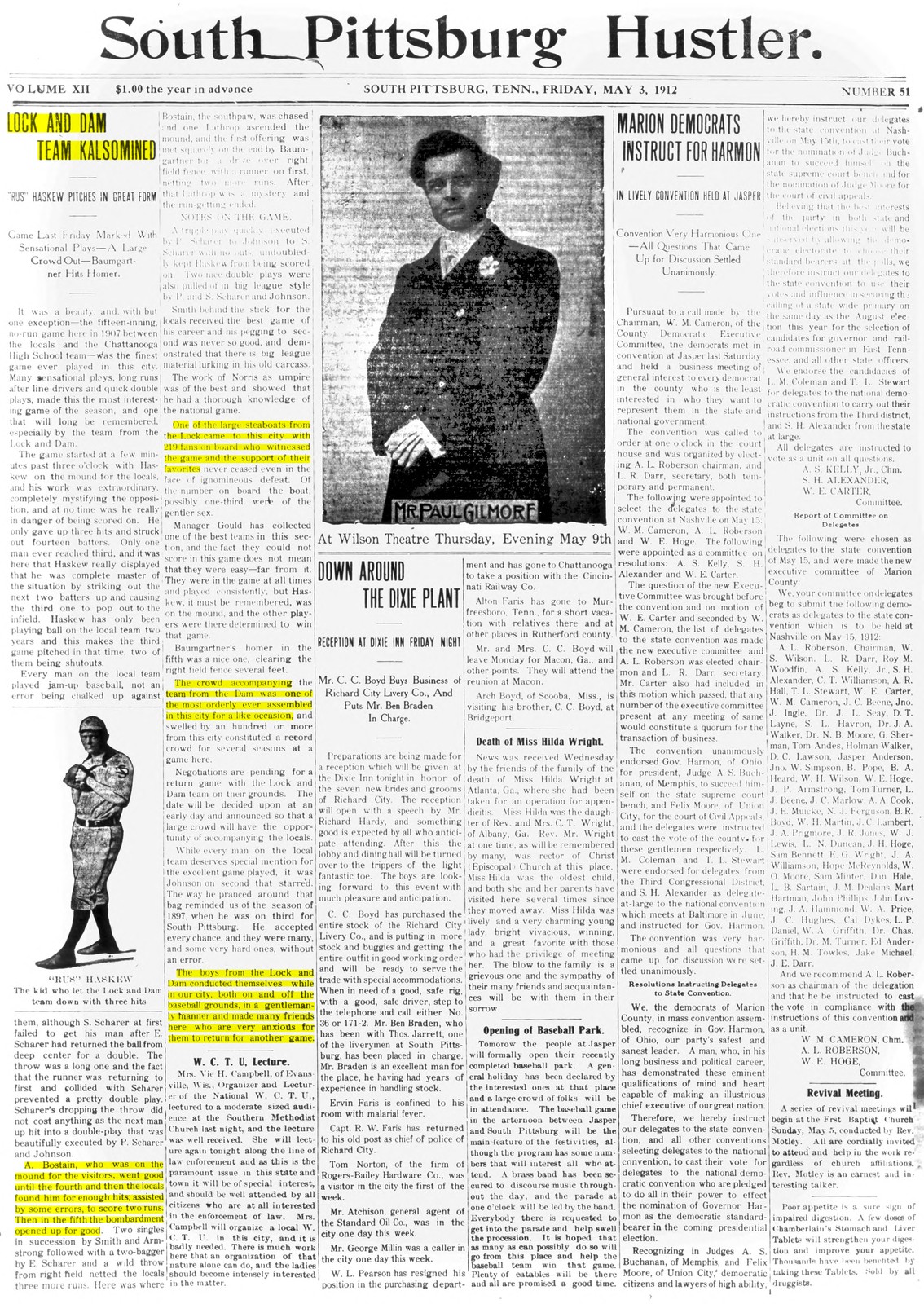
The convention's business was to instruct delegates. It endorsed Gov. Judson Harmon of Ohio for the presidency, calling him the party's safest and sanest leader, and instructed its delegates to the state convention at Nashville on May 15 to vote for national-convention delegates pledged to Harmon. It endorsed Judge A. S. Buchanan of Memphis to succeed himself on the state supreme court and Judge Felix Moore of Union City for the court of civil appeals; it endorsed L. M. Coleman and T. L. Stewart as Third Congressional District delegates and S. H. Alexander as a delegate at large to the national convention; and it instructed its delegation to press for a state-wide primary held the same day as the August election, so that candidates for governor, railroad commissioner, and other state offices would be chosen by a primary rather than by convention. All delegates were instructed to vote as a unit on every question. The resolutions committee was A. S. Kelly Jr., chairman, with S. H. Alexander and W. E. Carter. The paper reported that the convention was very harmonious and that every question that came up for discussion was settled unanimously.
On a motion by Carter, seconded by Cameron, the convention made its delegate list serve simultaneously as the county's new Democratic executive committee, with the added provision that any number of members present at a meeting would constitute a quorum. The sixty-seven men named to that dual role, as printed, were:
A. L. Roberson (chairman), W. S. Wilson, L. R. Darr, Roy M. Woodfin, A. S. Kelly Jr., S. H. Alexander, C. T. Williamson, A. R. Hall, T. L. Stewart, W. E. Carter, W. M. Cameron, J. C. Beene, Jno. J. Ingle, Dr. J. L. Seay, D. T. Layne, S. L. Havron, Dr. J. A. Walker, Dr. N. B. Moore, G. Sherman, Tom Andes, Holman Walker, D. C. Lawson, Jasper Anderson, Jno. W. Simpson, B. Pope, B. A. Heard, W. H. Wilson, W. E. Hoge, J. P. Armstrong, Tom Turner, L. J. Beene, J. C. Marlow, A. A. Cook, J. E. Muicke, N. J. Ferguson, B. R. Boyd, W. H. Martin, J. C. Lambert, J. A. Prigmore, J. R. Jones, W. J. Lewis, L. N. Duncan, J. H. Hoge, Sam Bennett, E. G. Wright, J. A. Williamson, Hope McReynolds, W. O. Moore, Sam Minter, Dan Hale, L. B. Sartain, J. M. Deakins, Mart Hartman, John Phillips, John Loving, J. A. Hammond, W. A. Price, J. C. Hughes, Cal Dykes, L. P. Daniel, W. A. Griffith, Dr. Chas. Griffith, Dr. M. Turner, Ed Anderson, H. M. Towles, Jake Michael, and J. E. Darr.
The instruction for Harmon came to nothing. When the national convention met at the Fifth Regiment Armory in Baltimore from June 25 to July 2, 1912, Harmon took 148 votes on the first ballot against 440 and a quarter for Champ Clark and 324 for Woodrow Wilson, and his support fell away as the balloting went on. Wilson was nominated on the forty-sixth ballot and went on to the presidency. What the Jasper convention does record, durably, is the machinery itself: a county party that met in the courthouse, resolved unanimously, bound its delegates to vote as a bloc, and folded its entire delegation into the committee that would run the party locally for the next cycle.
The 1978 reform: county executive and county commission
On March 7, 1978, Tennessee voters approved a set of constitutional amendments that restructured county government statewide. Chapter 934 of the Public Acts of 1978 abolished the office of county judge, transferred its judicial duties to the general sessions courts, and transferred its administrative duties to a new office: the county executive. At the same time, the old quarterly court was replaced by a formal county legislative body (commonly called the county commission), limited to no more than twenty-five members with no more than three members elected from any single district.
The reform gave Tennessee counties, for the first time, a clear separation between executive, legislative, and judicial functions. The county executive became the chief administrative officer, responsible for the county budget, departmental oversight, and day-to-day operations. The county commission became the legislative body, responsible for appropriations, ordinances, and policy. Separately elected constitutional officers (sheriff, trustee, register, county clerk, assessor of property) retained their independent mandates.
In Marion County, Doug Fitzgerald appears on the TNGenWeb roster as county executive in 1986. Howell Moss succeeded Fitzgerald and served through at least 1995, the last year covered by the roster.
Effective September 1, 2003, the Tennessee General Assembly renamed the office of county executive to county mayor statewide (Tennessee Code § 5-6-101). The change was a title revision, not a substantive restructuring; the duties of the office remained the same.
County mayors (2003 to the present)
| Period | Name | Title |
|---|---|---|
| 1986 | Doug Fitzgerald | County Executive |
| 1990–1995+ | Howell Moss | County Executive |
| 2014–present | David Jackson Jr. | County Mayor |
Sources: Marion County Officials roster (Fitzgerald, Moss); UT County Technical Assistance Service and Marion County Mayor's Office leadership page (Jackson).
Per the Marion County Mayor's Office, David Jackson Jr. is a lifelong Marion County resident, born and raised in Kimball, a 1979 graduate of Marion County High School, and a thirty-four-year veteran of Lodge Manufacturing in South Pittsburg (the last twenty as a supervisor). He began his civic career as a Kimball alderman in 1990, served as vice mayor and then as Mayor of Kimball beginning in 2003, and was elected Marion County mayor in 2014. He serves as the county's chief executive officer, presiding over county operations from the courthouse in Jasper.
The county commission today
Marion County's county commission is a fifteen-member body elected from five districts, with three commissioners per district. The commission meets on the fourth Monday of each month at 6:30 p.m. at the courthouse in Jasper. As the county's legislative body, the commission approves the annual budget, sets the property tax rate, adopts county ordinances, and confirms certain mayoral appointments. Commissioners serve four-year terms.
The five-district, fifteen-member structure is well within the constitutional maximum of twenty-five members and reflects the county's rural character and moderate population (roughly 28,000 as of the 2020 Census). Each district encompasses a geographic cross-section of the county, though the exact district boundaries are redrawn after each decennial census to equalize population.
Constitutional officers
In addition to the county mayor and the county commission, Marion County elects a set of constitutional officers to four-year terms. These positions have existed in some form since the county's creation, and the TNGenWeb roster documents their holders across nearly two centuries:
The Sheriff is the county's chief law enforcement officer. The County Clerk maintains county records and issues licenses. The Circuit Court Clerk serves the circuit and criminal courts. The Register of Deeds records land transactions and other legal instruments. The Trustee collects property taxes and manages county funds. The Assessor of Property determines property values for taxation. The Clerk and Master serves the chancery court.
Several officeholders in the historical record are notable beyond their routine service. E. H. Craven, recorded as Register of Deeds in 1894 with the annotation "(black)" in the TNGenWeb roster, is the only Black county official so identified in the 1820 to 1995 officials list. His service came during Reconstruction's aftermath, when Black officeholding in rural Tennessee was rare and rapidly diminishing under the pressure of Jim Crow.
Women appear in the roster starting in the late 1930s. Minnie V. Ingram served as Trustee in 1938. Bessie Towles became Trustee in 1942 after her husband, C. M. Towles, died in office. Raymond H. Cooley, a World War II Medal of Honor recipient elected Marion County Trustee in 1946, died on March 12, 1947, in a single-car wreck just south of Burl Lee Hill; Agnes Cooley succeeded her husband in the trustee's office for the balance of his term, as recorded in the contemporary press coverage preserved on the SPHPS legacy site. Annie Lee Beene served as Clerk and Master beginning in 1955 and again in 1974. Mary Faye Payne became Circuit Court Clerk in 1986. Several of the earliest women on the roster reached office through the death of an incumbent husband, a common path to women's officeholding in mid-20th-century Tennessee; by the 1980s, women were winning constitutional offices in their own right.
The Marion County Election Commission
The Marion County Election Commission oversees voter registration, polling-site coordination, early and absentee voting, and election-day operations. The commission is a bipartisan five-member board appointed every odd year on the first Monday in April by the Tennessee State Election Commission, with three members from the majority party and two from the minority party in the Tennessee House of Representatives. The commission meets on the third Thursday of each month at 5:30 p.m. at 109 Academy Street in Jasper.
Tennessee does not register voters by party affiliation. In recent presidential elections, Marion County has voted decisively for Republican candidates, with the Republican share growing from 70.9 percent in 2016 to 77.4 percent in 2024. For detailed presidential election returns, see the Elections section on the Demographics page.
Related pages
- The Marion County Courthouse – where county government has met since 1820
- The Marion County Sheriff – the law enforcement arm of county government
- Town Governments – mayors and boards of Jasper, South Pittsburg, Whitwell, Kimball, New Hope, and Monteagle
- County Formation (1817) – the creation of the county and its first officials
- Jasper – the county seat
- Elections (Demographics) – presidential election returns and voter data
- Civic and Government (Demographics) – county government structure overview
Sources
- South Pittsburg Hustler, Volume XII, Number 51, Friday, May 3, 1912, page 1 — “Marion Democrats Instruct for Harmon,” with the resolutions, the committee reports, and the full sixty-seven-name delegate roster. Community contribution, courtesy of Ronnie Bostain
- Wikipedia — 1912 Democratic National Convention (Baltimore, June 25 to July 2, 1912; Harmon’s 148 first-ballot votes and Wilson’s nomination on the forty-sixth ballot)
- Marion County Officials, 1820–1995 – RootsWeb / TNGenWeb Marion County (compiled by Euline Harris, posted June 18, 2004)
- Article VII, Section 1: Elected Officials and Governmental Form – UT County Technical Assistance Service
- County Government under the Tennessee Constitution – UT County Technical Assistance Service
- County Mayor: David Jackson Jr. – UT County Technical Assistance Service
- Tennessee Code § 5-6-101: County Mayor title and term – Justia
- Leadership – Marion County Mayor's Office (David Jackson Jr. biography)
- County and Municipal Officials – Marion County TN Election Commission
- Raymond H. Cooley obituary (March 1947) – South Pittsburg Historic Preservation Society (legacy site)
- Marion County – Tennessee Encyclopedia
- Genealogical Fact Sheets: Marion County – TN Secretary of State / State Library and Archives
- Marion County, Tennessee – Wikipedia