Last updated: June 2, 2026
- Type: City
- Incorporated: 1887
- 2020 population: 3,106
- Elevation: ~630 ft (lowest incorporated city in East Tennessee)
- Area: 5.9 sq mi
- Named for: Pittsburgh, Pennsylvania
South Pittsburg sits on the Tennessee River at the southwestern edge of Marion County, roughly 25 miles west of Chattanooga. Unlike most communities in the county, it was not a natural agricultural settlement but a planned industrial city, organized in the 1870s and 1880s by investors who sought to replicate Pittsburgh's iron economy in the Sequatchie Valley. It is today best known as the home of Lodge Cast Iron and the annual National Cornbread Festival.
Setting
South Pittsburg occupies a narrow stretch of river bottomland between the Cumberland Plateau to the west and the Tennessee River to the east, bounded by Whitacre Point to the north and Lodge Point to the south. At roughly 630 feet above sea level, it is the lowest incorporated city in East Tennessee, and the valley here is tight: the plateau wall rises within a few blocks of downtown, with Battle Creek cutting down through it to join the river at the town's northern edge. The Shelby Rhinehart Bridge carries State Route 156 east across the Tennessee to New Hope, and U.S. Route 72 runs the length of the city and continues south toward Alabama. The name was chosen in 1876 by British-backed industrialists who hoped the town would become a great iron-manufacturing center to rival Pittsburgh, Pennsylvania; the earlier post-office name was Battle Creek Mines.
The river bottoms where the city now stands carried Indigenous use for thousands of years. Archaeological sites at the mouth of Battle Creek and along the nearby Tennessee River document Archaic, Woodland, and Mississippian occupation spanning roughly 8000 BC to AD 1600, and the Mississippian mound tradition at Shellmound upstream extended its agricultural world down to this stretch of the river. By the late 18th century the ground was part of the Chickamauga (Lower) Cherokee homeland, with Battle Creek a corridor used by Cherokee households moving between the plateau and the river. Under the Treaty of 1819 Cherokee families took 640-acre reservations on Battle Creek; the remaining Cherokee community was forcibly removed along the Trail of Tears in 1838, four decades before the iron speculators renamed the post office. The Cherokee Nation continues today as a sovereign nation headquartered in Oklahoma.
Before the city: Battle Creek and the Civil War
The area that became South Pittsburg was sparsely settled before the Civil War, with a few river landings and farmsteads along Battle Creek and the Tennessee River. During the war, the strategic value of the river crossings made this ground contested territory. In the summer of 1862, Federal divisions under Maj. Gen. Alexander McD. McCook and Maj. Gen. Thomas L. Crittenden built Fort McCook, an earthen redoubt near the confluence of Battle Creek and the Tennessee, named for the senior Federal commander on the bluff. By late August the position had been thinned out, with most of the Federal force pulled back to the Cumberland Plateau and Col. Leonard A. Harris of the 2nd Ohio Infantry left in charge of two regiments and a small cavalry detachment. On August 27, 1862, Confederate Brig. Gen. Samuel B. Maxey, with the 32nd Alabama under Col. Alexander McKinstry, Capt. Rice's cavalry, and two batteries plus a 24-pounder siege gun, crossed at Bridgeport and shelled the fort from the east bank for twelve hours. Harris withdrew that night through a mountain path. The Confederates briefly held the work as Fort Maxey before moving up the Sequatchie Valley to join Bragg's Kentucky offensive.
A year later, in early September 1863, Brig. Gen. John M. Brannan's division of the XIV Army Corps reoccupied the same earthwork as Fort Thomas, named for corps commander Maj. Gen. George H. Thomas. With no pontoon train assigned, Brannan's men built a bridge across Battle Creek and rafts of scrap lumber to ferry the division across the Tennessee, completing the crossing on September 2, 1863, on the way to the Chickamauga Campaign. The Fort McCook site is now part of South Pittsburg River Park off U.S. 72 on Jaycee Drive, marked since 2008 by an interpretive marker on the Chickamauga Campaign Heritage Trail. Read the detailed Fort McCook page →
Industrial origins (1869, 1887)
In 1869, a post office opened under the name Battle Creek Mines, serving the resumed coal operations on the lower creek. The original Battle Creek mines, opened in 1854 as Tennessee's fifth coal operation, had been shut down by the Civil War, and a new mine was opened on the plateau near Whitacre Point in 1868 as the Jasper Branch Railroad was completed. Woods Wilson was the first postmaster at Battle Creek Mines, which opened on August 10, 1869, and is the institutional predecessor of the present-day South Pittsburg post office. More on the Battle Creek Mines, the institutional ancestor of South Pittsburg →
In 1873, a group of English iron-trade investors organized a London-chartered syndicate called the Southern States Coal, Iron and Land Company, Limited with the goal of buying combined coal-and-iron land in the United States. The syndicate's principals were the Welsh metallurgist Thomas Whitwell, the English iron master James Bowron Sr. (1816–1877), the firebrick manufacturer Joseph Cliffe, and a Quaker banker named Mr. Pike. After two earlier U.S. land deals had failed for lack of the right combination of minerals, Bowron Sr. was sent overseas in 1873 to find a property containing coal and iron in close proximity. Two years of survey work in nearly every state in the Union ended in 1875 with three Marion County purchases: a tract of coking coal in the Cumberland Plateau wall, a valley tract of red iron ore, and a third valley tract of brown ore suitable for charcoal furnaces. The same syndicate's Sequatchie Valley purchases also founded Whitwell, named for Thomas Whitwell, and Victoria, named for the reigning British monarch.
On May 23, 1876, the Battle Creek Mines post office reopened under the new name South Pittsburg, chosen to mirror the Pennsylvania iron city the syndicate hoped to rival. Richard Clark was the first postmaster of record. A few members of the syndicate, later remembered locally as the “Old English Company,” built permanent residences near the foot of the plateau. Streets and avenues were graded and platted; blast furnaces went under construction near the mouth of Battle Creek. Then the project lost its leadership in quick succession. Bowron Sr. died in New York in November 1877 and his son James Bowron Jr. (1844–1928) took over as general manager; Whitwell was killed in a mine explosion in 1878; Cliffe and Pike both died in the same period. The syndicate carried on in name but had no driving force, and for nearly four years South Pittsburg consisted of a single hotel called the Read House, a few houses, and many vacant lots overgrown with vegetation.
In 1882, the dormant English company was consolidated into the Tennessee Coal, Iron and Railroad Company (TCI), which placed the land in American hands. TCI's new manager, Thomas A. Graham, built a row of workers' houses on Holly Avenue between Third and Fourth Streets known as “Graham Row,” and chartered the short-lived South Pittsburg College. Most of the rest of the town site, however, was let go: streets washed into gullies, and curbstones fell into the roadbeds where the supporting earth had eroded away.
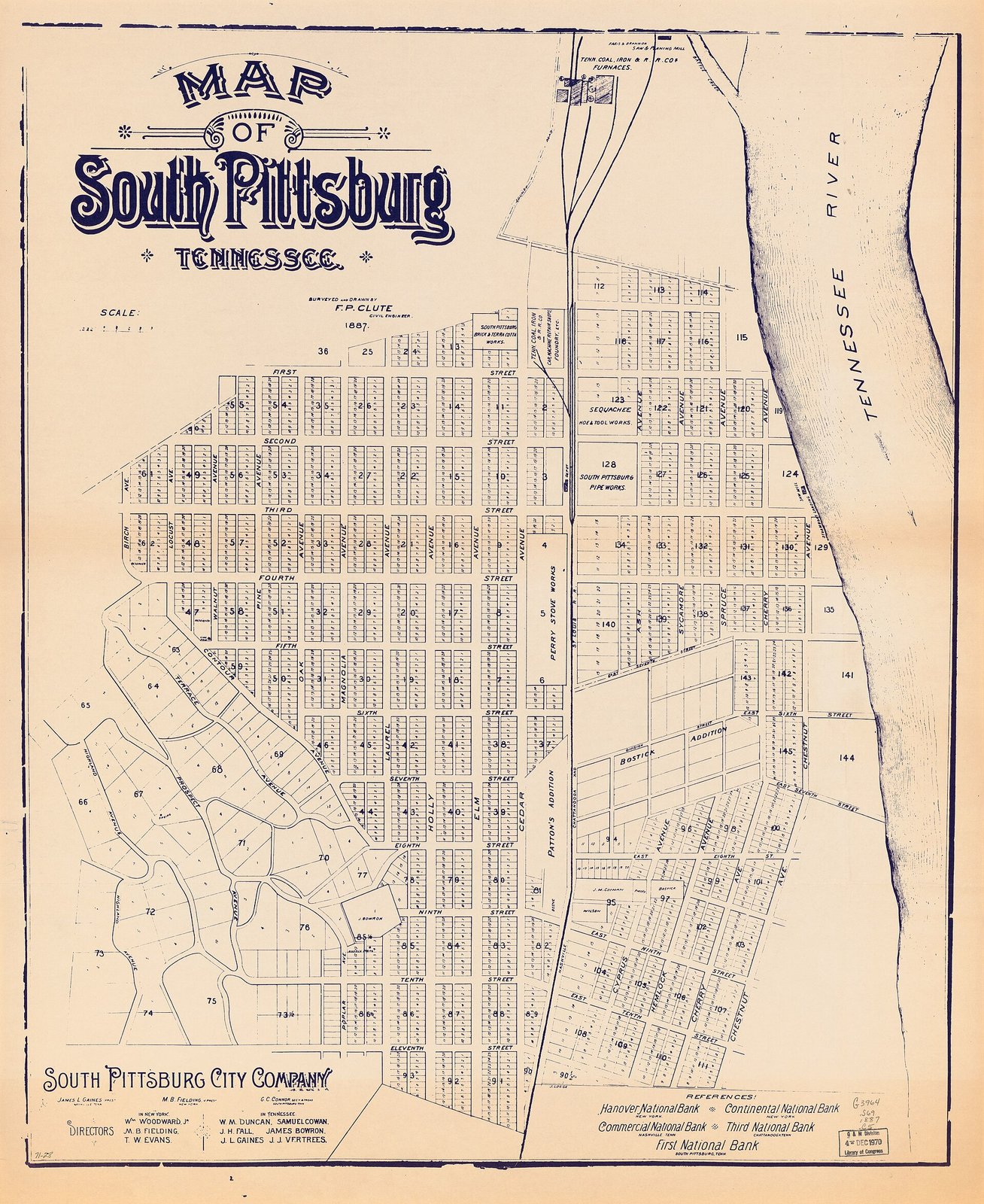
The relaunch came in 1886, when Nashville banker William M. Duncan bought the South Pittsburg town site from TCI to revive the project. In December 1886 he organized the South Pittsburg City Company, which in turn purchased the 3,000-acre town site together with a contiguous 700-acre tract from Dr. Joe Bostick. On November 19, 1886, the new company hosted representatives of Harper's Weekly at a large gourmet dinner at its newly built City Inn; Harper's was preparing a supplemental edition on cities of the “new south” that ran in 1887. By May 1887 the twenty-room Marion Hotel had been completed in anticipation of a well-advertised land auction held on May 10 and 11, 1887, and F. P. Clute had platted the block-and-lot grid that still defines downtown South Pittsburg. A new water system pumped through iron pipes at 80 pounds per square inch for daily use and 200 PSI for fire suppression, fed by a reservoir trapping streams off the mountain.
The City Company's promotional pamphlet titled South Pittsburg, Tennessee circulated nationwide in early 1887. By the May land sale the company's assets included two hotels, an unfinished National Bank building, four large two-story residences, a twenty-four-unit two-story tenement block, sixty one-story tenements, four miles of water pipe, an operating coal mine, a school building, and a post office. South Pittsburg incorporated in November 1887, and John G. Kelly was elected as its first mayor; the new government's first business was to bring electricity and telephone service to the town. The growth of the city between 1887 and 1890 was the fastest in the Sequatchie Valley until it was overshadowed in 1888 by an even larger speculative boom across the river at Bridgeport, Alabama, which became known as the “New York of the South.” The two communities, each promoting itself as a southern industrial capital in miniature, were referred to in the local press as the Twin Cities.
Growth in the 1890s was rapid. Foundries, smelters, and rail infrastructure anchored the economy. The Nashville, Chattanooga & St. Louis Railway (NC&StL) served the town, connecting it to the broader southern rail network. By 1888 the railroad had outgrown its existing depot and built a new Queen-Anne style passenger station beside the south half of block #6 next to the Perry Stove Works; Jones C. Beene was the agent at the new depot. The population grew from 1,045 in 1880 to 1,479 by 1890. Records released by the NC&StL for the first eight months of 1899 alone show $143,997.93 in freight receipts out of South Pittsburg, an estimated 4,042 rail cars or roughly 162 trains of twenty-five cars each, what one local writer described as “one continuous train of thirty-one miles in length.”
The Old English Company and the contour lots
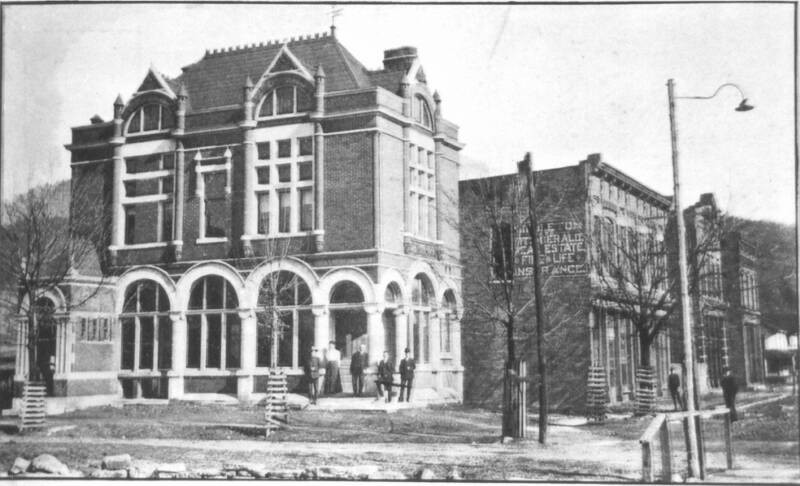
The first houses built at South Pittsburg did not follow the rigid block-and-lot grid that F. P. Clute later platted across the valley floor. According to Dennis Lambert's South Pittsburg Historic Preservation Society history of the town's founding, several members of the British syndicate, the men later remembered locally as the “Old English Company,” chose a string of “contour lots” near the base of the mountain that rises west of downtown and built their permanent residences there. The name described the lots themselves: instead of squaring to the surveyor's grid, they were laid out to follow the natural contour of the lower plateau face, where the graded streets ran up into the rising slope. These were the homes of the iron men who expected South Pittsburg to become a second Pittsburgh, occupied before the furnaces at the mouth of Battle Creek had proven out and before the 1887 land auction filled in the valley-floor grid that Clute platted for the City Company, reproduced in the lithographed map above.
South Pittsburg College
During the brief window from 1882 to 1886 when the Tennessee Coal, Iron and Railroad Company held the town site, the company chartered the South Pittsburg College as a non-profit institution, in Lambert's words “to confer degrees and instruction in the higher branches of education.” The venture was short-lived. When TCI let most of the town site lapse and the project passed to William M. Duncan's South Pittsburg City Company in 1886, the college stopped operating, but its building was put back to use as an early public school and became a forerunner of South Pittsburg's modern school system. The college thus sits at the head of the line that runs through the town's later graded schools to present-day South Pittsburg High School, and it is recorded among the county's vanished institutions on the historical schools roster.
Stove foundries and heavy industry (1886, 1920s)
South Pittsburg's industrial base expanded beyond iron smelting into stove and hollowware manufacturing. The Perry Stove Company opened a South Pittsburg foundry in mid-1887 as a southern branch of John S. Perry's Albany, New York operation, then the largest stove founder in the United States. The South Pittsburg plant occupied the entirety of block #5 and more than half of blocks #4 and #6, employing some 500 workers from the outset. Fire destroyed the plant in 1888; the company rebuilt on the same site in brick the following year. Between 1891 and the early 1900s the operation was variously known as the Harvest Stove Works before passing to the H. Wetter Manufacturing Company; after a fire destroyed Wetter's Memphis plant in January 1902, Wetter bought the South Pittsburg facility outright. By the 1920s Wetter was the town's largest employer, employing several hundred workers. Local 165 of the International Molders Union of North America at South Pittsburg was the largest and oldest local of the union in the entire South. An eight-year labor dispute over the union shop versus the open shop culminated in the 1927 Christmas Night Shootout on Cedar Avenue, in which six law-enforcement officers were killed, including Marion County Sheriff Wash Coppinger. (See the dedicated 1927 Christmas Night Shootout page for the full account.) H. Wetter was forced to close the South Pittsburg plant in 1929; the operation reorganized in 1930 under local ownership as the United States Stove Company, which operated on the original Cedar Avenue site for decades; the vacant building was razed in spring 2003. United States Stove continues to manufacture wood and pellet stoves at a successor plant on Industrial Park Road.
Around the Perry / Wetter complex the city assembled an unusually dense industrial cluster for a town of its size. By the end of 1887 the surveyed industries on the South Pittsburg plat already included the South Pittsburg Pipe Works, the Sequachee Hoe and Tool Works, the South Pittsburg Brick and Terra Cotta Company, the South Pittsburg Railroad, Coal and Iron Company, two saw and planing mills, and a combined gristmill and cotton gin. TCI ran two 100-ton blast furnaces near the mouth of Battle Creek, with at least one in operation by 1882, and a sad-iron foundry on block #1 producing two tons of polished articles per day. Through the 1890s the roster grew to include the Eagle Pencil Company, the Schuster Foundry, the Blacklock Foundry (the predecessor of Lodge Manufacturing), the DeBleiux and John J. Ingles & Company bottling works, the Oxley Stave Company, and the South Pittsburg Milling Company. The mountainside coal mines below Whitacre Point and below Lodge Point near Midway, between downtown and the Alabama state line, used state-leased convict labor as early as 1887, following the same pattern as the Inman mines farther up the valley before the system was abandoned in favor of paid labor. The first decade of the twentieth century brought the largest setback in the city's industrial history: when TCI consolidated its core operations in the Birmingham, Alabama district, where coking coal, iron ore, and limestone lay close together, hundreds of foundry jobs disappeared from South Pittsburg in a single decision, retail trade contracted, and the city's pre-1900 momentum was permanently broken.
Cedar Avenue commercial life
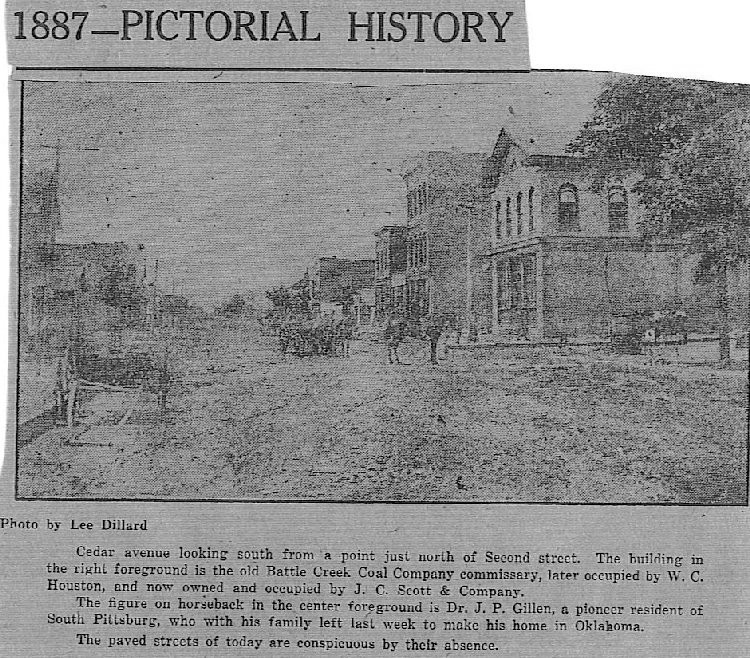
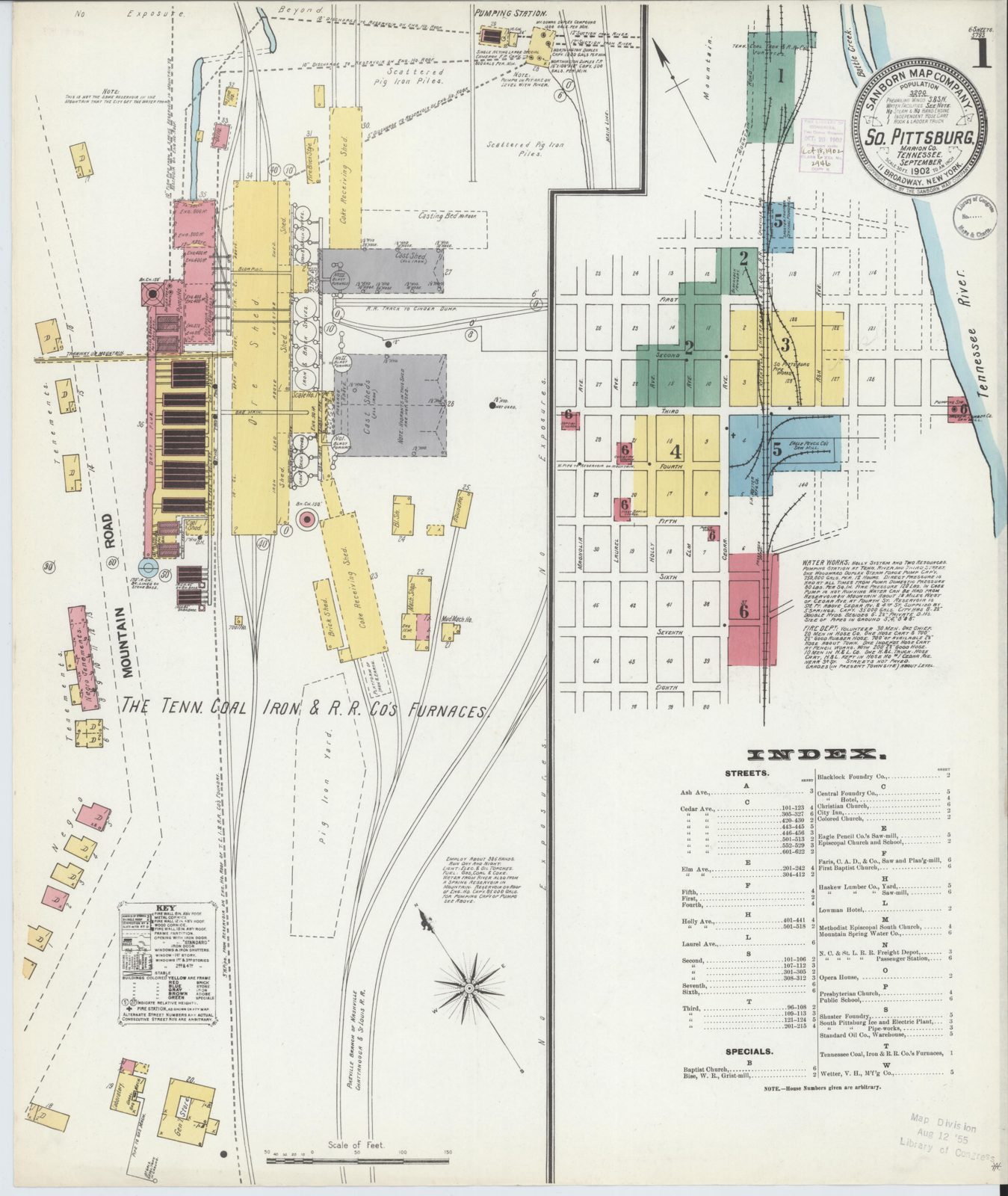
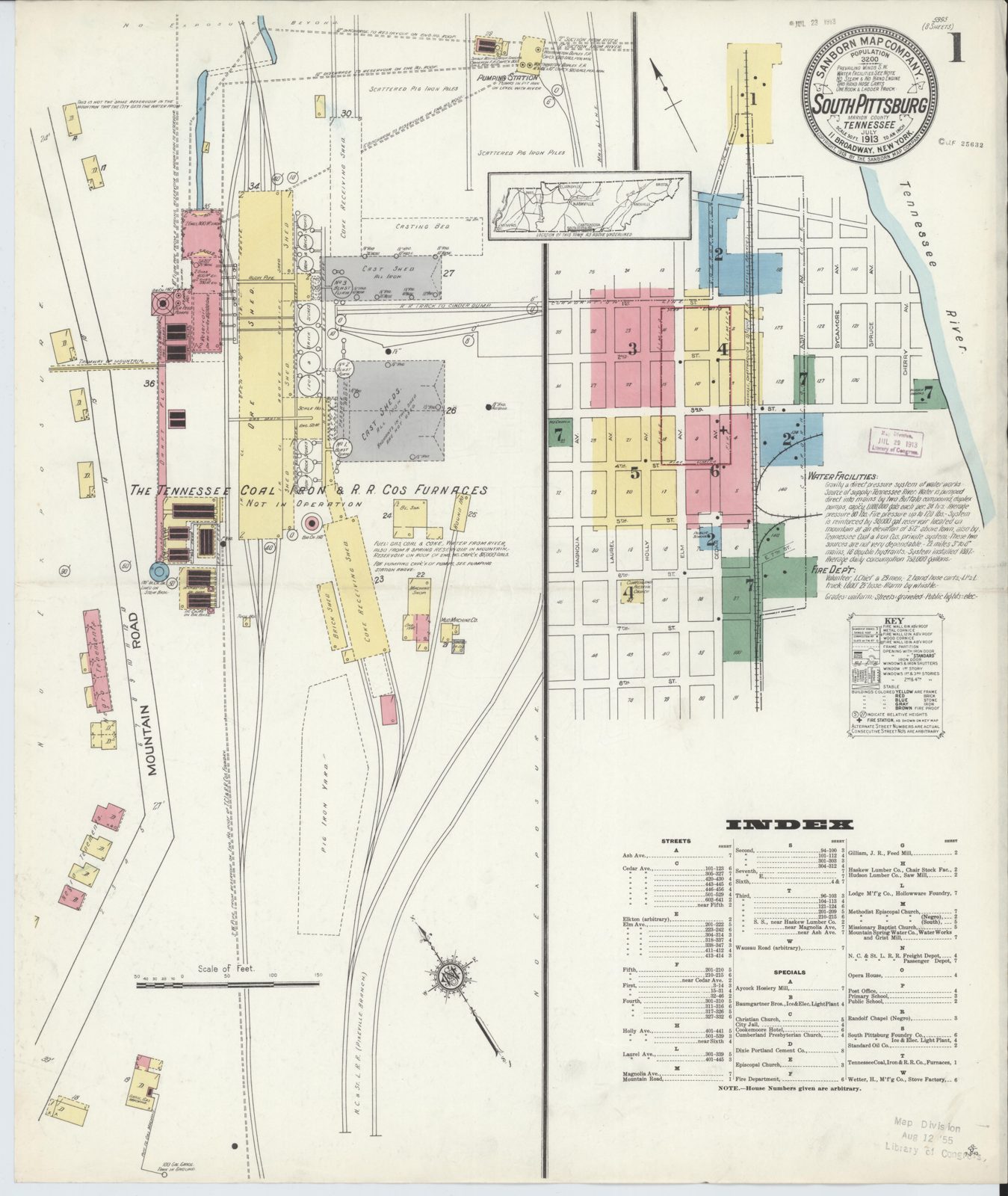
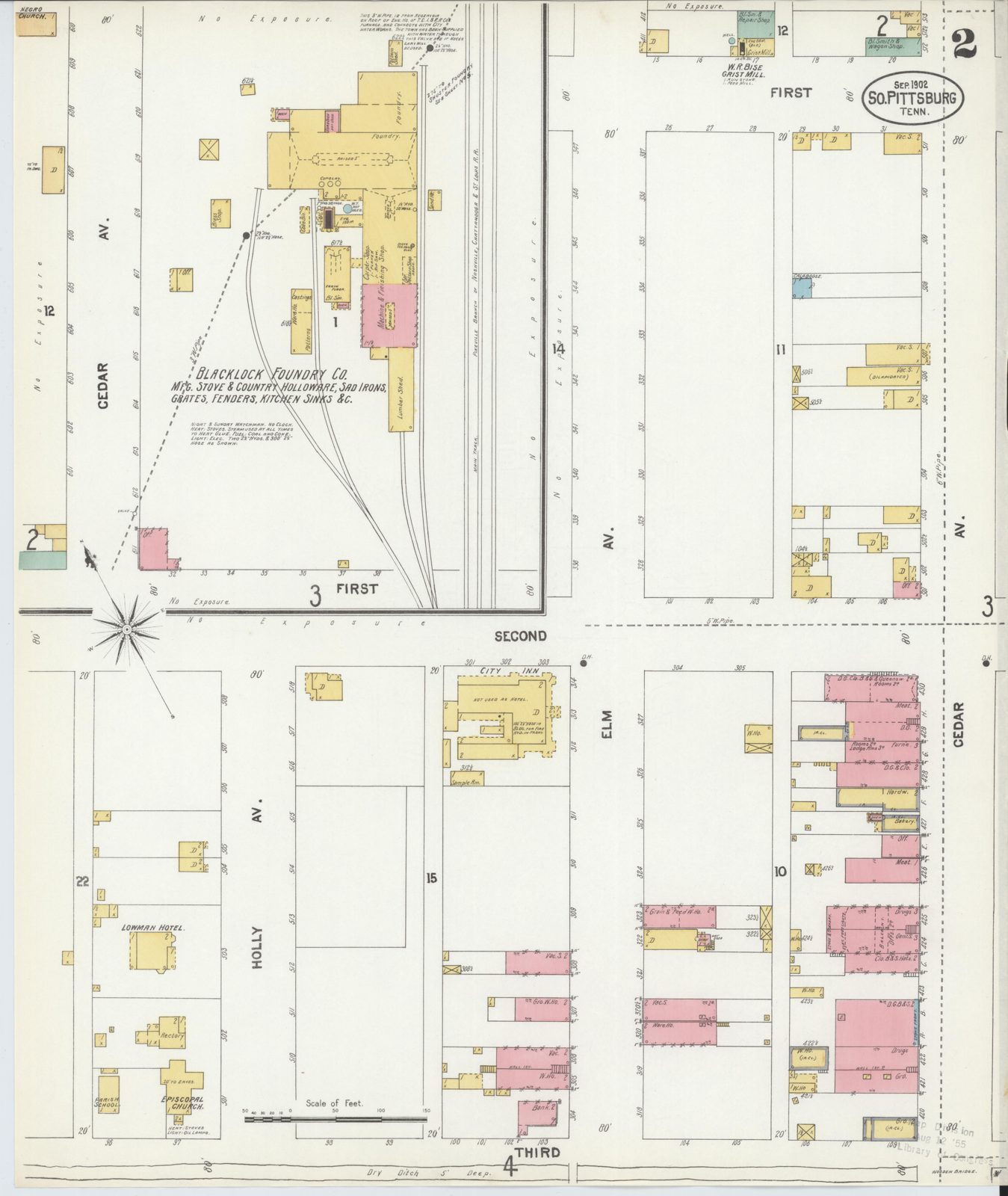
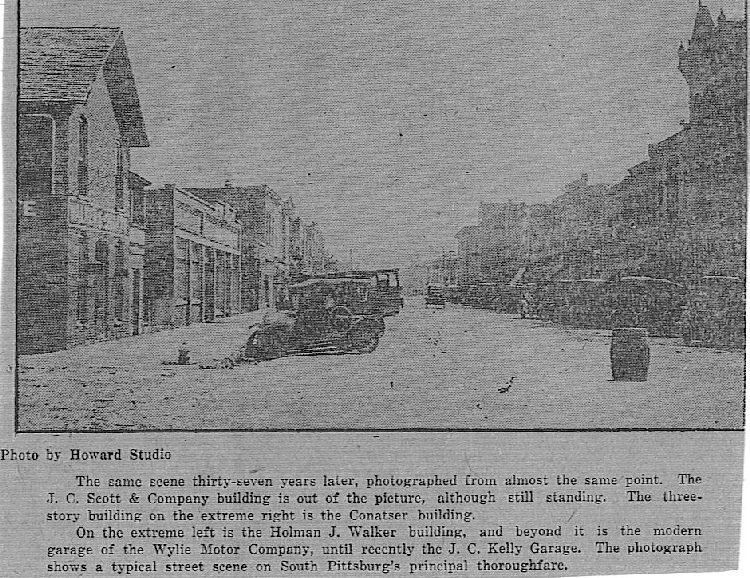
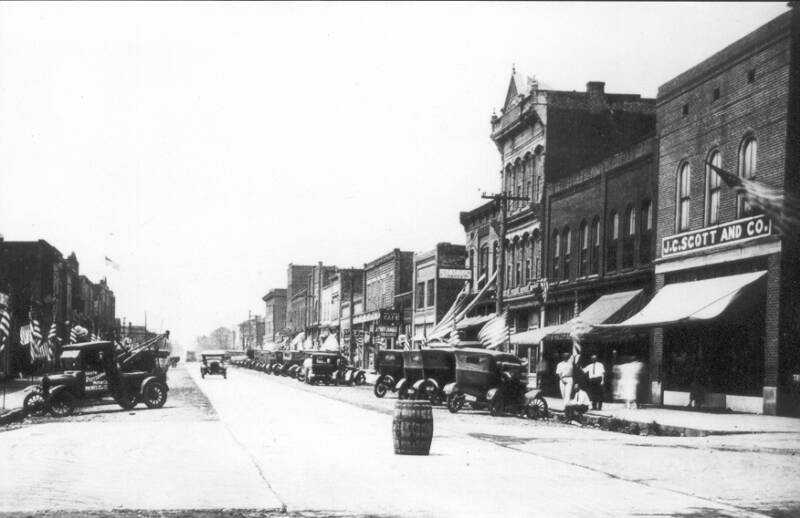
Cedar Avenue grew into the city's commercial spine almost as quickly as the foundries went up, and it has carried that role from the 1880s to the present. Period photographs preserved in the RootsWeb / TNGenWeb Marion County journal scrapbook track the street across nearly eight decades: an 1887 view looking south down an unpaved Cedar Avenue lined with its first commercial buildings, a settled 1924 streetscape of two- and three-story brick storefronts, a c. 1928 view with the J. C. Scott and Co. store and American flags strung overhead, and a paired 1900-and-1965 comparison showing how little the building line itself changed as the proprietors turned over. The same downtown core appears in fine detail on the Sanborn fire-insurance maps surveyed in 1902, 1907, and 1913, which record the avenue block by block and building by building, down to construction material and use.
Hotels and boarding houses lined the street to serve traveling iron buyers, commercial drummers, and the railroad. The City Inn (1886) was the site of the Harper's Weekly dinner that introduced the town to a national readership, and the twenty-room Marion Hotel went up in 1887 for the land auction. At the corner of Cedar Avenue and Third Street stood the hotel later known as the Robert E. Lee Hotel; per the South Pittsburg Historic Preservation Society's buildings inventory, it began as the Cameron-Patton Hotel and was raised on the site of the older Central Hotel, which was rolled to the back of the lot and built into the new structure rather than torn down; the old section burned in the early 1990s. The original three-story Opera House stood on Cedar Avenue and was the first home of the South Pittsburg Hustler, the city's weekly newspaper of record; it burned in 1907 and was replaced the following year by a smaller Opera House on the same block.
Drug stores, liveries, and dry-goods houses filled in the rest of the commercial frontage. The RootsWeb journal scrapbook preserves photographs of the Sartain Drug Store, the business of Luther Sartain and John Bowers, and of the Humble Livery, the kind of stable-and-hack business that every railroad town of the period supported. Williamson's Pharmacy stood on the Cedar Avenue block near Third Street where the 1927 Christmas Night Shootout unfolded between the Robert E. Lee Hotel and the pharmacy; the contemporary South Pittsburg Hustler account of January 5, 1928 opens with the sacred cantata at the Cumberland Presbyterian Church on Christmas night fading into the first volley of gunfire, a juxtaposition that fixed the event in local memory.
The downtown commercial core spilled one block over onto Elm Avenue as well. The First National Bank, built in 1887 at the corner of Elm Avenue and Third Street one block off Cedar, is a Romanesque Revival landmark that still stands as South Pittsburg City Hall and was added to the National Register of Historic Places in 1991. The Coca-Cola franchise opened its first South Pittsburg bottling plant on Elm Avenue in February 1914, on the site now occupied by the Beene-Pearson Library; needing more room for its machinery, the bottler moved to a purpose-built plant on Cedar Avenue between Fourth and Fifth Streets in July 1940 and ran it there until 1966. The South Pittsburg Hustler, founded in the 1890s, is still publishing more than a century later as the city's weekly newspaper, and the South Pittsburg Historic Preservation Society has reissued its 1899 edition as a fundraiser for restoration work.
That commercial fabric remains the focus of present-day revitalization. In December 2025 the State of Tennessee awarded South Pittsburg a $500,000 Downtown Improvement Grant, its share of $4.3 million in Rural Economic Opportunity funding spread among sixteen Tennessee Main Street and Downtowns communities, to be spent on building facades, wayfinding signage, gateways, and streetscapes, with recipients matching a quarter of the funds. The avenue has also turned toward the arts: Arts in the Burg, a nonprofit program of South Pittsburg Area Revitalization Quest (SPARQ) at 207 South Cedar Avenue, runs public studio space and arts programming meant to make the historic downtown a travel destination.
The Post Office (1934, 1935)
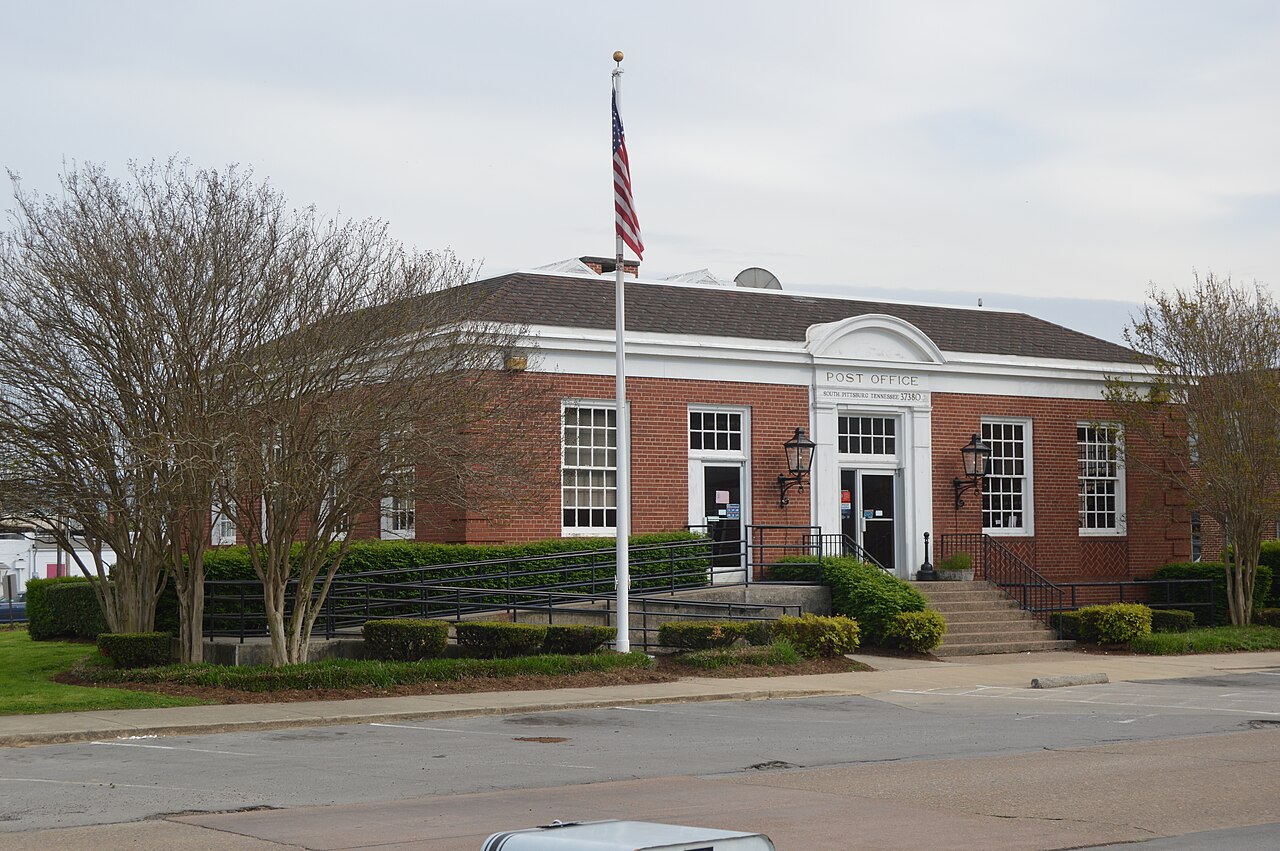
Marion County's congressman, Sam D. McReynolds, secured Congressional authorization in October 1932 for a new $75,000 federal post office at South Pittsburg. After Depression-era budget cuts, the appropriation fell to roughly $40,100. Bids opened in Washington on April 25, 1934, and were won by the Hiram L. Lloyd Building and Construction Company of St. Louis at $32,800 for a fire-proof structure; Emil C. Seiz, Jr. served as construction engineer and G. W. Stone as superintendent of architecture. Ground was broken at the corner of Elm Avenue and Third Street on Friday, July 13, 1934. The building opened informally on April 1, 1935 and was formally dedicated at 2 p.m. on Saturday, April 27, 1935, with McReynolds as keynote speaker, Reverend H. C. Salmond of Christ Church Episcopal giving the invocation, and Dr. W. S. Neighbors of the South Pittsburg Methodist Episcopal Church-South delivering the benediction. Mayor R. C. Aycock, postmaster Lois McReynolds, Judge William M. Ables, and Post Office Department inspector W. B. Wooten of Washington also spoke; the Post Office Band of Chattanooga provided music. The post office still operates from the same building.
Lodge Cast Iron (1896 to present)
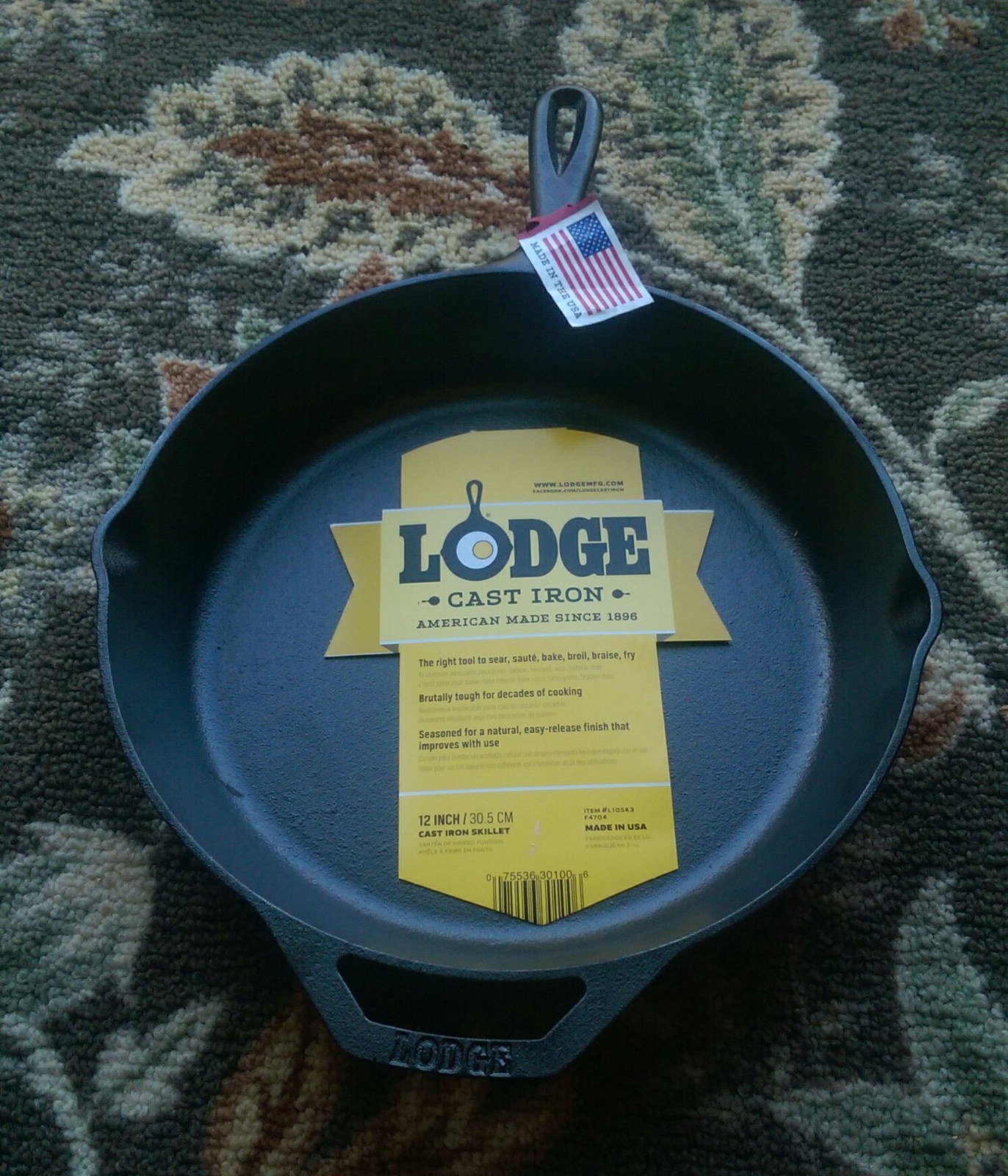
In 1896, Joseph Lodge, a Pennsylvania-born machinist who had come to South Pittsburg in 1877 to manage TCI's blast furnaces and adjacent coal mines, founded a cast-iron foundry of his own. He initially named it the Blacklock Foundry after his friend and minister, Joseph Blacklock. The foundry produced soil pipe and cast-iron cookware. On May 19, 1910, a fire destroyed the original facility. Within three months Lodge rebuilt a few blocks away under the name Lodge Manufacturing Company.
Lodge survived waves of industry contraction that closed nearly every other American cast-iron cookware maker through the 20th century. The company remains family-owned, still operates two foundries in South Pittsburg, and is the oldest cast-iron cookware manufacturer in the United States. It is the largest private employer in Marion County. Lodge broke ground in mid-2016 on a new 127,000-square-foot foundry on 3rd Street a few blocks from the original plant, known locally as the 3rd Street Foundry, and began production there on November 20, 2017; the expansion increased Lodge's manufacturing capacity by roughly 75 percent. The Lodge Museum of Cast Iron opened on October 8, 2022 in a refurbished building at 220 3rd Street next to the new foundry, consolidating historical displays that had previously been scattered. In February 2023 the Oxford, Mississippi-based restaurateur and James Beard Award winner John Currence opened a Big Bad Breakfast location inside the Lodge Cast Iron Foundry and Museum complex on 3rd Street; its menu features a Cornbread Omelet developed in honor of the National Cornbread Festival. The Lodge campus on 3rd Street has effectively replaced Cedar Avenue as the city's busiest visitor destination.
Richard City and Dixie Portland Cement
In 1906, the Dixie Portland Cement Company established operations in an area called Deptford, just north of South Pittsburg. Industrialist Richard Hardy oversaw the development of a company town for cement workers, which became known as Richard City. The cement plant operated under various owners, including Penn-Dixie Industries, until it closed in 1980. The current operator of the quarry site is Vulcan Materials. Richard City was annexed by South Pittsburg in 1985 and survives today as a neighborhood. Read more about Richard City →
The Princess Theatre
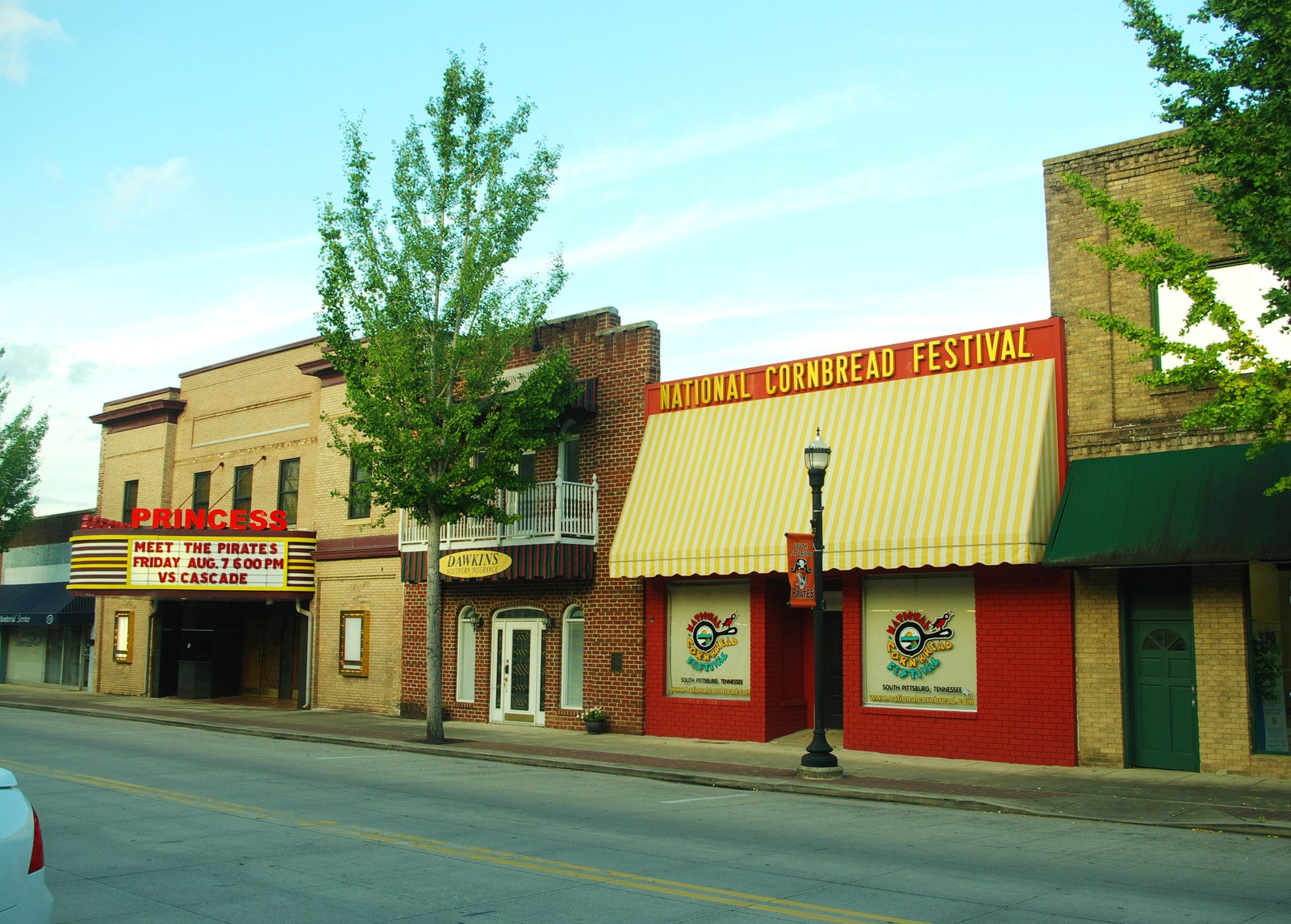
The Imperial Theatre opened on or before July 29, 1921 under manager O. C. Ogg. By the South Pittsburg Historic Preservation Society's history of the theatre, its opening film was a silent picture titled Tank Town Follies, said to feature South Pittsburg native Jobyna Ralston. The theater was sold to H. G. Jenkins in 1924 and renamed the Palace Theatre. In 1934, the Cumberland Amusement Company acquired it, closed it for remodeling, and added a neon-lit marquee, reopening it as the Princess Theatre on the night of July 2, 1934 with a showing of Sadie McKee starring Joan Crawford. The last movie screened in the early 1980s, and the building sat vacant for the next fifteen years.
Across its first six decades the Princess hosted touring acts as well as films, with appearances credited locally to Bill Monroe, the Carter Sisters, and a number of other early country and bluegrass figures during the regional theater circuit's mid-century run. By 1999, the roof had collapsed and a portion of the north wall was failing. The building was condemned and slated for demolition to make way for a parking lot. To save it, the City of South Pittsburg purchased the structure in 1999, and the city council chartered the South Pittsburg Historic Preservation Society (SPHPS) to lead the rebuild. The Society replaced the roof, rebuilt the rear wall, and restored the facade and marquee between 2003 and 2004, and completed interior renovation in 2014. The 350-seat theater reopened in August 2014 and hosts community events today. SPHPS has since expanded its work to include stewardship of Cedar Avenue's historic commercial district, the Chapel on the Hill, local cemeteries, and the South Pittsburg Heritage Museum, which opened in 2012 at 316 South Cedar Avenue and is open to the public free of charge on Friday and Saturday mornings. Society fundraisers include the annual Christmas Tour of Homes, a Trash and Treasure sale, a community cookbook produced in partnership with Lodge Manufacturing, a series of South Pittsburg postcards, and a reprint of the December 1899 South Pittsburg Hustler.
Civic institutions and public life
South Pittsburg's civic life was built around the same industrial-era fraternal culture that shaped most southern factory towns. American Legion Marion Post No. 62, on the corner of Elm Avenue and Third Street, broke ground on October 24, 1925, six years after the Legion's national founding, and has served as a veterans' hall and civic meeting space continuously since. The post building was listed on the National Register of Historic Places on November 22, 2016. A Rotary Club of South Pittsburg meets on the first and third Thursday of each month, hosted at the Sequachee Valley Electric Cooperative offices on Elm Avenue. The Marion County Chamber of Commerce sponsors the annual South Pittsburg Christmas Parade, which runs down Cedar Avenue in early December.
The South Pittsburg Volunteer Fire Department, operated by the city, shares its station on Elm Avenue with city dispatch and is staffed entirely by local volunteers. A separate South Pittsburg Mountain Volunteer Fire Department (SPMVFD) was founded on July 1, 1997 to serve the higher-elevation subdivisions on the plateau west of town that were outside the city's original service area. The two departments operate under mutual-aid arrangements with their neighbors.
Athletics and the Pirates
South Pittsburg High School, home of the Pirates, has been one of the most successful small-school football programs in Tennessee since the Tennessee Secondary School Athletic Association (TSSAA) adopted a classification-based playoff format in 1969. The Pirates won the state championship that first playoff season, defeating Tennessee Preparatory School 26 to 6 in Nashville. The program added state titles in 1994, 1999, 2007, 2010, 2021, 2023, and 2025, giving South Pittsburg eight TSSAA Gold Balls, among the most of any program in the state. The 2025 championship, a 42 to 14 win over the McKenzie Rebels, was played at Finley Stadium in Chattanooga. The Pirates share a long rivalry with the Whitwell Tigers across the county and with the neighboring McKenzie and Alcoa programs at the state level.
The defining Pirates rivalry, however, was the 97-year annual football series against Marion County High in Jasper, which ran from 1924 to 2021 and was Tennessee's second-longest continuous high-school football series. A full series history is on the MCHS vs. SPHS rivalry page, and the Pirates' broader championship ledger and coaching history, including Don Grider's 1969 first title and his son Vic Grider's three championships, is on the Marion County athletics page.
Decline and reinvention (mid-20th century to present)
South Pittsburg's population peaked at 4,130 in 1960. As heavy industry contracted, the city lost jobs and residents. TCI had shifted its primary operations to Alabama decades earlier, U.S. Stove eventually wound down production at the original Cedar Avenue plant (the building was razed in spring 2003), and the Penn-Dixie cement plant shut down in 1980. By 1970 the city had lost more than 500 residents, and population continued to slide through 2010 (2,992) before modestly rebounding to 3,106 in the 2020 census. Lodge Cast Iron endured and grew, but could not by itself replace the employment base of the earlier industrial era. United States Stove continues to manufacture wood and pellet stoves at a successor plant on Industrial Park Road, but the foundry workforce is a fraction of its 1920s scale.
Civic services followed a similar trajectory. The South Pittsburg Municipal Hospital, opened on Holly Avenue at the foot of South Pittsburg Mountain in October 1959, served as the city's general hospital for almost forty years and was for most of that time the only acute-care facility in the lower Sequatchie Valley. It closed in 1998 when the new Grandview Medical Center, today known as Parkridge West Hospital, opened on the northern edge of Jasper. The South Pittsburg building sat vacant for years before reopening in the mid-2010s under new ownership as the Old South Pittsburg Hospital Paranormal Research Center, the building's unusual second life as an overnight investigation venue and recurring location for paranormal-television programming.
In response, the city pivoted toward historic preservation and tourism. The Princess Theatre was restored. The Chapel on the Hill, a historic 1888 Primitive Baptist church, was renovated for public events and added to the Southeast Tennessee Heritage Religious Trail in December 2007. The downtown commercial district has been maintained as an active, walkable center, and the Lodge Museum and 3rd Street Foundry, opened in 2017 and 2022 respectively, anchored a new foundry-tourism axis a few blocks east of the historic Cedar Avenue spine.
National Cornbread Festival (1997 to present)
Launched in 1997 after a planning group began meeting in 1996, the National Cornbread Festival runs the last full weekend in April each year. The event pairs Lodge Cast Iron's foundry heritage with Southern cornbread culture, featuring the Lodge Cast Iron National Cornbread Cook-Off, rare public foundry tours, live music on multiple stages, a 5K run, a Cornbread Alley sampling of local recipes, and food vendors along Cedar Avenue. In 2000 the American Bus Association named the festival one of its Top 100 Events in North America. By the mid-2020s the festival drew more than 20,000 visitors across the two days, and organizers reported cumulative fundraising in excess of $1.4 million for community improvement projects including athletic facilities, building restorations, and theater and library programs. The festival was cancelled in 2020 and 2021 due to the COVID-19 pandemic and returned in April 2022. The Lodge Museum of Cast Iron houses a 14,360-pound skillet billed as the world's largest, and hosts the annual Cook-Off's on-site foundry seasoning demonstrations. Read the full festival page →
Present day
South Pittsburg today has a population of 3,106 (2020 census), a roughly four-percent recovery from the 2010 low of 2,992 driven mostly by Lodge's foundry hiring. The city is governed by a board of mayor and commissioners, with four commissioners elected by district, under the General Law Mayor-Aldermanic charter codified in the South Pittsburg Municipal Code. Lodge Cast Iron remains the economic anchor, with two active foundries and the largest private-sector employment in Marion County. The city is connected to the broader region by U.S. Route 72, Tennessee Route 156 (via the Shelby Rhinehart Bridge across the Tennessee River), and proximity to Interstate 24 at Kimball. South Pittsburg's schools, including South Pittsburg High School (the Pirates, winners of eight TSSAA state football titles between 1969 and 2025) and South Pittsburg Elementary, are part of the Marion County Schools district. The city was also home to McReynolds High School, the county's Black high school from 1918 to 1966. South Pittsburg is part of the Chattanooga metropolitan statistical area.
Population
| Year | Population |
|---|---|
| 1880 | 1,045 |
| 1890 | 1,479 |
| 1900 | 1,789 |
| 1910 | 2,106 |
| 1920 | 2,356 |
| 1930 | 2,103 |
| 1940 | 2,285 |
| 1950 | 2,573 |
| 1960 | 4,130 (peak) |
| 1970 | 3,613 |
| 1980 | 3,636 |
| 1990 | 3,295 |
| 2000 | 3,295 |
| 2010 | 2,992 |
| 2020 | 3,106 |
Notable people
- Joseph Lodge (1848, 1931), founded the Blacklock Foundry (now Lodge Cast Iron) in 1896. Born in Pennsylvania, he traveled through Cuba and Peru before settling in South Pittsburg in 1877. He is buried at Patton Annex Cemetery.
- Jobyna Ralston (born Jobyna Lancaster Raulston) (1899, 1967), silent-film actress from South Pittsburg; co-starred with Harold Lloyd in seven films and appeared in Wings (1927), the first Best Picture Oscar winner. She made her stage debut at age 9 at the Wilson Theatre. A Tennessee Historical Marker was dedicated at her birthplace in 2004.
- Richard Hardy (1868, 1927), industrialist who founded Richard City and served as president of Dixie Portland Cement.
- John T. Raulston (1868, 1956), judge who presided over the 1925 Scopes "Monkey" Trial; born on a small farm at Raulstontown on South Pittsburg Mountain. He read law at Jasper, was elected judge of the Eighteenth Tennessee Circuit in 1918, presided over the Scopes Trial in Dayton in 1925, practiced law with Raulston, Raulston, and Swafford until 1952, died in South Pittsburg in 1956, and is buried at Cumberland View Cemetery in Kimball. Full profile on the people page →
- James Thomas Fitz-Gerald, Jr. (1920–1948), WWII fighter pilot and POW, the second man to break the sound barrier in the Bell X-1 (1948); born in South Pittsburg. James Fitz-Gerald Boulevard at Edwards Air Force Base is named for him.
- Hiram Beene Moore, M.D. (1914–2005), South Pittsburg native and Black physician who returned home from medical training in 1945 and treated patients of all races for nearly six decades. Named the city's first Black member of the Housing Authority in 1958 by Mayor Lew W. Loyd, named General Practitioner of the Year by the National Medical Association in 1964, and honored with Moore Park, a city clock, and a Tennessee Historical Commission marker on Elm Avenue dedicated in 2025. Served on the Lodge Manufacturing board of directors.
- James M. Lewis, pharmacist and Tennessee state senator.
- Eddie Moore, NFL linebacker.
Landmarks
- Lodge Manufacturing foundries (active industry, two facilities)
- Lodge Museum of Cast Iron (home of the 14,360-lb skillet)
- Princess Theatre (1921, restored)
- Chapel on the Hill (1888 Primitive Baptist church, restored)
- Historic downtown commercial district on Cedar Avenue
- Fort McCook site (Civil War earthwork, near Battle Creek confluence)
- Shelby Rhinehart (“Blue”) Bridge (1981, crossing Tennessee River to New Hope)
- Old South Pittsburg Hospital, 1100 Holly Avenue (1959 hospital, today operating as a paranormal research center)
- Old City Cemetery (about 1,600 burials below Whiteacre Point on the south side of South Pittsburg Mountain; integrated by race, religion, and Civil War side; founded by 1840 with the Haley vault burials and holding the English Quaker founders of South Pittsburg)
National Register of Historic Places
South Pittsburg contains several properties listed on the National Register of Historic Places. The South Pittsburg Historic District, bounded by Elm and Walnut Avenues and 2nd and 7th Streets, was listed on October 25, 1990, recognizing the downtown commercial and residential core that dates to the city's industrial founding.
- South Pittsburg Historic District (listed October 25, 1990), Elm-Walnut Aves., 2nd-7th Sts.
- Christ Episcopal Church and Parish House (listed August 22, 1977), corner of 3rd and Holly Streets
- First National Bank of South Pittsburg (listed June 24, 1991), 204 West 3rd Street
- Richard Hardy Memorial School (listed September 30, 1982), 1620 Hamilton Avenue
- Marion Post No. 62 (listed November 22, 2016), 300 Elm Avenue
- Putnam-Cumberland Historic District of Richard City (listed July 25, 1991), Cumberland and Putnam Avenues
- Townsite Historic District of Richard City (listed July 25, 1991), Dixie, Lee Hunt, and Cumberland Avenues
Related
Richard City →
The Civil War in Marion County →
Fort McCook on Battle Creek →
The 1927 Christmas Night Shootout →
Wars and military service (Fitz-Gerald, wartime defense production) →
South Pittsburg foundries: Perry, Wetter, Blacklock →
Coal & coke industry →
Transportation & railroads →
The Shelby Rhinehart “Blue” Bridge →
The Old South Pittsburg Hospital →
Religious history of Marion County →
Town Governments (mayors and boards of Marion County's incorporated towns) →
Black History of Marion County →
The Civil Rights Era in Marion County →
Sources
- Wikipedia: South Pittsburg, Tennessee
- Wikipedia: Lodge (company)
- Wikipedia: Jobyna Ralston
- Wikipedia: United States Stove Company
- Tennessee Encyclopedia: Marion County
- Historic South Pittsburg Preservation Society: History
- Lodge Cast Iron: History
- National Cornbread Festival
- TSLA Civil War Sourcebook: August 27, 1862, Skirmish at Fort McCook on Battle Creek
- HMdb: Fort McCook Historical Marker
- FortWiki: Fort McCook
- Princess Theatre: History
- City of South Pittsburg: 150th Anniversary
- Wikipedia: NRHP Listings in Marion County, Tennessee
- Wikipedia: John T. Raulston
- South Pittsburg Mountain Volunteer Fire Department
- City of South Pittsburg: Volunteer Fire Department
- City of South Pittsburg: Government
- TSSAA: South Pittsburg High School football championship history
- TSSAA: South Pittsburg establishes its playoff credentials in first state playoff (1969)
- Lodge Cast Iron: Second Lodge foundry now in production (2017)
- Lodge Cast Iron: Lodge Museum of Cast Iron now open (2022)
- Chattanooga Times Free Press: Lodge museum to open in South Pittsburg in summer 2022
- South Pittsburg Historic Preservation Society (SPHPS)
- SPHPS: Our projects
- Cinema Treasures: Princess Theatre, South Pittsburg
- SPHPS — History of the Princess Theatre (Imperial / Palace / Princess; 1921 opening)
- Dennis Lambert, “The Birth of South Pittsburg, Tennessee” (SPHPS, 2004)
- Dennis Lambert, “The South Pittsburg, Tennessee Post Office” (SPHPS, 2005)
- SPHPS — Jobyna Lancaster Ralston-Arlen Day (November 21, 2004 marker dedication)
- SPHPS — History of the Society
- HMdb — Hiram Beene Moore, M.D., historical marker (Tennessee Historical Commission, 2025)
- RootsWeb / TNGenWeb Marion County — South Pittsburg Journal Scrapbook (Cedar Avenue, Coca-Cola Building, Cameron / Robert E. Lee Hotel, Eagle Pencil & Steamboat, Knights of Pythias Band, Three Musketeers, etc.)
- Library of Congress, 1887 lithographed map of South Pittsburg (LOC gm71000028, via Wikimedia Commons)
- South Pittsburg Historic Preservation Society — Buildings inventory (Robert E. Lee / Cameron-Patton Hotel, First National Bank, Coca-Cola bottling plant)
- Sanborn Fire Insurance Maps of South Pittsburg, Marion County, Tennessee, 1902 / 1907 / 1913 (Library of Congress, via Wikimedia Commons)
- Chattanoogan.com — South Pittsburg to receive $500,000 Downtown Improvement Grant (December 18, 2025)
- Arts in the Burg (South Pittsburg Area Revitalization Quest, 207 S. Cedar Avenue)