Last updated: May 20, 2026
- Type: City
- Incorporated: February 1, 1956
- 2020 population: 1,641
- Elevation: 679 ft
- Area: 3.51 sq mi
- Former name: Cheekville
- Named for: Thomas Whitwell (1837–1878), British metallurgist
Whitwell sits in the Sequatchie Valley in the north-central part of Marion County, approximately 24 miles northwest of Chattanooga, at the base of the Cumberland Plateau. It is the site of the county's first court (1817) and was for over a century one of the busiest coal-mining communities in the valley. In recent decades it has become internationally known as the home of the Children's Holocaust Memorial and the Paper Clips Project.
Setting
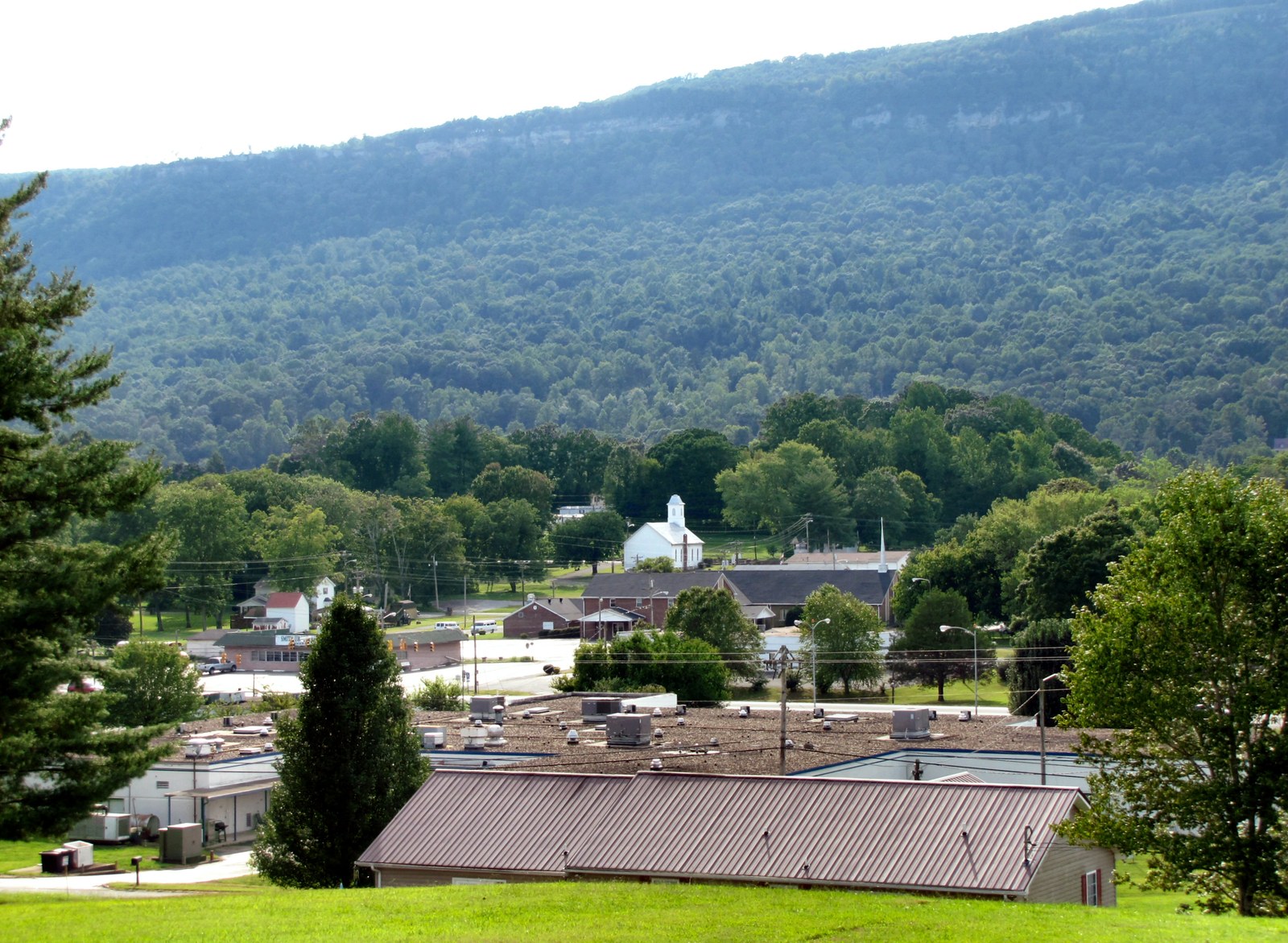
Whitwell occupies the Sequatchie Valley floor between the Cumberland Plateau to the west and the ridge that separates the valley from the Tennessee River Gorge to the east. The plateau wall rises sharply just behind the town, and the coal seams that defined Whitwell's industrial era run through the plateau rim directly above. U.S. 41 follows the valley floor through town, continuing southwest toward Jasper and northeast toward Pikeville and the head of the valley in Bledsoe County. The old Sequatchie Valley Railroad grade, reaching town in 1887, tracks along the same corridor. The upper Sequatchie River crosses the northwestern edge of the city limits, and streams coming off the plateau feed into it. Before it was renamed for the British metallurgist Thomas Whitwell in the late 1870s, the settlement on this ground was Cheekville, where Marion County's first court met in 1817. At 679 feet of elevation, Whitwell is a valley town, not a plateau town, even though the mines that built it were cut into the plateau above.
The Whitwell valley floor was in Indigenous use for thousands of years before Cheekville or the first coal tipple. The Sequatchie Valley preserves Archaic and Woodland camps (roughly 8000 BC to AD 900) along its streams, and the deep bottom soils fell within the Mississippian farming world between about AD 900 and 1600. By the late 18th century the valley was part of the Cherokee homeland and served as a travel and hunting corridor tied to the Chickamauga (Lower) Cherokee towns at Nickajack and Running Water. After the 1794 Nickajack Expedition, Cherokee households continued to hold land in the valley; under the Treaty of 1819, several took 640-acre reservations on Battle Creek and near Jasper, and the remaining Cherokee community in the region was forcibly removed along the Trail of Tears in 1838. The Cherokee Nation, today a sovereign nation headquartered in Oklahoma, traces a portion of its ancestry through the families of the Lower Towns.
Earliest European settlement: Cheekville (1817)
When the Tennessee General Assembly created Marion County in 1817 (signed November 20, 1817), the first court was held in the home of John Shropshire in the small settlement then called Cheekville, named for the Cheek family whose two-story double log house had served as a courthouse before Tennessee statehood while the territory was still under North Carolina jurisdiction. The county seat was moved to Jasper in 1819, but the community at Cheekville persisted as a quiet agricultural settlement on the valley floor for the next six decades. The federal Cheeksville post office (using the federal-record spelling with a terminal “s”) operated from 1830 to 1887; the Whitwell post office opened two years later, in 1889. See the dedicated Cheekville subpage for the pre-1877 history →
The coal era begins (1877, 1890s)
The transformation of Cheekville into a coal town began in 1877, when James Bowron and associates from the Southern States Coal, Iron and Land Company brought British capital into the Sequatchie Valley. The company opened coal mines at and around Cheekville, feeding the coke ovens at nearby Victoria and the iron furnaces at South Pittsburg. The settlement was renamed Whitwell in honor of Thomas Whitwell, a British metallurgist and a founder of the Southern States company. Born at Kendal, in the north of England, on October 24, 1837, Whitwell had patented the Whitwell hot-blast stove, a firebrick furnace-heating design eventually installed at more than seventy ironworks around the world. He never saw the town carry his name: on August 5, 1878, at the age of forty, he was scalded to death by escaping steam while inspecting a furnace at the Thornaby Iron Works in England, just as the Tennessee operations he had helped finance were getting underway.
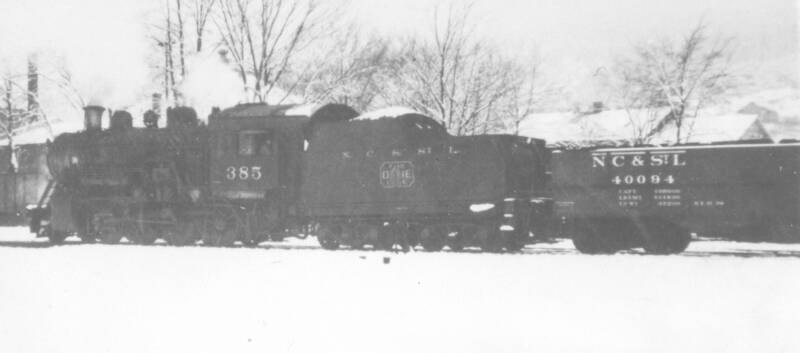
The Sequatchie Valley Railroad reached Whitwell in 1887, linking it to Jasper and the Nashville, Chattanooga & St. Louis mainline at Bridgeport, Alabama. The branch ran the length of the valley as the NC&StL's Pikeville Branch, and the Whitwell depot stood at Mile 22.60 of that line. Rail access accelerated mining output and drew immigrants from Britain and continental Europe to work the mines. By 1890, the community had grown to 906 people.
Mining life and community
Coal mining shaped every aspect of Whitwell for over a century. Housing stock, commercial strips, churches, and civic rhythms were built around the shift schedule of the mines. The local mine grew to be the largest in Marion County. Miners and their families formed a tight-knit community marked by shared danger, labor solidarity, and cultural traditions brought from Europe and the broader Appalachian region.
The coal itself lay high on the Cumberland Plateau, in seams cut into the rim above the town, while the railroad and the town sat on the valley floor hundreds of feet below. Bridging that drop was a gravity incline: loaded coal cars running down the mountain on a cabled track hauled the empty cars back up as they descended. At the foot of the incline, a tipple and power house operated by the Tennessee Coal, Iron and Railroad Company dumped the coal into railroad hoppers for the run down the valley.
Around the mines grew a full coal-town business district. The Whitwell journal scrapbook assembled by local historian Euline Harris on the TNGenWeb Marion County site preserves photographs of that vanished commercial strip: general-merchandise and dry-goods stores, groceries, a drugstore, a blacksmith shop, a barber shop, the Bank of Whitwell, a Miners Hall, and the lodges of the Odd Fellows and a Whitwell Athletic Club, along with images of the incline, the depot, the coke ovens that turned local coal into furnace fuel, and the miners themselves.
The Whitwell Cumberland Presbyterian Church
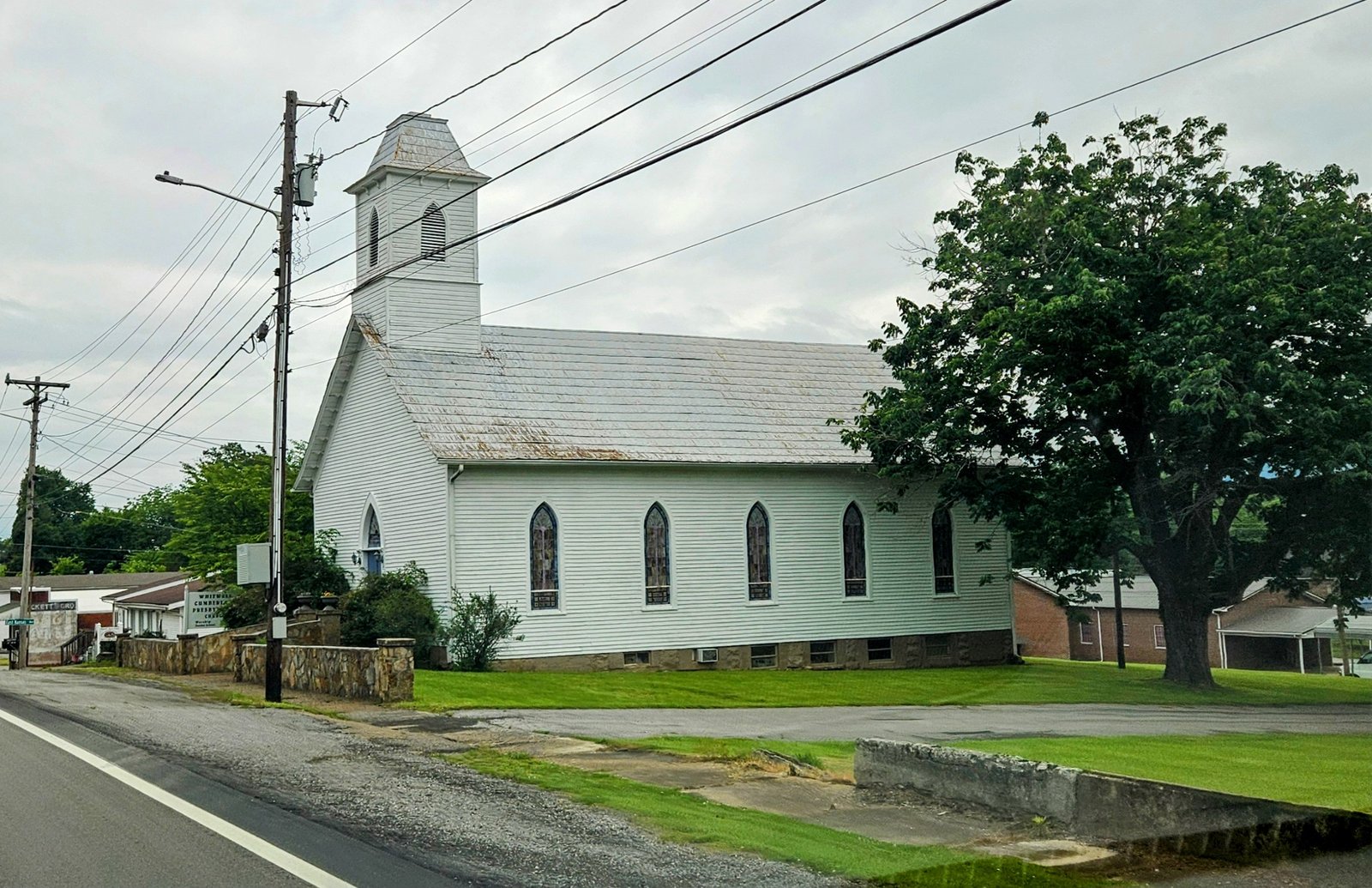
One Whitwell institution is older than the coal era and older than the town's name. The Whitwell Cumberland Presbyterian Church on South Main Street was organized in 1842 as the Cheekville Cumberland Presbyterian Church, gathering a small rural congregation on the valley floor decades before the first coal tipple. When Cheekville was renamed for Thomas Whitwell, the church followed: in 1878 the congregation changed its name to the Whitwell Cumberland Presbyterian Church to match the town. The Cumberland Presbyterian denomination itself had been founded on the Tennessee frontier in 1810, and the Whitwell congregation is one of its early Sequatchie Valley churches.
The present church building, a frame structure at 876 South Main Street, was raised around 1892, as the coal boom was filling the valley with new families. It is a gable-front Gothic Revival church: pointed-arch windows and entry, weatherboard siding with a distinctive decorative notching in the gable, a central square bell tower, and a roof of pressed-tin scalloped shingles. The interior keeps its original wood pews and pulpit. The church and its parish house were listed on the National Register of Historic Places on November 26, 2018, recognized as a well-preserved example of late-19th-century rural church architecture in southern Tennessee. The congregation, part of the Tennessee-Georgia Presbytery, has dwindled to fewer than a dozen members, but the building remains one of the most intact survivors of Whitwell's 19th-century townscape.
Incorporation and postwar civic build-out (1956, 1970s)
Whitwell organized itself as a mining community long before it was a city. The settlement had grown up around the mines, the railroad, and the Cheekville-era court site, but it remained unincorporated through the first half of the 20th century. On February 1, 1956, it incorporated under a Home Rule charter, the form adopted by only a small number of Tennessee municipalities, and set up a government of an elected board of mayor and commissioners with an appointed city manager. The Home Rule framework, uncommon in Tennessee, reflected the town's long-standing sense of itself as a distinct place with interests different from those of the agricultural valley and the industrial river-bottom towns.
The Whitwell Volunteer Fire Department was organized in 1959, three years after incorporation. Its first fire truck was paid for through the proceeds of the First Annual Labor Day Celebration the same year, binding the department and the town's best-known civic event together from the start. The department operated for more than half a century out of a station on South Walnut Street before moving into a new firehouse at 155 East Spring Street in June 2016. The department remains all-volunteer, serving the city and a surrounding mutual-aid area that reaches into the unincorporated Sequatchie Valley.
Labor Day Celebration and the Coal Miner's Reunion
Founded in 1959 to fund the first fire truck, the Whitwell Labor Day Celebration has run every year since, one of the longest-running continuous community festivals in the Sequatchie Valley. The centerpiece is a parade down Main Street on the Monday holiday, with lineup at 8 a.m. and step-off at 9, followed by food trucks, craft vendors, games, and live music at Whitwell City Park. A Coal Miner's Reunion, held as part of the Labor Day weekend, gathers retired miners and their families, tying the festival's civic origin to the industry that built the town. The celebration's signature food has long been Whitwell's barbecue chicken. In recent years, organizers have expanded the event into a multi-day program bridging the preceding weekend.
Mine No. 21 disaster (1981)
On December 8, 1981, a methane gas explosion at the No. 21 Mine, operated by the Grundy Mining Company (a subsidiary of Tennessee Consolidated Coal Company), killed 13 miners. The blast was powerful enough to blow out the headlights of trucks parked 100 feet from the mine entrance. Rescue teams with oxygen respirators dug through the shaft for six hours before recovering the bodies.
The U.S. Department of Labor found that a cigarette lighter taken into the mine in violation of federal regulations ignited accumulated methane, and cited the operator for failure to ventilate the shaft adequately and to enforce the ban on smoking materials. It was the worst mining disaster in Tennessee since the introduction of modern safety regulations. The names of the 13 men are memorialized at Whitwell High School. A documentary film, Mine 21, produced by students at the University of the South in Sewanee, aired on PBS. See the full account on the No. 21 Mine Explosion page.
End of mining (1996)
Coal mining remained a significant part of Whitwell's economy through the late 20th century, but the mines went bankrupt in 1996. The closure ended over a century of continuous coal extraction in the area and left the community searching for a new economic identity.
The Whitwell-Marion County Coal Miners Museum, on South Main Street, preserves the story of underground mining through more than 500 artifacts donated by local families and through the presence of retired miners who volunteer as guides. Its exhibits trace the texture of a working miner's day: mining caps and headlamps spanning more than a century, including a child-sized cap from the era when boys went underground; a “rail horse” of the kind miners rode down the mountain after a shift; and the numbered metal tags miners hung on their loaded coal cars to be paid. Early wages ran about eighty-seven cents a ton, and a boy working alongside his father was issued a half tag so the father could claim the credit. A stone bearing “1877” scrawled in grease marks the first recorded death in the Whitwell mines. Among the museum's holdings is a bell donated by Queen Victoria of England to Bethel Church, built by John Frater in the late 1880s for coal miners and farmers in the nearby community of Victoria.
The Paper Clips Project (1998 to present)
In 1998, Whitwell Middle School principal Linda Hooper asked teachers to launch a Holocaust education class. When 8th-grade students struggled to grasp the scale of six million murdered Jews, they decided to collect paper clips, one for each victim. The idea was inspired by the wartime Norwegian resistance practice of wearing paper clips as a silent protest against the Nazi occupation. (The paper clip is widely credited to Norwegian inventor Johan Vaaler.)
Students wrote letters to public figures asking for paper clips and personal stories. The response was enormous: over 30,000 letters and more than 30 million paper clips arrived at the school from around the world. International attention grew when German journalists Peter and Dagmar Schroeder, who covered the White House for German newspapers, published a book about the effort, Das Büroklammer-Projekt (The Paper Clip Project). In 2001, reporter Dita Smith wrote about the project for The Washington Post.
An authentic German railway transport car, the kind used to carry prisoners to Nazi concentration camps, was brought to Whitwell and converted into the Children's Holocaust Memorial, filled with 11 million paper clips (six million for Jewish victims and five million for other groups targeted by the Nazis). The memorial was dedicated on November 9, 2001, the anniversary of Kristallnacht. A 2004 documentary film, Paper Clips, directed by Elliot Berlin and Joe Fab, brought the story to a worldwide audience.
The memorial remains on the grounds of Whitwell Middle School and continues to host visitors, including Holocaust survivors. The total number of paper clips collected now stands in the tens of millions.
The 2018 Tigers
The city's public high school, Whitwell High School, fields athletic teams known as the Tigers. On December 1, 2018, the Tigers capped an undefeated 15 and 0 season with a 7 to 6 win over Cornersville at the TSSAA Class 1A BlueCross Bowl at Tennessee Tech in Cookeville. It was the program's first state championship, and its first appearance in a title game. Second-year head coach Randall Boldin's team won it on a fourth-down, 15-yard touchdown pass from Hudson Petty to Tanner Stewart with 7:31 remaining; Petty, a senior who also made 16 tackles and an interception, was named the game's most valuable player. The playoff run included a double-overtime quarterfinal win at intracounty rival South Pittsburg and a last-second field goal in the semifinals that eliminated the 2017 defending champions, Greenback. The 2018 win was Whitwell's contribution to Marion County's all-champion-county distinction, the only Tennessee county in which every public-school football program had won a state championship. The wider county-wide athletic context is on the Marion County athletics page.
Present day
Whitwell today is a city of 1,641 people (2020 census), down slightly from 1,699 in 2010 and a longer peak of 1,857 in 1960. The coal mines have been closed for three decades, but the city retains its identity as a close-knit valley community with strong roots in its mining past. The economy has shifted toward a mix of commuter employment toward Chattanooga (about 45 minutes south on US-41 and I-24), small manufacturing, and service work in the surrounding Marion and Sequatchie county areas. The Paper Clips Project has brought a steady international visitor stream to the middle school, and the Coal Miners Museum, Labor Day festival, and Whitwell Tigers football program give the town a public profile that punches above its population.
Schools in Whitwell are part of the Marion County Schools district and include Whitwell Elementary, Whitwell Middle School (home of the Children's Holocaust Memorial), and Whitwell High School. The city sits on the Sequatchie Valley National Scenic Byway and is part of the Chattanooga metropolitan statistical area. Its two principal visitor attractions are the Children's Holocaust Memorial at the middle school and the Whitwell-Marion County Coal Miners Museum on South Main Street.
Population
| Year | Population |
|---|---|
| 1890 | 906 |
| 1960 | 1,857 (peak) |
| 1980 | 1,783 |
| 2000 | 1,660 |
| 2010 | 1,699 |
| 2020 | 1,641 |
Notable people
- Hillis Layne (1918–2010), Major League Baseball player.
- Bennie Tate (1901–1973), Major League Baseball catcher.
- Jon Coffelt (b. 1963), artist.
- Ray E. Duke (1923–1951), Medal of Honor recipient (Korean War), born in Whitwell; killed as a prisoner of war.
- Ruth Marie Terry (1936–1974), born in Whitwell; identified through DNA evidence in 2022 as the Massachusetts homicide victim known since 1974 as the “Lady of the Dunes.”
Landmarks
- Children's Holocaust Memorial (Whitwell Middle School), authentic German railcar with 11 million paper clips.
- Whitwell-Marion County Coal Miners Museum, on South Main Street.
- Whitwell Cumberland Presbyterian Church, 876 South Main Street, organized in 1842 and listed on the National Register of Historic Places on November 26, 2018.
- Historic downtown and coal-era buildings.
- No. 21 Mine memorial at Whitwell High School.
- Marion County Veterans Memorial Park, at Whitwell City Park on Highway 28, honoring veterans of all eras.
Related
Cheekville (the pre-1877 name for Whitwell) →
Condra (the upper-valley Condra-family hamlet along TN-28 northeast of town) →
Red Hill (the upper-valley community north of town on the old Dunlap Highway) →
County Formation (1817): the treaty, the act, the first court, and the courthouses →
First settlers of Marion County (Shropshire and the Cheekville court, 1817) →
Wars and military service (Ray E. Duke, Medal of Honor) →
The Paper Clips Project →
Victoria →
Coal & coke industry →
The No. 21 Mine Explosion (1981) →
Religious history of Marion County →
Town Governments (mayors and boards of Marion County's incorporated towns) →
Sources
- Wikipedia: Whitwell, Tennessee
- Wikipedia: Thomas Whitwell
- Wikipedia: Whitwell Cumberland Presbyterian Church
- Wikipedia: Paper Clips Project
- Wikipedia: No. 21 Mine explosion
- Wikipedia: Ruth Marie Terry
- Wikipedia: NRHP Listings in Marion County, Tennessee
- South Pittsburg Historic Preservation Society: Sequatchie Valley Railroad at Whitwell
- TNGenWeb Marion County: Whitwell journal scrapbook
- Sequatchie Valley National Scenic Byway: Whitwell
- Tennessee Encyclopedia: Marion County
- Southeast Tennessee Travel: Coal Miners Museum
- U.S. Deadly Events: Mine No. 21
- University of Tennessee MTAS: City of Whitwell profile
- City of Whitwell: official municipal site
- City of Whitwell: Fire Department
- Marion County, Tennessee: Museums & Memorials
- Visit Marion County: Tours & History
- Whitwell Middle School: Children's Holocaust Memorial history
- Chattanooga Times Free Press: Whitwell wins 2018 TSSAA Class 1A football state title
- TSSAA: Whitwell High School football record
- Sequatchie Valley News: Whitwell Labor Day Celebration grows for 2025
- Marion County News: Whitwell Labor Day Parade (2022)