Last updated: April 28, 2026
- Location: Downtown South Pittsburg, centered on Cedar Avenue and the Lodge foundry block
- Held since: 1997 (first festival held over the last full weekend of April)
- When: The last full weekend in April, annually
- Cancelled: 2020 and 2021 (COVID-19 pandemic)
- 29th annual edition: April 25 to 26, 2026
- Attendance: 30,000 to 40,000+ visitors over the two-day weekend in recent years
- Organizer: National Cornbread Festival, Inc., a 501(c)(3) nonprofit, in partnership with Lodge Cast Iron and the City of South Pittsburg
- Title sponsors: Lodge Cast Iron, Martha White, FiveStar Professional Cooking Equipment, Bush's Beans, Tennessee Valley Federal Credit Union
- Volunteer base: 350+ each year, drawn principally from South Pittsburg households and surrounding Marion County communities
- National recognition: Named one of the Top 100 Events in North America by the American Bus Association in 2000
The National Cornbread Festival is held each year in downtown South Pittsburg on the last full weekend of April. Since its debut in 1997, the nonprofit event has grown into one of the largest food festivals in the southeastern United States, drawing tens of thousands of visitors each year to a town of roughly 3,100 residents. Its centerpiece is the Lodge Cast Iron National Cornbread Cook-Off, a competitive cooking event that has crowned a new champion every year since the festival's first weekend; its infrastructure is a partnership between Lodge Manufacturing, the city, the Tennessee Valley Federal Credit Union, and a volunteer corps of more than three hundred local residents. The festival has become the single most visible economic event on the Cedar Avenue corridor and the principal national platform for South Pittsburg as a cast-iron destination.
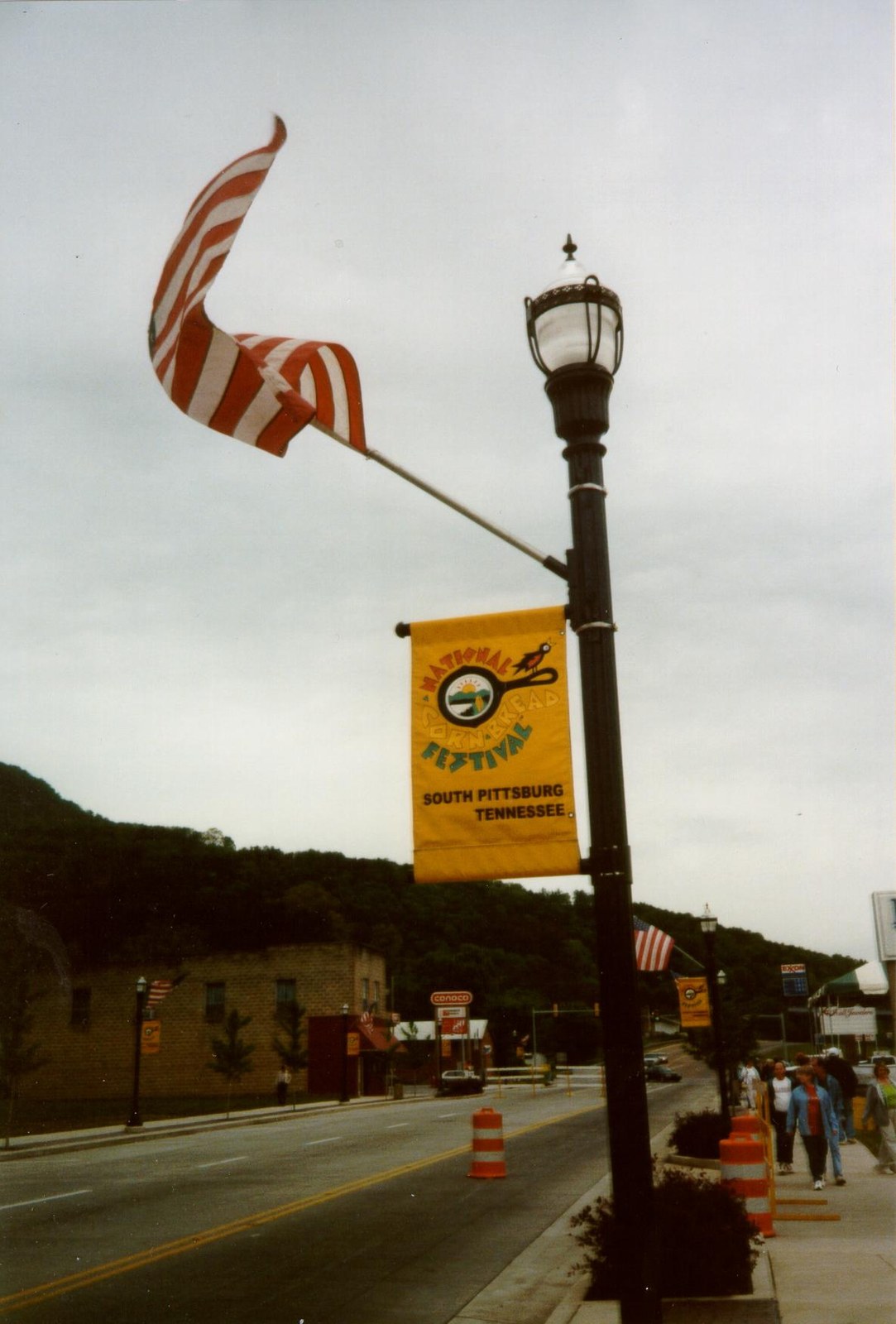
Origins (1996 to 1997)
The festival traces its origins to 1996, when civic leaders in South Pittsburg gathered to discuss the town's economic future. The conversation centered on the community's most prominent asset: Lodge Manufacturing Company, the oldest continuously operating cast-iron cookware foundry in the United States, which had been pouring iron in South Pittsburg since 1896. A cast-iron skillet is the traditional vessel for Southern cornbread, and the pairing suggested a natural theme for a hometown festival that would draw on Lodge's national consumer reach without depending on Lodge to underwrite a single-company event. Lodge signed on as a strategic partner; the festival's nonprofit structure kept ownership of the event in the community while allowing Lodge to lead the cook-off and use the festival as a national marketing event.
The first National Cornbread Festival was held in 1997. The opening weekend established the format that has held with little variation through every subsequent year: a juried Lodge Cast Iron National Cornbread Cook-Off as the marquee event, foundry tours through the Lodge plant during the festival hours (otherwise closed to visitors), an arts-and-crafts vendor field of more than a hundred booths, Cornbread Alley with sampling, contests, and a buttermilk-chugging race, a 5K race and a Gran Fondo bike ride, blacksmithing and tractor demonstrations, and live music across the weekend. That format proved durable enough that the only material interruptions in the festival's history have been the 2020 and 2021 cancellations forced by the COVID-19 pandemic; every other year from 1997 forward has run on schedule.
The Lodge Cast Iron National Cornbread Cook-Off
The cook-off is the festival's centerpiece and its principal national draw. It has run every festival year except the two pandemic cancellations and is a major main-dish recipe contest in its category. The format and prize structure are stable across years.
Entries are submitted online in the months before the festival and must satisfy two product-placement constraints from the title sponsors: every recipe must use at least one Lodge Cast Iron skillet or other Lodge cast-iron product, and at least one cup of Martha White Cornbread Mix. The contest is for original main-dish entrées, not desserts or breads alone; the cornbread element typically appears as a crust, a topping, a stuffing, or a structural component of a larger dish rather than as the dish itself. Recipes are judged on appearance, originality, taste, and ease of preparation by a panel that has included food writers, regional chefs, and food-magazine editors over the years.
Ten finalists are selected from the entry pool and invited to South Pittsburg with up to five hundred dollars in travel reimbursement and a Lodge gift basket. On the festival Saturday, the finalists cook on stage in front of a live audience, each given one hour to prepare their dish. The prize structure has been:
- First place: $5,000 cash, a FiveStar 30-inch stainless steel gas range (valued at roughly $3,200 to $3,250 in recent years), the cast iron skillet "crown," and special gifts from Lodge Cast Iron
- Second place: $1,500 cash
- Third place: $1,000 cash
- Remaining seven finalists: $150 each, in addition to travel and the welcome basket
Winning recipes are published in the festival's annual cookbook and distributed through Lodge's national marketing channels. A consolidated cookbook, National Cornbread Festival Winning Recipes 1997 to 2011, collects the first fifteen years of cook-off champions in a single volume; subsequent winners have been published in continuing editions and on the festival website.
Notable cook-off champions
The cook-off has named a champion every year of the festival's running. The cumulative list draws competitive home cooks from across the country and reflects the steady evolution of the contest from a regionally focused event in the late 1990s to a national contest by the 2010s. Selected champions include:
- 2015 (19th): Karen Shankles of Knoxville, Tennessee, a former cook-off finalist named "All-Star Champion" in a special edition pitting prior winners against each other; her winning dish, "Festive Good Luck," combined cornbread with sausage, black-eyed peas, and collard greens
- 2016 (20th): Ronna F. of Rockville, Maryland, with "Cornbread-Topped Cordon Bleu Skillet"
- 2017 (21st): Hidemi Walsh of Centreville, Virginia, with "Chili Shrimp and Coconut Cornbread"; second place to Ashlyn Morgan of Englewood, Tennessee with "Cornbread Cuban Sandwiches with Mojo Sauce"; third place to Felice Bogus of Raleigh, North Carolina with "Smokey Chicken Tinga Street Gorditas"
- 2019 (23rd): Lidia Haddadian, with a "Smoky Cajun-Style Shrimp 'n Bacon Pizza with Crispy Cornbread Crust"
- 2022 (25th, the silver-anniversary edition): Veronica Callaghan, in the first cook-off held after the two-year pandemic cancellation
- 2024 (27th): Christine Siebeneck of Ohio, with "Spicy Shrimp, Sausage, and Black Bean Hand Pie"
- 2026 (29th): Gracie Woods, with "Corn Fritter Smash Burger"
Earlier-era champions named in the consolidated 1997 to 2011 cookbook include Kinzee Clark, Justin Crittenden, Brynn Kiser, Sue Gulledge, Susie Mical, Karen Shankles, Rosemary Johnson, Janice Carver, Sherilyn Johnson, Stuart Boone, Kay Gay, Helen Hollansworth, Melanie McCoy, Betty Cleveland, Fran Pickens, Jane W. Flowers, Victoria McCord, Diane Sparrow, Patricia Reese, Andria Gaskins, David Jackson (then mayor of nearby Kimball, Tennessee), Jordan Venable, Lydia Rae Sewell, Emily Gill, Sonya Goergen, Jamie Martin, and Erin Renouf Mylroie among others. The recurrence of repeat finalists and even repeat champions across the cookbook list reflects the cook-off's status as a circuit event in the home-cooking-contest community, with national recipe-contest cooks traveling to South Pittsburg from across the country in search of the title.
What happens at the festival
Beyond the cook-off, the festival fills several blocks of downtown South Pittsburg with a coordinated weekend program:
- Lodge foundry tours. During the festival, the Lodge Cast Iron foundry opens its doors to the public. This is the only regular opportunity each year to see the active foundry in operation, as it is otherwise closed to visitors. Tours run through Friday and Saturday, in groups timed to the work shifts of the active iron pours.
- Lodge Cast Iron Museum. The museum, opened in 2022 at 220 East 3rd Street (two blocks east of Cedar Avenue), is a permanent showcase of Lodge's history and houses the world's largest cast-iron skillet.
- Cornbread Alley. A dedicated area for cornbread sampling, the cornbread-eating contest, and the buttermilk-chugging race. The Alley has its own programming track with celebrity-judge sampling sessions and recipe demonstrations.
- Arts and crafts. More than a hundred juried vendors sell handmade goods along the festival's vendor field, with traditional Southern crafts (quilting, woodworking, pottery, basket-making) heavily represented.
- Classic Car Cruise-In. A static display of vintage and classic automobiles from regional car clubs, held on the Saturday afternoon.
- 5K race and Gran Fondo bike ride. The Saturday morning 5K starts at the festival grounds; the Gran Fondo is a longer recreational and competitive ride looping out into Marion County and back.
- Demonstrations. Blacksmithing demonstrations, glass-blowing, antique tractor exhibits, Dutch-oven cooking demonstrations, and demonstrations from the Lodge cast-iron staff are scheduled across both days.
- Live music. A two-stage music program runs Friday evening and across Saturday, drawing on the regional country, bluegrass, gospel, Americana, and southern-rock circuits with occasional national-name headline acts.
- Carnival rides and family programming. A small carnival operates on the festival's edge for the duration of the weekend, with separate programming for children.
Lodge Cast Iron and the festival as a national platform
For Lodge Cast Iron, the festival has been a strategic platform that goes beyond a single weekend's worth of brand exposure. The cook-off carries the name "Lodge Cast Iron National Cornbread Cook-Off" in title sponsorship across all marketing channels; winning recipes are featured in Lodge's national cookbook line, used as content marketing on the company website, and circulated through the company's social media year round. The cook-off itself is timed to give Lodge a pre-summer marketing event, ahead of the cookware industry's traditional Father's Day and grilling-season selling cycles. Lodge CEO emeritus Bob Kellermann has been a recurring presence at the cook-off, named in 2017 Chattanoogan.com coverage as personally presenting the first-place skillet crown to the cook-off winner.
Lodge has folded the festival into its long-running brand-rebuilding work since the late 1990s, alongside the opening of the Lodge Cast Iron Museum two blocks east of Cedar Avenue on East 3rd Street and the company's broader marketing for its seasoned-cast-iron and porcelain enamel lines. The cook-off has drawn a regular audience of food bloggers, recipe developers, food magazines, and broadcast outlets to South Pittsburg in late April; the Tennessee Farm Table podcast, the Southern Cast Iron magazine, and Smoky Mountain Living have all run feature coverage of the festival within the last decade.
Cedar Avenue ripple effects
The festival's economic effect on Cedar Avenue is the most visible of any single weekend on the South Pittsburg calendar. Downtown businesses adjacent to the Lodge foundry block run at festival-weekend capacity; lodging across South Pittsburg, Kimball, and the Monteagle Mountain corridor fills well in advance with overflow extending into Chattanooga and across the state line into Bridgeport, Alabama; and volunteer-staffed community organizations and school groups run booth-based fundraisers across the festival grounds. The operational effect on Cedar Avenue is documented in regional press coverage of each annual edition.
The festival's own revenue keeps National Cornbread Festival, Inc. operating year round, funds the cook-off prize purse and finalist travel reimbursements, and underwrites the festival's outreach work. The South Pittsburg community page covers the broader Cedar Avenue restoration arc within which the festival sits.
Scale and recognition
Attendance has grown from the first 1997 festival's local crowd to a regional draw of twenty thousand by the early 2000s and a national draw of thirty to forty thousand through the 2010s, with the most recent editions drawing on the order of forty thousand visitors over the two days. The 2026 edition was reported as a "huge turnout" by local coverage. The festival's own published figures cluster around 30,000 to 40,000+ in recent editions.
In 2000, the American Bus Association named the National Cornbread Festival one of the Top 100 Events in North America, an industry award that recognizes events worth structuring a group-travel itinerary around. The recognition helped establish the regional draw that the festival has carried since. Subsequent coverage of the festival has appeared in regional and national food and travel publications including Smoky Mountain Living, Southern Cast Iron, and the Tennessee Farm Table podcast.
Cultural footprint
The Cornbread Festival is one node in a broader Marion County festival calendar that also includes Jasper's four annual town events (Easter Egg Extravaganza, Big Boom, Jack-O-Lantern Jamboree, Christmas in a Small Town), the Whitwell Labor Day Celebration and Coal Miner's Reunion (since 1959), the Monteagle Mountain Market for Arts & Crafts (since the late 1950s), and the Ketner's Mill Country Fair each October. Among these, the Cornbread Festival is the largest single-weekend event by attendance, the only one to draw a national audience, and the only one with a corporate-partnership marketing engine of Lodge's scale. It is also part of a dense local pattern of spring-through- Christmas community programming that runs across the county throughout the year.
Within South Pittsburg, the festival has become inseparable from the city's identity. The municipal welcome signs on US 72 advertise it; the city government times its annual Cedar Avenue infrastructure work around the festival weekend; and the SPHPS, the Princess Theatre, and the Chapel on the Hill all schedule their public-facing activities around the festival's draw to maximize the incremental visitors moving along Cedar Avenue while the festival is running. The festival's relationship to the broader county is more diffuse, but tour-operator itineraries that include the Cornbread Festival regularly add the Lodge Museum of Cast Iron, the Princess Theatre, and the Chapel on the Hill as adjacent stops; many also add stops at the Ketner's Mill on the Sequatchie River and at the National Children's Holocaust Memorial in Whitwell, an hour up the valley.
Related
About Lodge Cast Iron →
All Marion County Festivals and Fairs →
Marion County Foodways →
About South Pittsburg →
About the Princess Theatre (Cedar Avenue, two blocks from the festival grounds) →
The modern era (the Cornbread Festival and civic identity) →
Sources
- National Cornbread Festival, "Our Story"
- National Cornbread Festival, "National Cornbread Cookoff" (rules, prize structure, finalist process)
- Wikipedia, "National Cornbread Festival"
- Lodge Cast Iron, "National Cornbread Festival"
- Chattanoogan.com — Hidemi Walsh Wins Lodge National Cornbread Cook-Off, May 5, 2017 (2017 first/second/third place named, prize structure, sponsorship)
- Food Republic — 2015 All-Star Champion Karen Shankles named at the 19th festival
- Lodge Cast Iron Story — Pizza Recipe Wins the 2019 Lodge National Cornbread Cook-Off (Lidia Haddadian)
- National Cornbread Festival Facebook page — 2024 Champion Christine Siebeneck
- SValleyNow.com — Cornbread Festival has Huge Turnout in South Pittsburg, April 26, 2026 (2026 attendance, 29th annual edition, Gracie Woods named champion)
- National Cornbread Festival Winning Recipes 1997 to 2011 (Amazon listing as bibliographic record for the consolidated cookbook of the first fifteen years' winners)
- Tennessee Farm Table — 2022 Cook-Off Champion (25th festival), Bob Kellermann's Pan Heads, Ronni Lundy's Tao of Cornbread (April 28, 2022)
- Smoky Mountain Living — National Cornbread Festival Celebrates a Tennessee Town