Last updated: April 28, 2026
- First rail line into the county: Jasper Branch Railroad of the NC&StL, completed 1867 from Bridgeport, Alabama to Jasper
- Dominant operating carrier through the industrial era: Nashville, Chattanooga & St. Louis Railway (NC&StL); merged into L&N in 1957, now CSX Transportation
- Other carrier active in the county before 1985: Sewanee Mining Railroad / Mountain Goat Railroad (1853 to 1985), at the Monteagle area on the Marion-Grundy line
- Sequatchie Valley Branch Railroad (consolidated): Sequatchie Valley spur lines, including the original Jasper Branch, the Inman Branch (1883), the Pikeville Branch (1891), the Orme Branch (1902), and the Dixie-Portland spur (1906)
- Industrial spurs: Dixie-Portland cement plant spur (Copenhagen / Richard City, 1906); Lodge foundry siding (South Pittsburg); Tennessee Coal, Iron and Railroad sidings at Inman; Hales Bar Dam construction siding (1905-1913)
- Switches and flag stops in the county: Condra Switch on the Sequatchie Valley Branch (Condra hamlet); Moffat Station; Sequatchie; Ladd; and several smaller flag stops along the spurs
- Major abandonments: Mountain Goat (CSX, 1985); Orme Branch (post-1970, after the closure of the Orme coal mines); upper Pikeville Branch and several smaller spurs at varying dates
- Active rail freight today: CSX on portions of the former NC&StL Sequatchie Valley main line and the Bridgeport-to-Jasper connection
- Companion deep-dive page: NC&StL Railway for the dominant carrier's main-line and corporate-history detail
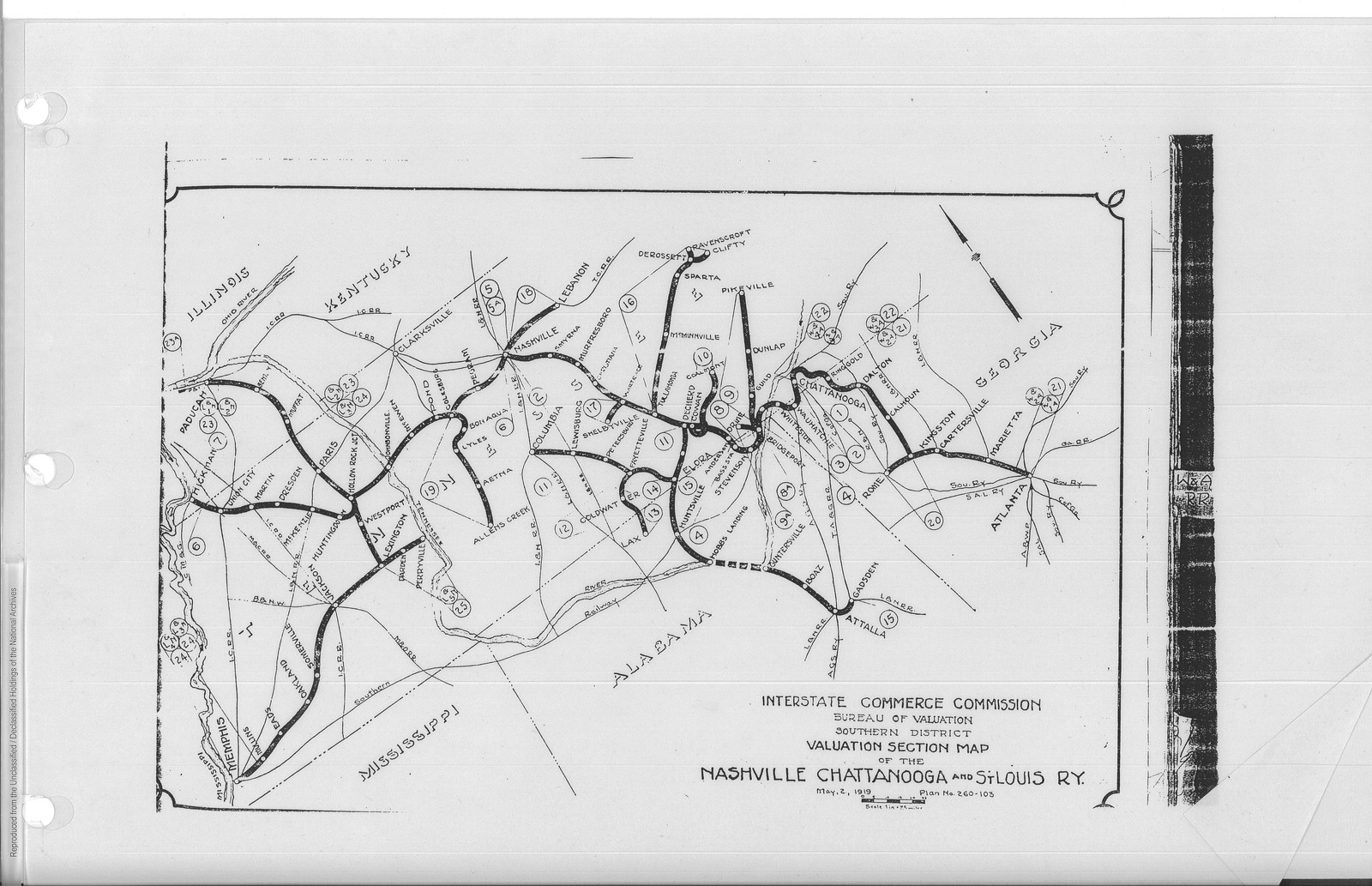
Marion County has been touched by two distinct rail systems and a small constellation of industrial spurs and short branches across roughly 130 years of rail operation. The dominant carrier through the industrial era was the Nashville, Chattanooga & St. Louis Railway (NC&StL), whose main line, branch lines, depots, and corporate succession are treated in their own dedicated page. This page is the broader inventory: a corridor-by- corridor walk of every line that ran rails in or across Marion County, the Sewanee Mining (Mountain Goat) Railroad which served the plateau immediately above the county, the industrial spurs that fed the foundries and the cement plant, the smaller switches and flag stops that have left their names on the modern road grid, and the post-1985 pattern of abandonment and rail-to-trail conversion that has defined the corridor's modern second life.
The NC&StL system in Marion County
Most of Marion County's rail history is the NC&StL story. The dedicated NC&StL Railway page covers the main-line history, the antebellum chartering, the Civil War-era U.S. Military Railroads operation through the gorge, and the corporate succession into L&N and then CSX. This page covers the county-side branch network in slightly more detail than the main NC&StL page, and focuses especially on the smaller stops, switches, and spurs.
Jasper Branch Railroad (1867)
The Jasper Branch Railroad, completed in 1867, was the first rail line into Marion County. It ran from Bridgeport, Alabama on the NC&StL main line northward to the county seat at Jasper, a distance of roughly fifteen miles. The branch was the single most consequential piece of infrastructure in opening the Sequatchie Valley to national markets, and it was the precondition for the British-capital-driven industrial development that followed. Without the Jasper Branch, the Battle Creek mining begun in 1854 could not have been sustained at industrial scale, and the South Pittsburg foundries of the 1870s and 1880s could not have moved iron ore in or finished iron out at national-market prices.
The Jasper Branch's depot at Jasper still stands, in modern use as the city hall.
Inman Branch Railroad (1883)
The Inman Branch Railroad, completed in 1883, connected the iron-ore mines at Inman to the coke ovens at Victoria, integrating the county's iron-and-coke production chain across a single rail-served corridor. The Tennessee Coal, Iron and Railroad Company (TCI) took over the Inman mines and surrounding operations in the late 1880s and held them through the 1892 Coal Creek War, when free Marion County miners freed convict laborers from the TCI stockade at Inman in coordinated solidarity with the broader statewide convict-leasing revolt; the Inman convict-leasing episode is treated on the labor history page.
The Inman depot survived into the late 20th century but is no longer in active rail use; the rails have been lifted from the spur to the original Inman mine portals. The Inman Branch corridor remains legible as a graded right-of-way running through the community and as inset fills along the Marion County valley floor.
Pikeville Branch Railroad (1891) and the Sequatchie Valley Branch consolidation
The Pikeville Branch Railroad, completed in 1891, extended the NC&StL line northward from Jasper through Whitwell and up the Sequatchie Valley to Pikeville in Bledsoe County, a reach of about forty miles. The Pikeville Branch opened the upper Sequatchie Valley to coal shipping, tied the Whitwell coal operations into the regional rail network, and eventually carried the dedicated spur that branched off at Deptford (later Richard City) to serve the Dixie-Portland Cement plant from 1906 forward, pulling Marion County's largest 20th-century manufacturer into the same regional rail grid that had served the coal-and-iron boom.
The Jasper, Inman, and Pikeville Branches were operated as a single integrated network by the NC&StL through the 20th century and are referred to collectively in the railroad's own published timetables and in the South Pittsburg Historic Preservation Society's Sequatchie Valley Railroad overview as the Sequatchie Valley Branch Railroad. That overview is the principal secondary source for the consolidated branch's local history; for corporate timetabling and the broader system context, the dedicated NC&StL Railway page remains the primary entry.
Orme Branch (1902)
A separate spur to Orme was built in 1902 after Chattanooga businessman Frederick Gates negotiated with NC&StL to extend service into the narrow valley where the original Needmore coal operation sat. The spur was short, steep, and single-purpose, running from the Sequatchie Valley main line up into the Orme basin to serve the Campbell Coal and Coke Company (later Tennessee Consolidated Coal Company) operations. At its peak, Orme shipped about a thousand tons of coal per day over the branch. The line outlasted the original Needmore name, which was replaced by Orme in 1902 after Chattanooga businessman Richard Orme Campbell (1860–1912) reorganized the operation as the Campbell Coal and Coke Company and renamed the town after his son (Wikipedia — Orme, Tennessee); the Orme coal mines closed in 1970, which closed the rail branch with them. The Orme depot still survives as one of the town's few remaining original buildings.
Dixie-Portland spur (1906)
The Dixie-Portland Cement spur, completed in 1906, branched off the Pikeville Branch at Copenhagen (renamed Richard City in 1914 after company president Richard Hardy) to serve the cement plant. At the 1927 plant peak, Richard City shipped the equivalent of approximately six thousand barrels of cement per day, almost all of it by NC&StL rail. The spur ran through the cement plant property and into the workers' housing at Richard City; it carried not only the finished cement but also the inbound limestone, gypsum, fuel, and labor required to keep the plant in operation.
The Dixie-Portland spur was the only piece of Marion County rail infrastructure directly tied to the Rexton venture in 1909-1912 (see Rexton), as the proposed five-mile spur from Copenhagen into King's Cove was to branch off this same Dixie-Portland line. That proposed spur was completed only as far as the Clayton Jenkins residence in early 1910 before the Rexton project failed.
Switches, flag stops, and the smaller stations
Beyond the named depots, the Sequatchie Valley Branch carried a working set of small switches and flag stops:
- Condra Switch, on the upper Sequatchie Valley Branch between Whitwell and Powells Crossroads, served the Condra hamlet and its J. E. Condra Blacksmith Shop and John Condra Store. The switch survived as the place-name Condra Switch Road, which still carries the modern road grid through the hamlet (see the Condra community page for detail).
- Moffat Station, an upper-valley flag stop, has lent its name to a place still recognized on regional maps; the station itself was a small wooden shed type rather than a depot building.
- Sequatchie and Ladd were small flag stops named for the river itself and for a local family. Both saw passenger service in the early 20th century but were never large enough to support depot infrastructure.
The cumulative effect of the switches and flag stops was that rail access in the Sequatchie Valley was substantially denser than the main-depot list (South Pittsburg, Deptford / Richard City, Kimball, Jasper, Victoria, Inman, Whitwell, Orme) suggests. Smaller mines, farm-supply businesses, and individual landowners in the valley could flag a train at Condra Switch or at one of the smaller stops, ship a single boxcar of coal, lumber, or produce, and receive supplies inbound the same way.
The Sewanee Mining Railroad (Mountain Goat)
Outside the NC&StL system, the most consequential rail line in or near Marion County was the Sewanee Mining Railroad, popularly known as the Mountain Goat Railroad. It was built between 1853 and 1856 by the Sewanee Mining Company to connect the plateau-top coal fields around Tracy City and Palmer (in Grundy County) to the Nashville & Chattanooga main line at Cowan in Franklin County. The line climbed what was then one of the steepest mainline-railroad grades in the United States, which gave the branch its enduring nickname.
Operationally the line was passed through several owners and several names. The Sewanee Mining Company began the operation; the NC&StL took over the branch in the late 19th century; the L&N inherited the property after the 1957 NC&StL merger; CSX inherited it from L&N. CSX abandoned the line in 1985 as plateau coal traffic ended and as the steep grade rendered the line uneconomic for any other freight. The Marion County dimension of the corridor is small but real: the Mountain Goat passed across the Marion-Grundy county line at the Monteagle area, and a section of the southern edge of the line runs along that line.
The corridor's second life is the Mountain Goat Trail, a paved rail-to-trail managed by the Mountain Goat Trail Alliance; the trail's history, current open segments, planned extensions, and Marion County relationship are treated on its dedicated culture page. Marion County's direct trail access is on its northwest corner near Monteagle, with a short section of the corridor crossing the county line.
Industrial spurs in the county
Several smaller industrial spurs ran inside Marion County in addition to the named branch railroads. Most were short, single-purpose, and built by the operating industries themselves rather than by the carrier railroad. They have left a clear trace on the modern landscape in the form of grading cuts, surviving rails, and roadbed alignments visible from the air.
- South Pittsburg foundry sidings. The Lodge Manufacturing foundry, the predecessor South Pittsburg Iron Furnace operations, and the smaller iron and stove-manufacturing concerns along Cedar Avenue all maintained sidings off the NC&StL Jasper Branch. These were the connections that moved iron ore inbound from Inman, coke inbound from Victoria, and finished foundry product outbound to national markets.
- Hales Bar Dam construction siding (1905 to 1913). The construction of Hales Bar Dam required a temporary heavy-haul rail siding that brought construction materials, cement, and equipment to the dam site at Guild. The siding was lifted after the dam was completed; the alignment is no longer visible at ground level today, but is referenced in period construction photographs.
- Dixie-Portland Cement plant (1906 onward). Beyond the inbound spur off the Pikeville Branch, the plant itself ran an internal switching network connecting the limestone quarry, the kiln line, and the warehouse loading docks. The internal network was operated by the cement company rather than by NC&StL.
- TCI Inman mines (1880s onward). The Inman ore mines maintained an internal network of small spurs running from the main Inman Branch to the individual mine portals. Mine operations on the upper hills above the main siding were served by short tap-tracks rather than by the main branch itself.
- Whitwell coal mine sidings. Multiple small spurs branched off the Pikeville Branch through the Whitwell area to serve the Sewanee Coal mine portals, the Bowater mining-era operations, and (later, in the 20th century) the strip-mine loading points along the south face of Walden Ridge.
A separate South Pittsburg & Valley short-line carrier has appeared occasionally in regional rail-history references, but its operating dates, route, and relationship to the NC&StL Sequatchie Valley Branch have not been confirmed.
Convict labor and the rail-construction record
Several Marion County rail projects intersected with the broader Tennessee convict-leasing system that operated from the 1870s through the 1893 reform and into the early 20th century. The single best-documented case in the county is the Inman convict-leasing episode of 1892, in which the Tennessee Coal, Iron and Railroad Company operated a convict stockade at Inman to supply the labor for the iron-ore mines and for the spur-track maintenance that kept those mines connected to Victoria and Bridgeport. Free Marion County miners freed the convict laborers in coordinated solidarity with the statewide Coal Creek War; the broader narrative is on the labor history page.
Convict labor was also widely deployed across the original construction of the county's branch lines in the 1880s and 1890s. The contracting practice of the period commonly used "leased" prisoners from the Tennessee Penitentiary system on the steepest grades, the bridgework, and the rock cuts; the precise convict-labor record for the Jasper, Inman, Pikeville, and Orme Branches in Marion County itself has not been pulled out of the secondary sources at this depth. The labor history page treats the convict-leasing system in detail, with the Marion County focus on the Inman episode.
The Cincinnati Southern Railway, often referenced in regional rail history as a notable convict-labor construction project of the 1870s, ran from Cincinnati through Scott County, Tennessee to Chattanooga via the Tennessee plateau corridor that did not pass through Marion County. The most-cited Cincinnati Southern convict-labor anecdote, the November 1874 Cincinnati Enquirer account naming the Cherry O'Conner and W. H. Cox contracting firms with three hundred Tennessee Penitentiary prisoners at work, places that work on Scott County stretches of the line, not in Marion County. The Cincinnati Southern is therefore part of the broader regional convict-labor record but not a Marion County rail project itself.
Post-1985 abandonments and rail-to-trail conversions
The most consequential rail-network event in Marion County since World War II was the wave of branch-line abandonments that ran through the 1970s and into the late 1980s as the underlying coal, iron, coke, and cement industries closed.
- Orme Branch: abandoned shortly after the closure of the Orme coal mines in 1970. The branch had no other industry to serve once coal stopped; rails were lifted in the early 1970s.
- Mountain Goat Railroad: abandoned by CSX in 1985 after the end of plateau coal traffic. The corridor passed to private ownership and was eventually transferred to the Mountain Goat Trail Alliance, which has converted opening segments to paved trail (see the Mountain Goat Trail page).
- Upper Pikeville Branch: the segments above the active Whitwell coal-shipping territory were progressively abandoned through the late 20th century as upper-valley shipper traffic dwindled.
- Inman Branch and various smaller spurs: rails were lifted from many of the side-spurs as the iron-ore and cement operations they served closed or contracted.
- Dixie-Portland spur: the spur to the Richard City cement plant continued to see traffic into the late 20th century but contracted with the plant; the principal alignment is preserved as a graded corridor.
The formal Interstate Commerce Commission abandonment dockets for these line-abandonment proceedings (each abandonment required an ICC docket, with public notice and a "no shippers remaining" finding) are held at the National Archives in records of the ICC and its successor Surface Transportation Board.
Active CSX operations today
CSX Transportation, the inheritor of the NC&StL system, continues to run freight service on portions of the historic Marion County rail network. The Sequatchie Valley main line from Bridgeport, Alabama through Jasper carries timber, aggregates, and chemical traffic; the Jasper-to-Bridgeport connection remains a working interchange between the Marion County branch and the CSX main line. Several of the historic mid-century depots survive in adapted reuse, principally the Jasper depot (now Jasper City Hall) and the Orme depot. No passenger service has stopped at any Marion County depot since the mid-20th century.
Locomotive rosters and rolling-stock detail
The principal preserved NC&StL equipment is held at the Tennessee Central Railway Museum in Nashville (locomotive No. 576) and at the Tennessee Valley Railroad Museum in Chattanooga. Marion-County-specific rolling-stock operating records (specific locomotive assignments, freight-car routings, depot-by-depot loadings and unloadings) sit primarily in the NC&StL Historical Society, the L&N Historical Society, and individual museum archives. The Sequatchie Valley Branch ran a mix of branch-line steam power into the 1950s and diesel road-switchers thereafter.
Why it all matters
Marion County's modern geography is still framed by where the rails went and where they did not. The Sequatchie Valley settlement pattern, with the named communities clustered along the branch-line route from Jasper through Victoria, Inman, Whitwell, and on to Orme, is a direct expression of the 1867-1902 rail-extension sequence. The community names that survive in road-grid form, Condra Switch Road, Ketner Mill Lane, Ladd, Moffat, and many others, are the inheritance of those switches and flag stops. The post-1985 quiet of the Mountain Goat corridor, the Orme branch grade, and the upper-Pikeville right-of-way is the inheritance of the underlying industrial-economy contraction that the rail-network abandonments tracked. Where the rails go, and where they used to go, still defines where people live, work, and travel through the county.
Related
NC&StL Railway (the corporate-history deep dive) →
Marion County transportation history (multi-mode landing) →
Mountain Goat Trail (the rail-to-trail second life) →
Marion County labor history (the convict-leasing record at Inman) →
Dixie-Portland Cement (the principal rail customer at Richard City) →
Marion County coal and coke industry →
Hales Bar Dam (1905-1913 construction siding) →
Condra and Condra Switch →
Orme →
Rexton (the proposed Dixie-Portland-spur extension that failed in 1912) →
Sources
- Wikipedia — Nashville, Chattanooga and St. Louis Railway
- Wikipedia — Sequatchie Valley Railroad
- South Pittsburg Historic Preservation Society — Sequatchie Valley Railroad (the Jasper, Inman, Pikeville, and Orme Branch consolidation, depot inventory, and the Dixie-Portland spur)
- Tennessee Encyclopedia — NC&StL Railway
- Tennessee Encyclopedia — Marion County
- Appalachian Railroads — Nashville Chattanooga & St. Louis Railway
- Chattanoogan — Tri-state Sequatchie Valley Branch Railroad rail stops (Condra Switch and the smaller depot inventory)
- Mountain Goat Trail Alliance — The Trail (Mountain Goat Railroad history, NC&StL operation, 1985 abandonment)
- Tennessee Valley Railroad Museum (NC&StL preserved equipment)
- Wikipedia — Cincinnati Southern Railway (the regional convict-labor construction record; cited here only to establish that the line did not pass through Marion County)