Last updated: April 28, 2026
- Type: Ghost town (built but abandoned within three years)
- Location: Head of King's Cove, on the mountain above the cove floor; the cove proper extends south into Alabama near Bridgeport, but the Rexton town site is on the Tennessee side of the state line, in the southwestern corner of Marion County
- Named for: Ringland Fisher "Rex" Kilpatrick (1881-1955), primary investor
- Operating company: Tennessee River Coal Company
- Land purchase: Early 1909 by Kilpatrick-led investor group
- Earlier mining on the same lands: R. A. Patton and Gaines coal lands (late 19th century, less extensive)
- Town site engineer: Captain George W. Crozier
- Mining-town contractors: R. A. & B. F. Patton (offices in the First National Bank building, South Pittsburg)
- Railroad contractors: R. A. & B. F. Patton and J. N. Dietzen
- Right-of-way and water rights: John Berry Wynne, deeded September 30, 1909
- Railroad ground broken: October 6, 1909, for a five-mile spur from Copenhagen (Richard City) into King's Cove
- Town incorporated: October 31, 1910
- Construction at full pace: January 1910; substantial weather delays in early March 1910
- Coal vein found to be much thinner than the surveys had predicted: 1910 to 1911
- Frank J. Kilpatrick (Rex's father) died in New York City: November 4, 1911
- Railroad partly washed out by a flash flood: 1911
- Backers walked away: 1912
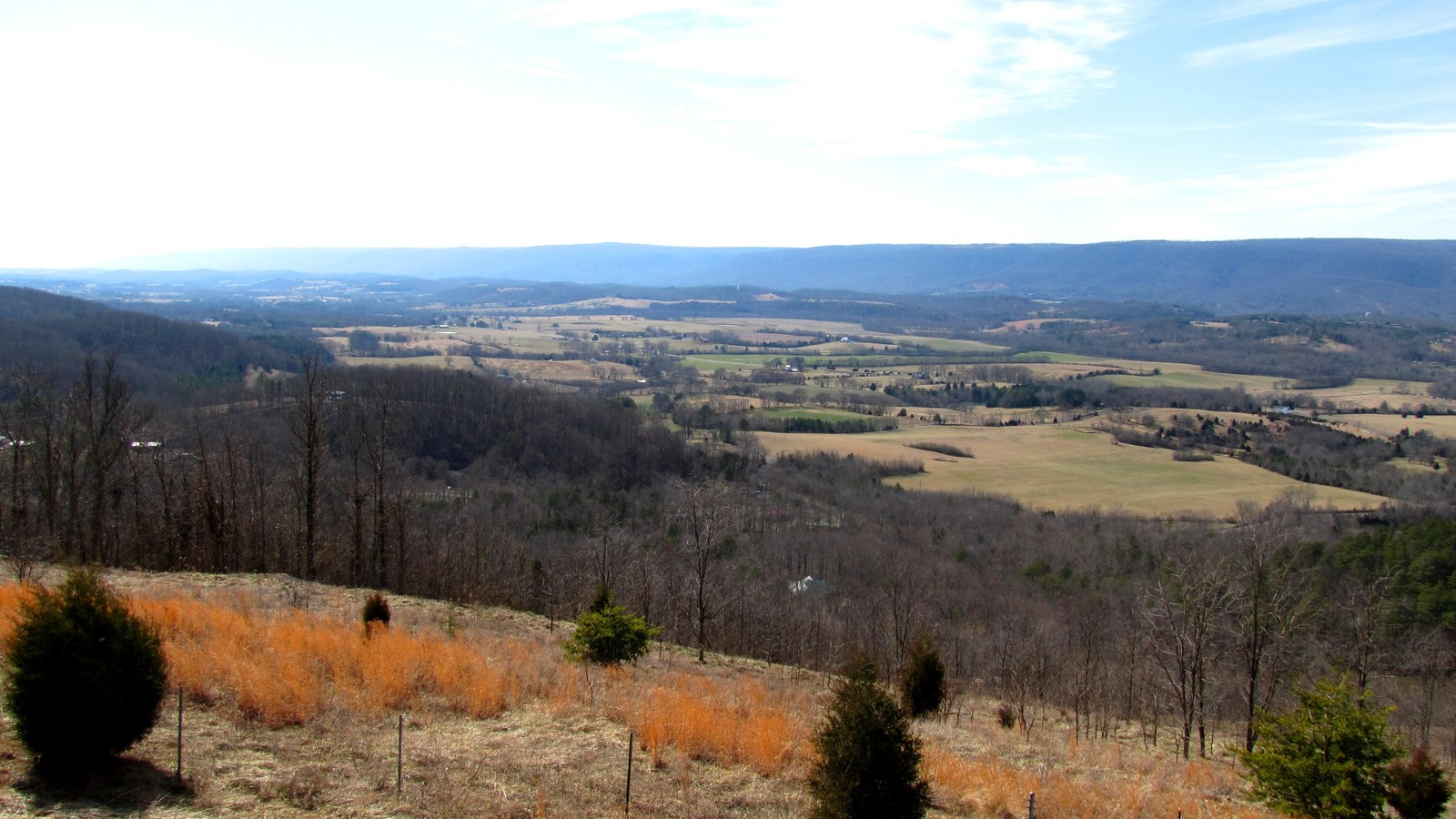
Rexton is among the quieter entries in Marion County's roster of places: a coal-mining town that was platted, started, and abandoned in three short years before it ever became a real community. Its name derives from Ringland Fisher "Rex" Kilpatrick (1881-1955), a New-York-based mining investor whose family had earlier underwritten the Bridgeport, Alabama boom of the 1890s and who returned to the same county-line corner of the southern Appalachians in 1909 to try again. The site at the head of King's Cove survives today as bridge abutments, a long stone retainer wall, the concrete supports of the coal tipple, scattered cabin foundations, the bed of the spur railroad cut through the hillside, and the incline that ran from the mine entry down to the loading dock. None of the built structures survive intact.
Setting
Rexton sits at the head of King's Cove, a narrow plateau cove on the Cumberland escarpment in the southwestern corner of Marion County. The cove's cove floor proper extends south into Jackson County, Alabama, near Bridgeport, with the Tennessee- Alabama state line running along the cove's southern reach. The town site itself was on the Tennessee (Marion County) side, on the mountain above the cove floor where the targeted coal seam outcropped. The cove is high-walled and narrow, with steep sandstone rims and a thin strip of bottomland along a small creek that drains south toward the Tennessee River bottom near Bridgeport. The proposed coal-shipping route was an extension railroad dropping from the cove down to a connection with the Dixie Portland Cement plant's spur off the Pikeville Branch Railroad at Copenhagen (now part of Richard City). Surrounding country is forest and old farmland; the route in and out of the cove is difficult today and was difficult then.
King's Cove was part of the Chickamauga (Lower) Cherokee homeland through the late 18th century, with the closest of the Lower Towns at Nickajack and Long Island a few miles east. The remaining Cherokee community was forcibly removed along the Trail of Tears in 1838, roughly seventy years before the Rexton venture arrived. The Cherokee Nation continues today as a sovereign nation headquartered in Oklahoma. After the 1838 removal, the cove floor was settled by Anglo-American farmers, and small-scale coal extraction occurred on the same Marion County uplands during the late 19th century in what was known as the old R. A. Patton and Gaines coal lands. The Patton-Gaines workings were limited but profitable enough to encourage the much larger 1909 venture. Today the cove floor is largely the farm of the Grider family; the Rexton ruins are reached across pastures from the road that follows the original Rexton Railroad bed through the cove.
The 1909 venture
In early 1909, an investor group led in part by Ringland Fisher "Rex" Kilpatrick of New York purchased land at the head of King's Cove. The pitch to investors leaned on three things: the working Battle Creek coal seam already producing in the neighboring covers (Doran's Cove and Sweeden's Cove); engineering surveys that concluded the same seam extended into King's Cove; and the modest but real success of the earlier R. A. Patton and Gaines workings on the same uplands. The Kilpatrick group organized as the Tennessee River Coal Company and announced plans to mine the King's Cove seam, ship coal out via the Dixie-Portland spur, and build a permanent company community on the mountain to be named Rexton in Kilpatrick's honor.
The contracting work was assigned to local construction firms based in South Pittsburg. R. A. & B. F. Patton took the contract for the mining town's buildings and opened a project office in the First National Bank building in South Pittsburg. The same Patton firm, together with J. N. Dietzen, was contracted for the five-mile spur railroad from Copenhagen into King's Cove. Town-site and mine-entry engineering went to Captain George W. Crozier, who began layout work earlier in 1909.
Right-of-way and water-rights agreements were secured from cove landowners through the late summer of 1909, including a wagon-road and water-rights deed from John Berry Wynne recorded on September 30, 1909. On October 6, 1909, ground was broken at the King's Cove town site for the five-mile railroad. Patton and Dietzen brought supplies and tools onto the ground and moved into a winter-spring construction push.
By January 1910, work was progressing rapidly, with Crozier and the Patton firm targeting completion of the town and the railroad by spring of that year. On the mountain town site, construction was under way on a nineteen-room hotel, a seven-room office building, a two-story store building, and approximately thirty-five three- and four-room worker cottages, all in advanced framing or finishing as of January. Mining infrastructure was being installed alongside: a horse-drawn coal car and tipple, the incline rail bed running down from the mine entry to the loading point, hand-hewn sandstone-and-limestone bridge abutments along the spur railroad route, and a stone retainer wall about a hundred and fifty feet long and ten feet high holding the railroad bed against the slope.
The first serious setback came in early March 1910, when sustained bad weather rendered the wagon roads into the cove nearly impassable, slowing the inflow of construction supplies. By the time the rail spur reached the residence of cove farmer Clayton Jenkins, completion of the railroad to the mines was held up waiting for conditions to improve. The town was nonetheless formally incorporated on October 31, 1910, with the railroad and the bulk of the town's buildings nearing completion. A photograph dated to roughly 1911, the only known image of the operating mine, shows a horse pulling a coal car out of the mine entry for transport down the incline to the tipple.
The collapse (1911 to 1912)
Two simultaneous failures killed the Rexton venture inside a calendar year of the town's formal incorporation.
First, the coal seam was much thinner than the surveys had predicted. Once the company began driving entries into the King's Cove uplands, the mining engineers found that the seam projected from the Doran's Cove and Sweeden's Cove operations did not maintain its thickness across the cove. The vein narrowed as the entries advanced, and even sustained mining produced too little coal to recover the capital that had been sunk into the railroad, the town buildings, and the right-of-way agreements. Without a thick, regular seam to feed the tipple, the entire economic premise of Rexton failed.
Second, the venture's chief financial backer was destabilized in late 1911. On November 4, 1911, Frank J. Kilpatrick, Rex Kilpatrick's father and one of the principal sources of the venture's New York capital, died in New York City. Frank J. Kilpatrick and his brother Walter F. Kilpatrick had been the primary investors in the Bridgeport, Alabama boom of 1888 to 1893, in which the family had backed an effort to develop Bridgeport into what newspaper coverage at the time called "the New York City of the South." The Bridgeport boom collapsed in the Panic of 1893, leaving behind a row of Queen Anne homes built by Frank J. known today as "Kilpatrick Row" in Bridgeport as a small surviving memorial to that earlier failed project. With his father gone and the family's Bridgeport-era confidence already chastened, Rex Kilpatrick lost both an investor and a political shield in the New York banking circles where the Tennessee River Coal Company was raising its operating capital.
Compounding both blows, the railroad into King's Cove was partly washed out by a flash flood in 1911. The Patton-Dietzen contractors had hand-built the spur through difficult terrain over the previous two years; rebuilding washed-out sections at the same time the seam was reading thin, the founder's father had just died, and the broader money market was tight, was beyond what the company could sustain. By 1912, the backers had walked away from Rexton. Most of the salvageable building materials were stripped, either by the company recovering investment or by cove farmers reusing lumber and hardware on their own properties. The buildings that were not stripped deteriorated quickly in the next few decades.
What remains
The standing ruins in King's Cove are the most legible example of an early-20th-century coal-rush failure on the ground in Marion County. Surviving features include:
- The concrete supports for the coal tipple, set in line on the slope below the original mine entry
- Multiple pairs of railroad bridge abutments for the spur railroad, made of hand-hewn sandstone and limestone blocks, standing roughly eight feet tall along the route in and out of the cove
- The stone retainer wall approximately one hundred and fifty feet long and ten feet high, holding the spur-railroad bed against the slope
- The incline rail bed leading up the mountain side from the tipple to the original mine entry
- Cabin stone-block chimney remnants and other small foundations from the worker cottages
- An underground concrete storage unit of unknown function adjacent to the town site
- The original railroad bed still legible as it crosses the pastures of the Grider family farm and cuts across the cove from the Copenhagen end
Period sections of rail itself are still visible in the cove. A 1911 photograph of the operating mine, courtesy of Marion County local historian Noni Webb, is the only known image of Rexton in operation. The site is privately owned, and visitors are asked to contact the landowner before walking the ruins.
The Kilpatricks and the Bridgeport-Rexton arc
The Rexton venture is best understood not as a one-time mistake but as the second of two Kilpatrick-family attempts to develop the Tennessee-Alabama state-line corner of the southern Appalachians. The earlier attempt, the Bridgeport boom of 1888 to 1893, was led by Rex Kilpatrick's father Frank J. Kilpatrick and uncle Walter F. Kilpatrick; it produced the Kilpatrick Row of Queen Anne houses in Bridgeport before being undone by the Panic of 1893. The same New York capital base, two decades later, funded Rex Kilpatrick's Tennessee River Coal Company, with the same instinct that the coal-and-iron-rich plateau corner south of Chattanooga held the next big extractive opportunity. The Rexton failure of 1912 closed the second venture, ended the family's operating involvement in southern Appalachian coal, and confirmed in retrospect that the Battle Creek seam's profitability did not extend uniformly across every neighboring cove.
Rex Kilpatrick himself outlived the Rexton venture by more than four decades. He returned to New York after 1912, lived through both world wars, and died in 1955; the only known photograph of him, courtesy of his descendant Rex K. Bray, is the portrait reproduced on the SPHPS ghost-towns page. His career after Rexton has not been traced in Marion County local-history sources.
Rexton in Marion County's broader story
Rexton is a useful counterpoint to the success stories of the county's industrial era. Unlike Orme, which managed a real boom decade despite similar early troubles, and unlike South Pittsburg, which survived the failure of the Tennessee Coal, Iron and Railroad Company's ambitions to become a small but durable industrial city, Rexton never got off the ground. It is a record of how many of the speculative coal-and-iron-rush projects of the 1880s through 1910s never became anything. For every South Pittsburg or Whitwell, Marion County carried several Rextons: places that hopeful investor maps once showed as future industrial centers, now absorbed back into the surrounding hollows. The coal and coke industry page covers the broader pattern of Marion County coal-extraction enterprises that succeeded, failed, and consolidated through the same period.
Related
Coal & coke industry →
Richard City (the Copenhagen rail connection point) →
Orme (the Marion County coal town that did manage a boom) →
Battle Creek (the original 1854 seam the Rexton venture extrapolated from) →
Transportation history of Marion County (the Pikeville Branch and Dixie-Portland spur context) →
Sources
- South Pittsburg Historic Preservation Society — Rexton, Tennessee (Dennis Lambert narrative, February 2006, last updated June 26, 2007; covers the 1909 land purchase, Tennessee River Coal Company, R. A. & B. F. Patton and J. N. Dietzen contracting work, Captain George W. Crozier engineering, John Berry Wynne right-of-way, October 6, 1909 ground-breaking, January 1910 building program, October 31, 1910 incorporation, 1911 thin-seam discovery, November 4, 1911 death of Frank J. Kilpatrick, 1911 flash flood, 1912 abandonment, surviving ruins, Kilpatrick family role in the 1888 to 1893 Bridgeport boom and Kilpatrick Row Queen Anne homes; with the only known 1911 mine photograph courtesy Noni Webb and the Rex Kilpatrick portrait courtesy Rex K. Bray)
- Marion County Coal Mines — TNGenWeb
- Wikipedia — Bridgeport, Alabama (the 1888 to 1893 boom and the Kilpatrick family's role)
- Wikipedia — Panic of 1893 (the broader market collapse that ended the earlier Kilpatrick venture)