Last updated: April 23, 2026
- Full name: Nashville, Chattanooga & St. Louis Railway
- Predecessor: Nashville & Chattanooga Railroad (chartered December 11, 1845; operational February 11, 1854)
- Organized as NC&StL: 1873
- L&N controlling interest: 1880
- Merged into L&N: 1957
- Successor: CSX Transportation (via L&N → Seaboard → CSX)
- Marion County branches: Jasper Branch (Bridgeport to Jasper, 1867); Inman Branch (Inman to Victoria, 1883); Pikeville Branch (Jasper to Pikeville, 1891)
- Marion County depots: South Pittsburg, Deptford (Richard City), Kimball, Jasper, Victoria, Inman, Whitwell, Orme
The Nashville, Chattanooga & St. Louis Railway, commonly abbreviated NC&StL, was the dominant rail carrier through Marion County during the industrial era. Its lines connected the coal, iron, and coke operations of the Sequatchie Valley to the regional trunk network, and in doing so made the industrial boom of the late 19th century economically viable.
The Nashville & Chattanooga Railroad
The railroad traces its origins to the antebellum Nashville & Chattanooga Railroad, chartered in Nashville on December 11, 1845. It was the first railway to operate in the state of Tennessee. Construction began in 1849, and the 150-mile line between Nashville and Chattanooga took nine years to complete, complicated by the steep elevations of the Highland Rim and Cumberland Plateau. The 2,228-foot Cowan Tunnel near Cowan, Tennessee, was considered an engineering marvel of its era. The railroad reached full operation on February 11, 1854, cutting the old stage journey between Nashville and Chattanooga from twenty-two hours to nine.
The main line did not pass through Marion County, instead crossing the Cumberland Plateau to the north and descending the Tennessee River Gorge along the north bank between Whiteside and Wauhatchie before reaching Chattanooga. But that routing through the northern rim of Marion County produced a set of structures that became consequential during the Civil War. The 780-foot Running Water trestle at Whiteside, carrying the main line across the Running Water ravine, was one of the largest timber trestles in the antebellum South. It was destroyed repeatedly and rebuilt during the Civil War and was progressively replaced with steel and later concrete piers through the early to mid 20th century.
During the Civil War, the Nashville and Chattanooga line was strategically vital to both armies. The Tennessee campaigns of 1862 and 1863 saw Union forces push Confederate troops southward from Nashville to Chattanooga along the railroad corridor. U.S. Military Railroads took over operation of the line after the Chattanooga campaign, rebuilt the bridges and blockhouses along the Marion County reach, and photographed much of the reconstruction work; George N. Barnard's January 8, 1864 photograph of the Whiteside trestle is one of the earliest surviving photographs of any Marion County subject. After the war, the railroad was reorganized and expanded, adopting the Nashville, Chattanooga & St. Louis name in 1873 to reflect its ambitions westward.
The Sequatchie Valley Branch
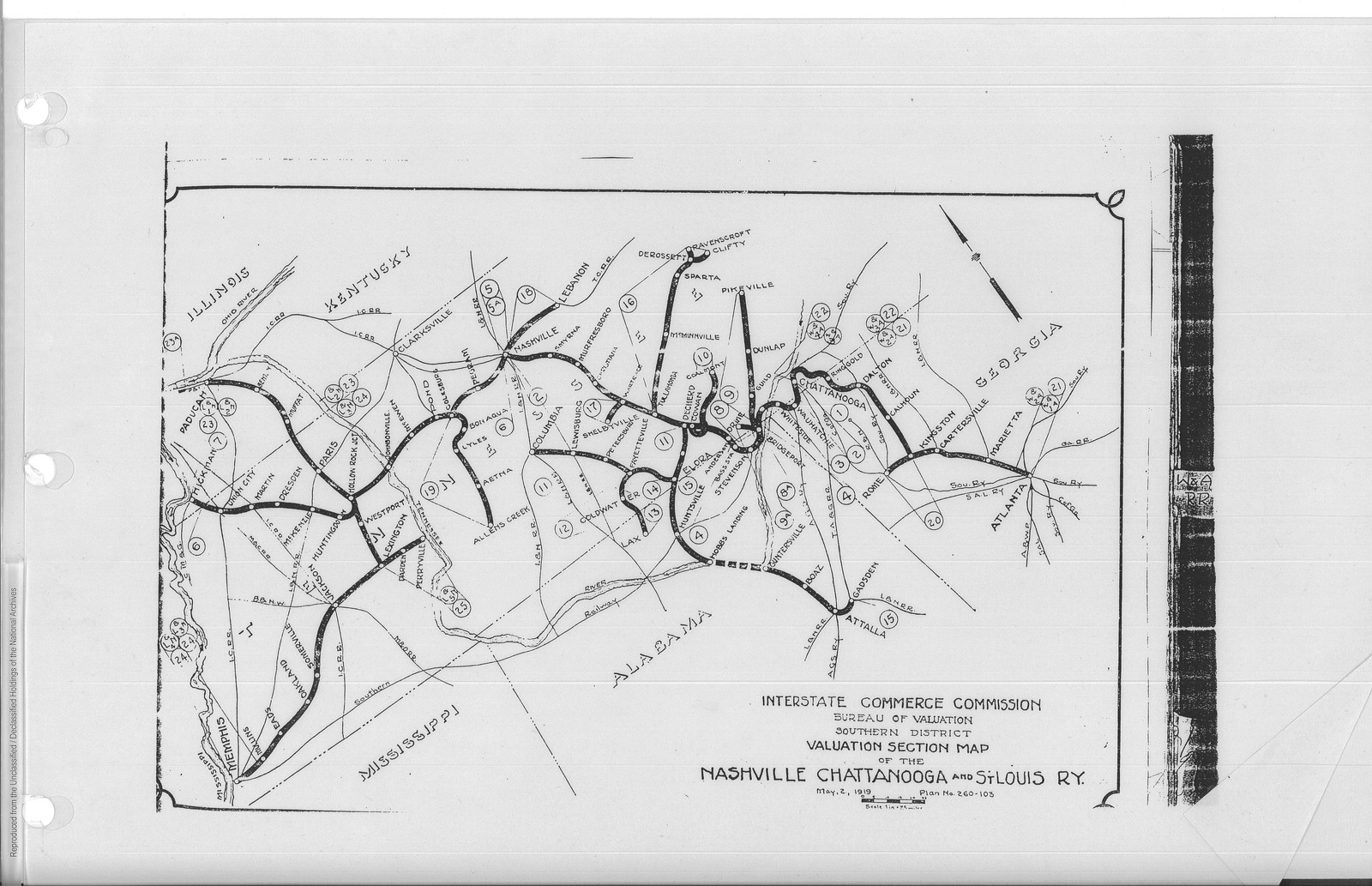
The NC&StL's presence in Marion County was concentrated on the Sequatchie Valley Branch, which was actually composed of three separate branch lines built at different times and later consolidated into a single railroad.
The Jasper Branch Railroad, completed in 1867, was the first rail line into the county. It ran from Bridgeport, Alabama (on the NC&StL main line) northward to the county seat at Jasper, a distance of roughly 15 miles. The branch was one of the earliest post-war extensions of the Tennessee rail network and the single most consequential piece of infrastructure in opening the Sequatchie Valley to national markets. Without the Jasper Branch, the British-capital industrial development that began at Battle Creek in 1854 and accelerated under James Bowron after 1877 would not have been economically viable. See the James Bowron profile on the people page for the broader industrial context.
The Inman Branch Railroad, completed in 1883, connected the iron-ore mines at Inman to the coke ovens at Victoria, integrating the iron-and-coke production chain across a single rail-served corridor. Tennessee Coal, Iron and Railroad Company (TCI) took over the Inman mines and surrounding operations in the late 1880s and held them through the 1892 Coal Creek War, when free miners freed convict laborers from the TCI stockade at Inman. See the labor history subpage for the Inman convict-leasing episode.
The Pikeville Branch Railroad, completed in 1891, extended the line northward from Jasper through Whitwell and up the Sequatchie Valley to Pikeville in Bledsoe County, a reach of about 40 miles. The branch opened the upper Sequatchie Valley to coal shipping, tied the Whitwell coal operations into the regional network, and eventually carried the dedicated spur that branched off at Deptford (later Richard City) to serve the Dixie Portland Cement plant from 1906 forward, pulling Marion County's largest 20th-century manufacturer into the same regional rail grid that had served the coal and iron boom.
A separate branch line to Orme was built in 1902 after Chattanooga businessman Frederick Gates negotiated with the NC&StL to extend service into the narrow valley where the Needmore coal operation sat. The spur was short, steep, and single-purpose, running from the Sequatchie Valley main line up into the basin to serve the Campbell Coal and Coke Company (later Tennessee Consolidated Coal Company) operations. At its peak, Orme shipped about 1,000 tons of coal per day over the branch. The line outlasted the original Needmore name, which was replaced by Orme after Chattanooga businessman Richard Orme Campbell (1860–1912) reorganized the operation as the Campbell Coal and Coke Company in 1902 and renamed the town after his son (Wikipedia — Orme, Tennessee); the Orme coal mines finally closed in 1970, which closed the rail branch with them.
Depots and stations in Marion County
Depots were built at communities along the Sequatchie Valley Branch, including South Pittsburg, Deptford (Richard City), Kimball, Jasper, Victoria, Inman, Whitwell, and Orme. Smaller flag stops served Moffat Station, Sequatchie, Ladd, and several other communities along the branches. Each depot served as a freight and passenger stop, and the depot buildings became civic landmarks in their communities.
Depot closures tracked the decline of the underlying coal, iron, coke, and cement industries. The Kimball depot closed in the mid-20th century as rail passenger service through Marion County ended. The Victoria depot, Inman depot, Whitwell depot, and most of the smaller flag stops followed in the decades after.
As of 2005, three depots on the old Sequatchie Valley line survived. The brick depot at Victoria is now a private residence. The depot at Jasper serves as the city hall. The Orme depot also survives and is one of the town's few remaining original buildings. The preserved depots, together with the grades and cuts still visible along the Sequatchie Valley, are the most legible on-the-ground remains of the NC&StL industrial era.
Role in Marion County industry
NC&StL rail access was a prerequisite for the integrated coal-iron-coke operations that defined the county's late-19th-century industrial economy. Trains moved Whitwell coal to the Victoria coke ovens, Inman iron ore to the smelters at South Pittsburg, and finished pig iron and cement out to national markets. Without the railroad, the entire industrial complex would not have been economically viable: coal and iron ore are heavy, low-value-per-ton commodities that require cheap bulk transport to compete. The branches also carried the mine props, cordwood, and cross-tie timber that the same operations consumed (see the timber and logging subpage), closing the loop between the forest economy and the industrial economy.
At peak, the Dixie Portland spur alone handled a train each direction daily loaded with finished Portland cement for construction markets across the Southeast, and at the 1927 peak the Richard City plant shipped the equivalent of 6,000 barrels of cement per day, nearly all of it by NC&StL rail. Orme's 1,000-tons-per-day coal shipments ran on the 1902 branch to the Sequatchie Valley main line and out to the Bridgeport connection. Whitwell mines shipped coal to Victoria's coke ovens on the Inman and Pikeville lines, and the coke ovens in turn shipped coke to the South Pittsburg smelters. The daily rail-traffic pattern from 1880 to roughly 1930 was extraction inbound to the valley, finished product outbound to Chattanooga, Nashville, and Birmingham.
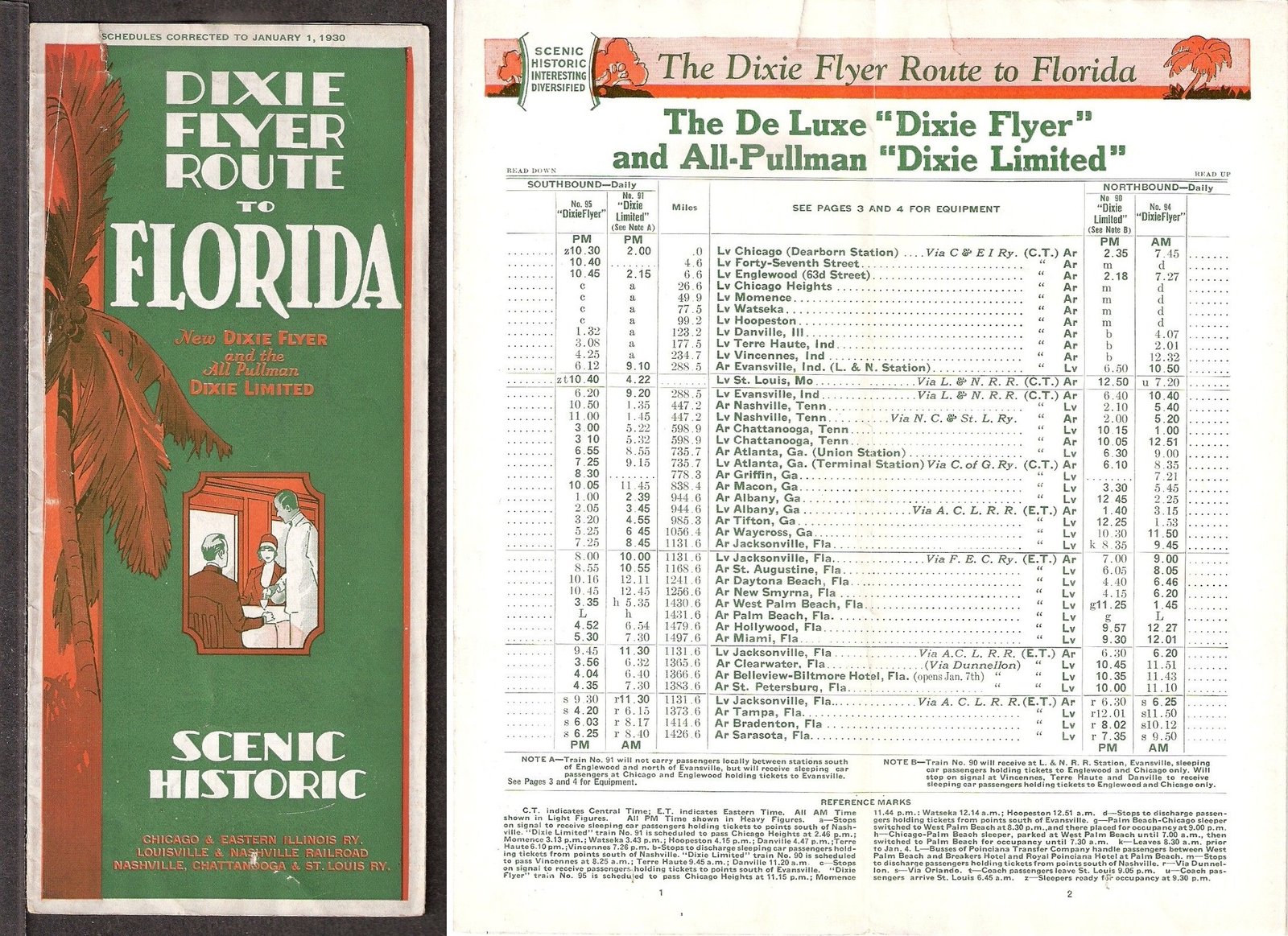
The railroad also served as a passenger carrier, connecting Marion County towns to Chattanooga, Nashville, and the broader NC&StL network. The Dixie Flyer and the Dixie Limited, flagship passenger trains on the NC&StL main line, connected Chicago to Florida via Nashville, Chattanooga, and Atlanta. Marion County's passengers boarded main-line expresses by transferring at Bridgeport, Alabama from the Jasper Branch local service. The Sequatchie Valley branches themselves carried local passenger service into the mid-20th century, with school children, merchants, doctors, and the occasional traveling salesman as the regular clientele, before the post-war rise of the automobile ended the passenger service altogether.
Corporate succession
The Louisville & Nashville Railroad (L&N) acquired a controlling interest in the NC&StL through a hostile stock takeover in 1880, though the two railroads continued to operate separately for decades. By the end of 1925, the NC&StL operated 1,259 miles of road on 1,859 miles of track. The two railroads were fully merged in 1957, ending the NC&StL as a separate entity. The combined network was later folded into the Seaboard System and ultimately into CSX Transportation, which still operates freight service on portions of the historic route through Marion County.
Passenger rail service to Marion County ended in the mid-20th century as highway travel took over. No passenger trains stop in the county today.
Present-day CSX operations
CSX Transportation, the inheritor of the NC&StL network, continues to run freight service on portions of the historic Marion County route. The Sequatchie Valley main line carries timber, aggregates, and chemical traffic; the Jasper Branch connection at Bridgeport remains in service. The Orme branch, the Pikeville Branch north of active shipper territory, and several other subsidiary spurs were abandoned after their serving industries closed, with rails lifted and grades returned to right-of-way-only status. Present-day rail freight is a small fraction of what the NC&StL carried in the 1920s, but the physical corridor that the railroad cut through the county between 1867 and 1902 still frames much of its modern geography.
Legacy
The NC&StL left its mark on the physical geography of Marion County: surviving depots, grades, cuts, trestles, and a network of place-names that still anchor the community map. Several Marion County towns, including Orme and Richard City, were essentially built along its line. The community of Whitwell was itself renamed to honor Thomas Whitwell, a British metallurgist and cofounder of the Southern States Coal, Iron and Land Company who was killed in an 1878 ironworks accident; the railroad's arrival helped solidify the town's identity as a mining community.
Beyond the physical corridor, the railroad also left a civic legacy. Depot agents, telegraphers, track-crew foremen, and conductors formed a recognizable layer of Marion County's late-19th and early-20th-century middle class, and the NC&StL payroll underwrote homes, schools, and churches in the branch-line towns long after the coal and iron operations contracted. The 1957 merger of NC&StL into L&N consolidated the payrolls into L&N's Louisville headquarters; the local rail workforce shrank steadily through the 1960s and 1970s under successive rounds of dieselization, track consolidation, and the Seaboard and CSX restructurings that followed.
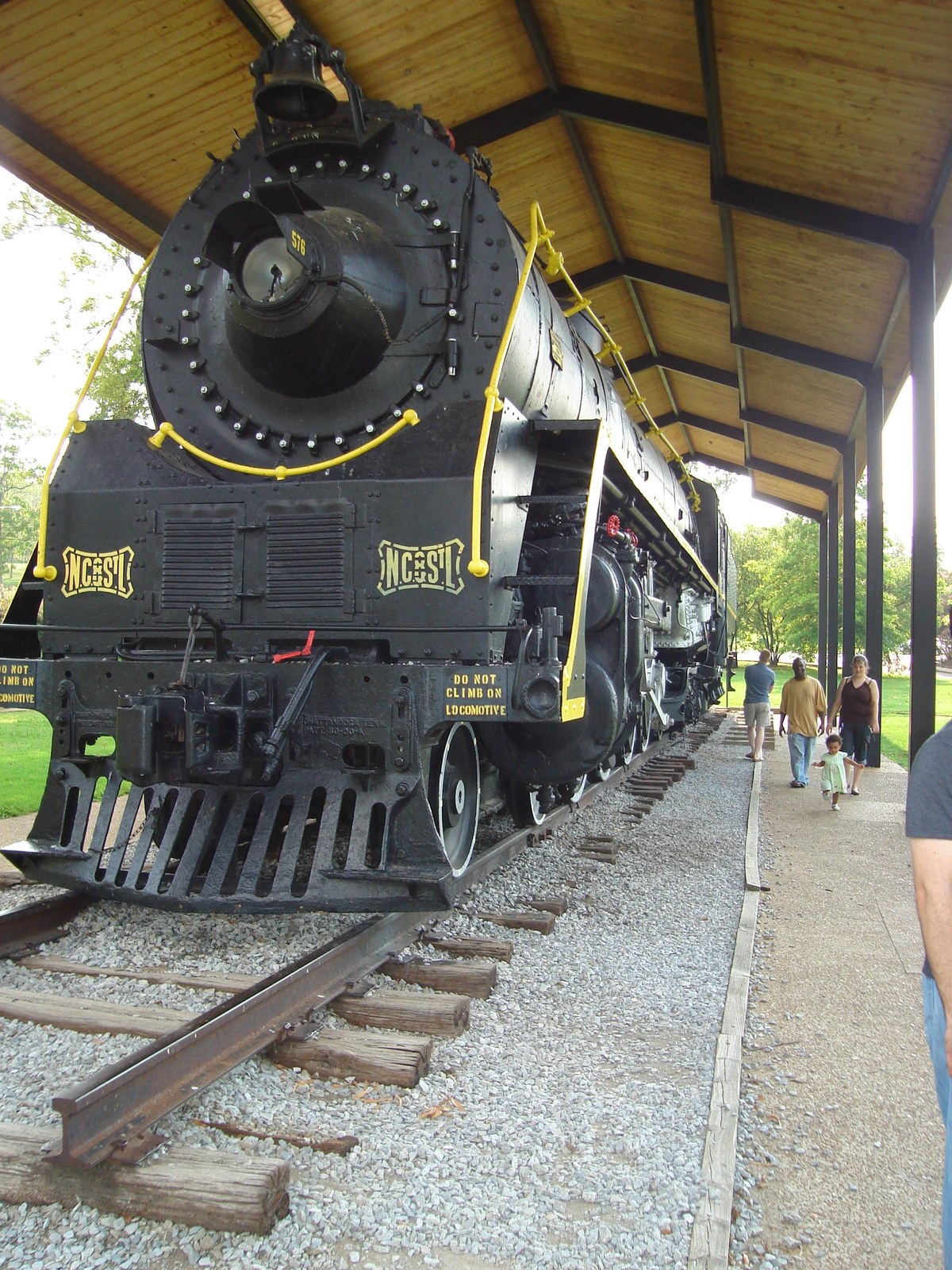
Historic NC&StL equipment is preserved at the Tennessee Central Railway Museum in Nashville (including locomotive No. 576) and at the Tennessee Valley Railroad Museum in Chattanooga. The Orme depot survives as one of the town's few original structures. The Running Water trestle at Whiteside, rebuilt repeatedly since the 1854 original, is still in active use on the present CSX main line running along the northern rim of the county.
Related
About the Coal & Coke Industry →
About Dixie Portland Cement →
About Transportation History →
About Orme →
About South Pittsburg →
About Jasper →
About Whitwell →
About Inman →
About Victoria →
Sources
- Wikipedia — Nashville, Chattanooga and St. Louis Railway
- Wikipedia — Sequatchie Valley Railroad
- Tennessee Encyclopedia — NC&StL Railway
- Tennessee Encyclopedia — Marion County
- Historic South Pittsburg Preservation Society — Sequatchie Valley Railroad
- Appalachian Railroads — Nashville Chattanooga & St. Louis Railway
- Tennessee State Museum — The First Railroad in Tennessee