Last updated: April 27, 2026
- Type: Pre-1876 post-office community (predecessor to South Pittsburg)
- First mine on site: 1854, the fifth coal mine opened in Tennessee, after Rockwood (1831), Roane County (1841), Sale Creek (1843), and the Etna Mines (1852)
- Post office: Battle Creek Mines, 1869–1876 (renamed to South Pittsburg on May 23, 1876)
- Successor name at Orme: Battle Creek Coal & Coke Company, 1905, head of Doran's Cove
- Closed: By the late 1930s
Battle Creek Mines was the small post-office community on the river bluff at the mouth of Battle Creek that became South Pittsburg when British investors arrived in 1876 and renamed it for Pittsburgh, Pennsylvania. The community grew up around the 1854 coal mine, the fifth mine opened anywhere in Tennessee, and around the postwar restart of mining in 1868–1869. The federal post office under the Battle Creek Mines name operated for only seven years, but the name was revived a generation later, in 1905, at Orme ten miles upstream, when new owners of Richard Orme Campbell's coal operation reorganized as the Battle Creek Coal & Coke Company. This page covers both the original lower-creek community and the upper-cove operation that took its name.
Setting
The original Battle Creek Mines community sat at the mouth of Battle Creek where the creek joins the Tennessee River, on the north-bank bluff that is now the industrial core of South Pittsburg. The creek itself rises high on the Cumberland Plateau near the Grundy County line, cuts through a steep sandstone gorge, and emerges into the lower Sequatchie Valley before reaching the river. The 1854 mine workings were on the lower part of that drainage, on workable seams that outcrop near the river. The 1869–1876 post office served a few dozen households of miners, foundry hands, and small-merchant families clustered around the mine head and the river landing. Apart from the creek itself and the topographic-map bluff line, the original site has been overbuilt by South Pittsburg's grid and by the river park that runs along the creek mouth today.
The 1905 successor operation was upstream and across the county, at the head of Doran's Cove on the western Marion County side of the plateau. That site is the same one covered on the Orme community page, where the company-town infrastructure survives in better physical form than the lower-creek site does.
The 1854 mine: Tennessee's fifth coal operation
Captain John Frater, who set up most of Marion County's earliest mines and is described in local history as “the man who set up the mines in 1859,” left an account written in 1909 of the founding of the county's coal industry. His narrative, preserved in Nonie Webb's later compilation Old Mines and Miners of Marion Co., TN, lists the first coal mines opened anywhere in Tennessee:
- 1831: Rockwood Mines (Roane County), where Capt. William Jackson shipped the first coal.
- 1841: Roane County, one mile from Rockwood, supplying Allisson Howard's blacksmith shop at Post Springs.
- 1843: Sale Creek (northern Hamilton County).
- 1852: Etna Mines (Marion County, on top of Etna Mountain).
- 1854: Battle Creek Mines (Marion County, southwest end).
- 1854: White County (Bon Air).
The 1854 Battle Creek Mines were on the lower part of the creek, near where it joins the Tennessee River at the foot of Walden Ridge. The 1863 Civil War-era coal-mine map of Marion County, redrawn in Webb's compilation, identifies Battle Creek alongside Etna, Whitwell, Victoria, Needmore, Orme, Inman, Whiteside, Tracy City, Doran's, Kelly's Ferry, Vulcan, Sweeden's Cove, Sequatchie, and Summit, with Castle Rock and Russell Gordon Mines below the state line in Georgia. The map captures the pre-war pattern of small, scattered operations that pre-dated the British-capital boom of the late 1870s. Most of these early mines used hand-cut headings, mule haulage, and short, locally improvised inclines. Frater's 1909 narrative, written for an industry that by then was running on machine cutters, electrified haulage, and integrated coke ovens, is essentially a generational memoir of what mining looked like in Marion County before all of that.
Production at Battle Creek through the 1850s was modest by post-war standards but commercially significant for the period. The output moved by flatboat down the Tennessee River, the only practical bulk-transport route before the Nashville & Chattanooga Railroad reached the area, and supplied small foundries and household markets in Chattanooga and downriver Alabama.
Civil War interruption and the 1869 post office
The Civil War shut Battle Creek down. Federal troops under Maj. Gen. Alexander McD. McCook and Maj. Gen. Thomas L. Crittenden built Fort McCook on the bluff just above the creek mouth in the summer of 1862, and the cove around the mines became contested ground. The August 27, 1862 Confederate bombardment of the fort, followed by the Federal river crossing in September 1863, drove civilian operations off the creek for most of the war. The Battle Creek post office that had served the area between 1831 and 1858 (a separate, earlier office not directly tied to the mines) had already closed before the conflict.
Restart of the mines came after the war. In 1868, shortly after the completion of the Jasper Branch Railroad through the area, a coal mine opened in the plateau near Whitacre Point, the bluff overlooking the future South Pittsburg site. On August 10, 1869, the federal post office serving the resumed coal operations opened under the name Battle Creek Mines, with Woods Wilson as the first postmaster. That post office is the institutional ancestor of the current South Pittsburg post office and the bridge between the antebellum mines and the iron town that British capital was about to build on top of them.
1876: rename to South Pittsburg
In the mid-1870s, several British investors organized the Southern States Coal, Iron and Land Company, the same enterprise that simultaneously transformed Cheekville into Whitwell. The company sent James Bowron Sr. (1816–1877) from England to investigate town and manufacturing sites along the Tennessee River, and Bowron chose the Battle Creek Mines area as the company's iron-production center and commercial hub. The plan was to integrate coal from Whitwell, coke from Victoria, and iron ore from Inman into a single smelting operation on the river, modeled deliberately on Pittsburgh, Pennsylvania's iron district.
On May 23, 1876, the post office name was changed from Battle Creek Mines to South Pittsburg, the name the company had chosen in the hope, as local accounts put it, that the city would one day grow to become a great iron manufacturing center like Pittsburgh. The town that grew up around the post office took the new name with it, and the “Battle Creek Mines” designation passed out of federal records. The original 1854 mine workings were absorbed into the South Pittsburg industrial footprint over the next two decades, and most physical traces are now under the city, the river park along Battle Creek, or the bluff that once held Fort McCook.
1905: the Battle Creek Coal & Coke Company at Orme
The name re-emerged twenty-nine years later in a different cove and a different decade. Richard Orme Campbell had owned the Needmore coal operation at the head of Doran's Cove, in the western Marion County uplands about ten miles north of South Pittsburg, and had renamed the surrounding camp town for his son in 1902. (See the Orme community page.) In 1905, Campbell sold the Orme operation, and the new owners reorganized the company as the Battle Creek Coal & Coke Company, reaching back to the 1854-era name. The new company name was a marketing as well as an organizational choice: the broader Battle Creek drainage rises on the plateau above Doran's Cove and flows down past the old 1854 mine site at South Pittsburg, so the upper-cove and lower-creek operations sat on the same hydrographic system even though they were fifty years and ten miles apart.
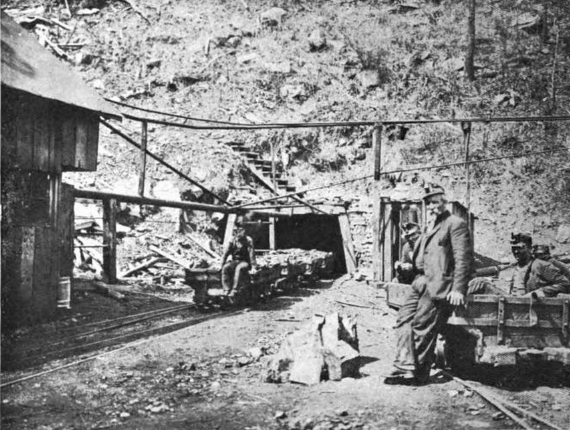
Photographs taken in 1904, just before the company name change, document the commissary the operation kept near the Nashville, Chattanooga & St. Louis Railway depot at Orme, along with mining equipment and miners' housing. The commissary was the company store where miners drew supplies on credit against their wages, the standard fixture of the company-town economy of the period; surviving images show it as a substantial frame structure beside the rail siding. By 1912, the operation consisted of four drift mines cut into the Cumberland Plateau wall, some reaching high up the cliff face. Drift mines, driven horizontally into the plateau seam, were the standard configuration for Sequatchie-Valley-rim coal extraction; the spent slack and refuse formed the long bone-piles still visible on the slope above Orme a century later.
The Battle Creek Coal & Coke Company operation at Orme followed the broader trajectory of the Marion County coal-and-coke district. Output rose through the 1910s, faltered in the 1920s as Birmingham, Alabama, outcompeted the Sequatchie Valley smelters, and the mines closed during the 1930s under the combined pressure of Depression-era demand collapse and seam exhaustion. The Orme post office stayed open until 1965; the town's 2020 population was 87, the smallest incorporated place in Tennessee. The Battle Creek Coal & Coke name disappeared from the federal records when the company was wound up.
Why the name endures
The Battle Creek Mines name is unusual in Marion County mining history for sitting at two ends of the same operational chain a half-century apart. The 1854 mine and 1869–1876 post office community were the institutional ancestor of South Pittsburg; the 1905 company was the Sequatchie-rim operation at Orme. The same name covers both because the underlying drainage runs through both sites, because Capt. Frater's industry-founder narrative threaded the original Battle Creek mine into Tennessee's coal-history canon, and because by 1905 there was enough institutional memory in the regional industry that reaching back to a fifty-year-old name still meant something to investors. The pattern is rare in Tennessee but common in older coal districts of Pennsylvania and Britain, where second- and third-iteration companies often took names from defunct first-generation predecessors.
On the modern map the name survives only on the creek itself and on a handful of historical markers and project documents around South Pittsburg and Orme. The 1854 workings are not signed; the 1912 mine entrances at Orme are visible as collapsed adits up the cove walls, accessible only on private timber land. The Marion County Coal Miners Museum at Whitwell, the regional institutional successor to the Sequatchie Valley coal-history collections, holds artifacts and oral- history records that touch both ends of the Battle Creek Mines story.
Related
Battle Creek (the community and creek) →
South Pittsburg (built on the original Battle Creek Mines site) →
Orme (site of the 1905 reorganization) →
Cheekville (the upper-valley settlement Bowron Sr. simultaneously transformed into Whitwell) →
Marion County coal & coke industry overview →
Civil War in Marion County (which closed the original mines) →
Sources
- TNGenWeb Marion County — Coal Mines (with the 1863 mine map and excerpt from Capt. John Frater's 1909 narrative in Nonie Webb's Old Mines and Miners of Marion Co., TN)
- TNGenWeb Marion County — Post Offices (Battle Creek Mines, 1869–1876)
- Wikipedia — South Pittsburg, Tennessee
- Wikipedia — Orme, Tennessee
- South Pittsburg Historic Preservation Society — SPHistory1 (origins of South Pittsburg)
- South Pittsburg Historic Preservation Society — Orme, Tennessee history (Battle Creek Coal & Coke Co. 1905 reorganization, 1904 commissary photo)
- Tennessee Encyclopedia — Marion County