Last updated: April 23, 2026
- Carries: Tennessee State Route 156 over the Tennessee River / Nickajack Lake
- Connects: South Pittsburg (north bank) to New Hope and Alabama-bound routes (south bank)
- Type: Steel tied-arch bridge
- Length: 1,514 feet (461 meters); two lanes, 47.9 feet wide
- Opened: 1981
- Designer: Tennessee Department of Transportation
- Fabricator: American Bridge Company, Pennsylvania
- Named for: Shelby A. Rhinehart (died September 19, 2002), Democratic state representative in the Tennessee General Assembly
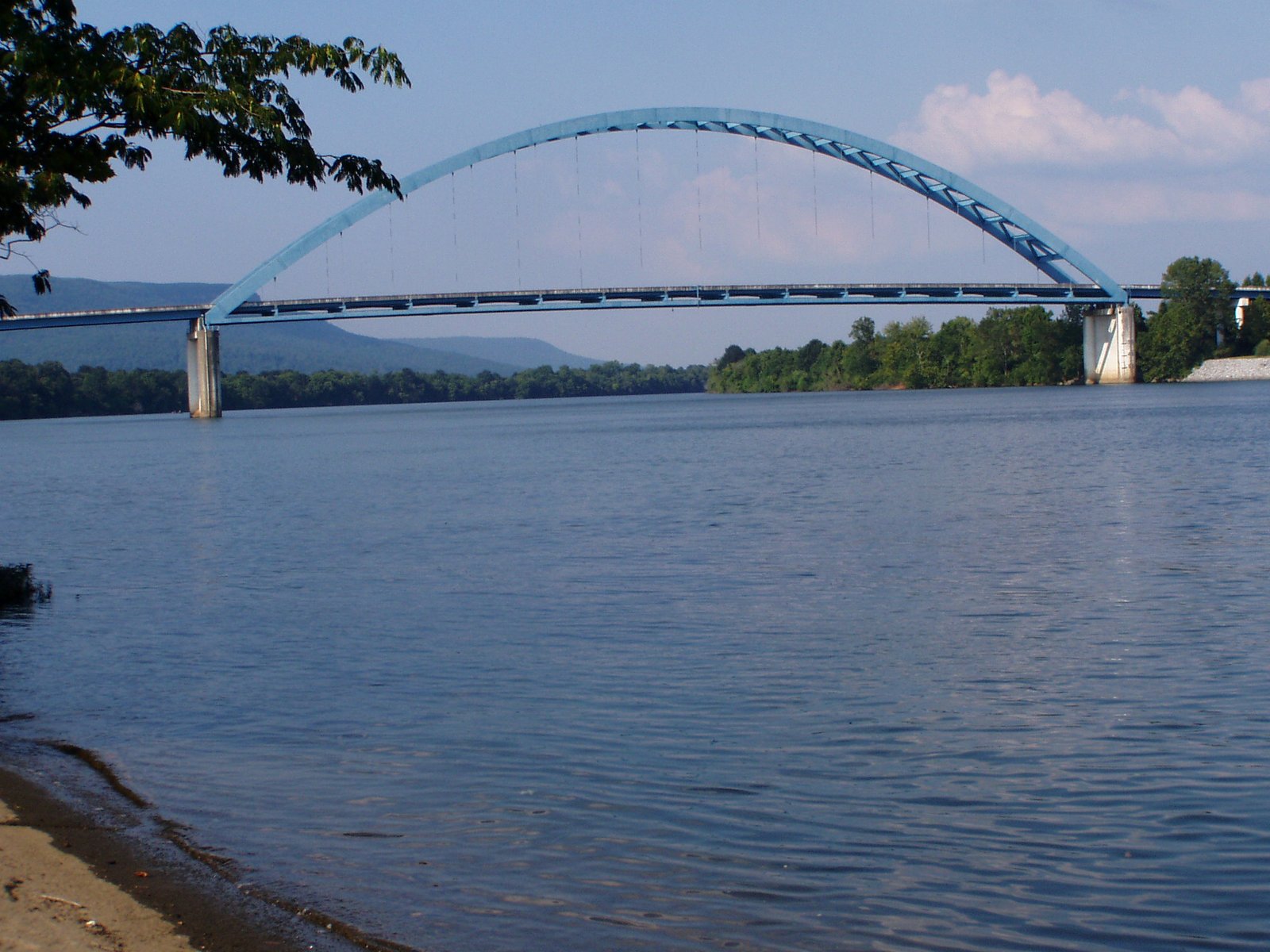
The Shelby Rhinehart Bridge, universally known locally as the Blue Bridge for its painted steel arches, carries Tennessee State Route 156 over the Tennessee River at South Pittsburg. It is one of the most recognizable landmarks in Marion County and the only fixed connection between South Pittsburg and the communities on the south bank of the river. The bridge opened in 1981, replacing a ferry that had operated continuously for more than 75 years.

Before the bridge: the South Pittsburg ferry
For most of the 19th and 20th centuries, South Pittsburg residents reaching the south bank of the Tennessee River had two choices: a lengthy road detour east to Chattanooga or west to Bridgeport, Alabama, or a ferry across the river. The South Pittsburg ferry ran at the foot of downtown and was the main daily link between the industrial town and the farms, churches, and homesteads of the south bank. Commerce, school traffic, and emergency services all passed over it. The ferry operated into the late 1970s and was replaced directly by the 1981 bridge.
The ferry's closure marked the end of a much longer regional pattern. Rankin's Ferry between Guild and Shellmound had closed in the late 1920s; Betsy Pack's ferry at Jasper had closed even earlier. See the transportation subpage for the broader Marion County ferry history. The South Pittsburg ferry was the last of the Marion County Tennessee River ferries to operate, surviving into the automobile era by roughly five decades.
Design and construction
The bridge is a two-lane steel tied-arch structure, a design in which the roadway deck carries the horizontal thrust of the arch through a steel tie below the traffic lanes, allowing the arch to be supported at its ends rather than pushing outward against abutments. The tied-arch form suits river crossings in narrow floodplains because it does not require deep abutment foundations to resist lateral thrust. The total length is 1,514 feet (461 meters), and the deck width of 47.9 feet carries two traffic lanes plus shoulders and narrow curbs.
The bridge was designed by the Tennessee Department of Transportation and fabricated by the American Bridge Company of Pennsylvania, one of the historic steel-bridge shops in the U.S. American Bridge delivered completed steel sections for field erection on site.
The arches are painted blue, a TDOT specification. The "Blue Bridge" nickname is near-universal in local usage and overshadows the formal Rhinehart name on day-to-day signage and in local references.
Economic impact
Opening the bridge had measurable effects on both sides of the river. On the north bank, South Pittsburg gained a direct commercial link to the south-bank market, including the farms and small businesses of New Hope and the U.S. 72 corridor toward Stevenson and Scottsboro in Alabama. On the south bank, New Hope and the communities around it gained a direct connection to I-24 at Kimball (through the road network running north from the bridge), to the hospitals and retail of the Chattanooga metro, and to the industrial employers of South Pittsburg. The bridge eliminated the ferry's wait times, weather-related closures, and limited night service.
Lodge Cast Iron, whose 2017 distribution center is on the south bank in New Hope, depends on the bridge for product movement between the foundry in South Pittsburg and the 212,000-square- foot distribution facility that ships finished cookware to national retailers. The bridge's role in Lodge's two-site operation is invisible to most visitors but is a practical anchor of the county's largest private industrial operation.
The bridge also opened the South Pittsburg river shore to tourism and recreation access. The annual National Cornbread Festival relies on the bridge to move attendees between the north- and south-bank parking and staging areas.
Shelby A. Rhinehart
The bridge was officially named for Shelby A. Rhinehart, a Democratic member of the Tennessee General Assembly whose district included Marion County and neighboring Sequatchie Valley and Cumberland Plateau counties. Rhinehart's legislative career covered the period during which TDOT planned and funded the crossing. He died on September 19, 2002. The formal dedication preceded his death. The naming is one of several infrastructure honorifics the state legislature has attached to bridges and road segments across the Upper Cumberland and Sequatchie Valley region for legislators who worked on their funding; the Rhinehart designation is the best-known of them in Marion County.
Condition and future
The Blue Bridge is now more than forty years into its service life. TDOT inspection records rate the structure in serviceable condition as of the most recent publicly-available TDOT bridge-inventory reports, with routine maintenance including paint touch-up and deck resurface work. No replacement span is currently in the TDOT long-range plan. A steel tied-arch of the Blue Bridge's size and condition is expected to remain in service for several decades with continued maintenance.
The distinctive paint scheme has been a civic feature of South Pittsburg since the bridge opened, and any future TDOT repainting would be watched locally. A full replacement would rebalance the South Pittsburg waterfront in ways that have not been publicly debated; the bridge is functionally important but is not on the immediate replacement list.
Related
About Marion County transportation history →
About U.S. 41 & the Dixie Highway corridor →
About Interstate 24 →
About South Pittsburg →
About New Hope →