Last updated: April 23, 2026
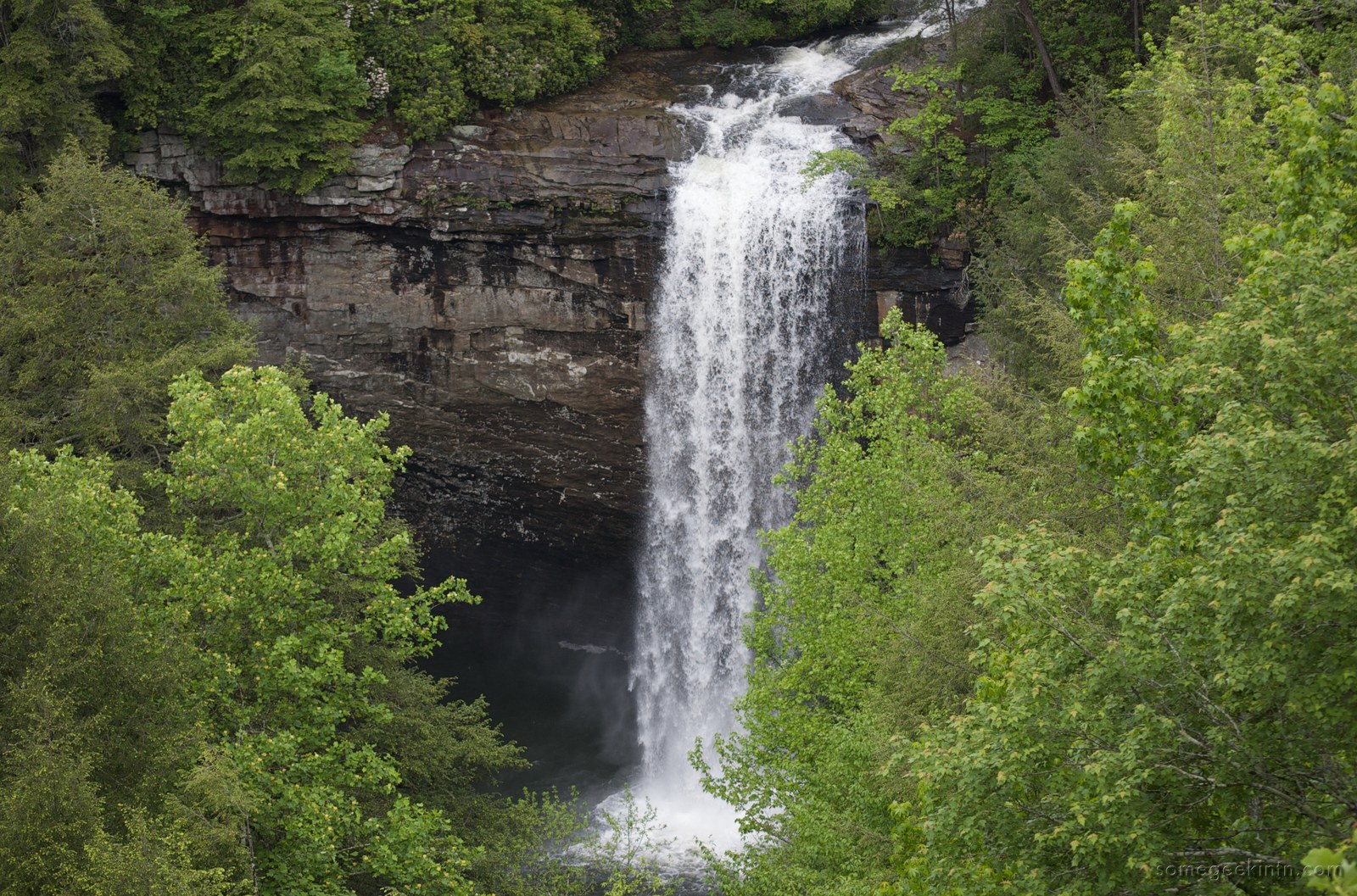
Tourism and outdoor recreation are the closest thing Marion County has to a successor industry to the 19th- and early-20th-century extractive and manufacturing economy. Coal mines closed at Orme in 1970. Coke ovens at Victoria were already idle by the 1930s. Dixie Portland shut down in 1982. The Hales Bar powerhouse was decommissioned in 1968. What has replaced the extraction economy, in terms of non-agricultural employment and outside-the-county spending, is a cluster of outdoor recreation, lake and valley real estate, festival tourism, and interstate-corridor hospitality. None of these sectors individually equals the payroll of the old industries, but together they have repositioned the county from a mining-and-mill identity to one oriented around scenic byways, state parks, lake frontage, and festival weekends.
Foster Falls and plateau climbing
Foster Falls, a waterfall on Little Gizzard Creek at the head of the Cumberland Plateau south of Tracy City, is part of the South Cumberland State Park system and managed by Tennessee State Parks. The sandstone cliffs that frame the falls support sport-climbing routes and are one of the Southeast's most-used climbing areas. The falls themselves, the Climber's Loop and Climbers' Overlook trails, and the Fiery Gizzard Trail that leaves from the Foster Falls trailhead draw climbers and hikers from Chattanooga, Nashville, Atlanta, and farther afield.
The state's acquisition of the Denny Cove property added plateau escarpment and opened an additional climbing area on the same sandstone belt, with routes of a slightly different character than Foster Falls. Denny Cove climbing grew quickly and is now part of the same Marion / Grundy county climbing complex that runs along the southern Cumberland rim. The climbing economy's visible effects on gear shops, short-term rentals, and restaurant traffic in and around Jasper, Monteagle, and Tracy City are documented in regional tourism surveys.
Nickajack Lake and Tennessee River recreation
Nickajack Lake, the 46-mile impoundment created by TVA's Nickajack Dam in 1967 (see Nickajack Dam), is the county's largest recreational water body. Lake frontage has supported an expanding market for second homes, lake houses, and short-term rental properties across Maple View, Hales Bar, Mullins Cove, Haletown, and the western Nickajack peninsula near Shellmound. The TVA Raccoon Mountain Pumped Storage Plant, whose lower reservoir is Nickajack Lake, is not itself a destination, but the lake's navigable length and its relative scarcity of heavy-traffic marinas have kept it popular with houseboat owners and fishermen.
Nickajack Cave's historic entrance, submerged below the 1967 impoundment, sits at the head of a TWRA-protected gray bat refuge with a public observation platform at Maple View. The platform draws wildlife viewers during the bat emergence months. Hales Bar Marina, built on the site of the former Hales Bar Dam powerhouse, operates as a destination marina and event venue on the north bank.
The Tennessee River Gorge more broadly, managed in part by the Tennessee River Gorge Trust through roughly 17,000 acres of conservation holdings, is a growing kayaking, paddleboarding, and wildlife-viewing destination. The gorge has been a federally-designated scenic area under several federal and TVA recreation-resource designations, and its status as one of the largest undeveloped river gorges in the eastern United States has been part of its recreation pitch since the 1970s.
Sweetens Cove Golf Club
Sweetens Cove Golf Club, a nine-hole course in the Sequatchie Valley near Sweetens Cove, is the Marion County tourism draw that punches farthest above its weight. The site had operated as a forgettable municipal layout in South Pittsburg for decades before architects Rob Collins and Tad King redesigned the course as an inland links layout during the Great Recession; it reopened in October 2014 under the Sweetens Cove name. Per Sewanee Magazine's “The Wizard of Sweetens Cove” and The Whiskey Wash, a 2019 ownership group of Peyton Manning, Andy Roddick, Tom Nolan, Skip Bronson, Mark Rivers, and singer Drew Holcomb joined Collins to turn the course into a cult destination. The course has continued under the new ownership with modest infrastructure upgrades (pavilion, food truck, putting green, plumbing) rather than significant design changes to the nine holes themselves.
Sweetens Cove has become the most-covered Marion County venue in national press since the National Cornbread Festival. It has not generated the payroll of an industrial operation, but its tee-sheet pricing, waiting lists, and the Chattanooga-Nashville traffic it draws are measurable in the way the 19th-century iron industry never was: it is a consumption good priced per round. See the Sweetens Cove Golf Club culture page for additional detail.
Hang gliding at Henson Gap and Whitwell
The Tennessee Tree Toppers hang-gliding chapter operates launch sites at Henson Gap, on the Sequatchie County side of the plateau rim just north of Marion County, and at Whitwell inside the county. The sport has been part of Marion County's plateau-edge identity since the 1970s. Pilots flying from Henson Gap and Whitwell have recorded multi-hundred-mile cross-country flights along the Sequatchie Valley, and the 40-plus-acre landing zone below Henson Gap supports the club's training and fly-in events. See the Marion County Airport subpage for further detail on the club and the Henson Gap complex.
Festivals
The National Cornbread Festival, held annually in South Pittsburg since 1997, is the largest single-event tourism draw in Marion County. A partnership between Lodge Manufacturing, the Martha White brand, and the South Pittsburg Main Street program, the festival turns the downtown Cedar Avenue corridor into a weekend street fair with a national cornbread cook-off, live music, crafts, and a food midway. Attendance in recent years has been estimated in the tens of thousands across the two-day event.
Other recurring Marion County festivals and fairs are covered on the festivals and fairs subpage: Jasper's Big Boom Fourth of July, Easter Egg Extravaganza, Jack-O-Lantern Jamboree, and Christmas in a Small Town; Whitwell's Labor Day Celebration and Coal Miner's Reunion; Monteagle Mountain Market for Arts and Crafts; and, historically, the Marion County Fair. Collectively they occupy most of the weekends on a county-level calendar and collectively generate several hundred thousand visitor days per year.
The Smoke House and the I-24 / Monteagle cluster
The opening of Interstate 24 between 1962 and 1971 reshaped the pattern of Marion County tourism away from the old U.S. 41 Dixie Highway motor courts and toward the interchange clusters at Exit 134 (Monteagle) and Exit 152 (Kimball). At Monteagle, Jim Oliver's Smoke House Restaurant opened in 1975 on what had been his 1960 Beehive Drive-In site. The Smoke House became the iconic stopover between Nashville and Chattanooga for four and a half decades, anchoring a hospitality cluster of lodges, gas stations, and chain restaurants at the Monteagle interchange. The April 27, 2021 fire destroyed the main restaurant building. The Smokehouse Patio Grill and the Smoke House Lodge continue to operate on the site, but the country-restaurant identity that defined Monteagle's roadside tourism for a generation was lost with the fire.
Kimball's I-24 Exit 152 cluster anchors the southern Sequatchie Valley's interstate-era commercial hospitality. Hotels, restaurants, truck stops, and convenience operations at the interchange serve both through-traffic and the county's resident market. The interchange is the largest retail concentration in Marion County and has displaced downtown Jasper and South Pittsburg as the county's default commercial center.
Jasper Highlands and residential tourism
Jasper Highlands is a gated master-planned residential development on Jasper Mountain, with lot sales that began in the mid-2010s and a build-out pace that has continued into 2026. The development is part of a broader pattern of plateau-edge and mountain-top residential communities across the southeastern Cumberland (Bridgestone, River Gorge Ranch, Raven Rock, Dunlap Ranch) marketed primarily to retirees and second-home buyers from the Chattanooga, Nashville, and Atlanta metros. Economic effects on the broader county are measurable in property-tax rolls, in the volume of construction employment, and in the customer base at Kimball and Jasper retail; Jasper Highlands itself operates as a semi-self-contained community.
Mountain Goat Trail spillover
The Mountain Goat Trail, a rail-to-trail along the former NC&StL Mountain Goat branch between Sewanee, Monteagle, and Tracy City, is centered in Franklin and Grundy counties but touches Marion County at Monteagle's southern edge. The trail's 5 to 6 miles of paved rail-grade surface opened in December 2014 and has expanded in subsequent phases. Mountain Goat Trail users spill into Monteagle for food and lodging, pulling day-trip traffic through the I-24 / U.S. 41 corridor that the county inherits. See the Mountain Goat Trail culture page for additional detail. The full set of regional trails accessible from Marion County, including the Cumberland Trail, Foster Falls / Fiery Gizzard, Prentice Cooper, Marion County Park, Little Cedar Mountain, and the Walls of Jericho, is collected on the hiking and trails hub.
The economic scale of the transition
Tourism and recreation are not a clean replacement for the industrial economy that preceded them. The peak Dixie Portland payroll of 600 to 700 workers, the Whitwell coal operation at its peak, and the Lodge foundry's roughly 400 current employees were and are year-round, full-time, benefited jobs. Tourism employment in the county is heavily seasonal, heavily part-time, and concentrated in hospitality and food service, sectors whose wage profile sits well below the industrial wage of the extraction era. Marion County's current BEA per-capita personal income of $51,590 (2023) and its Appalachian Regional Commission Transitional status (2026) reflect an economy that is still rebalancing.
The compensating gains are scale, diversification, and durability. A recreation-and-rental economy is less exposed to a single commodity cycle than a single-industry coal or cement economy was; a bad summer at Foster Falls does not close the county the way the 1980 Penn- Dixie Chapter 11 filing did. The transition is incomplete, and the county still carries both the infrastructure (I-24, the NC&StL rail corridor, the Blue Bridge, Nickajack Lake) and the institutional memory of the older industries. But the weight of the local economy has shifted decisively away from extraction and toward visitors, lake houses, and festival weekends.
Related
About Foster Falls →
About Nickajack Lake, Cave, and Dam →
About Sweetens Cove Golf Club →
About the National Cornbread Festival →
About Jim Oliver's Smoke House →
About Marion County Airport & Henson Gap hang gliding →
About Jasper Highlands →
About the Mountain Goat Trail →
Sources
- Visit Marion County TN — official tourism site
- South Cumberland State Park (includes Foster Falls and Denny Cove)
- Sweetens Cove Golf Club — About
- Tennessee Tree Toppers — hang gliding at Henson Gap
- Mountain Goat Trail Alliance
- U.S. Bureau of Economic Analysis — Regional BEARFACTS (Marion County per-capita income)
- Appalachian Regional Commission — County economic status
- Tennessee Encyclopedia — Marion County