Last updated: April 23, 2026
- Number of farms (2022): 308
- Land in farms: 62,071 acres (average 202 acres per farm)
- Total agricultural product sales (2022): $43.1 million, up 153 percent since 2017
- Land use: 28,925 acres cropland, 9,404 acres pasture, 21,877 acres woodland
- Top crops by acreage: soybeans (8,755), forage / hay (7,245), corn for grain (6,386), wheat (1,817), sorghum for grain (567)
- Livestock inventory (Dec. 31, 2022): 6,633 cattle and calves, 918,298 broilers, 6,301 layers, 596 horses, 537 sheep, 351 goats
- Producers: 556 individuals across 308 farms; 171 classified as new and beginning farmers
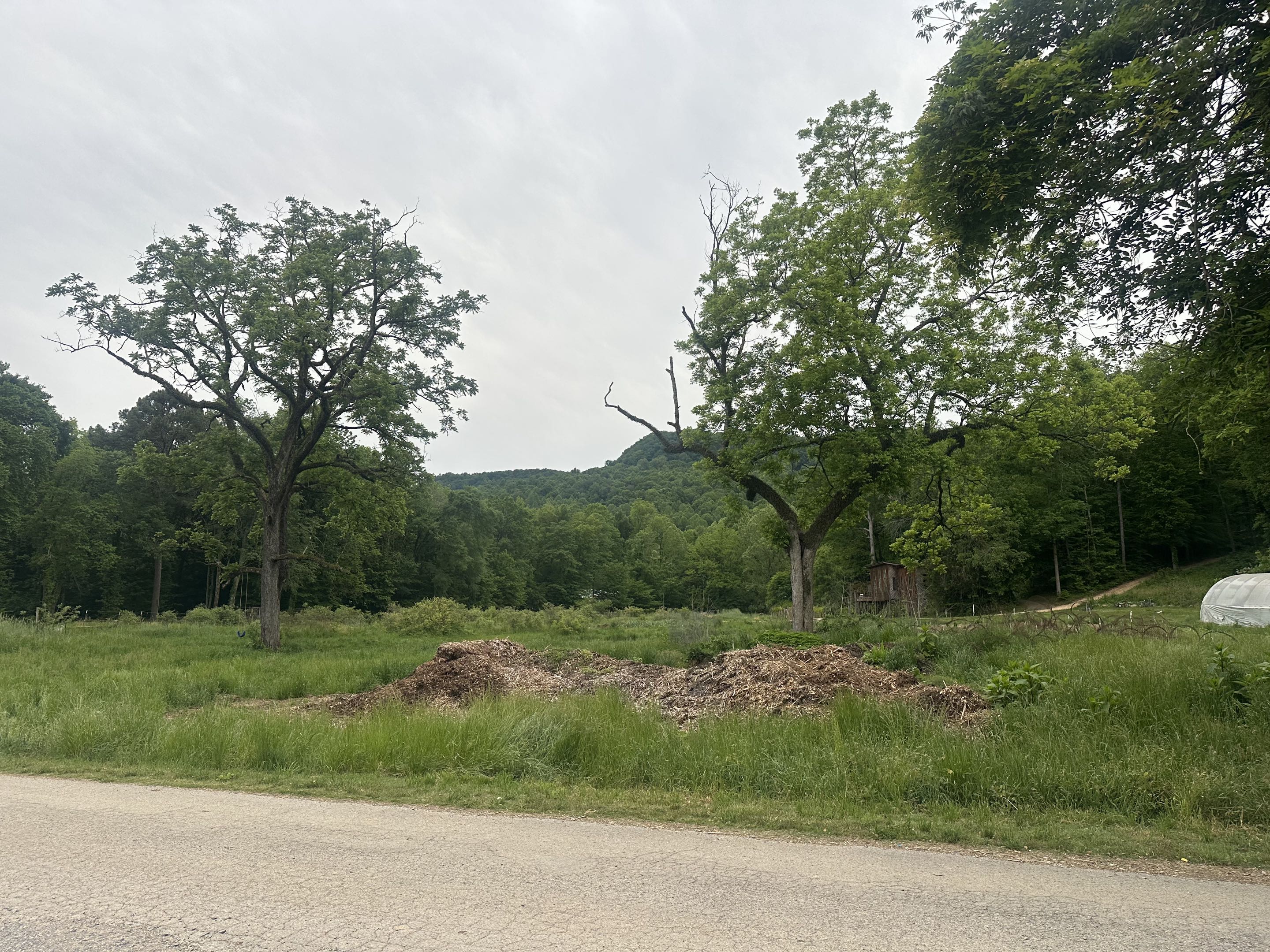
Marion County's agriculture has three distinct landforms working on it. The Tennessee River bottomlands in the south are flood-enriched alluvial soils, historically worked for corn, cotton, and small grains. The Sequatchie Valley proper, the narrow fault-bounded graben that runs northeast to southwest through the middle of the county, carries the deepest and most productive soils in Marion, with limestone-based bottomlands suited to row crops and grass-fed livestock. The Cumberland Plateau rises to either side, thinner-soiled and historically a mixture of subsistence farming, timber, and livestock grazing.
That geography has shaped Marion County farming for two hundred years. The county has never been a plantation district; its topography favored smallholder family farms from the outset, and the 2022 Census of Agriculture still shows a median operation of under 180 acres. Poultry consolidation has reshaped the top of the distribution (see the poultry subpage), but the smallholder base has proved durable. Cattle, hay, soybeans, corn, and wheat anchor most of the remaining commercial acreage.
Early and antebellum agriculture
Marion County was organized in 1817 on former Cherokee land, and Anglo-American settlement followed quickly along the Tennessee River and up the Sequatchie Valley (see first settlers). The antebellum pattern was one of smallholder family farms rather than large plantations, a direct consequence of the plateau- and-valley topography that made large contiguous fields impractical. Early county agriculture produced corn, cotton, wheat, oats, potatoes, and fruit, with cattle, sheep, hogs, and poultry raised both for household use and for local markets. Some enslaved labor existed, but at far smaller scale than in the cotton belt to the south; the 1860 slave schedule recorded Marion County among the least enslaved-population counties in Middle and East Tennessee. See the demographics page for the 19th-century population and labor composition that shaped county farming.
The Sequatchie Valley specifically was known as an exceptionally fertile corn-producing district in the 19th century. Contemporary accounts described the valley, roughly 60 miles long and 5 miles wide, running through Marion, Sequatchie, and Bledsoe counties, as producing “immense crops of corn” which were largely fed to cattle, horses, mules, and hogs. Farmers either sold livestock on the hoof to drovers or walked them to market themselves along what became the U.S. 41 Dixie Highway corridor (see US 41). The Ketner's Mill on the Sequatchie River east of Victoria has ground that corn in continuous operation under the same family since 1824, and its survival into the 21st century is the clearest visible trace of the valley's antebellum grain-and-livestock agriculture.
19th- and 20th-century transitions
After the Civil War, Sequatchie Valley agriculture remained corn-and-livestock oriented, with smaller acreages of wheat, oats, hay, fruit, and garden crops. Tobacco was cultivated in some areas of the valley and plateau, though Marion County was never a top-tier tobacco county like those farther west in Middle Tennessee. Cotton had a limited presence in the warmer river bottomlands near South Pittsburg and declined through the 20th century. Cattle, both beef and, later, dairy, became an increasingly dominant operation type across the Sequatchie Valley. Poultry operations, which would come to dominate much of East and Middle Tennessee agriculture by the late 20th century, began their Marion County expansion in this period.
The industrial boom of the late 1800s, with coal mining in Whitwell and Victoria, iron smelting in South Pittsburg, and cement works at Richard City (see coal and coke and Dixie Portland Cement), drew labor away from farms and competed with agriculture for valley land. When those heavy industries collapsed in the mid-20th century, many families returned to part-time or supplementary farming while working wage jobs in manufacturing, construction, and services. The shift from full-time to part-time farming is visible on the 2022 census table: 45 percent of Marion County farms reported less than $2,500 in sales, a scale consistent with hobby and retirement operations, while only 9 percent sold more than $100,000.
The 2022 Census picture
The USDA National Agricultural Statistics Service publishes a county-profile page for every county in every Census of Agriculture. The 2022 profile for Marion County (FIPS 47115) is the most recent authoritative snapshot of county farming. It shows 308 farms on 62,071 acres, an average operation of 202 acres. Both counts are up about 13 percent from 2017. Total agricultural product sales came to $43.10 million, a 153 percent jump from 2017, driven almost entirely by the poultry expansion.
Crop receipts alone totaled $15.82 million. The dominant crop category is "grains, oilseeds, dry beans, dry peas," at $14.84 million, which in Marion County means primarily soybeans, corn for grain, and wheat. Vegetables and melons ($44,000), fruit and tree nuts (withheld for disclosure reasons but small), and nursery and greenhouse products (also withheld) are minor categories. Hay and other forage crops reported $774,000 in sales, understating their real importance because most hay is consumed on-farm and never enters the market-value figure.
The crop acreage table tells a different story than the sales table. By planted acres, Marion County in 2022 reported 8,755 acres of soybeans, 7,245 acres of all forage including hay and haylage, 6,386 acres of corn for grain, 1,817 acres of wheat for grain, and 567 acres of sorghum for grain. Forage and hay cover almost as much ground as the leading cash crop, reflecting the central role of cattle and livestock feed in the county farm economy.
On the livestock side, the 2022 inventory on December 31 recorded 918,298 broilers (covered separately on the poultry subpage), 6,633 cattle and calves, 6,301 layers, 596 horses and ponies, 537 sheep and lambs, 351 goats, 155 pullets, 135 hogs, and 35 turkeys. The cattle-and-calves inventory is the county's second-largest livestock line by animal count and the largest outside poultry by sales.
Cattle and hay
Cow-calf beef cattle operations are the second substantial livestock sector after poultry. Marion County held 6,633 cattle and calves on December 31, 2022, generating $2.04 million in sales that year. The county's operational mix is consistent with the broader Sequatchie Valley pattern documented by the University of Tennessee Extension: cow-calf producers graze valley bottoms and plateau benches, sell weaned calves to feeder buyers in the region, and feed purchased and on-farm hay through the winter. Dairy, which had a modest presence in the mid-20th-century valley, now reports no Marion County sales on the 2022 census; the small on-farm dairy line has effectively disappeared from the county over the past half century.
Hay production is almost entirely for on-farm feed. The 7,245 acres of forage recorded in 2022 produce the winter feed supply for the cattle inventory; additional hay is sold into the regional market during drought years. The county is not a commercial horse-country like the bluegrass counties of Middle Tennessee, but 596 horses and ponies, 537 sheep and lambs, and 351 goats all contribute smaller niches to the pasture-and-hay demand.
The Tennessee Century Farms program
The Tennessee Century Farms Program recognizes family farms that have been continuously owned and operated by the same family for at least 100 years and include at least ten acres of the original farm still in production. The program was created in 1975 to 1976 by the Tennessee Department of Agriculture as a bicentennial project and is now administered by the Center for Historic Preservation at Middle Tennessee State University. Statewide, more than 2,300 farms have been certified across all 95 Tennessee counties.
The program maintains a Marion County page on its official website. The public-facing map does not show specific farm locations, in order to protect owners' privacy. A county-level roster is held in the MTSU Center for Historic Preservation archives rather than published directly online; researchers can request the Marion County listing or specific farm profiles by contacting the program at MTSU. As of the most recent published program reports, several Marion County farms are on the Century Farm roster. The Ketner's Mill family operation, established in 1824, pre-dates the program by more than 150 years and is the most visible of the county's long-continuous farm enterprises.
Statewide, the Tennessee Century Farms program has become a standing tool for documenting farmland continuity. Marion County's participation is modest compared with some Middle Tennessee counties where three- and four-generation farms are still common, but the program remains the best public record of which farms in the county have weathered the 20th century's industrial boom, the Depression, wartime labor shortages, and the post-war consolidation into poultry contracting.
Specialty and direct-market operations
Marion County's 2022 Census reported 17 percent of farms selling directly to consumers and 95 percent classified as family farms. The direct-market category includes farm stands, farmers' market vendors, community-supported agriculture (CSA) subscriptions, and specialty meat and cheese sales. The county hosts several notable specialty operations:
Sequatchie Cove Farm, a 300-acre diversified farm on Dixon Cove Road along the Little Sequatchie River, is now in its fourth generation: Jim and Emily Wright bought the land, their daughter Miriam and her husband Bill Keener built the diversified operation, and their son Kelsey and his wife Ashley work the next rotation with the Keener grandchildren as a fourth generation on the property. The farm produces grass-fed beef, heritage pork, pasture-raised chicken and Katahdin lamb, eggs, organic produce, grains, and small fruits, with sister operation Sequatchie Cove Creamery running the cheesemaking side. The creamery, founded in 2010 by Nathan and Padgett Arnold, makes Savoie-inspired Alpine-style cheeses; its lineup includes the Cumberland tomme (American Cheese Society first-in-category, 2012), the ash-lined washed-rind Coppinger, the fig-leaf-wrapped Shakerag Blue, and Walden (launched 2019). The Arnolds trained in France, Vermont, Canada, and Wisconsin between 2005 and 2006 before starting the creamery. The creamery ran its own Jersey herd through 2021, when it sold the dairy and switched to sourcing milk from neighboring grass-fed dairies.
Small orchards, vineyards, and agritourism farms also operate on plateau uplands in and adjacent to the county. A commonly-referenced regional stop, Wheeler's Orchard & Vineyard, sits atop Fredonia Mountain near Dunlap in neighboring Sequatchie County rather than in Marion County itself; Marion's plateau coves host smaller, less-publicized specialty operations that serve the Chattanooga and Monteagle markets.
New and beginning farmers
Marion County reported 171 new and beginning farmers out of 556 producers in 2022, roughly 31 percent of all producers in the county. That share is unusually high for rural Appalachian Tennessee. Three forces probably drive it in parallel. First, generational transfer of broiler operations triggers a "new producer" record even when the underlying operation is continuous and has been running for decades. Second, some back-to-the-land migration from Chattanooga and Nashville into plateau coves has put a small layer of new farmers on specialty, homestead, and direct-market operations. Third, USDA's counting rules capture up to four principal operators per farm, which can push the "new" count up when a spouse or adult child is recorded for the first time alongside an existing farmer.
The same census recorded 12 percent of producers as under 35 years old (38 individuals), 56 percent between 35 and 64 (310), and 37 percent 65 and older (208). The age distribution is older than the U.S. average but consistent with rural Appalachian Tennessee at large.
Farmland preservation
Marion County has formally declared April as Farmland Preservation Month, a civic recognition that farmland conversion to subdivisions, gated-community developments (see Jasper Highlands), and commercial uses is a local concern. The Tennessee Farmland Legacy Partnership, administered jointly by the Tennessee Department of Agriculture and the Land Trust for Tennessee, is the primary state vehicle for voluntary farmland easements. Marion County's specific participation in easement purchases is not publicly broken out, but the county's overall 13 percent gain in land in farms between 2017 and 2022 suggests that farm consolidation and not outright conversion is the main land-use trend in the valley itself.
Related
About Marion County poultry →
About Ketner's Mill →
About the Sequatchie Valley →
About Marion County demographics and economy →
Sources
- USDA NASS — 2022 Census of Agriculture County Profile, Marion County, Tennessee (cp47115.pdf)
- Tennessee Century Farms — Marion County
- Tennessee Department of Agriculture — Century Farms program
- Tennessee Encyclopedia — Tennessee Century Farms
- Tennessee Encyclopedia — Agriculture
- Tennessee Encyclopedia — Livestock
- Tennessee Encyclopedia — Marion County
- Tennessee Encyclopedia — Sequatchie County (comparison context)
- USDA NASS — State Agriculture Overview, Tennessee