Last updated: June 1, 2026
- Earliest documented occupation: about 6,000 to 7,000 B.C. along the Tennessee River at Nickajack; a hearth at nearby Russell Cave radiocarbon-dated to roughly 9,000 years ago
- Cultural sequence: Paleo-Indian, then Archaic, Woodland, and Mississippian
- Key sites: Russell Cave (Jackson County, Alabama, just over the state line), the Nickajack reservoir sites, Shellmound, and mounds along the Sequatchie and Tennessee rivers
- First scientific study: Clarence B. Moore by boat (1914–1915), William Edward Myer (1918), and the University of Tennessee salvage excavations at Nickajack (1964–1965)
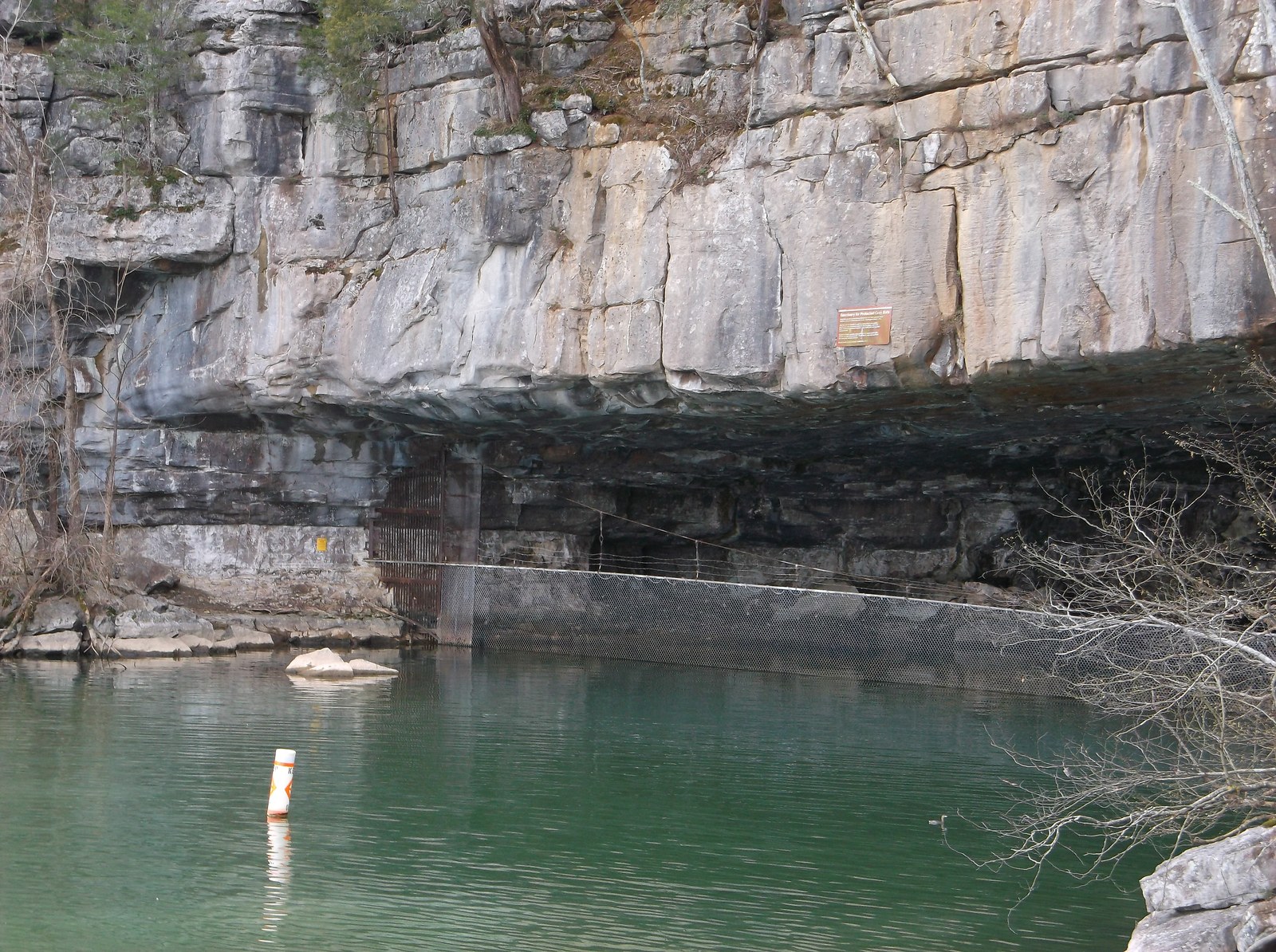
Long before the Cherokee Lower Towns and centuries before the first Anglo-American settlers crossed the Cumberland Plateau, the Sequatchie Valley and the Tennessee River gorge below it were home to people whose story survives only in the ground: in cave floors, river-bank shell heaps, and the earthen mounds that still dot the valley. The 1974 regional history Sequatchie: A Story of the Southern Cumberlands, by J. Leonard Raulston and James Weston Livingood, opens with that deep past, drawing on the excavations at Russell Cave just across the Alabama line and on the salvage digs carried out before Nickajack Dam flooded the old river. This page follows their account of the first peoples of the Sequatchie country, from the earliest hunters through the mound-building villages the Europeans would eventually find.
Deep time in the Sequatchie country
Human beings have lived in and around the Sequatchie Valley for the better part of ten thousand years. The salvage excavations at Nickajack, on the Tennessee River east of South Pittsburg, found that aboriginal occupation of that stretch of river had begun about 6,000 or 7,000 B.C., and that the long sweep of prehistory there formed what the archaeologists called a "cultural continuum," with the Late Archaic, Woodland, and Mississippian epochs all represented in the same ground. As Raulston and Livingood put it, the dig at Russell Cave "established the fact that Indians had roamed the area immediately around the Sequatchie Valley long before the pyramids of Egypt were built."
Scholars divide that long span into broad cultural stages, each marked less by a sharp boundary than by gradual change in tools, food, and ways of living: the Paleo-Indian period of the first big-game hunters, the Archaic period of foragers, the Woodland period of the first potters and mound builders, and the Mississippian period of farming villages and temple mounds. The valley's people moved through these stages within the broad chronology shared across the southeastern United States, but the local record, read out of cave floors and river-bank sites, gives the story a Sequatchie shape.
The Archaic hunters
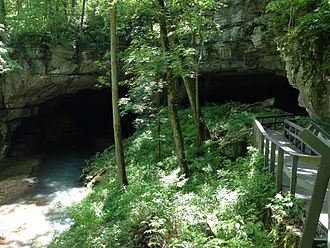
The earliest occupants of Russell Cave, the great shelter cave in Doran's Cove just below South Pittsburg, were Archaic people who lived by hunting and gathering. At the lowest level of the excavation, twenty-three feet down, the Smithsonian archaeologist Carl F. Miller found a pocket of charcoal from an ancient hearth that radiocarbon testing dated to roughly 9,000 years ago. Because the diggers found no agricultural tools, they concluded that these early people did not farm and kept no domesticated animal except the dog, which they buried with evident care.
Archaic life in the valley turned on the hunt. Deer and turkey were the favored game, along with squirrel, raccoon, gray fox, skunk, bobcat, and bear. Families wasted nothing, roasting or stewing meat by dropping heated stones into vessels of skin or bark, turning hides into shelter and clothing, and working bone into tools and fishhooks. They fashioned rings, ear plugs, and necklaces of bone, stone, and shell, and painted themselves with hematite, a red ore. Their most advanced weapon was the atlatl, a short spear tipped with a stone point and thrown with a wooden throwing stick that lengthened a hunter's reach and gave his missile the velocity to bring down large game. Cane-mat impressions preserved in clay deep in the Russell Cave excavation, and the careful placement of fashioned stones, told the archaeologists how those throwing sticks had been assembled from perishable wood that had long since rotted away.
The Woodland people
A new way of life, slowly produced as later migrants mingled with the Archaic population, emerged in what archaeologists call the Early Woodland period, dated in the valley from roughly 500 B.C. to about A.D. 1,000. Generation by generation, the Woodland people perfected new technology, the bow and arrow, the grindstone, and above all pottery, which became both a practical craft and an art. Early Woodland pots bore the imprints of cords and woven fabric; later ones were stamped with carved wooden paddles or marked with incised and punctured designs. Flint points, soapstone ornaments, and shell necklaces belong to this age, and there is evidence that Woodland people had begun to cultivate corn.
Carl Miller's report on Russell Cave reconstructed a day in the life of these Sequatchie Woodland people, a passage Raulston and Livingood quote at length:
The men soon depart into the forest that rolls endlessly in all directions. With bows and arrows, stone-headed spears and axes, they hunt deer, bear, wild turkey, raccoons, rabbits, turtles, and snakes… While the hunters are away, the women and older girls squat at work. The women moisten clay, already cleaned by working it through loosely woven baskets, and roll it into long, supple ropes. These they coil in spirals to shape wide-mouthed jars… Other women weave sleeping mats from rushes and cane fibers, scrape bear hides with sharp-edged stone dressing knives, or sew leather bags from supple deerskins.
As the culture matured, the Woodland people took a deep interest in burying their dead with goods for an afterlife. They raised earthen burial mounds, often laying the body within a cribbing of logs, and into those mounds went shells from the coast, mica from the Carolinas, copper from the Great Lakes country, tobacco pipes, ornaments, and tools. Such mounds, found throughout Tennessee and typically about fifty feet across and ten feet high, frequently held many graves. The Sequatchie Valley was home to many of these Woodland villagers, and their mounds still dot the landscape, although a great many have been wrecked by untrained diggers or by farmers clearing their fields.
Woodland culture was not uniform across the Tennessee Valley. The Hamilton people, in what is now neighboring Hamilton County, preferred shell ornamentation, while the Copena people of the Great Bend country in Alabama worked copper and were the more skilled craftsmen. In the Sequatchie Valley the influence of both traditions appears together, mixed in the artifacts that amateur explorers have recovered from the valley's sites.
The Mississippian mound builders
Above the Woodland layers, the Russell Cave excavation reached a later culture that began about A.D. 1,000: the Mississippian, named for the river valley where it was concentrated. These Native Americans lived in permanent farming villages and were only casual visitors to the cave, but along the streams of eastern Tennessee they left abundant traces. Their era is best known for its temple mounds, flat-topped earthen platforms that carried temple and community buildings, some large enough to hold three hundred people. The buildings themselves have long since decayed; only the mounds on which they stood remain.
Mississippian families built their houses on the same plan as the temples but smaller, setting long saplings upright in trenches, bending and weaving the tops together, sheathing the walls in split-cane lath plastered with clay, and roofing the whole with thatch. They were farmers above all. Corn was their principal food, and its planting, ripening, and harvest shaped their ceremonial year; beans, squash, and pumpkins rounded out a diet still supplemented by wild plants, nuts, and game. Their potters produced smooth, polished wares decorated with painting, stamping, and modeling.
The age of the mound builders ran on into the period of recorded history, when Europeans first met the tribes and began naming them. Remnants of Mississippian mounds line the Sequatchie and Tennessee rivers. None within the Sequatchie area itself has been scientifically excavated, but the great temple-mound sites of neighboring East Tennessee, at Hiwassee Island and the Dallas Island location in Hamilton County, have drawn close archaeological study and frame what the Sequatchie mounds likely held.
Reading the record: the archaeologists
For most of the nineteenth century, Americans were too busy with the present to dig for a knowledge of the past, and the valley's antiquities went largely unstudied. One of the first to work systematically was Clarence B. Moore, who traveled up the Tennessee River by boat in 1914 and 1915, compiling an inventory of sites where Native Americans had lived and died. Moore's party entered the Sequatchie region from northern Alabama, noting mound sites near present-day Scottsboro before crossing into Tennessee at the northern tip of Long Island. He found mounds on Long Island and promising ground on Burns' (or Lowrey's) Island west of the mouth of the Sequatchie River, the same island a 1939 federal commission would identify as Chiaha, where De Soto's expedition rested in 1540, though landowners there refused him permission to dig. At a place called Shellmound he came upon a great heap of river-mussel shells piled up from early times, evidence of how much the "lowly mussel" had meant as a food source. His richest find came on the Bennett farm on the north bank of the river near the eastern edge of the Sequatchie area, where he opened a mound holding ninety-two graves, signs of fire ceremonies, and a wealth of artifacts from hatchets and bone beads to sheet-copper ornaments and pierced pearls.
A few years later, in 1918, William Edward Myer, a Tennessean who gave his vacations to archaeology and the study of old Native American trails, explored the Sequatchie Valley and reported traces of at least twelve old Native American villages and about fifty earthen mounds. He believed his discoveries represented "the oldest culture in the Southern States," though the pottery he found was crude and the human remains had decayed to little more than "a faint dark streak of earth."
Modern, scientific excavation came to the valley only under pressure of the rising water. When the Tennessee Valley Authority decided to build Nickajack Dam on the Tennessee River east of South Pittsburg, the Department of Anthropology at the University of Tennessee, under contract with the National Park Service, conducted two eight-week salvage seasons in the summers of 1964 and 1965 at the Nickajack location, racing to record a site that had been a busy center of Native American life before it was inundated. The diggers accumulated records of burial customs and collections of mortuary goods, potsherds, projectile points, gorgets, plummets, net sinkers, and even charred walnuts. Their work confirmed the long cultural continuum and showed that the Native Americans of the Sequatchie Valley had kept pace with the broad chronology of the southeastern United States.
The Nickajack discoveries gave the region's amateur archaeologists fresh energy and made valley residents more aware of their own deep history. As Raulston and Livingood close the story, the modern traveler who drives along the margins of Nickajack Reservoir, or looks down on its placid water from the surrounding heights, cannot help wondering what other secrets lie hidden beneath the lake and what the dreams were of those early Sequatchie people who left their few possessions there so long ago.
Related
Russell Cave: the 1956 excavation and the 9,000-year record →
The early explorers: De Soto, Luna, and Pardo →
Chiaha: the lost town De Soto found →
The Native American trails and the Old Creek Crossing →
The Cherokee Lower Towns: Nickajack and Running Water →
The first settlers of Marion County →
Nickajack Cave, Lake, and Dam →
The caves of Marion County →
Shellmound community page →
Sources
- J. Leonard Raulston and James Weston Livingood, Sequatchie: A Story of the Southern Cumberlands (Knoxville: University of Tennessee Press, 1974), chapter 1, "In the Beginning," pp. 3–12.
- Carl F. Miller, "Life 8,000 Years Ago Uncovered in an Alabama Cave," National Geographic Magazine 110 (1956), and "Russell Cave: New Light on Stone Age Life," National Geographic Magazine 113 (1958).
- Charles H. Faulkner and J. B. Graham, Excavations in the Nickajack Reservoir: Season I (Univ. of Tennessee, Dept. of Anthropology, 1965) and Westmoreland-Barber Site (40 Mi-11) Nickajack Reservoir: Season II (1966).
- National Park Service — Russell Cave National Monument
- Wikipedia — Russell Cave National Monument