Last updated: August 5, 2026
- Active period: 1782 to 1794
- Marion County towns: Nickajack and Running Water (the separate Cherokee town of Crowmocker stood nearby in the Battle Creek cove)
- Leader: Dragging Canoe (Tsiyu Gansini, c. 1738 to 1792)
- Wider population: Chickamauga Cherokee, Muscogee (Creek), Shawnee visitors, escaped enslaved Black people, dissident white settlers, and traders from both sides of the Tennessee River
- Ending event: Nickajack Expedition, September 12–13, 1794
For a dozen years at the end of the 18th century, what is now Marion County was the southern anchor of the Chickamauga Cherokee, a faction led by Dragging Canoe that rejected the treaties older Cherokee leaders were signing with the expanding United States. Two of their towns stood inside the bounds of modern Marion County: Nickajack and Running Water on the Tennessee River; a separate Cherokee town, Crowmocker, stood in the Battle Creek cove a few miles upstream. These were not hide-outs or temporary camps. They were substantial mixed-heritage communities of farms, council houses, and trading points, and they served as the political and military center of a campaign to hold the Cumberland frontier against American settlement. The towns' destruction in 1794 effectively ended Cherokee armed resistance east of the Mississippi and cleared the way for the creation of Marion County twenty-three years later. Every chapter that follows in the county's history sits on top of what happened here.
Before the Cherokee Lower Towns
The Tennessee River gorge and the mouth of Nickajack Cave were already ancient ground when Dragging Canoe's followers arrived. Shell middens along the river near Shellmound, cave deposits at Russell Cave just across the state line in Alabama, and scattered surface evidence on the river bluffs point to continuous human presence in the area from the Paleo-Indian period (before 8,000 BCE) through the Archaic (roughly 8,000 to 1,000 BCE), the Woodland (1,000 BCE to about 1,000 CE), and the Mississippian culture of about 1,000 to 1,600 CE. By the late prehistoric era, the gorge was a corridor, not a frontier: river traffic, shell-trade networks, and seasonal movement along the bluff terraces connected the Nickajack area to large Mississippian centers downstream and to the Overhill Cherokee country upstream. Cherokee arrival in the region is conventionally placed after roughly 1500 CE; by the time Dragging Canoe moved his followers west in 1782, Cherokee and predecessor communities had been drawing on the same caves, bluffs, and bottomlands for a very long time.
Dragging Canoe and the split of 1777–1782
The Chickamauga faction was born from a treaty dispute. In 1775, the Treaty of Sycamore Shoals between the Transylvania Company and the older Cherokee leadership transferred a large tract of Cherokee land in what is now middle and eastern Tennessee and Kentucky to American speculators. Dragging Canoe, then in his late thirties, spoke against the sale and warned that the ceded land would become “a dark and bloody ground.” When the American Revolution opened the next year, he led Cherokee warriors against the Watauga and Holston settlements in coordination with British frontier policy. A July 1776 raid on the Holston settlements was turned back at Island Flats and at Fort Watauga, and in retaliation, Continental and militia forces under Col. William Christian burned a string of Overhill towns the following autumn.
The older Cherokee leadership, damaged by those burnings, signed the Treaties of DeWitt's Corner and Long Island of the Holston in 1777. Dragging Canoe refused to recognize the cessions and moved his followers south to a cluster of new towns on Chickamauga Creek, near present-day Chattanooga. Americans called the faction the Chickamauga after the creek. In the spring of 1779, Evan Shelby's Virginia militia burned the Chickamauga Creek towns in turn, but the faction rebuilt on the same ground and kept drawing recruits. The raid had shown Dragging Canoe how exposed the creek towns were to attack, and in 1782, per Raulston and Livingood, he led a second relocation, further downriver past Lookout Mountain and into the bottomlands and cave country west of the mountain. There he and his people built the communities that Americans came to call the Five Lower Towns. The ground he chose was still claimed by the Muscogee (Creek), so Dragging Canoe sent his brother Little Owl to seek their approval, which, per Raulston and Livingood, was immediately given. Governor William Blount later reported to the secretary of war that the Chickamaugas had abandoned Chickamauga Creek “believing it was infested with Witches,” and that the new towns drew “the young and active more or less from every town in the nation.”
The Five Lower Towns
- Nickajack: modern Marion County, at the mouth of Nickajack Cave on the south bank of the Tennessee River, three miles west (downstream) of Running Water
- Running Water (Amoyeli Egwa): modern Marion County, at the mouth of Running Water Creek on the south bank, twelve miles downstream from the Suck rapids; Dragging Canoe's headquarters and the political seat of the towns
- Lookout Mountain Town: modern Dade County, Georgia, on Lookout Creek about fifteen miles south of Running Water, in a small valley three to four miles wide near present-day Trenton
- Long Island Town: on an island in the Tennessee River at present-day Bridgeport, Alabama, in modern Jackson County; decades earlier, per Raulston and Livingood, imperial mapmakers had sketched first a French (c. 1715, “Since ye Warre a French Fort”) and then an English (1744) fort at the same island, beside the Old Creek Crossing ford
- Crow Town (Kagunyi): modern Jackson County, Alabama, about one-half mile from the mouth of Crow Creek and some ten miles down the river from the Marion County towns; the “lowest” town, roughly thirty miles from the Suck
The conventional “five” count sometimes stretches to six with Willstown, further south in present-day DeKalb County, Alabama, built later, per Raulston and Livingood, so the Chickamaugas could keep close contact with the Creek Nation, and the town to which John Watts moved his headquarters after Dragging Canoe's death in 1792. The nearby Battle Creek town of Crowmocker, attested in Hodge's Handbook of American Indians town list, does not appear in the Lower Towns rosters and should not be confused with Crow Town; it has its own page. Marion County historically anchored the northern end of the cluster. The two Marion-side towns, Nickajack and Running Water, were the largest and most strategically important of the five, and they sat directly on the Tennessee River supply line that tied the Lower Towns to the Muscogee (Creek) Confederacy to the south.
A natural bastion
The location was chosen for defense, and for twelve years it worked. Per Raulston and Livingood, the deep defile of the Narrows bordering the Sequatchie Valley made the land approach so hazardous that a small band of warriors could hold the passes against a much larger force, while the dangerous waters of the river's canyon let the towns decide who moved on the Tennessee at all. In this mountain retreat war parties were organized and victories celebrated with dances that could run through the night. Here too, at times, the leadership floated what the book calls “make hastes,” peace proposals that served as subterfuges, buying time to prepare the next campaign. The 1788 Martin expedition, turned back twice at Lookout Mountain without ever reaching the towns, and Sevier's 1782 campaign, steered away from them entirely, both demonstrated how well the geography served its purpose; no American force penetrated the bastion until September 1794.
Raiding sustained the towns' war economy. Successful parties returned from the frontier with captured settlers, enslaved Black people, and horses. White prisoners were held as hostages to be exchanged for captured warriors; enslaved people and horses were taken toward the established settlements east and south and sold, some as far away as South Carolina and southern Georgia. People moved through the Lower Towns as prizes of war in both directions: Cherokee captives ransomed home, and Black and white captives distributed, adopted, held, or sold.
Who lived there
The Lower Towns were Cherokee communities, and the political and ceremonial center was Cherokee, but the daily population was mixed. Chickamauga Cherokee households predominated, drawn from the Overhill towns during the 1777 secession and the 1779 retreat under military pressure, and from intermarriage with older Lower Cherokee lines. Muscogee (Creek) warriors came north from the Coosa and Tallapoosa towns to join raids and often wintered in the Lower Towns. Shawnee visitors from the Ohio country, and later from northern Alabama, traded and fought alongside Cherokee and Creek war parties; a small permanent Shawnee population settled near Running Water by the early 1790s, and sizable bands, per Raulston and Livingood, lived in the towns for months and even years as exchange warriors representing a pledge of continuing friendship between their nations and the Chickamaugas. Enslaved Black people who had escaped from plantations in Georgia and the Carolinas reached the Lower Towns and were sometimes adopted into households, sometimes held in bondage by wealthier Cherokee families, and in at least one documented case rose to warrior status. Dissident white traders and renegades (among them a tight community centered on the mixed Cherokee-Scottish John Watts the Younger) lived alongside the Cherokee and often translated for British and Spanish agents passing through.
This diversity reflected the Lower Towns' role as a hinge point between Spanish Florida, the southeastern Native confederacies, and the contested American frontier. Spanish agents from Pensacola reached the towns through Creek intermediaries and supplied firearms and powder. British agents working from Pensacola and Mobile before the Revolution, and then unofficially afterward, coordinated with Dragging Canoe and, after his death, with his nephew John Watts the Younger. The towns were not isolated; they were plugged into a long-distance network of correspondence, trade, and arms supply.
Leadership was correspondingly broad. Besides Dragging Canoe himself, Raulston and Livingood's roster of Lower Towns leaders across the era runs: John Watts, Doublehead, Bench, Glass of Lookout Mountain, Shawnee Warrior, Pumpkin Boy, Little Owl, The Breath, Richard Justice, Turtle at Home, Bloody Fellow, Robert McLemore, John Lowrey, and the English trader Tom Tunbridge. The trading community had its own origin stories: in 1785 the Chickamaugas captured the boat of a trader named Francis Maybery carrying goods to the Chickasaws, and the party's fate turned on the advice of John McDonald, who urged that the captives be spared, and persuaded one of them, a young Scot named Daniel Ross, to stay on and open a trading post. Ross married McDonald's daughter, was adopted into the tribe, and lived and traded among the Cherokee for the next forty-five years. His son John Ross rose to become Principal Chief of the Cherokee Nation and led it through the removal era.
Tecumseh at Running Water
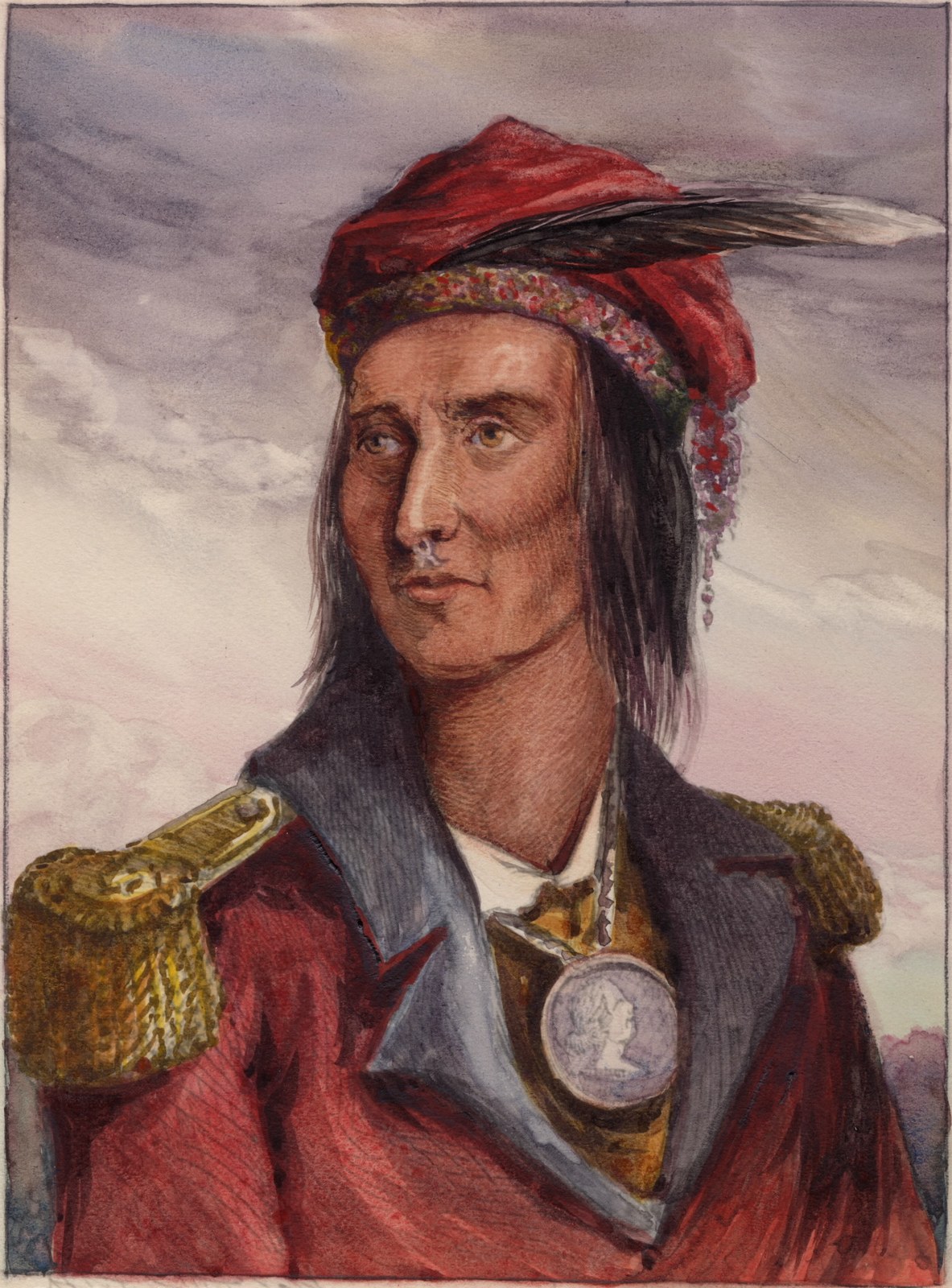
The most consequential of the Shawnee visitors came south with a band of warriors to Running Water Town; Raulston and Livingood date the arrival to 1788, while modern biographers place it in 1789 or 1790. Among them, per the book, were two sons of a chief who had been killed fighting the Americans north of the Ohio; their mother was a Cherokee who had returned south after her husband's death. The elder brother, Cheesekaw (Cheeseekau), led the band and entered into the Chickamauga war plans; he was mortally wounded leading an attack on Buchanan's Station near Nashville in 1792. The younger, Tecumseh, had learned the arts of war at his brother's side; in the book's telling he pledged to remain in the Five Lower Towns until Cheesekaw's death was satisfactorily avenged. For roughly two years Tecumseh roamed the Sequatchie Valley, rode with the far-ranging Chickamauga war parties, and heard the talk, constant in the Lower Towns, of the need to seek strength through confederation of the Native nations. Historians have long treated Dragging Canoe as a model for the pan-tribal resistance Tecumseh led a generation later; the connection was formed here, in the years he spent based in what is now Marion County.
Nickajack and Nickajack Cave
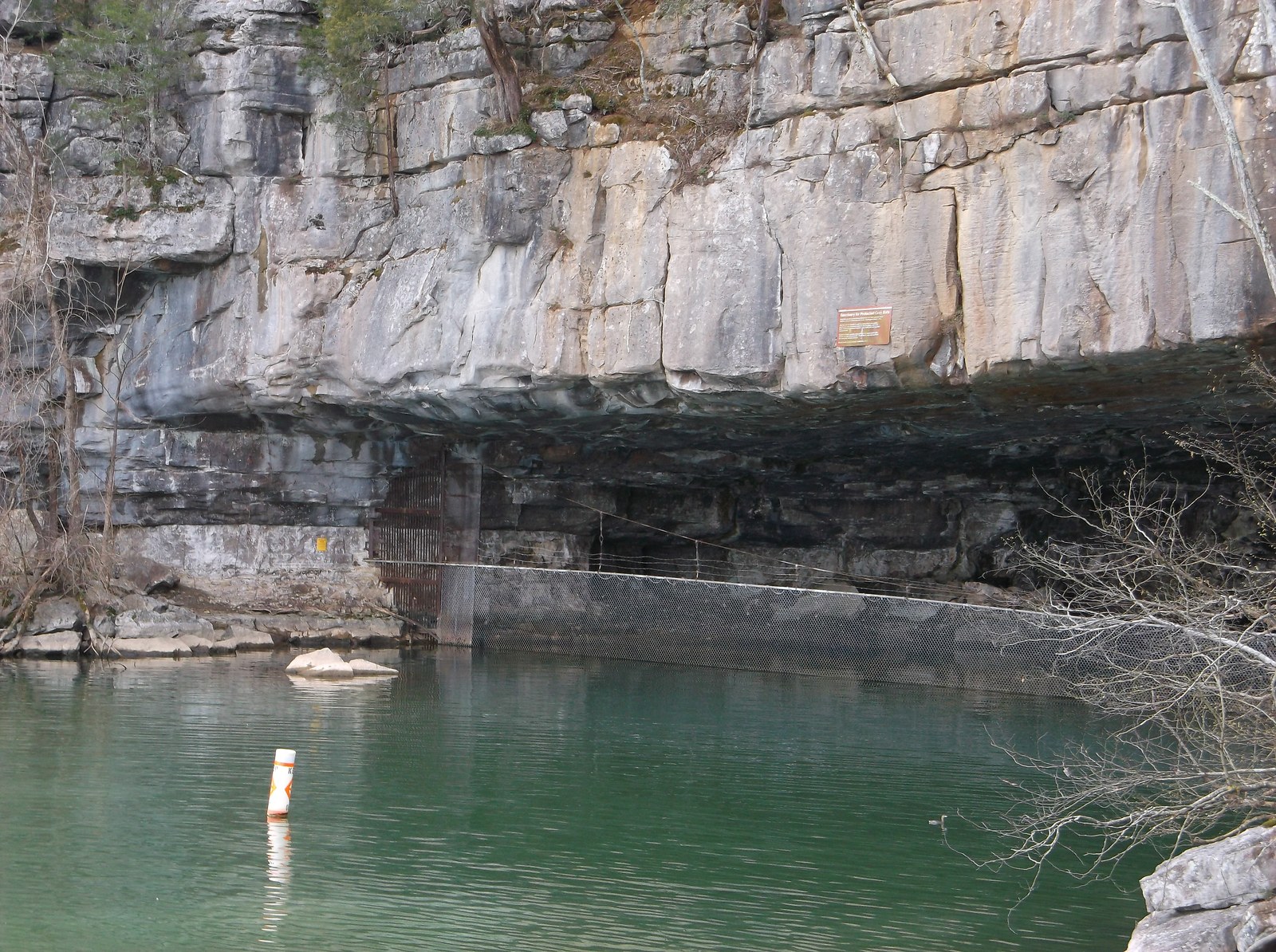
Nickajack town stood on the south bank of the Tennessee River immediately east of the mouth of Nickajack Cave, on a terrace now partially submerged by the reservoir that bears its name. The cave was central to the town's survival strategy. Cherokee forces mined its inner passages for saltpeter (potassium nitrate) to manufacture gunpowder, giving the Lower Towns an independent supply of a commodity that Spanish and British resupply could not always deliver reliably. The cave's inner galleries offered shelter in case of attack; scouts posted on the bluff above the entrance could give warning of approaching boats. The name “Nickajack” has attracted more than one explanation. The historian John P. Brown, whose study of the Chickamaugas remains standard, recorded that the Cherokee called the place Ani-Kusati-yi, “Creek People Place,” and that the Creeks called the cave Tecallassee, “Old Crossing Place.” Other readings connect the name to the Koasati people of Chiaha. The etymology remains contested, but the very range of explanations records how many peoples had a name for this bend of the river.
A population estimate for Nickajack at its peak around 1790 is difficult, but the combination of census-style reports by visiting traders, Spanish emissaries' notes, and later American accounts place the town in the range of 100 to 150 households, with a total population in the several hundreds. Households were a mix of the chinked-log houses that had spread through Cherokee country by the late 18th century, smaller traditional wattle-and-daub structures, and a central council house for public meetings. Fields of corn, beans, squash, and tobacco ran along the river terrace upstream of the town.
Running Water
Running Water (the Cherokee Amoyeli Egwa, “great flowing water”) sat roughly three miles upstream of Nickajack at the mouth of Running Water Creek, along what is now the bed of Nickajack Lake south of the community of Whiteside. Dragging Canoe made his personal residence at Running Water after the 1782 relocation, and the town served as the de facto political capital of the Lower Towns. It was here that he held council with visiting Creek, Shawnee, and Spanish emissaries, and here that he died on February 29, 1792 (sometimes given as March 1, 1792) after a night of ceremonial dancing to celebrate a recent Muscogee victory. His death passed leadership of the Chickamauga movement to his nephew John Watts the Younger, who continued the military campaign for another two and a half years until the 1794 expedition ended it.
Crowmocker: the neighbor in the cove
Crowmocker was not one of the Five Lower Towns, and it is easy to confuse with Crow Town in Alabama; the two are separate entries in Hodge's town list, and the Lower Towns rosters, including Raulston and Livingood's, do not include Crowmocker. It was a distinct Cherokee town of the same era, in the Battle Creek cove a few miles from the river towns, and the scarcity of sources about it is itself part of the story. Named for its headman, the Cherokee chief Crowmocker (Cherokee: Kâg′-ahyelis′kĕ, per Hodge's Handbook of American Indians North of Mexico), the town stood in the cove that Americans would later call Battle Creek, several miles north of the Tennessee River. J.L. Rollings' 1956 memoir records that the land at the head of Battle Creek "was ceded by the Indian Chief, Cromocker, to the white people, about the year 1790," and that the cove lay along "the famous Nickojack Trail, from the Indian settlements near Nashville to the Indian town above Chattanooga." The cove's English name most likely traces to the conflict associated with this trail: Rollings writes that "the Indians had fought a battle here, hence the name Battle Creek." Crowmocker's population was probably smaller than Nickajack or Running Water, but its cove location made it a useful inland refuge and a staging point for raids northward across the Cumberland Plateau to the Cumberland settlements. What happened to Crowmocker during the 1794 expedition is not recorded in the surviving American accounts, which focus on Nickajack and Running Water. The town name disappears from the record after 1794, and whether the cove's residents fled south to the Creek country, west to Willstown, or simply dispersed into the surrounding hollows is an open question. See the dedicated Crowmocker page for the full treatment.
The Chickamauga Wars, 1776 to 1794
From the Lower Towns, Chickamauga warriors conducted a sustained military campaign against American settlements from 1777 through 1794. Raids reached north to the Cumberland settlements around present-day Nashville, east into the Watauga and Holston valleys, south into Georgia, and west into the Ohio Valley via alliances with the Shawnee. A partial chronology of the war, focused on events tied to the Marion County towns, includes:
- 1780: The Donelson flotilla, carrying the families of the future Nashville settlement downriver, is attacked at the “Suck” rapids and again at Nickajack. Several boats are captured; enslaved Black passengers and white settlers are killed or taken captive.
- May 9, 1788: A boat carrying the family of the Virginia pioneer Col. James Brown is intercepted off Nickajack. Col. Brown, two of his sons, and five other young men are killed; his wife and younger children, including sixteen-year-old Joseph Brown, are taken captive. Joseph is adopted into the household of The Breath, the principal man of Nickajack.
- 1787: James Robertson's Coldwater Expedition reaches a Chickamauga-Creek outpost on the Tennessee River at the mouth of Coldwater Creek in what is now Alabama and burns it. The expedition does not reach the Lower Towns proper but disrupts the southern supply line.
- February 1792: Dragging Canoe dies at Running Water; leadership of the Chickamauga movement passes to John Watts the Younger.
- September 25, 1793: The Cavett's Station massacre near Knoxville, in which a Chickamauga-Creek war party led by John Watts kills thirteen members of the Cavett family after promising quarter, hardens American public opinion against any negotiated end to the war.
- September 30, 1793: Hightower in present-day north Georgia is the site of a sharp Chickamauga-Creek defeat by Tennessee militia under John Sevier, further eroding the Lower Towns' strategic position.
- September 12–13, 1794: The Nickajack Expedition destroys Nickajack and Running Water.
For a dedicated account of the campaign as a whole, see the Chickamauga Wars subpage. The focus here remains on what happened inside the Marion County towns.
Joseph Brown, captive and guide
Joseph Brown (1772 to 1868) is the single best-documented inhabitant of Nickajack during the Chickamauga years because he later wrote about it in detail. Taken captive at sixteen in the May 9, 1788 attack on his father's boat, Brown was adopted into the household of The Breath, the principal man of Nickajack, and lived in the town for roughly eleven months before being exchanged. He learned Cherokee, participated in daily work, witnessed councils with Creek and Spanish visitors, and came to know the approach routes to Nickajack from Monteagle Mountain with the intimacy of someone who had hunted and traveled them as a member of the household. His mother, one of his sisters, and two younger brothers were held at other Cherokee towns during the same period.
After his release, Brown lived in Virginia and later returned to Tennessee. In September 1794 he guided Major James Ore's militia across Monteagle Mountain to Nickajack, using the same paths he had traveled as a captive. He later became a Presbyterian minister, moved to Maury County north of Marion, and died there in 1868 at the age of 96. Brown wrote a detailed Narrative of his captivity and his role in the expedition, first published in 1834 in Western Journal and widely reprinted afterward. His testimony is the most important firsthand Anglo-American source on life in Nickajack on the eve of its destruction, and the only one written by someone who had lived inside a household in the town. A profile of Brown is on the People page.
Daily life in the towns
The routine of life at Nickajack and Running Water, and in the neighboring cove town of Crowmocker, combined farming, fishing, trade, and war. Women managed the corn, bean, and squash fields along the river terraces and in the Battle Creek bottom; men hunted deer and bear in the surrounding mountains and fished in the Tennessee and its tributaries. Trade brought deerskins, bear oil, salt, and ginseng downriver in exchange for iron tools, cloth, gunpowder, and rum from Spanish and British suppliers to the south. The towns held ceremonial ballgames, dances, and councils at the central council houses. Cherokee clan organization structured households and marriage. By the early 1790s, a minority of households had acquired enslaved Black laborers, a reflection of the slow adoption of plantation-style agriculture among wealthier Cherokee families that would later accelerate in the Cherokee Nation proper.
The war was a continuous rhythm of departure and return. Warriors left in small parties for weeks or months at a time, returning with captives and livestock or with dead and wounded. The approach of winter slowed raids and brought visiting parties from Creek and Shawnee allies into the Lower Towns. Spring reopened the campaigning season. Joseph Brown's narrative describes this pattern from the inside: dances held to welcome returning warriors, scaffolds raised for the bodies of those killed in raids, and the ordinary routines of pounding corn and mending fishing weirs that continued through all of it.
The end of the Lower Towns, September 1794
On September 13, 1794, a Southwest Territory militia of about 550 men under Major James Ore of Sumner County, guided by Joseph Brown, crossed the Tennessee River below the Nickajack town landing at dawn. Nickajack was attacked first and burned. Running Water was attacked and burned later the same day. About 70 Cherokee were killed; only three Americans were wounded. The raid was legally unauthorized. Tennessee's frontier leaders had acted without explicit federal approval, and Territorial Governor William Blount was politically insulated from the decision. It was, however, decisive. Chickamauga resistance collapsed within weeks, and the formal end of hostilities was ratified at the Treaty of Tellico Blockhouse on November 7 and 8, 1794. The treaty opened the area to American settlement and set up the conditions for the creation of Marion County in 1817.
For a detailed account of the expedition, the composition of Ore's force, the route across Monteagle Mountain, and the political aftermath in both Philadelphia and the Cherokee Nation, see the Nickajack Expedition subpage.
What happened after 1794
Nickajack town was not rebuilt. A handful of Cherokee households remained in the immediate area under the general amnesty that followed the 1794 treaty, and several Cherokee reservees under the Treaty of 1819, most prominently the Lowrey family along Battle Creek, held legal title to tracts that had been the hinterland of Crowmocker and Nickajack. That window of coexistence closed by the mid-1820s under settler pressure, and the remaining Cherokee residents were swept up in the forced removal of 1838. The Cherokee Nation is a sovereign nation today, based in Tahlequah, Oklahoma, and Cherokee descendants of the Lower Towns families continue to live both there and in Marion County.
The caves and rapids that anchored the Lower Towns took on new roles in the 19th century. Nickajack Cave was mined for saltpeter again during the War of 1812, when a small commercial operation worked the inner galleries for gunpowder supply to American forces, and again during the Civil War, when Confederate authorities drew saltpeter from the cave for Army of Tennessee ordnance. By the late 19th century the cave was a tourist curiosity, described in early Tennessee travel accounts and photographed by visitors arriving by rail at Shellmound. Nickajack Dam, completed in 1967, partially flooded the entrance and the sites of the two river towns. The cave entrance is today gated to protect an endangered summer colony of gray bats (Myotis grisescens) and can be viewed from a TVA observation platform off Maple View Lane. Nothing of the original town structures remains above water.
Notable figures
- Dragging Canoe (Tsiyu Gansini, c. 1738 to 1792): Cherokee war leader; founded the Lower Towns in 1779 and led the Chickamauga campaign until his death at Running Water. See People.
- John Watts the Younger (Kunnesee, c. 1750 to 1802): Dragging Canoe's nephew and successor; led the Lower Towns from 1792 through the 1794 expedition; negotiated the 1794 Treaty of Tellico Blockhouse with Territorial Governor William Blount. See People.
- The Breath (died September 13, 1794): principal man of Nickajack at the time of its destruction; adoptive father of Joseph Brown; killed in the dawn attack.
- Doublehead (Taltsuska, c. 1744 to 1807): war leader prominent in raids from the Lower Towns; later a Cherokee signatory of the 1805 Treaty of Tellico and killed in 1807 by Cherokee political opponents.
- Bloody Fellow (Nenetooyah, also Iskagua / "Clear Sky"): Chickamauga diplomat who traveled to Philadelphia to meet President Washington in 1791 and later argued for peace.
- Joseph Brown (1772 to 1868): captive at Nickajack in 1788 to 1789; guide for the 1794 expedition; later a Presbyterian minister in Maury County.
- Major James Ore (c. 1755 to 1829): commander of the militia that destroyed the towns. See People.
Why it still matters
The destruction of Nickajack and Running Water is the foundational event in the modern history of Marion County. Every later chapter, the 1817 formation of the county, the Betsy Pack land sale for Jasper in 1819 and 1820, the Trail of Tears through Martin Springs in 1838, the Civil War crossing at Kelly's Ferry in 1863, the industrial boom, the TVA era, and the communities along the river today, sits on top of what happened here in 1794. The name Nickajack persists on the cave, the lake, the dam, and several subsidiary place names along the river. Running Water persists in the creek name and in the ravine that the Nashville and Chattanooga Railroad crossed on its 780-foot timber trestle at Whiteside beginning in 1854. Crowmocker survives only as a mention in a handful of 19th-century county histories and as the most plausible source of the Battle Creek place name.
Related
In the Beginning: the valley's first peoples →
Russell Cave: the 9,000-year record →
The early explorers: De Soto, Luna, and Pardo →
The Contest for the Land, 1673–1775 →
The Donelson Voyage, 1779–1780 →
Chiaha and the Koasati →
The Native American trails and the Old Creek Crossing →
The Chickamauga Wars, 1776–1794 →
The Nickajack Expedition, September 1794 →
First settlers of Marion County, Cherokee reservees, and the 1838 forced removal →
Trail of Tears through Marion County, 1838 →
Nickajack and Running Water (community page) →
Crowmocker (community page) →
Battle Creek →
Nickajack Cave, Lake, and Dam →
Sources
- Wikipedia — Chickamauga Cherokee
- Wikipedia — Cherokee–American wars
- Wikipedia — Nickajack Expedition
- Wikipedia — Nickajack Cave
- Wikipedia — Dragging Canoe
- Wikipedia — John Watts (Cherokee chief)
- Tennessee Encyclopedia — Chickamaugas
- Tennessee Encyclopedia — Marion County
- Native History Association — Dragging Canoe
- The Tennessee Magazine — Much Tennessee history happened at Nickajack Cave
- Tennessee Encyclopedia — John Donelson (1780 flotilla voyage)
- Wikipedia — Doublehead (1793 Watts campaign that included Cavett's Station)
- Joseph Brown, Narrative of the Life of Col. Joseph Brown, reprinted from Western Journal, 1834.
- J. Leonard Raulston and James Weston Livingood, Sequatchie: A Story of the Southern Cumberlands (Knoxville: University of Tennessee Press, 1974), pp. 39–42 (the 1782 relocation, Little Owl's mission to the Creeks, the towns' locations and distances, the mapped forts at Long Island, the Narrows as a defensive bastion, the “make hastes,” the raid economy, John P. Brown's etymology of the Nickajack name, exchange warriors, and the leadership roster), p. 41n (Blount's 1793 letter on the abandonment of Chickamauga Creek), p. 44 (the Spanish supply line), p. 48 (the Maybery capture and Daniel Ross), pp. 48–49 (the 1788 attack on the Brown family boat), and pp. 49–50 (Cheesekaw and Tecumseh at Running Water).