Last updated: June 1, 2026
- Location: Doran's Cove, Jackson County, Alabama, about seven miles below South Pittsburg, just across the Tennessee state line
- Named for: Thomas Russell and Major James Doran, Revolutionary War veterans from South Carolina buried nearby
- Archaeological record: nearly continuous human occupation across roughly 9,000 years; a hearth at the lowest level radiocarbon-dated to about 7,000 B.C.
- Excavated: first dug by the Tennessee Archaeological Society in 1953; the Smithsonian expedition under Carl F. Miller ran three seasons beginning May 1, 1956
- Protected: established as Russell Cave National Monument by presidential proclamation on May 11, 1961; managed by the National Park Service
Russell Cave sits a few miles southwest of Marion County, in Doran's Cove just over the Alabama line, but its story belongs to the Sequatchie country, and the people who dug it out of obscurity were Marion County men. The cave holds one of the longest continuous records of human occupation of any shelter in the eastern United States, and that record was first read in a 1956 excavation carried out, improbably, by a crew of South Pittsburg coal miners working for the Smithsonian Institution. The story is told at the opening of Sequatchie: A Story of the Southern Cumberlands (1974), by J. Leonard Raulston and James Weston Livingood, and this page follows their account. For the broader prehistory of the valley's first peoples, the Archaic, Woodland, and Mississippian cultures whose layers the cave preserved, see In the Beginning.
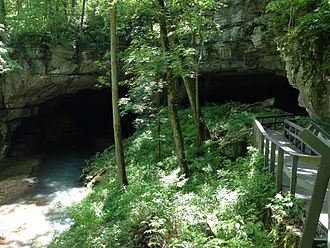
A cave in Doran's Cove
The cave stands high and relatively dry in a cliff along the margin of Doran's Cove, on land that in the 1950s belonged to a farmer named Oscar Ridley. The cove runs about five miles below South Pittsburg, in the northern section of Jackson County, Alabama, in what Raulston and Livingood call the southern portion of the Sequatchie country. Nearby lie the graves of Thomas Russell and Major James Doran, two Revolutionary War veterans who came from South Carolina to take up land claims here and who gave their names to the landforms, the cave to Russell, the cove to Doran. Major Doran's name still attaches to Doran Cove on the Marion County side, where he settled about 1811 among the Long, Mullins, Inman, and Coppinger families of the Tennessee River gorge.
For most of the cave's modern history it was simply a local landmark, naturally air-conditioned, cool in the worst heat, and wrapped in the kind of legend that gathers around any dark opening in the rock. That ordinary obscurity ended in the 1950s, when a handful of amateur archaeologists realized what the cave floor might contain.
The miners turned diggers
Early on the morning of May 1, 1956, a small group of coal miners from South Pittsburg made their way up Doran's Cove to the Ridley farm to report for one of the strangest jobs of their working lives. They had been hired not to mine but to excavate, to work the floor of the cave for a team of archaeologists. They carried none of the heavy tools of their trade. Instead they were handed masons' trowels, brushes, and sieves, and told to search with patience and care through the debris of past centuries for human bones and objects made by early people.
The miners were skeptical. They did not at first understand what their new employers were after, and rumors ran through the crew that the scientists were only disguising their true purpose. Old legends held that the Creek or the Cherokee had hidden gold in the cave, and other tales told of two men who had made off with a fortune in gold coin after a train robbery in the vicinity, tracked by a posse to Russell Cave and killed there before they could reveal where the loot was cached. To men used to hard, dangerous work underground, the prospect of buried treasure made more sense than brushing dirt off old bones. Slowly, though, the crew, supplemented by college and high school youth, learned the new trade and grew genuinely interested in recording the long human history sealed in the cave floor.
How the dig began
The idea that Russell Cave might hold the key to the story of early man in the Sequatchie country belonged to four members of the Tennessee Archaeological Society: Paul V. Brown, Le Baron W. Pahmeyer, Charles K. Peacock, and J. B. Graham. Visiting the area in 1953, they began their own excavations and quickly found evidence convincing them that a major archaeological treasure lay hidden in the cave. Rather than risk damaging it, they turned to the National Geographic Society and the Smithsonian Institution for help, urging that professional scientists be sent to examine the site.
The Smithsonian assigned Dr. Carl F. Miller to organize and lead the expedition. For three seasons his crews turned and sifted the cave floor stratum by stratum, excavating, marking, and removing broken pottery, cracked animal bones, stone weapons, tools, shell objects, and ornaments. The cave's ancient occupants had been "careless housekeepers": when their garbage grew too foul, they simply carried in clean earth and built a new floor on top of the old, sealing each era's litter under the next and leaving, for the archaeologists, a layered calendar of occupation. Tons of material went off to laboratories, where experts read in the bones, tools, and ashes of ancient fires a record of some of the earliest people on the continent. Miller published his findings in two articles in National Geographic, in 1956 and 1958.
What the cave held
At the lowest level of the dig, twenty-three feet down in undisturbed ground, Miller and his associates found a small pocket of charcoal from an ancient hearth. Radiocarbon testing dated those charred embers to roughly 9,000 years ago, give or take a few centuries, fixing the cave's earliest known fire in the time of the Archaic hunters. Above that hearth the strata rose through the whole sweep of the valley's prehistory.
The Archaic people who lit that first fire lived by hunting and gathering, kept no domestic animal but the dog, and threw stone-tipped spears with the atlatl. Above their layer came the Woodland people, who made pottery, took up the bow and arrow, raised burial mounds, and began to grow corn; Miller's vivid reconstruction of a day in the life of these Russell Cave Woodland families is quoted on the In the Beginning page. Higher still lay traces of the Mississippian culture that began about A.D. 1,000, by which time the cave's people had mostly moved out to permanent farming villages and used the shelter only occasionally.
One absence in the record told its own story. Miller's teams found no artifacts from the period after Europeans reached the region's Native Americans, no trade beads, no metal, nothing of contact. The cave that had sheltered Sequatchie families for thousands of years had been completely abandoned in favor of village life before Europeans arrived. Russell Cave, in short, preserved the deep prehistory of the valley almost in full, and then fell silent just before recorded history began.
Russell Cave National Monument
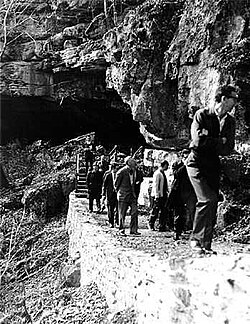
The excavation proved that people had lived around the Sequatchie Valley long before the pyramids of Egypt were built, and the discovery stirred wide interest. The National Geographic Society purchased the cave and the surrounding land and presented both as a gift to the American people. On May 11, 1961, the site was established as Russell Cave National Monument by presidential proclamation, and it has been administered by the National Park Service ever since. Today the monument protects one of the longest archaeological sequences of any cave shelter in the eastern United States, a record that begins thousands of years deeper in time than any written history of the region and that frames how archaeologists read the Woodland mounds and river-bank sites across the line in Marion County.
Related
In the Beginning: the first peoples of the Sequatchie country →
The first settlers, including the Doran and Russell families →
The caves of Marion County →
Nickajack Cave, Lake, and Dam →
The Cherokee Lower Towns →
Sources
- J. Leonard Raulston and James Weston Livingood, Sequatchie: A Story of the Southern Cumberlands (Knoxville: University of Tennessee Press, 1974), chapter 1, "In the Beginning," pp. 3–12.
- Carl F. Miller, "Life 8,000 Years Ago Uncovered in an Alabama Cave," National Geographic Magazine 110 (1956), and "Russell Cave: New Light on Stone Age Life," National Geographic Magazine 113 (1958).
- National Park Service — Russell Cave National Monument
- Wikipedia — Russell Cave National Monument