Last updated: April 27, 2026
- Type: Pre-industrial settlement (predecessor to Whitwell)
- Approximate dates: Pre-1796 (North Carolina jurisdiction) through 1877
- Post office: Cheeksville, 1830–1887
- Named for: The Cheek family, early settlers in the upper Sequatchie Valley
- Renamed: Whitwell, 1877, after British metallurgist Thomas Whitwell
Cheekville was the name of the small Sequatchie Valley settlement that became Whitwell when British capital and the Southern States Coal, Iron and Land Company arrived in 1877. For the six decades before that change, Cheekville was a scattered agricultural community on the valley floor at the base of the Cumberland Plateau, named for the Cheek family who farmed the area and whose two-story double log house had served as a courthouse before Tennessee was even a state. In November 1817, when the Tennessee General Assembly carved Marion County out of former Cherokee land, Cheekville held the county's first court session at the home of John Shropshire, the smith and justice of the peace whose house the General Assembly named in the act establishing the county.
Setting
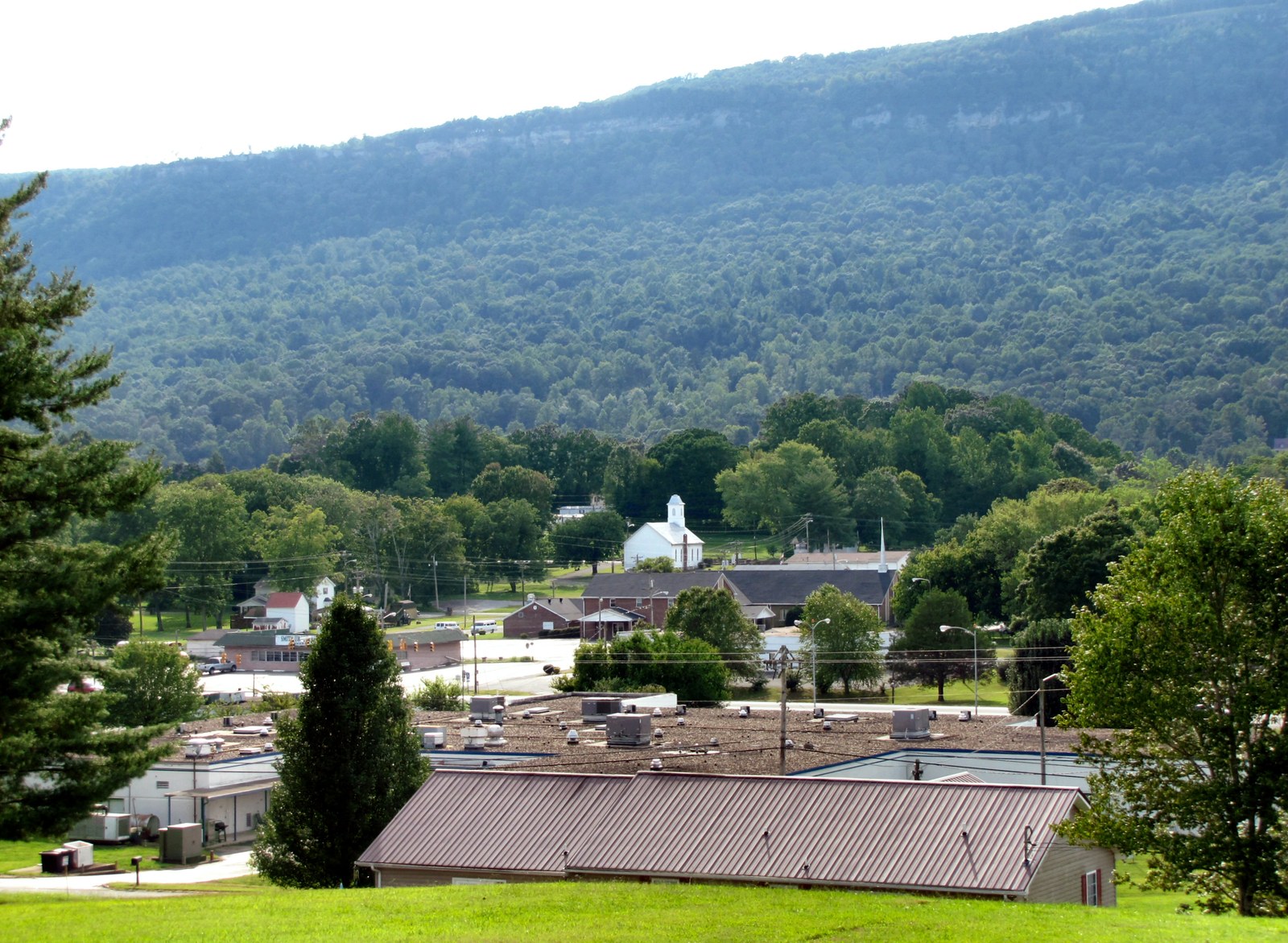
Cheekville sat on the floor of the upper Sequatchie Valley, the same ground as modern Whitwell, in the north-central part of Marion County. The Cumberland Plateau rises sharply on the west side of the valley, and the long ridge separating the Sequatchie from the Tennessee River Gorge bounds the east. The valley floor here is fertile bottom soil watered by the upper Sequatchie River and the streams that come off the plateau, and was farmable long before it was minable. The plateau wall hides what would later become Cheekville's defining resource, the thick coal seams running through the rim above the valley, but in the Cheekville period the place was still a farming settlement, not a coal town.
Pre-statehood roots and the Cheek family
The settlement's name comes from the Cheek family, early Anglo-American settlers in the upper Sequatchie Valley whose holdings included a substantial two-story double log house. Court was held at that Cheek house even before Tennessee became a state in 1796, while the area was still under North Carolina jurisdiction. The arrangement was typical of the period: jurists rode circuit, and a settler family with a large enough building hosted court when the docket reached their corner of the territory. The Cheek family's prominence is the reason the broader settlement on the valley floor came to be known as Cheekville.
Sources differ on the exact location of the original Cheek house relative to later Whitwell. The Tennessee Encyclopedia and county-history accounts place the Cheek house slightly south of present-day Whitwell, in a sub-area sometimes called Liberty in the early 19th century, while Wikipedia and the Sequatchie Valley Scenic Byway corridor site treat Cheekville as a direct predecessor name for Whitwell at the same site. The likeliest reconciliation is that Cheekville referred broadly to the upper-valley settlement clustered around the Cheek family's holdings and that the specific Cheek house sat on the southern edge of the cluster, in a sub-locality that took on the separate name Liberty as it grew. The 1824–1828 Marion County post office Liberty East, listed in the TNGenWeb post-office register, is consistent with that southern-edge Liberty hamlet. By the time the Cheeksville post office opened in 1830, the broader settlement had settled on the Cheek-family name.
1817: Marion County's first court
The Tennessee General Assembly created Marion County by Acts of 1817, signed on November 20, 1817, carving the new county out of land ceded by the Cherokee under the Treaty at the Cherokee Agency earlier that year. The act provided that "the courts of pleas and quarter sessions, and the circuit court in said county" would be "held at the house of John Shropshire" until otherwise provided for, with the same powers and jurisdiction as courts in other Tennessee counties. Shropshire was a smith and a justice of the peace, and he kept a shop near his home where, by tradition, lesser trials had already been held before the General Assembly's act formalized the arrangement.
The Shropshire-house court convened in Cheekville. After about a year, court business moved for one year to the older two-story double log Cheek house in the Liberty sub-locality, before the county seat was moved to Jasper in 1819 on land purchased from Betsy Pack. The pattern of three court venues in three years, all within a few miles of each other in the upper valley, is the kind of fast institutional churn typical of newly organized Tennessee frontier counties: the General Assembly named the first venue, the court itself moved to whatever larger building was available next, and the eventual seat was settled by negotiation with a local landowner. Marion County's seat has been at Jasper ever since.
John Shropshire was born May 18, 1767 in Virginia and died June 16, 1846 in Marion County. He served as a justice of the peace and a smith, and trials of minor offenses were sometimes held in his blacksmith shop alongside the formal court sessions in his house. After the seat moved to Jasper, Shropshire stayed on at his Cheekville home and became a well-known figure in the upper-valley community. More about John Shropshire on the people page →
The Cheeksville post office (1830–1887)
The Cheeksville post office opened on the valley floor in 1830 and operated continuously for 57 years until it closed in 1887. The two-year gap before the Whitwell post office opened in 1889 marks the institutional transition from the Cheek-era settlement to the coal-era town. The federal records preserve the spelling as Cheeksville with a terminal "s," and that spelling appears on the TNGenWeb Marion County post-office register; local usage and most Marion County historical writing render the place as Cheekville without the "s." Both spellings appear in primary sources from the period.
The Cheekville Cumberland Presbyterian Church (1842)
Cheekville also had an organized church a full generation before the coal era. The Cheekville Cumberland Presbyterian Church was organized in 1842, gathering a small rural congregation on the valley floor. When the settlement was renamed for Thomas Whitwell, the church followed: in 1878 it became the Whitwell Cumberland Presbyterian Church. Its present frame building, raised around 1892 and listed on the National Register of Historic Places in 2018, still stands at 876 South Main Street, one of the most intact survivors of the Cheekville-era community even though it now carries the later name. See the religious history page for more on the county's early churches.
The 1877 transformation into Whitwell
Cheekville the agricultural settlement gave way to Whitwell the coal town when the Southern States Coal, Iron and Land Company, a British-backed enterprise organized by James Bowron and associates, brought capital into the Sequatchie Valley in 1877 to develop the coal seams in the plateau rim above. The company opened mines on the plateau wall, built coke ovens nearby at Victoria, and shipped coal and coke to feed the iron smelters down the valley at South Pittsburg. The settlement was renamed in honor of Thomas Whitwell (1837–1878), a British metallurgist, inventor, and co-founder of the Southern States company. Whitwell had patented the “Whitwell Heating Stove,” a hot-blast furnace design used at more than seventy furnaces worldwide; he was killed in a steam explosion at his own Thornaby ironworks in England on August 5, 1878, only months after the operations he had helped finance were getting underway in Tennessee.
The Sequatchie Valley Railroad reached Whitwell in 1887, linking the new coal mines to Jasper and the NC&StL mainline at Bridgeport, Alabama. The Cheeksville post office closed the same year. The Whitwell post office opened in 1889. By 1890, the renamed community had grown to 906 people, and the Cheekville name had passed out of everyday use. See the Whitwell community page for the full record of the coal-era town and its 20th-century history, including the 1981 No. 21 Mine explosion and the Paper Clips Project.
Legacy
The Cheekville name survives mostly in three places. The TNGenWeb Whitwell journal scrapbook preserves photo pages titled Anderson Cheek Log House and Cheekville School Class of ?, contributed by local historian Euline Harris, that document late-Cheekville-era buildings and a turn-of-the-century school class whose photograph caption still uses the older settlement name. The Tennessee Encyclopedia, Wikipedia, and the Sequatchie Valley Scenic Byway corridor site each note Cheekville as Whitwell's predecessor name when explaining how the town came to be called what it is. And the federal post-office records preserve Cheeksville, 1830–1887 as one of the longer-lived 19th-century Marion County offices, sitting between the short-lived crossroads stops covered on the other named places page and the post offices of the cities and towns that grew large enough to have their own subpages on this site.
Cheekville is also a useful reminder that Whitwell did not begin in 1877 as a fresh coal camp built on empty ground. The valley floor had been farmed by the Cheek family and their neighbors for at least a generation before the British arrived, and the valley itself had been part of the Cherokee homeland for centuries before that. The coal-and-coke town was layered onto an existing settlement, not stamped onto a blank.
Related
Whitwell →
Other named places in Marion County →
Jasper, the county seat since 1819 →
First settlers of Marion County →
Coal & coke industry →
Sources
- Acts of Tennessee 1817, Chapter 109 — Establishment of Marion County (UT County Technical Assistance Service)
- Wikipedia — Whitwell, Tennessee (history section)
- Wikipedia — Thomas Whitwell, British metallurgist
- Wikipedia — Whitwell Cumberland Presbyterian Church
- Tennessee Encyclopedia — Marion County
- Sequatchie Valley Scenic Byway — Whitwell
- TNGenWeb Marion County Post Offices — Cheeksville (1830–1887), Liberty East (1824–1828), Whitwell (1889–present)
- TNGenWeb Whitwell Journal Scrapbook — Anderson Cheek Log House
- TNGenWeb Whitwell Journal Scrapbook — Cheekville School Class
- Find a Grave — John Shropshire (1767–1846)