Last updated: August 1, 2026
- Departure: December 22, 1779, from Fort Patrick Henry on the Holston River
- The fleet: some thirty flatboats, dugouts, and canoes carrying about two hundred settlers, led by the flagship Adventure
- Commander: Col. John Donelson, partner of James Robertson in the Cumberland settlement scheme
- The gauntlet: March 7–8, 1780, past the Chickamauga towns, Moccasin Bend, the Suck, and the length of the Marion County river reach
- Arrival: April 24, 1780, at the Big Salt Lick on the Cumberland, the future Nashville
- Primary source: Donelson's own journal, kept aboard the Adventure
In the last days of 1779, a fleet of flatboats pushed off from Fort Patrick Henry on the Holston River carrying about two hundred men, women, and children toward a settlement that did not yet exist. Their route ran the whole navigable length of the Tennessee River, including every mile of the reach that now borders Marion County, and their passage through the river gorge under fire from the Chickamauga towns became one of the founding stories of Tennessee. Col. John Donelson kept a journal of the voyage aboard his flagship Adventure, and that journal, titled “Journal of a voyage, intended by God's Permission, in the good Boat Adventure”, is the closest thing the county's stretch of river has to an eyewitness account from the settlement era. The fullest regional retelling is in Raulston and Livingood's Sequatchie (1974), whose account this page follows.
The Cumberland scheme
The voyage grew out of the last great project of Richard Henderson, the North Carolina speculator whose Transylvania Company had bought some twenty million acres from the Cherokee at Sycamore Shoals in 1775. Virginia had refused to recognize his title to the Kentucky country, but per Raulston and Livingood, Henderson knew the Cumberland Valley lay within North Carolina's western charter claim, and by 1779 he was “busy preaching the advantages of that promising region.” The plan that emerged had two prongs. James Robertson, a border farmer, militia officer, and leader of men, would take most of the men and boys overland with the livestock to build cabins at the site. The families, with the household goods, would go by water under John Donelson: down the Tennessee to the Ohio, up the Ohio to the Cumberland, and up the Cumberland to the new settlement, a route of well over a thousand miles to cover a straight-line distance a fraction of that length.
The river road before Donelson
The water route was daunting but not untried. Raulston and Livingood record that despite the difficulties of the Narrows and Muscle Shoals, and the hostile country most of it passed through, the river road through the Sequatchie region “had been used by a group in 1768,” and that ten years later another flotilla of forty boats floated downstream to new homes in the Far West. What set the Donelson party apart was its size, its cargo of families rather than hunters, and its timing: it set out in the middle of a war, four months after Evan Shelby's raid had burned the Chickamauga towns and hardened the river's defenders.
A cold start
The fleet left Fort Patrick Henry on December 22, 1779, per the Tennessee Encyclopedia a flotilla of thirty or so flatboats, dugouts, and canoes carrying about thirty families. It immediately ran into one of the coldest winters of the century. Raulston and Livingood write that the party was delayed by extremely cold weather for two months at the outset, creeping down the frozen Holston. Aboard the flagship Adventure were Mrs. James Robertson and her children and the Donelson family, including the colonel's daughter Rachel, who later married Andrew Jackson.
The gauntlet: March 7–8, 1780
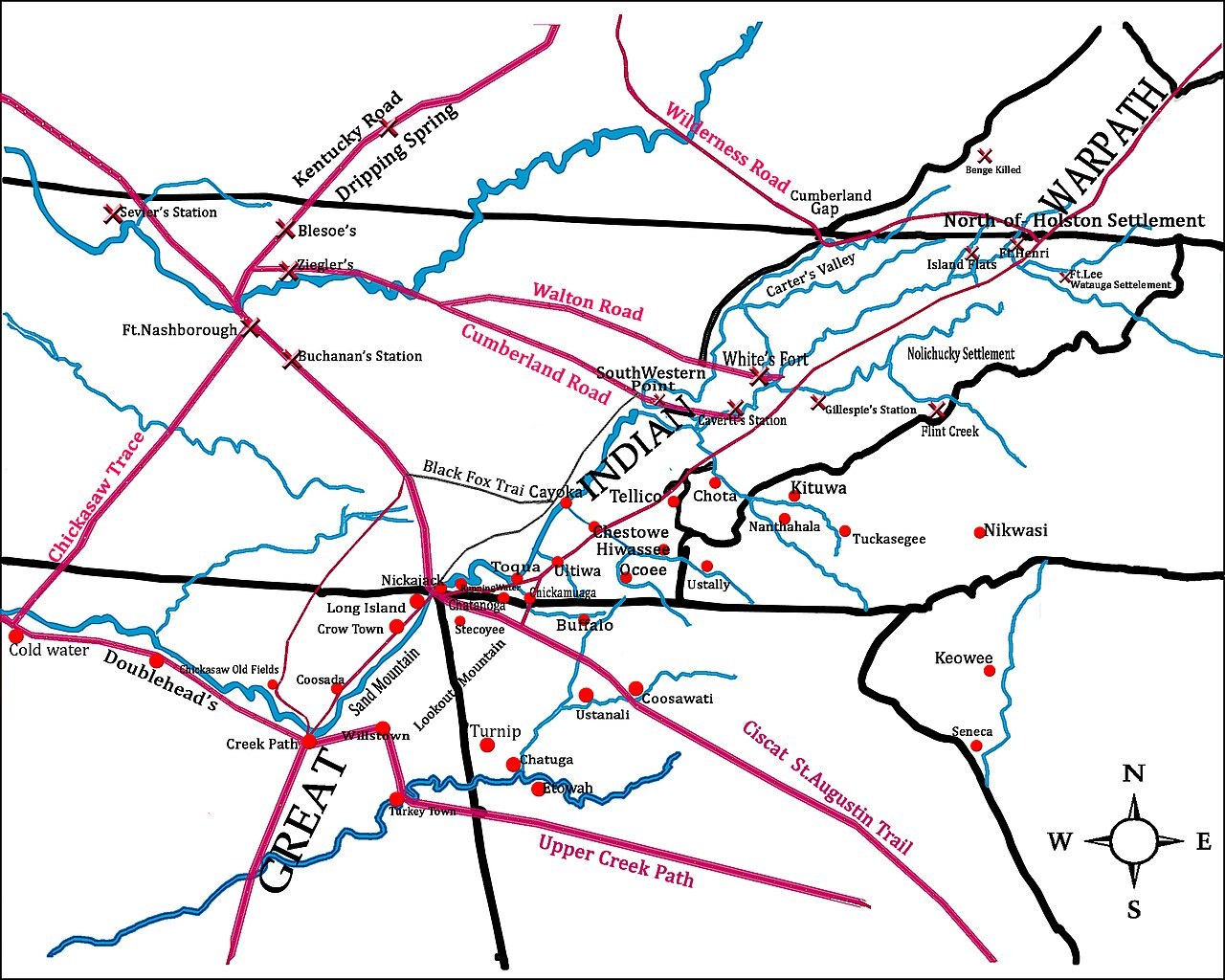
On March 7, 1780, the fleet reached the immediate vicinity of the Chickamauga towns east of Lookout Mountain and camped for the night. The next day the party drifted past the future site of Chattanooga, where, in Raulston and Livingood's telling, Cherokee along the bank at first beckoned in apparent friendship, luring the boats into a false sense of security. Then warriors in red and black war paint appeared on the shoreline, and rifle fire opened on the fleet from concealed vantage points, killing at least one young man. The National Park Service places the heart of the attack at Moccasin Bend, where the river doubles back beneath Lookout Mountain.
The worst fell on a single boat trailing the fleet. Twenty-eight people, some of them sick with smallpox, had been placed aboard it under a kind of floating quarantine, keeping their distance from the other boats. Chickamauga warriors cut the lone vessel off and, in the words Donelson set down in his journal, “killed & took prisoner the whole crew, to the great grief of all the Company uncertain how soon they might share the same fate.”
At the Suck: the Jennings boat
Trailed along the shore by a growing number of warriors, the fleet entered the river gorge and reached the Suck, the whirlpool rapid at the mouth of Suck Creek that was the most feared water on the river. There a large canoe overturned and spilled its cargo; when the flotilla paused to recover the goods, rifle fire came down from the bluffs above, and the boats hastily pushed on. In the confusion the boat of Jonathan Jennings ran onto a large rock projecting from the shore and partly sank, and the rest of the fleet, unable to stop under fire, left the Jennings family behind. Donelson recorded what followed when survivors caught up two days later. Jennings had ordered his family and the two enslaved people aboard to throw the cargo into the river while he returned fire; his son, another young man, and the enslaved man jumped from the boat, but his wife stayed. “Mrs. Jennings, however,” together with the enslaved woman, “succeeded in unloading the boat, but chiefly by the exertions of Mrs. Jennings, who got out of the boat & shoved her off,” Donelson wrote, adding that she was nearly thrown from the freed boat as it swung loose, and that on inspection Jennings appeared “to have made a wonderful escape, for his boat is pierced in numberless places with bullets.”
Through Marion County waters
Below the gorge the fleet ran the reach that is now Marion County's riverfront. In Raulston and Livingood's words, the party “drifted on down the Tennessee through the lower Sequatchie region by Long Island and the Old Creek Crossing,” the ancient ford where the trail network of the whole region met the river near present-day South Pittsburg. The banks they passed held the sites where, two years later, the Chickamaugas would build the Lower Towns of Nickajack and Running Water; the same stretch of river would see boats attacked for another fourteen years, until the Nickajack Expedition of 1794. The Donelson fleet, already past the worst of the gauntlet, slipped down the county reach, through the Narrows and on toward the shoals of Alabama.
Arrival and afterward
Beyond Muscle Shoals the fleet turned up the Ohio and then the Cumberland, working against the current for the final weeks. Per the Tennessee Encyclopedia, the boats reached the Big Salt Lick, the future Nashville, on April 24, 1780, closing a four-month, thousand-mile voyage through “Indian attacks, a smallpox outbreak, hunger, exhaustion, extreme cold, swift currents, and treacherous shoals.” Raulston and Livingood note that the families were reunited with the overland party along the Cumberland in the last week of April, on ground almost two hundred miles beyond the settled frontier: the most exposed position on the American frontier at that time, surrounded by the hunting grounds of the Cherokee, Creek, Chickasaw, and northern nations. The Cumberland settlements the voyage planted grew into Nashville, and the journal Donelson kept became one of the founding documents of Tennessee history, preserved in Three Pioneer Tennessee Documents and in Ramsey's Annals of Tennessee.
For Marion County, the voyage is the settlement era's opening scene played out on local water: the first documented passage of an American emigrant fleet down the county's stretch of the Tennessee, fourteen years before the river here was safe for the families who would follow. The rapids that nearly wrecked it are told in full on the Suck page, and the wider war it sailed through on the Chickamauga Wars page.
Related
“The Suck” rapids →
The Chickamauga Wars →
The Cherokee Lower Towns →
The Contest for the Land, 1673–1775 →
The Native American trails and the Old Creek Crossing →
The Tennessee River →
Sources
- J. Leonard Raulston and James Weston Livingood, Sequatchie: A Story of the Southern Cumberlands (Knoxville: University of Tennessee Press, 1974), chapter 3, “Whose Land?,” pp. 36–38, quoting John Donelson's journal from Three Pioneer Tennessee Documents (Nashville: Tennessee Historical Commission, 1964).
- Tennessee Encyclopedia — John Donelson (departure December 22, 1779; the flotilla; arrival at the Big Salt Lick April 24, 1780).
- Wikipedia — John Donelson (the journal and the co-founding of the Cumberland settlements).
- National Park Service — John Donelson's Harrowing Expedition Around Moccasin Bend (the Chickamauga attack at Moccasin Bend).
- Wikipedia — Treaty of Sycamore Shoals (Richard Henderson, the Transylvania Company, and the twenty-million-acre purchase).