Last updated: August 5, 2026
- Period: 1776 to 1794
- Core Cherokee leadership: Dragging Canoe (1776–1792), John Watts the Younger (1792–1794)
- Capital: The Lower Towns, centered on Running Water and Nickajack in modern Marion County
- Opposing force: Watauga, Holston, Cumberland, and Southwest Territory militia, in coordination after 1790 with U.S. federal authorities
- Conclusion: Nickajack Expedition (September 1794) and Treaty of Tellico Blockhouse (November 1794)
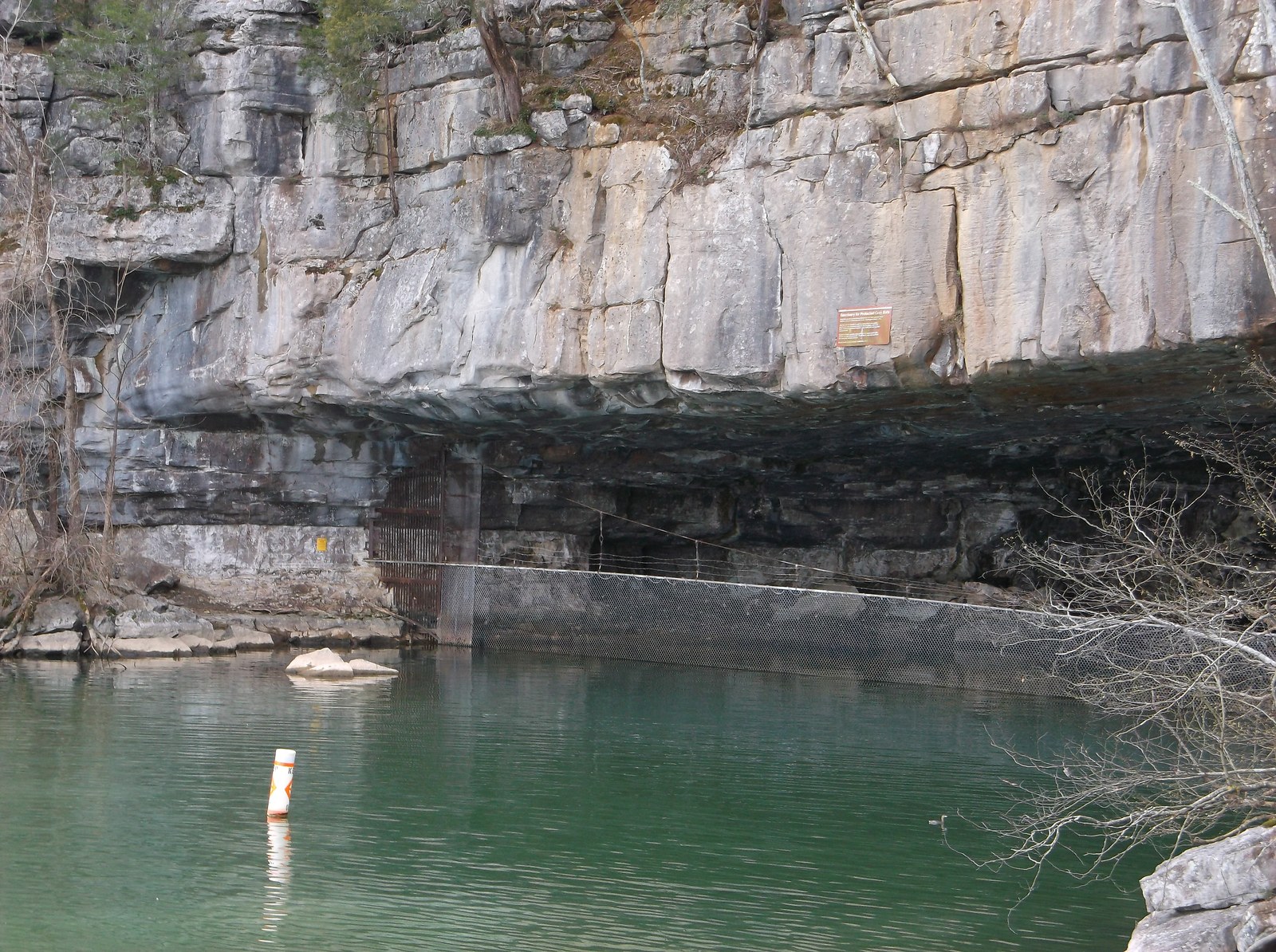
The Chickamauga Wars were an eighteen-year armed conflict between a breakaway Cherokee faction led by Dragging Canoe and the American settlers who were pushing across the Appalachians into what is now Tennessee, Kentucky, northern Alabama, and northwest Georgia. The campaign ran from the opening of the American Revolution in 1776 through 1794, overlapping and outlasting the Revolution itself by more than a decade. Its strategic center from 1779 onward was the cluster of Cherokee towns along the south bank of the Tennessee River in what is now Marion County. The conflict ended when Tennessee militia crossed Monteagle Mountain at dawn on September 13, 1794 and burned Nickajack and Running Water to the ground. This page follows the campaign as a whole and places the Marion County towns at its center.
Origins: the Treaty of Sycamore Shoals and the Cherokee split
In March 1775, the Transylvania Company, a land-speculation partnership led by Richard Henderson, met a Cherokee delegation at Sycamore Shoals on the Watauga River. In exchange for goods valued at £10,000, the older Cherokee leadership signed a deed transferring roughly 20 million acres in what is now central and eastern Tennessee and Kentucky. Dragging Canoe, then in his late thirties and an emerging war leader, stood up at the treaty ground and spoke against the sale. He warned the Americans that the ceded land would become “a dark and bloody ground.” The phrase followed the Cumberland country into a generation of American writing about the frontier. Per Raulston and Livingood, when the signing came he left the council never to return, and many of the young warriors, seeing the impressive pile of trade goods reduced to small rewards for each individual, went with him. The full story of the purchase and the century of contested claims behind it is on the Contest for the Land page.
The Cherokee Nation's response to Sycamore Shoals split the nation. Older leaders accepted the cession as the price of peace with an aggressive neighbor. Dragging Canoe and his followers rejected it. When the American Revolution opened in the summer of 1776 and British Indian agents in the South began supplying the Cherokee with arms and powder, Dragging Canoe committed to war. A Cherokee offensive that July against the Watauga, Nolichucky, and Holston settlements was turned back at Island Flats (near modern Kingsport) and at Fort Watauga. In retaliation, Continental and state militia forces under Col. William Christian, Gen. Griffith Rutherford, and Col. Andrew Williamson burned a string of Overhill and Middle Cherokee towns in the autumn.
The older Cherokee leadership, under pressure, signed the Treaty of DeWitt's Corner (May 1777) with South Carolina and Georgia and the Treaty of Long Island of the Holston (July 1777) with Virginia and North Carolina. The two treaties ceded additional Cherokee land. Dragging Canoe refused to recognize the cessions. In the spring of 1777, per Raulston and Livingood, thoroughly disgusted with the older chieftains' willingness to hold peace conferences and cede more land, he and his followers broke completely with the Cherokee Nation and withdrew from the Overhill settlements to Chickamauga Creek, near present-day Chattanooga, where the British deputy agent John McDonald had earlier planted a trading post at the Great War and Trading Path's crossing of the creek. On foot, by pack horse, canoe, and travois, the breakaway faction made its exodus as a splinter tribe. Many lesser chiefs went with Dragging Canoe: Judd's Friend, Big Eagle, Bloody Fellow, Lying Fish, Buck, and Young Tassel, later known as John Watts. In the new villages the warriors were joined by friendly traders, Tories, disillusioned Cherokee, and roving bands of Creeks, Shawnee, and other allied warriors, while caravans of British supplies and ammunition continued to arrive in McDonald's care. By the end of 1778 the faction Americans had begun calling the Chickamauga, after the creek, was recognized as a force of more than 1,000 warriors, and Dragging Canoe had become, in Raulston and Livingood's estimate, the most powerful Native leader in the entire Southeast. The internal Cherokee split was complete.
Shelby's raid and the retreat to the Lower Towns
By 1779 the Chickamauga raids had made the river a political issue. Governor Patrick Henry of Virginia, seeking North Carolina's support for a campaign, pointed per Raulston and Livingood to the navigation of the Tennessee, “rendered unsafe and impracticable so long as these banditti go unpunished.” On April 10, 1779, a force accounts put at nine hundred to a thousand men under Col. Evan Shelby left the Holston in boats for a rare naval invasion, taking Chickamauga Town by surprise while most of the warriors were away, though nearly all of Dragging Canoe's people escaped. Over the next two weeks Shelby destroyed the remaining towns in the immediate area, ten beyond the first, and carried home the captured British war supplies and the furs taken from John McDonald's post. The blow deterred few: the Chickamaugas had lost very few fighters and soon rebuilt, and Alexander Cameron, who succeeded John Stuart as British agent after Stuart's death, replaced the lost war matériel over the trails from Pensacola. But Dragging Canoe returned to find the towns and winter supplies burned. His people rebuilt on the same ground and kept drawing recruits, and the raid had shown how exposed the creek towns were to attack from upriver. In 1782, per Raulston and Livingood, he moved his followers further west, past Lookout Mountain and into the bottomlands and cave country of the Tennessee River gorge. There he and his people established the Five Lower Towns. Two of them, Nickajack and Running Water, sat inside what is now Marion County, with the separate Cherokee town of Crowmocker nearby in the Battle Creek cove. The Lower Towns' location combined four strategic advantages: the river corridor to the Muscogee (Creek) and Spanish supply line to the south, the defensible cave and bluff terrain at Nickajack, the Tennessee River crossings that made approach from the north difficult without ferry or boat, and a position well outside the reach of the coastal states' militia.
For the next twelve years, the Lower Towns were the military capital of the Chickamauga campaign. Raids against American settlements were planned there. Prisoners were brought there. Spanish and British agents arrived there. Allied Creek, Shawnee, and occasionally Delaware warriors wintered there. The detailed account of life in the towns is on the Cherokee Lower Towns subpage.
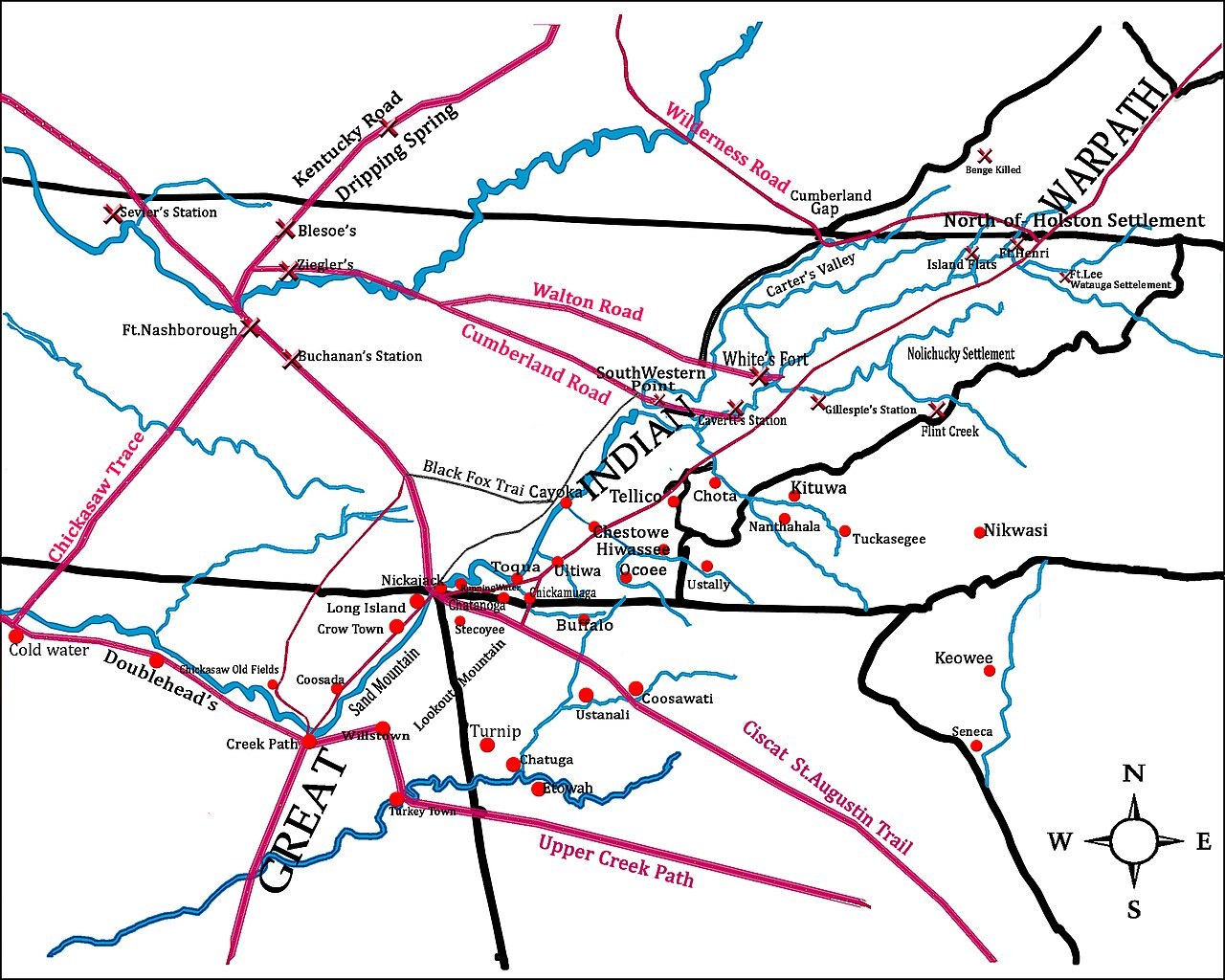
The Cumberland frontier, 1780 to 1787
The first major target of raids from the Lower Towns was the new Cumberland settlements around what is now Nashville, whose founding families came down this very river. In the winter of 1779–1780, a flotilla of some thirty boats carrying about two hundred settlers descended the Tennessee under the command of Col. John Donelson, bound for the Cumberland via the Ohio. The flotilla ran the gauntlet in March 1780: warriors fired on the boats as they passed the Chickamauga towns, captured a trailing boat whose twenty-eight occupants were under smallpox quarantine, and poured rifle fire from the bluffs onto the fleet at the “Suck” rapids, where Jonathan Jennings's boat hung on a rock and was nearly lost. Col. Donelson's journal, one of the founding documents of Tennessee settler history, records the running fight and the losses; the full story is on the Donelson Voyage page.
The pressure on the Cumberland settlements in those first years was nearly fatal. Settler families on isolated farm lands were the natural target for raiders, and, per Raulston and Livingood, families had to abandon their cabins and huddle together in central stations and blockhouses for common defense; all through the Cumberland settlements cattle were killed, horses stolen, and men shot, mutilated, or scalped. In 1781 even Nashborough itself, the future Nashville, was directly attacked. The settlements' survival hung on the leadership of James Robertson, who rallied wavering settlers with a speech the early historians preserved: “As for me, I have come to stay. . . . We shall not find a better country. I believe we can do better here, and be safer, than we are likely to be by flight. We have to fight it out here, or fight our way out of here.”
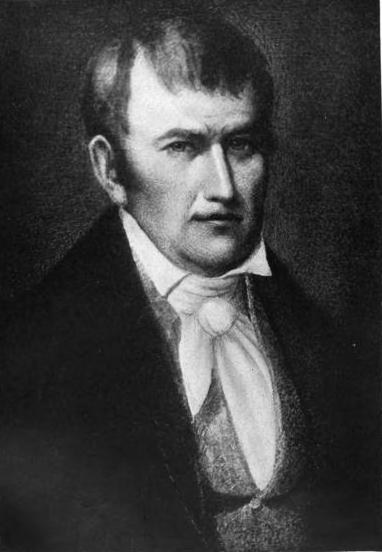
From 1780 through 1787, Chickamauga warriors raided the new Nashville station persistently. The methods were the ones Dragging Canoe had drawn from earlier defeats: per Raulston and Livingood, after his massed forces failed in the open in 1776, he returned to small-band warfare, parties relying on surprise and ambush that struck and retreated, taking scalps, burning cabins, and driving off cattle and horses. Parties moved north across the Cumberland Plateau, descended into the Cumberland Valley, struck outlying farms and stations, and withdrew south. The Nashville settlers' response was to build fortified stations and to conduct periodic counter-raids. In 1787, the Cumberland militia under James Robertson descended the Tennessee River to the mouth of Coldwater Creek (in present-day Colbert County, Alabama) and burned the Chickamauga-Creek trading post there. The Coldwater Expedition did not reach the Lower Towns proper but disrupted the southern supply line that Spanish Pensacola used to arm Dragging Canoe's forces.
How desperate the Cumberland country had become by 1787 is preserved in a letter Raulston and Livingood reprint from Anthony Bledsoe, a militia commander in the Cumberland settlements west of the Sequatchie Valley, to John Sevier, then serving as president of the breakaway state of Franklin. Written on August 5, 1787, it reported that the Chickamaugas, “in combination with the Creeks, have done this country very great spoil by murdering numbers of our peaceful inhabitants, stealing our horses, killing our cattle and hogs, and burning our buildings through wantonness,” counted “about twenty-four people” killed “in this country in a few months,” and asked Sevier to “avenge the blood thus wantonly shed.”
1782: Sevier's campaign and the “last battle of the Revolution”
The frontier's first organized answer had come five years earlier, in the same year the Chickamaugas completed their move to the Five Lower Towns. In June 1782 the governor of North Carolina wrote that the “Chicamoggies” had “been very troublesome in murdering many peaceful families in this state and Virginia,” and the North Carolina General Assembly answered by authorizing “Continental Credit” to support a force of one thousand volunteers. The instructions issued to that force, per Raulston and Livingood, are worth quoting because they state plainly what frontier war meant in 1782: the volunteers were to destroy the towns of the Chickamaugas, “all the males therein to be killed, and the females captured to be divided among the soldiers participating.” Neither side of this war fought it gently, and official policy on the American side could be as annihilationist as anything done in the field.
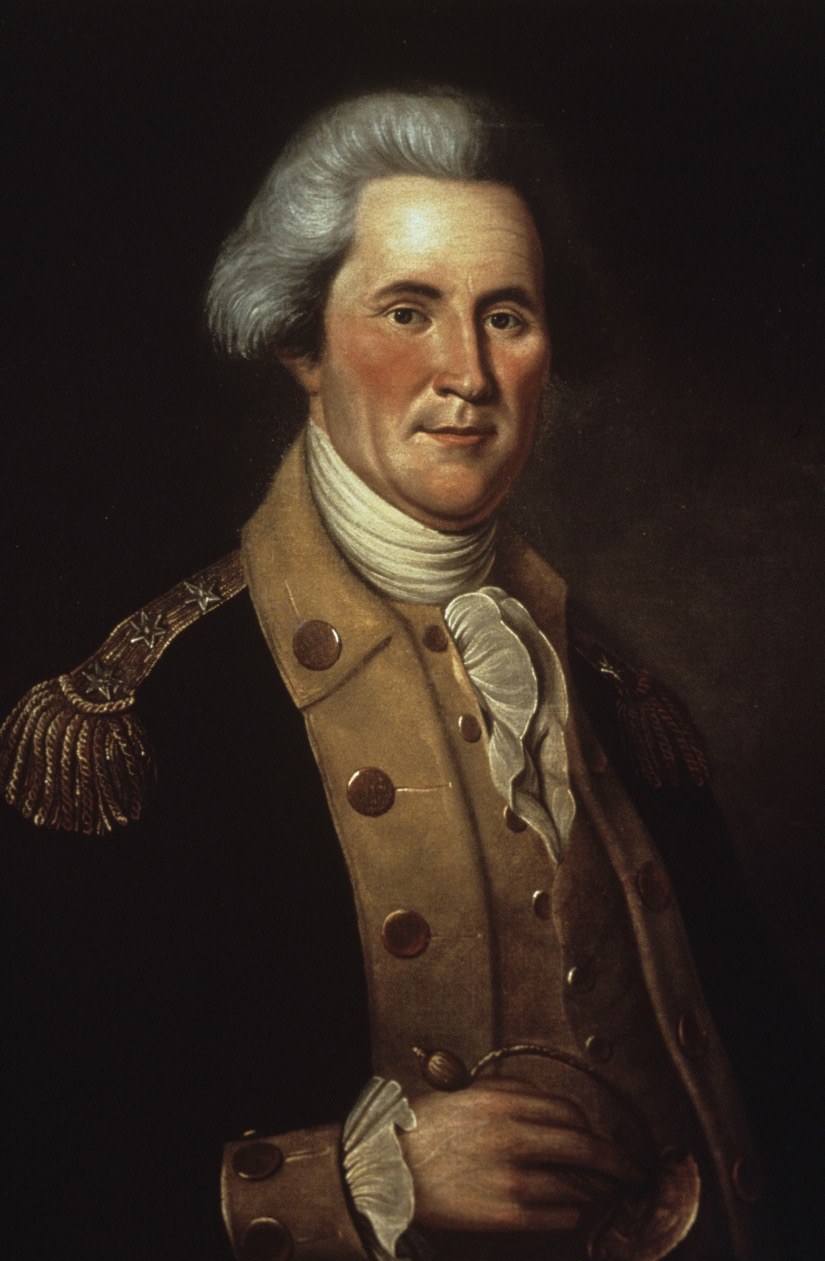
John Sevier led the invasion force from East Tennessee south in September 1782. He destroyed the exposed Chickamauga towns east of Lookout Mountain, which some families still occupied after the main body's move west, and on September 20, 1782 fought a small engagement on the mountainside itself that is sometimes called the last battle of the American Revolution, because it was fought after Yorktown. Sevier went on to campaign into Georgia, but his Cherokee guides, per Raulston and Livingood, managed to lead him away from the Five Lower Towns, which came through the campaign untouched.
The 1788 attack on the Brown boat
On May 9, 1788, a flatboat carrying the family of the Virginia pioneer Col. James Brown, a Revolutionary veteran, was intercepted by Chickamauga warriors off the landing at Nickajack. Col. Brown, two of his older sons, and five other young men were killed. His wife, several of his younger children (including sixteen-year-old Joseph Brown), and the family's enslaved workers were taken captive and distributed among Cherokee households. Joseph was adopted into the household of The Breath, the principal man of Nickajack town, where he lived for roughly eleven months before being exchanged. Six years later, he guided the militia that destroyed the town. Brown's 1834 Narrative of his captivity is the single most important firsthand Anglo-American account of daily life in the Lower Towns.
1788: the killing of Old Tassel and the Martin expedition
The same year brought the killing that, more than any single event, drove the wider Cherokee Nation toward the Chickamauga position. Old Tassel, the head chief of the Upper Towns and the leading advocate of accommodation with the Americans, was slaughtered along with several other leaders of high rank by revenge-seeking militiamen serving on a voluntary campaign associated with John Sevier. The slain men, per Raulston and Livingood, were unarmed and traveling under a flag of truce. What followed stunned Cherokee opinion as much as the killing itself: Sevier's response to the murderers was a mild leniency, and no one answered for the deaths. Across the Nation, able-bodied men turned toward the Chickamaugas, and calls for retaliation echoed from the Five Lower Towns to every section of the frontier. The war's engine, here as throughout, was reciprocal: every killing under a truce flag, every burned town, every ambushed family on either side pushed the middle ground further out of reach.
In August 1788 a force of about five hundred men left White's Fort, the future Knoxville, to attack the Five Lower Towns, which the settlements blamed for all the trouble. The expedition, commanded by Joseph Martin, North Carolina's Indian agent, was repulsed at Lookout Mountain: a detachment of volunteers trying to seize the trail between the mountain's palisades and the river bluffs was ambushed and, in the words the book preserves, “frightened out of their wits,” fleeing in disorder. A second attempt the next day also failed, and the militiamen, suspicious of their commander because of his position as Indian agent, refused to fight further. Dragging Canoe read the withdrawal as a major triumph, and a great victory celebration was held at Running Water Town. Sevier's follow-up expedition punished the Upper Cherokee towns, which he believed to be the granary of the whole Nation, but Chickamauga parties harassed him constantly while refusing open battle, and he returned home a discouraged man, his state of Franklin collapsing behind him. The early Tennessee historian J. G. M. Ramsey, surveying this period in his Annals of Tennessee, wrote that if a map could be drawn of every ambush, raid, and fight, “every spring, every ford, every path, every farm, every trail, every house, nearly, in its first settlement, was once the scene of danger, exposure, attack, exploit, achievement, death.”
Treaties, fraud, and escalation, 1785 to 1791
The Cherokee Nation as a whole signed treaties in this period that the Chickamauga faction rejected as either fraudulent or unauthorized. The Treaty of Hopewell (November 1785), the federal government's first treaty with the Cherokee, wrote a policy of conciliation and fairness into its terms and set a boundary between Cherokee land and U.S. settlement, but Washington proved unable to protect the people it had just made its wards: Americans crossed the line within months, and the government could not or would not remove the squatters the Cherokee insisted must go. The Treaty of Holston (July 2, 1791) ceded additional Cherokee land in exchange for a U.S. annuity and a promise of federal enforcement against settler encroachment, and its signers, per Raulston and Livingood, felt they had signed under duress. The treaty also demanded “free” navigation of the Tennessee, a clause aimed squarely at the Lower Towns' control of the river; Dragging Canoe's followers, who had taken no part in the treaty-making, refused to recognize the terms and informed the authorities that boats using the Tennessee “must take the consequences.” Federal enforcement of the boundaries was minimal, American settlement continued, and within the settlements, as the book puts it, there were always irresponsible people who did not hesitate to abuse or murder Cherokee people; even peaceful Cherokee found neutrality impossible, and young men moved to the Chickamauga stronghold in increasing numbers.
The Lower Towns could sustain the war because they were never dependent on American goodwill for arms. For a short time after Yorktown, per Raulston and Livingood, Dragging Canoe drew supplies from British agents at Detroit, with his brothers Little Owl and Badger serving as his emissaries. Then Spain, holding Florida again after 1783 and anxious to keep aggressive American frontiersmen away from her possessions, took over the role: Spanish agents cultivated Dragging Canoe directly, and the Crown permitted Panton, Leslie and Company, the established British trading concern at Pensacola, to keep doing business on Spanish soil. John McDonald, the Scottish trader based at Running Water, drew trade goods and weapons through Savannah and Augusta before changing allegiance outright to become “Spanish Agent to the Chickamaugas.” The Spanish, wanting a buffer between the American frontier and their territory, encouraged Dragging Canoe to “drive off the Cumberland settlers, or destroy them utterly.” Chickamauga leaders concluded that diplomacy was not producing results and that only sustained pressure would slow the American advance.
1792: the war's high tide and a loss of leadership
The spring and summer of 1792 were the high-water mark of Chickamauga military activity. A coordinated campaign with Creek allies put hundreds of warriors into the field across what is now eastern Tennessee and northern Georgia. Raids struck settlements on the Holston and French Broad and threatened Fort Southwest Point at the mouth of the Clinch.
Dragging Canoe died at Running Water on the night of February 29, 1792 (some sources give March 1), after a celebration of a Muscogee victory that included overnight ceremonial dancing. Leadership of the Chickamauga passed to his nephew John Watts the Younger (Kunnesee), who continued the campaign with somewhat less personal authority but essentially the same strategy: raid, withdraw, resupply from Spanish Pensacola, and hold the river towns.
1793 and 1794: American counter-offensive
The Chickamauga campaign escalated through 1793 under Watts's leadership. On September 25, 1793, a Chickamauga-Creek war party led by Watts reached Cavett's Station, a small fortified farm on the western outskirts of Knoxville. After negotiating a surrender with a promise of quarter, Creek warriors under Doublehead killed thirteen of the Cavett family. The Cavett's Station massacre hardened American public opinion against any negotiated end to the war and gave frontier leaders like John Sevier political cover for retaliatory campaigns that ignored federal instructions.
On October 17, 1793, a Tennessee militia force under John Sevier engaged a Chickamauga-Creek army at Hightower (Etowah) in northwest Georgia. Sevier's men inflicted significant casualties and turned the Chickamauga force back before it could reach the Holston settlements. The Hightower engagement (also called the Etowah Expedition) marked the shift in momentum. For the first time, a Chickamauga-Creek army in the field had been met and defeated in open engagement. The Lower Towns' strategic position, already weakened by the disruption of the Creek supply line, began to deteriorate.
By 1794 the territorial government itself was demanding war. The territorial House of Representatives, at its first session in February 1794, adopted a memorial to Congress urging a declaration of war on the Creeks and Cherokee, citing, per Raulston and Livingood, upwards of two hundred citizens killed in the previous two and a half years “without regard to age or sex,” others carried into captivity, and at least two thousand horses stolen. A second memorial later that year counted 67 killed, 10 wounded, 25 captured, and 374 horses stolen in six months, and drew the frontier's conclusion in a single sentence: “Fear, not love, is the only means by which the Indians can be governed.” Settlers throughout the Tennessee country were crowding into blockhouses. James Robertson asked the question the whole frontier was asking: “When will the Lower Towns get their deserts?” And the cycle kept feeding itself: desperate frontiersmen repeatedly took matters into their own hands by ambushing Cherokee who had stayed friendly, and every such killing drove more warriors to John Watts.
In the spring and summer of 1794, Tennessee frontier leaders began planning an attack on the Lower Towns themselves. Federal authorities in Philadelphia opposed the attack as likely to provoke a wider frontier war, and Territorial Governor William Blount, caught between his federal superiors and his militia commanders, gave vague instructions and then political cover. In September 1794, Major James Ore of Sumner County led a 550-man militia force south across Monteagle Mountain, guided by Joseph Brown, and attacked Nickajack at dawn on September 13. Running Water was attacked the same day. Both towns were burned. About 70 Cherokee were killed; only three Americans were wounded. The detailed account of the attack is on the Nickajack Expedition subpage.
End of the war
Chickamauga resistance collapsed within weeks of the Nickajack Expedition. John Watts the Younger and the surviving Lower Towns leadership met Territorial Governor Blount at the Tellico Blockhouse on the Little Tennessee River on November 7 and 8, 1794. The resulting treaty formally ended hostilities. The Chickamauga Cherokee accepted the Cumberland settlements, the Holston settlements, and the boundaries drawn by the earlier treaties they had refused to sign. The Cherokee Nation retained formal political identity and federal recognition, but the military phase of resistance east of the Mississippi was finished.
Two discoveries in the raid's aftermath, recorded by Raulston and Livingood, explain why the collapse was so complete. On the body of The Breath, Ore's men found a letter from the Spanish governor at New Orleans, Baron de Carondelet, telling the Chickamauga chiefs that Spain could no longer supply them and advising peace with the United States. And on the march home the militia learned that Anthony Wayne had crushed the northern nations at Fallen Timbers, ending the hope of a wider Native confederation. From the Five Lower Towns the Chickamaugas had fought for twelve years against the encroachment of the settlements; with both external supports gone and the towns in ashes, the Sequatchie country ceased to be the rendezvous and refuge it had been since 1782.
The survivors of Nickajack and Running Water dispersed. Some rebuilt at Willstown in northern Alabama, where the Cherokee Nation's council relocated during the early 19th century. Some moved east into the Ridge-and-Valley country to rejoin the Overhill towns. Some crossed into the Muscogee Confederacy to the south and remained with Creek kin. A smaller number remained in and around the former Lower Towns as the landscape opened to American settlement. The nineteen years between the 1794 treaty and the 1819 Treaty of Cherokee Agency saw Cherokee and settler families coexist in the area under increasing pressure; that coexistence is traced on the First Settlers page and closed with the forced removal of 1838.
Consequences for Marion County
The Chickamauga Wars settled three questions that would shape the next two centuries of Marion County's history. First, they decided that the Tennessee River gorge would be American-controlled ground, opening the corridor between Knoxville and the Cumberland settlements. Second, they broke the political and military institutions that might have kept the area in Cherokee hands long enough for federal protection to matter, which is why by the time of the 1819 Treaty the reservees under George Lowrey and Betsy Pack were individual families holding scattered 640-acre tracts rather than a contiguous Cherokee territory. Third, they established the place-name geography (Nickajack, Running Water, Battle Creek) that the county's later industrial and civic life would be built on. The eighteen-year war is the reason Marion County exists in the form it does.
Related
The Cherokee Lower Towns: Nickajack and Running Water →
The Nickajack Expedition, September 1794 →
First settlers and Cherokee reservees, 1805 to 1838 →
Trail of Tears through Marion County, 1838 →
Nickajack and Running Water community page →
Battle Creek community page →
Sources
- Wikipedia — Cherokee–American wars
- Wikipedia — Chickamauga Cherokee
- Wikipedia — Dragging Canoe
- Wikipedia — John Watts (Cherokee chief)
- Wikipedia — Nickajack Expedition
- Wikipedia — Doublehead (1793 Watts campaign incl. Cavett's Station)
- Wikipedia — Battle of Hightower, 1793
- Wikipedia — Treaty of Sycamore Shoals, 1775
- Wikipedia — Treaty of Holston, 1791
- Tennessee Encyclopedia — John Donelson (1779–1780 flotilla voyage)
- Tennessee Encyclopedia — Chickamaugas
- Native History Association — Dragging Canoe
- Joseph Brown, Narrative of the Life of Col. Joseph Brown, reprinted from Western Journal, 1834.
- J. Leonard Raulston and James Weston Livingood, Sequatchie: A Story of the Southern Cumberlands (Knoxville: University of Tennessee Press, 1974), chapter 3, “Whose Land?,” pp. 33–36 (the Sycamore Shoals walkout, the spring 1777 secession, the named lesser chiefs, McDonald's post, the 1,000-warrior strength of 1778, Patrick Henry's “banditti” letter, and Shelby's April 10, 1779 expedition), and chapter 4, pp. 39–55 (the 1782 relocation; the 1781 Nashborough attack and Robertson's speech; the 1782 North Carolina authorization and Sevier's September 1782 campaign; the Bledsoe letter of 1787; the 1788 attack on the Brown family boat; the killing of Old Tassel and the 1788 Martin expedition; the Hopewell and Holston treaty failures; the Spanish supply line and McDonald's agency; the 1794 territorial memorials; and the Carondelet letter and Fallen Timbers news of 1794).