Last updated: June 15, 2026
Marion County's plant life reflects the collision of three landscapes: the sandstone caprock of the Cumberland Plateau, the limestone-floored Sequatchie Valley, and the Tennessee River Gorge. Each has its own soils, its own moisture regime, and its own flora. A hike from the Sequatchie River bottoms up onto the plateau at Prentice Cooper passes through at least four distinct plant communities in under two miles. This page walks through those communities and names the species most likely to catch a botanist's eye.
Species lists here draw from Tennessee-Kentucky Plant Atlas records, the Tennessee Natural Heritage Program, Tennessee River Gorge Trust inventories, and iNaturalist observations from Marion County and its immediate neighbors. Where a species is regionally characteristic but has not been specifically documented in Marion, the prose notes that. The goal is a trustworthy working guide, not a claim of exhaustive coverage.
- Elevation range: ~630 ft (Tennessee River at South Pittsburg) to ~2,000 ft (Monteagle)
- Climate: humid subtropical (Köppen Cfa); 55–60 inches annual precipitation
- Bedrock: sandstone caprock on the plateau, limestone in the valley, mixed on gorge slopes
- Growing season: ~200 days in the valley, ~180 days on the plateau
Pines and conifers
Conifers in Marion County are a small but ecologically distinctive group. Eastern hemlock (Tsuga canadensis) is the signature tree of cool, shaded streamsides on the plateau and in the gorge. The hard-needled pines split by habitat: Virginia pine and shortleaf pine hold the dry sandstone caprock, eastern white pine appears on mesic gorge slopes and richer cove edges, and loblolly pine is mostly a planted timber tree. Eastern red-cedar is the calcium-loving juniper of cedar glades and limestone outcrops in the Sequatchie Valley. Bald cypress appears in Marion only as a planted ornamental: its native range on the Tennessee River reaches up to roughly the lower valley near Chattanooga, and the plateau and upper gorge sit outside that range.
Hemlock has been the visible casualty of the last two decades. The hemlock woolly adelgid (Adelges tsugae) has spread through Tennessee since the early 2000s, including into hemlock stands at South Cumberland State Park in Marion County, per the USDA Invasive Species Information Center HWA profile. Cottony white egg masses on the underside of hemlock branches are the diagnostic sign. Without chemical treatment or biocontrol, infested trees usually die within four to ten years. Coordinated treatment programs by state agencies and the Tennessee River Gorge Trust have kept some stands alive, but county-wide loss is ongoing.
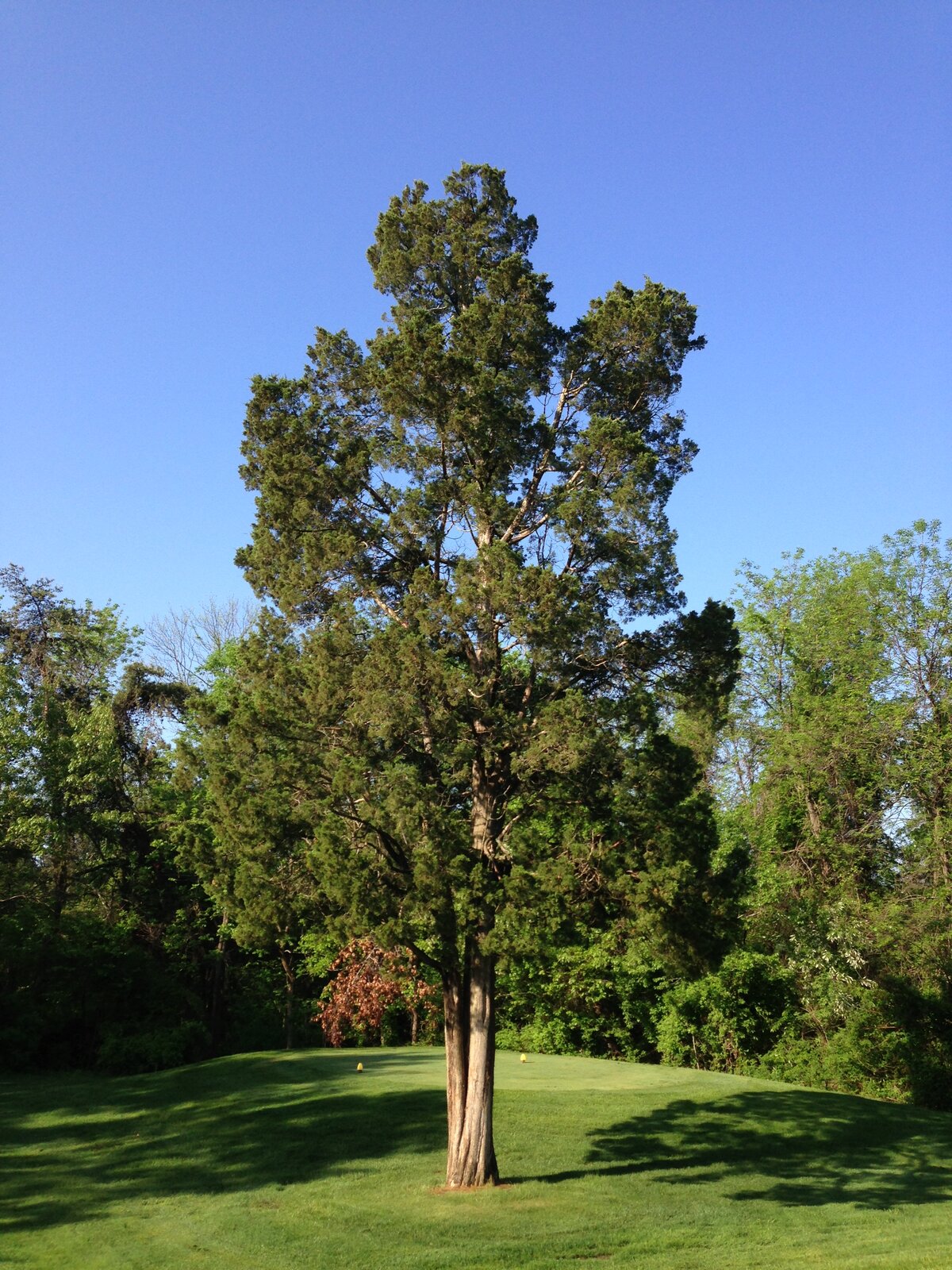
Eastern red-cedar
Juniperus virginiana
A juniper, not a true cedar. Scaly evergreen foliage, fibrous reddish bark, and waxy blue berry-like cones. Calcium-tolerant: the indicator tree of cedar glades and limestone outcrops in the Sequatchie Valley. Tennessee designated red-cedar a second state tree, alongside the deciduous tulip poplar.
Status: Native, common.
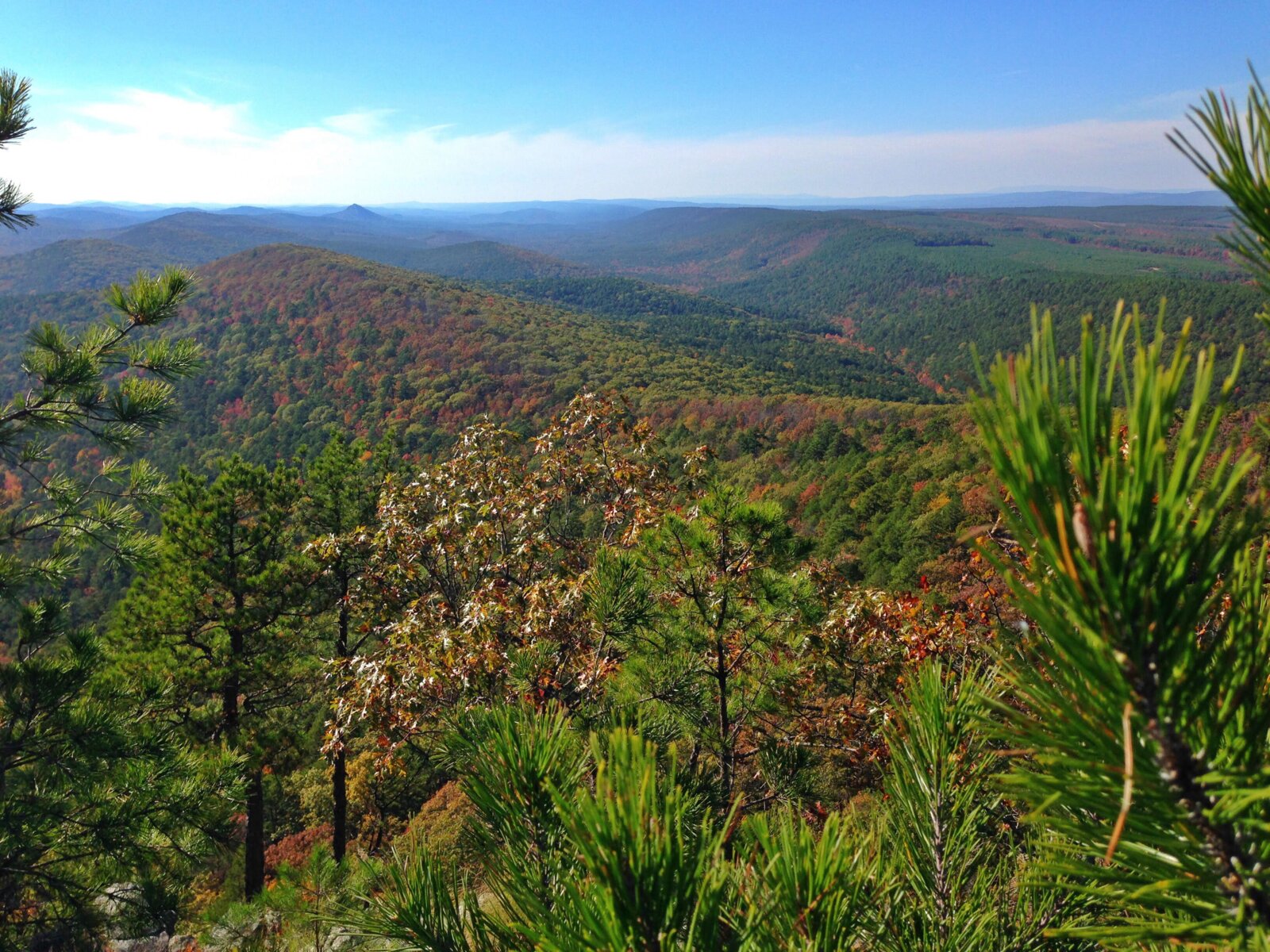
Shortleaf pine
Pinus echinata
The native plateau pine. Slender needles in pairs, seven to twelve centimeters long, with small egg-shaped cones held close to the branch. Stump-sprouts after fire. Found on dry sandstone caprock alongside Virginia pine and chestnut oak.
Status: Native.
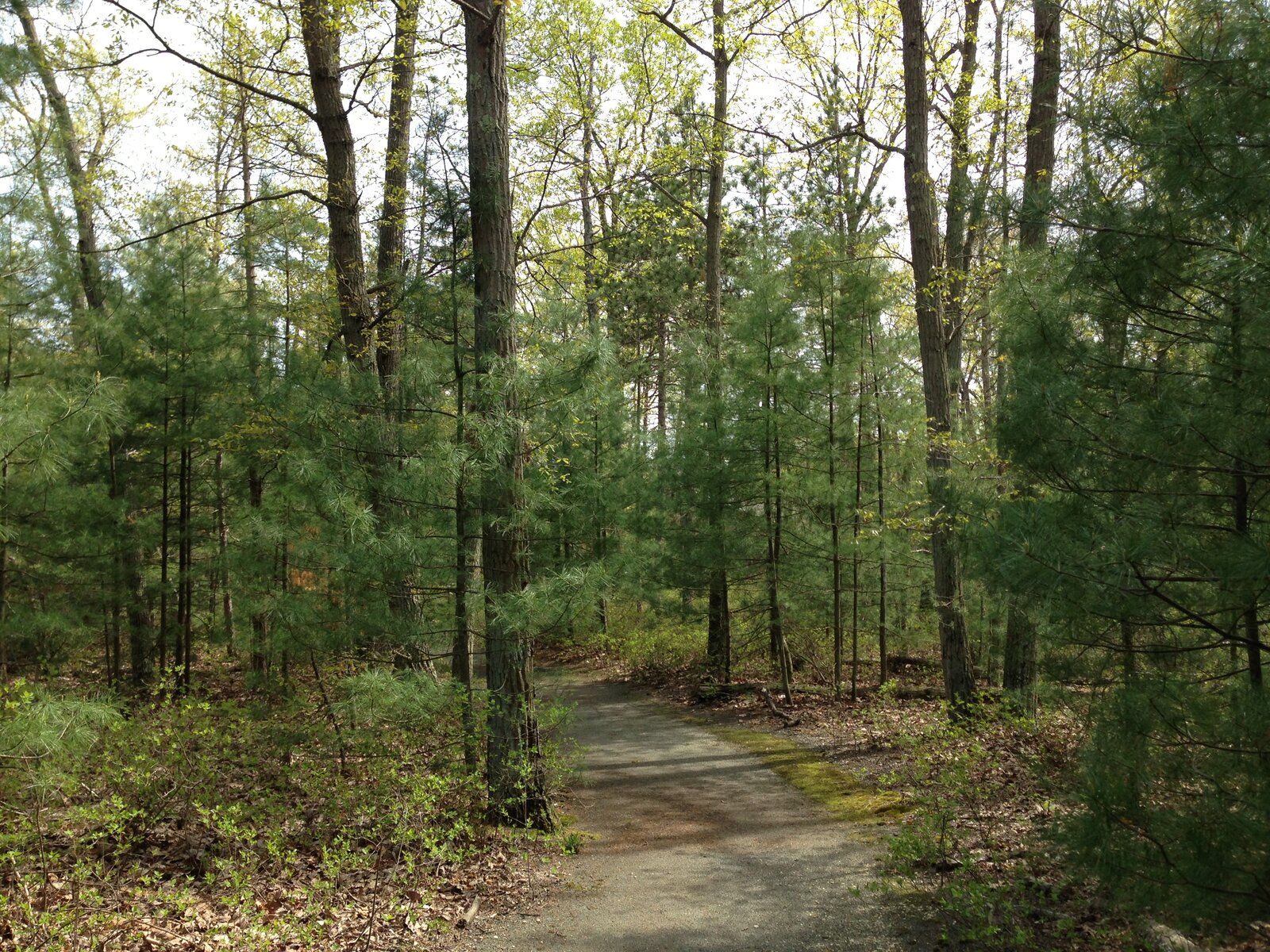
Eastern white pine
Pinus strobus
Soft, flexible needles in clusters of five distinguish white pine from every other pine in the region. Cones are long and curved. Native to mesic gorge slopes and cool cove edges; less common on dry caprock than shortleaf or Virginia pine.
Status: Native.
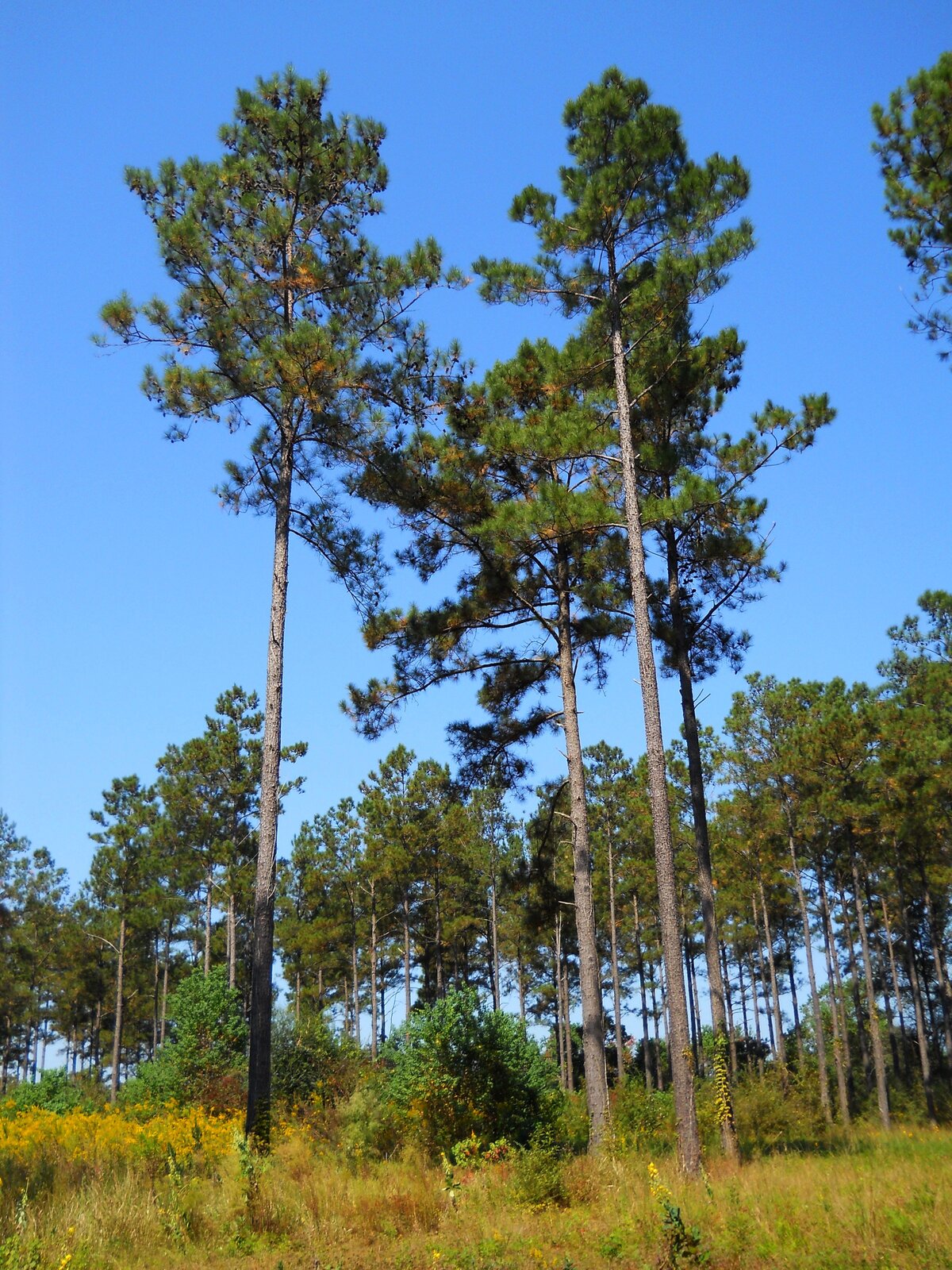
Loblolly pine
Pinus taeda
The dominant timber pine of the southeastern coastal plain, planted widely in Marion County for pulp and lumber. Long needles in bundles of three. Native range reaches lower Tennessee but most local stands are planted.
Status: Native to lower Tennessee; primarily planted in Marion.
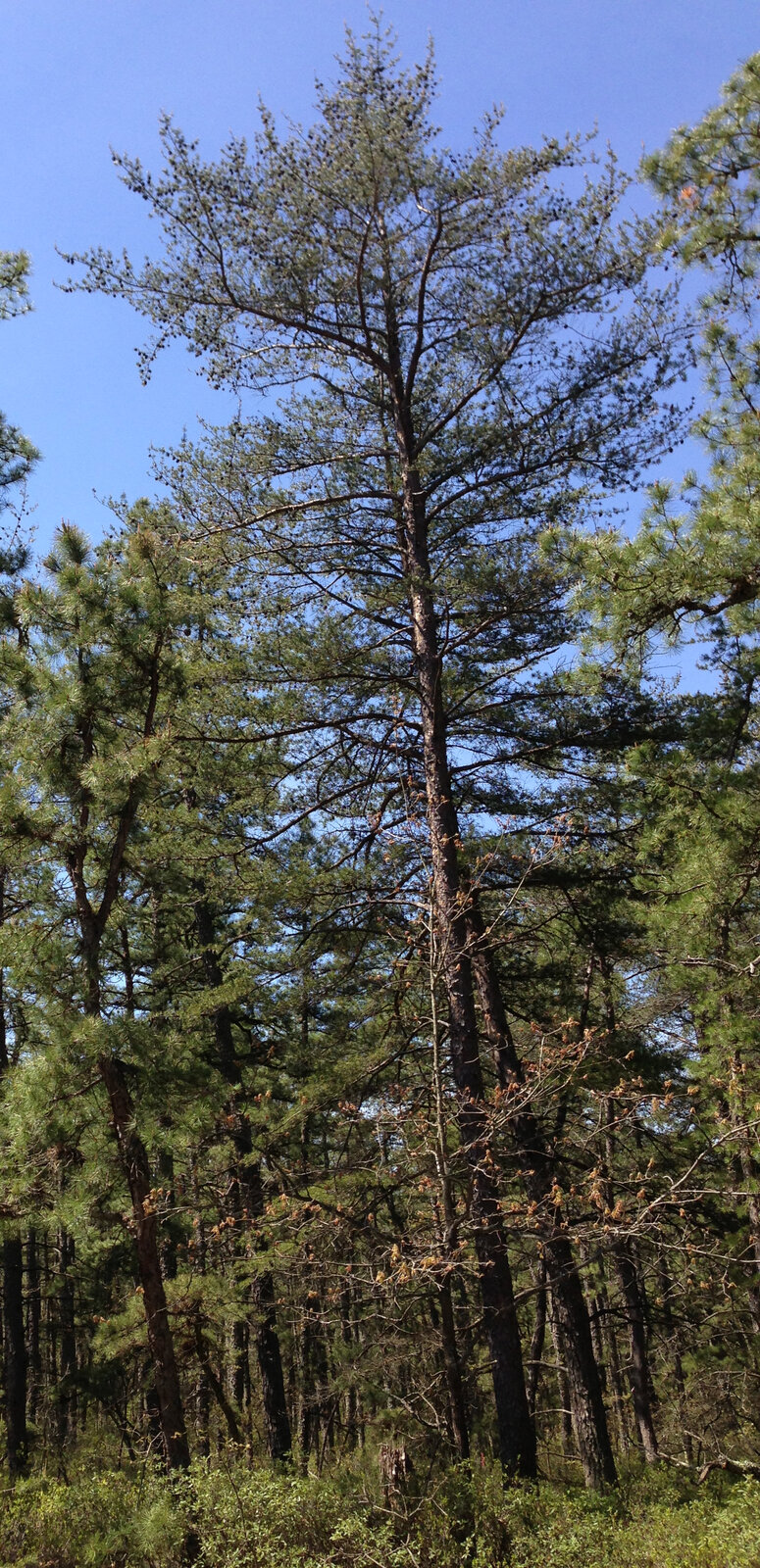
Virginia pine
Pinus virginiana
The other plateau caprock pine. Short, twisted needles in pairs, three to seven centimeters, distinguish it from the longer-needled shortleaf. Pioneers abandoned fields and burn scars; rarely lives more than seventy or eighty years.
Status: Native, common.
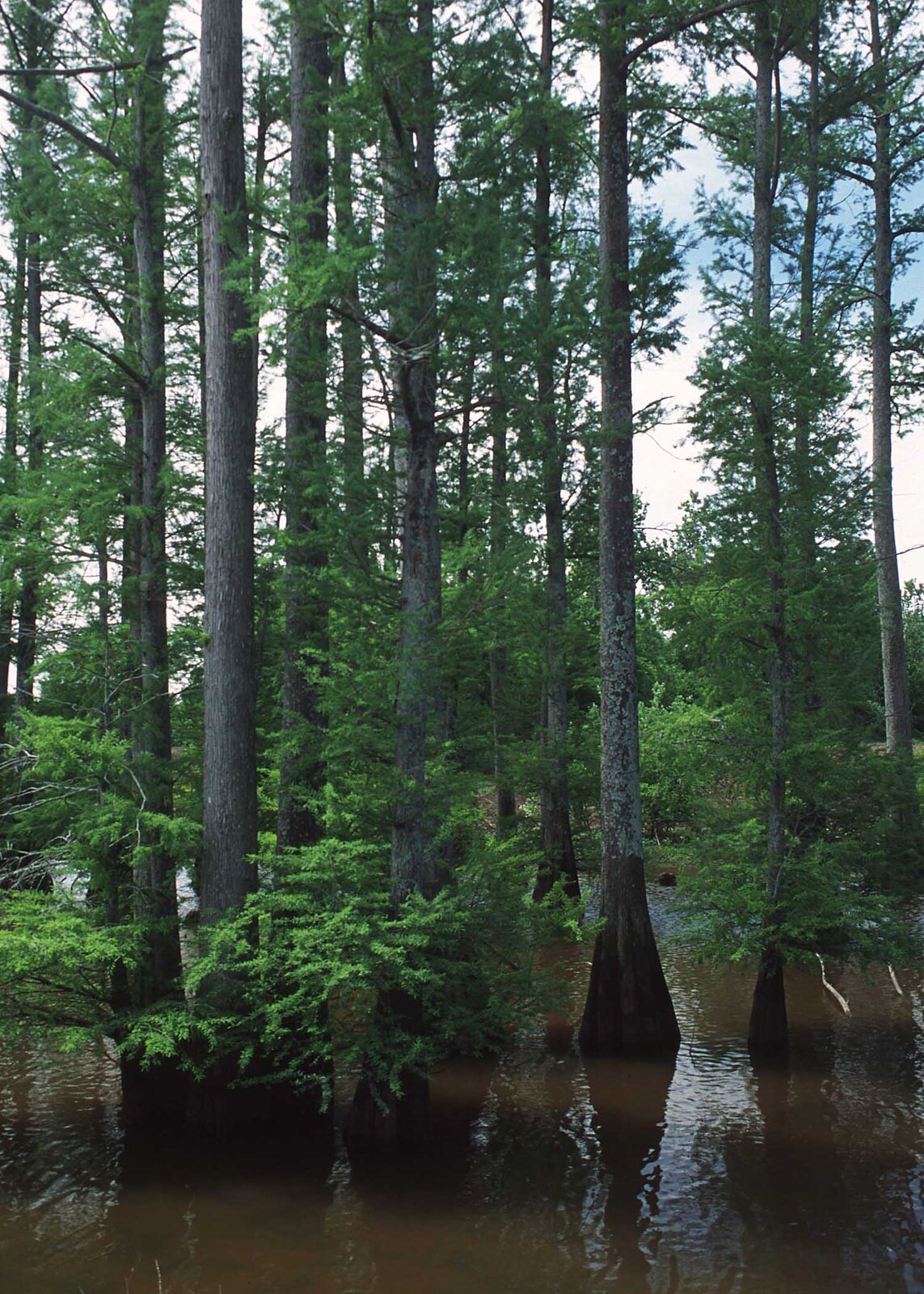
Bald cypress
Taxodium distichum
A deciduous conifer of southern bottomlands. The native range on the Tennessee River reaches only as far up as the lower valley near Chattanooga; trees in Marion County are planted ornamentals along ponds and yards, not native flora. Sources vary on the exact northern limit, but the plateau and upper gorge sit outside it.
Status: Planted in Marion; native range below the county.
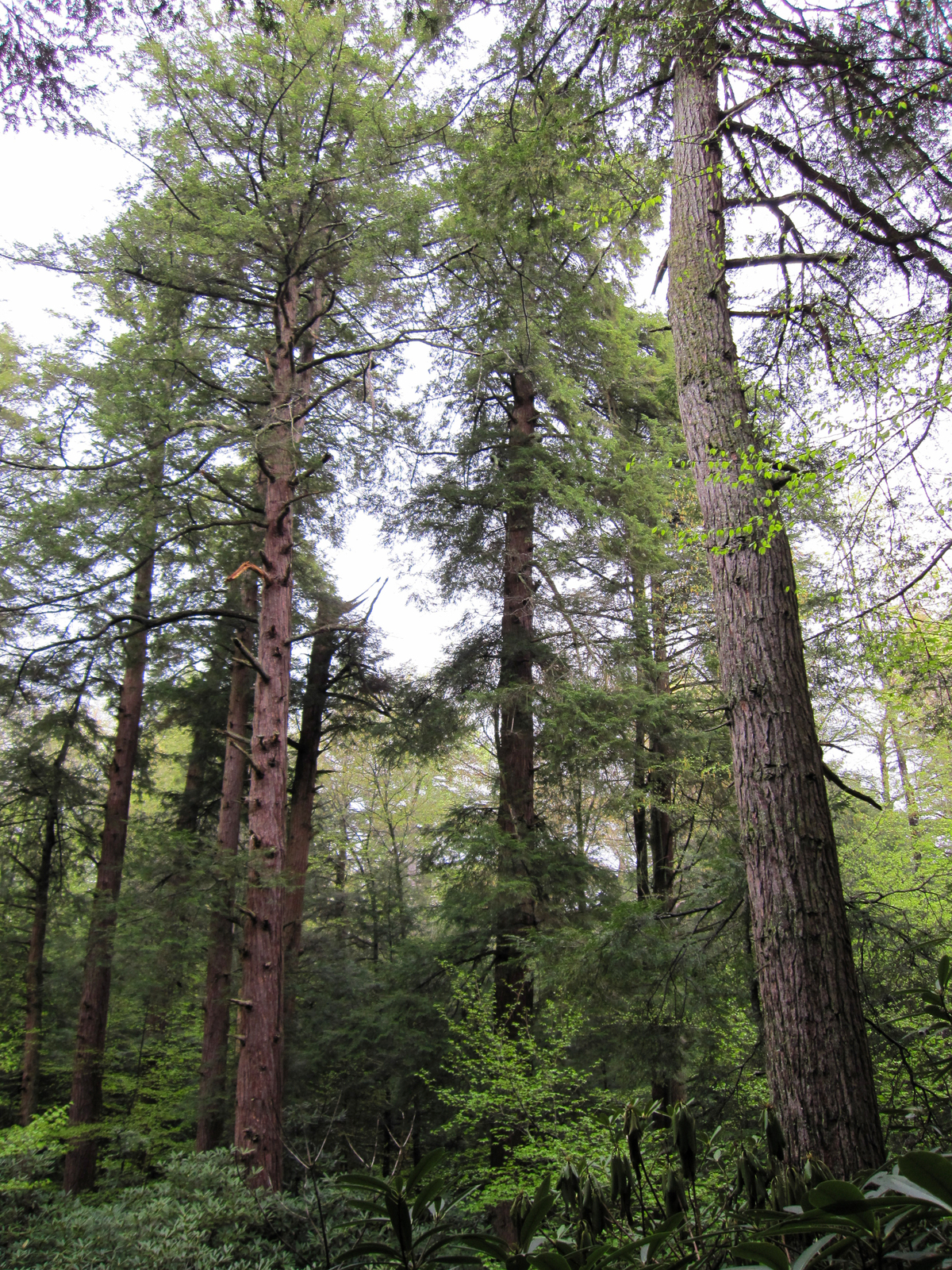
Eastern hemlock
Tsuga canadensis
The signature conifer of cove forest. Short, flat needles with two white stripes underneath, and drooping leader shoots that give the tree a soft, feathery silhouette. Lines shady streamsides throughout Prentice Cooper State Forest, the Tennessee River Gorge, and the upper reaches of Foster Falls.
Status: Native; severely threatened in Marion County by hemlock woolly adelgid.
Oaks
The dry ridge tops and plateau surface are dominated by an oak-hickory forest of white oak, chestnut oak, post oak, scarlet oak, black oak, and several hickory species. This is the forest type most visitors see along the Cumberland Trail and along Prentice Cooper's roads. The bottomland and slope members of the genus add another half-dozen oaks: shumard, cherrybark, willow, water, overcup, swamp chestnut, pin, and northern red oak all turn up on calcareous bottoms or rich slopes. Chestnut oak dominates the sandstone caprock from Prentice Cooper across to Foster Falls. White oak is the most recognizable upland oak: light gray loosely shaggy bark, deeply rounded leaf lobes without bristle tips, and acorns that germinate in the fall they drop. White oak was the preferred cooperage wood for Tennessee's whiskey-barrel industry, and its rot resistance made it the standard for fence rails in the 19th century. Mature white oaks live for several centuries and the largest plateau specimens on Prentice Cooper are correspondingly old.
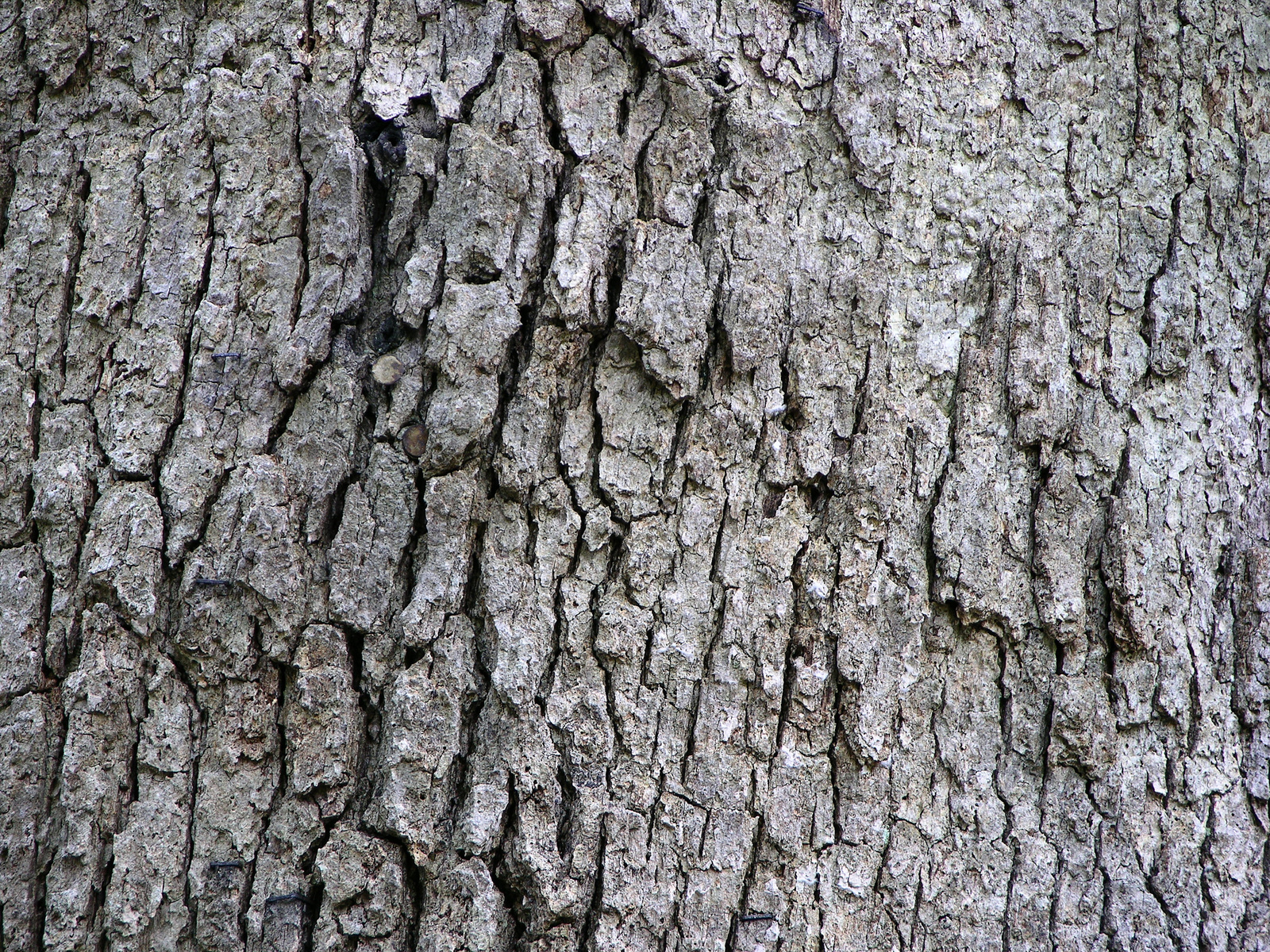
White oak
Quercus alba
Light gray, loosely shaggy bark and deeply rounded leaf lobes without bristle tips. Acorns germinate in the fall they drop. Preferred cooperage wood for Tennessee's whiskey-barrel industry; rot-resistant heartwood made it the standard for 19th-century fence rails.
Status: Native, common.
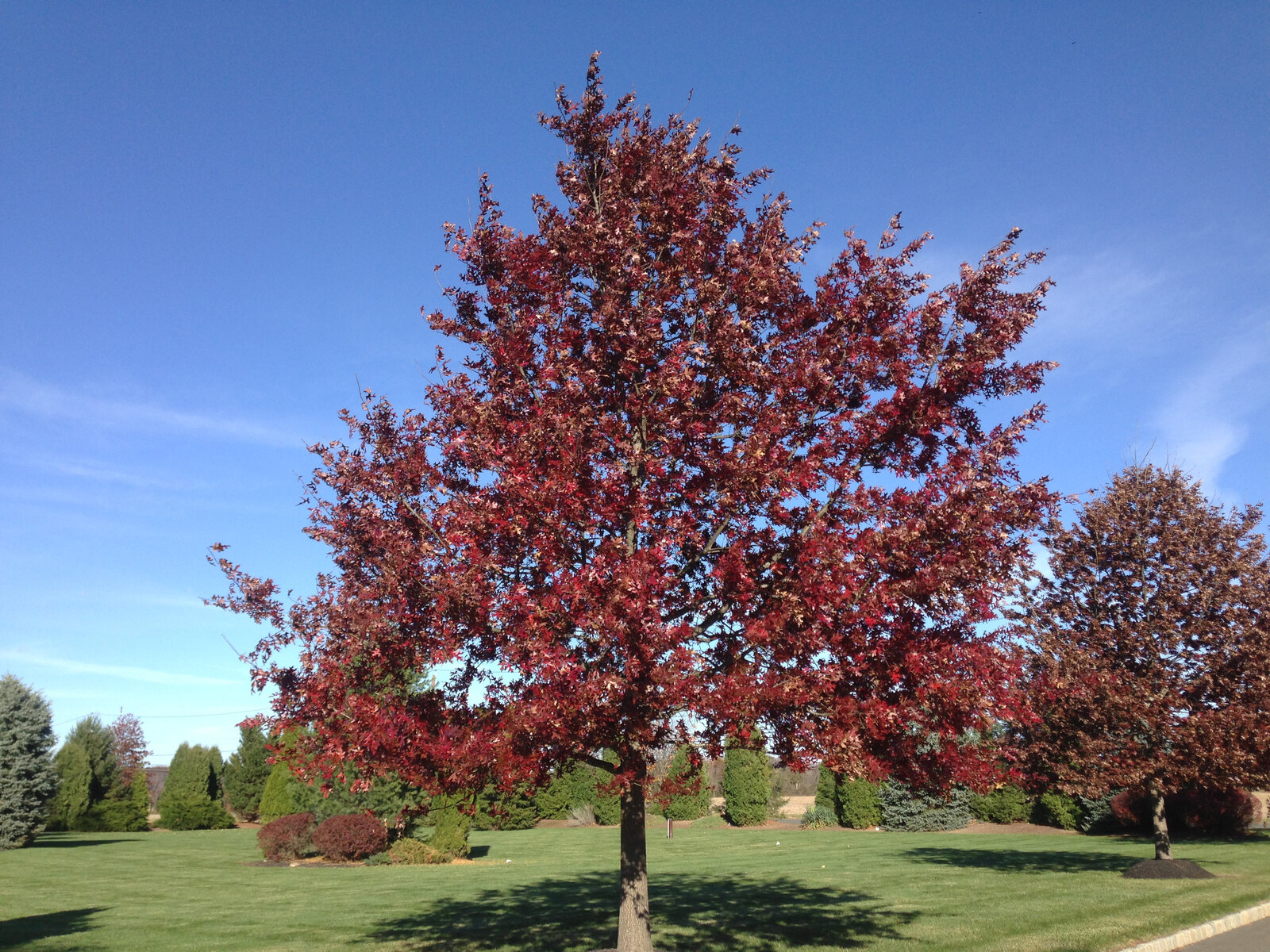
Scarlet oak
Quercus coccinea
A red-oak-group species of dry plateau uplands. Leaves are deeply lobed with sharp bristle tips and turn brilliant scarlet in fall, often the most vivid red of any local oak. Acorns mature in two seasons.
Status: Native.
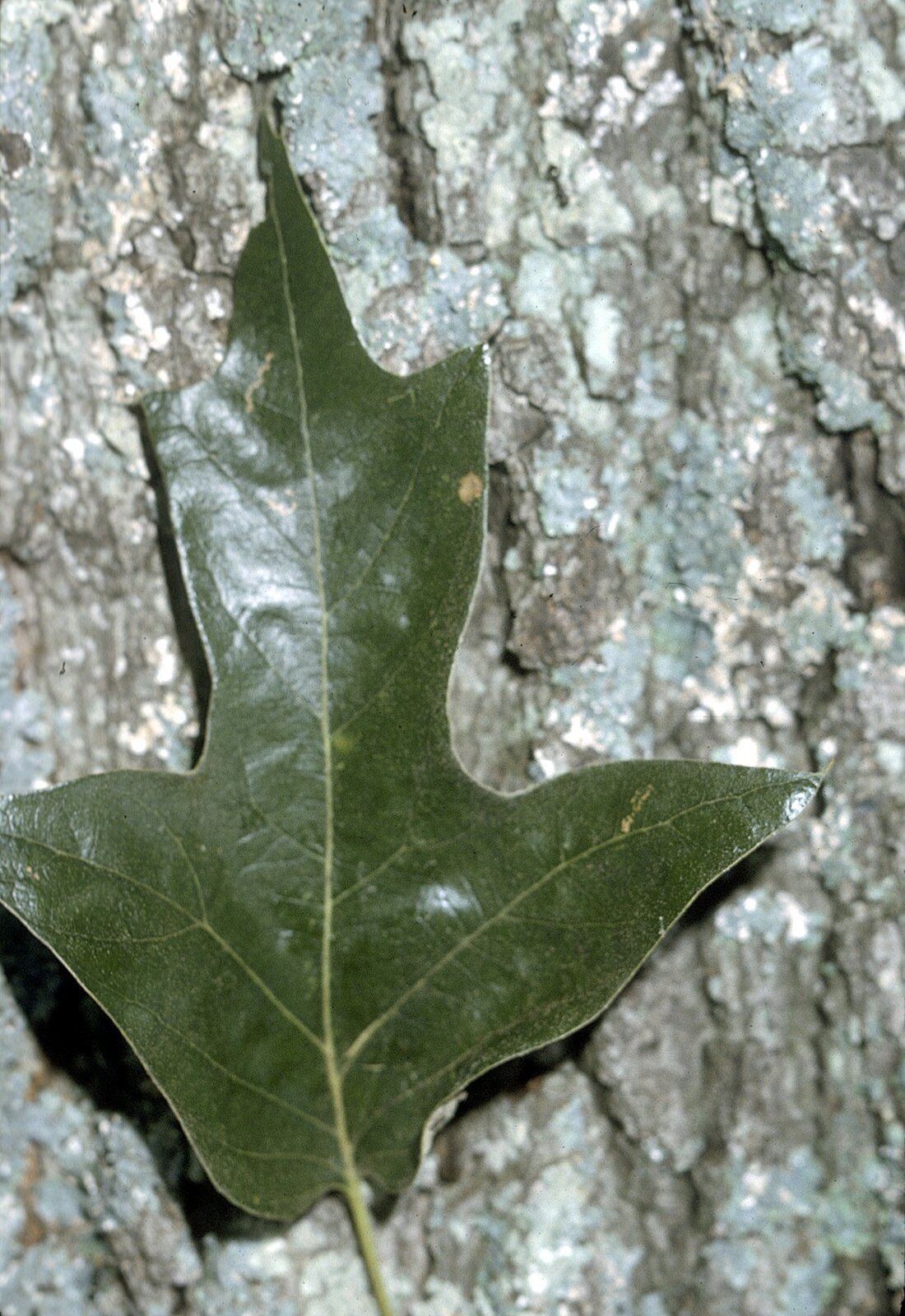
Southern red oak
Quercus falcata
Sometimes called Spanish oak. Distinctive bell-shaped leaf base and three to seven asymmetric, falcate (sickle-shaped) lobes. A tree of bottoms and lower slopes rather than dry ridge tops.
Status: Native.
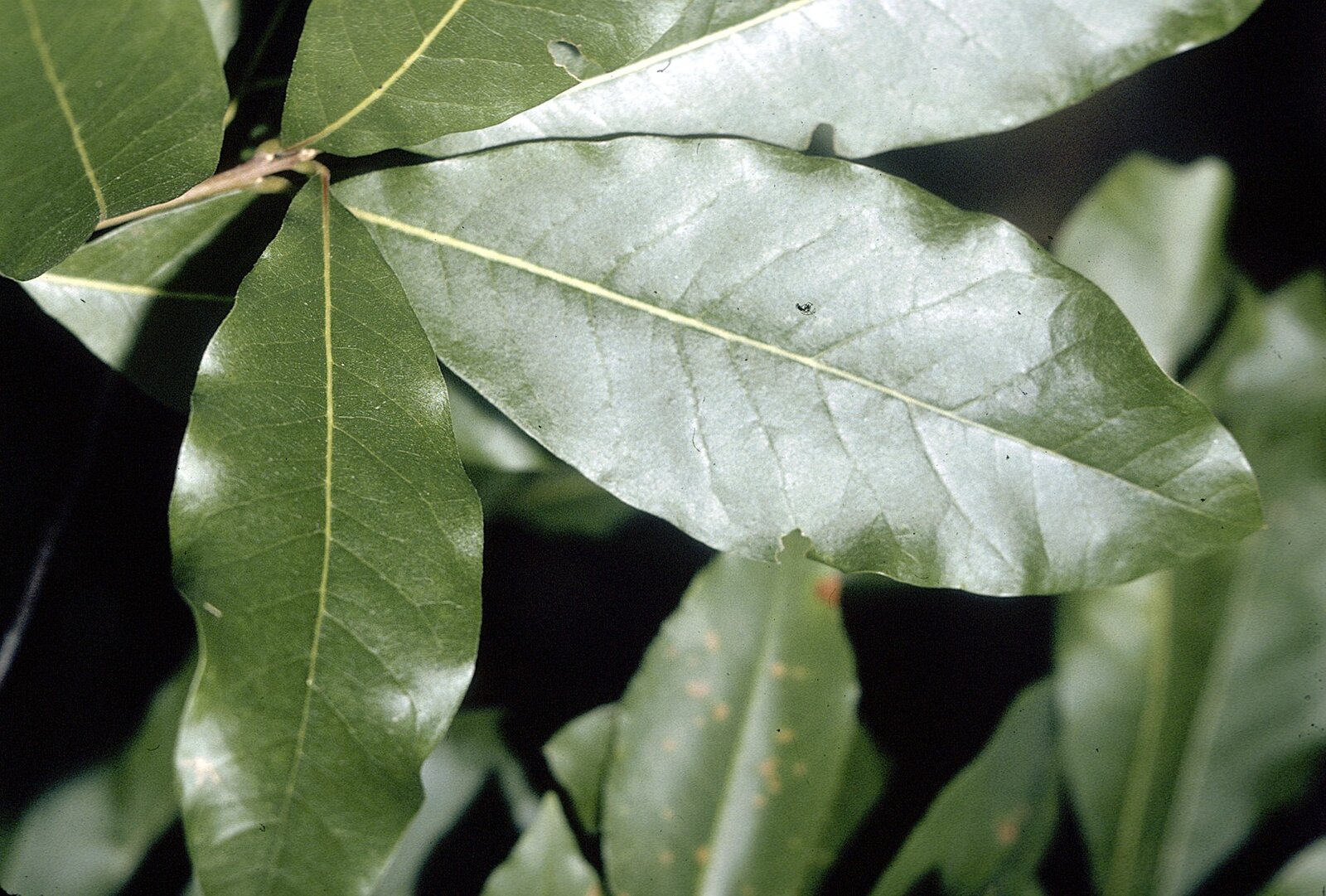
Shingle oak
Quercus imbricaria
An oak that does not look like an oak: leaves are unlobed, laurel-like, glossy above and softly hairy below. The common name comes from frontier use of the wood for split shingles.
Status: Native.
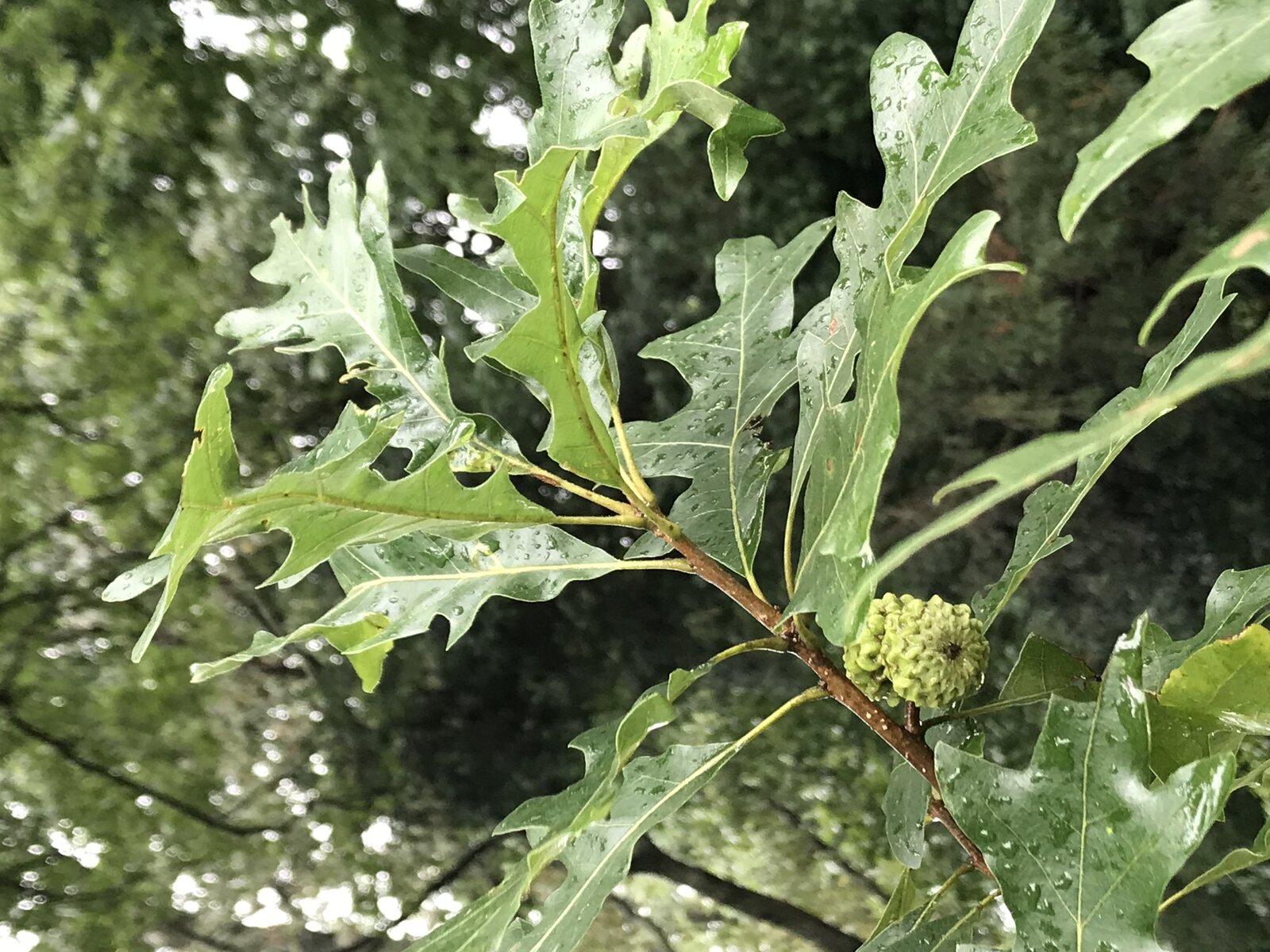
Overcup oak
Quercus lyrata
A bottomland white oak named for its acorn cup, which nearly covers the nut. The cup floats, and acorns are dispersed by floodwaters. Found on poorly drained bottoms along the Sequatchie River and Tennessee River.
Status: Native.
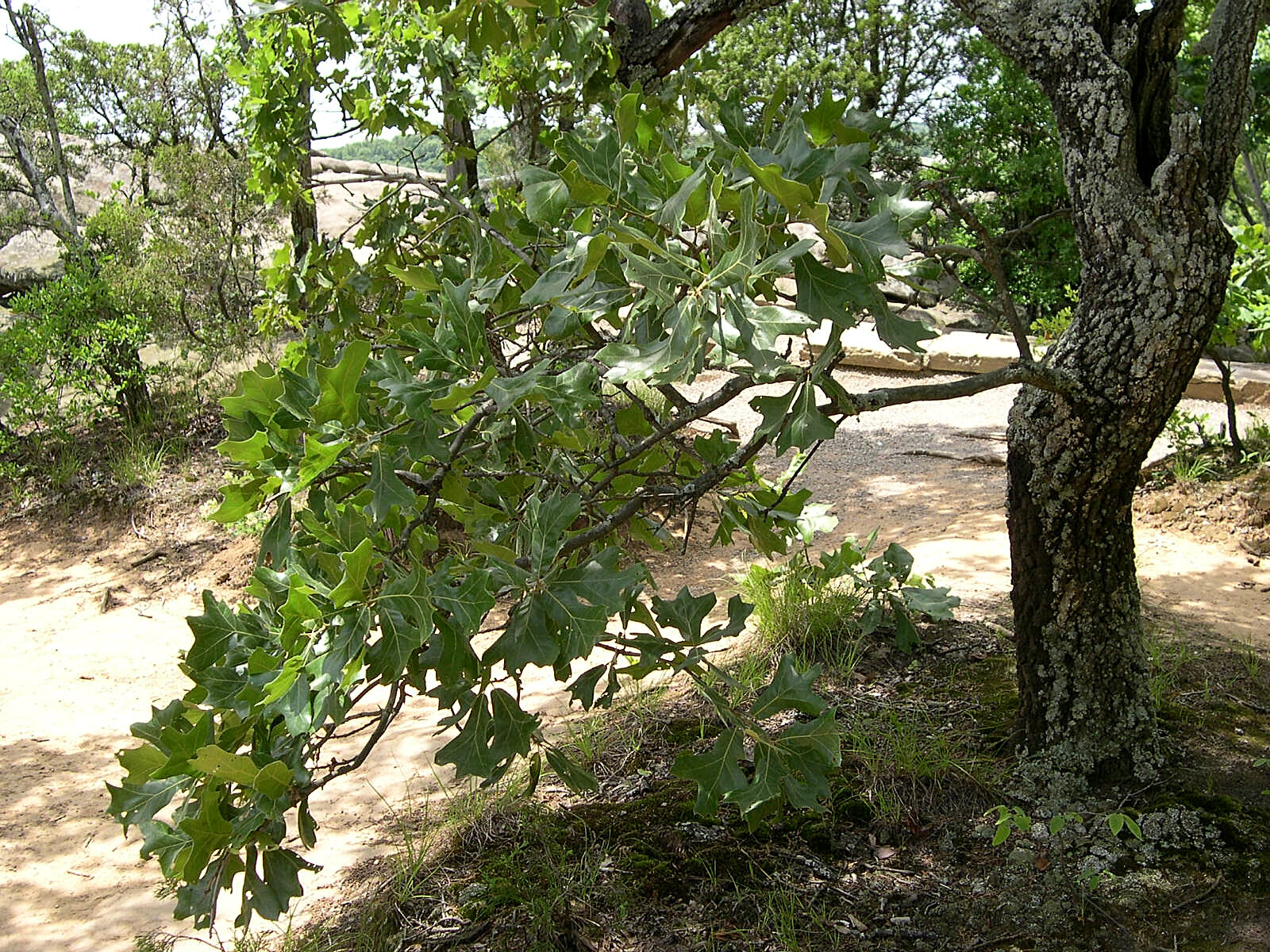
Blackjack oak
Quercus marilandica
A small, gnarled oak of dry caprock and barrens. Leaves are leathery, three-lobed, and shaped like a bell with the broad end at the tip. Dark, deeply blocky bark. A reliable companion of post oak on the poorest plateau soils.
Status: Native.
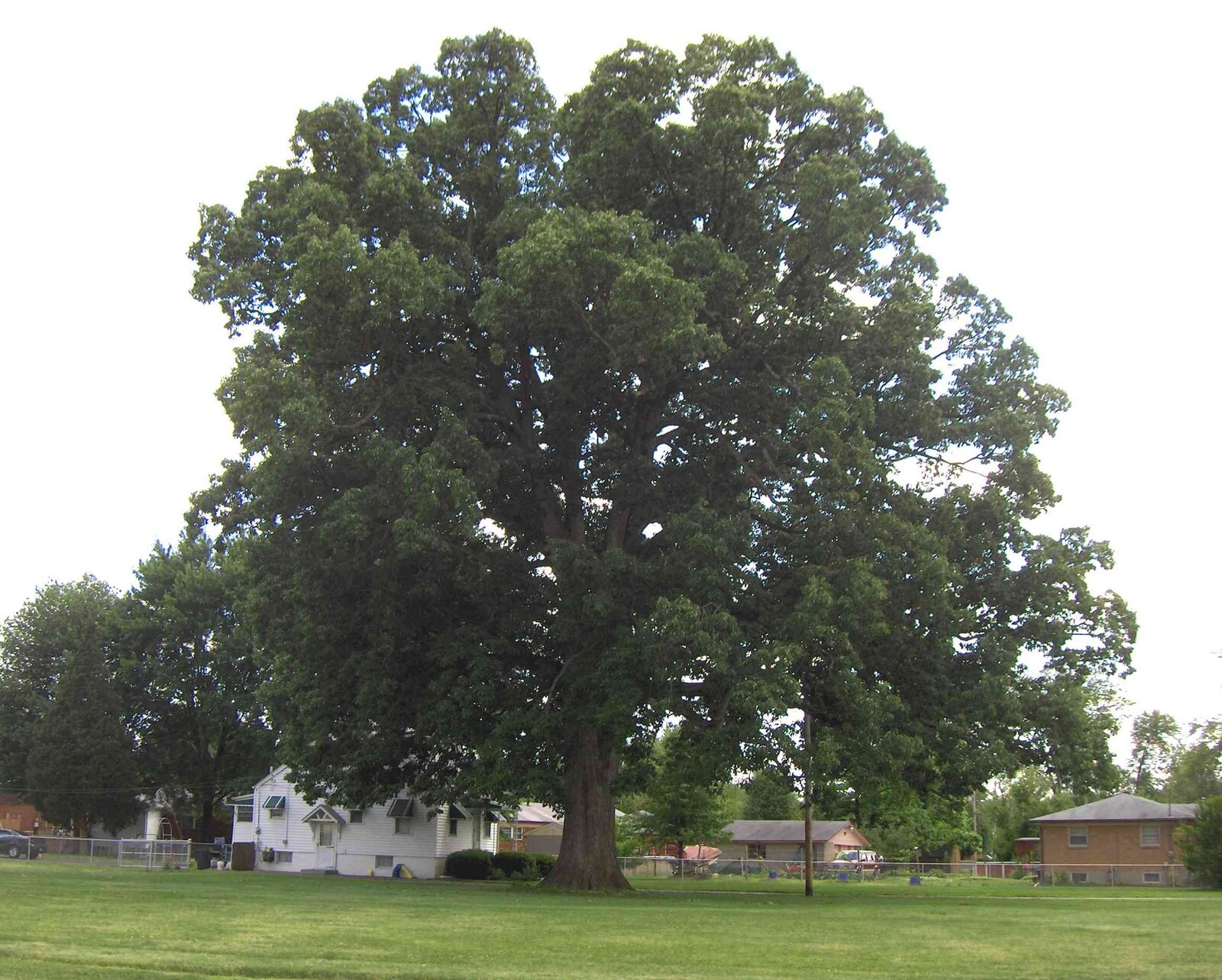
Swamp chestnut oak
Quercus michauxii
Bottomland white oak with leaves that resemble chestnut oak but on better-drained alluvial soils rather than dry caprock. Acorns are unusually large and sweet enough that the species is sometimes called basket oak or cow oak.
Status: Native.
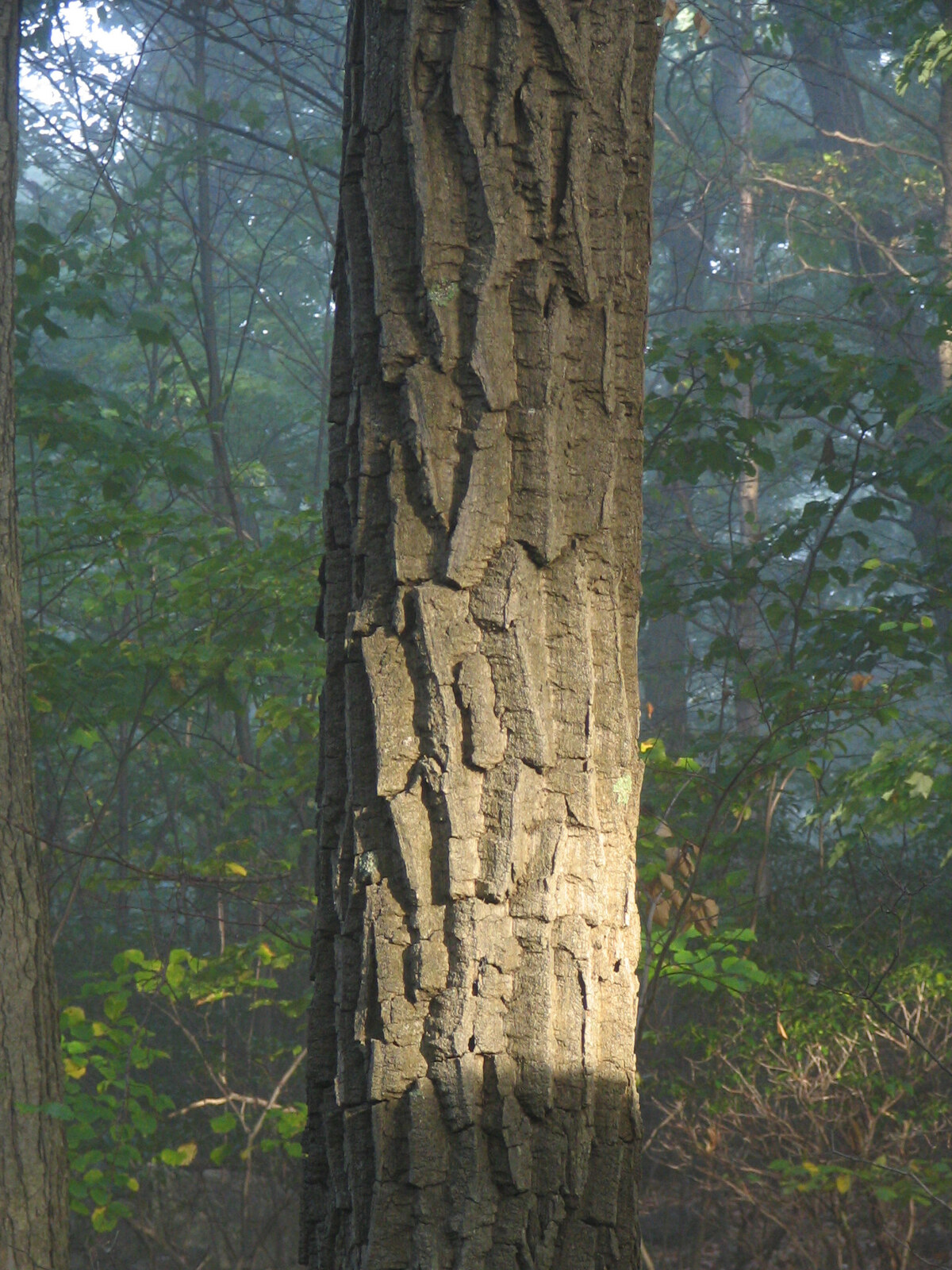
Chestnut oak
Quercus montana
Formerly Q. prinus. The oak of the sandstone caprock. Deeply furrowed gray-brown bark with narrow blocky ridges, and leaves with large rounded marginal teeth rather than deep lobes. Tolerates the thin, acidic soils on top of the plateau better than most other oaks; dominant tree along the rim from Prentice Cooper across to Foster Falls.
Status: Native, dominant on caprock.
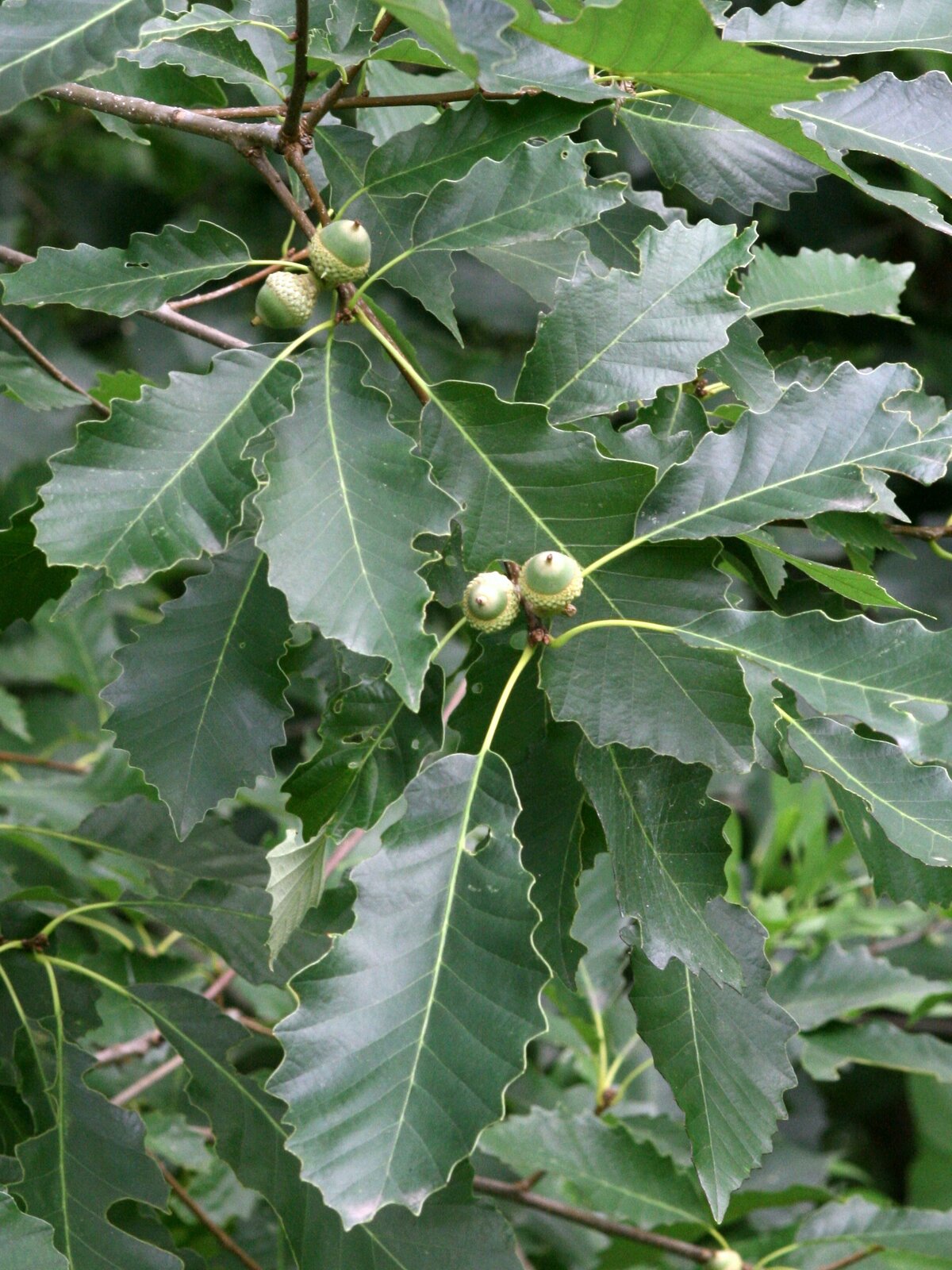
Chinkapin oak
Quercus muehlenbergii
A limestone-loving white oak. Leaves resemble chestnut oak's, but the marginal teeth are sharper and pointed rather than rounded. Common on calcareous bluffs and Sequatchie Valley slopes; absent from acidic plateau caprock.
Status: Native.
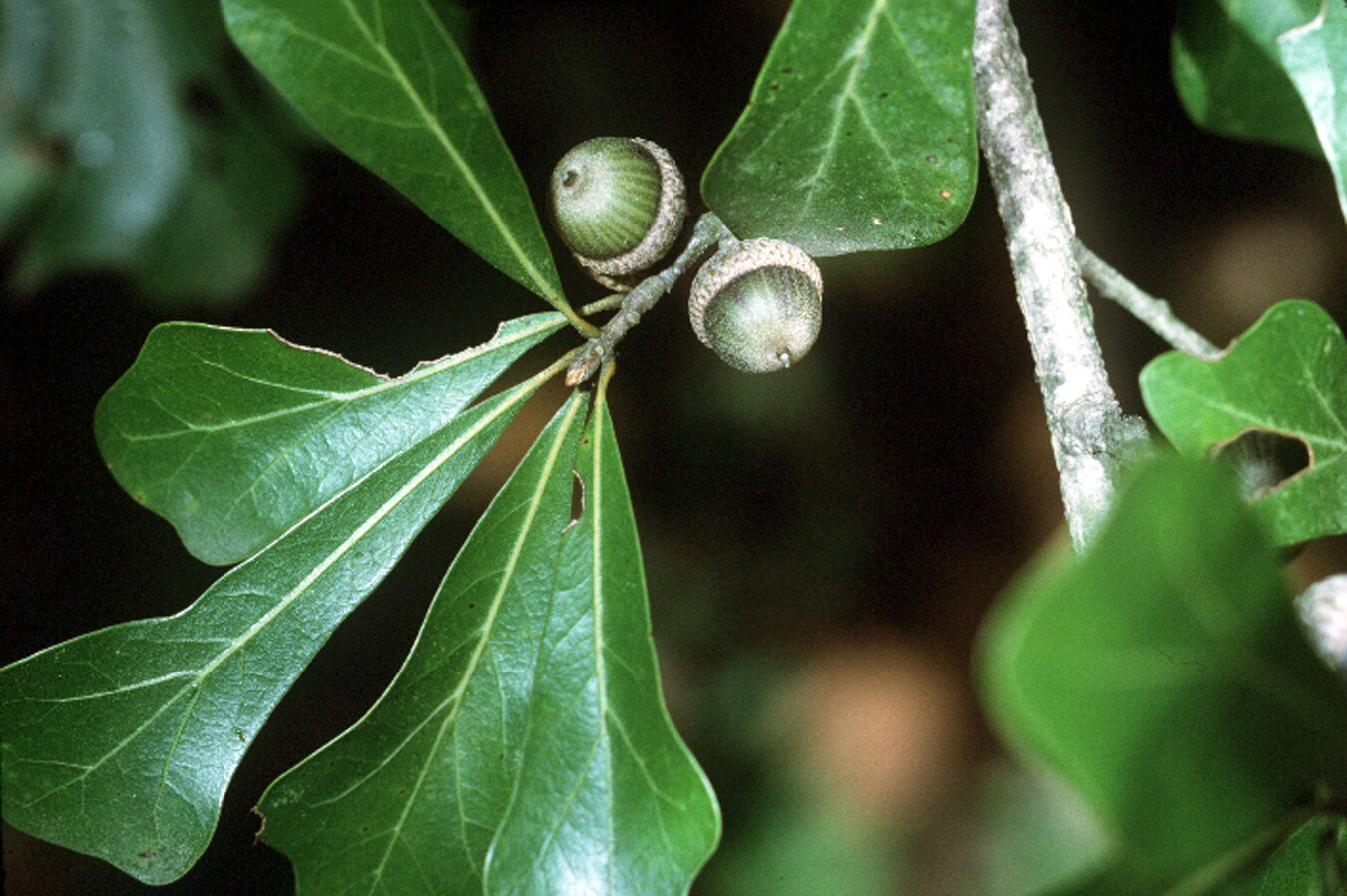
Water oak
Quercus nigra
A bottomland red-oak-group species. Spatulate leaves, narrow at the base and rounded at the tip, sometimes with three shallow lobes. Common on poorly drained alluvial flats along the Tennessee River.
Status: Native.
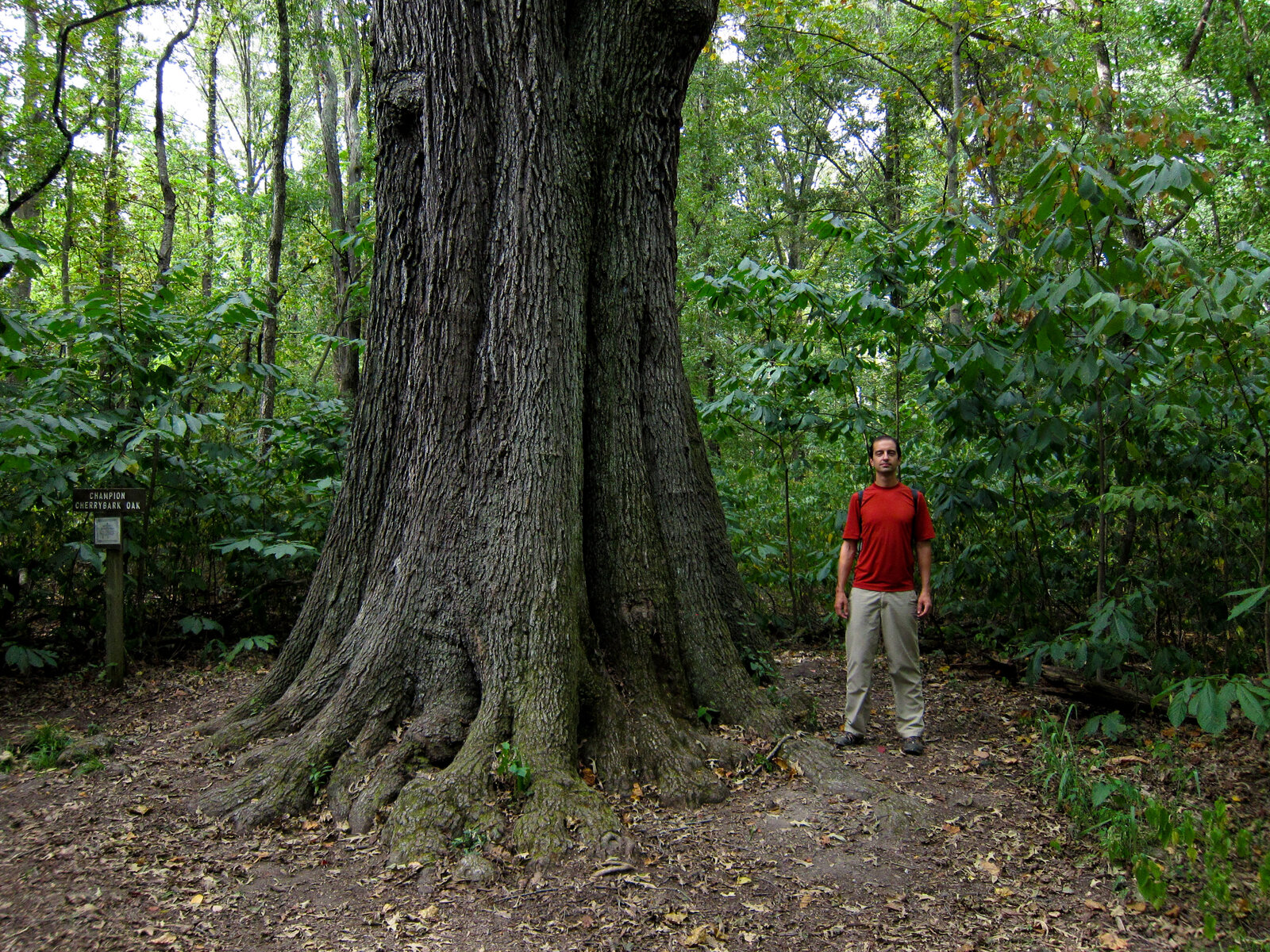
Cherrybark oak
Quercus pagoda
A bottomland red oak, formerly classed as a variety of southern red oak. Bark resembles black cherry: dark, plate-like flakes. Leaves have evenly spaced, pagoda-like lobes that give the species its scientific name.
Status: Native.
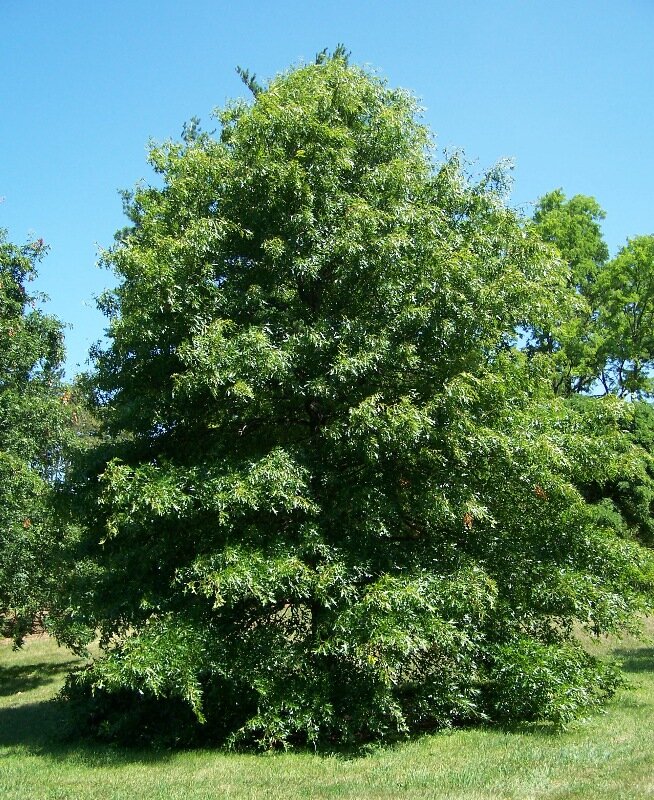
Pin oak
Quercus palustris
A wet-bottomland red oak with deeply lobed, sharp-tipped leaves. Lower branches descend, middle branches go horizontal, and upper branches ascend, giving the species a recognizable layered silhouette. Common in roadside plantings.
Status: Native.
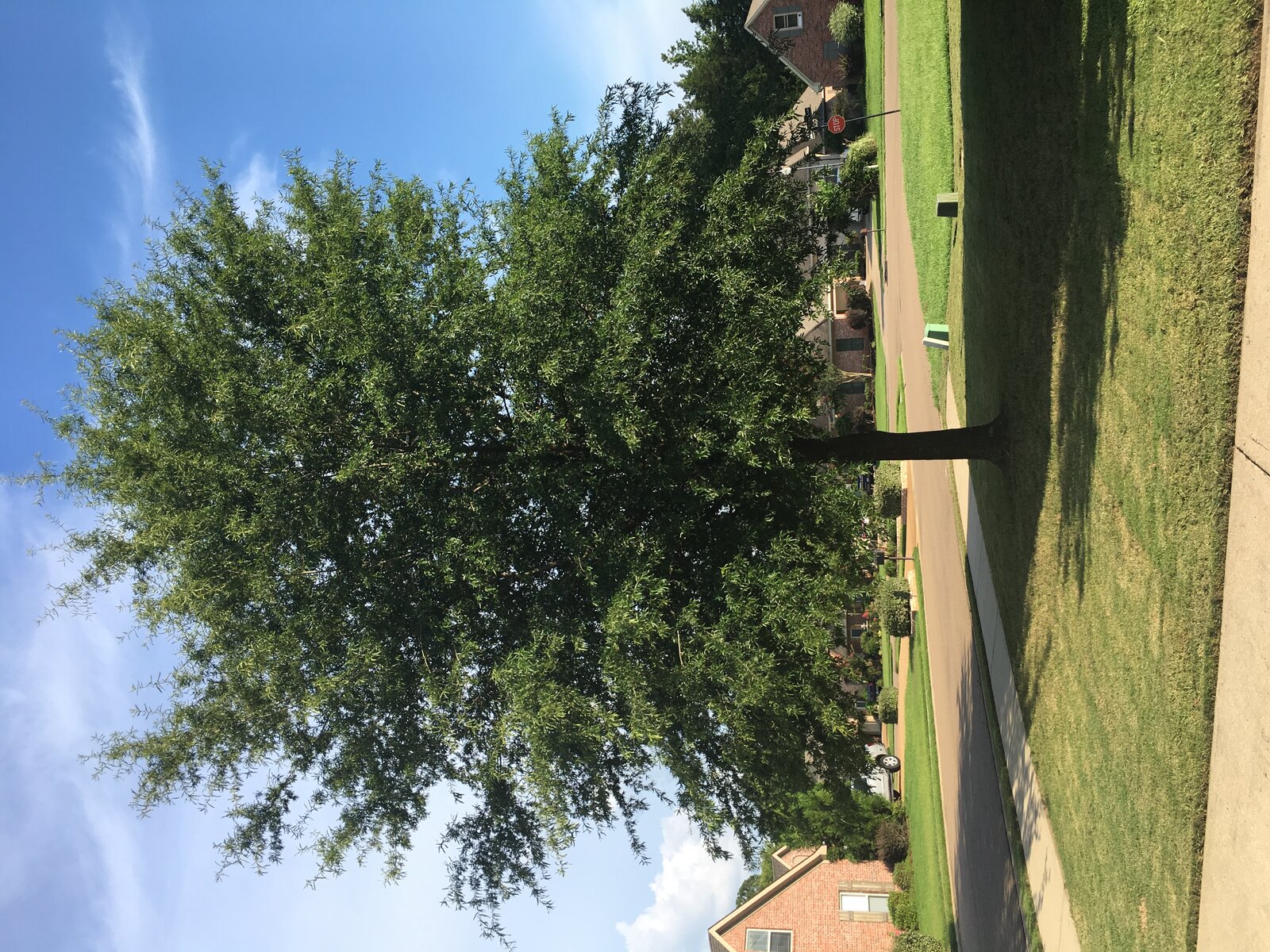
Willow oak
Quercus phellos
Another oak that does not look like an oak: narrow, willow-like leaves without lobes. A red-oak-group species of bottomlands and slow-draining flats. Acorns are small, abundant, and an important food source for waterfowl.
Status: Native.
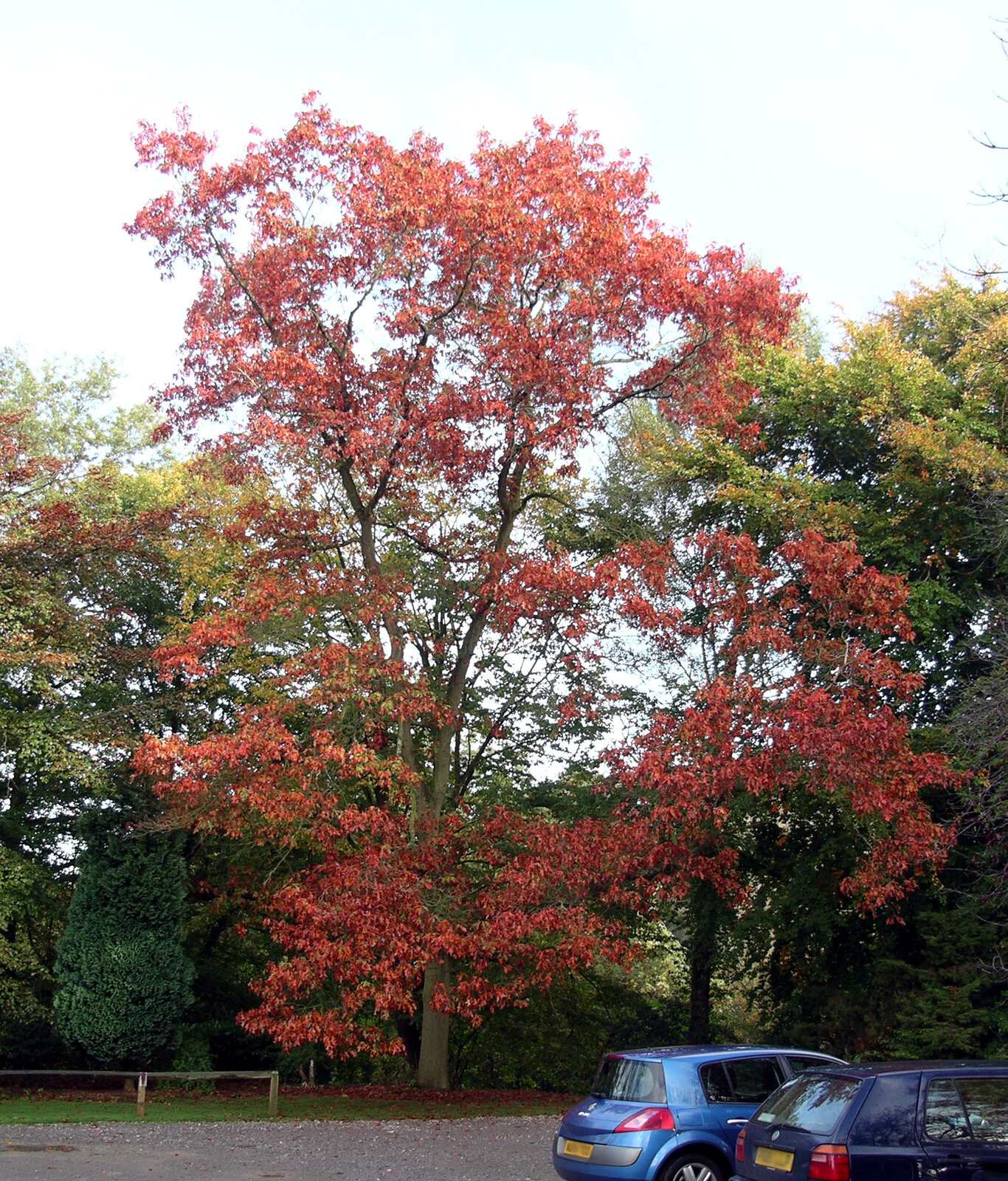
Northern red oak
Quercus rubra
The cove and slope co-dominant alongside tulip poplar, beech, and sugar maple. Leaves are deeply lobed with bristle tips. Bark develops shiny vertical strips with darker fissures between them at maturity.
Status: Native, common in coves.
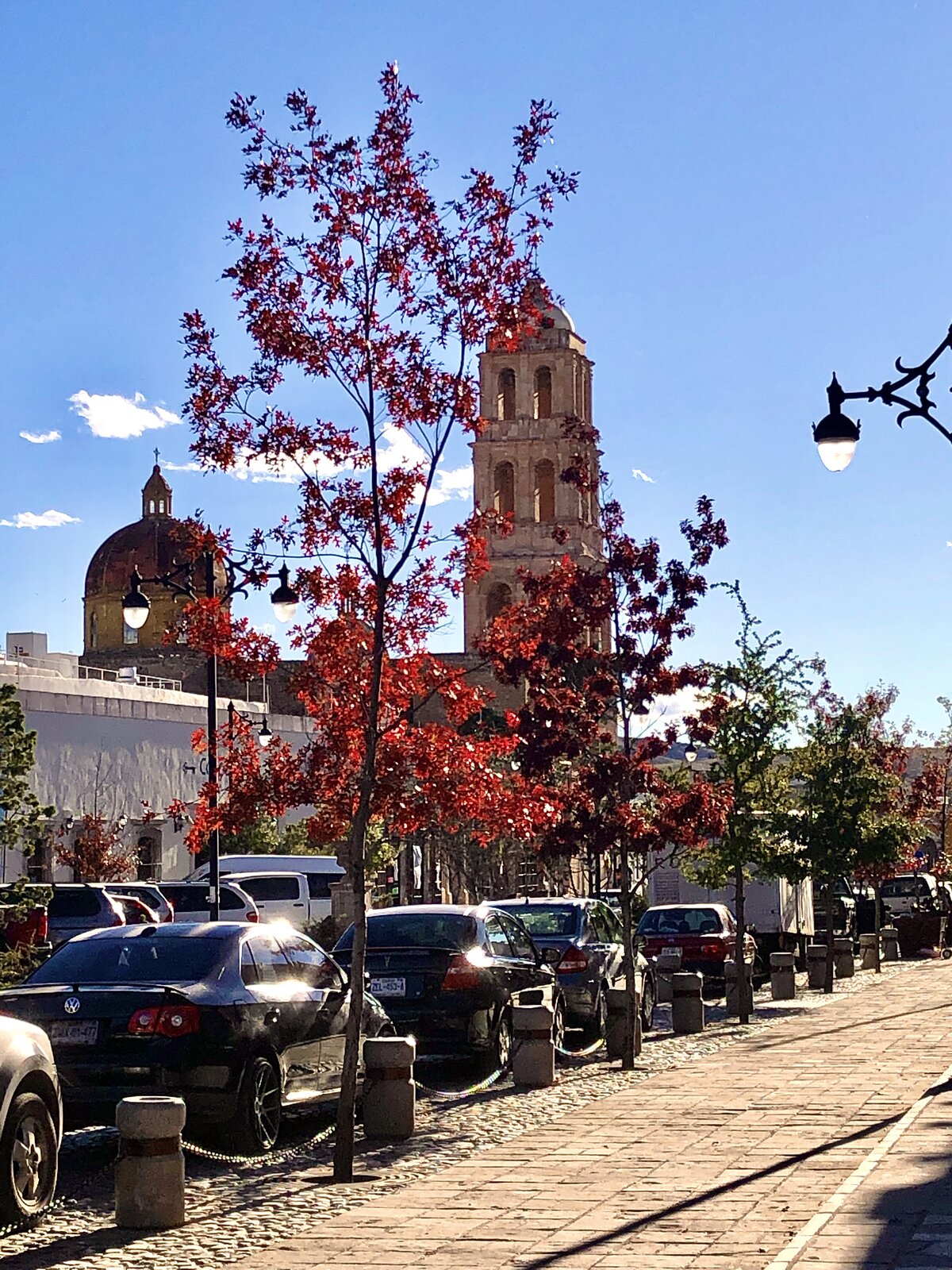
Shumard oak
Quercus shumardii
A red-oak-group species of calcareous bottoms and slopes. Closely resembles northern red oak but with deeper sinuses and brilliant red fall color. Tolerant of urban conditions; often planted as a shade tree.
Status: Native.
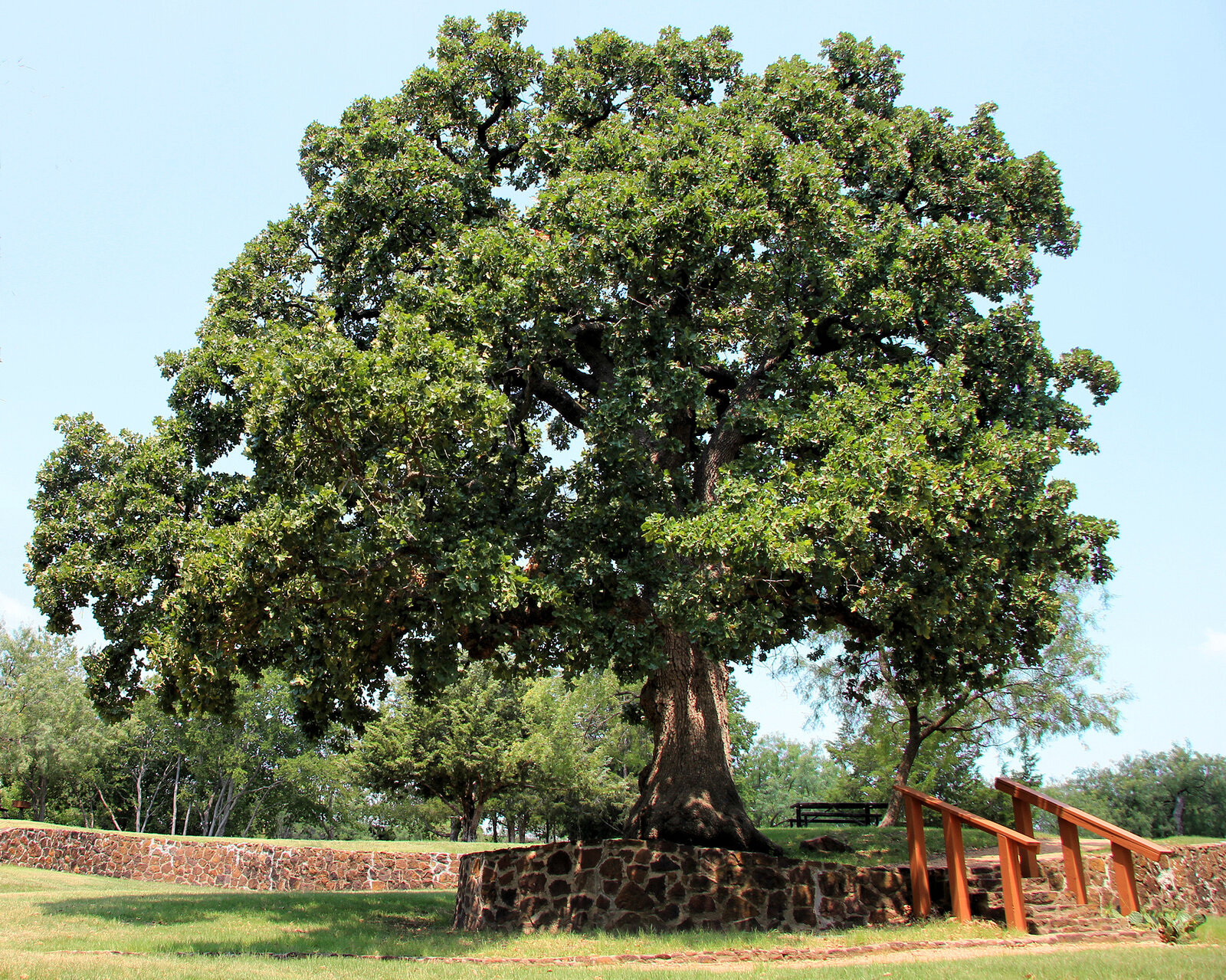
Post oak
Quercus stellata
A small to mid-sized white oak of the driest, poorest sites. The leaves have a cross-shaped silhouette: a pair of broad central lobes and two smaller lobes near the base. Common on barrens and dry sandstone uplands alongside blackjack oak.
Status: Native.
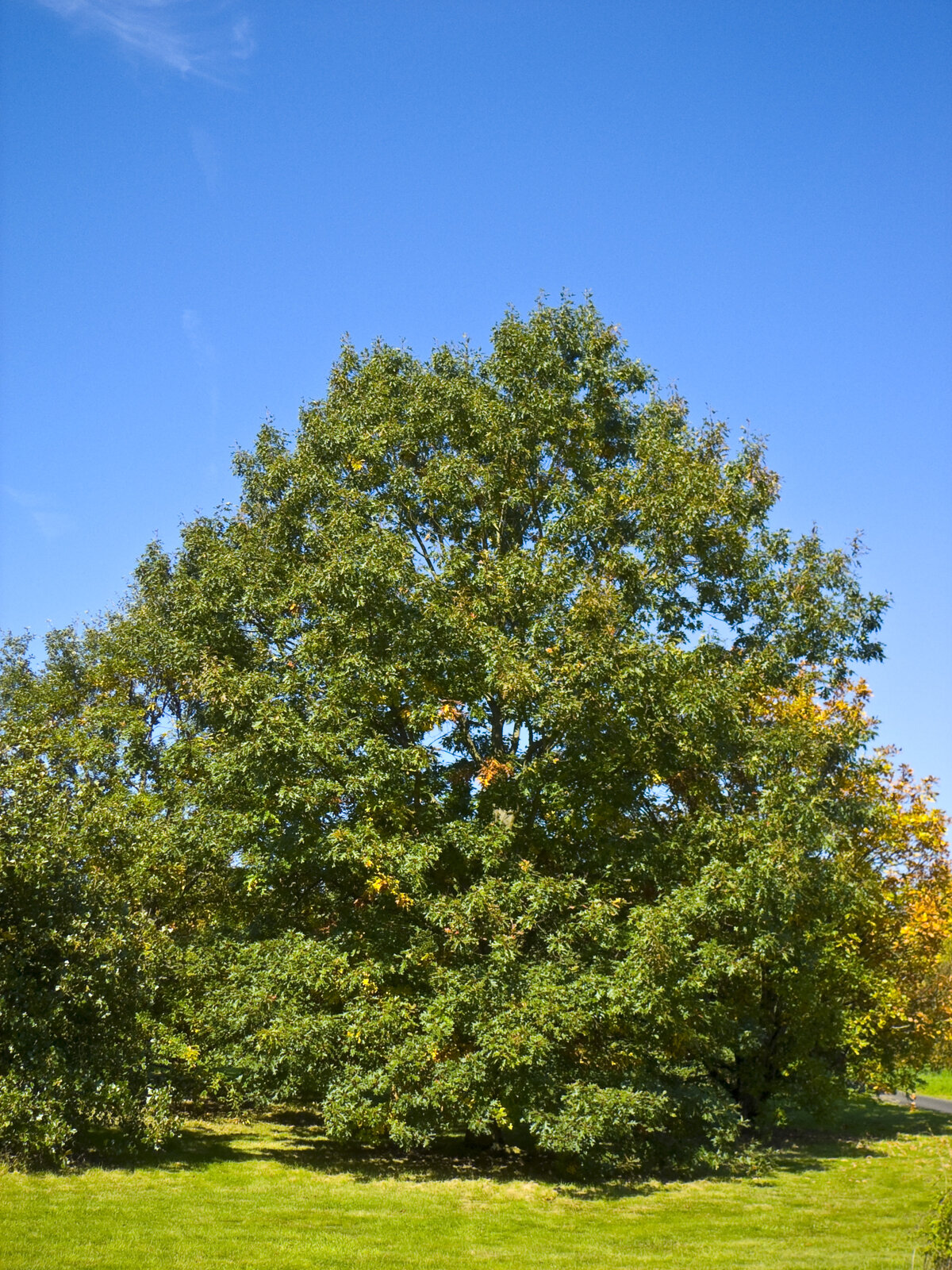
Black oak
Quercus velutina
A red-oak-group species of dry uplands. Dark, deeply furrowed bark; inner bark bright orange-yellow, the source of a historic dye called quercitron. Buds are conspicuously hairy.
Status: Native, common.
Hickories and walnuts
The hickories share Marion's plateau and slope forests with the oaks. Shagbark hickory is the easiest to identify at a glance: long, loose, curling strips of bark give the tree a torn-up appearance even from a distance. The other hickories on dry ridges, mockernut, pignut, bitternut, red, and sand hickory, have tight rather than shaggy bark, and the species are distinguished mainly by leaflet number and nut shape. Three more hickories (pecan, shellbark, and the southern Carolina shagbark) live on better-drained bottoms or southern lowland edges. The walnuts share the family and habitat range: black walnut is a prized timber tree of rich coves and farm fencerows, and butternut is its rare, declining relative.
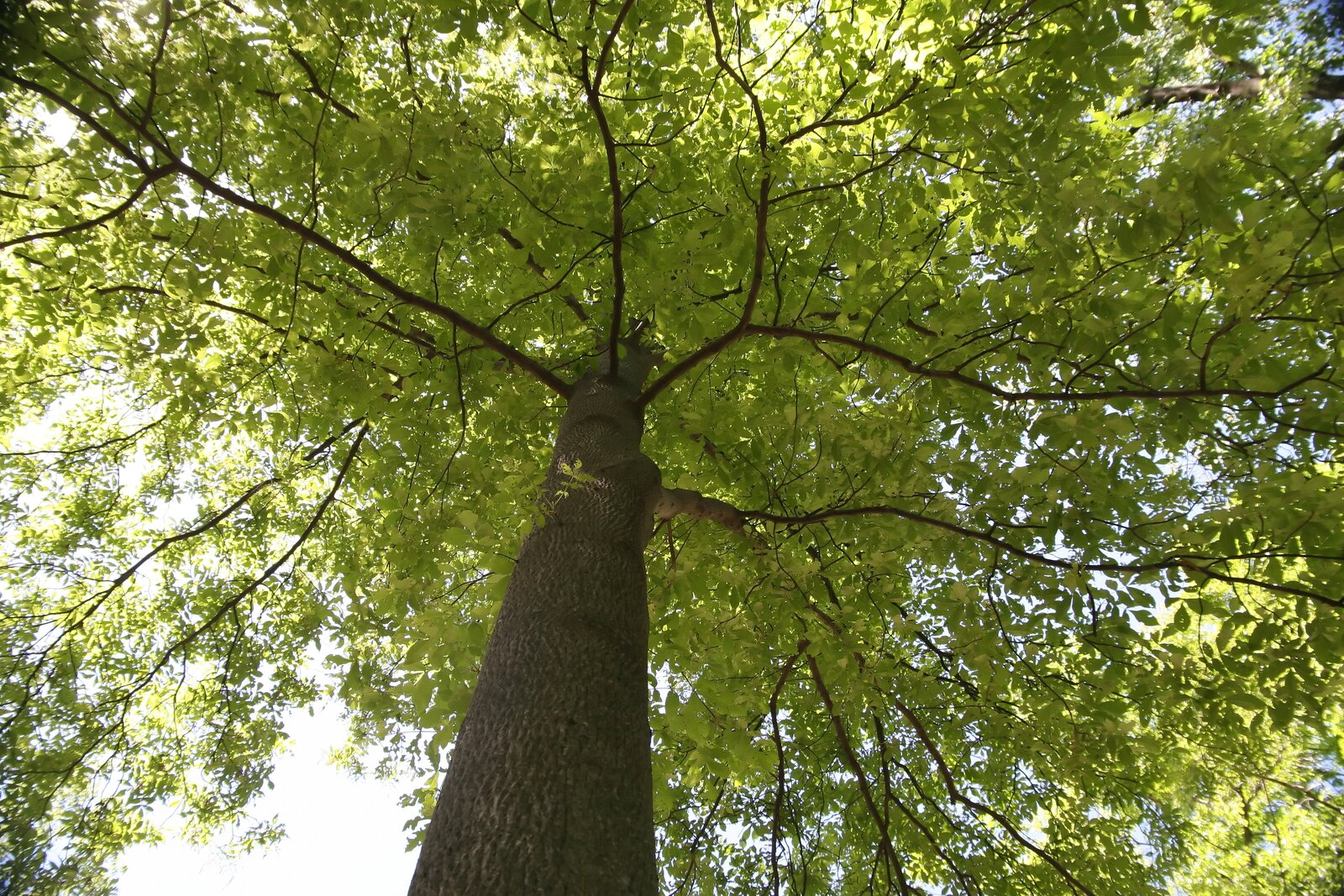
Mockernut hickory
Carya tomentosa
A common upland hickory with seven to nine leaflets and densely hairy young twigs. Nuts are thick-shelled with comparatively small kernels, the basis for the common name "mocker." Tight, interlacing-ridged bark.
Status: Native, common.
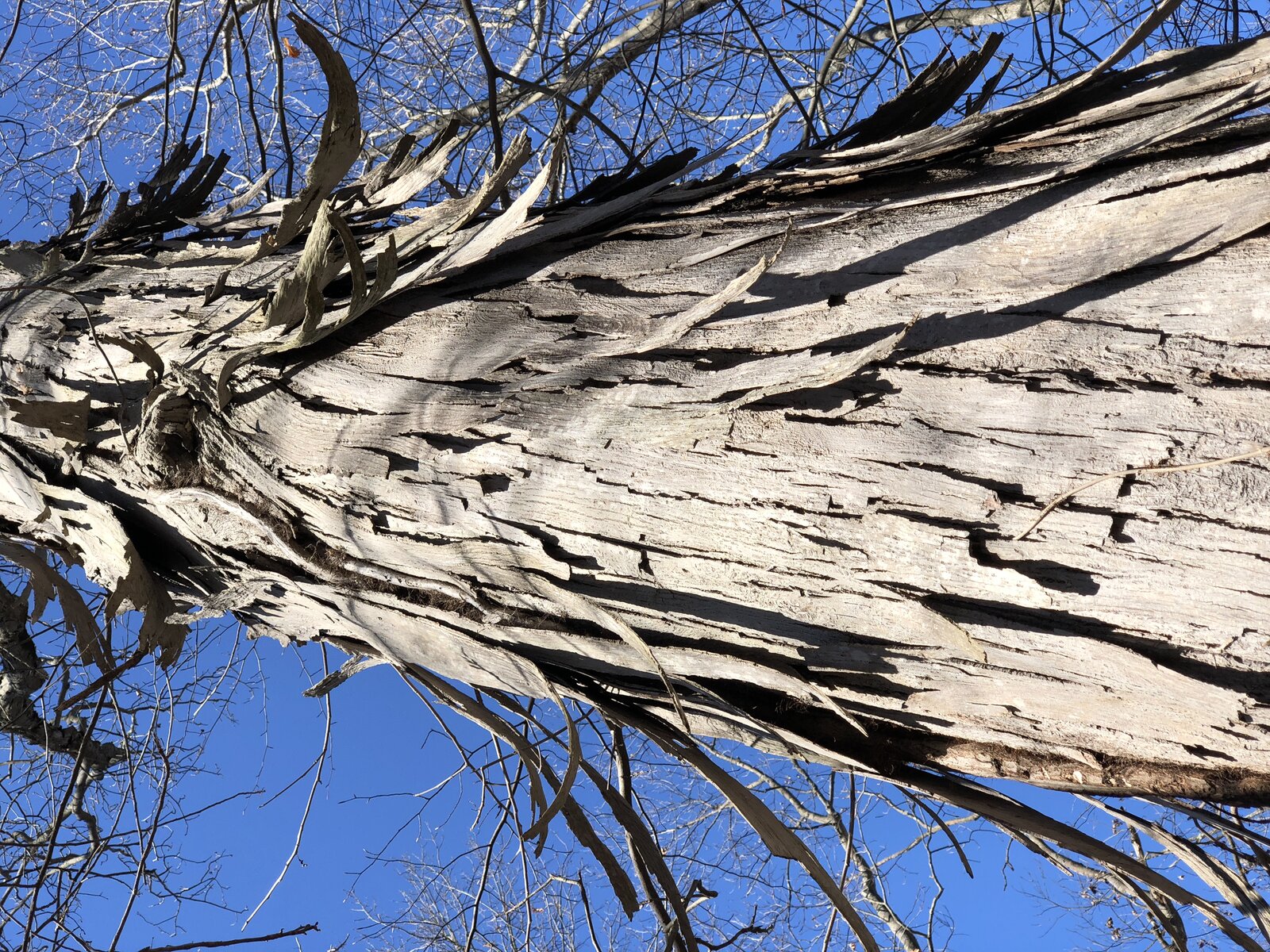
Carolina shagbark hickory
Carya carolinae-septentrionalis
A southern, smaller-leaved counterpart of shagbark hickory, sometimes treated as a variety of C. ovata. Lower-elevation calcareous slopes and bottoms.
Status: Native.
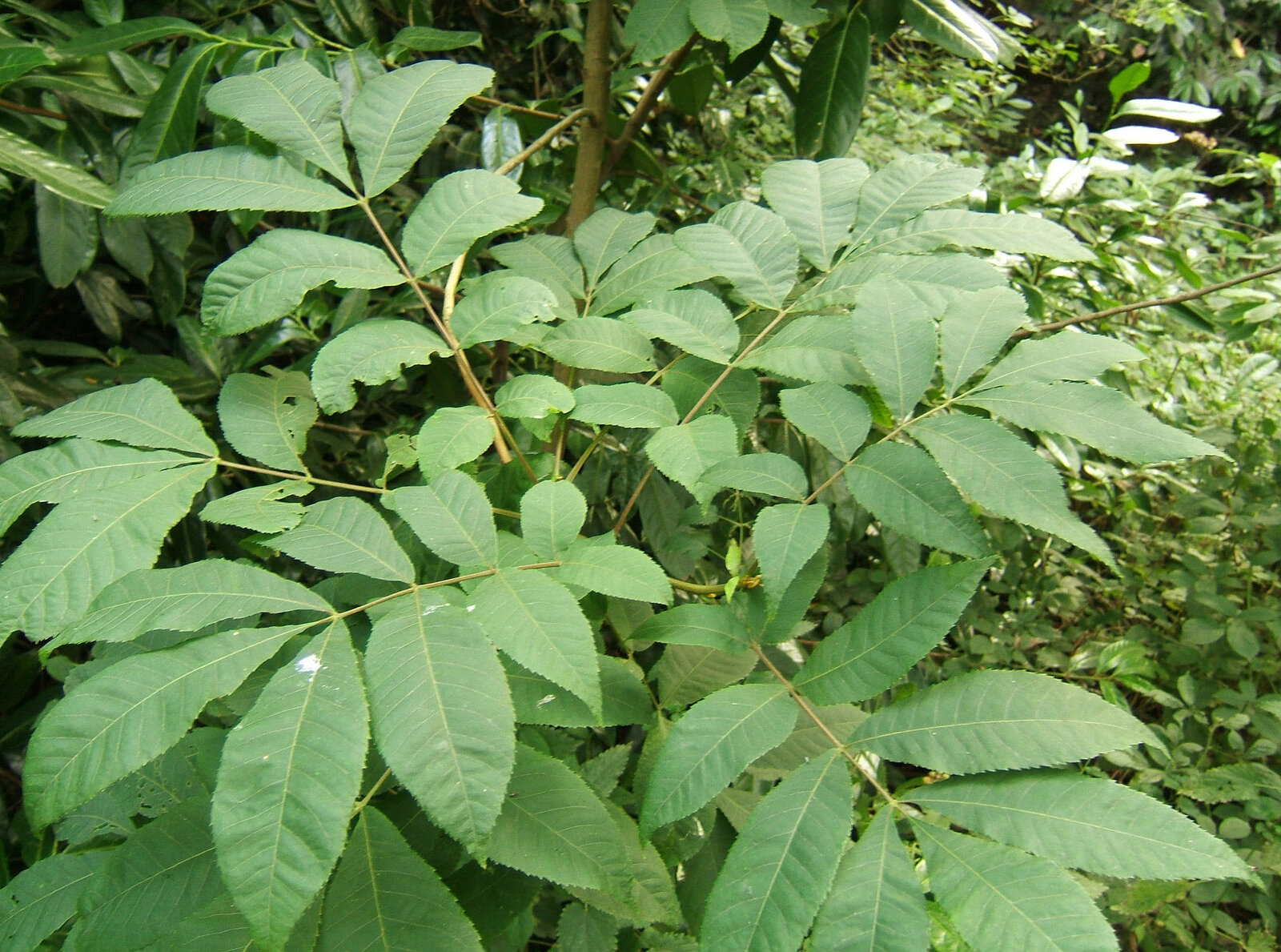
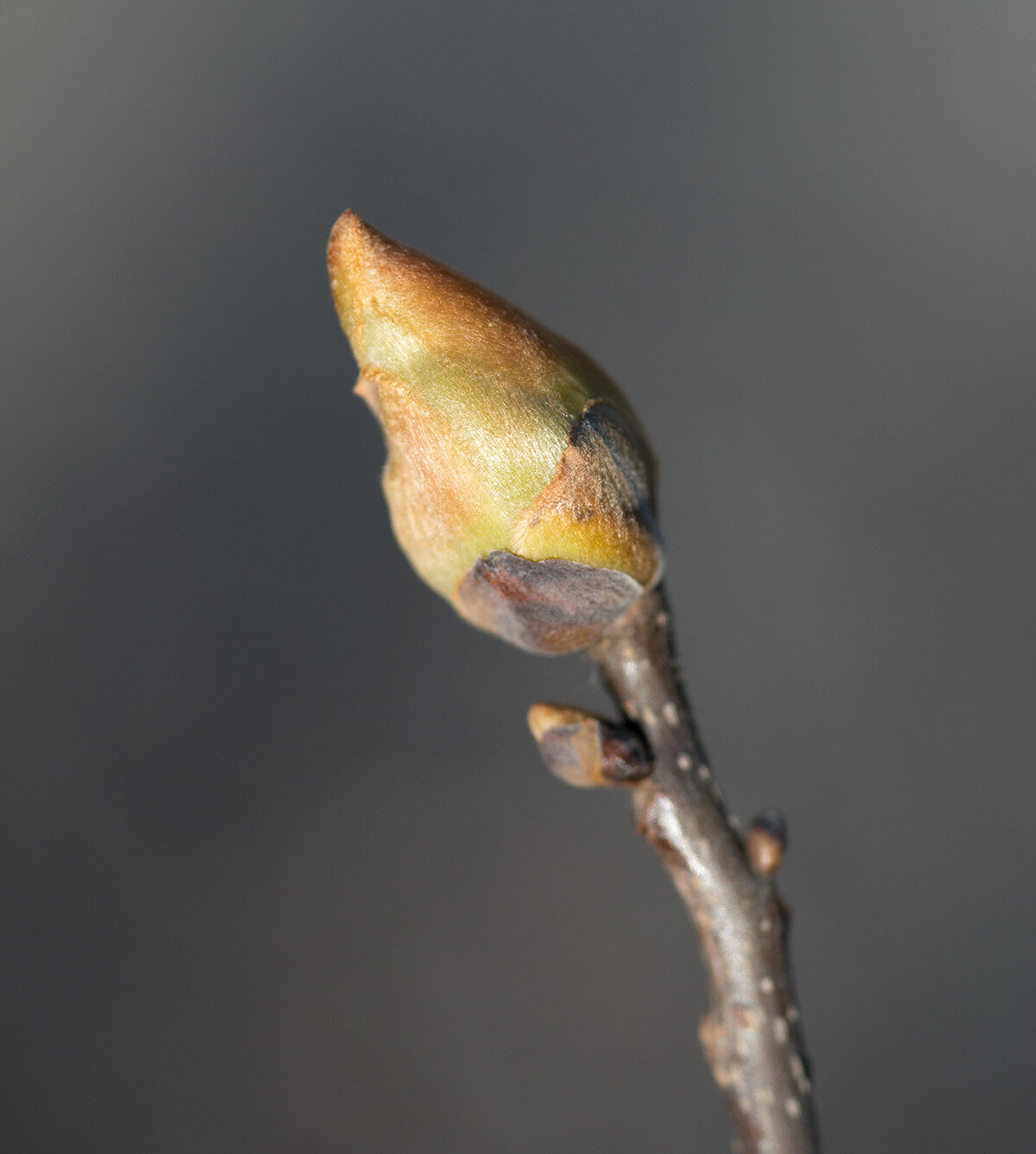
Bitternut hickory
Carya cordiformis
Sulfur-yellow winter buds are diagnostic. The thin-shelled nut is bitter and largely inedible to humans, though squirrels eat them readily. Common on moist slopes and bottomland edges.
Status: Native.
Pignut hickory
Carya glabra
The common dry-upland hickory. Five (rarely seven) leaflets, smooth twigs, and pear-shaped nuts. Bark is closely interlaced rather than shaggy. The "pignut" name reflects the historic use of the small, bitter nuts as livestock mast.
Status: Native, common.
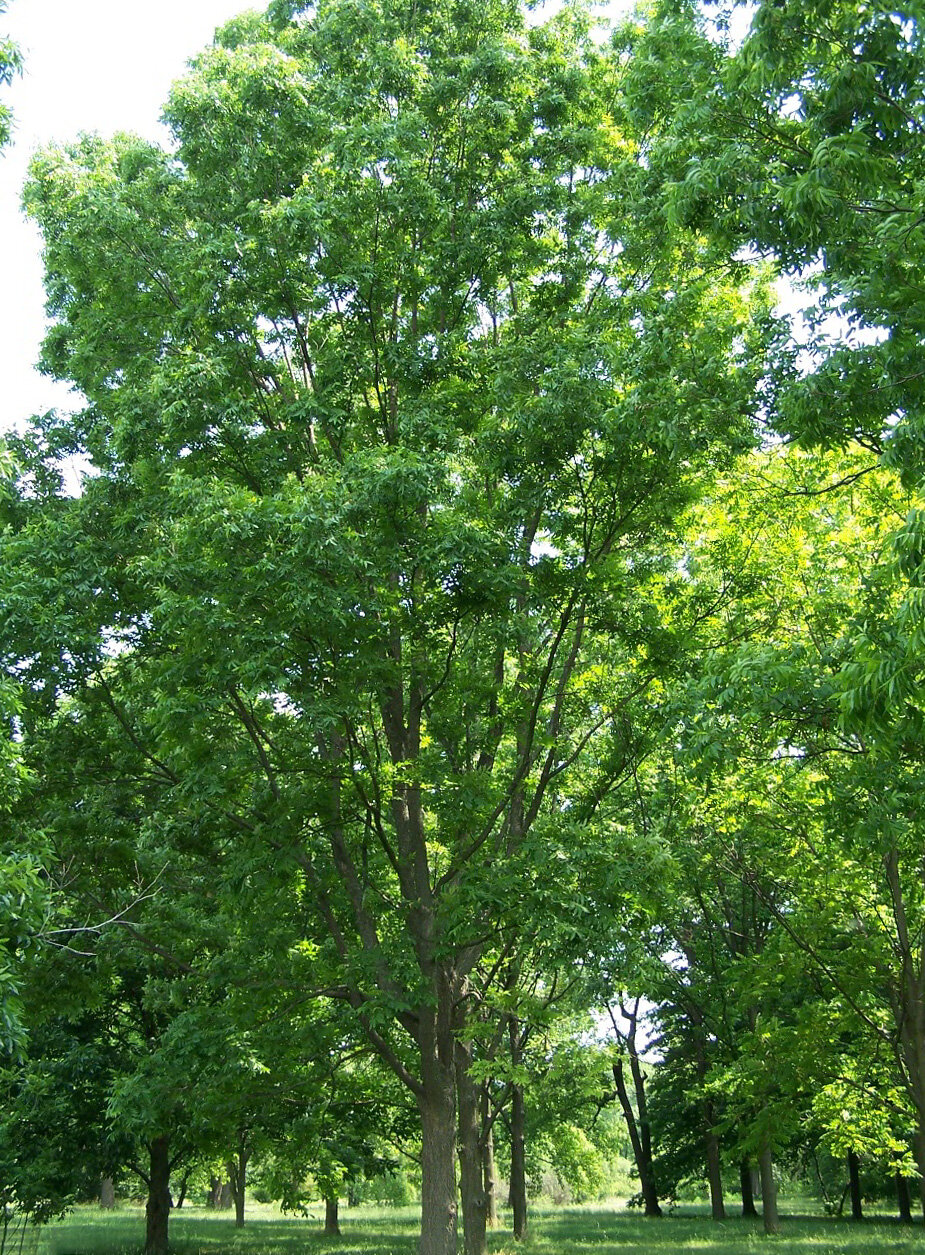
Pecan
Carya illinoinensis
A bottomland hickory native to the Mississippi watershed and lower Tennessee. Eleven to seventeen narrow leaflets per leaf. The thin-shelled nuts have driven cultivation; orchard plantings are scattered across Marion farms and yards.
Status: Native to the lower watershed; widely planted.
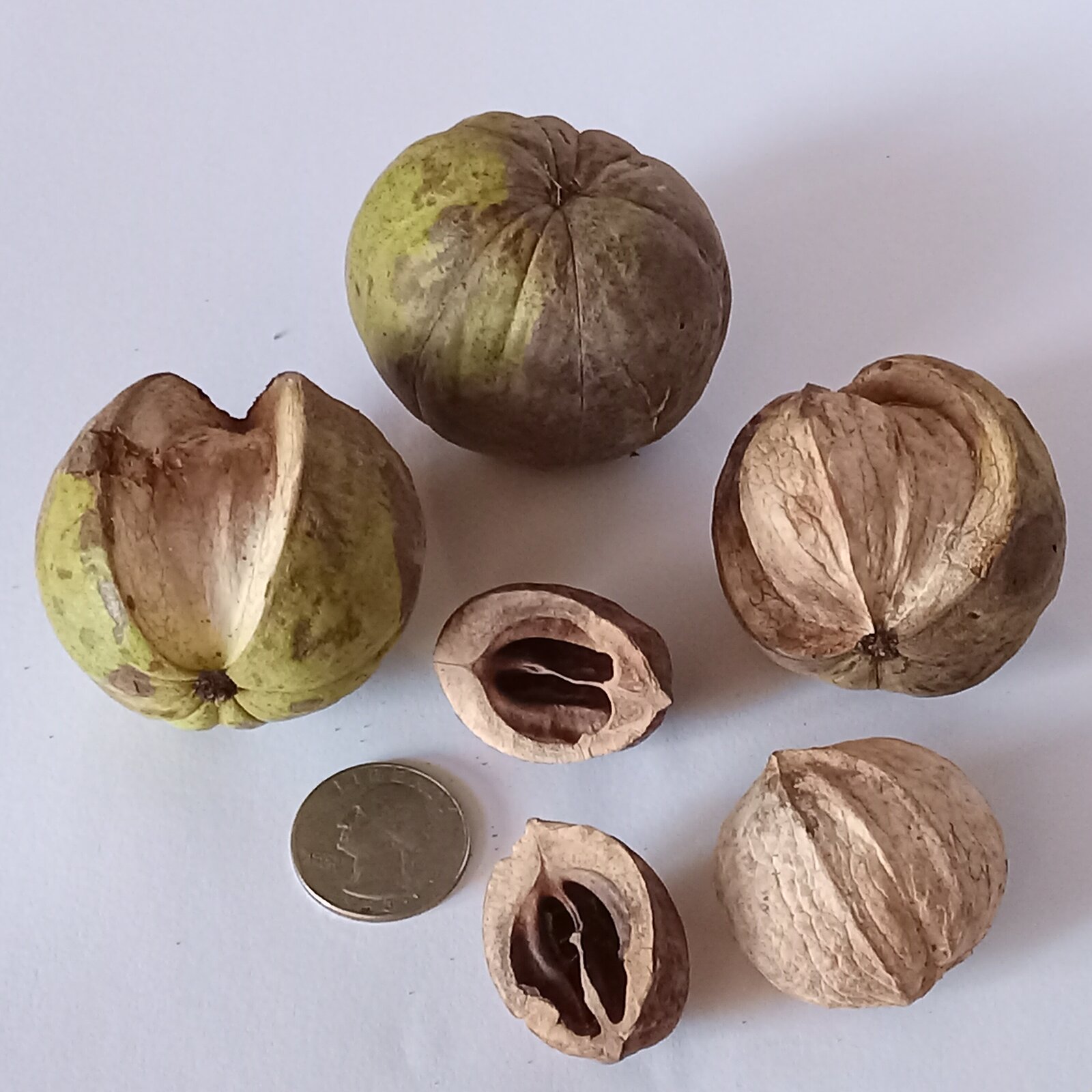
Shellbark hickory
Carya laciniosa
A bottomland counterpart to shagbark, with the same loose curling bark plates but larger leaflets (usually seven, sometimes nine) and the largest nuts of any North American hickory. Sometimes called kingnut.
Status: Native.
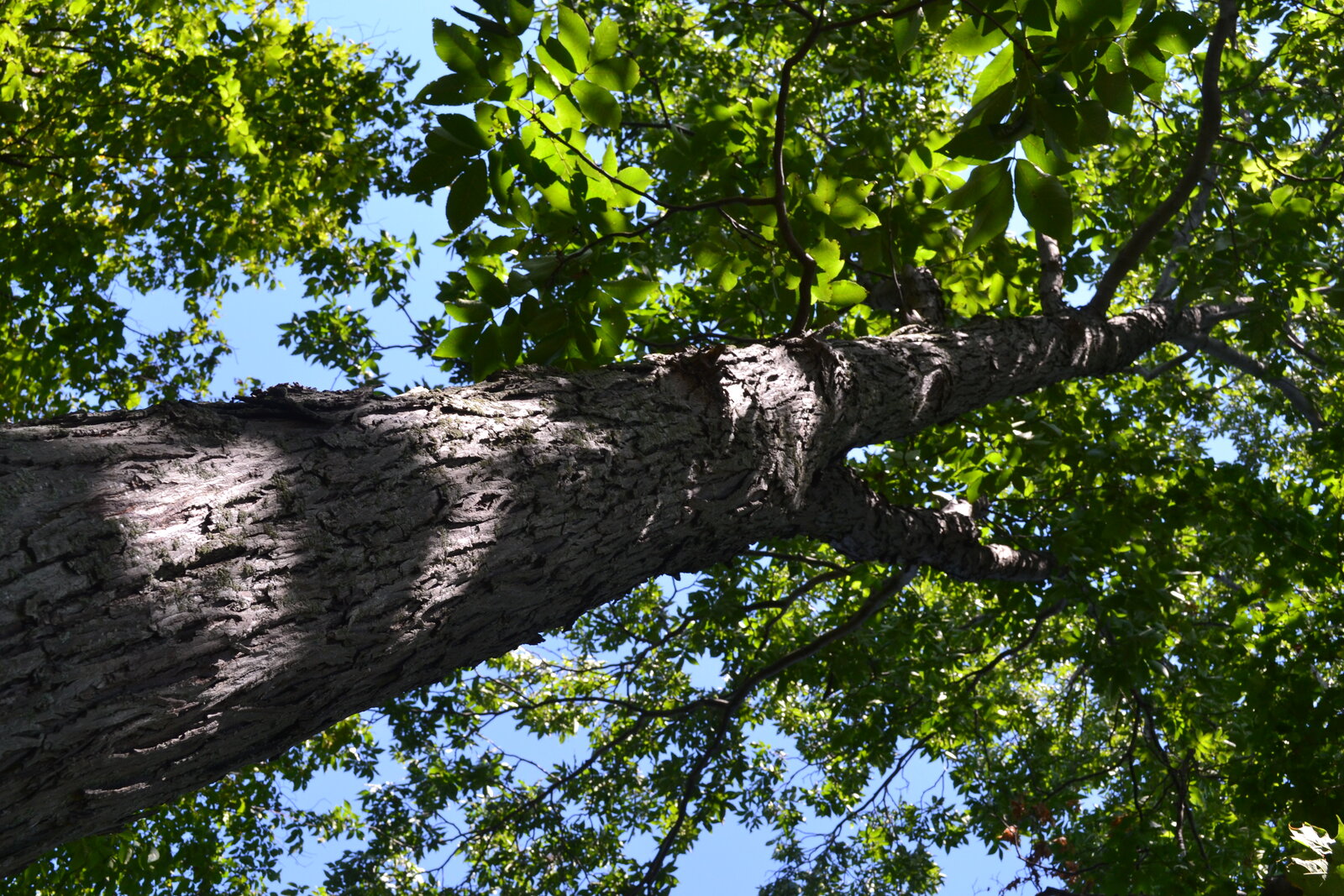
Red hickory
Carya ovalis
Sometimes called sweet pignut. A dry-upland species closely related to pignut hickory, distinguished by its sweet kernel and slightly shaggy bark on older trunks. Some authorities treat it as a variety of C. glabra.
Status: Native.
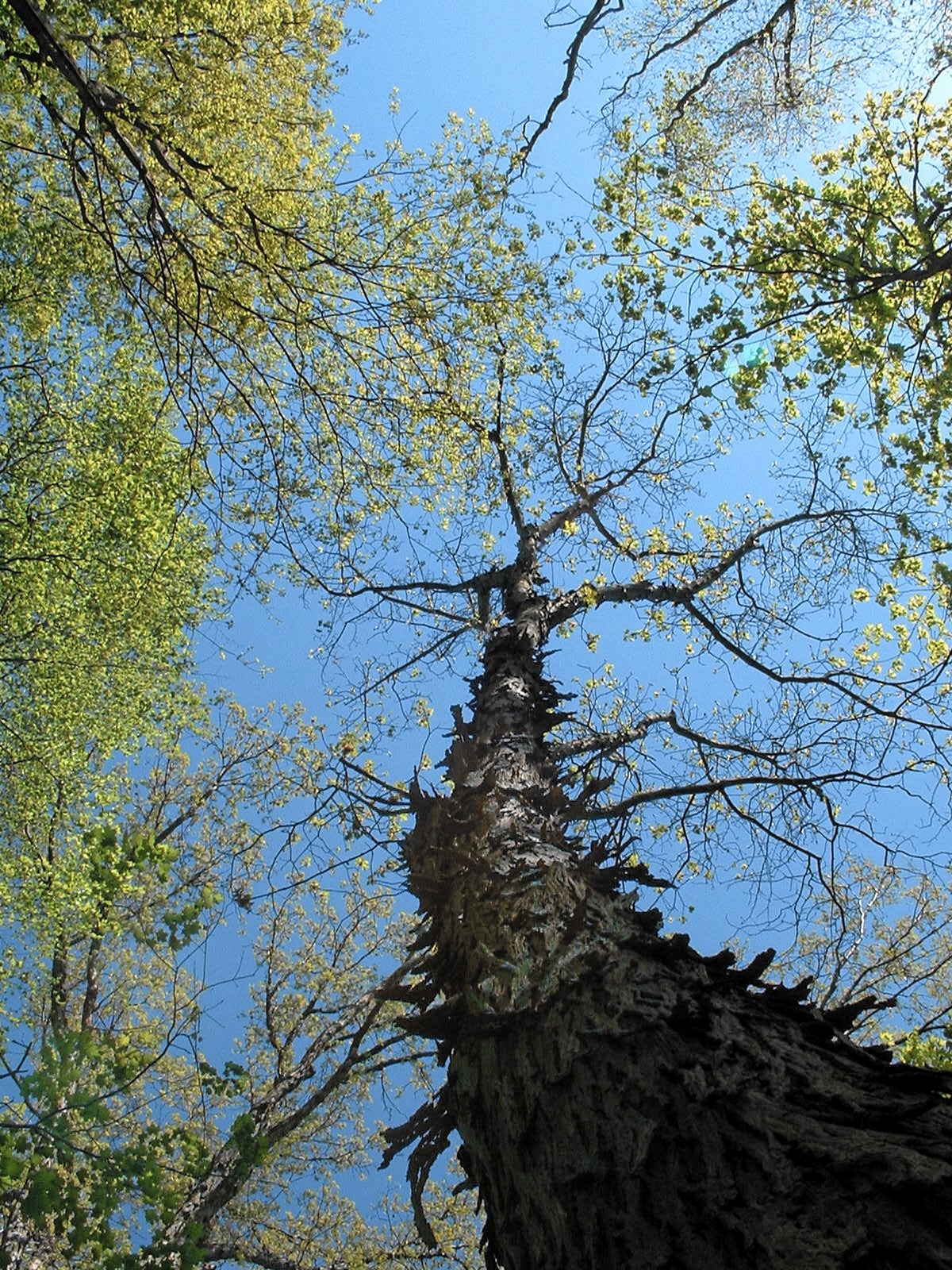
Shagbark hickory
Carya ovata
The most recognizable hickory: long, loose, curling strips of bark give the tree a torn-up appearance even from a distance. Five leaflets per compound leaf, the upper three notably larger than the lower two.
Status: Native, common.
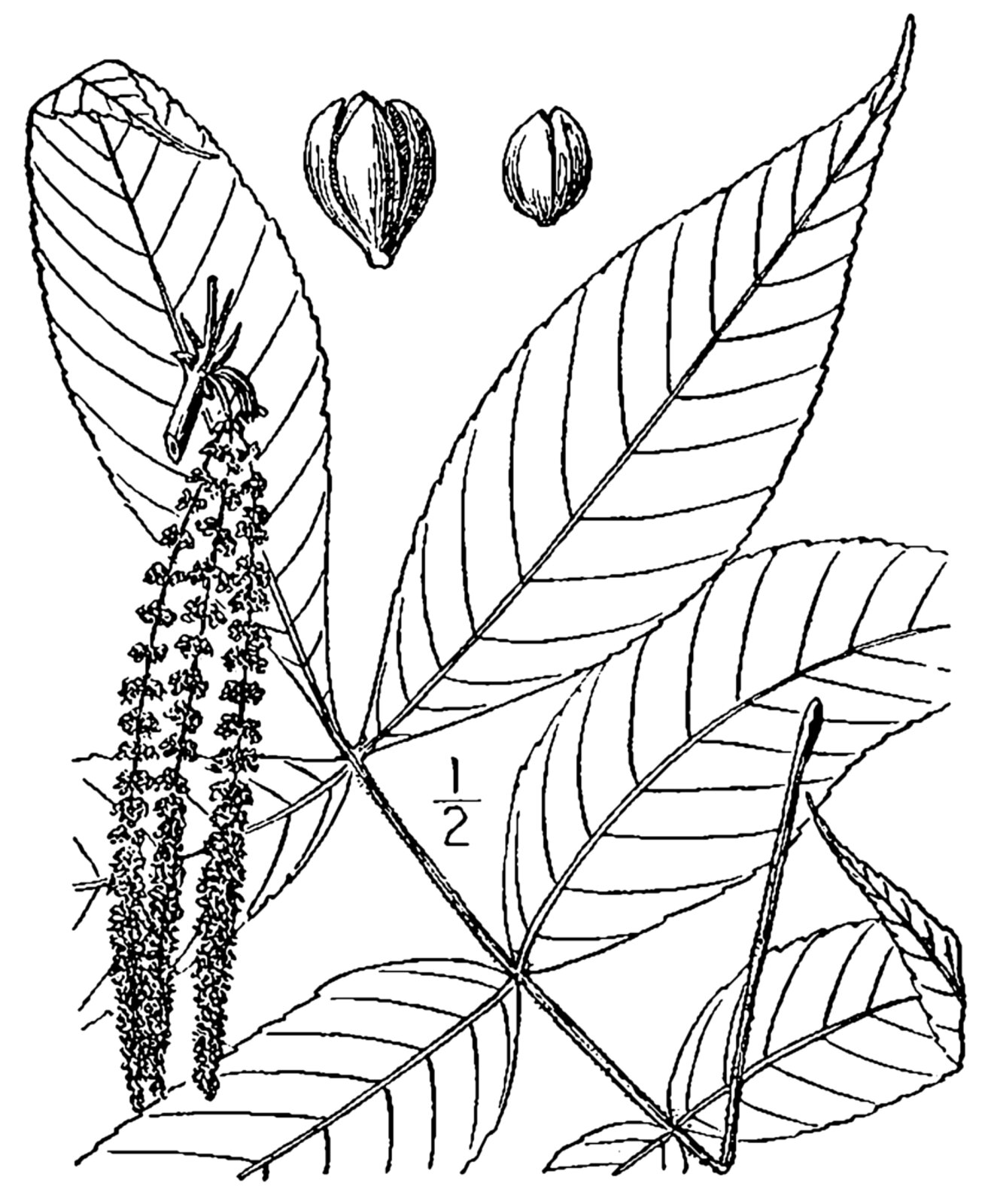
Sand hickory
Carya pallida
A small hickory of dry, sandy plateau soils. Pale undersides on the leaflets give the species its scientific name. Nuts are small and thin-shelled.
Status: Native.
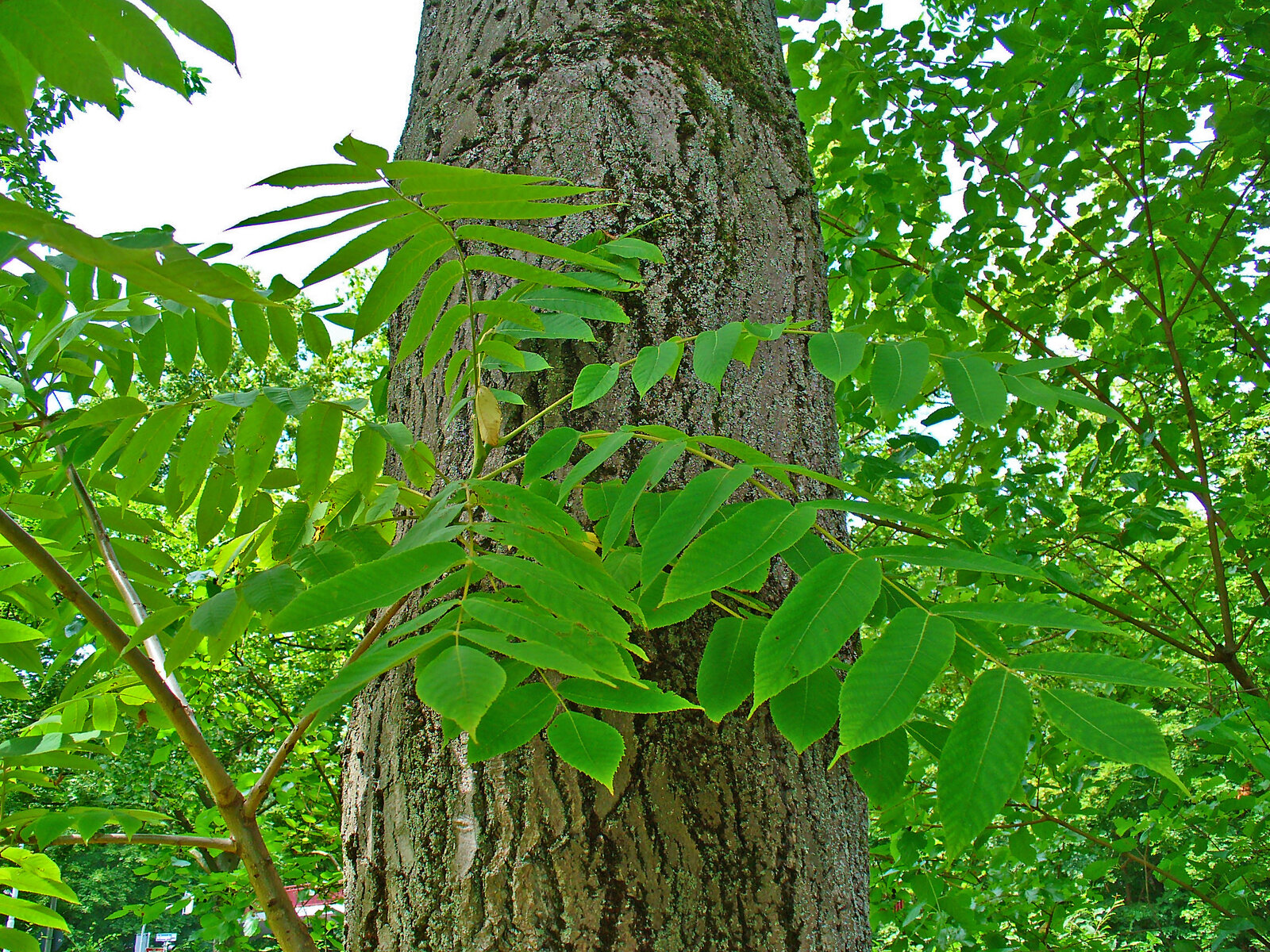
Butternut
Juglans cinerea
Closely related to black walnut, with longer, narrower leaflets and oval nuts. Severely declining range-wide from butternut canker (Ophiognomonia clavigignenti-juglandacearum); finding a healthy mature tree is uncommon. Listed by the Tennessee Department of Environment and Conservation 2025 Rare Plant List.
Status: Native; Tennessee state-Threatened (S3/G3).
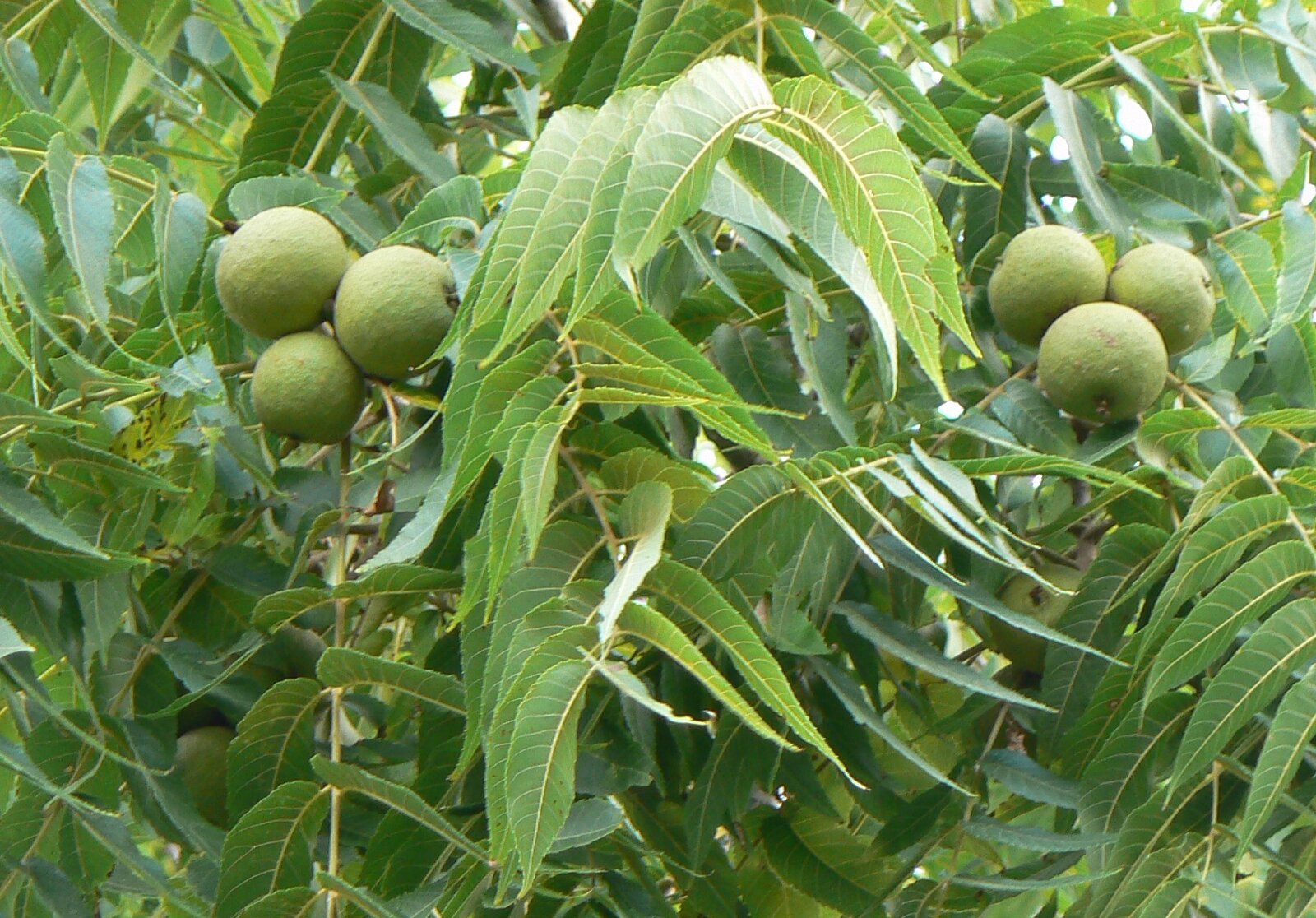
Black walnut
Juglans nigra
A prized cabinet timber and yard tree on rich coves and bottoms. Compound leaves with fifteen to twenty-three leaflets; thick-husked nuts. Roots release juglone, a chemical that suppresses the growth of many other plants nearby.
Status: Native, common.
American chestnut and the blight legacy
Before 1904, one in every four canopy trees in Appalachian forests was an American chestnut, and Marion County's ridges carried chestnut at proportions that would be difficult to picture today. The chestnut blight, caused by the fungus Cryphonectria parasitica, arrived in New York in 1904, reached the Cumberland Plateau by the 1920s, and killed virtually every mature American chestnut on the southern plateau by the end of the 1930s. Range-wide the blight killed roughly 3.5 billion trees between 1910 and 1950, per the Wikipedia chestnut blight article. Oak-hickory associations replaced chestnut in the canopy and now account for roughly 85 percent of hardwood stands on the Tennessee Cumberland Plateau.
The species is not extinct. Shallow root systems of dead trees still send up stump sprouts that grow ten to twenty feet before the blight finds them again, and hikers on Prentice Cooper trails regularly encounter these sprouts. The American Chestnut Foundation has been working since the 1980s on backcross breeding, crossing American chestnut with blight-resistant Chinese chestnut and back-crossing the hybrids to recover American form. Tennessee is one of several states with TACF restoration test plots.
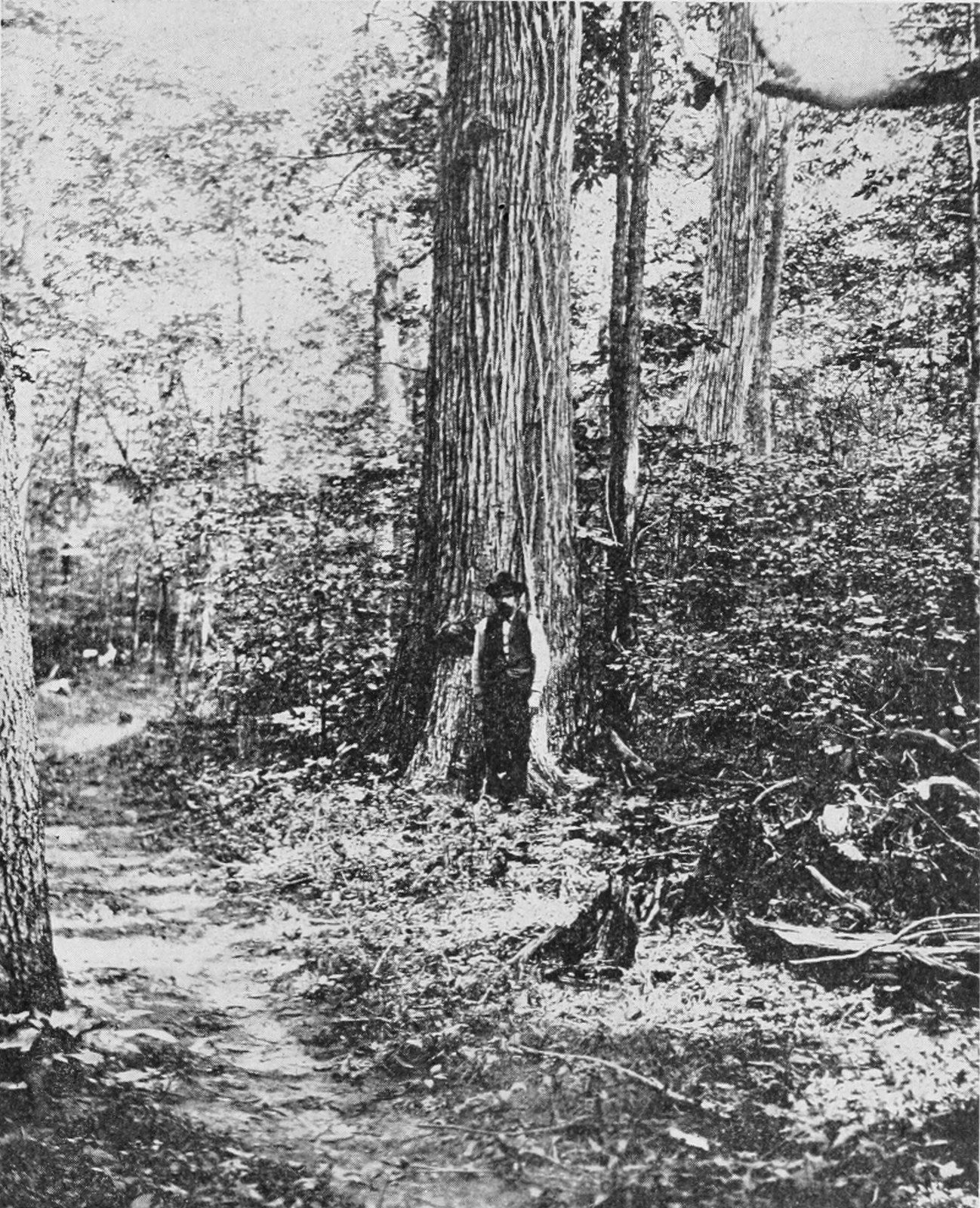
American chestnut
Castanea dentata
Once a canopy dominant of Appalachian forests, now persisting in Marion mostly as understory stump sprouts that resprout from blight-killed root systems. Long, finely toothed leaves; spiny burs around three nuts. Flowering rare in the wild.
Status: Native; functionally extinct as a canopy tree, persisting as sprouts.
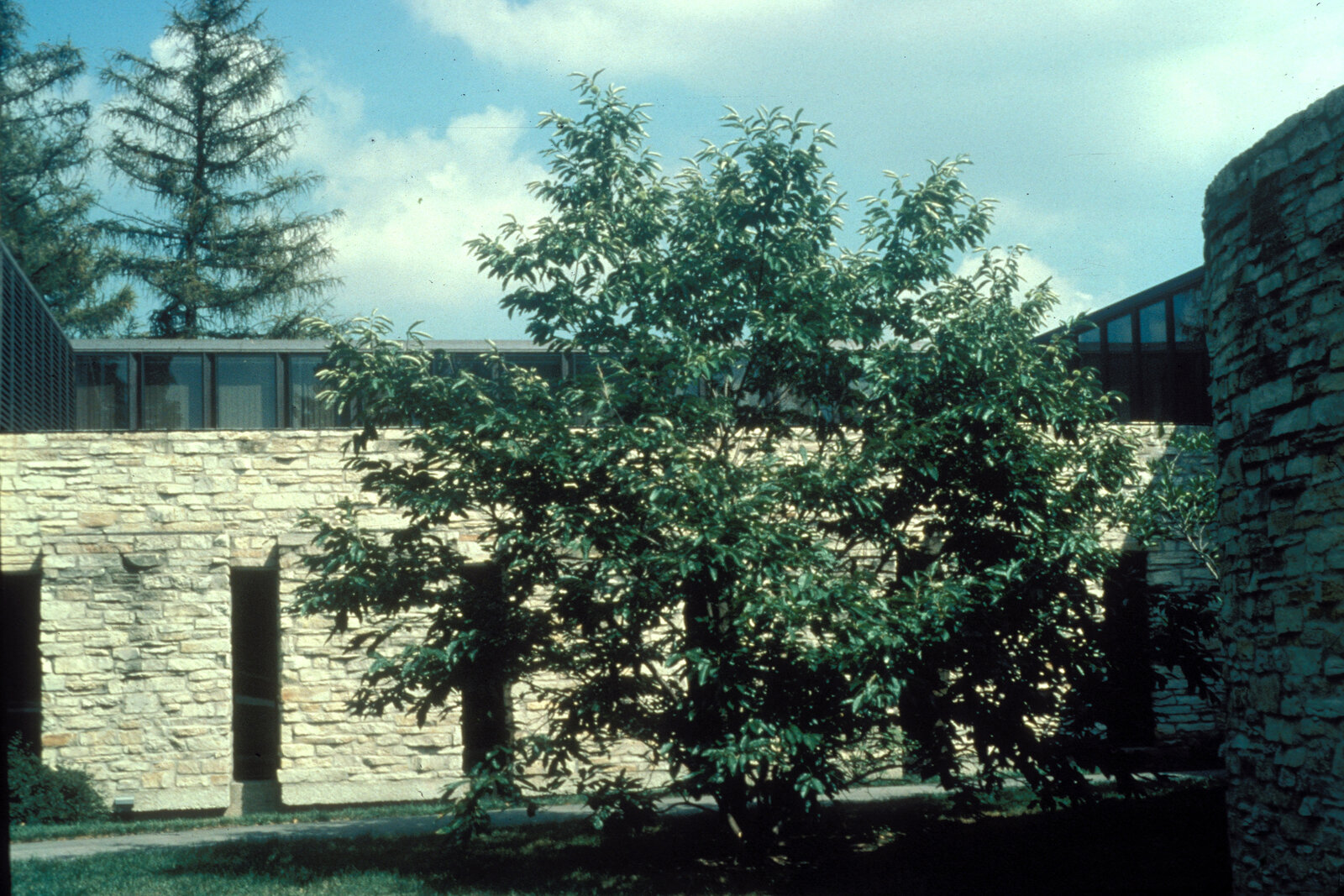
Chinese chestnut
Castanea mollissima
Introduced from East Asia and largely resistant to the blight that destroyed the American chestnut. Planted in Marion as a nut tree and in TACF backcross-breeding programs as the parent species contributing blight resistance to American-form hybrids.
Status: Introduced; planted.
Cove-mesic canopy companions
The sheltered ravines, north-facing slopes, and cove bottoms on the Cumberland Plateau escarpment support one of the richest temperate forest types in North America, a mixed-mesophytic association sometimes called Cumberland Plateau cove plant community. Tulip poplar is the flagship canopy species. Per the Wikipedia article on Liriodendron tulipifera, Tennessee's General Assembly designated tulip poplar the official state tree by Public Chapter 204 of 1947, signed March 14, 1947. American beech and American basswood share the cove canopy and the upper subcanopy with tulip poplar, northern red oak (treated above with the oaks), sugar maple and yellow buckeye (treated below with the maples and buckeyes), and eastern hemlock (treated above with the conifers).
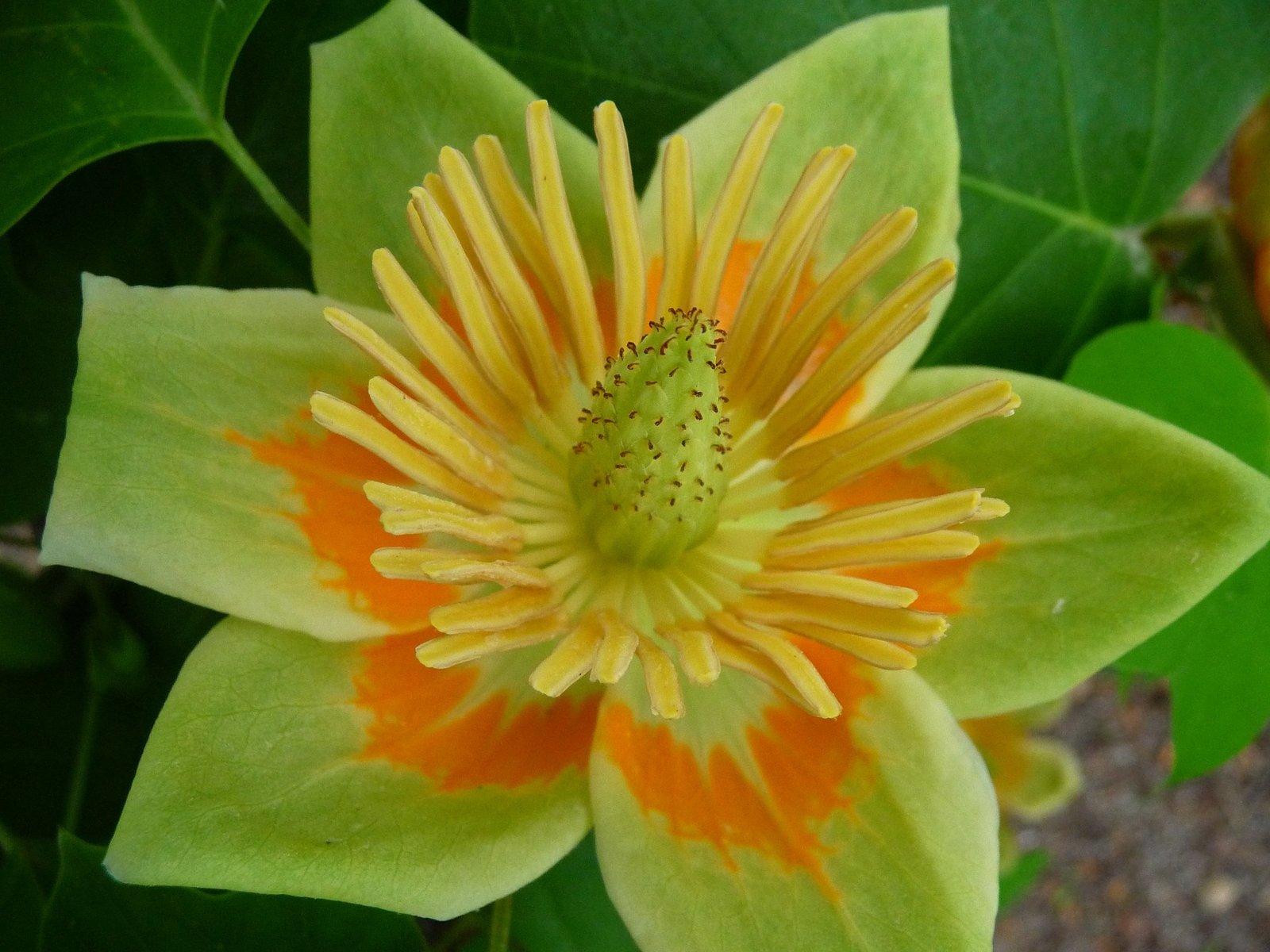
Tulip poplar
Liriodendron tulipifera
Tennessee's state tree. Not a true poplar but a member of the magnolia family. Distinctive four-lobed leaves with a flat or notched tip, and cup-shaped greenish-orange flowers in May. The straight, fast-growing trunk is a cove-canopy dominant.
Status: Native; Tennessee state tree (designated 1947).
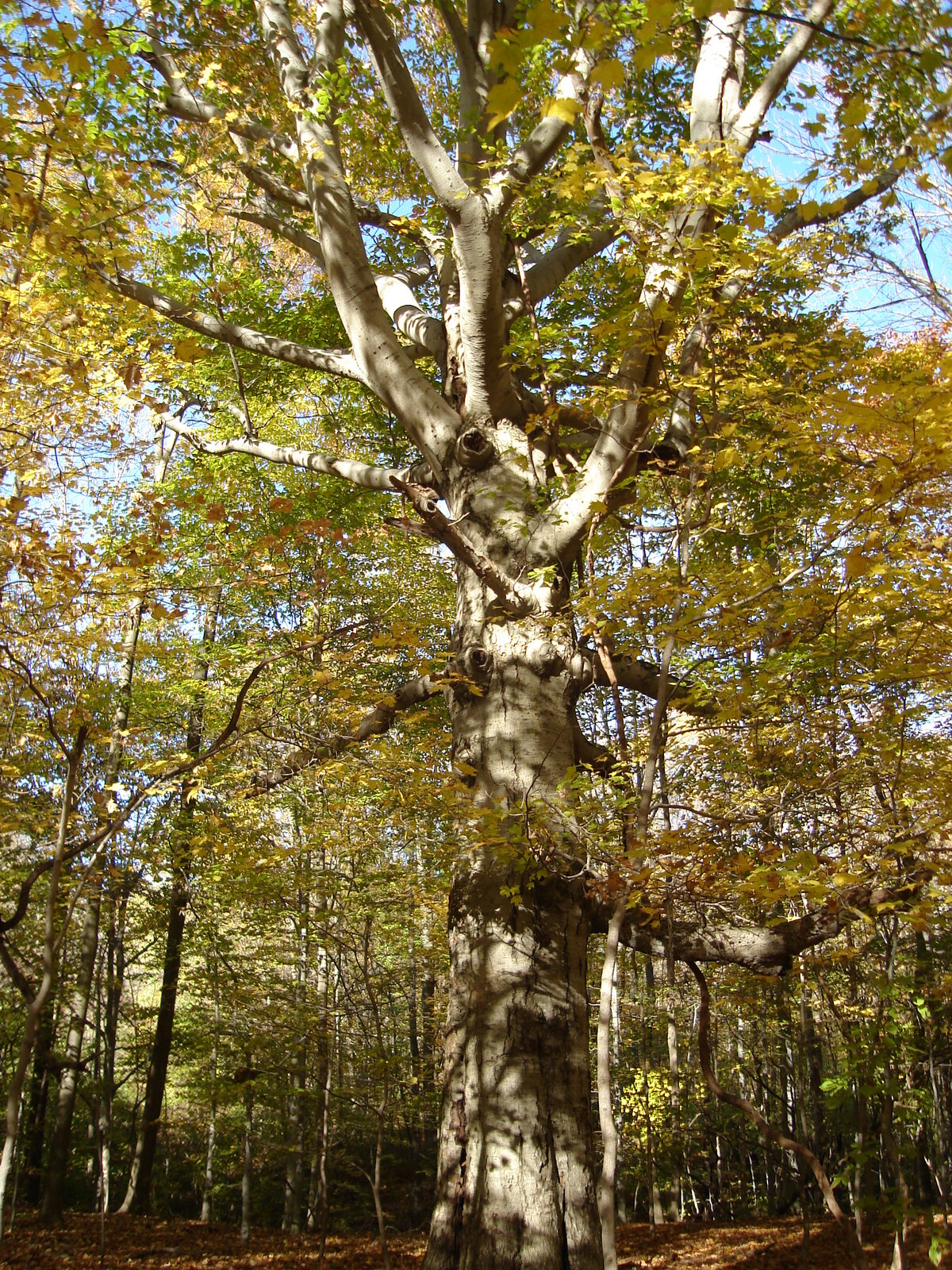
American beech
Fagus grandifolia
Smooth, light gray bark unlike any other tree in the region. Holds bronze-tan dead leaves through winter on younger branches, a useful identification feature in February woods. Cove dominant on rich, well-drained slopes alongside tulip poplar and sugar maple.
Status: Native, common in coves.
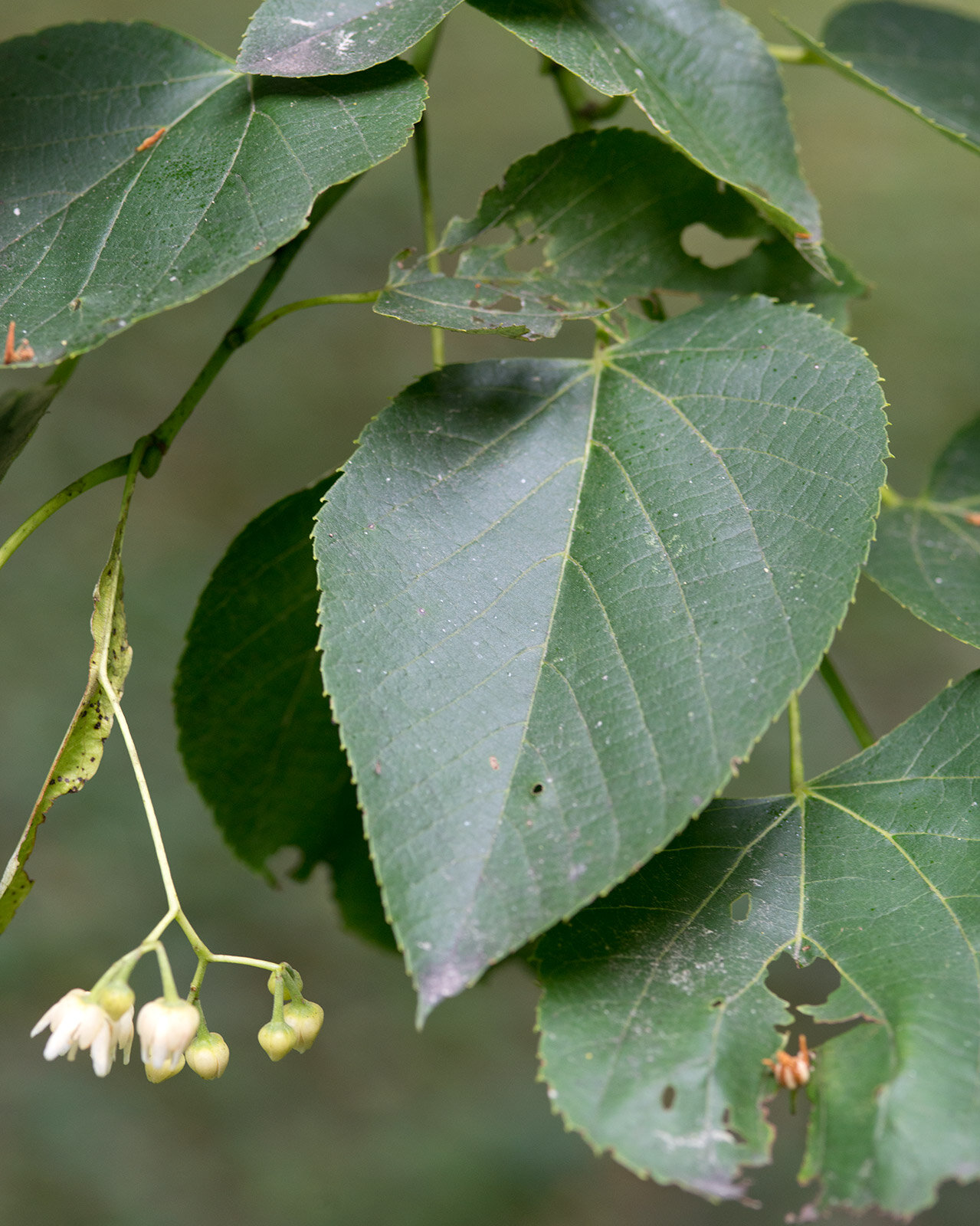
American basswood
Tilia americana
Large, asymmetric heart-shaped leaves, fragrant pale-yellow June flowers, and pea-sized nutlets attached to a leaf-like bract that acts as a parachute when seeds fall. A signature honey tree; basswood honey is mild and pale.
Status: Native.
Maples and buckeyes
The maples split sharply by habitat. Sugar maple is a cove canopy species and pairs naturally with tulip poplar, beech, and northern red oak on rich slopes; its brilliant orange-red fall color is the signature autumn signal of cove forest. Red maple is the most abundant maple county-wide, ubiquitous from plateau ridges to floodplains. Silver maple sits in floodplains. Boxelder is the bottomland anomaly: a maple with compound leaves rather than the lobed simple leaves of its relatives. Striped maple is a small, cool-climate cove understory tree at the southern edge of its range. The buckeyes, in the same family (Sapindaceae), include yellow buckeye as the showy cove canopy species and red and painted buckeye as small understory trees.
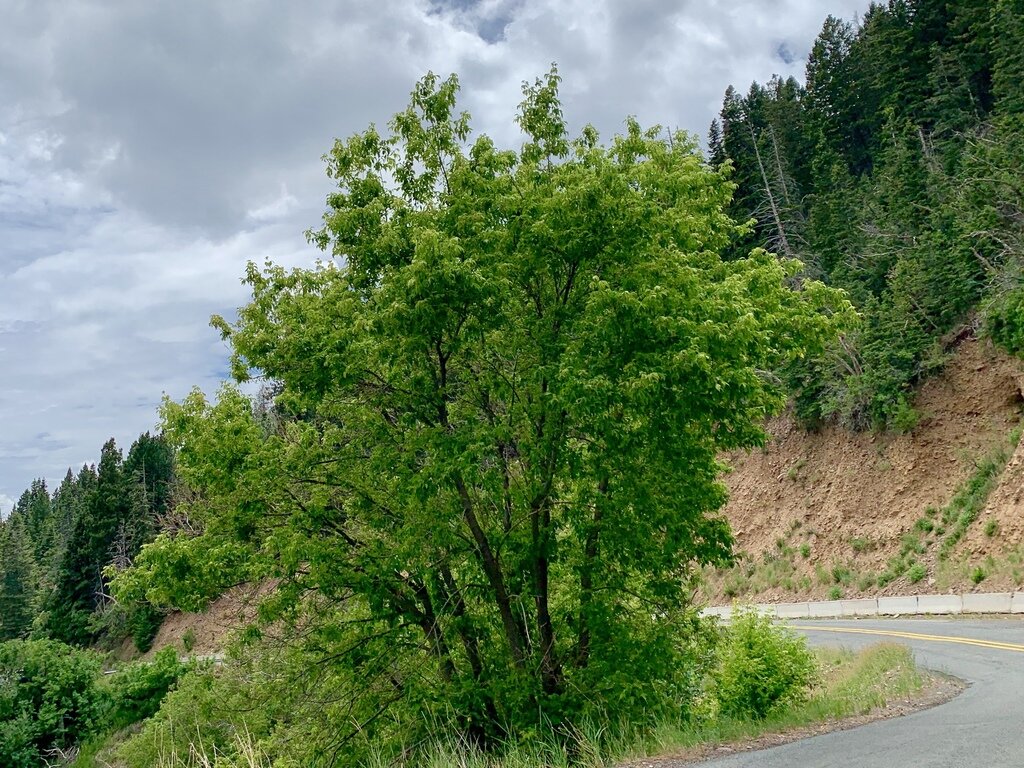
Boxelder
Acer negundo
The maple with compound leaves: three to seven leaflets, looking more like a young ash than a maple. Paired samaras (winged seeds) are diagnostic. A pioneer of disturbed bottomlands and streambanks.
Status: Native.
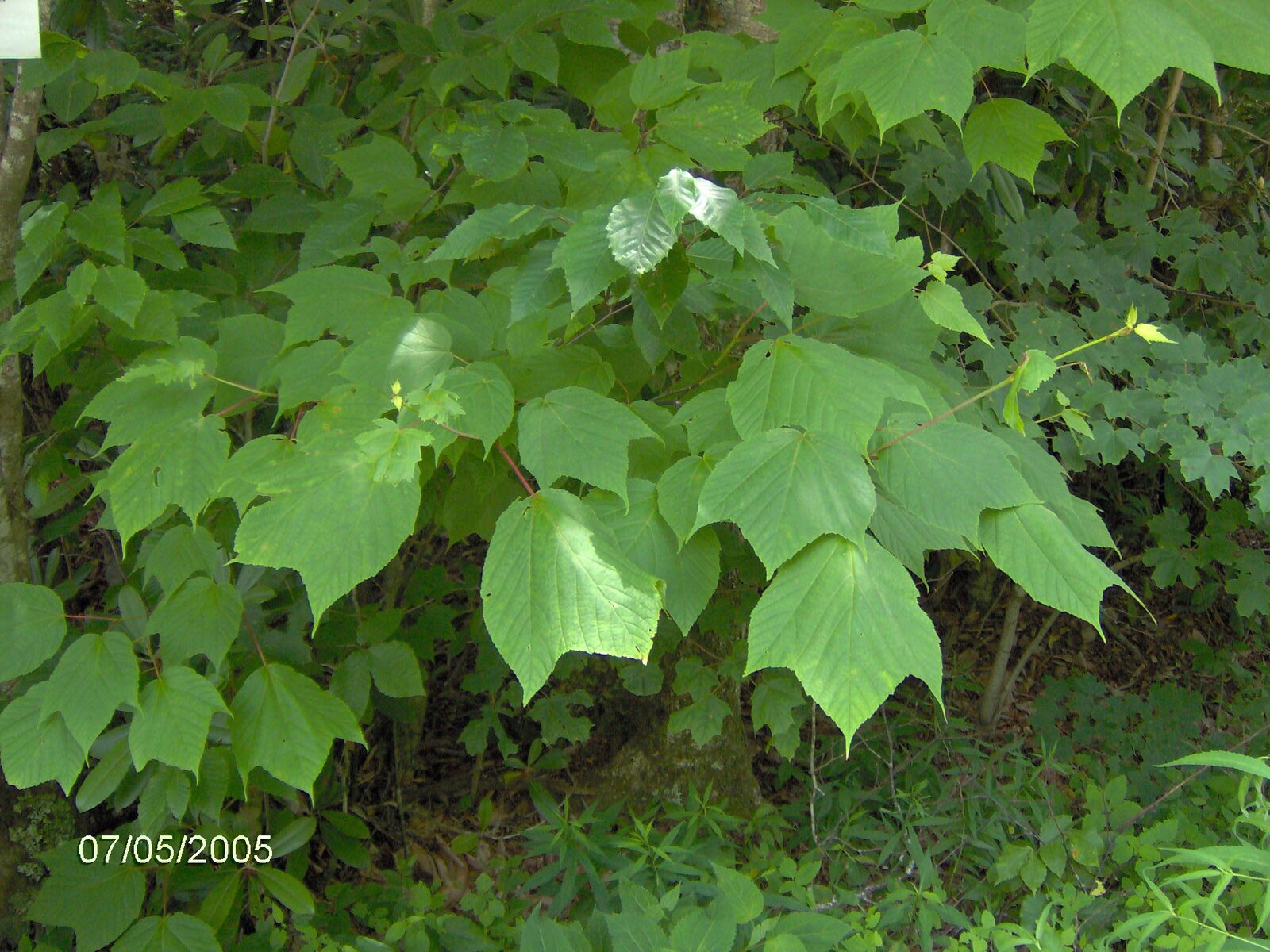
Striped maple
Acer pensylvanicum
Sometimes called moosewood. Smooth green bark with vertical white stripes is unmistakable on younger trunks. A small cool-climate cove understory tree at the southern edge of its range in the southern Cumberland Plateau.
Status: Native; locally distinctive.
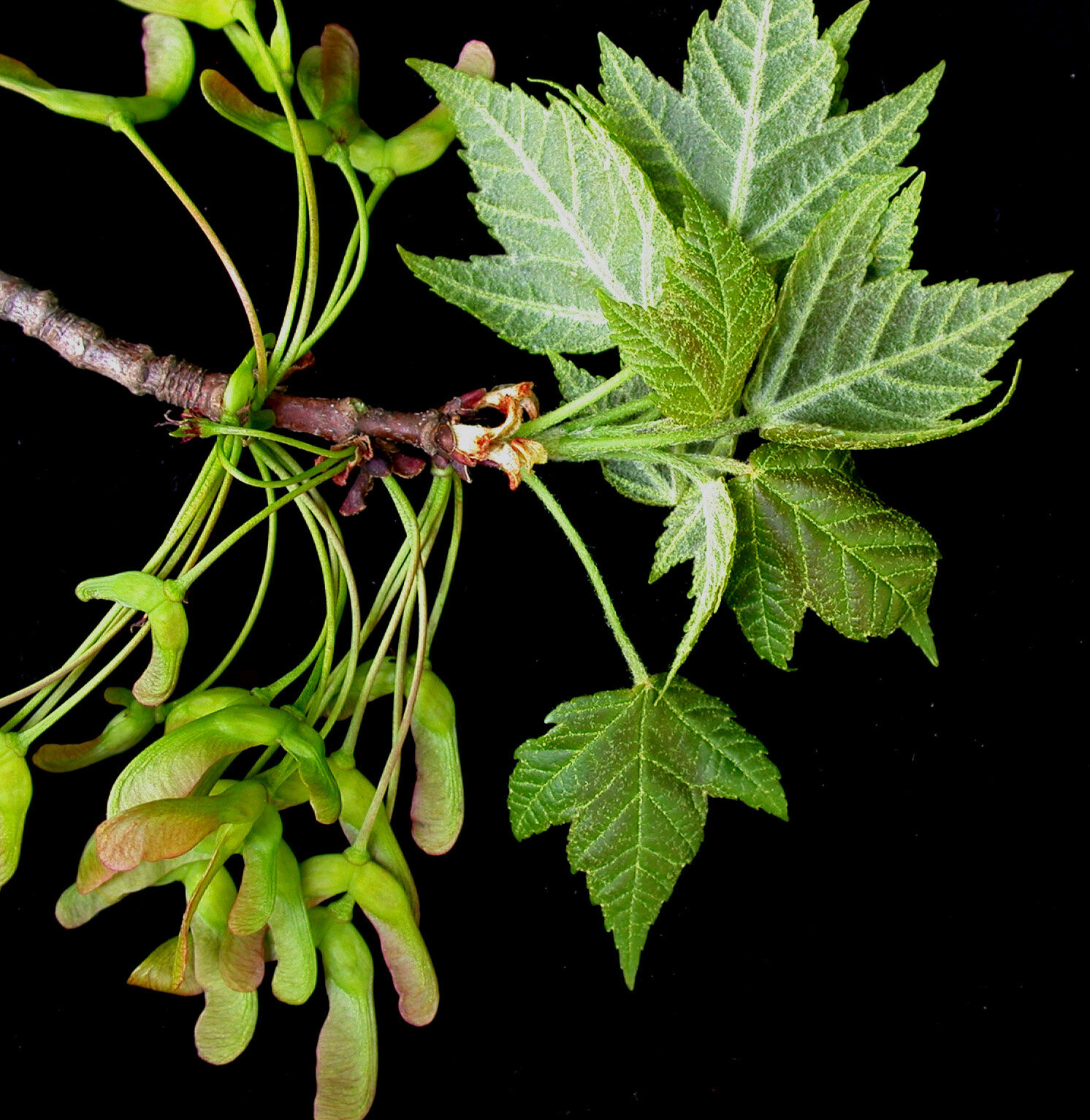
Red maple
Acer rubrum
The most abundant maple in Marion County, occurring from plateau ridges to floodplains. Three-lobed leaves with serrated margins and small clusters of red flowers in late winter, often the earliest sign of approaching spring on bare branches.
Status: Native, abundant.
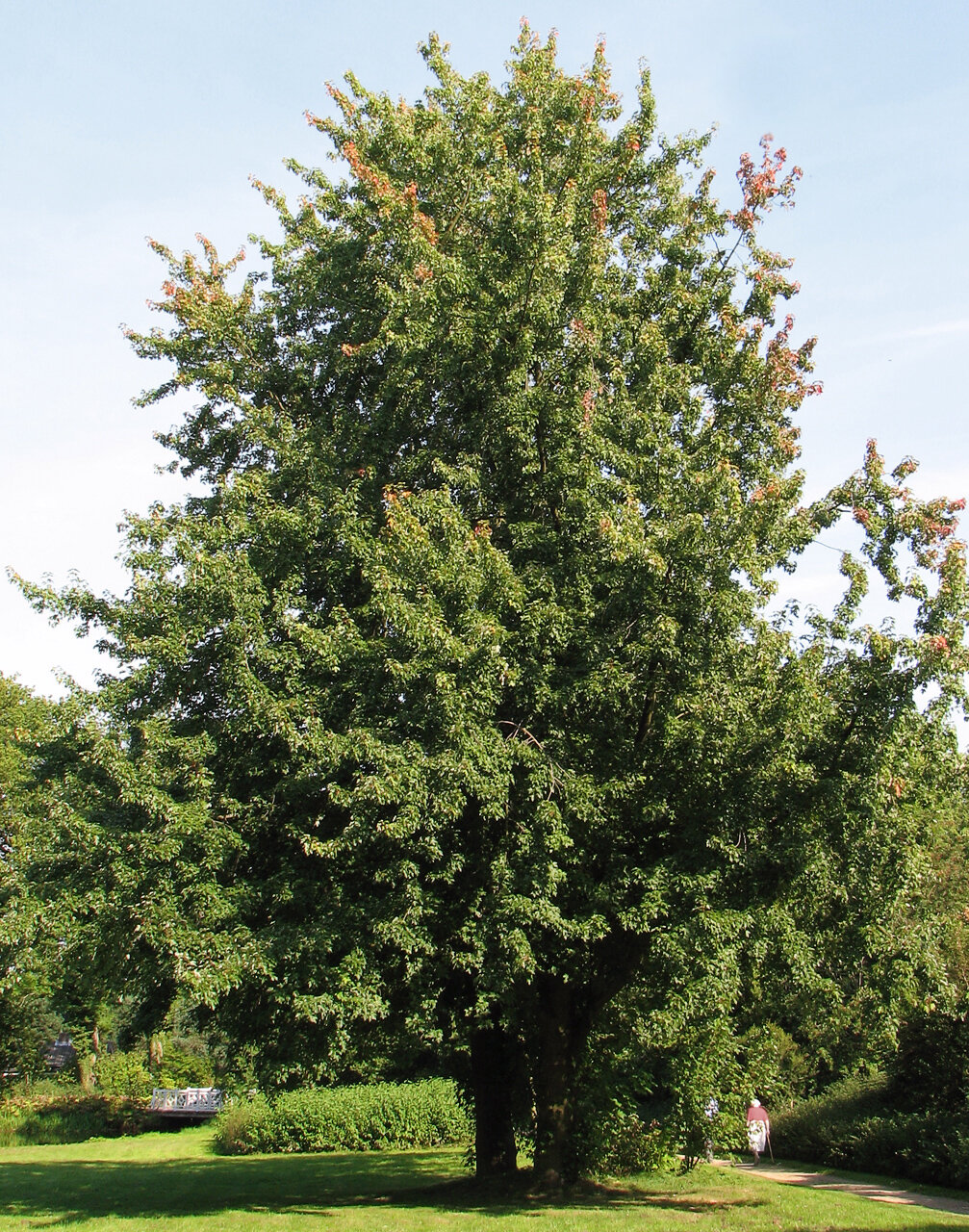
Silver maple
Acer saccharinum
Floodplain species along the Sequatchie and Tennessee Rivers. Deeply cut, jagged leaves silvery-white below; trees flash in the wind. Brittle wood; large branches break in storms.
Status: Native.
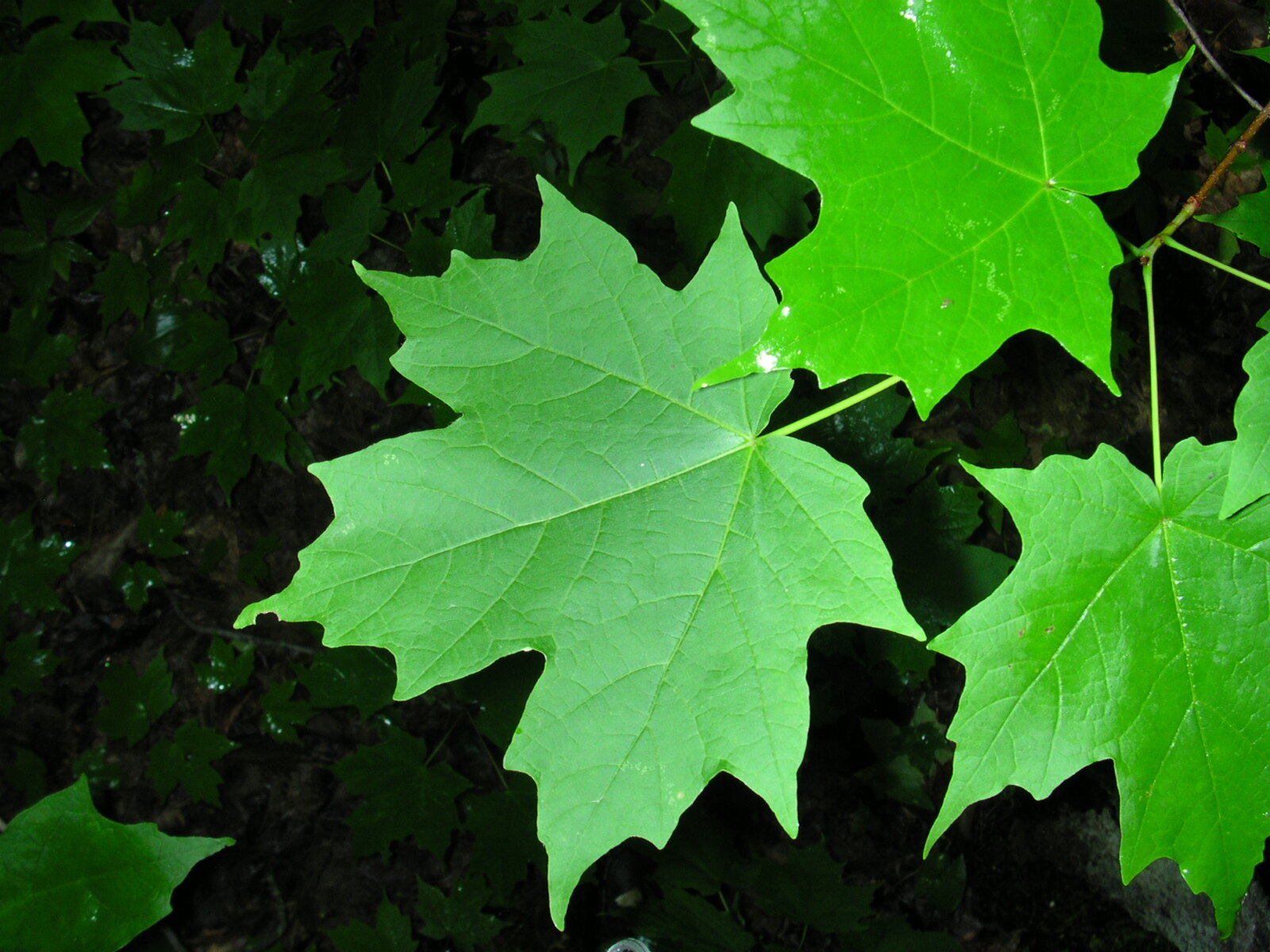
Sugar maple
Acer saccharum
The signature cove canopy maple, paired with tulip poplar, beech, and northern red oak on rich, well-drained slopes. Five-lobed leaves with smooth-edged sinuses; brilliant orange-red autumn color. The traditional source of maple syrup, though commercial sugaring is uncommon this far south.
Status: Native, common in coves.
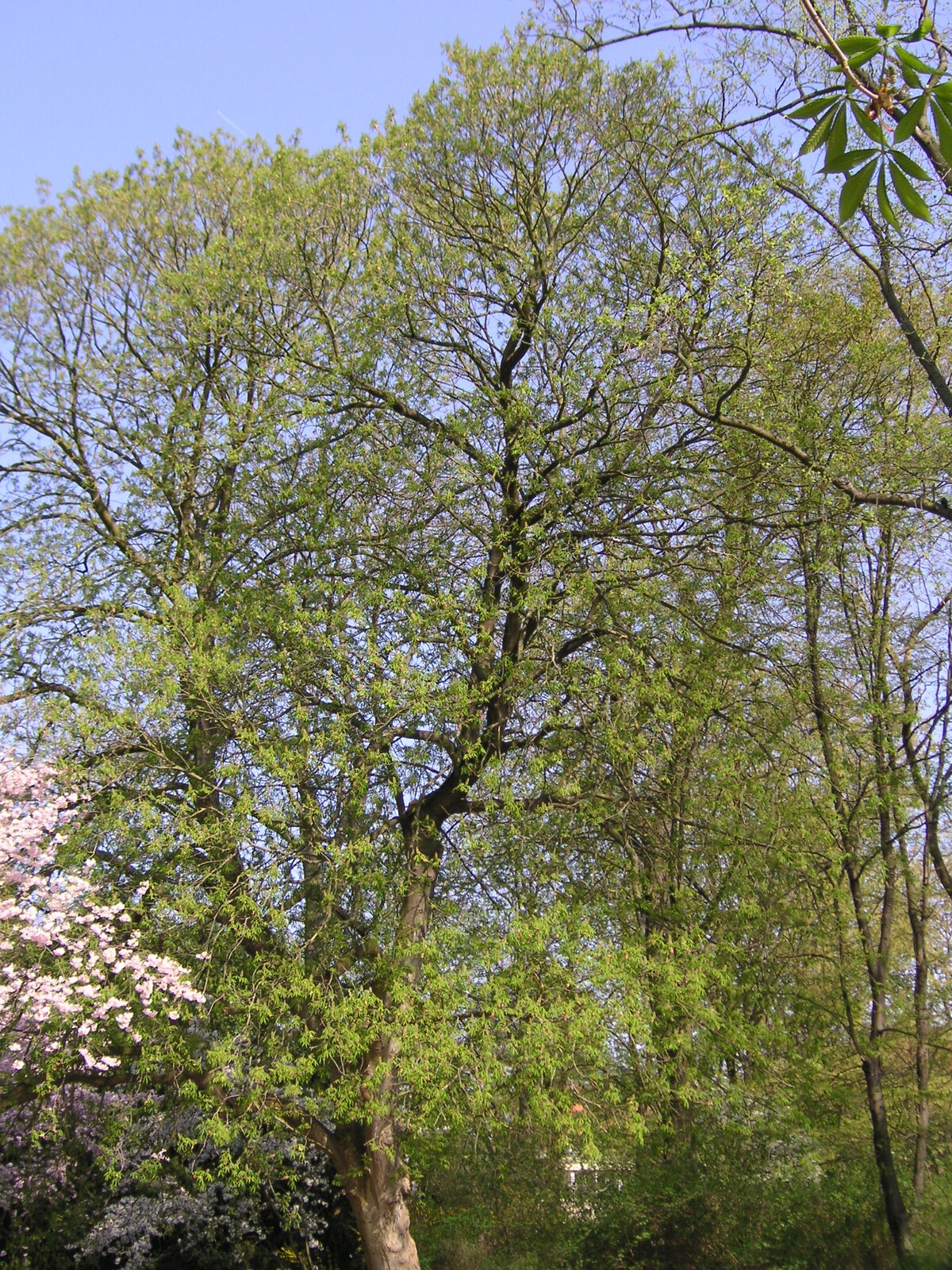
Yellow buckeye
Aesculus flava
The largest buckeye in eastern North America. Palmately compound leaves with five leaflets, pale yellow upright flower clusters in May, and large smooth seeds in pear-shaped capsules. A cove understory and lower-canopy tree on the richest sites.
Status: Native.
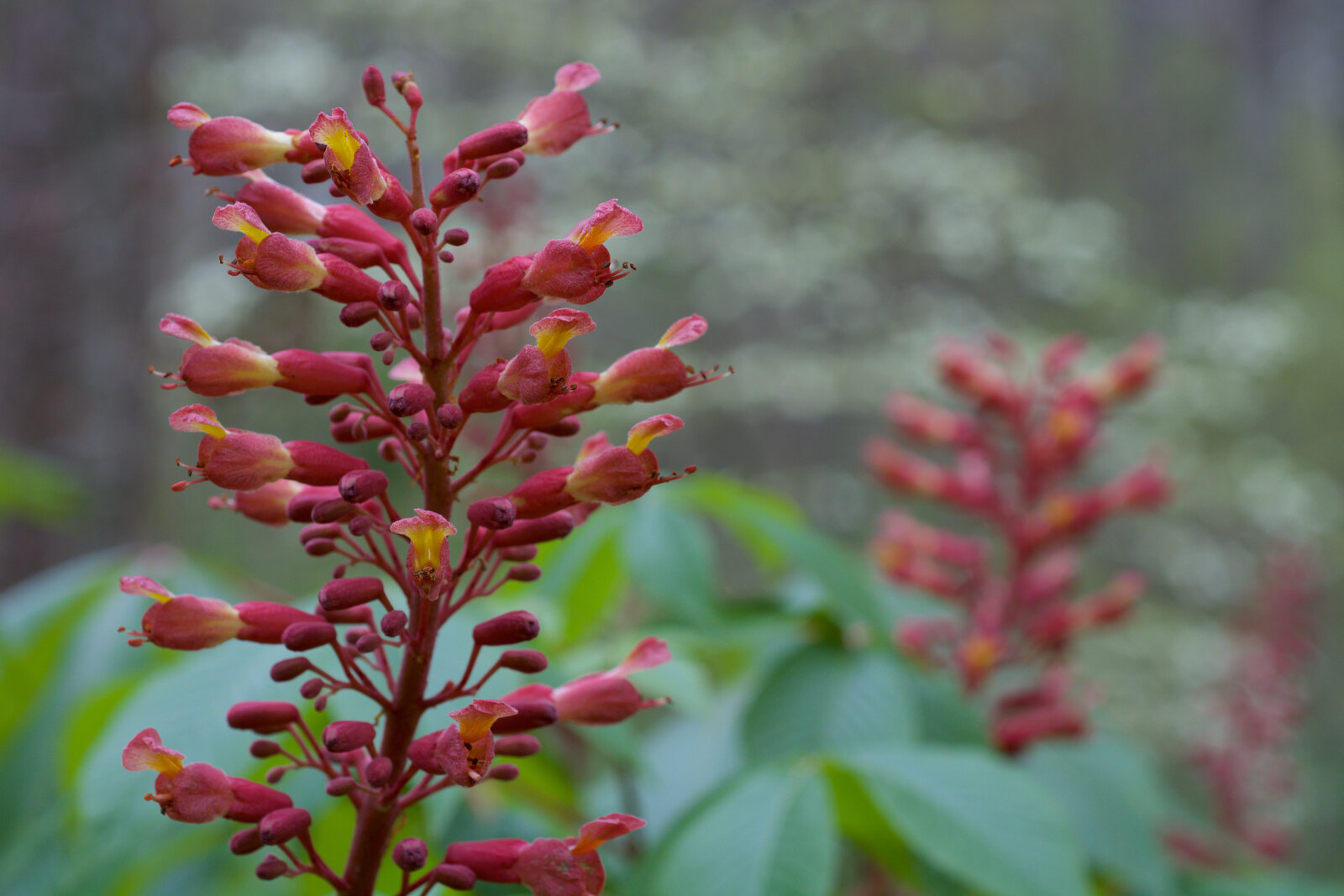
Red buckeye
Aesculus pavia
A small understory tree or large shrub. Bright red tubular flowers in upright clusters in April and May, pollinated by ruby-throated hummingbirds returning from migration. Scattered on rich slopes and along streams.
Status: Native.
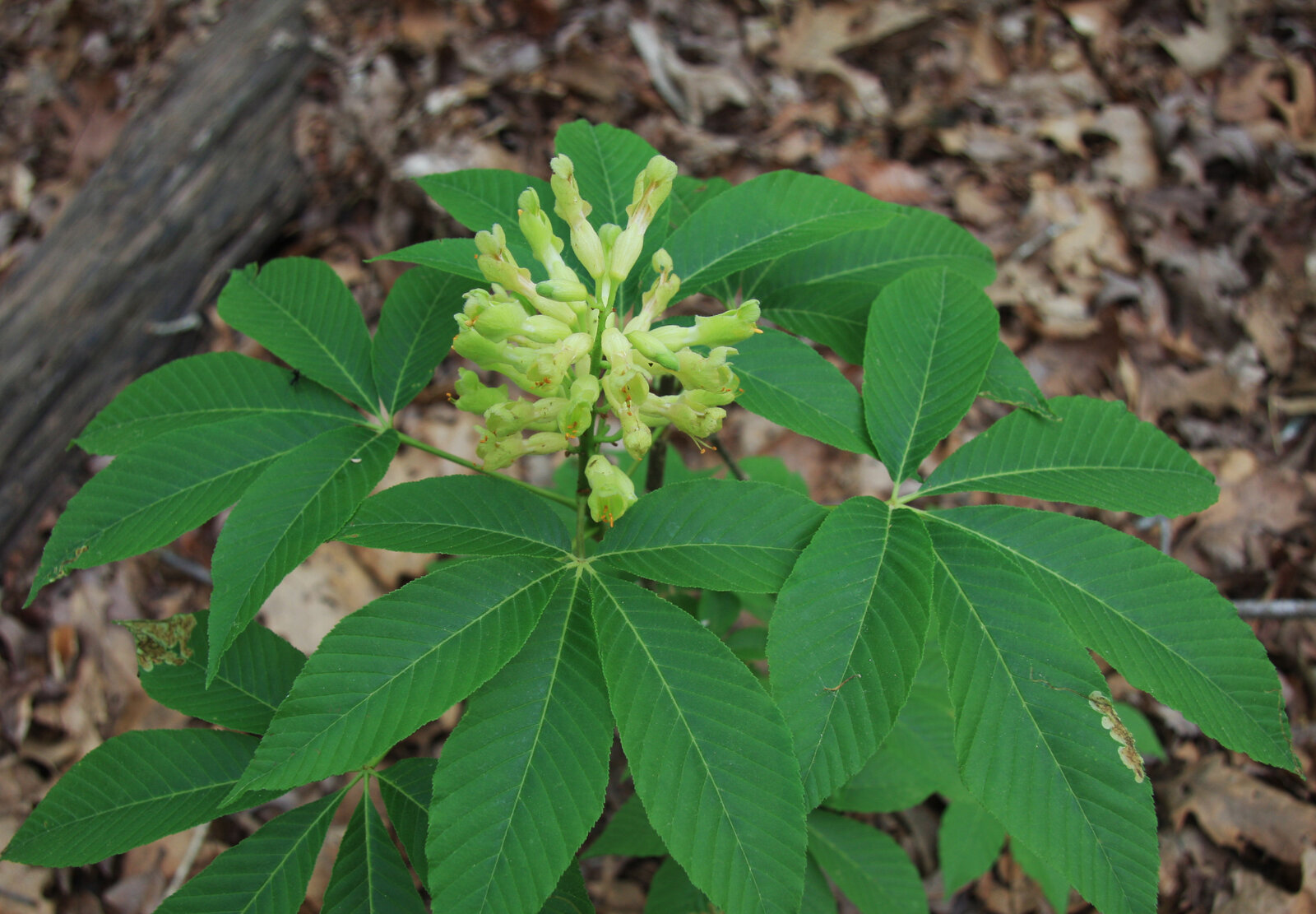
Painted buckeye
Aesculus sylvatica
A small understory buckeye with pale yellow to pinkish flowers, intermediate in color between yellow and red buckeye. Found on slopes and ravines.
Status: Native.
Magnolias and other notable broadleaves
Marion's coves and lower slopes hold three native deciduous magnolias: cucumber magnolia is a canopy tree with greenish flowers; bigleaf magnolia has the largest simple leaves and largest flowers of any North American temperate tree; and umbrella magnolia has whorled leaves clustered at the branch tips that look like umbrellas. Southern magnolia, the evergreen species with large white flowers, is native to the Gulf Coastal Plain rather than Marion's plateau and gorge; locally it appears as a planted and sometimes naturalized yard tree. Sweetgum, blackgum, and water tupelo are grouped here for shared traits as broadleaf canopy or subcanopy trees with brilliant fall color.
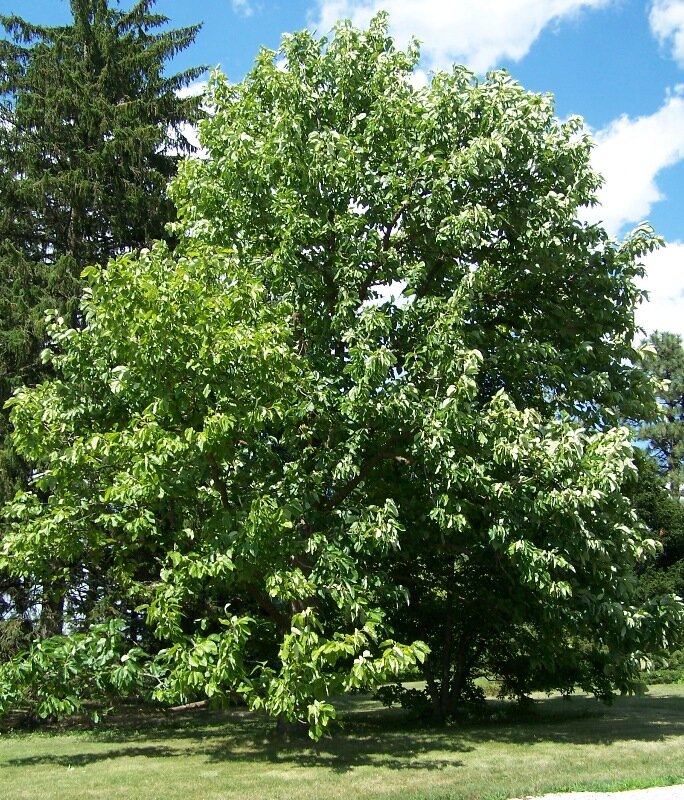
Cucumber magnolia
Magnolia acuminata
The cove canopy magnolia. Large smooth-edged leaves and inconspicuous greenish-yellow flowers in late spring. The young fruit looks like a small cucumber, hence the name; ripe fruits release red seeds dangling on threads.
Status: Native.
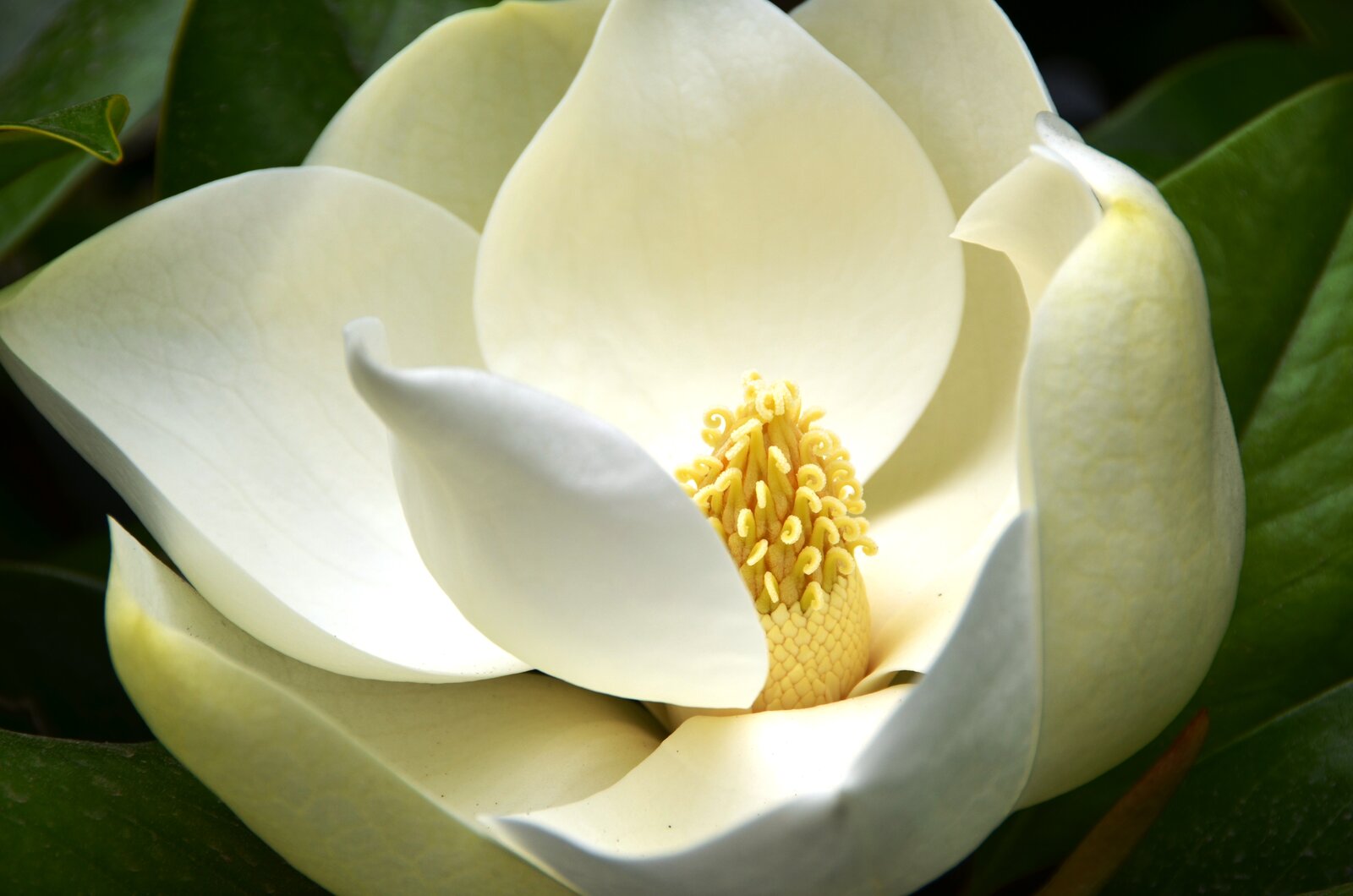
Southern magnolia
Magnolia grandiflora
An evergreen magnolia with thick leathery leaves, glossy dark green above and rusty-felted below, and large fragrant white flowers in late spring. Native to the Gulf Coastal Plain; in Marion the species appears as a planted yard and cemetery tree, occasionally naturalized.
Status: Native to the Deep South; planted and sometimes naturalized in Marion.
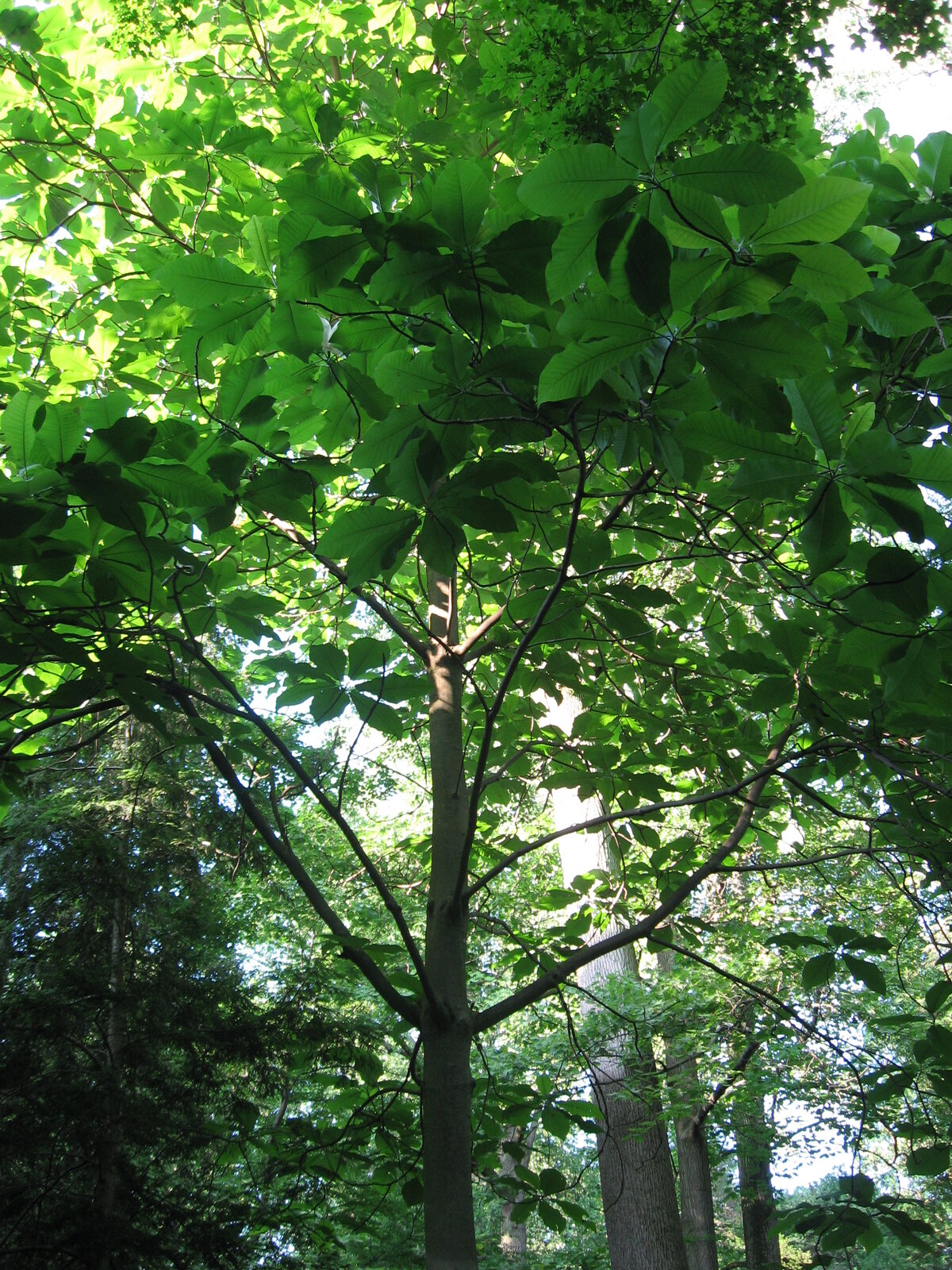
Bigleaf magnolia
Magnolia macrophylla
Largest simple leaves of any temperate North American tree, often two to three feet long, with pale undersides and ear-like lobes at the base. Flowers are correspondingly large, white with purple markings at the petal bases. A cove understory and small canopy tree.
Status: Native; locally distinctive.
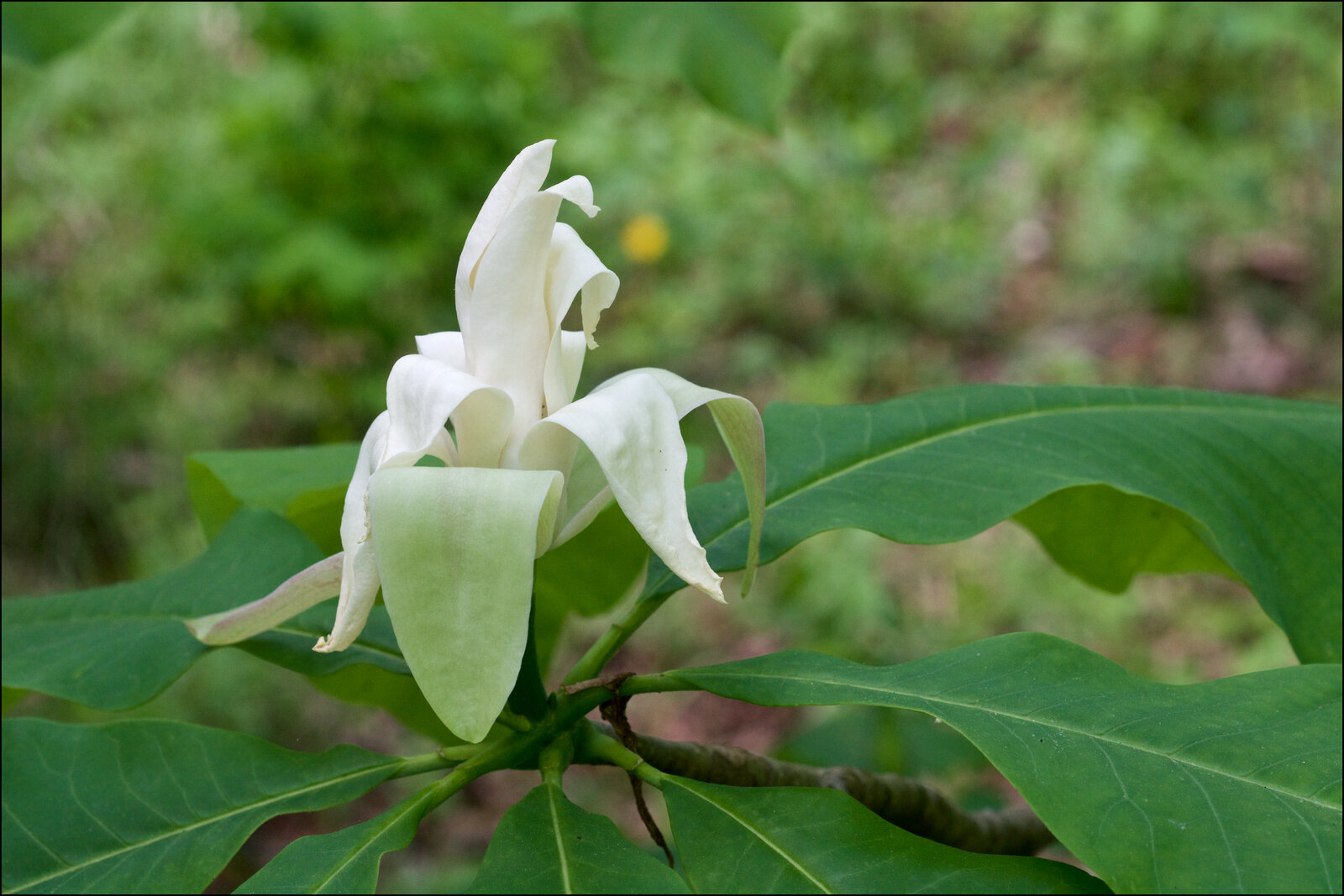
Umbrella magnolia
Magnolia tripetala
Large simple leaves whorled at the branch tips give the species its common name. Flowers are creamy white and lightly fragrant, sometimes described as ill-smelling at close range. A cove understory tree of moist slopes.
Status: Native.
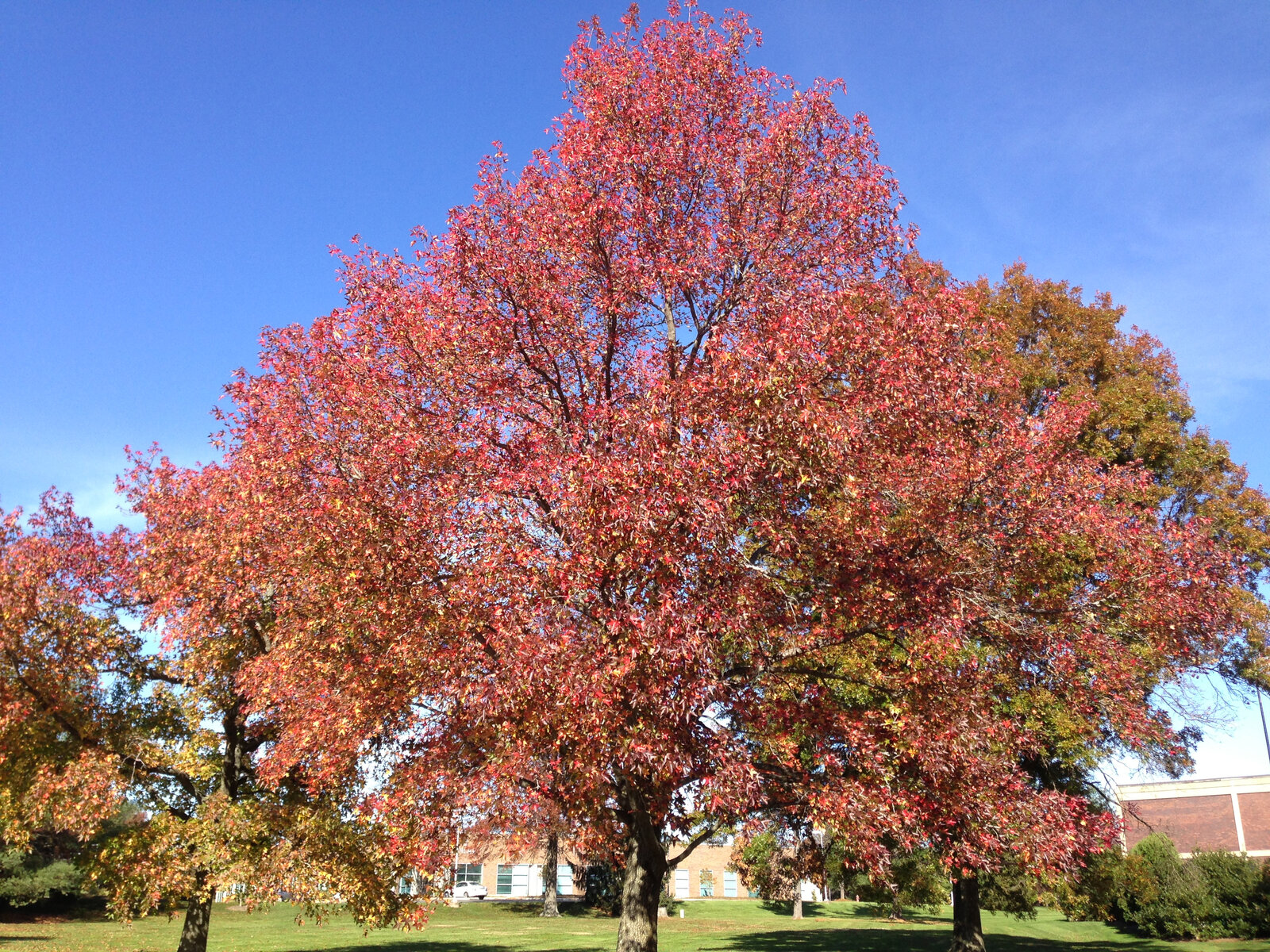
Sweetgum
Liquidambar styraciflua
Star-shaped, five-lobed leaves and spiky woody seed balls (gumballs) that persist through winter. Brilliant red, orange, and purple autumn color, often on the same tree. Common on bottomlands and disturbed sites.
Status: Native, common.
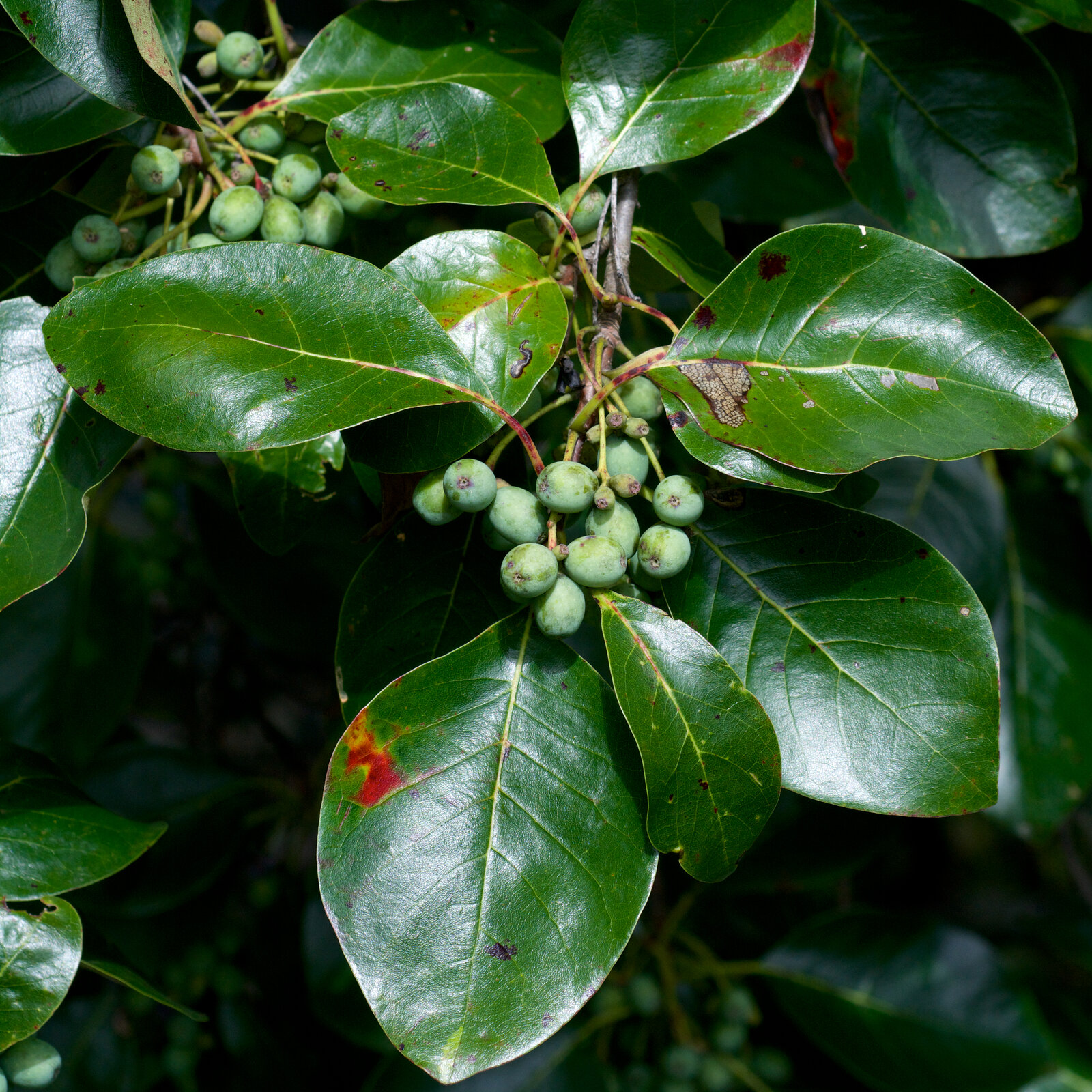
Blackgum
Nyssa sylvatica
Also called black tupelo. Glossy oval leaves that turn brilliant scarlet in early fall, often the first tree to color in late September. Small dark blue drupes are eaten by birds. Branches grow at right angles to the trunk.
Status: Native, common.
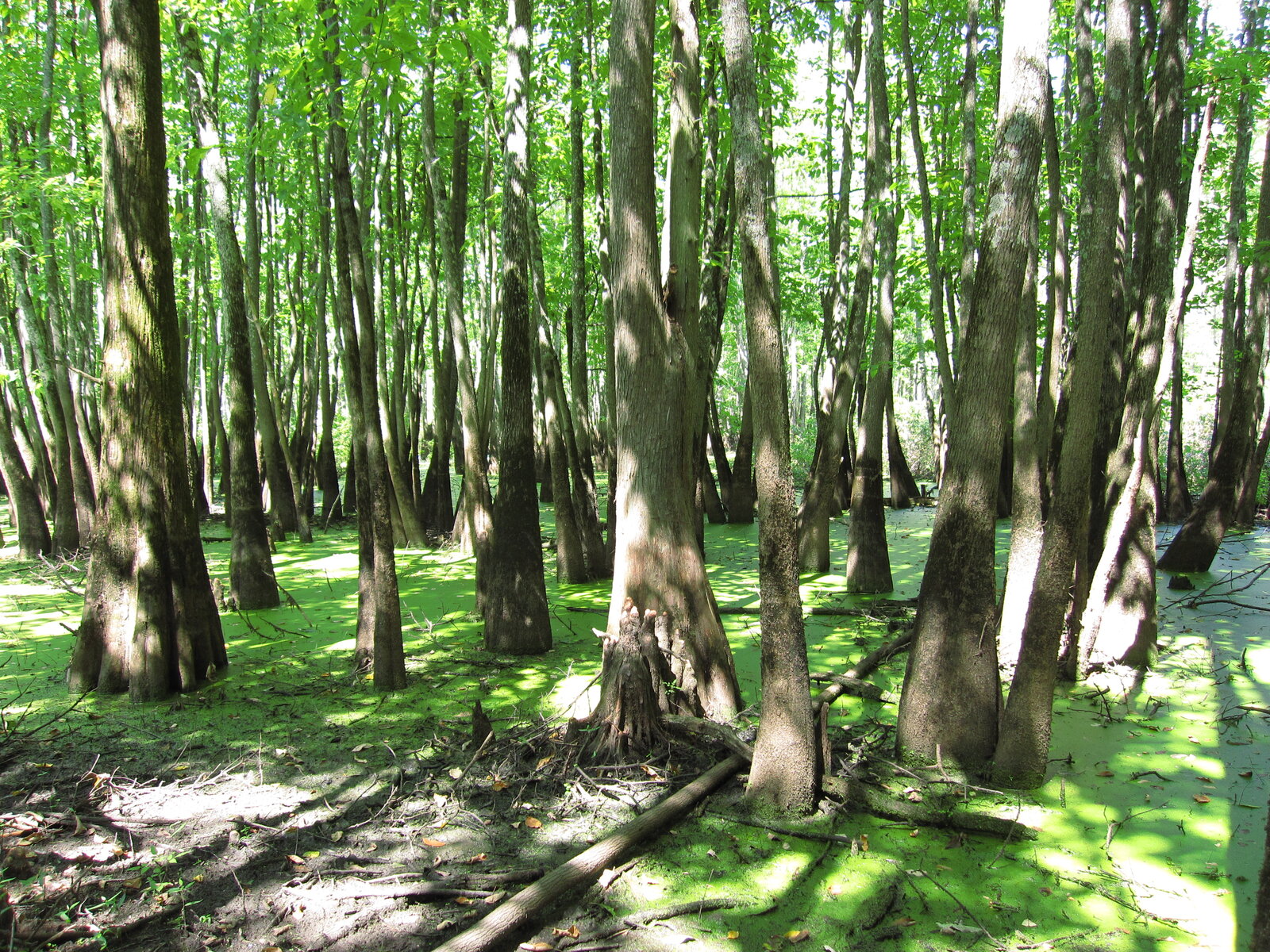
Water tupelo
Nyssa aquatica
A wet-bottomland tupelo with a swollen, buttressed base. Larger leaves and larger fruits than blackgum. Reaches the northern edge of its range in lower Tennessee; in Marion mostly in slack-water sloughs along the Tennessee River.
Status: Native; uncommon north of the Tennessee River.
Riparian and bottomland trees
Along the Sequatchie River, Battle Creek, the Little Sequatchie, and the small streams that drop off the plateau into the Tennessee River Gorge, a riparian forest of sycamore, river birch, black willow, silver maple, and eastern cottonwood lines the banks. American sycamore is the showcase species, with bark that peels in camouflage plates of white, cream, and pale green; large trees are easy to pick out from a distance on a winter ridgeline. The largest hardwood diameter in the eastern United States belongs to this tree. River birch has exfoliating salmon-pink bark; sweet birch is a cooler-slope species more often found on cove edges and rocky stream banks than on muddy lowlands, with twigs that smell strongly of wintergreen when broken. (Silver maple is treated above with the maples.)
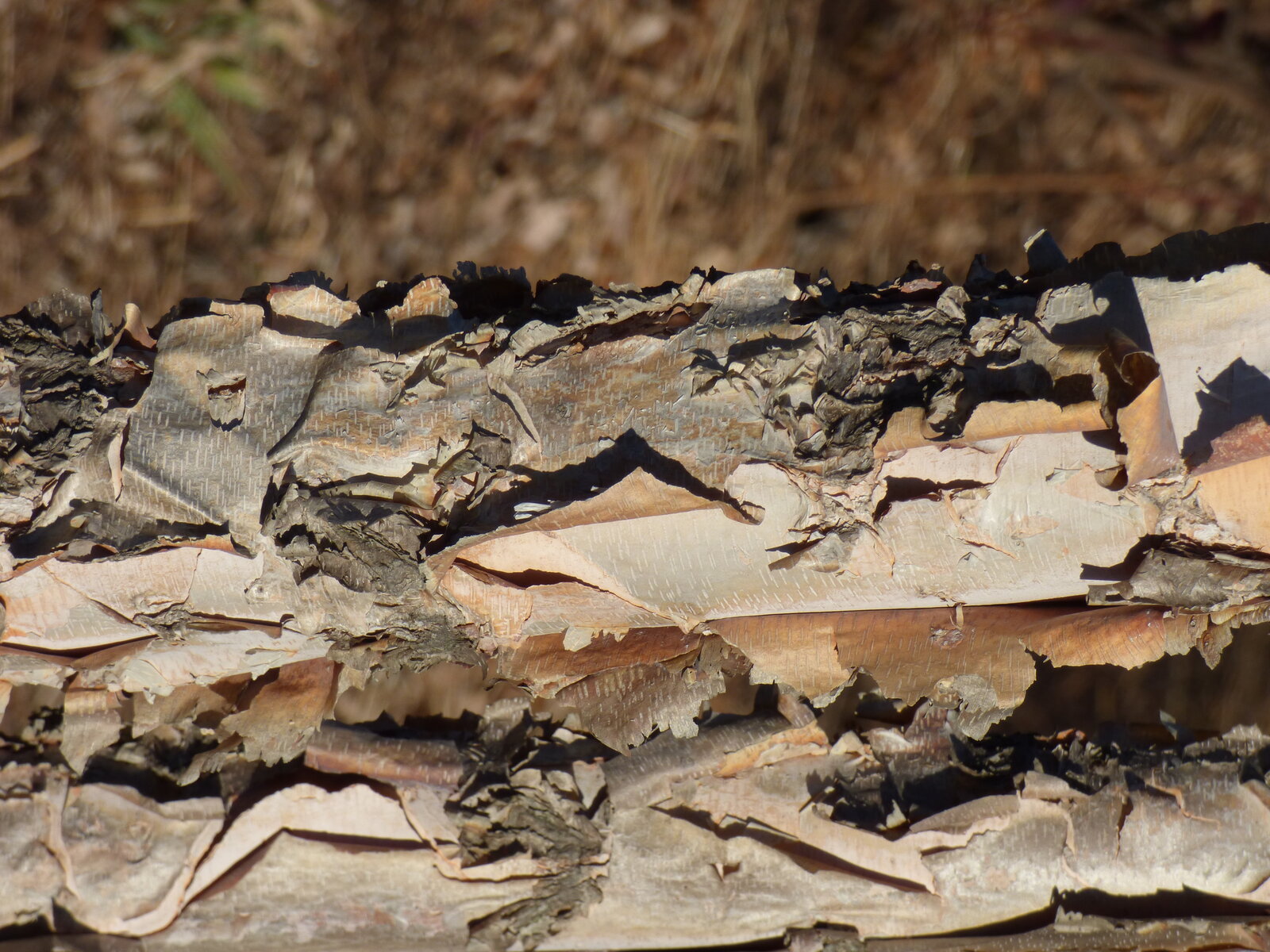
River birch
Betula nigra
Salmon-pink, exfoliating bark in papery curls is diagnostic on younger trunks. Triangular, doubly serrate leaves. The most heat-tolerant North American birch and a common streambank species along the Sequatchie River and lower-elevation creeks.
Status: Native, common.
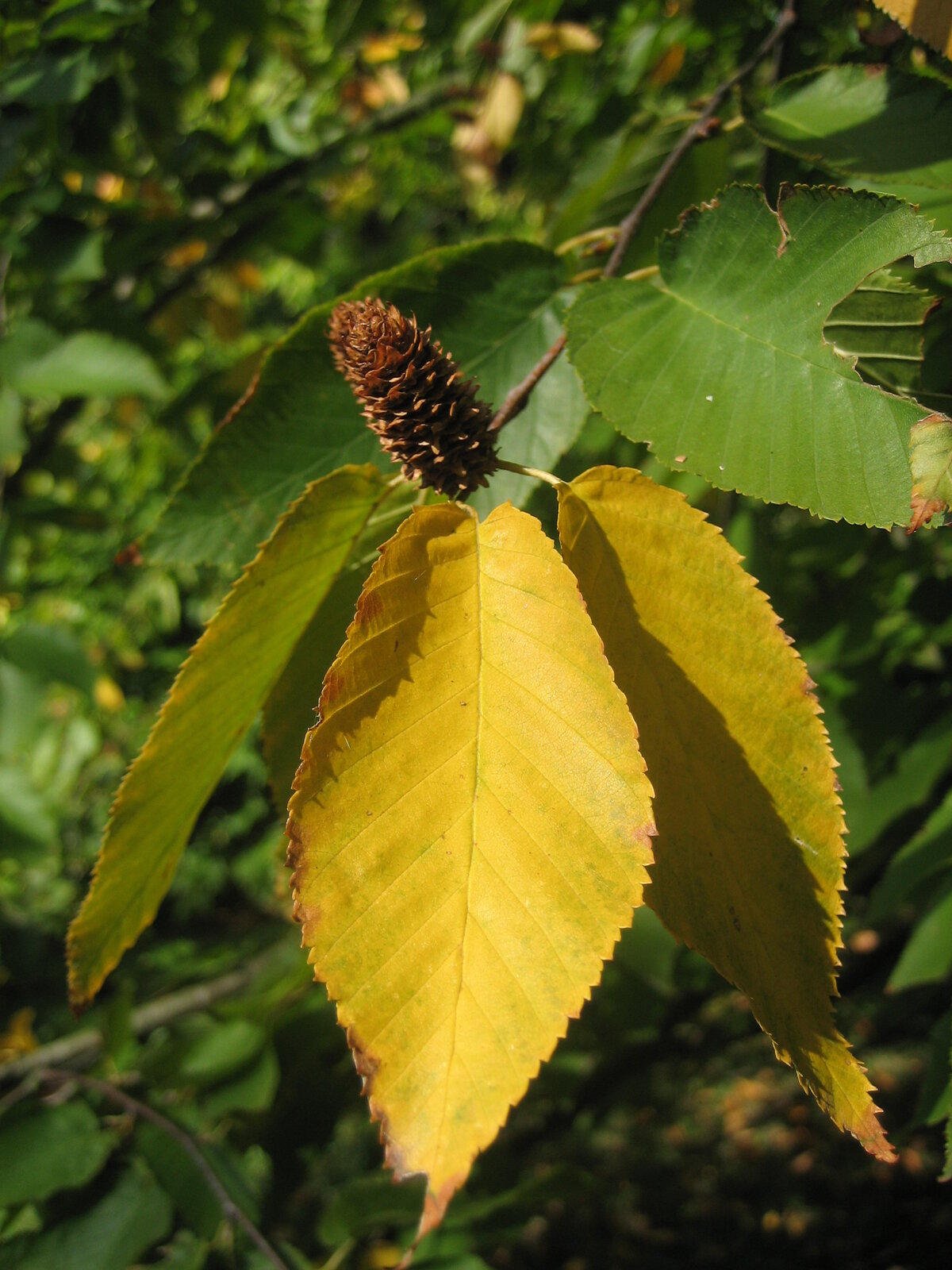
Sweet birch
Betula lenta
Also called black birch or cherry birch. Dark, cherry-like bark on younger trunks; on older trees the bark develops irregular plates. Twigs and inner bark smell strongly of wintergreen when broken. A cool-slope and rocky-stream species rather than a muddy-lowland one.
Status: Native.
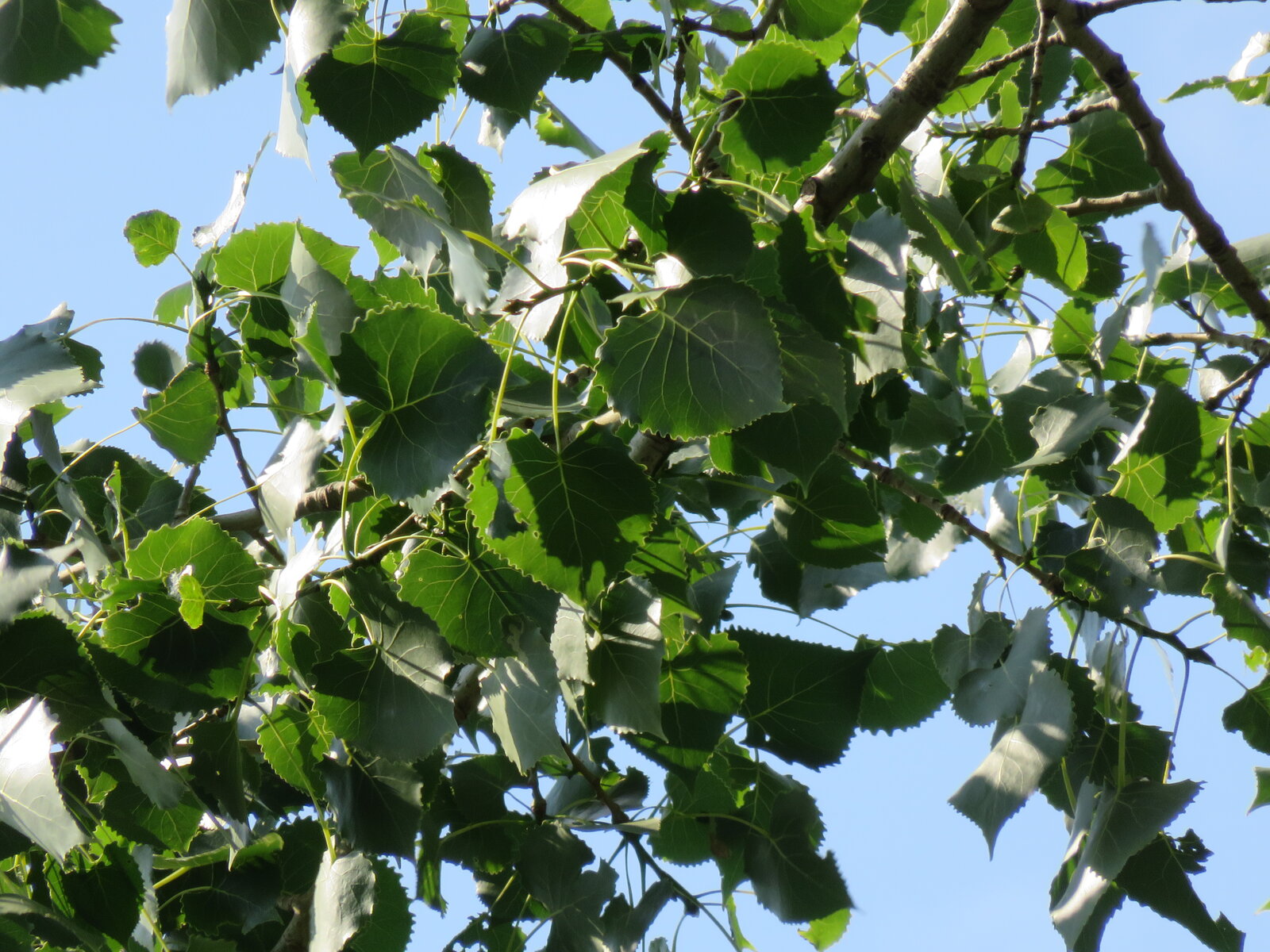
Eastern cottonwood
Populus deltoides
A floodplain pioneer with triangular toothed leaves on flattened stalks that flutter in the slightest wind. Female trees release cottony seeds in late spring. One of the fastest-growing eastern hardwoods.
Status: Native.
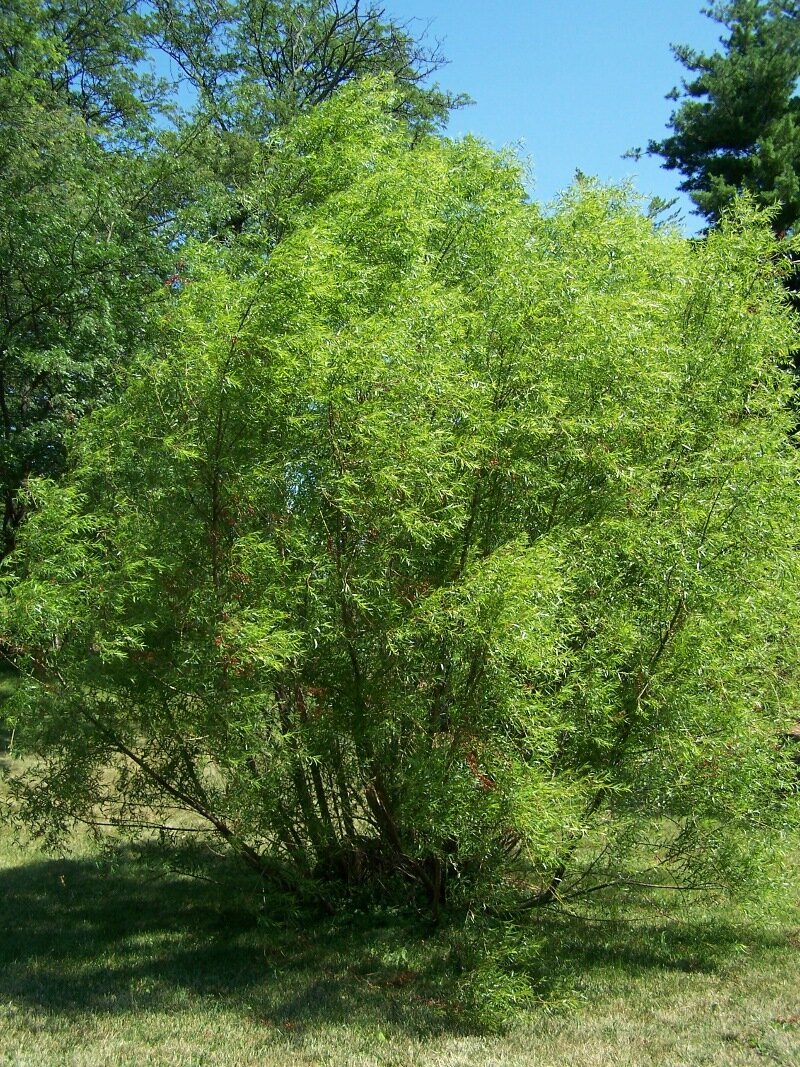
Black willow
Salix nigra
The largest native willow in eastern North America. Narrow lance-shaped leaves and dark, deeply furrowed bark. Fibrous roots stabilize streambanks; common on the Sequatchie River and lower Battle Creek.
Status: Native, common.
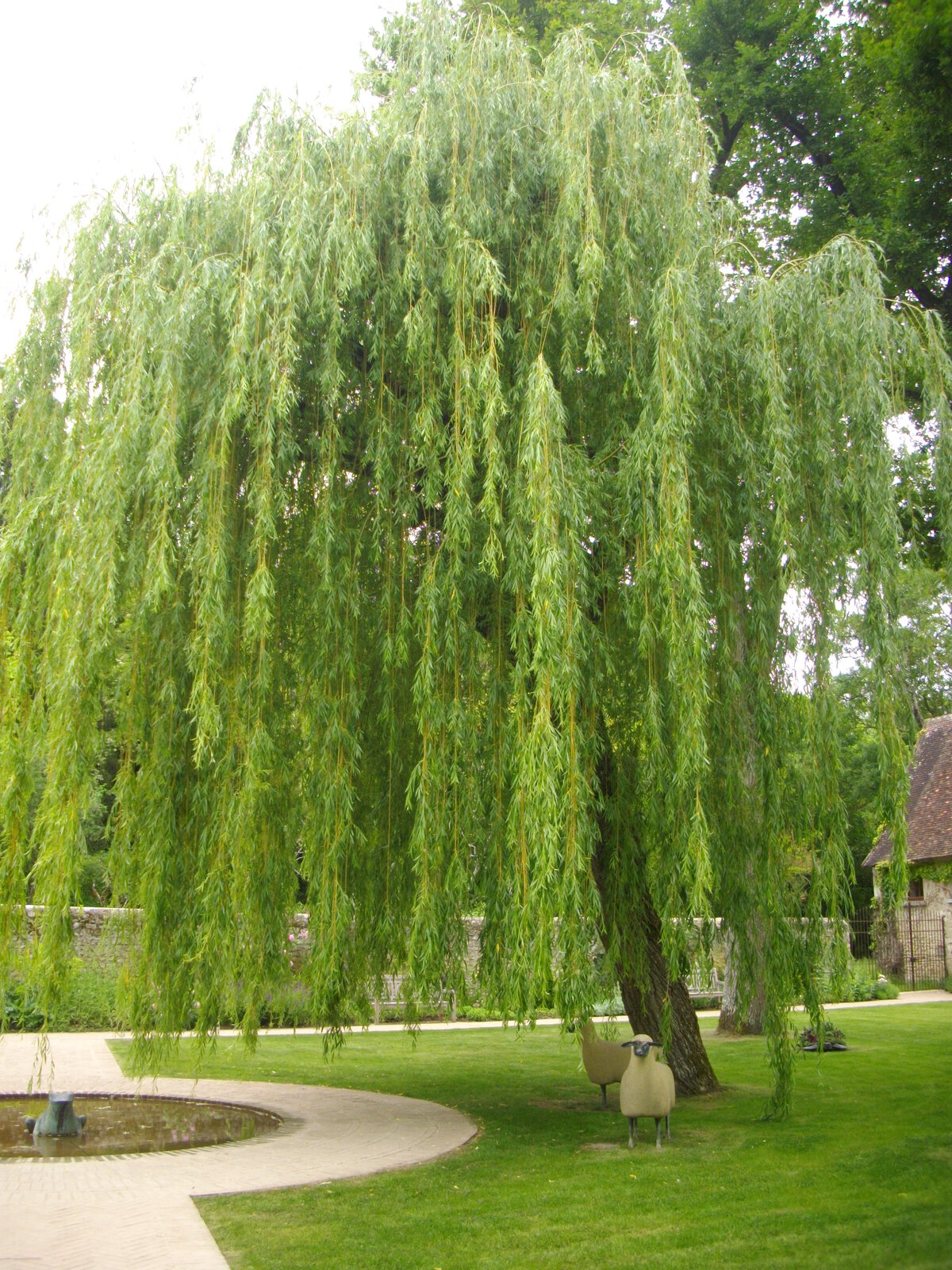
Weeping willow
Salix babylonica
An ornamental willow native to Asia, planted at ponds and yards across Marion. Long pendulous branches reach the ground. Not native to Marion's riparian system; sometimes naturalizes near plantings but does not displace the native black willow.
Status: Introduced; planted.
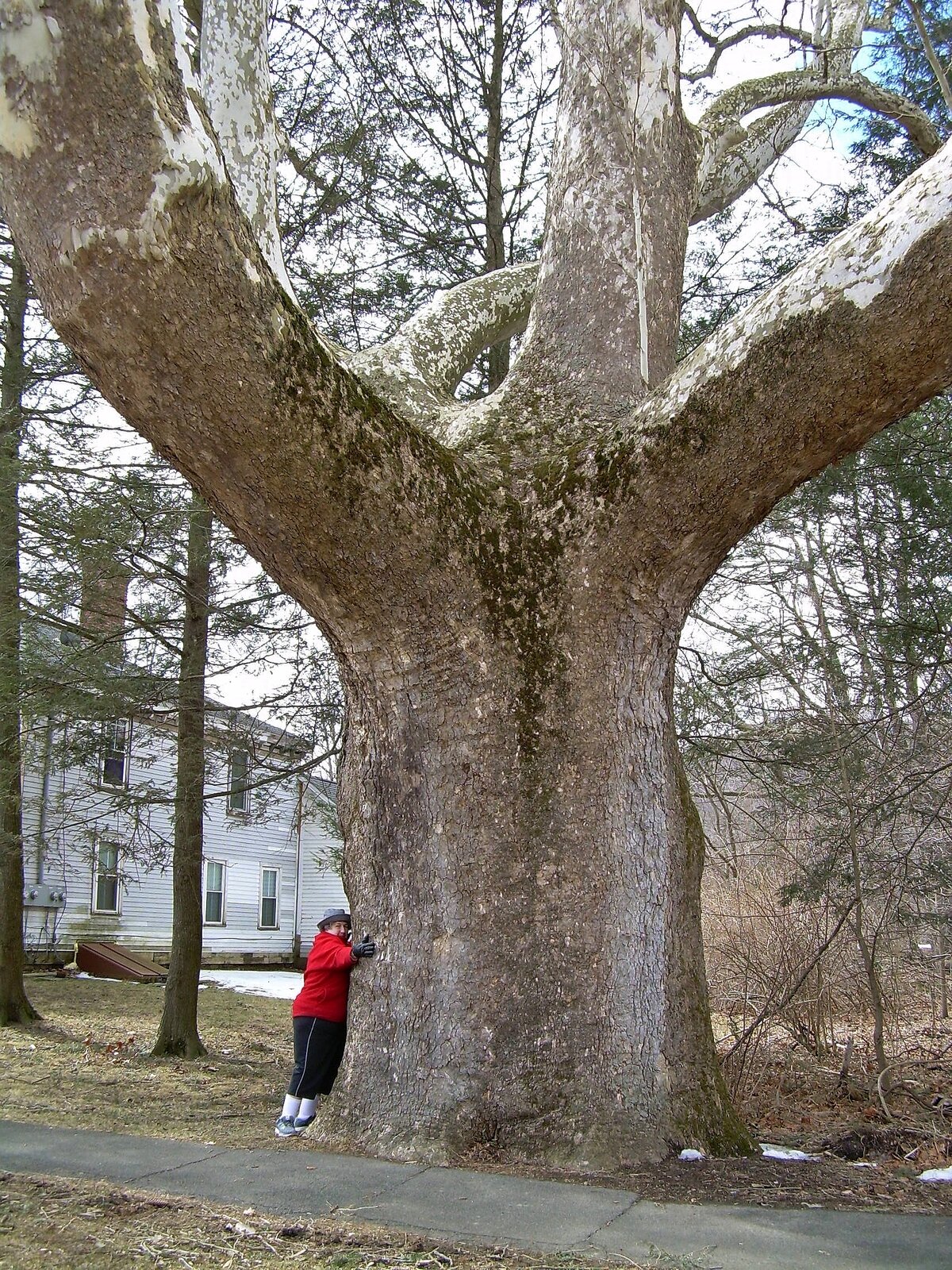
American sycamore
Platanus occidentalis
Bark peels in camouflage plates of white, cream, and pale green, making large trees easy to pick out from a winter ridgeline. Largest hardwood diameter of any tree in the eastern United States. Lines the Sequatchie River and tributaries throughout Marion County.
Status: Native, common.
Understory flowering trees
The understory of Marion's mid-elevation forests is layered with small flowering trees: the spring-blooming dogwoods and redbud, three native serviceberries, the muscle-trunked hornbeam and shreddy-barked ironwood, a cluster of native and orchard-escape plums and cherries, the famously difficult Crataegus hawthorns, four hollies (one evergreen and three deciduous), and a long tail of small-tree species that don't fit elsewhere.
Dogwoods and redbud
In April, the dogwood-and-redbud bloom overlap paints whole hillsides pink and white for about two weeks across the plateau and Sequatchie Valley. Flowering dogwood is the more familiar species; stiff dogwood is its smaller, swamp-edge cousin. Eastern redbud is the legume of the trio, leafless when its pink pea-flowers open along bare branches.
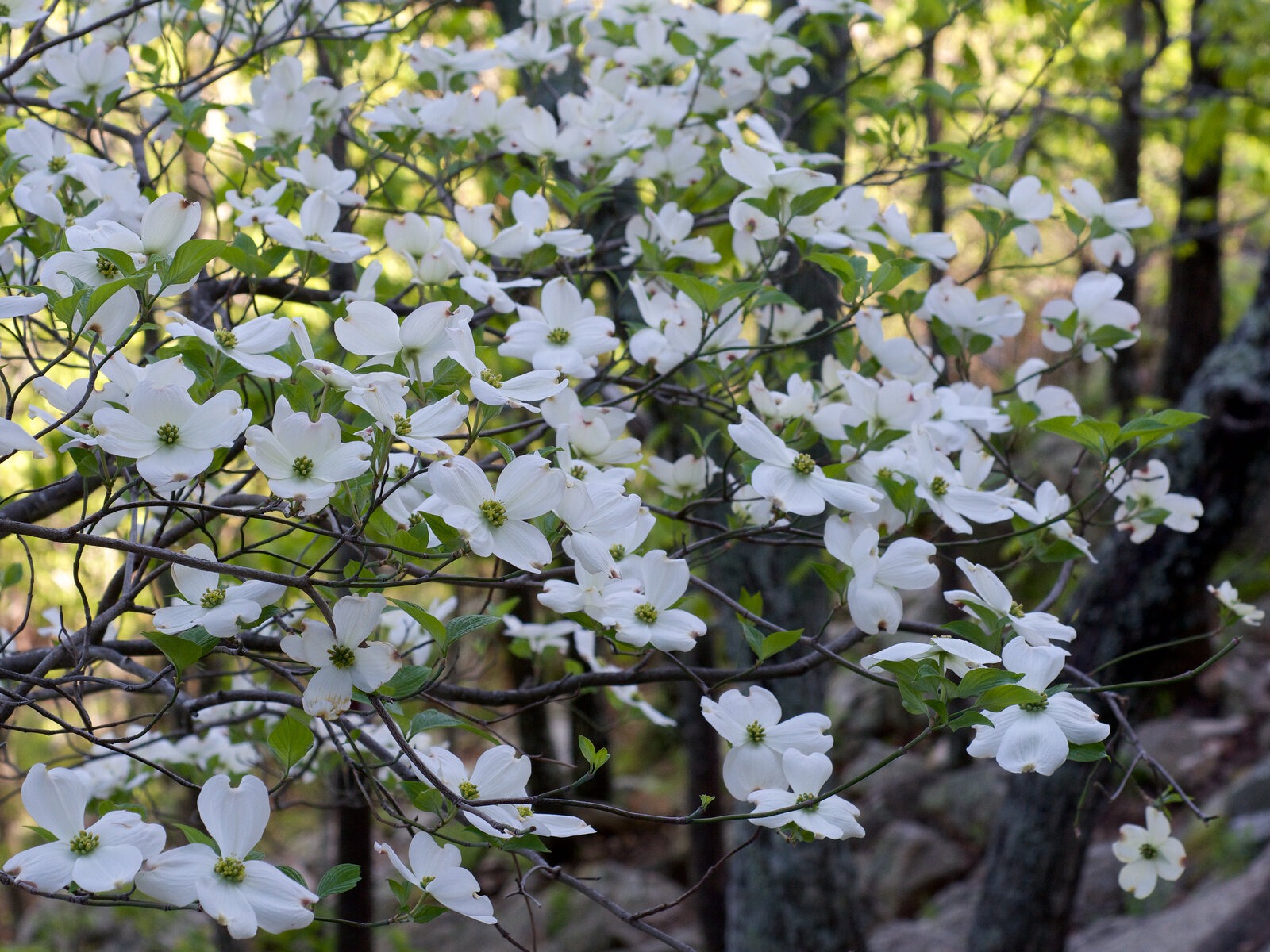
Flowering dogwood
Cornus florida
A small understory tree with horizontally tiered branches. The "flowers" are tight clusters of true small flowers surrounded by four large white (occasionally pink) bracts. Red drupes follow in fall. State flower of Virginia and North Carolina.
Status: Native, common.
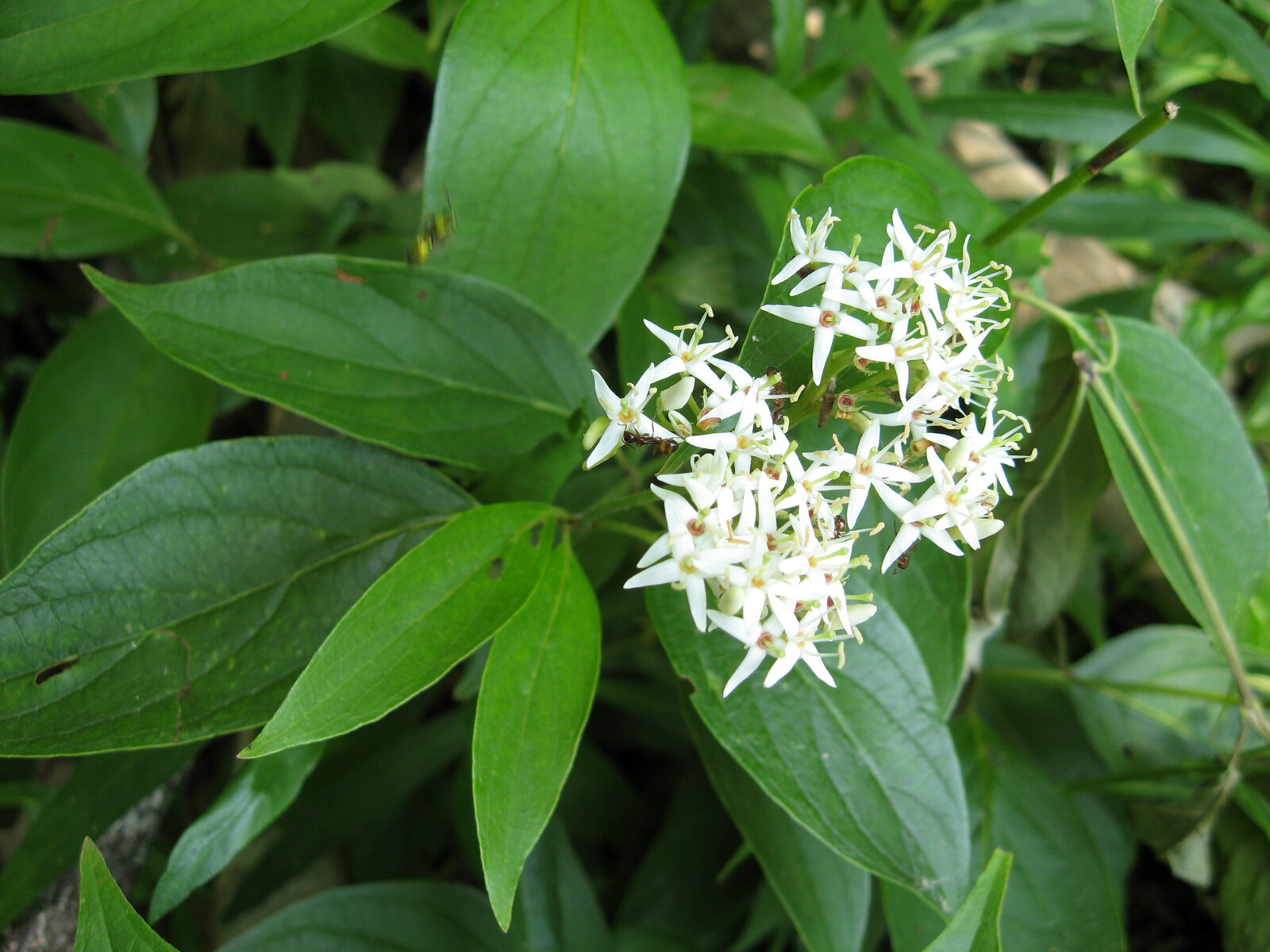
Stiff dogwood
Cornus foemina
Sometimes called southern swamp dogwood. Flat-topped clusters of small white flowers (no showy bracts) and pale blue drupes. A small tree or large shrub of bottomland edges and wet woodland margins.
Status: Native.
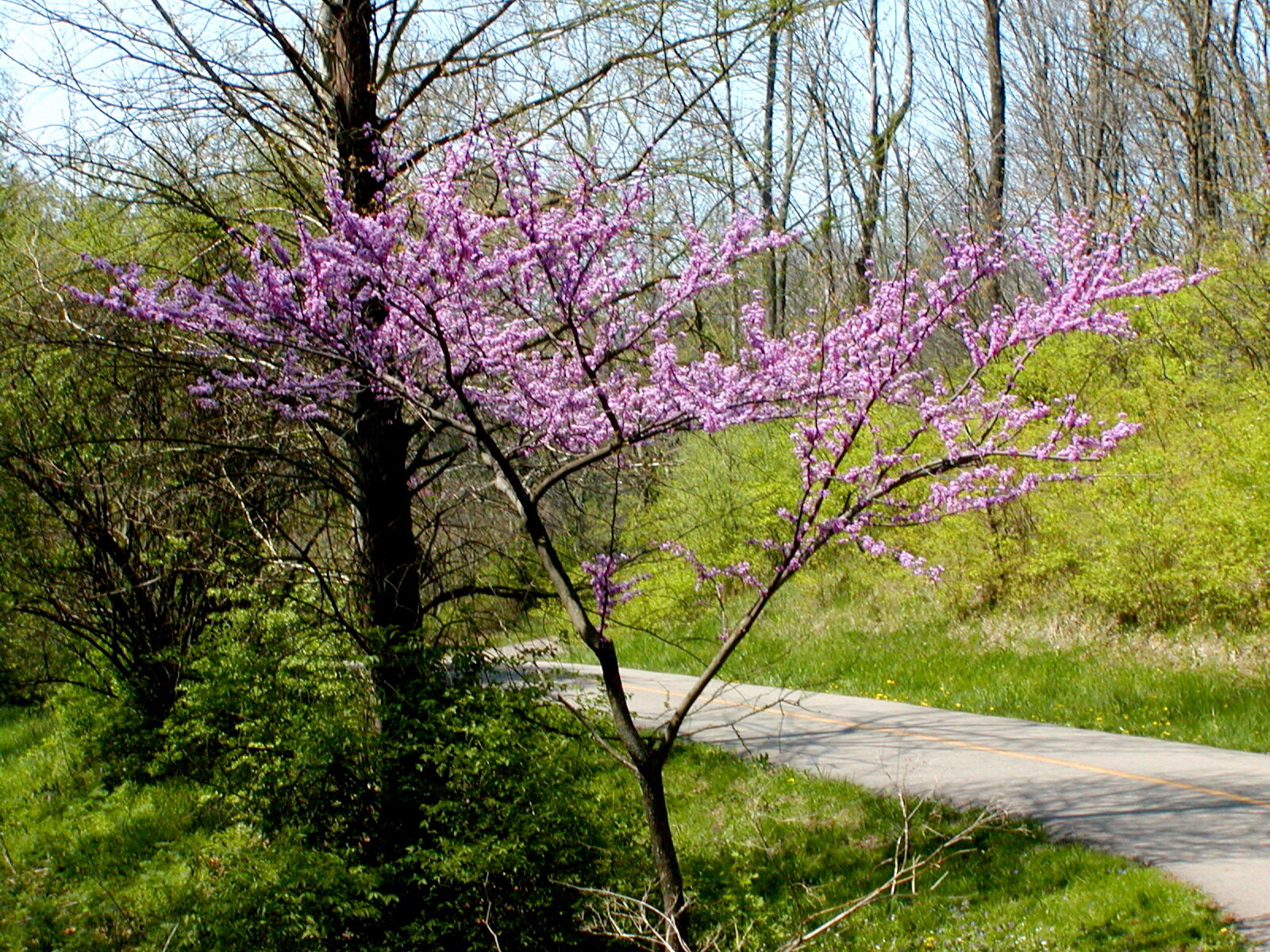
Eastern redbud
Cercis canadensis
A small tree of woodland edges and roadsides. Pink to magenta pea-flowers cluster directly along bare branches in early April, before the heart-shaped leaves emerge. Flat brown legume pods persist into winter.
Status: Native, common.
Serviceberries
Three native serviceberries bloom in late March and early April, often the first showy white flowers in the cove and ridge understory before any leaves have emerged. The genus is famously prone to hybridization; positive identification often requires multiple characters.
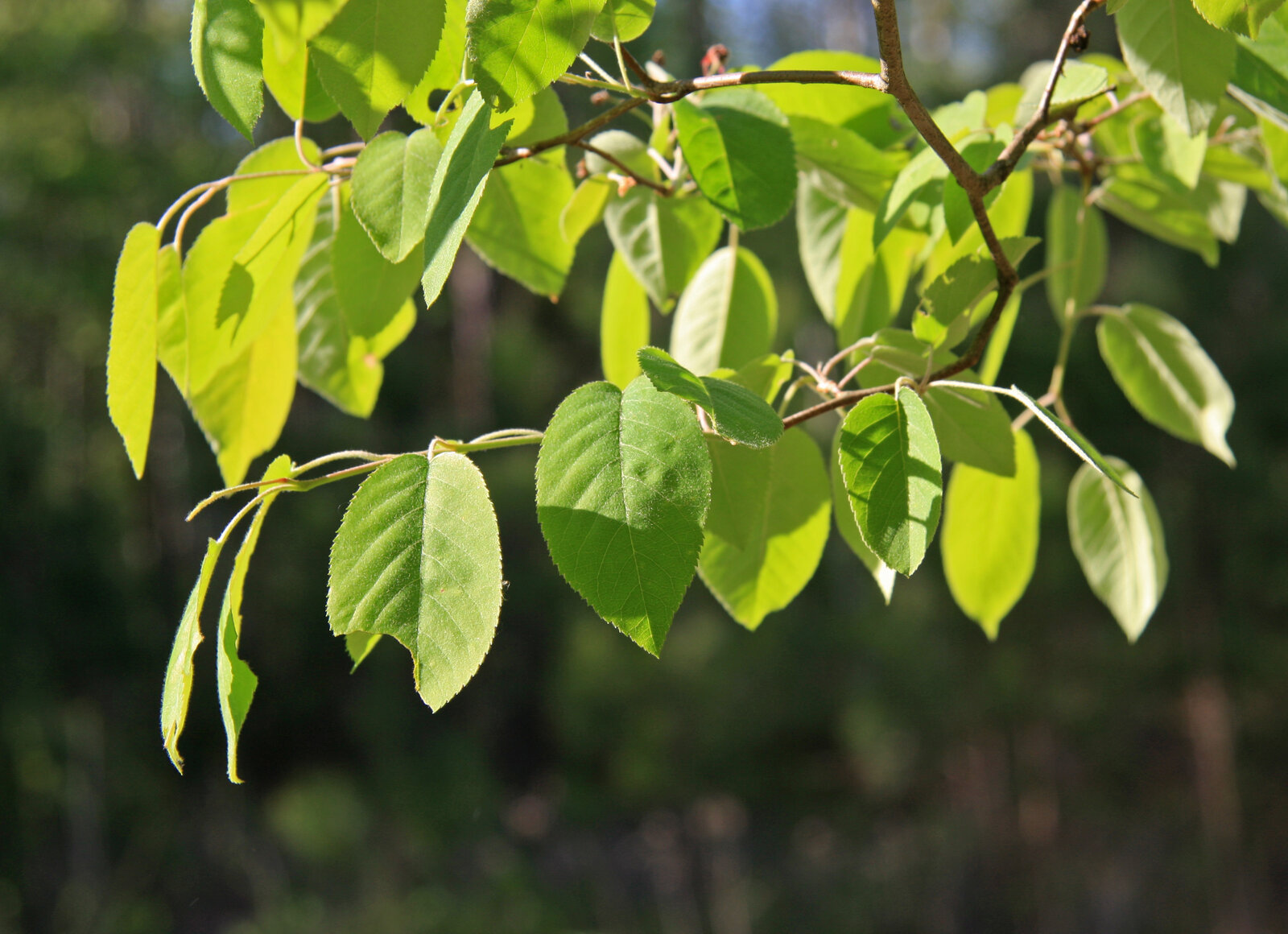
Common serviceberry
Amelanchier arborea
Sometimes called downy serviceberry, sarvis, or shadbush. Five-petaled white flowers open before or with the leaves; small purple-black pomes ripen in early summer. Young leaves are softly hairy, the basis for the alternative common name.
Status: Native, common.
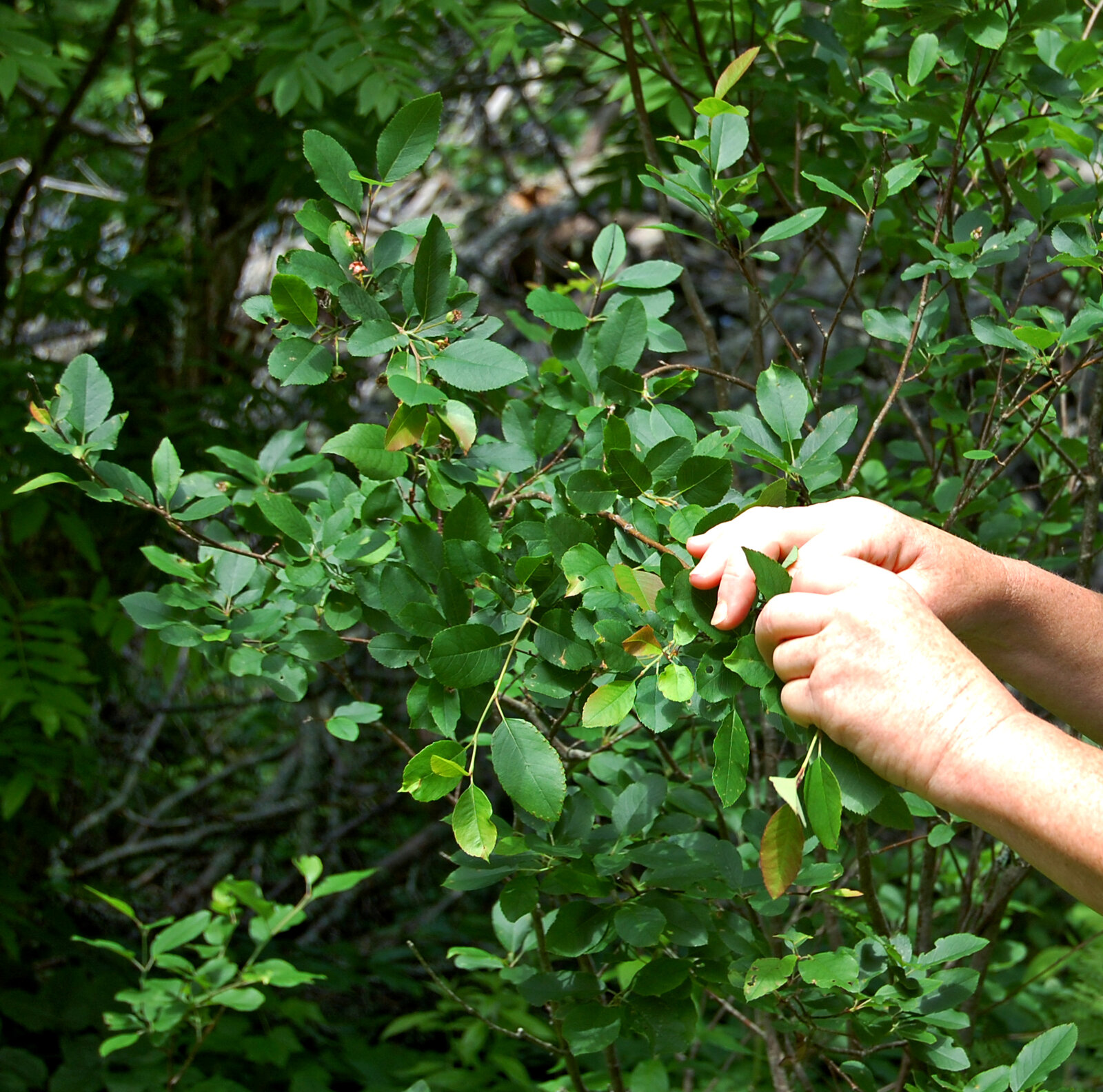
Canadian serviceberry
Amelanchier canadensis
A multi-stemmed serviceberry of bog edges, swamp margins, and bottomlands. Smaller than common serviceberry, with leaves that are more rounded at the tip.
Status: Native.
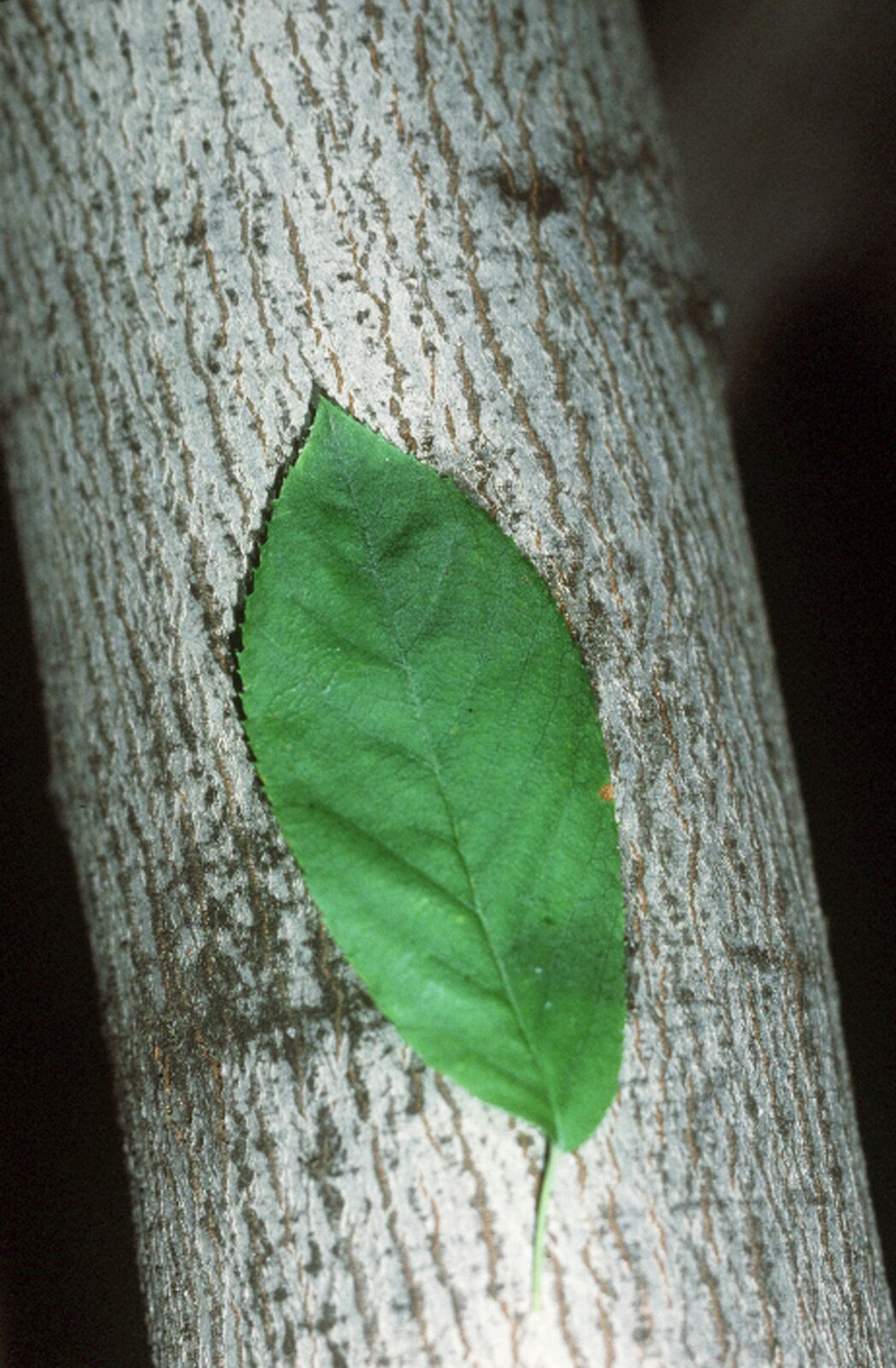
Smooth serviceberry
Amelanchier laevis
Differs from common serviceberry in having hairless young leaves, often tinged purple-bronze in spring. Hybridizes with A. arborea where the two species meet. Mid-elevation slopes.
Status: Native.
Hornbeams and ironwood
Two birch-family understory trees with similar names but distinct identification characters. Both produce hard, dense wood (the source of "ironwood" and "musclewood" common names) that early settlers used for tool handles, mallets, and ox yokes.
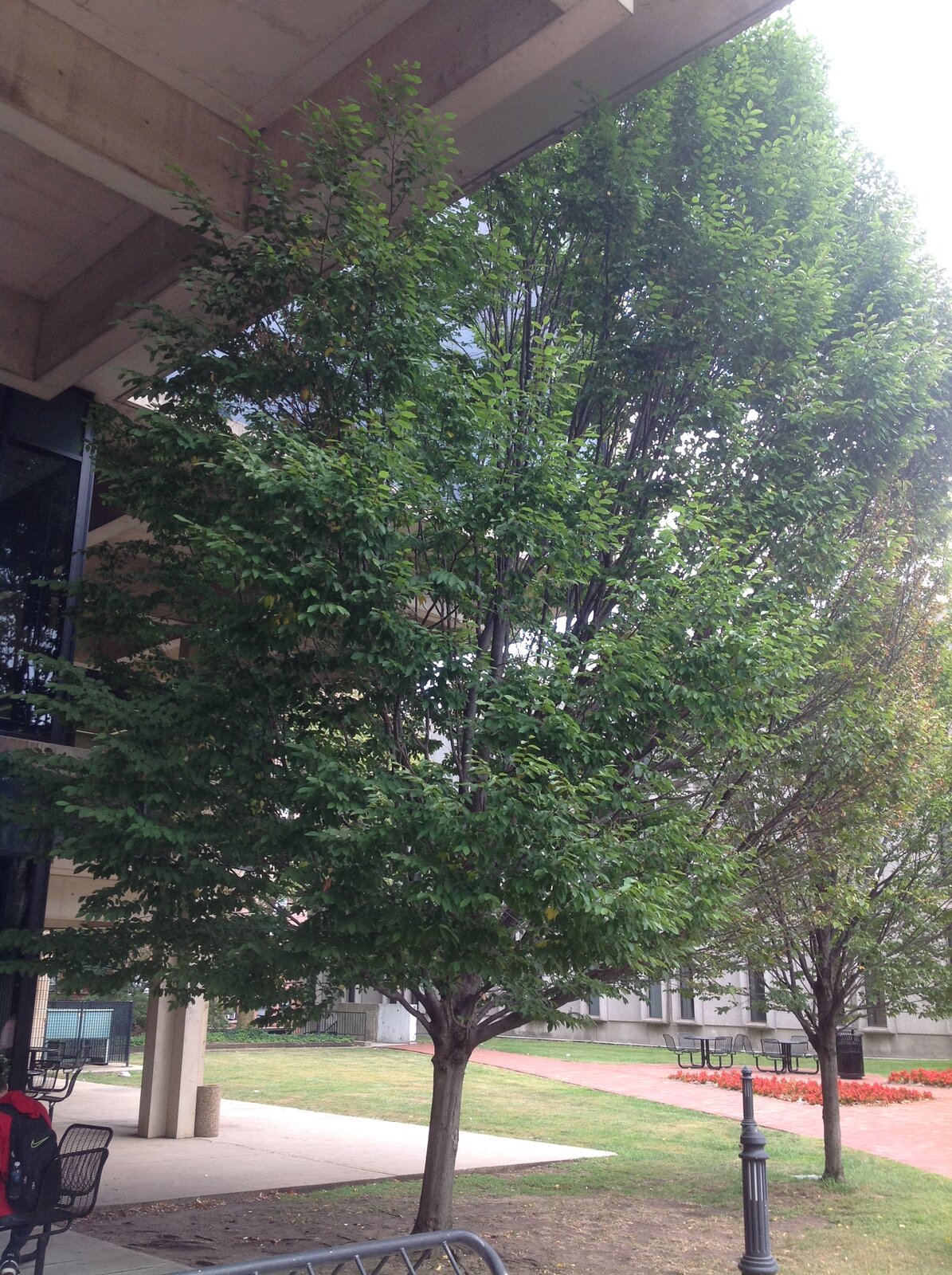
American hornbeam
Carpinus caroliniana
Also called musclewood or blue beech. Smooth gray bark on a fluted, muscular-looking trunk that gives the tree its common name. Doubly serrate leaves and small nutlets borne in leafy three-pointed bracts. Cove and streamside understory.
Status: Native, common.
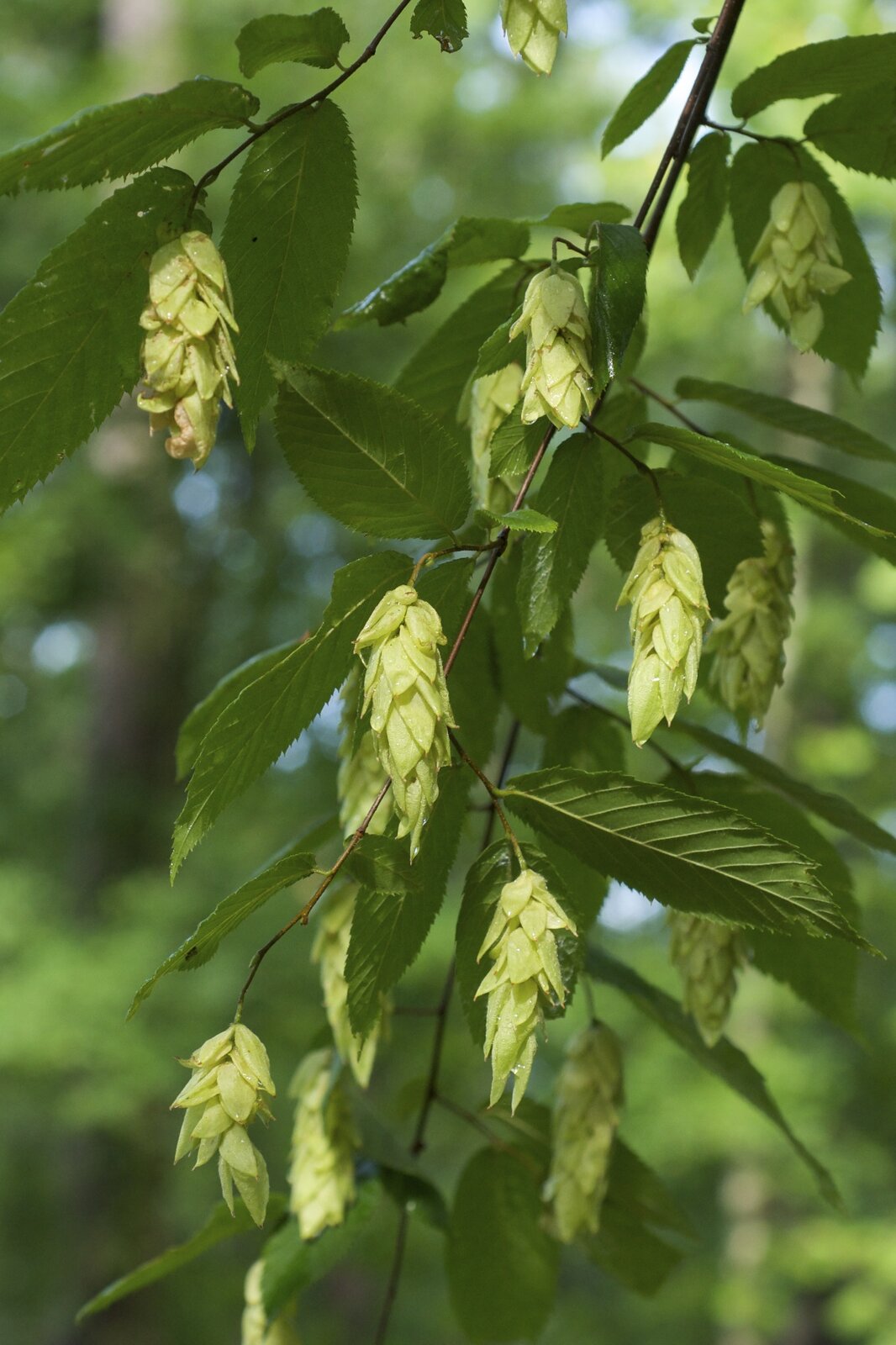
Hop hornbeam
Ostrya virginiana
Also called ironwood. Shreddy, vertically peeling bark in narrow strips and clusters of inflated papery sacs that resemble hops, giving the tree its common name. Dry slopes and ridge edges.
Status: Native, common.
Plums and cherries
Plums and cherries (genus Prunus) cover a wide range of habitats, from native thicket species at woodland edges to orchard escapes naturalizing in old fields. The Cherokee cultivated chickasaw plum across the southeastern interior, including for trade. Black cherry is the only canopy-reaching member of the group; the others are small understory trees or large shrubs.
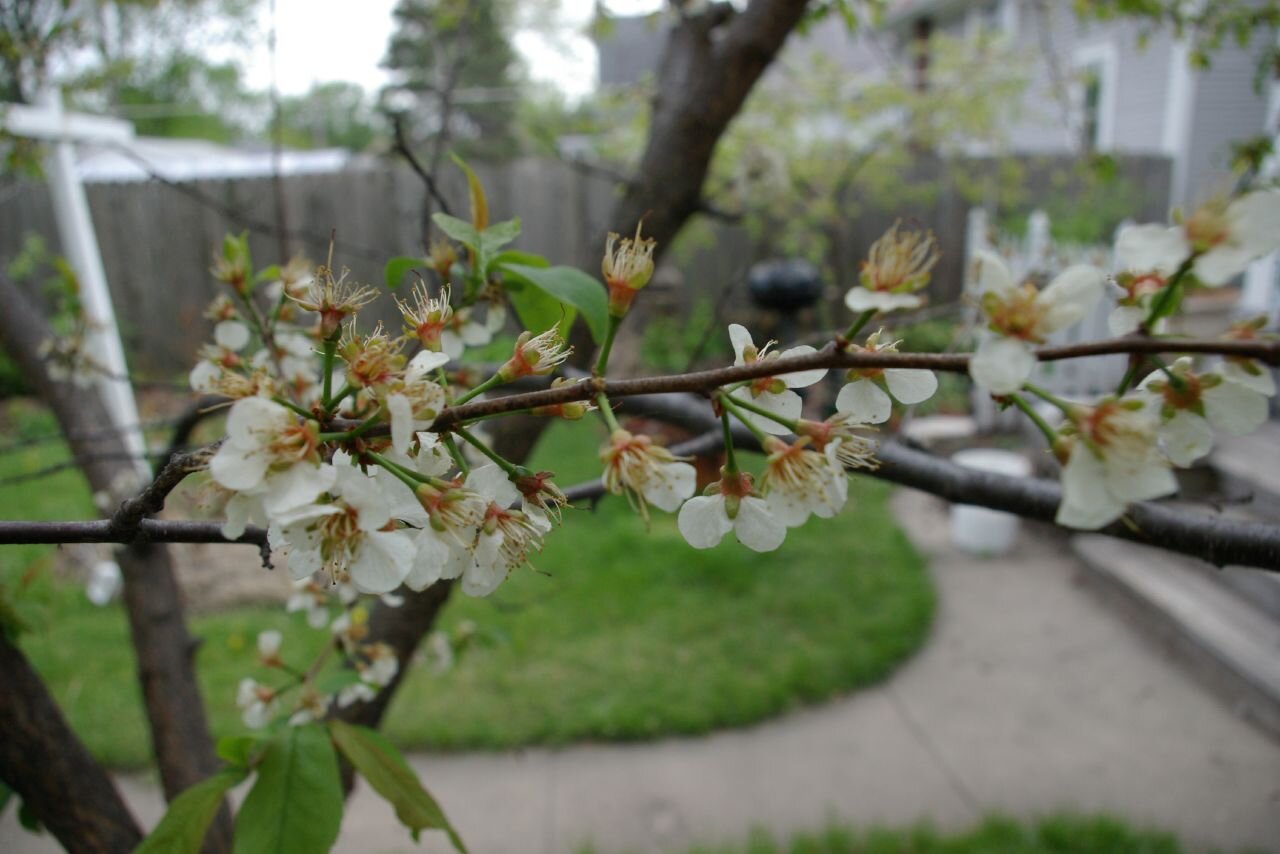
American plum
Prunus americana
A thicket-forming small tree of fencerows and woodland edges. Fragrant white flowers in early April before the leaves; red to yellow plums ripen in late summer. Twigs sometimes bear short sharp spurs.
Status: Native.
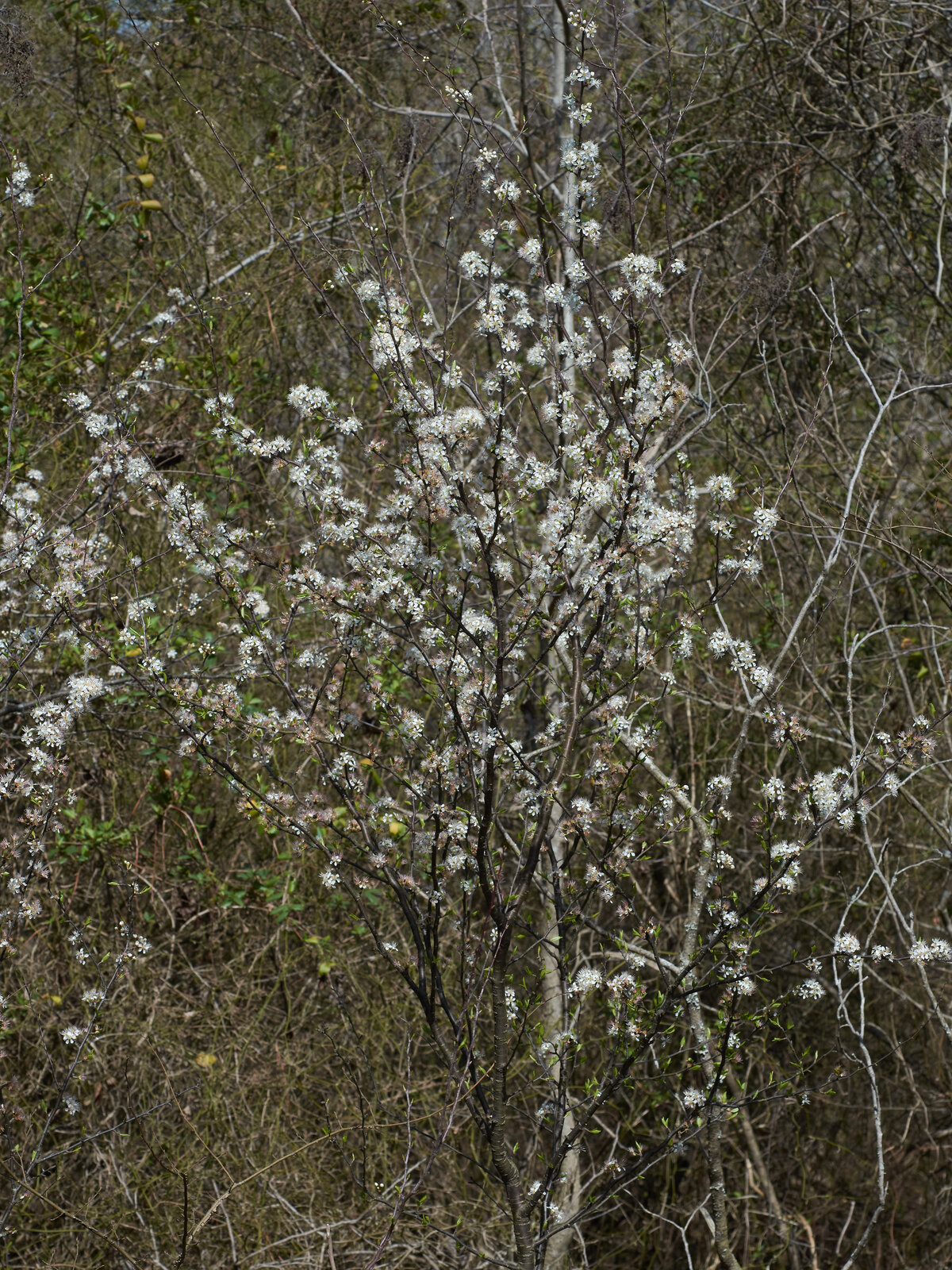
Chickasaw plum
Prunus angustifolia
A thicket-forming plum cultivated by the Cherokee and traded across the southeastern interior in the centuries before European contact. Small red or yellow plums ripen in midsummer; narrow folded leaves. Often the first plant in spring to flower along Marion fencerows.
Status: Native; long cultivated.
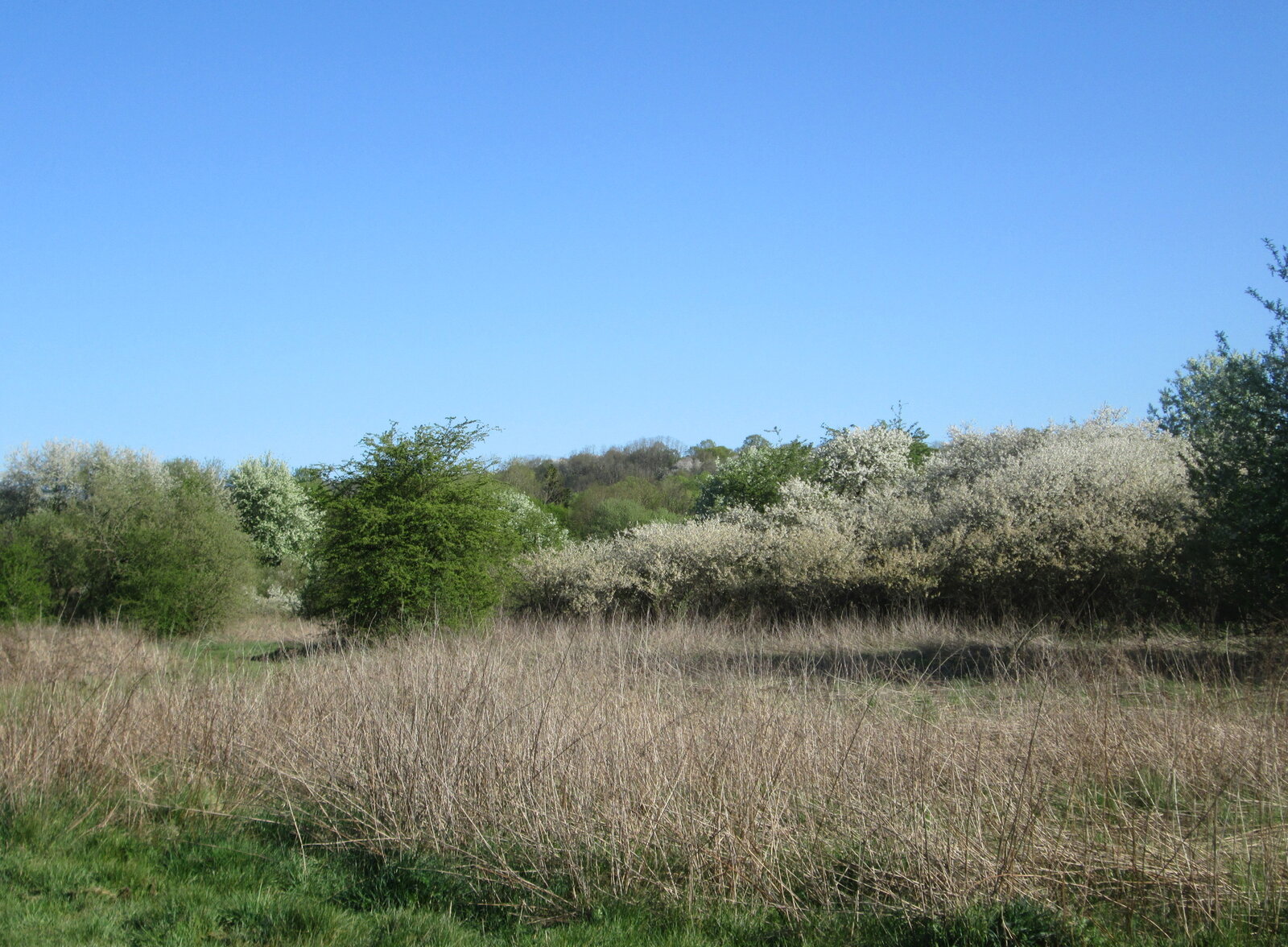
Sour cherry
Prunus cerasus
The orchard pie cherry, native to Europe and the Near East, occasionally naturalizing from plantings on old farmsteads. Red fruit, smaller and more acidic than sweet cherry. Not common as an escape but persistent where it has been planted.
Status: Introduced; orchard species.
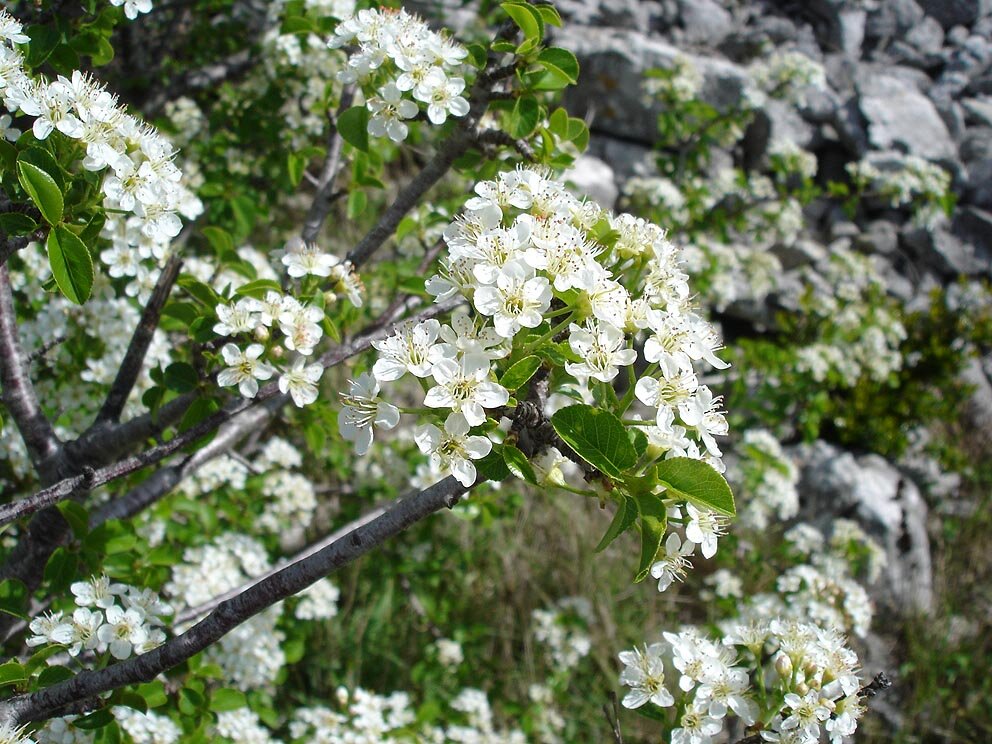
Mahaleb cherry
Prunus mahaleb
A European cherry used commercially as rootstock for sweet and sour cherry trees and for the aromatic seed kernel that flavors Middle Eastern baking. Sometimes naturalizes from orchard rootstocks.
Status: Introduced.
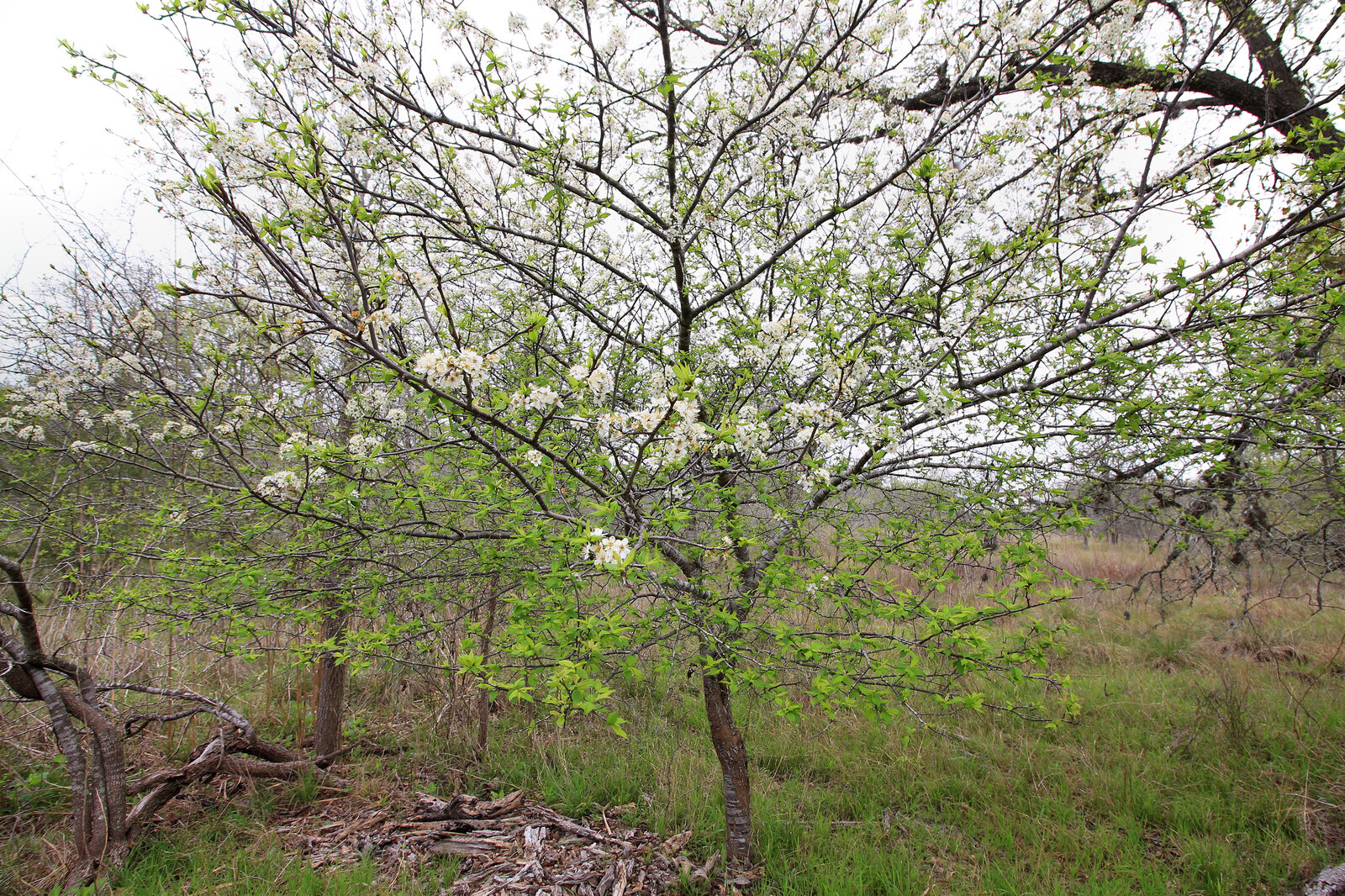
Mexican plum
Prunus mexicana
A limestone-loving plum of calcareous slopes and bluff edges in the Sequatchie Valley. Larger purple plums than the other native plums; bark develops blocky plates on older trunks. Single trees rather than thickets.
Status: Native.
Wild-goose plum
Prunus munsoniana
A bottomland thicket-forming plum with small red plums and slightly drooping branches. Closely related to chickasaw plum and sometimes treated as a variety. Photo not yet sourced.
Status: Native.
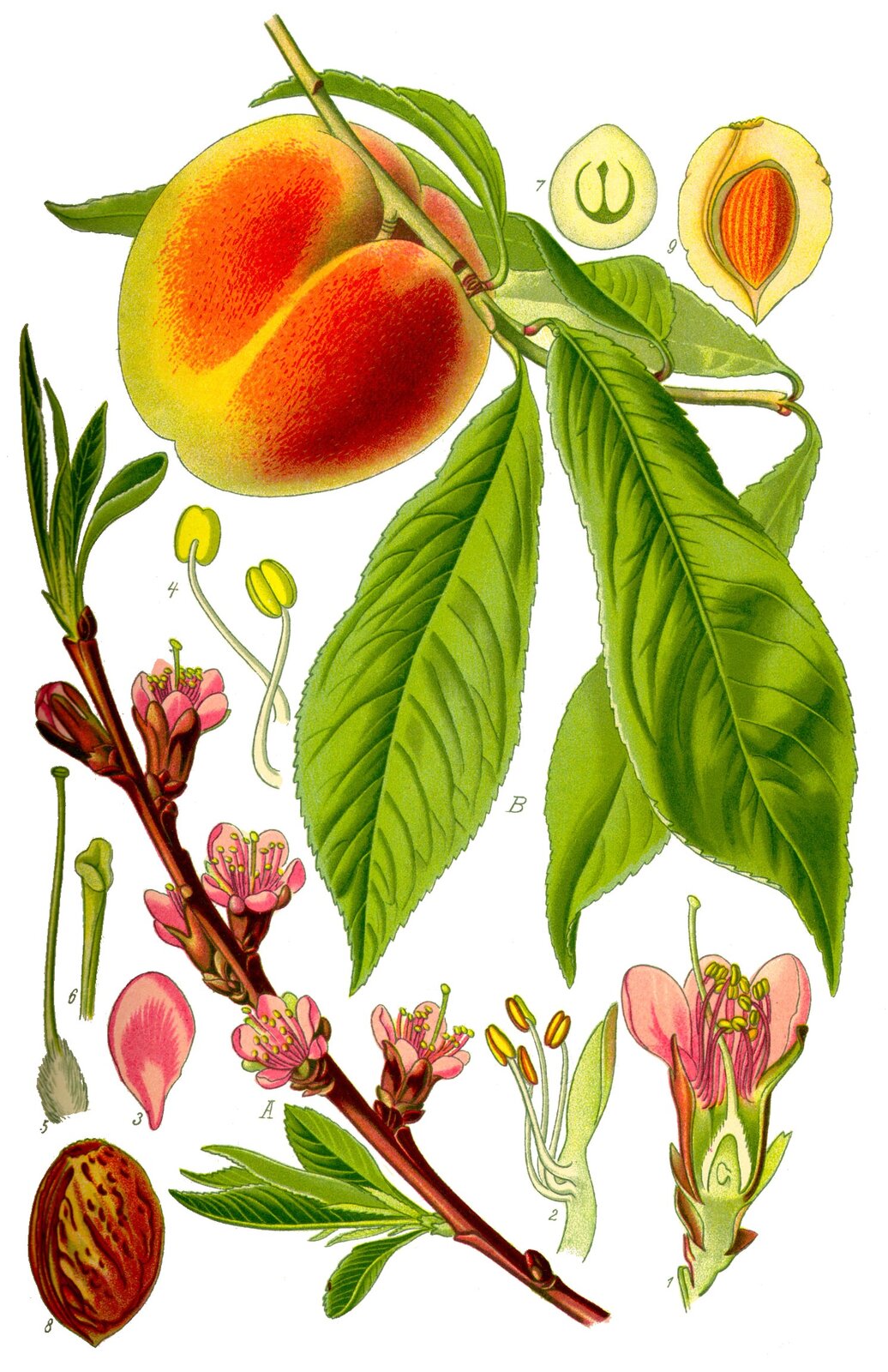
Peach
Prunus persica
The orchard peach, native to East Asia, planted for centuries in Marion County yards and small orchards. Pink five-petaled flowers in March, single-pitted velvety fruits in summer. Naturalizes occasionally from old plantings.
Status: Introduced; orchard species.
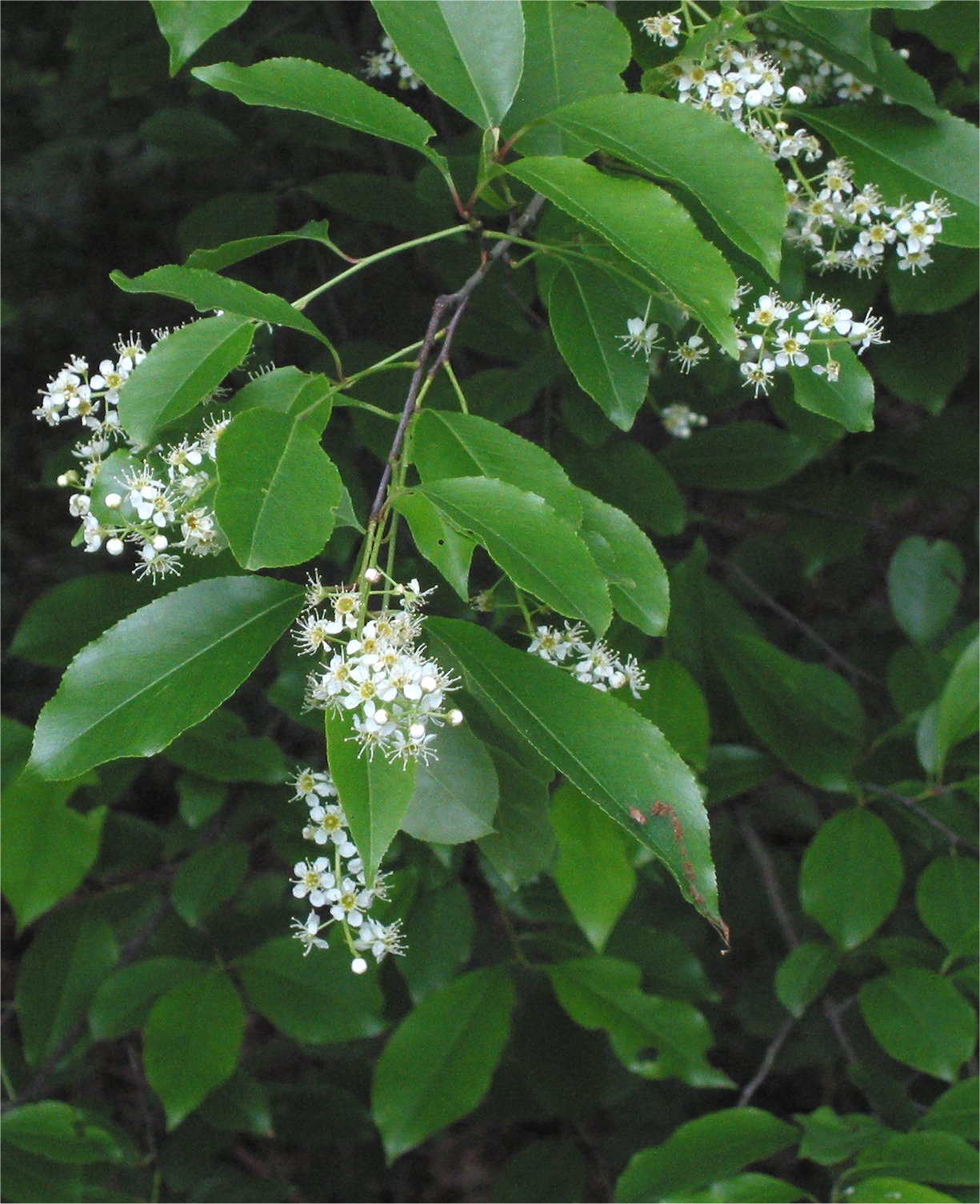
Black cherry
Prunus serotina
The only canopy-reaching native cherry. Mature bark develops dark, scaly plates that flake off, and the wood is prized for furniture. Small white flowers in late spring give way to small dark drupes eaten by birds. A pioneer of plateau old fields and forest gaps.
Status: Native, common.
Hawthorns
The genus Crataegus is famously difficult to identify. Estimates of species number range widely depending on whether minor variations are treated as full species or as forms; the seven species below are the ones documented in Marion County by the regional plant atlases. Most have sharp thorns, white spring flowers, and small red pomes (haws) that persist into winter.
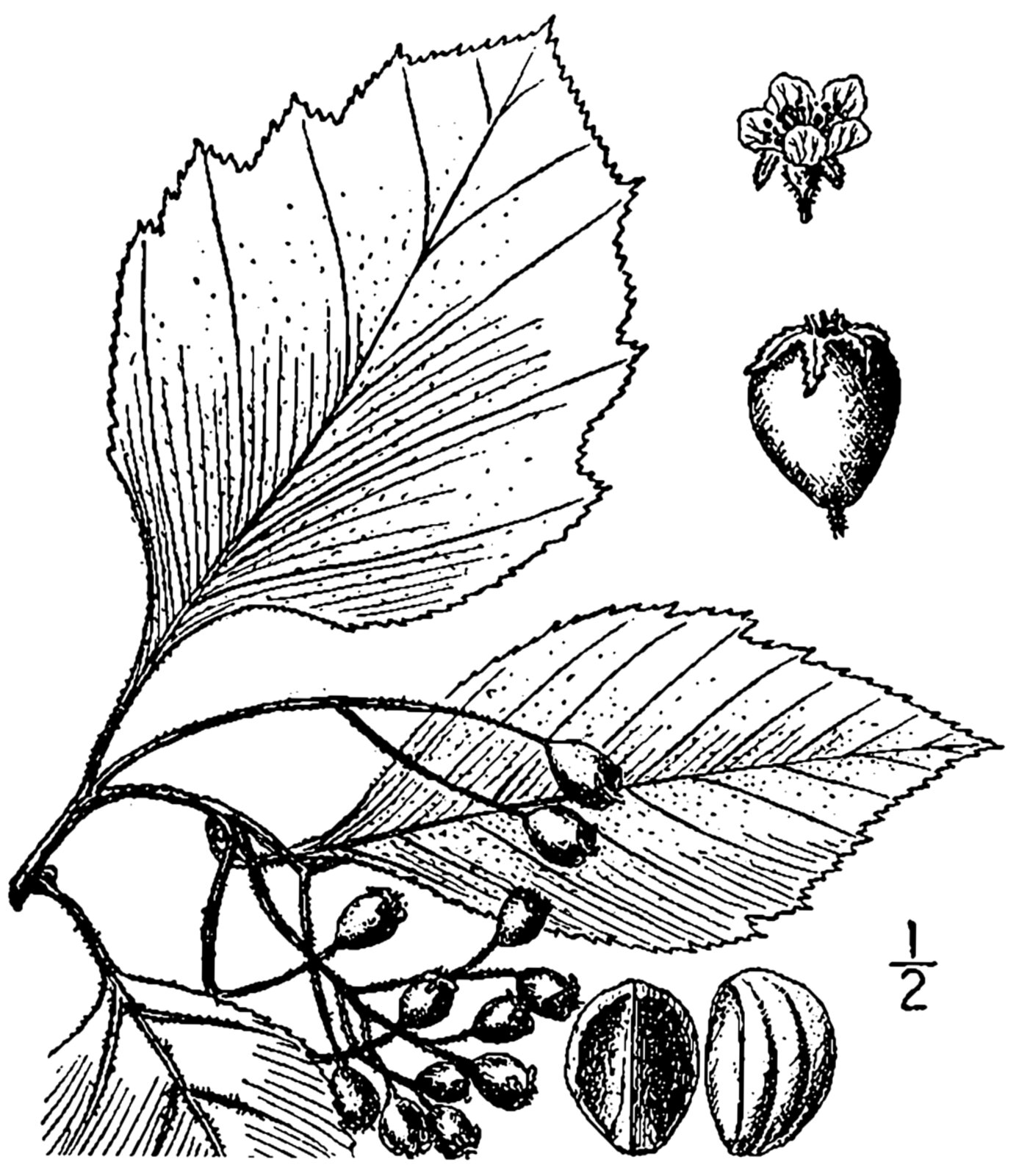
Pear hawthorn
Crataegus calpodendron
Sometimes called urn-tree or sugar hawthorn. Limestone bluffs and old field edges. Pear-shaped fruits, leaves with shallow lobes and toothed margins.
Status: Native.
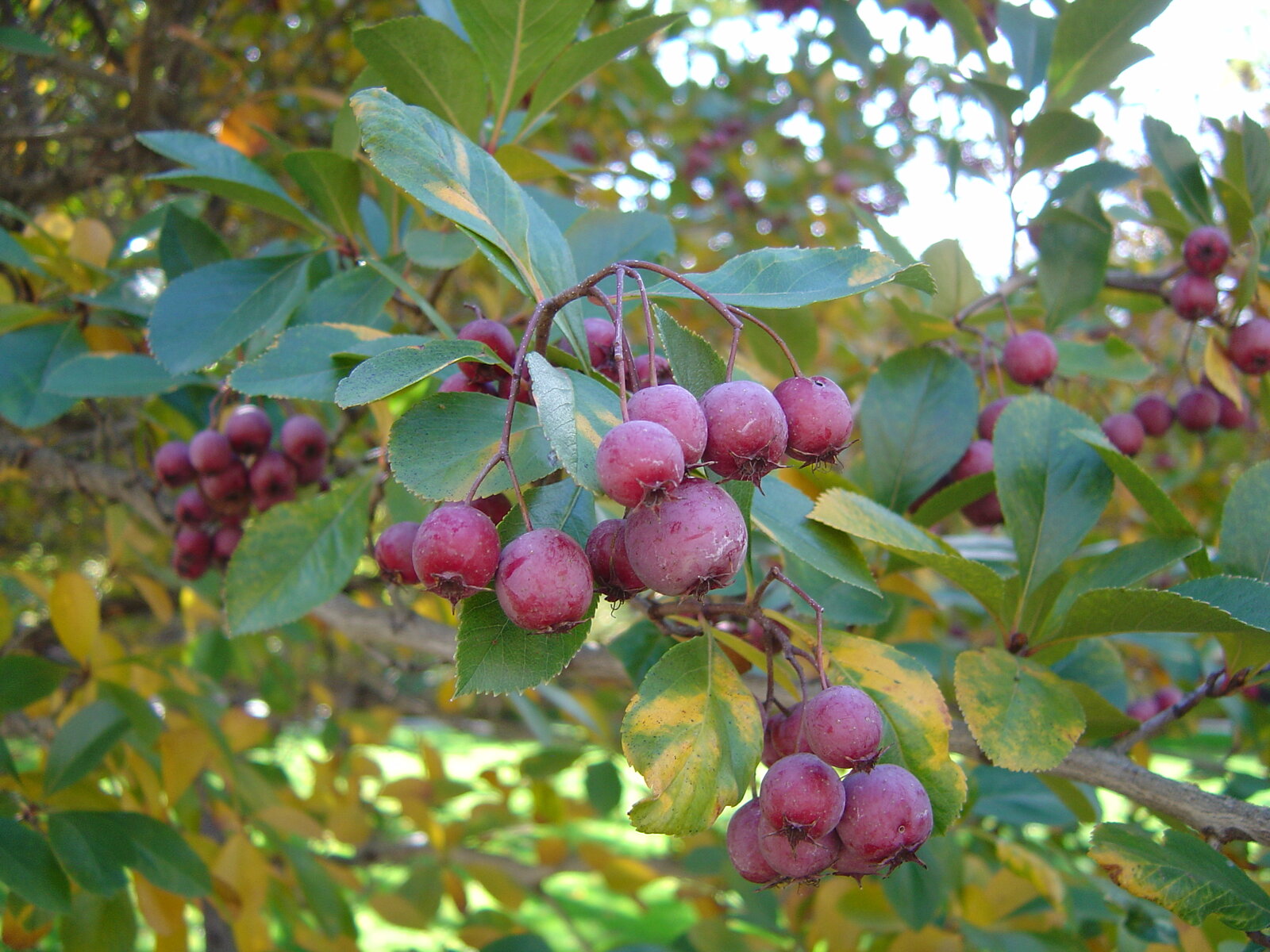
Cockspur hawthorn
Crataegus crus-galli
Long, sharp curved thorns up to four inches long; smooth oblong leaves. An old-field colonizer; common on overgrazed pasture and abandoned farmland. Persistent red fruit through winter.
Status: Native.
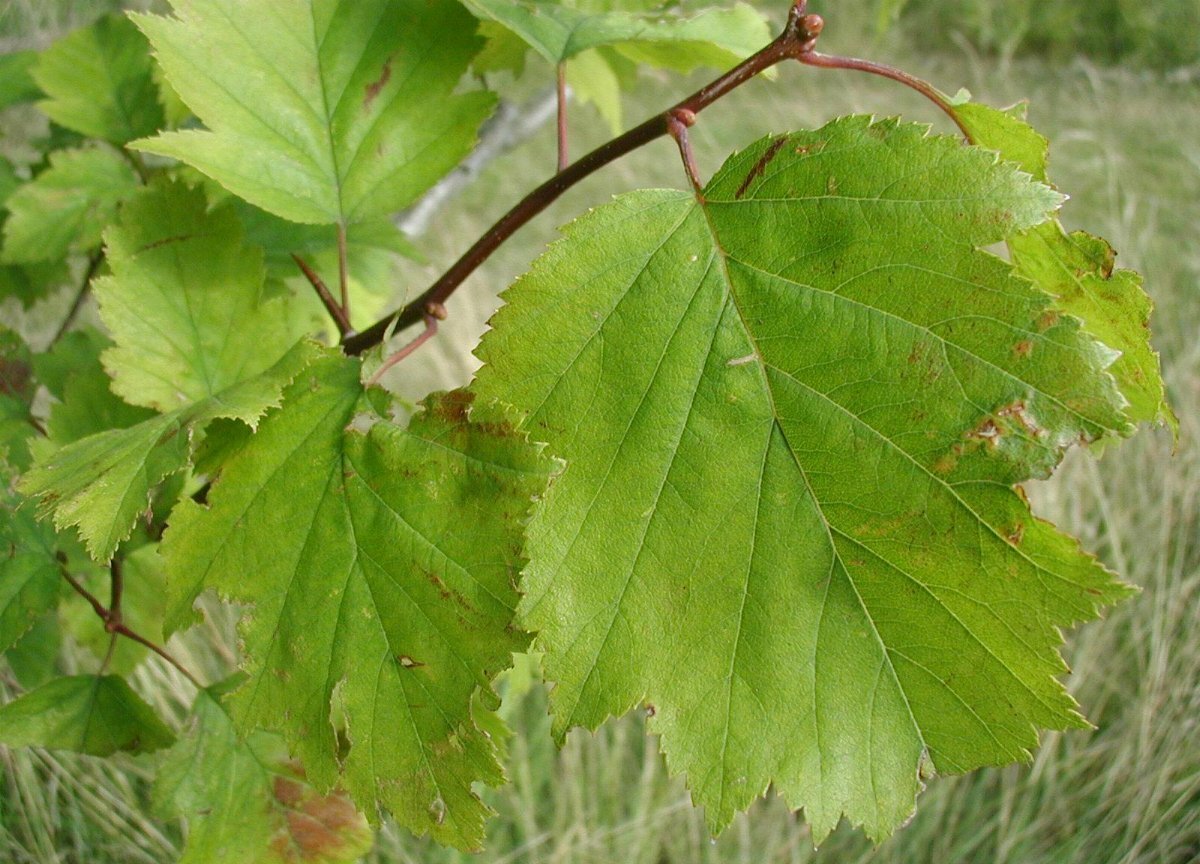
Entangled hawthorn
Crataegus intricata
A dry-upland hawthorn, low-growing and tangled in branching habit. Small red fruits.
Status: Native.
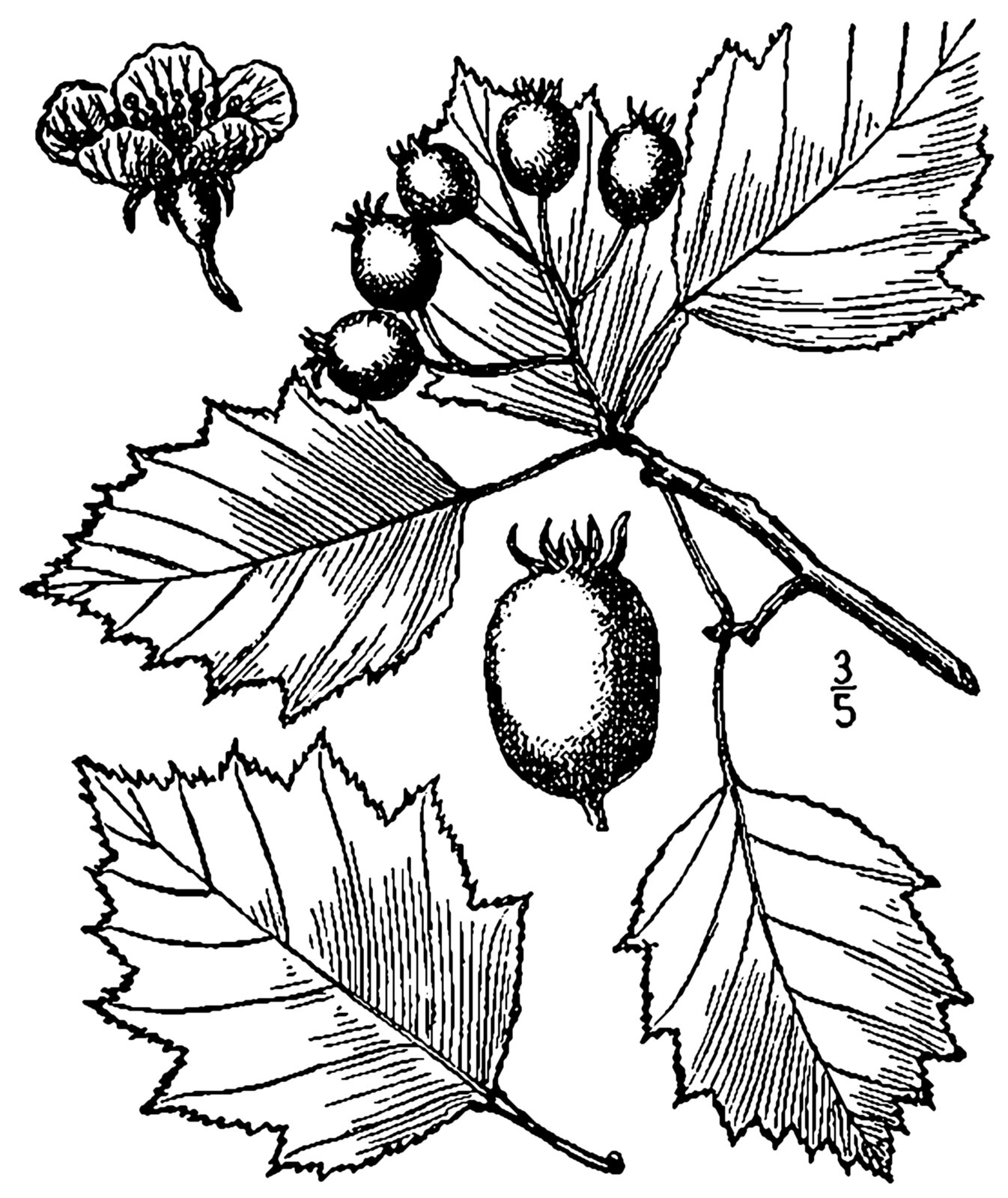
Eastern hawthorn
Crataegus macrosperma
Sometimes called large-seeded hawthorn. A mountain and upper-piedmont species of woodland edges and rocky slopes.
Status: Native.
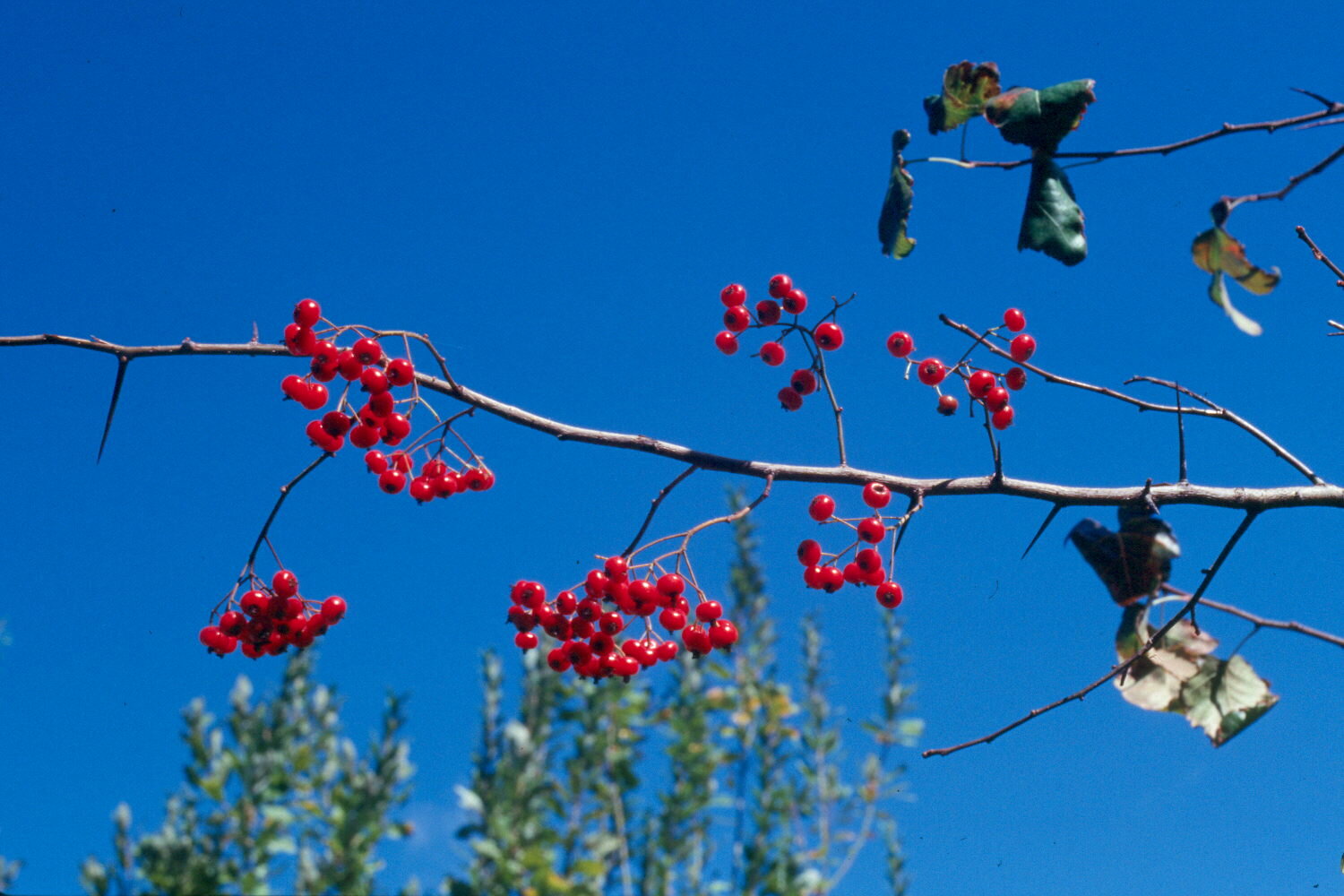
Washington hawthorn
Crataegus phaenopyrum
Three- to five-lobed maple-like leaves and clusters of small red fruit that persist into winter. Frequently planted as an ornamental.
Status: Native; widely planted.
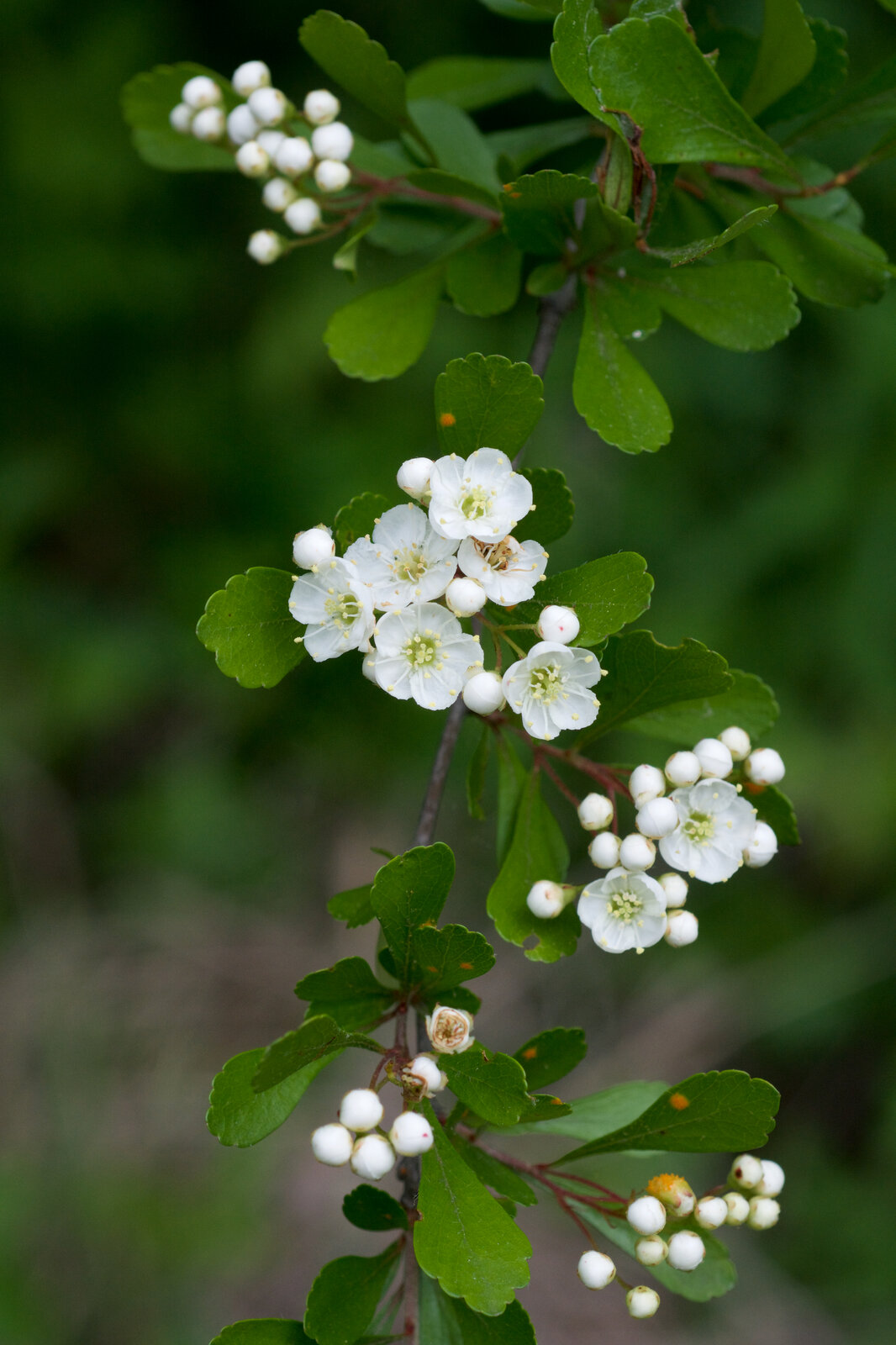
Littlehip hawthorn
Crataegus spathulata
A bottomland species with small spatulate leaves and very small red haws. Often grows as a multi-stemmed thicket-former on alluvial flats.
Status: Native.
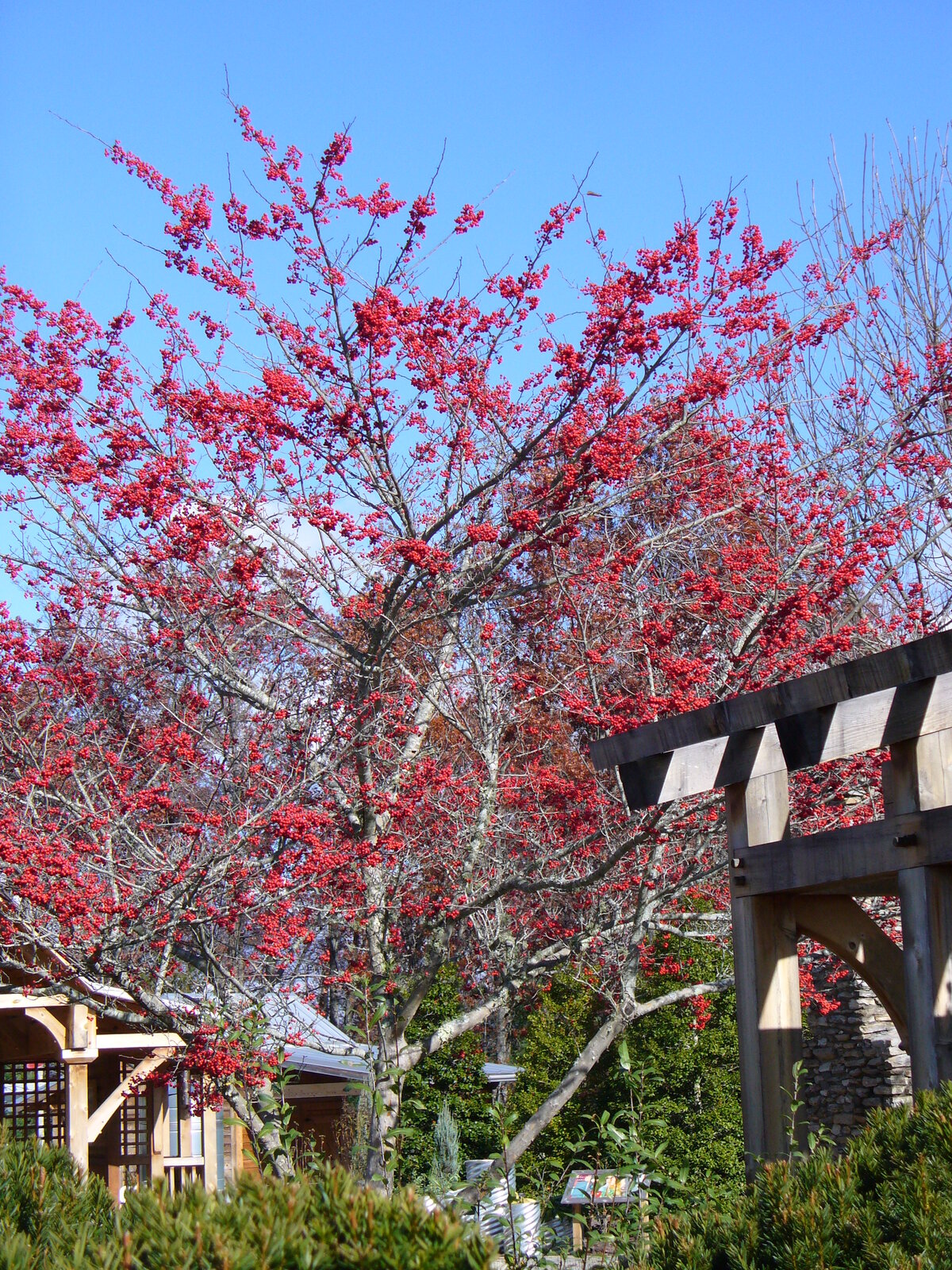
Green hawthorn
Crataegus viridis
A bottomland hawthorn with smooth bark and persistent bright red fruit through winter. The cultivar 'Winter King' is widely planted as an ornamental.
Status: Native.
Hollies
Marion holds one evergreen and three deciduous hollies. The deciduous holly group ("possumhaw" and the like) confuses visitors who associate hollies only with their evergreen relatives.
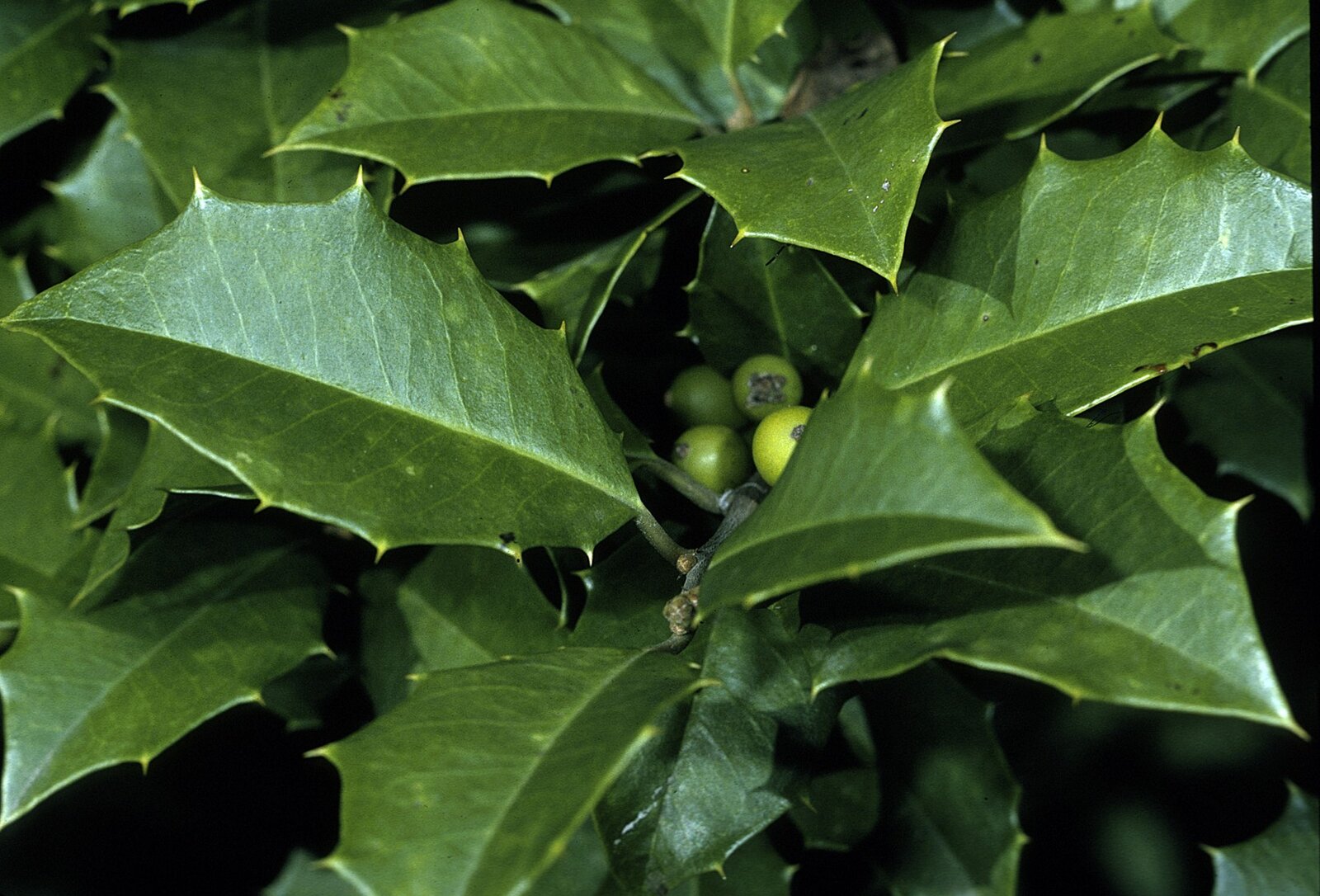
American holly
Ilex opaca
The familiar evergreen holly. Spiny, leathery dark-green leaves and bright red drupes on female trees. A small understory tree of the Sequatchie Valley and lower-elevation slopes.
Status: Native.
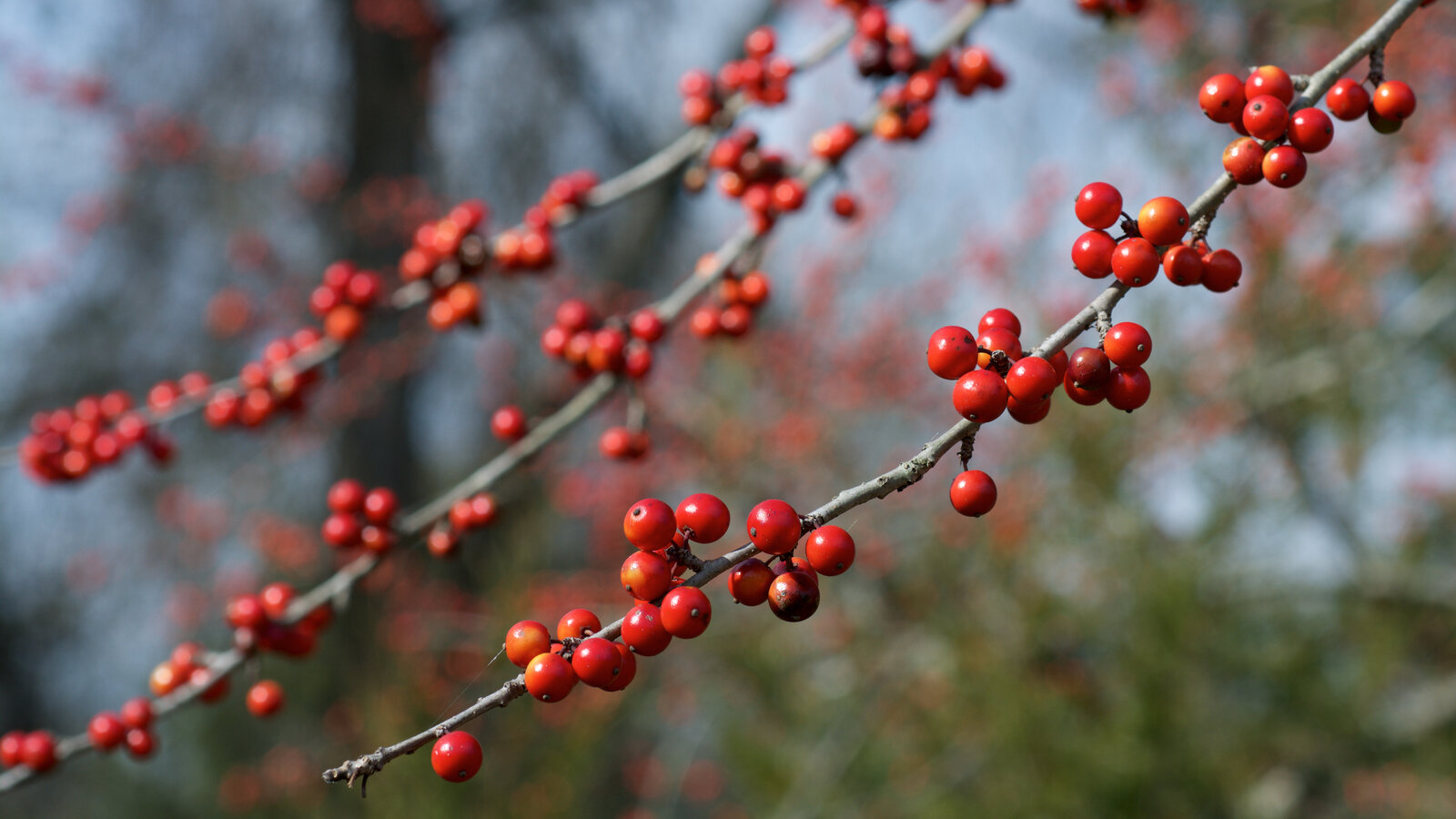
Possumhaw
Ilex decidua
A deciduous holly of bottomlands and stream margins. Drops its leaves in fall, leaving brilliant red berries clustered along bare gray branches into the winter. Eaten by birds; opossums and deer take fallen fruit.
Status: Native.
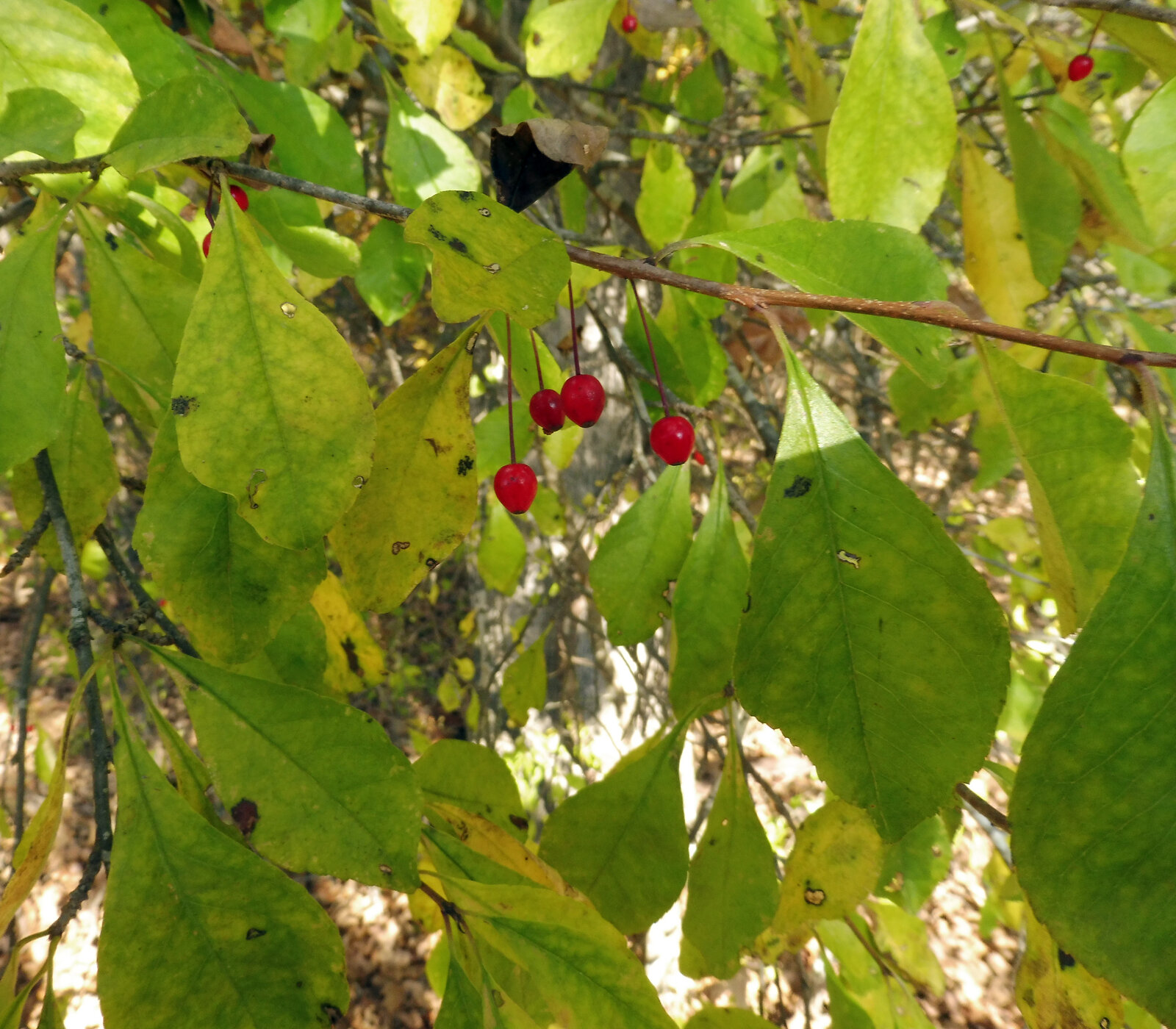
Georgia holly
Ilex longipes
A deciduous holly with unusually long-stalked red drupes that hang well below the branches. A bottomland species of the southeastern interior.
Status: Native.
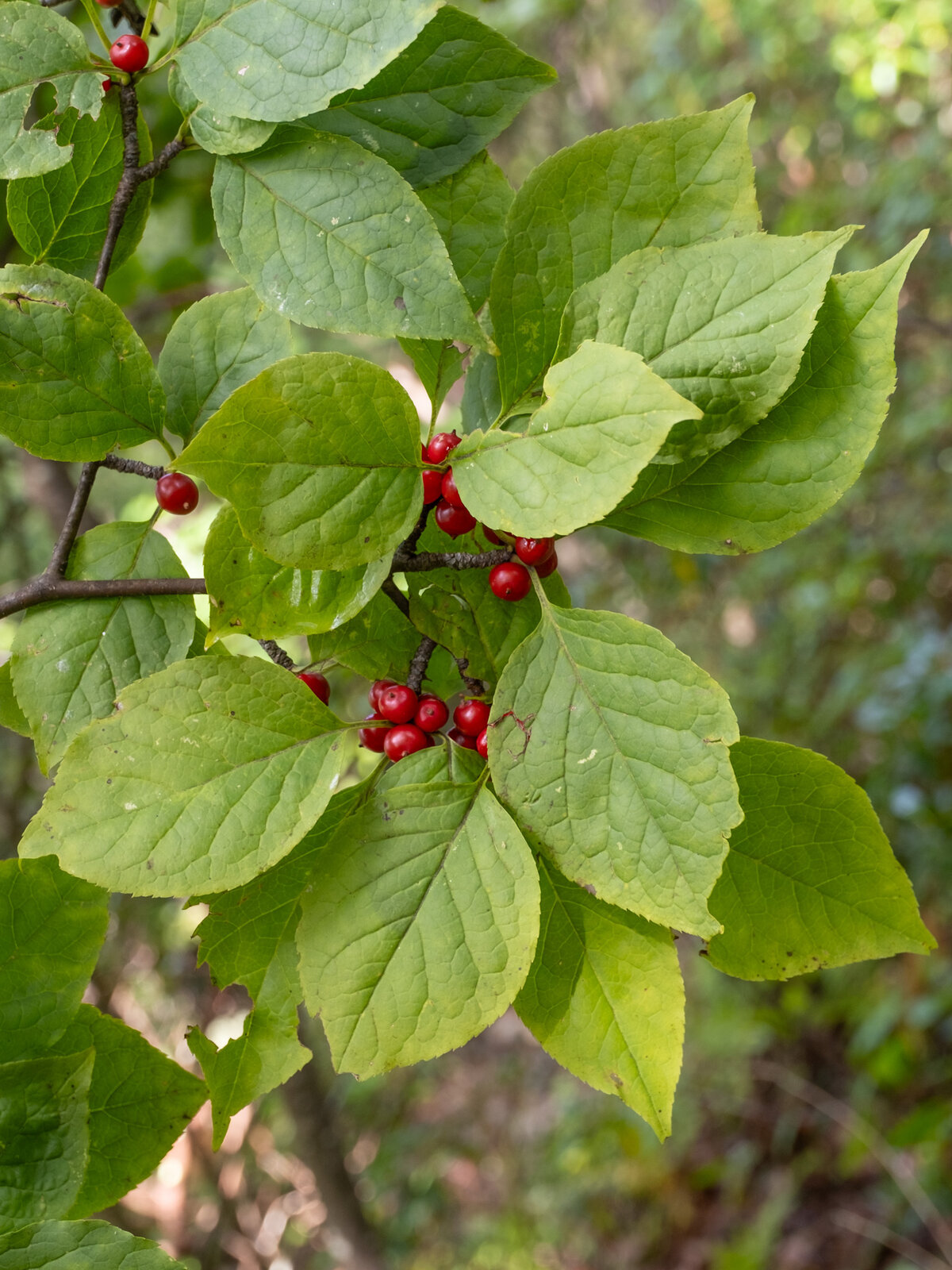
Mountain holly
Ilex montana
A deciduous holly of cool mountain coves at the southern edge of the Cumberland Plateau. Larger leaves than the other deciduous hollies; bright red drupes.
Status: Native; locally distinctive.
Other small-tree understory
Small-tree species that don't fit the other understory groupings, including sourwood, sassafras, pawpaw, persimmon, and the limestone-bluff specialists yellowwood and American smoketree. Sourwood honey, harvested from Appalachian bee yards placed near sourwood stands, has been a cottage industry in Marion County for generations. Sassafras is the only local tree whose leaves come in three distinct shapes on the same branch: unlobed, mitten, and three-lobed "ghost." The roots were the original flavoring for root beer until safrole was banned from commercial food use in 1960.
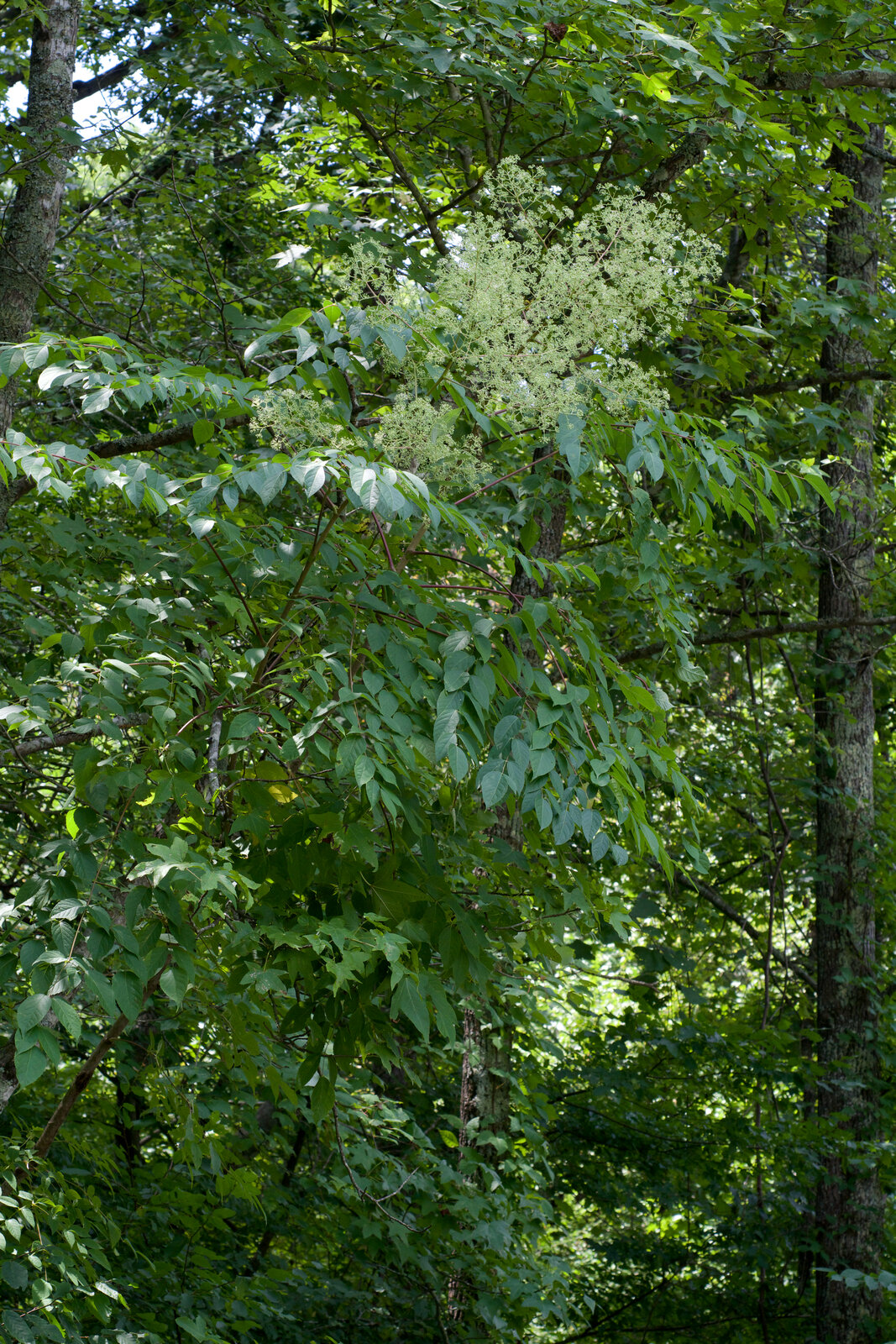
Devils walking-stick
Aralia spinosa
A small tree or large shrub with stout, thorny stems and enormous bipinnately compound leaves up to four feet long. Late-summer panicles of small white flowers attract pollinators in numbers; followed by purple-black drupes eaten by birds.
Status: Native.
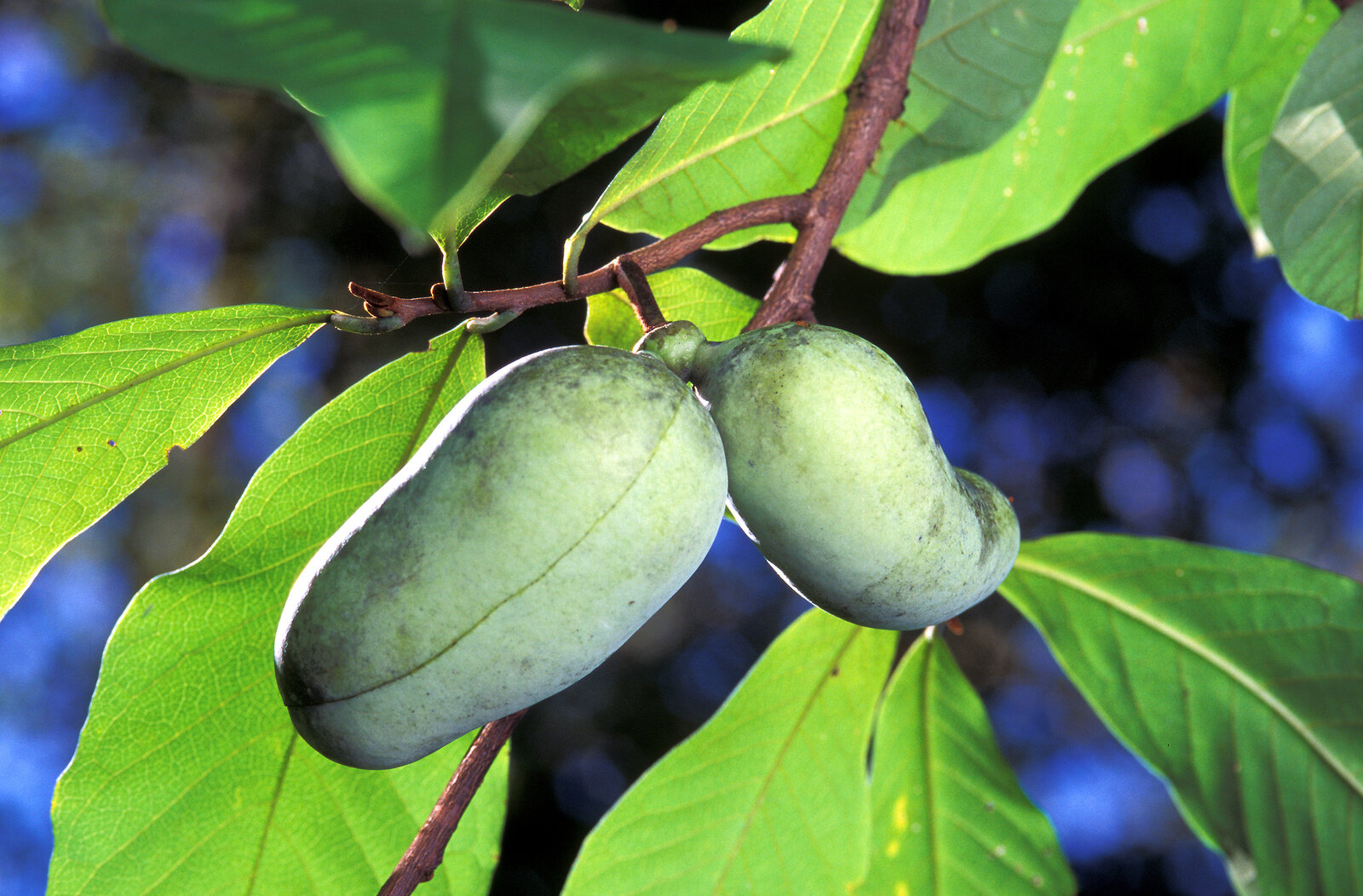
Pawpaw
Asimina triloba
Tropical-looking drooping leaves, dark maroon flowers in early spring, and fragrant kidney-shaped fruits in early fall. Forms thickets in cove understory.
Status: Native.
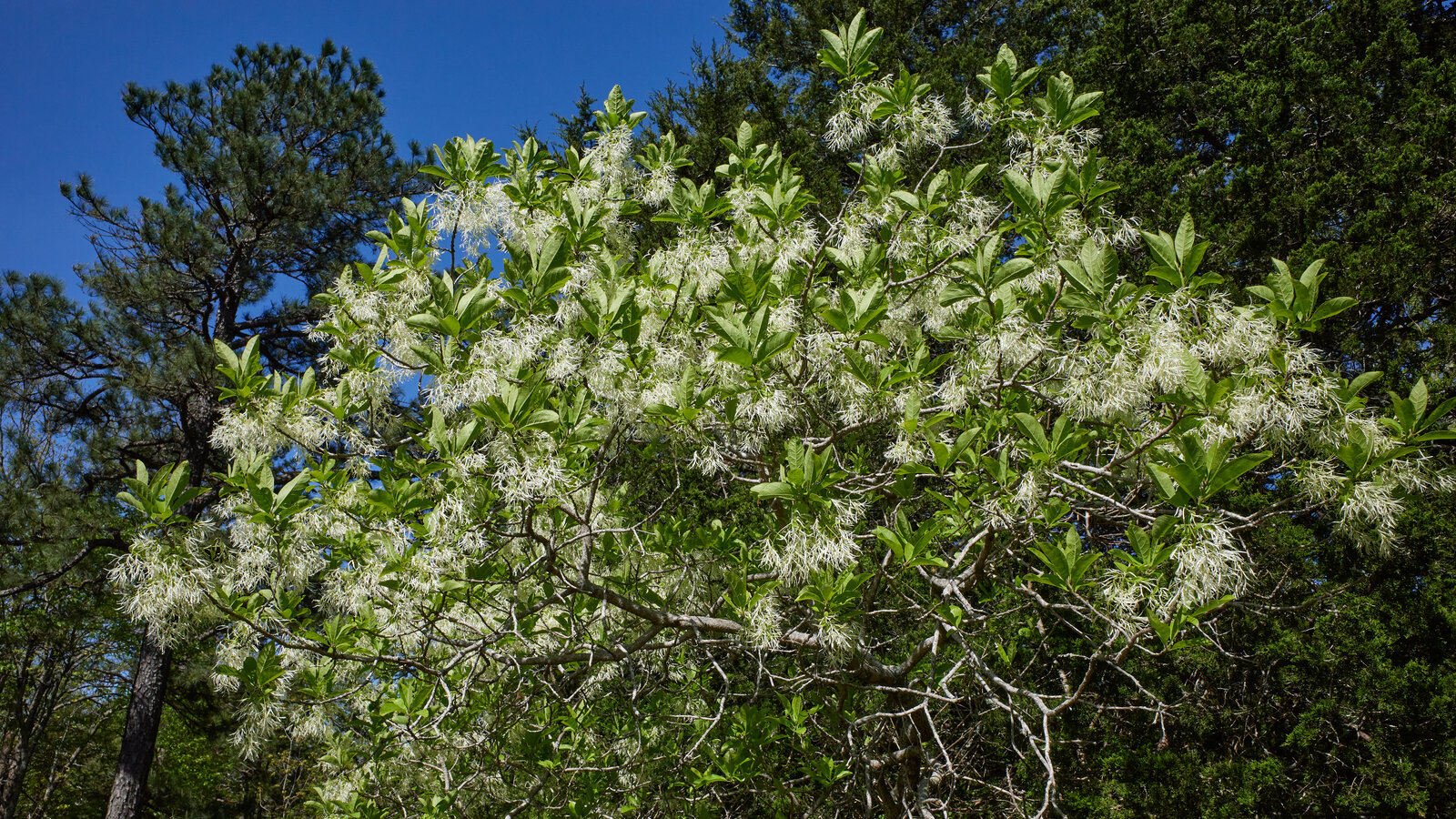
Fringe tree
Chionanthus virginicus
Sometimes called grancy graybeard. Drooping panicles of white, four-petaled flowers with narrow, fringe-like petals appear in May, giving the tree the look of a snowfall on the branches. A small understory tree of moist slopes.
Status: Native.
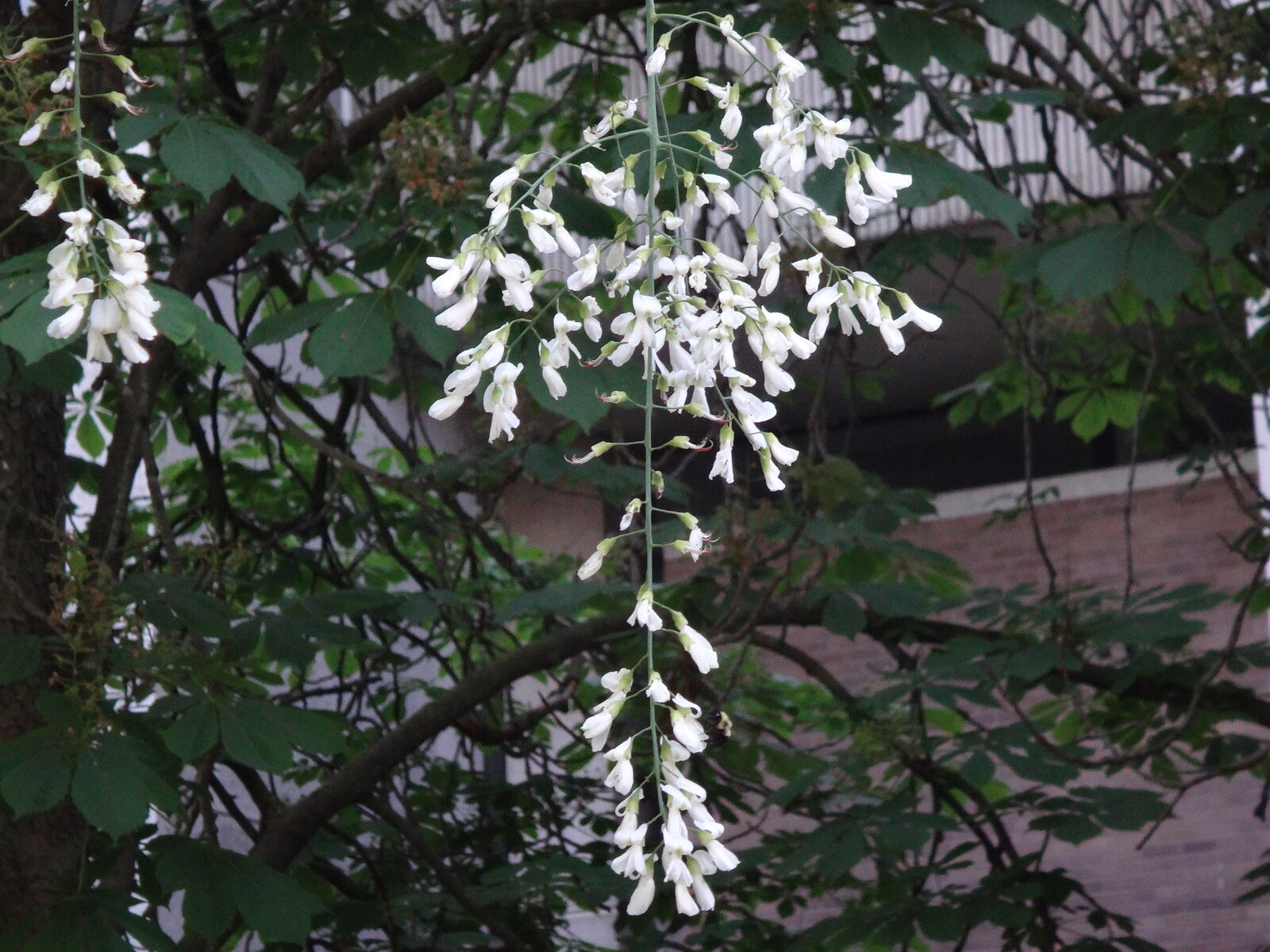
Yellowwood
Cladrastis kentukea
A regional rarity with a scattered Appalachian distribution centered on Tennessee and Kentucky. Pendant clusters of fragrant white pea-flowers in late spring; pinnately compound leaves with seven to eleven leaflets. Limestone slopes and ravines.
Status: Native; locally distinctive.
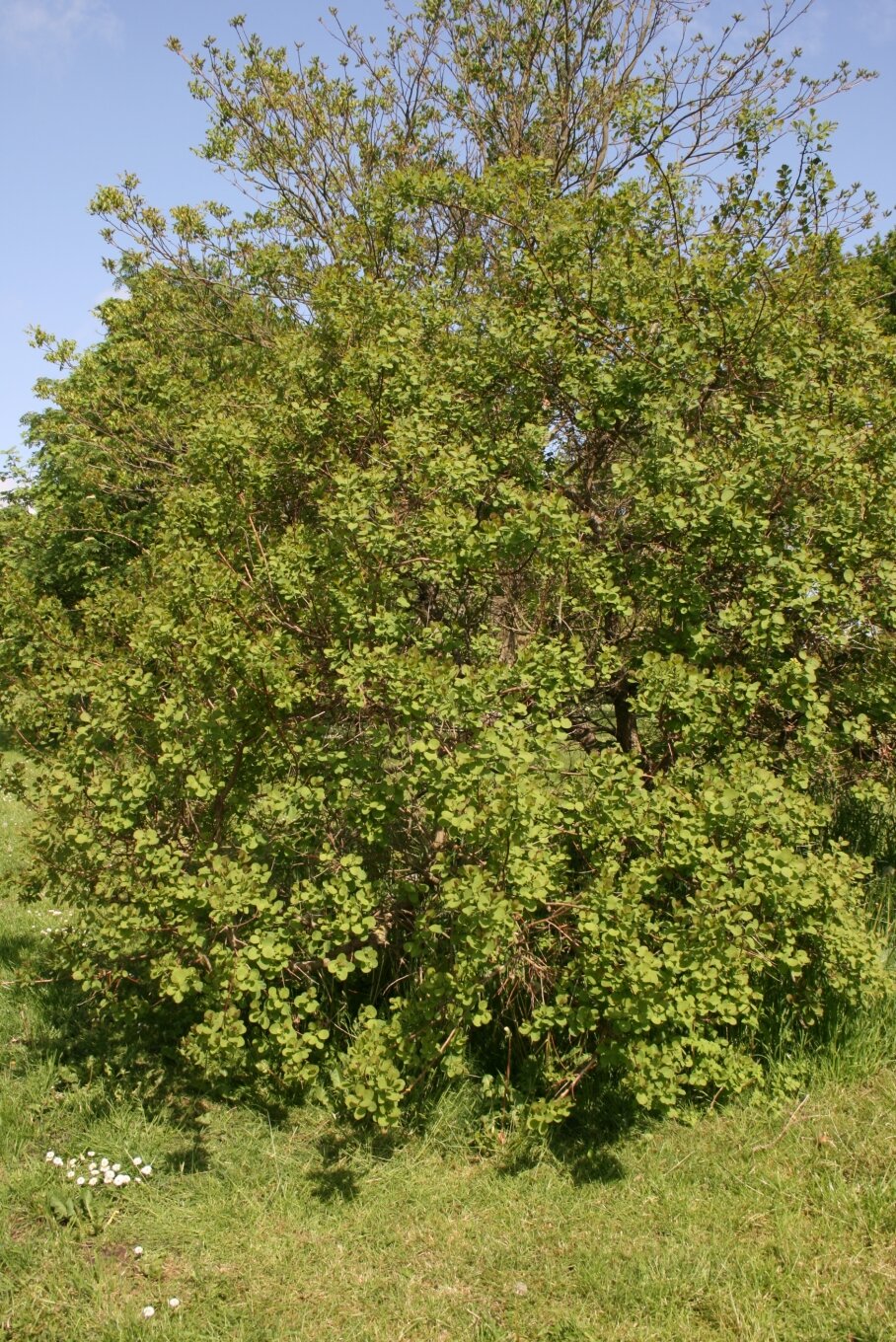
American smoketree
Cotinus obovatus
A limestone bluff specialist of restricted range. Rounded, blue-green leaves turn brilliant orange and red in fall; airy panicles of small flowers followed by feathery, smoke-like fruiting clusters give the species its name. Listed by the Tennessee Department of Environment and Conservation 2025 Rare Plant List.
Status: Native; Tennessee special-concern (S2/G4).
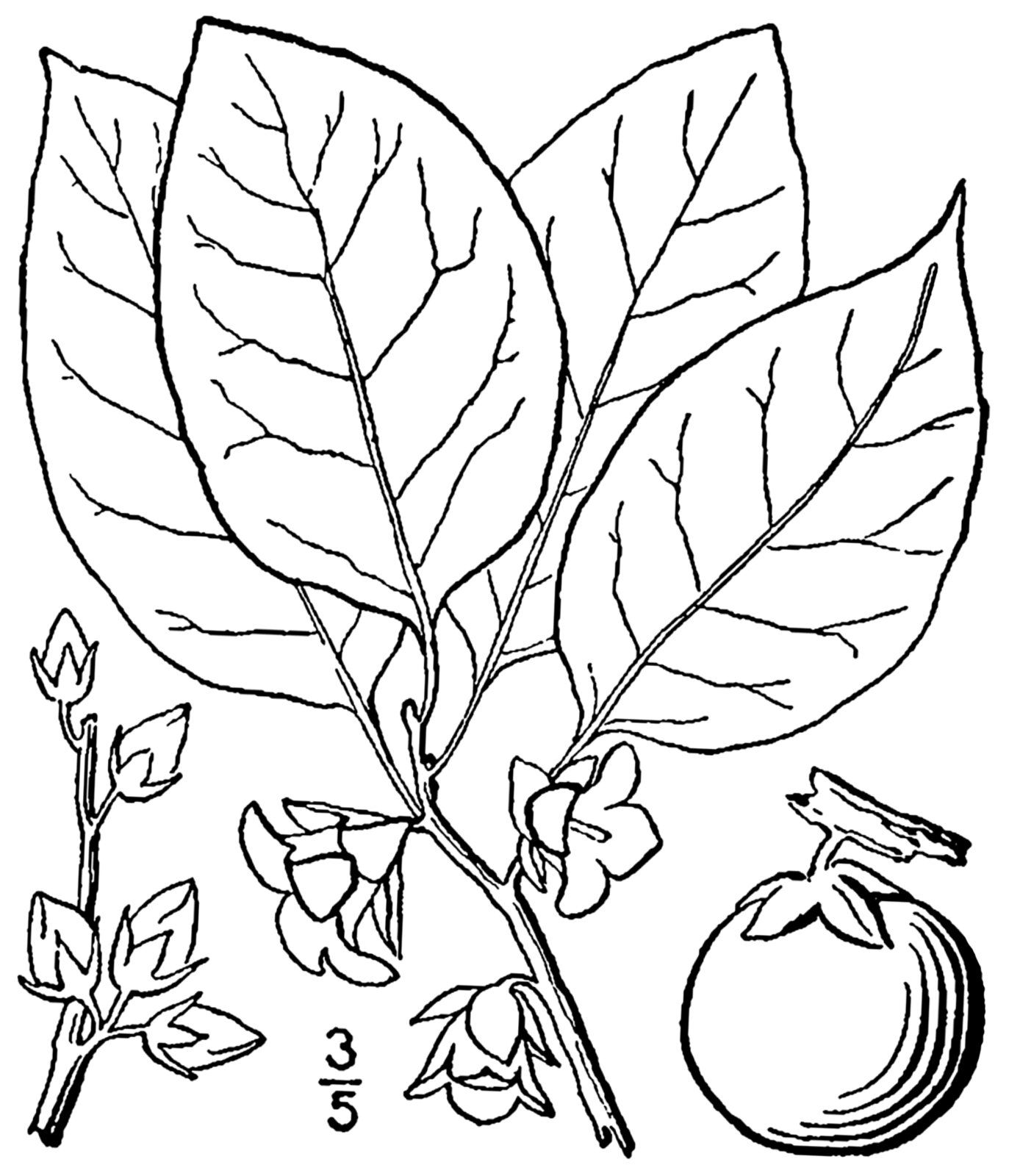
Persimmon
Diospyros virginiana
Distinctive blocky bark in small, alligator-skin squares. Orange fruits ripen after the first hard frost; unripe persimmons are extremely astringent. Common on old-field edges and dry uplands.
Status: Native, common.
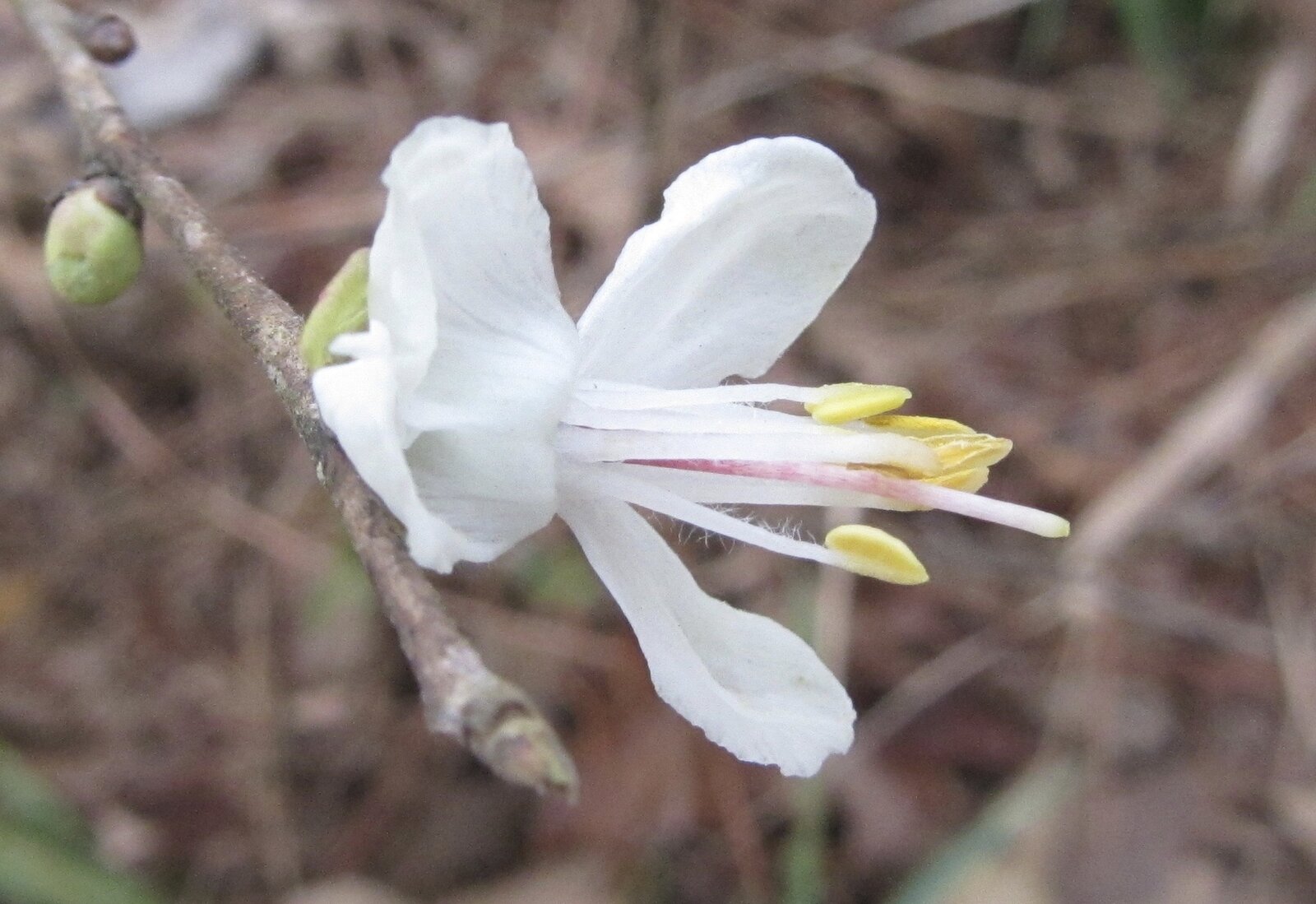
Mountain silverbell
Halesia carolina
Pendant white bell-shaped flowers along the branches in April, before the leaves are fully out. A cove understory tree of rich slopes.
Status: Native.
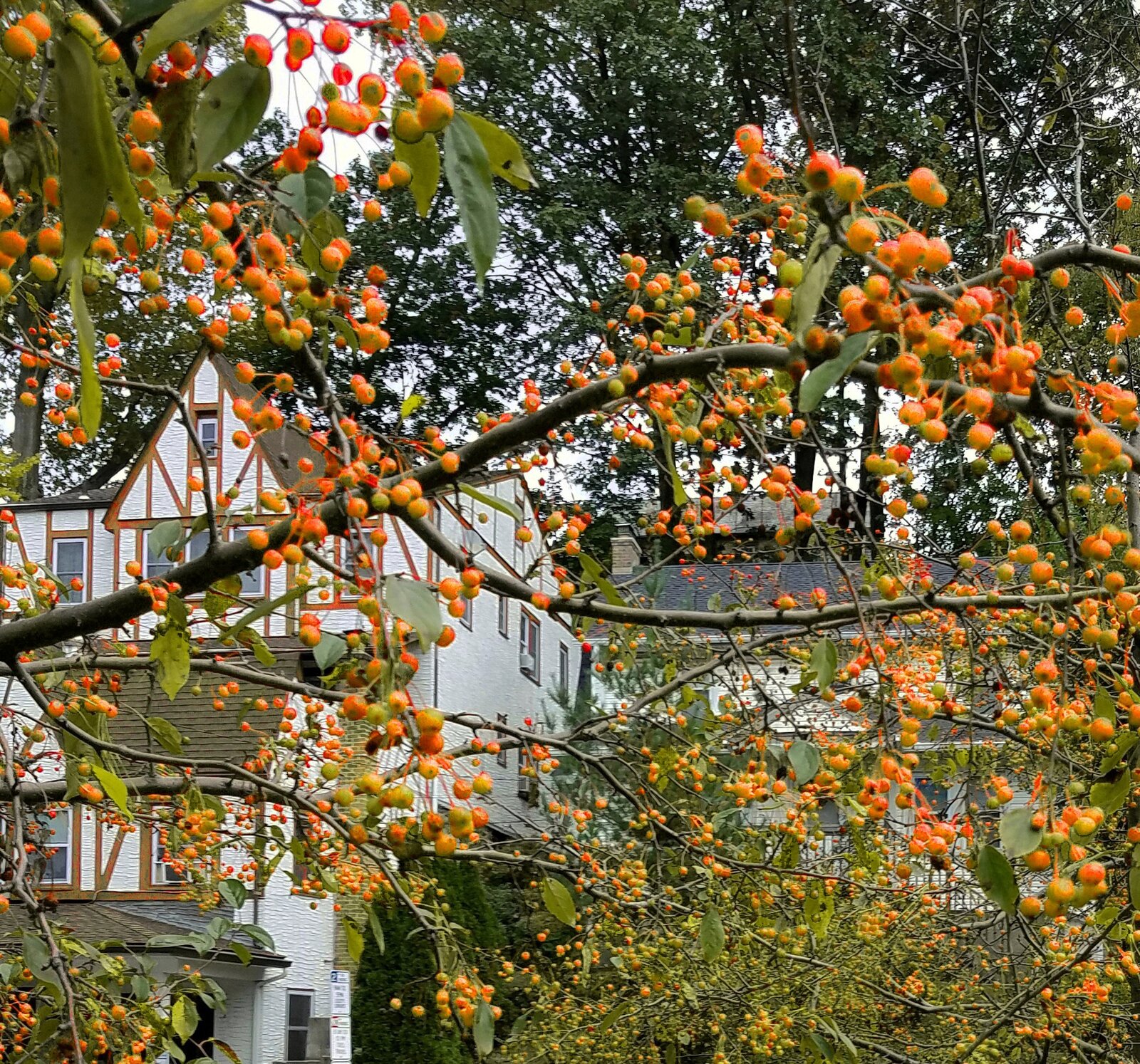
Southern crabapple
Malus angustifolia
A small native crabapple with intensely fragrant pink-and-white flowers in April and small hard yellow-green apples in fall. Old-field edges and woodland margins; sometimes spreads by root sprouts into thickets.
Status: Native.
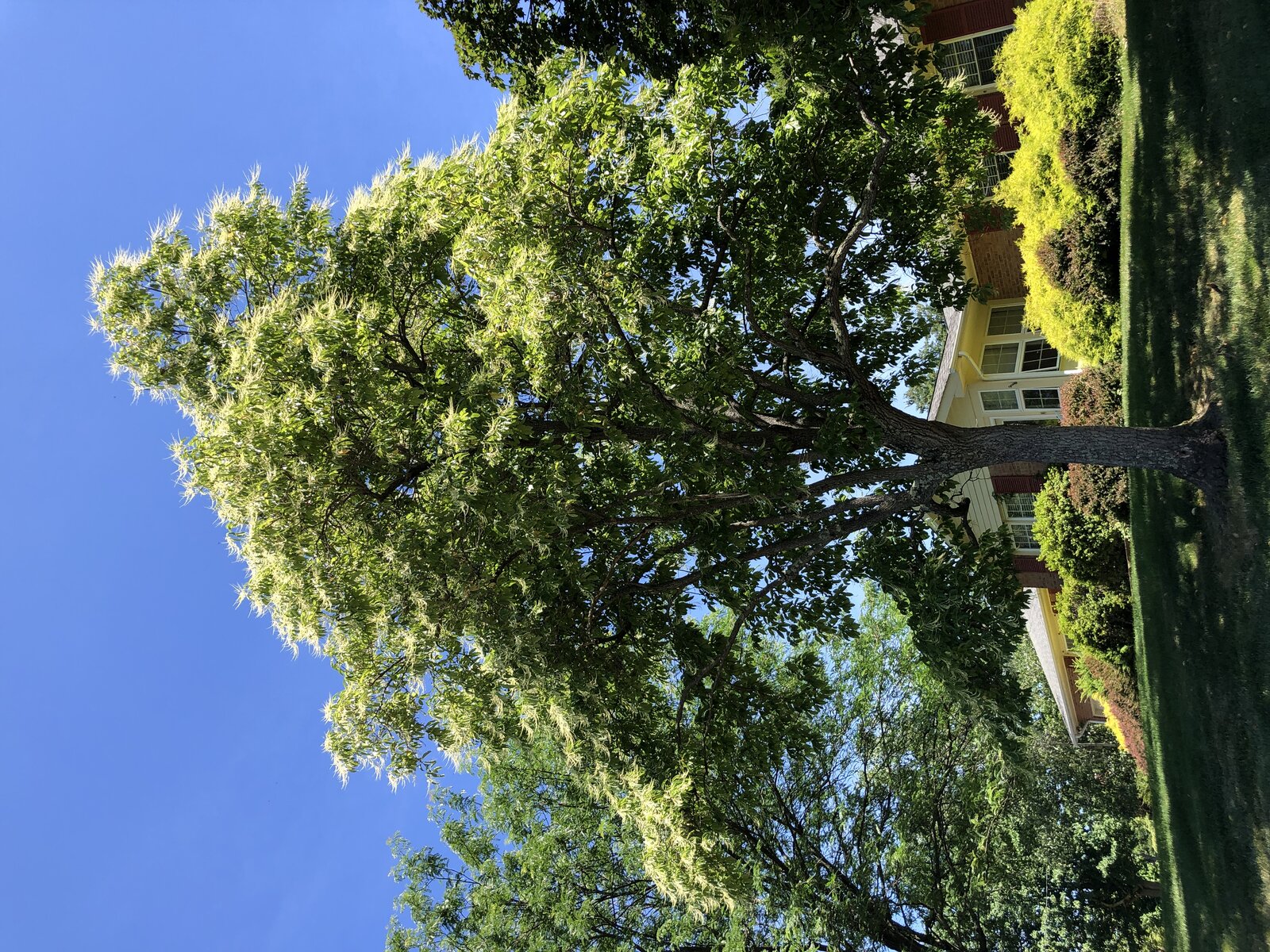
Sourwood
Oxydendrum arboreum
Long drooping panicles of small white urn-shaped flowers in summer, followed by persistent papery seed capsules into winter. Brilliant red autumn foliage. Sourwood honey, gathered from Appalachian bee yards placed near sourwood stands, commands premium prices and has been a cottage industry in Marion for generations.
Status: Native, common.
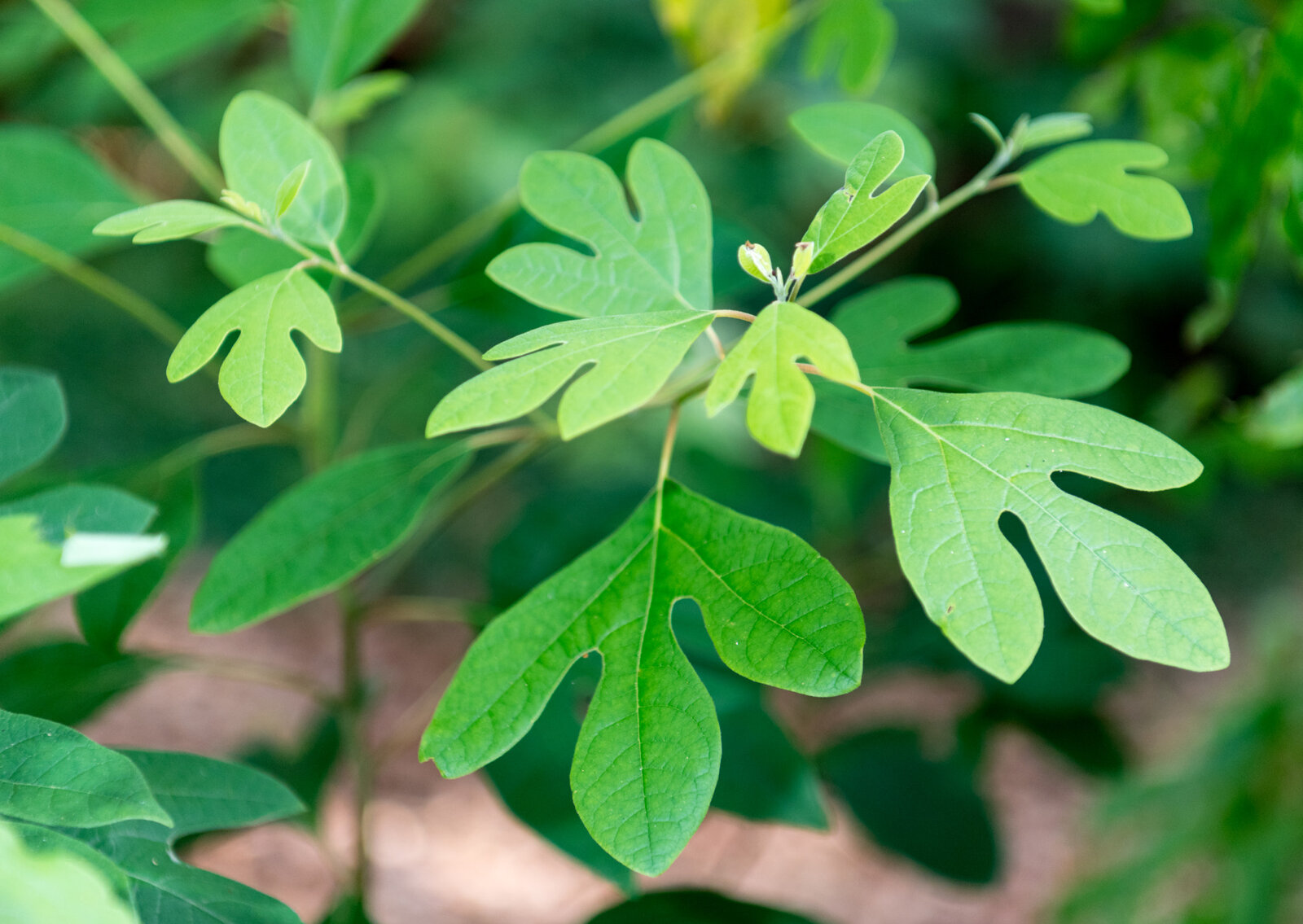
Sassafras
Sassafras albidum
The only local tree whose leaves come in three distinct shapes on the same branch: unlobed, mitten, and three-lobed "ghost." Roots are aromatic and were the original flavoring for root beer until safrole was banned from commercial food use in 1960. Pioneers of plateau old fields.
Status: Native, common.
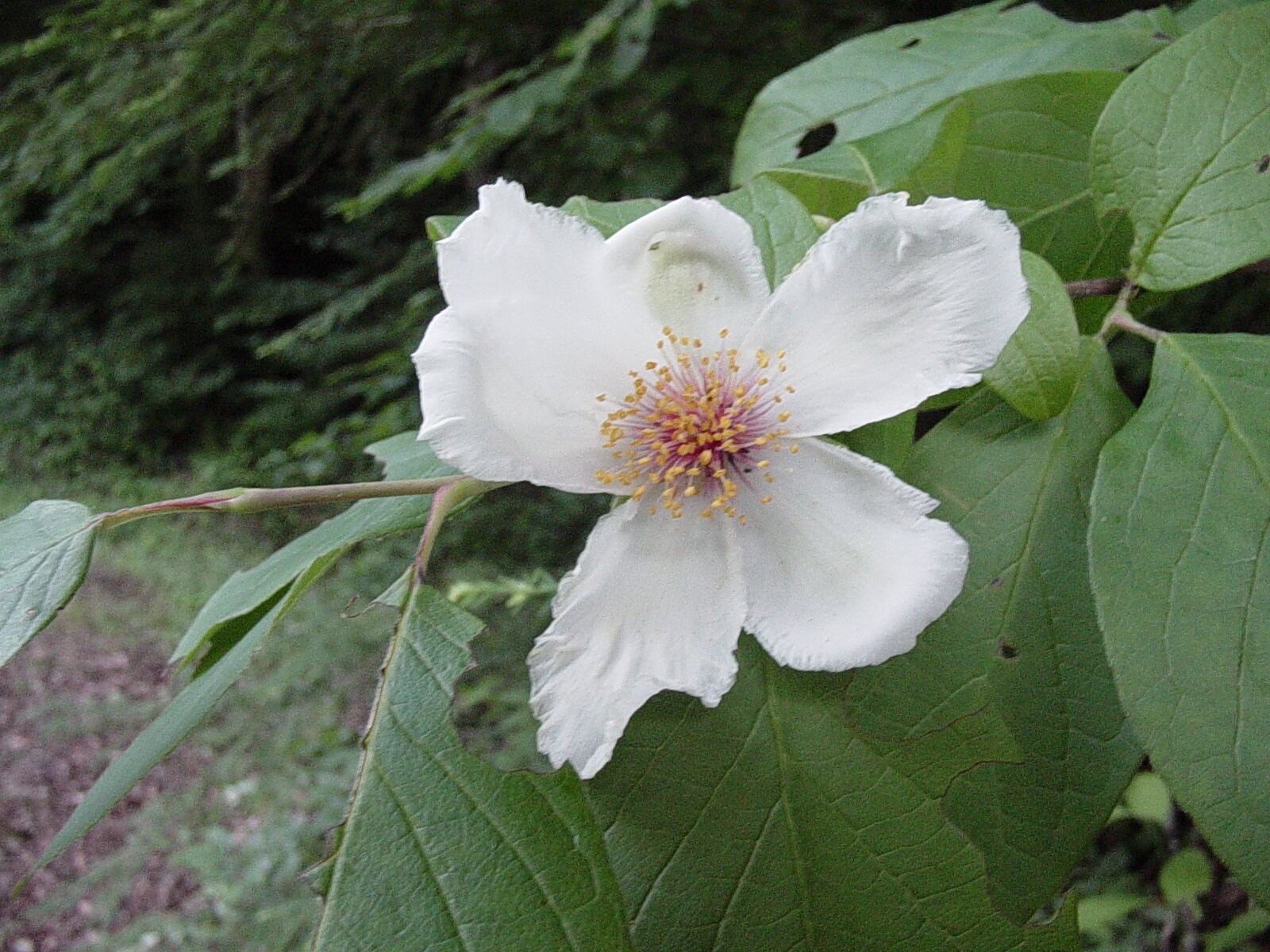
Mountain camellia
Stewartia ovata
A regional rarity. Large white camellia-like flowers with a central ring of orange stamens open in midsummer when most other woody plants are no longer flowering. Rich, moist slopes near limestone bluffs and along streams.
Status: Native; locally distinctive.
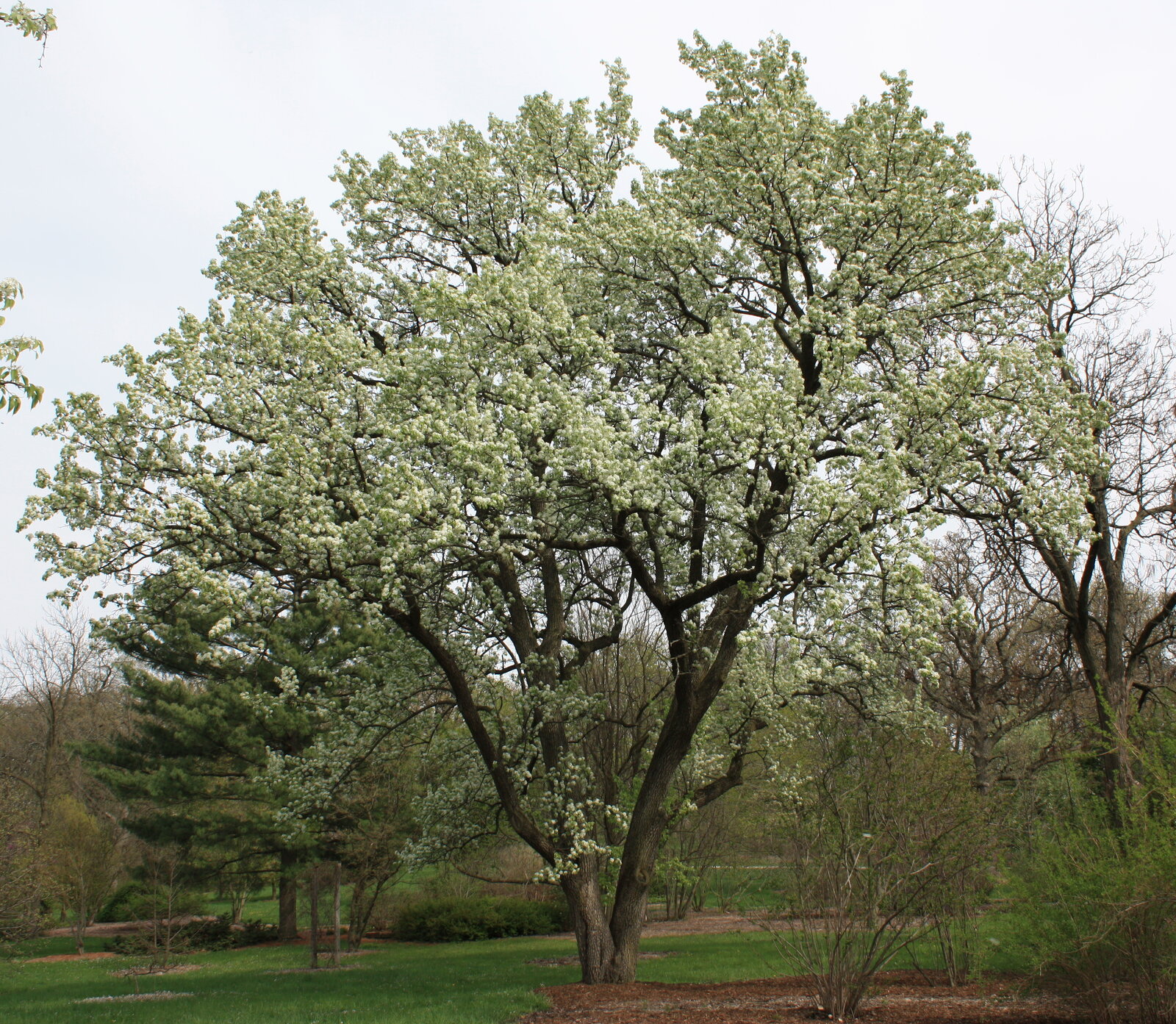
Callery pear
Pyrus calleryana
Cultivars including the once-popular Bradford pear. Showy white spring flowers and small hard fruit. The cultivars have hybridized, producing thorny fertile escapes that now dominate Marion fencerows, abandoned lots, and roadside thickets. Listed as a severe-threat invasive by the Tennessee Invasive Plant Council.
Status: Introduced; TN-IPC severe-threat invasive.
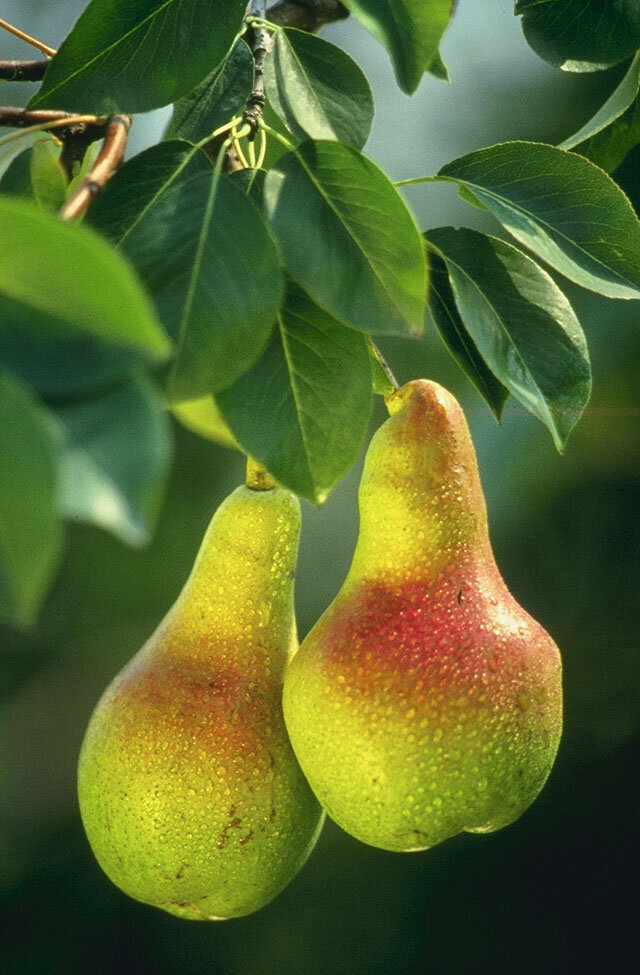
Common pear
Pyrus communis
The orchard pear, native to Europe and western Asia. Long-cultivated in Marion farmsteads; occasionally naturalizing from old plantings.
Status: Introduced; orchard species.
Ash and elm
Two genera, two epidemics. Dutch elm disease, caused by the fungus Ophiostoma novo-ulmi (and its predecessor O. ulmi) and spread by elm bark beetles, arrived in the United States in 1928 and devastated American elm populations from the 1930s through the 1960s, per the Wikipedia article on Dutch elm disease. Marion's mature American elms were largely lost in the same window. Younger trees still grow back from seed and from older root systems but rarely reach the vase-shaped maturity that defined the species before the disease.
The emerald ash borer (Agrilus planipennis), a green wood-boring beetle from East Asia, was first detected in Tennessee at a Knox County truck stop on Interstate 40 in July 2010, per a Tennessee Department of Agriculture press release. By 2020 sixty-five Tennessee counties were under EAB quarantine, and the Tennessee Department of Agriculture estimated five million urban ash trees in Tennessee at two billion dollars at risk and 261 million ash trees on Tennessee timberland at nine billion dollars at risk. Most of Marion County's mature ash trees have died in the years since.
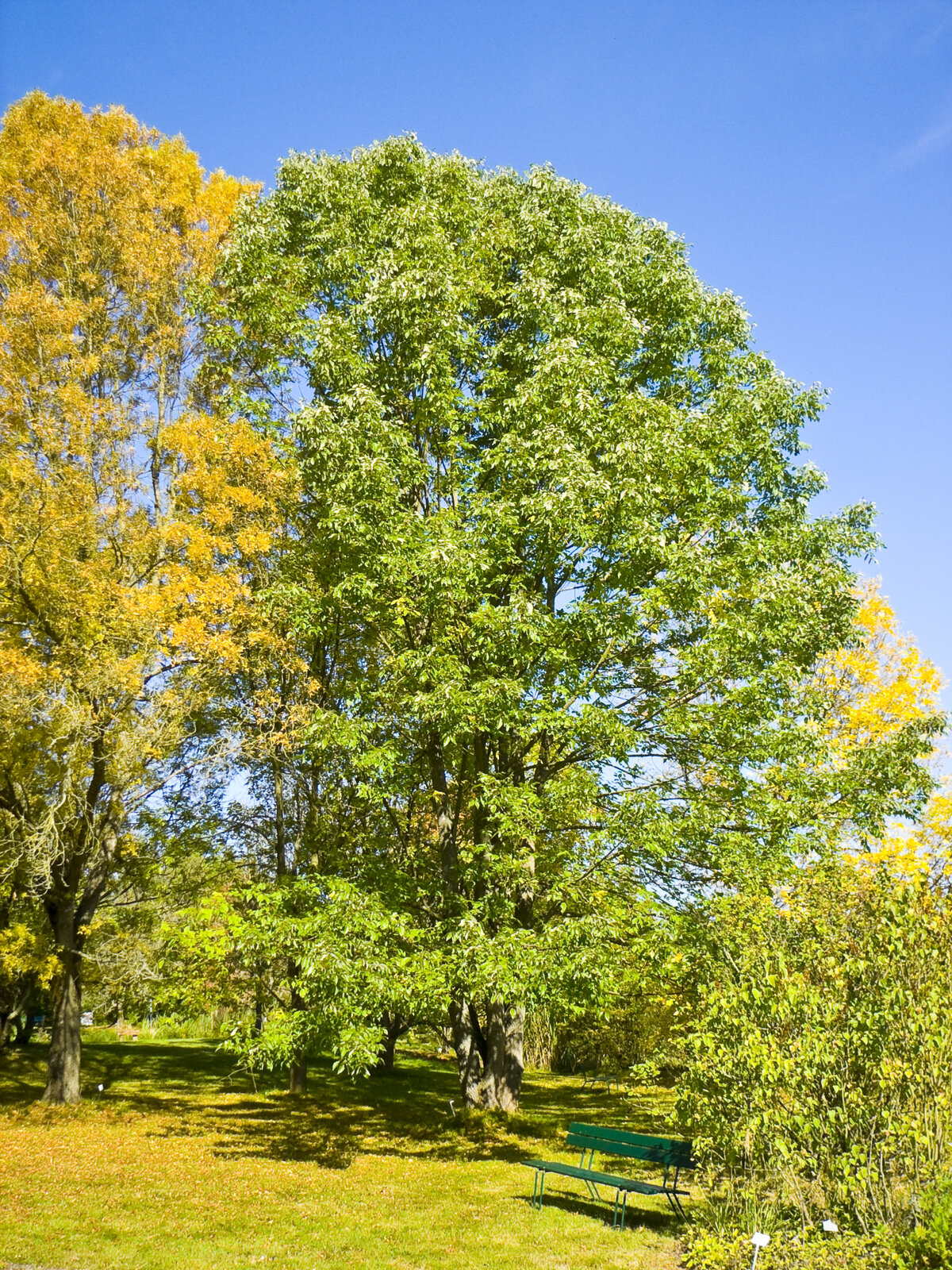
White ash
Fraxinus americana
Pinnately compound leaves with five to nine leaflets and diamond-furrowed bark. The traditional wood for baseball bats, tool handles, and canoe paddles. Most mature trees in Marion have been killed by emerald ash borer.
Status: Native; severely affected by EAB.
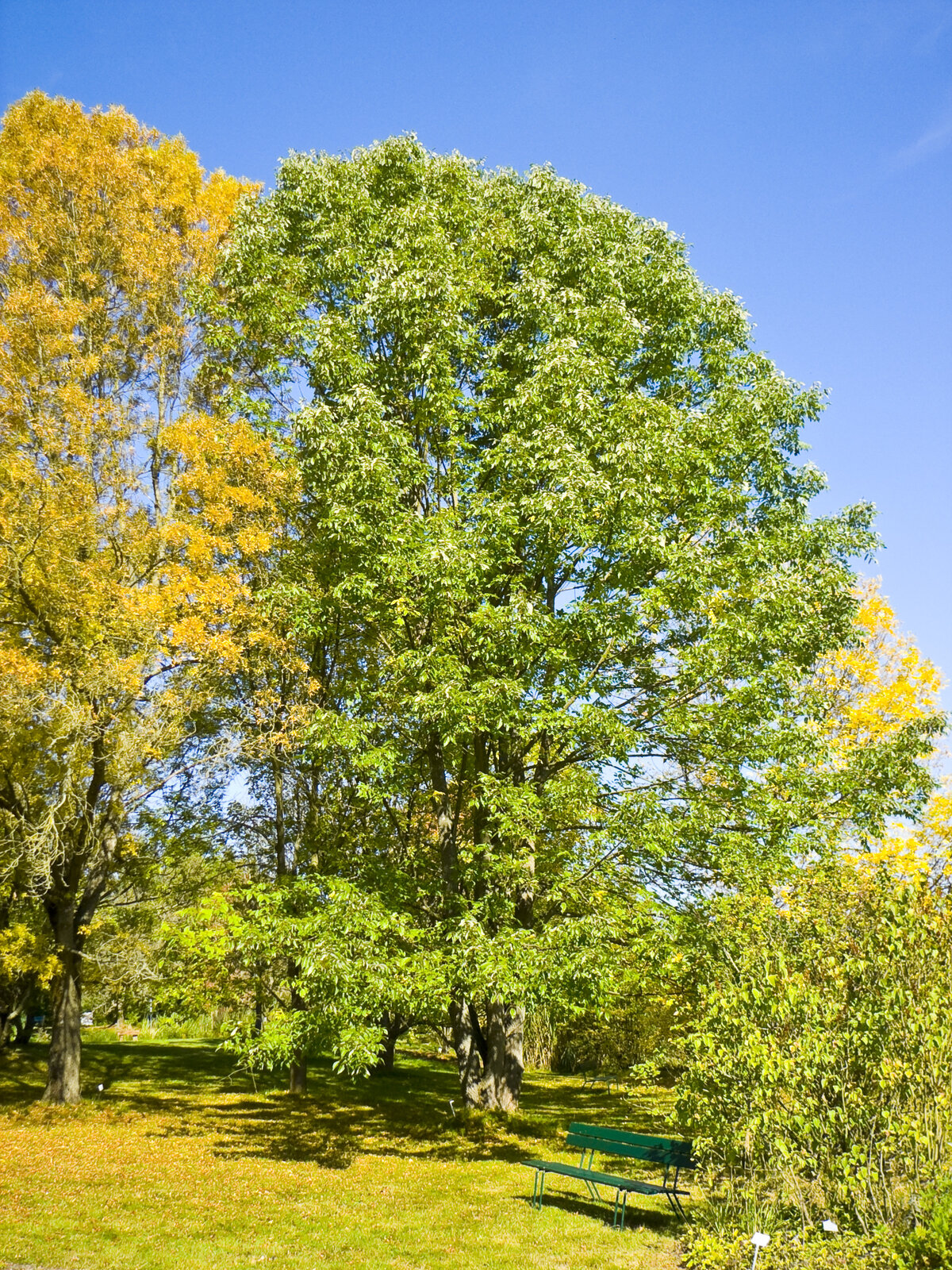
Biltmore white ash
Fraxinus biltmoreana
A rare segregate from the white ash complex, sometimes treated as a variety of F. americana. Slightly hairier young twigs and leaves; otherwise similar to white ash. Affected by EAB along with the rest of the ash genus.
Status: Native; rare segregate.
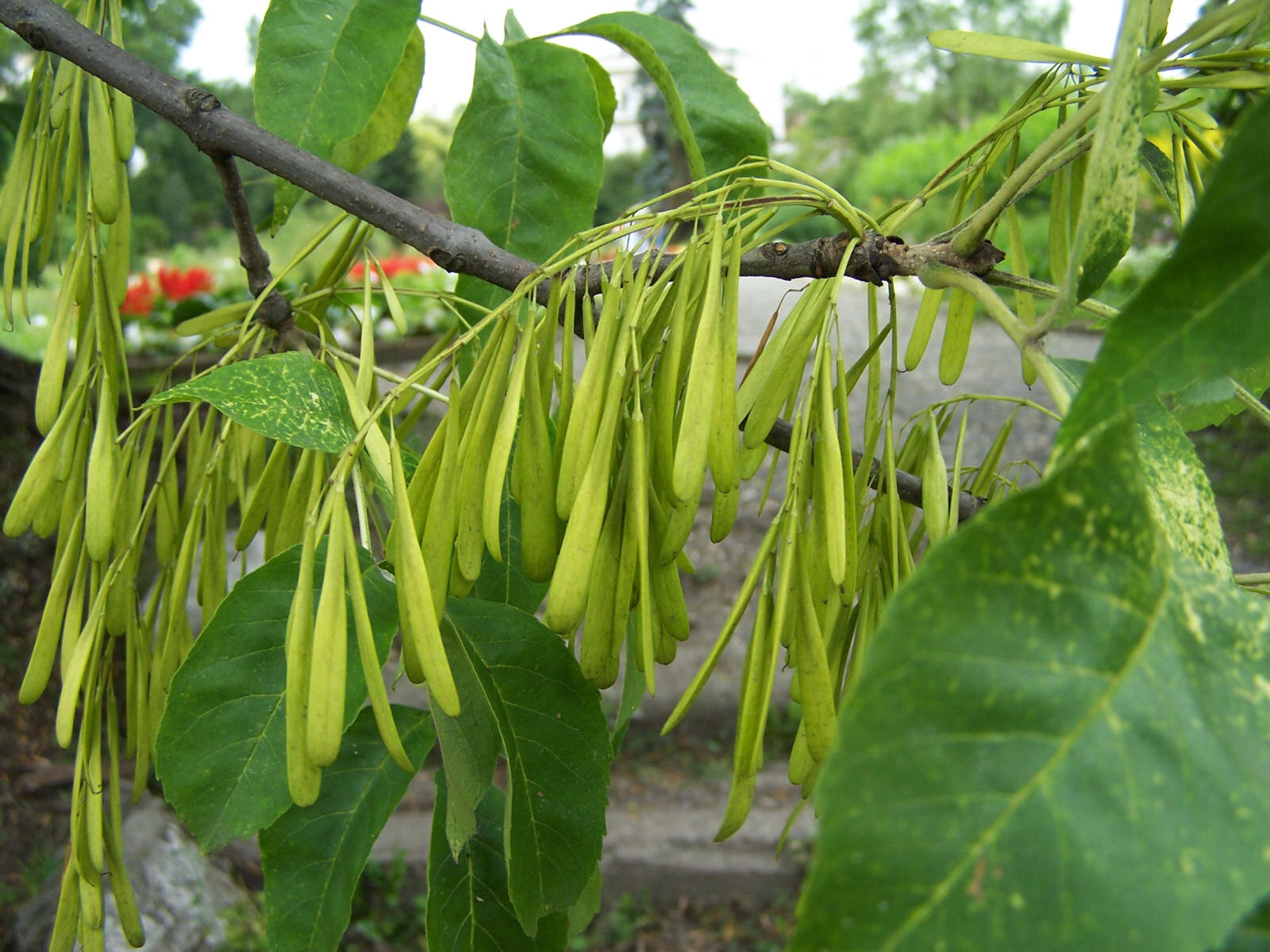
Green ash
Fraxinus pennsylvanica
The bottomland ash. Smaller and more flood-tolerant than white ash; once one of the most widely planted urban shade trees in the eastern United States. Most mature trees in Marion bottomlands have been killed by EAB since 2010.
Status: Native; severely affected by EAB.
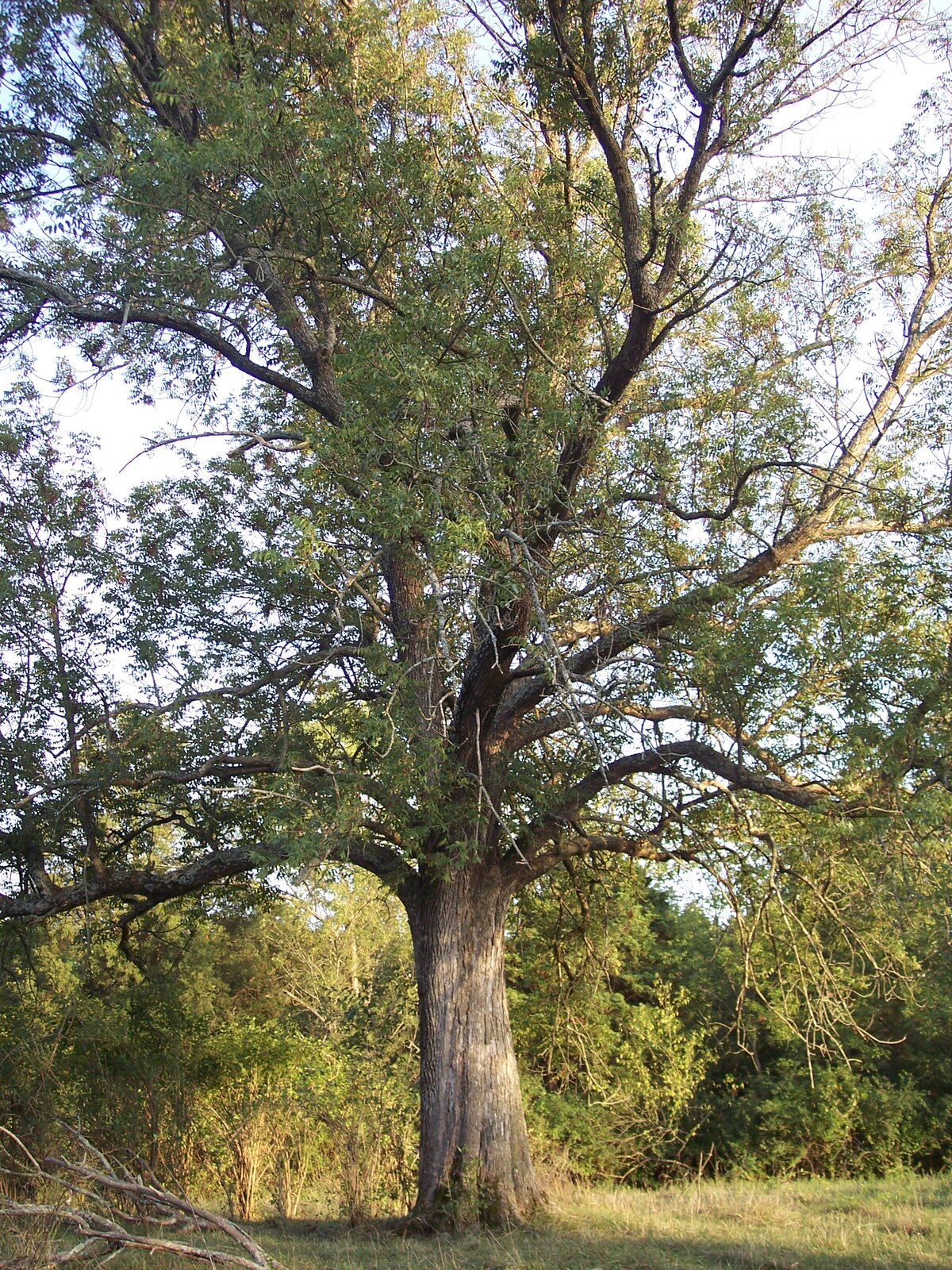
Blue ash
Fraxinus quadrangulata
A limestone-loving ash with four-angled or winged twigs (run a finger along a young branchlet to check). Calcareous bluffs and slopes in the Sequatchie Valley. The inner bark turns blue when crushed and steeped, the source of a historic dye and the species' common name.
Status: Native; affected by EAB but apparently more resistant than white or green ash.
Smalls white ash
Fraxinus smallii
A rare segregate from the white ash complex described from the southeastern interior; some authorities treat it as a variety or synonym of F. americana. Photo not yet sourced.
Status: Native; rare segregate.
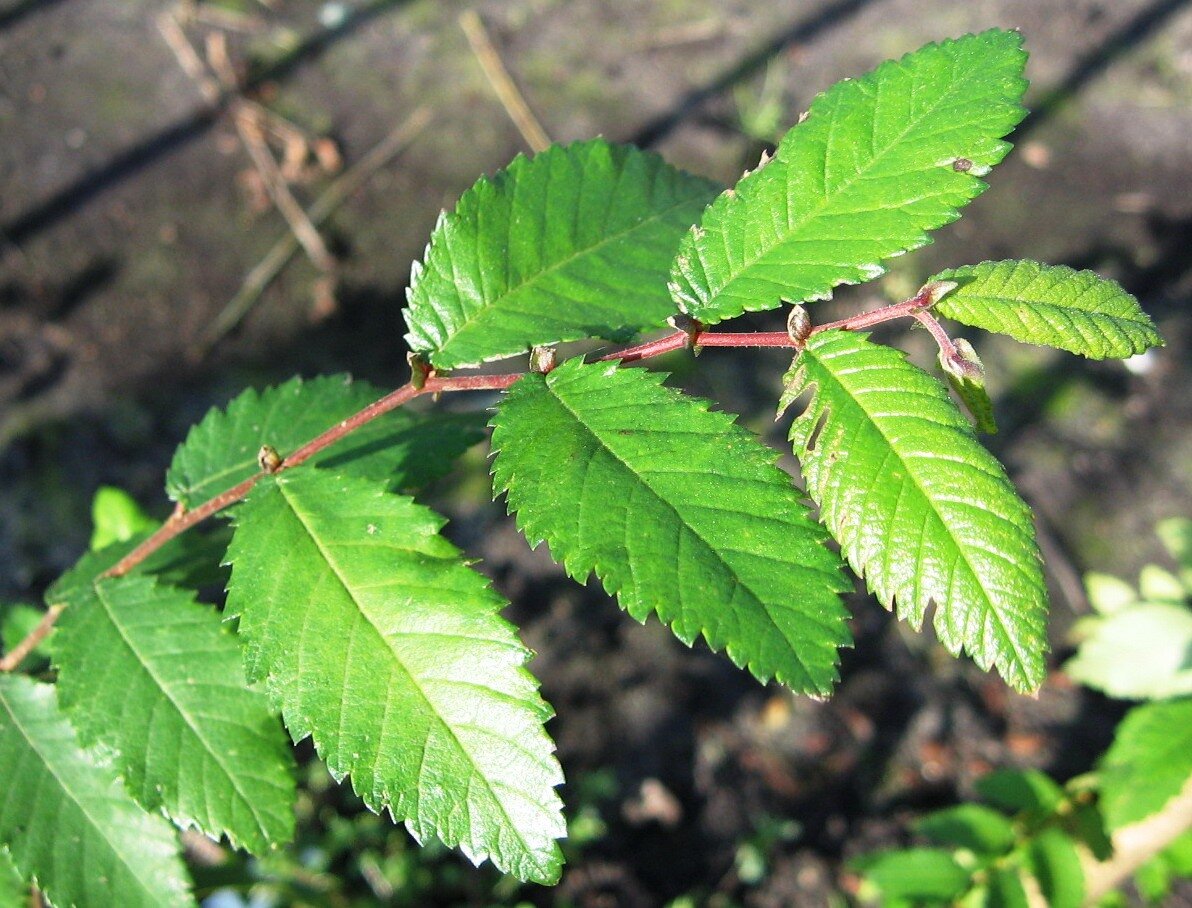
Winged elm
Ulmus alata
Distinctive corky flanges or "wings" running along younger twigs. Smaller than American elm and less affected by Dutch elm disease. Common on dry uplands and old fencerows.
Status: Native, common.
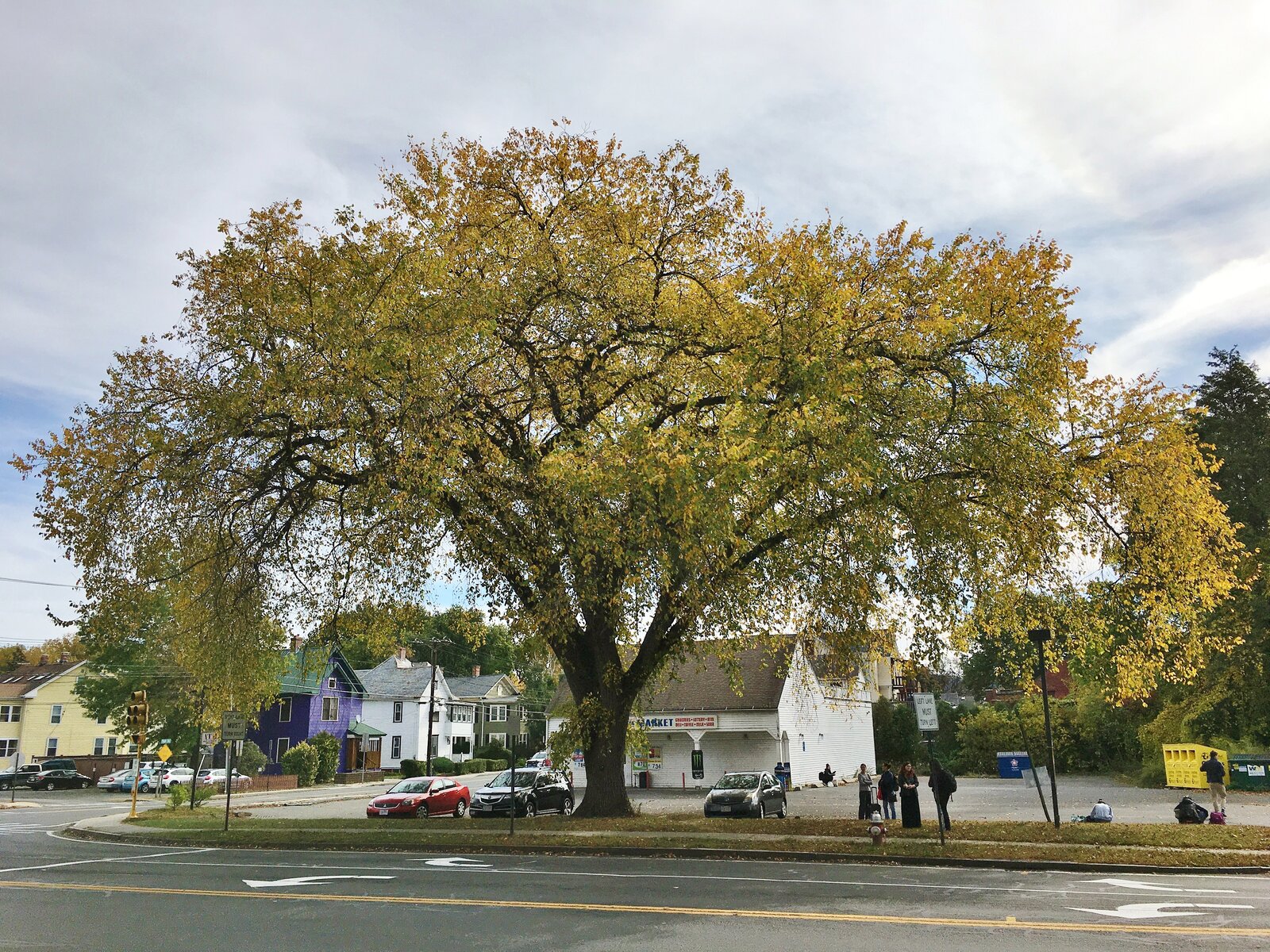
American elm
Ulmus americana
The vase-shaped shade tree of pre-Dutch-elm-disease American towns. Older Marion specimens were lost in the mid-twentieth century; younger seedlings and root sprouts persist but most are killed before reaching mature size.
Status: Native; severely affected by Dutch elm disease.
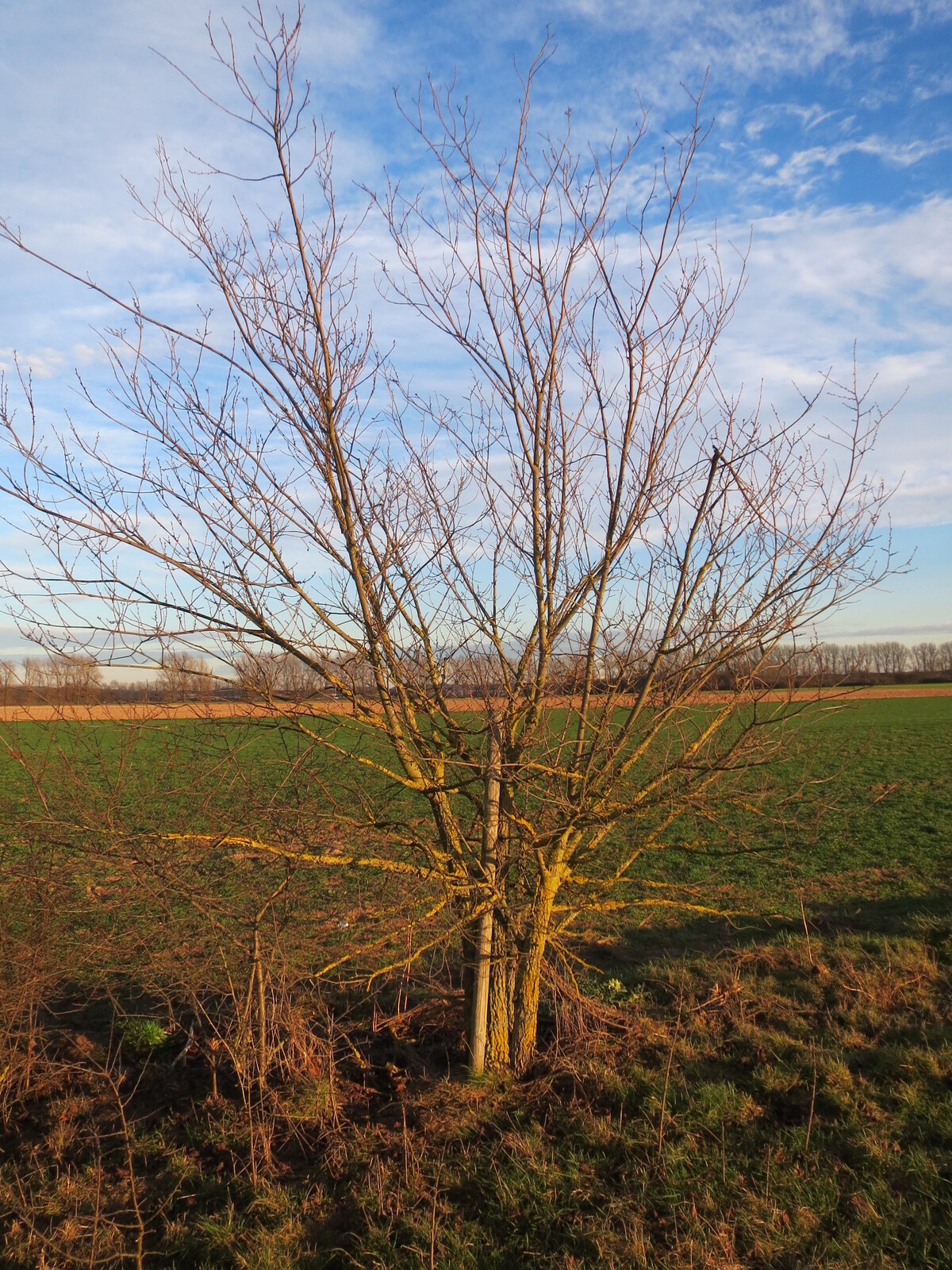
English elm
Ulmus minor
A European elm planted occasionally as a shade tree in 19th-century towns. Rare in Marion; surviving specimens are uncommon.
Status: Introduced; rare.
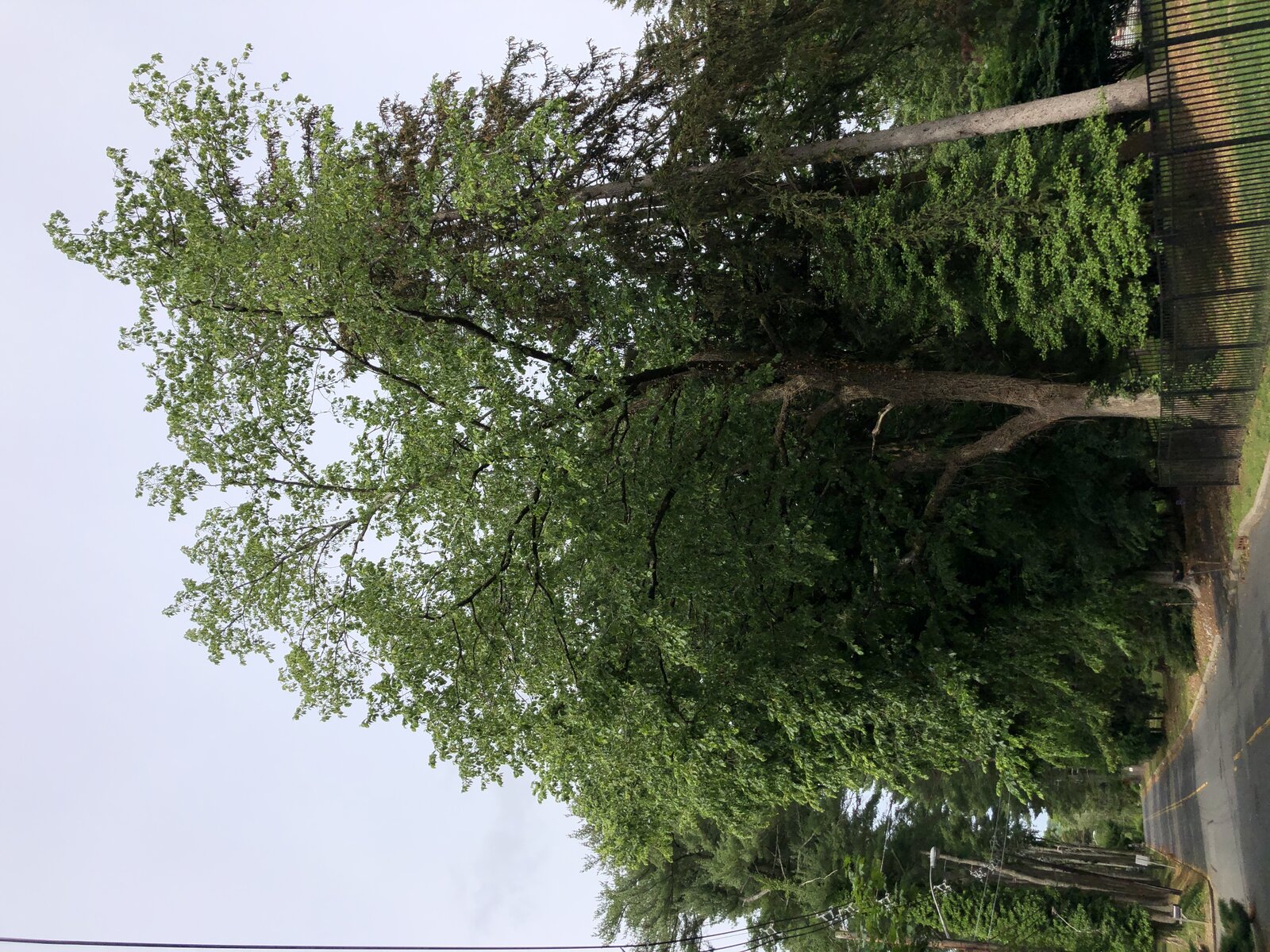
Slippery elm
Ulmus rubra
Coarse, sandpaper-rough upper leaf surfaces and a mucilaginous inner bark long used as a folk-medicine throat lozenge. Common on bottomland slopes and stream margins. Affected by Dutch elm disease but somewhat more resistant than American elm.
Status: Native; affected by Dutch elm disease.
Other notable trees
A handful of native and naturalized trees that don't fit the previous groupings: the hackberries and sugarberry of bottomlands and limestone bluffs, the long-fenced hedge species osage orange and black locust, the catalpa with its big white-orchid flowers, honey locust, red mulberry, and the rare European alder buckthorn.
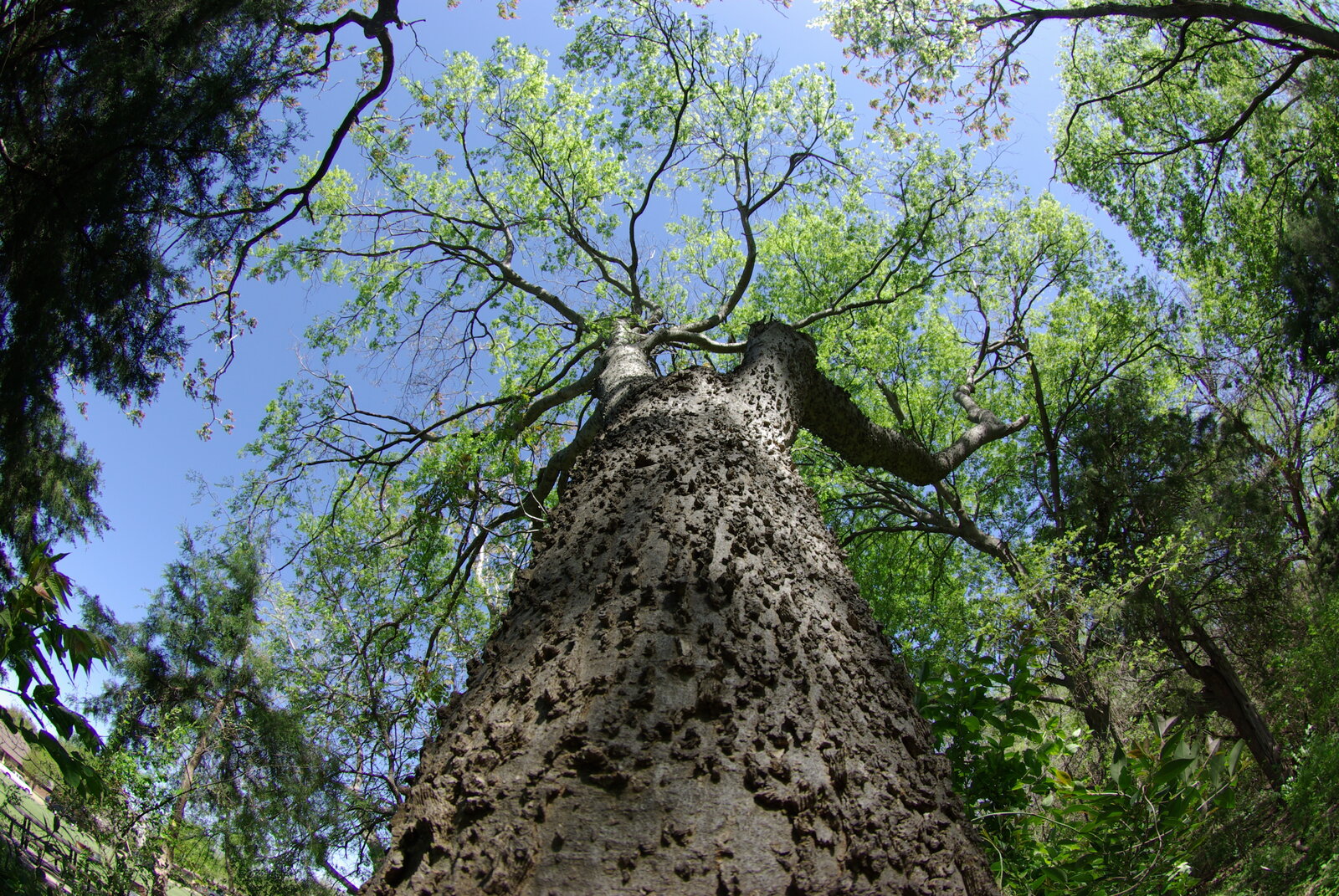
Sugarberry
Celtis laevigata
Also called southern hackberry. Smooth lance-shaped leaves and pale gray bark with scattered corky warts (less prominent than on hackberry). Bottomland and lower-slope species.
Status: Native.
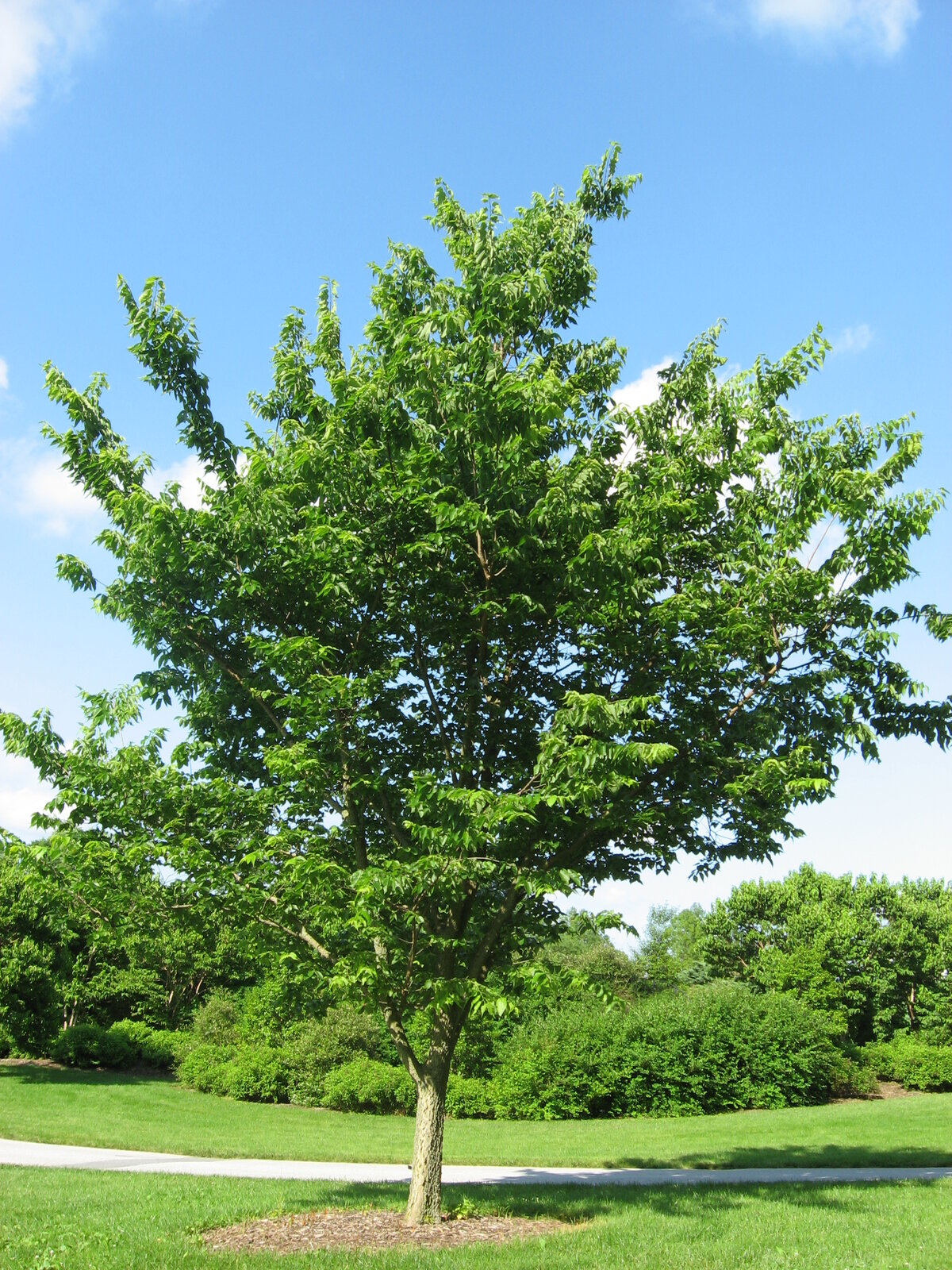
Hackberry
Celtis occidentalis
Distinctive corky-warty gray bark and rough-textured asymmetric leaves. Small orange-red drupes ripen in fall and are eaten by birds. A common tree of bottomlands, fencerows, and old-field edges.
Status: Native, common.
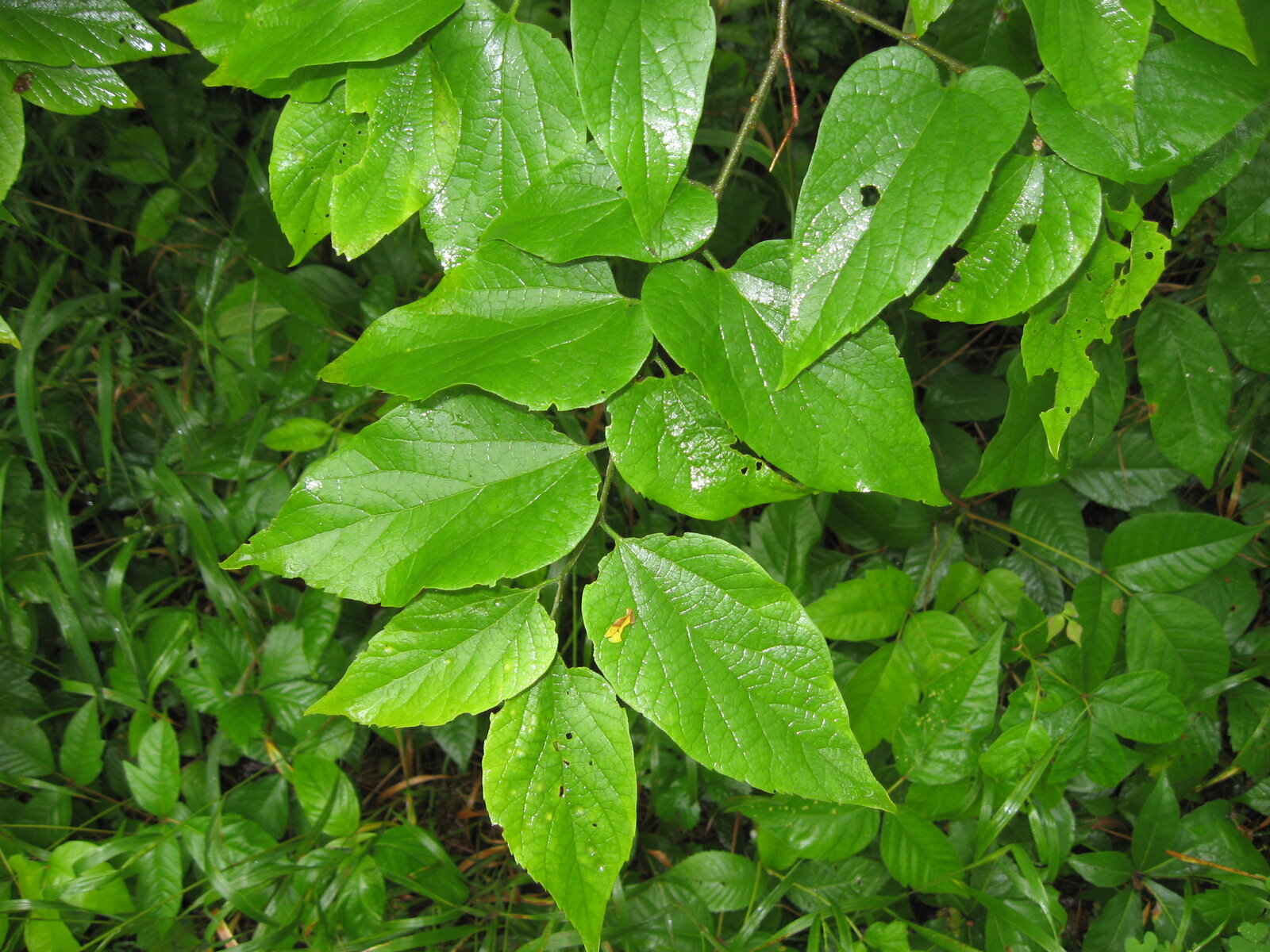
Dwarf hackberry
Celtis pumila
A limestone-bluff small tree, sometimes treated as a variety of hackberry (C. tenuifolia in some treatments). Smaller stature, smaller leaves, and a preference for thin calcareous soils.
Status: Native.
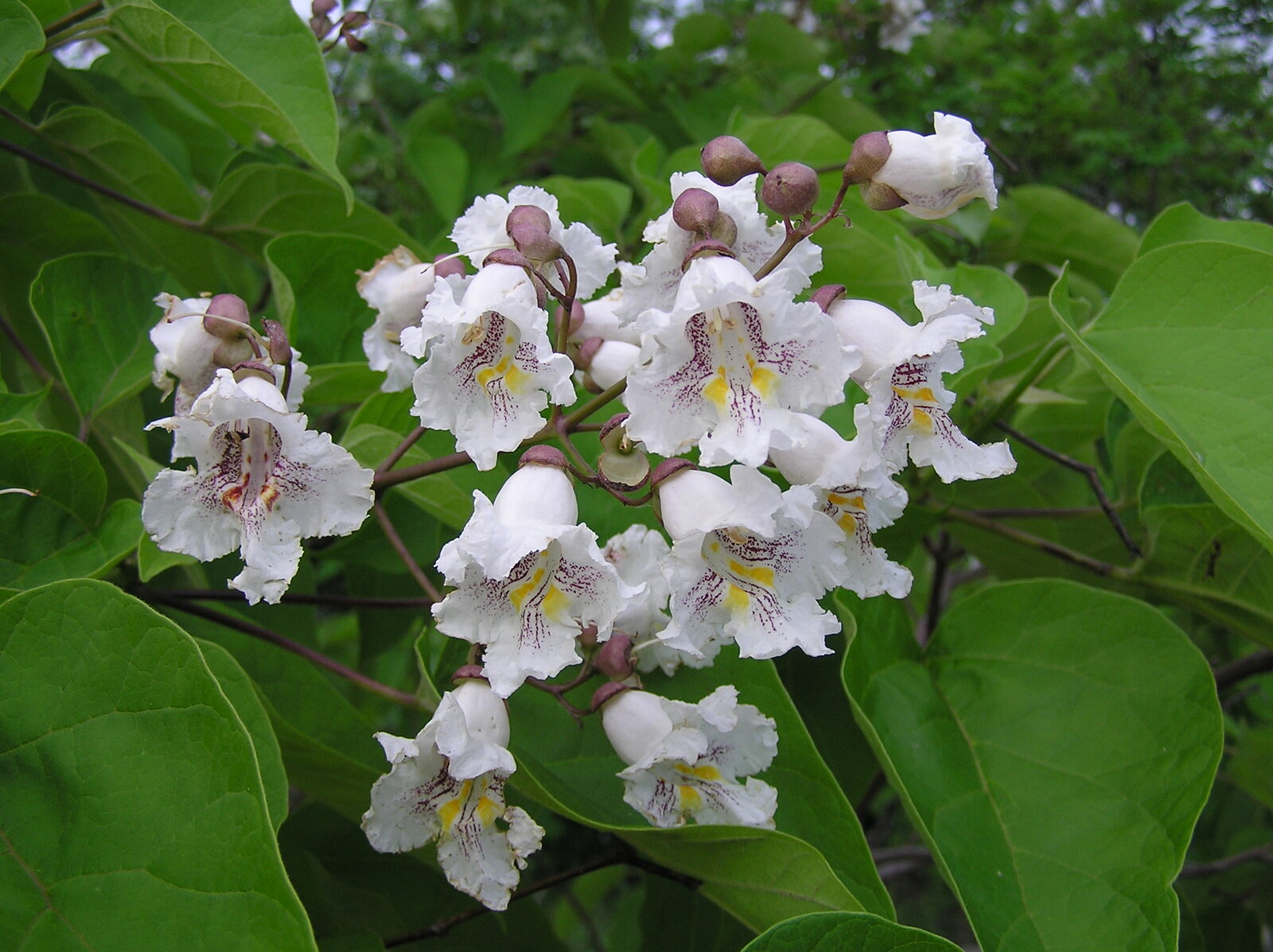
Southern catalpa
Catalpa bignonioides
Large heart-shaped leaves and showy upright clusters of white orchid-like flowers in late spring. Long, slender bean pods follow and persist through winter. Native to the southeastern Coastal Plain; planted across Marion and frequently naturalizing.
Status: Native to the lower South; planted and naturalized in Marion.
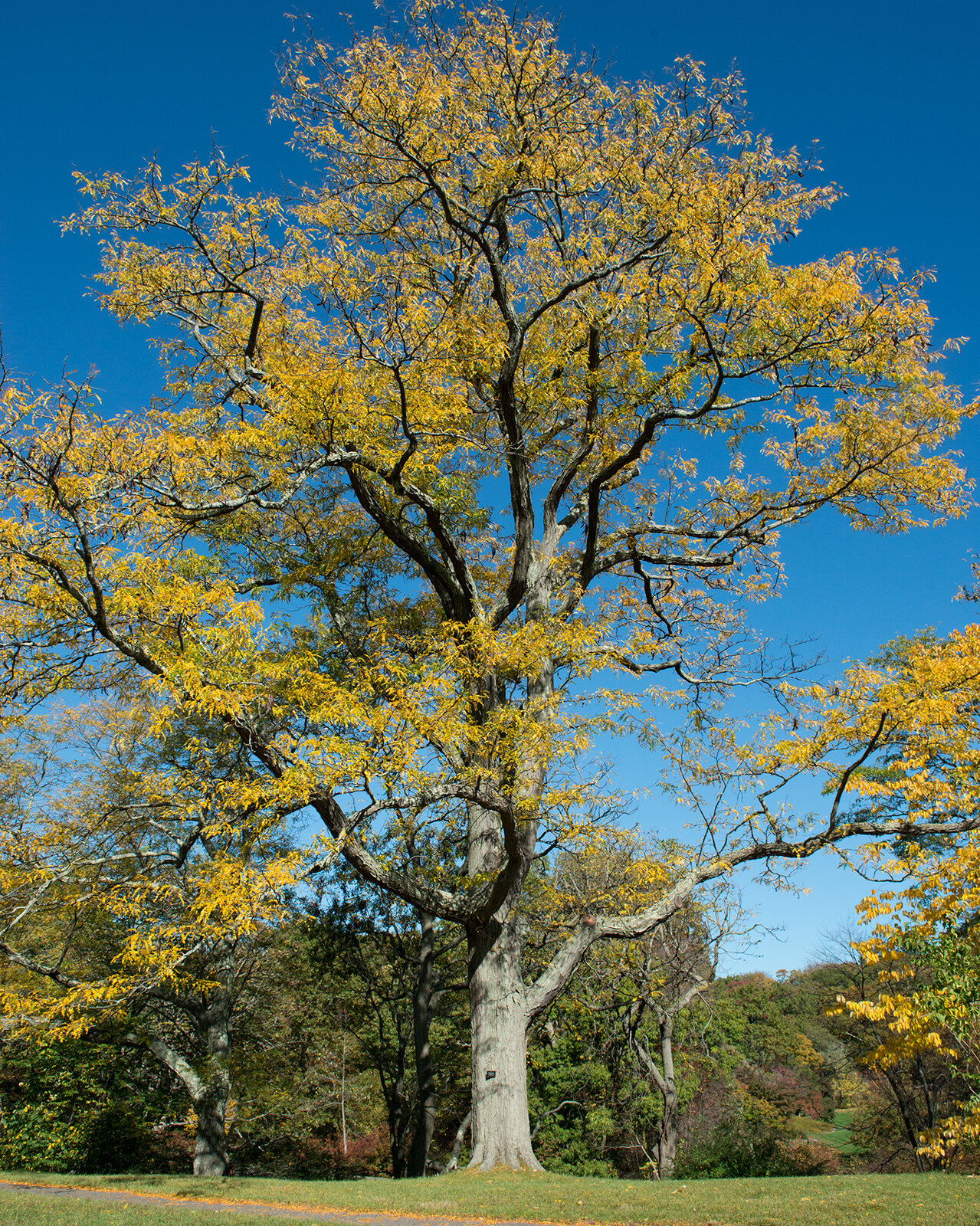
Honey-locust
Gleditsia triacanthos
Long, branched thorns on the trunk and main limbs (absent on cultivated thornless varieties), pinnately or bipinnately compound leaves, and long, twisted dark-brown bean pods that persist into winter. Common on calcareous bottoms and disturbed ground.
Status: Native, common.
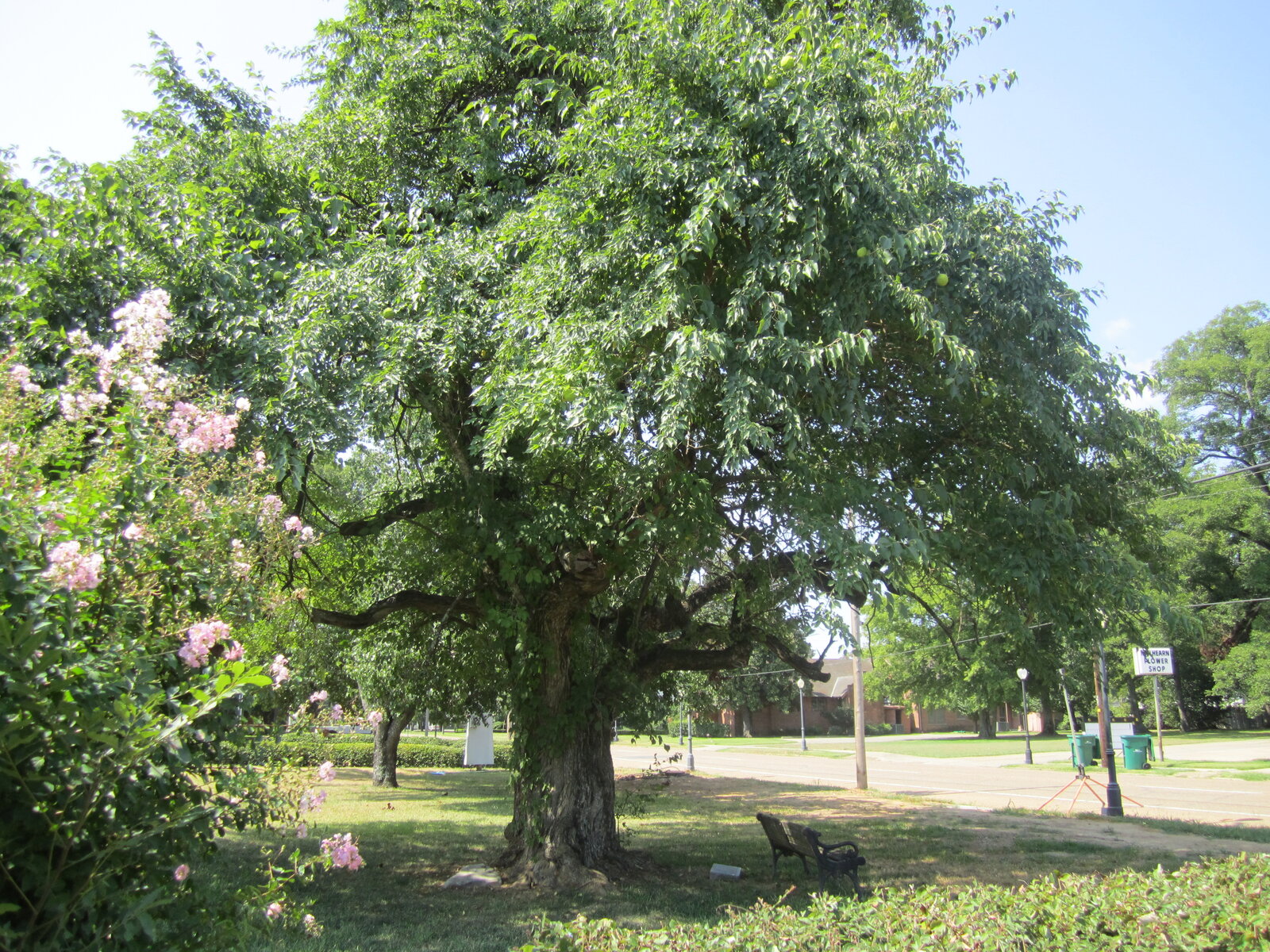
Osage orange
Maclura pomifera
Native to the south-central plains and widely planted east of its range as a livestock-proof hedge in the decades before the spread of barbed wire. Stout sharp thorns and softball-sized green fruits ("hedge apples"). Wood is exceptionally rot-resistant and was the standard for fence posts. Persists in old fencerows long after the hedges have grown out.
Status: Native to the plains; long-naturalized in Marion fencerows.
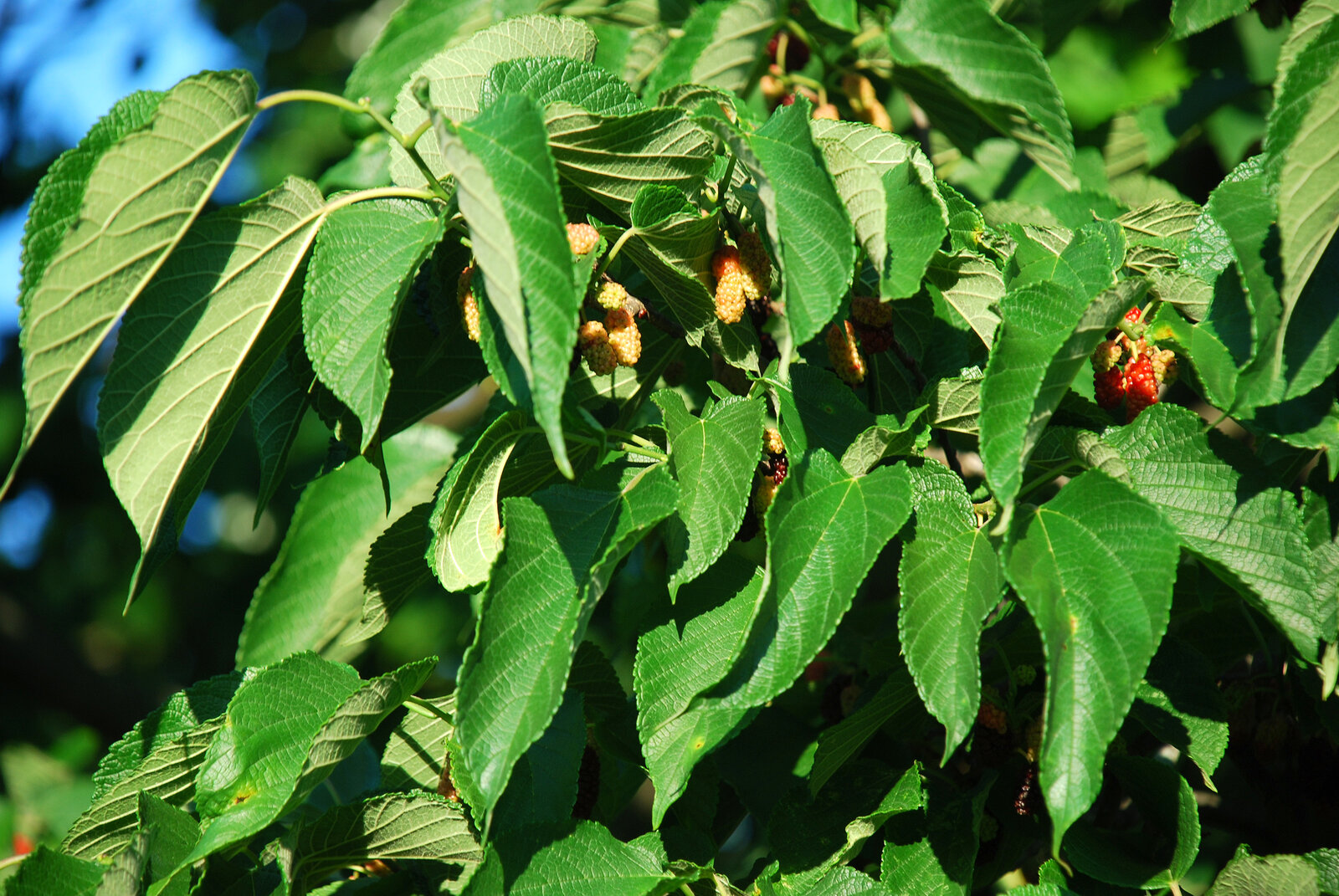
Red mulberry
Morus rubra
Native mulberry with dark red to purple fruit ripening in early summer. Hybridizes with the introduced white mulberry where the two species meet, and the native species' integrity is locally compromised. Rough, sandpaper-textured leaves.
Status: Native; hybridizing with white mulberry.
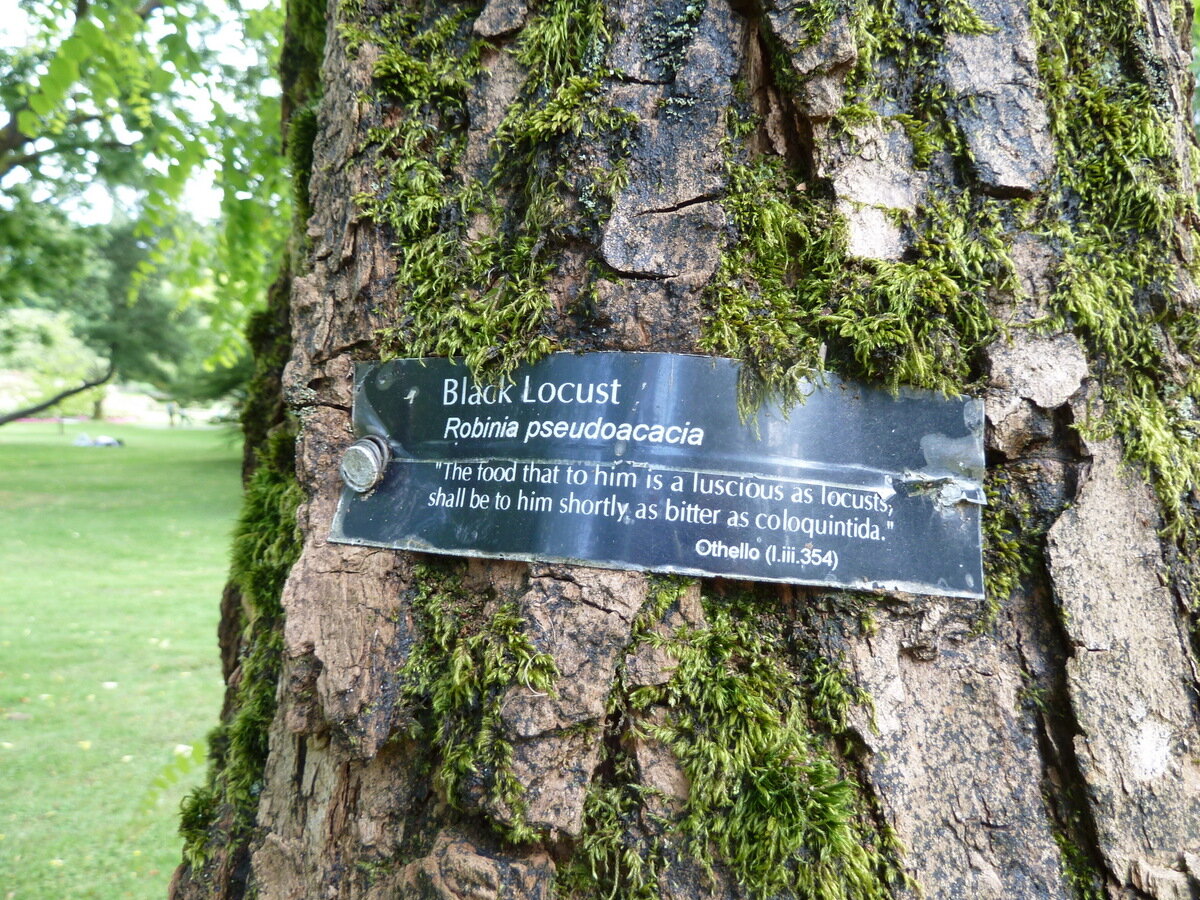
Black locust
Robinia pseudoacacia
A nitrogen-fixing legume tree of disturbed ground and old fencerows. Pinnately compound leaves with rounded leaflets, stout paired spines at the leaf nodes, and long pendant clusters of fragrant white pea-flowers in May. Heartwood is exceptionally rot-resistant; black locust fence posts can stand a century in the ground.
Status: Native, common.
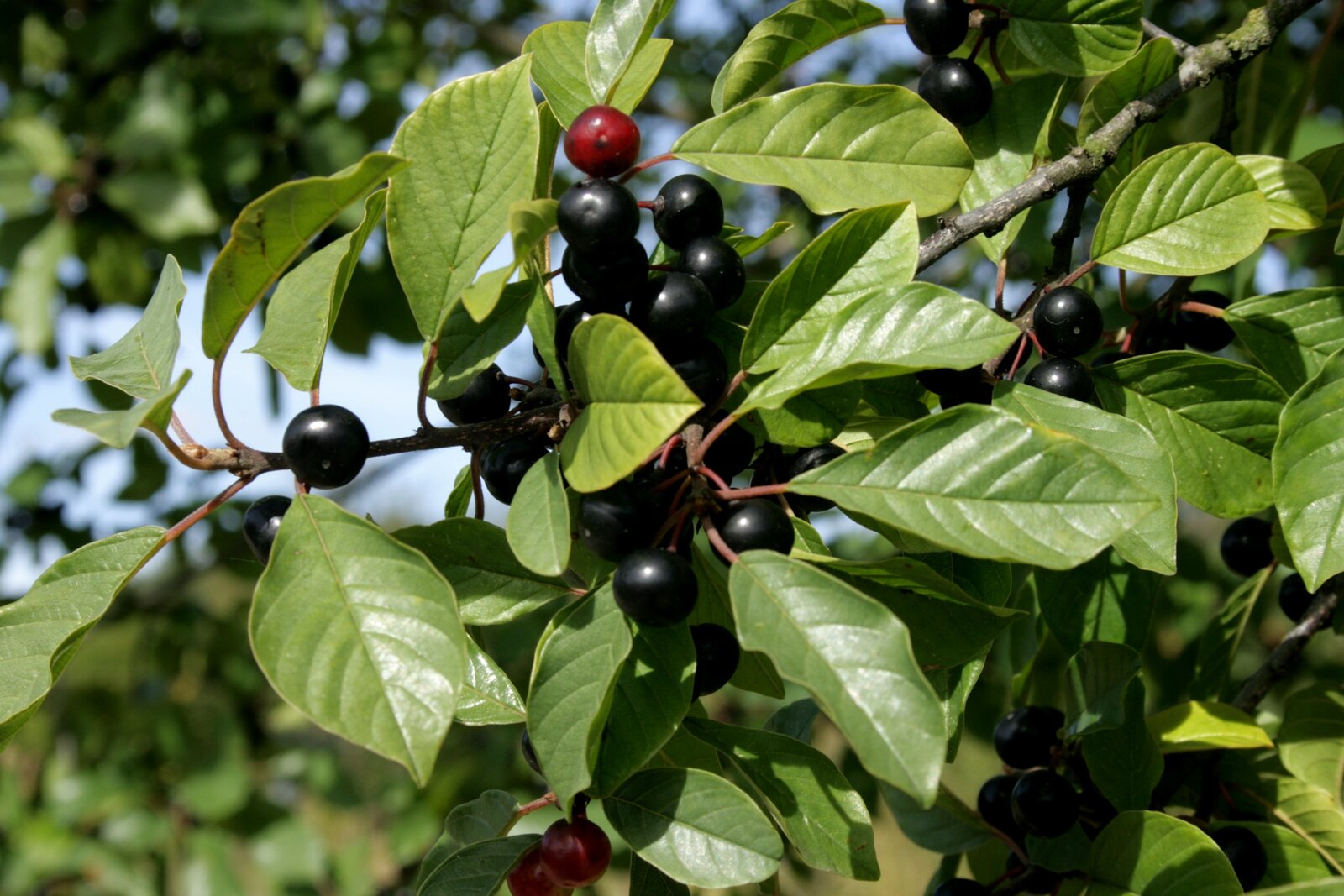
European alder buckthorn
Frangula alnus
A wetland buckthorn introduced from Europe. Small drupes ripen from green through red to black on the same plant. Rare in Tennessee; not yet a serious invasive in Marion but worth watching at swamp and pond edges.
Status: Introduced; uncommon.
Invasive trees of concern
Four tree species that combine ecological aggressiveness with the ability to seed prolifically into Marion's fencerows, abandoned lots, and roadside thickets. The same species are framed alongside kudzu, Japanese honeysuckle, and other invasives in the "Invasive species and ecological threats" section further down the page; the cards below treat them as trees per se. Tree-of-heaven, mimosa, and princesstree are listed as severe-threat invasives by the Tennessee Invasive Plant Council.
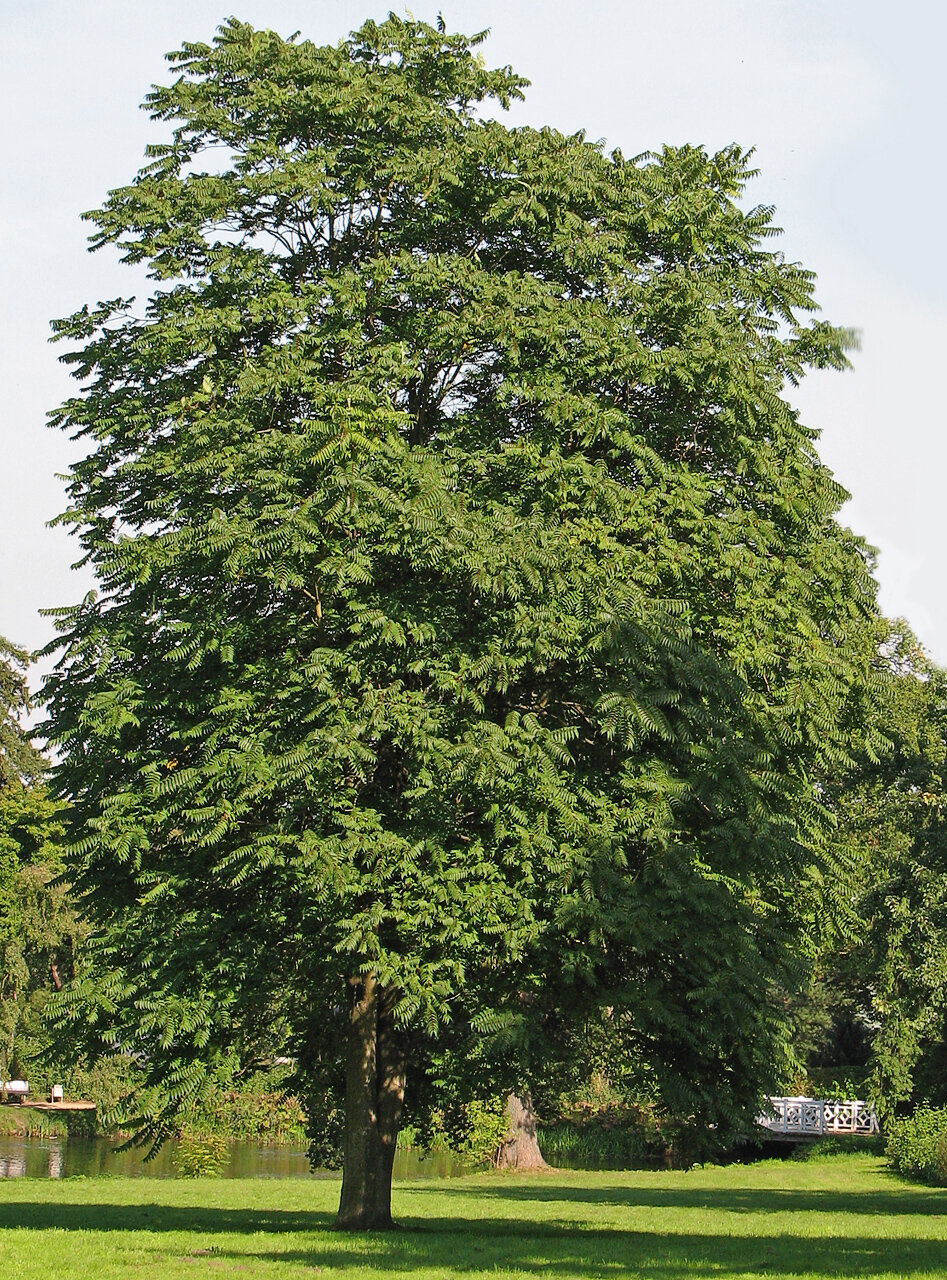
Tree-of-heaven
Ailanthus altissima
Pinnately compound leaves, smooth gray bark, and a strong unpleasant odor when crushed. Aggressive root sprouter and prolific seeder. The preferred host of the spotted lanternfly (Lycorma delicatula), a planthopper that arrived in the U.S. in 2014; when lanternfly reaches Tennessee, Marion's abundant tree-of-heaven corridors will make control difficult.
Status: Introduced; TN-IPC severe-threat invasive.
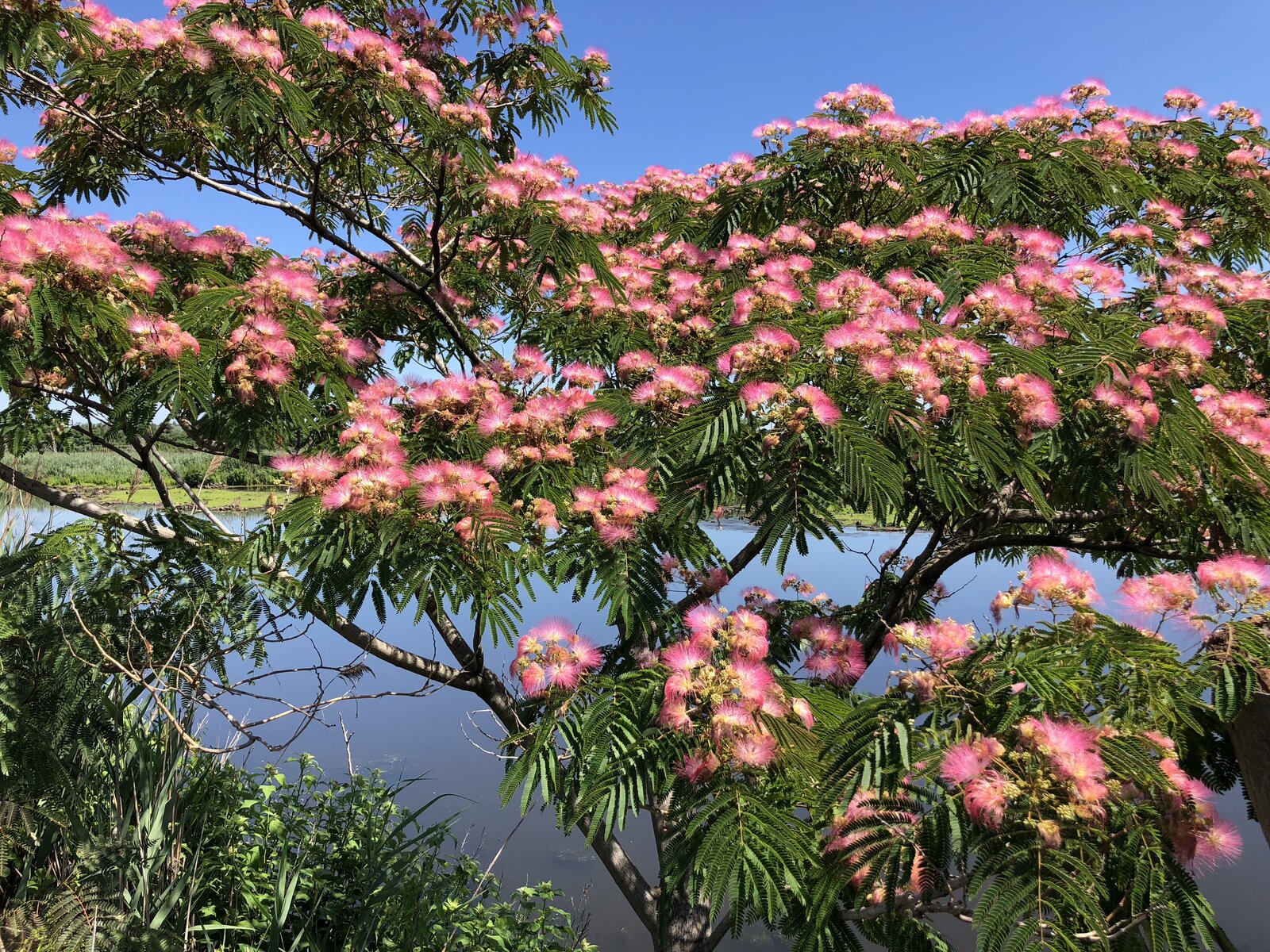
Mimosa
Albizia julibrissin
Sometimes called silktree. Bipinnately compound leaves with small leaflets that fold at night, and pink puffball flower clusters in midsummer. Native to East Asia; widely planted and now seeding aggressively into roadsides, old fields, and forest edges.
Status: Introduced; TN-IPC severe-threat invasive.
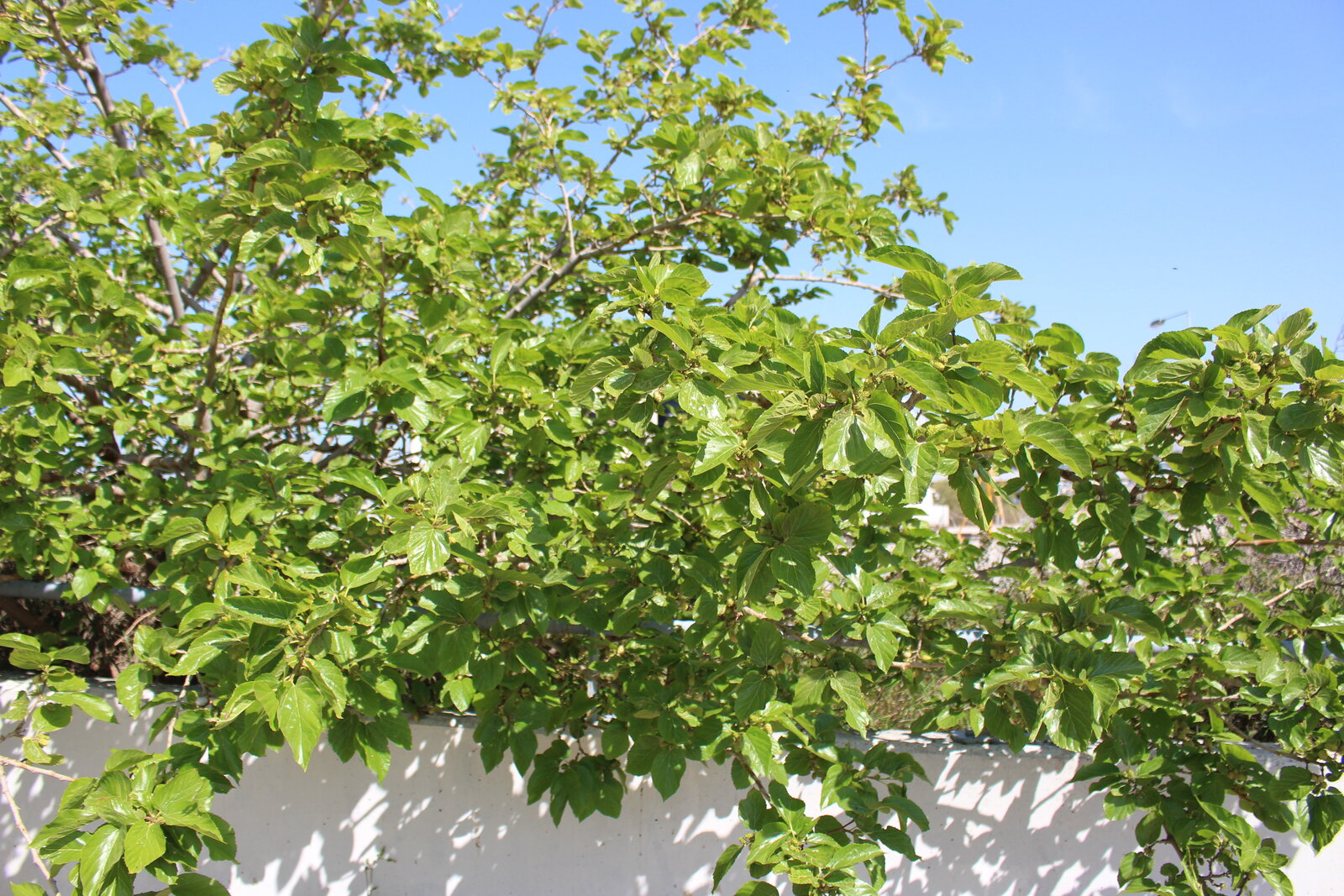
White mulberry
Morus alba
An East Asian mulberry introduced for silkworm cultivation in the 18th and 19th centuries. Hybridizes with the native red mulberry and is gradually swamping the native species' genetic integrity in eastern North America. Glossy leaves; pale to dark fruit.
Status: Introduced; hybridizing with native red mulberry.
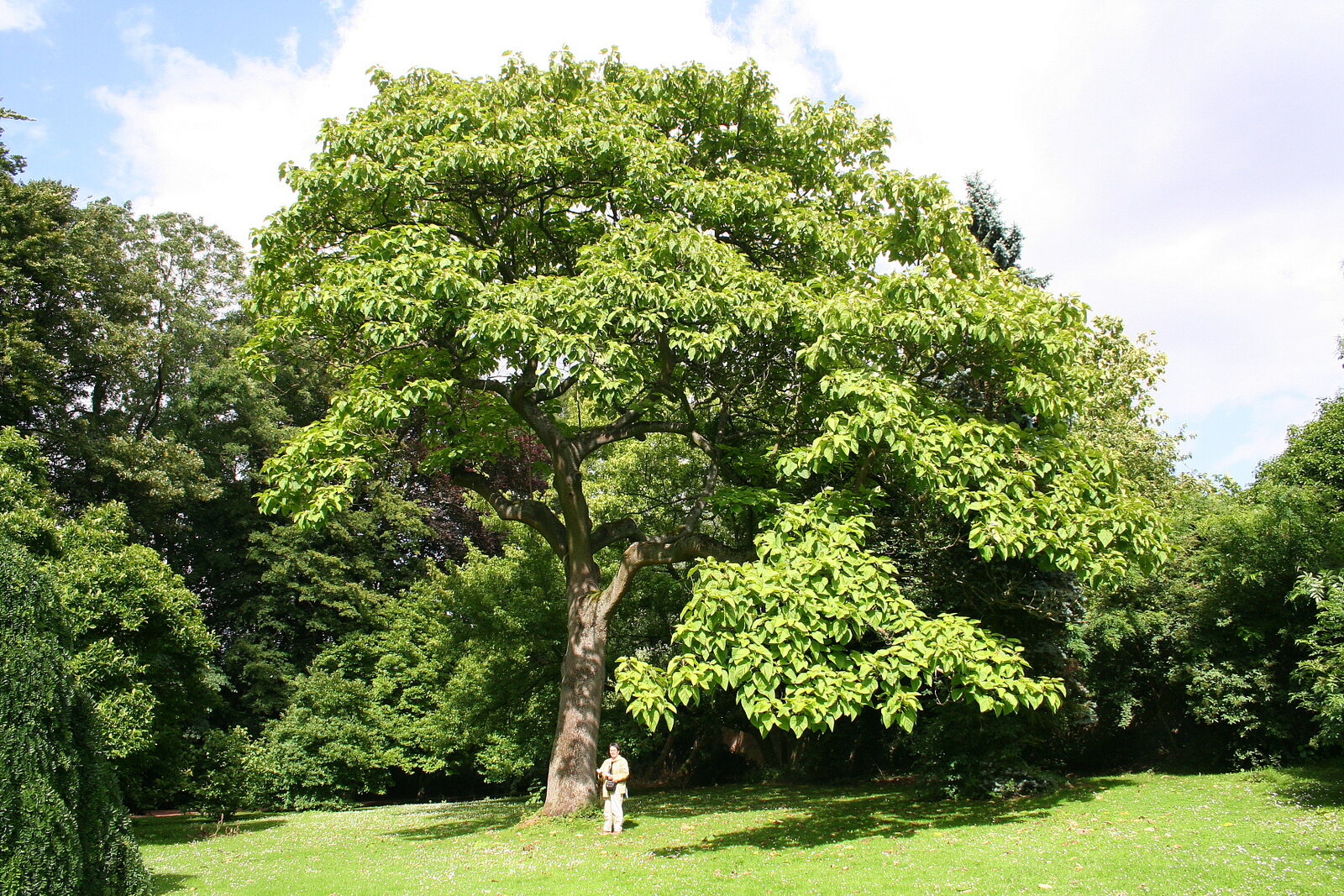
Princesstree
Paulownia tomentosa
Sometimes called empress tree. Large heart-shaped leaves, upright panicles of purple foxglove-like flowers in April, and persistent woody seed capsules. Native to East Asia; aggressively colonizes disturbed ground, roadcuts, and forest gaps. The wood is light and prized in Asian markets, sometimes leading to selective harvest of trees from public lands.
Status: Introduced; TN-IPC severe-threat invasive.
Shrubs of the heath family: laurel, rhododendron, azalea, and blueberry
Where the plateau's caprock breaks down into thin acidic soils along bluff edges, a distinctive heath-family shrub community takes over. The acid-soil indicators of this group define the look of the rim trails: mountain laurel dominates from Foster Falls to the Cumberland Trail's gorge section, blooming in mid-May a week or two after flowering dogwood is done; rosebay rhododendron forms dense evergreen thickets along shaded plateau streams and blooms in late June and July; and the wild blueberries and azaleas stagger their flowering across April, May, and June so that some heath shrub is in bloom on the rim from the first redbud to the late-summer asters. Most visitors who time a hike to the rhododendron bloom are after the rosebay; serious wildflower watchers come earlier in the season for the azaleas and the laurel.
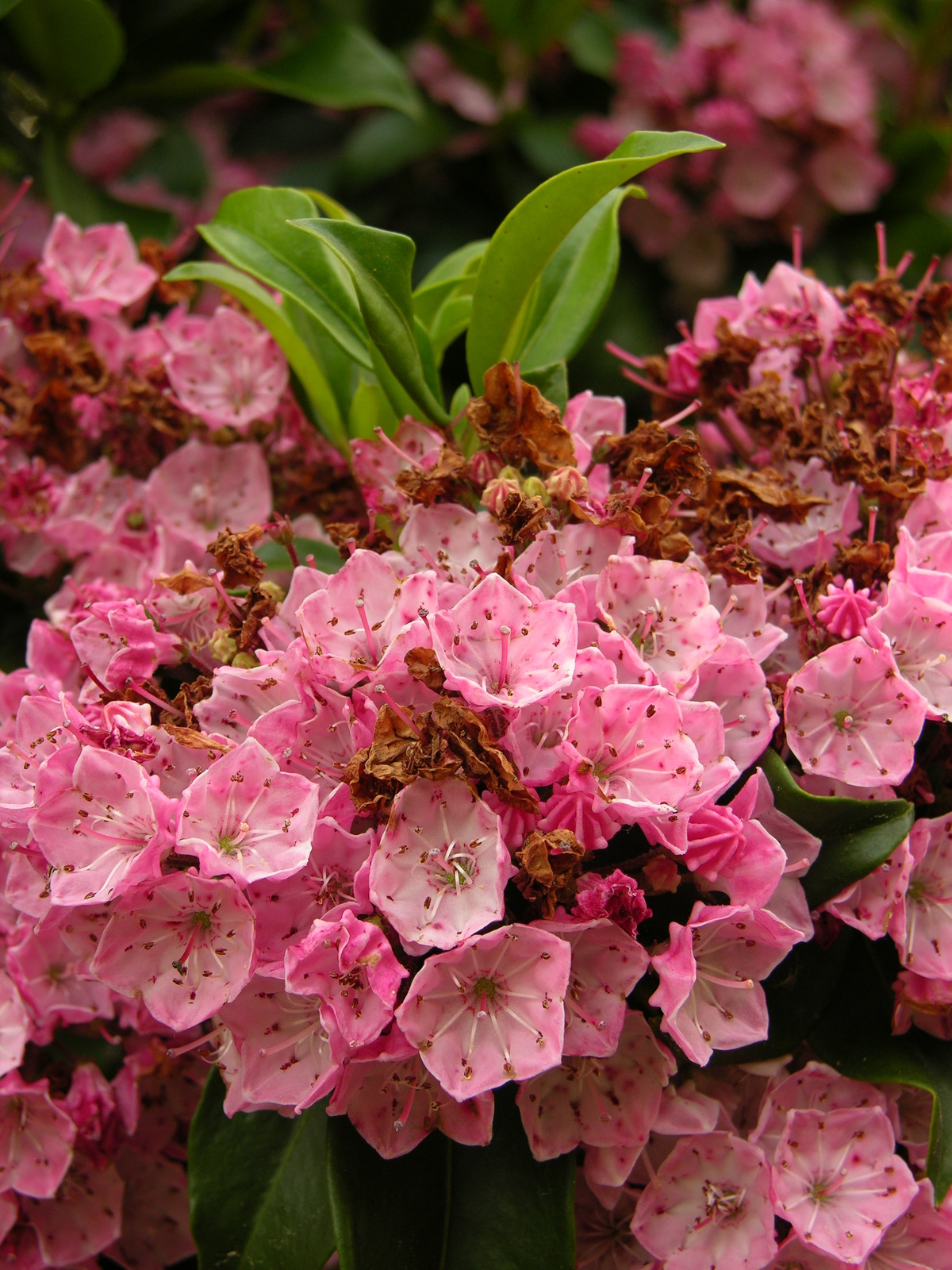
Mountain laurel
Kalmia latifolia
The signature shrub of the plateau rim. Leathery evergreen leaves and intricately patterned pink and white flowers cover bluff edges from Foster Falls to the Cumberland Trail's gorge section in mid-May, a week or two after flowering dogwood is done. The wood is so hard and dense that pipe makers favor laurel burls for briar-like pipe bowls. See TN Smart Yards on Kalmia latifolia.
Status: Native; common along the rim.
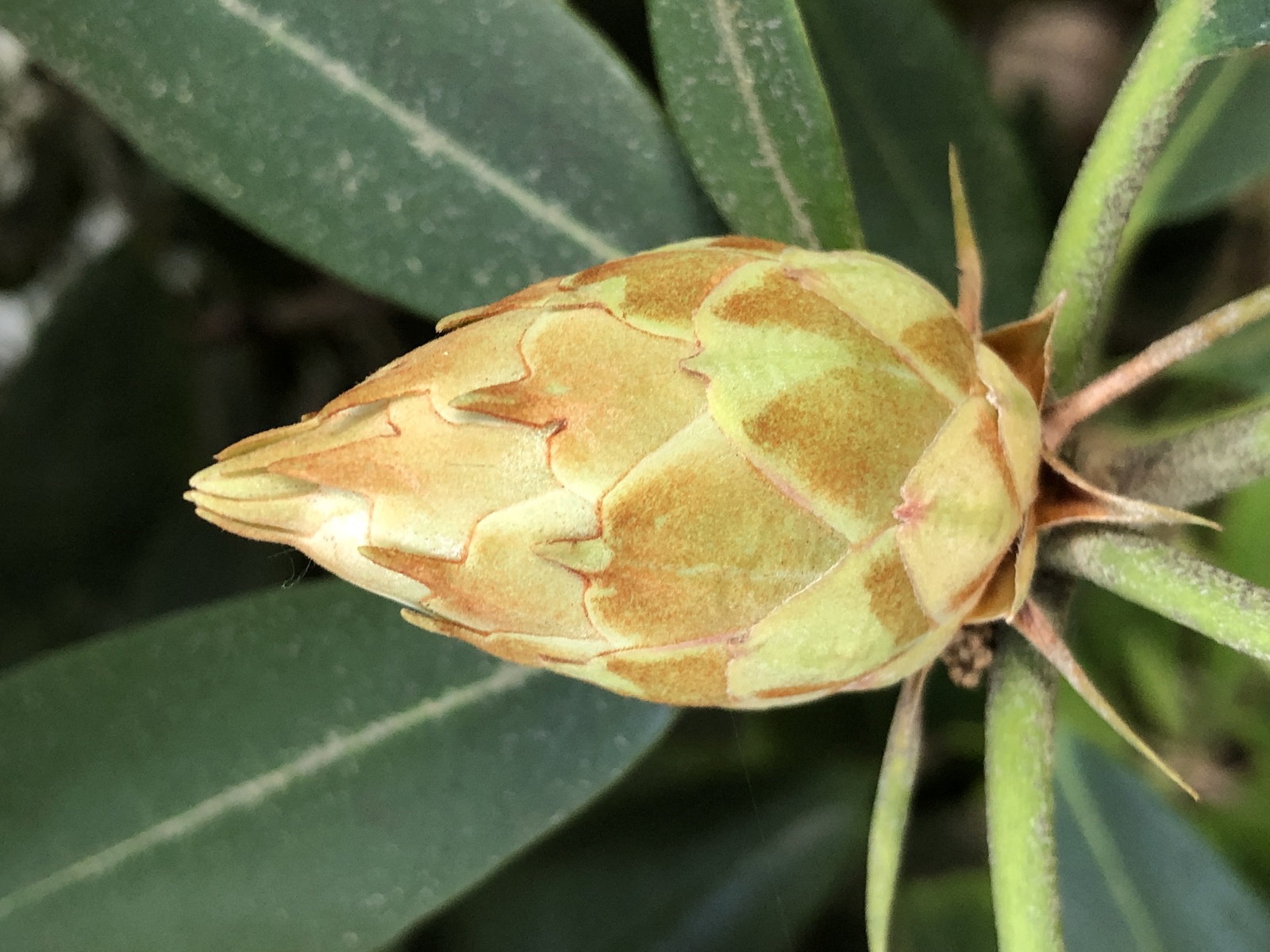
Rosebay rhododendron
Rhododendron maximum
Forms dense evergreen thickets along shaded streams and cove-hardwood gulches. Blooms in late June and July with white flowers splashed by green spots, well after the laurel and pinxter azalea finish. The thickets are so dense in places that hikers know them as rhododendron hells, especially on the Fiery Gizzard escarpment.
Status: Native; common in shaded streamside thickets.
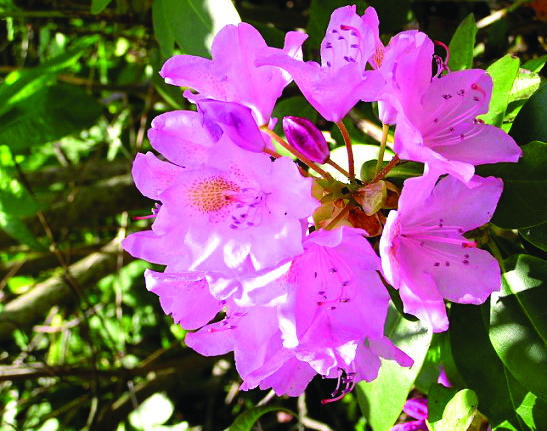
Catawba rhododendron
Rhododendron catawbiense
Larger leaves and showier purple-pink flower clusters than rosebay rhododendron, and a rim-and-ridge habitat preference rather than streamside. Reaches its westernmost extent on the Cumberland Plateau; in Tennessee, it is most abundant on the higher ridges.
Status: Native; locally distinctive on exposed plateau edges.
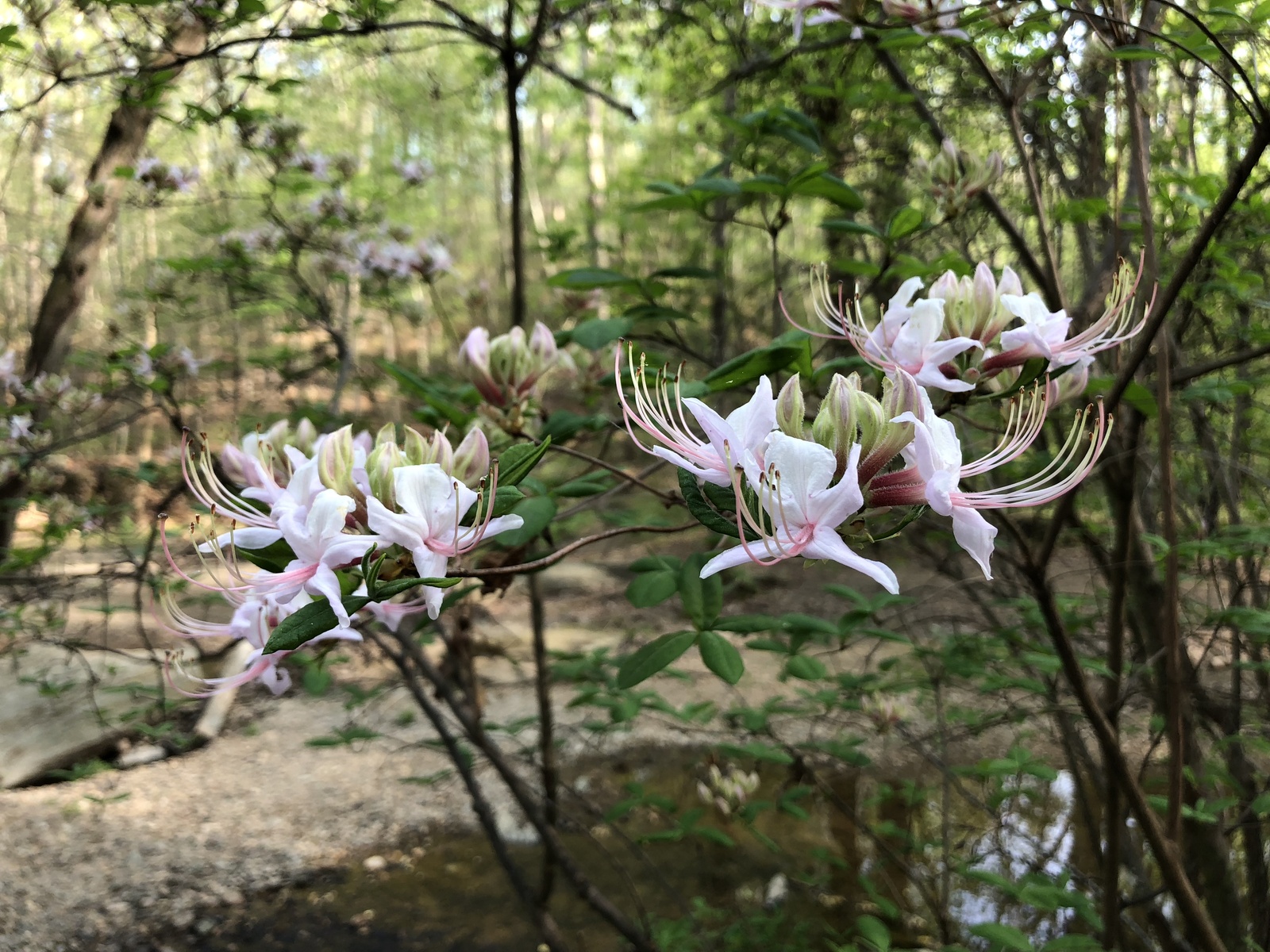
Pinxter azalea
Rhododendron periclymenoides
A deciduous native that scatters pink tubular flowers through oak woods in mid-April. Often the first wild azalea visitors see in the season. Common name is older Dutch for Whit-Sunday, the holiday near which the flowers open.
Status: Native; common in oak woods.
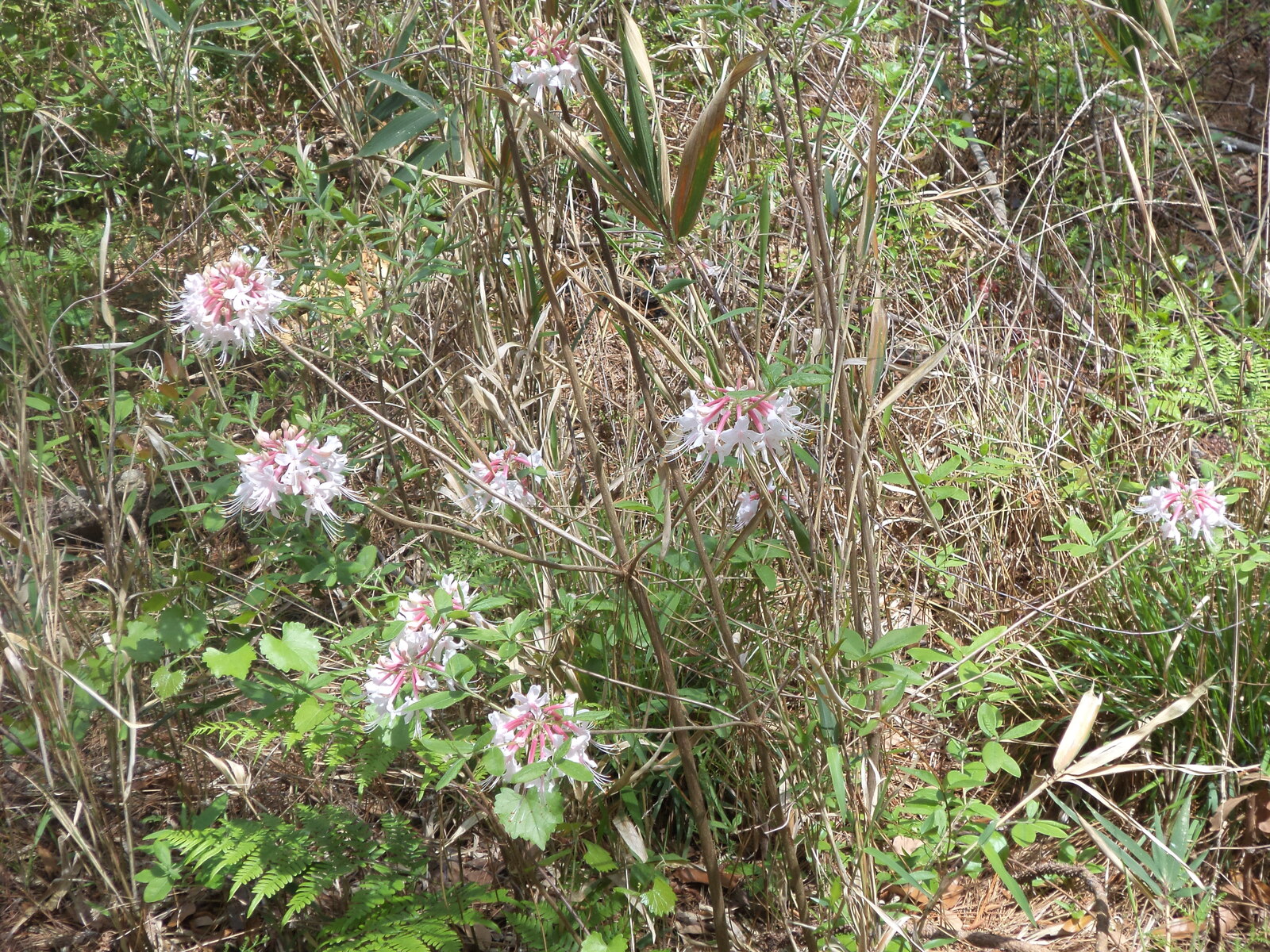
Southern pinxter azalea
Rhododendron canescens
Replaces the northern pinxter azalea on lower-elevation slopes and along stream bottoms in the southern Cumberland Plateau and Tennessee River Gorge. Pale pink to nearly white tubular flowers, slightly fragrant, opening in April just before the leaves expand.
Status: Native; common in stream-bottom woods.
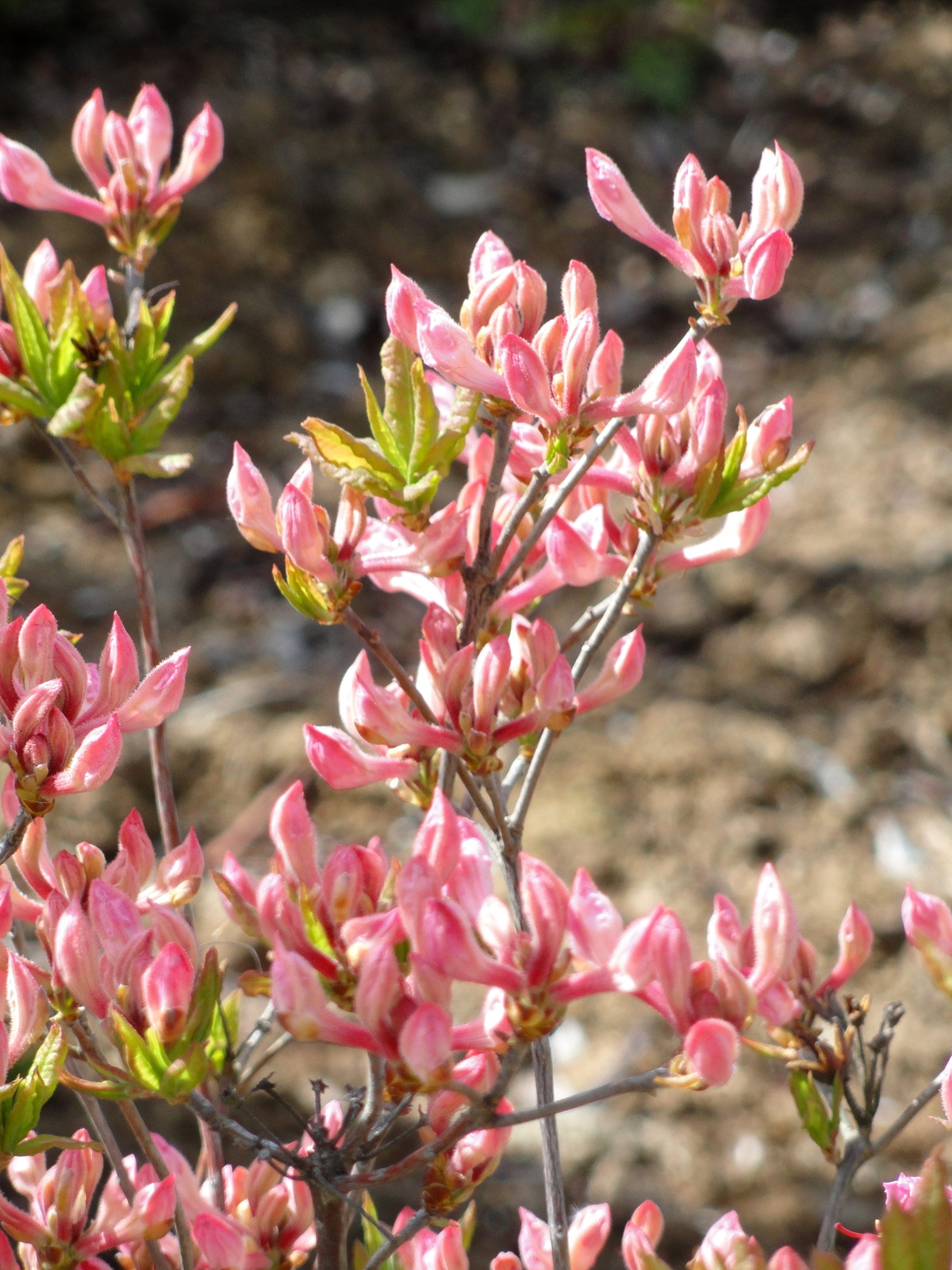
Early azalea
Rhododendron prinophyllum
Pink to white fragrant flowers opening in May, before or with the leaves, with rose-colored anthers. Habitat overlaps with the pinxter azaleas but reaches higher elevations on the plateau. The most fragrant of the regional native azaleas.
Status: Native; uncommon but present in plateau woods.
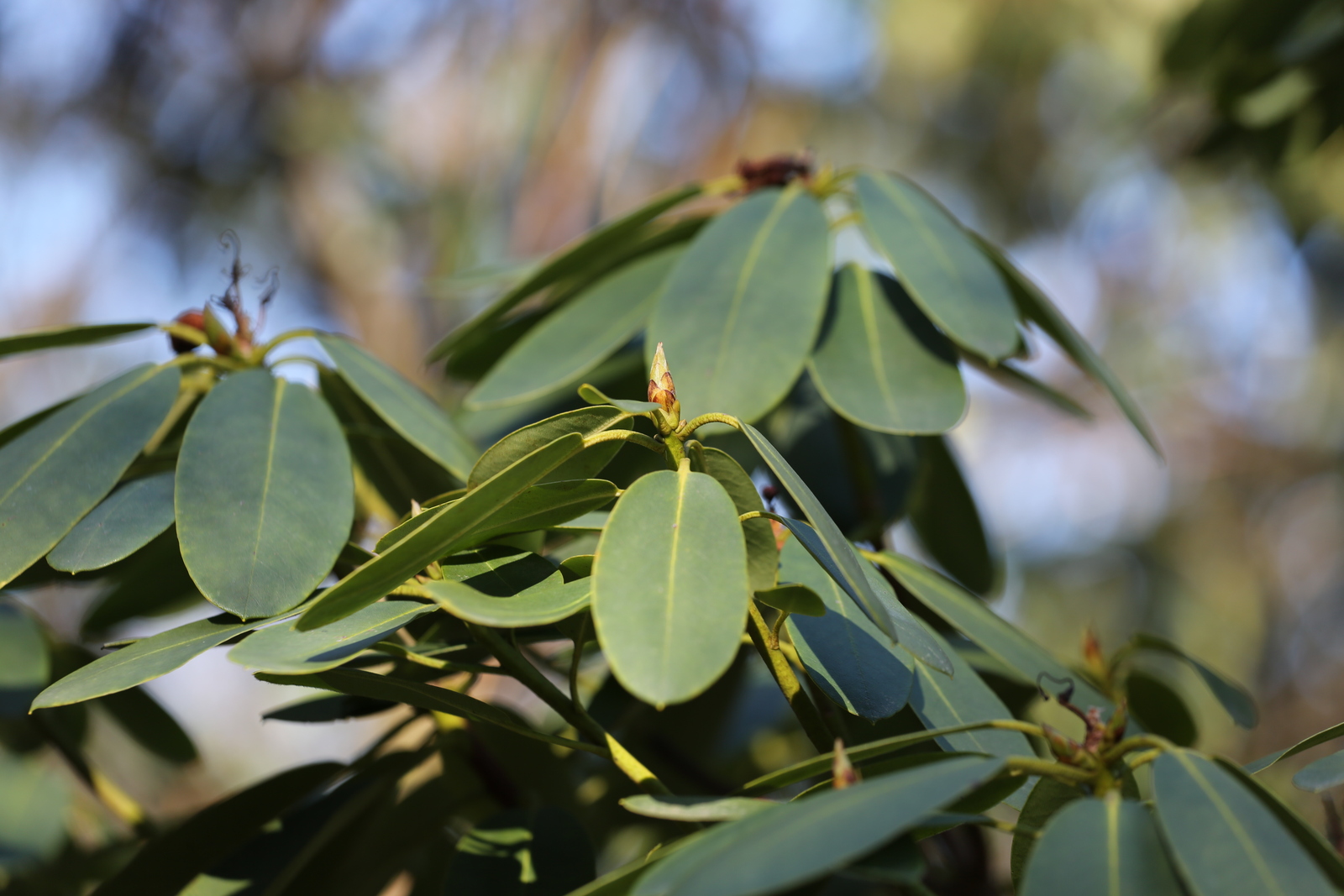
Sweet azalea
Rhododendron arborescens
White or pale-pink fragrant flowers with prominent red stamens, blooming in June after the leaves are fully out. Stream-bottom habitat on the plateau and along plateau-edge waterfalls; one of the latest-flowering native azaleas.
Status: Native; locally common along plateau streams.
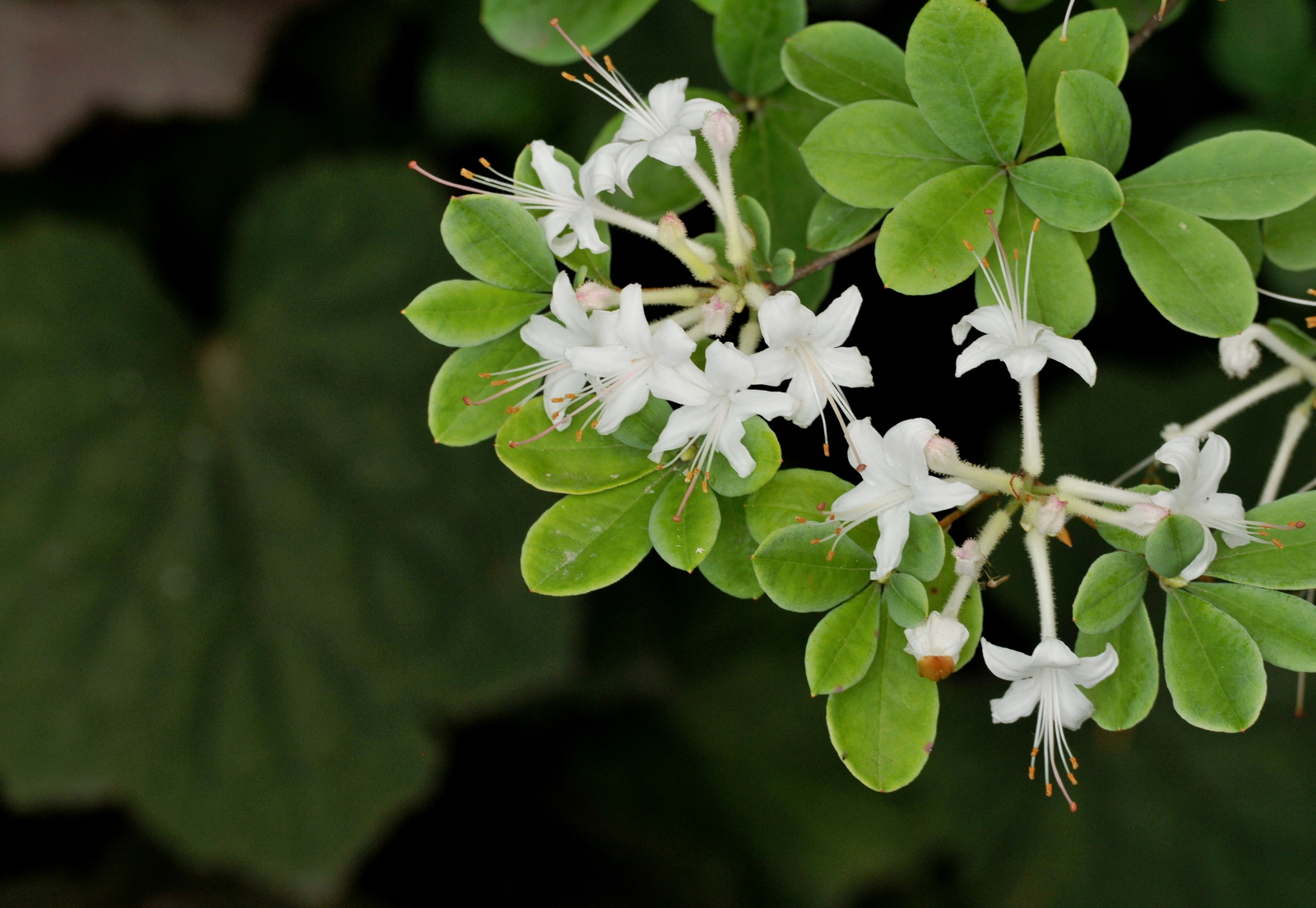
Clammy azalea
Rhododendron viscosum
Also called swamp azalea. Sticky, glandular flower tubes (hence "clammy"); white or pinkish, very fragrant, opening in June and July. Wet flatwoods and bog edges; less common in Marion County than on the coastal plain.
Status: Native; uncommon, in wet spots.
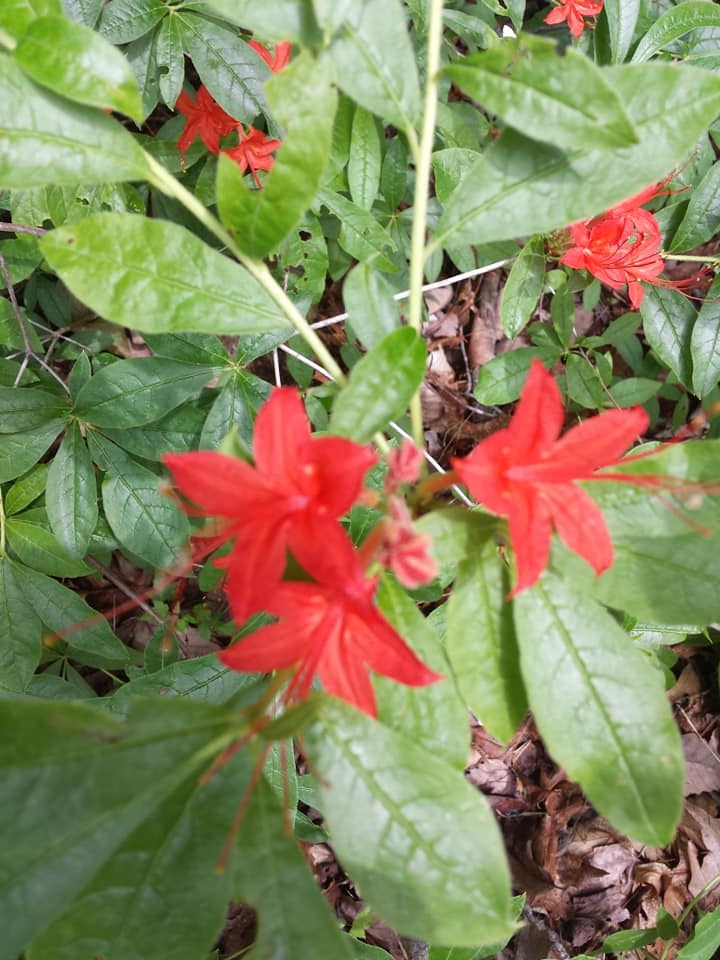
Cumberland azalea
Rhododendron cumberlandense
A regional endemic of the Cumberland Plateau: orange to red flowers, blooming in late May and June after the leaves are out. The latest-flowering of the orange-flowered native azaleas, distinguishing it from the more widely planted flame azalea (Rhododendron calendulaceum).
Status: Native; regional Cumberland Plateau endemic.
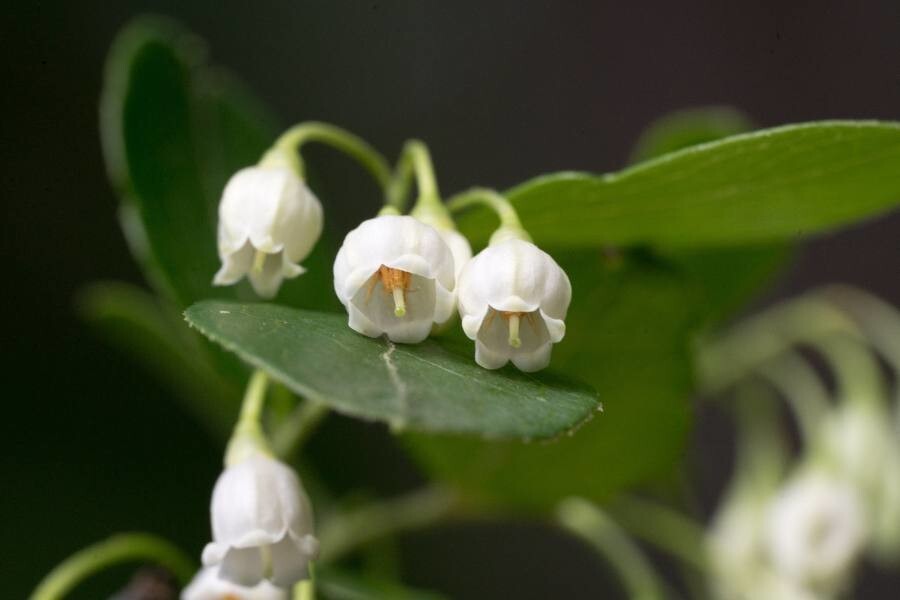
Farkleberry
Vaccinium arboreum
Also called sparkleberry, the largest of the native blueberries; old plants take on a small-tree form with shedding cinnamon bark. Small white bell-shaped flowers in May; fruits black and dry. Common on dry sandstone uplands and rocky woods.
Status: Native; common on dry sandstone soils.
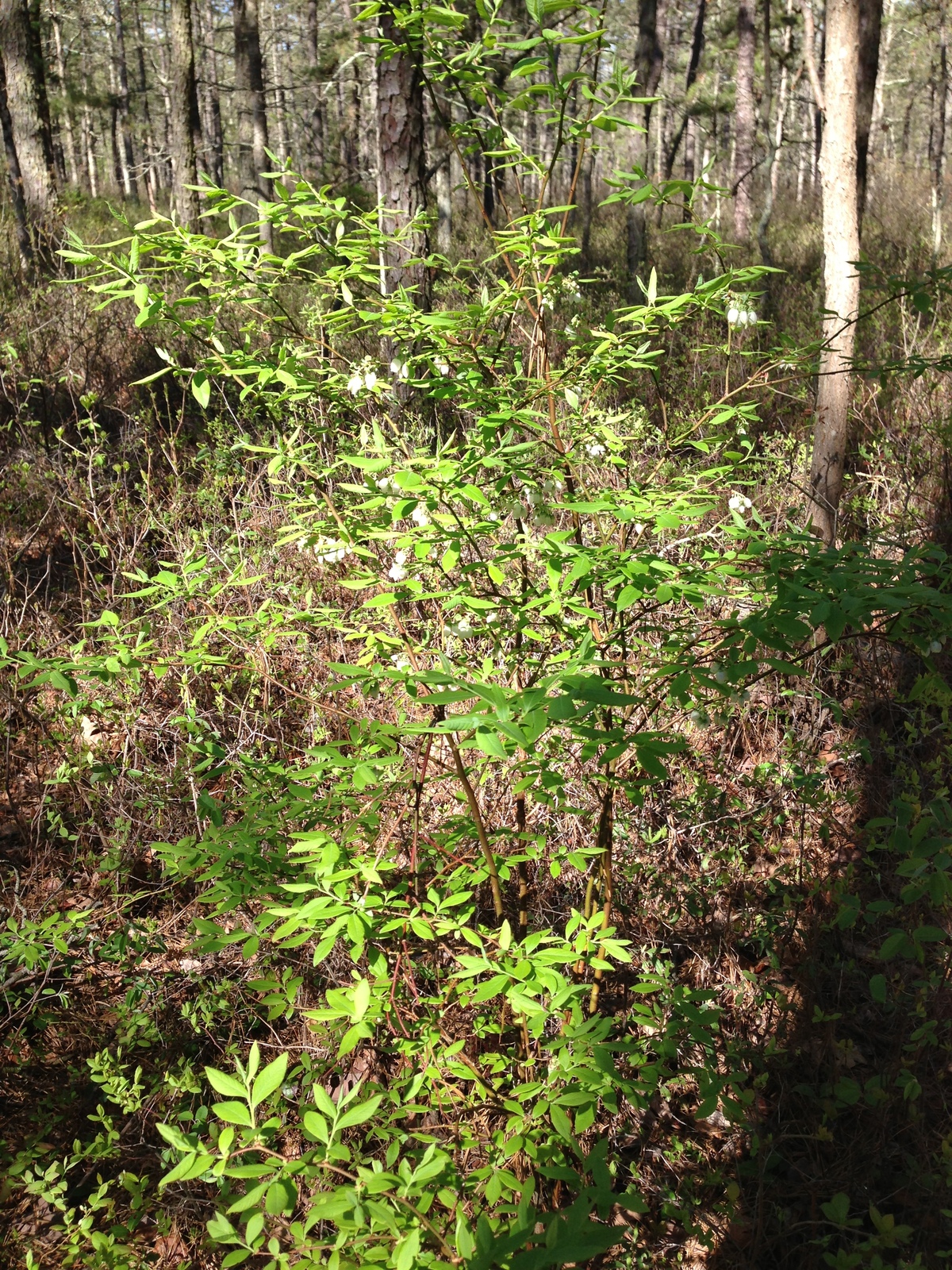
Highbush blueberry
Vaccinium corymbosum
A multi-stemmed shrub of moist plateau woods and stream margins, two to three meters tall. White bell-shaped flowers in April, dark blue fruits in July. The same species long since selected for cultivated blueberries.
Status: Native; common in moist plateau woods.
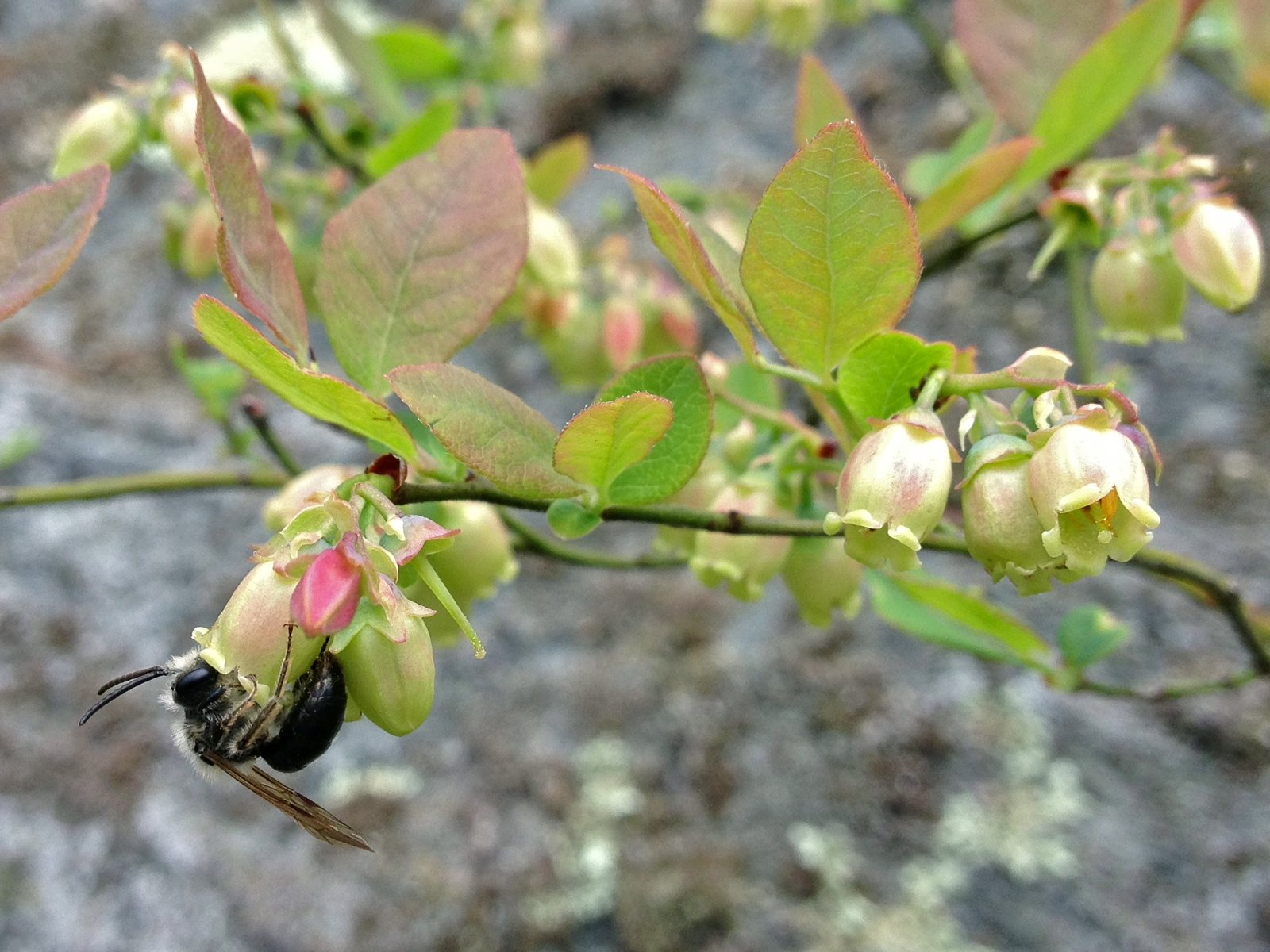
Lowbush blueberry
Vaccinium pallidum
A short, ground-hugging blueberry of dry sandstone caprock and rocky woods. Pink-tinged white bell-shaped flowers in April, blue fruits in early summer. Locals have picked the lowbush patches on the rim for generations.
Status: Native; common on the sandstone caprock.
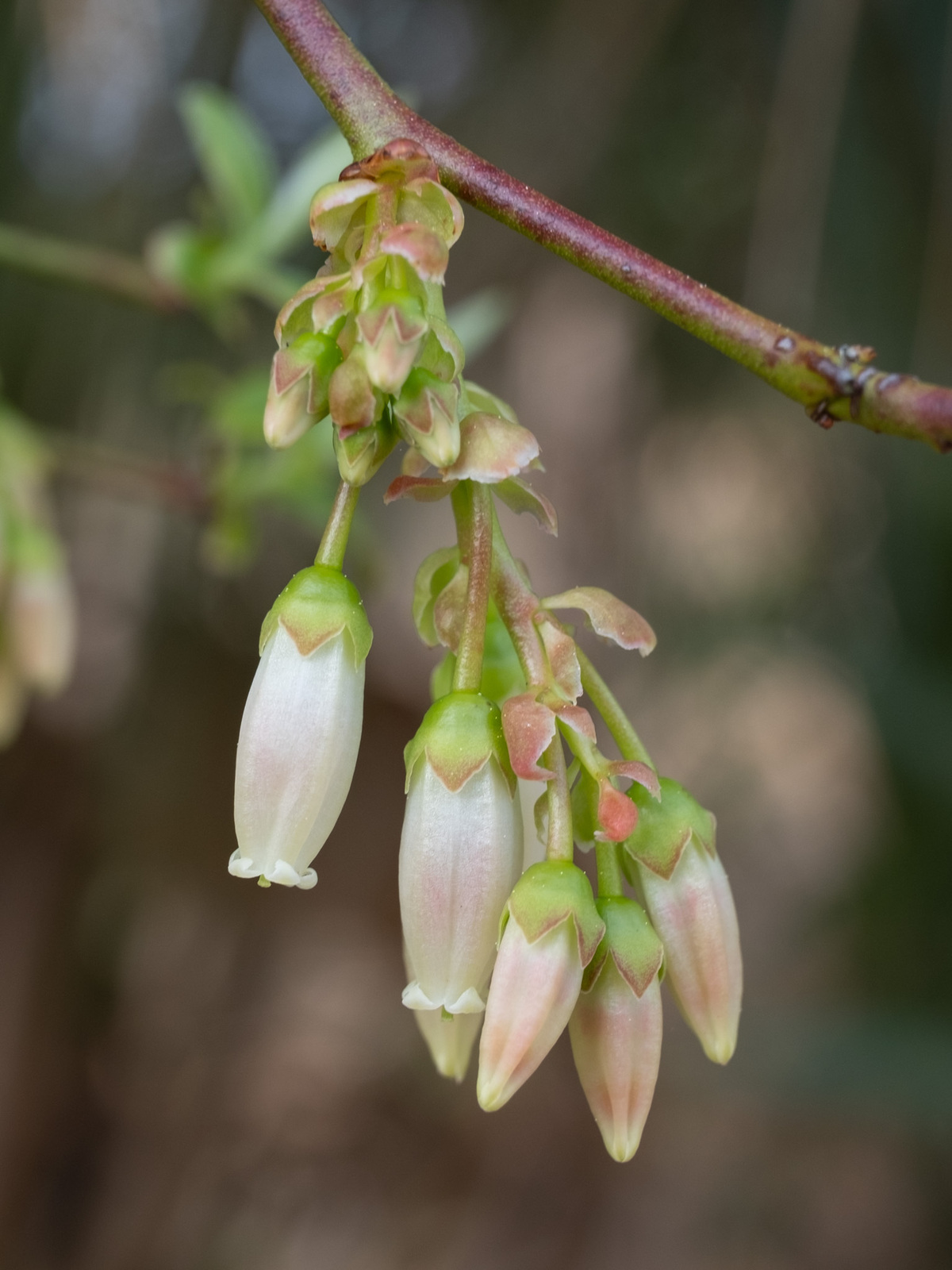
Hairy highbush blueberry
Vaccinium fuscatum
Similar to highbush blueberry but with hairy young twigs and leaf undersides; tends to lower wet spots and stream margins. Hybridizes freely with V. corymbosum in the field, making firm separation difficult.
Status: Native; locally common in wet spots.
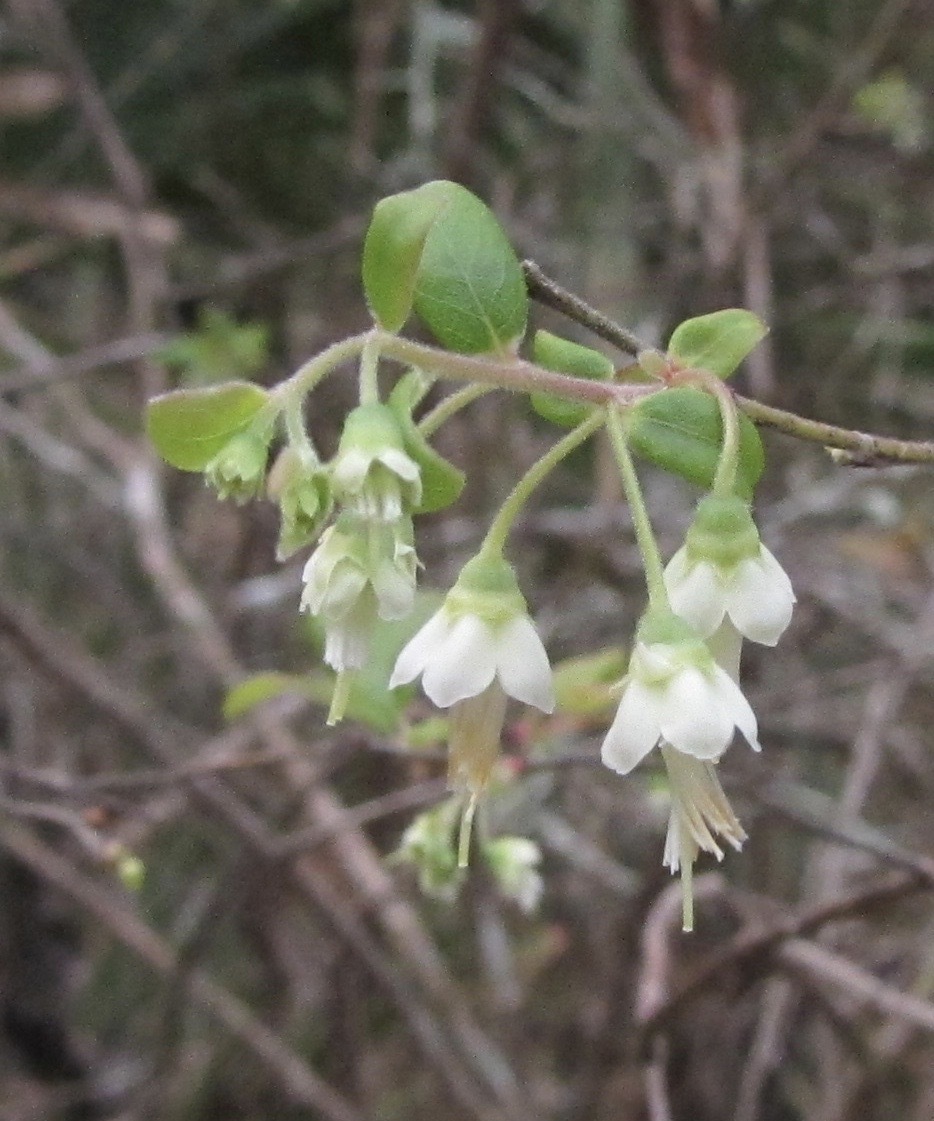
Deerberry
Vaccinium stamineum
A larger blueberry relative with bell-shaped flowers but shaped more openly than the others, with petals that flare back to expose the long stamens. Greenish-yellow fruits ripen to dull purple, less palatable than the true blueberries. Common on dry oak ridges.
Status: Native; common on oak ridges.
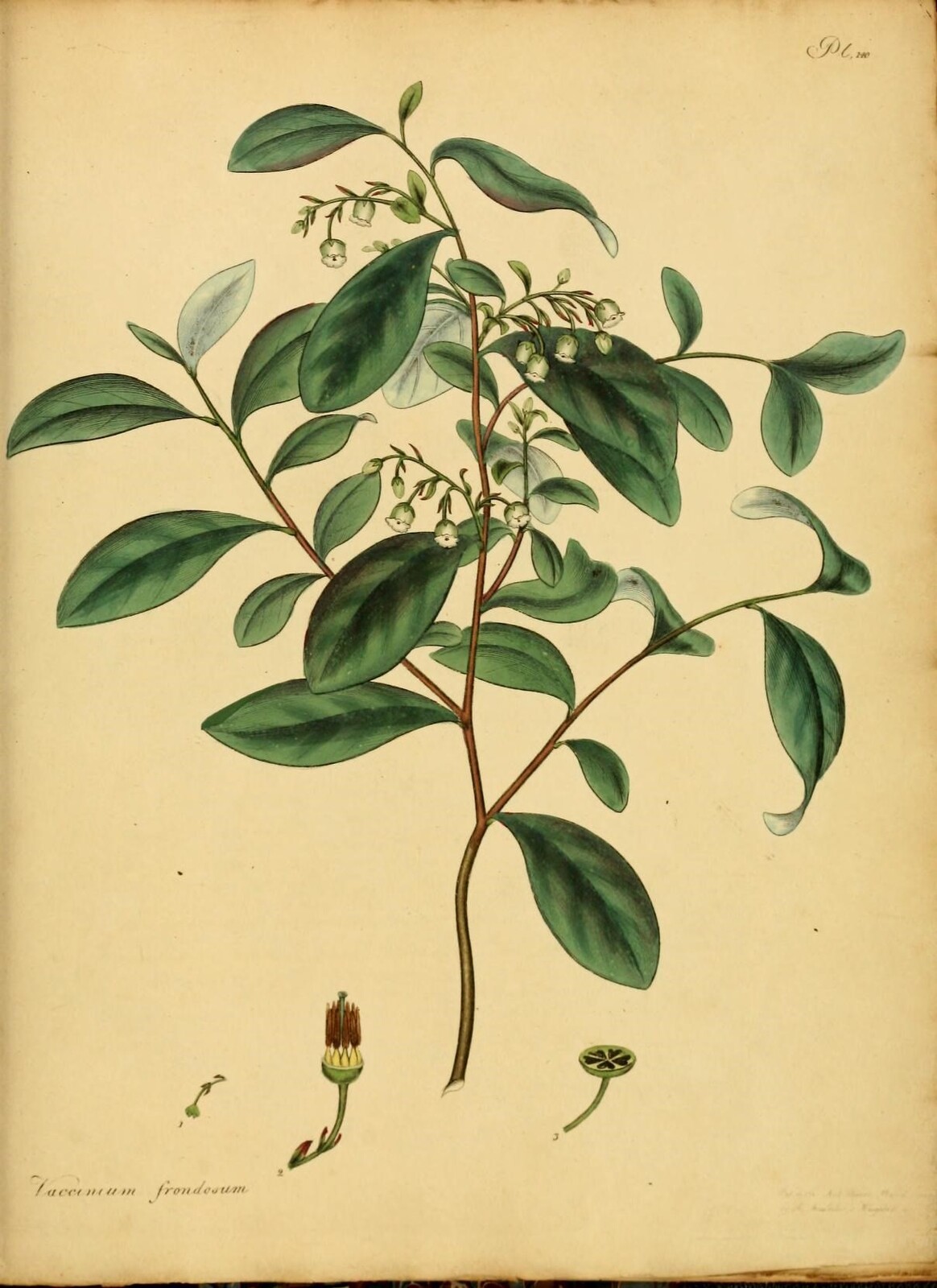
Dangleberry
Gaylussacia frondosa
A huckleberry of dry oak woods and pine flatwoods; fruits dark blue with a pale bloom, on noticeably long stalks (hence "dangle"). Less abundant in Marion County than the deerberry and the lowbush blueberries.
Status: Native; uncommon but present.
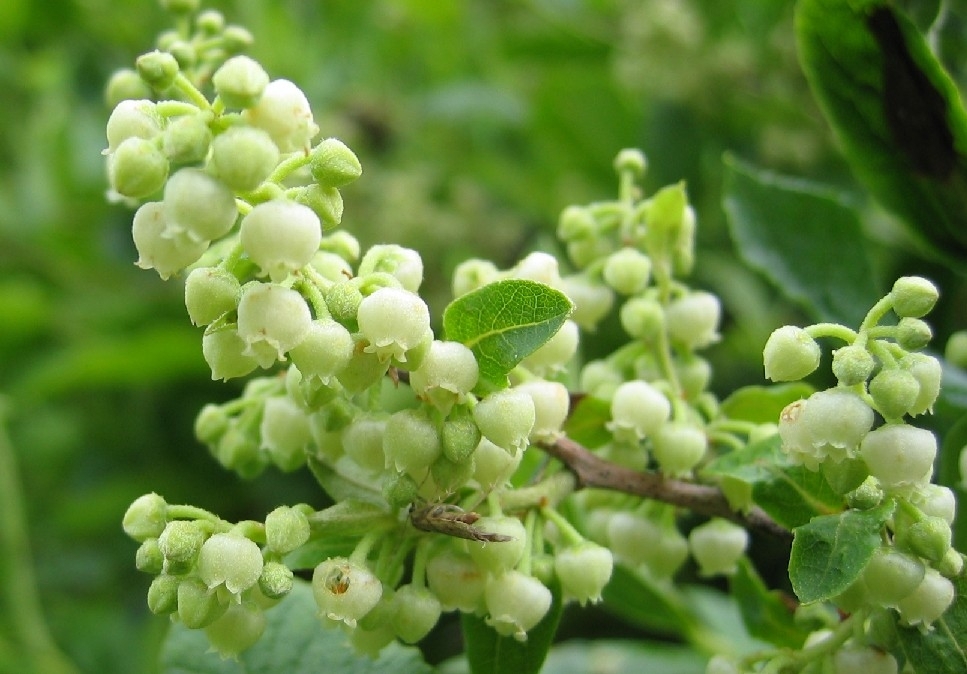
Maleberry
Lyonia ligustrina
Looks like a blueberry but produces hard, dry, woody capsules instead of fleshy berries. Common in wet pine flatwoods and shrub bogs. The persistent capsules are a useful winter ID feature.
Status: Native; uncommon, in wet flatwoods.
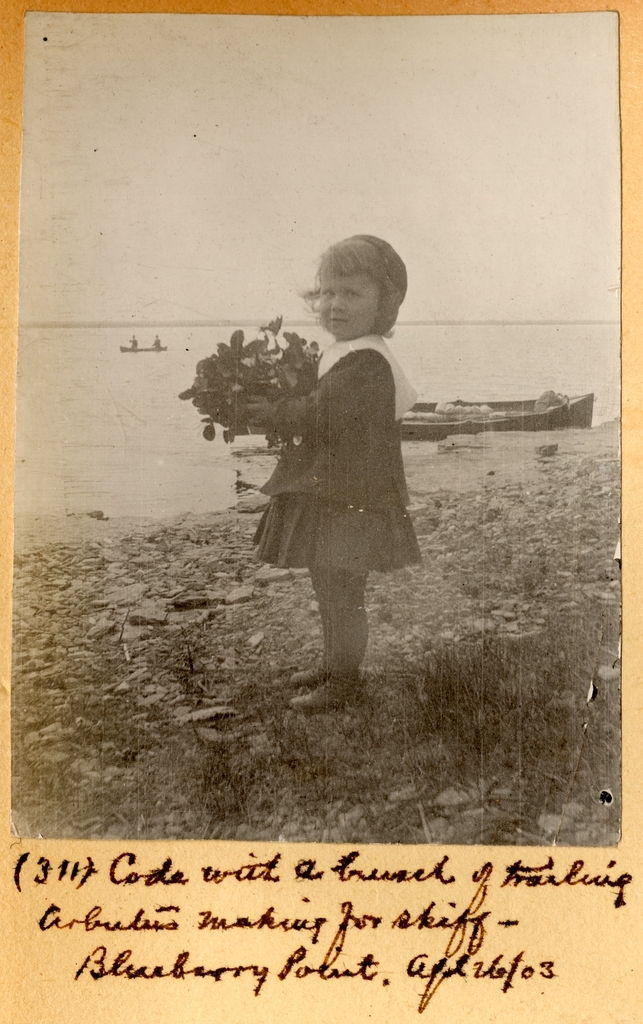
Trailing arbutus
Epigaea repens
A creeping evergreen sub-shrub of dry pine-oak woods, with small leathery leaves and pinkish-white tubular flowers that open in late March and April. The flowers are heavily fragrant; trailing arbutus was over-collected through much of the 20th century and is now scarce in many counties.
Status: Native; uncommon and slow to recover from disturbance.
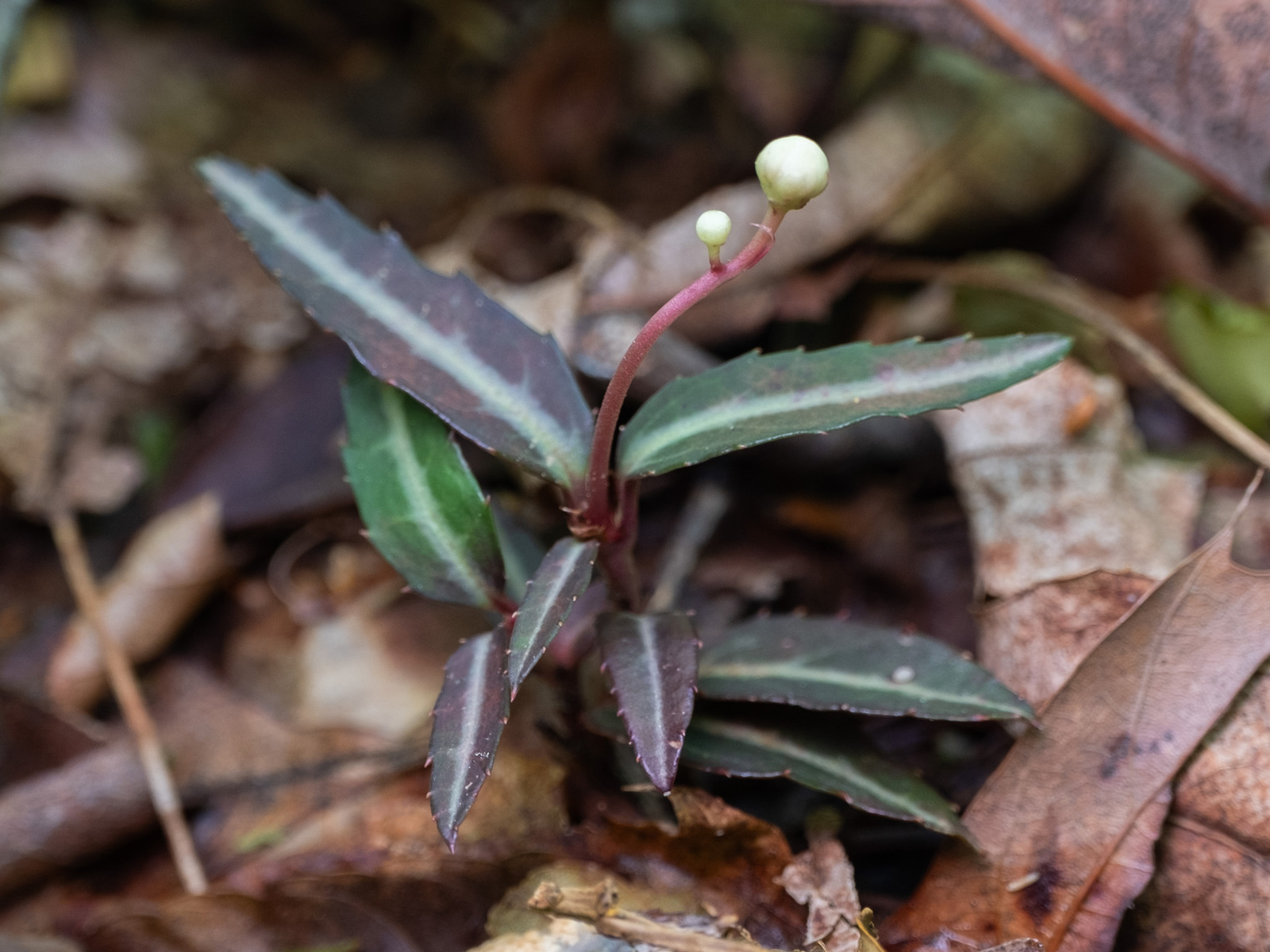
Pipsissewa
Chimaphila maculata
Also called striped wintergreen for the white midrib stripe down each leaf. Evergreen rosette with nodding waxy white-pink flowers in summer. A reliable indicator of acidic, undisturbed pine-oak forest.
Status: Native; common in undisturbed acidic woods.
Witch-hazels and witch-alders
The witch-hazel family is a small but recognizable group on the plateau, including the only native shrub that flowers in November and a Cumberland-Plateau-edge species ranked Threatened in Tennessee.
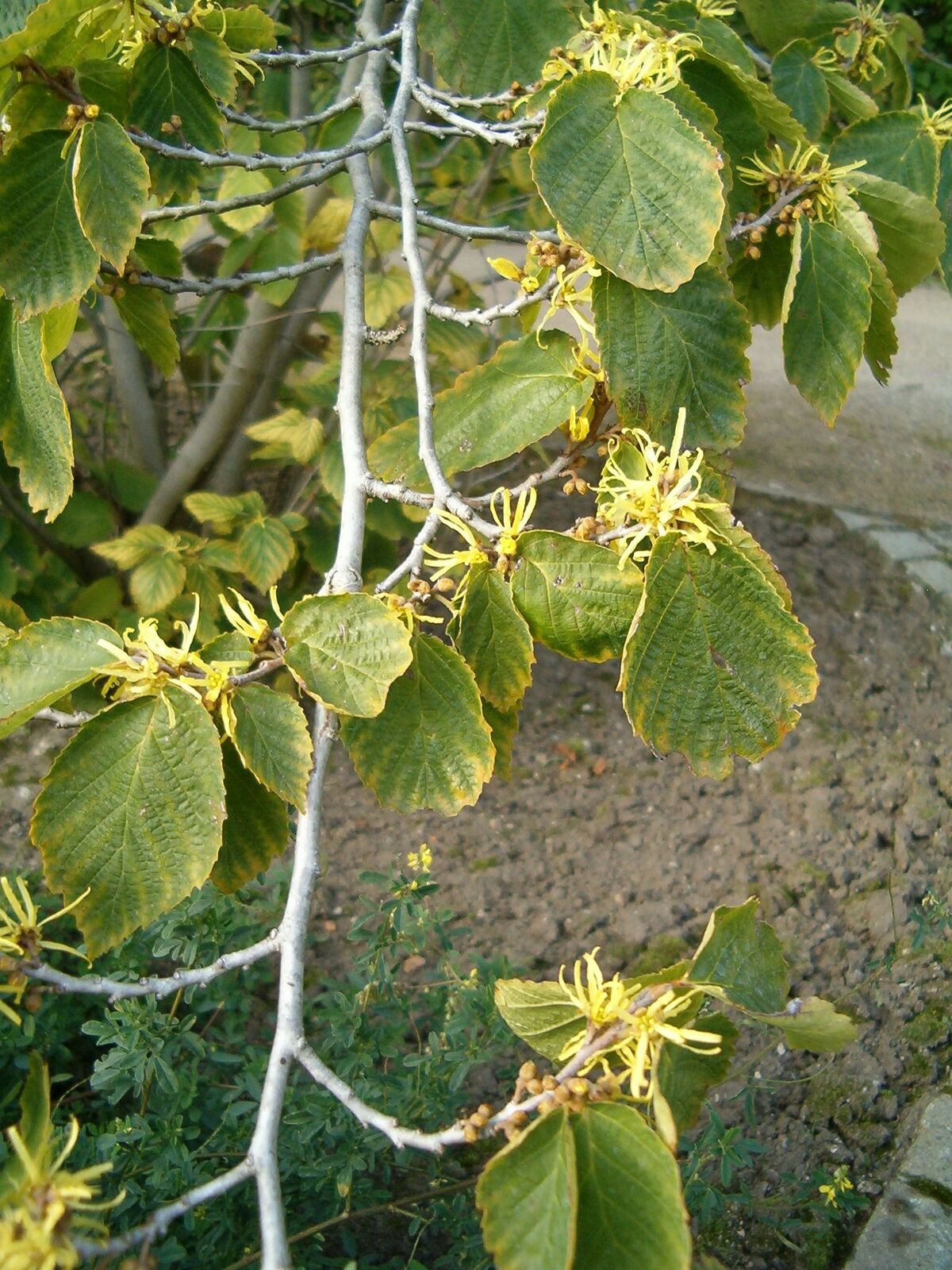
American witch-hazel
Hamamelis virginiana
The one native shrub that blooms in November, after the leaves have fallen. Thin yellow strap-like petals hang on bare branches well into winter. Bark and leaves are the source of the original astringent witch-hazel extract.
Status: Native; common in plateau woods.
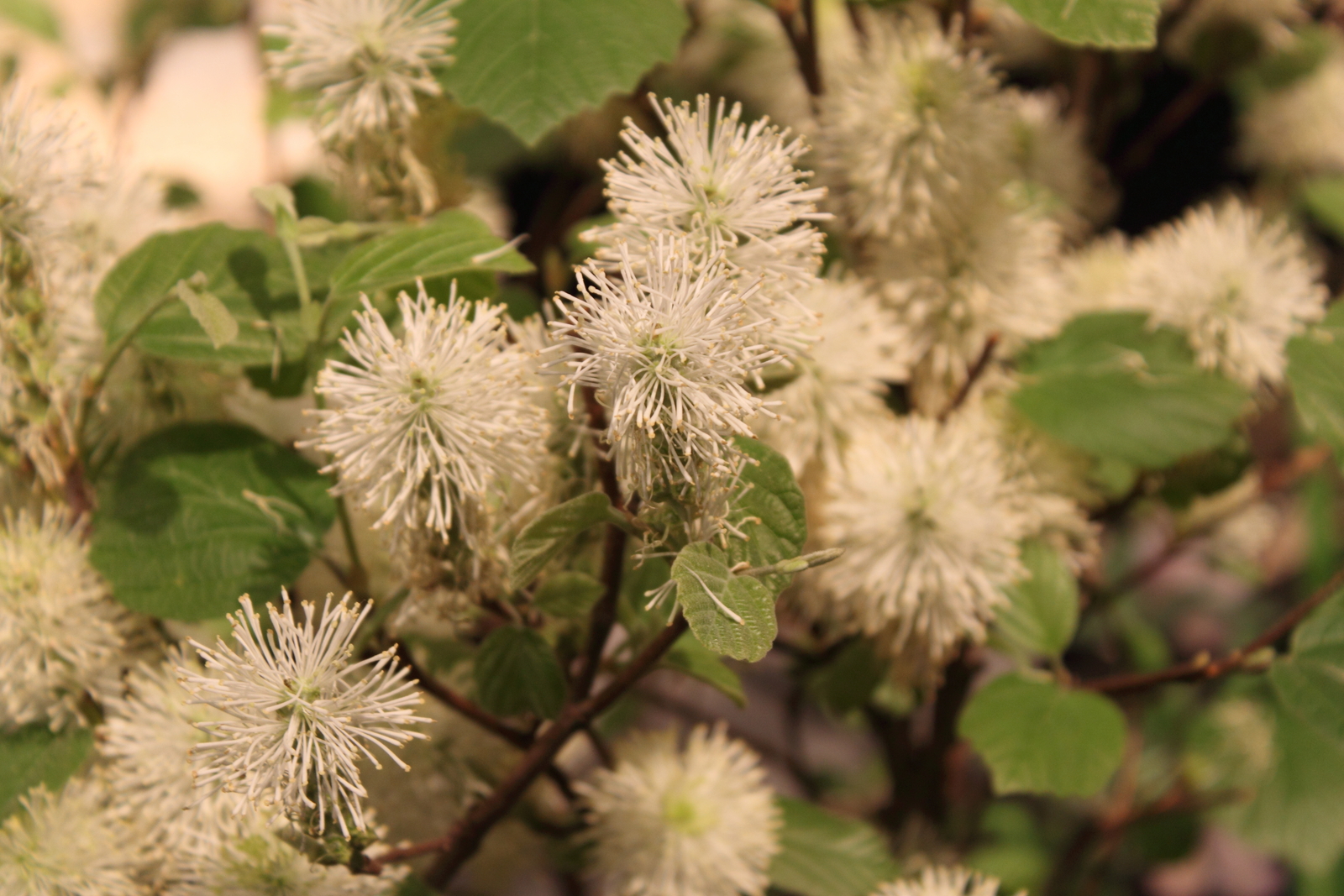
Mountain witch-alder
Fothergilla major
A small shrub with brush-like clusters of white flowers in April that emerge with or before the leaves. The state-Threatened ranking reflects its limited range on the Cumberland Plateau and Blue Ridge edges. Per the TDEC 2025 Rare Plant List, S2/G3 in Tennessee.
Status: Native; Tennessee state-Threatened (S2 / G3).
Hazels
The native hazelnuts produce small but wildlife-important nuts at woodland edges. American hazelnut is widespread; beaked hazelnut is restricted to cooler higher-elevation slopes.
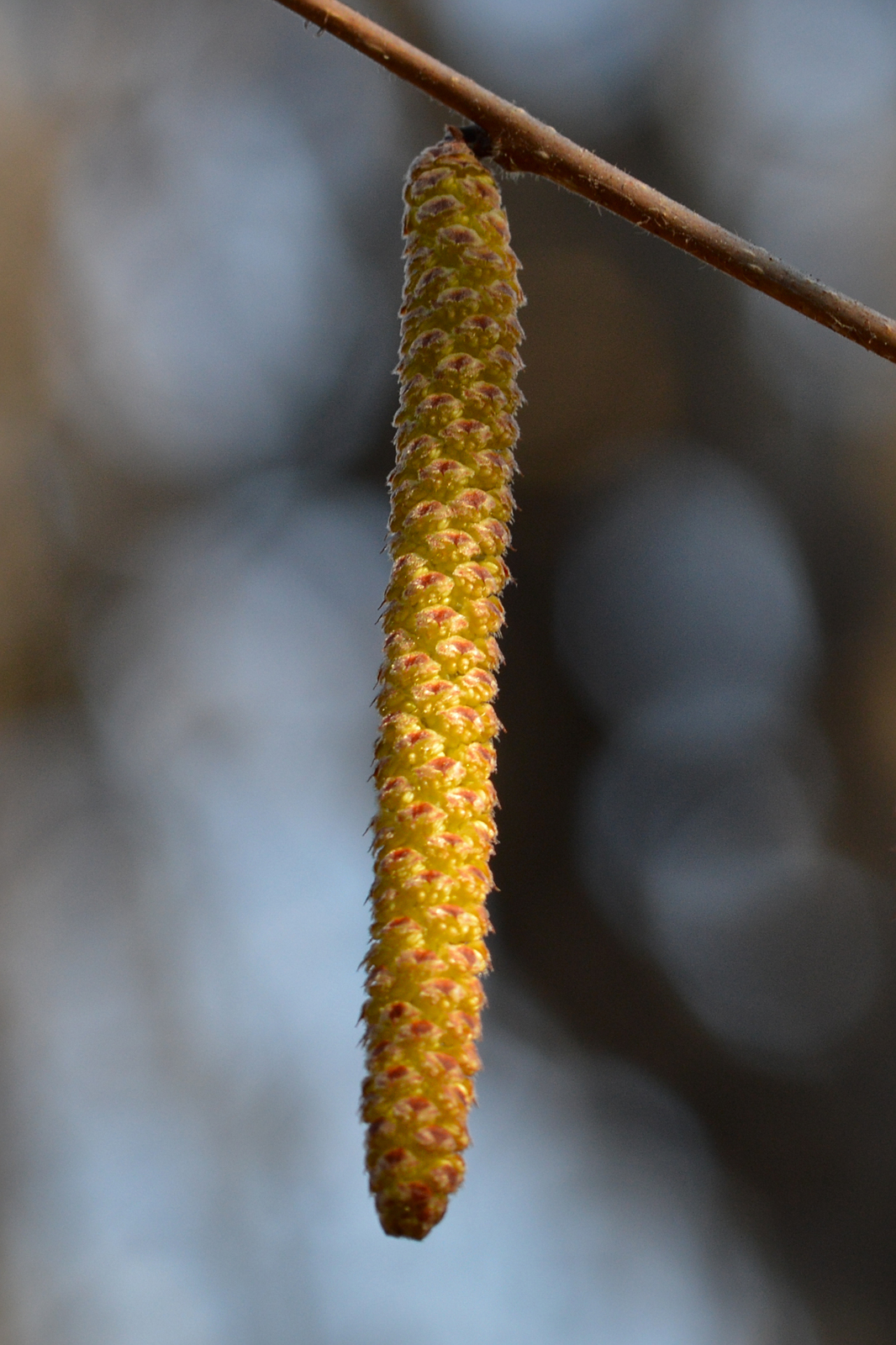
American hazelnut
Corylus americana
A large multi-stemmed shrub of forest edges and old fields. Long pendant catkins open in March before the leaves; nuts (smaller than European hazelnuts) ripen inside leafy husks in late summer. Heavy nut production once provided a fall food staple for both wildlife and people.
Status: Native; common at forest edges.
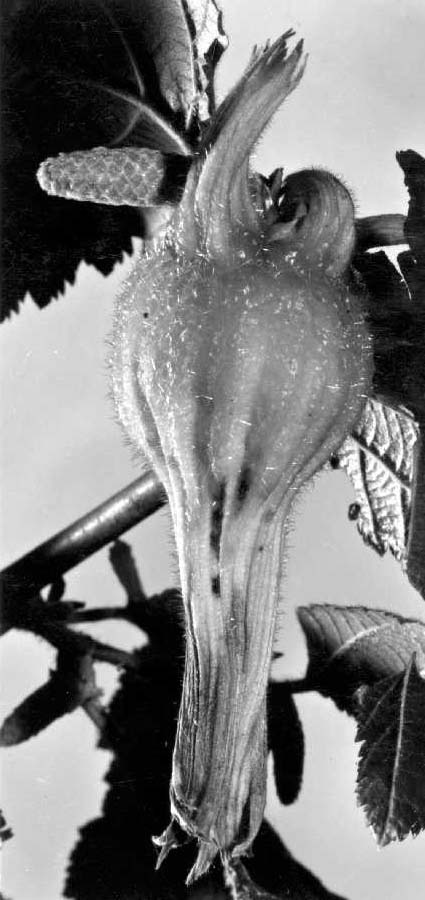
Beaked hazelnut
Corylus cornuta
Distinguished from American hazelnut by tubular husks that taper into a long beak around each nut. Higher elevations and cooler slopes than the American species; rare to absent on the lowest gorge slopes.
Status: Native; less common, on cooler slopes.
Viburnums, shrub-form dogwoods, and elderberries
Three closely related lineages of fruit-producing shrubs that share the niche of moist forest edges and stream margins. Viburnums, dogwoods, and elderberries are all in the order Dipsacales (with sambucus now placed in Viburnaceae); their fruits feed migrating thrushes and waxwings through fall.
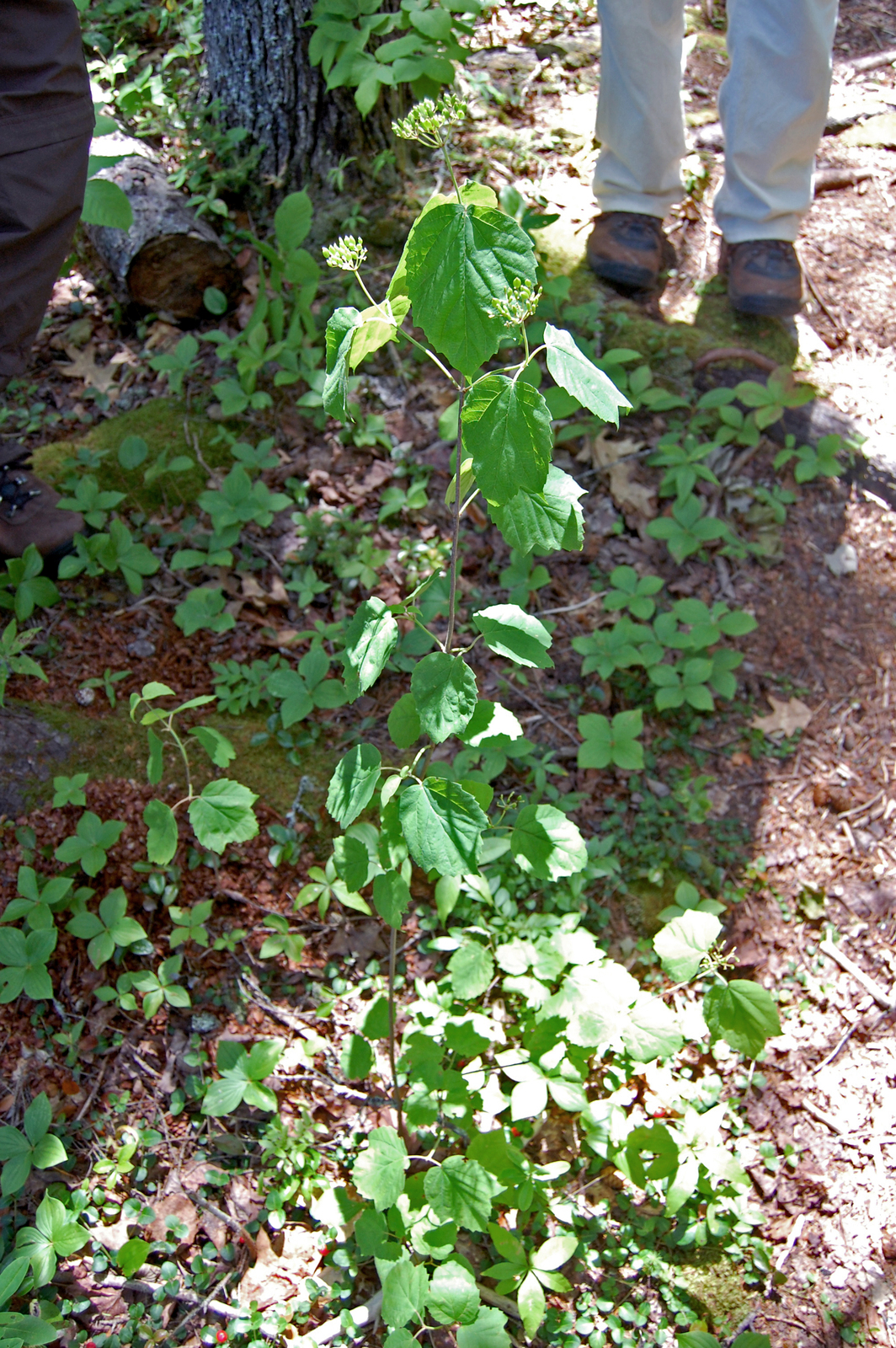
Maple-leaf viburnum
Viburnum acerifolium
Maple-shaped leaves and flat-topped clusters of small white flowers in May. Fruits ripen blue-black in fall. Common in dry oak woods; one of the most reliable shrubs for fall leaf color in the dry uplands, turning rose-pink to wine-red.
Status: Native; common in oak woods.
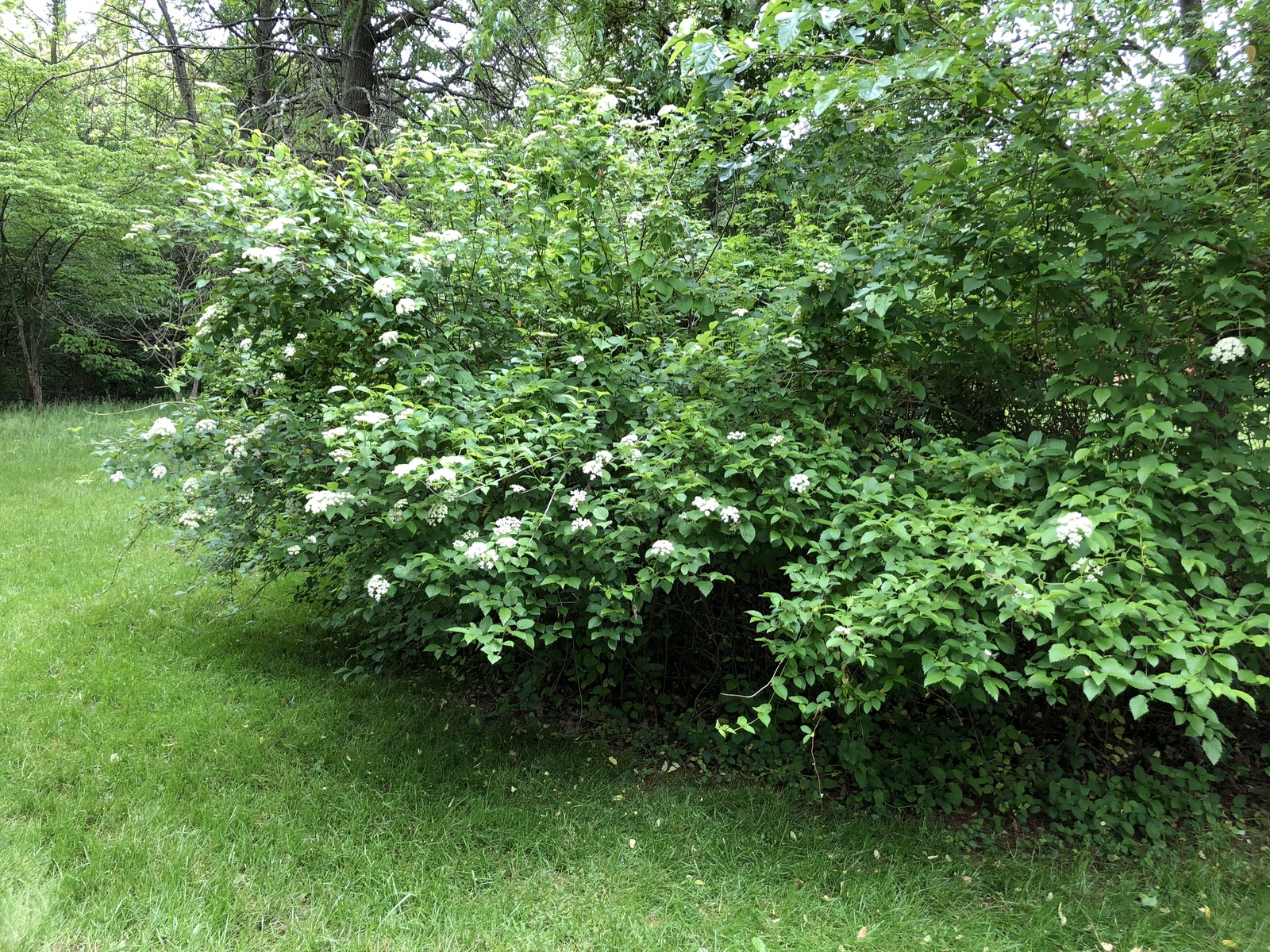
Southern arrowwood
Viburnum dentatum
Straight stems were used by Native Americans for arrow shafts. Flat clusters of white flowers in May; blue-black fruits in late summer. Wet woods, stream banks, and flatwoods on the plateau and in valley bottoms.
Status: Native; common in moist woods.
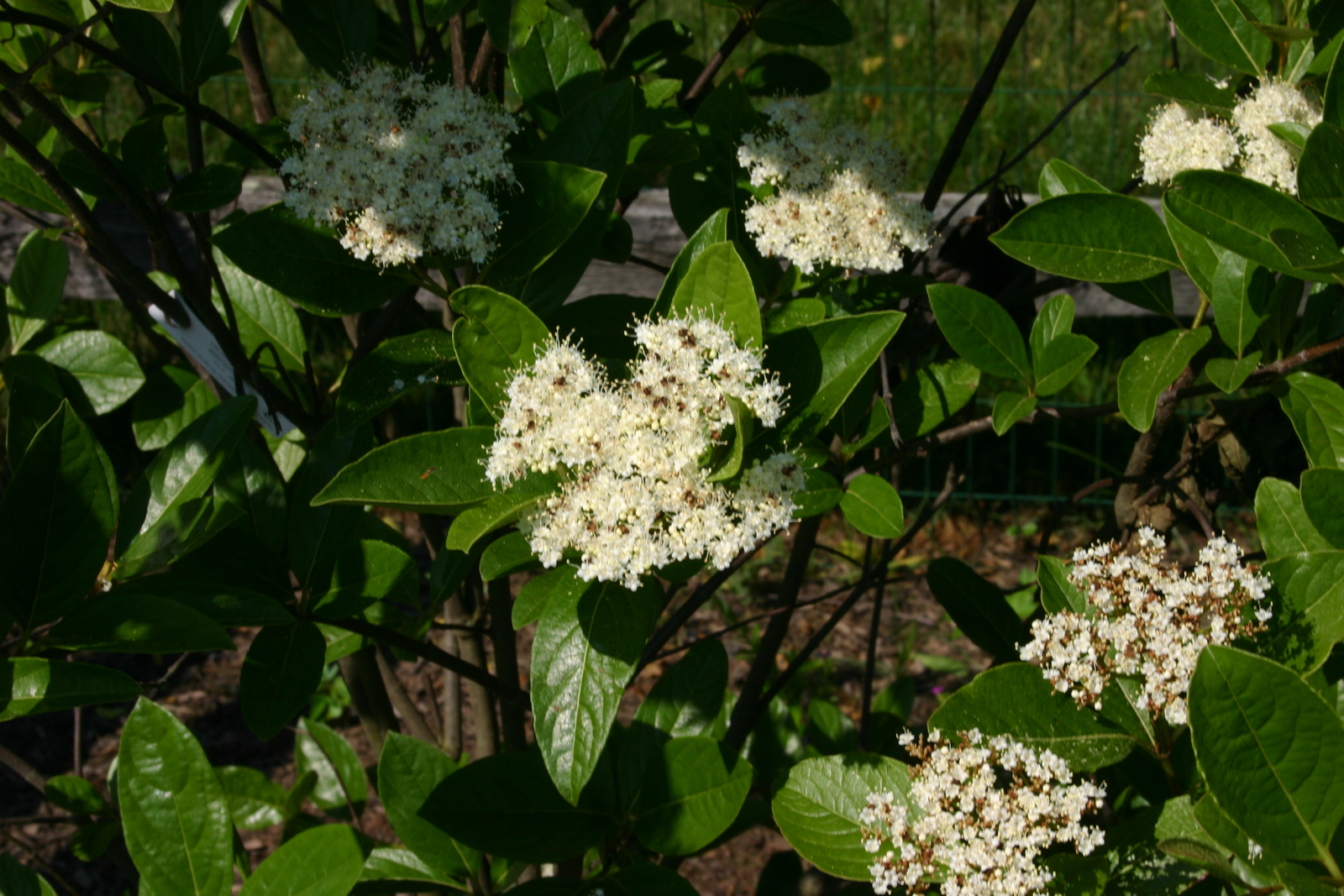
Possumhaw viburnum
Viburnum nudum
Shiny dark green leaves and clusters of pink-and-blue ripening fruits. Tolerates wet feet better than most viburnums; common in plateau bogs and along plateau streams. Distinct from the holly-family possumhaw (Ilex decidua) despite the shared name.
Status: Native; common in wet plateau spots.
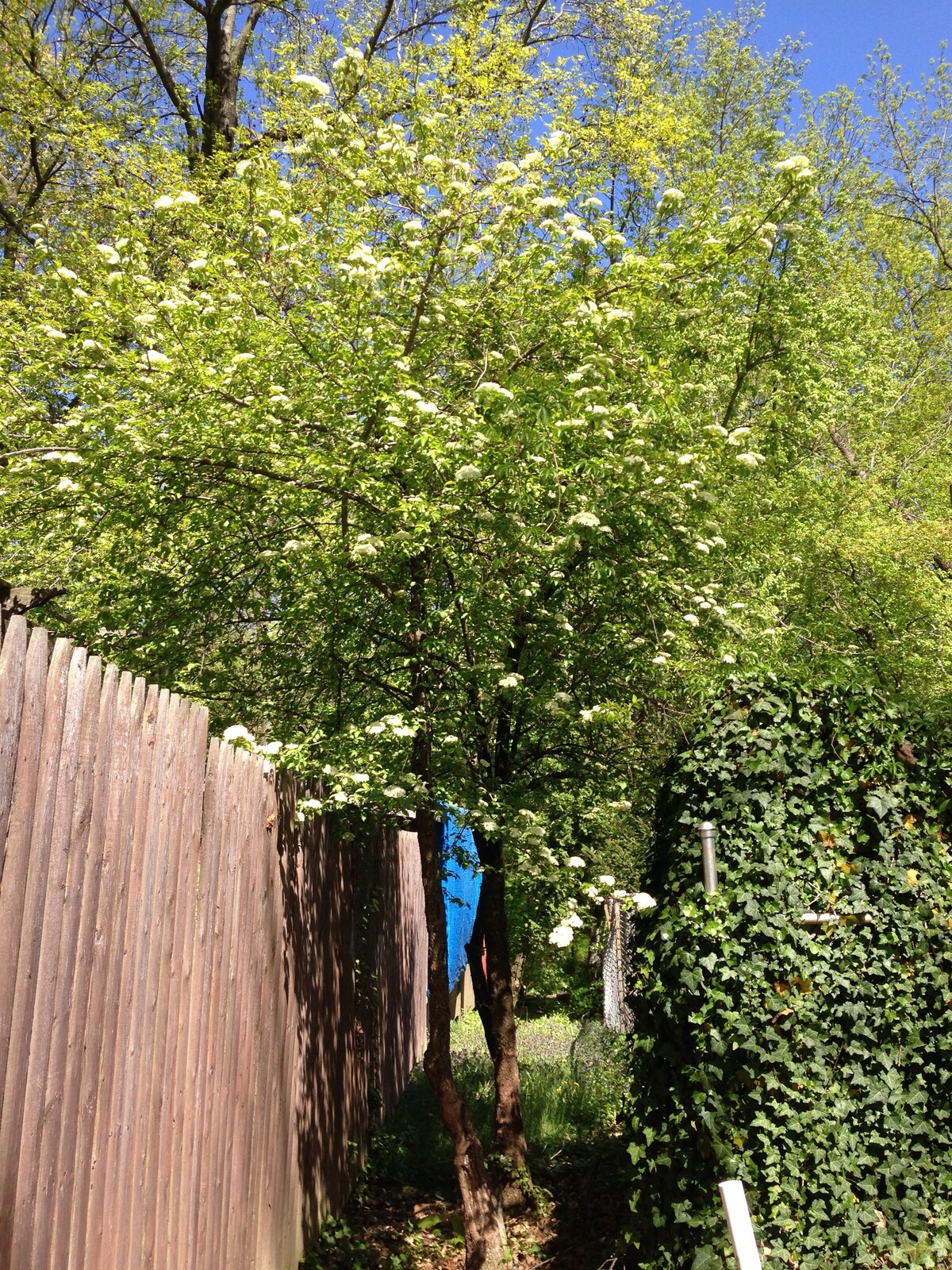
Smooth blackhaw
Viburnum prunifolium
A larger viburnum that can reach small-tree size; leaves resemble black cherry but lack the cherry's gland-tipped petiole. White flat-topped flower clusters in April; blue-black drupes in late summer that locals sometimes harvest for jelly.
Status: Native; common in valley woods.
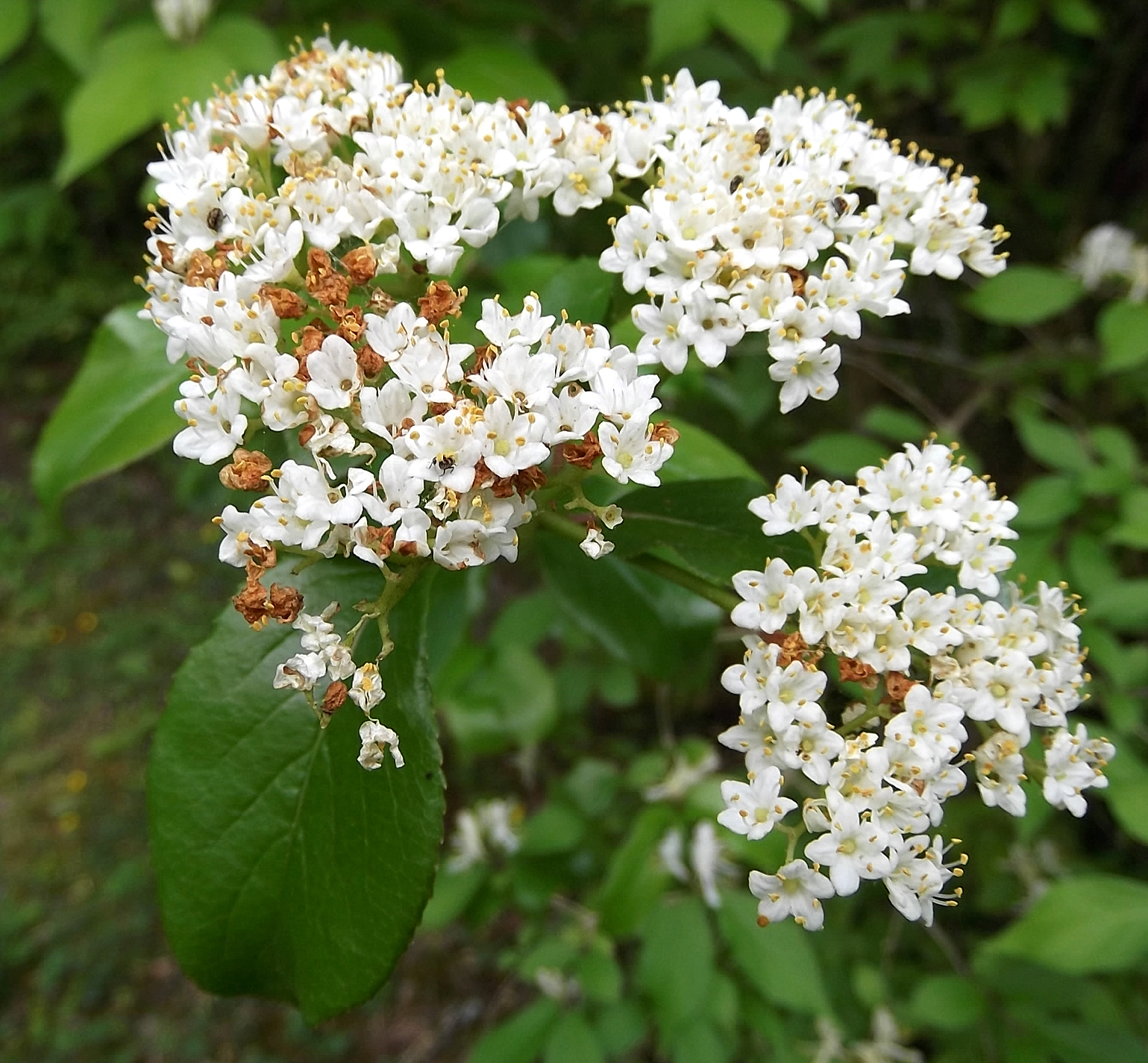
Rusty blackhaw
Viburnum rufidulum
Distinguished from smooth blackhaw by the rust-colored fuzz on young shoots and leaf undersides. Drier sites, including limestone bluffs and rocky uplands. Often the most reliable viburnum in dry rocky woods on the gorge slopes.
Status: Native; common on dry rocky slopes.
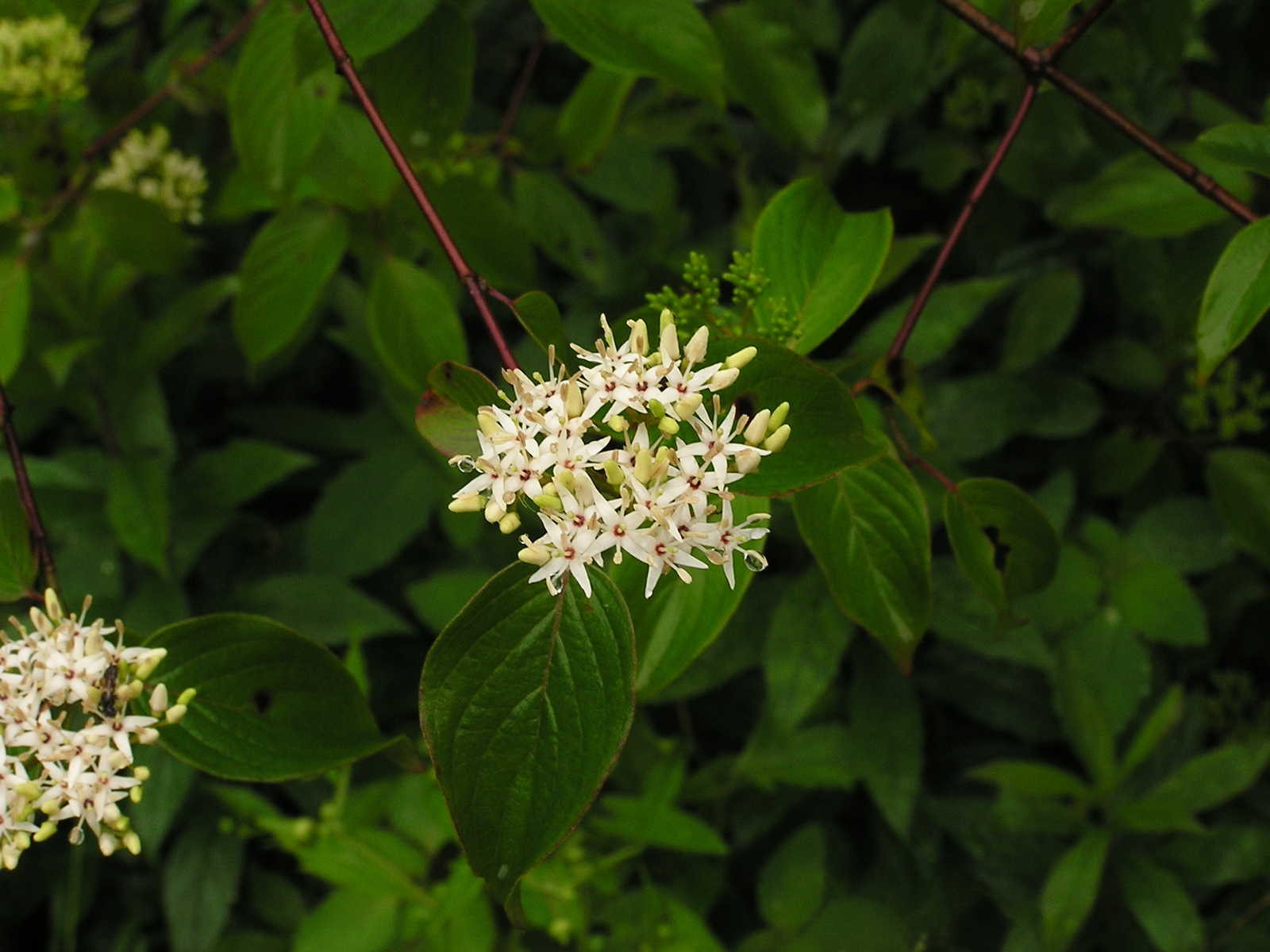
Silky dogwood
Cornus amomum
Streamside dogwood with white flat-topped flower clusters in May and June and blue ripening fruits. Young twigs purple-red; new leaves and fruit stalks covered in silky hair (hence the common name).
Status: Native; common along plateau streams.
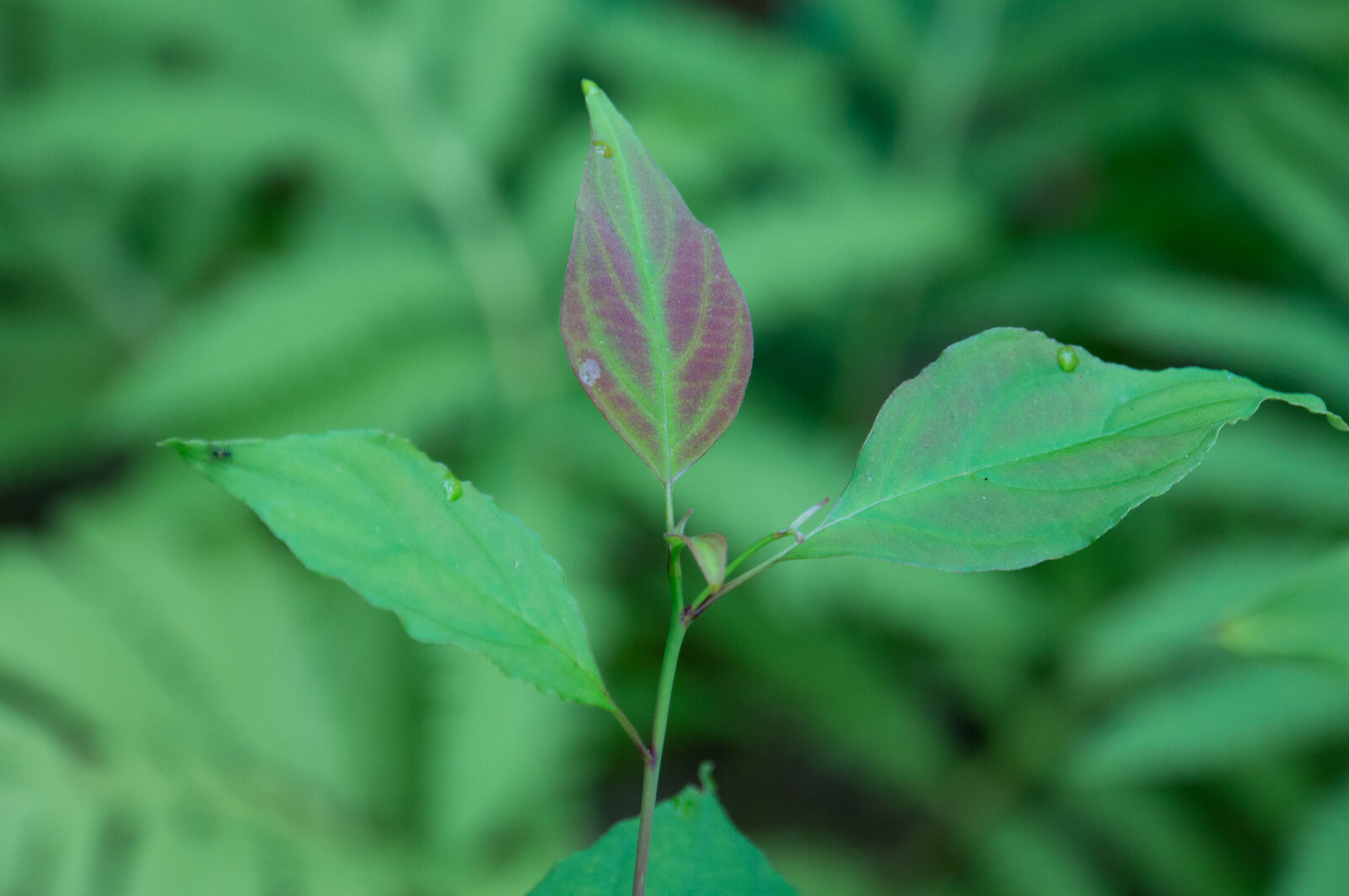
Pagoda dogwood
Cornus alternifolia
A small understory tree-shrub with horizontal branches arranged in flat layers (the "pagoda" form). White flat-topped flower clusters in May; blue-black fruits on red stalks in late summer. Cooler cove-mesic habitat.
Status: Native; uncommon, in cove woods.
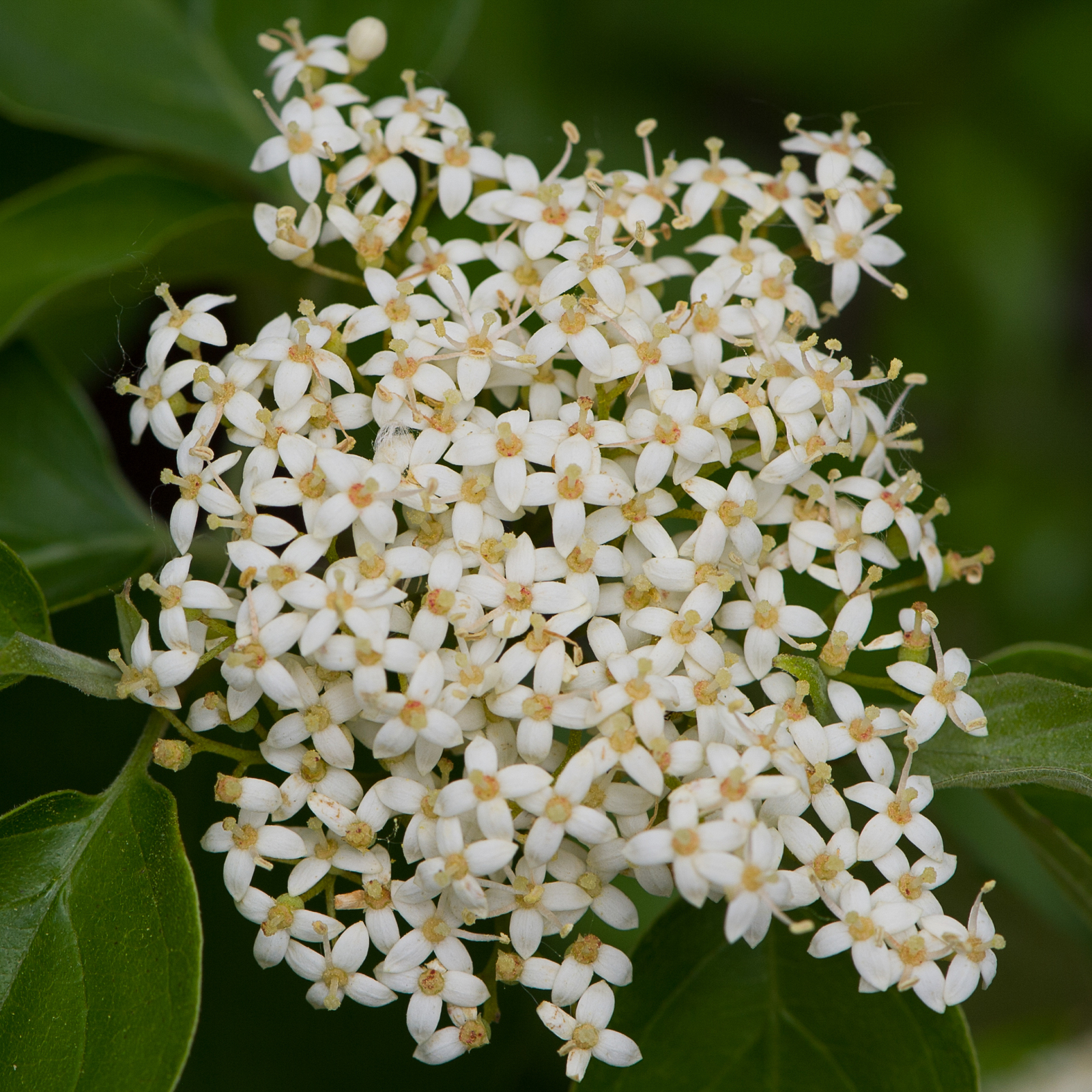
Rough-leaf dogwood
Cornus drummondii
A thicket-forming dogwood of valley margins and old fields, with sandpapery leaves. White flat-topped flower clusters in late spring; white fruits on red stalks. More common in the Sequatchie Valley than on the plateau.
Status: Native; common in valley old fields.
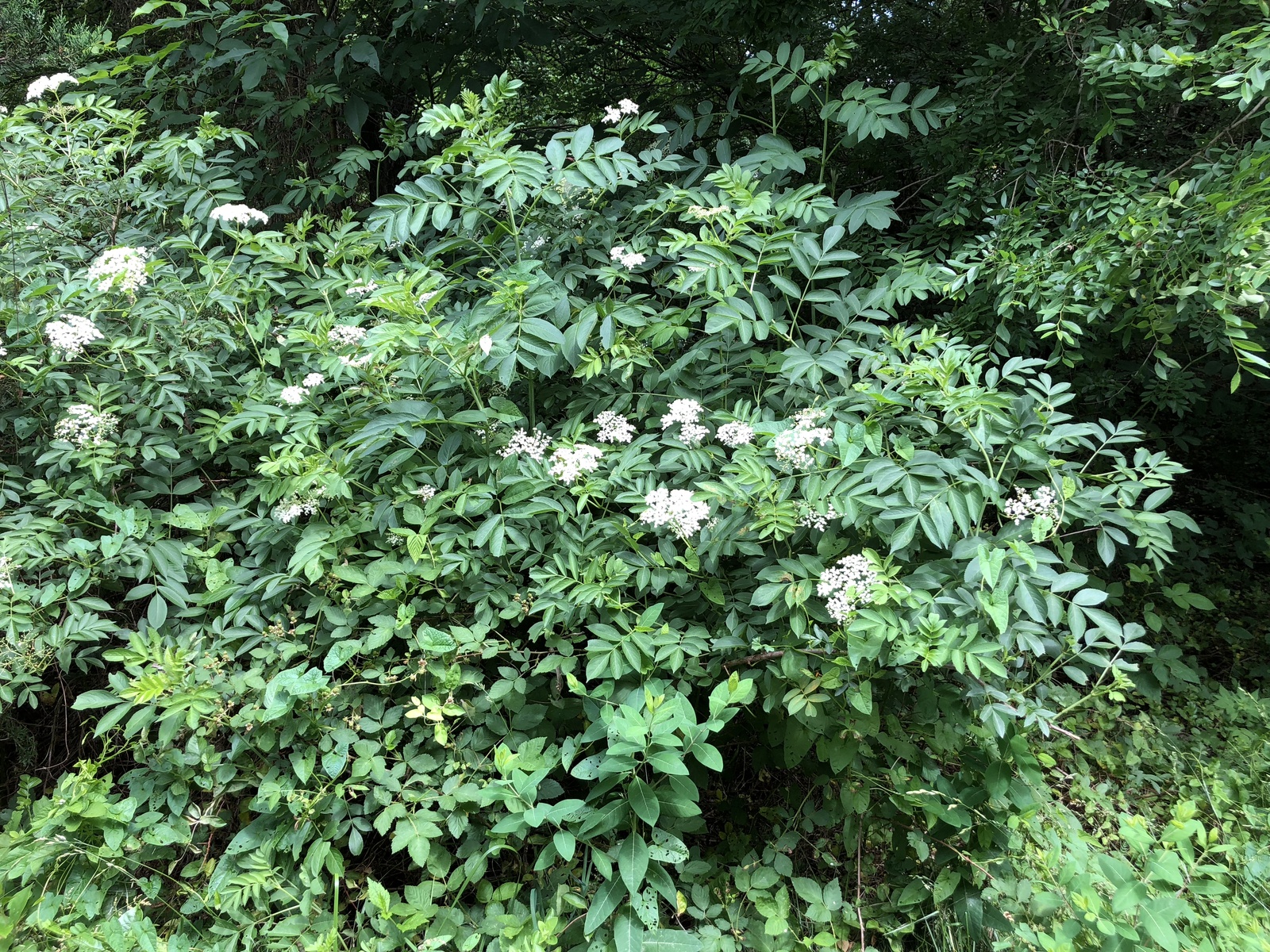
American elderberry
Sambucus canadensis
Large flat-topped white flower clusters in June, ripening to clusters of small purple-black drupes in August. Common in moist roadsides and stream banks. Berries (cooked) make jelly and wine; raw berries and the bark, leaves, and roots are toxic.
Status: Native; common in moist disturbed ground.
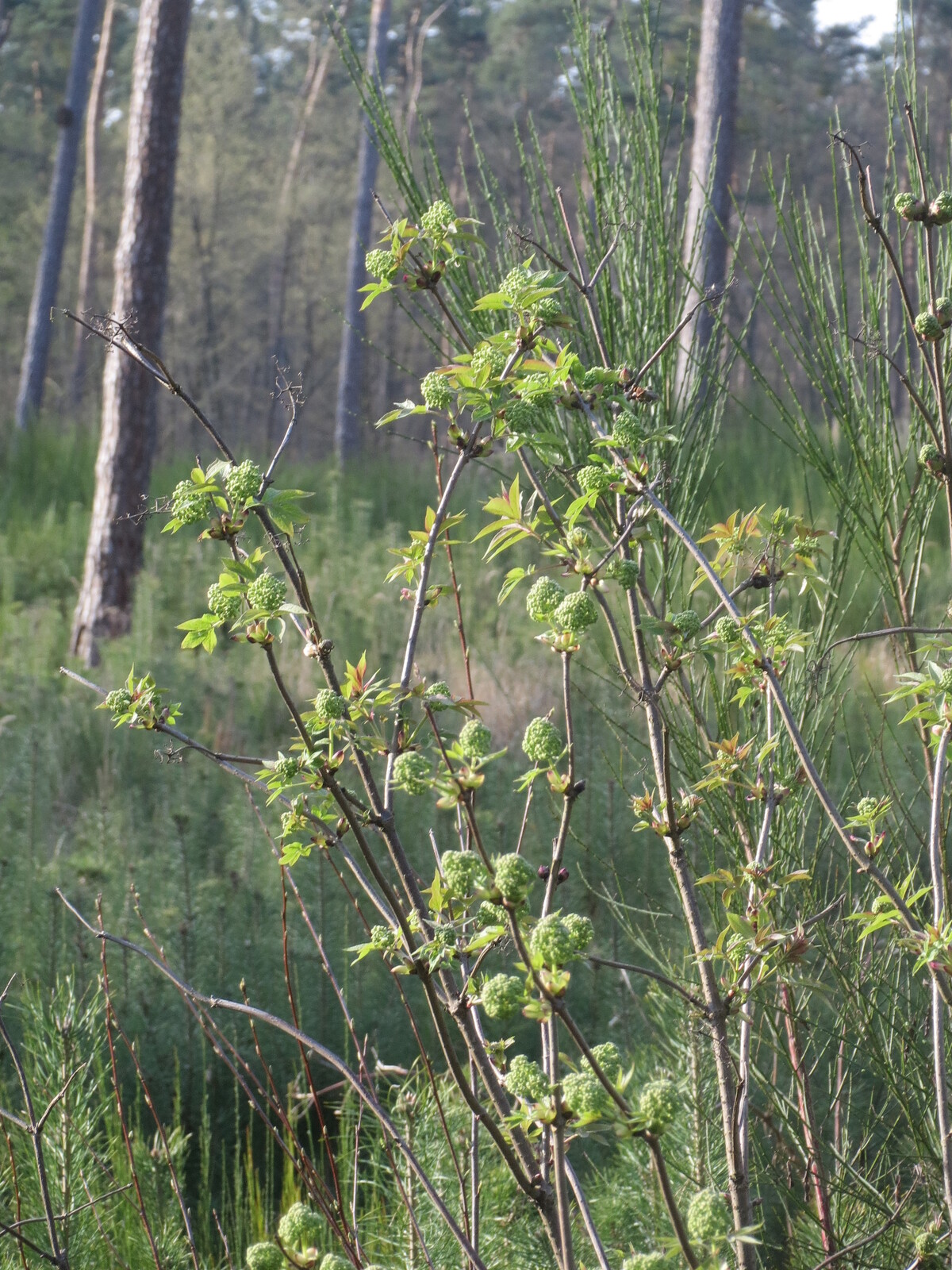
Red elderberry
Sambucus racemosa
Pyramidal (rather than flat) flower clusters in May, ripening to bright red drupes in midsummer. Cooler spots than American elderberry; more common at higher elevations on the plateau than in the valley. Berries are mildly toxic raw and not generally used for jelly.
Status: Native; uncommon, in cool plateau coves.
Spicebush, sweetshrub, alder, and other forest-floor shrubs
A group of mostly native shrubs that share the moist understory niche, several with strong aromatic chemistry: northern spicebush smells of lemon-pepper, Carolina allspice of clove, and the bruised twigs of leatherwood are pungent enough that the early-spring flowers carry the smell some distance.
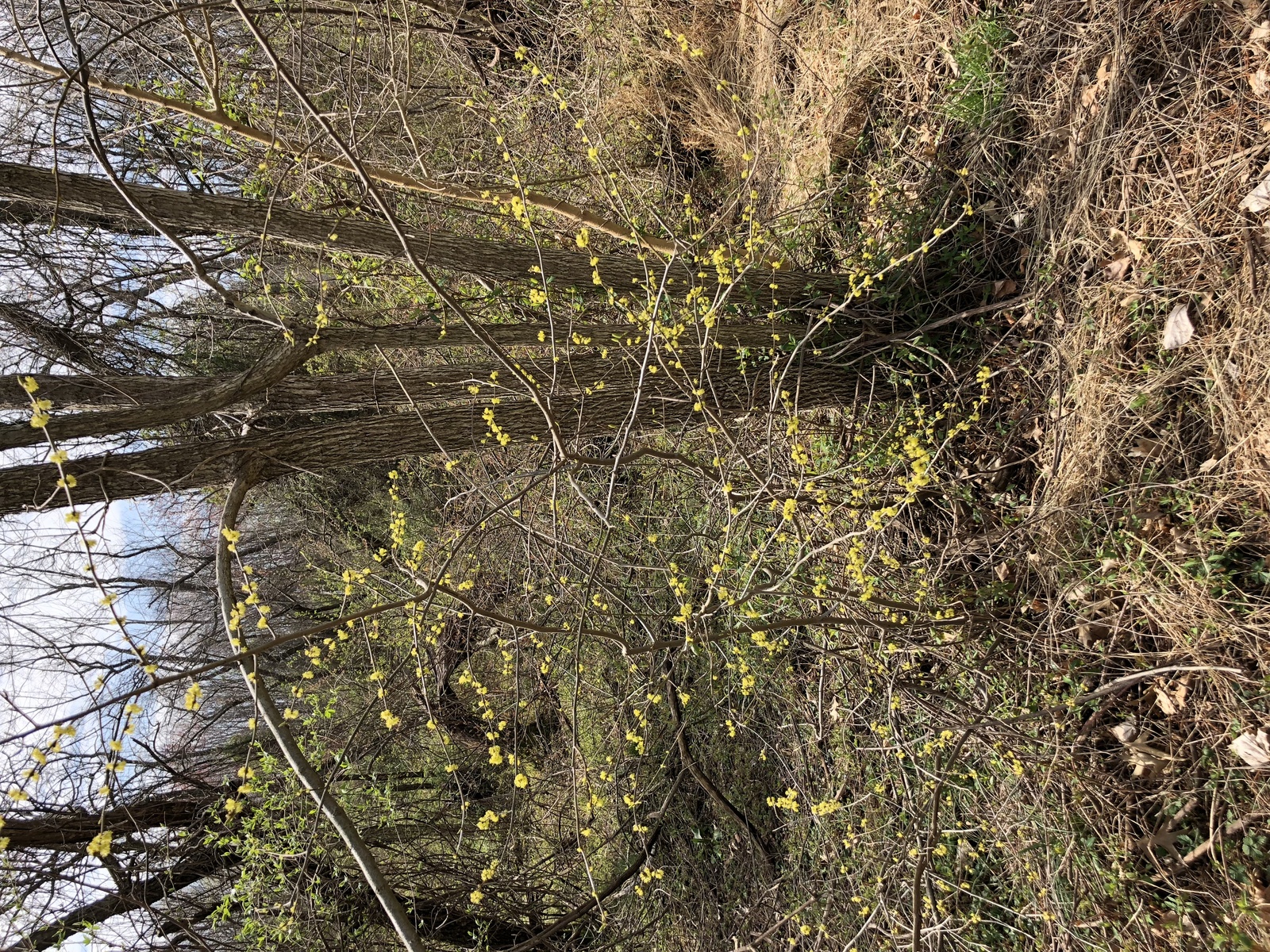
Northern spicebush
Lindera benzoin
A tall shrub of rich cove-hardwood understory; leaves and twigs give off a strong lemon-pepper smell when crushed. Tiny yellow flowers in clustered umbels appear in late March before the leaves, often the first splash of color in cove woods. Bright red drupes in fall feed migrating thrushes.
Status: Native; common in cove woods.
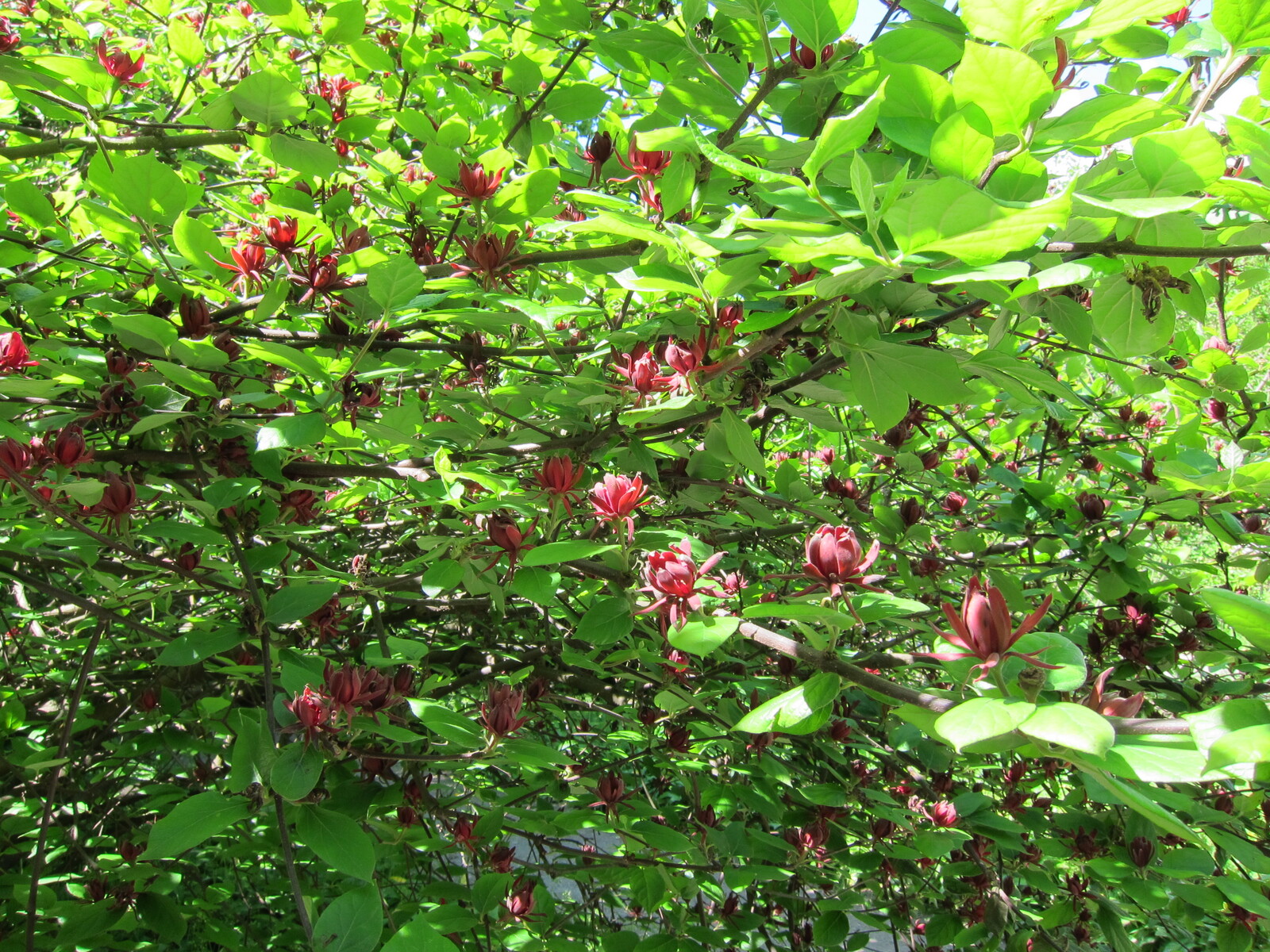
Carolina allspice
Calycanthus floridus
Also called eastern sweetshrub. Reddish-brown strap-like fragrant flowers open in May; the bruised wood, leaves, and bark have a clove-cinnamon smell that frontier homesteaders used as a clothes-trunk sachet. Cove forest understory; often along the Cumberland Trail in the lower gorge.
Status: Native; uncommon but distinctive.
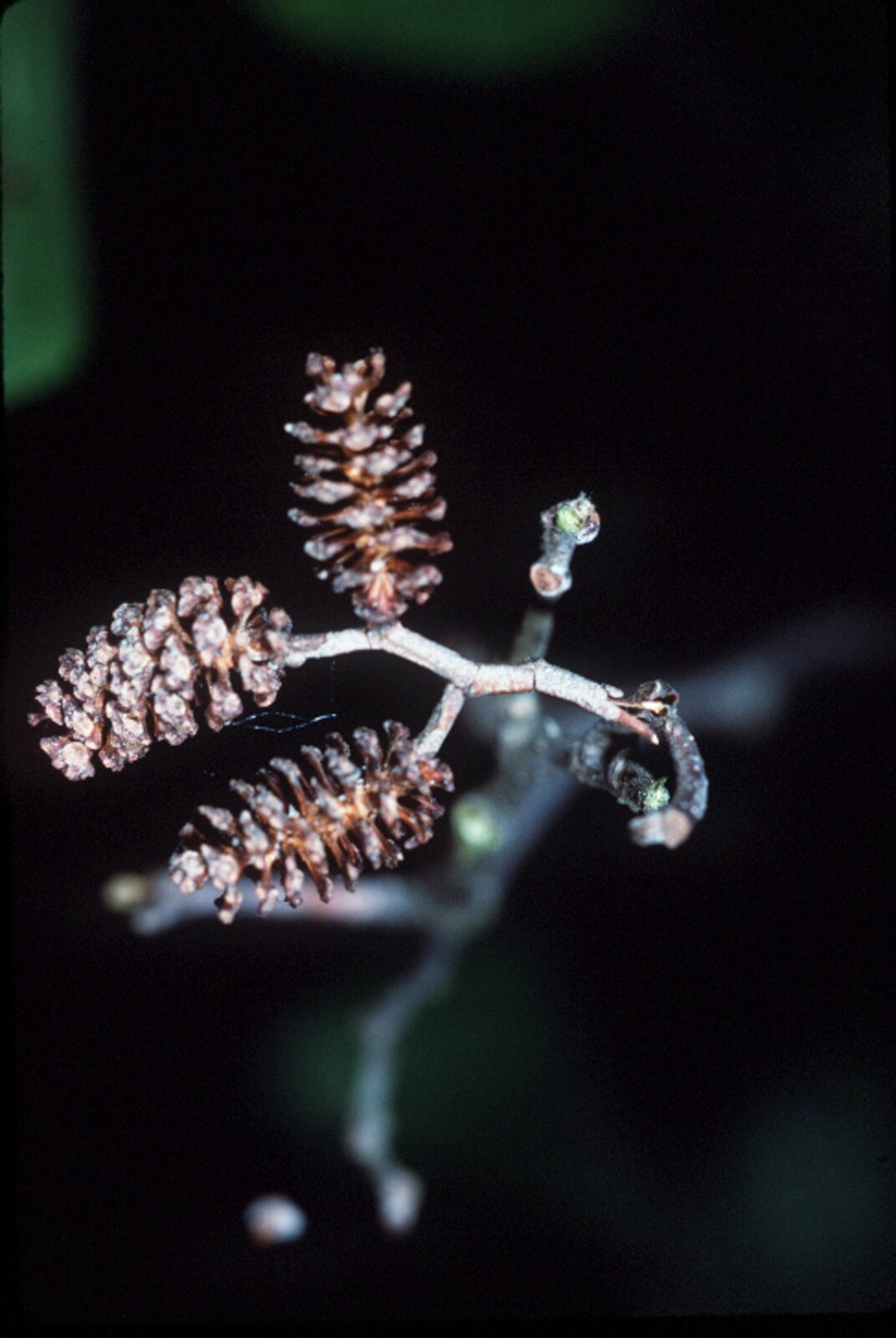
Brookside alder
Alnus serrulata
Also called hazel alder or smooth alder. Multi-stemmed shrub or small tree of stream banks and seepage areas; small woody cones persist on the branches through winter. Fixes nitrogen at the roots, an important contribution to riparian-soil fertility.
Status: Native; common along plateau streams.
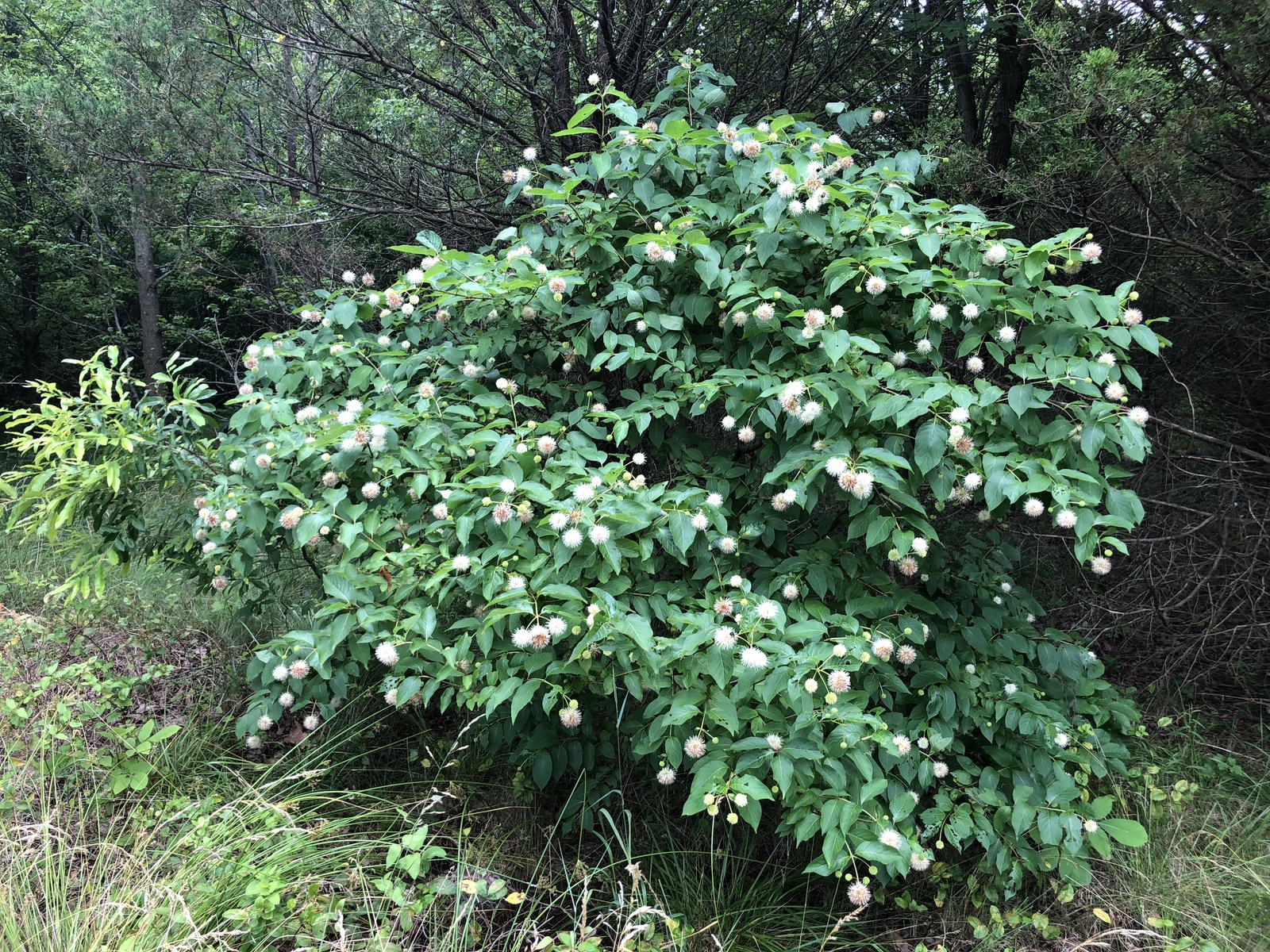
Buttonbush
Cephalanthus occidentalis
Spherical creamy-white flower heads in June and July. Wet feet are obligatory: pond margins, slow-water river edges, swamp openings. The flower heads are heavily visited by butterflies and bumblebees.
Status: Native; common at pond margins.
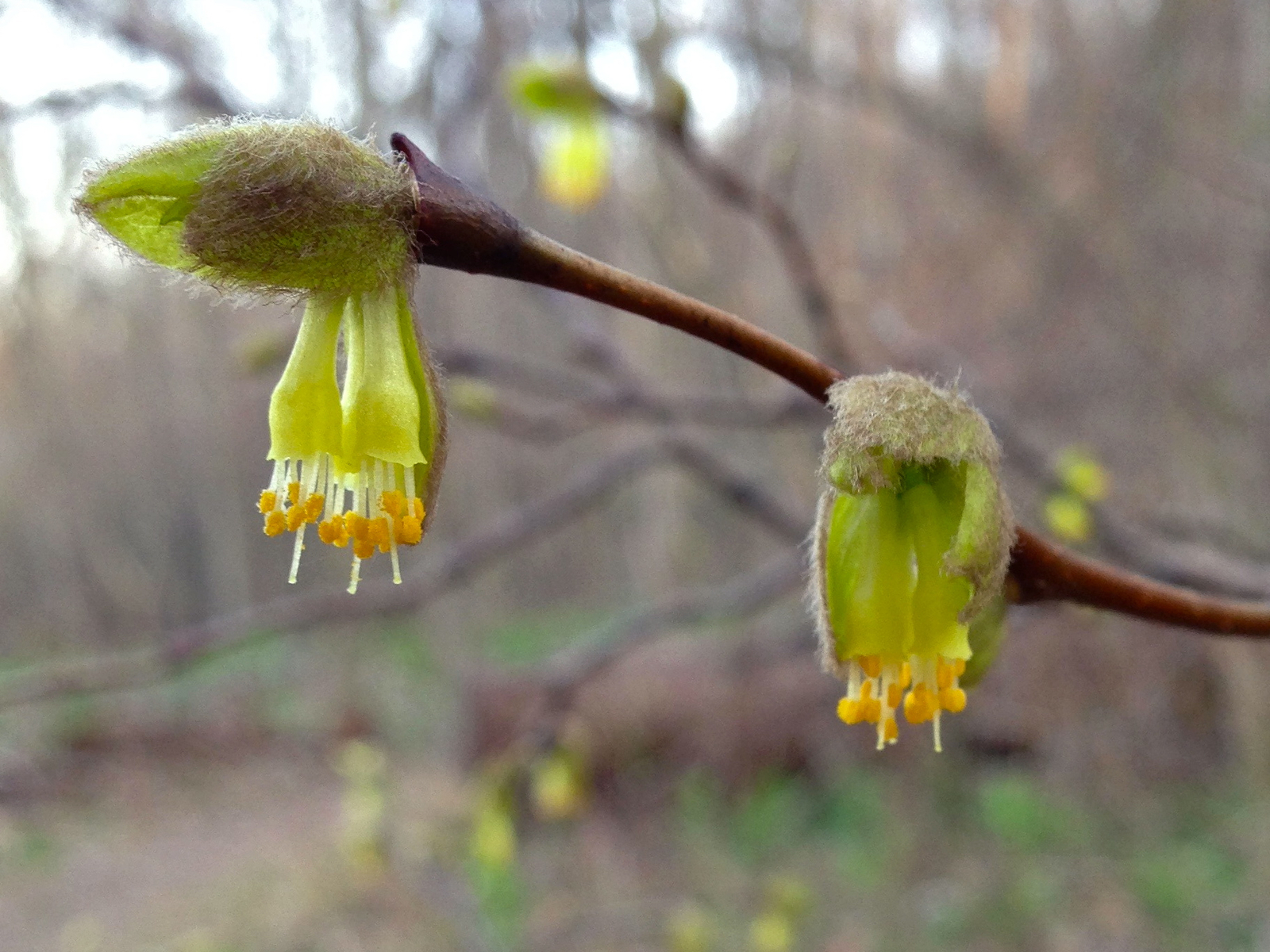
Leatherwood
Dirca palustris
A small understory shrub of rich cove-hardwood forest; the bark is so flexible and tough that it was used for cordage and basket bands. Tiny pale-yellow flowers in early March before the leaves, well ahead of most cove understory shrubs.
Status: Native; uncommon, in rich cove forest.
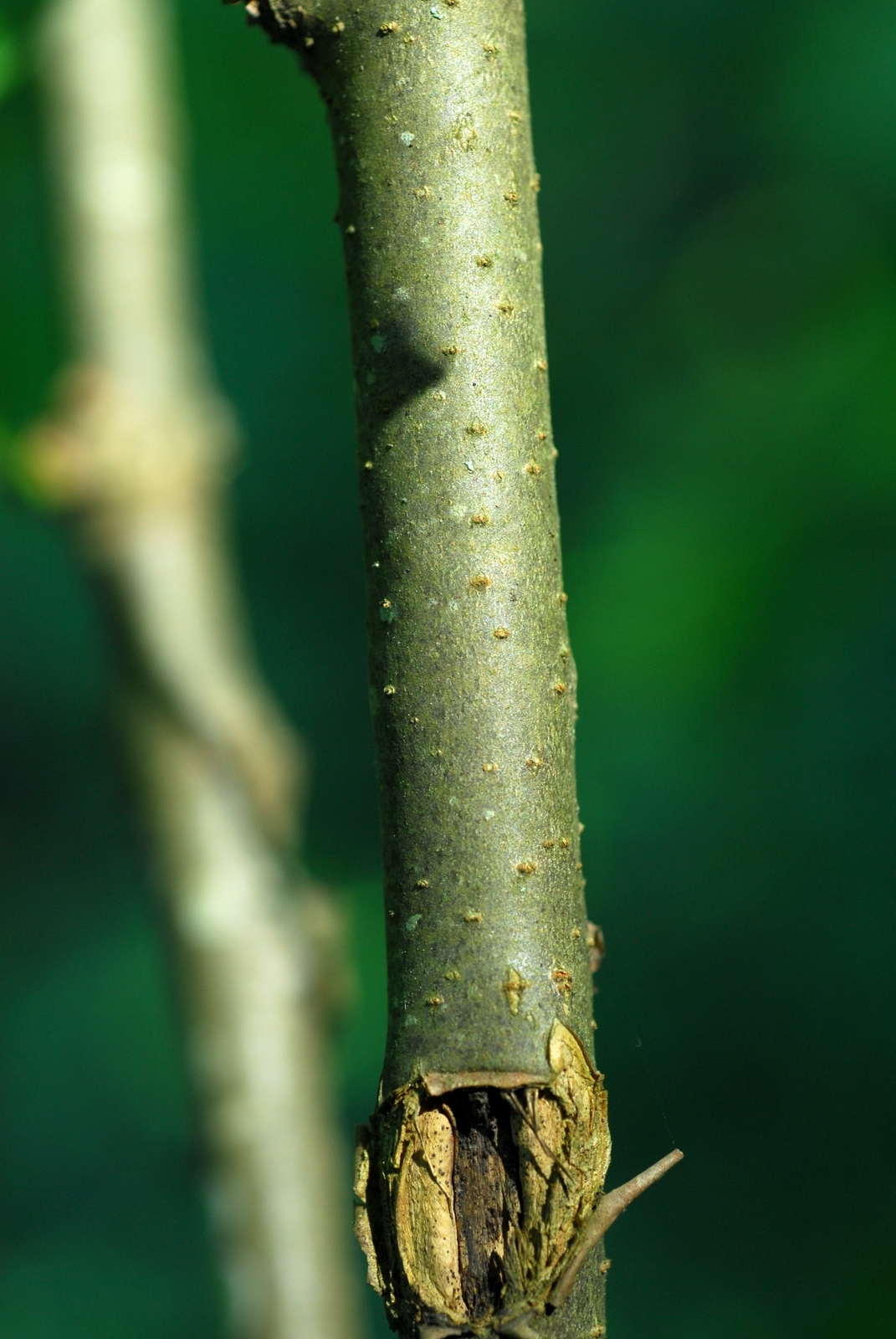
Buffalo nut
Pyrularia pubera
A hemiparasitic shrub: it photosynthesizes but also taps the roots of nearby trees for water and nutrients. Small green flowers in spring; pear-shaped fruits in summer. Found in dry oak woods on plateau slopes and ridges.
Status: Native; uncommon, on dry oak slopes.
Nestronia
Nestronia umbellula
A low hemiparasitic shrub of dry pine-oak ridges, related to mistletoe and buffalo nut. Small whitish flowers in spring; fruits a fleshy drupe. Marion County is at the northwestern edge of its known range. Per the TDEC 2025 Rare Plant List, S1/G4 in Tennessee.
Status: Native; Tennessee state-Endangered (S1 / G4).
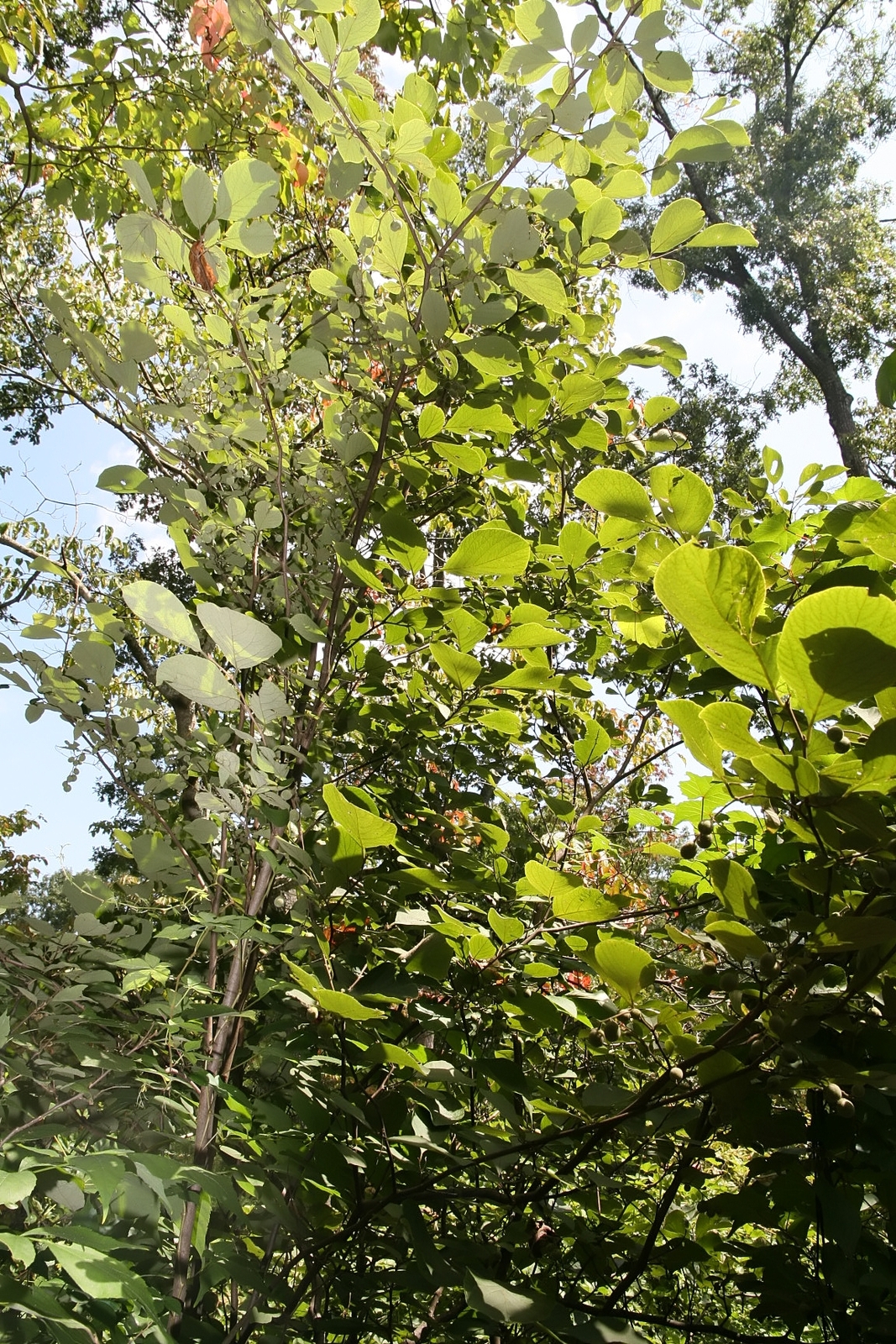
Big-leaf snowbell
Styrax grandifolius
Drooping clusters of bell-shaped white flowers in April and May, with the petals reflexed back so the prominent yellow stamens hang downward. Larger leaves than the common snowbell of cultivation. Cove-mesic forest understory.
Status: Native; uncommon in cove woods.
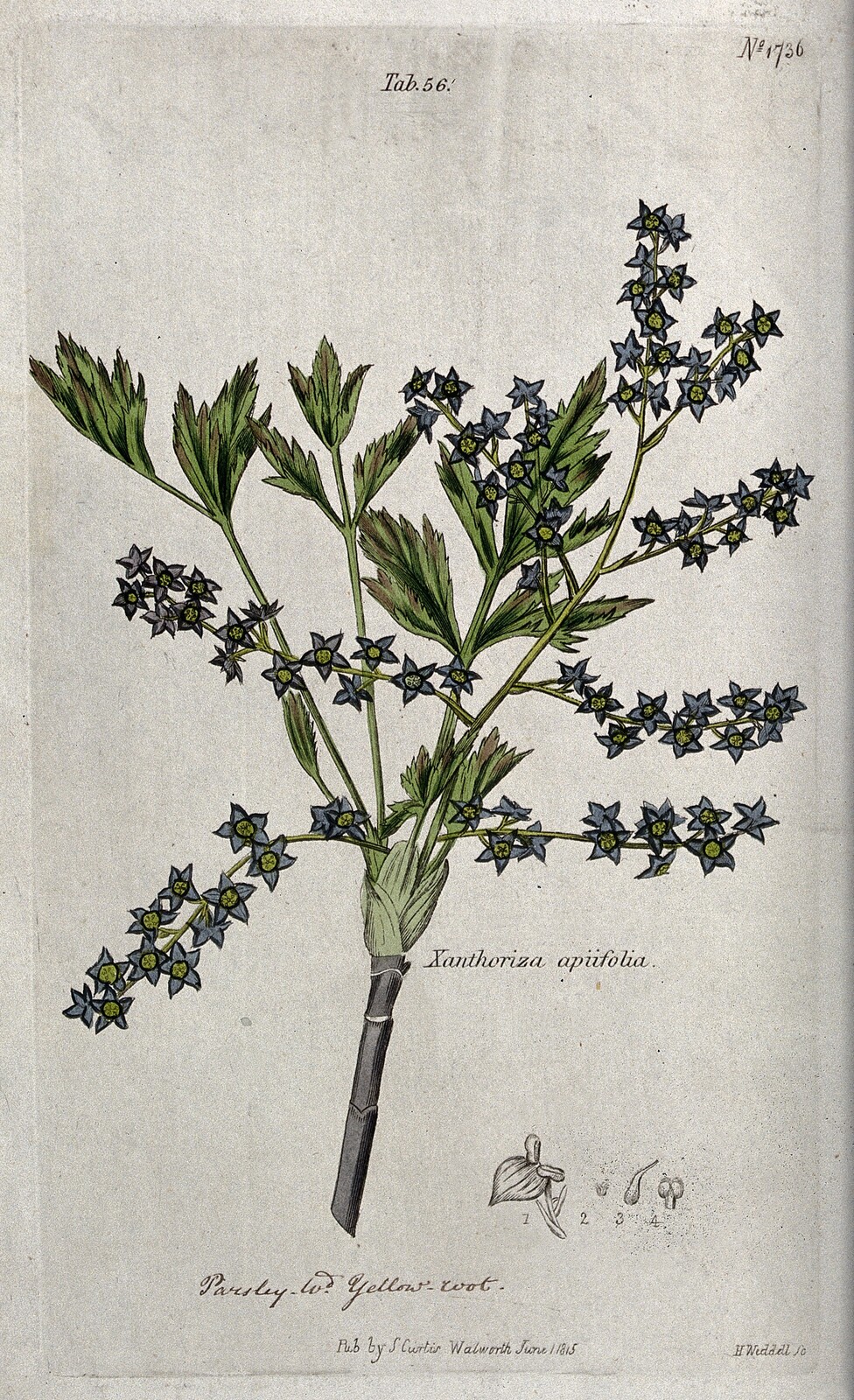
Yellowroot
Xanthorhiza simplicissima
A low colonial shrub of stream banks and floodplain woods; brilliant yellow rootlets give it the common name (and a long history of folk medicinal use for bitter tonics). Small purple star-shaped flowers in dropping racemes in early spring.
Status: Native; common along plateau streams.
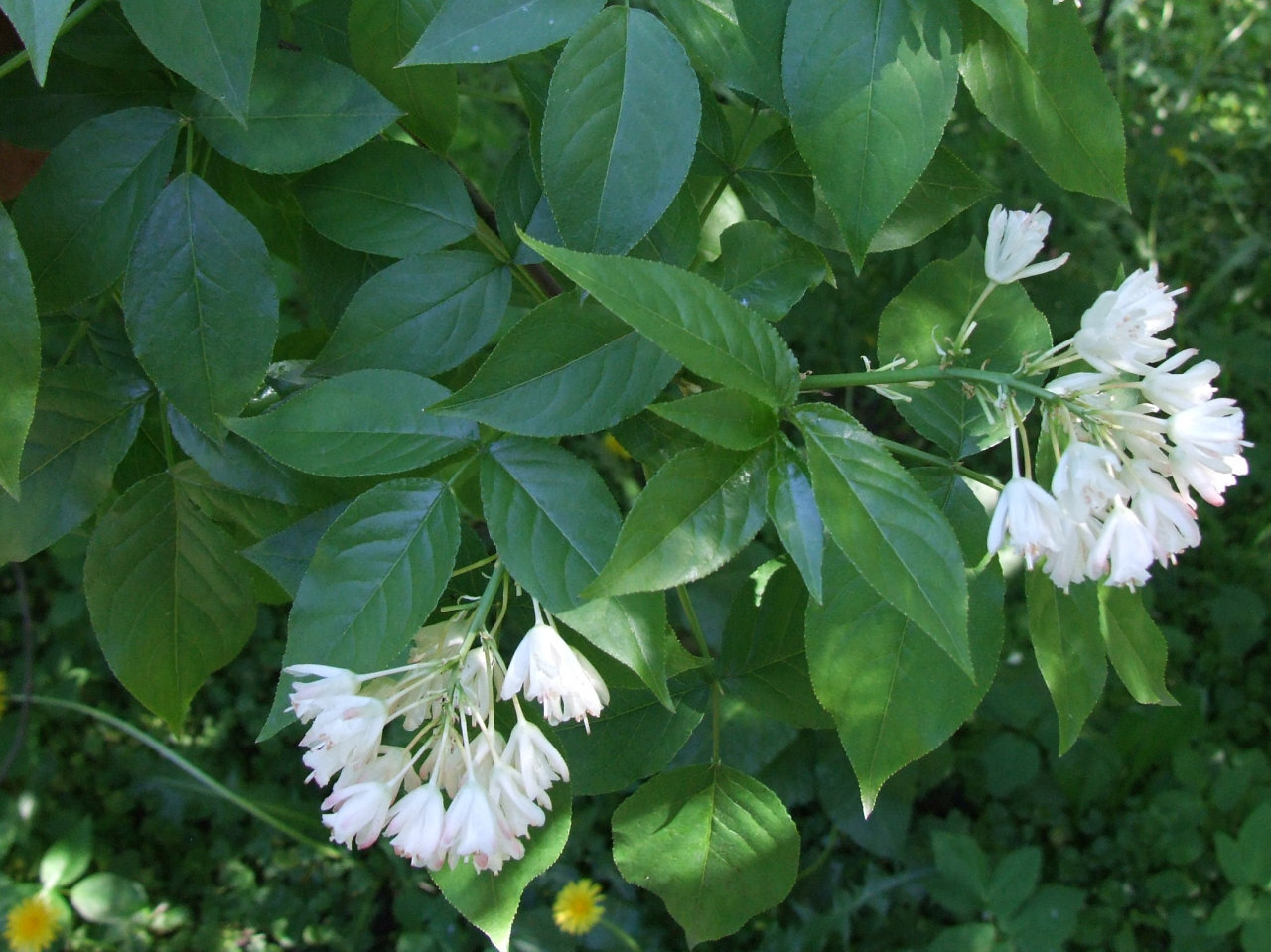
American bladdernut
Staphylea trifolia
Inflated three-lobed papery seed capsules persist on the branches into winter, the most reliable ID feature. Streamside and ravine slopes; small drooping clusters of bell-shaped white flowers in April.
Status: Native; uncommon, in stream ravines.
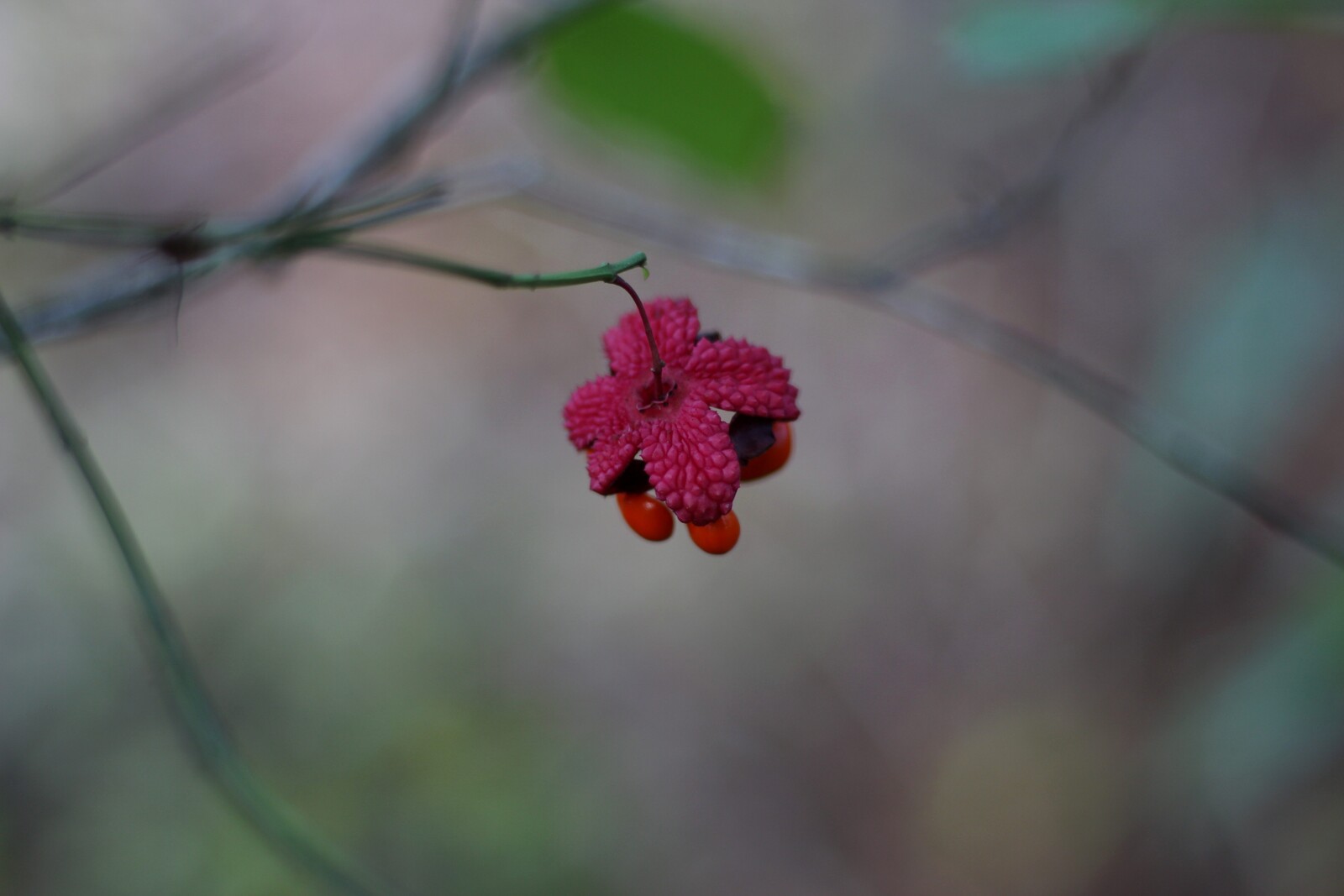
Strawberry bush
Euonymus americanus
Also called hearts-a-bursting. The pink-red warty seed capsules split open in fall to reveal bright orange seeds; the plant is otherwise easy to overlook. Rich woods and cove understory; thin green twigs are a good winter ID feature.
Status: Native; uncommon in rich woods.
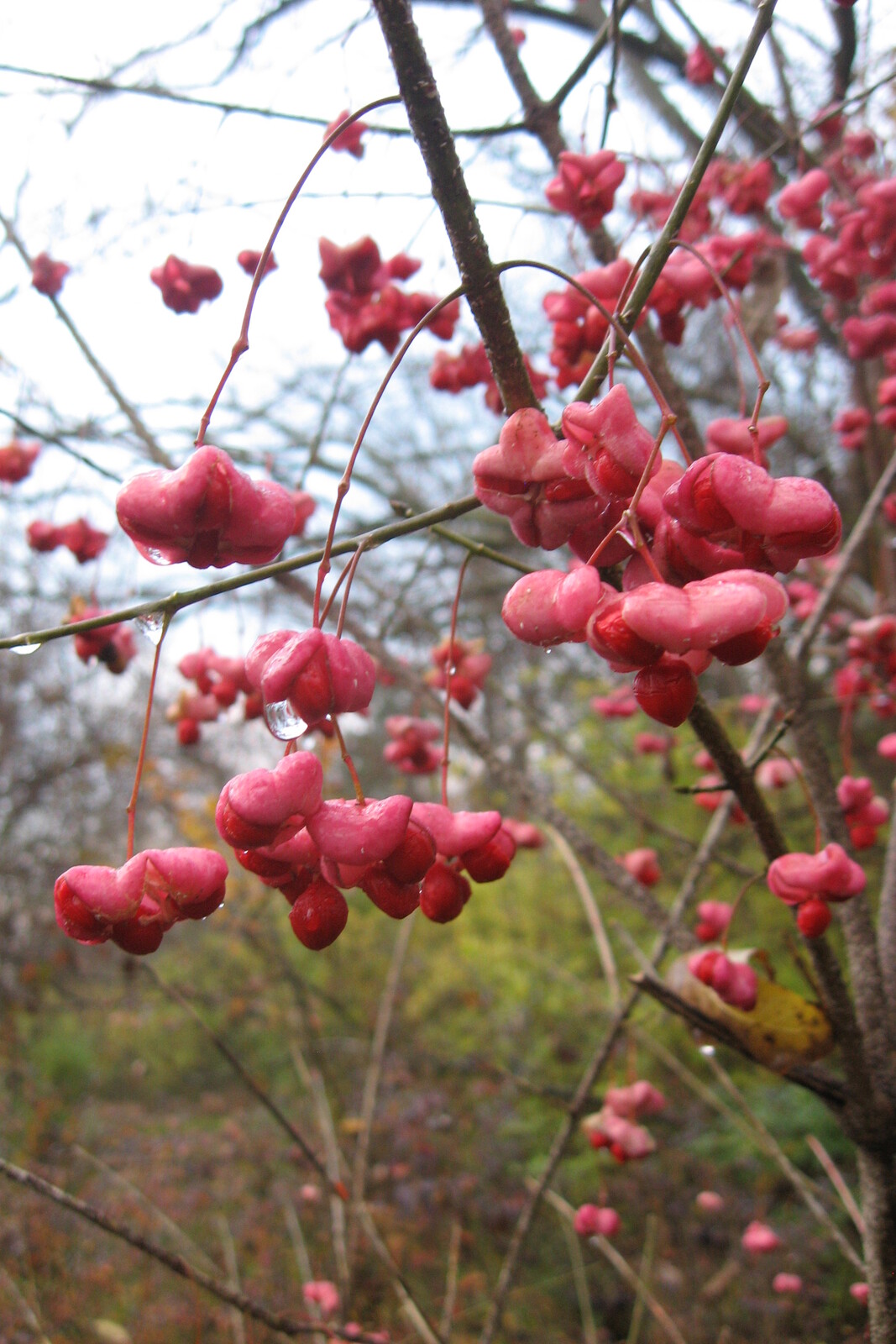
Eastern wahoo
Euonymus atropurpureus
A larger shrub or small tree relative of strawberry bush; pink four-lobed capsules split to reveal red seeds in fall. The bark was once used in folk medicine, and the species name atropurpureus refers to the dark-purple flowers in late spring.
Status: Native; uncommon in valley woods.
Sumacs and the poison-ivy relatives
The cashew family (Anacardiaceae) holds the regionally dominant sumacs and the urushiol-bearing poison plants that get taught with the rhyme "leaves of three, let it be." The trick is that several look-alikes are also three-leaved (fragrant sumac, box elder, young hickory shoots, even Virginia creeper at the seedling stage) and the rule produces false positives. Add the test that follows: poison-ivy and poison-oak have a longer stalk on the central leaflet than on the two side leaflets, smooth gray bark on older stems, and (poison-ivy only) hairy aerial roots if climbing. Poison sumac is wetland-restricted and looks nothing like the rhyme implies. Reactions to all four come from contact with urushiol, including from dead canes in winter.
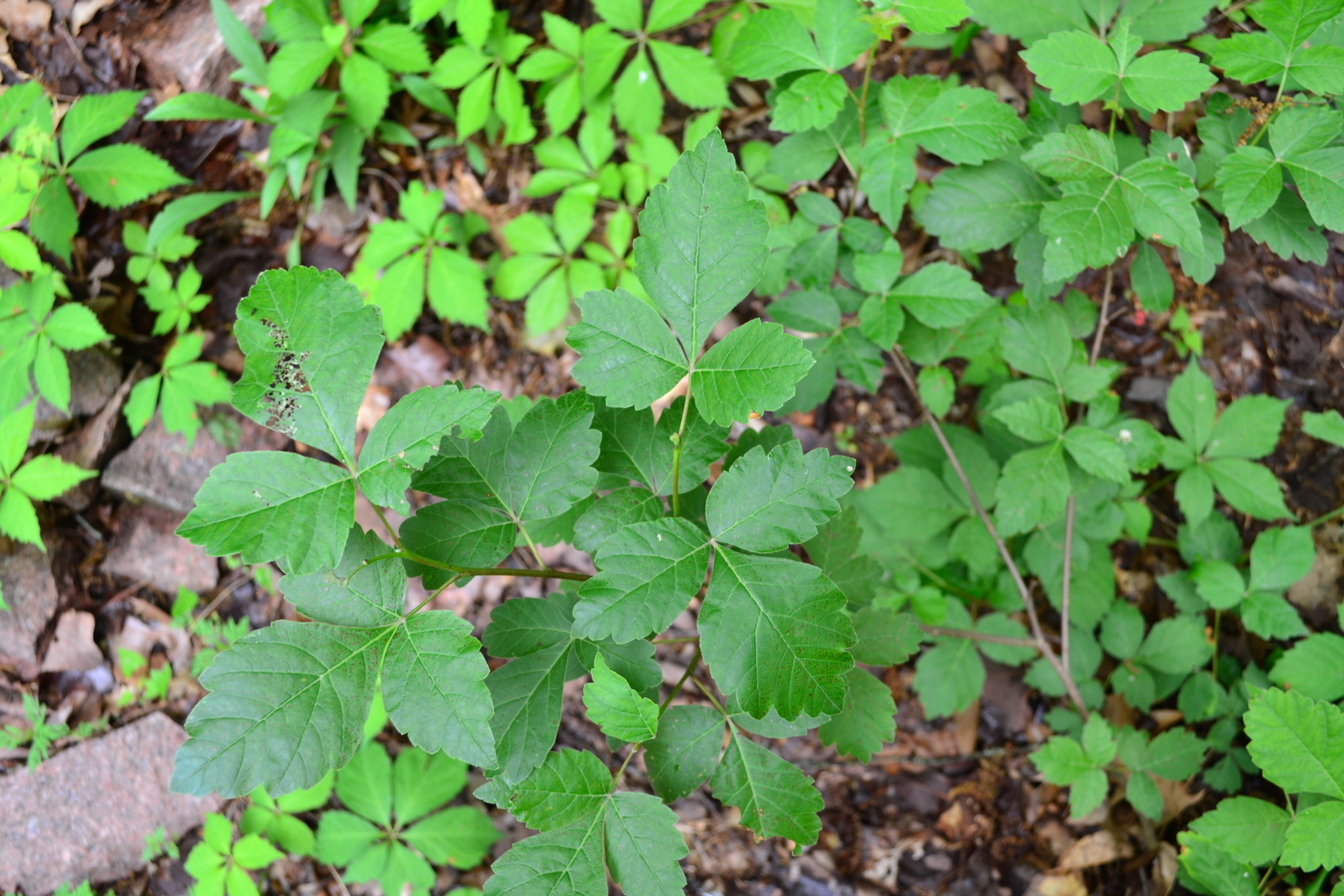
Fragrant sumac
Rhus aromatica
Three-part leaves smell strongly of citrus when crushed (hence "fragrant"). Yellow flower clusters in early spring before the leaves, red fuzzy fruit clusters in summer. Distinct from poison-ivy by its lack of climbing habit and by the terminal leaflet sitting nearly stalkless.
Status: Native; common on rocky uplands.
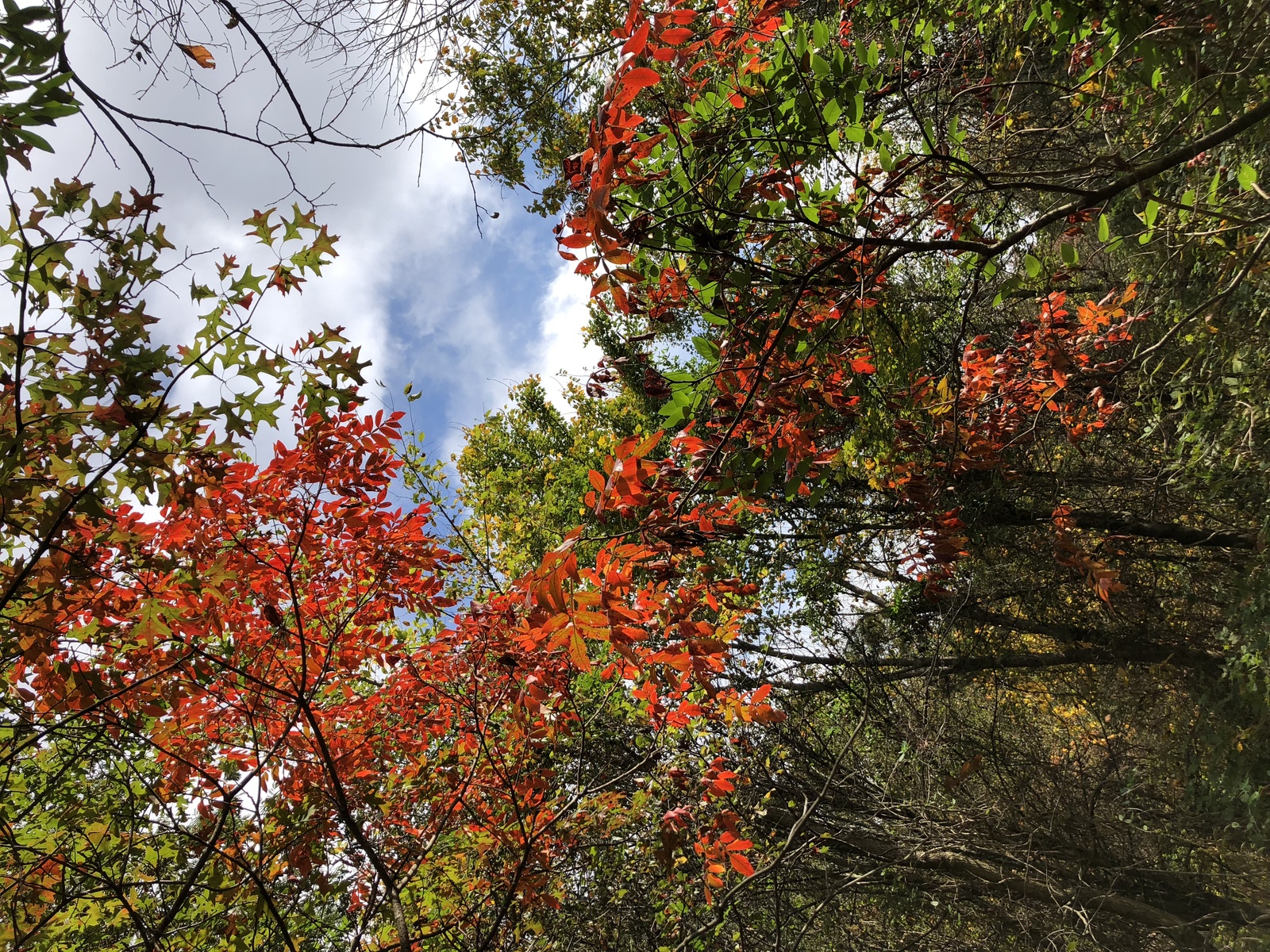
Winged sumac
Rhus copallinum
Pinnately compound leaves with characteristic winged or flattened axes between the leaflets; striking red-orange fall color. Old fields, roadsides, and forest gaps; common throughout Marion County.
Status: Native; common in old fields.
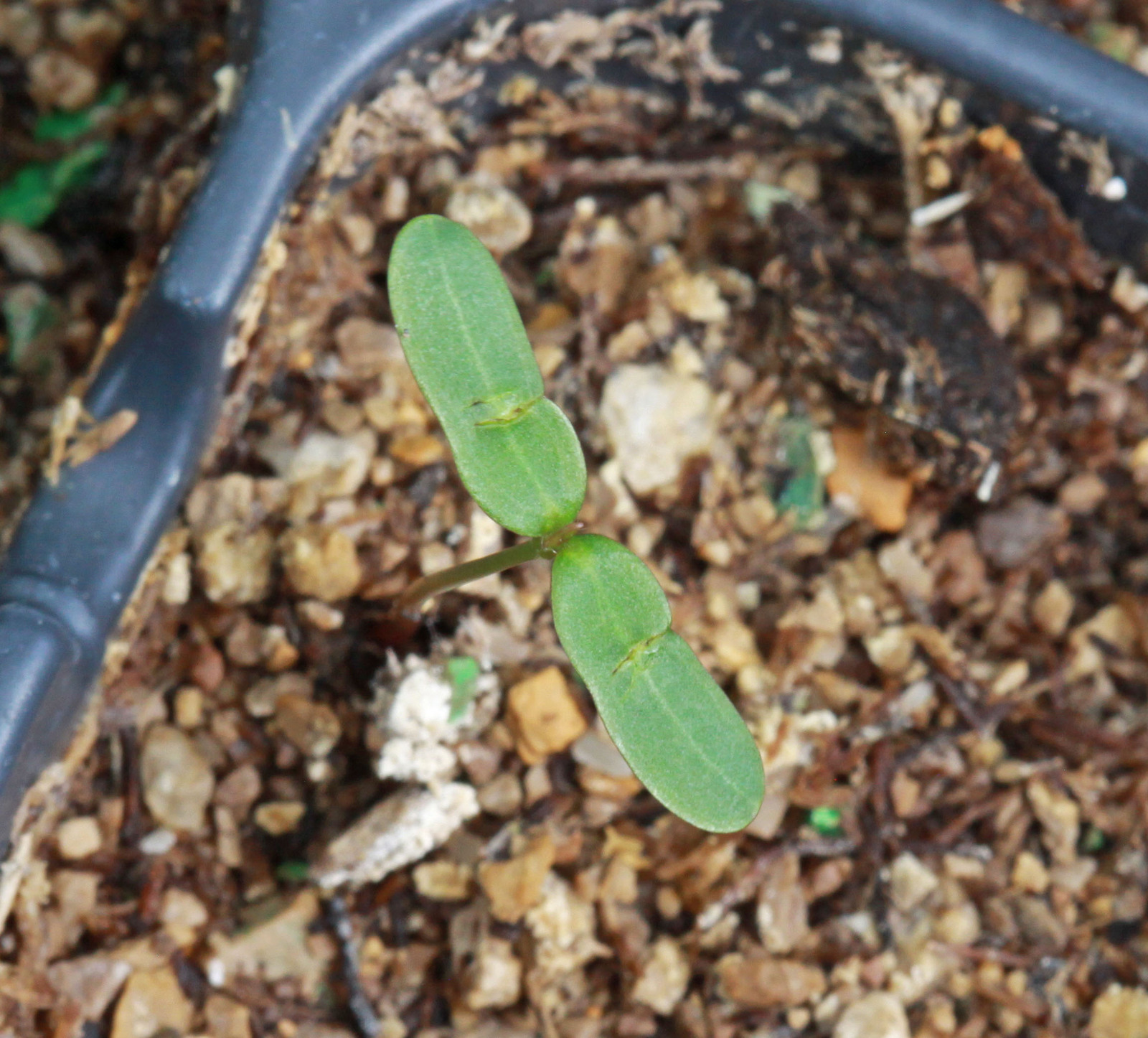
Smooth sumac
Rhus glabra
Like staghorn sumac but without the velvety hair on twigs and leaf rachises. Open fields and forest edges; pyramidal red fruit clusters last through winter. Native Americans and frontier settlers brewed the fruit clusters into a tart pink "sumac-ade."
Status: Native; common in fields and edges.
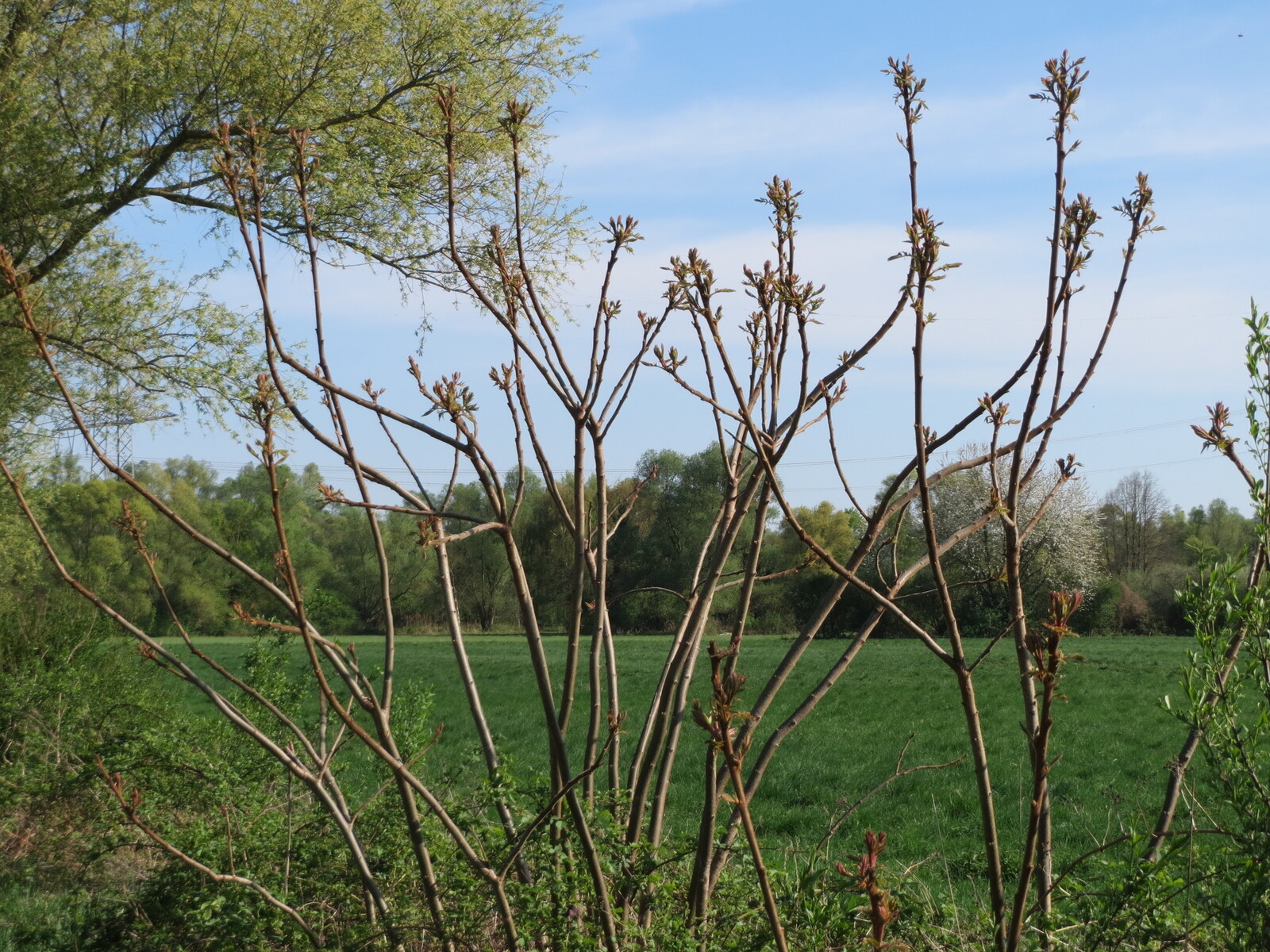
Staghorn sumac
Rhus typhina
Velvety hair on the young branches and the fruiting cones; the dense red fruit cones look like the velvet on a deer's antlers. More common at higher elevations on the plateau than smooth sumac. Brilliant orange and red fall color.
Status: Native; common at higher elevations.
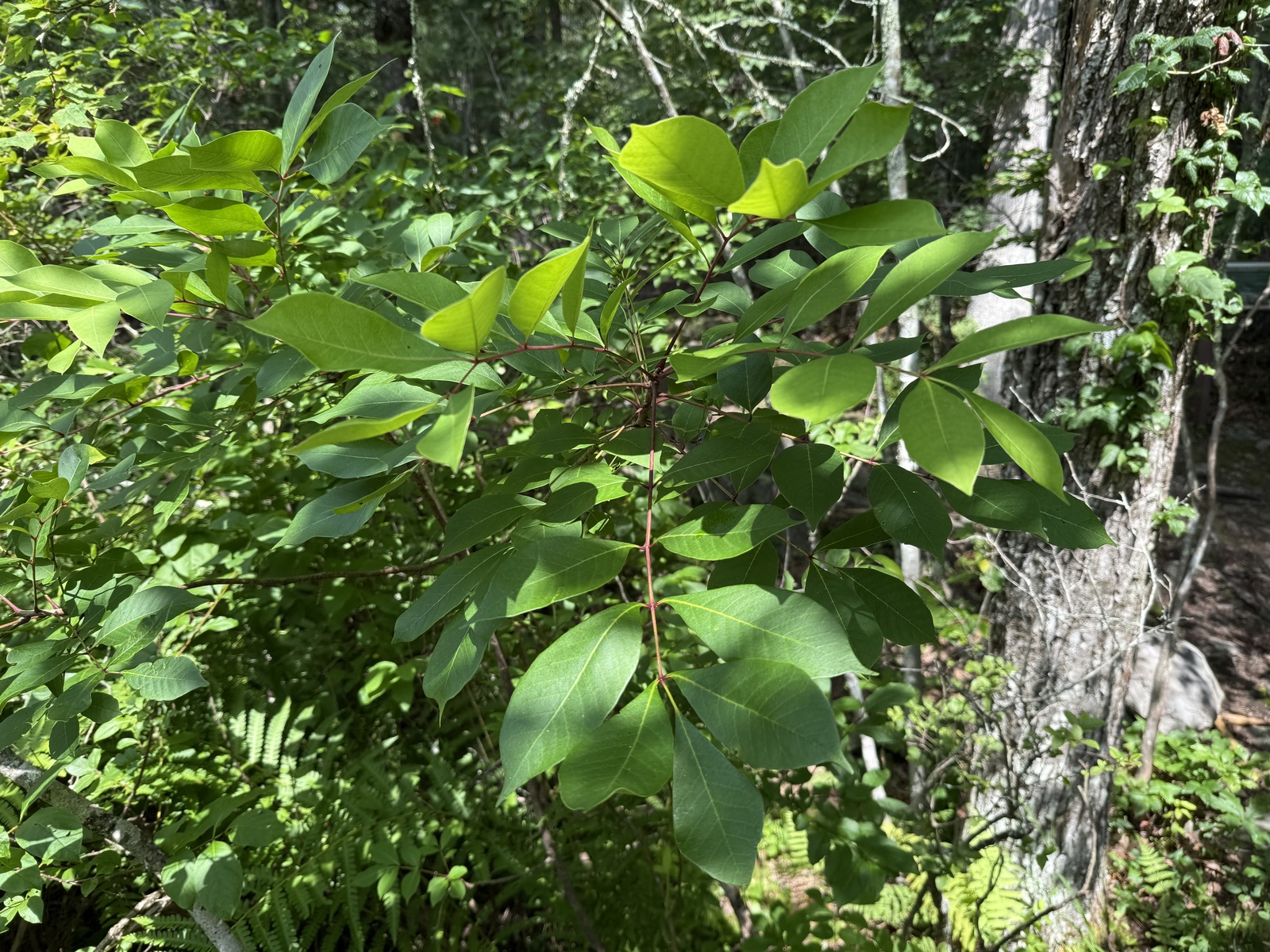
Poison sumac
Toxicodendron vernix
Smooth gray bark, pinnately compound leaves with red rachises, and drooping clusters of white-green fruits. Strictly wetland: bogs, swamps, and pond margins. Far more poisonous than poison-ivy, but limited Marion County habitat keeps encounters rare.
Status: Native; uncommon, in bogs.
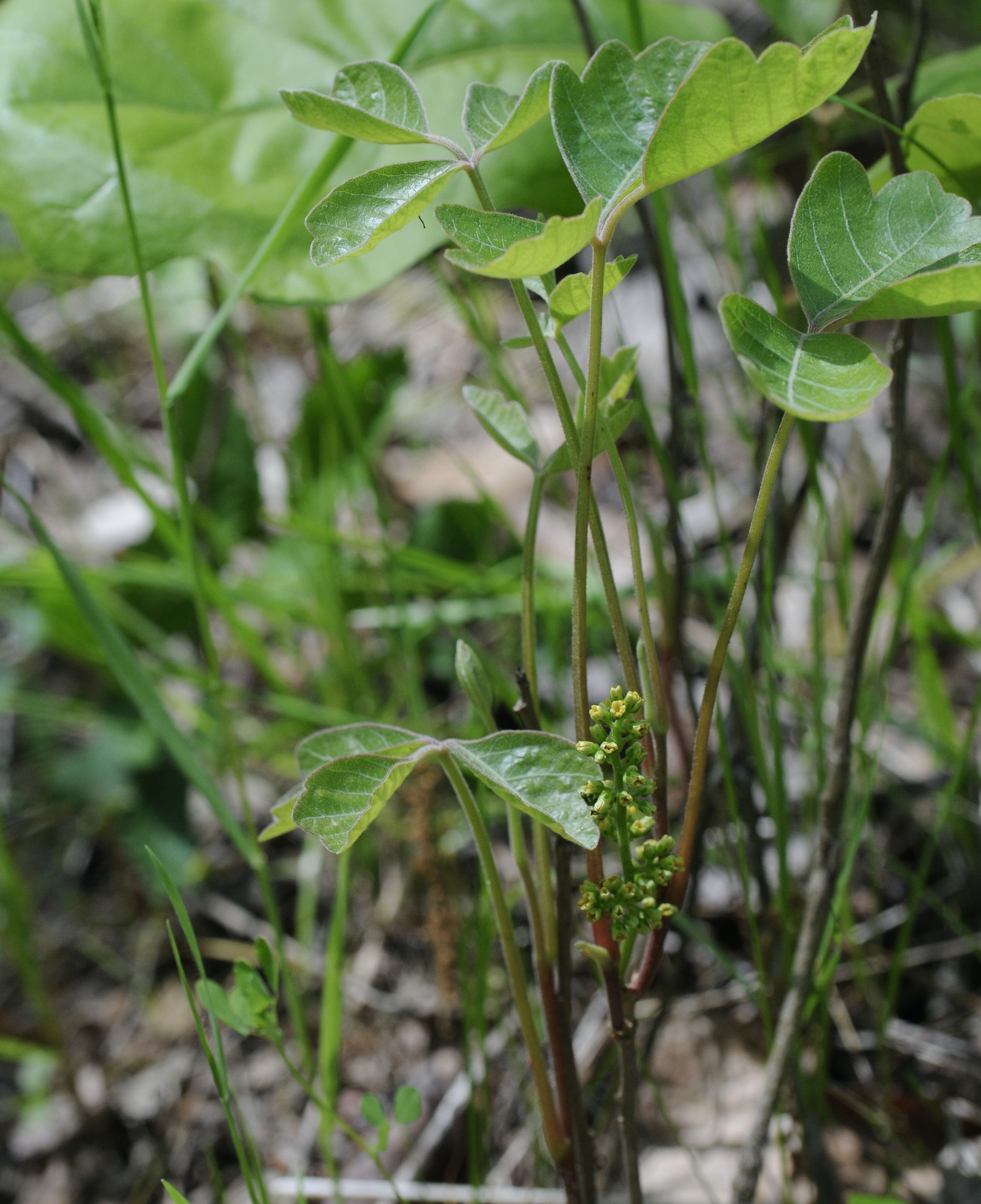
Poison oak
Toxicodendron pubescens
Erect shrub form (rather than the climbing or trailing habit of poison-ivy). Three-part leaves with lobed, oak-like leaflets. The same urushiol skin reaction as poison-ivy; less common in Marion County than the eastern poison-ivy but present on dry oak ridges.
Status: Native; uncommon on dry ridges.
Hydrangeas and mock-oranges
Two closely related groups of showy-flowered shrubs that share the rich-soil niche: hydrangeas with their flat or domed flower heads ringed by sterile florets, and mock-oranges with four-petaled white flowers that gave the cultivated landscape mock-orange its name. Several of the mock-oranges are limestone-bluff specialists in Marion County, restricted to the gorge slopes.
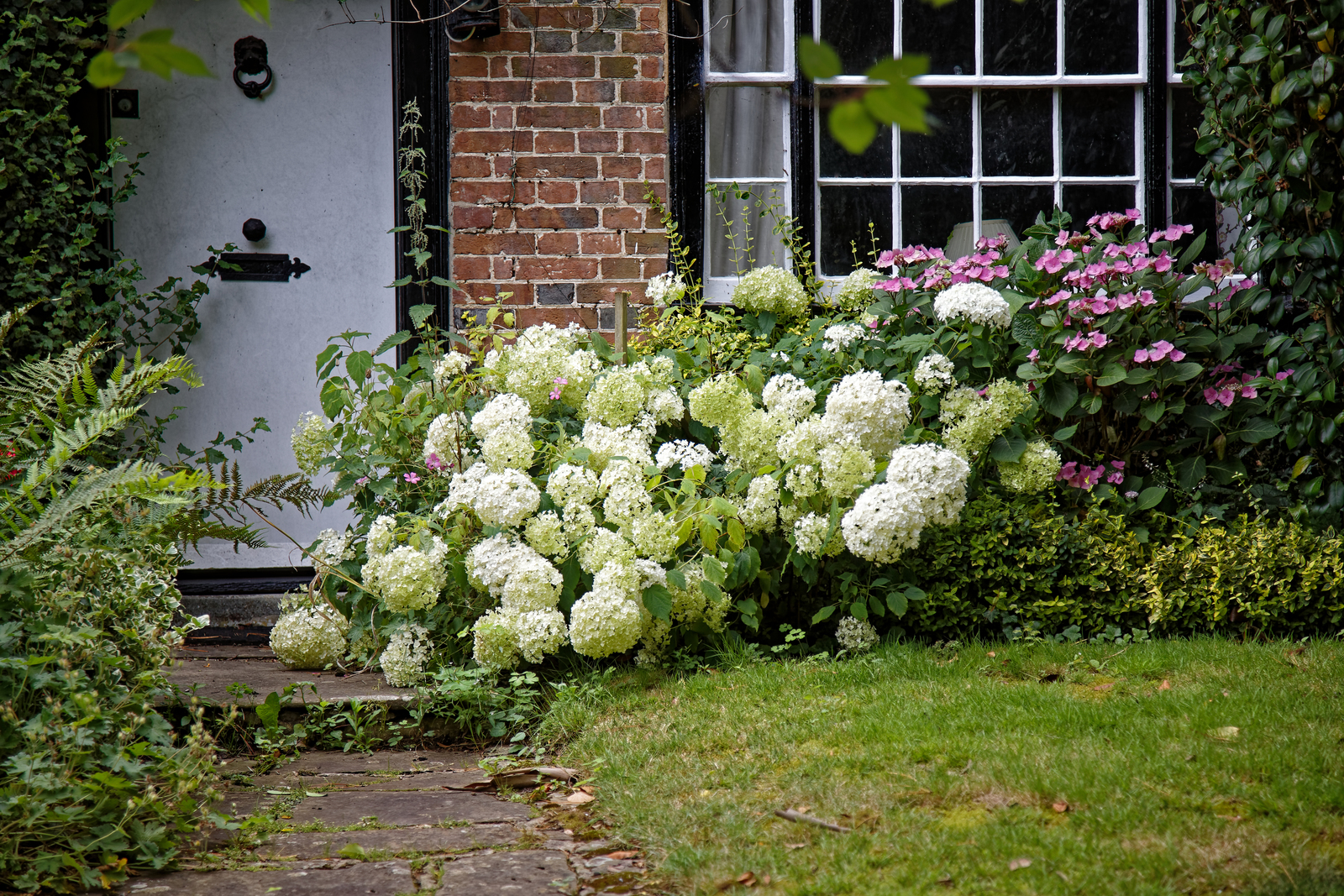
Wild hydrangea
Hydrangea arborescens
Flat-topped or slightly domed flower heads of small fertile flowers ringed by larger sterile flowers. Cove forest and rich stream-bank slopes; flowers in June and July. The cultivar Annabelle, a sterile-flowered selection of this species, traces back to Anna, Illinois.
Status: Native; common in cove woods.
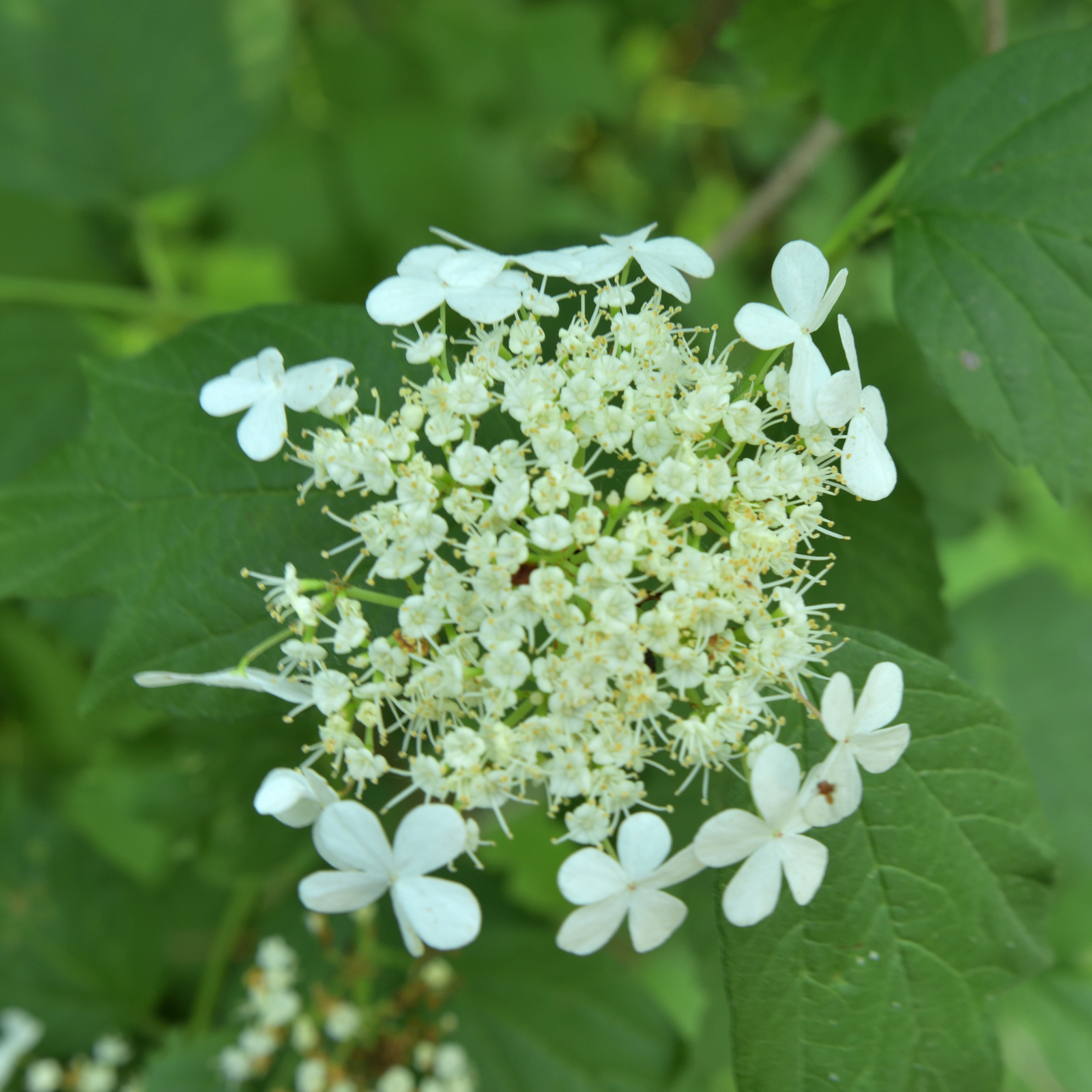
Ashy hydrangea
Hydrangea cinerea
Closely related to wild hydrangea, distinguished by densely white-hairy leaf undersides giving an "ashy" appearance. Some treatments lump it with H. arborescens as a variety; the TN-KY Plant Atlas treats it as a separate species.
Status: Native; uncommon in cove and limestone woods.
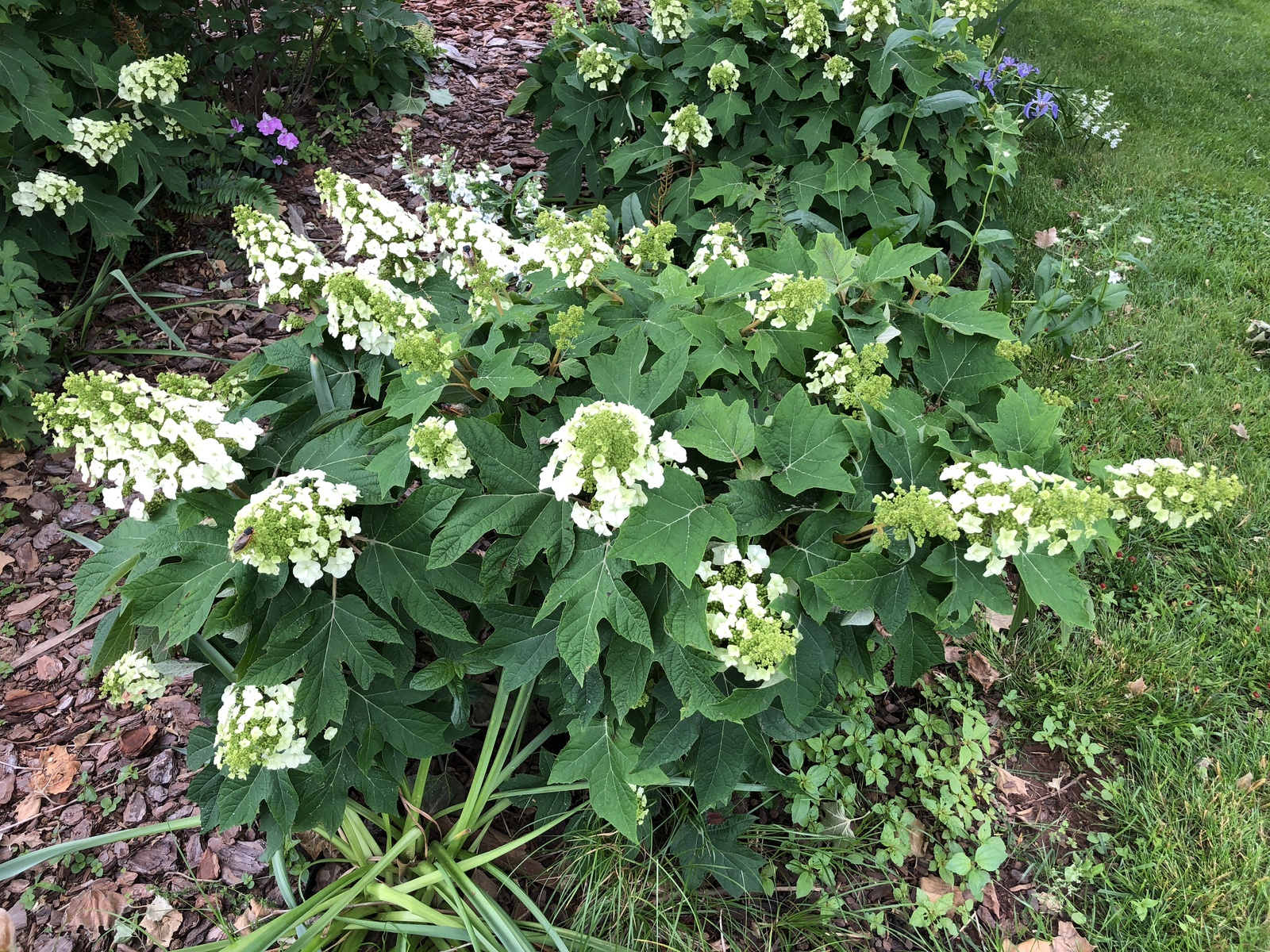
Oakleaf hydrangea
Hydrangea quercifolia
Distinctive deeply lobed oak-shaped leaves and large pyramidal flower clusters that fade from white to pink to bronze through summer. Native to the southern Appalachians and Cumberland Plateau; widely planted but documented as wild in Marion County by the TN-KY Plant Atlas.
Status: Native; locally distinctive on plateau slopes.
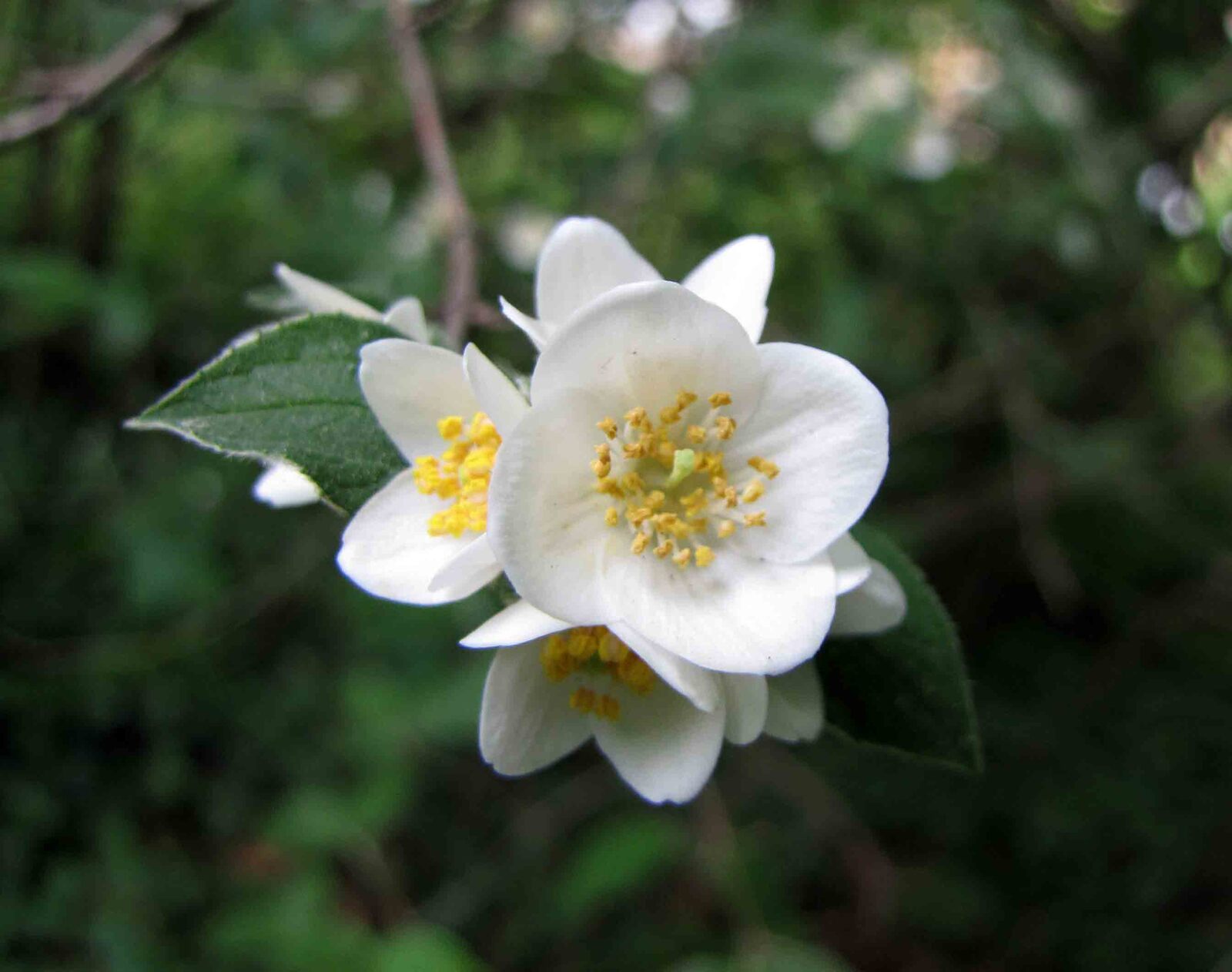
Hairy mock-orange
Philadelphus hirsutus
A southern Appalachian endemic mock-orange with hairy young twigs and softly fragrant white four-petaled flowers in May. Limestone bluffs and rich rocky slopes.
Status: Native; uncommon, on limestone bluffs.
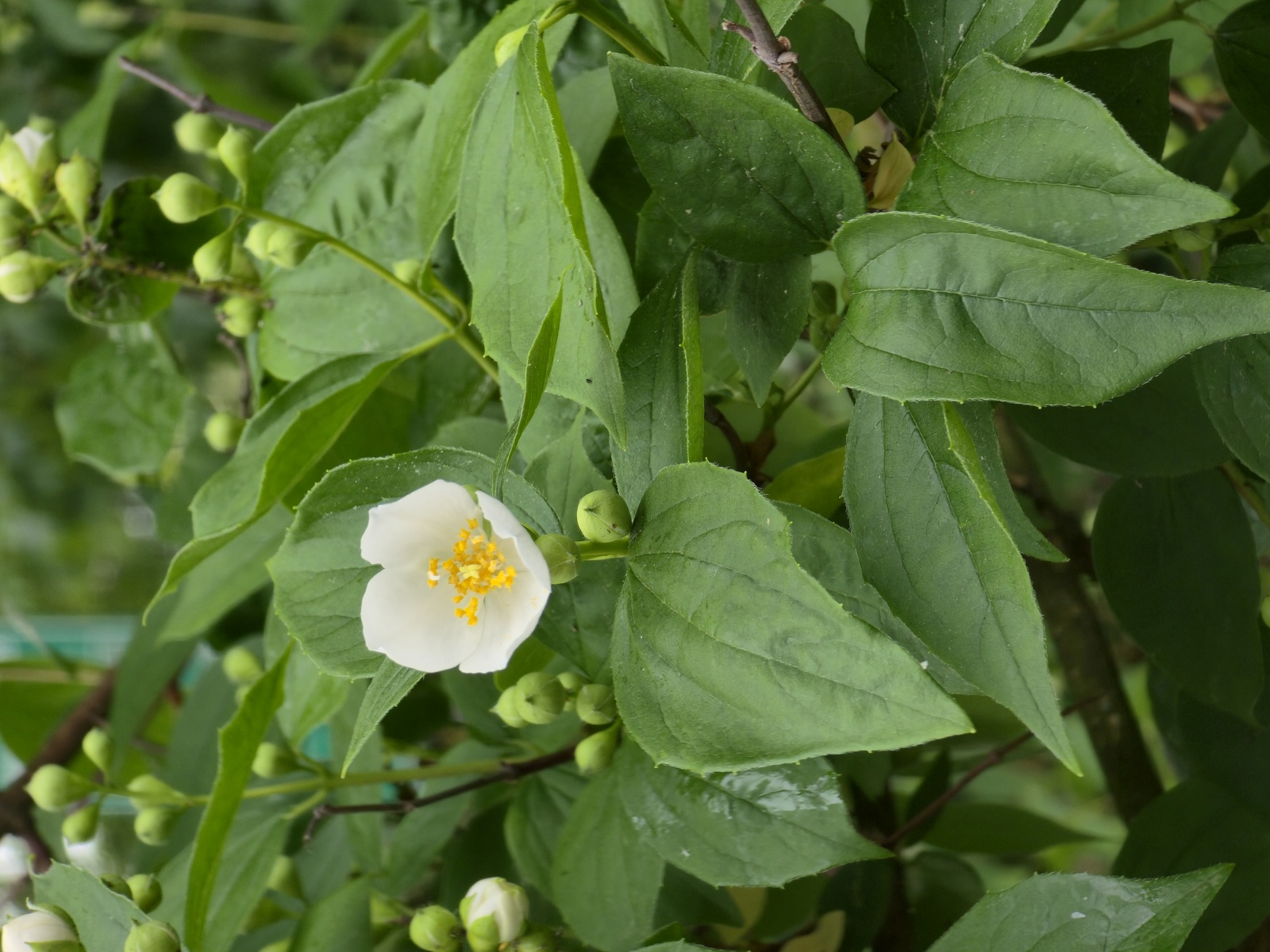
Appalachian mock-orange
Philadelphus inodorus
White four-petaled flowers in May without the orange-blossom fragrance of cultivated mock-oranges (hence the species name inodorus). Limestone bluffs and ledges, especially in the Tennessee River Gorge.
Status: Native; uncommon, on limestone bluffs.
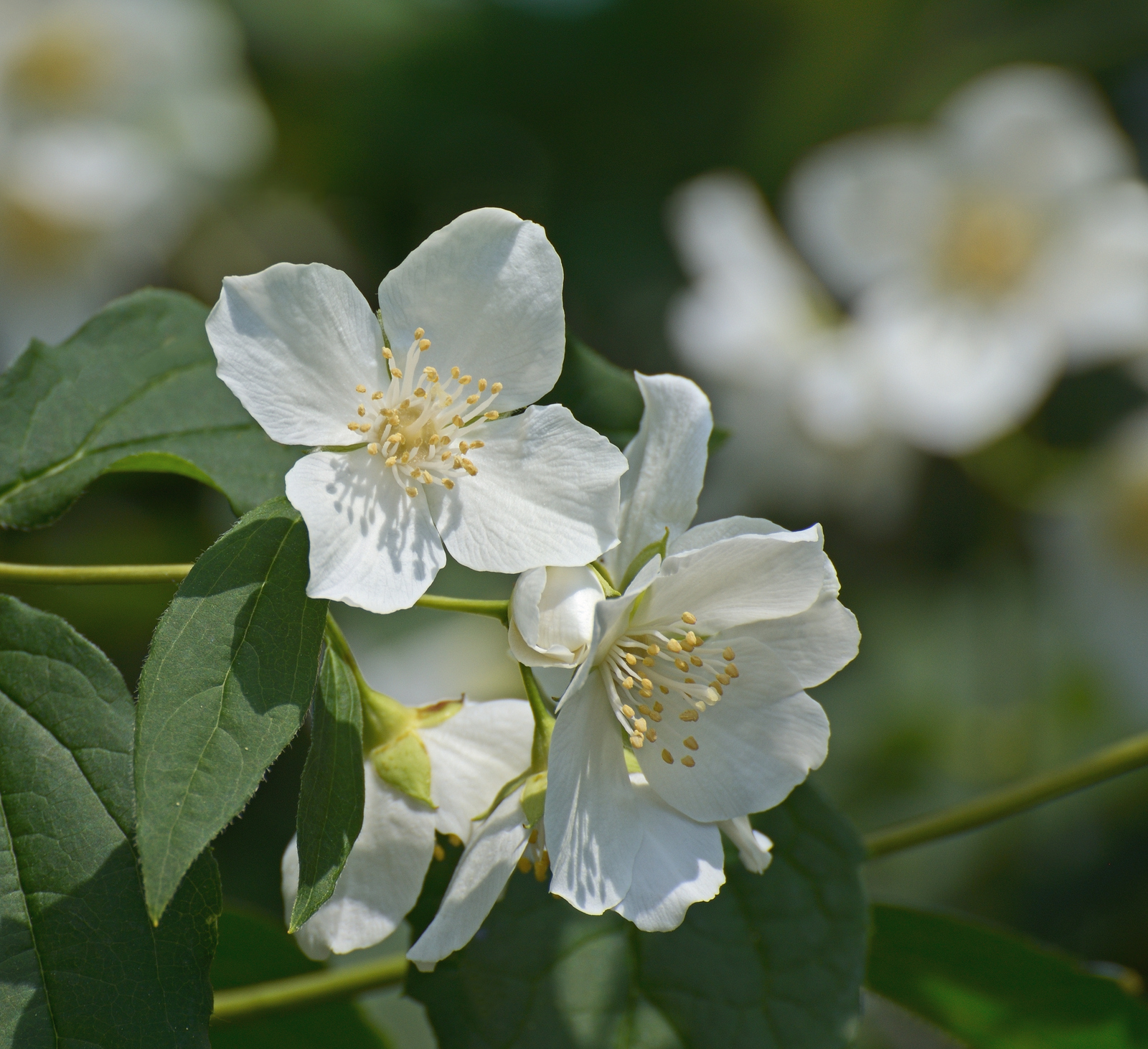
Ozark mock-orange
Philadelphus pubescens
Native to the Ozarks and the Cumberland Plateau-Interior Low Plateau border, with softly fragrant flowers and pubescent leaves. Limestone bluffs are the typical habitat.
Status: Native; uncommon, on limestone bluffs.
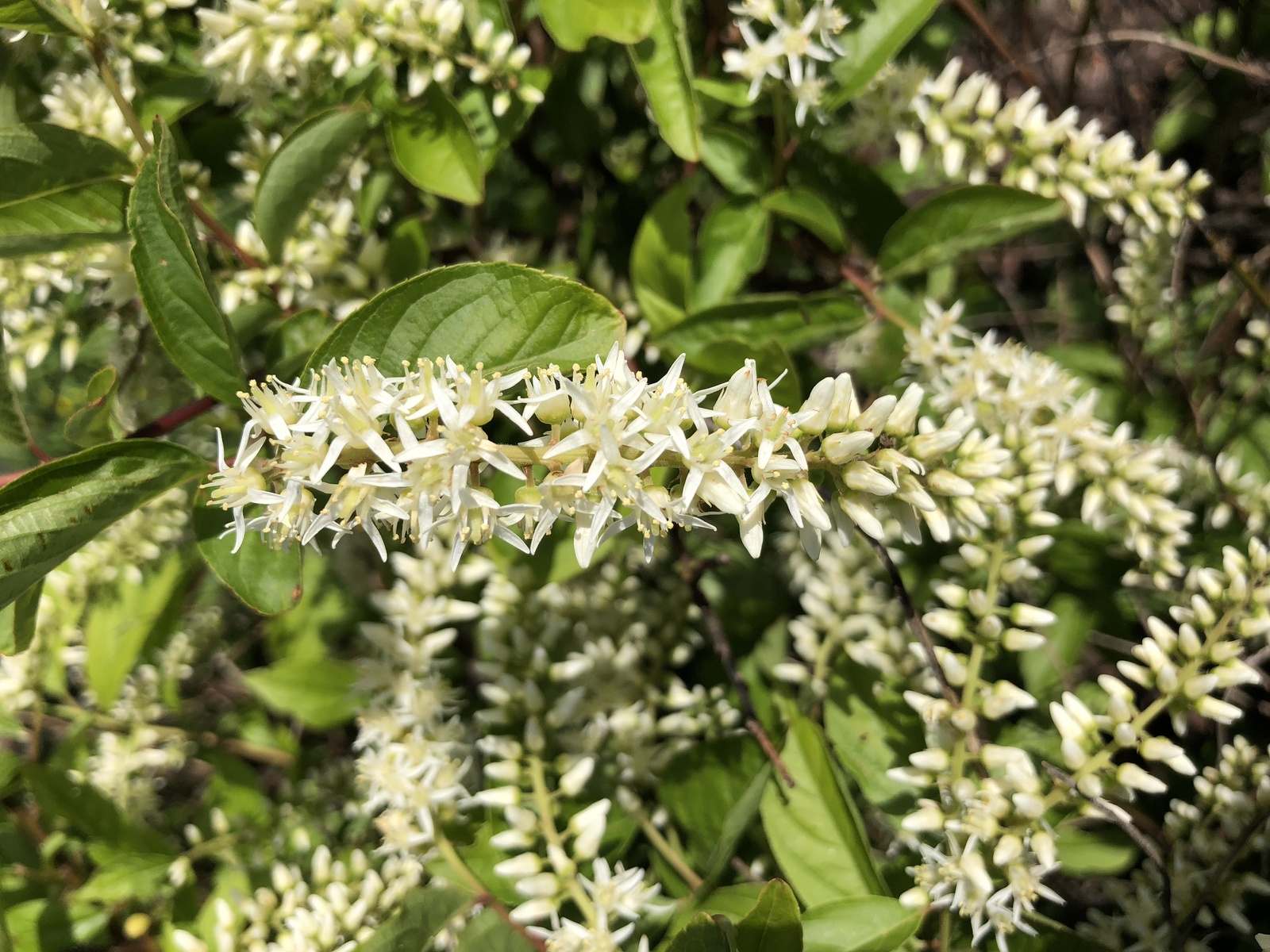
Virginia willow
Itea virginica
Also called sweetspire. Drooping racemes of small fragrant white flowers in May and June, brilliant red fall color. Despite the common name, not a true willow; closer relative of saxifrages. Wet woods and stream banks.
Status: Native; common in wet woods.
Buckthorns, hollies, and limestone-bluff specialists
A grouping of native fruit-producing shrubs, several of which prefer the limestone-derived soils of the gorge slopes and Sequatchie Valley.
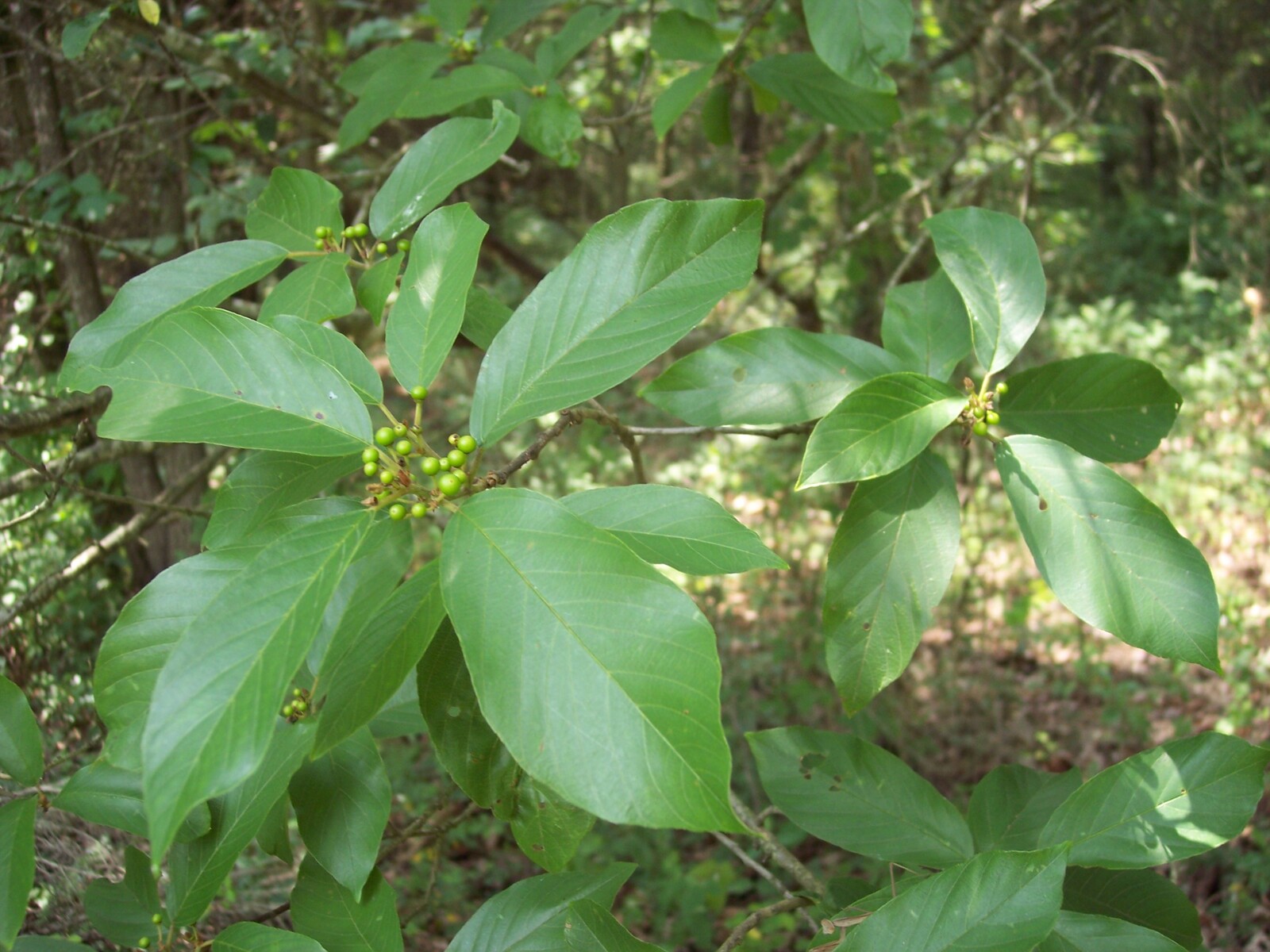
Carolina buckthorn
Frangula caroliniana
A tall shrub or small tree of rich woods with simple alternate leaves and red berries that ripen black through fall. Native; do not confuse with the introduced buckthorns (Rhamnus cathartica, Frangula alnus) that are aggressive invasives further north.
Status: Native; common in rich woods.
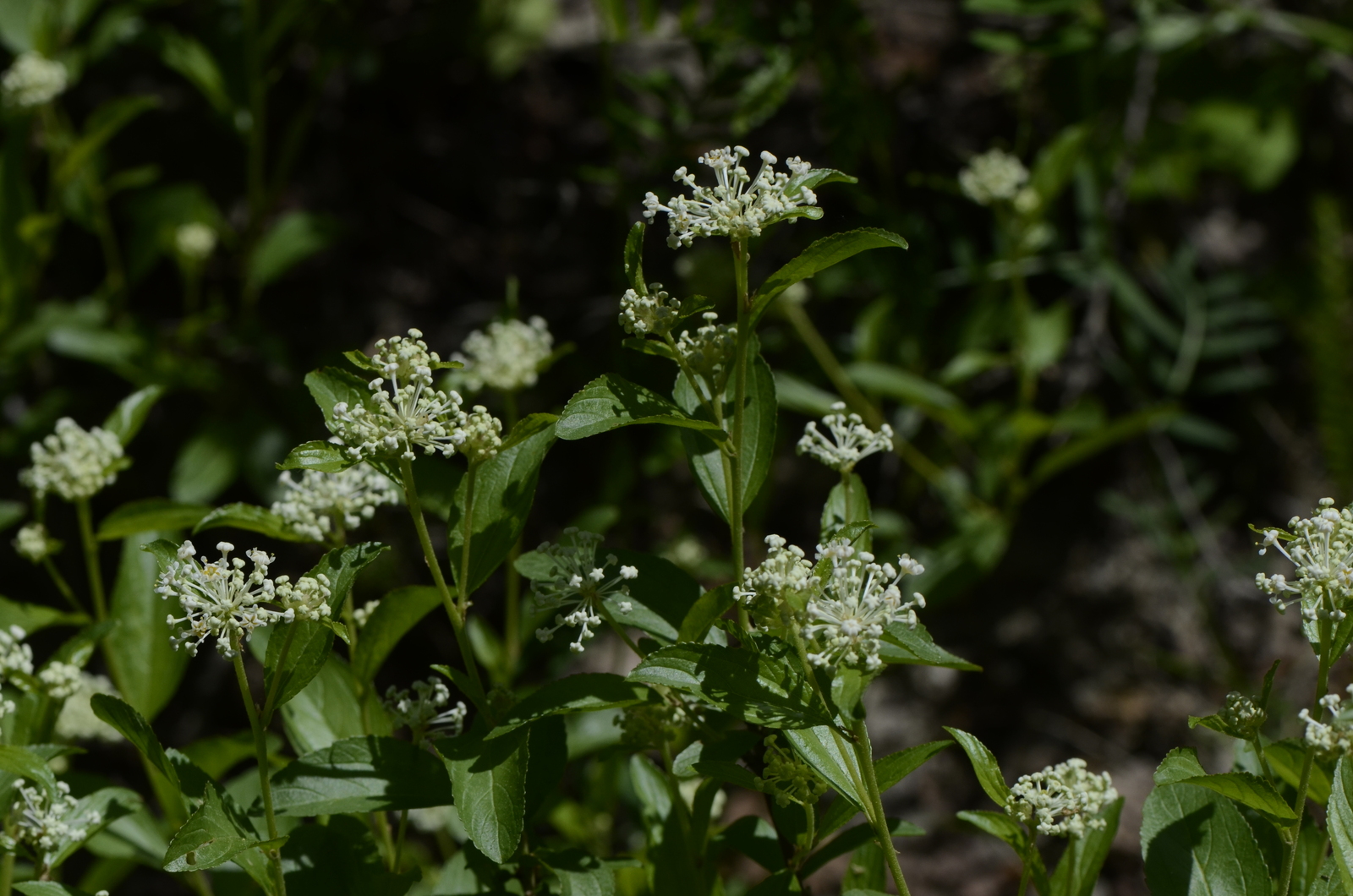
Jersey tea
Ceanothus americanus
Dense rounded clusters of tiny white flowers in June. Leaves were used as a tea substitute by colonial militias during the American Revolution. Dry oak ridges and limestone glades. Roots fix nitrogen in poor soils.
Status: Native; common on dry uplands.
Carolina holly
Ilex ambigua
A deciduous holly of dry pine-oak woods, often confused with possumhaw. Red drupes ripen in fall and persist into winter. Less common on the plateau than possumhaw or American holly.
Status: Native; uncommon, on dry sandstone soils.
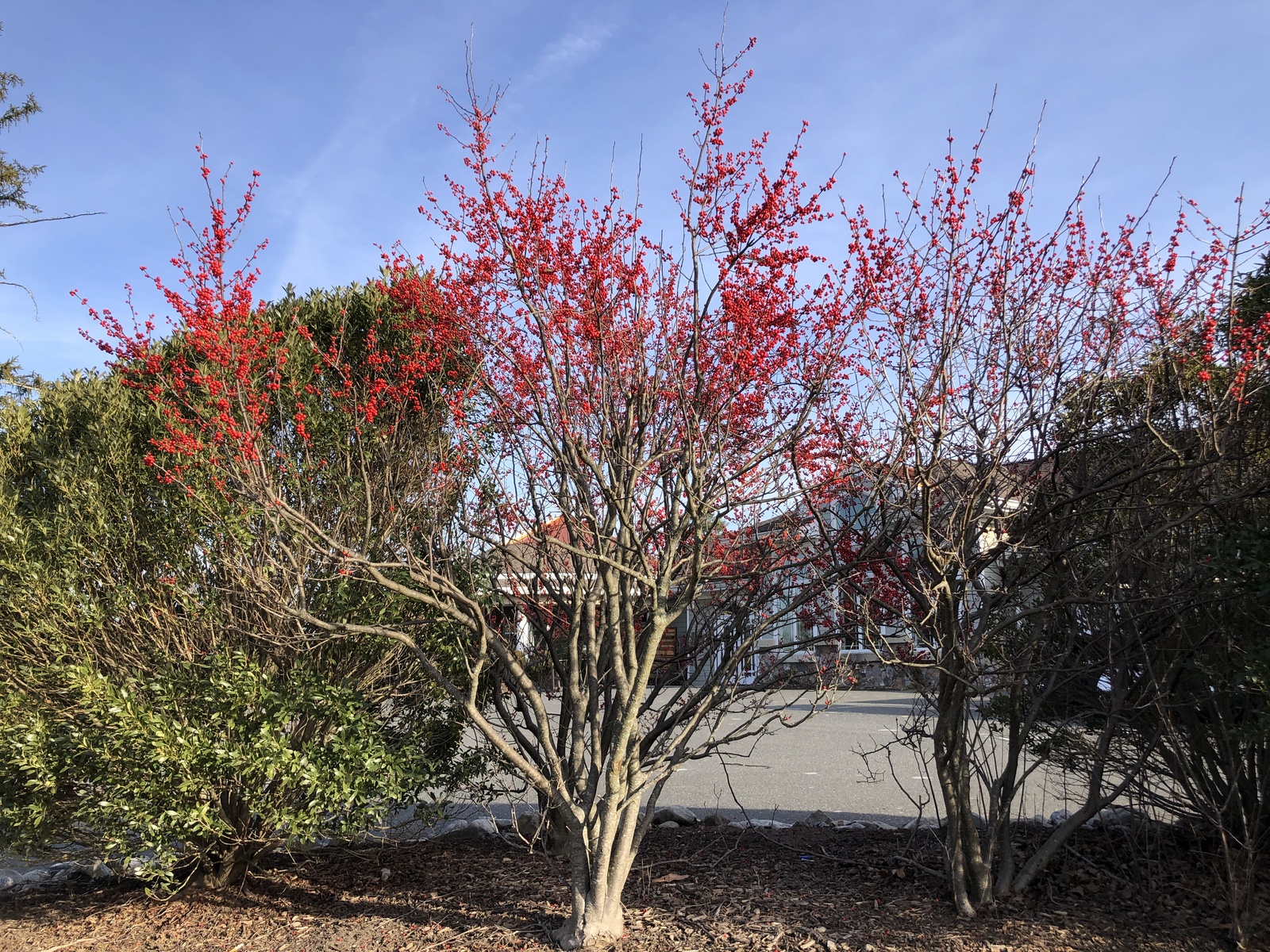
Winterberry
Ilex verticillata
Deciduous holly that drops its leaves in fall to reveal showy clusters of bright red berries. Wet feet preferred: bogs, swamp margins, wet plateau flats. The brightly fruited stems are a familiar winter-decoration cutting.
Status: Native; common in wet woods.
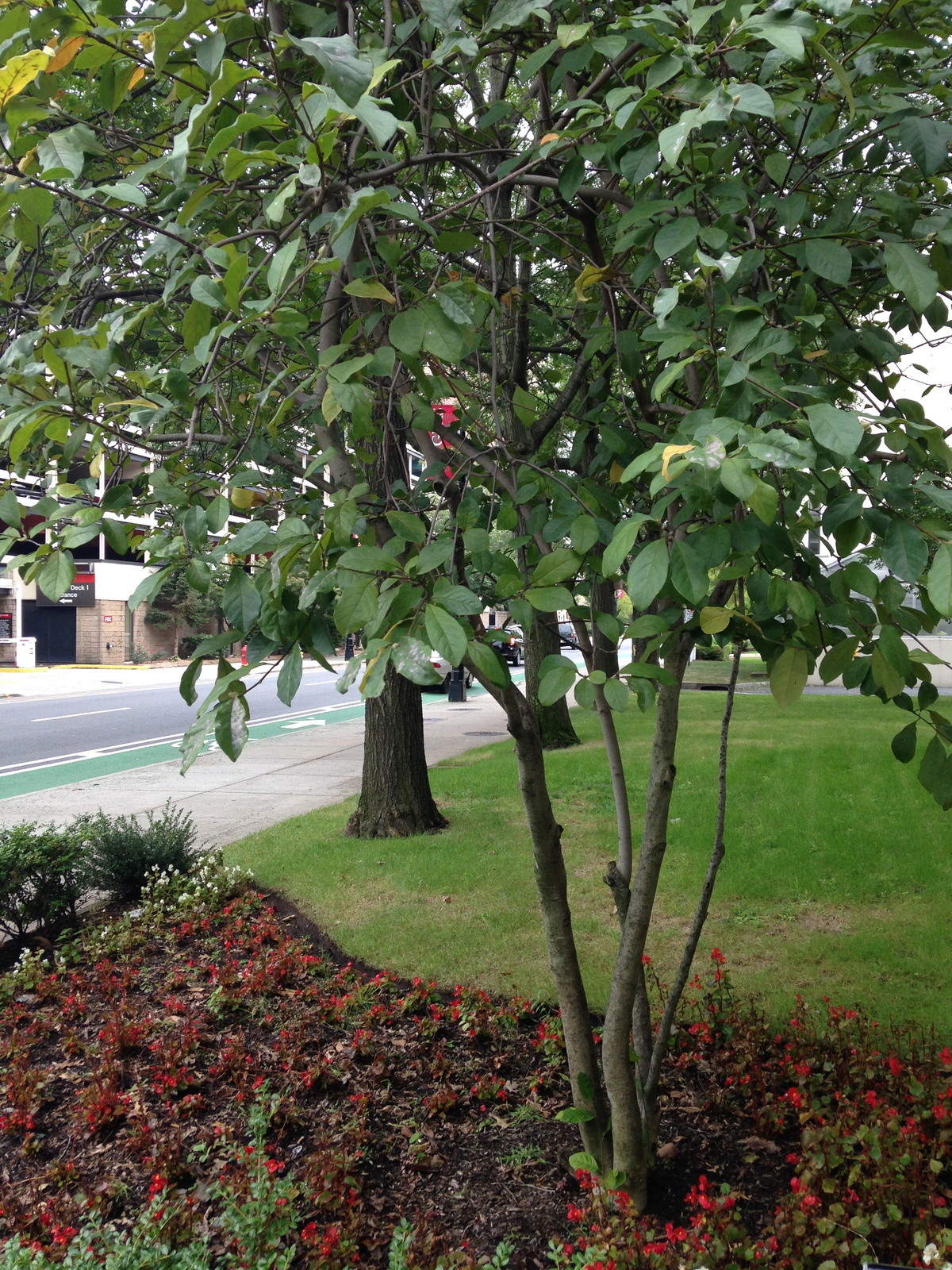
Buckthorn bumelia
Sideroxylon lycioides
A spiny shrub or small tree of rocky open woods and limestone bluffs; leaves dark green above, rust-fuzzy below. Small fragrant white flowers in midsummer; fleshy black drupes in fall.
Status: Native; uncommon, on limestone slopes.
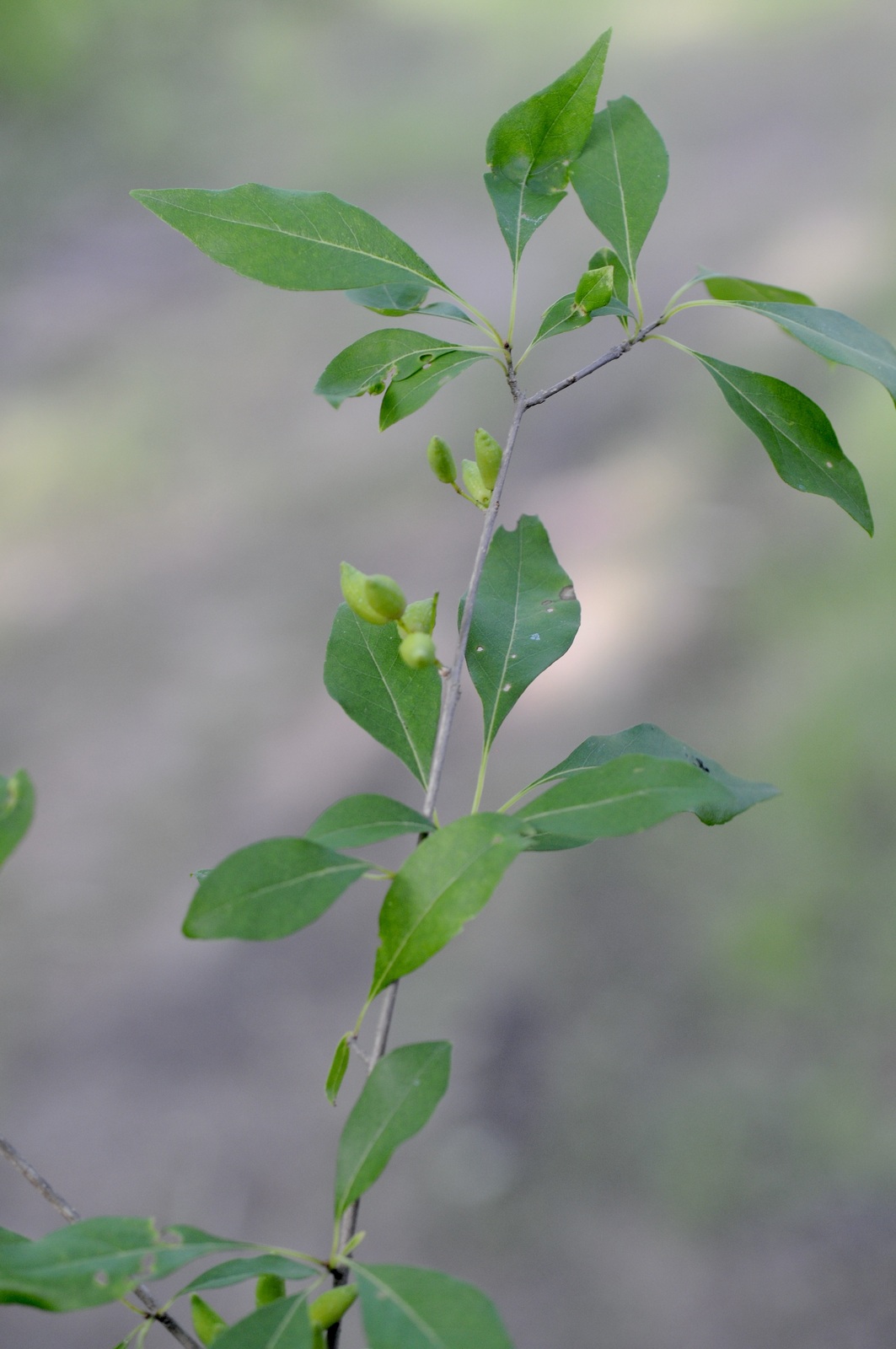
Eastern swamp-privet
Forestiera acuminata
A wetland shrub of swamps, sloughs, and Tennessee River backwater margins. Small yellowish flowers before the leaves in early spring; purple-black drupes in summer. Despite the common name, not closely related to the invasive Asian privets.
Status: Native; uncommon, in wetland margins.
St. John's-worts
The shrubby Hypericums on the plateau range from very small subshrubs (St. Andrew's cross) to chest-high flowering shrubs (shrubby St. John's-wort). All have bright yellow flowers with prominent stamen tufts and several have a tendency to dominate poor-soil sites where larger shrubs cannot thrive.
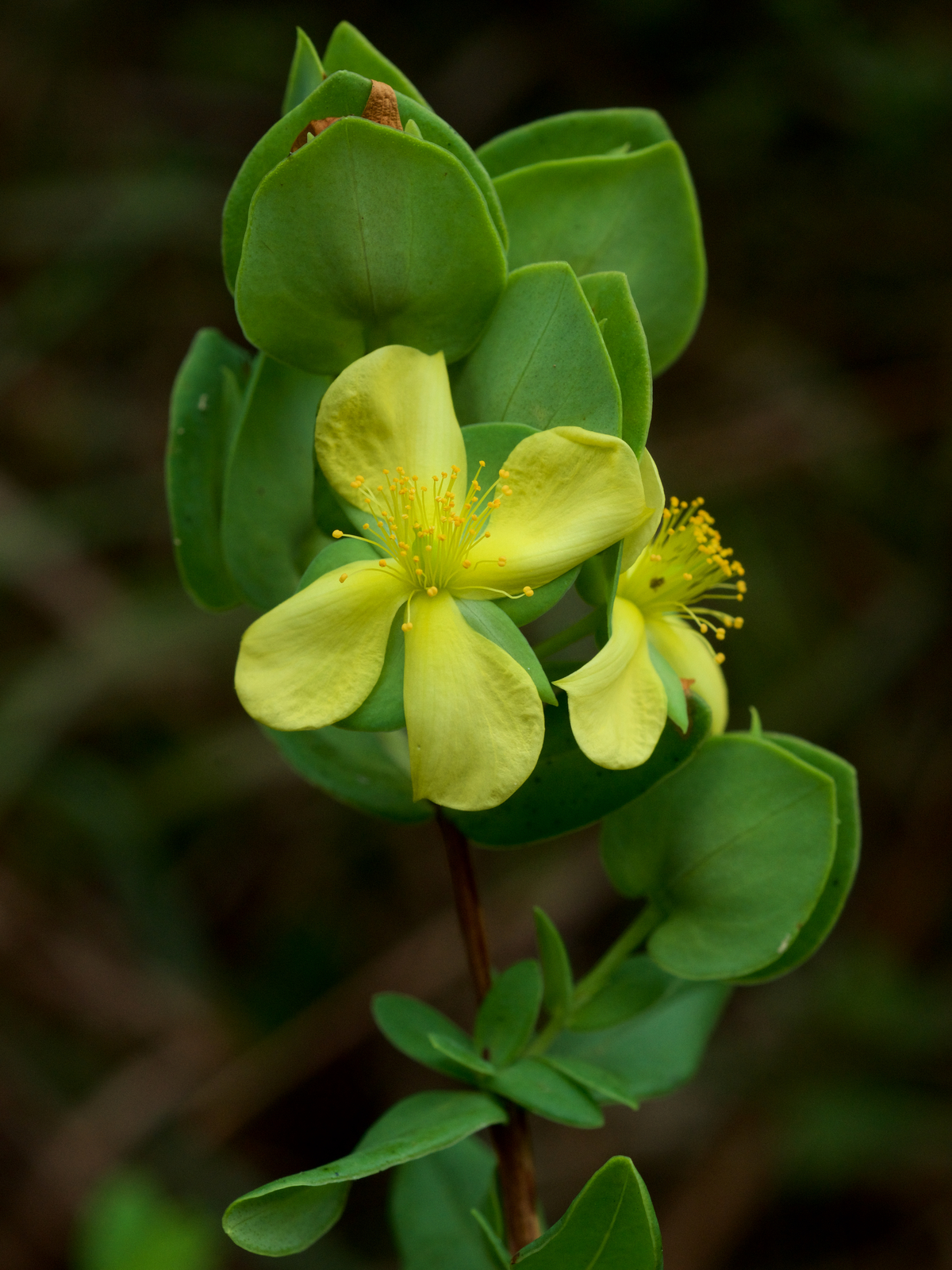
Peters wort
Hypericum crux-andreae
A small shrub of acid soils, with bright yellow four-petaled flowers in summer (most other Hypericums have five petals). Sandstone seepages and bog edges on the plateau.
Status: Native; uncommon on plateau seeps.
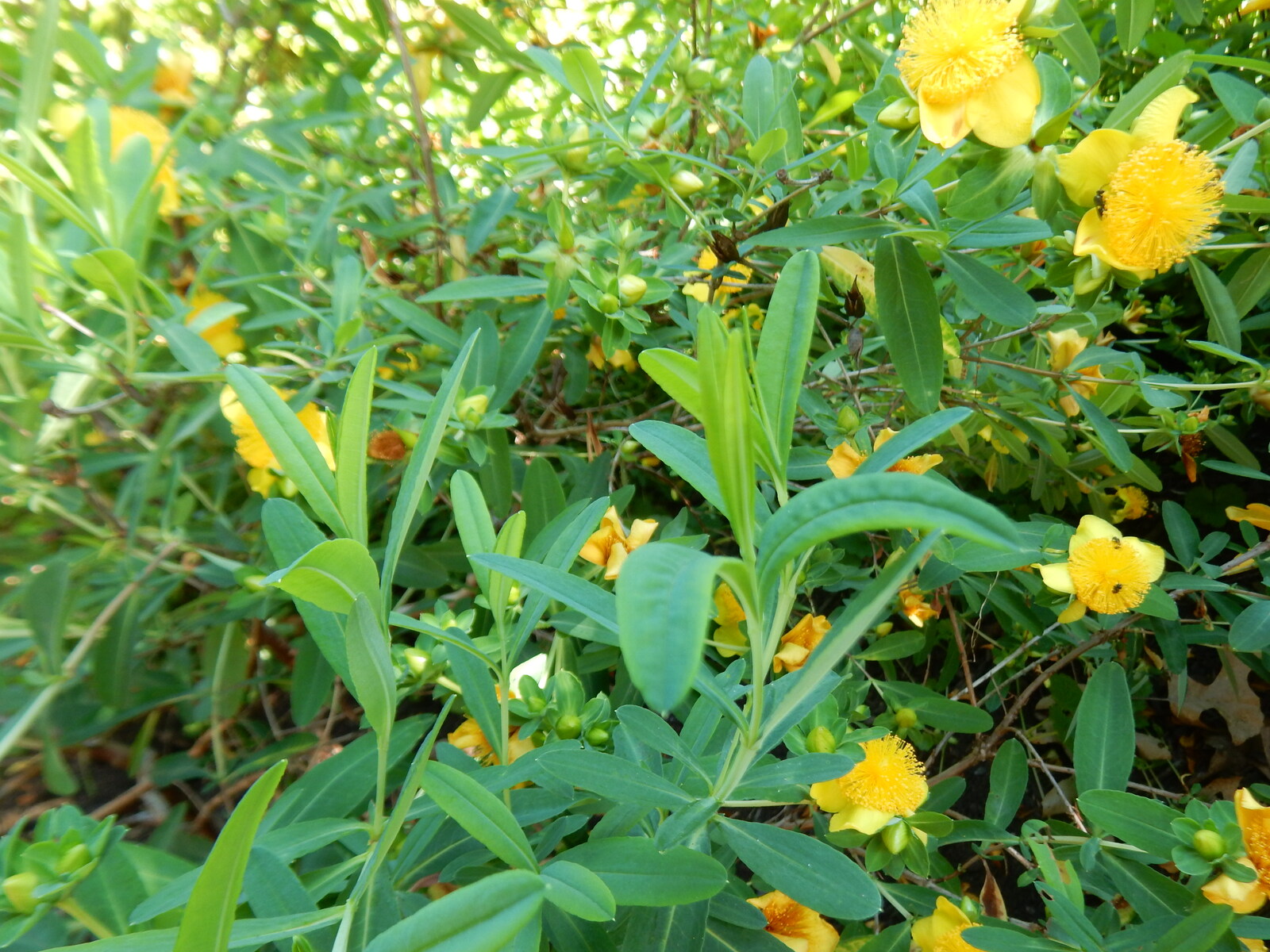
Cedar glade St Johnswort
Hypericum frondosum
A showy yellow-flowered shrub of limestone glades and bluffs; the natural range is centered on Tennessee's cedar glades. Five-petaled bright yellow flowers with a starburst of stamens, blooming in June.
Status: Native; uncommon, on limestone glades.
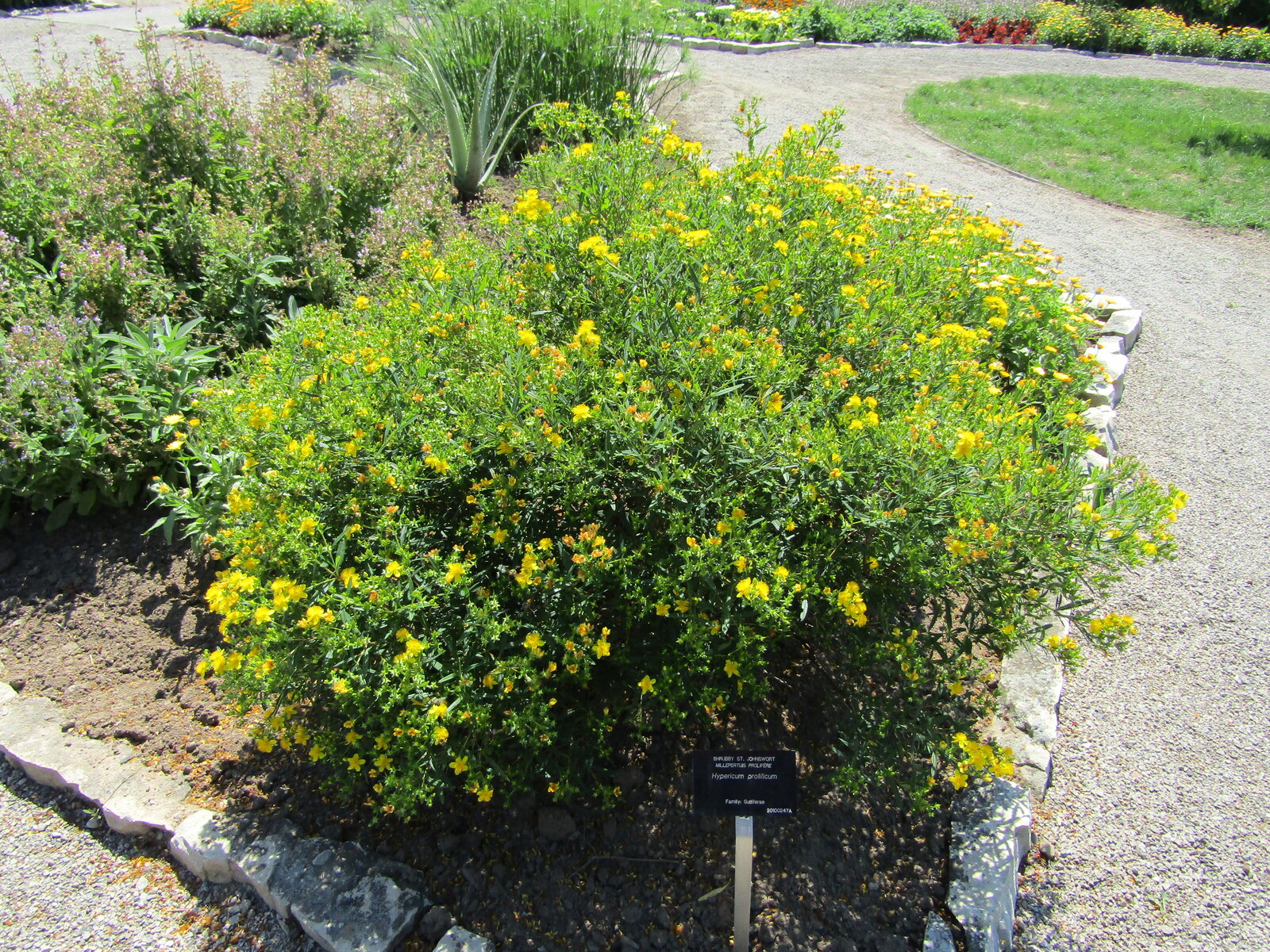
Shrubby St Johnswort
Hypericum prolificum
The common upland shrubby Hypericum across the eastern US. Bright yellow flowers with prominent stamen tufts, June through August. Old fields and roadsides on dry soils.
Status: Native; common in dry old fields.
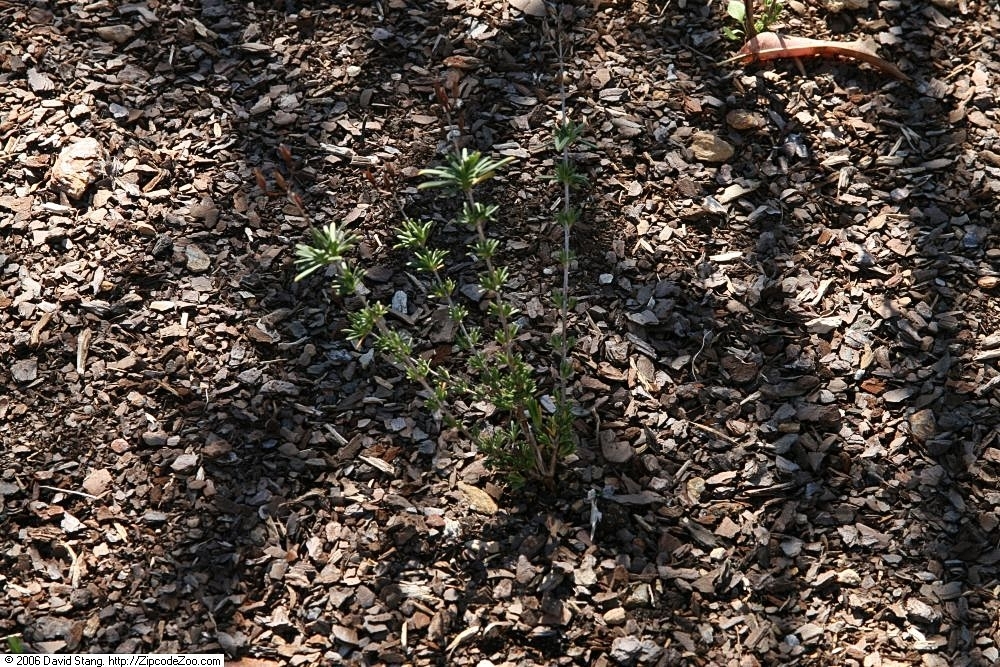
Mountain St Johnswort
Hypericum densiflorum
A higher-elevation shrubby Hypericum, often on rocky stream banks and seepages on the Cumberland Plateau. Smaller flowers and narrower leaves than shrubby St. Johnswort.
Status: Native; locally distinctive on plateau seeps.
Early St. John's-wort
Hypericum nudiflorum
Small subshrub of acidic plateau seepages with five-petaled yellow flowers. Per the TDEC 2025 Rare Plant List, S2/G5 in Tennessee.
Status: Native; Tennessee special-concern (S2 / G5).
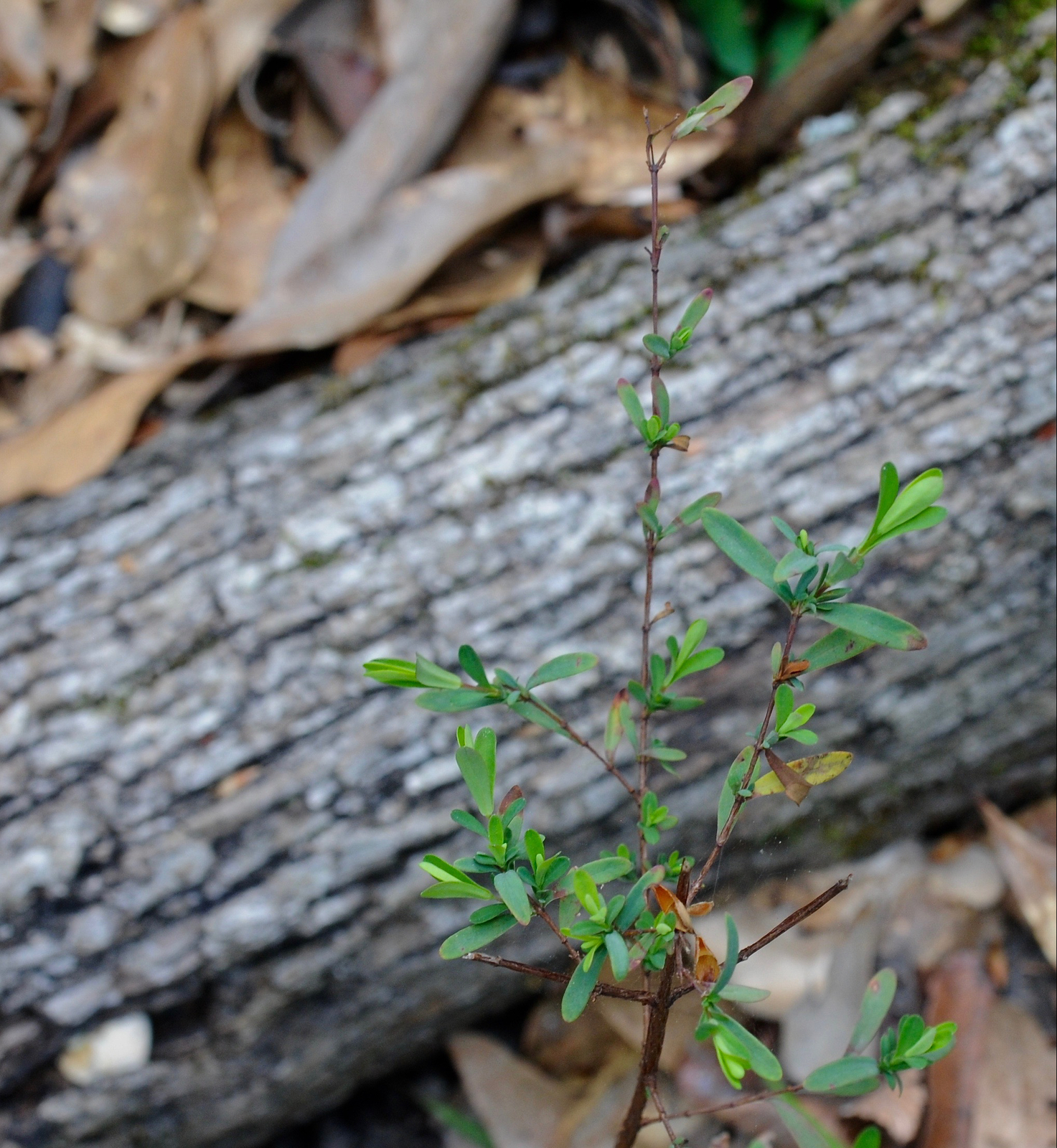
St Andrews cross
Hypericum hypericoides
Very small subshrub with four narrow yellow petals arranged in a cross (the namesake feature). Dry oak woods and rocky uplands. The TN-KY Plant Atlas separates a Cumberland-Plateau segregate (H. stragulum); both forms are present in Marion County.
Status: Native; common on dry uplands.
Brambles and roses
The thorn-bearing native blackberries, raspberries, and roses share old-field and forest-edge habitat. Identification within Rubus is notoriously difficult; the segregate species are largely a matter of cane shape, leaf number, glandular hairs, and flowering time, and most field workers settle for "blackberry" or "dewberry" as a working group name.
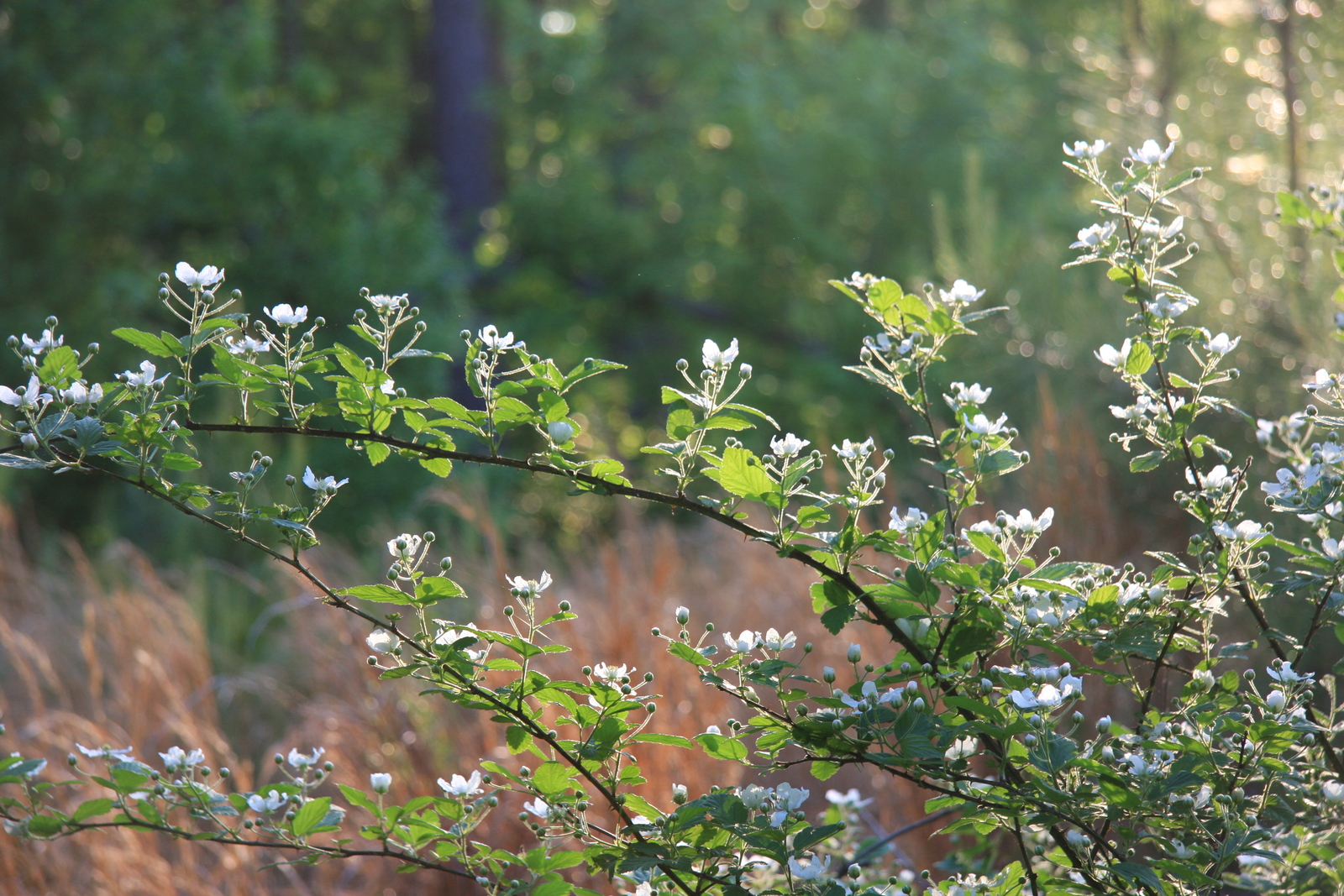
Sawtooth blackberry
Rubus argutus
The common arching-cane blackberry of plateau old fields and forest edges. Sharp recurved thorns; large white flowers in May; black aggregate fruits in late June and July. The base species behind most cultivated thornless blackberries.
Status: Native; common in old fields.
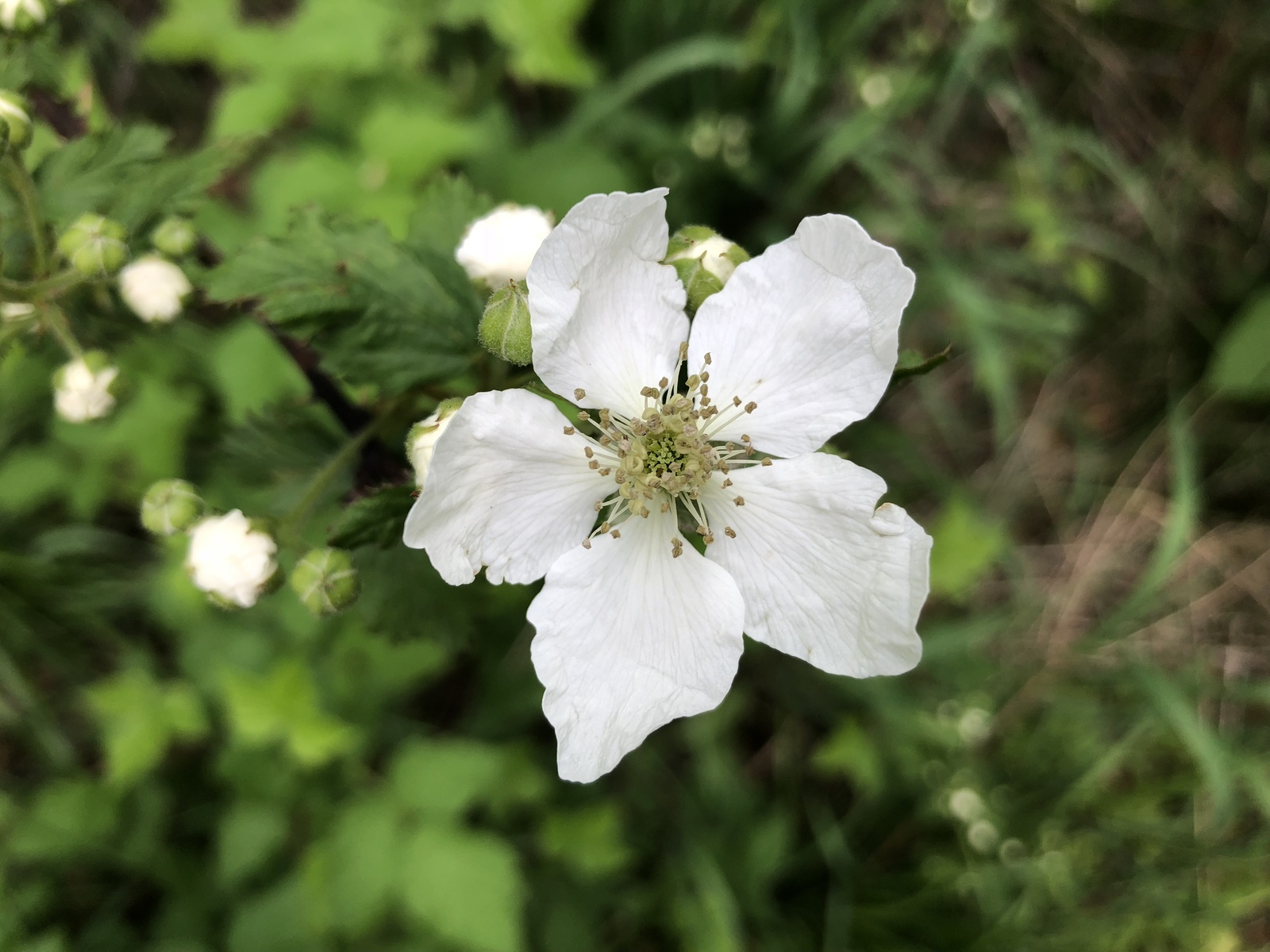
Allegheny blackberry
Rubus allegheniensis
A more upright cane than sawtooth blackberry, with finely glandular new growth and slightly later flowering. Distribution overlaps the sawtooth on the plateau; field separation is difficult.
Status: Native; common.
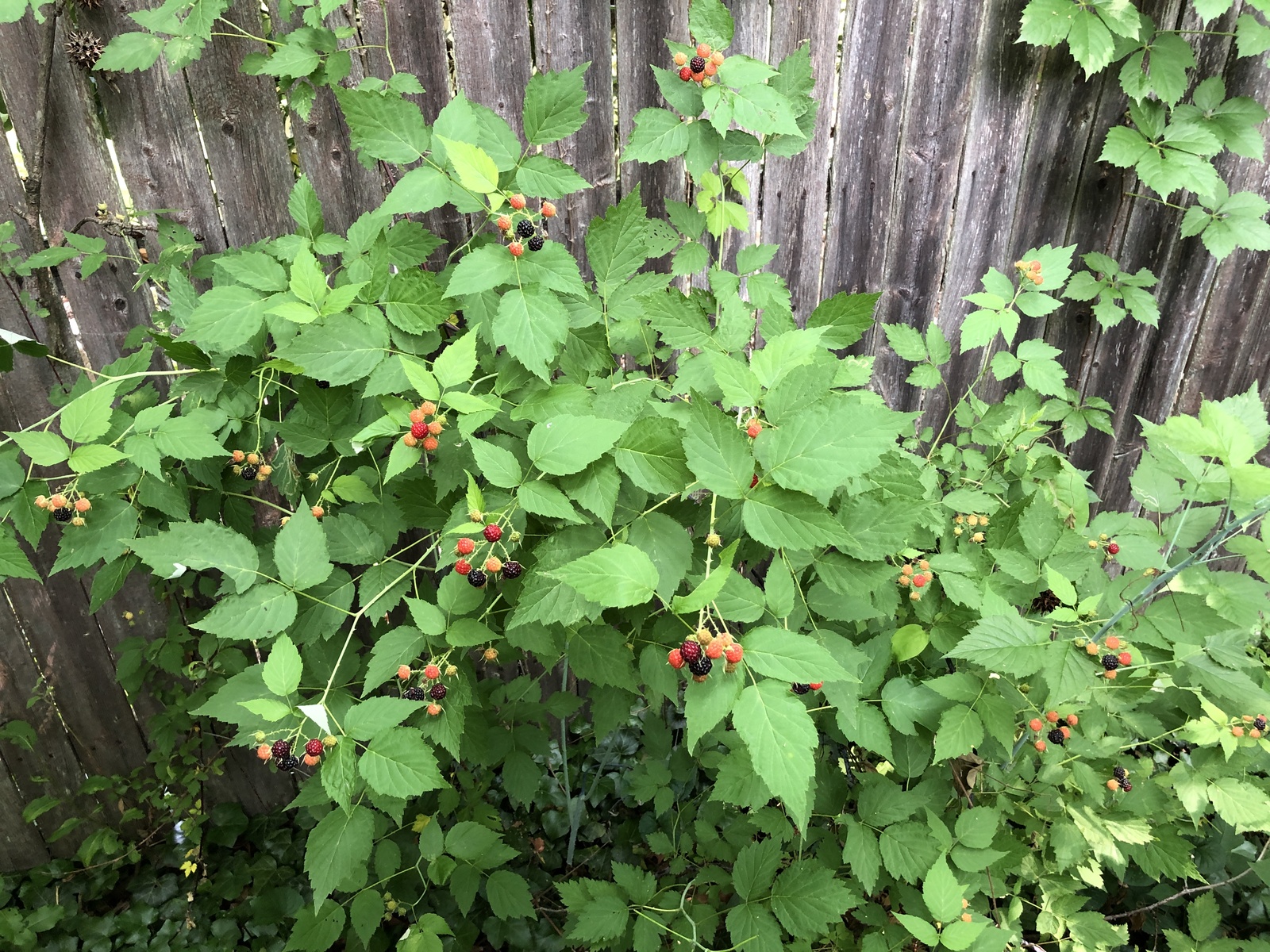
Black raspberry
Rubus occidentalis
Whitish-blue arching canes that root at the tips, distinctive even in winter. Red-then-black aggregate fruits in early summer. Old field margins and forest gaps; less aggressive than the cultivated and invasive Asian Rubus species.
Status: Native; common in old fields.
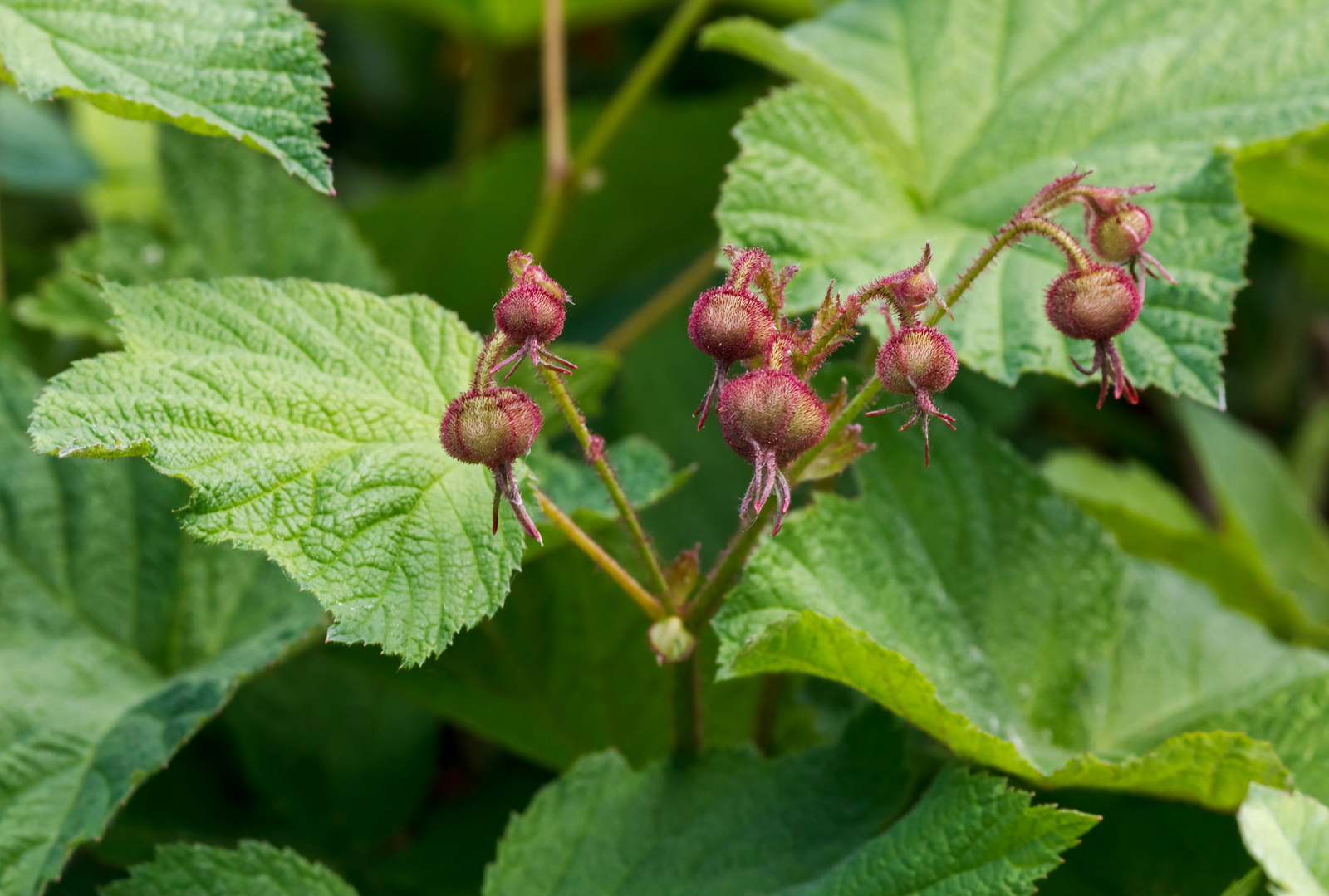
Flowering raspberry
Rubus odoratus
A thornless raspberry of cooler, mesic slopes and stream banks; broad maple-like leaves and showy purple flowers in June. Fruits red, dry, and not as palatable as the true raspberries.
Status: Native; uncommon, in cool ravines.
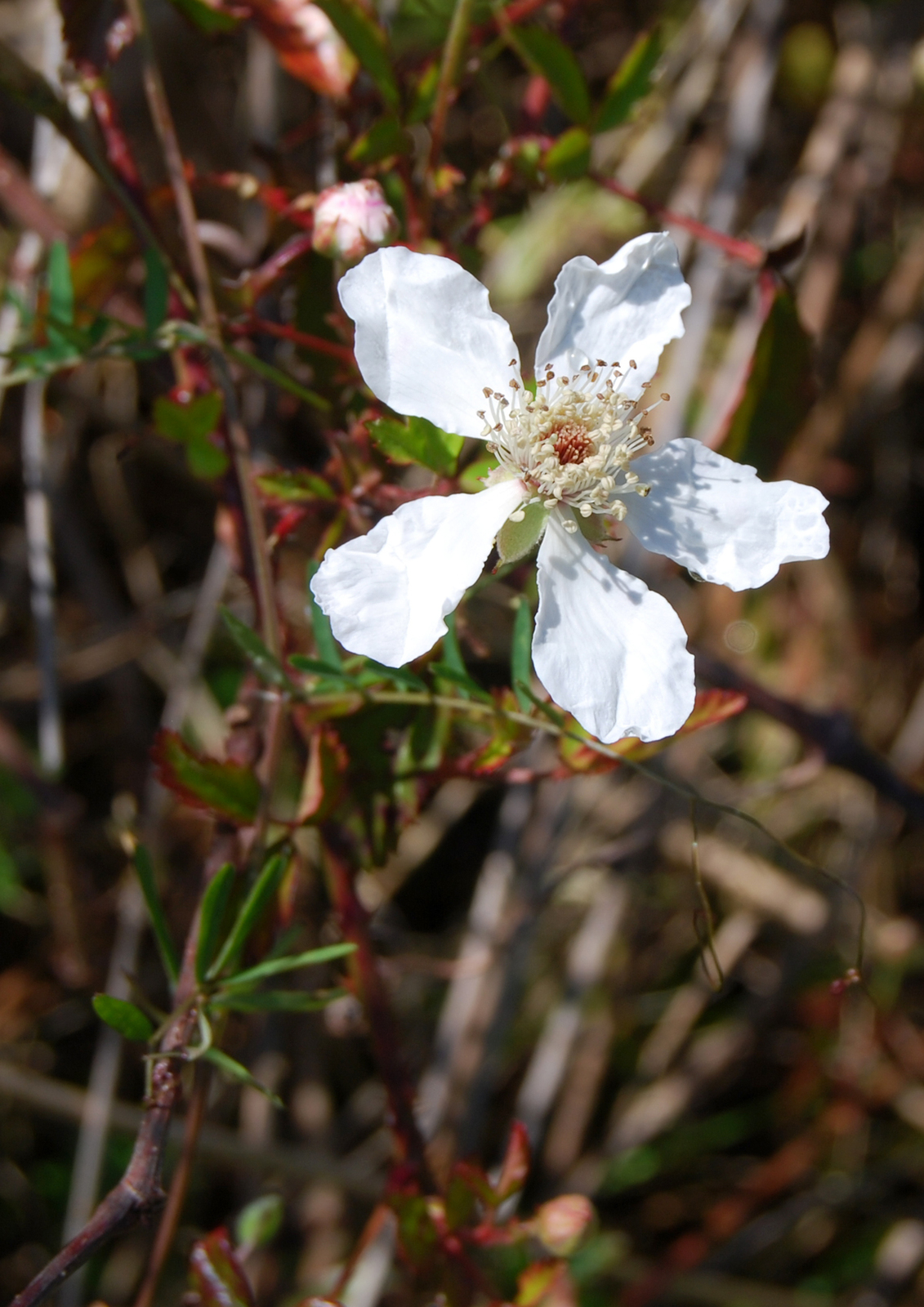
Coastal plain dewberry
Rubus trivialis
A trailing dewberry of sandy uplands; canes lie flat or arch only slightly, with sharp thorns. Common name reflects a coastal-plain center of distribution; plants do extend into the southern Cumberland Plateau.
Status: Native; uncommon, on sandy uplands.
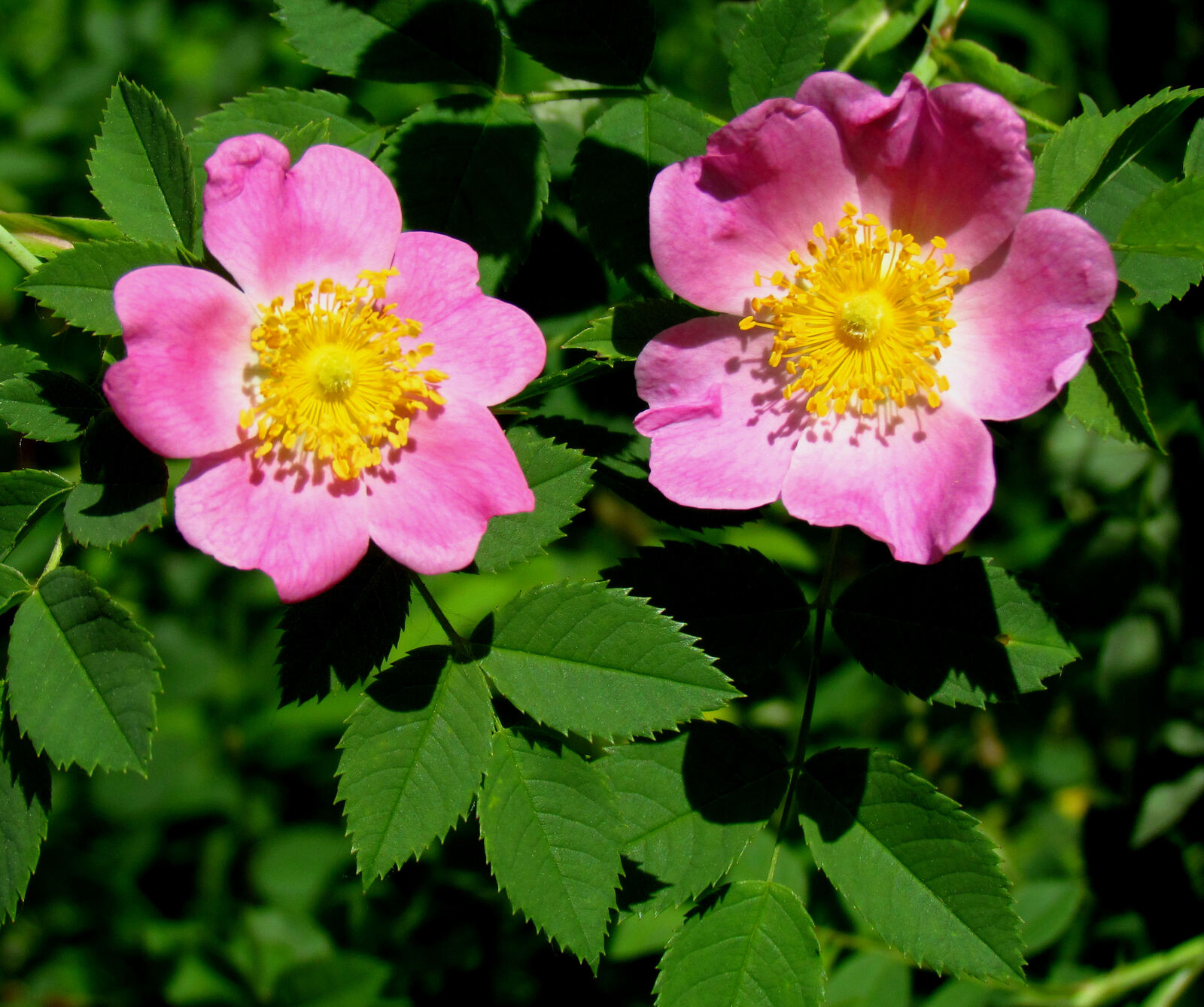
Carolina rose
Rosa carolina
Pink five-petaled flowers with prominent yellow stamens; not aggressive; small mounding habit. Old fields, forest edges, and limestone glades. The common native pasture rose of the southern uplands.
Status: Native; common in old fields.
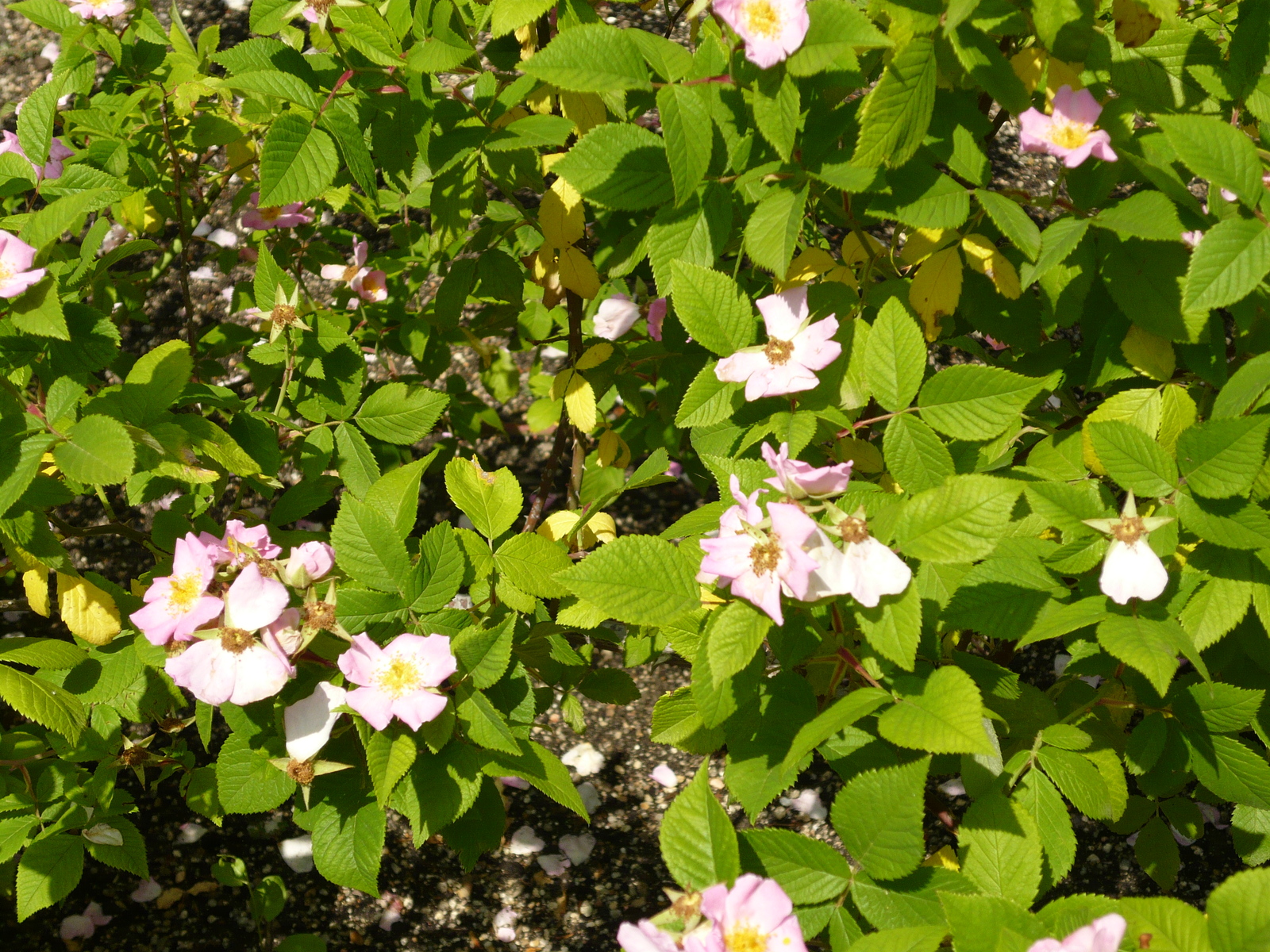
Climbing rose
Rosa setigera
Despite the common name, more accurately a sprawling rose with long trailing canes that climb over fences and shrubs. Pink five-petaled flowers in clusters, June. The only truly climbing native rose in the eastern US.
Status: Native; uncommon, in valley woods.
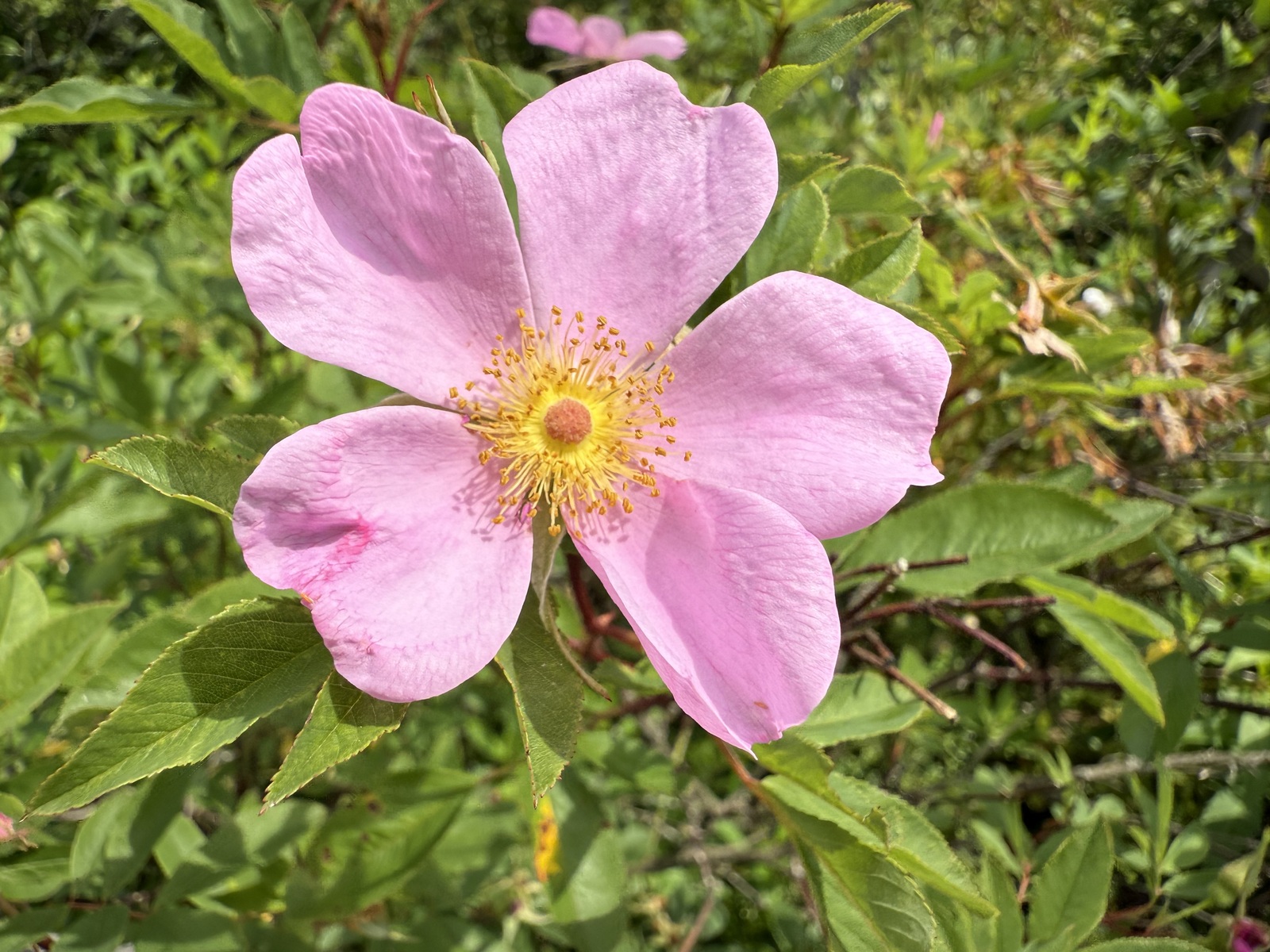
Swamp rose
Rosa palustris
Pink five-petaled flowers in clusters; wet feet preferred (bogs, swamp margins, plateau wet flats). Distinguished from other native roses by its consistently wetland habitat.
Status: Native; uncommon, in wetlands.
Serviceberries and chokeberries (Rosaceae)
The shrub-form serviceberries and the chokeberries (genus Aronia) are closely related Rosaceae shrubs with white five-petaled flowers in spring and persistent fruits in fall. The chokeberries hybridize freely; the purple chokeberry is the natural hybrid between the red and black species.
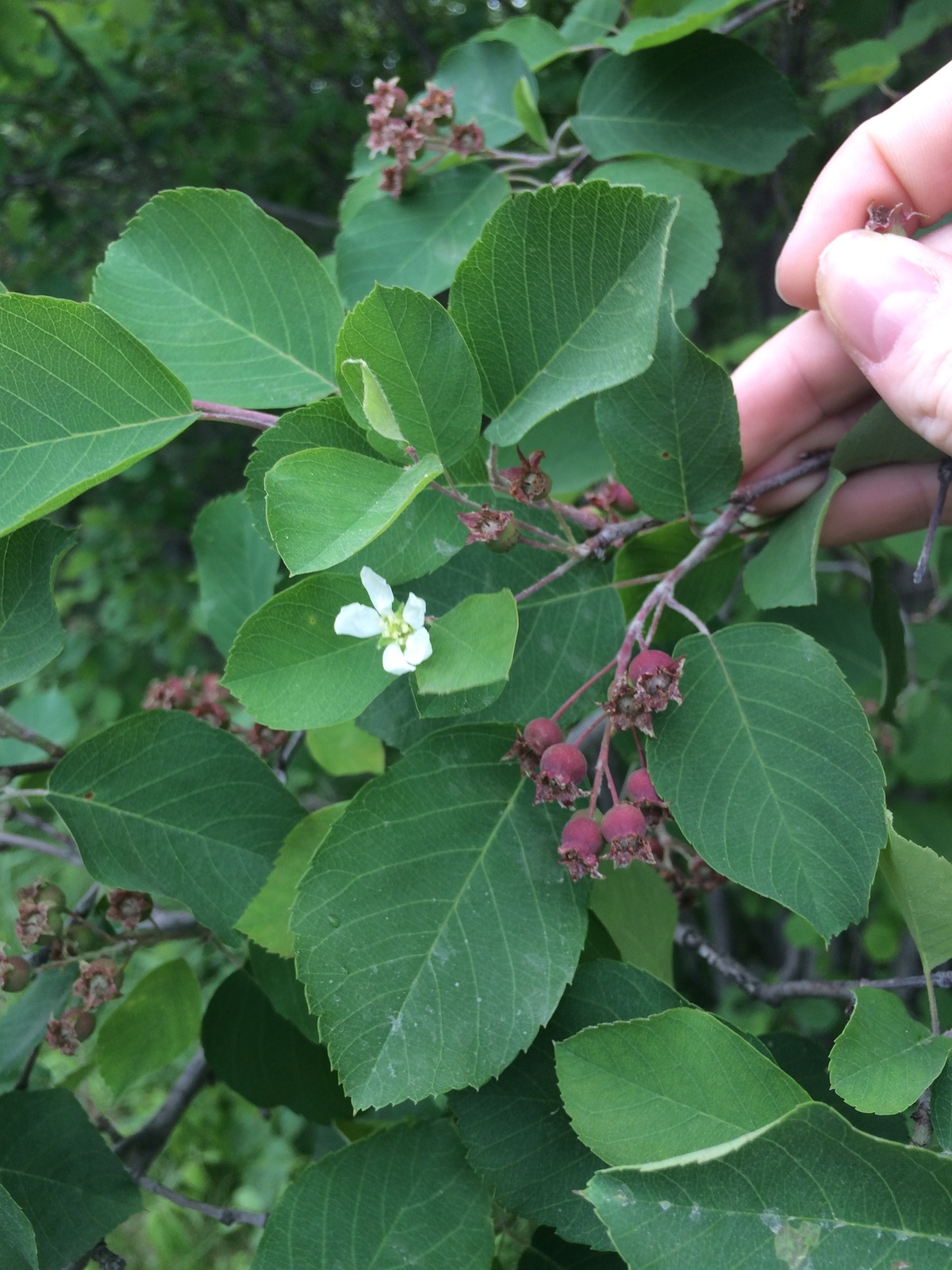
Roundleaf serviceberry
Amelanchier sanguinea
A small serviceberry with rounded leaves and white five-petaled flowers in early spring; reaches the southern edge of its range on the Cumberland Plateau. Per the TDEC 2025 Rare Plant List, S2/G5 in Tennessee.
Status: Native; Tennessee state-Threatened (S2 / G5).
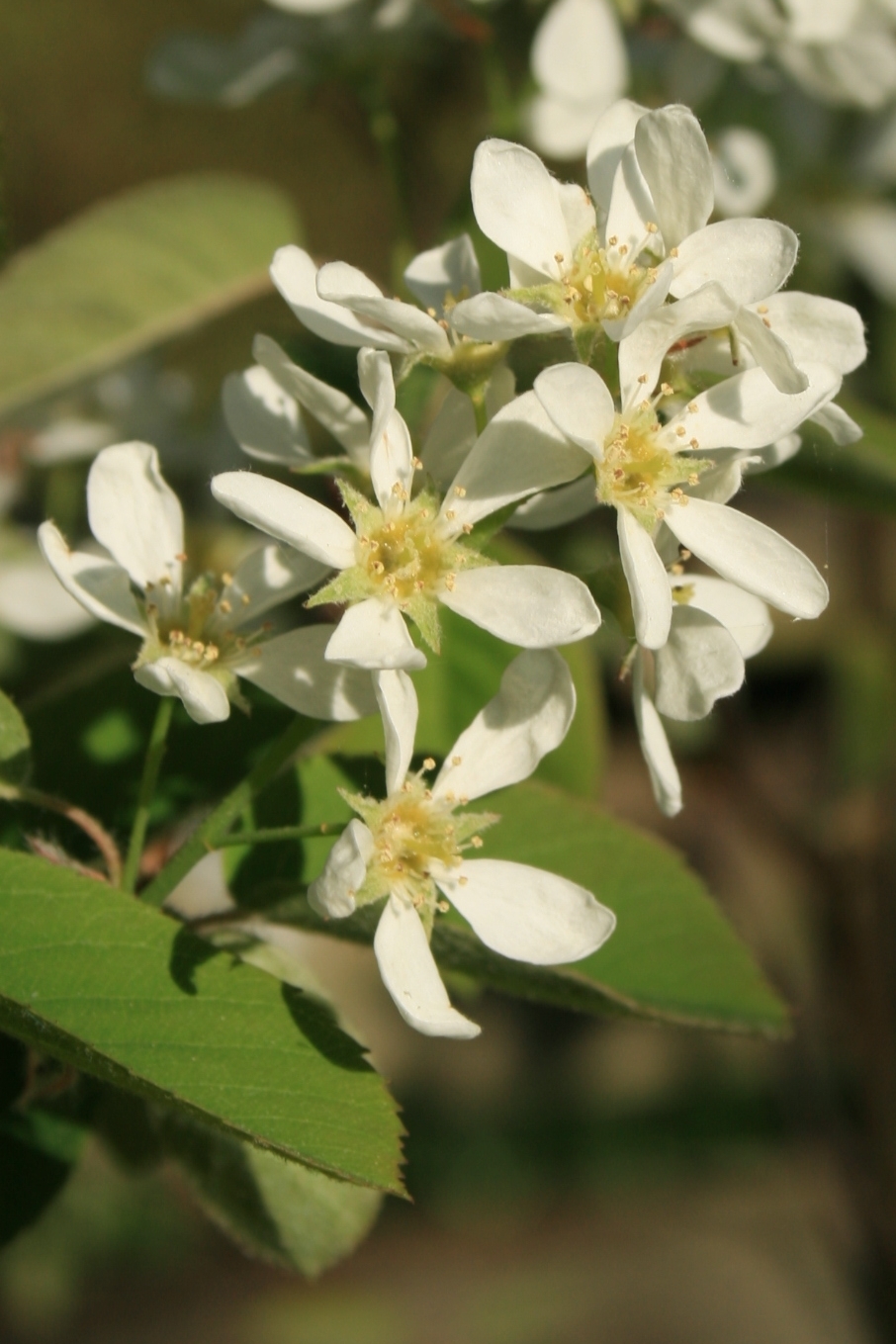
Dwarf serviceberry
Amelanchier spicata
A multi-stemmed shrubby serviceberry of rocky open woods and bluff edges. Smaller flower clusters than the tree-form serviceberries.
Status: Native; uncommon, on rocky uplands.
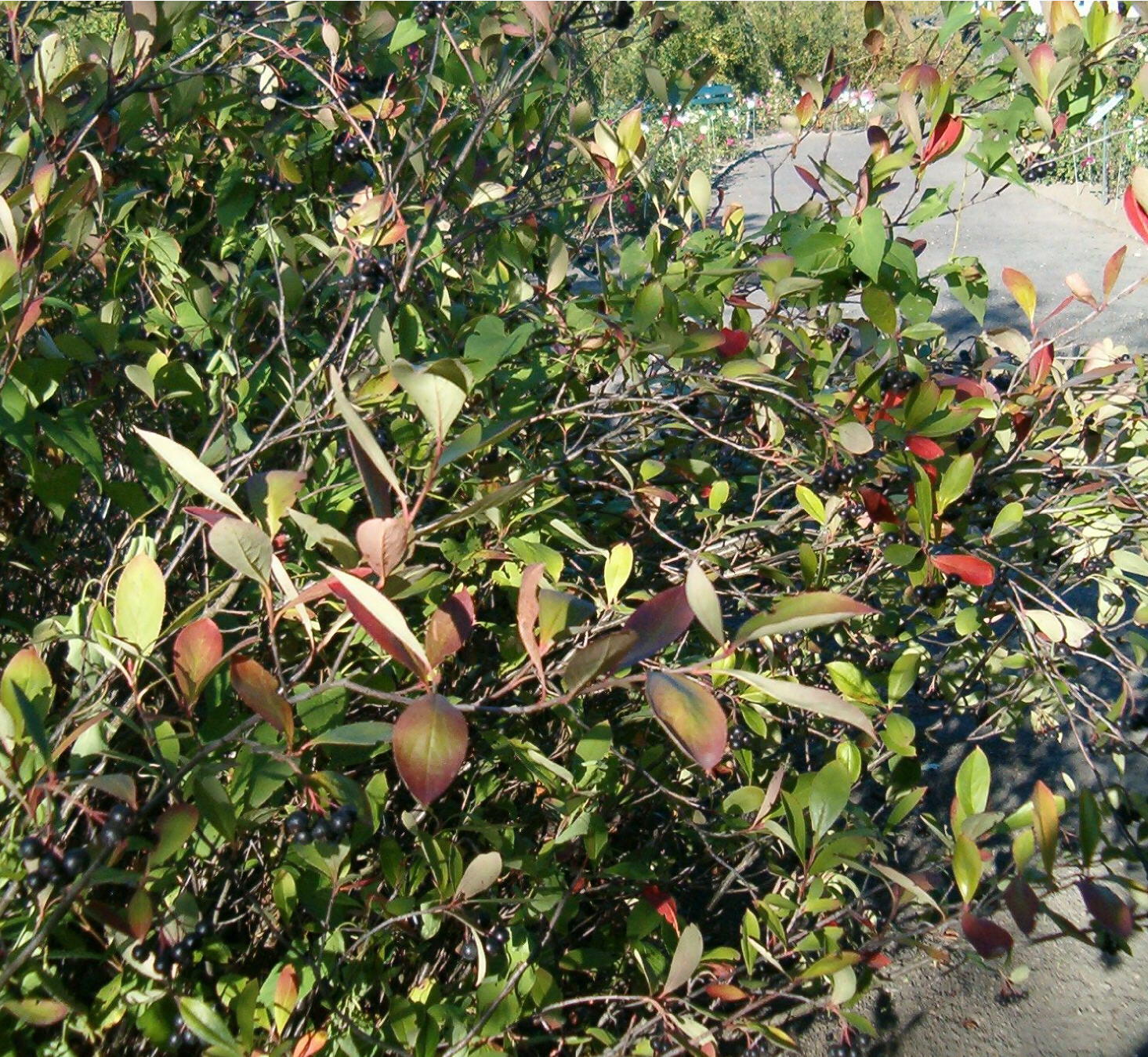
Red chokeberry
Aronia arbutifolia
White five-petaled flowers in clusters in May; bright red persistent fruits through fall and into winter. Brilliant red fall color. Wet woods, swamp edges, and plateau seepages.
Status: Native; common in wet plateau spots.
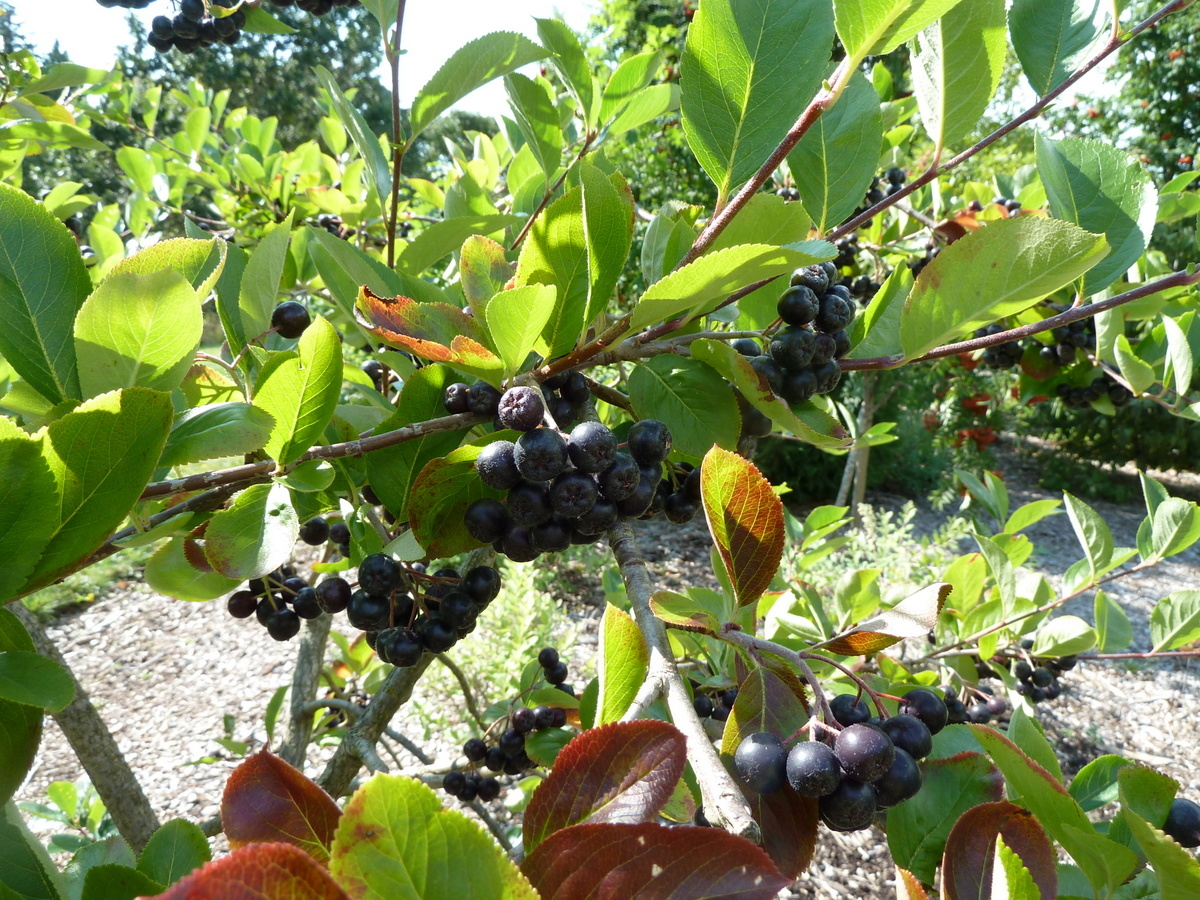
Black chokeberry
Aronia melanocarpa
Like red chokeberry but with black fruits and a more compact habit. Drier sites than red chokeberry; rocky uplands and ridge tops.
Status: Native; common on plateau ridges.
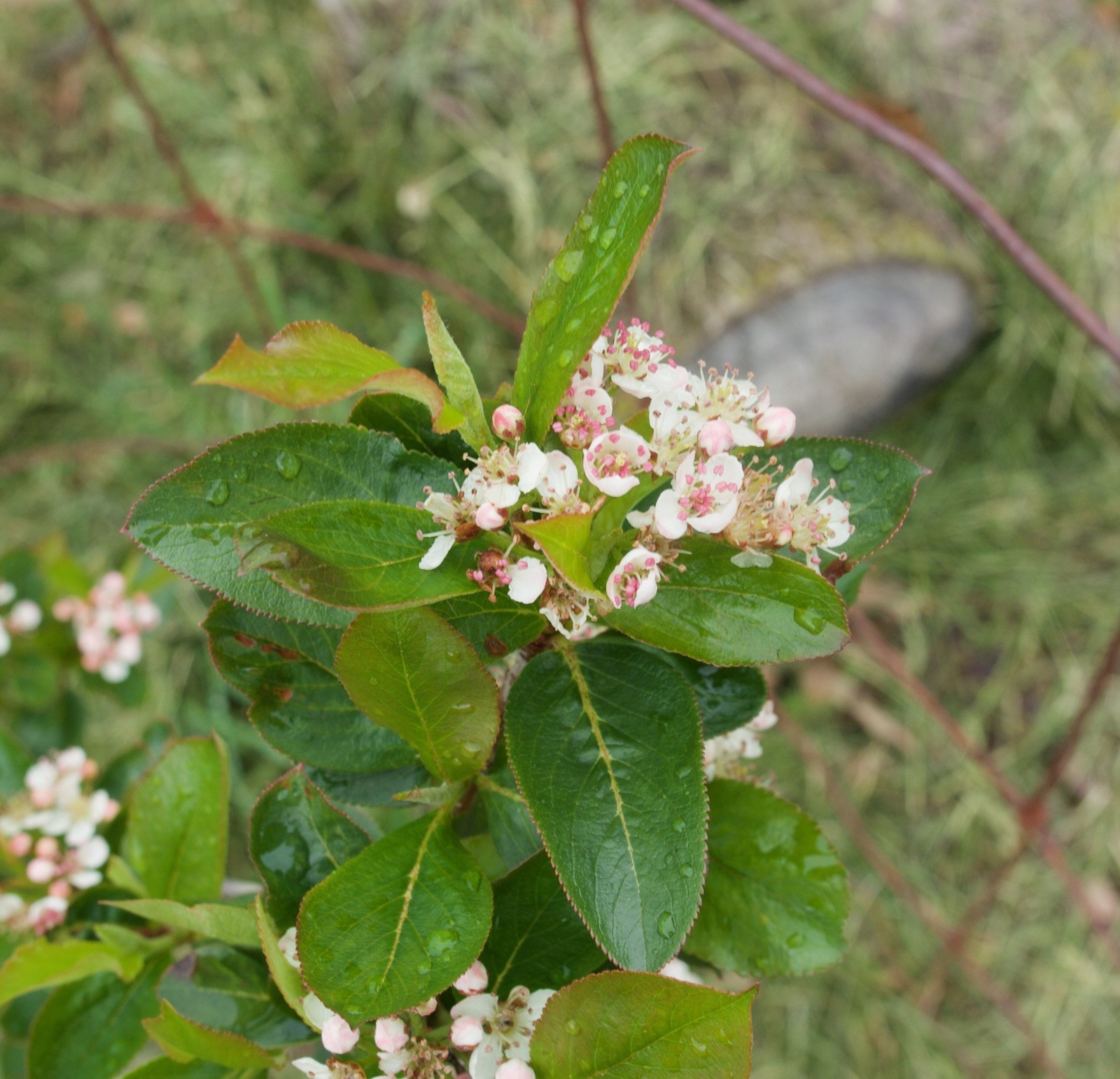
Purple chokeberry
Aronia prunifolia
A naturally occurring hybrid (Aronia × prunifolia) between red and black chokeberry, with intermediate purple-black fruits. Genetics resolve the parentage; in the field, intermediate forms occur where both parents grow together.
Status: Native; uncommon hybrid.
Native bush honeysuckles and coralberry
The native bush honeysuckles in genus Diervilla and the climbing-low Lonicera dioica are completely distinct from the invasive Asian Lonicera shrubs (L. maackii, L. morrowii) that dominate the invasive-shrub section below. Coralberry (genus Symphoricarpos) is a separate Caprifoliaceae shrub with persistent pink fruits.
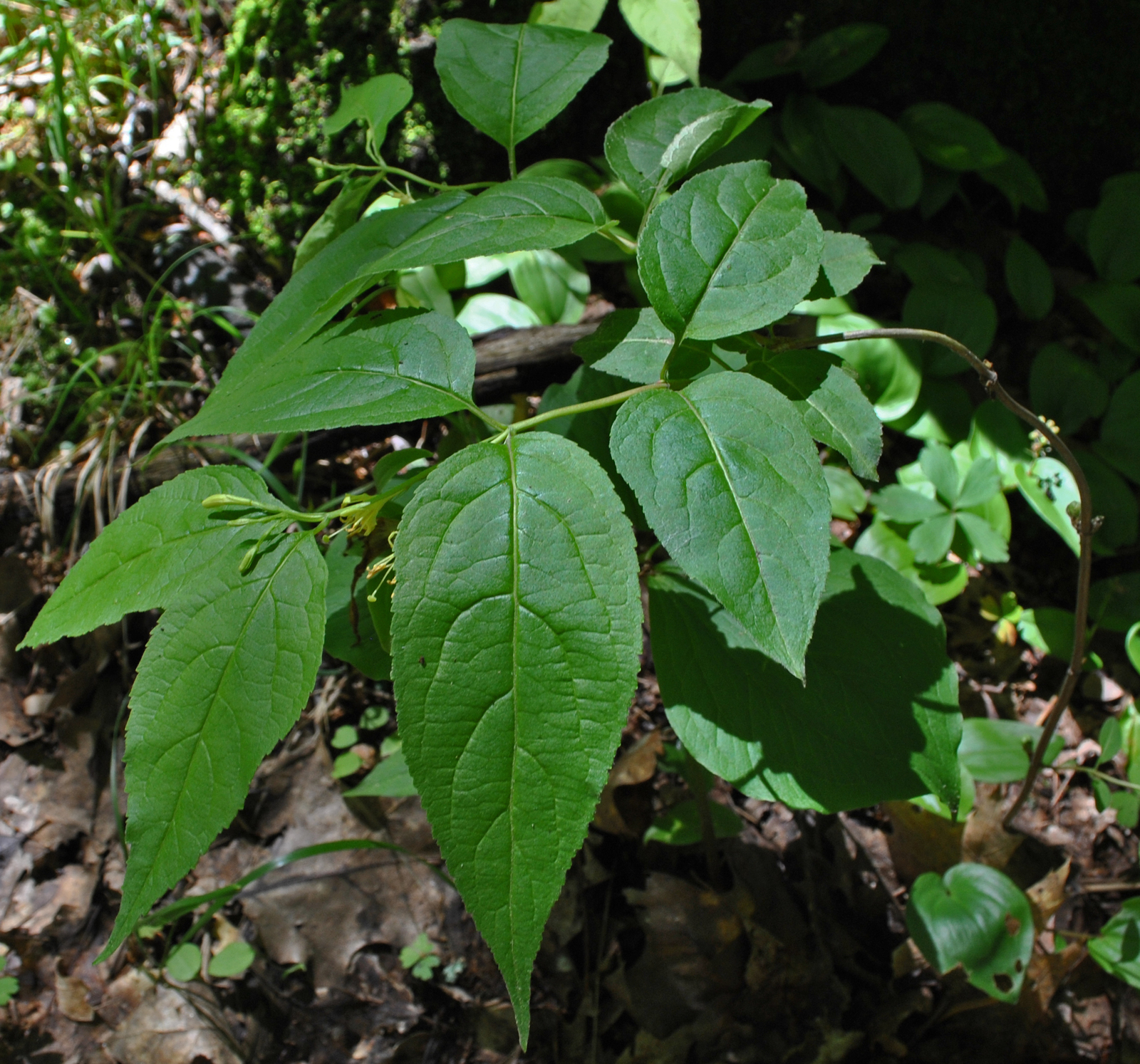
Northern bush-honeysuckle
Diervilla lonicera
A short native shrub with funnel-shaped yellow flowers (often turning orange-red as they age) in summer. Cool rocky slopes and Cumberland Plateau ridge tops. Distinct from the invasive Asian bush honeysuckles (Lonicera). Per the TDEC 2025 Rare Plant List, S2/G5 in Tennessee.
Status: Native; Tennessee state-Threatened (S2 / G5).
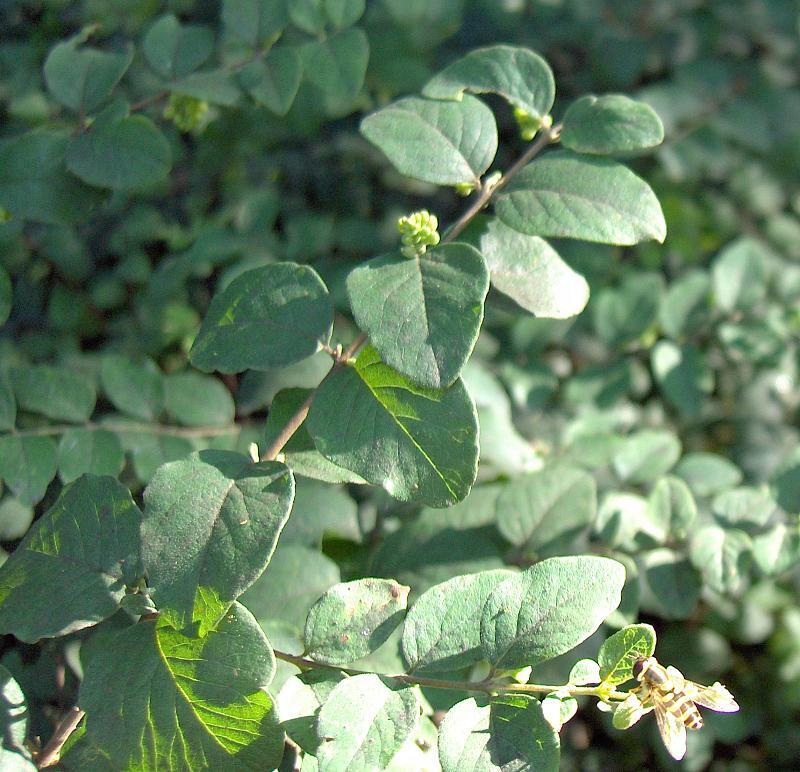
Coralberry
Symphoricarpos orbiculatus
A low colonial shrub with arching stems and tight clusters of pink-purple small fruits that persist through winter (the namesake "coral" beads). Old fields, forest edges, and disturbed limestone bluff margins.
Status: Native; common, often forming colonies.
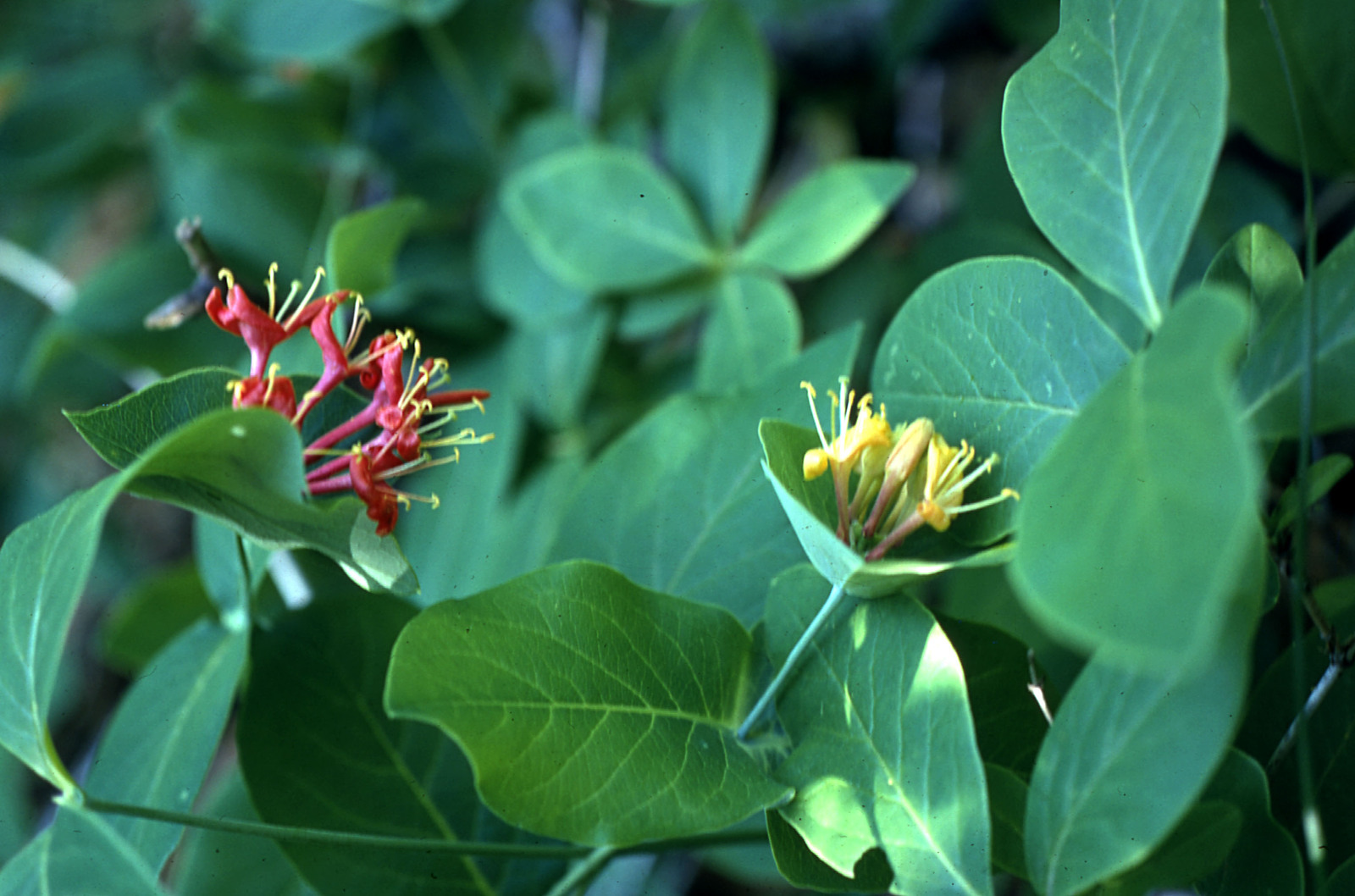
Wild honeysuckle
Lonicera dioica
A native climbing-low shrub or short twining vine, with yellow-to-red tubular flowers in late spring and red fruits in summer. The rarer of the native climbing honeysuckles in Tennessee. Per the TDEC 2025 Rare Plant List, S2/G5 in Tennessee.
Status: Native; Tennessee special-concern (S2 / G5).
Other notable native shrubs
A miscellaneous gathering of native shrubs that do not fit the larger groupings above: a creeping sub-shrub of cove-hardwood floors, two prickly pear cacti of limestone glades, a parasitic shrub that lives in oak canopies, and a set of stream-bank willows.
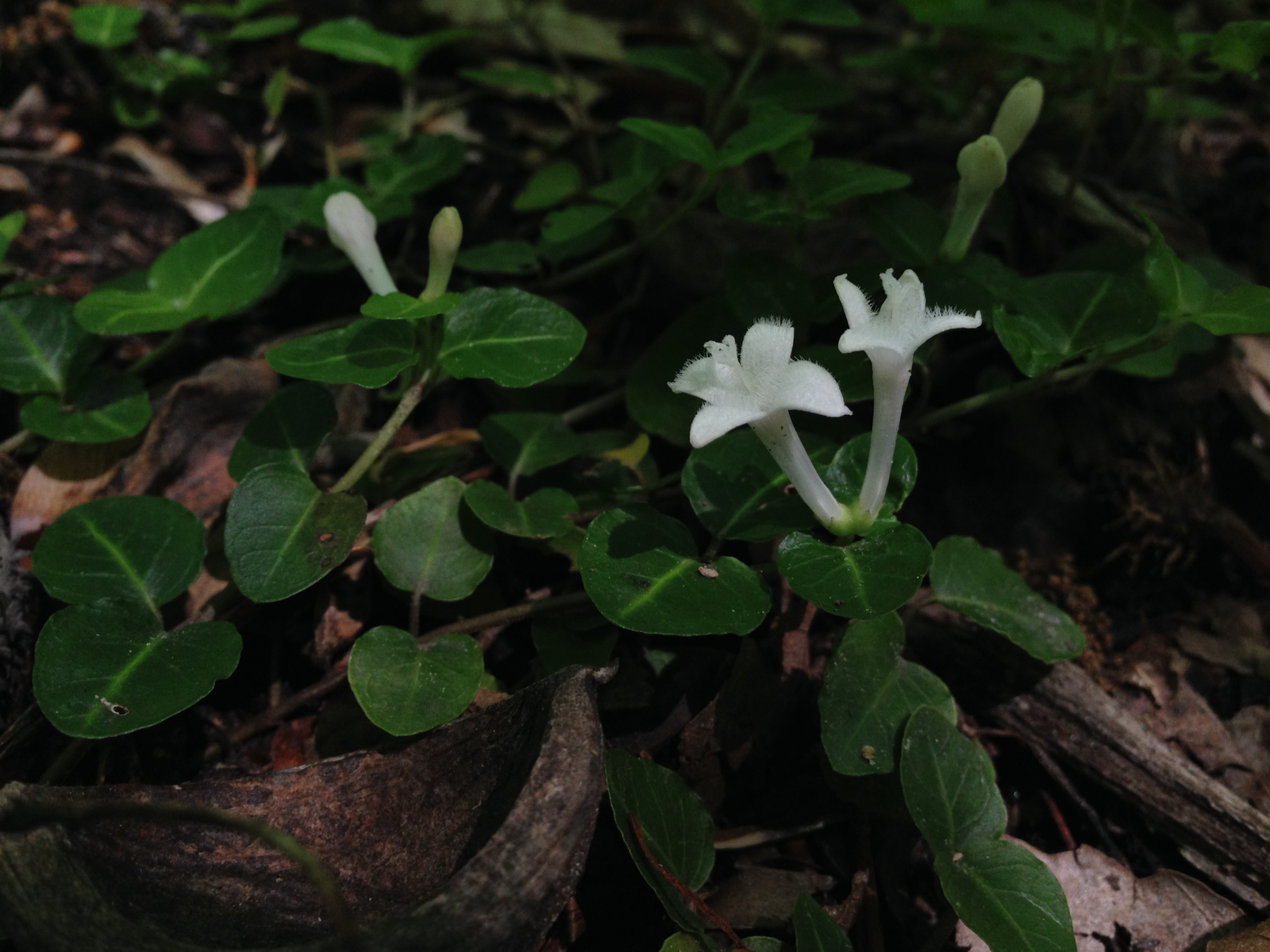
Partridge berry
Mitchella repens
A creeping evergreen subshrub of rich shaded woods, with paired tubular white flowers in summer that fuse to produce a single red berry with two scars where the two flowers met. Common on cove-hardwood floors in Marion County.
Status: Native; common in cove woods.
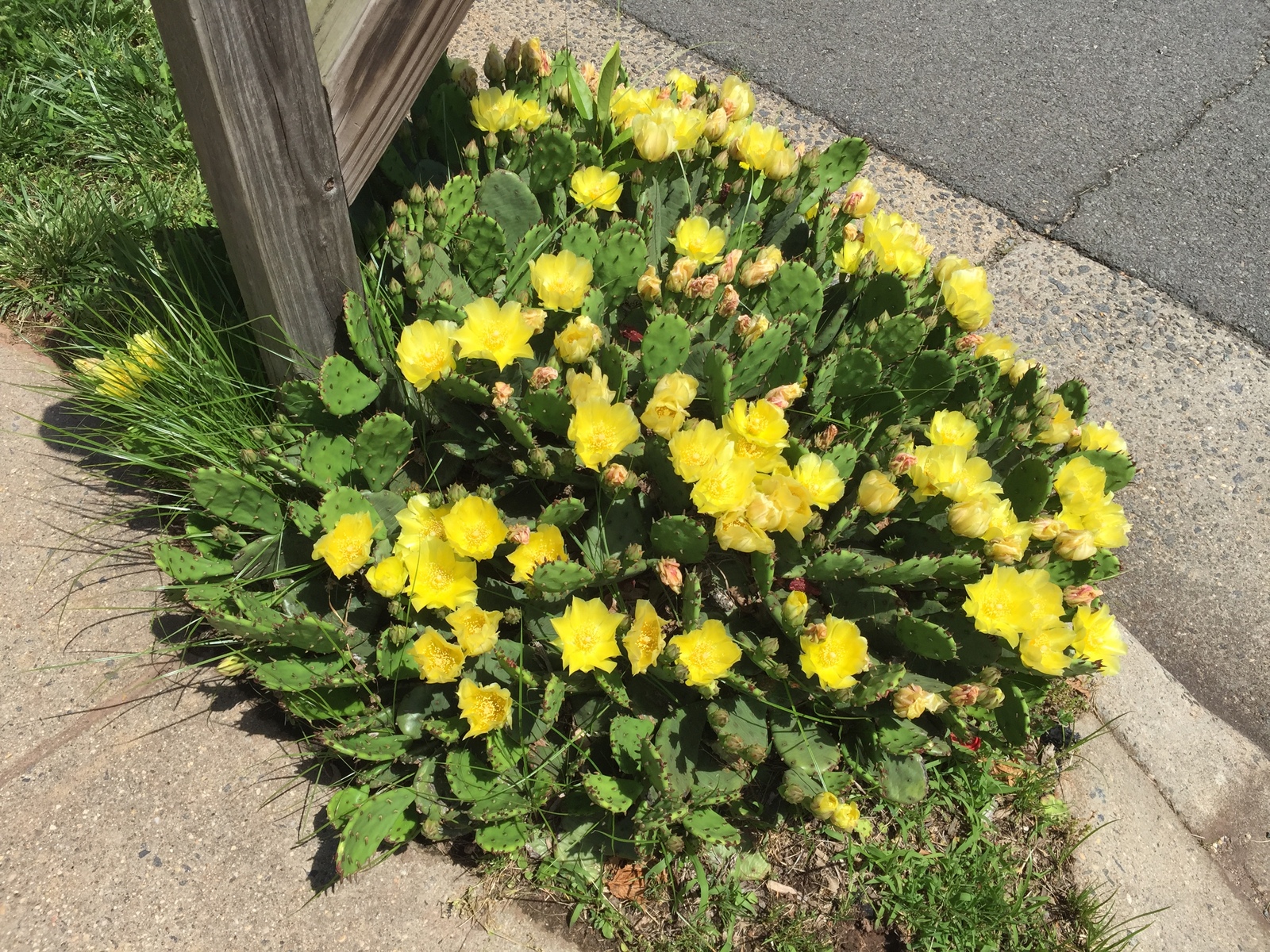
Prickly pear
Opuntia humifusa
Tennessee's only common native cactus. Flat oval pads with clusters of fine glochid spines (worse than the long ones); large yellow flowers in May; red purple-fleshed fruits. Limestone glades, sandstone outcrops, and rocky thin-soil sites.
Status: Native; locally common on rocky outcrops.
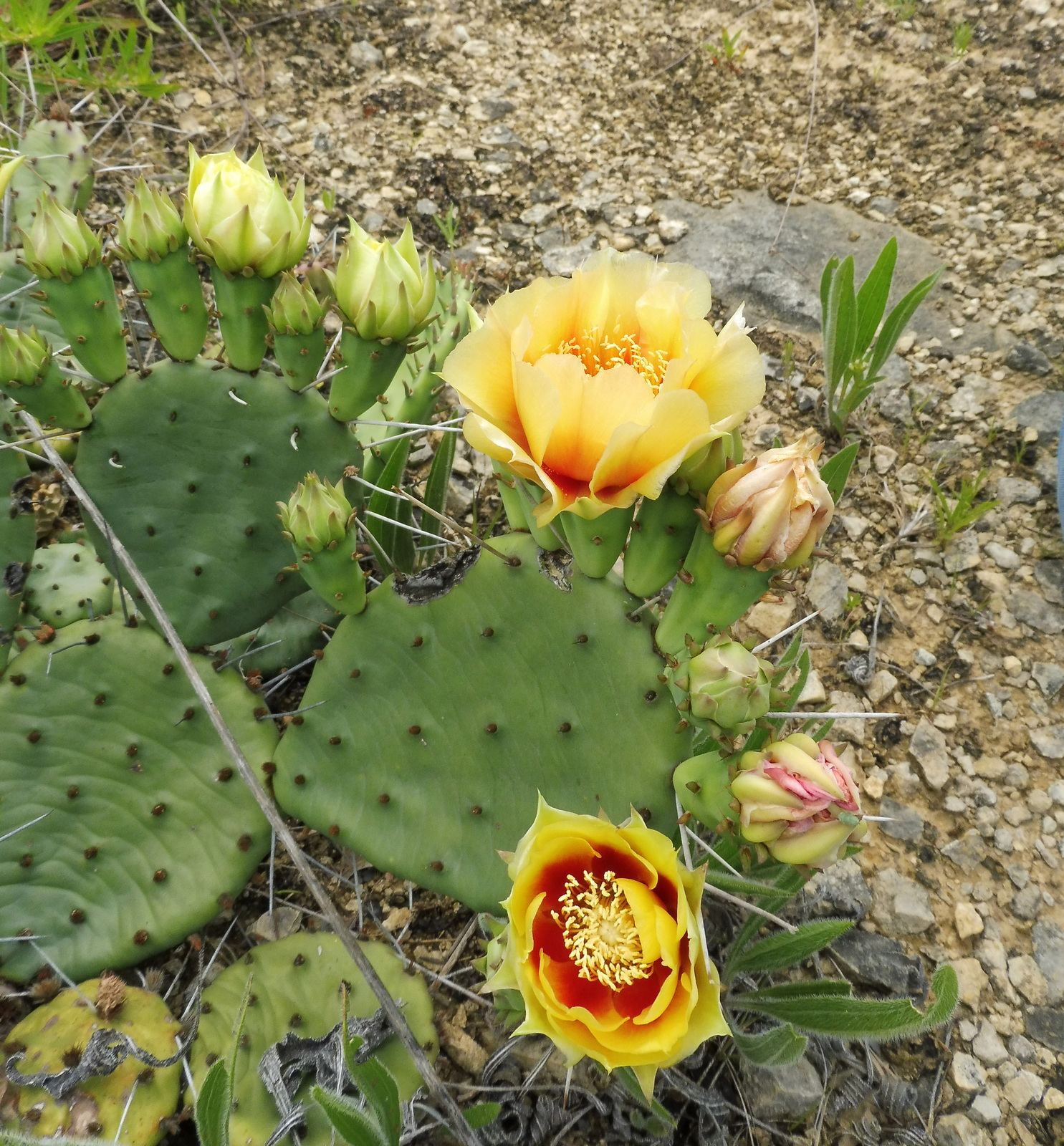
Eastern prickly pear
Opuntia cespitosa
Closely related to O. humifusa, separated mainly on chromosome counts and stem-pad characteristics. Limestone glade habitat overlaps with humifusa across the Interior Low Plateau and southern Cumberland.
Status: Native; locally common on limestone glades.
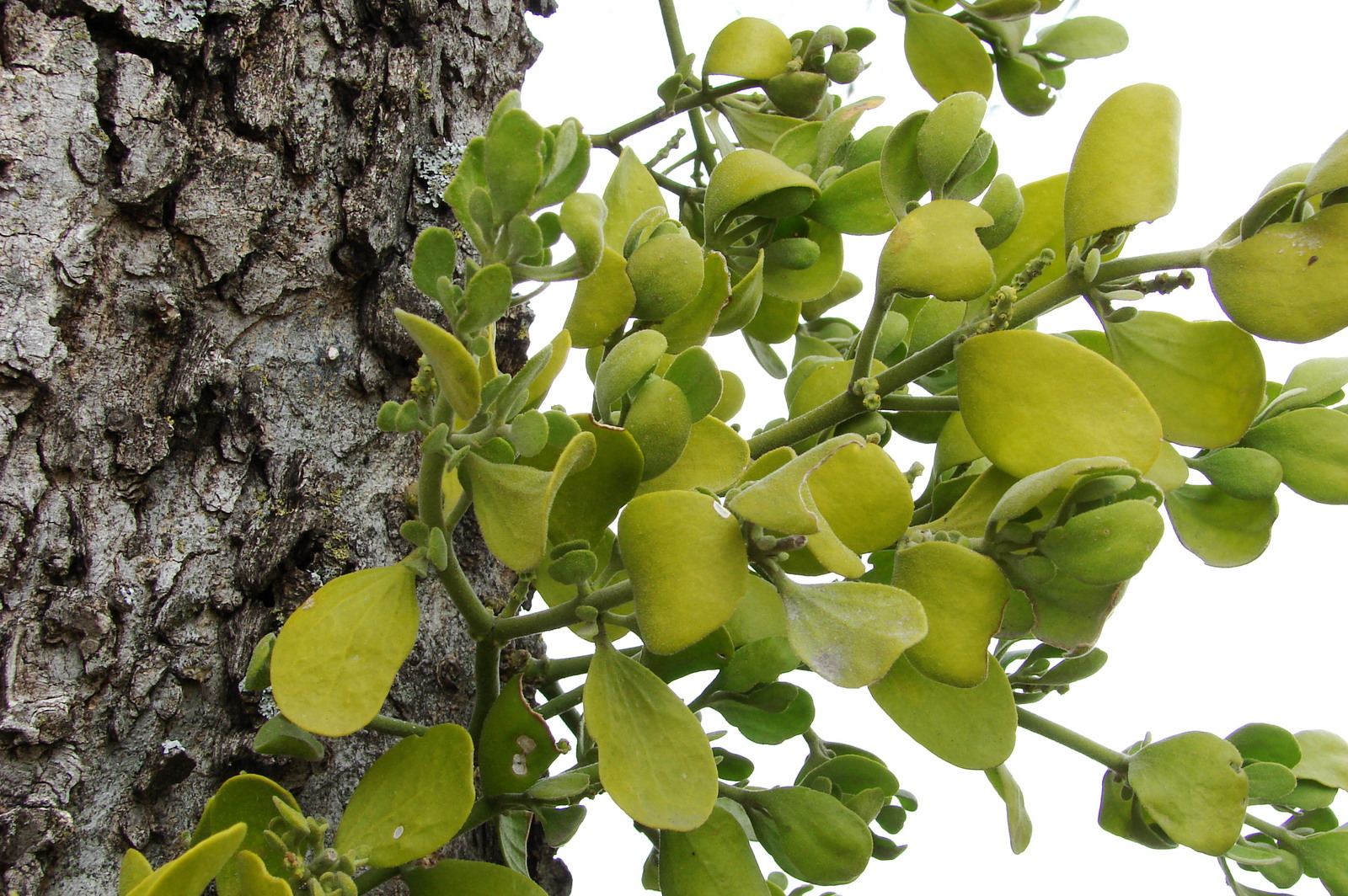
Mistletoe
Phoradendron leucarpum
A hemiparasitic shrub that lives entirely in the canopy of host trees (usually oaks and hickories), drawing water from the host. Best seen in winter when host trees are bare. White berries are toxic to humans and pets but a major mid-winter food source for cedar waxwings and bluebirds.
Status: Native; common in hardwood canopies.
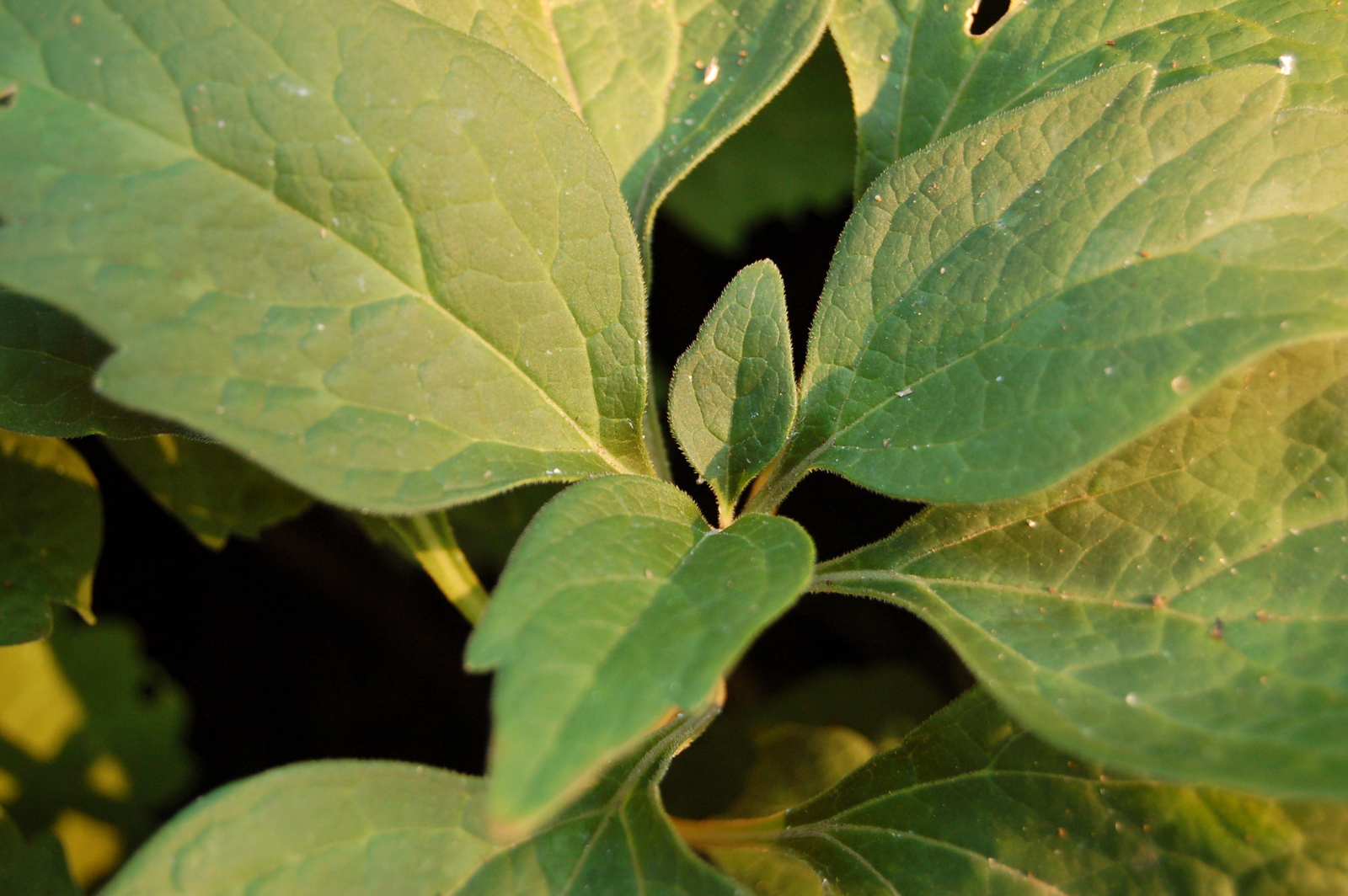
Allegheny spurge
Pachysandra procumbens
A native pachysandra of rich cove-hardwood floors, distinguished from the cultivated Japanese pachysandra by mottled blue-green leaves and white flower spikes in early spring. Reaches the western edge of its range on the southern Cumberland Plateau.
Status: Native; uncommon, on rich cove slopes.
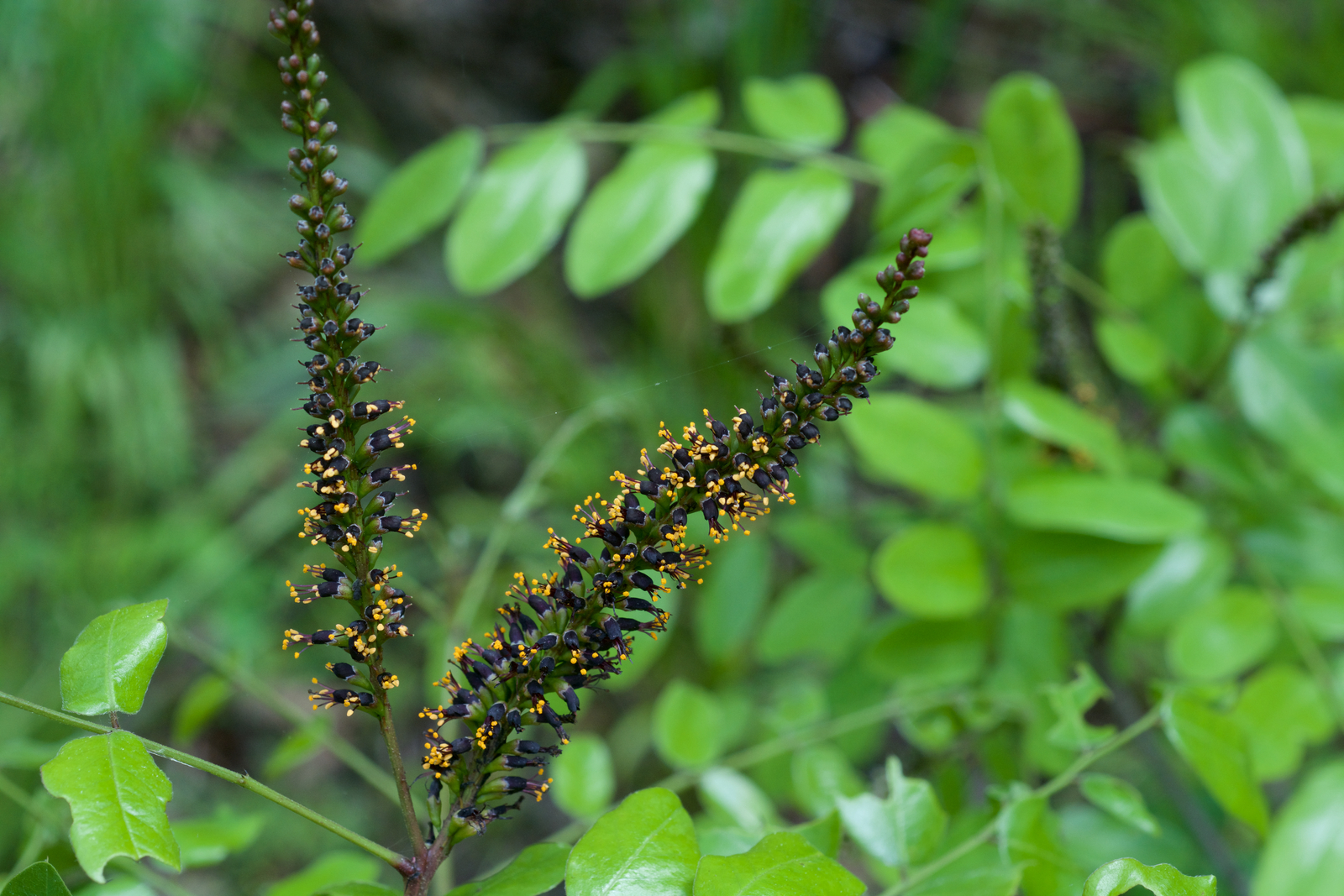
Dark indigo bush
Amorpha nitens
A small shrub of stream banks and floodplain woods, with pinnately compound leaves and dense purple flower spikes in early summer. Rarer in Marion County than the more abundant Amorpha fruticosa.
Status: Native; uncommon, in stream-bottom woods.
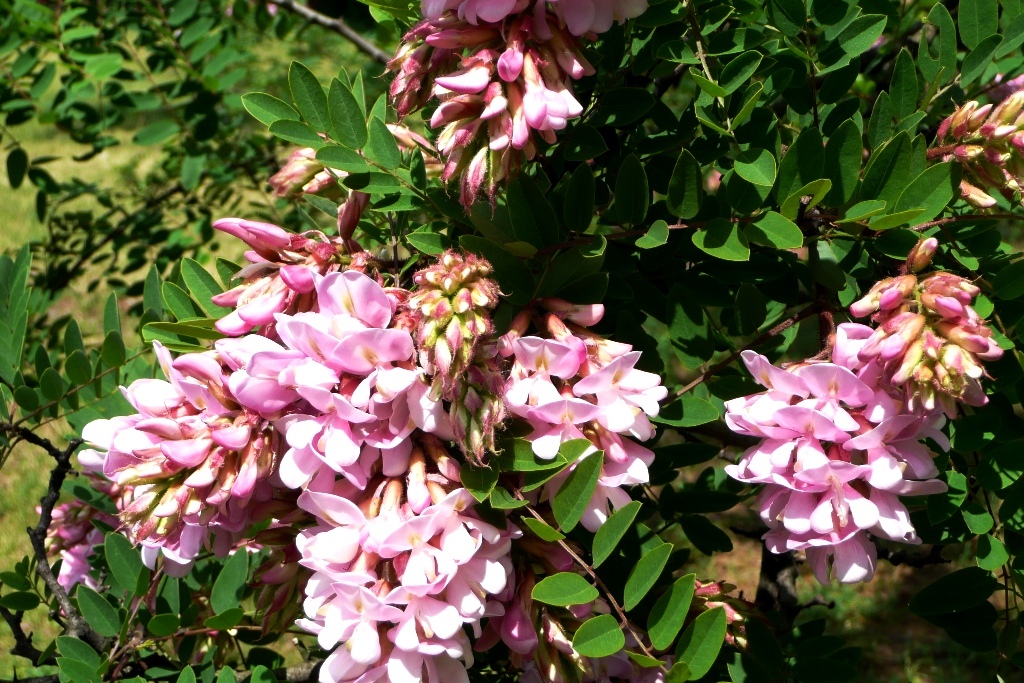
Clammy locust
Robinia viscosa
A small locust shrub with pink-purple flower clusters and sticky-glandular young growth. Disturbed roadcuts and gravelly soils on the plateau; less common than black locust.
Status: Native; uncommon.
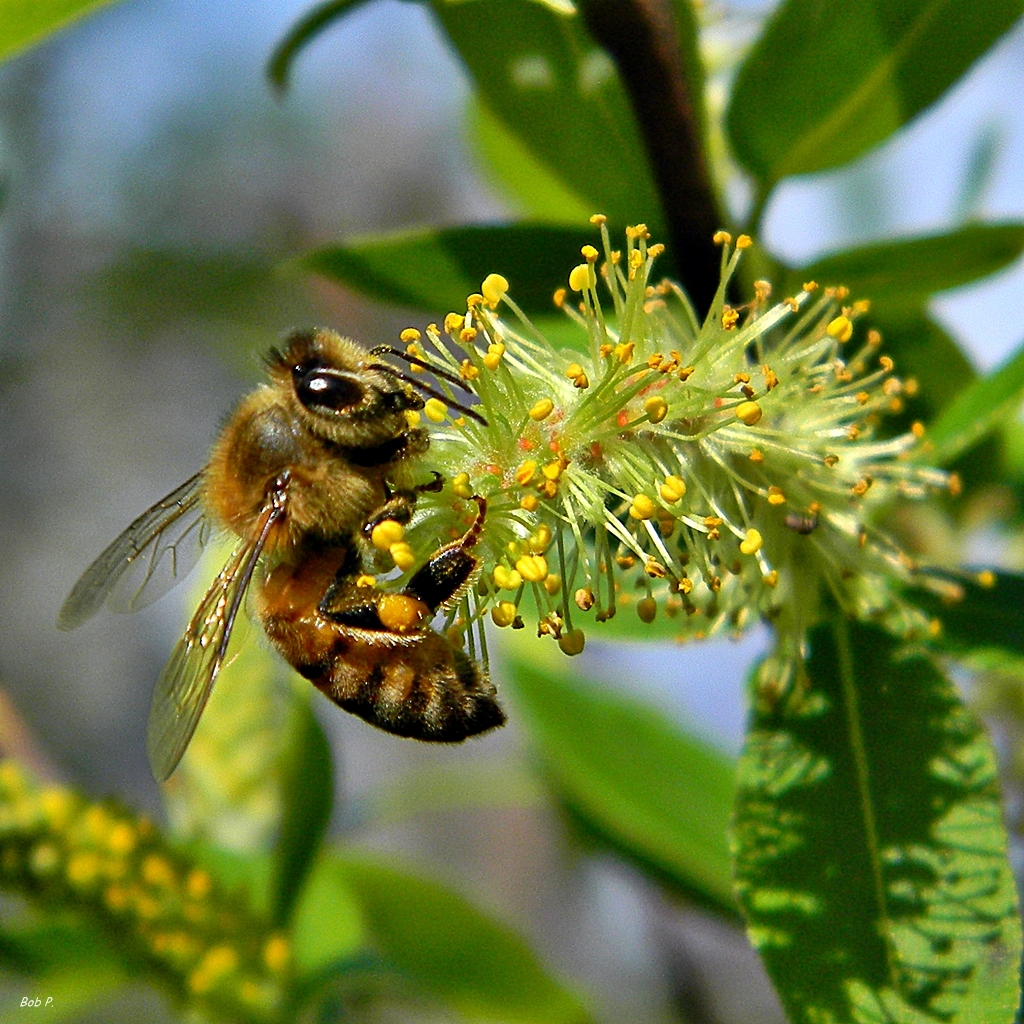
Carolina willow
Salix caroliniana
A multi-stemmed shrubby willow of stream banks and pond margins; one of the earliest plants to flower in late winter, with greenish-yellow catkins on bare stems. Common along the Sequatchie River and Tennessee River backwaters.
Status: Native; common along plateau streams.
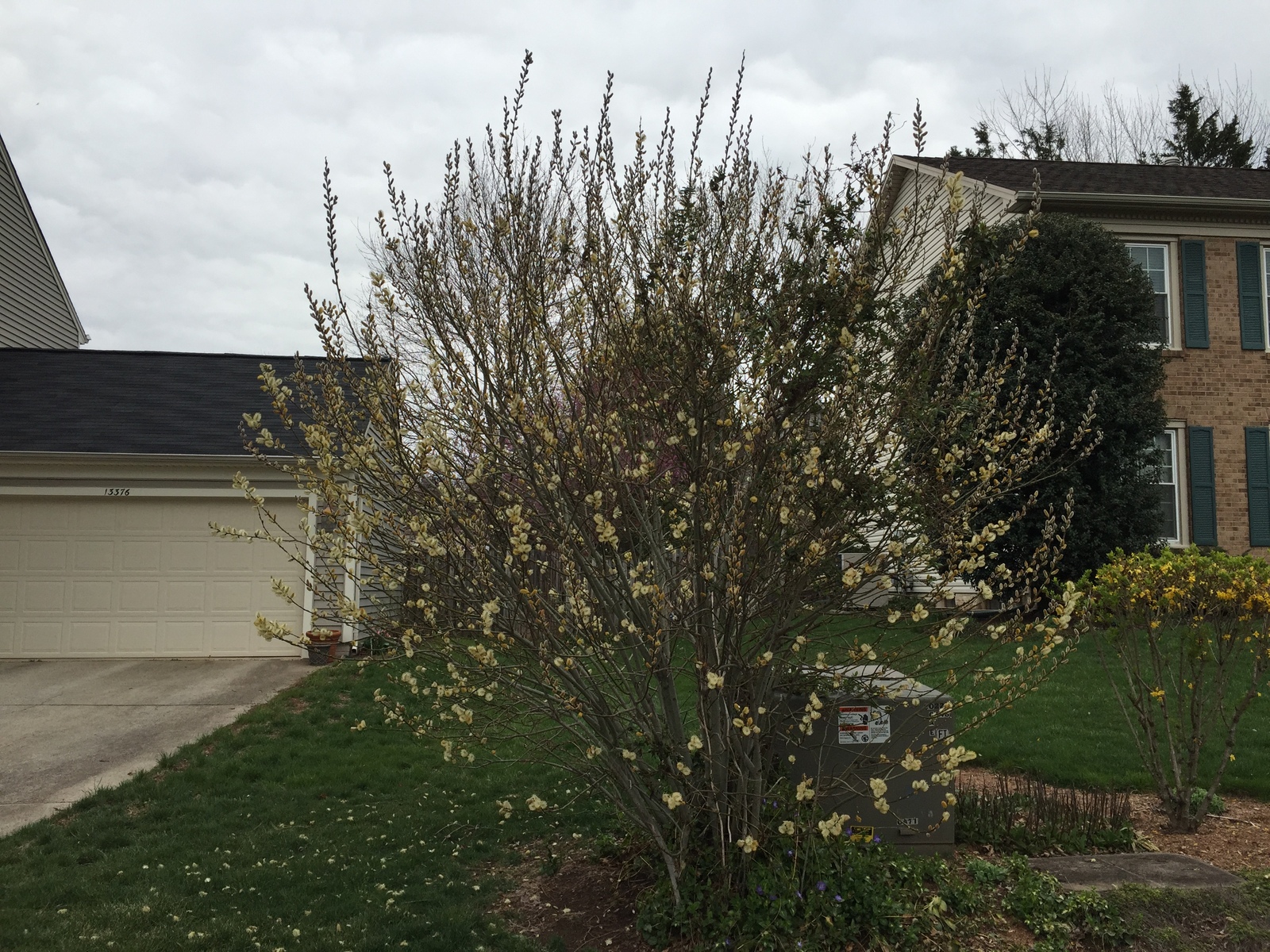
Pussy willow
Salix discolor
The familiar fuzzy gray catkins on bare branches in late winter, opening to fully developed yellow-anthered male flowers in March. Wet meadows and stream margins.
Status: Native; common in wet spots.
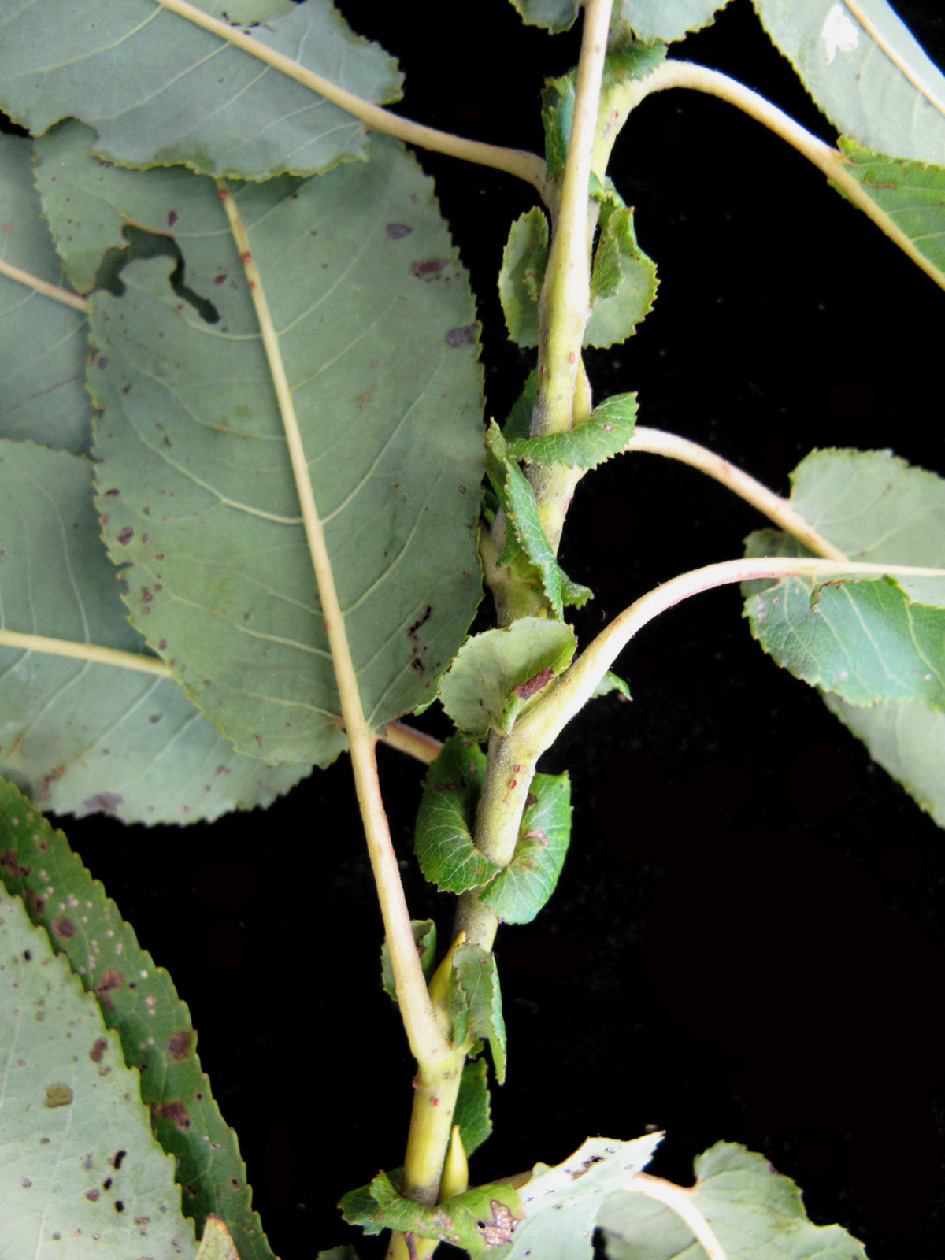
Heart-leaf willow
Salix eriocephala
A shrubby willow of plateau seepages and stream banks, with heart-shaped stipules at each leaf base. Less common than Carolina willow and pussy willow; field separation requires close examination.
Status: Native; uncommon.
Invasive shrubs of concern
Twenty-one non-native shrubs are documented as either established in Marion County or persisting from old plantings. Several are TN-IPC-listed severe-threat invasives that aggressively displace native shrubs in floodplain and disturbed-edge habitats; others are old-fashioned ornamentals that persist at abandoned home sites without spreading aggressively. The full ecological-threat context for invasive plants is in the Invasive species and ecological threats section below.
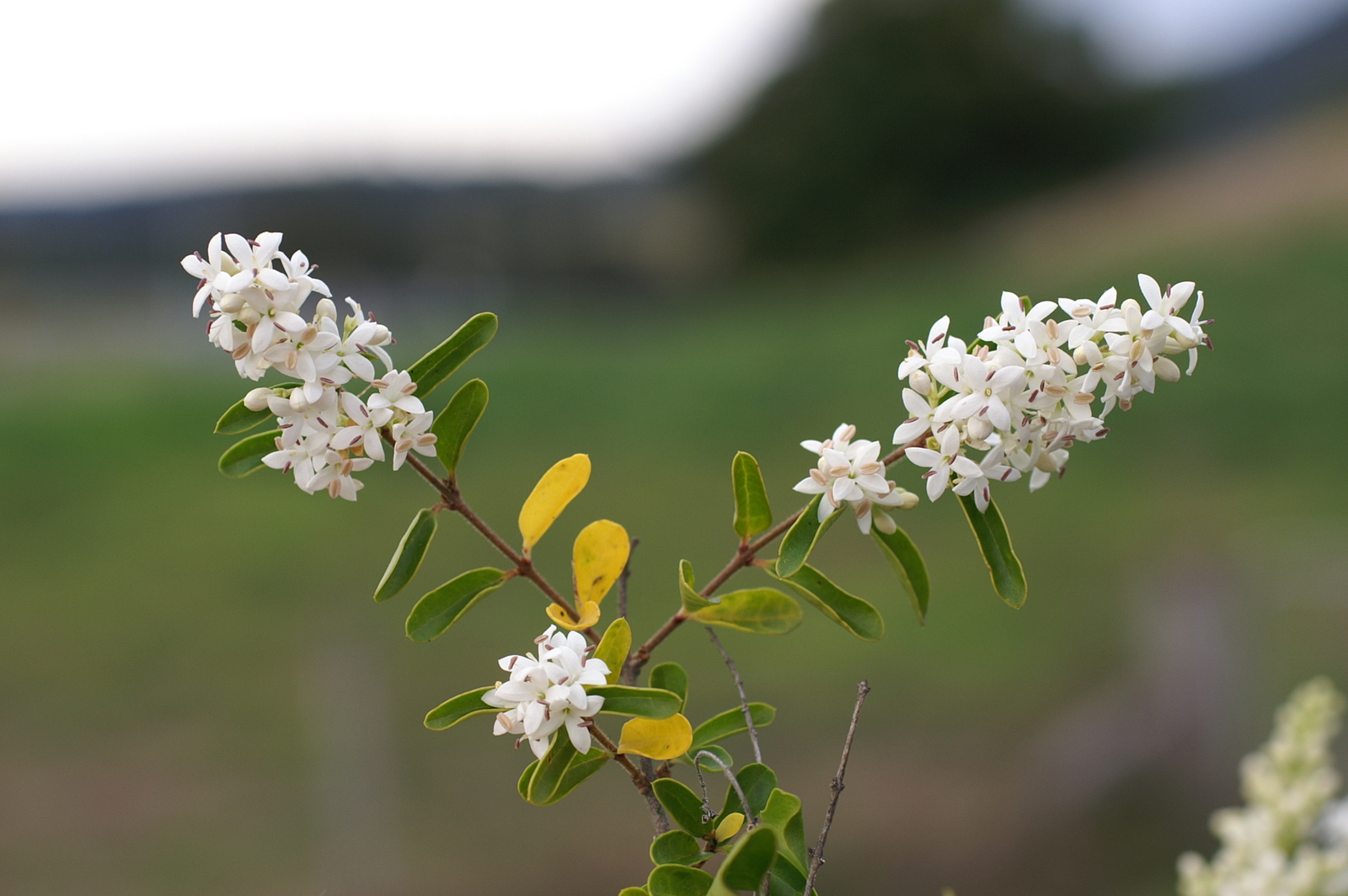
Chinese privet
Ligustrum sinense
Aggressive evergreen-to-semievergreen shrub that forms dense monocultures in floodplain woods and along disturbed valley margins. White flower clusters in late spring; small black drupes that birds spread widely.
Status: Introduced; TN-IPC severe-threat invasive. See Invasive species and ecological threats.
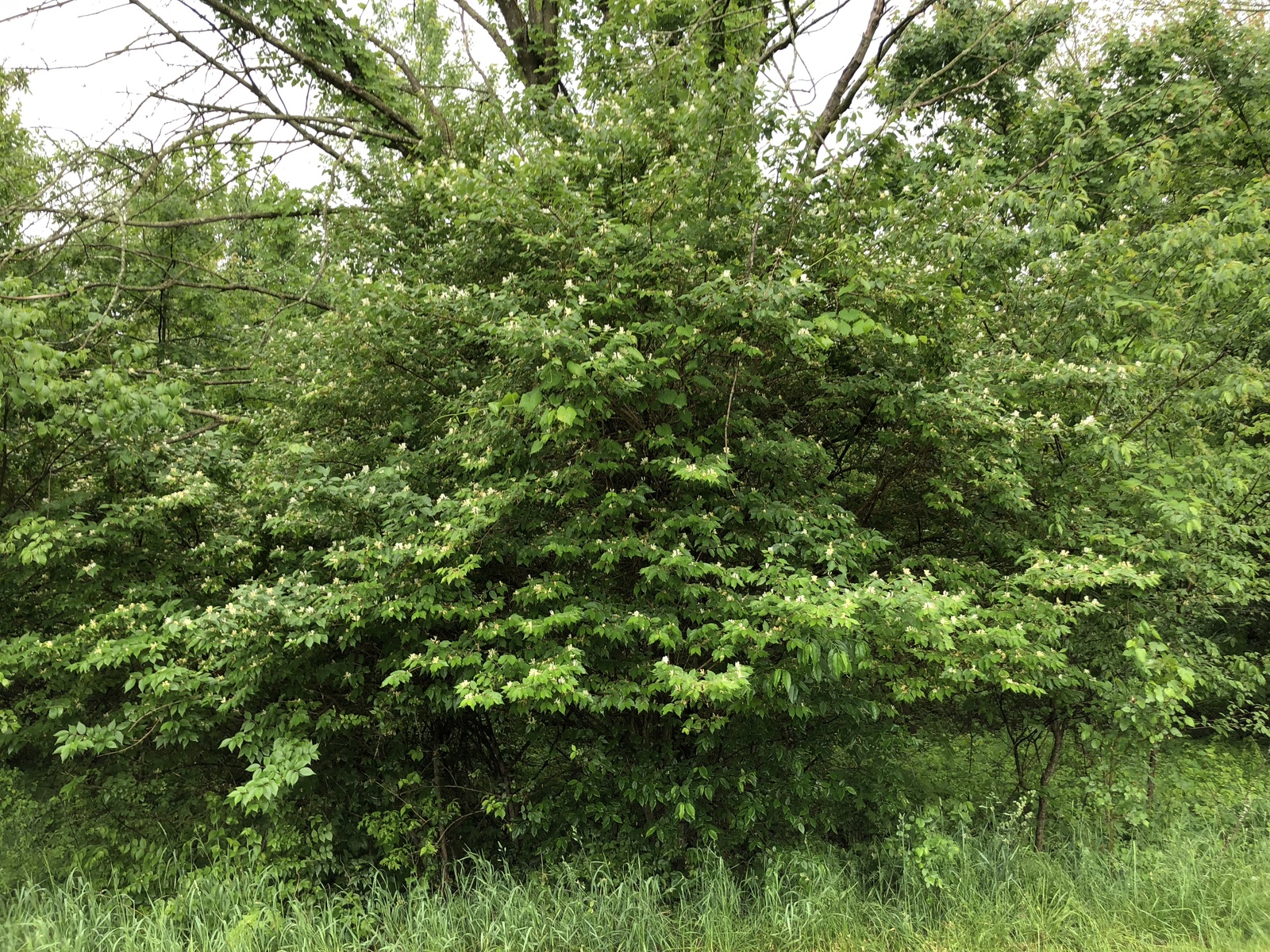
Amur honeysuckle
Lonicera maackii
The "bush honeysuckle" of forest understories: a tall non-native shrub that forms dense mid-story thickets, holds its leaves later in fall and flushes earlier in spring than natives, and shades out spring ephemerals. Originally promoted as a hedgerow plant in the mid-20th century.
Status: Introduced; TN-IPC severe-threat invasive.
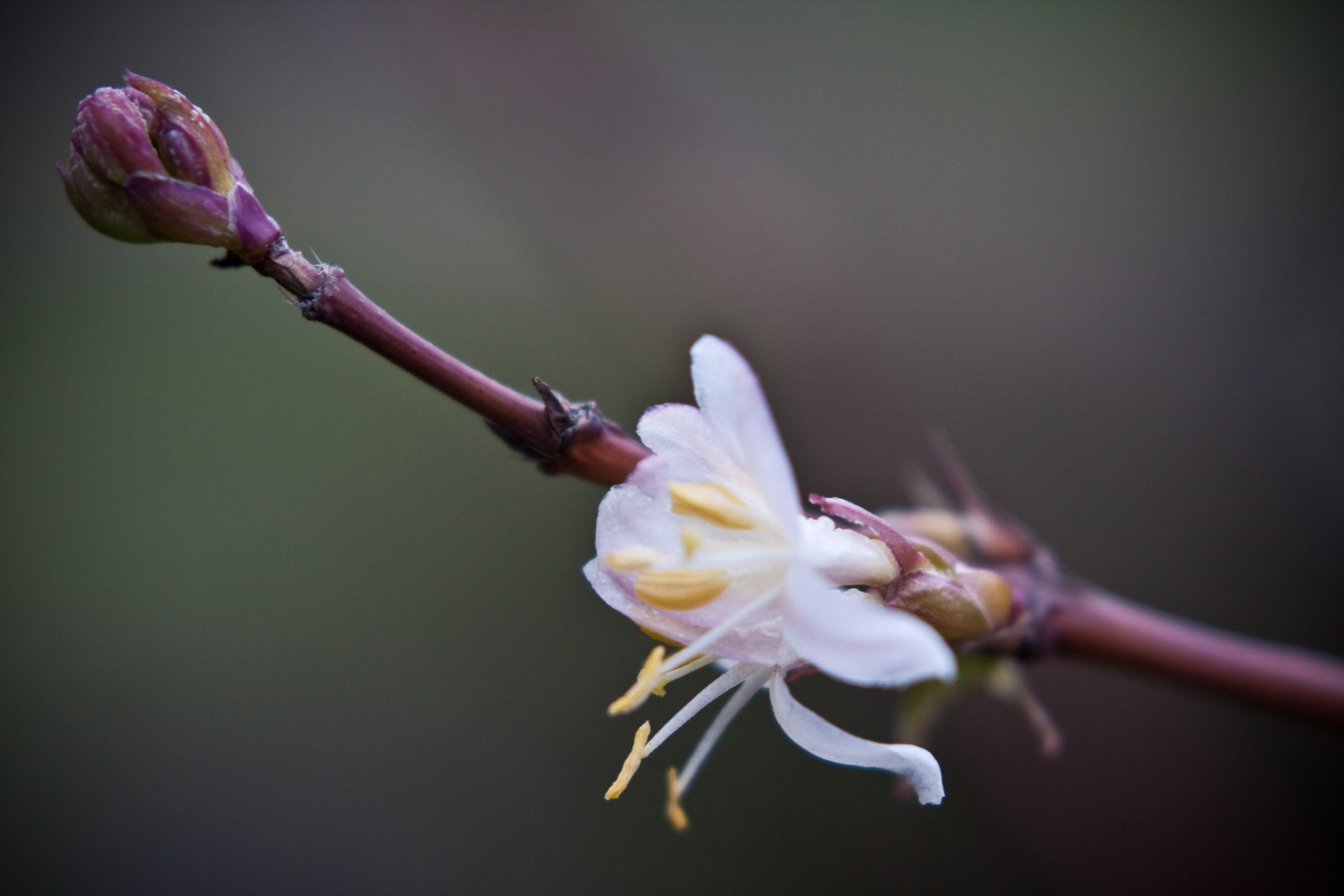
Fragrant honeysuckle
Lonicera fragrantissima
Very early flowering (late winter) with intensely fragrant tiny white flowers, a horticultural escape that persists in old plantings and along fencerows.
Status: Introduced; aggressive horticultural escape.
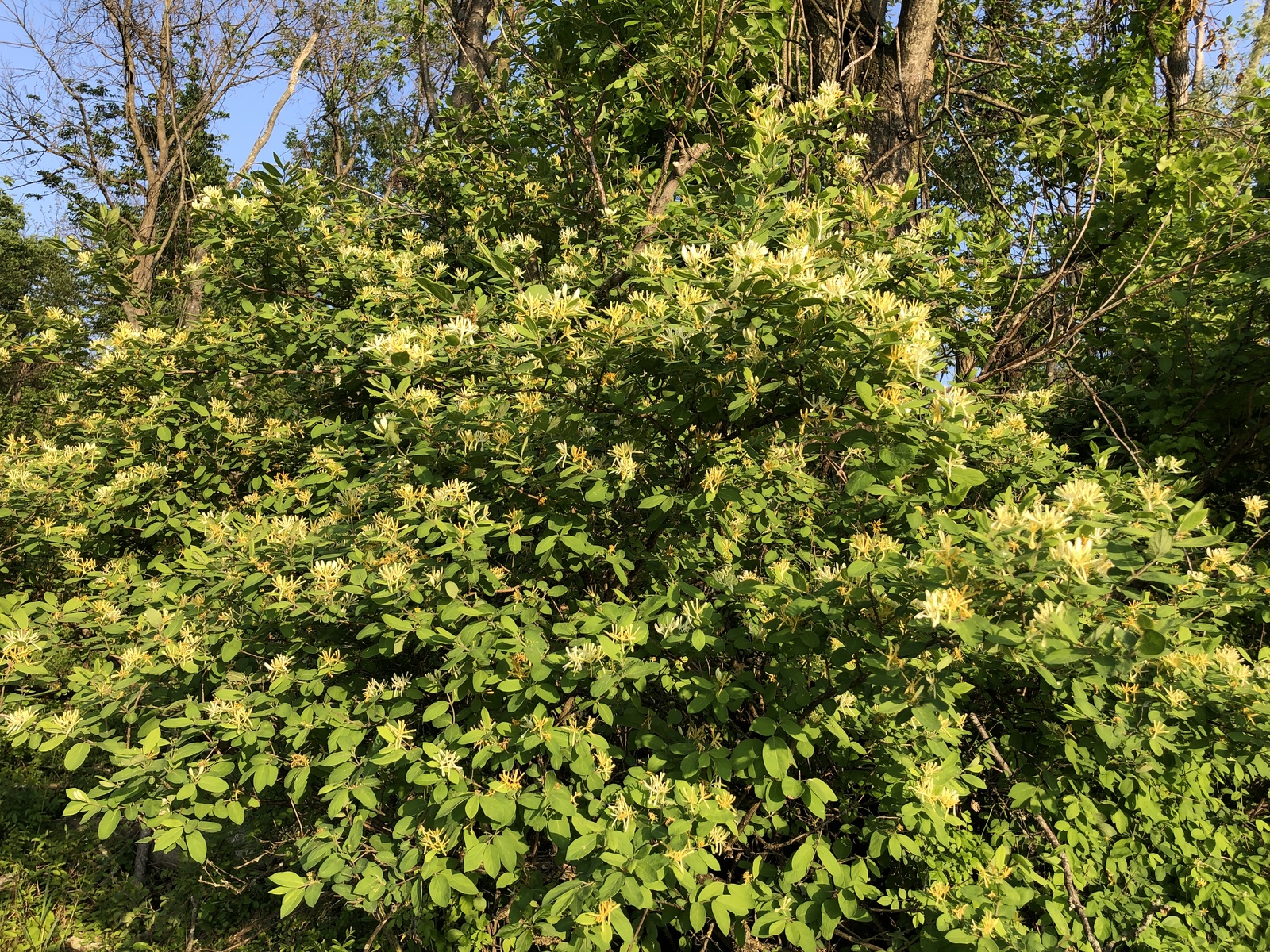
Morrows honeysuckle
Lonicera morrowii
A bush-honeysuckle relative of Amur honeysuckle, distinguished by hairier leaves and slightly different flower color. Less abundant than Amur honeysuckle on the plateau but still present and invasive.
Status: Introduced; TN-IPC severe-threat invasive.
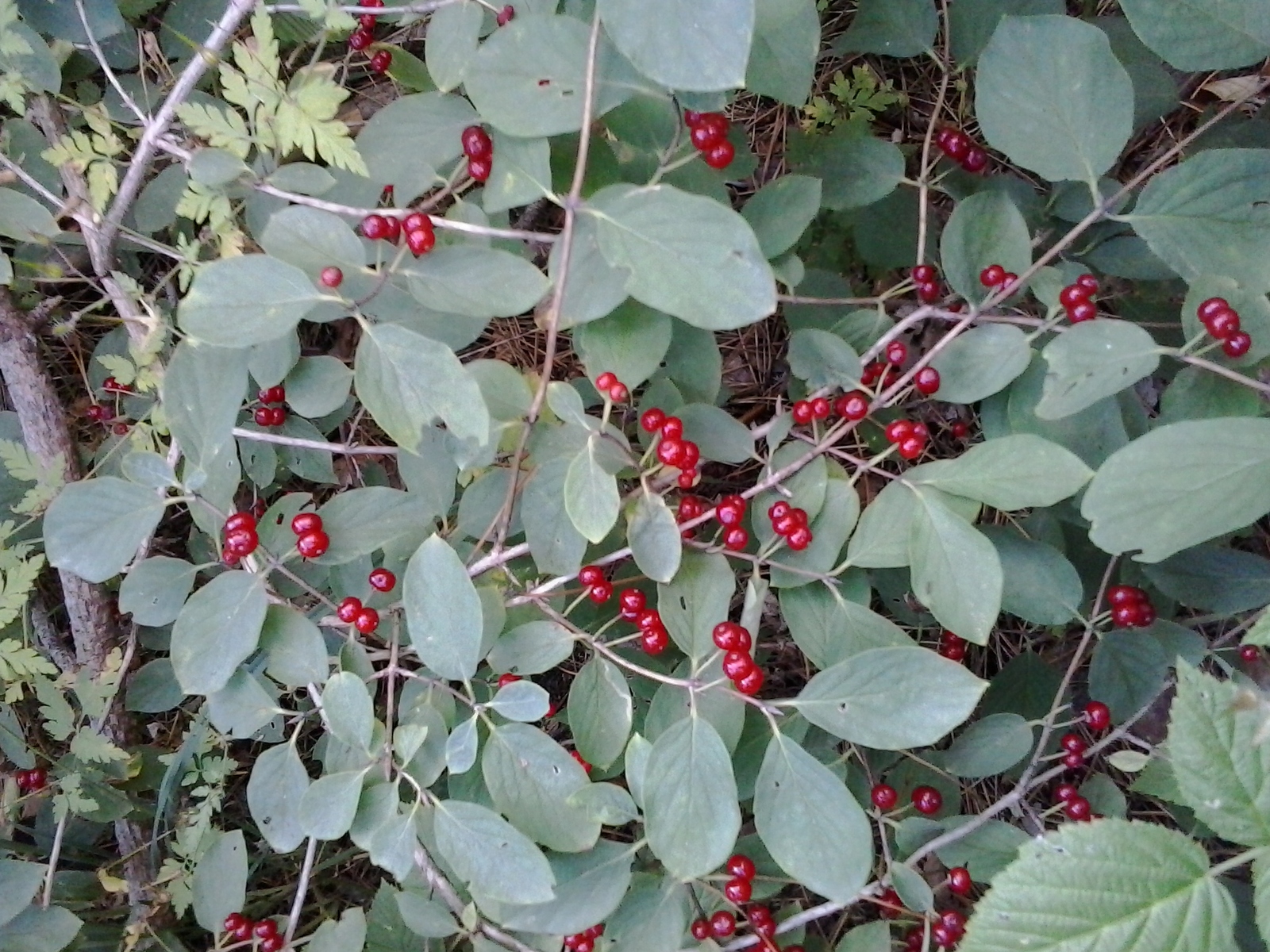
European fly honeysuckle
Lonicera xylosteum
Bushy shrub with paired red drupes; a less common bush honeysuckle than Amur or Morrow's, but present and invasive in some old farmstead plantings.
Status: Introduced; non-native shrub.
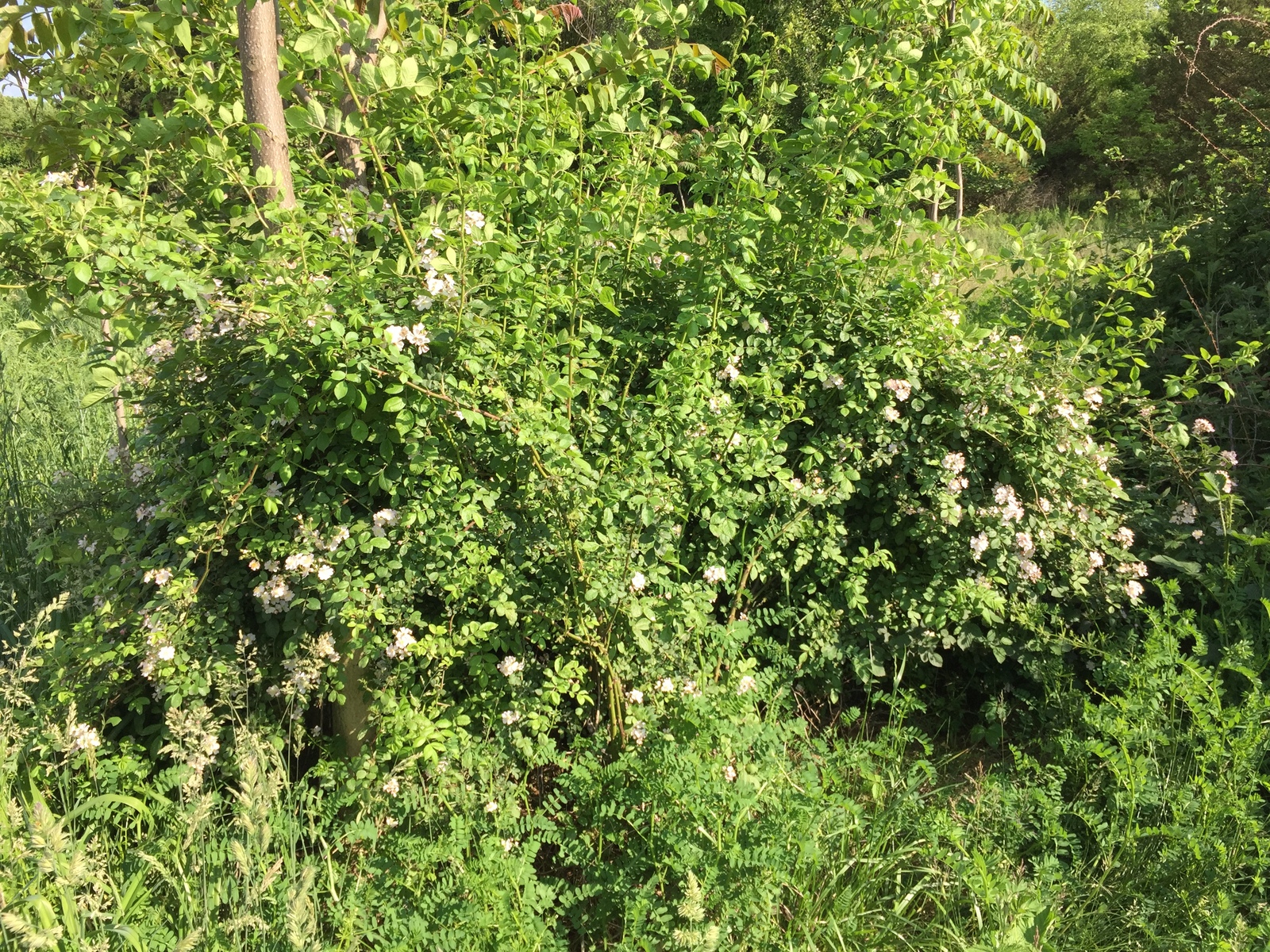
Multiflora rose
Rosa multiflora
Dense thicket-forming rose with arching prickly canes and large clusters of small white flowers in May. Promoted by the USDA Soil Conservation Service in the 1930s and 1940s as living fence and erosion control; still aggressively colonizes pastures and forest gaps.
Status: Introduced; TN-IPC severe-threat invasive.
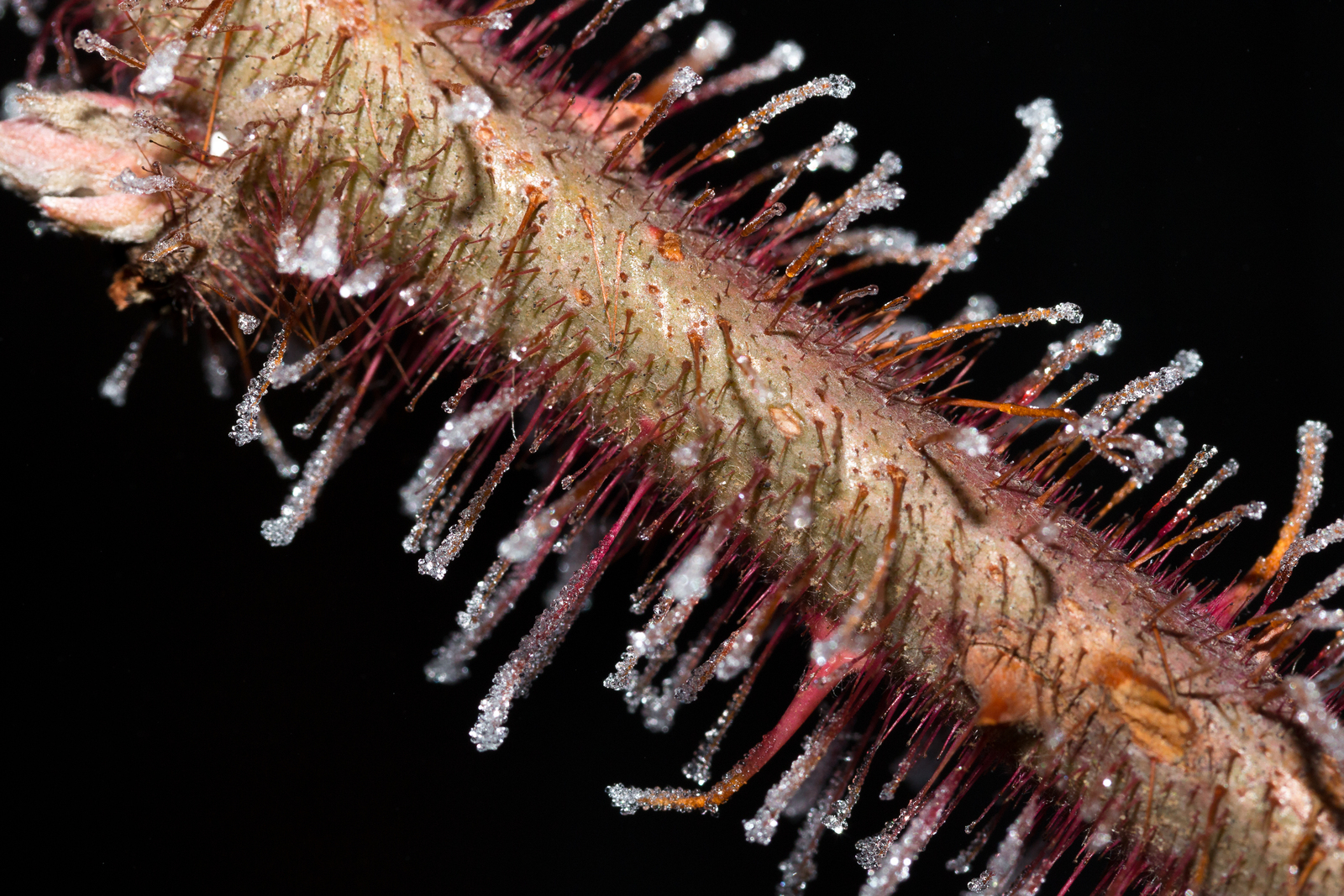
Wineberry
Rubus phoenicolasius
An Asian raspberry with bright red glandular hairs on the canes (a useful winter ID feature). Aggressive in disturbed forest edges and stream banks; sweet red fruits ripen in late June.
Status: Introduced; TN-IPC lesser-threat invasive.
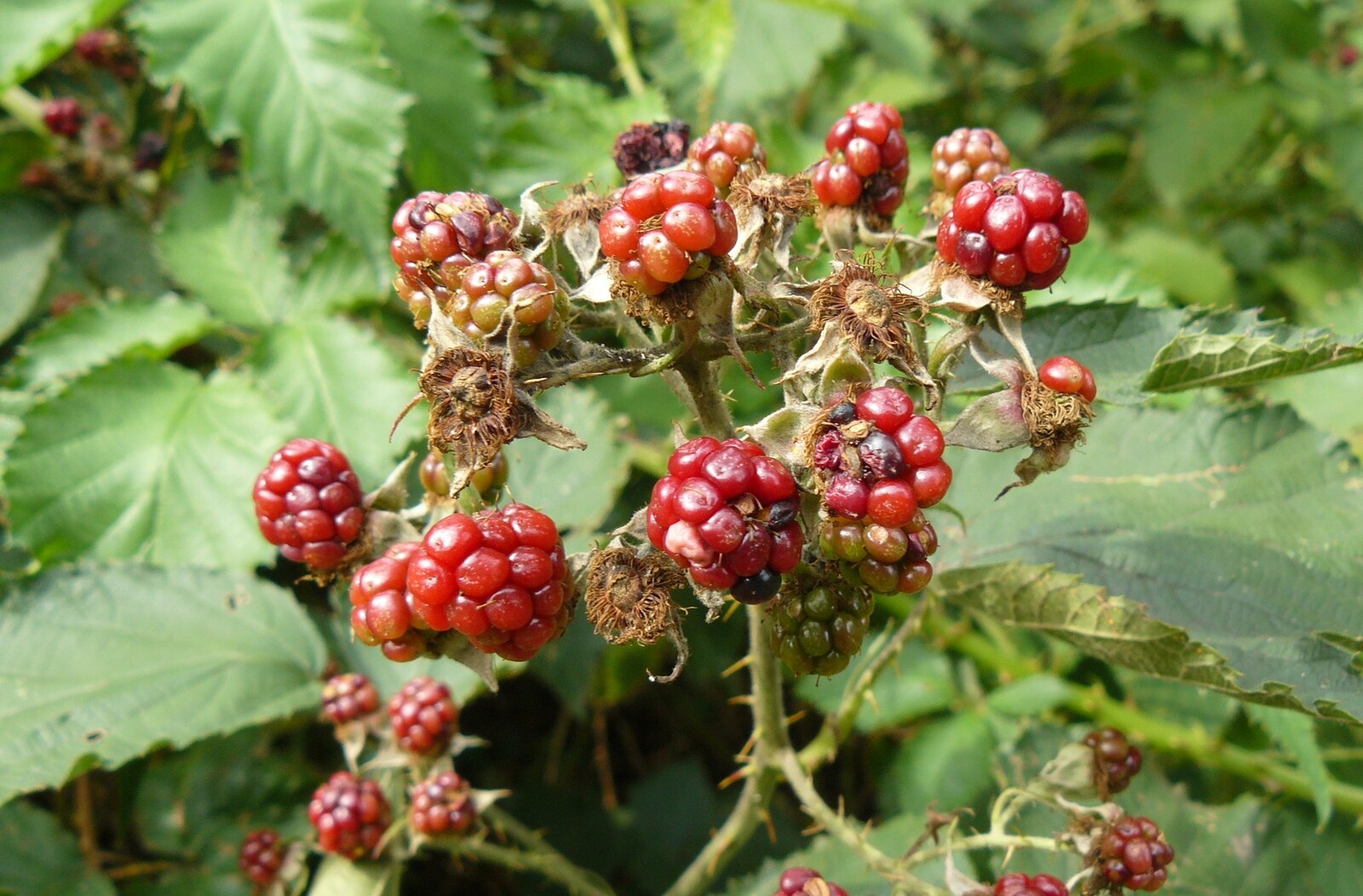
Himalayan blackberry
Rubus bifrons
Despite the common name, native to the Caucasus and western Eurasia. Forms huge thicket monocultures along Pacific Northwest waterways; less abundant in Tennessee but documented in Marion County by the TN-KY Plant Atlas.
Status: Introduced; aggressive non-native.
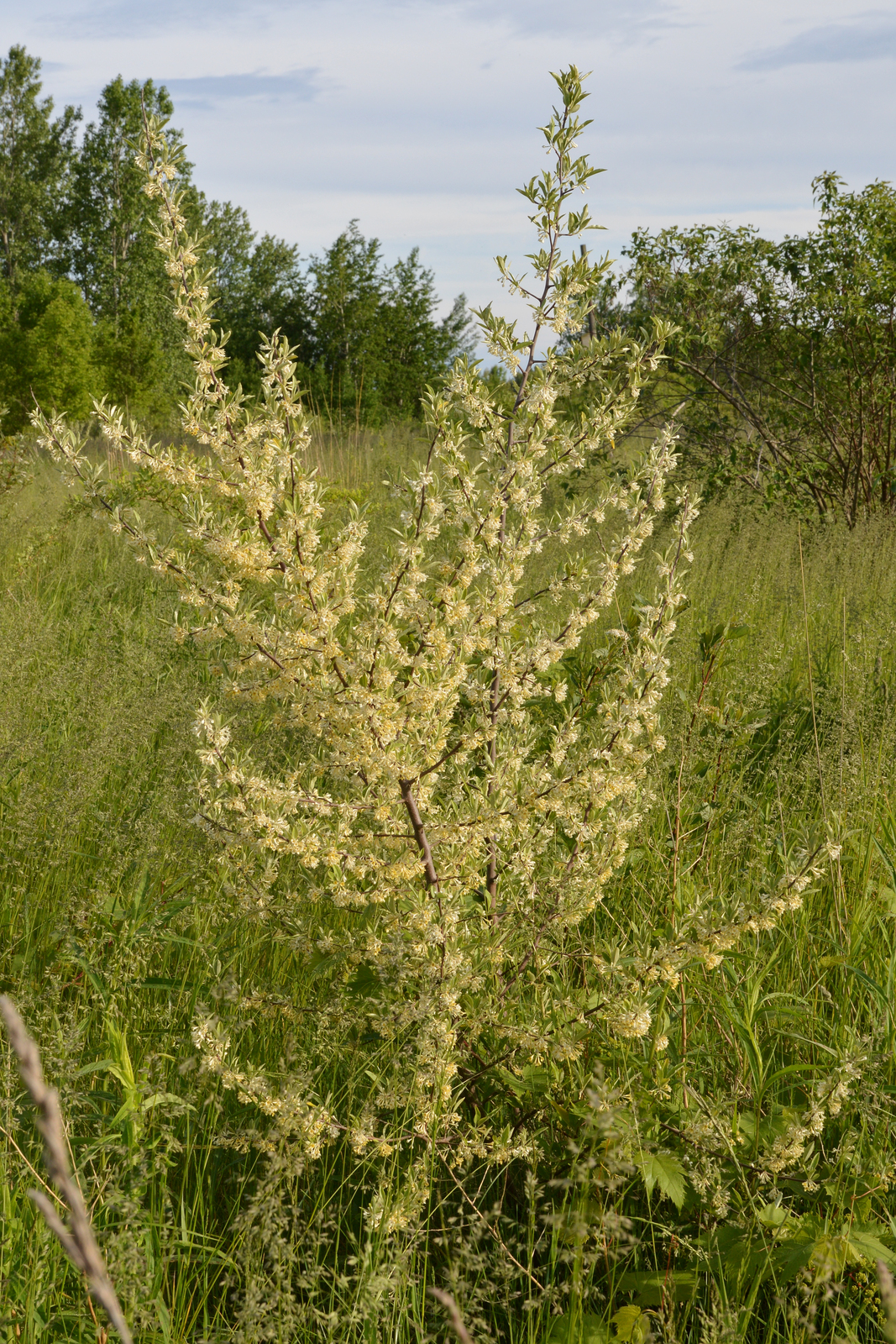
Autumn olive
Elaeagnus umbellata
Aggressive nitrogen-fixing shrub with silvery leaf undersides and small red drupes in fall. Promoted by the USDA Soil Conservation Service for wildlife plantings into the 1980s before its invasiveness was recognized.
Status: Introduced; TN-IPC severe-threat invasive.
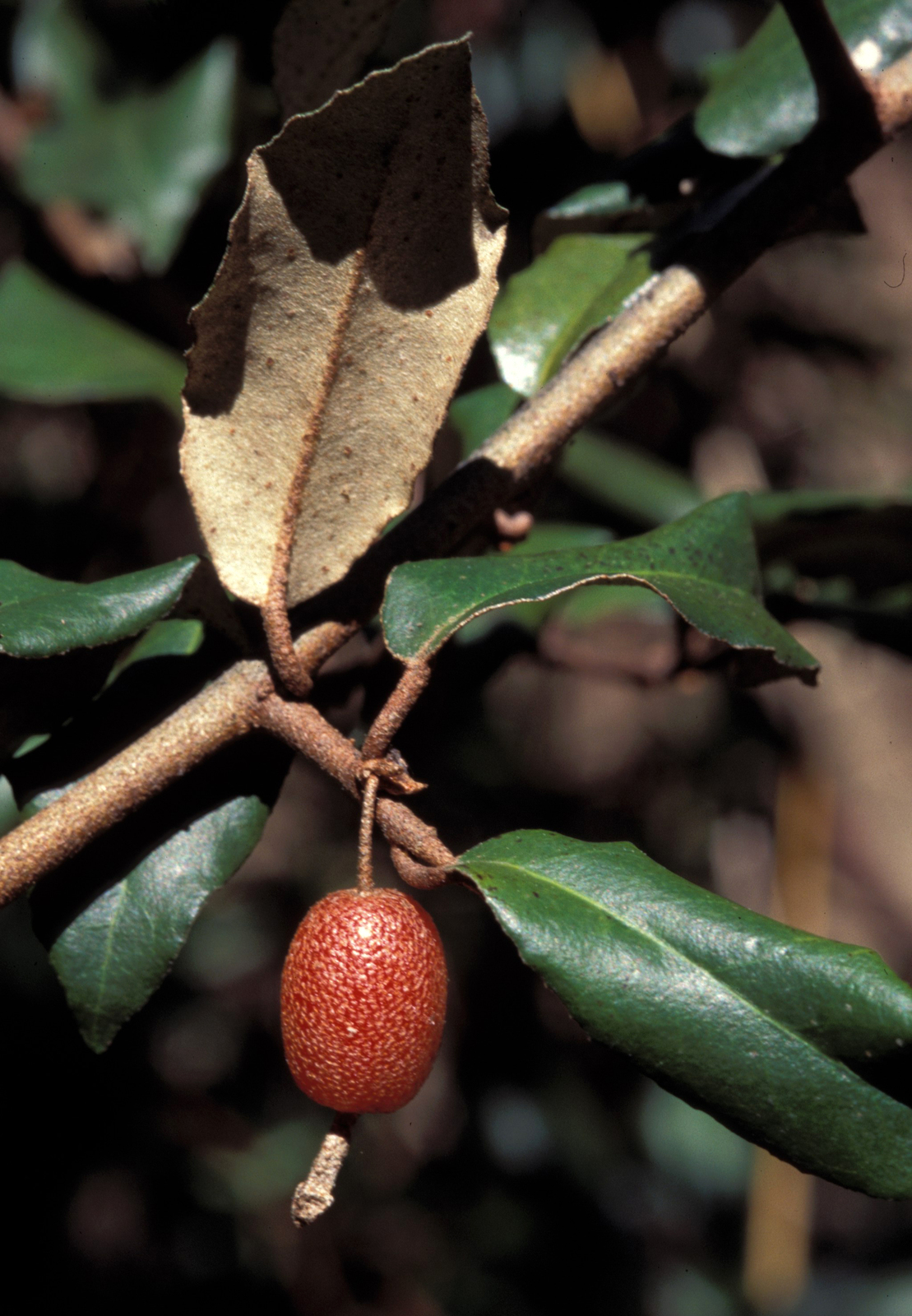
Thorny olive
Elaeagnus pungens
An evergreen relative of autumn olive with white speckled leaves and curved spines. Less aggressive than autumn olive in Tennessee but documented in Marion County by the TN-KY Plant Atlas.
Status: Introduced; non-native shrub.
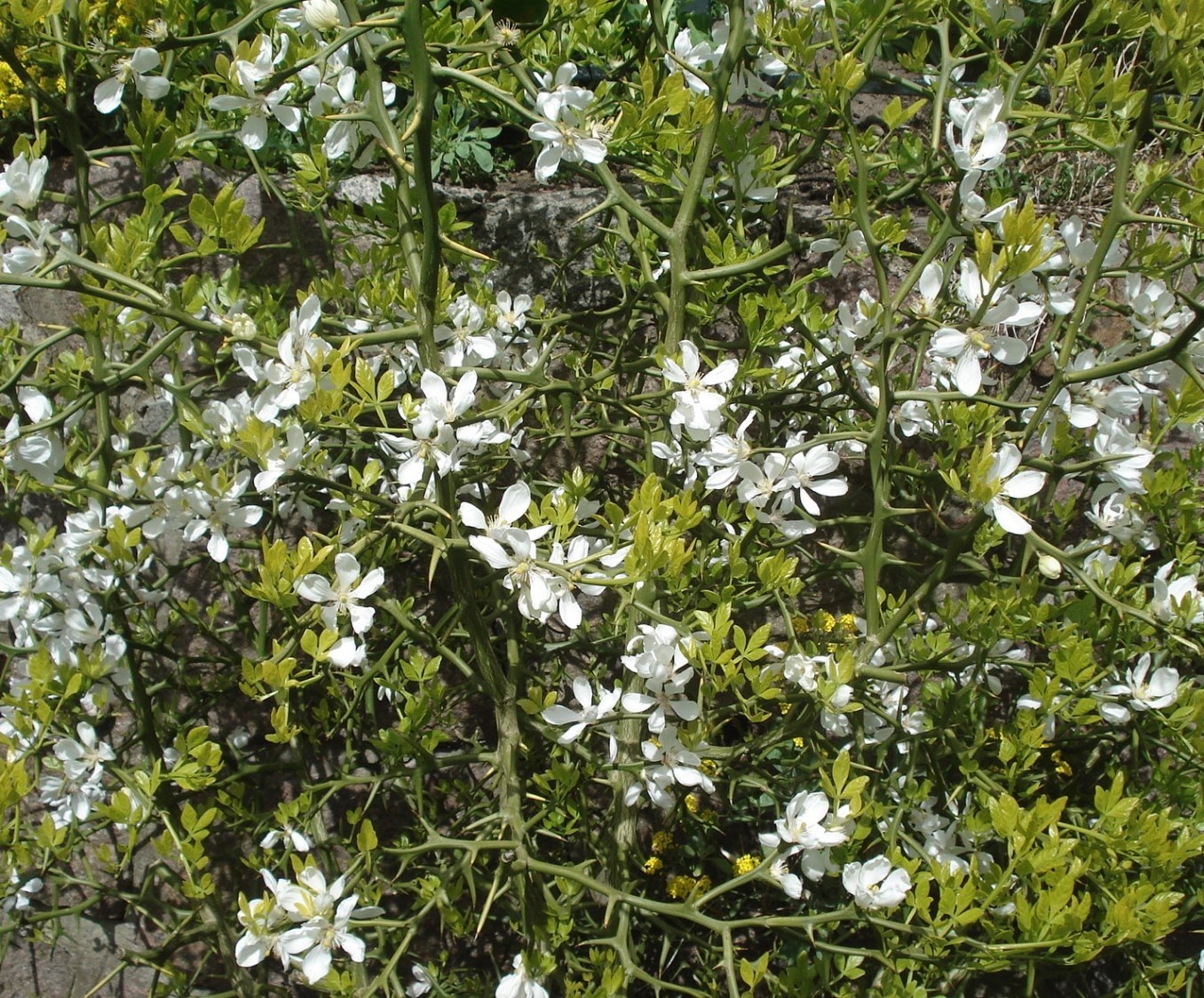
Trifoliate orange
Citrus trifoliata
A wickedly thorny citrus relative often planted as a security hedge or rootstock. Three-part leaves and small oranges that look tempting but are bitter and inedible. Persists in old plantings and along old fences.
Status: Introduced; non-native shrub.
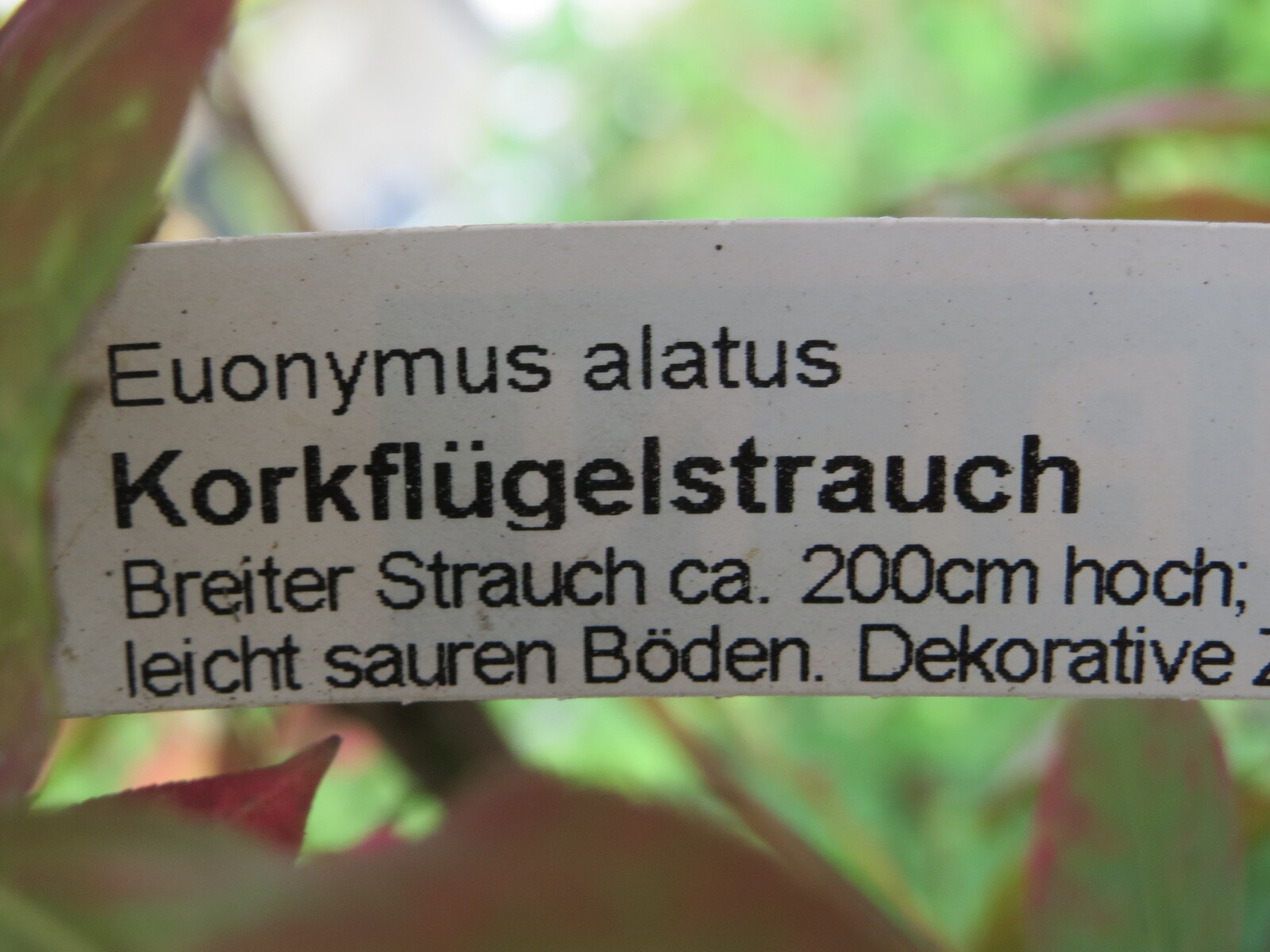
Winged burning bush
Euonymus alatus
Dramatic crimson fall color earned the cultivated "burning bush" its trade name; corky wings on the twigs are a winter ID feature. Bird-dispersed seeds escape from landscape plantings into nearby woods.
Status: Introduced; aggressive non-native.
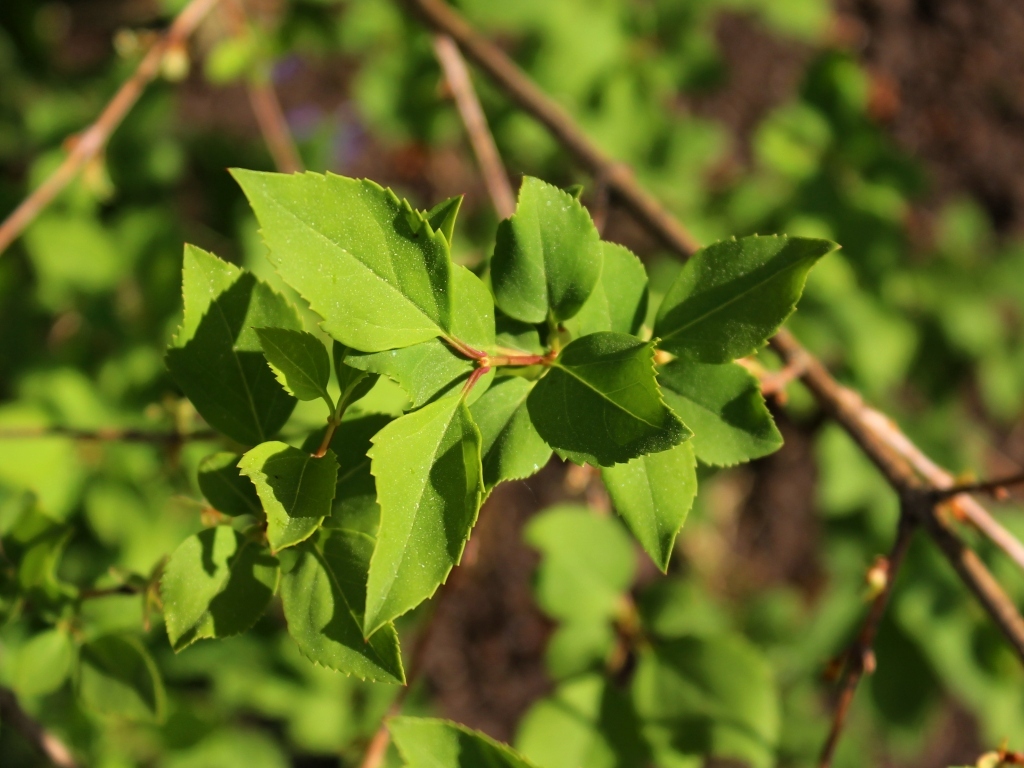
Weeping forsythia
Forsythia suspensa
Bright yellow flowers on bare branches in early spring; an old-fashioned ornamental that persists at abandoned home sites and old plantings.
Status: Introduced; non-native shrub.
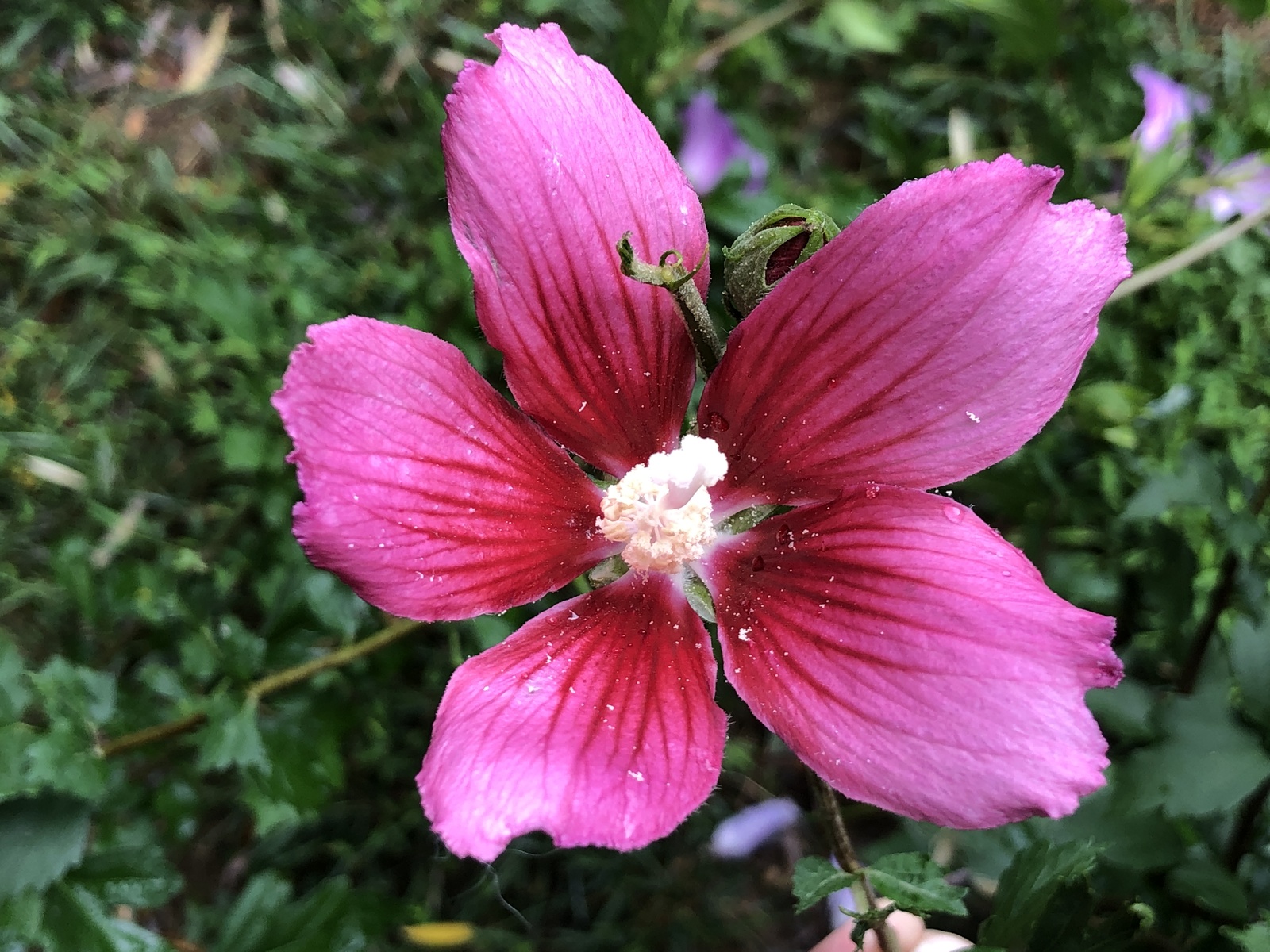
Rose of Sharon
Hibiscus syriacus
Showy late-summer-flowering shrub with hibiscus-like white, pink, or purple flowers. Aggressive seed-spreader from old yard plantings.
Status: Introduced; non-native shrub.
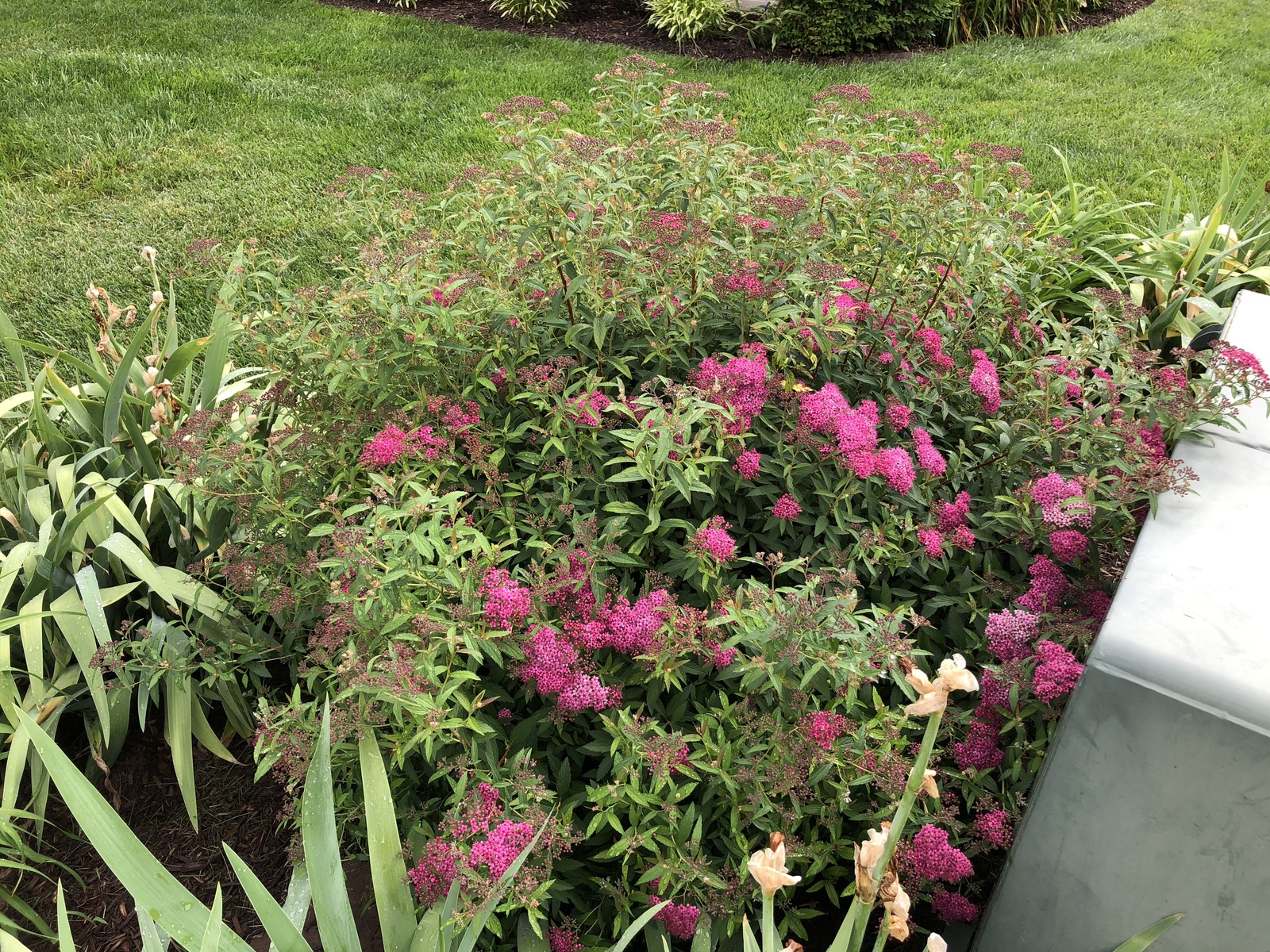
Japanese meadowsweet
Spiraea japonica
Pink flat-topped flower clusters in late spring; aggressive in disturbed plateau roadsides and forest edges.
Status: Introduced; TN-IPC severe-threat invasive.
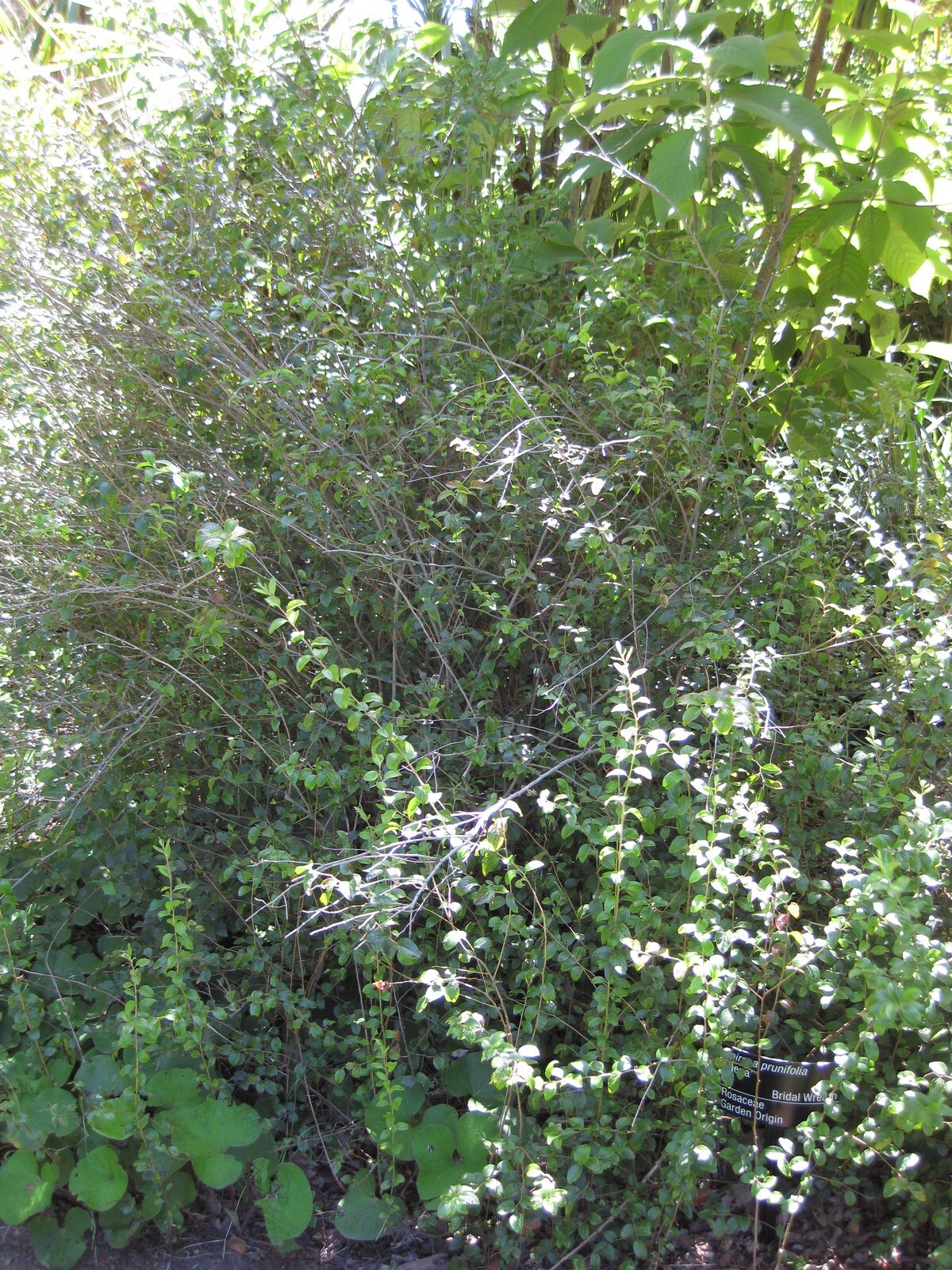
Bridalwreath spiraea
Spiraea prunifolia
Cascading branches of small white double flowers in spring; a popular old-fashioned ornamental that persists in old plantings and naturalizes weakly.
Status: Introduced; non-native shrub.
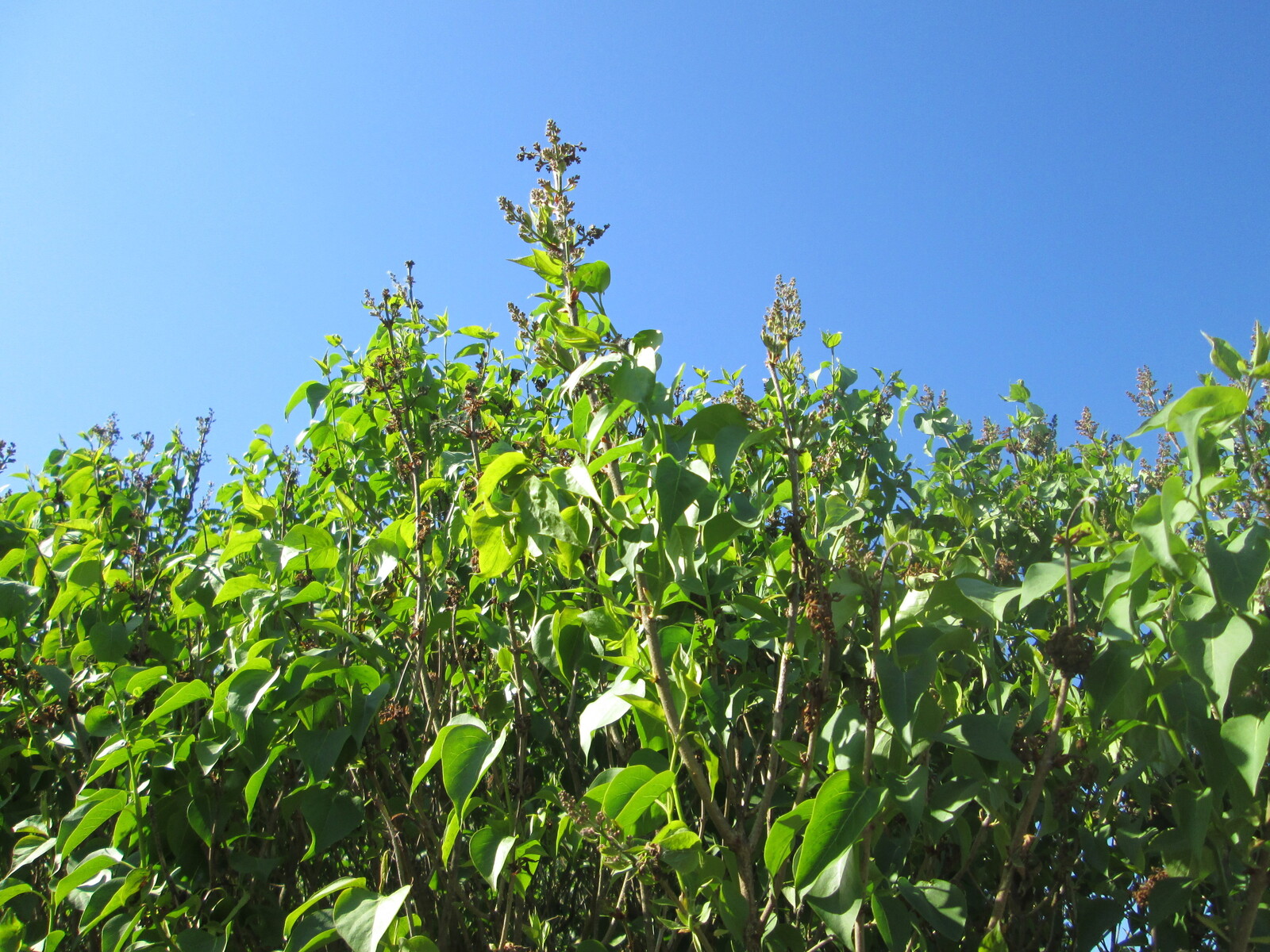
Lilac
Syringa vulgaris
Familiar yard ornamental with fragrant purple flower clusters in May. Documented as wild in Marion by the TN-KY Plant Atlas, almost certainly persisting from old farmstead plantings.
Status: Introduced; non-native shrub.
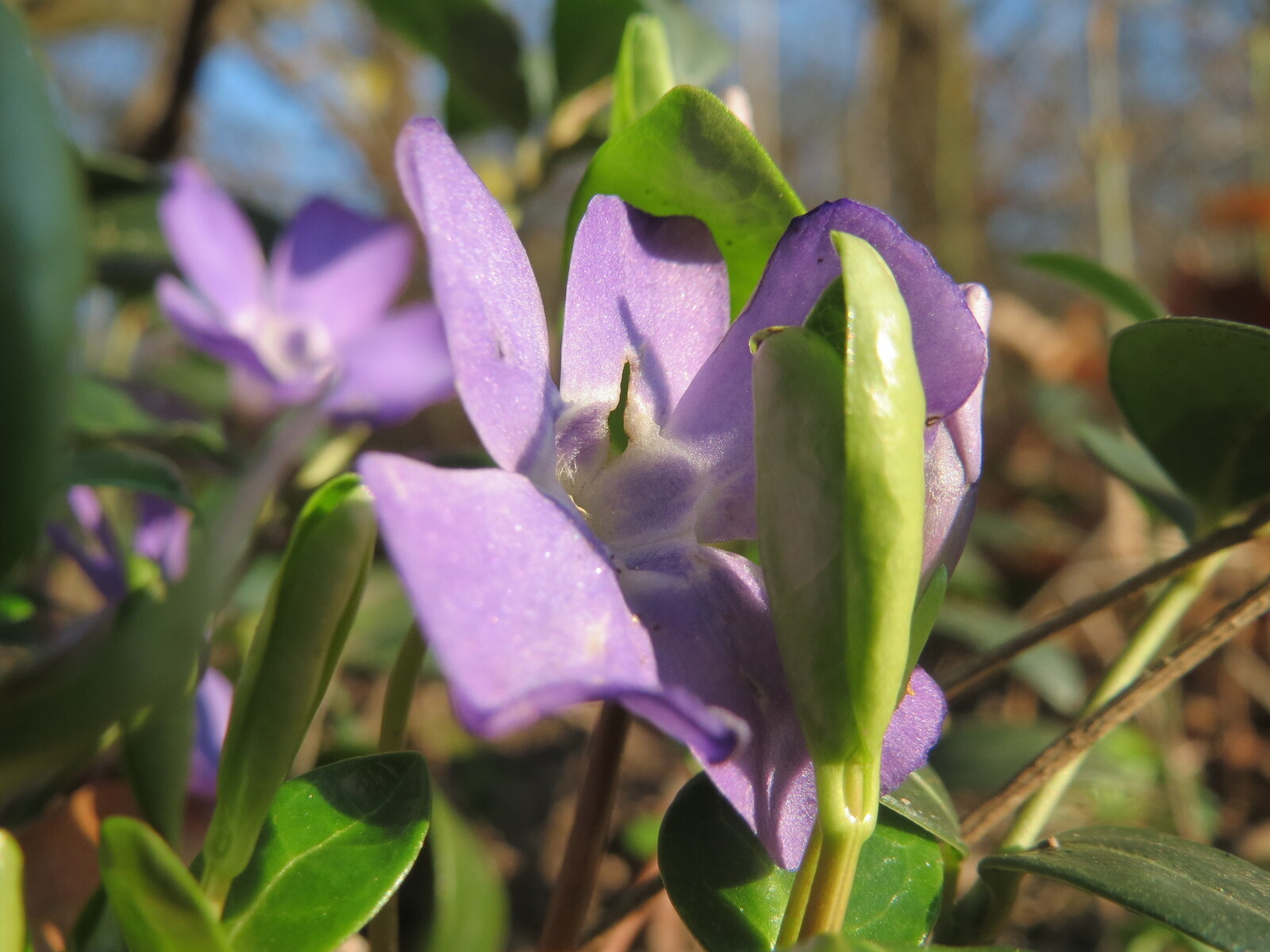
Lesser periwinkle
Vinca minor
A low evergreen subshrub used as a graveyard ground cover for two centuries; persists indefinitely once established and forms dense mats that exclude native spring ephemerals.
Status: Introduced; TN-IPC significant-threat invasive.
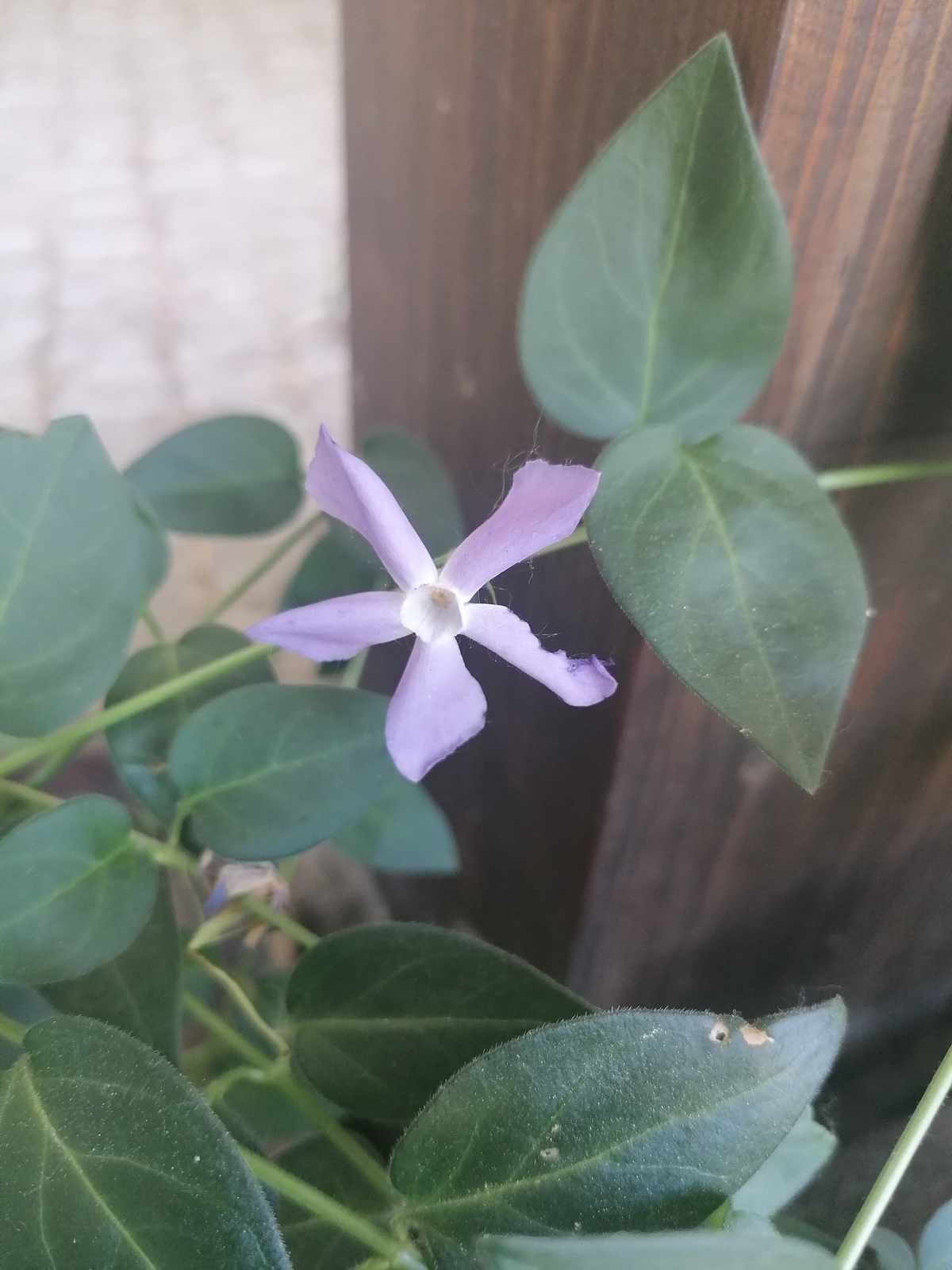
Greater periwinkle
Vinca major
Like lesser periwinkle but with larger leaves and flowers. Aggressive ground-cover habit; persists at old yard sites.
Status: Introduced; non-native subshrub.
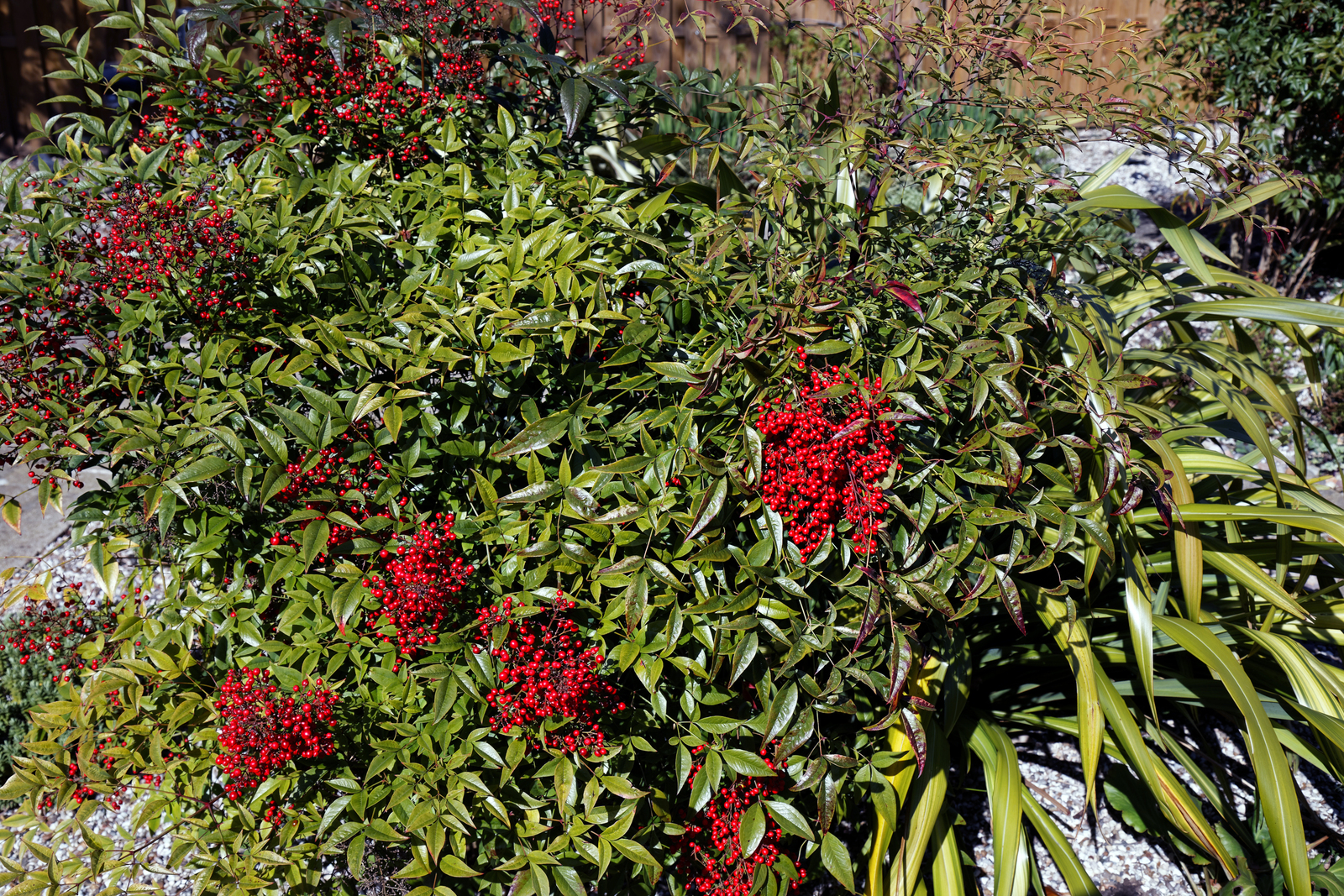
Nandina
Nandina domestica
Also called heavenly bamboo (despite not being a bamboo). Bright red persistent berries and pinnate leaves; berries are toxic to cedar waxwings and many other songbirds and have caused documented bird mortality.
Status: Introduced; non-native shrub.
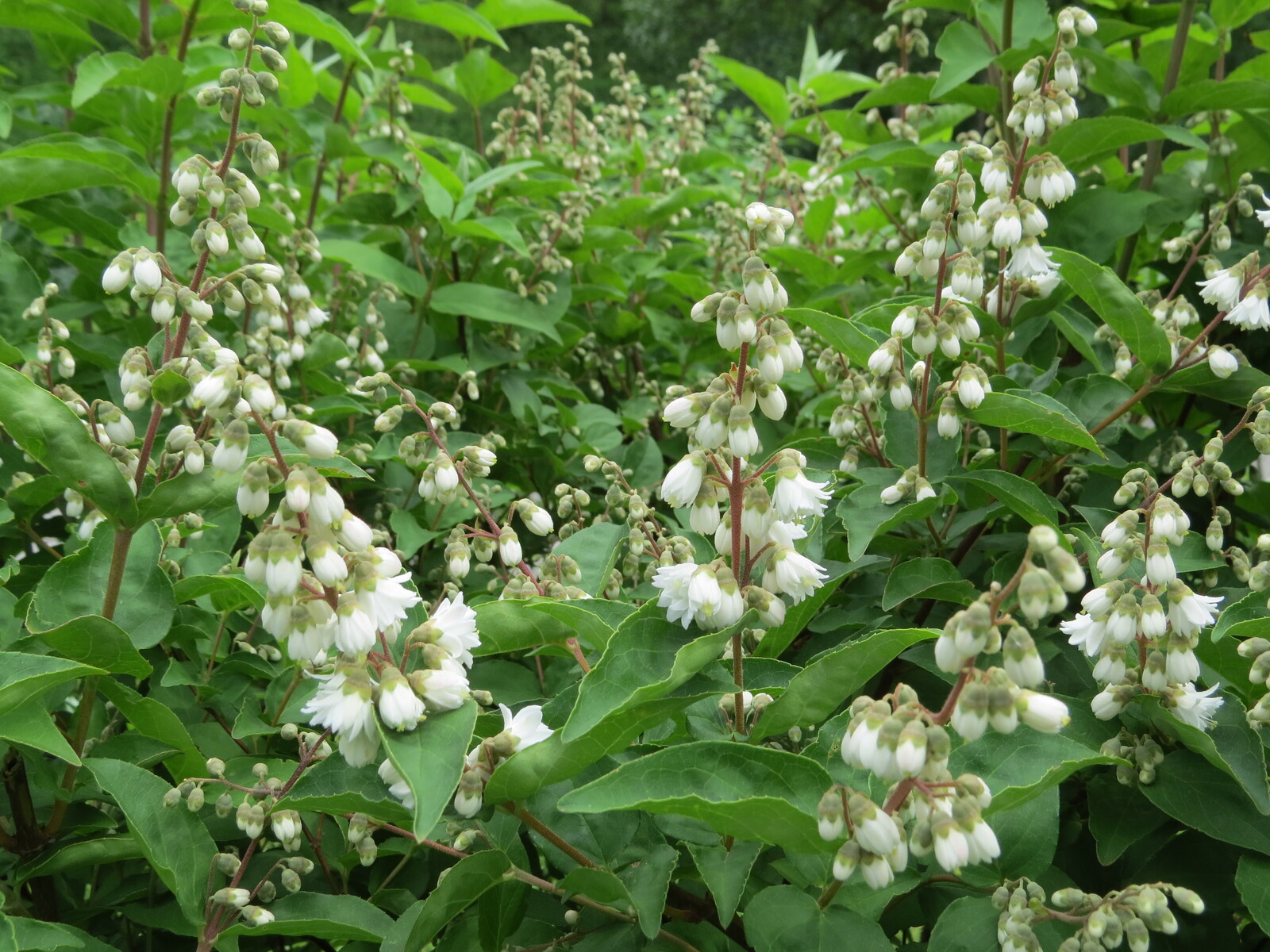
Deutzia
Deutzia scabra
Old-fashioned ornamental with arching branches of small white flowers in May. Persists at old plantings and naturalizes weakly along forest edges.
Status: Introduced; non-native shrub.
Native climbing vines
Marion County's native woody vines (lianas) climb by twining stems, tendrils, sucker-tipped tendrils, or aerial roots. Most are non-aggressive and do not damage their host trees the way the invasive Asian climbers below tend to. Several are showy-flowered enough to be planted as native alternatives to invasive climbers (American wisteria for the Asian wisterias; trumpet honeysuckle for Japanese honeysuckle).
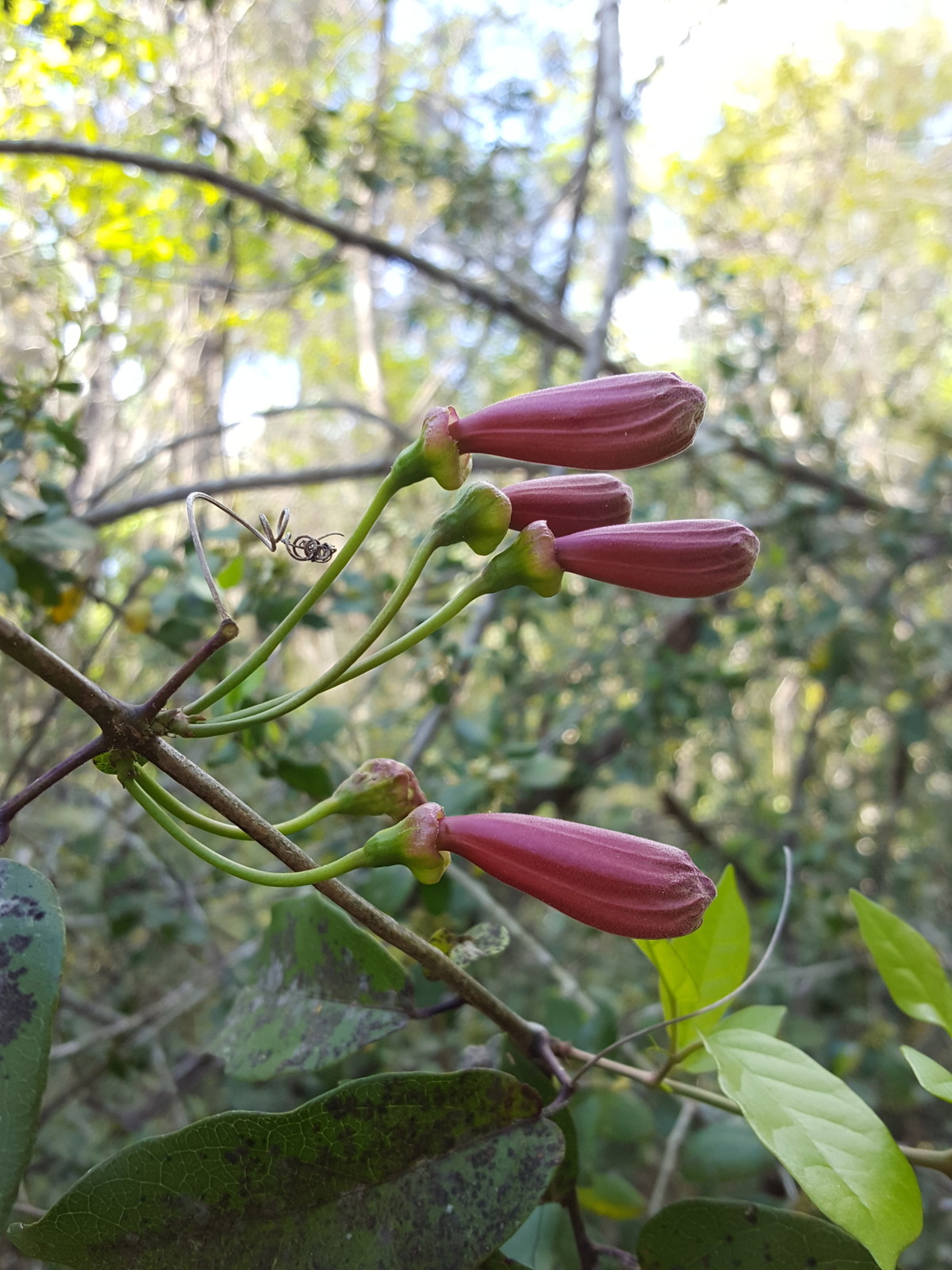
Crossvine
Bignonia capreolata
High-climbing native vine with semi-evergreen leaves and large red-orange tubular flowers in April and May. Pith of cut stems shows a Greek cross in cross-section (the namesake feature). One of the showiest native vines, often blooming with redbud.
Status: Native; common in valley woods.
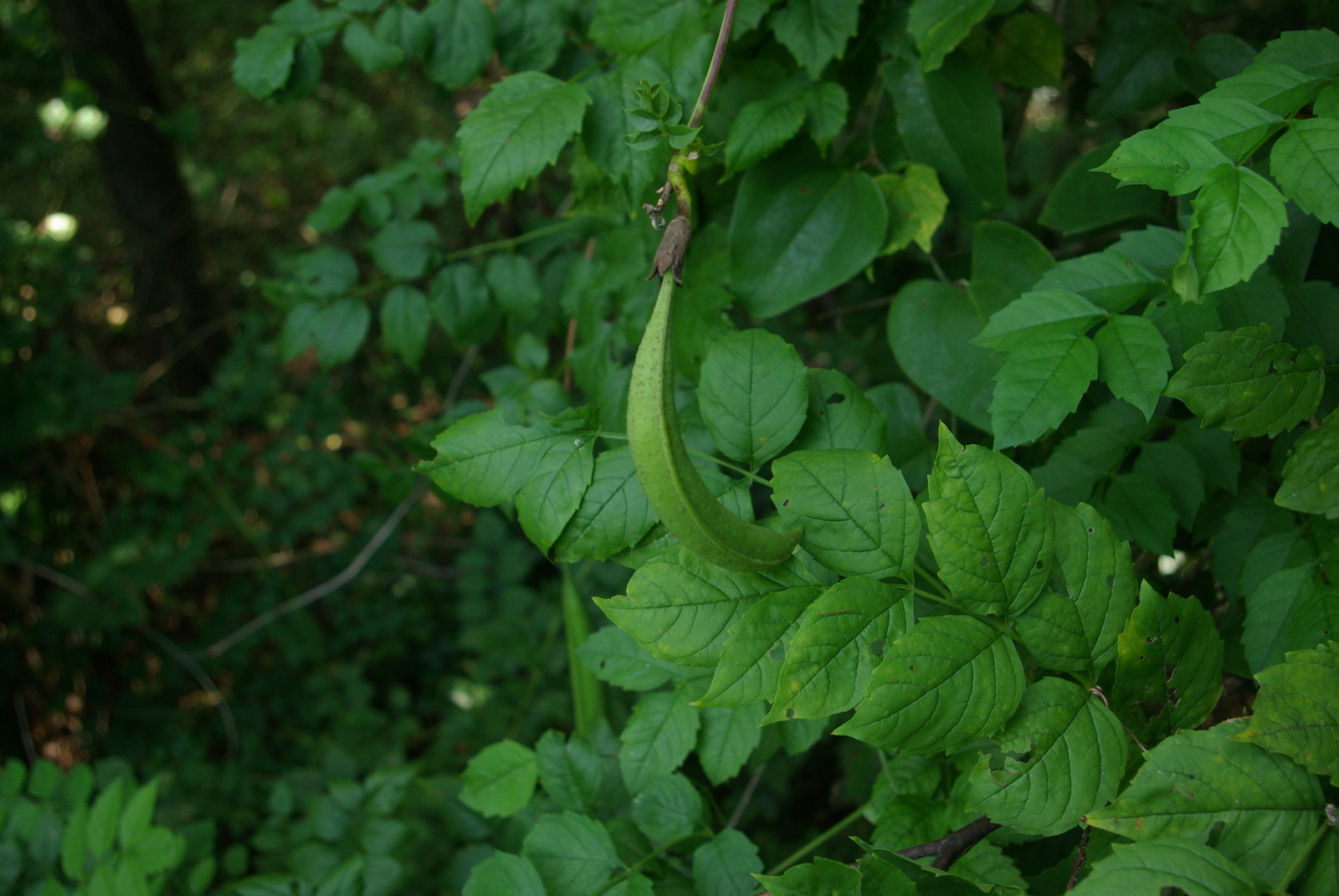
Trumpet creeper
Campsis radicans
Aggressive native climber with large orange-red trumpet-shaped flowers in summer that ruby-throated hummingbirds visit constantly. Heavy aerial roots can damage tree bark; the vine itself is a tough survivor of fence rows and old fields.
Status: Native; common in valley fence rows.
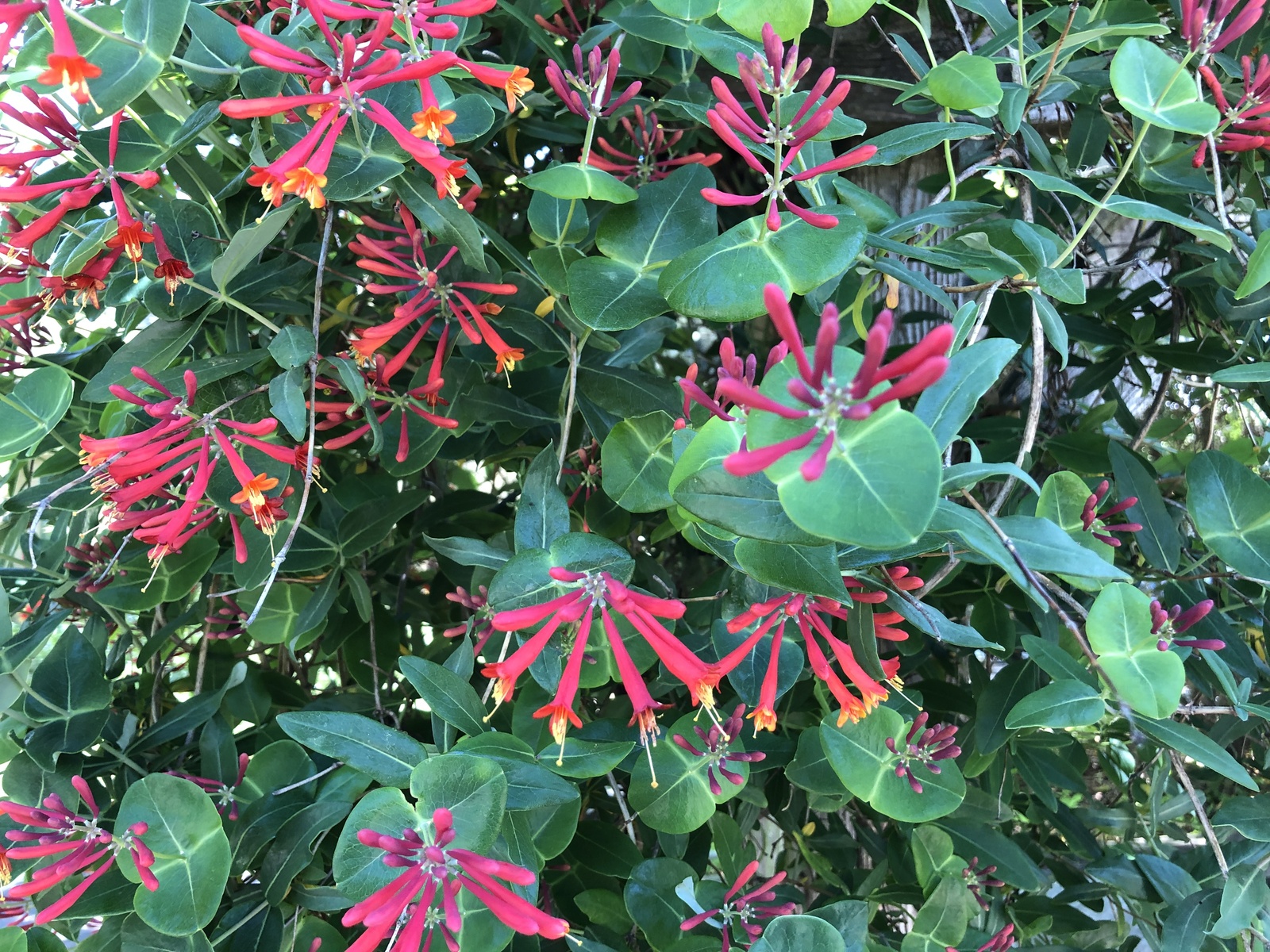
Trumpet honeysuckle
Lonicera sempervirens
Native climbing honeysuckle with whorls of red tubular flowers (yellow inside) at branch tips, blooming May through frost. Hummingbird-pollinated; not aggressive (unlike its invasive Asian cousin Japanese honeysuckle).
Status: Native; common.
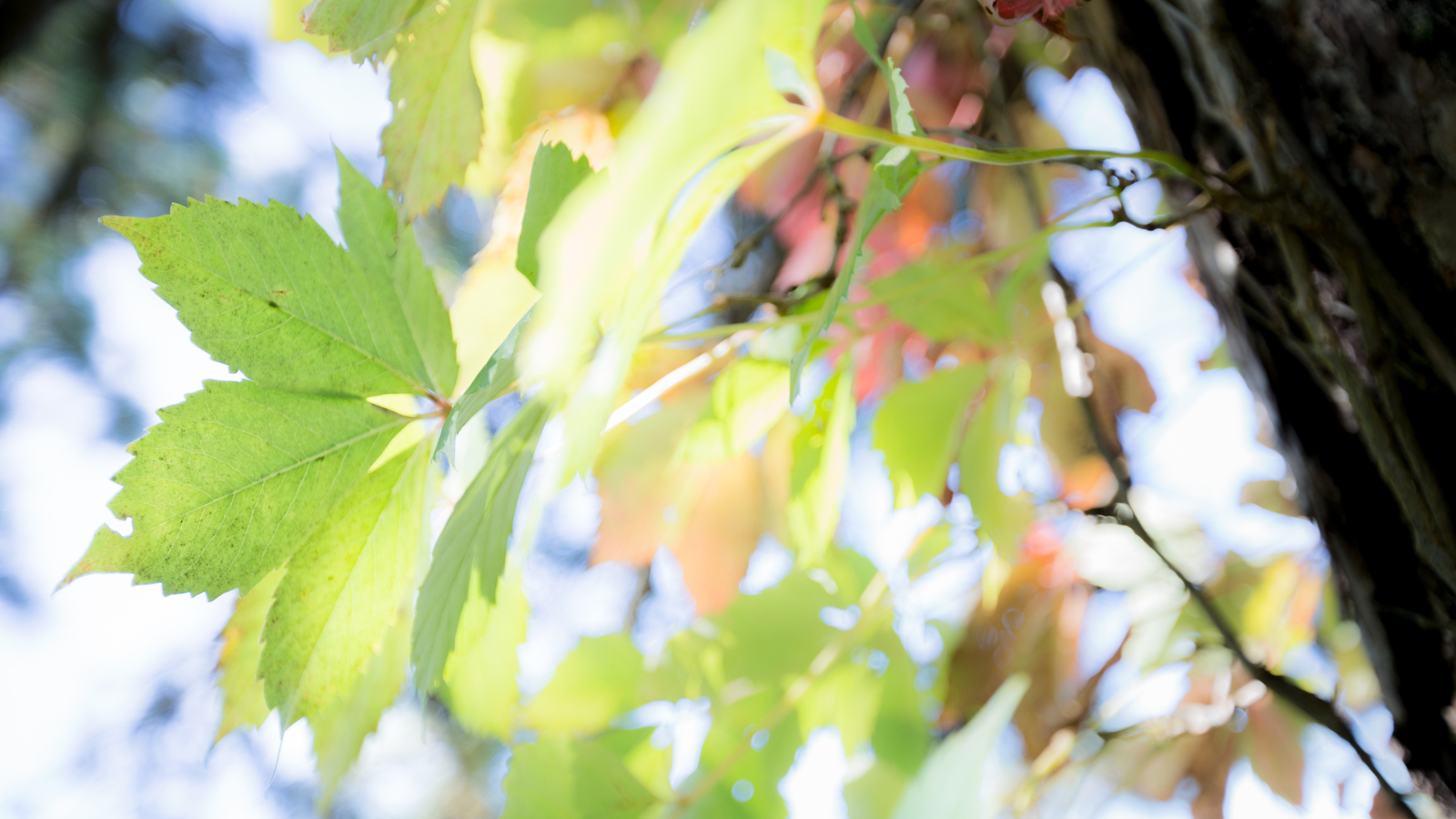
Virginia creeper
Parthenocissus quinquefolia
Five-leaflet palmately compound leaves; brilliant red fall color. Adheres to bark and brick with sucker-tipped tendrils. Often confused with poison-ivy by hikers; the five-leaflet pattern is the reliable separator.
Status: Native; common everywhere.
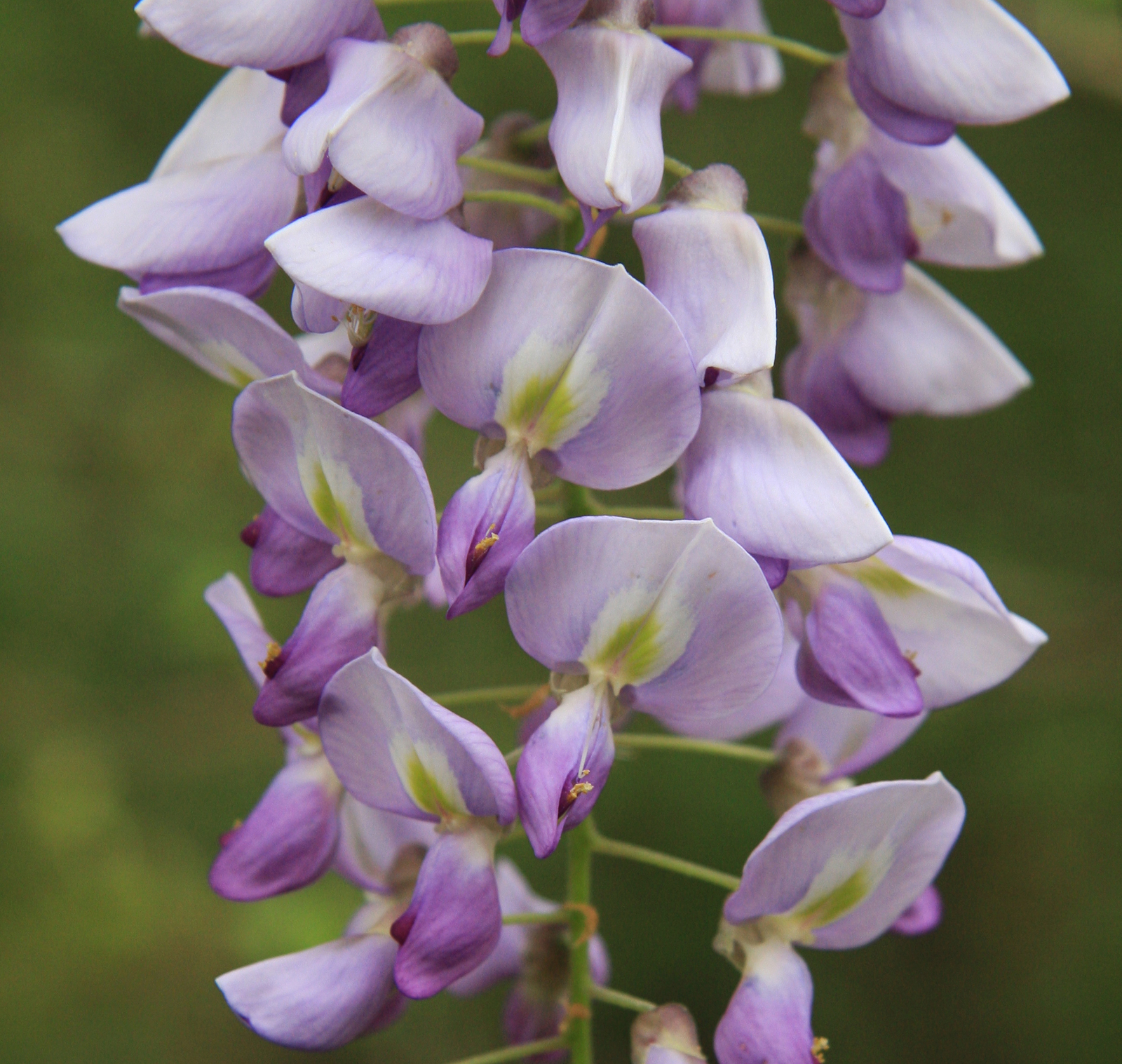
American wisteria
Wisteria frutescens
Native wisteria with shorter flower clusters than the invasive Asian wisterias and a later flowering time (after the leaves are out, June). Common name Atlantic wisteria is also used. Non-aggressive; preferred substitute for Asian wisterias in landscape plantings.
Status: Native; uncommon, in valley woods.
Carolina jessamine
Gelsemium sempervirens
Bright yellow tubular fragrant flowers on a high-climbing evergreen vine, opening in early spring. All parts toxic; the nectar is toxic to honey bees but not to specialist native bumblebees and southeastern blueberry bees.
Status: Native; uncommon at the northern edge of its range.
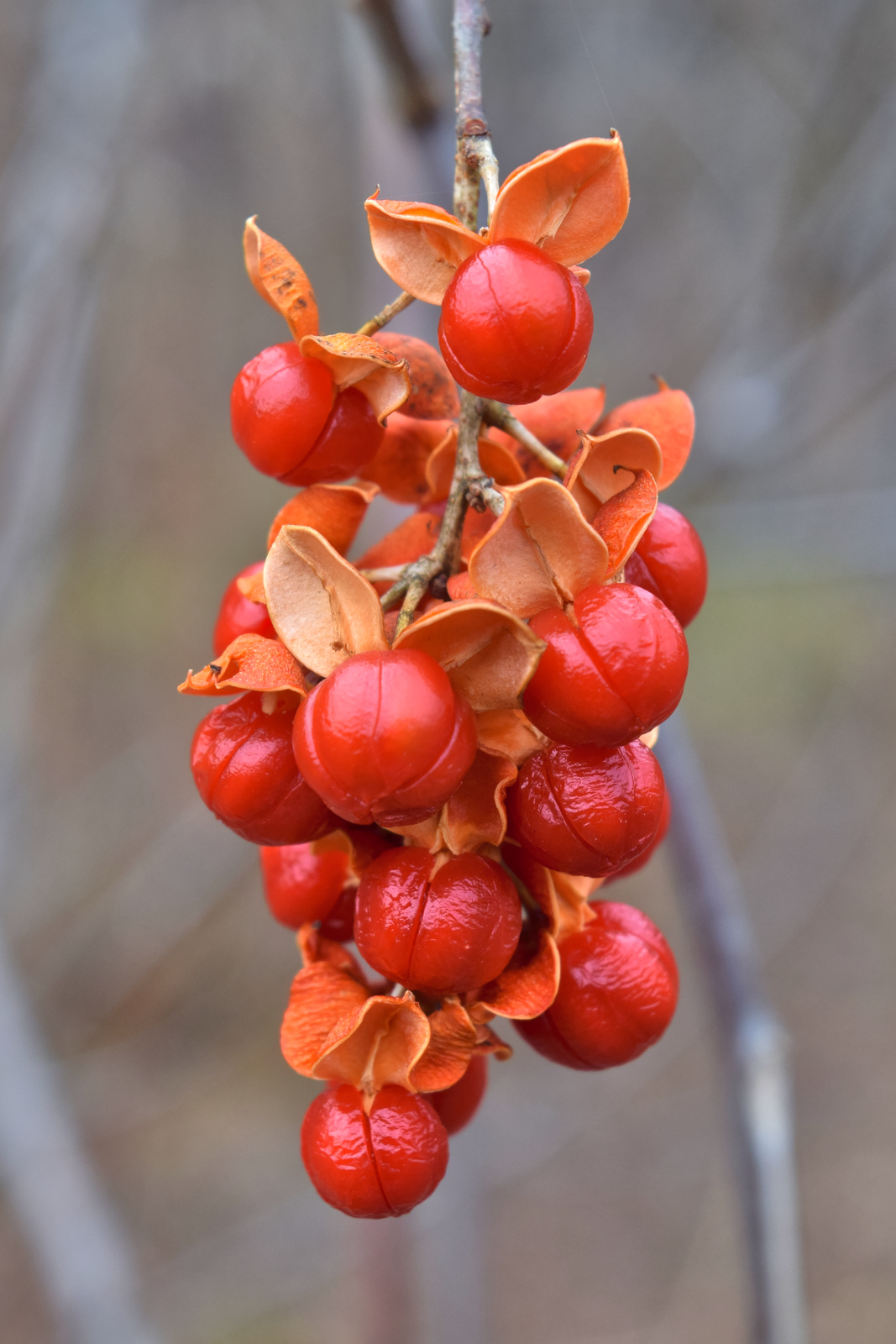
American bittersweet
Celastrus scandens
Native climbing vine with showy orange capsules opening to reveal red-coated seeds in fall, often used in dried-arrangement crafts. Distinct from the invasive Oriental bittersweet by terminal (rather than axillary) fruit clusters.
Status: Native; uncommon.
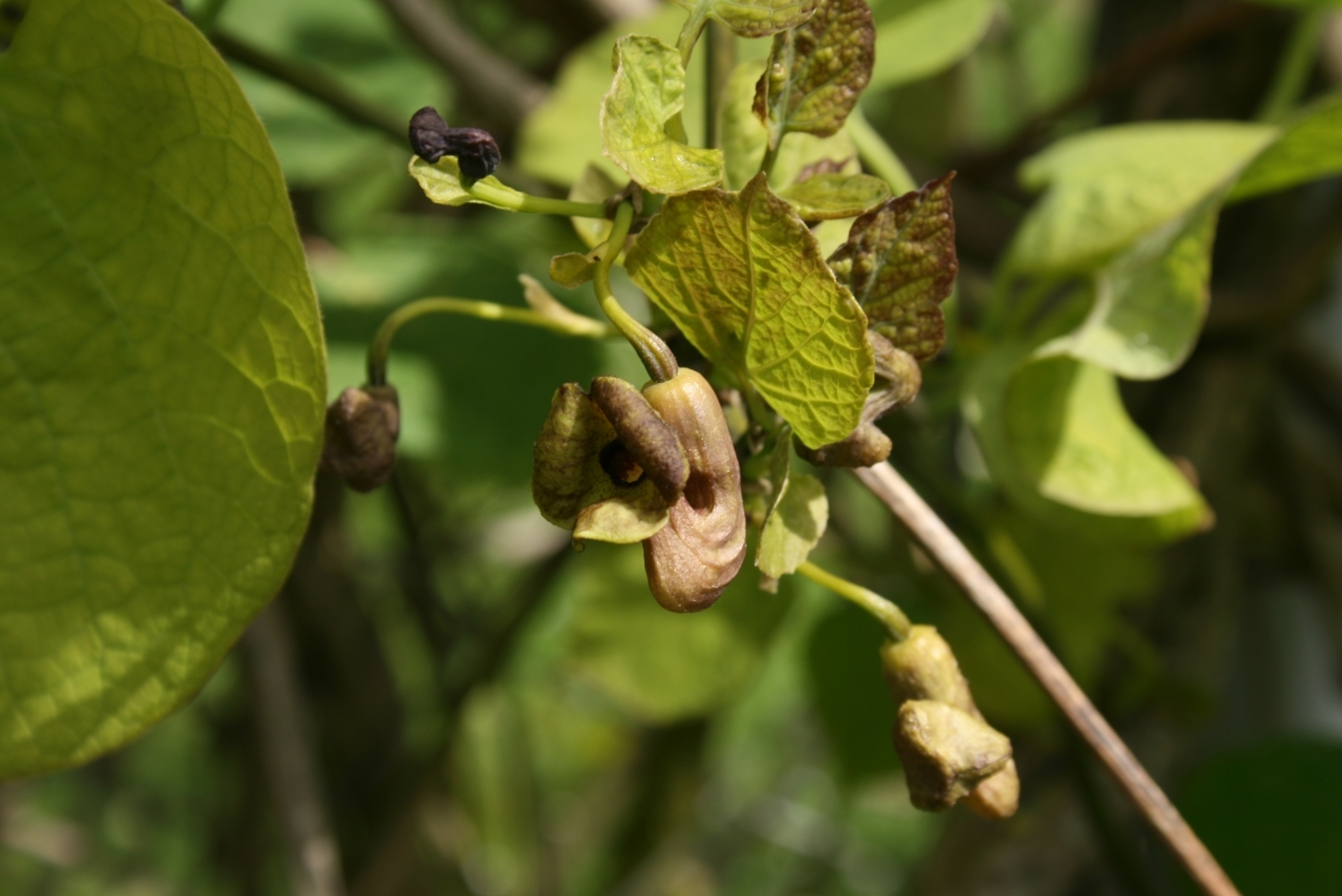
Pipevine
Isotrema macrophyllum
Native climber with large heart-shaped leaves and curved tubular yellow-and-purple "Dutchman's pipe" flowers in late spring. Sole larval host of the pipevine swallowtail butterfly. The Aristolochia name still appears in older references; Isotrema is the now-accepted genus.
Status: Native; uncommon, in cove woods.
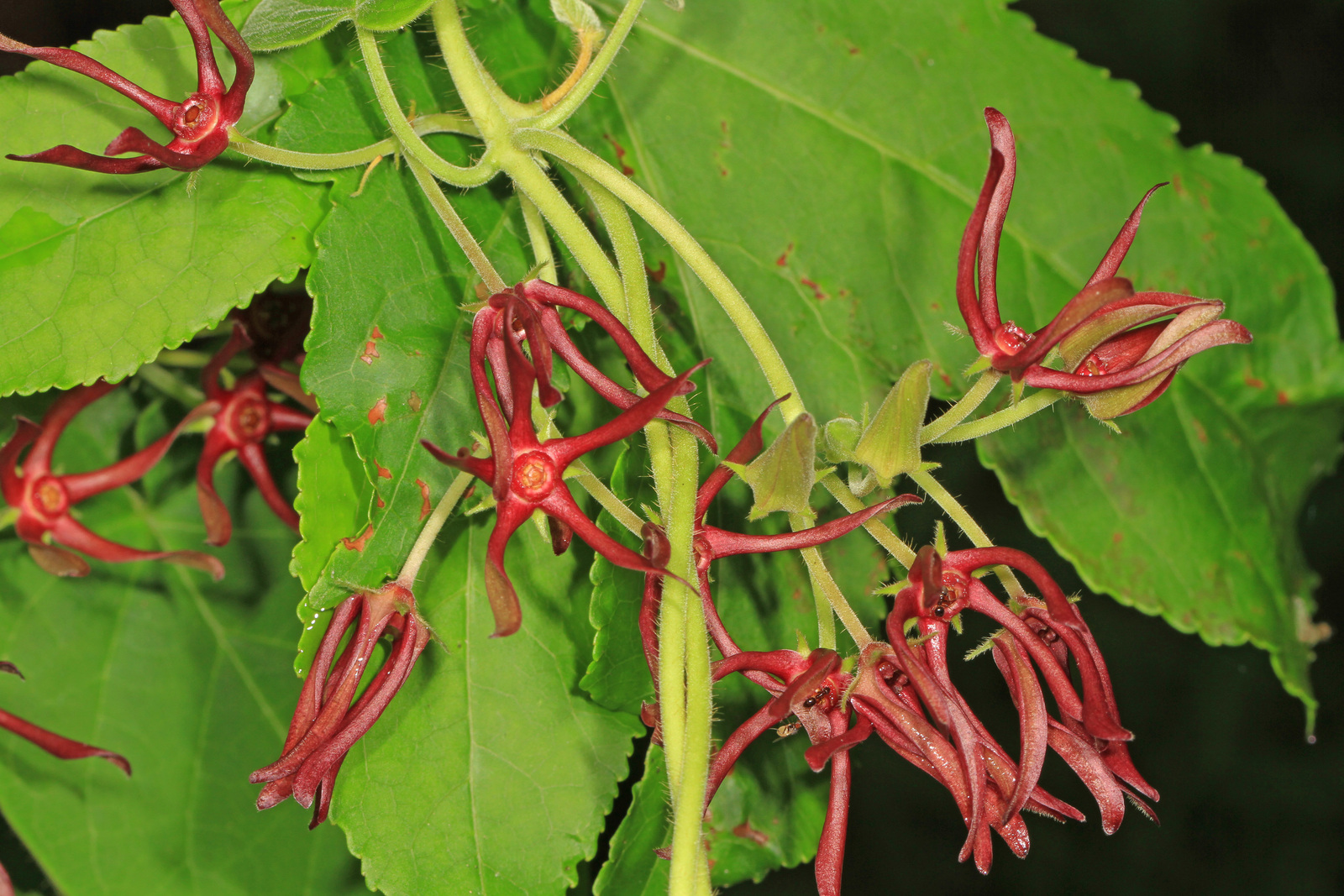
Climbing spinypod
Matelea obliqua
A milkweed-family vine with paired heart-shaped leaves and small purple-brown five-pointed flowers. Limestone-influenced soils and bluff slopes; uncommon throughout its range.
Status: Native; uncommon, on limestone slopes.
Moonseed
Menispermum canadense
Twining vine with rounded leaves resembling grape leaves; tiny white flowers in clusters and small dark blue-black drupes that look like wild grapes. The drupes are toxic; visitors who confuse them with wild grapes have been hospitalized.
Status: Native; common in valley woods.
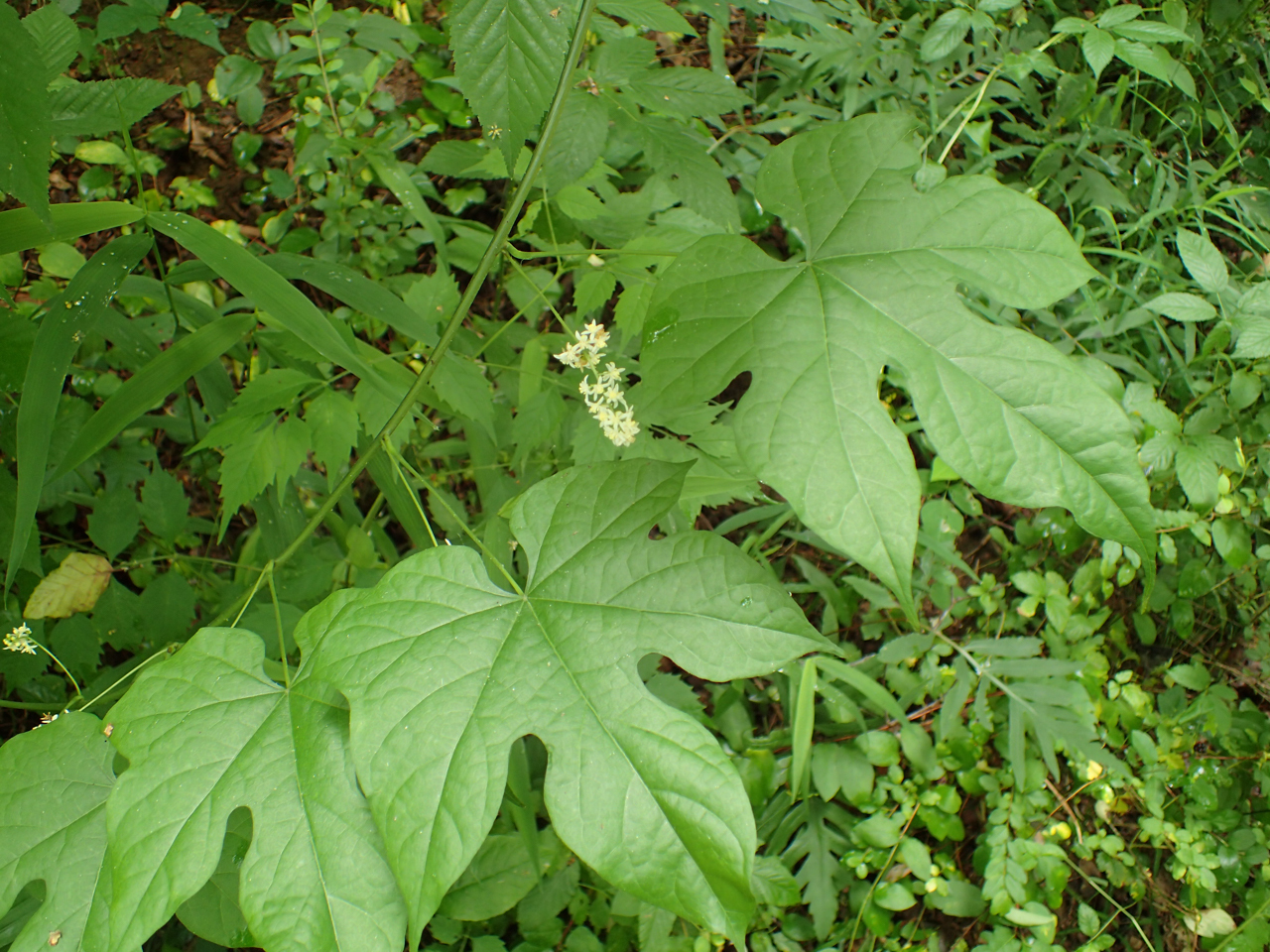
Cupseed
Calycocarpum lyonii
High-climbing moonseed-family vine with deeply lobed maple-like leaves and large round black fruits. Each seed has a deep cup-shaped depression on one face (the namesake feature). Bottomland and floodplain forest.
Status: Native; uncommon, in floodplain woods.
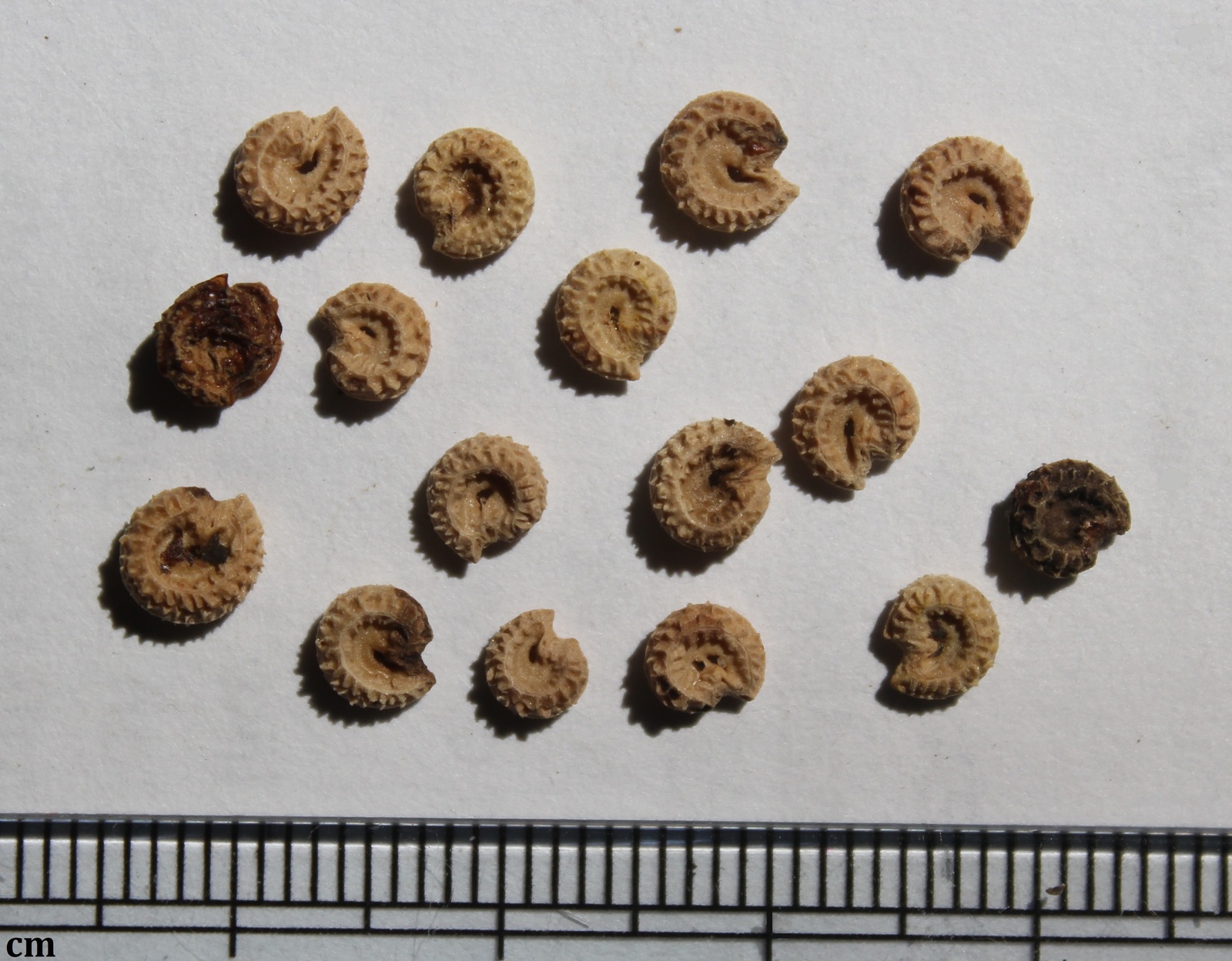
Carolina coralbead
Cocculus carolinus
Twining vine with bright red drupes that persist into winter; leaves with three to five rounded lobes. Distinct from the introduced Cocculus orbiculatus. Now sometimes placed in Nephroia.
Status: Native; uncommon, in valley thickets.
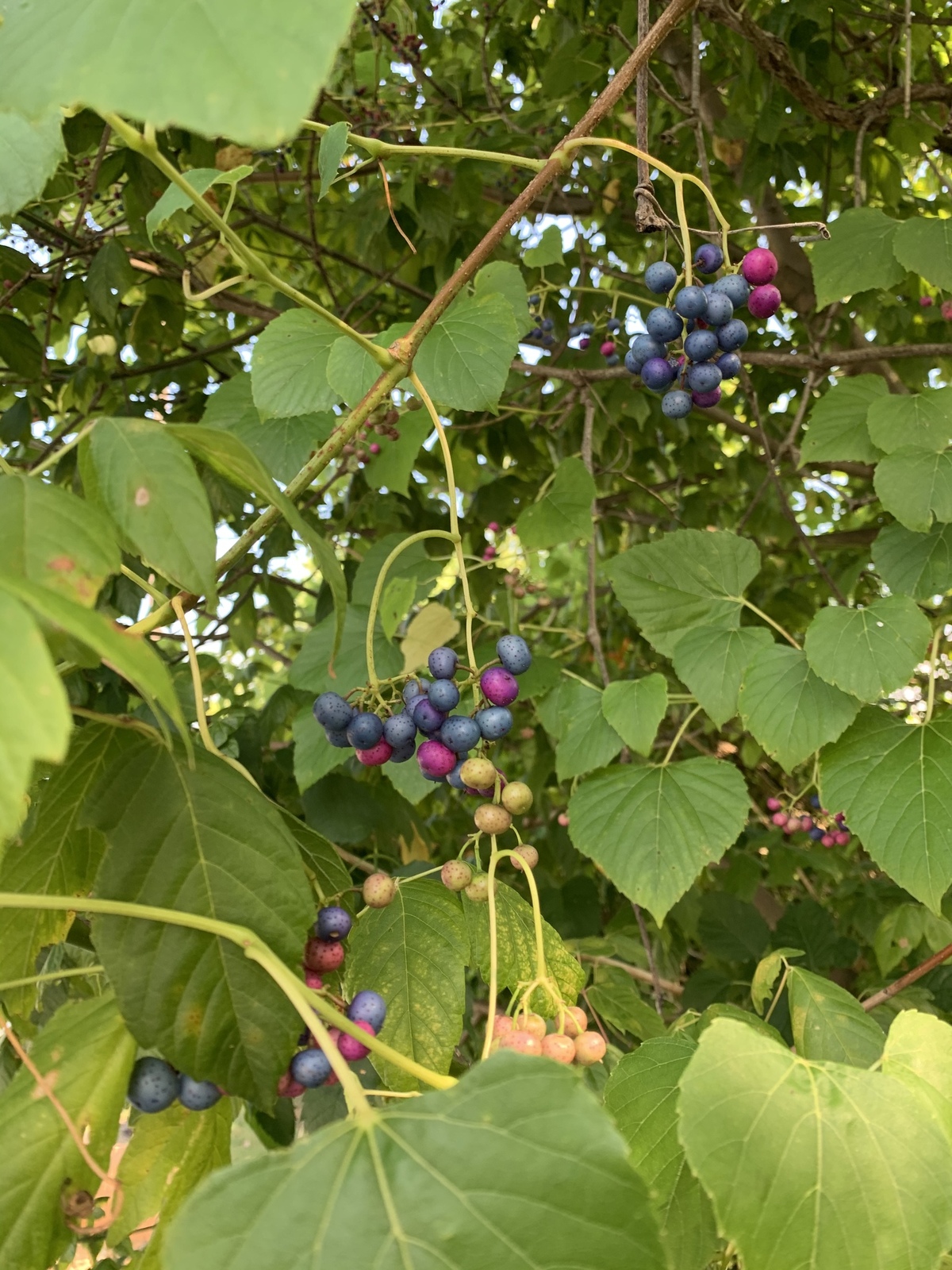
Heartleaf peppervine
Ampelopsis cordata
Grape-family vine with heart-shaped leaves and small dark-blue fruits in clusters. River and stream bottomlands; tolerates flooding well. Common in Tennessee River backwater margins.
Status: Native; common in floodplain woods.
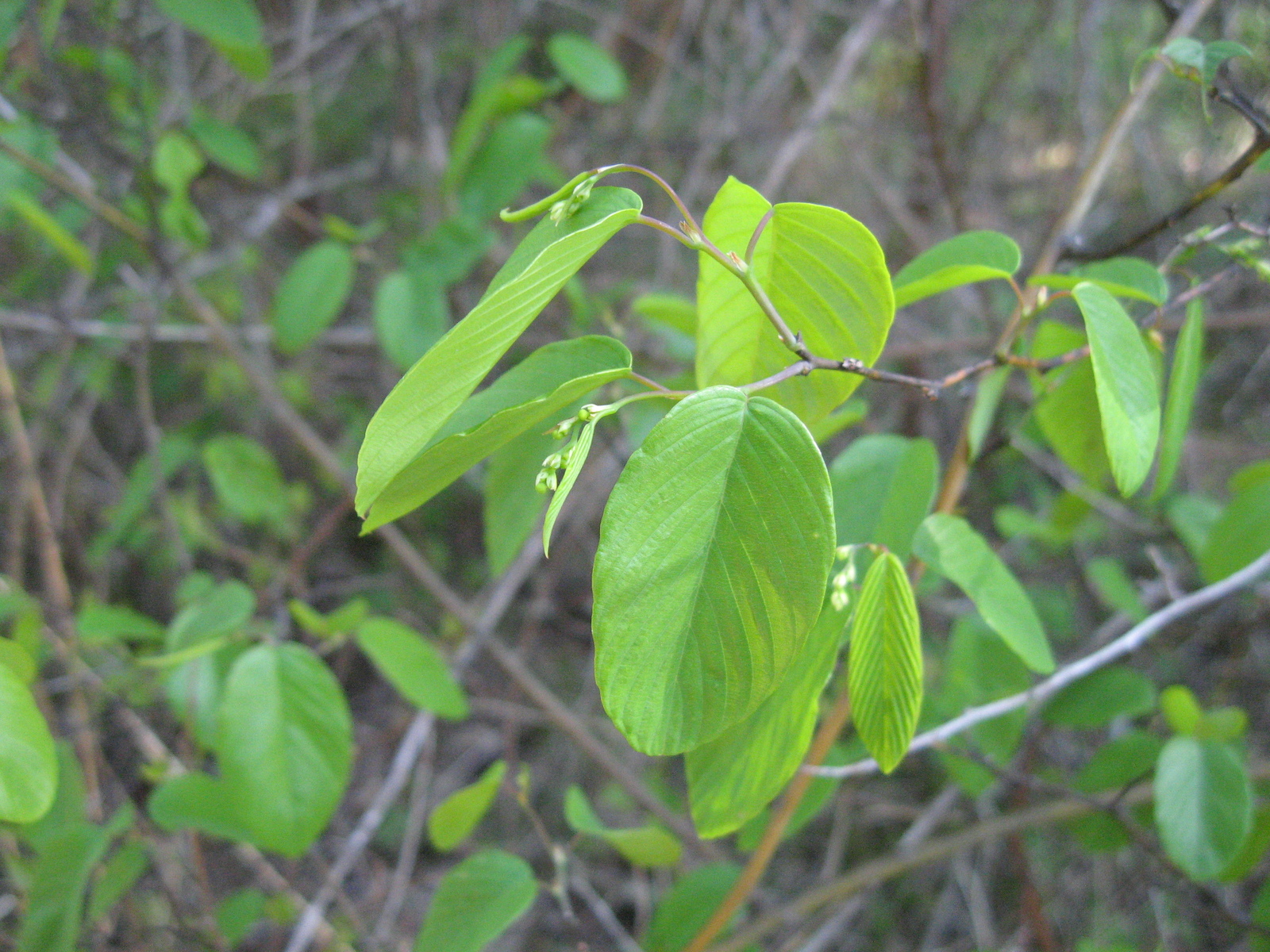
Supple-jack
Berchemia scandens
Also called rattan vine for its strong, flexible stems that were used in furniture and basketry; the stems can grow surprisingly thick (over 5 cm). Small greenish flowers; blue-black drupes. Wet bottomland forest.
Status: Native; common in floodplain woods.
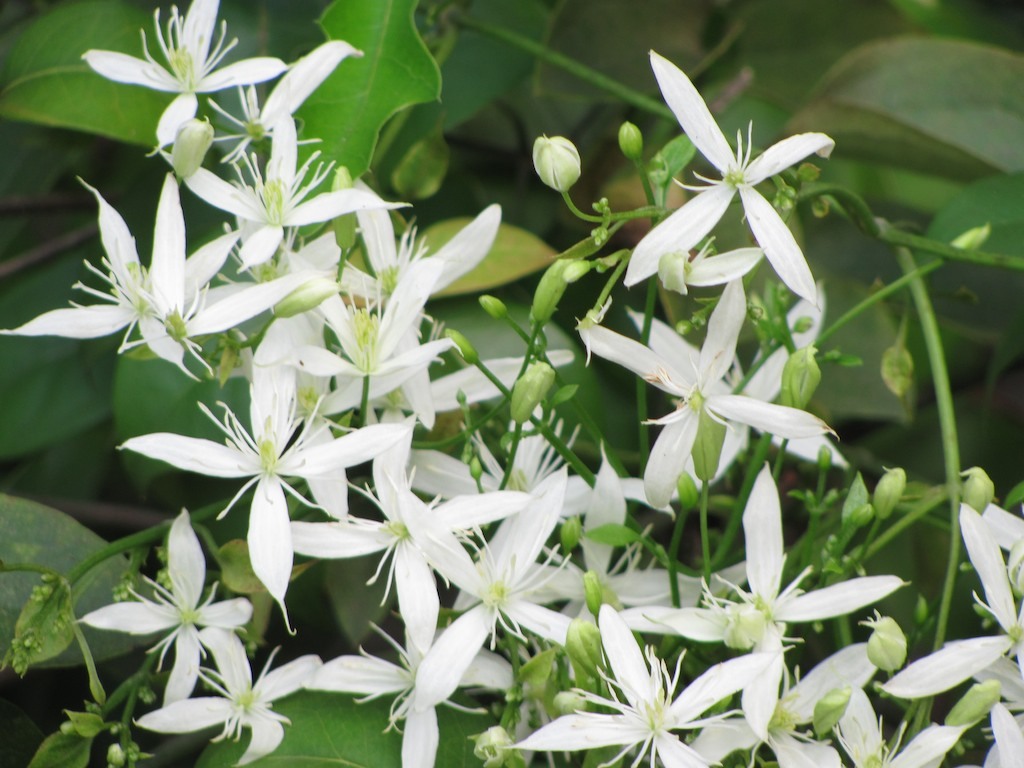
Virgins bower
Clematis virginiana
Native clematis with small white four-petaled flowers in clusters in late summer, followed by feathery silver seed plumes that persist into fall. Common in wet roadside fence rows; do not confuse with the invasive Asian leatherleaf clematis.
Status: Native; common in valley fence rows.
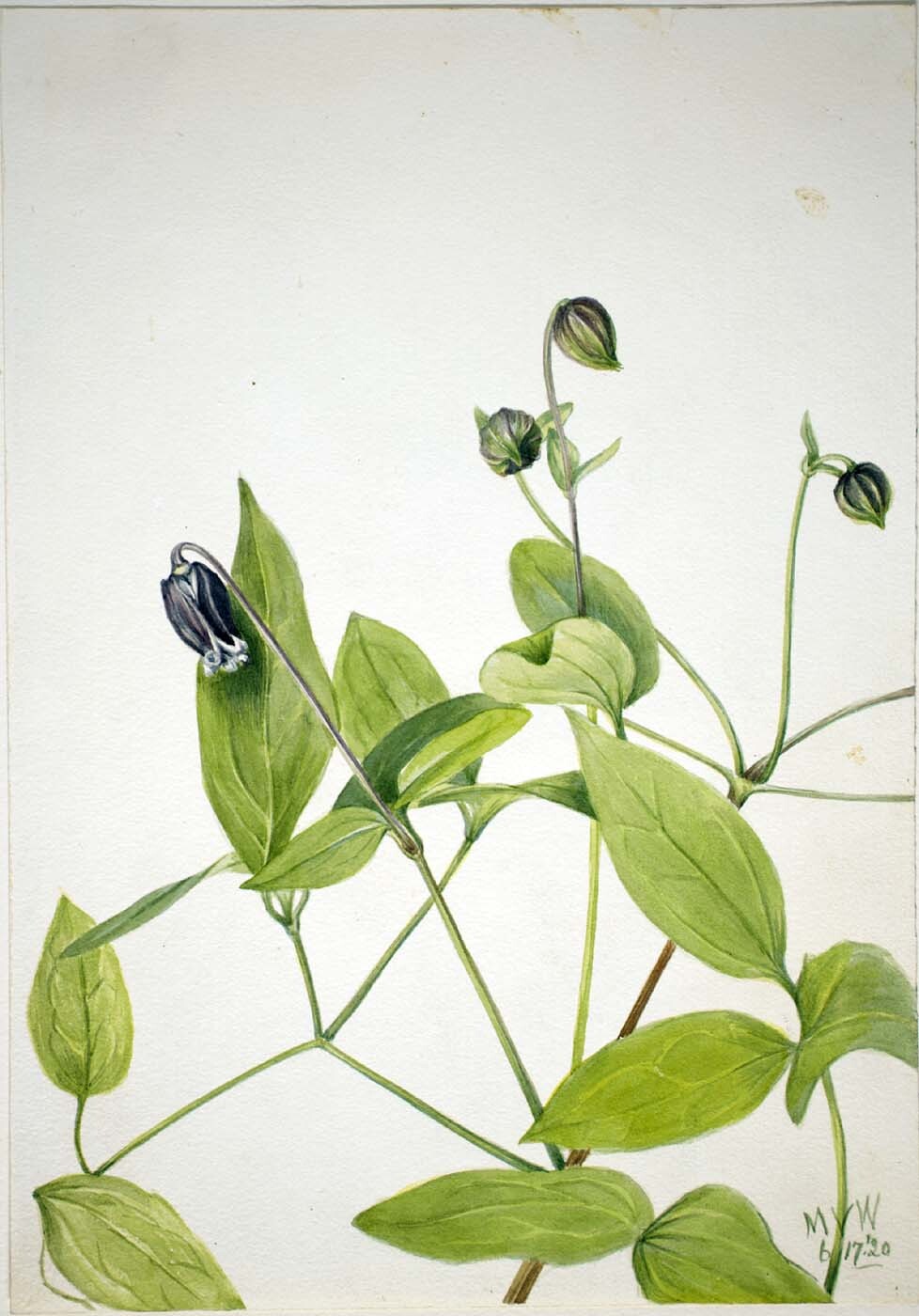
Vasevine
Clematis viorna
A native clematis with thick, urn-shaped, leathery dull-purple flowers that nod from the leaf axils in summer. Rich woods and stream banks. Less showy than virgin's-bower but distinctive once seen.
Status: Native; uncommon in cove woods.
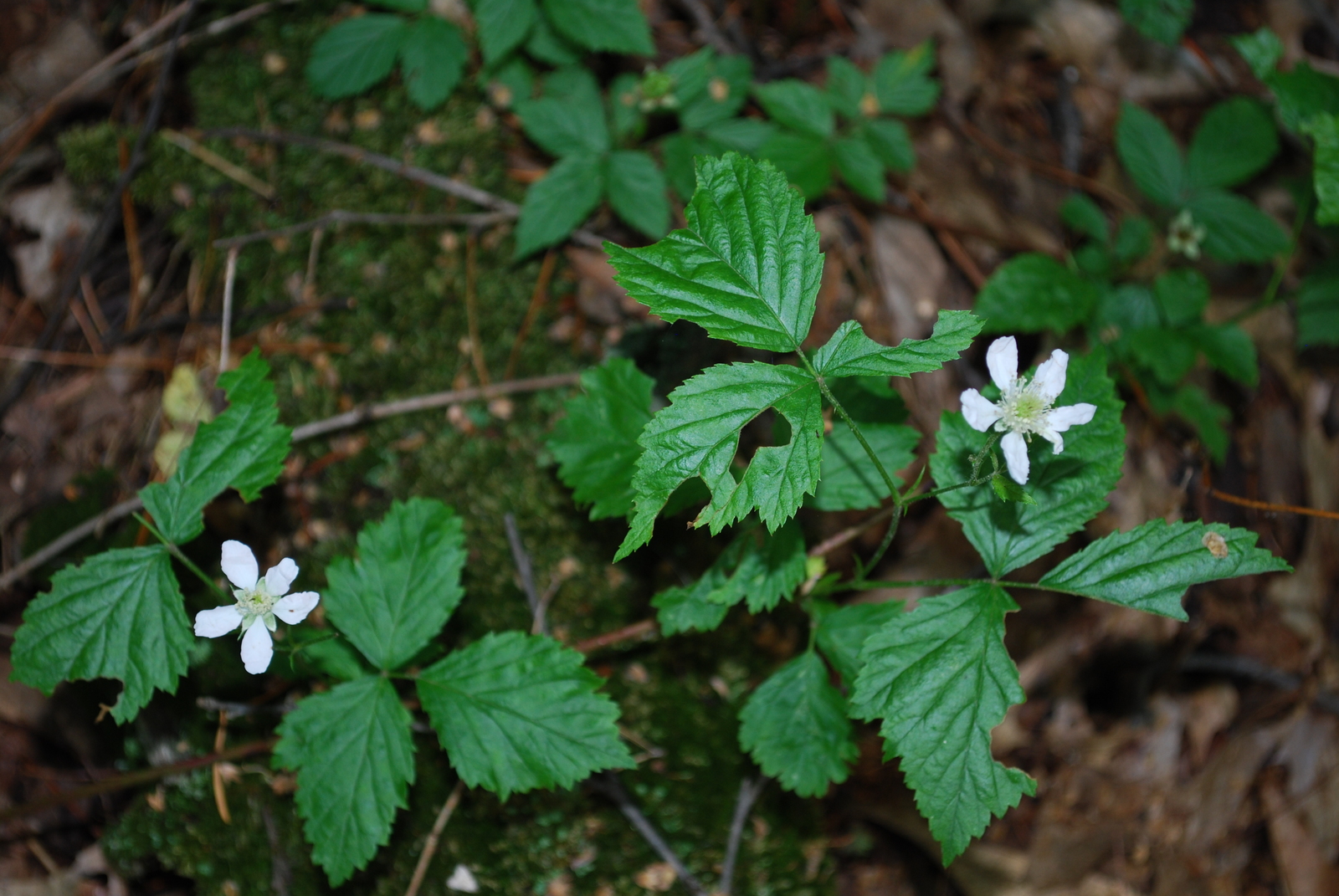
Whiplash dewberry
Rubus flagellaris
Trailing low woody vine with sharp recurved thorns; technically classified as a vine in the master inventory but functionally a low-running blackberry. Old fields, pasture margins, and rocky uplands.
Status: Native; common in old fields.
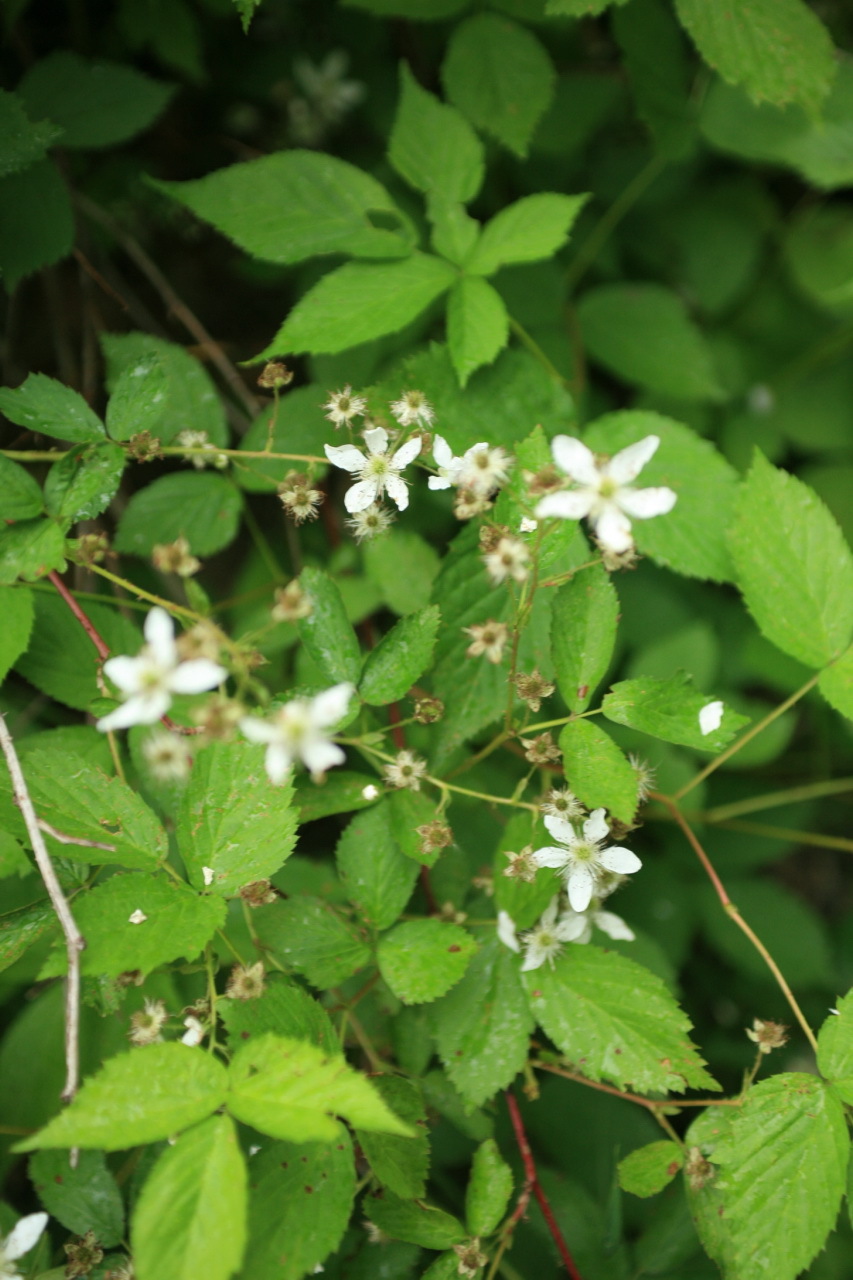
Bristly dewberry
Rubus hispidus
A trailing wetland dewberry with bristly hairs on the canes and leaves. Wet meadows, plateau bogs, and seepage slopes; the wetland counterpart of whiplash dewberry.
Status: Native; common in wet woods.
Eastern poison-ivy
Eastern poison-ivy gets its own subsection because the safety-information stakes are higher than for any other native vine on the page, and because its growth habit straddles ground-cover, shrub, and climber forms in the same population. The "leaves of three, let it be" rhyme works as a first-pass filter, but several non-toxic look-alikes (Virginia creeper, fragrant sumac, box elder seedlings) are also three-leaved. The reliable supplementary tests: the central leaflet sits on a longer stalk than the two side leaflets; older climbing stems have hairy aerial roots gripping the bark; and the fall fruits are matte waxy white in clusters. Urushiol is present in all parts of the plant year-round, including in dead winter canes.
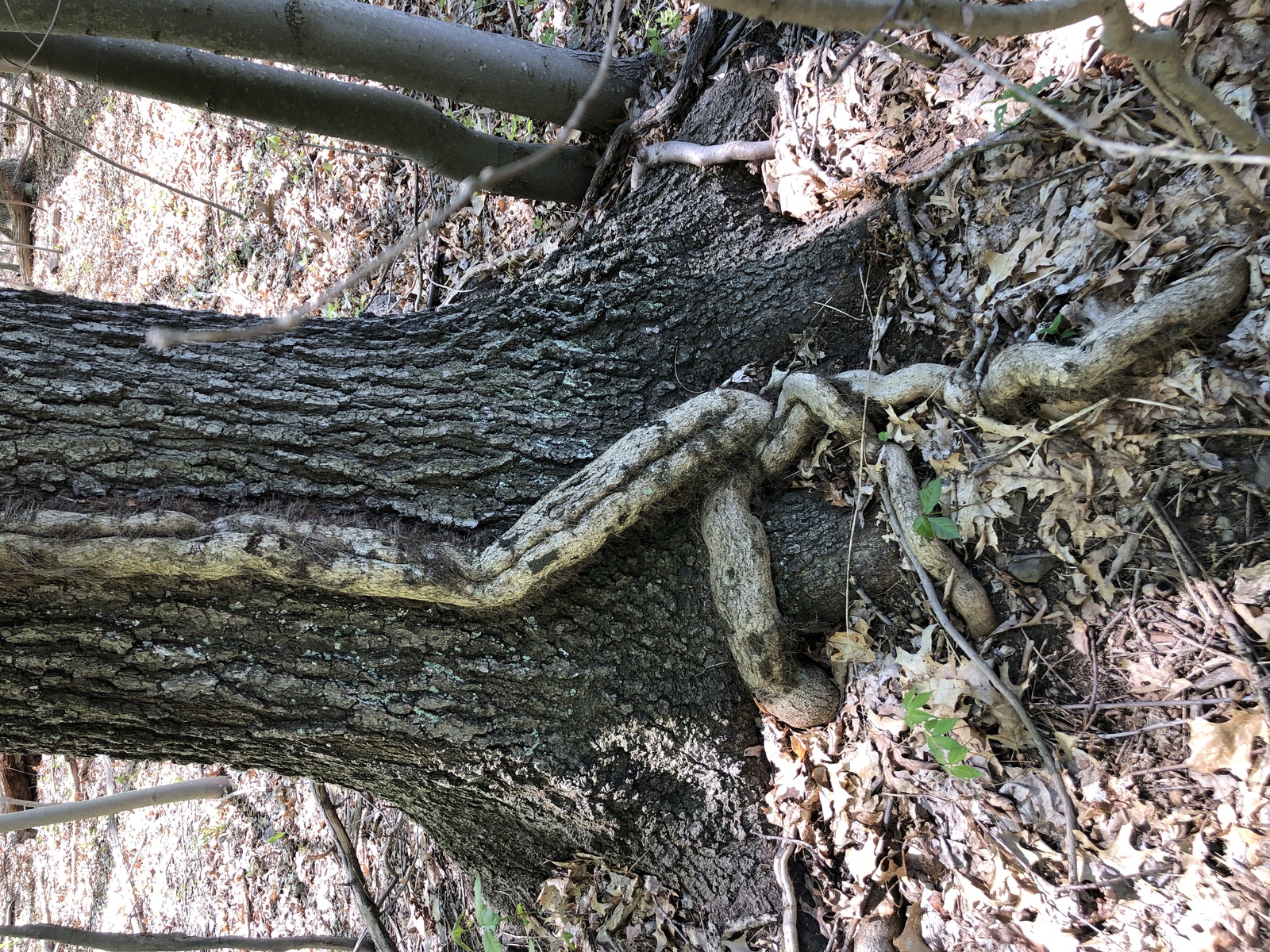
Eastern poison ivy
Toxicodendron radicans
"Leaves of three, let it be." Three-part leaves with the central leaflet on a longer stalk than the two side leaflets; growth habit varies from low ground-cover to climbing vine with hairy aerial roots. Urushiol oil in all parts of the plant produces the familiar contact dermatitis. White waxy berries in fall are an important winter food source for songbirds, including the white-throated sparrow and northern flicker.
Status: Native; common everywhere.
Greenbriers
The thorny climbing greenbriers are a familiar plateau-bushwhack obstacle. All are evergreen-leaved and have stout straight thorns; field separation among the three Marion County species rests on leaf shape and prickle character.
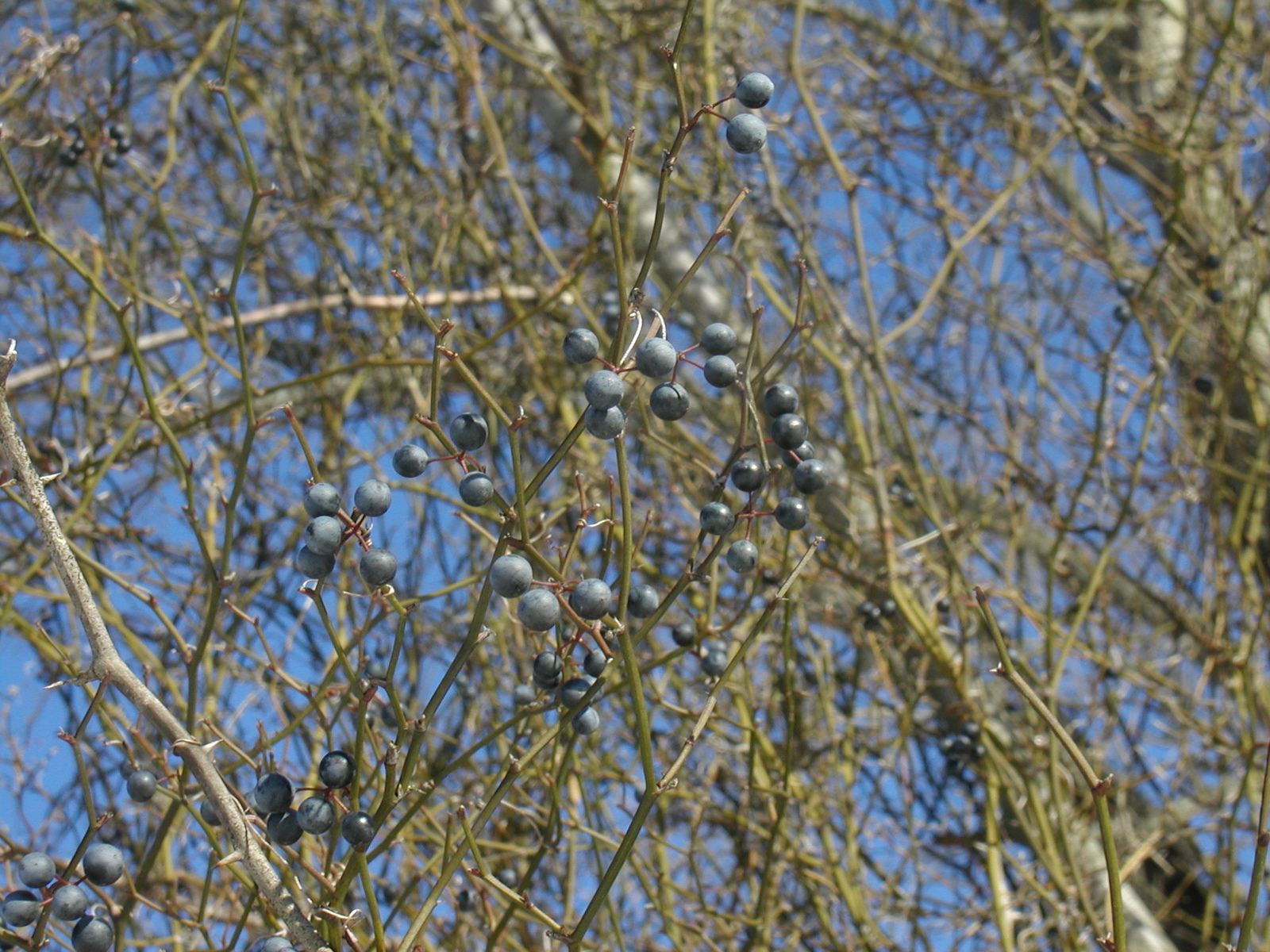
Common greenbrier
Smilax rotundifolia
Tough evergreen-leaved climbing vine with stout straight thorns and rounded leaves; blue-black fruits in clusters. The thorny tangles are a characteristic obstacle on plateau bushwhacks.
Status: Native; common in plateau woods.
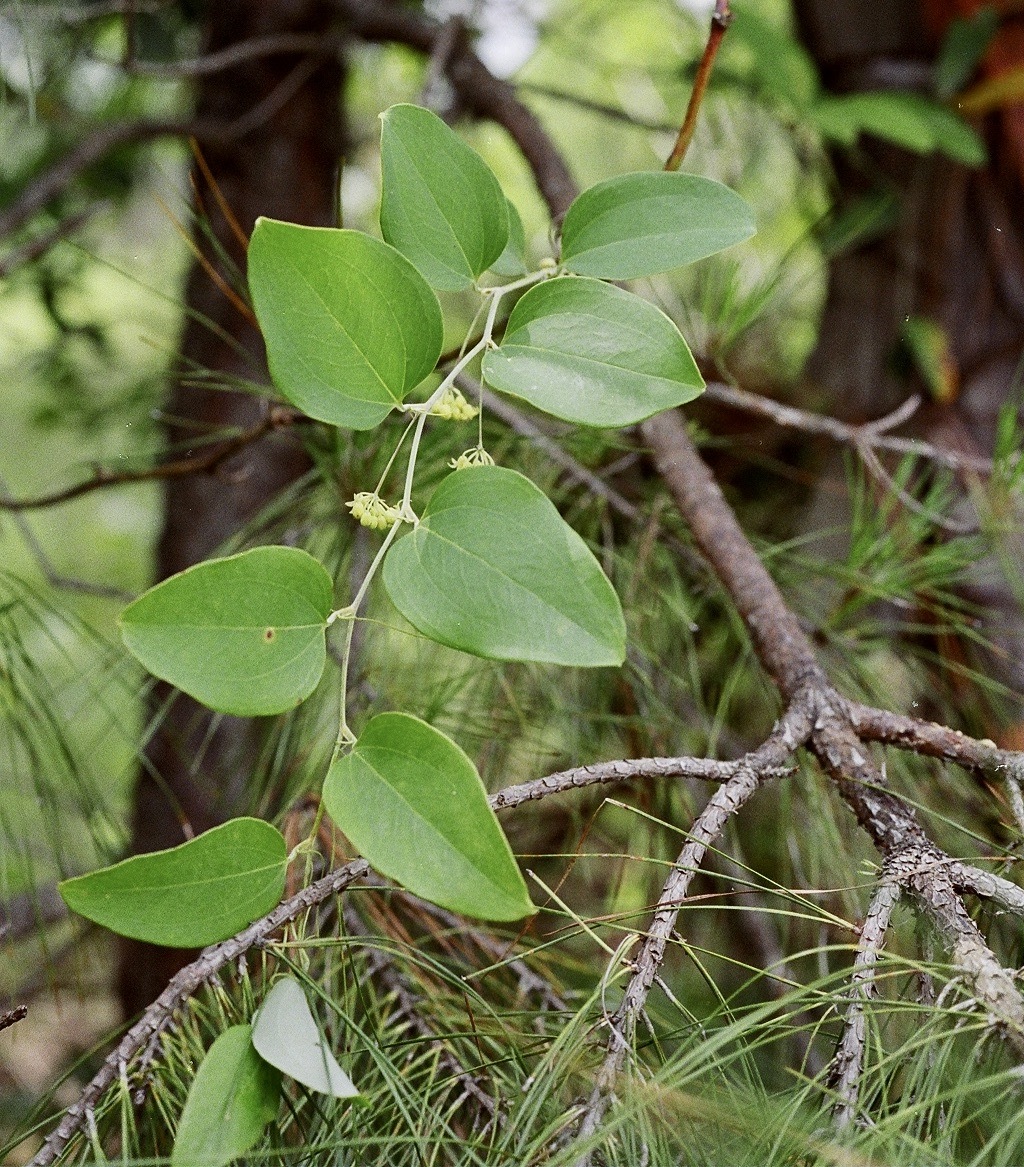
Saw greenbrier
Smilax glauca
Climbing greenbrier with mottled blue-green leaves and slender prickles. Distinguishes from common greenbrier by the lighter leaves and more flexible prickles.
Status: Native; common.
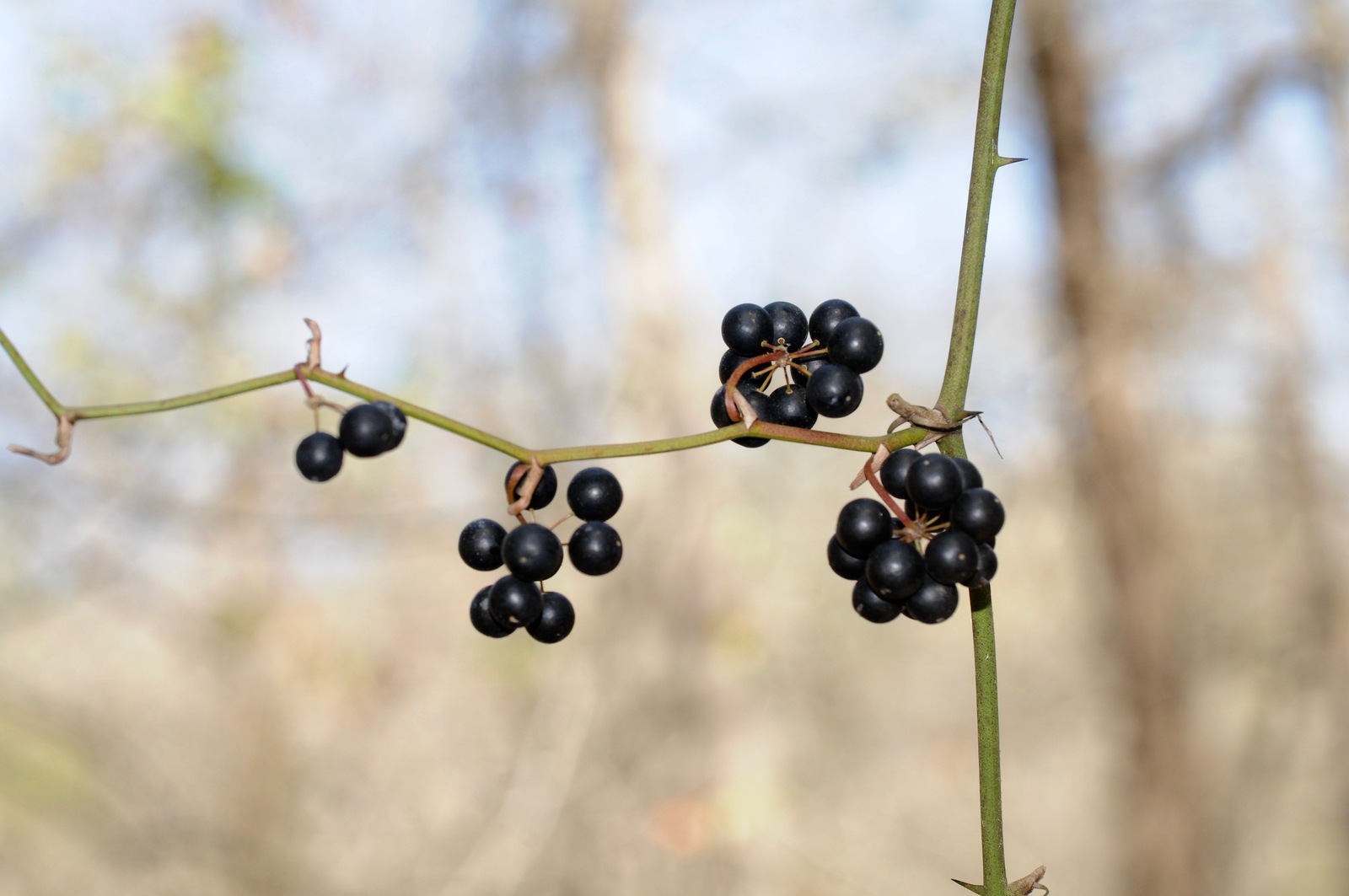
Bristly greenbrier
Smilax bona-nox
A greenbrier with very stout dark prickles and conspicuously prickly young stems. Lower-elevation thickets and forest edges; less common at higher elevations than common greenbrier.
Status: Native; common in valley thickets.
Native grapes
Five native grape species are documented in Marion County by the TN-KY Plant Atlas. All are real grapes (genus Vitis); separating species in the field rests on tendril branching, leaf lobe pattern, and bark behavior on older stems.
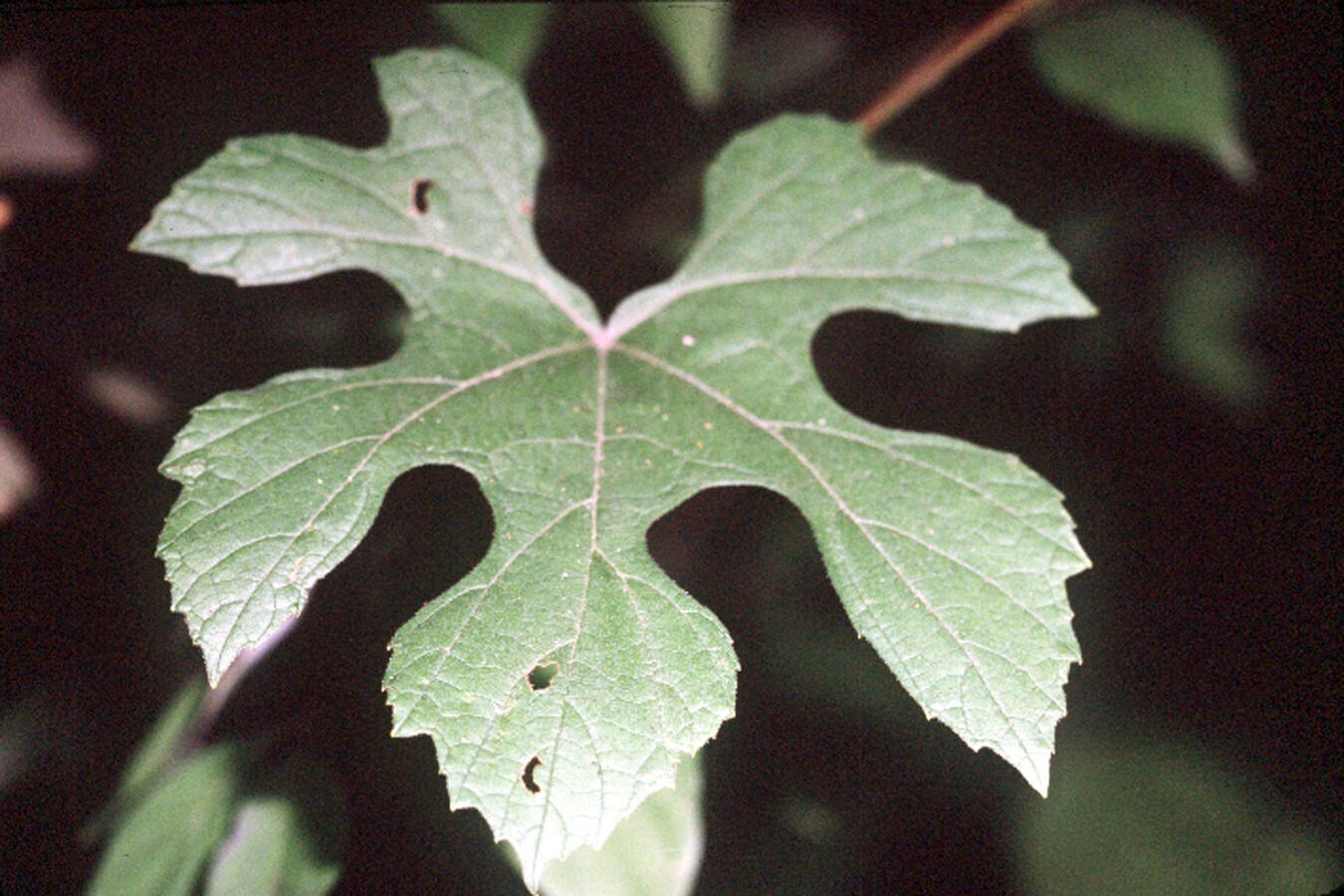
Summer grape
Vitis aestivalis
High-climbing native grape with leaves that are usually three-lobed but variable. Black fruits ripen in late summer; smaller and seedier than cultivated grapes. Fence rows and forest gaps throughout the county.
Status: Native; common.
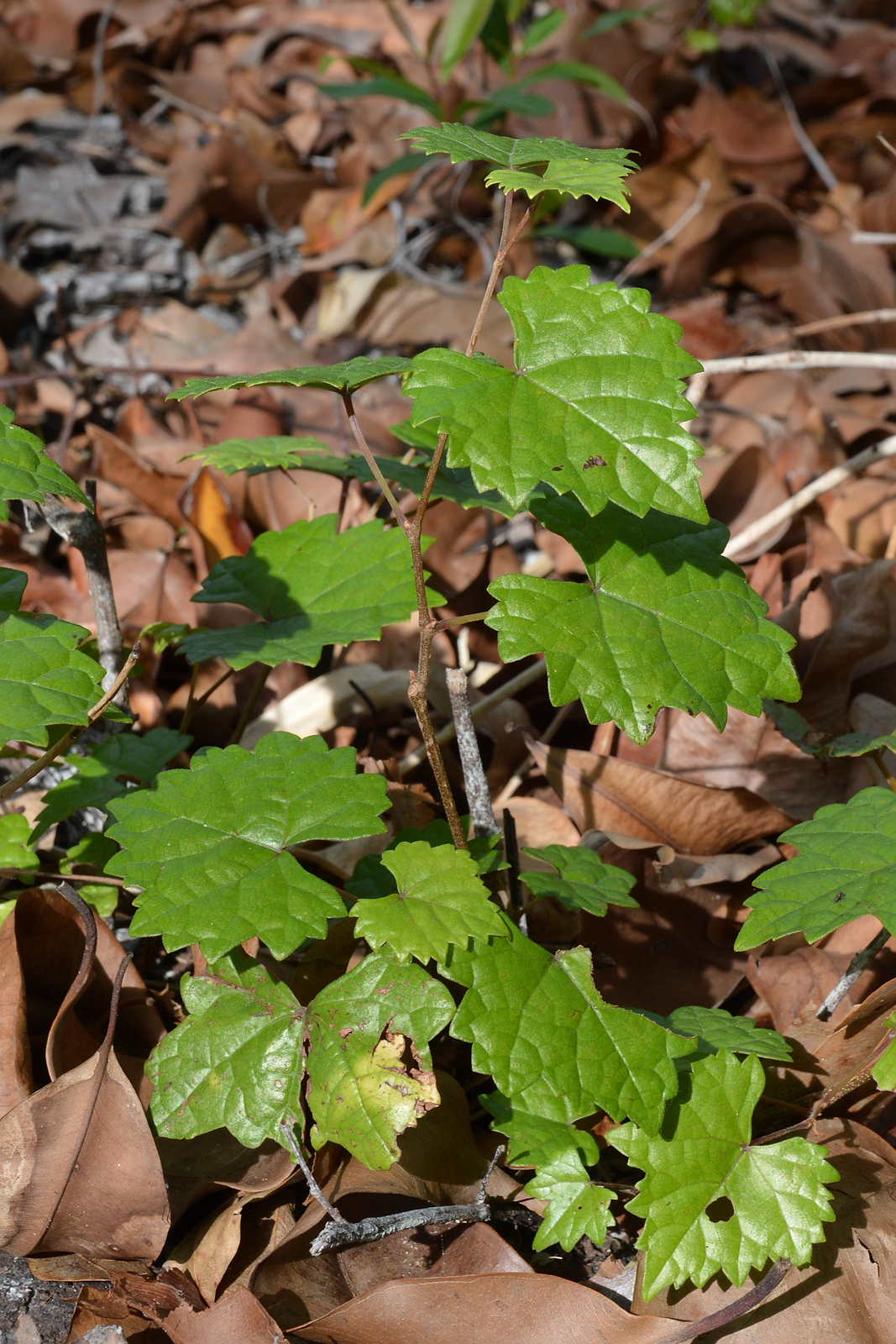
Muscadine
Vitis rotundifolia
The southern grape: thick-skinned bronze or dark-purple individual fruits (rather than tight clusters) in late summer. Climbs by simple unbranched tendrils (most other grapes have forked tendrils). Less common at the cooler higher elevations on the plateau.
Status: Native; common in valley woods.
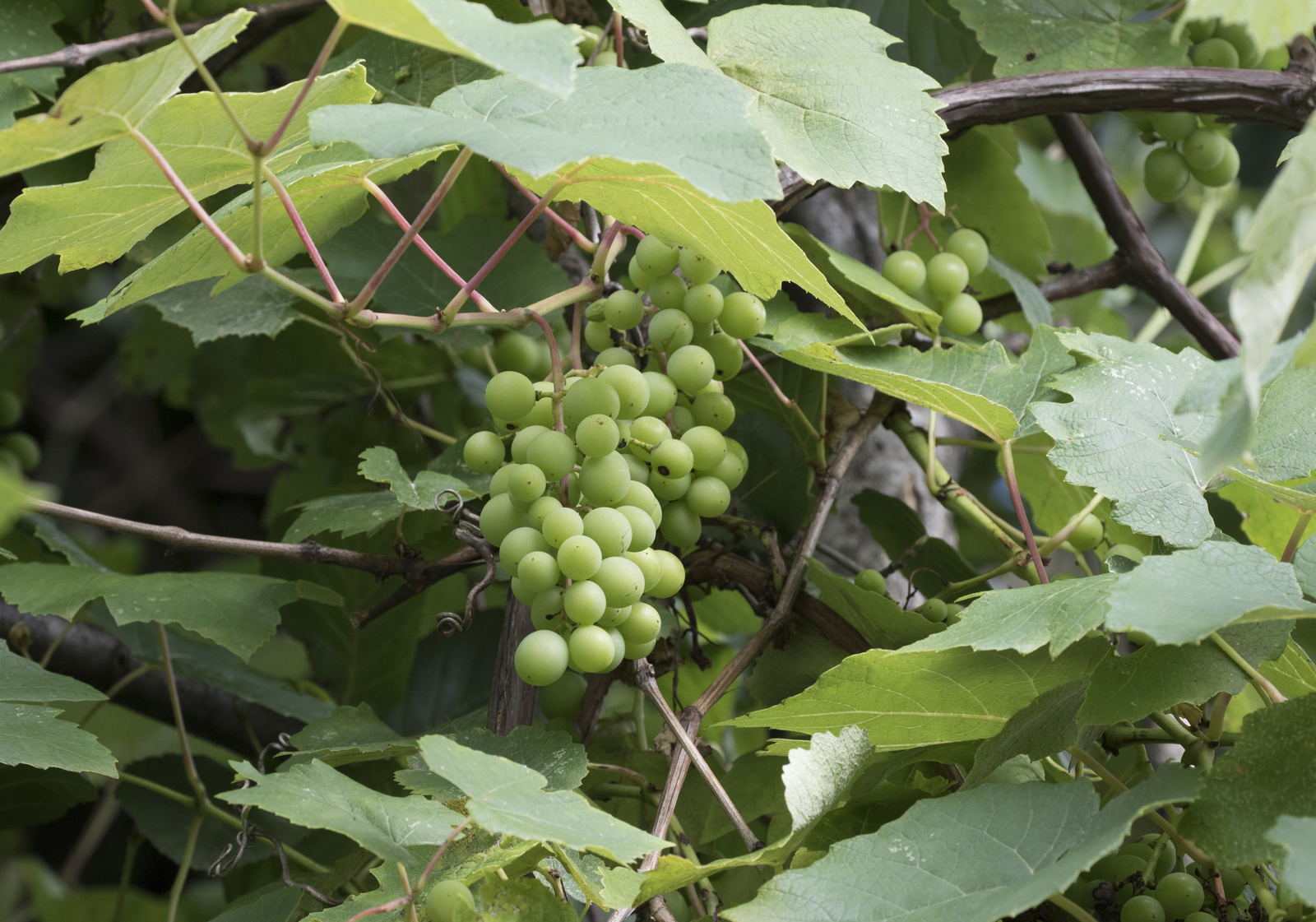
Fox grape
Vitis labrusca
A native grape of moist forest edges and valley bottoms, with medium-sized purple-black fruits with a strong "foxy" flavor (the namesake characteristic). Parent of the cultivated Concord and Catawba grape varieties.
Status: Native; common in valley woods.
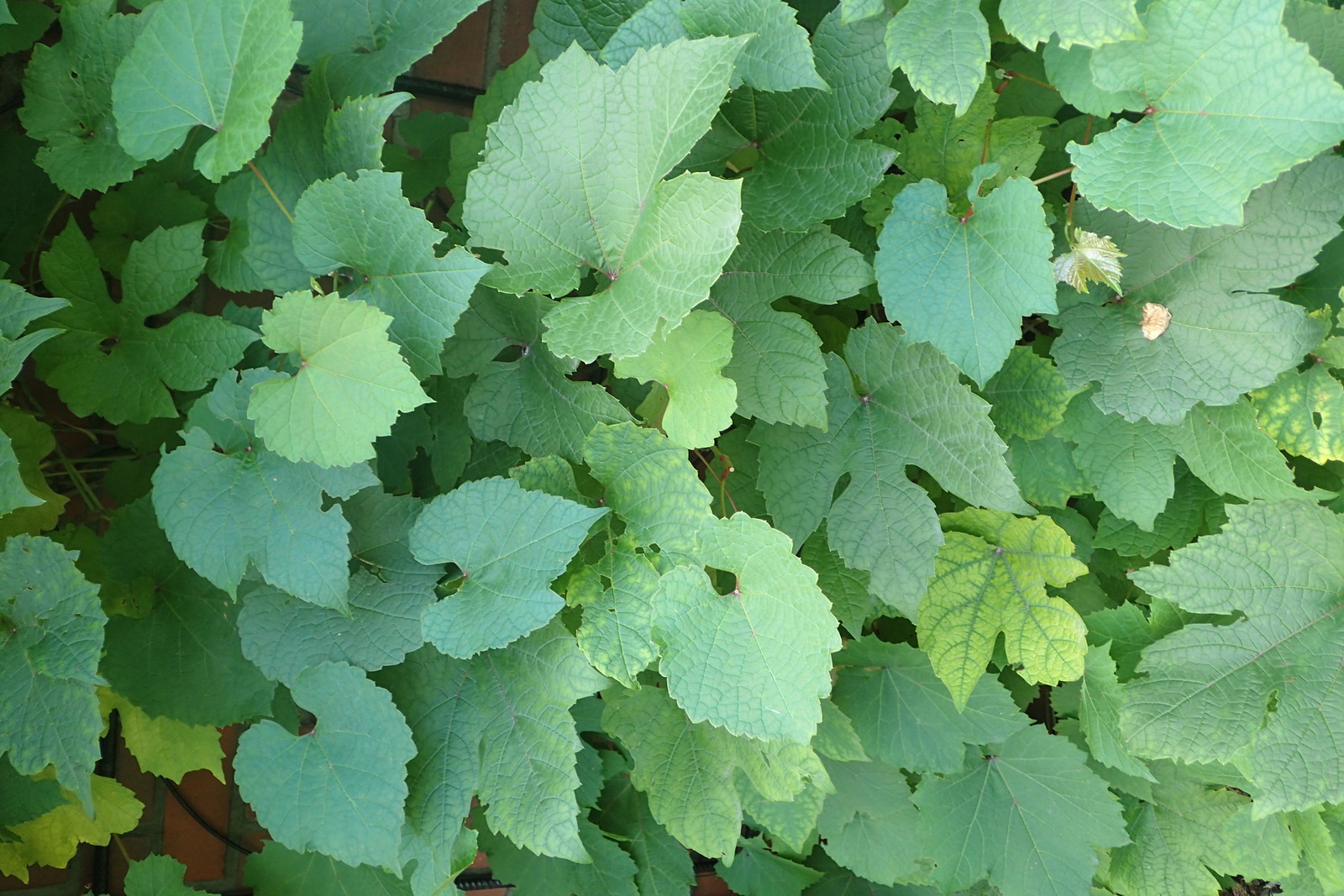
Red grape
Vitis palmata
Floodplain-bottomland grape with smooth red young branches, small dark fruits, and characteristic late summer ripening. Less common than summer grape and muscadine on the plateau.
Status: Native; uncommon, in floodplain woods.
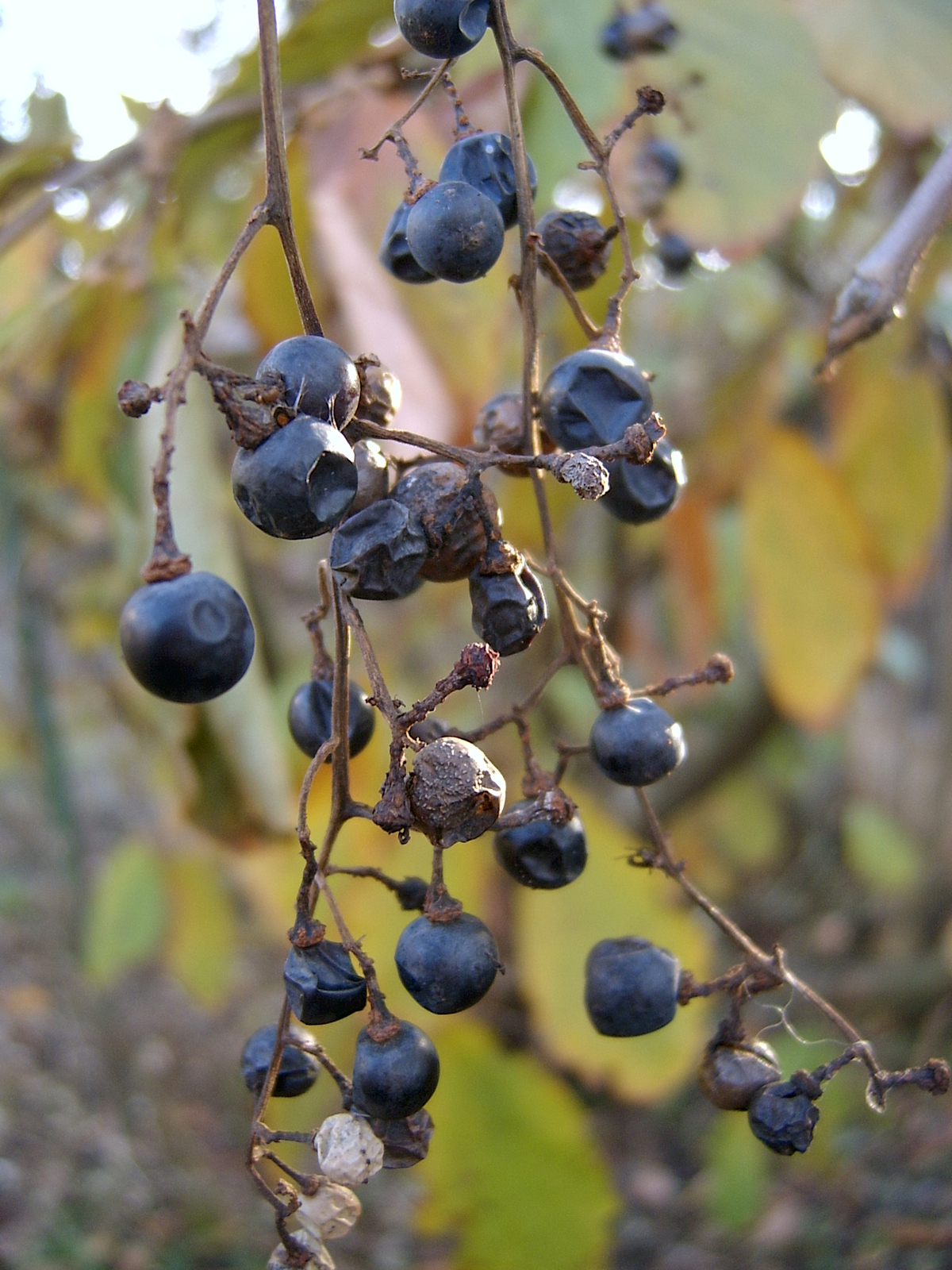
Frost grape
Vitis vulpina
Small dark grapes that hang on the vine into November and December (the namesake feature). Cold and frost actually improve their palatability. Stream-bottom and floodplain habitat.
Status: Native; common in valley woods.
Invasive vines of concern
Seven non-native woody vines are documented in Marion County. Three are TN-IPC severe-threat invasives that are reshaping forest understory and edge ecosystems; the others are persistent-but-less-aggressive garden escapes. The full invasive-plant context is in the Invasive species and ecological threats section.
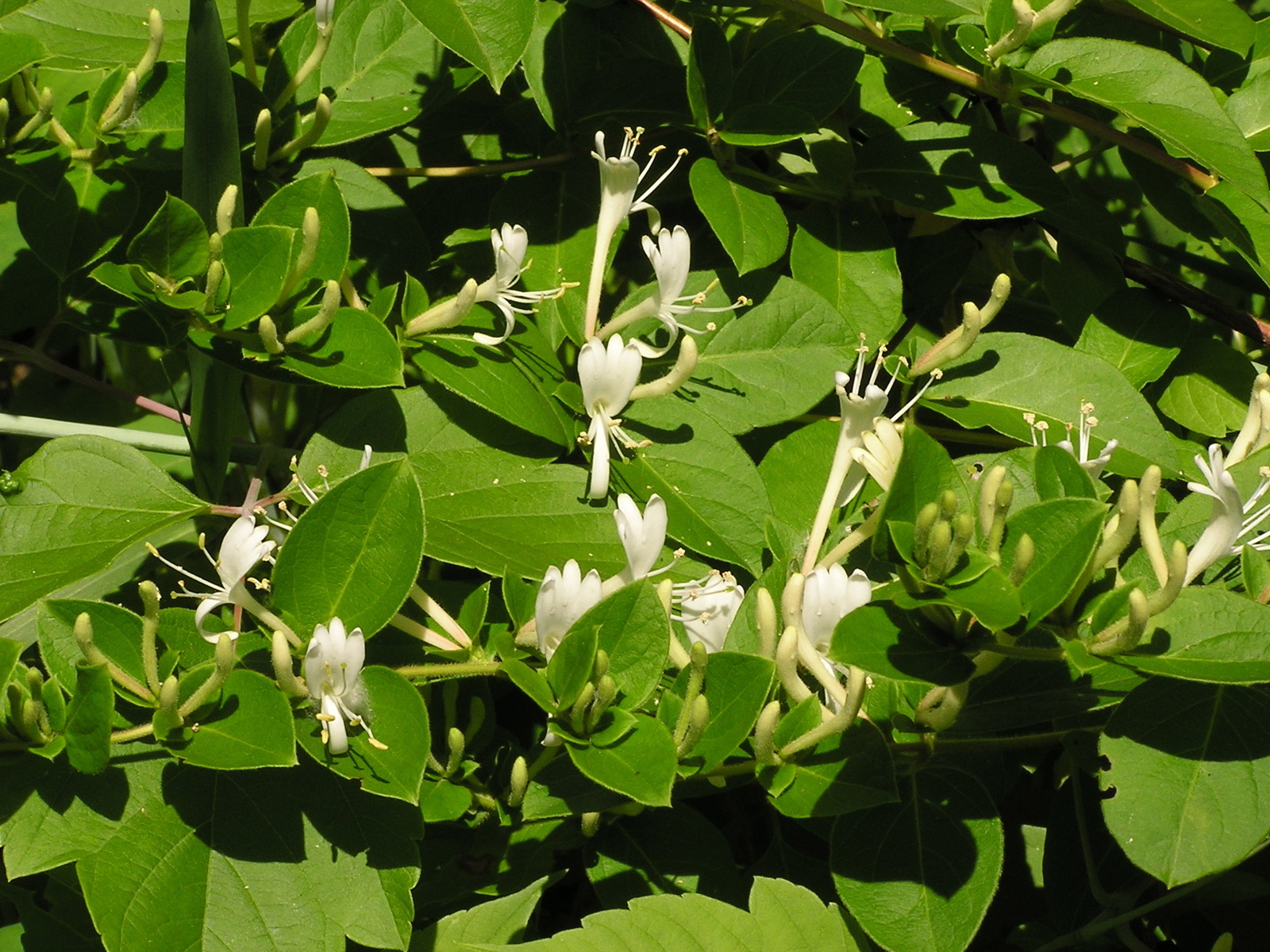
Japanese honeysuckle
Lonicera japonica
High-climbing semi-evergreen vine with fragrant white-and-yellow tubular flowers and black berries. Holds its leaves through most of the winter, giving it a photosynthetic head start over native plants. Smothers tree saplings, native vines, and spring ephemerals.
Status: Introduced; TN-IPC severe-threat invasive.
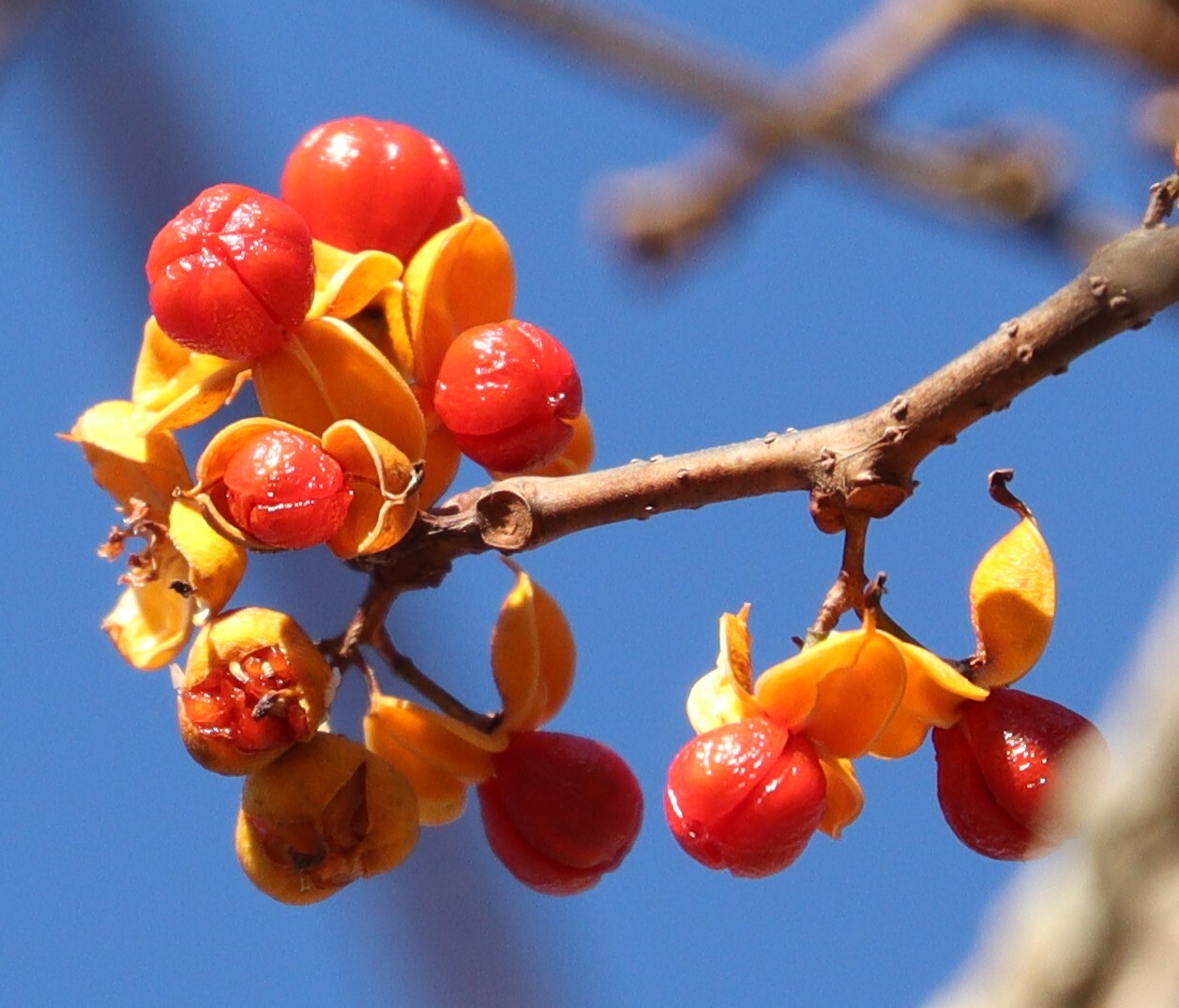
Oriental bittersweet
Celastrus orbiculatus
Aggressive Asian climbing vine with axillary (rather than terminal) clusters of orange-and-red capsules; distinct from native American bittersweet. Constricts and kills small trees; spreads rapidly along forest edges.
Status: Introduced; TN-IPC severe-threat invasive.
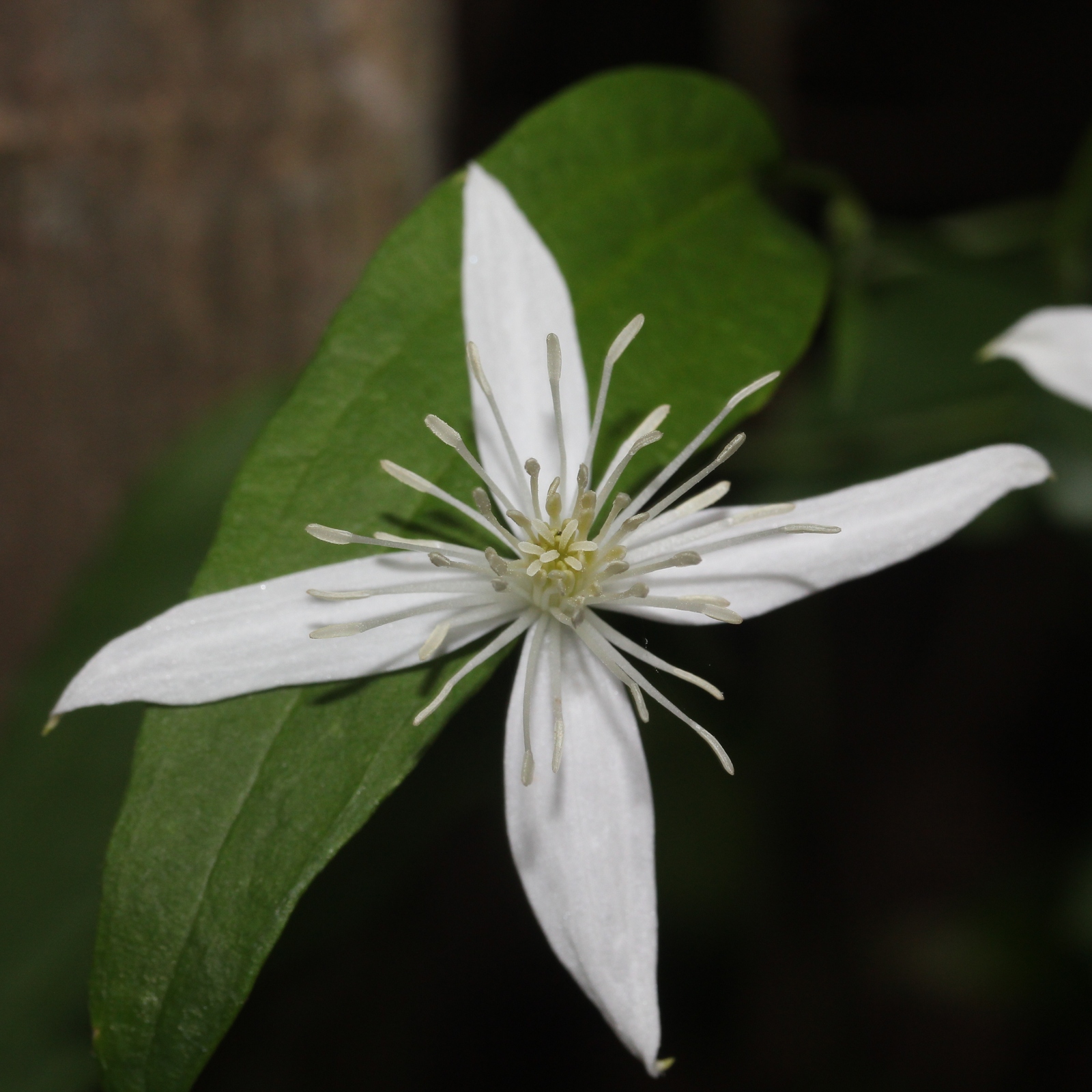
Leatherleaf clematis
Clematis terniflora
Asian clematis with leathery dark green leaves and white star-shaped flowers in fall (later than native virgin's-bower). A garden escape that is now widespread on disturbed valley fence rows.
Status: Introduced; non-native vine.
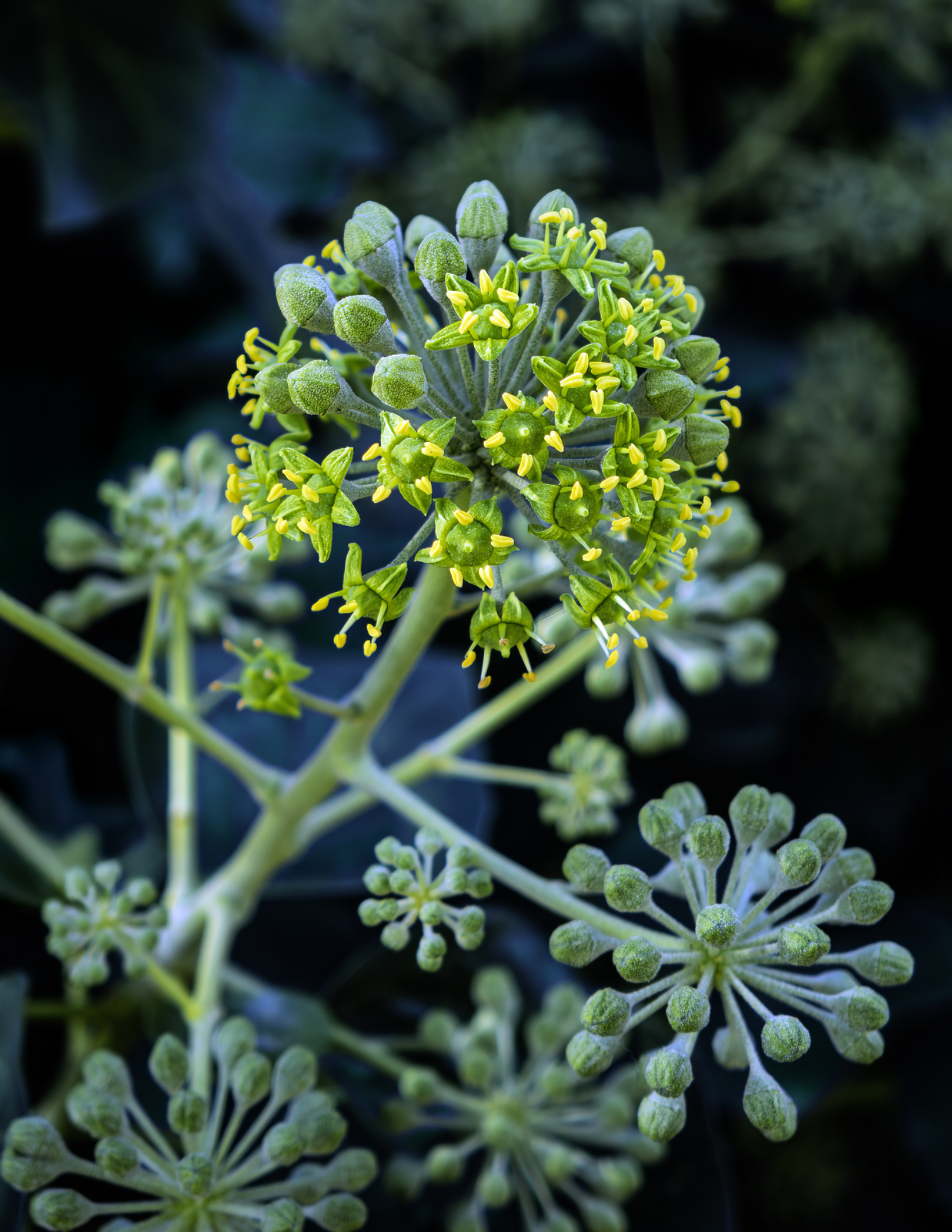
English ivy
Hedera helix
Aggressive evergreen climbing vine that forms thick mats on tree trunks and forest floors, shading out native ground cover and contributing to tree-fall in storms by its weight. Persists indefinitely once established.
Status: Introduced; TN-IPC severe-threat invasive.
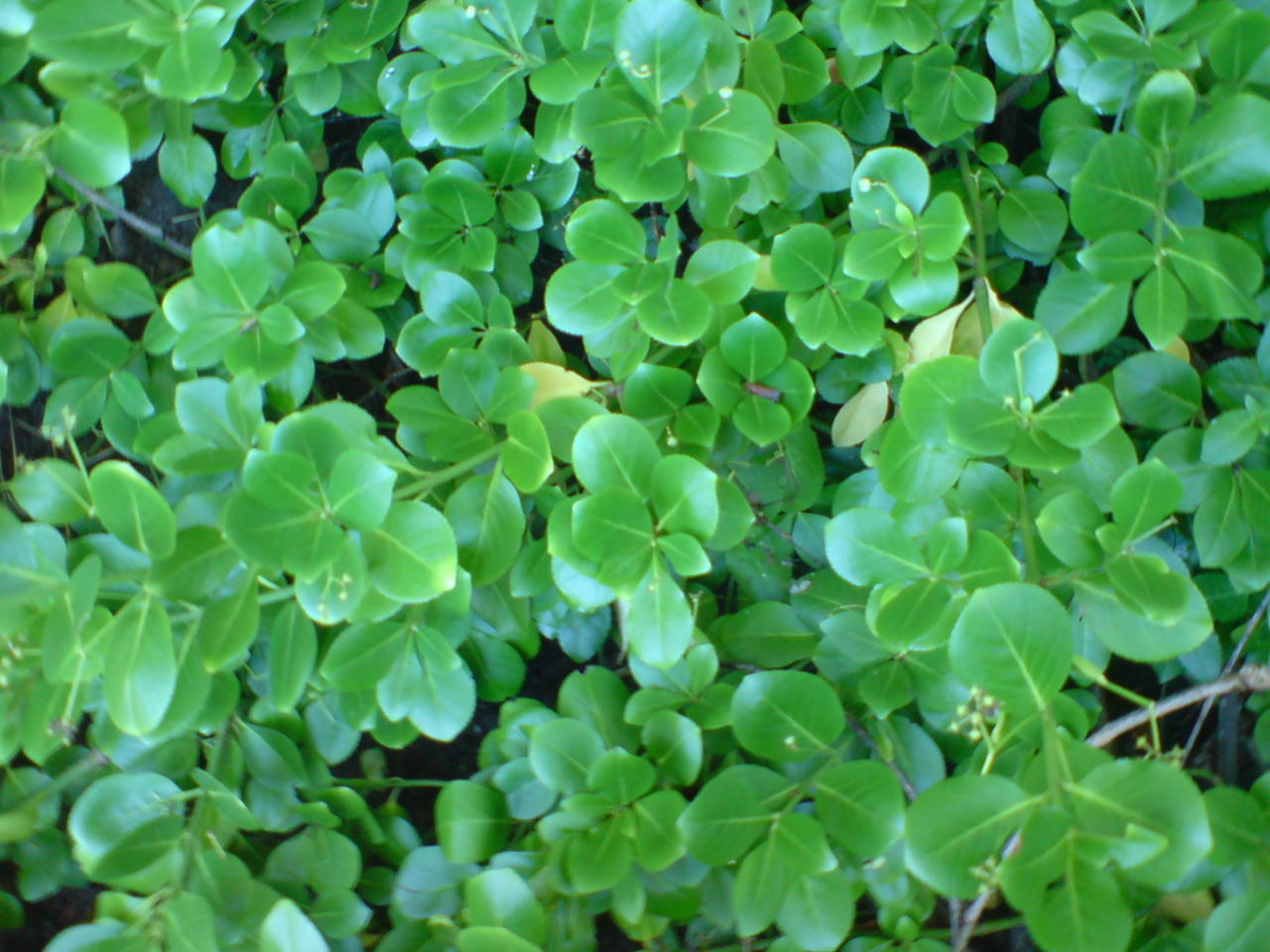
Wintercreeper
Euonymus fortunei
Asian woody vine with semi-evergreen leaves; juvenile form is a low ground-cover, mature form a high climber with small greenish flowers and pink-orange capsules. Aggressive in old yard plantings and adjacent woods.
Status: Introduced; non-native vine.
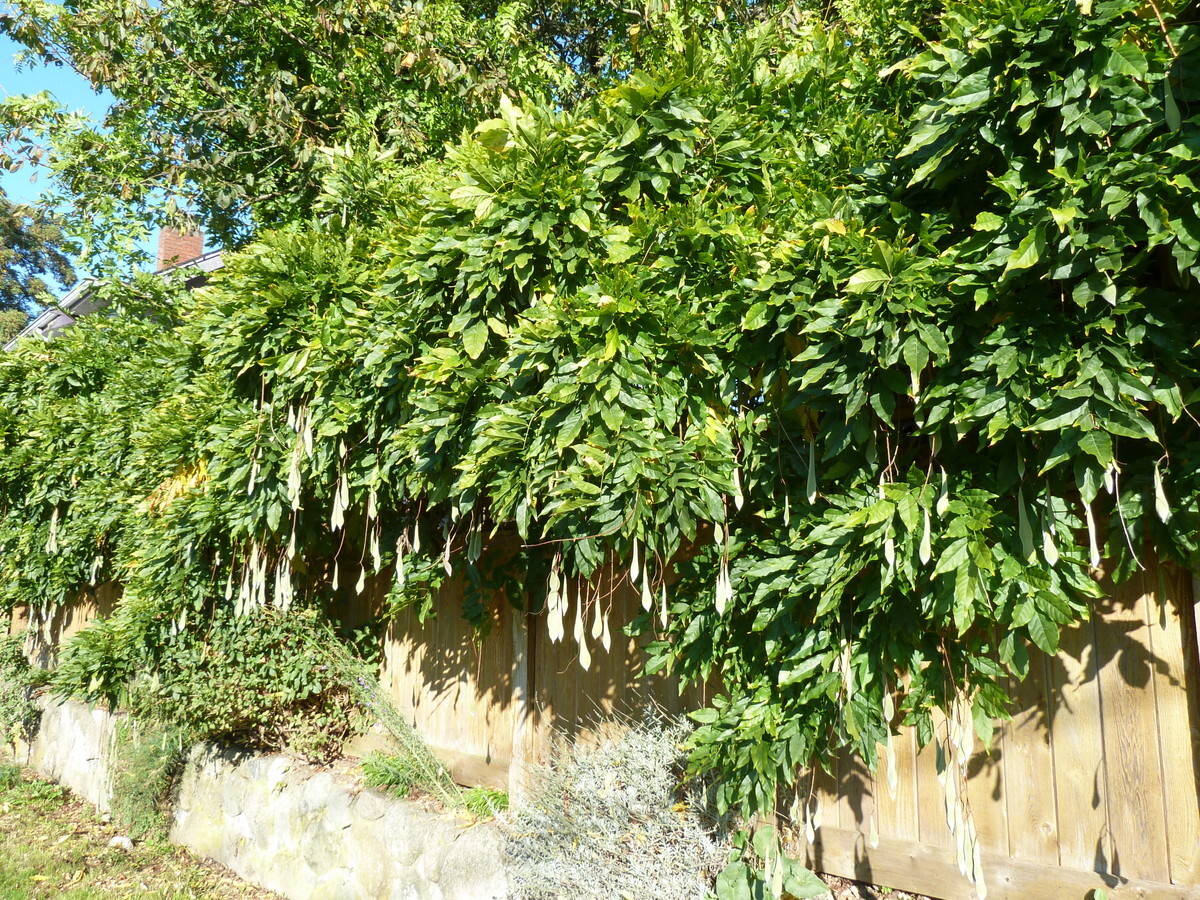
Chinese wisteria
Wisteria sinensis
High-climbing Asian vine with cascading purple flower clusters in early spring before the leaves are fully out. Aggressive seed disperser; wraps and constricts tree trunks. The garden plantings most visitors picture are this species or Japanese wisteria.
Status: Introduced; TN-IPC significant-threat invasive.
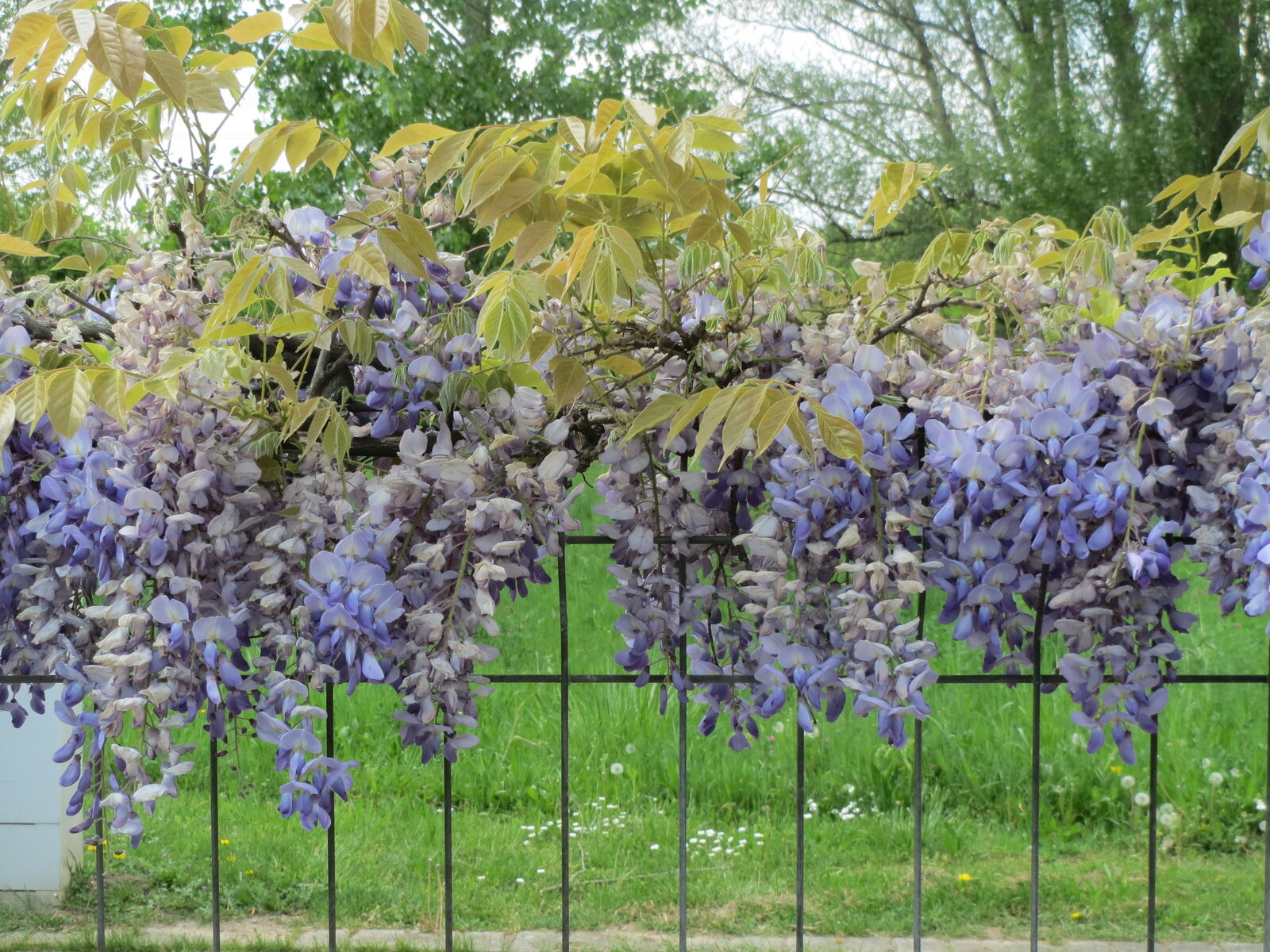
Japanese wisteria
Wisteria floribunda
Like Chinese wisteria but with longer flower clusters and right-handed twining (Chinese twines left). Often hybridizes with Chinese wisteria where both occur.
Status: Introduced; non-native vine.
Wildflowers and woodland forbs
Marion County's wildflower flora, the herbaceous broadleaved forbs, runs to several hundred species across the cove forest, oak-hickory slope, sandstone rim, limestone bluff, river floodplain, and open meadow. The card grid below catalogs the spring-ephemeral and woodland-forb portion: species whose primary habitat is the deciduous-forest understory, from late February openers like bloodroot and the hepaticas through the late-summer cove asters and goldenrods. Open-country, glade, and riparian forbs are filed separately further down the page.
From late February through early May, before the canopy closes, a short-lived wildflower display covers the floor of cove hardwood forests and protected north-facing slopes. The spring ephemerals (bloodroot, the trilliums, Dutchman's breeches, the trout lilies, the toothworts, the spring beauties, and the hepaticas) complete their entire above-ground life cycle in about six weeks. They flower, set seed, and die back before the trees overhead finish leafing out, trading a narrow window of sun for the advantage of going dormant through the dry summer. Most produce ant-dispersed seeds with an oil-rich elaiosome that ants carry into their underground nests, depositing the seeds in nutrient-rich tunnel debris.
The Cumberland Plateau's trillium diversity is one of the floristic signatures of the southern Appalachian region. Eight species are documented in or expected for Marion County, more than the entire flora of most western states. The plateau's deep, intact cove soils, its base-rich limestone exposures along the Tennessee River Gorge, and its long history of light human disturbance combine to support the high count.
Trilliums
Eastern North America has more trillium species than any other continent, and the southern Cumberland Plateau holds one of the richest concentrations on the continent. Eight species are documented in or expected for Marion County, ranging from the abundant sessile-flowered Trillium cuneatum on every cove slope to the rare twisted trillium known from a handful of southern Tennessee bluffscapes. All trilliums share the same three-leaved, three-petaled architecture, but they split into two clades by flower attachment: pedicellate trilliums hold the flower above the leaves on a short stalk, and sessile trilliums plant the flower directly on the leaf whorl. Both clades are slow growers; a seed takes seven to ten years to reach flowering age, and a colony measured in feet may be many decades old. Browsing white-tailed deer can wipe out a local patch in a season, which is one reason trillium populations are concentrated in protected areas like Prentice Cooper State Forest and the Foster Falls escarpment rather than along browsed roadsides.
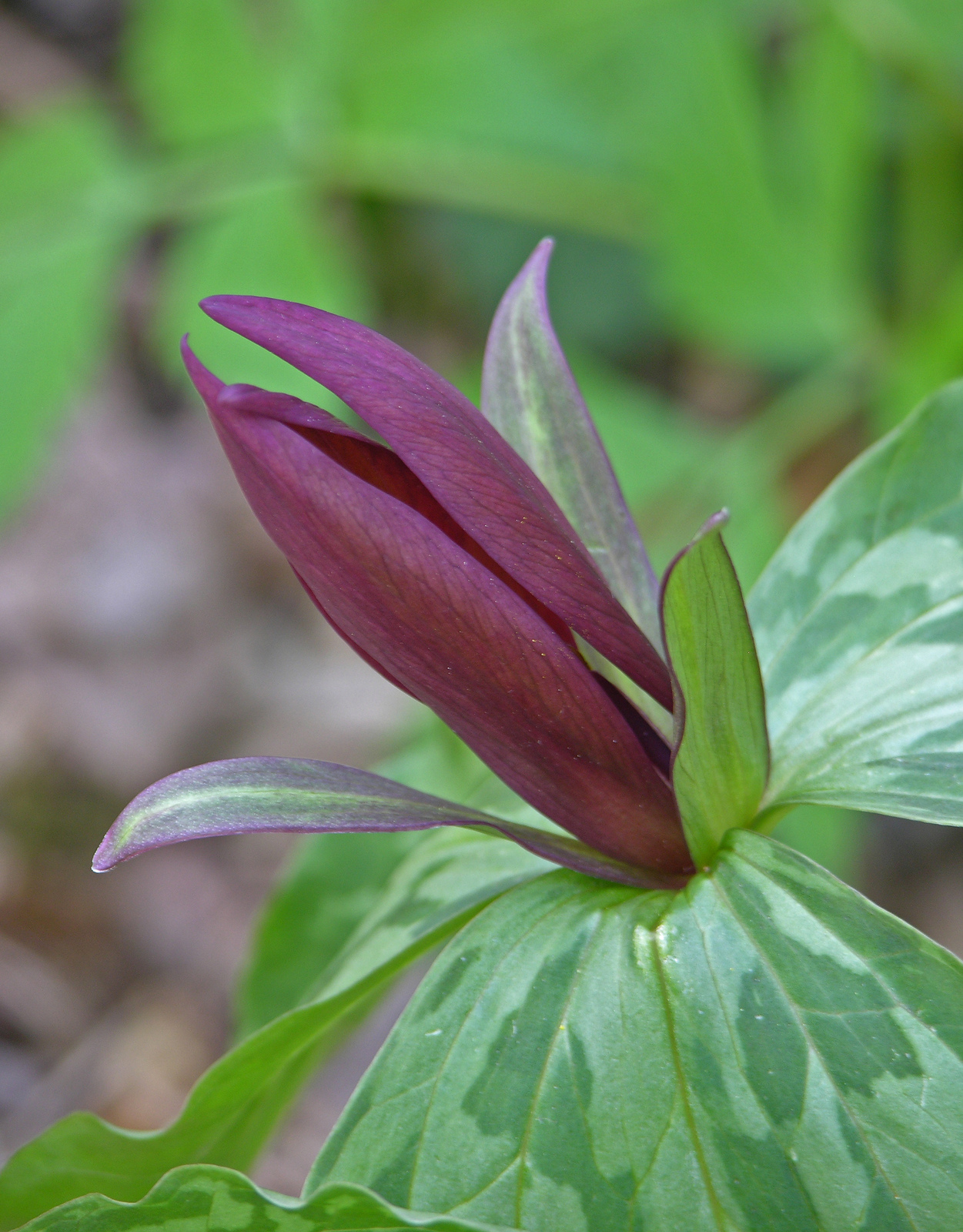
Sweet Betsy
Trillium cuneatum
The most abundant trillium on the southern Cumberland Plateau and in Marion County coves. Three mottled leaves sit flat at the top of a short stem with a stemless dark-red flower tucked into the leaf whorl. Crush a leaf and it gives off a faint watermelon scent, which is the easiest field cue separating sweet Betsy from other sessile trilliums.
Status: Native; common, widespread on cove slopes.
Large-flowered trillium
Trillium grandiflorum
Three pure-white petals held above the leaves on a short flower stalk in April and early May. Petals turn pink as they age, often with the whole colony fading to rose at once. Less abundant than sweet Betsy but conspicuous in rich cove soils where it does occur.
Status: Native; widespread in rich coves.
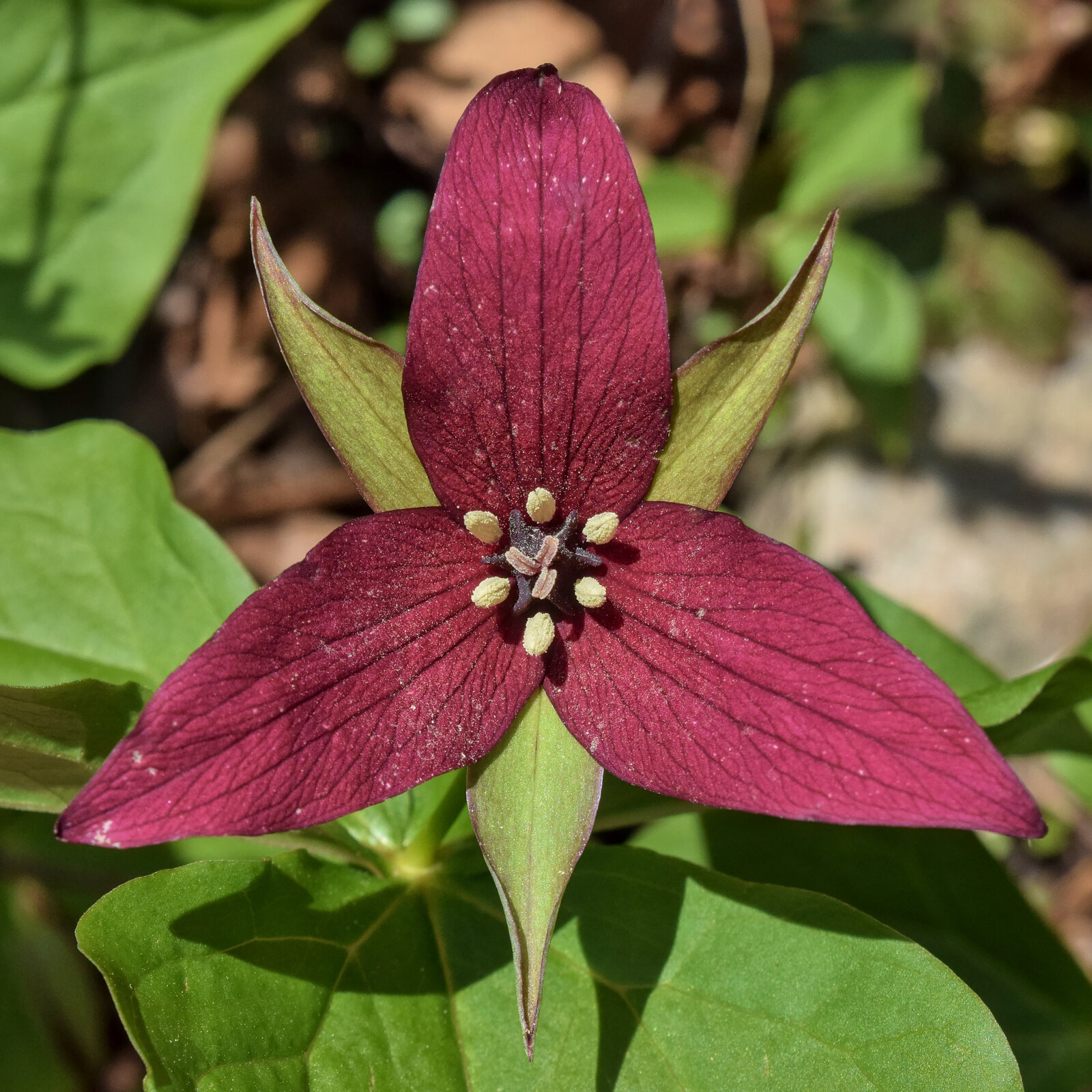
Red trillium
Trillium erectum
Also called wake robin or stinking Benjamin, the maroon-flowered pedicellate trillium of the cove forest. The flower is fly-pollinated and emits a faint scent of rotten meat to attract carrion flies, which is more noticeable in still air. Less abundant in Marion than the white-flowered T. grandiflorum.
Status: Native; less common, scattered.
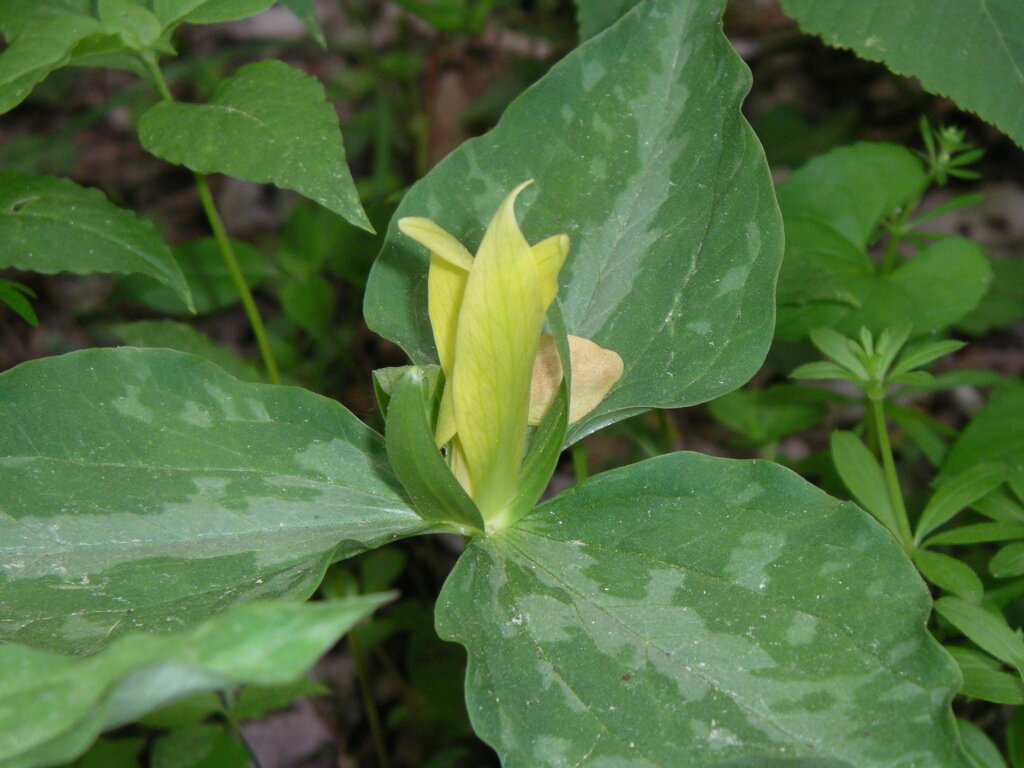
Yellow trillium
Trillium luteum
A sessile trillium with a stemless yellow flower and pale-green mottled leaves. The crushed-leaf scent is more strongly lemon than the watermelon of T. cuneatum. Patchy distribution in Marion; favors limestone-influenced cove slopes.
Status: Native; locally distinctive.
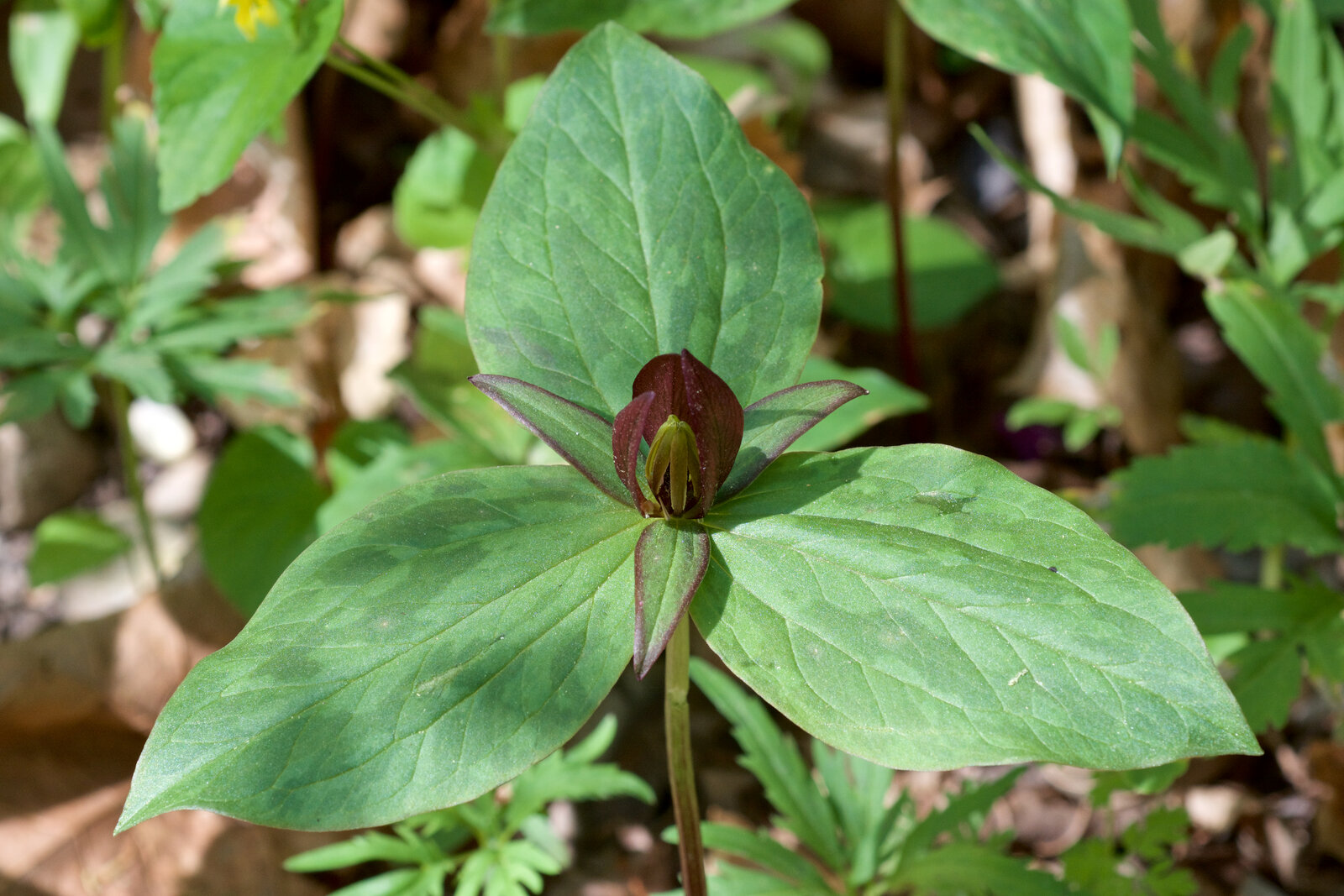
Sessile trillium
Trillium sessile
A small sessile trillium with a stemless purple-brown flower whose petals stand erect rather than spreading flat. Easy to confuse with sweet Betsy, but the sessile flower is shorter, the leaves less prominently mottled, and the petals more strictly upright.
Status: Native; uncommon.
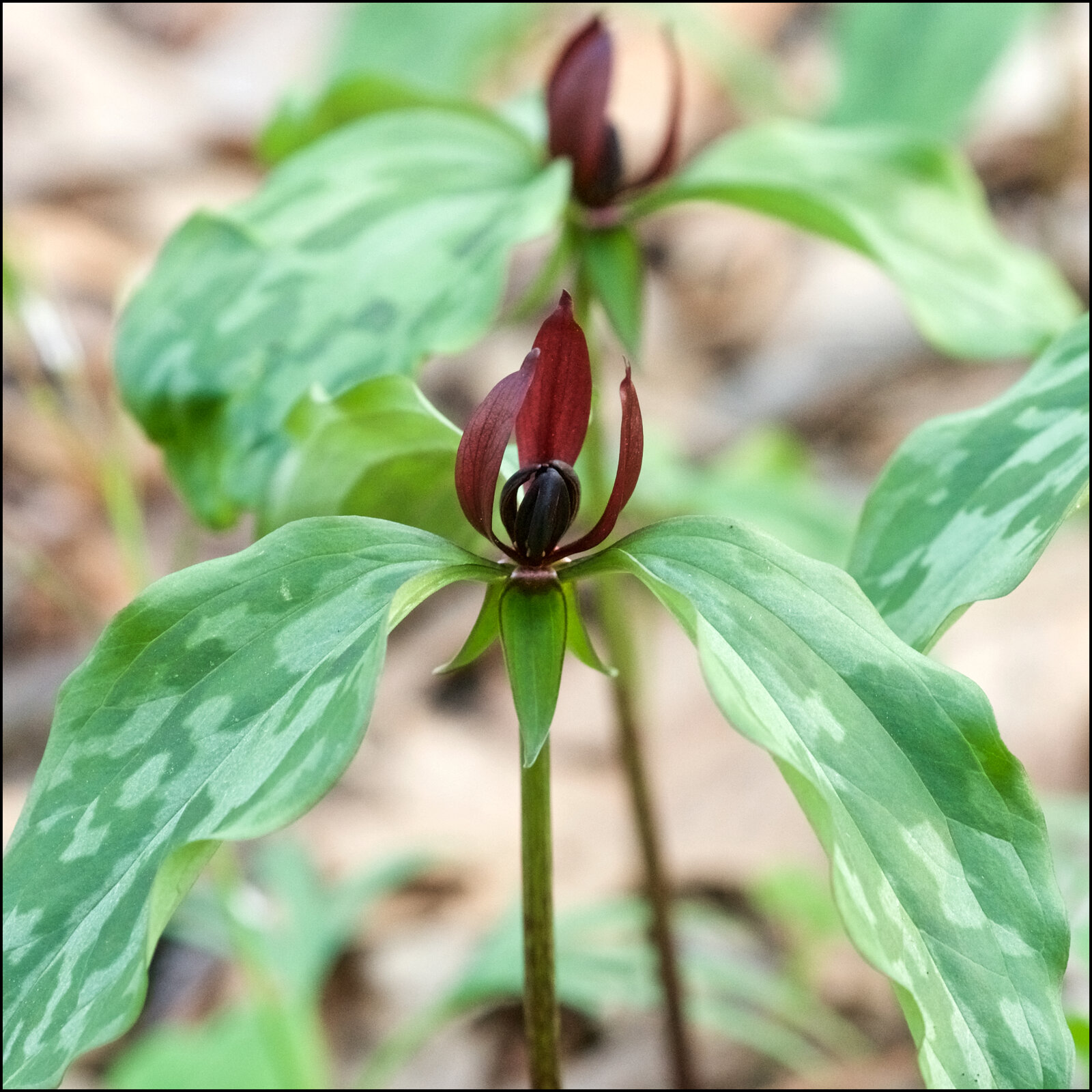
Prairie trillium
Trillium recurvatum
A sessile trillium of limestone-influenced woodlands, named for its sharply down-curved (recurved) sepals that bend back away from the dark-red petals. The leaves sit on short petioles rather than flat against the stem, which separates it from the more common sweet Betsy.
Status: Native; locally distinctive on calcareous soils.
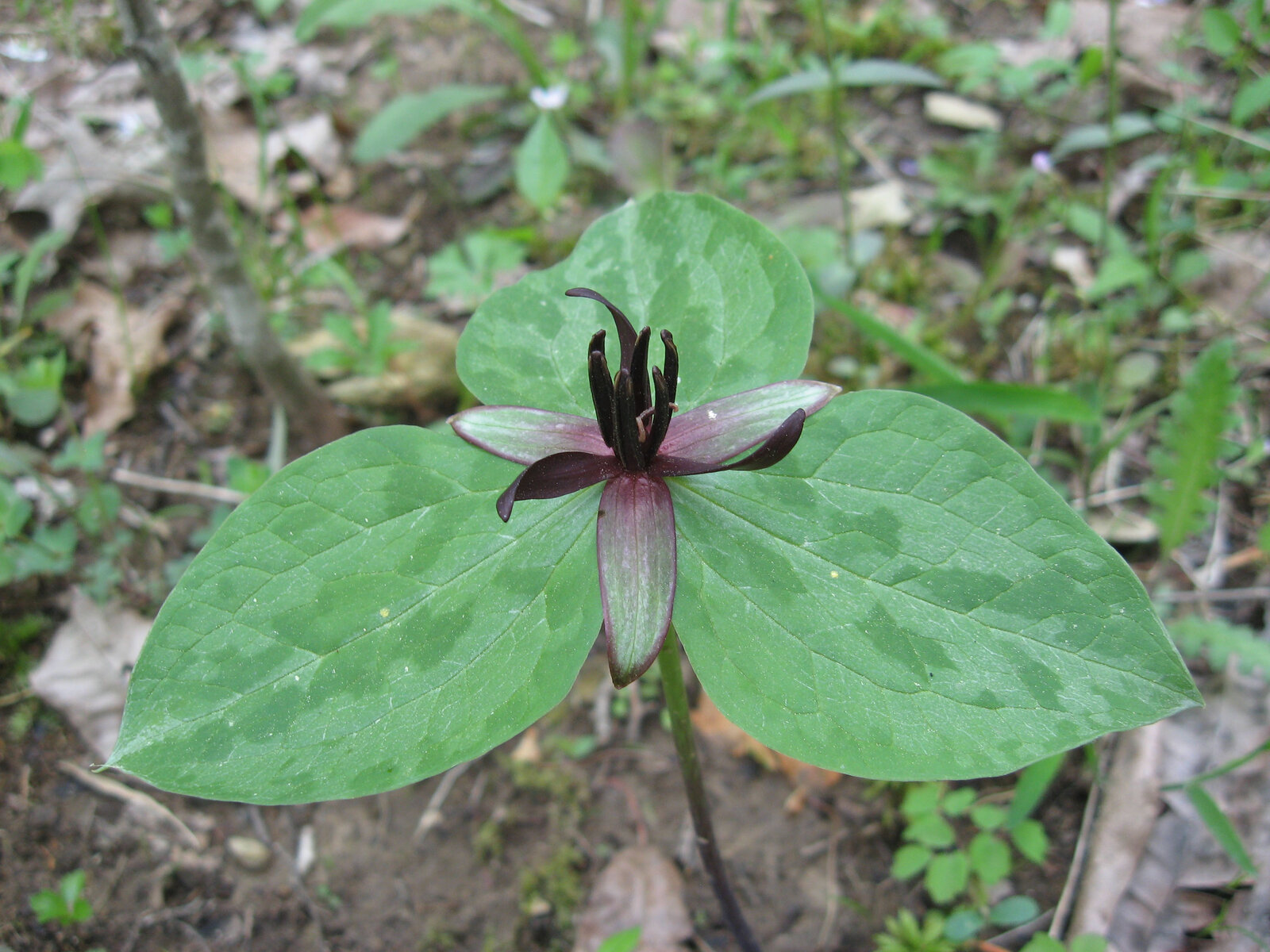
Twisted trillium
Trillium stamineum
A regional rarity of southern Tennessee, named for the spirally twisted maroon petals that distinguish it instantly from any other trillium. Restricted to a narrow band of the southern Cumberland Plateau and adjacent Highland Rim. Marion County is at the northern edge of its documented range.
Status: Native; rare, locally distinctive.
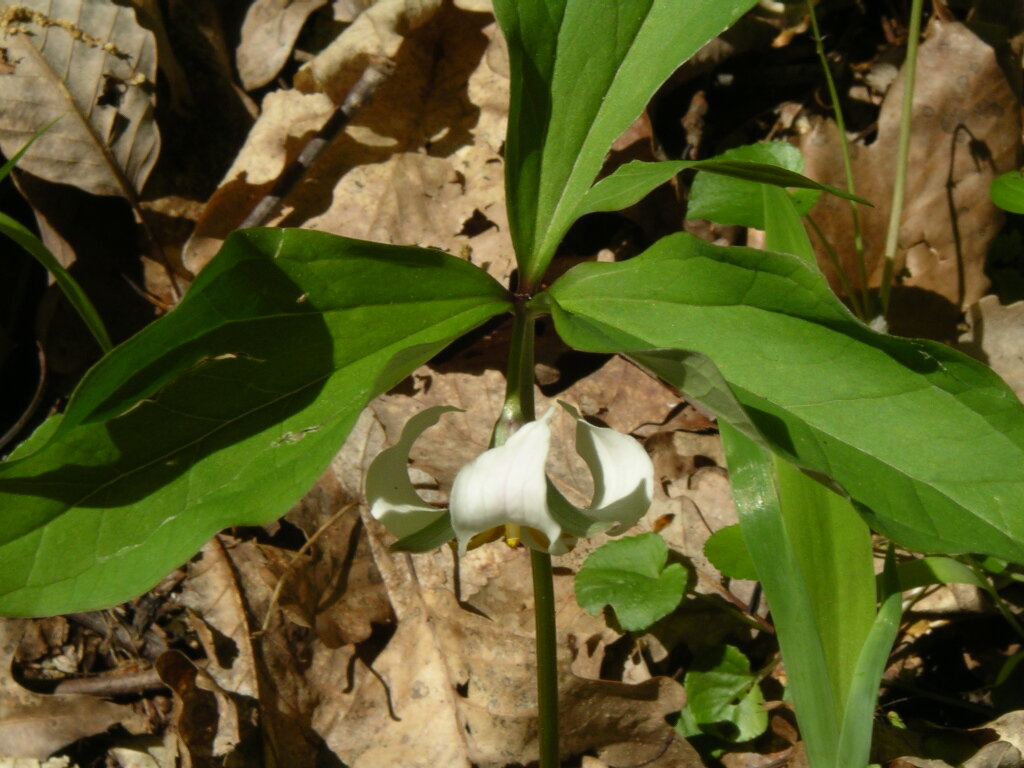
Catesby's trillium
Trillium catesbaei
A pedicellate trillium of the southeastern uplands, named for the eighteenth-century naturalist Mark Catesby. The pink-flushed flower nods below the leaves on a recurved stalk, which gives the species its other folk name, bashful wakerobin. Documented in the southern Plateau region; uncommon but worth looking for in pine-oak-heath margins.
Status: Native; uncommon, regionally distinctive.
Lilies, bellworts, and trout lilies
The lily-allied monocots of the woodland floor follow a similar architecture to trilliums: parallel-veined leaves, three-merous flowers, and bulbs or rhizomes that store energy through the dry summer dormancy. Trout lilies and Solomon's seal allies sit alongside the true lilies in this group; orchids and iris are filed elsewhere on the page. Bellworts (Uvularia) and yellow mandarin (Prosartes) hold the same drooping yellow-bell flower architecture in early spring; the differences come down to leaf attachment and stem branching. Indian cucumber root (Medeola) breaks the pattern with two whorls of leaves stacked on a single stem, the lower whorl wider and the upper whorl smaller.
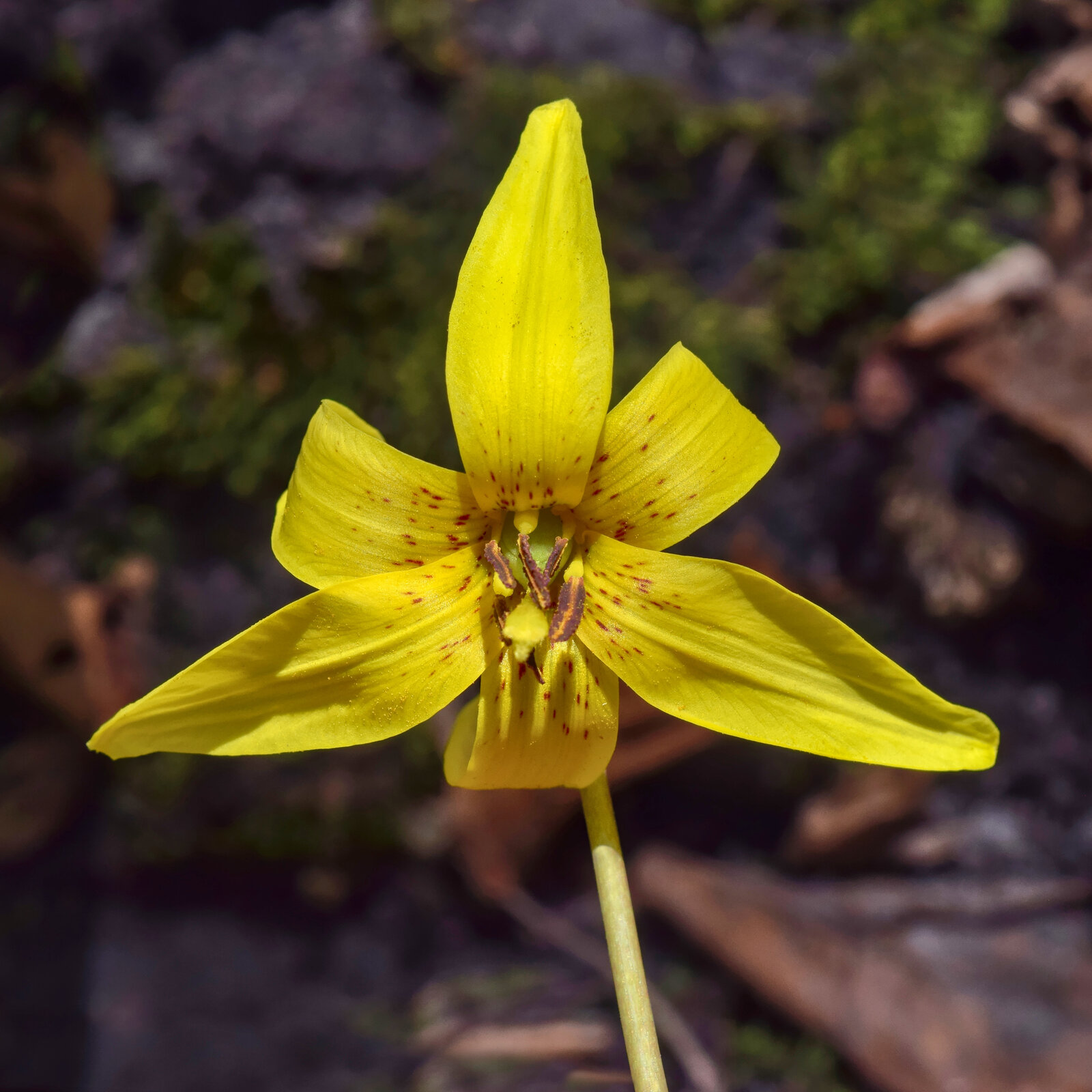
Yellow trout lily
Erythronium americanum
Named for the brown and green mottling on the paired leaves rather than the yellow nodding flower. An established trout lily colony can be many decades old, spreading slowly by underground corms rather than by seed; only a small fraction of the leaves in any patch are flowering plants in a given year.
Status: Native; common in cove forests.
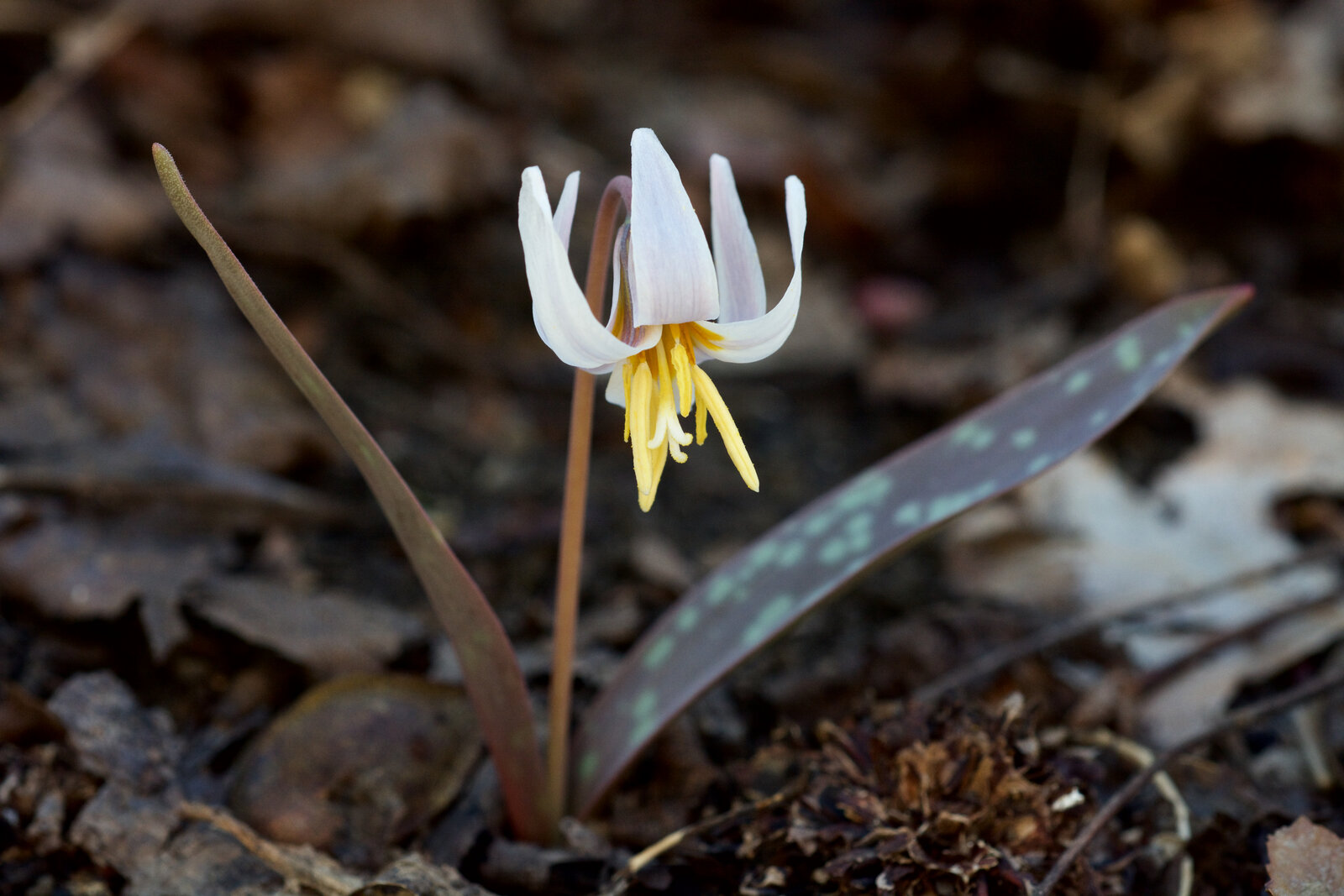
White trout lily
Erythronium albidum
The white-flowered counterpart of the yellow trout lily, less abundant in Marion than E. americanum but documented on calcareous slopes and floodplain edges. Like the yellow species, it forms slow-spreading colonies dominated by single-leaf non-flowering plants.
Status: Native; less common; calcareous-leaning sites.
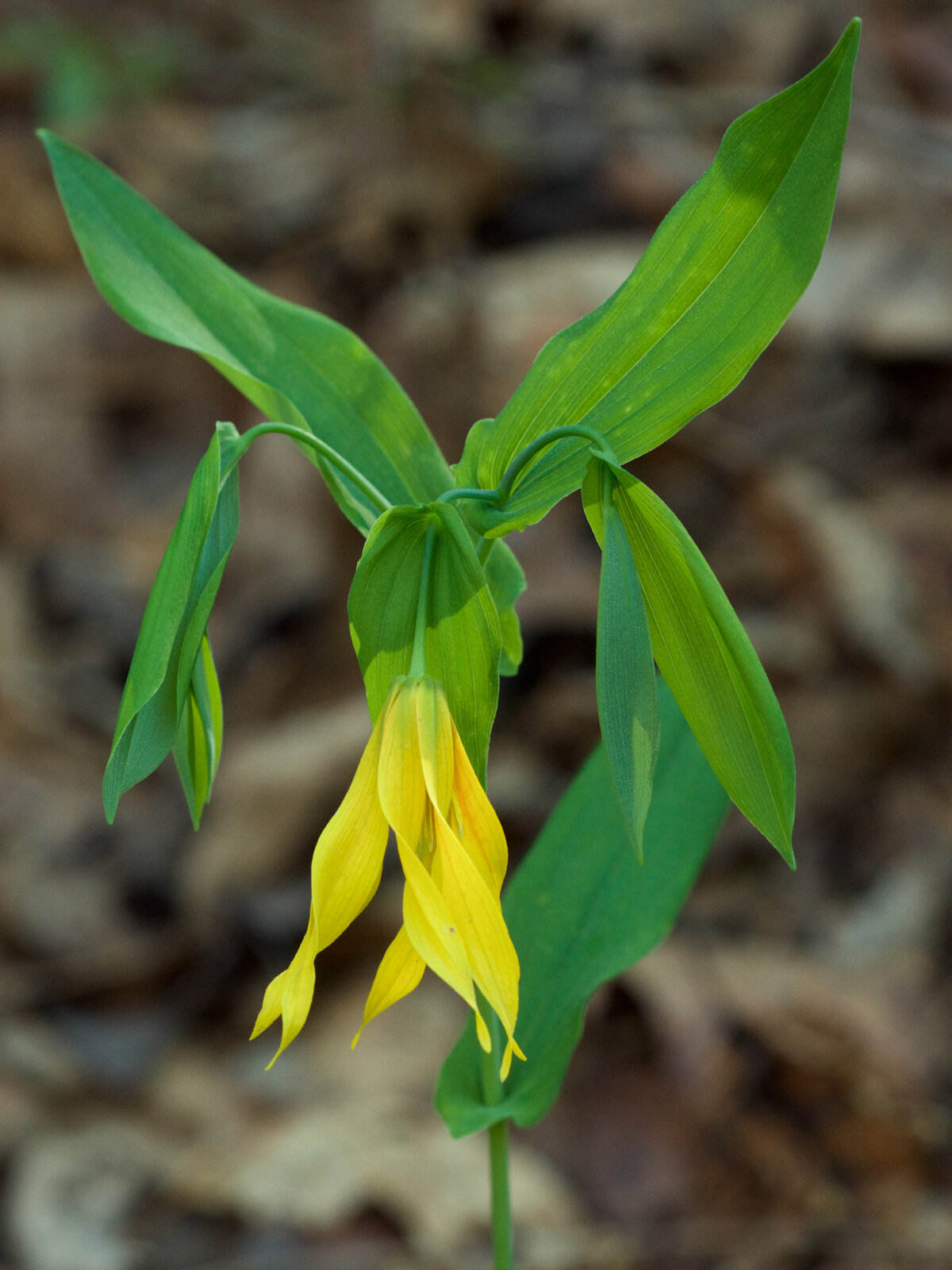
Large-flowered bellwort
Uvularia grandiflora
A rich-cove forb with twisted yellow petals hanging like a bell from a smooth, perfoliate stem (the leaves wrap around the stem so that the stem appears to pierce them). The largest-flowered of the Marion bellworts; favors limestone-influenced and base-rich cove soils.
Status: Native; locally distinctive.
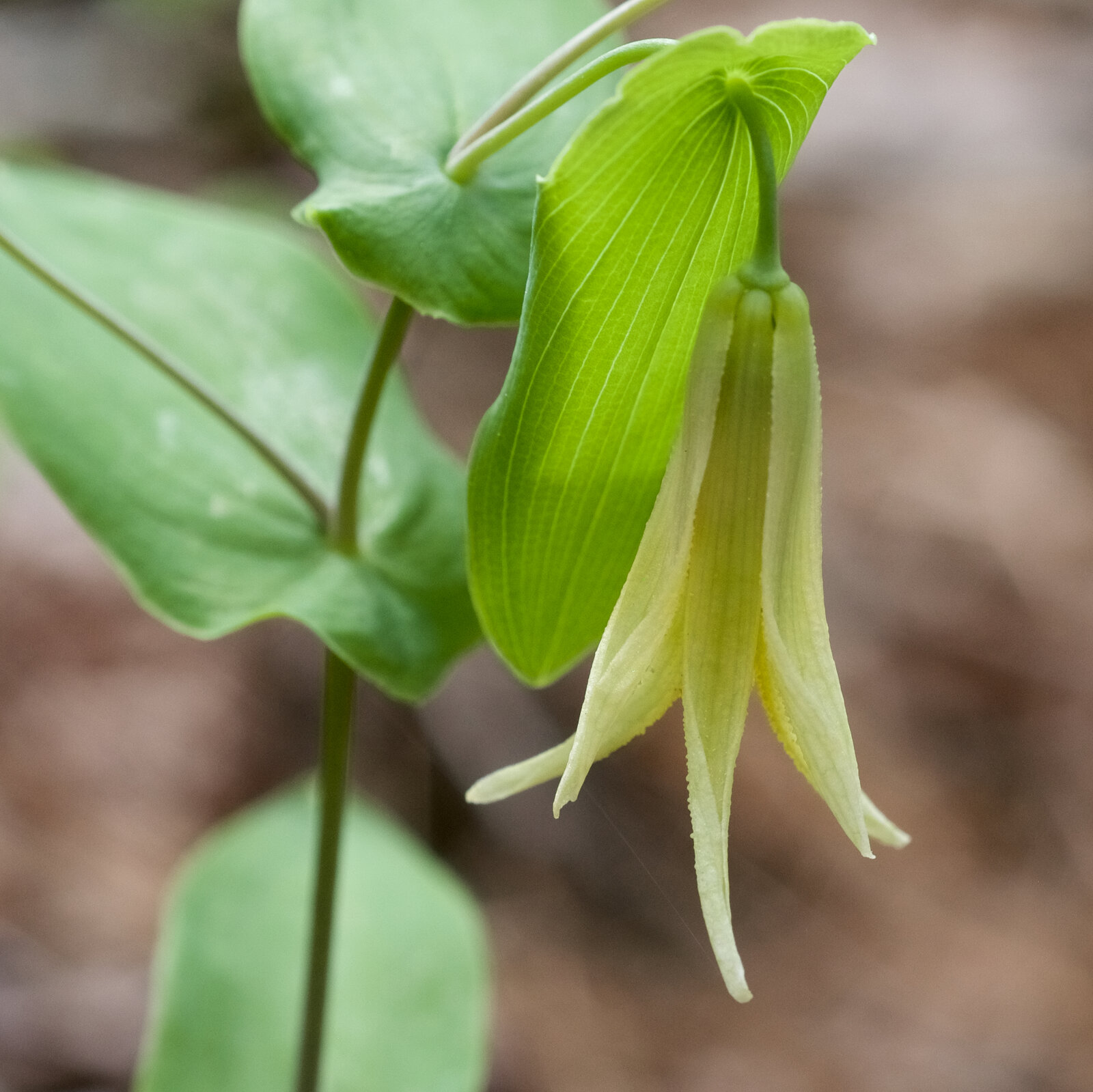
Perfoliate bellwort
Uvularia perfoliata
Similar architecture to U. grandiflora but smaller, with paler lemon-yellow flowers and tepals dotted with small orange granules on the inner surface. The perfoliate leaves and forking stem are diagnostic. More widely distributed than the large-flowered bellwort across acid plateau soils.
Status: Native; common in plateau forests.
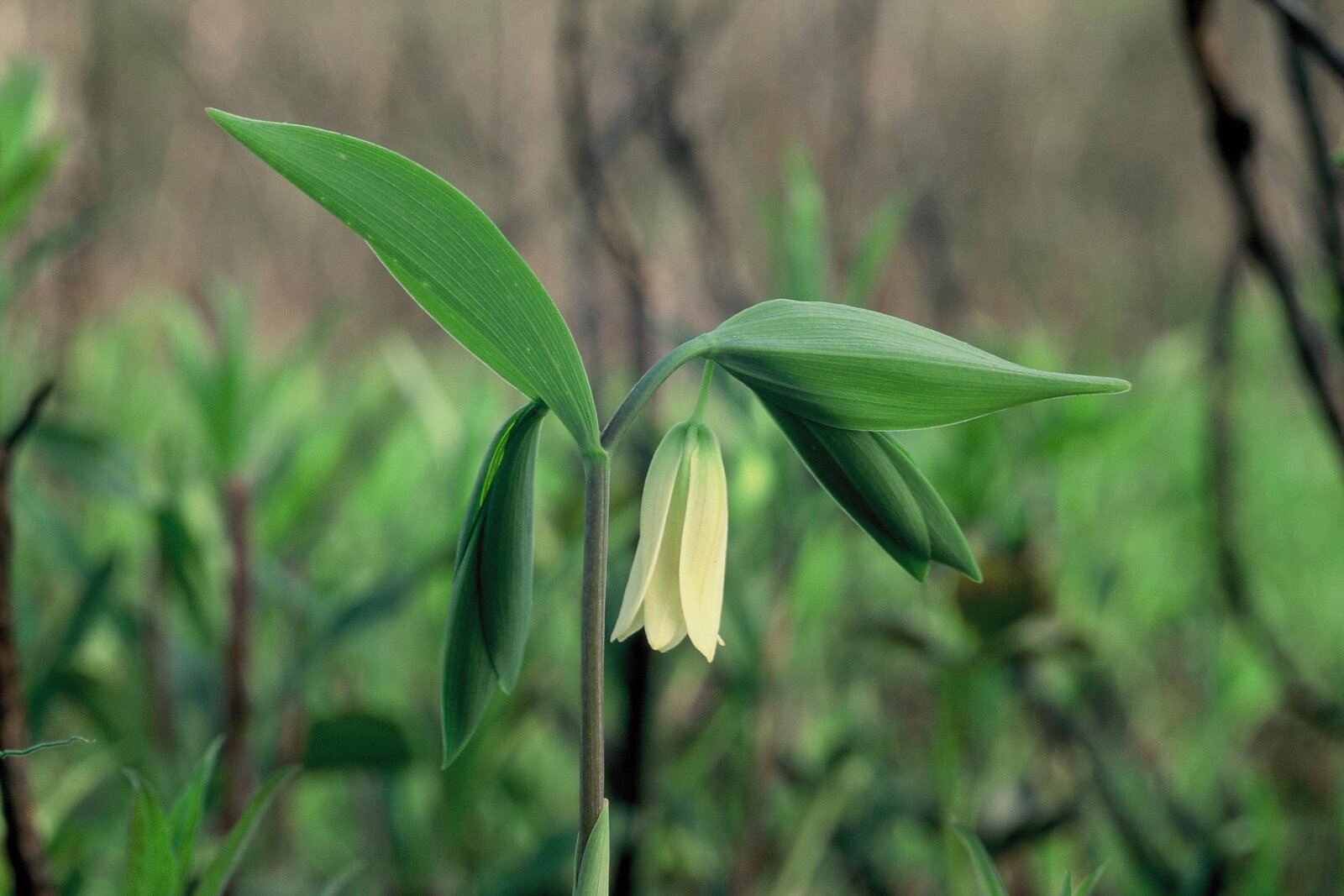
Wild oats
Uvularia sessilifolia
The smallest of the Marion bellworts. Sessile (not perfoliate) leaves are the easy ID, along with the smaller pale-yellow flowers held singly at the stem ends. Forms loose colonies on acid plateau soils.
Status: Native; common in plateau cove forests.
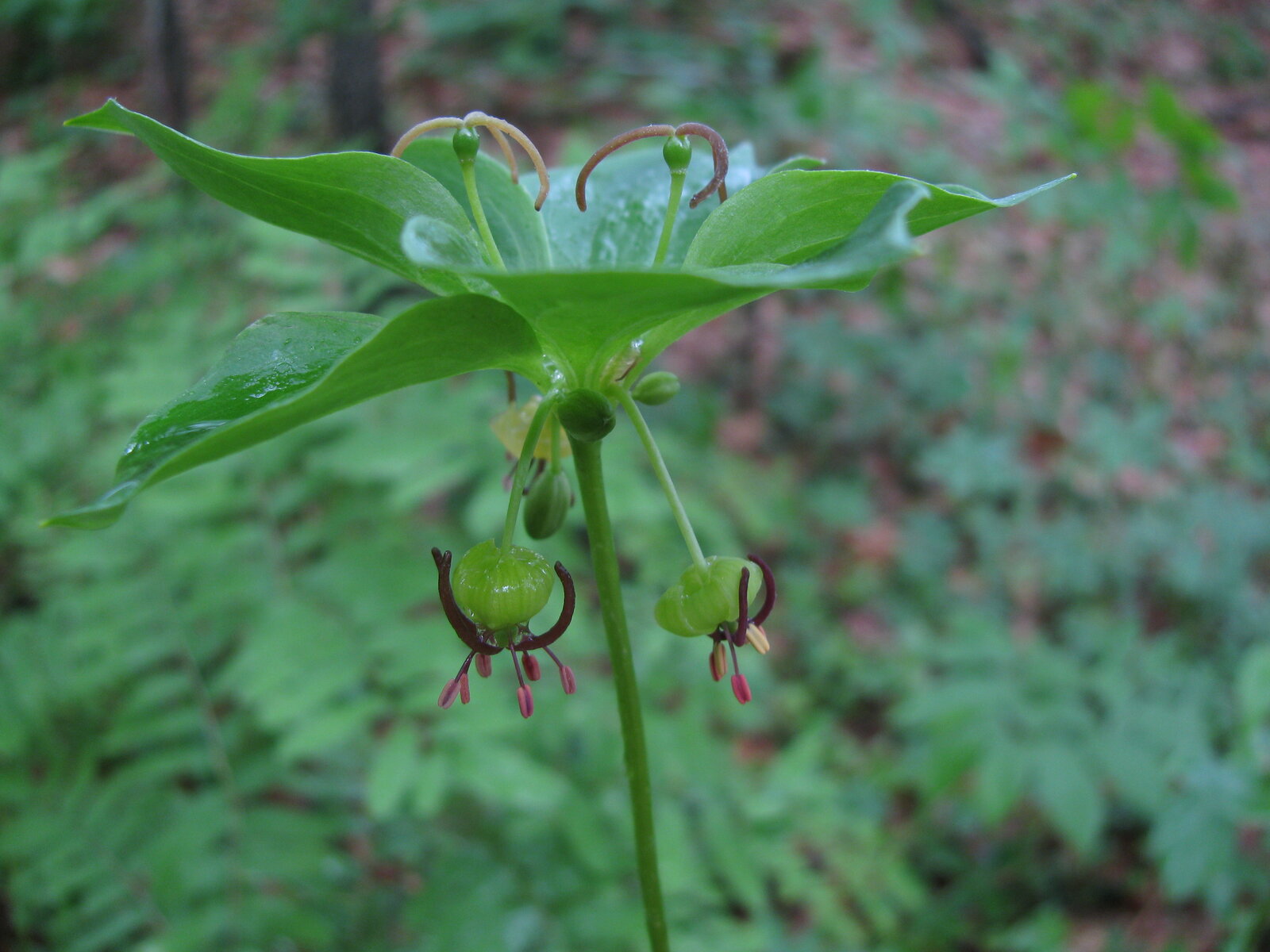
Indian cucumber root
Medeola virginiana
Distinctive two-tier architecture: a wider lower whorl of five to nine leaves and a smaller upper whorl of three. Small yellow-green flowers in May give way to dark-purple berries above the upper whorl in late summer. The white rhizome has a faint cucumber taste, the source of the common name; not harvested today because the plant is slow to recolonize.
Status: Native; uncommon; rich cove soils.
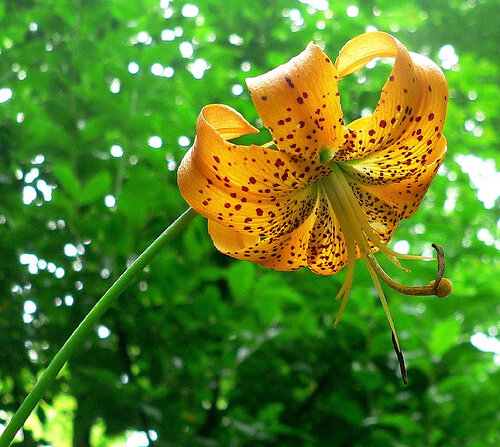
Turk's-cap lily
Lilium superbum
One of the showiest summer wildflowers in the eastern uplands. Stems can reach six to eight feet on rich seep soils, holding pyramidal clusters of orange-and-spotted flowers whose petals curve all the way back to touch the stem (the Turk's cap shape). Less abundant in Marion than in the Smoky Mountains but documented on damp cove margins.
Status: Native; uncommon; damp cove margins.
Bloodroot, mayapple, and the woodland poppies
The Papaveraceae and the closely allied Berberidaceae contribute three of the most recognizable woodland forbs on the Cumberland Plateau: bloodroot, with its red rhizome sap; the celandine poppy, with deeply lobed leaves and four-petaled yellow flowers; and mayapple, technically a barberry-family plant but conventionally grouped here with the early-spring cove forbs. Toxic alkaloids dominate the chemistry of all three; bloodroot's sanguinarine, mayapple's podophyllotoxin (the precursor to the chemotherapy drug etoposide), and the celandine poppy's chelidonine are the reason livestock and most insects leave them alone.
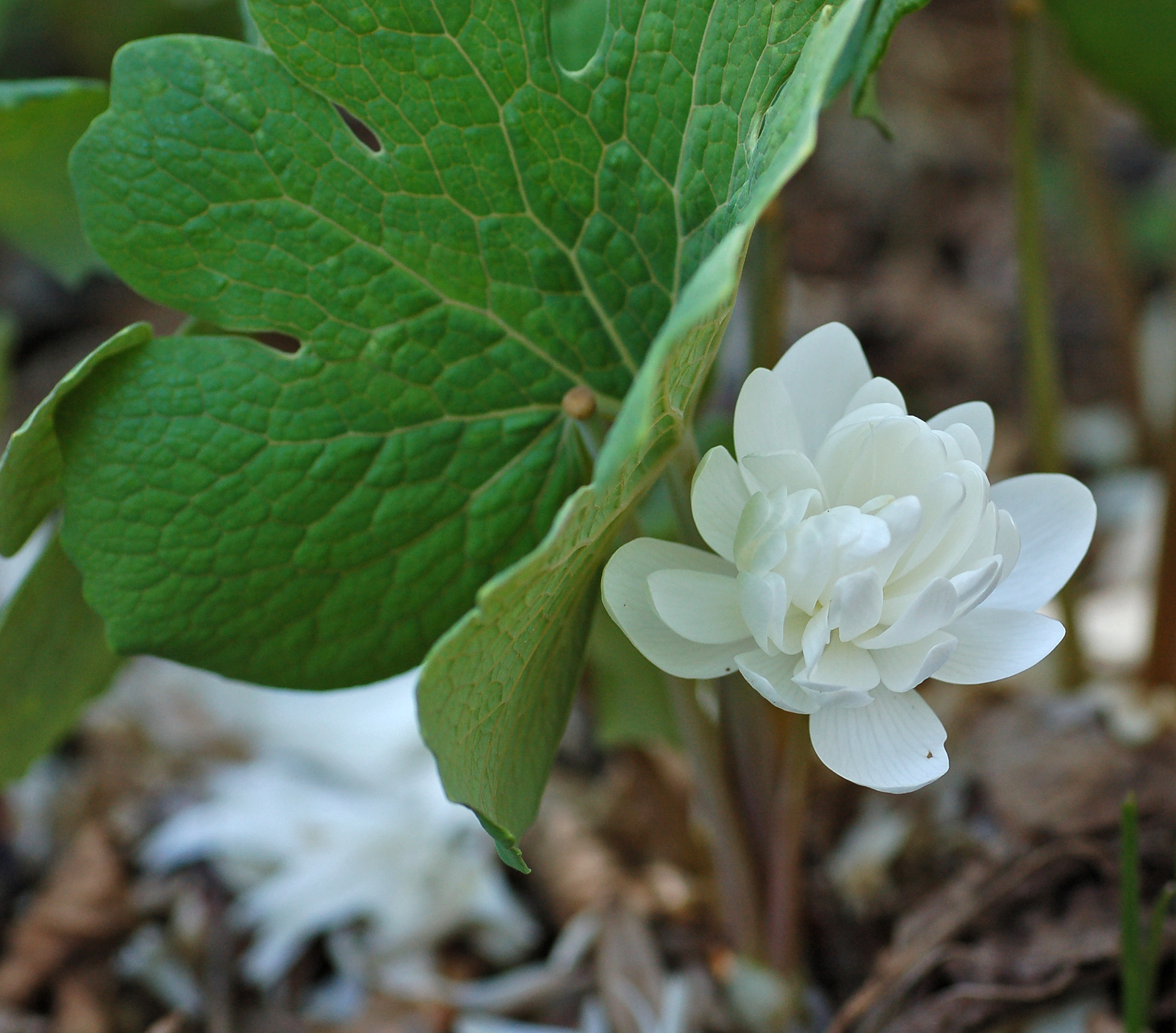
Bloodroot
Sanguinaria canadensis
Often the earliest conspicuous bloomer in Marion coves, sometimes opening in late February during warm spells. A single white flower with eight to twelve petals sits above a deeply lobed, bluish-green leaf that wraps around the flower stem like a shawl. Break the rhizome and the bright red-orange sap that gives the plant its name bleeds out; the sap contains sanguinarine, a toxic alkaloid, and should not be used casually despite the plant's historical role in folk medicine.
Status: Native; common in coves.
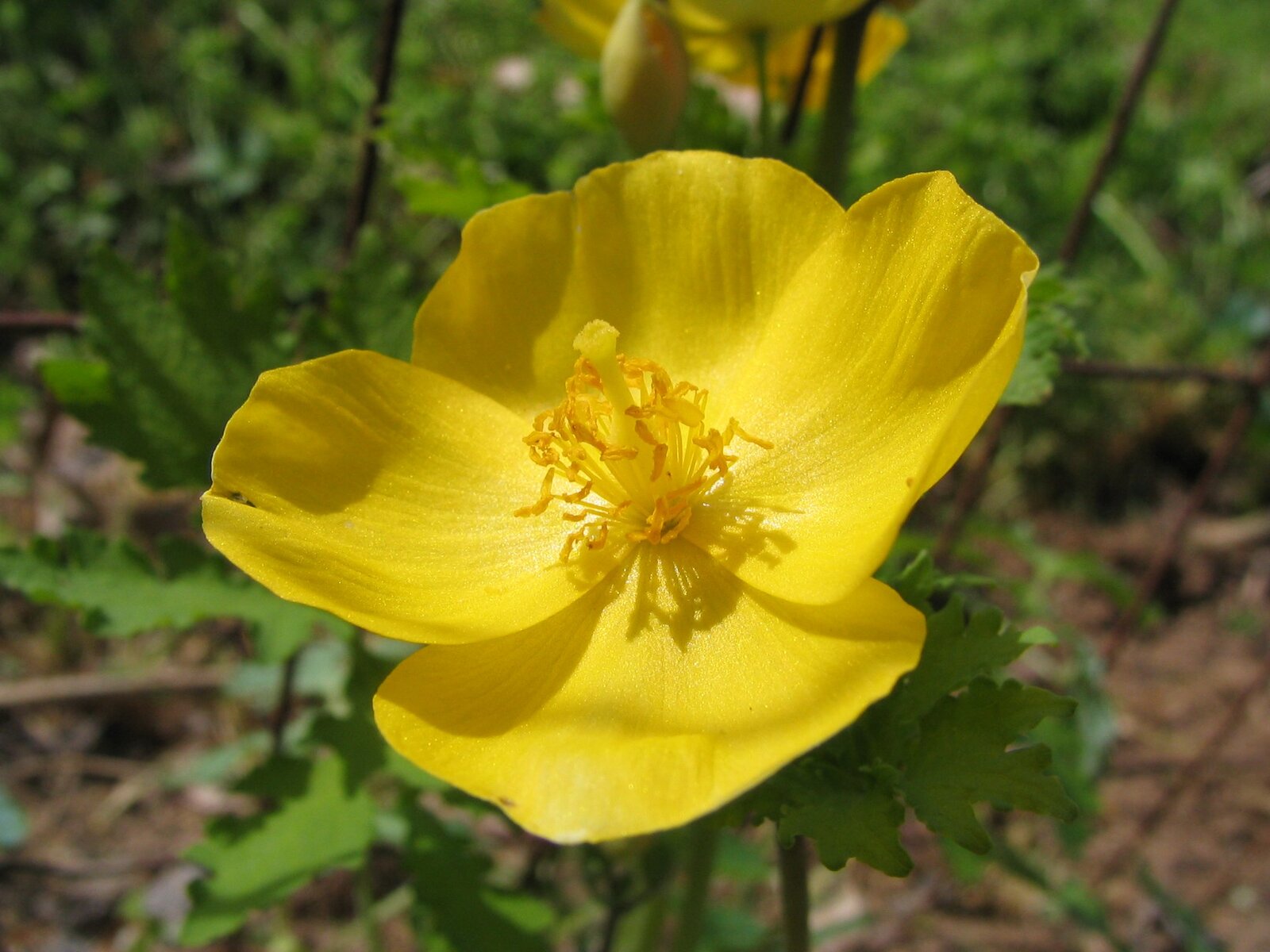
Celandine poppy
Stylophorum diphyllum
A rich-cove forb with four-petaled yellow flowers in April and May above blue-green, deeply lobed leaves. The yellow-orange sap is the easy field cue separating it from buttercups (which have the same flower color but a different leaf and no colored sap). Locally abundant in seepy cove drainages on limestone-influenced soils.
Status: Native; locally distinctive.
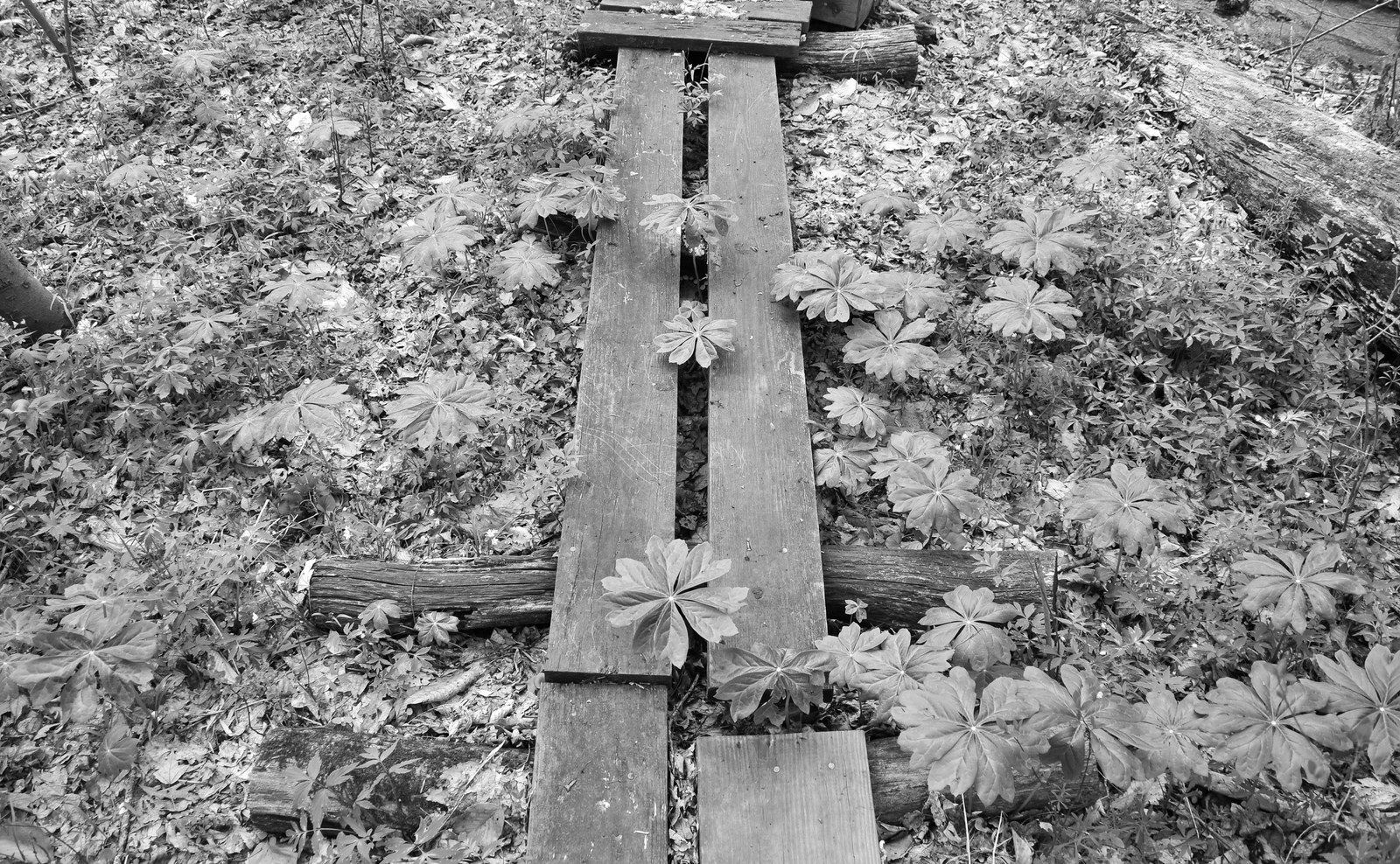
Mayapple
Podophyllum peltatum
Not a true ephemeral, since the paired umbrella leaves stay green into midsummer. Bursts from the ground in mid-April and hides a single white flower beneath its twin leaves. The yellow fruit that follows is the only part of the plant that is not strongly toxic; the rest contains podophyllotoxin, a compound later developed into the cancer chemotherapy drug etoposide.
Status: Native; abundant; forms dense colonies.
Dutchman's breeches and squirrel corn
The two Dicentra species of the cove forest are easy to confuse from leaf alone: both have finely divided ferny foliage that emerges in early April and fades by late May. But the flower architecture is unmistakable once they bloom. Both are now placed in the poppy family Papaveraceae (formerly the bleeding-heart family Fumariaceae), and both produce ant-dispersed seeds with an oil-rich elaiosome that ants carry into their underground nests, depositing the seeds in nutrient-rich tunnel debris.
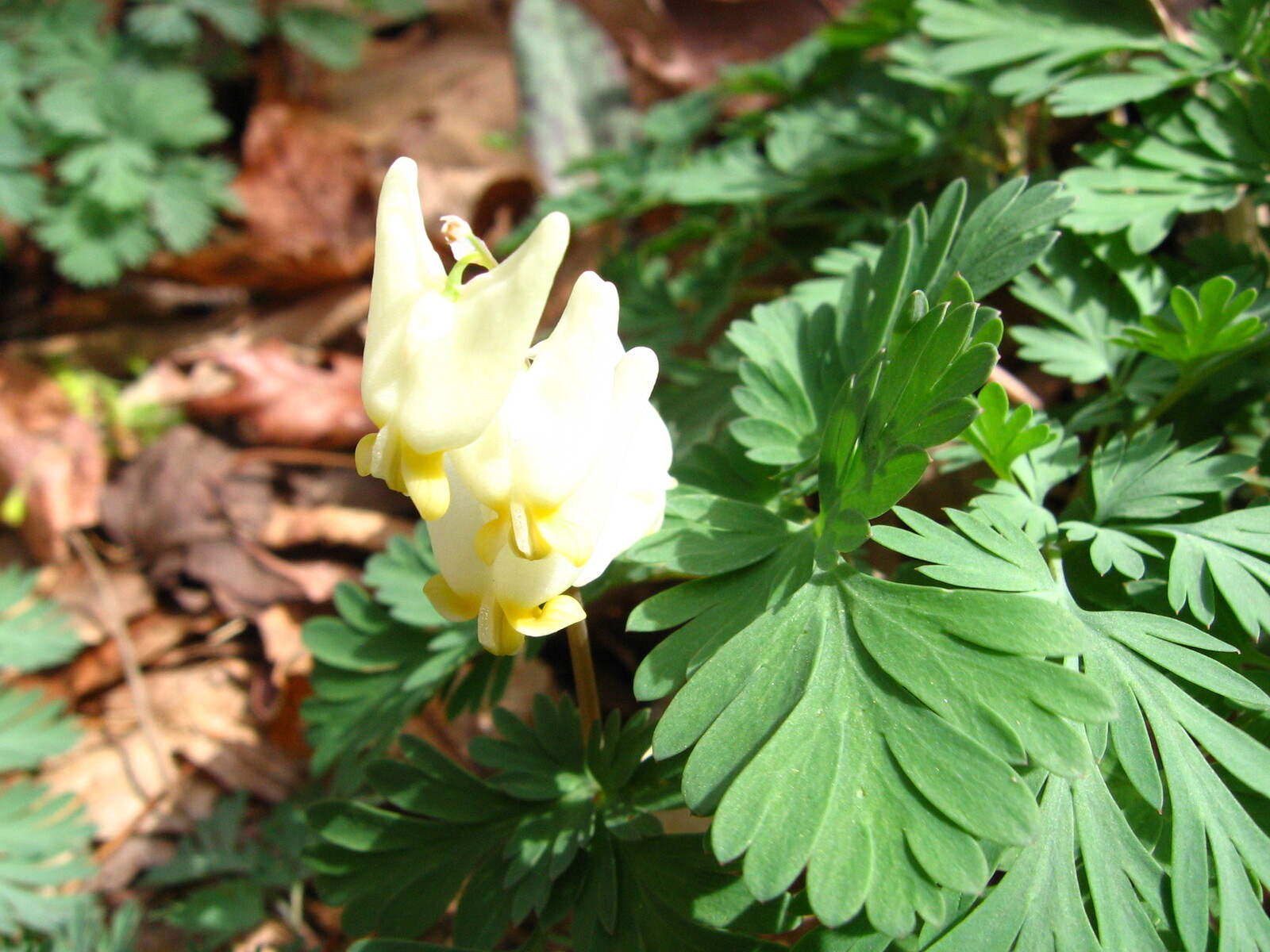
Dutchman's breeches
Dicentra cucullaria
Pairs of white, pantaloon-shaped flowers hang along a slender arching stalk over finely divided, ferny leaves. The flower's two outer petals form the trouser legs and a third forms the waistband. Pollinated almost exclusively by long-tongued bumblebees that can reach the nectar at the top of the spurs.
Status: Native; common in rich coves.
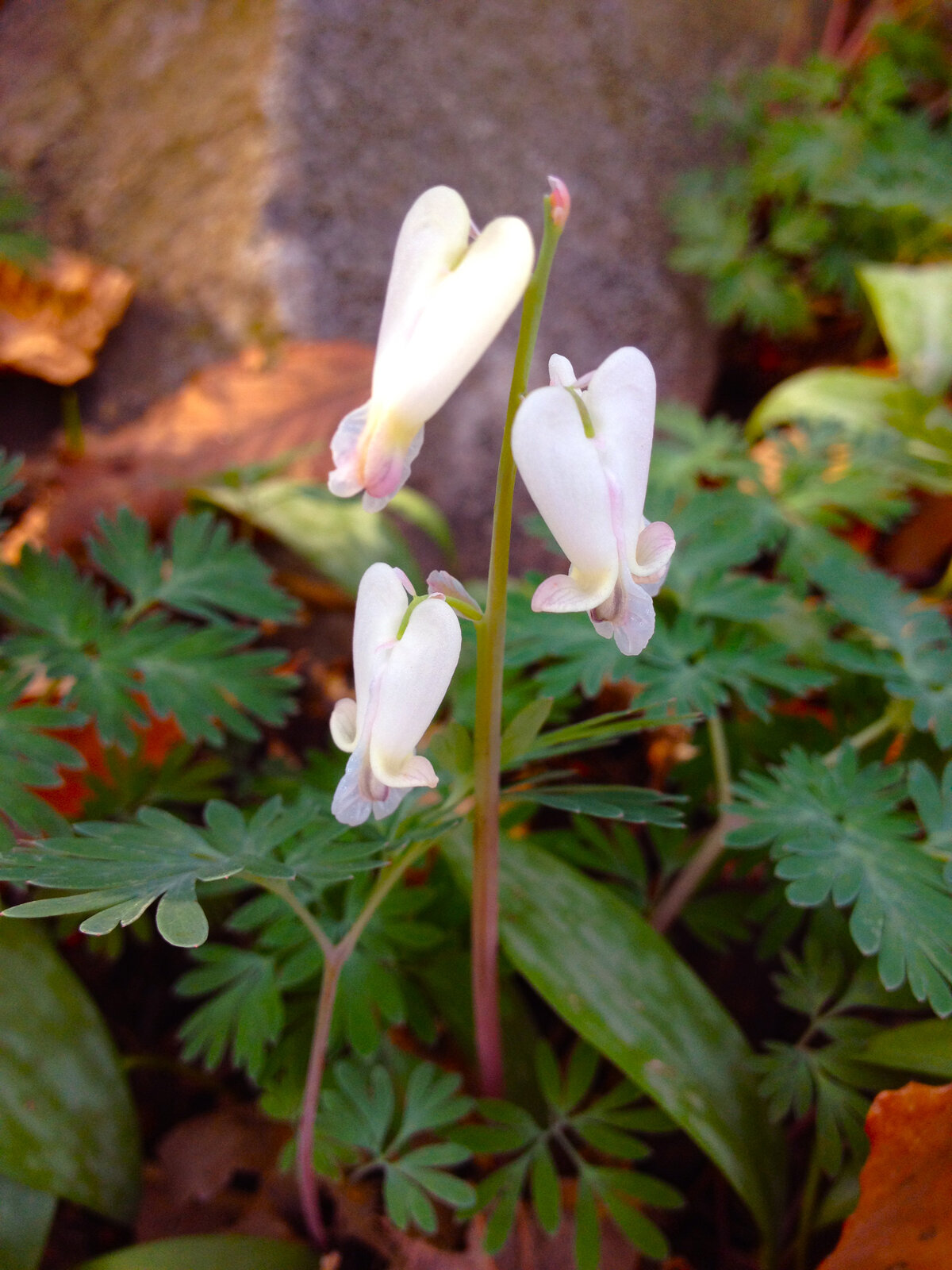
Squirrel corn
Dicentra canadensis
Grows alongside Dutchman's breeches in the same rich cove soils but blooms a week or two later and has more rounded, heart-shaped white flowers with a faint hyacinth scent. The common name comes from underground tubers that look like kernels of corn. Less abundant than the breeches in Marion; favors the wettest pockets of rich cove forest.
Status: Native; uncommon; rich cove pockets.
Toothworts and the early-spring mustards
Toothworts (Cardamine, formerly Dentaria) are members of the mustard family that bloom in early to mid-April under the still-bare canopy. The four white petals arranged in a cross are the family signature; the species split out by leaf shape, with cutleaf toothwort holding three deeply lobed leaflets in a single whorl, slender toothwort holding paired three-leaflet basal leaves, and broadleaf toothwort holding wider, less deeply lobed leaflets. All four Marion toothworts are native and most are confirmed in the county Atlas record.
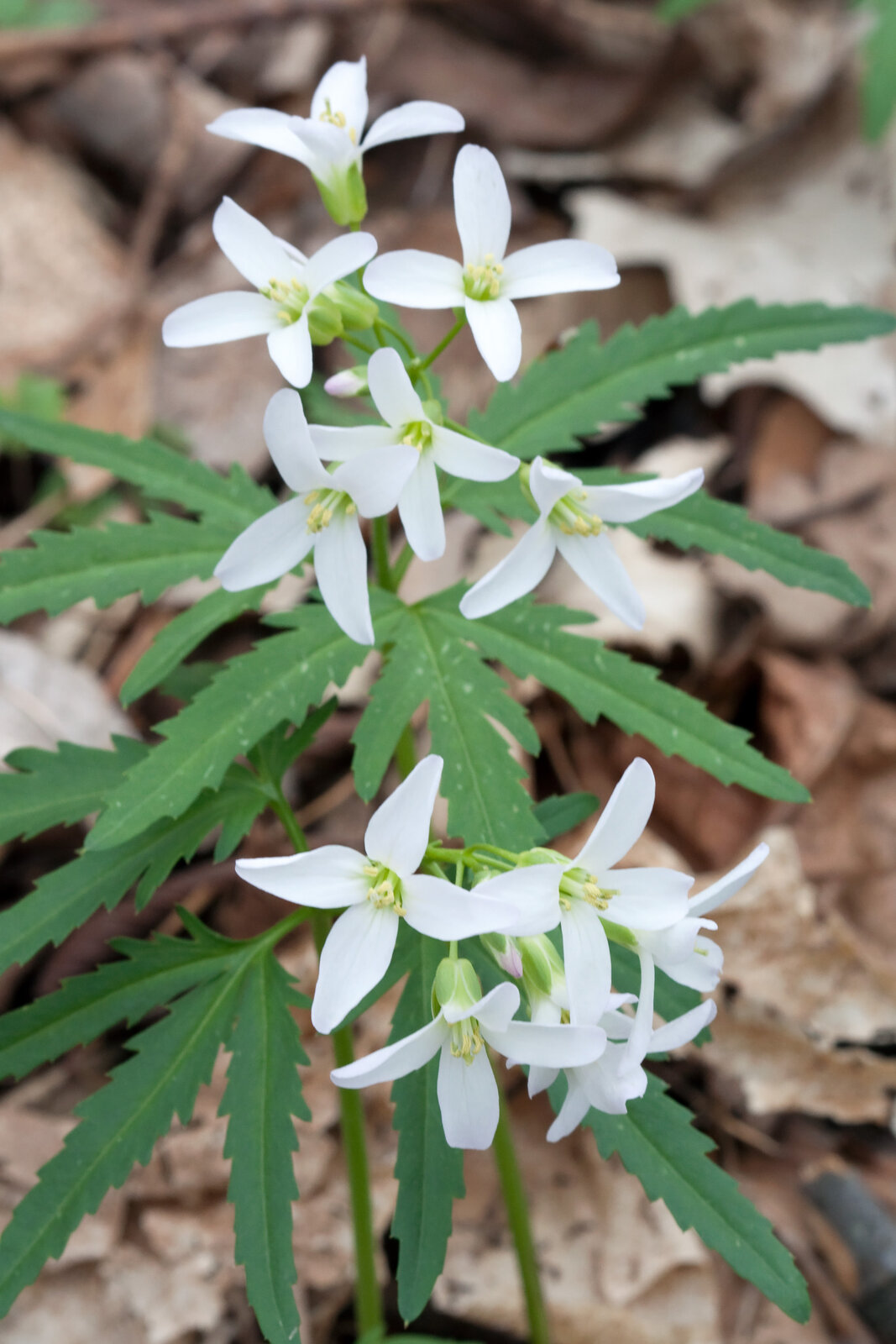
Cutleaf toothwort
Cardamine concatenata
The most abundant toothwort in Marion coves. Three deeply cut, narrow leaflets in a single whorl partway up the stem distinguish it instantly from the broader-leaved C. diphylla. White four-petaled flowers in April; the rhizomes are tooth-shaped, the source of the common name.
Status: Native; common in cove forests.
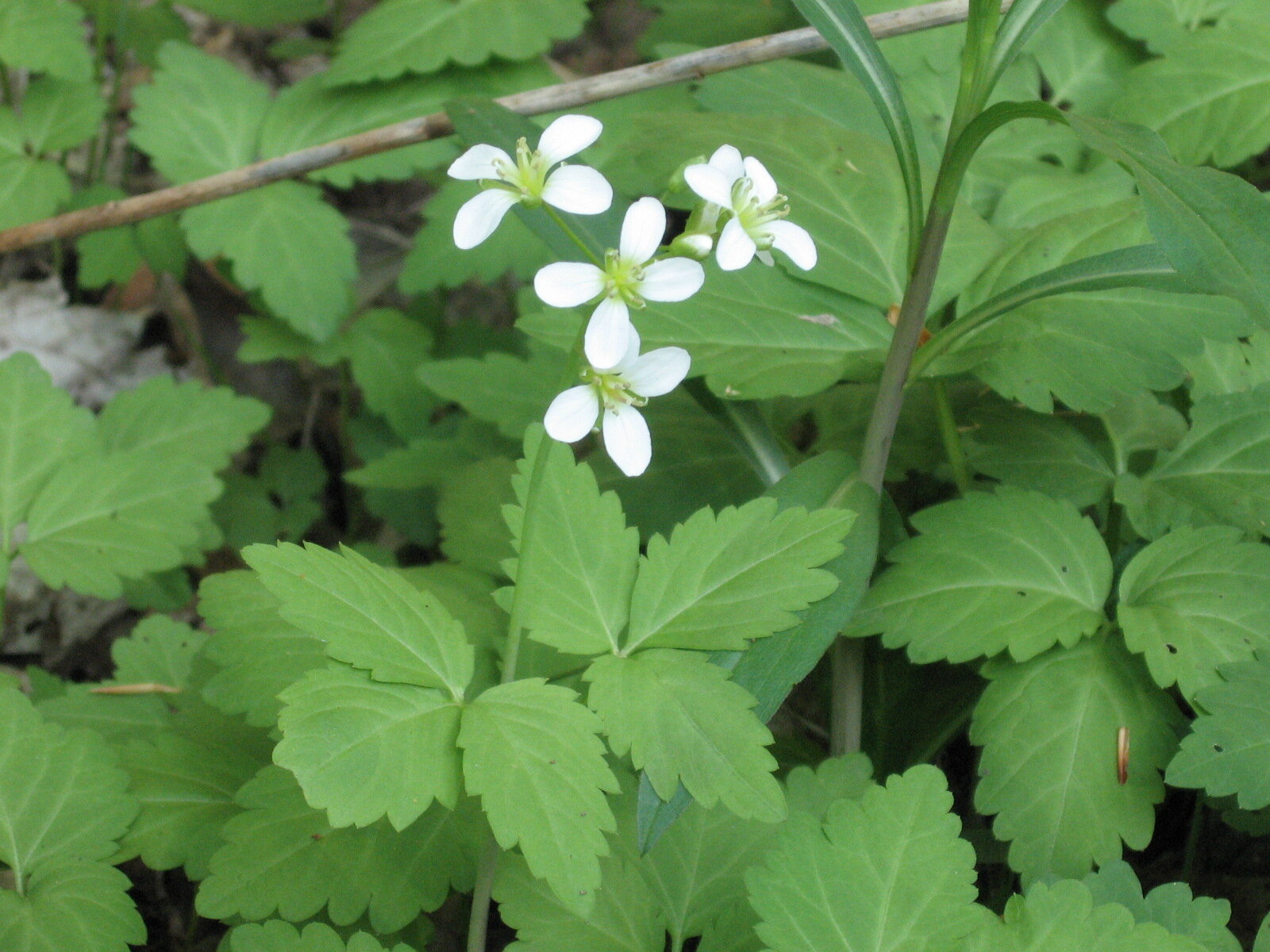
Broadleaf toothwort
Cardamine diphylla
Also called crinkleroot. Two paired stem leaves, each with three broad ovate leaflets, distinguish it from the narrow-leaved C. concatenata. The continuous, jointed rhizome (rather than the segmented one of cutleaf toothwort) is the easier underground ID. Same habitat and bloom period as cutleaf toothwort, often growing alongside.
Status: Native; common in coves.
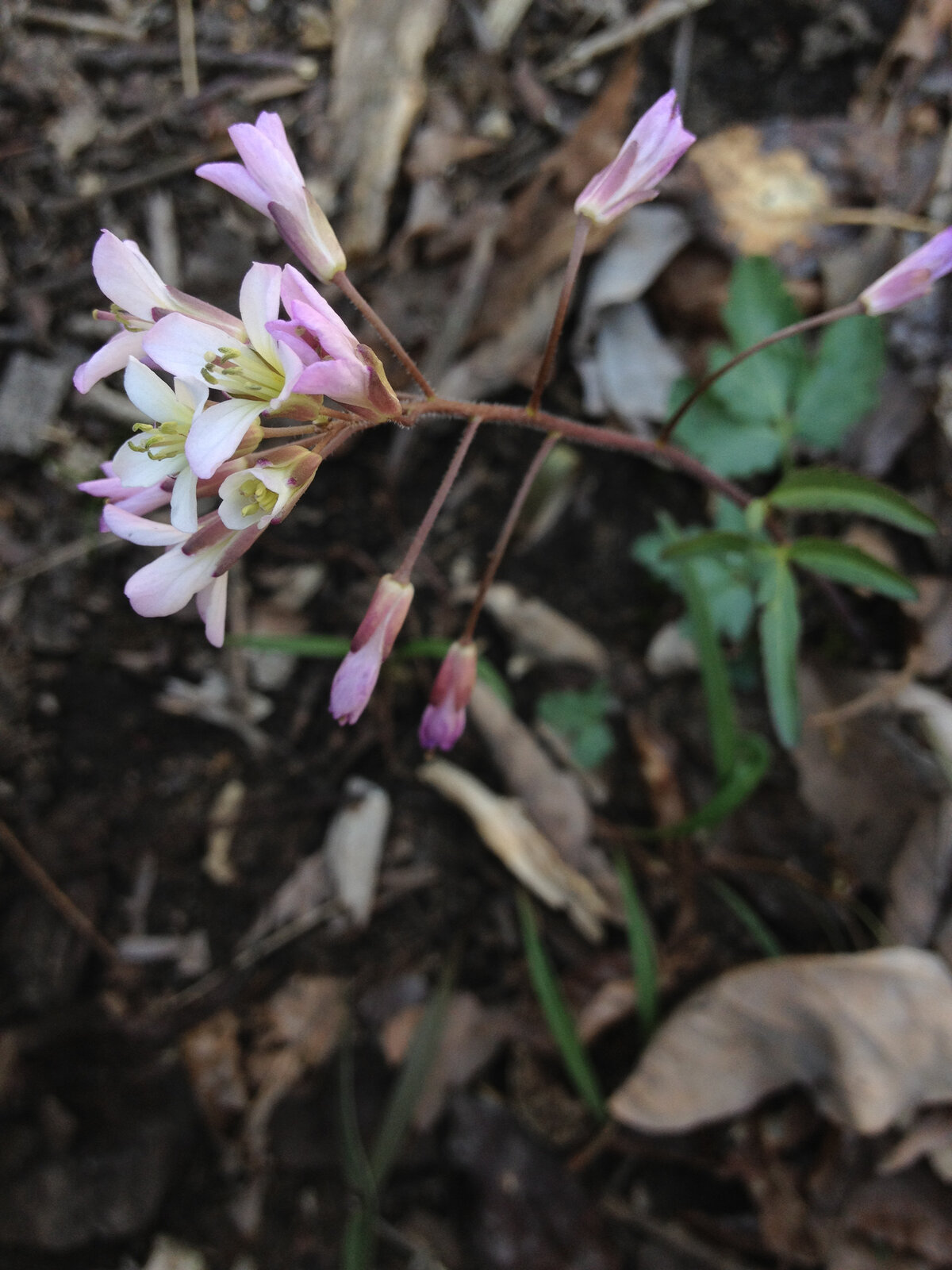
Slender toothwort
Cardamine angustata
A thinner, smaller toothwort of the southern Appalachians and Plateau. The basal leaves and stem leaves are both deeply three-parted but with much narrower, almost grass-like leaflets. Pale pink to white four-petaled flowers in April. Less abundant than the other two but distinctive once recognized.
Status: Native; locally distinctive.
Yellow harlequin
Corydalis are mustard-family relatives in the poppy family with delicate ferny foliage and four-petaled flowers ending in a single backward spur. They sit between the toothworts and the Dicentras both ecologically and evolutionarily.
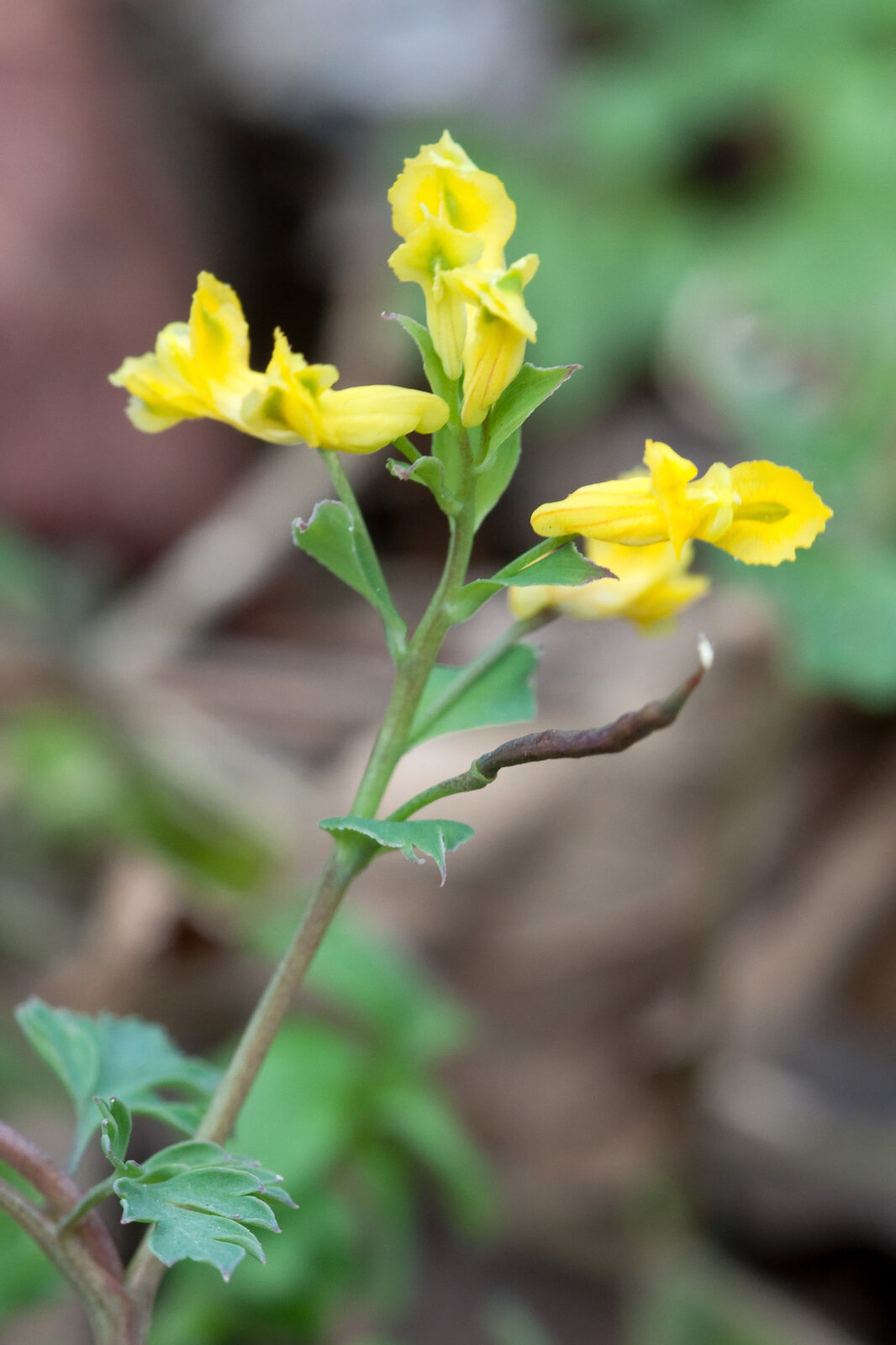
Yellow harlequin
Corydalis flavula
A small spring annual or short-lived perennial of rich cove margins, limestone outcrops, and disturbed-soil pockets. Bluish-green ferny leaves and small yellow spurred flowers give it away in March and April, before the canopy closes. Smaller and less aristocratic-looking than its cultivated relatives but a steady fixture of Marion cove edges.
Status: Native; locally common.
Virginia bluebells and the woodland borages
The Boraginaceae contributes Virginia bluebells (Mertensia virginica), the showiest of the Marion floodplain spring ephemerals, plus the much more modest Virginia stickseed (Hackelia virginiana) of disturbed cove edges and old logging roads. Both share the family signature of bristly stems and a five-lobed corolla; the bluebells dominate ground cover in floodplain pockets while the stickseed slips by unnoticed until its barbed seeds catch on socks.
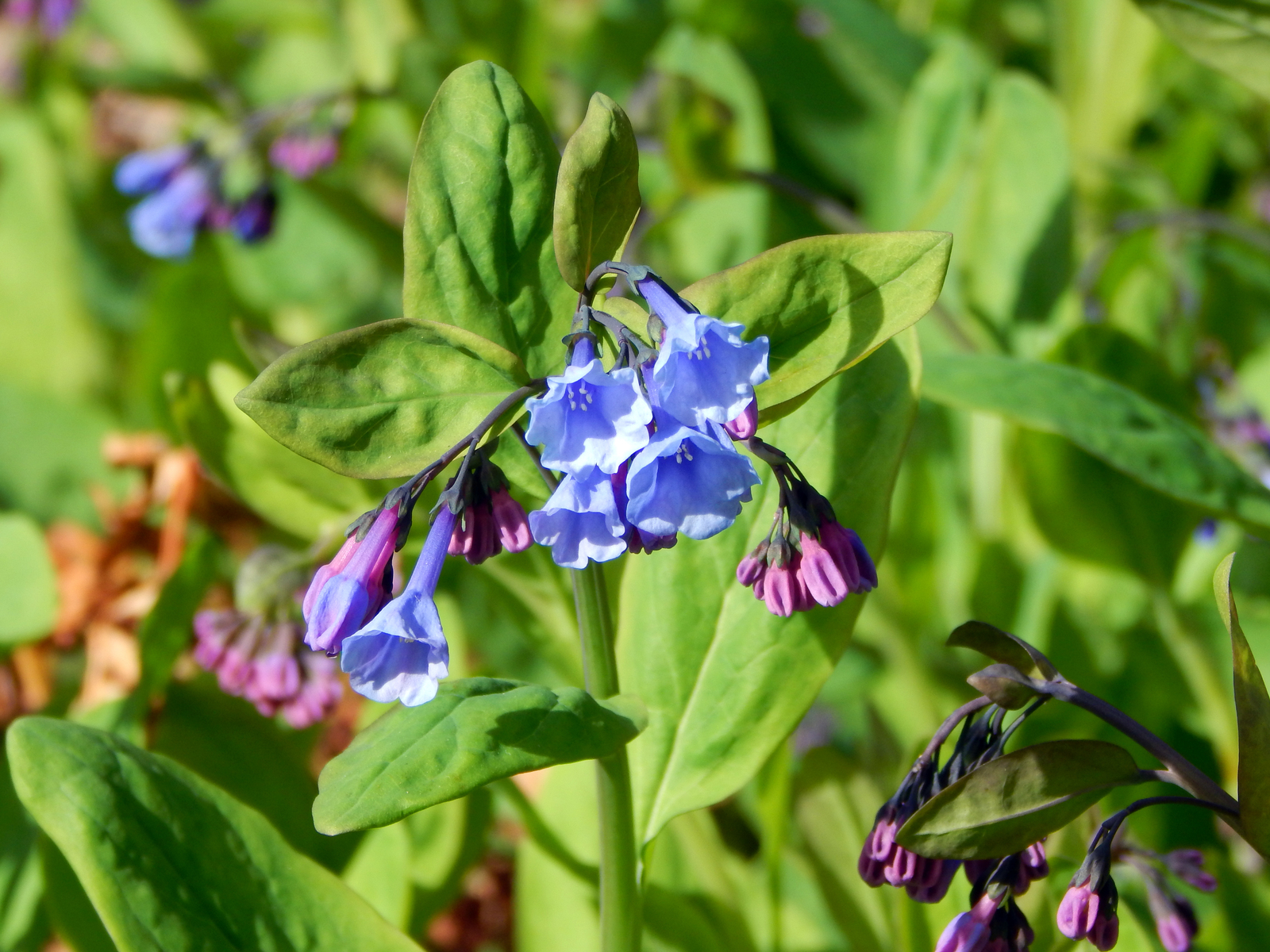
Virginia bluebells
Mertensia virginica
Prefers the richer, wetter soils of floodplains and streambanks. In Marion, the Sequatchie River bottom and the Battle Creek floodplain are the reliable spots. Pink buds open to sky-blue trumpet clusters that nod on arching stems, usually in early April. The whole plant goes dormant by mid-June.
Status: Native; common in floodplain forests.
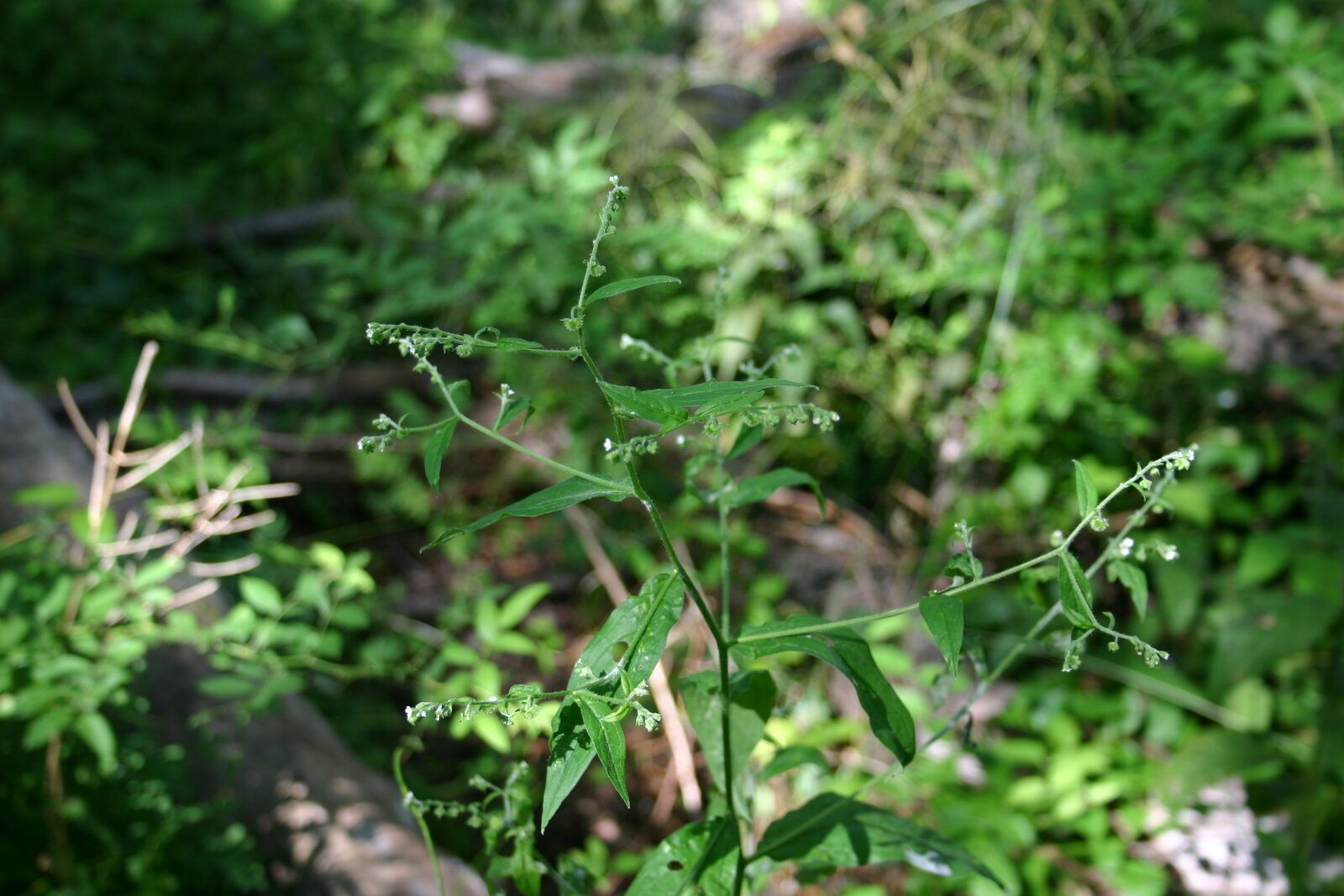
Virginia stickseed
Hackelia virginiana
A tall, weedy borage of cove edges, old roadbeds, and disturbed mesic woodland. Small white five-lobed flowers in mid- to late summer give way to barbed nutlets that stick to clothing and animal fur. Easy to overlook in flower; impossible to miss once the seeds attach to your boot laces.
Status: Native; common in disturbed mesic woods.
Phlox, foamflower, shooting star, and alumroot
Five mid-spring forbs that share the rich-soil understory of the cove and shaded slope. Woodland phlox (Phlox divaricata) and creeping phlox (Phlox stolonifera) put down sheets of pale-blue flowers in April and early May; foamflower's spike of small white flowers earns the genus name Tiarella, the diminutive of the Greek for crown; shooting star's strongly reflexed petals make it look like a comet; and alumroot's tall flowering stalk over a basal rosette of mottled leaves rounds out the group. All five are reliable garden plants in addition to wild presences in Marion coves.
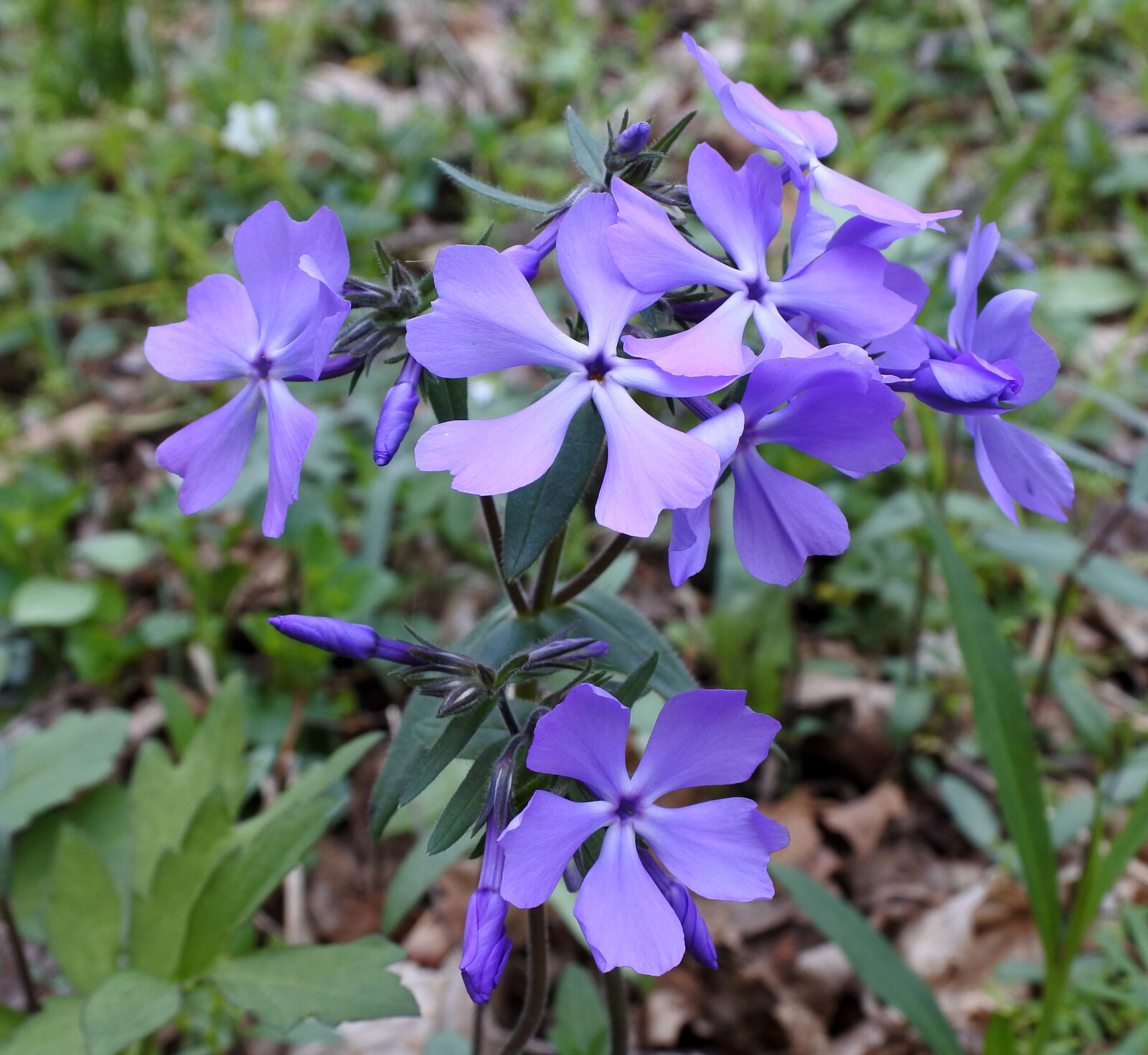
Woodland phlox
Phlox divaricata
The bluest sheet of color on the cove floor in late April. Pale violet-blue, five-petaled flowers held in loose clusters above clasping lance-shaped leaves. Self-incompatible, so seed set in any patch depends on cross-pollination by long-tongued bees and butterflies. The default phlox of mesic Marion coves.
Status: Native; common in coves.
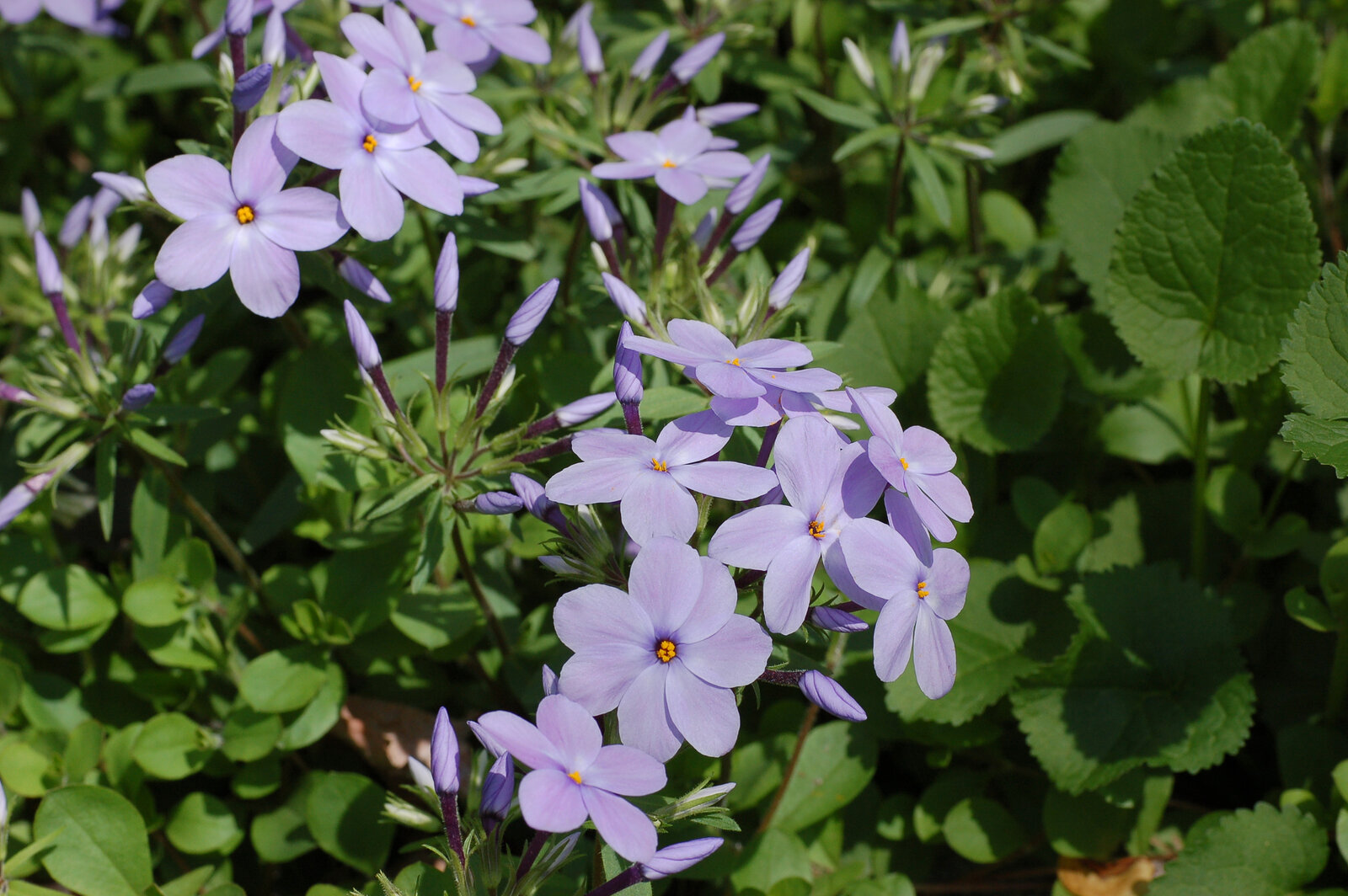
Creeping phlox
Phlox stolonifera
Differs from P. divaricata in its mat-forming, stoloniferous habit; the runners spread laterally and root at the nodes, producing a continuous low cover rather than scattered tufts. Flowers tend toward pink-purple rather than the pure blue of woodland phlox. Favors damper, mossier ground in the lower cove.
Status: Native; uncommon; damp cove margins.
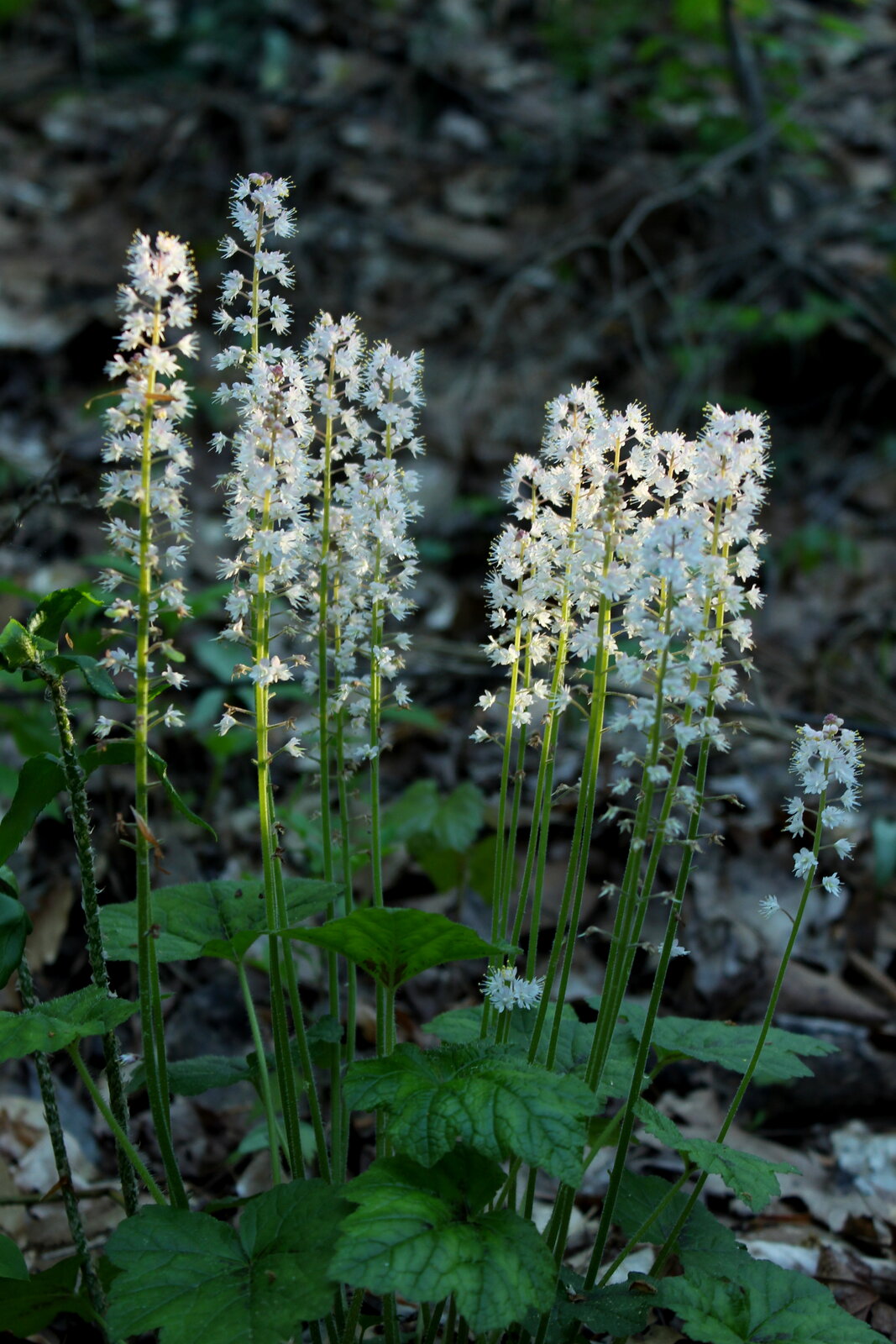
Foamflower
Tiarella cordifolia
A spike of small white flowers, each with five thread-like petals, rises above a basal rosette of heart-shaped, maple-like leaves in late April. The genus name Tiarella means "little crown" in Greek, after the shape of the seed capsule. A reliable indicator of rich, mesic soil; abundant on north-facing cove slopes and along seep margins.
Status: Native; common in coves.
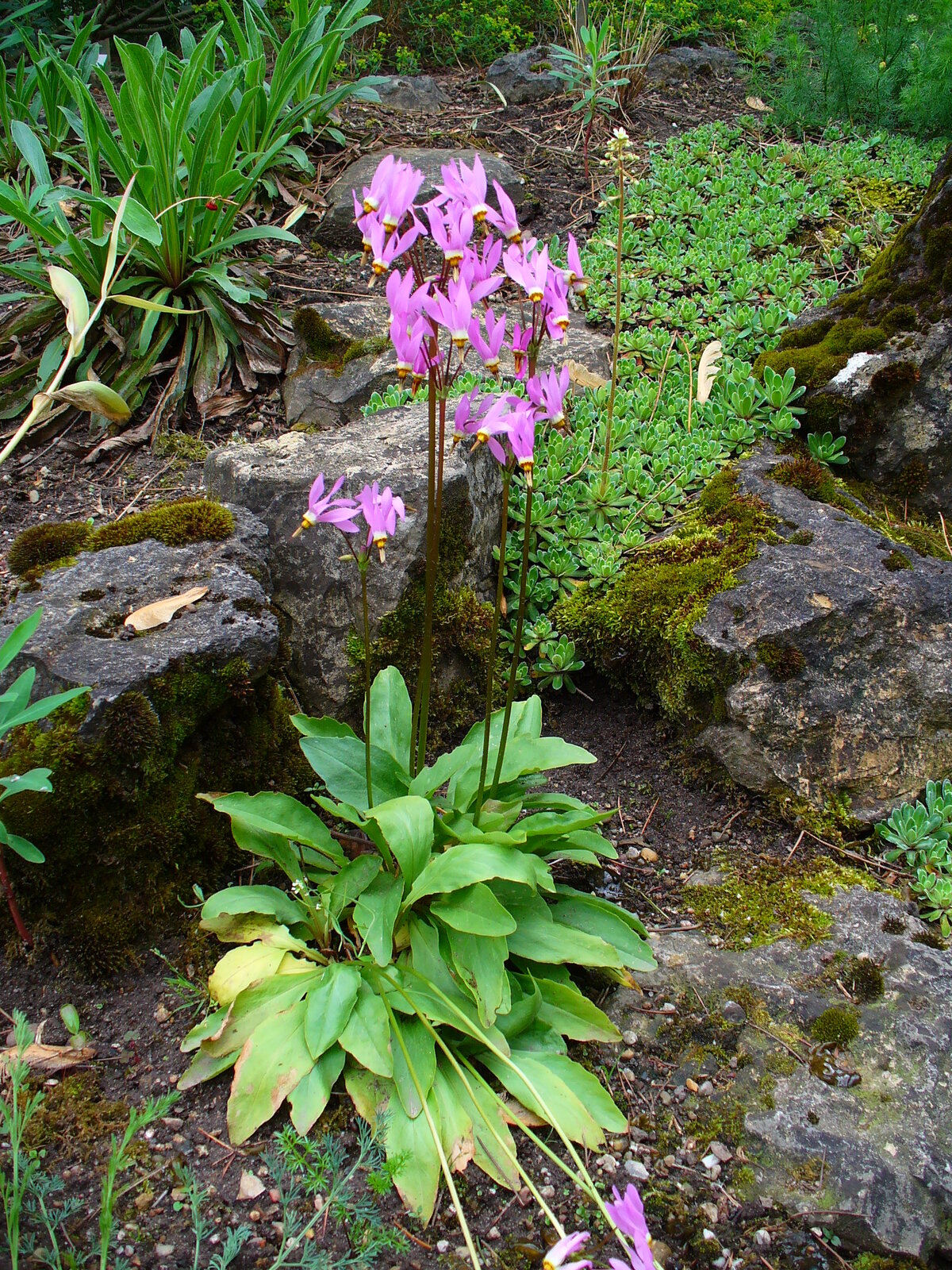
Shooting star
Primula meadia
Strongly reflexed pink-to-white petals shoot backward from the dark anther cone, giving the flower its falling-star silhouette. Several flowers nod in an umbel above a basal rosette of broad leaves. Pollinated by buzz-pollinating bumblebees that vibrate the anthers to release pollen. Local on limestone-influenced cove slopes and bluff bases. Recently moved from the genus Dodecatheon into Primula.
Status: Native; locally distinctive.
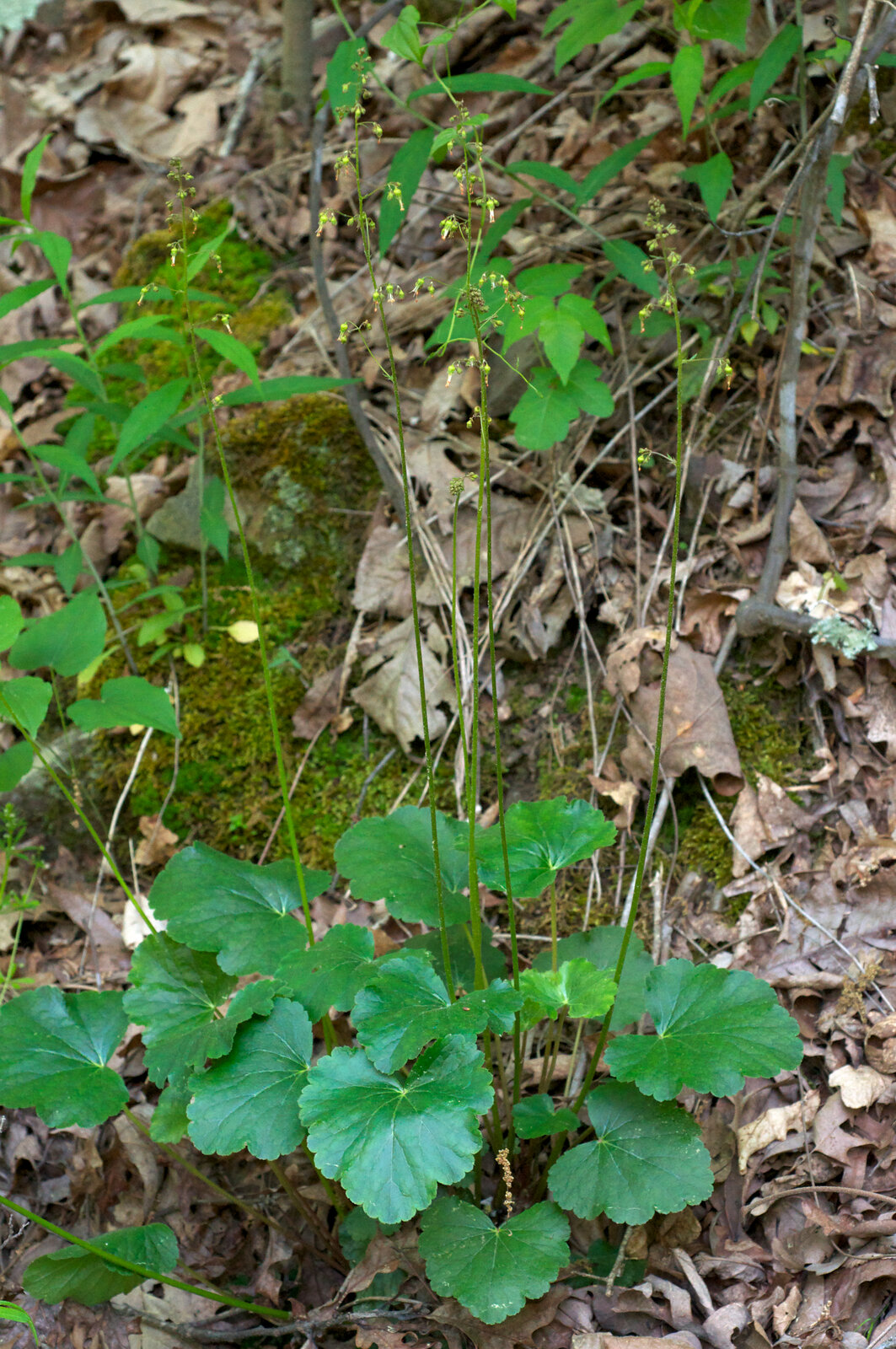
Alumroot
Heuchera americana
A tall, slender flowering stalk holds tiny greenish-bronze bell flowers above a basal rosette of marbled, maple-like leaves. The leaves are evergreen through winter and often the most conspicuous part of the plant on bluff faces and rocky cove slopes. Tannin-rich rhizomes were used by indigenous peoples and early settlers as an astringent.
Status: Native; common on rocky slopes and bluffs.
Wild ginger and heartleaf
The Aristolochiaceae includes two contrasting woodland forbs in Marion: northern wild ginger (Asarum canadense) with deciduous, kidney-shaped leaves, and the southern Appalachian heartleafs (Hexastylis) with thick evergreen leaves. Both hide their fleshy maroon flowers at ground level under the leaves, where carrion flies and beetles pollinate them. The aromatic rhizomes of Asarum have a true ginger scent and were used as a substitute for tropical ginger by indigenous peoples and early settlers, although the plant contains aristolochic acids that are toxic in quantity and should not be eaten today.
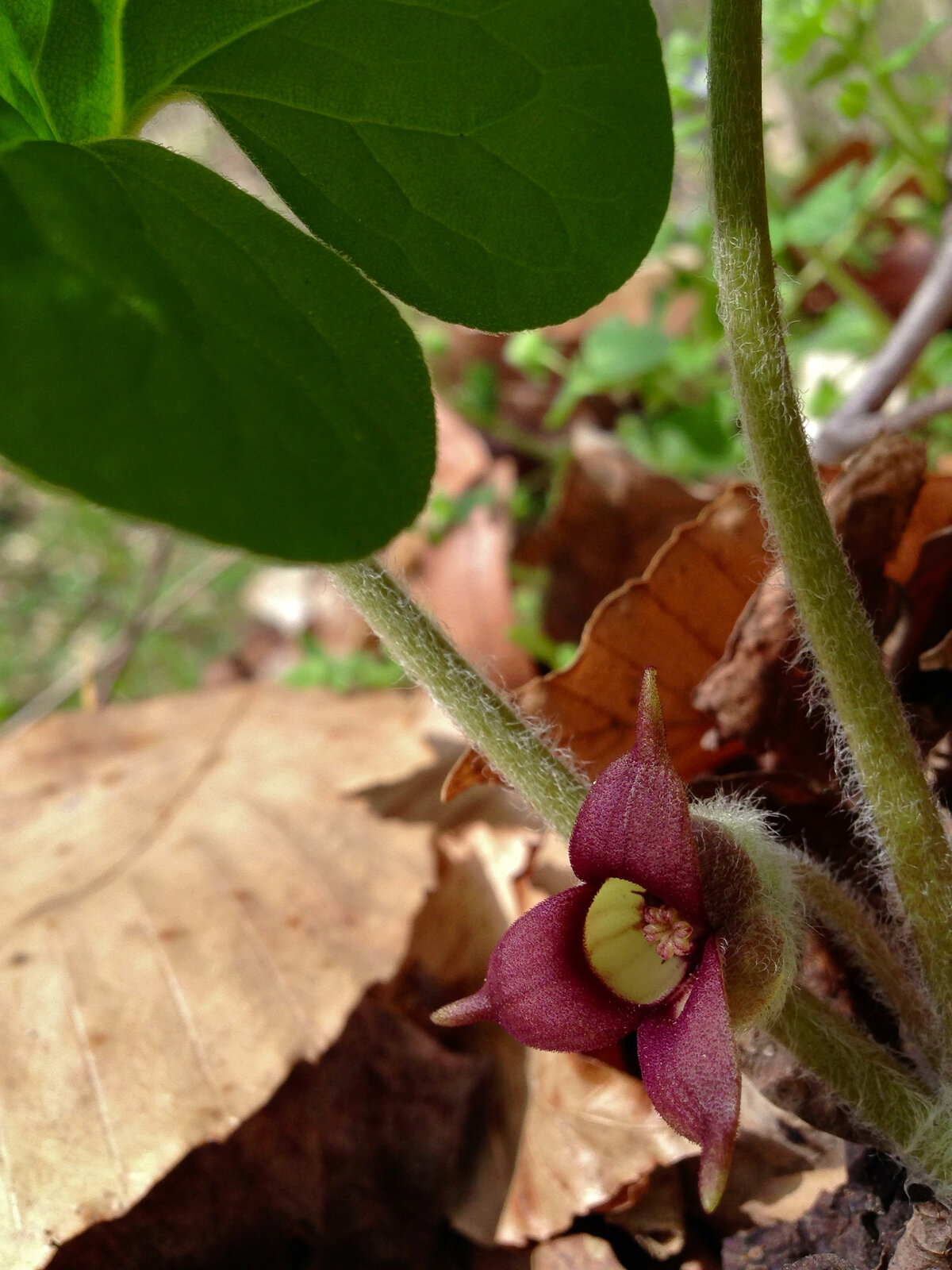
Canadian wild ginger
Asarum canadense
Paired heart-shaped to kidney-shaped deciduous leaves on hairy petioles emerge in mid-April. The fleshy maroon flower opens at ground level, hidden under the leaves, where it is pollinated by carrion flies and beetles drawn to a slight rotting scent. Forms slow-spreading rhizome colonies in rich, neutral cove soils.
Status: Native; common in rich coves.
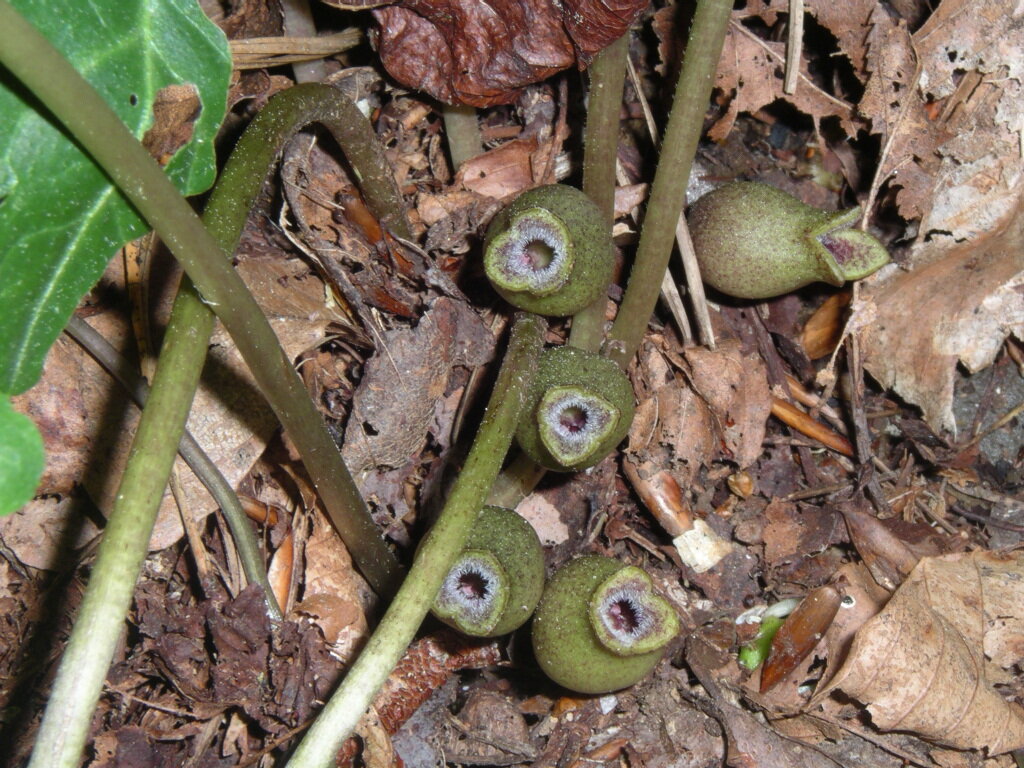
Heartleaf
Hexastylis arifolia
Differs from Asarum in its arrow-shaped, evergreen leaves that persist through winter. The flowers, hidden among the leaf bases, are little brown jugs (the alternate common name), with three short lobes and a strongly tapered base. Documented on the southern Cumberland Plateau on acid soils; persists through winter as one of the few green leaves on the woodland floor.
Status: Native; locally common on acid plateau soils.
Cohoshes, baneberries, columbine, and the woodland buttercups
The Ranunculaceae and the closely related Berberidaceae produce a long roster of woodland forbs in Marion, ranging from the giant flowering candelabras of black cohosh (Actaea racemosa) to the modest white anemones and the early-summer columbines on rocky bluffs. All share the family pattern of distinct (not fused) flower parts and a tendency toward toxic alkaloids, but the architecture varies wildly: some species hold compound leaves above the flowering stem, others basal rosettes, and the columbines have leaves divided into nine identical lobes. Goldenseal (Hydrastis canadensis), grouped here for ecological reasons rather than strict taxonomy, is one of the few state-tracked forbs in the group.
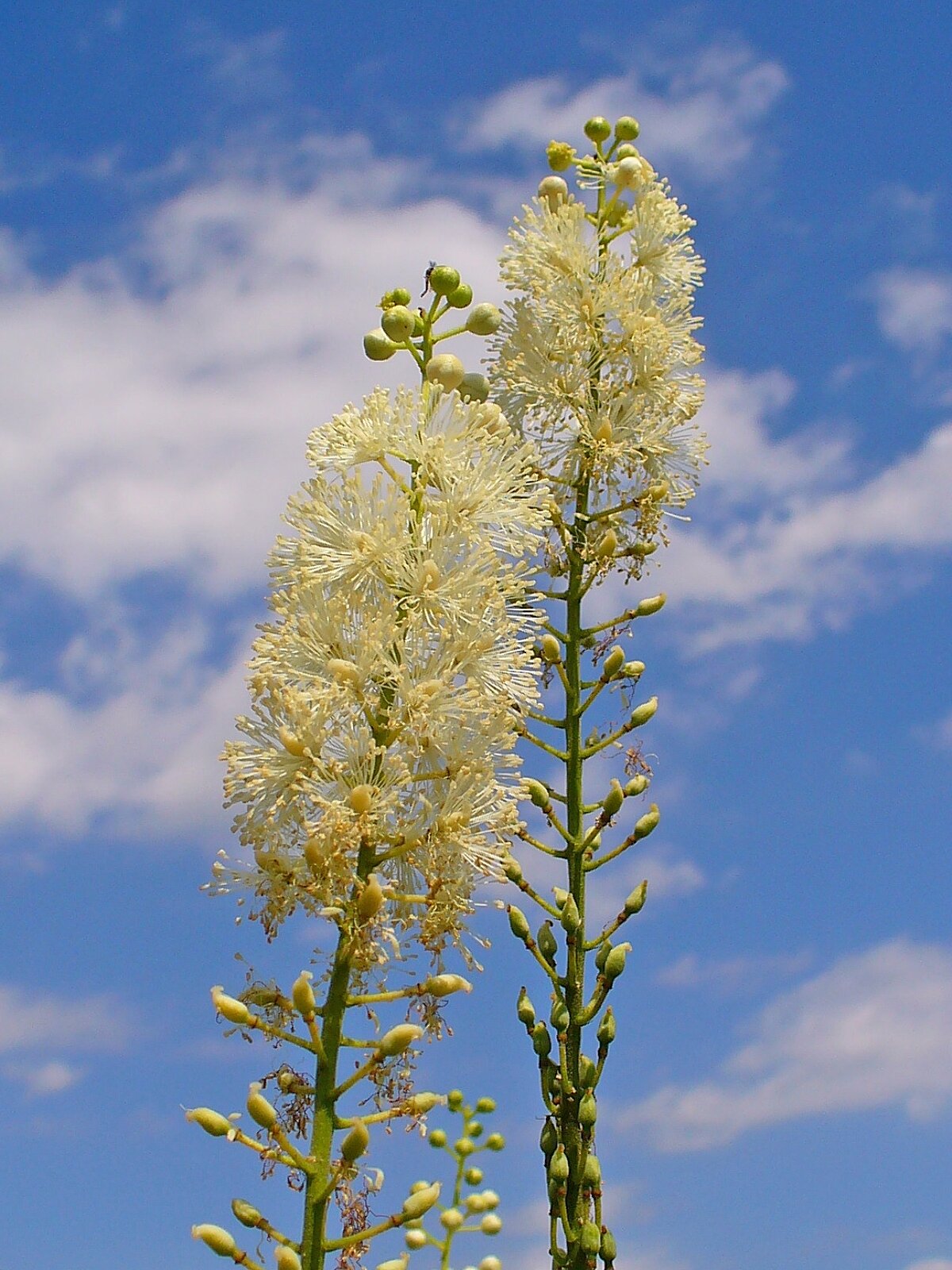
Black cohosh
Actaea racemosa
A tall (four to six feet) cove forb with a long white-bottlebrush flowering spike held above twice-divided leaves in June and July. The flowers have no petals; the white display is from a tuft of stamens. Strongly fly-pollinated and emits a sharp, slightly unpleasant scent in the field. The thick black rhizomes have been heavily harvested for the herbal market and the species is now state-tracked in some adjacent states.
Status: Native; common in rich coves.
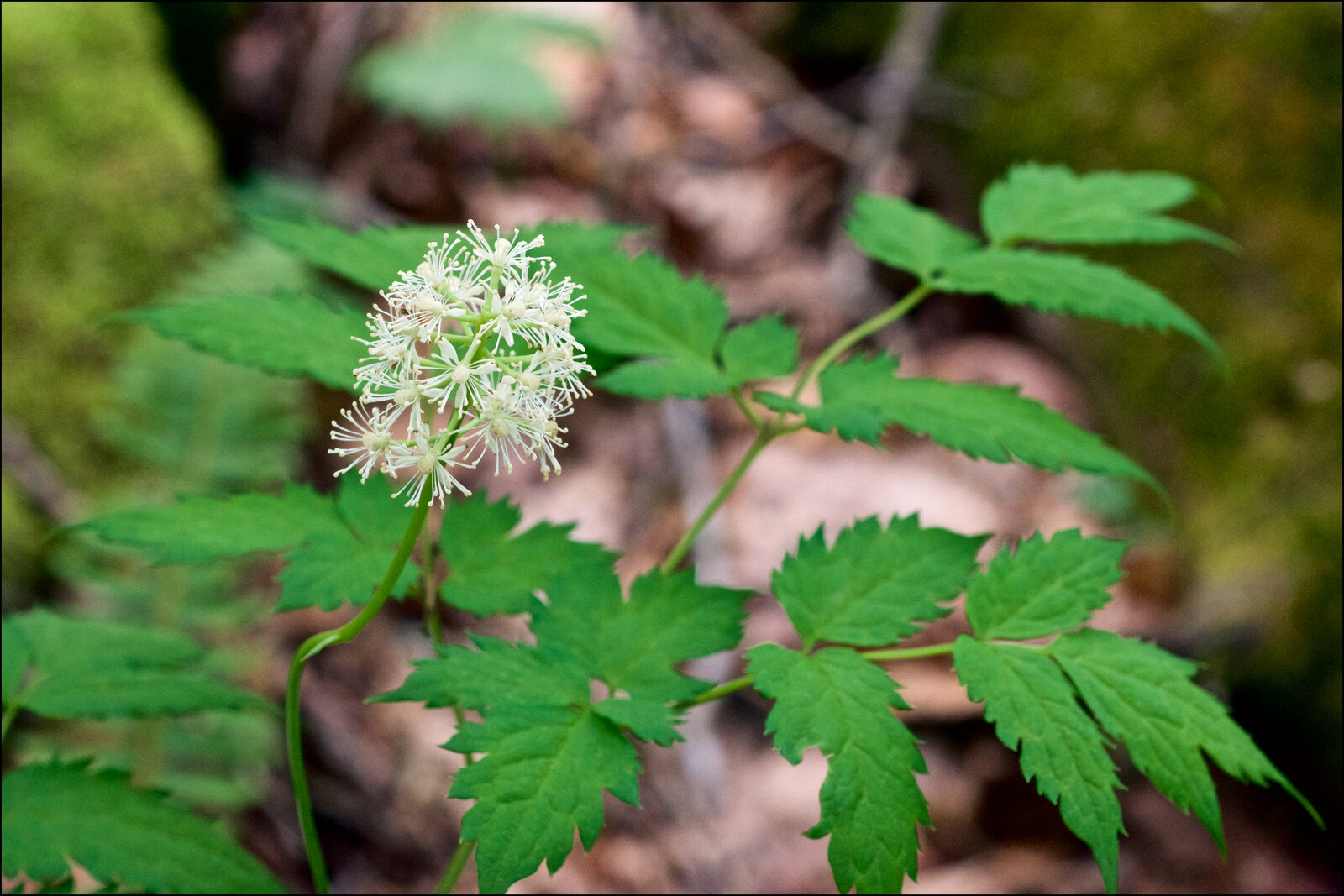
White baneberry
Actaea pachypoda
Also called doll's eyes, after the porcelain-white berries each marked with a single black scar that look like a doll's eyes on red stalks. Flowers in spring are an inconspicuous white spike; the dramatic display is the late-summer fruit. All parts of the plant are toxic and the berries are particularly dangerous to children. A reliable indicator of rich, neutral soil.
Status: Native; common in rich coves.
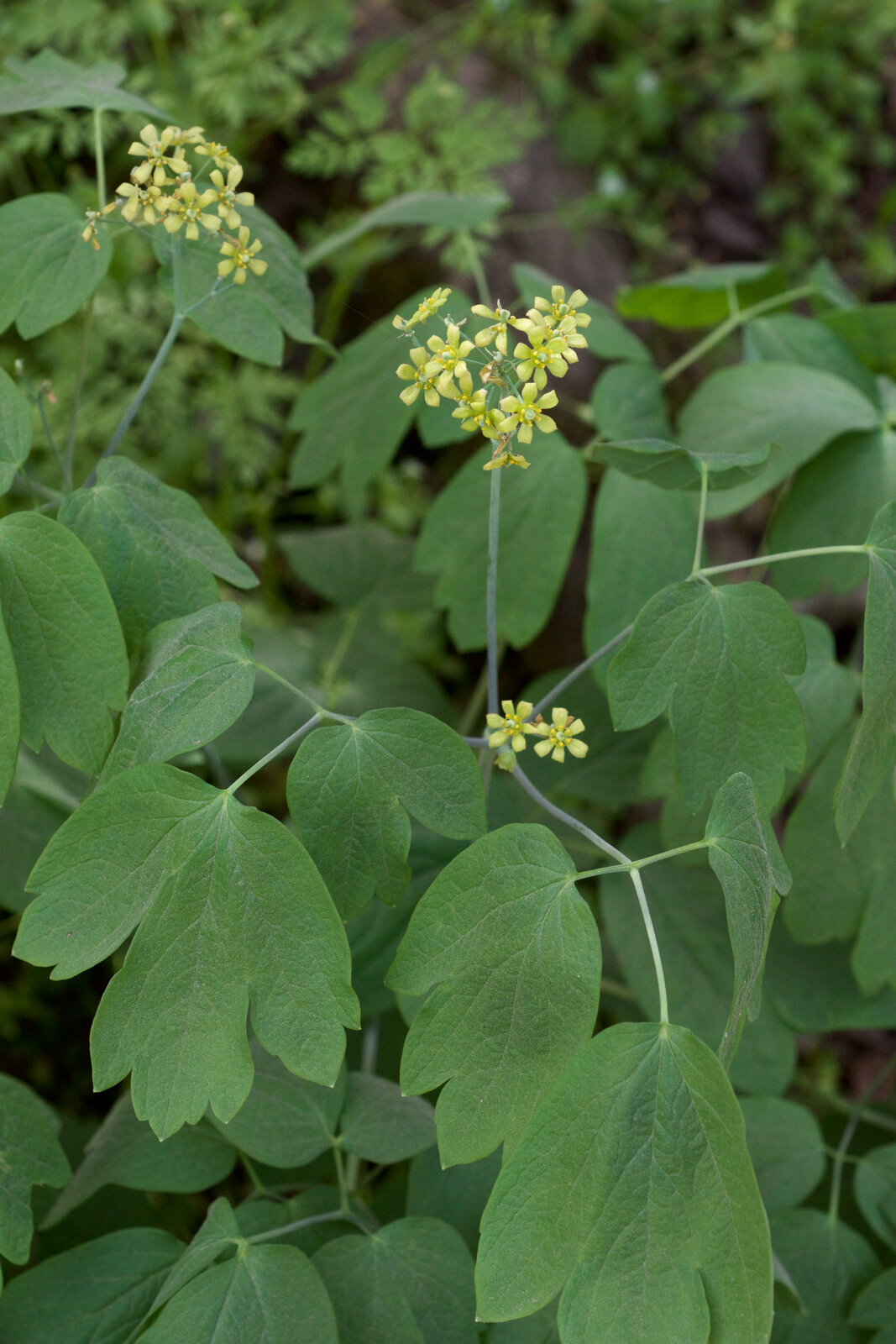
Blue cohosh
Caulophyllum thalictroides
Bluish-green, twice-compound leaves emerge in early April with a glaucous coating that gives the plant its name. Small greenish-yellow flowers are quickly outpaced by deep-blue, berry-like seeds (technically naked seeds, not true berries) that ripen in late summer. A barberry-family plant, not a true buttercup; grows alongside black cohosh in rich cove soils.
Status: Native; common in rich coves.
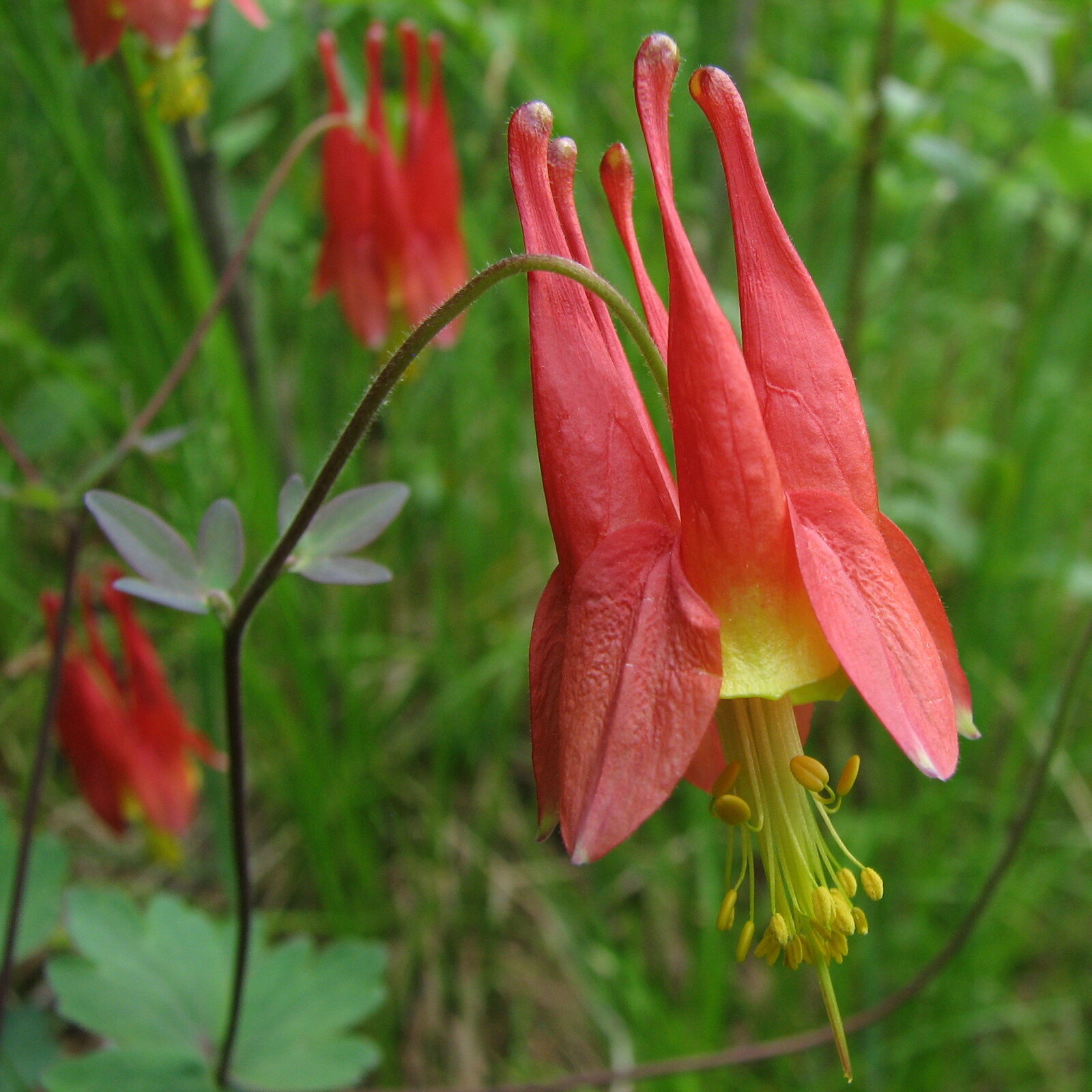
Wild columbine
Aquilegia canadensis
Red and yellow with five spurred petals; fills niches on limestone outcrops, rocky woods, and thin-soiled slopes. Pollinated almost exclusively by ruby-throated hummingbirds, whose long bills can reach the nectar in the spur tips. Reseeds reliably from cracks in rock and is one of the most adaptable native wildflowers for cultivation.
Status: Native; common on rocky slopes and bluffs.
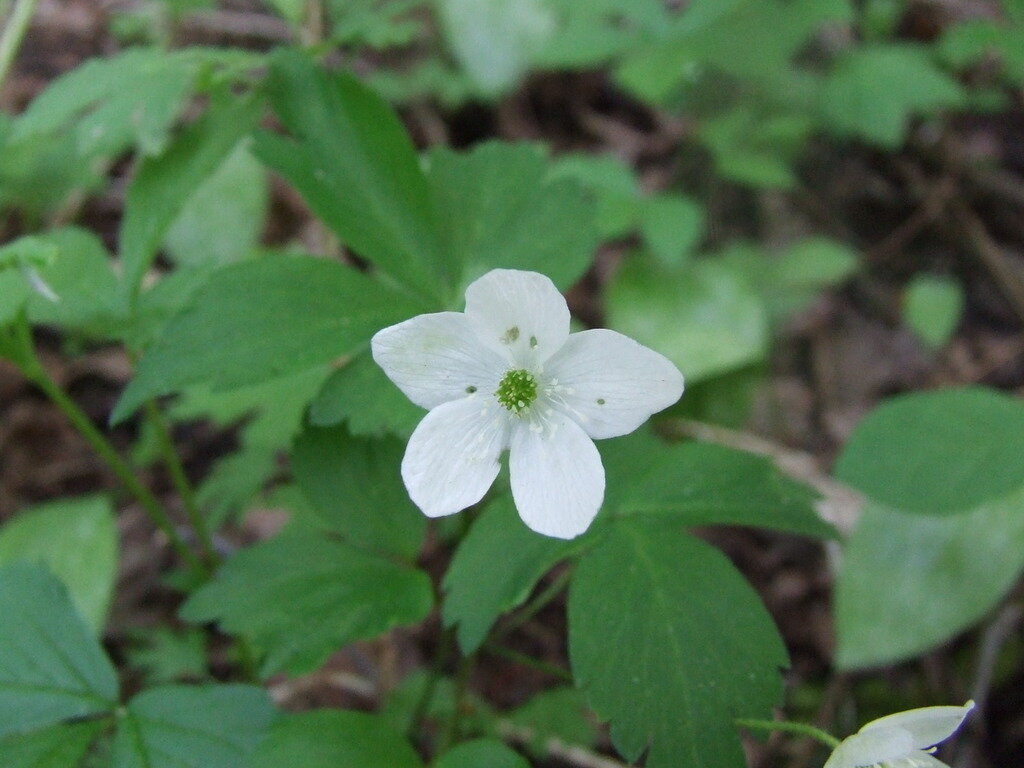
Wood anemone
Anemonoides quinquefolia
A small, delicate spring ephemeral with a single white flower (the petals are technically sepals; true petals are absent) above a whorl of three deeply divided leaves. Forms loose carpets on rich, mesic slopes. Less showy than its larger cousins but a reliable indicator of intact cove soil.
Status: Native; common on mesic slopes.
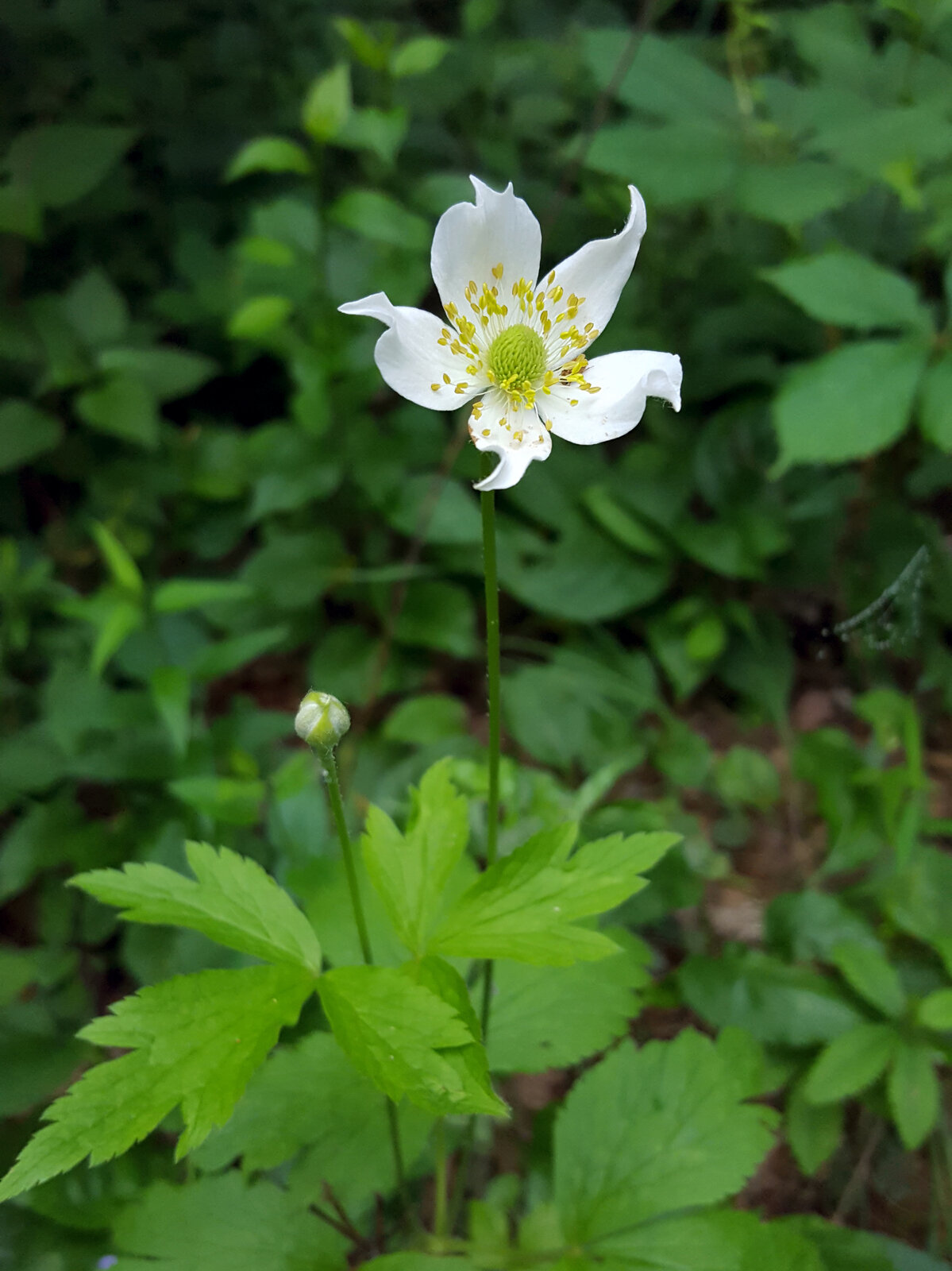
Thimbleweed
Anemone virginiana
A taller, drier-soil anemone of woodland edges and openings. The greenish-white flower in early summer is followed by a thimble-shaped seed head that gives the plant its name; mature seeds are wrapped in cottony fluff and disperse on the wind. Common on rocky woods and old-field margins in Marion.
Status: Native; common on woodland edges.
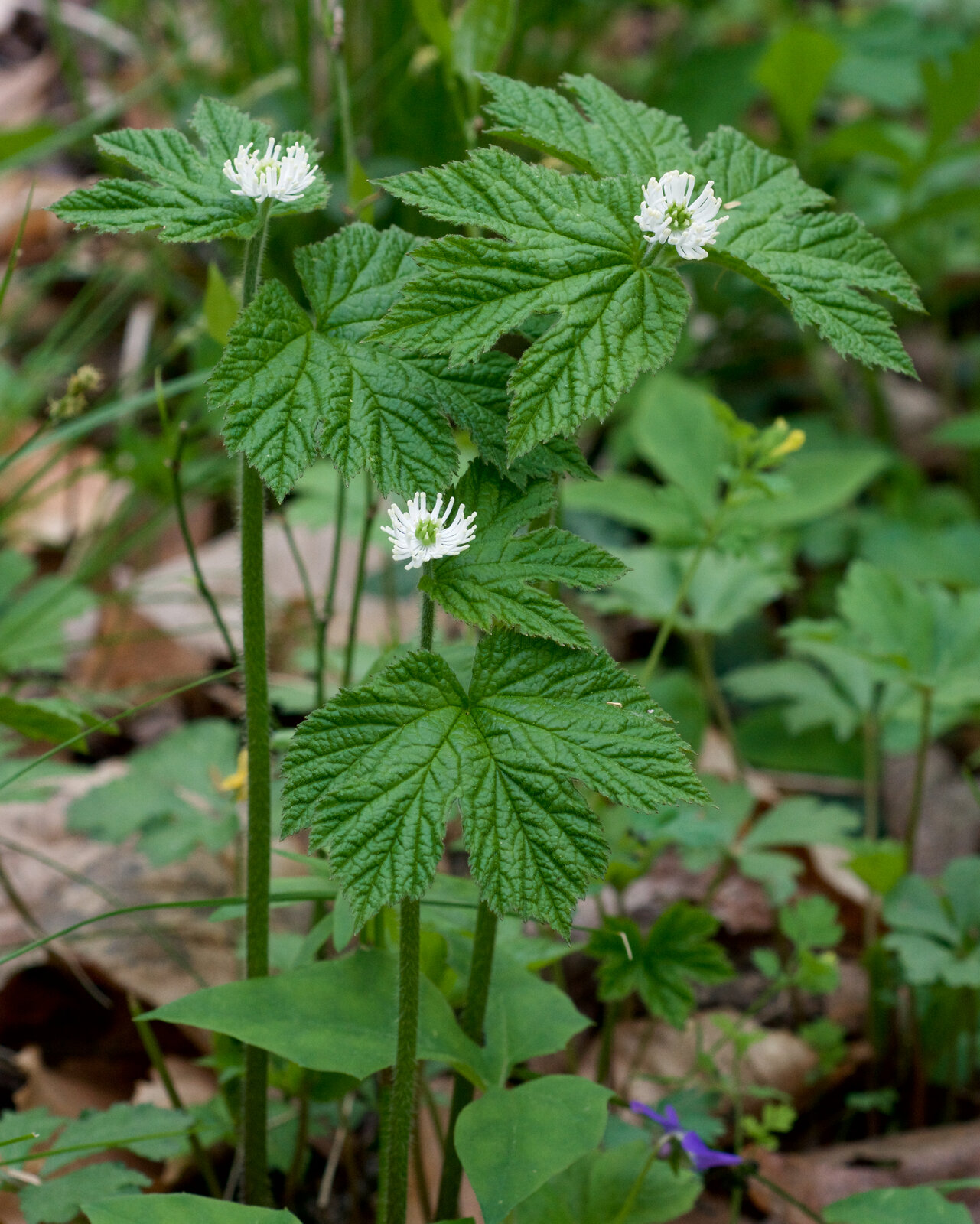
Goldenseal
Hydrastis canadensis
A rich-cove forb whose thick yellow rhizome (the source of the genus name) has been heavily harvested for the herbal market for two centuries. The single greenish-white flower in April is followed by a raspberry-like red fruit. State-tracked in many adjacent states; populations in undisturbed Marion coves should not be harvested.
Status: Native; uncommon; harvest-pressured.
Spring beauty, hepatica, and rue anemone
Three of the earliest-blooming small forbs of the cove and oak-hickory floor. Spring beauty (Claytonia) sometimes opens in late February. Hepatica (Anemone, formerly Hepatica) holds three-lobed evergreen leaves through winter and flowers in March before the new leaves emerge. Rue anemone (Thalictrum thalictroides) follows a few weeks later. None is a true cove specialist; all three appear on plateau slopes, oak-hickory rises, and limestone-influenced ground.
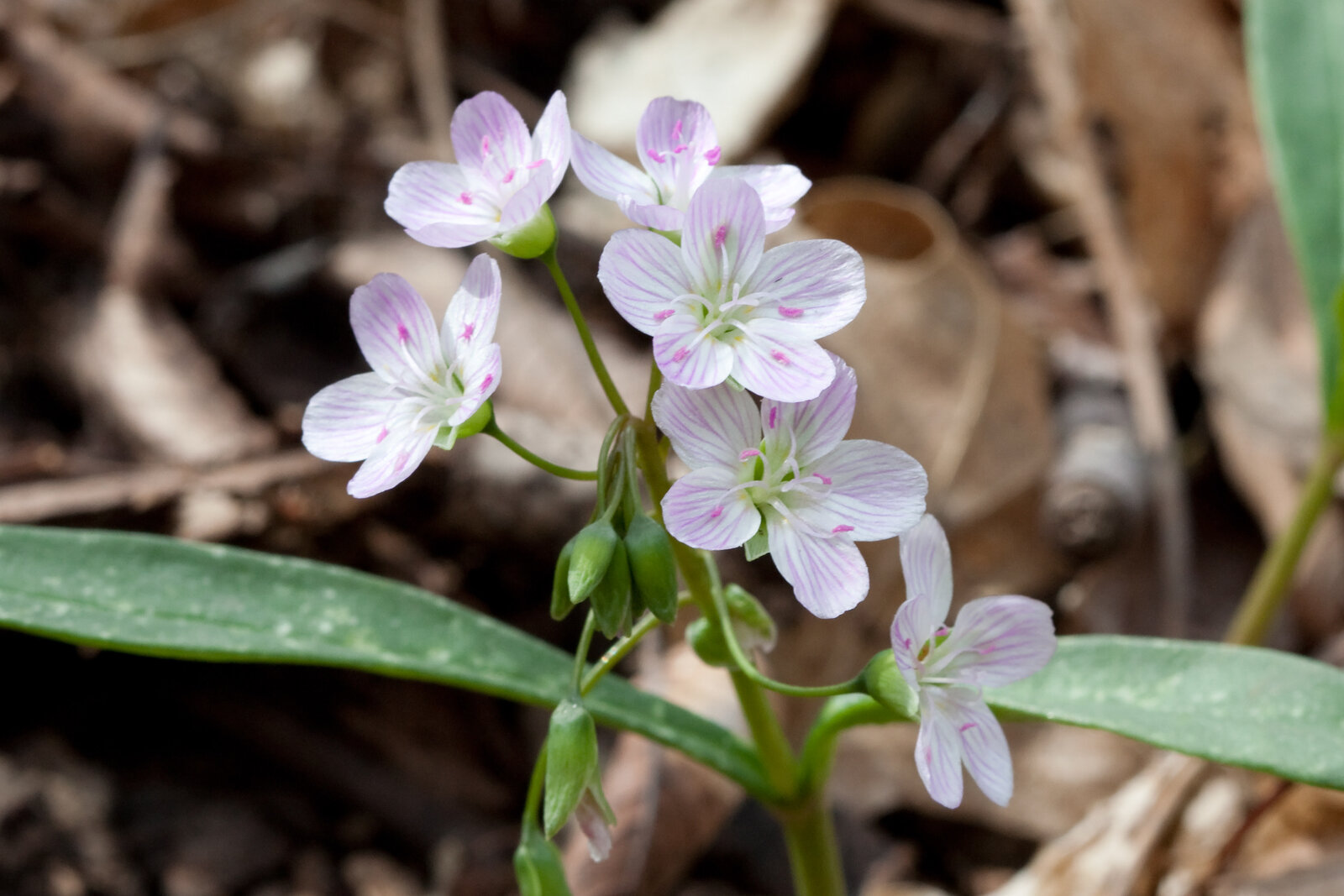
Virginia spring beauty
Claytonia virginica
Five white-to-pink petals with darker pink veins on grass-like leaves; forms loose carpets on cove slopes and even mowed lawns in March and April. Sometimes opens in late February in warm spells. The small underground corms are the basis for the folk name "fairy spuds."
Status: Native; abundant on cove slopes.
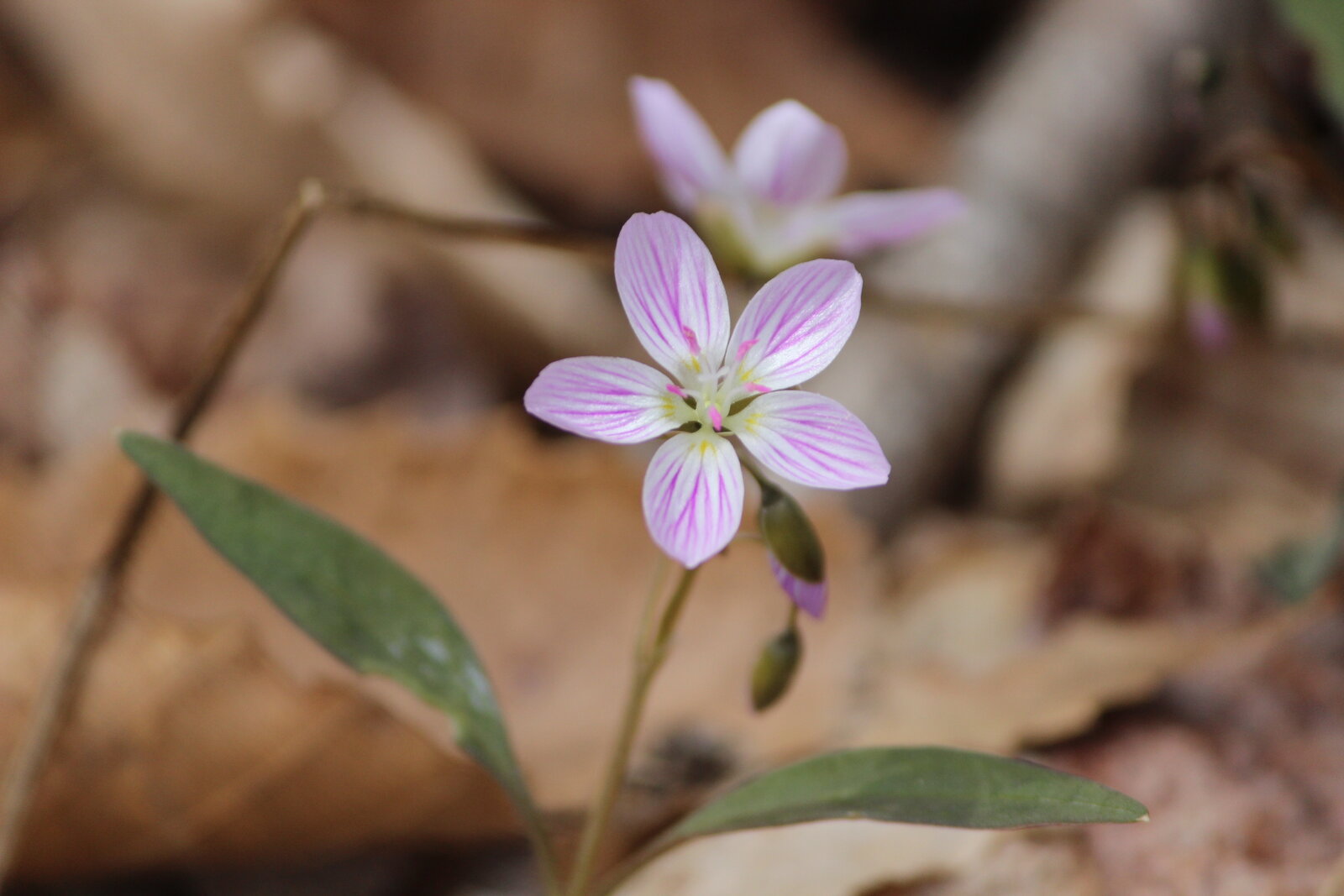
Carolina spring beauty
Claytonia caroliniana
Differs from C. virginica in having broad, paddle-shaped leaves rather than grass-like ones; otherwise the flowers are nearly identical. Less abundant in Marion than the Virginia species and usually filing in higher-elevation pockets of cove forest where the Plateau begins to step up toward the rim.
Status: Native; uncommon; cooler cove pockets.
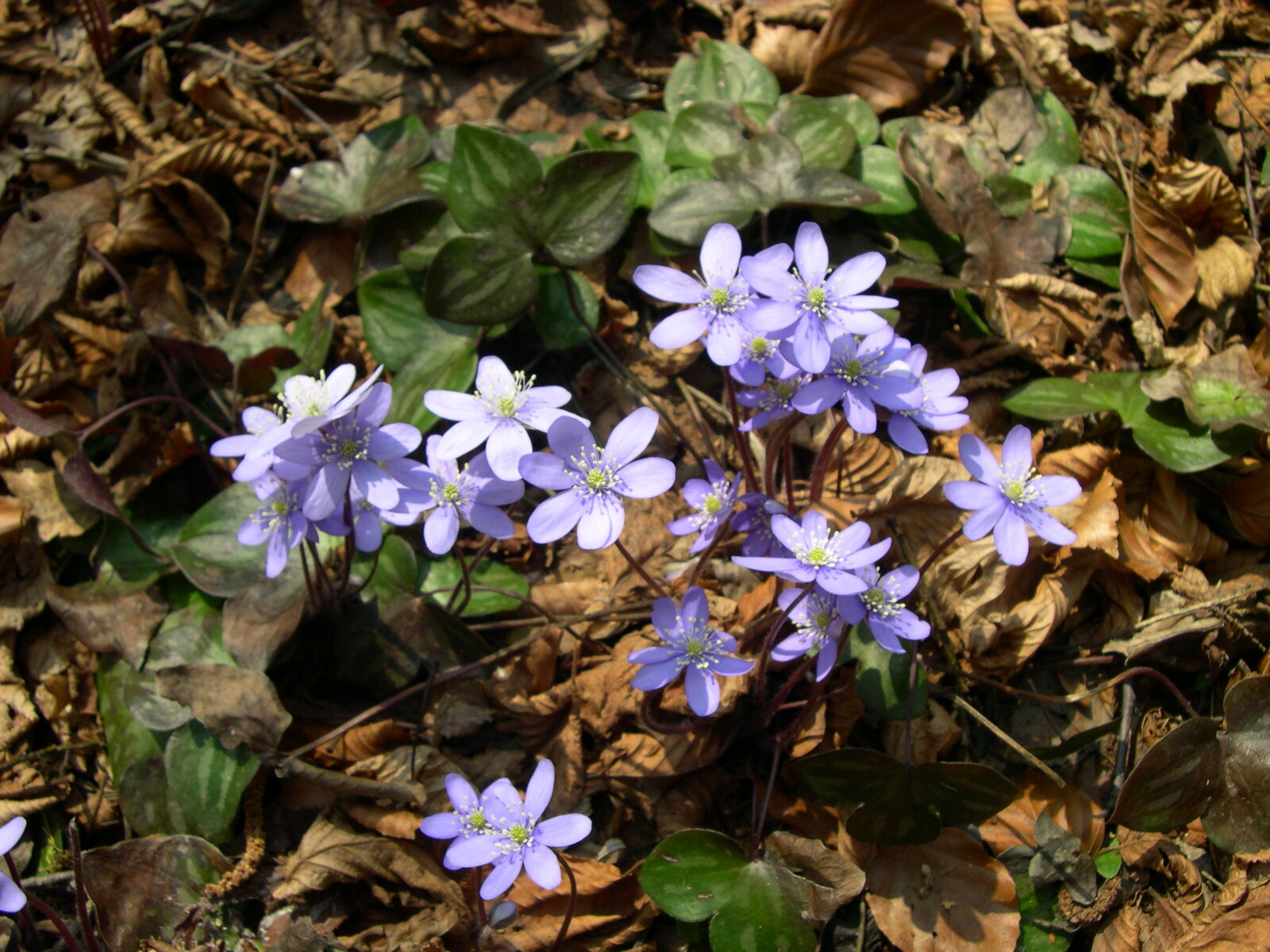
Round-lobed hepatica
Anemone americana
One of the earliest forbs to bloom in Marion, sometimes in late February. Pale lavender-to-white flowers (the tepals are sepals, not true petals) on hairy stalks above a basal rosette of three-lobed evergreen leaves. The name comes from the rounded leaf-lobe tips. Favors cove slopes and limestone-influenced ground.
Status: Native; common.
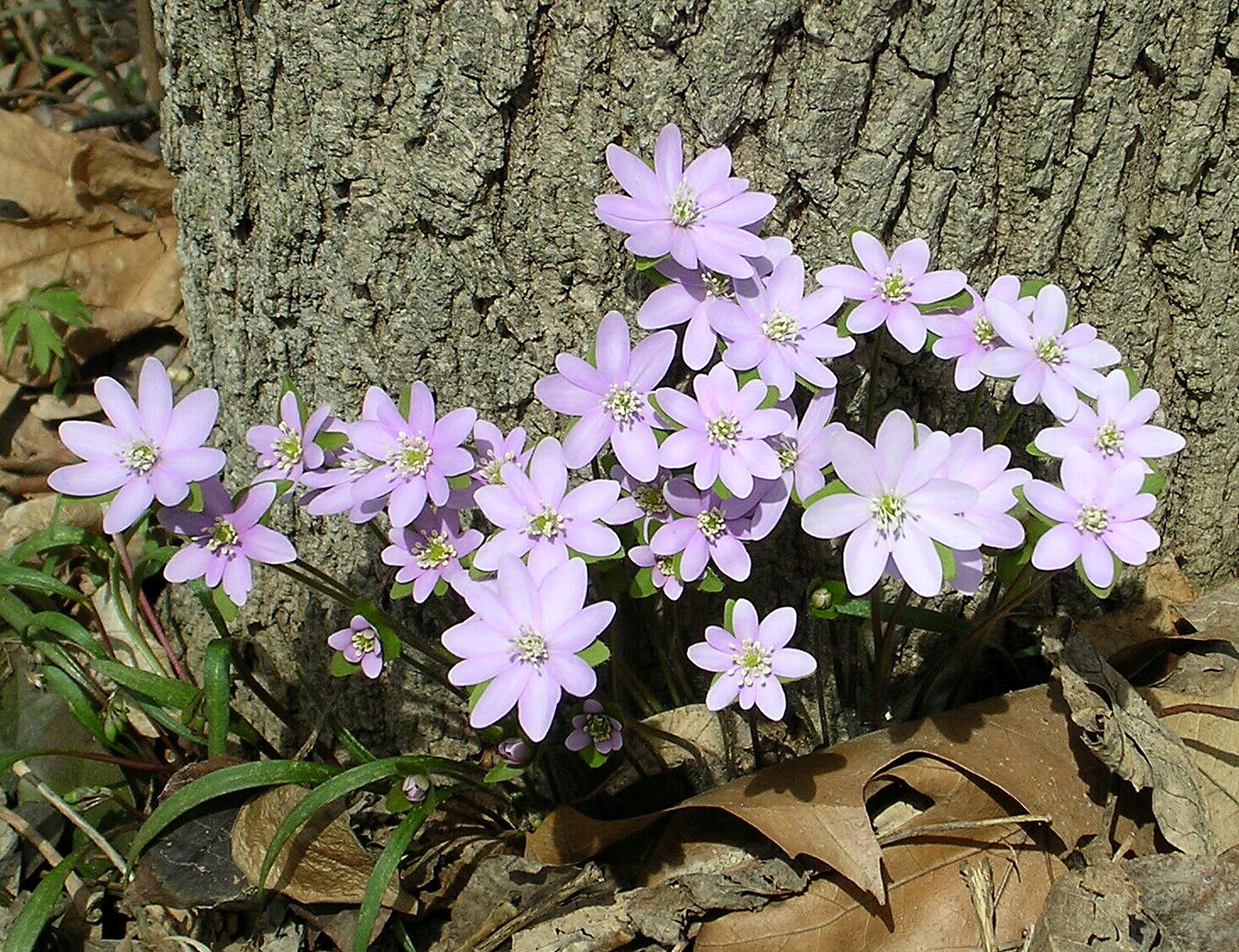
Sharp-lobed hepatica
Anemone acutiloba
The same architecture as A. americana but with sharply pointed (rather than rounded) leaf lobes; the two species can grow within sight of each other and rarely hybridize. Earliest of the cove forbs, often pushing flowers up through late-winter leaf litter before any other species. Common on limestone-influenced slopes and rocky woods on the plateau rim.
Status: Native; common on rocky slopes.
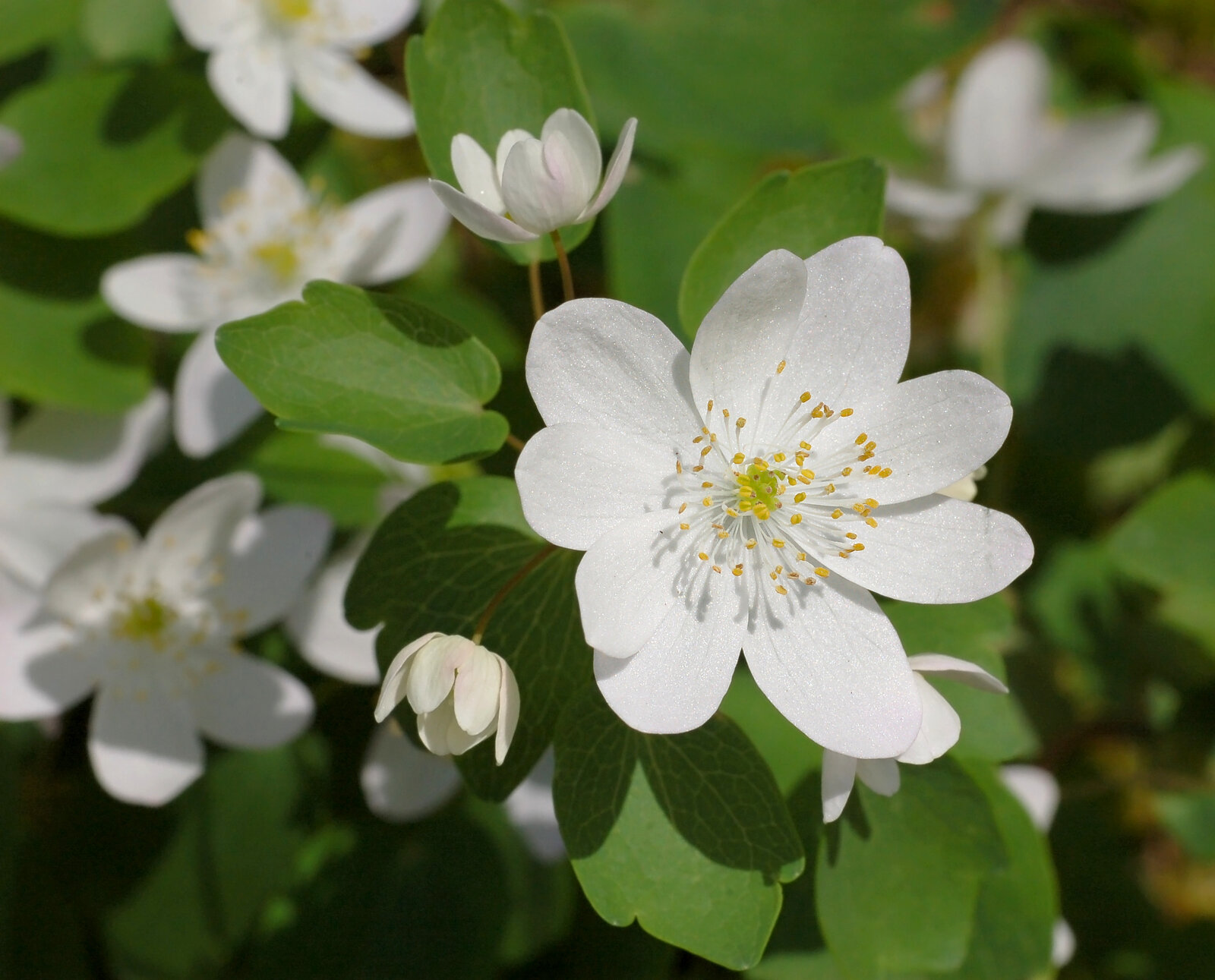
Rue anemone
Thalictrum thalictroides
Delicate white five-petaled flowers (the petals are sepals) above a whorl of small three-lobed leaflets. A buttercup-family species despite the meadow-rue genus name. Common in dry-mesic woods and rocky cove edges in April; smaller and finer than wood anemone.
Status: Native; common.
Solomon's seal, false Solomon's seal, and yellow mandarin
The arching leafy stems of Polygonatum (true Solomon's seal), Maianthemum (false Solomon's seal), and Prosartes (yellow mandarin) are a defining feature of the cove understory through summer. The four species split out by flower placement: Polygonatum hangs paired greenish-white tubular flowers along the underside of the arching stem; Maianthemum holds a terminal cluster of small white flowers at the stem tip; Prosartes hangs paired greenish-yellow bells from a forked stem. All four are members of the lily-allied monocots and produce dark-blue or red berries in late summer.
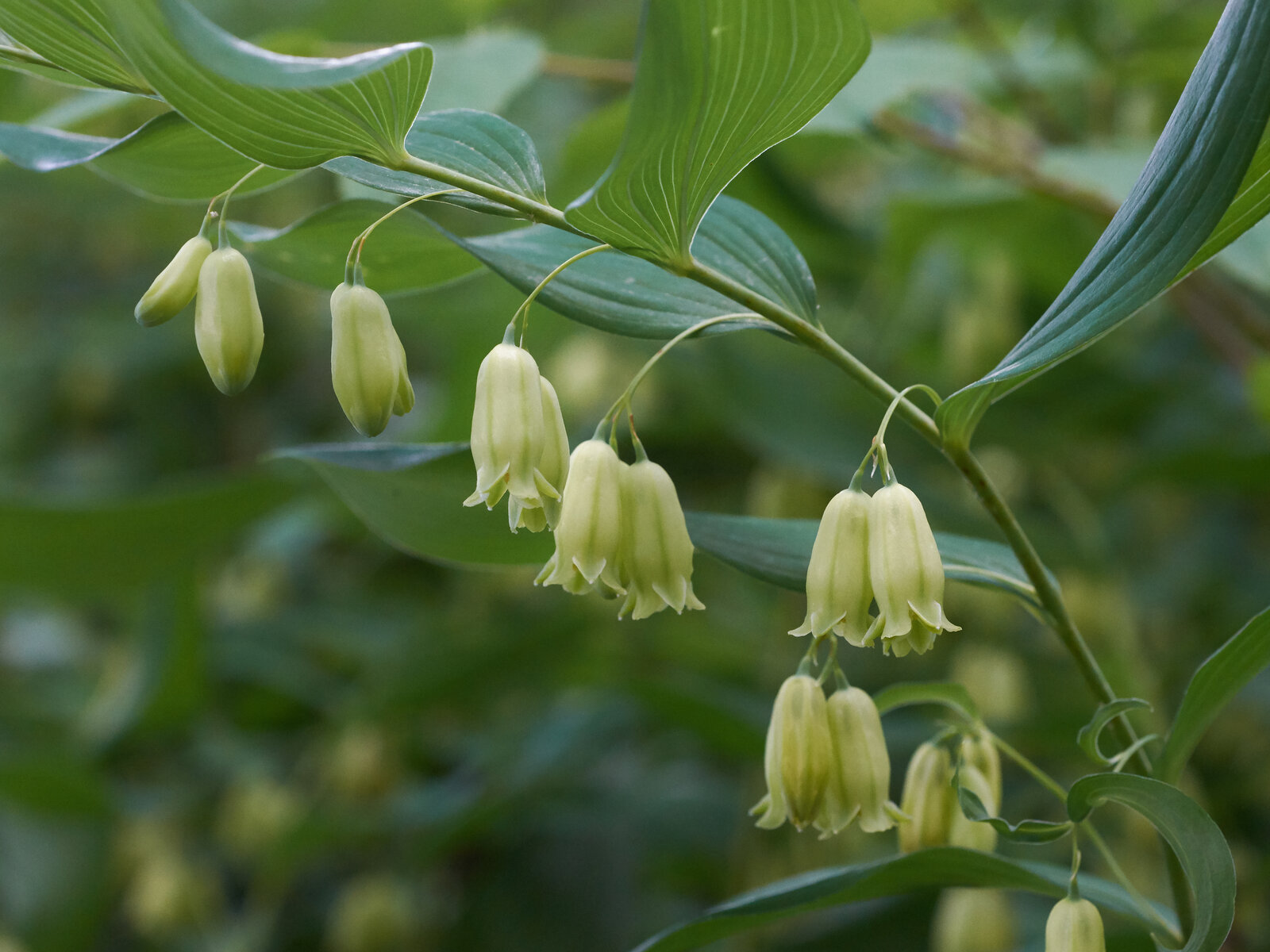
Solomon's seal
Polygonatum biflorum
Arching stem with alternate leaves and pairs of greenish-white tubular flowers hanging beneath each leaf node in May. The name "Solomon's seal" comes from the round scars on the rhizome left by old stems, said to resemble a wax seal. Common on cove and oak-hickory slopes; varies from two to five feet tall depending on soil depth.
Status: Native; common.
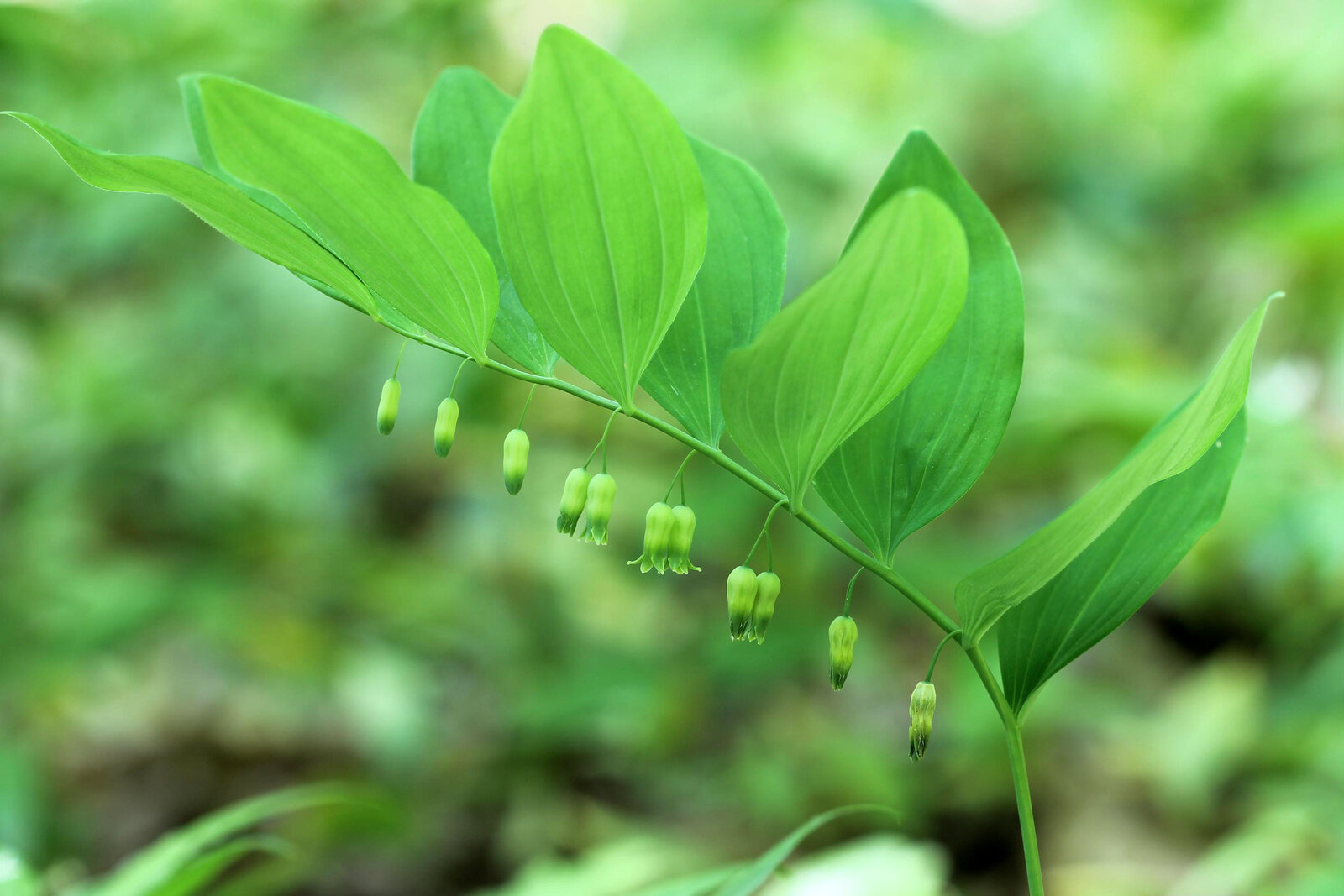
Downy Solomon's seal
Polygonatum pubescens
Differs from P. biflorum in having fine hairs on the underside of the leaves along the veins (visible with a hand lens) and slightly smaller flowers usually held singly rather than paired. Less abundant in Marion than the smooth Solomon's seal and usually associated with damper, shadier cove pockets.
Status: Native; uncommon; damp coves.
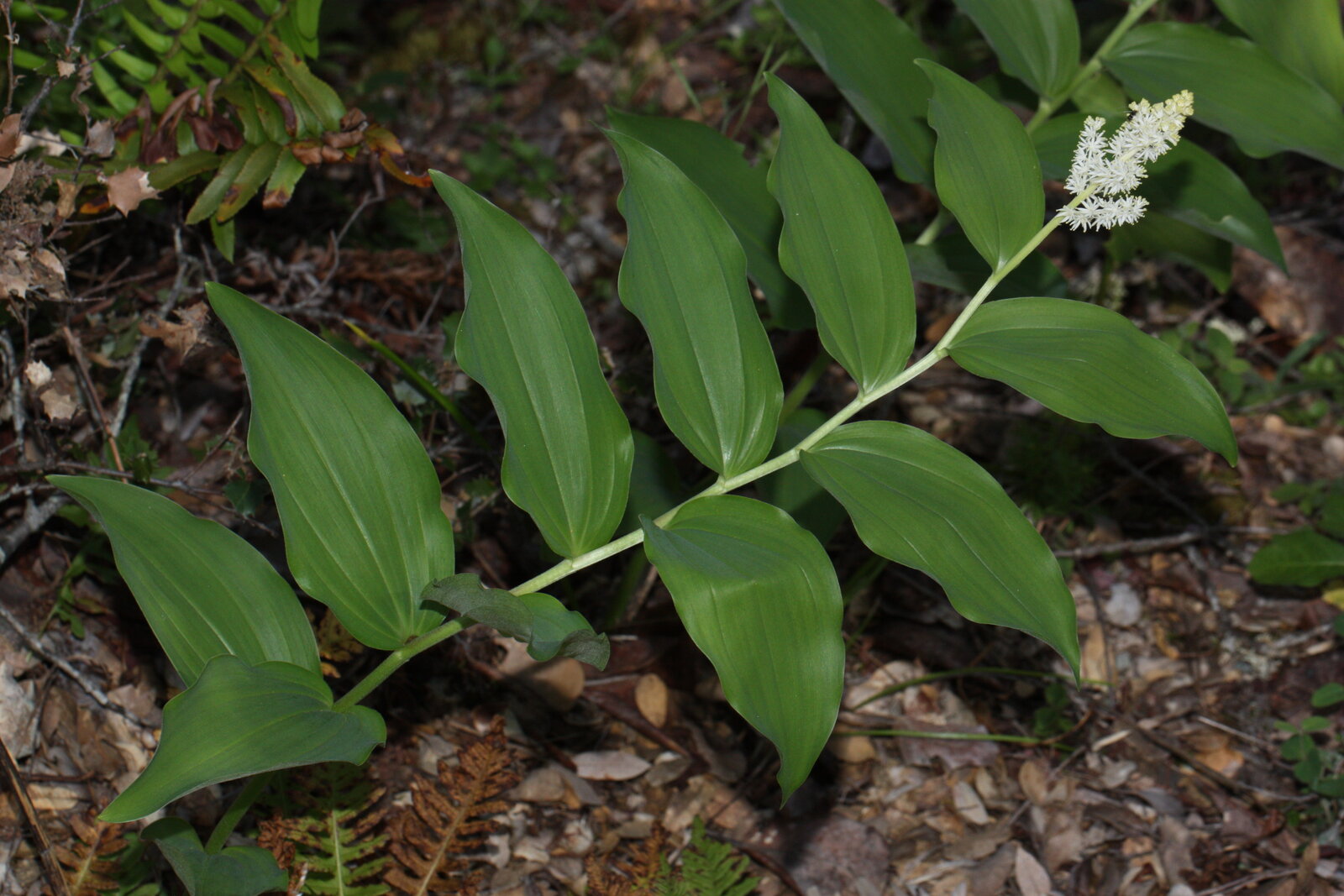
False Solomon's seal
Maianthemum racemosum
Same arching, leafy stem as true Solomon's seal but with a terminal feathery cluster of small white flowers at the stem tip rather than hanging bells along the stem. Late-summer red berries flecked with darker red. Often more abundant than Polygonatum in the same habitat.
Status: Native; common in cove forests.
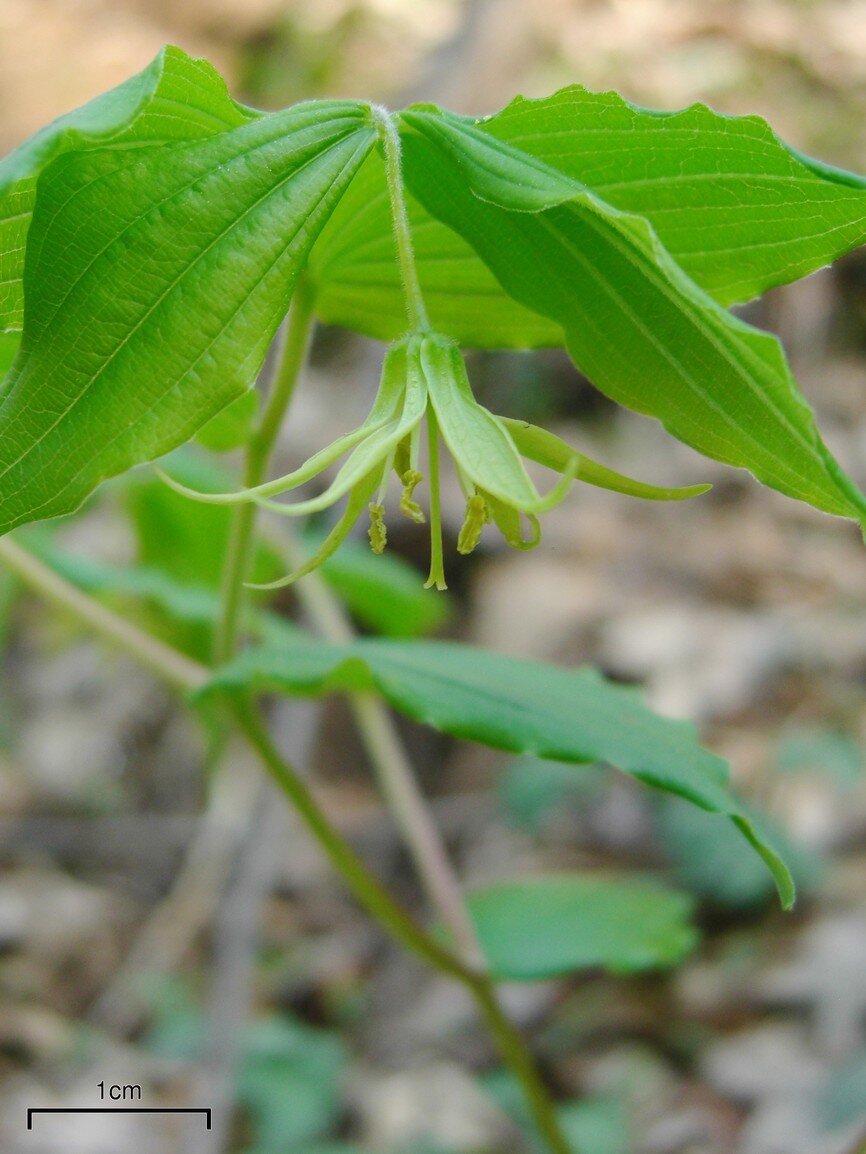
Yellow mandarin
Prosartes lanuginosa
A southern Appalachian and Plateau forb with a forked stem holding paired greenish-yellow bell flowers at the tips of each branch in May. Followed by red berries in late summer. Easy to overlook because the flowers hang under the leaves; favors rich, mesic cove soils.
Status: Native; locally distinctive.
Wood violets
Marion County's woodland violets split into a blue-flowered group with heart-shaped leaves (V. sororia, V. cucullata, V. striata) and a yellow-flowered group of cove and slope specialists (V. pubescens, V. rotundifolia, V. hastata), plus the bird's-foot violet (V. pedata) of dry, sandy openings and the white-flowered V. blanda and V. canadensis of mesic cove pockets. Most violets produce two kinds of flowers: showy chasmogamous flowers in spring that depend on insect pollinators, and self-pollinating cleistogamous flowers later in the season that never open and produce most of the year's seed crop. The dual strategy is one reason violet populations are so resilient.
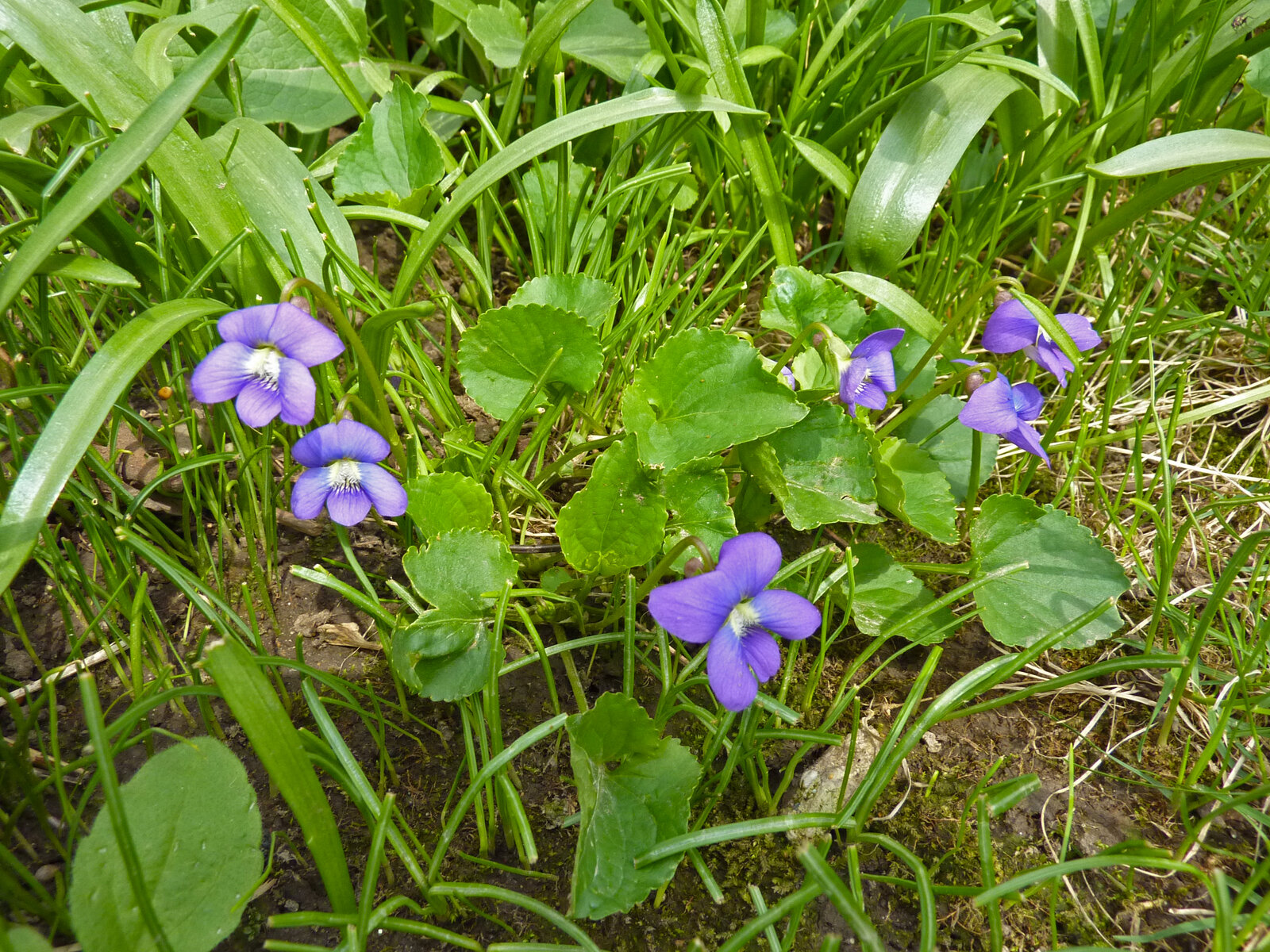
Common blue violet
Viola sororia
The default blue violet of Marion lawns, woodland edges, and cove margins. Heart-shaped leaves and blue-violet five-petaled flowers in April and May; tolerates a wide range of soils from acid plateau to limestone-influenced. The Tennessee state wildflower designation belongs to the passionflower (Passiflora incarnata), but the common blue violet is several southern states' floral emblem.
Status: Native; abundant.
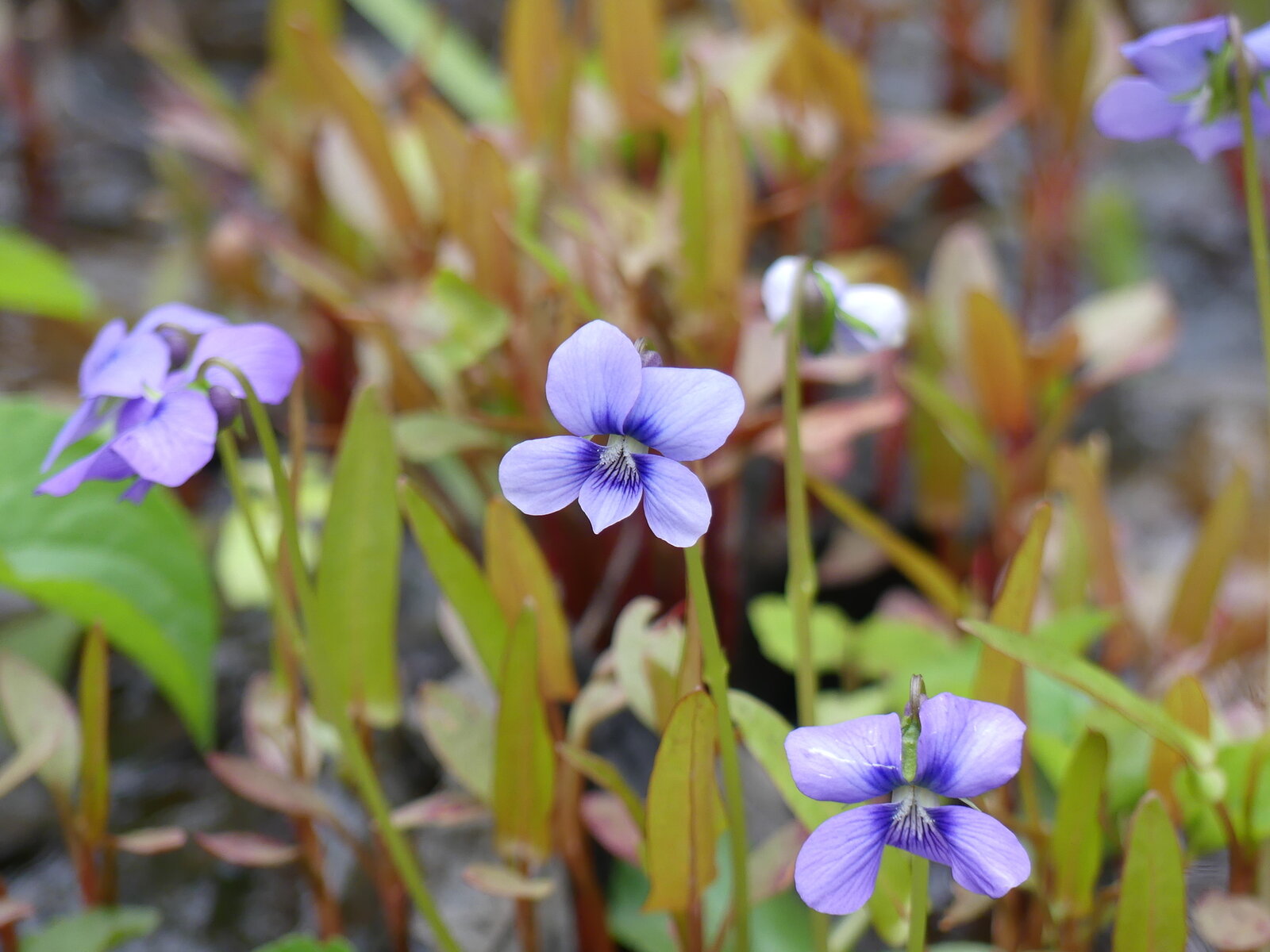
Marsh blue violet
Viola cucullata
Differs from V. sororia in its preference for damp, seepy, often boggy soils and in the cupped or hooded shape of the lateral petals. Common along seep margins, wet meadows, and the wet floor of north-facing cove drainages.
Status: Native; common in damp ground.
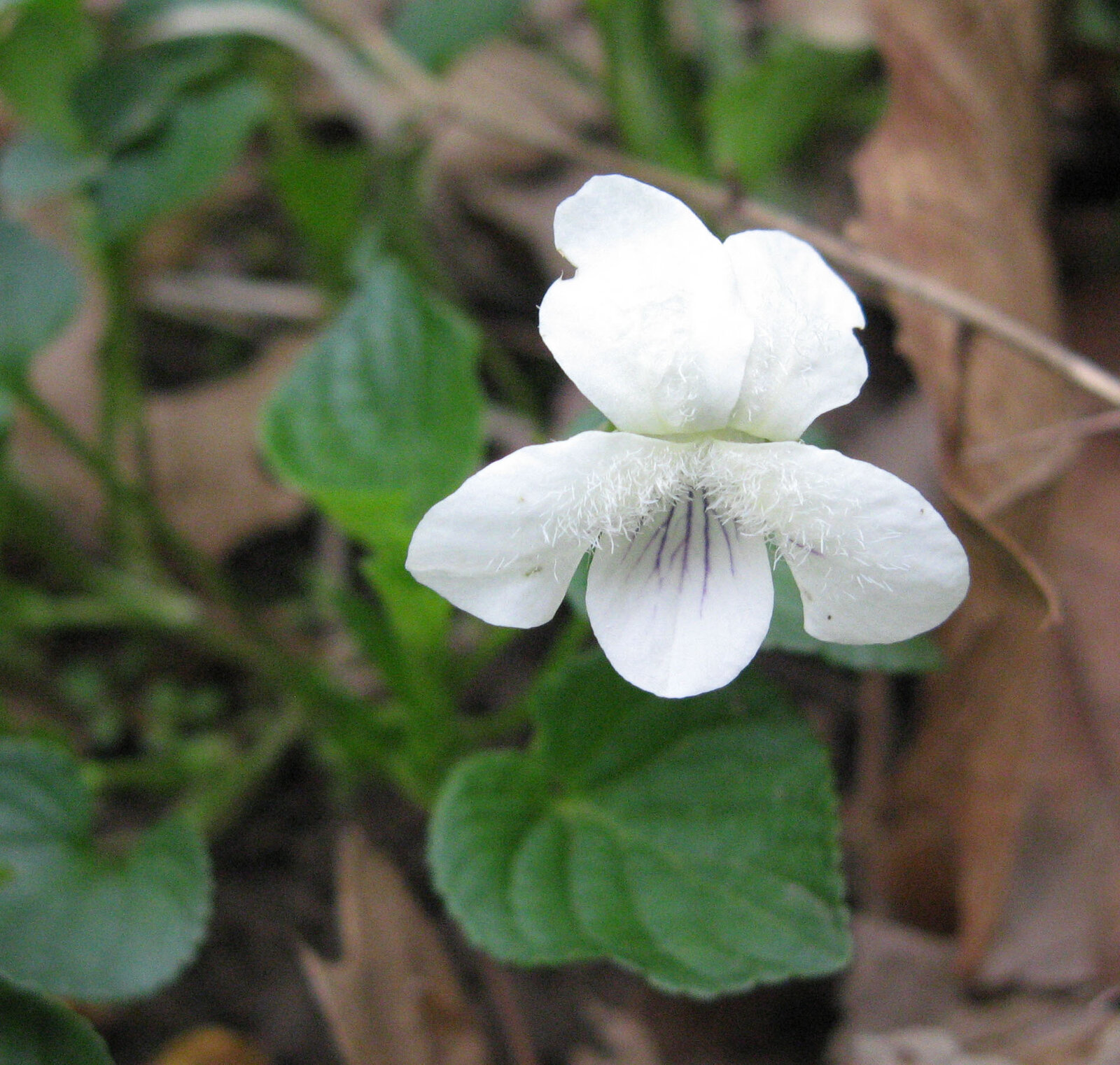
Striped cream violet
Viola striata
Differs from the typical blue violets in its cream-white petals striped with dark purple guide veins. Stem-leafy (rather than basal-rosette) habit; grows in mesic cove woods and along forested streambanks. Less common than the blue violets but distinctive.
Status: Native; common in mesic woods.
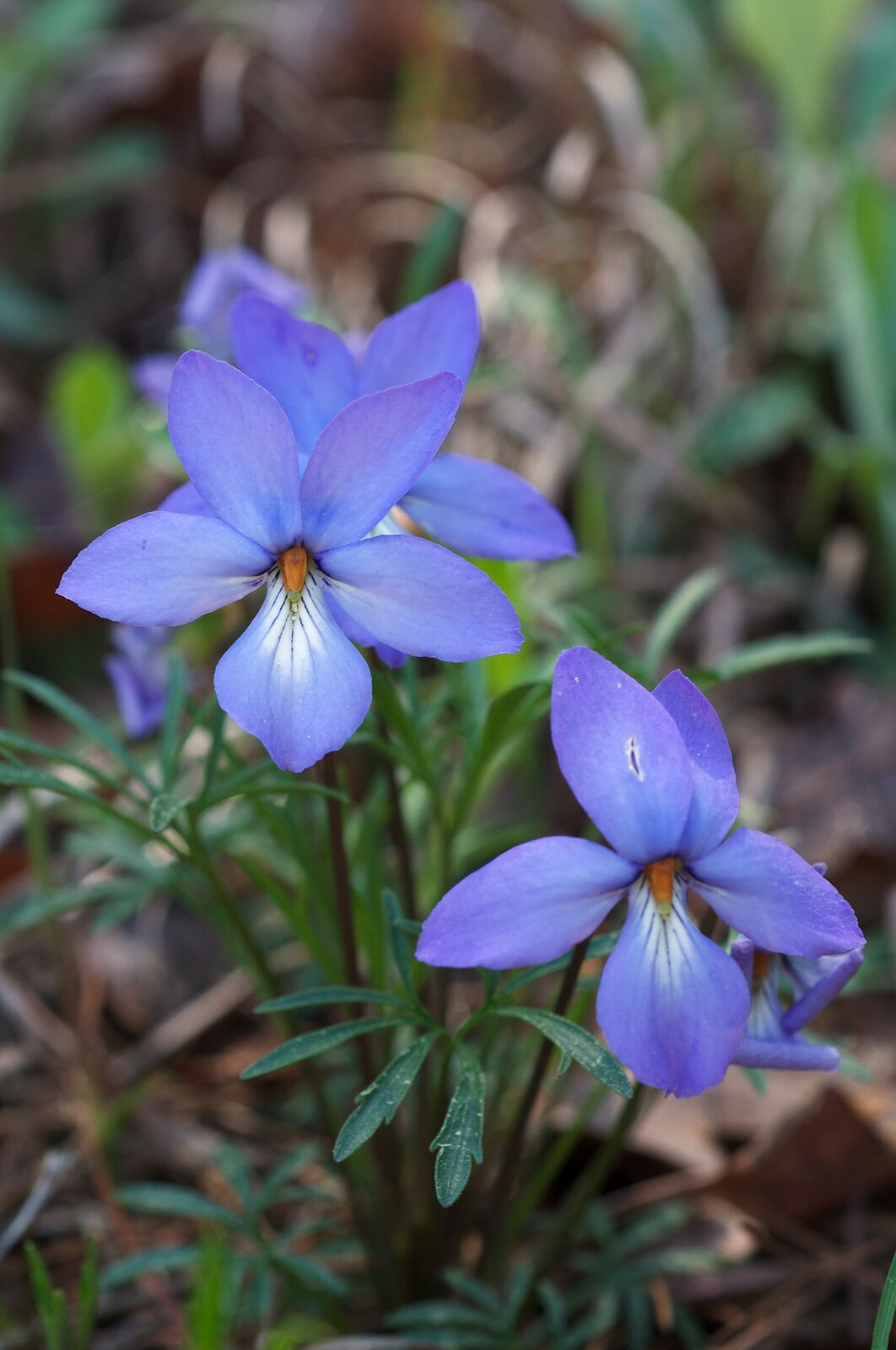
Bird's-foot violet
Viola pedata
The most distinctive Marion violet by leaf shape: deeply palmately divided into narrow lobes that resemble a bird's foot. Lavender-blue flowers in April; favors dry, sandy or gravelly openings on the plateau caprock and ridge-top oak-pine woods. Less tolerant of disturbance than the common blue violet.
Status: Native; locally common in dry ridges.
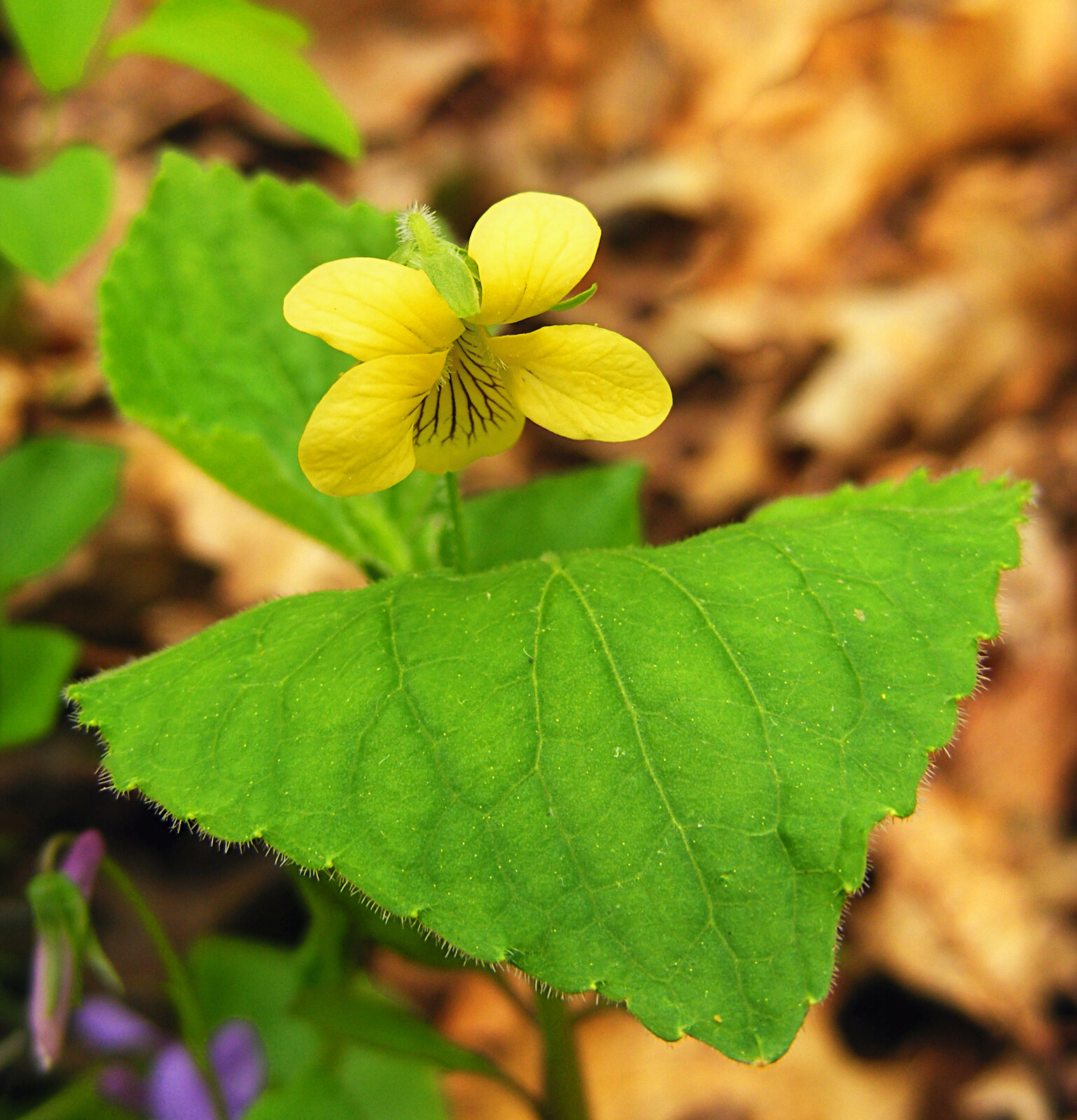
Yellow forest violet
Viola pubescens
A yellow-flowered violet with a hairy (pubescent) stem and heart-shaped to triangular leaves. Stem-leafy rather than basal-rosette. Common in rich cove forests in April and May; the most abundant of the yellow Marion violets.
Status: Native; common in rich coves.
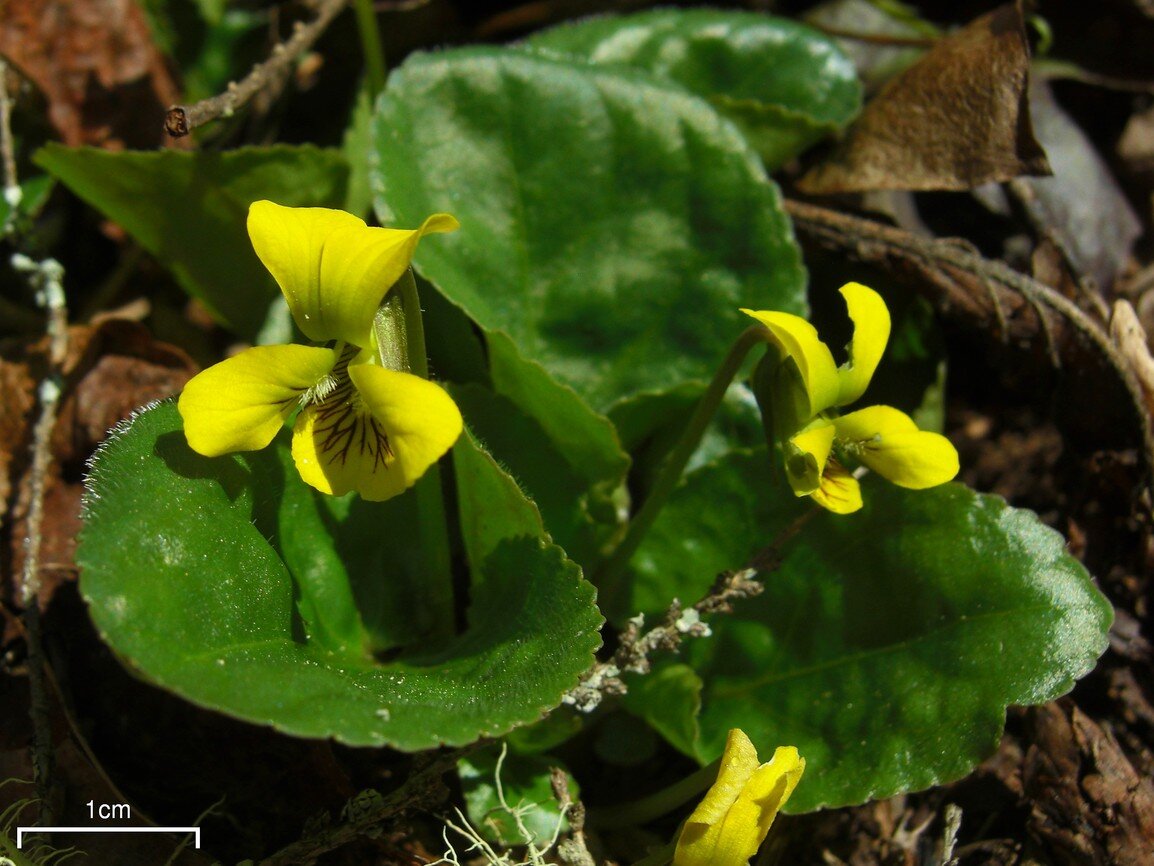
Round-leaved yellow violet
Viola rotundifolia
Differs from V. pubescens in its broadly rounded, almost circular basal leaves and its lower stature. The leaves grow much larger after the flowers fade and persist into summer as flat green plates on the cove floor. Less abundant than V. pubescens in Marion.
Status: Native; uncommon; rich coves.
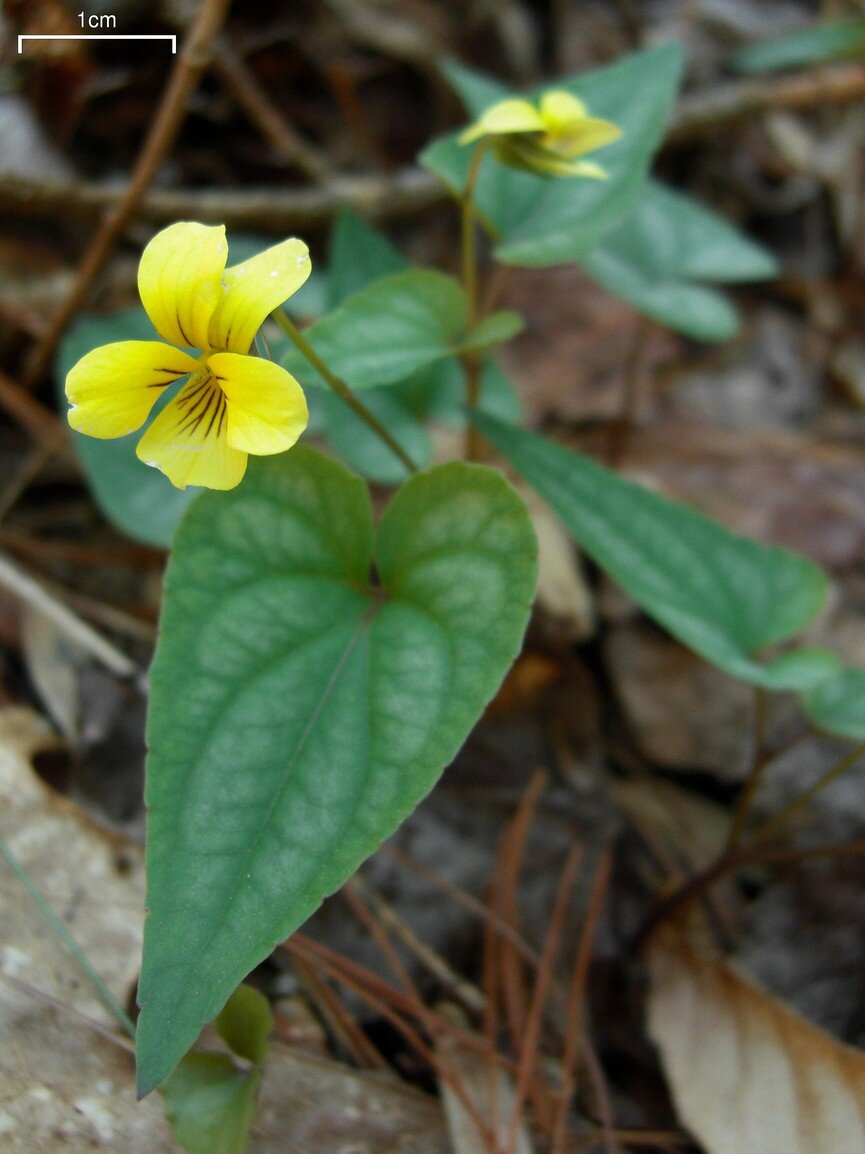
Halberd-leaved violet
Viola hastata
The most distinctive yellow violet by leaf shape: long, arrowhead-shaped (halberd) leaves often marked with silvery-gray mottling. Yellow flowers in April. Restricted to acid soils on the southern Plateau; less abundant than V. pubescens but reliable in pine-oak-heath cove margins.
Status: Native; locally distinctive.
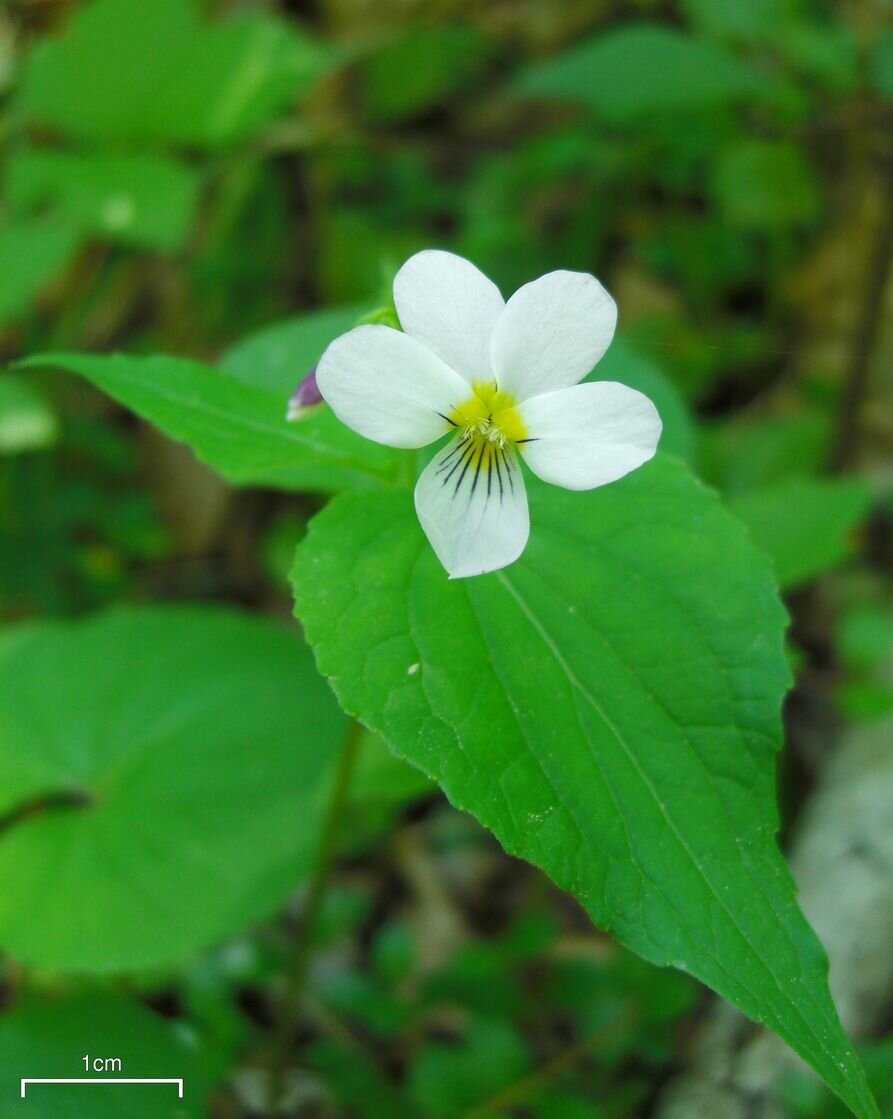
Canada violet
Viola canadensis
A taller stem-leafy violet with white five-petaled flowers, the lower three petals pencil-streaked with purple veins and the throat tinged yellow. Favors rich, mesic cove forests; less abundant in Marion than the common blue violet but conspicuous when in bloom in May.
Status: Native; uncommon; rich coves.
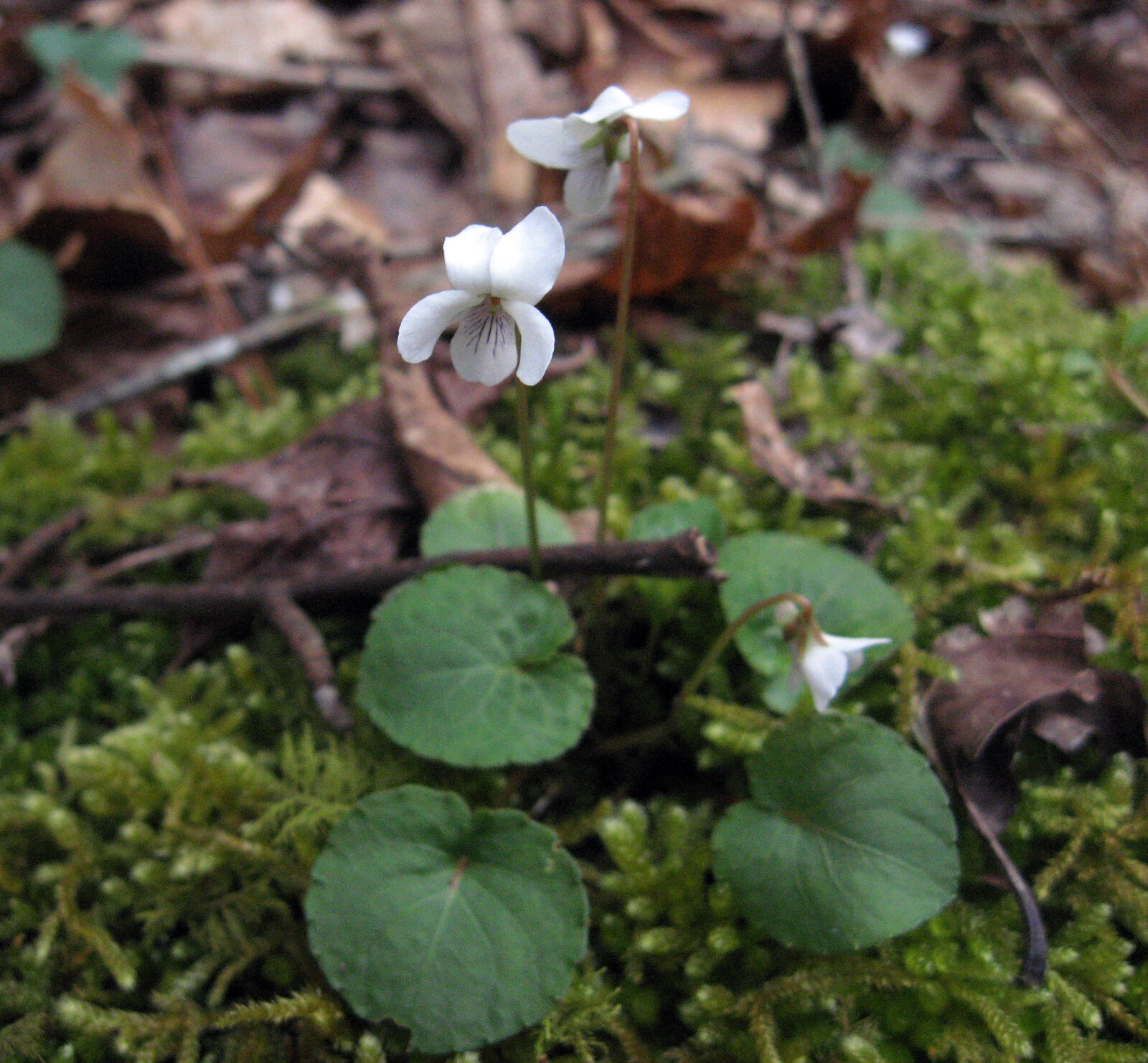
Sweet white violet
Viola blanda
A small white-flowered violet with a faint sweet scent (the source of the species name blanda). The lateral petals are bent slightly backward, which is the easiest field cue. Favors damp, mossy cove pockets and seep margins.
Status: Native; uncommon; damp coves.
Mid-summer and late-summer woodland forbs
By July the spring ephemerals have set seed and gone dormant, and a different set of woodland forbs takes over the cove and slope understory. Most are taller, leafier, and longer-blooming than the spring species; they rely on insect pollinators that are active through summer rather than the early bumblebees that work the cove in April. Yellow jewelweed (Impatiens pallida), white snakeroot (Ageratina altissima), and the woodland sunflowers and asters dominate the late-summer cove floor; the goldenrods of the deep woods are easy to overlook because they don't hold the bright field-edge yellows of their open-country cousins.
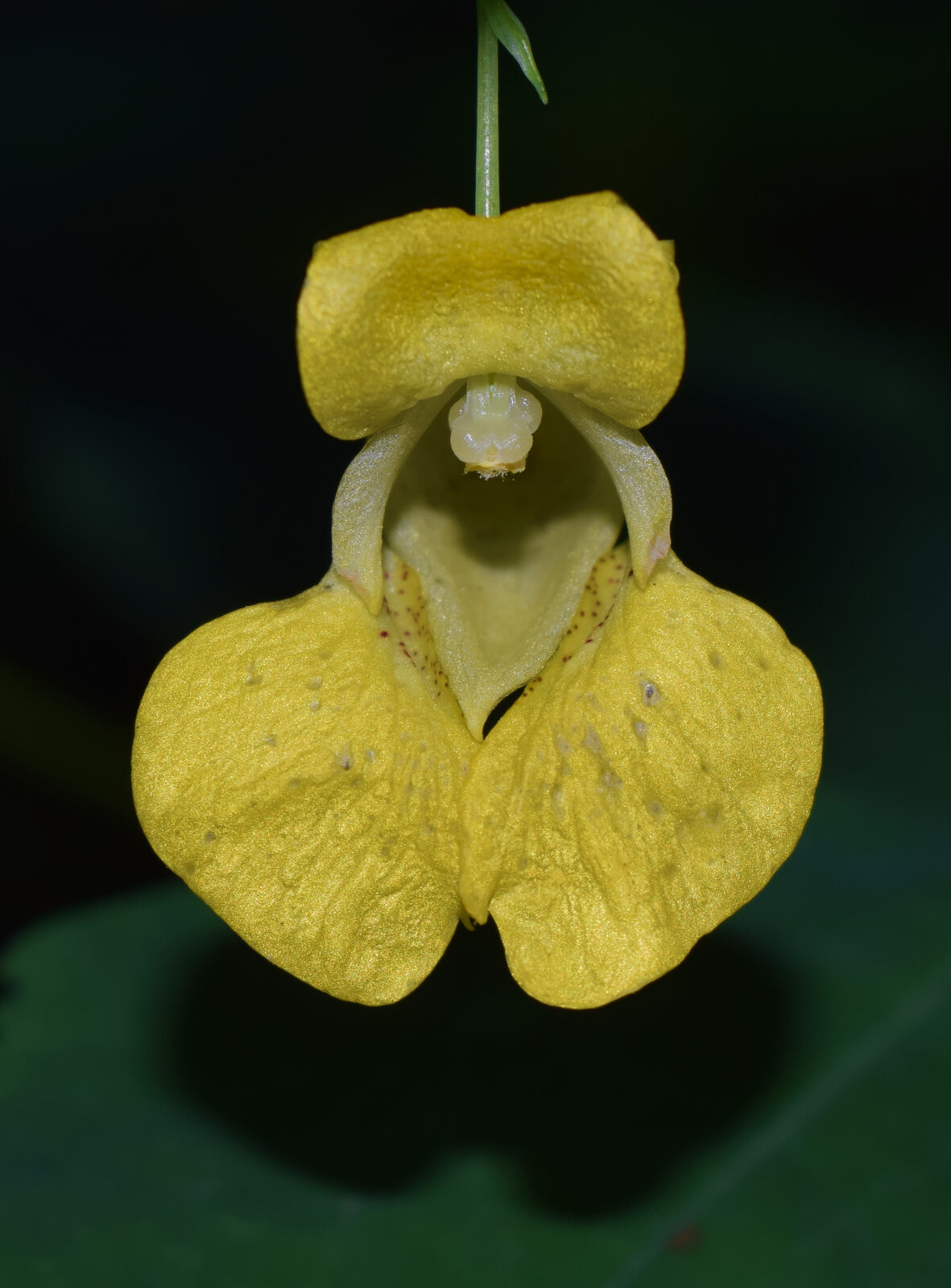
Yellow jewelweed
Impatiens pallida
The pale-yellow cousin of orange-flowered Impatiens capensis. Tall, succulent stems and pale-yellow tubular flowers with a curled spur in late summer. Favors damp cove pockets and shaded streambanks. Like the orange jewelweed, the seed capsules split explosively at a touch (the source of the folk name touch-me-not).
Status: Native; common in damp coves.
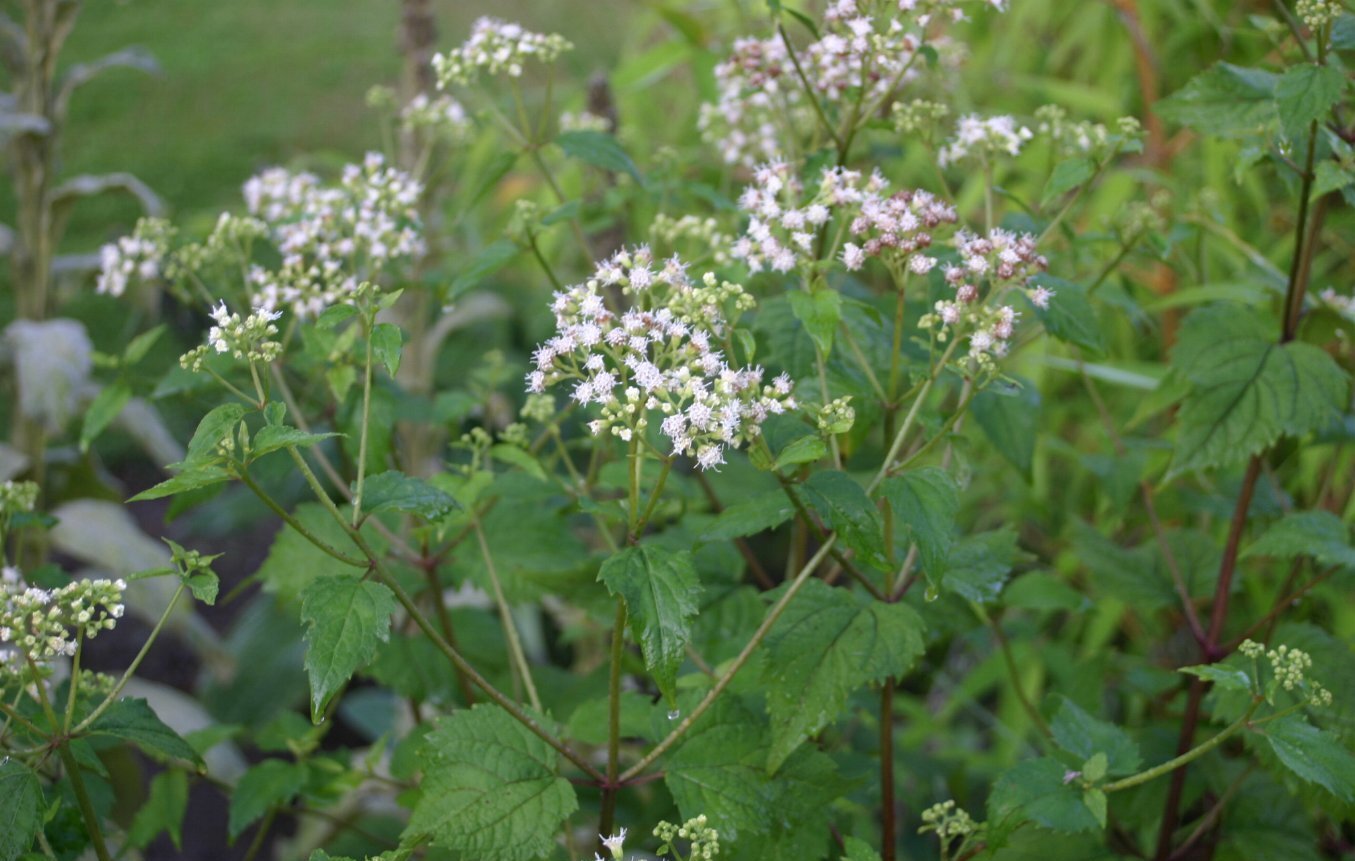
White snakeroot
Ageratina altissima
Flat-topped clusters of small white flowers in August and September on a shoulder-high stem; common throughout Marion cove forests. The plant contains tremetol, a toxin that passes into the milk of cattle that graze it, causing milk sickness in early-nineteenth-century settlers (Abraham Lincoln's mother is generally believed to have died of it in 1818). No longer a livestock concern in Marion since dairy cattle are not pastured in deep woods.
Status: Native; abundant in cove forests.
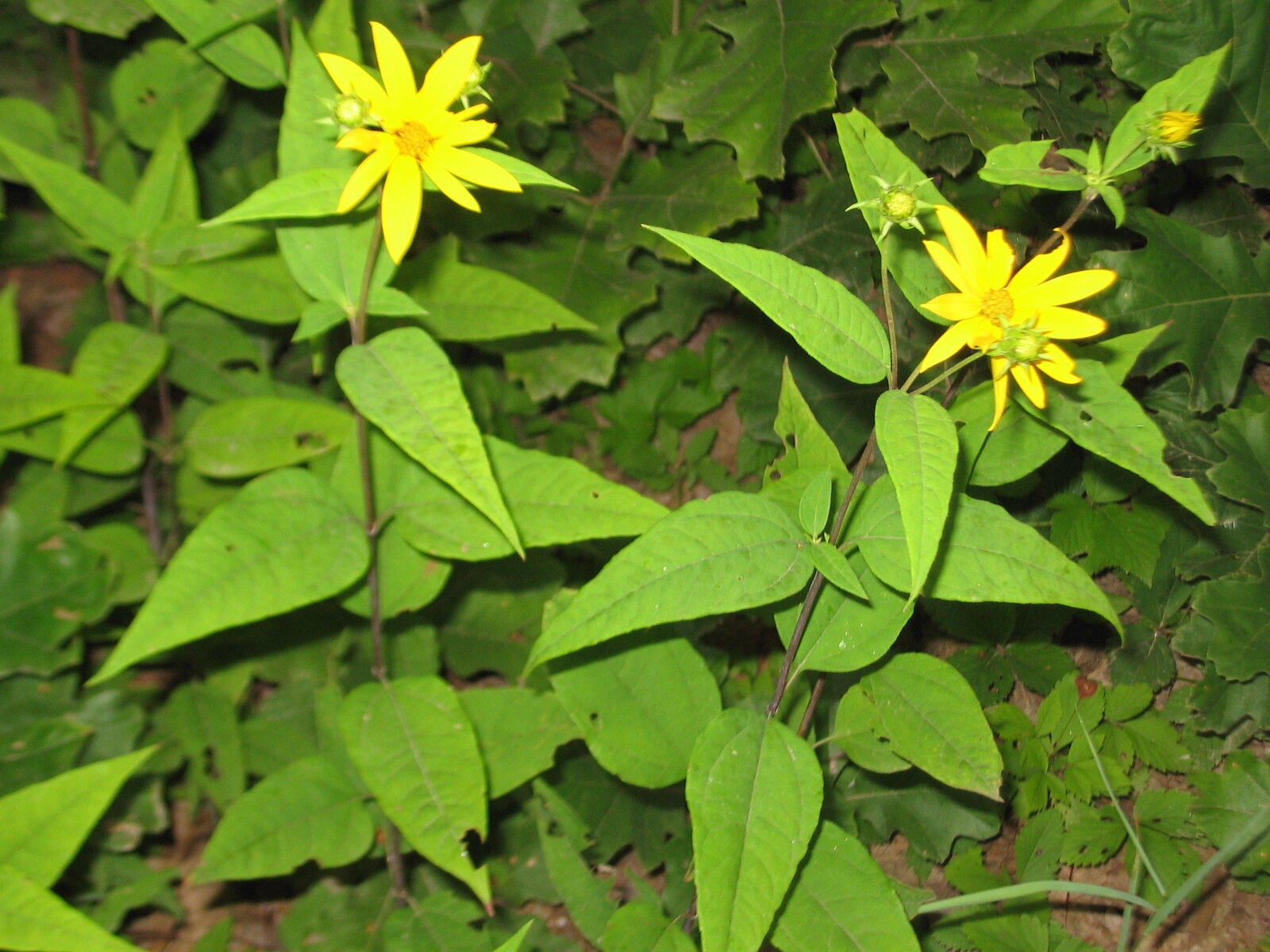
Woodland sunflower
Helianthus divaricatus
A four- to six-foot perennial sunflower of woodland edges and open cove margins. Yellow ray flowers in late July through September, smaller than the open-country sunflowers but more shade-tolerant. Forms slowly spreading rhizome colonies in the same habitat as white snakeroot.
Status: Native; common on woodland edges.
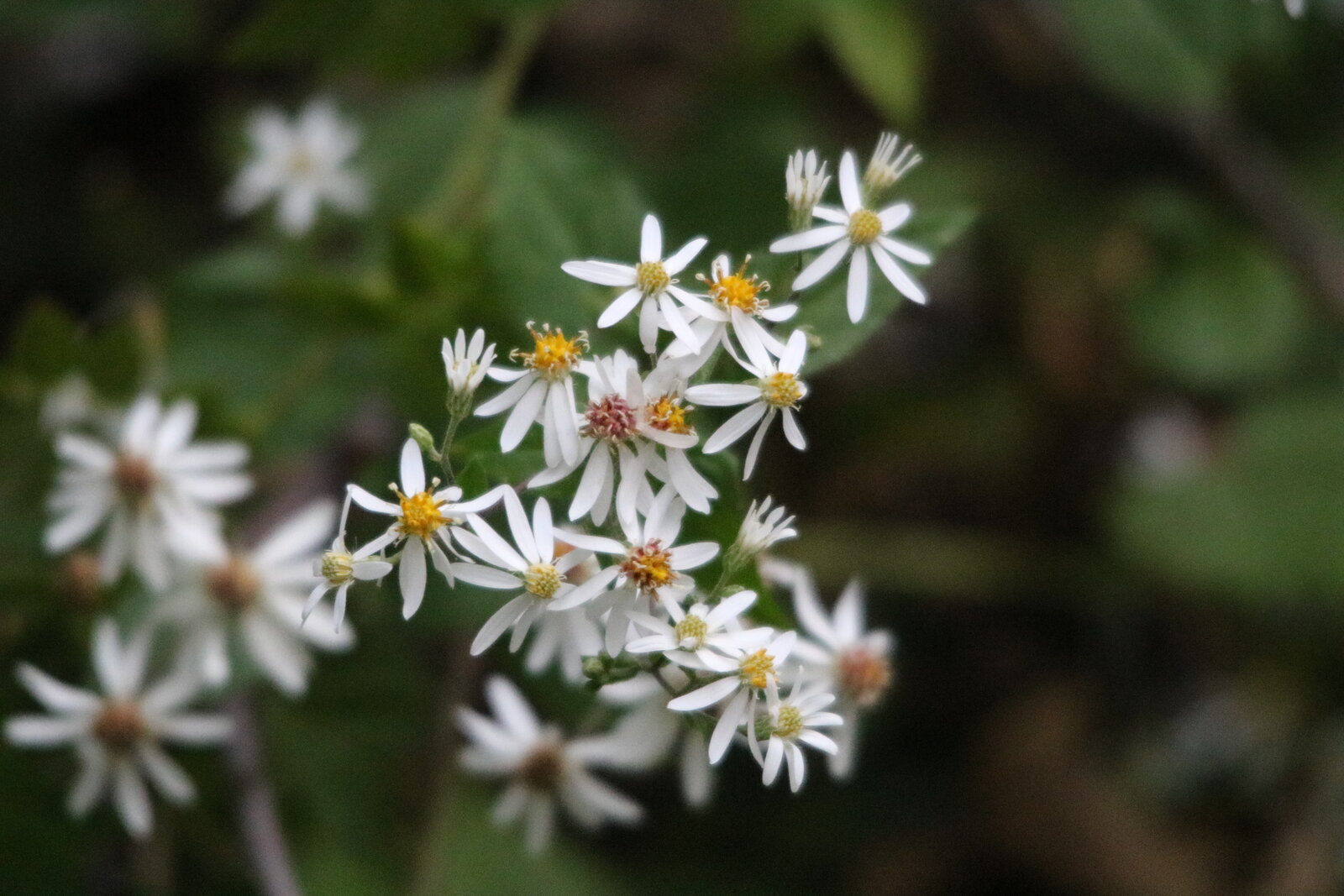
White wood aster
Eurybia divaricata
A common late-summer cove aster with sprays of small white-rayed flowers (the disk turns from yellow to red-purple as the flower ages) above a basal rosette of heart-shaped leaves. Often forms continuous understory cover in mature cove forests in September and October.
Status: Native; abundant in cove forests.
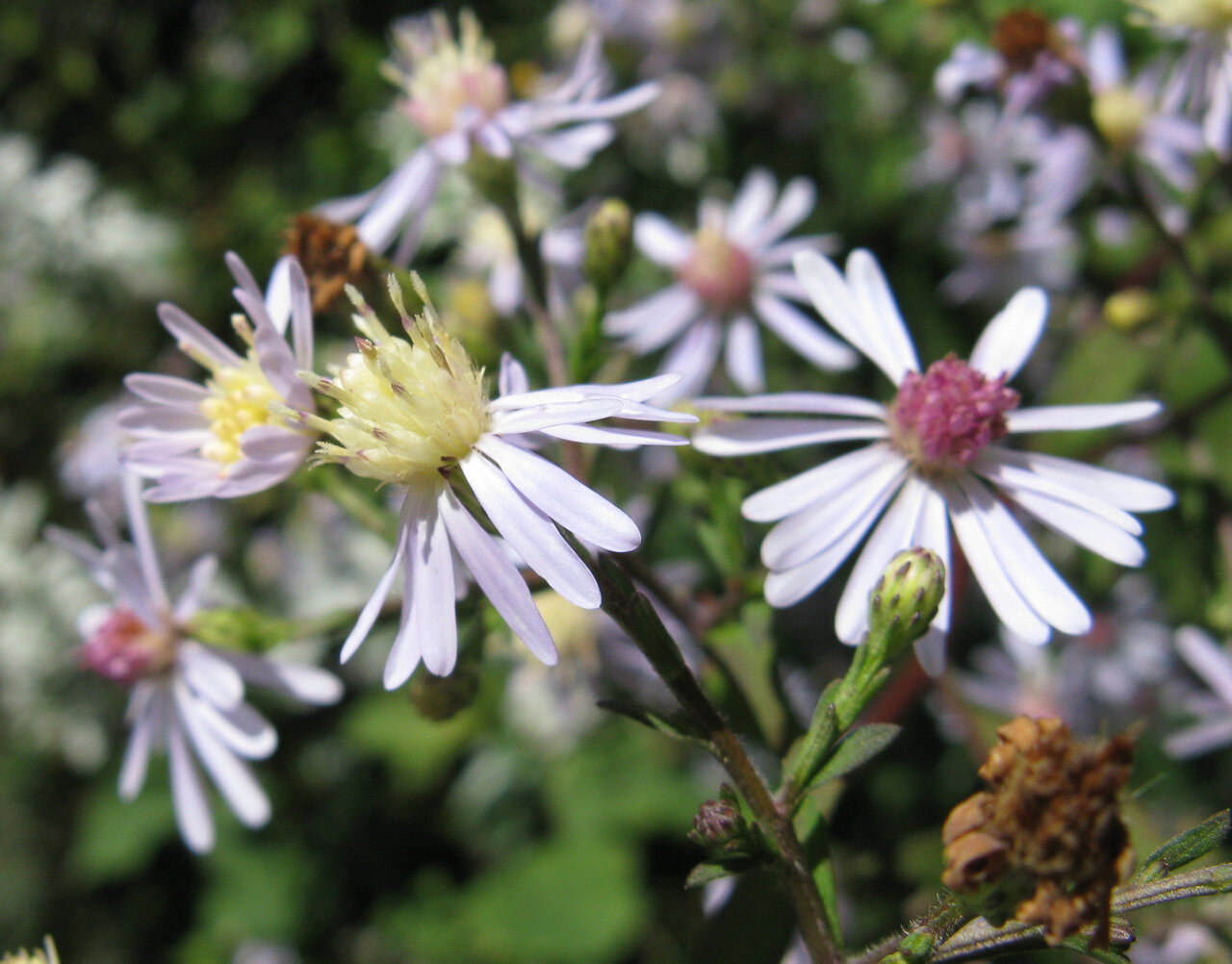
Heart-leaved aster
Symphyotrichum cordifolium
A pale-blue cove aster of mesic woods, often growing alongside the white wood aster but flowering slightly later (mid-September into October). Heart-shaped basal leaves on long winged petioles distinguish it from the other blue asters of Marion's open country.
Status: Native; common in cove forests.
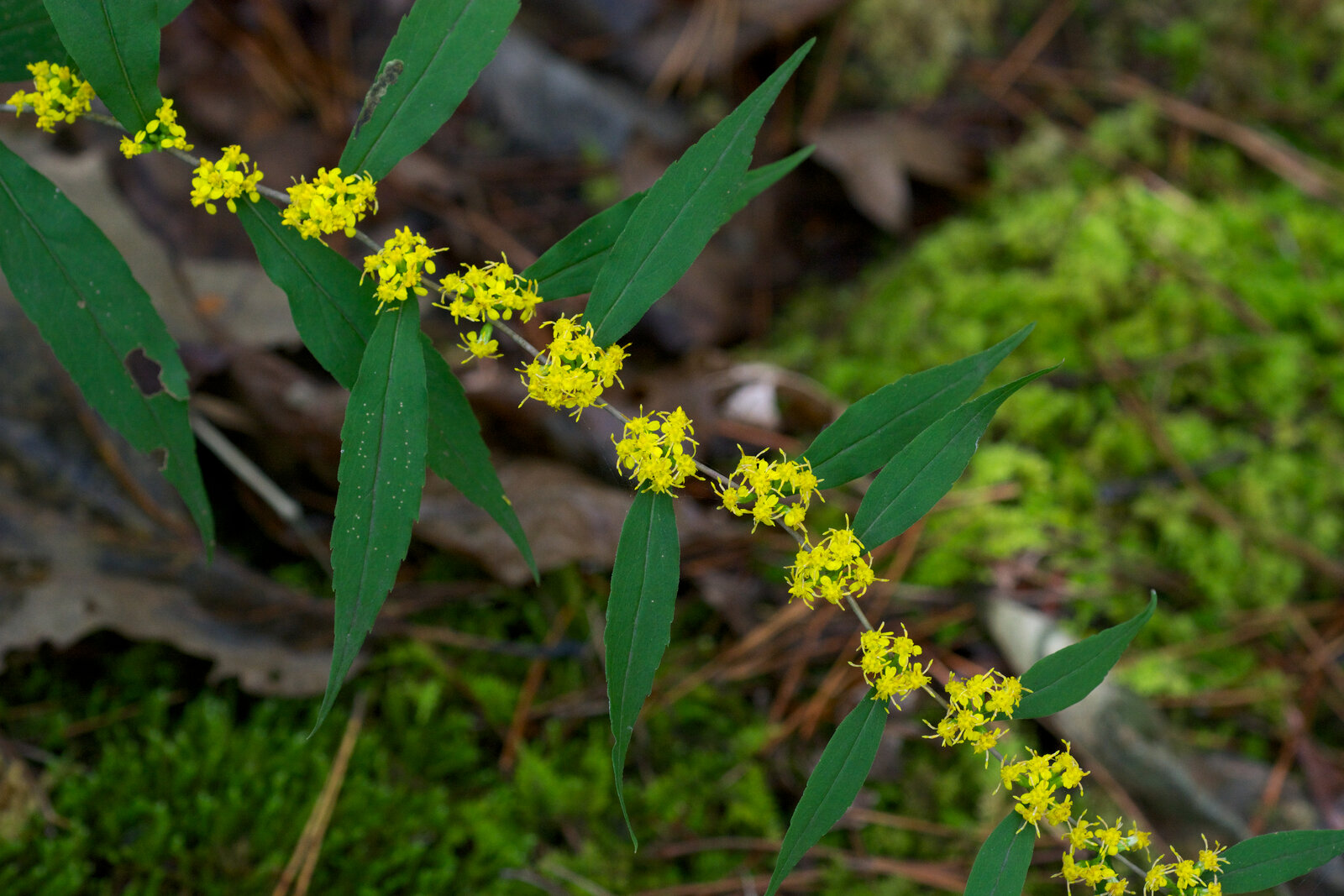
Blue-stemmed goldenrod
Solidago caesia
An arching, woodland goldenrod with small yellow flowers held in clusters along the stem at every leaf axil rather than in a terminal plume. The stem has a purplish-blue waxy bloom (the source of the species name). One of the few goldenrods to flower deep in shaded cove forest.
Status: Native; common in cove forests.
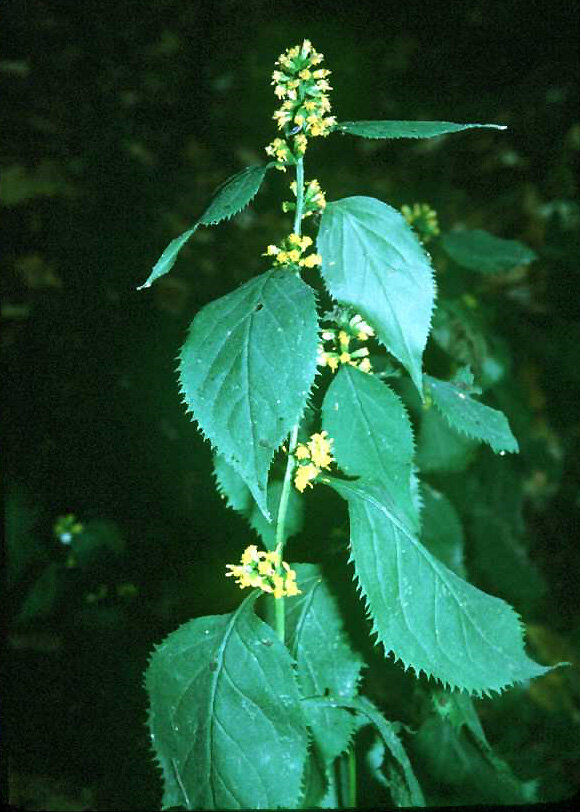
Zigzag goldenrod
Solidago flexicaulis
Named for the way the stem zigzags between alternate broad leaves rather than running straight. Yellow flower clusters at every leaf axil through September. A reliable woodland goldenrod of the rich cove understory.
Status: Native; common in rich coves.
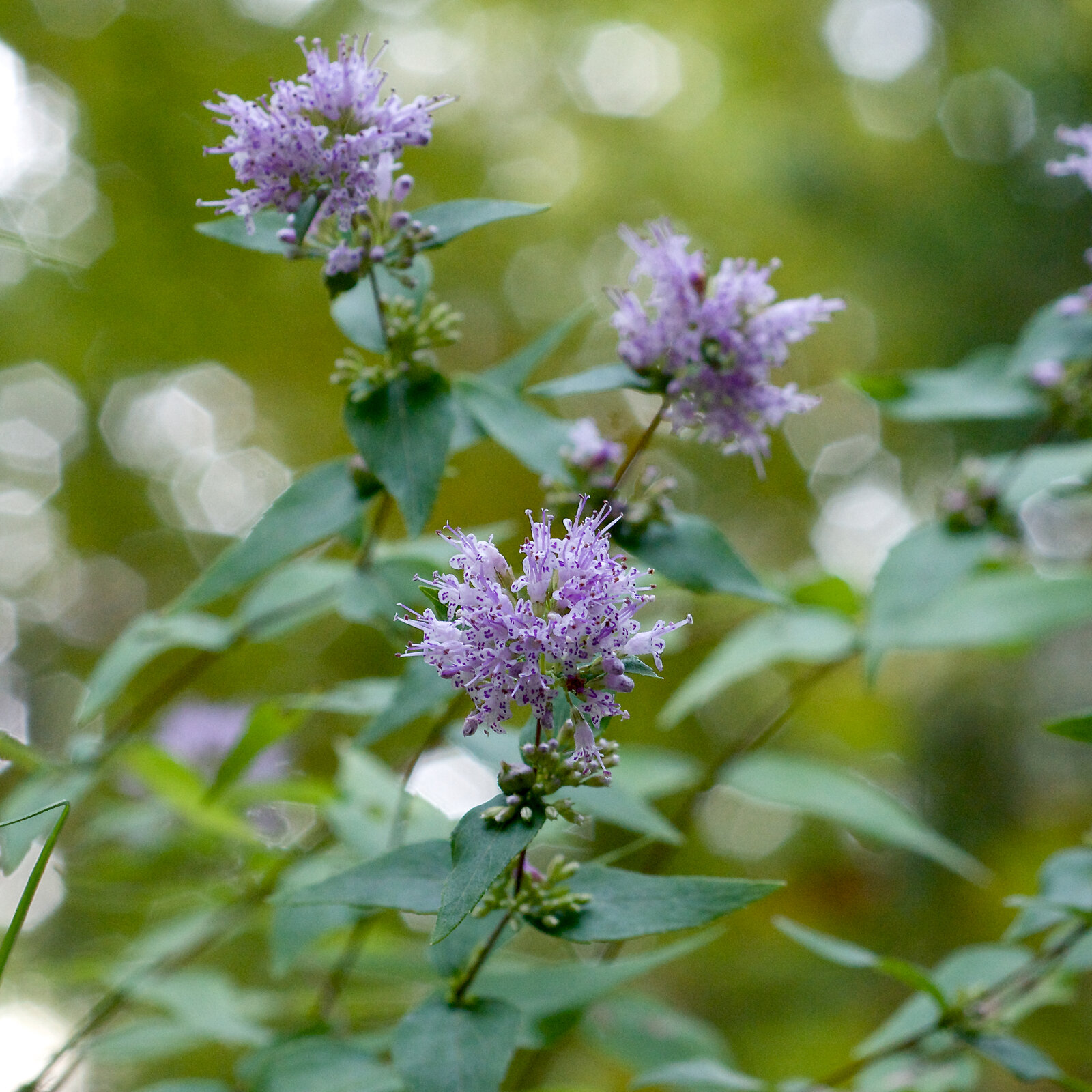
American dittany
Cunila origanoides
A small mint-family forb with strongly oregano-scented foliage and small lavender flowers in late summer. Favors dry, rocky woods and ridge openings rather than rich cove. Forms small loose patches on the plateau caprock; the leaves were used historically for tea.
Status: Native; common on dry ridges.
Galax, spotted wintergreen, and the saprophytes
The Ericaceae and the closely allied Pyrolaceae and Monotropaceae produce a small but distinctive set of woodland forbs adapted to nutrient-poor, fungus-rich plateau soils. Galax (Galax urceolata) and spotted wintergreen (Chimaphila maculata) are evergreen rosette plants that depend on mycorrhizal associations with soil fungi. Indian pipe (Monotropa uniflora) and pinesap (Hypopitys monotropa) take the strategy a step further: they have lost chlorophyll entirely and steal sugars from photosynthetic trees through shared fungal networks. All four are reliable indicators of mature, undisturbed forest soils on the southern Plateau.
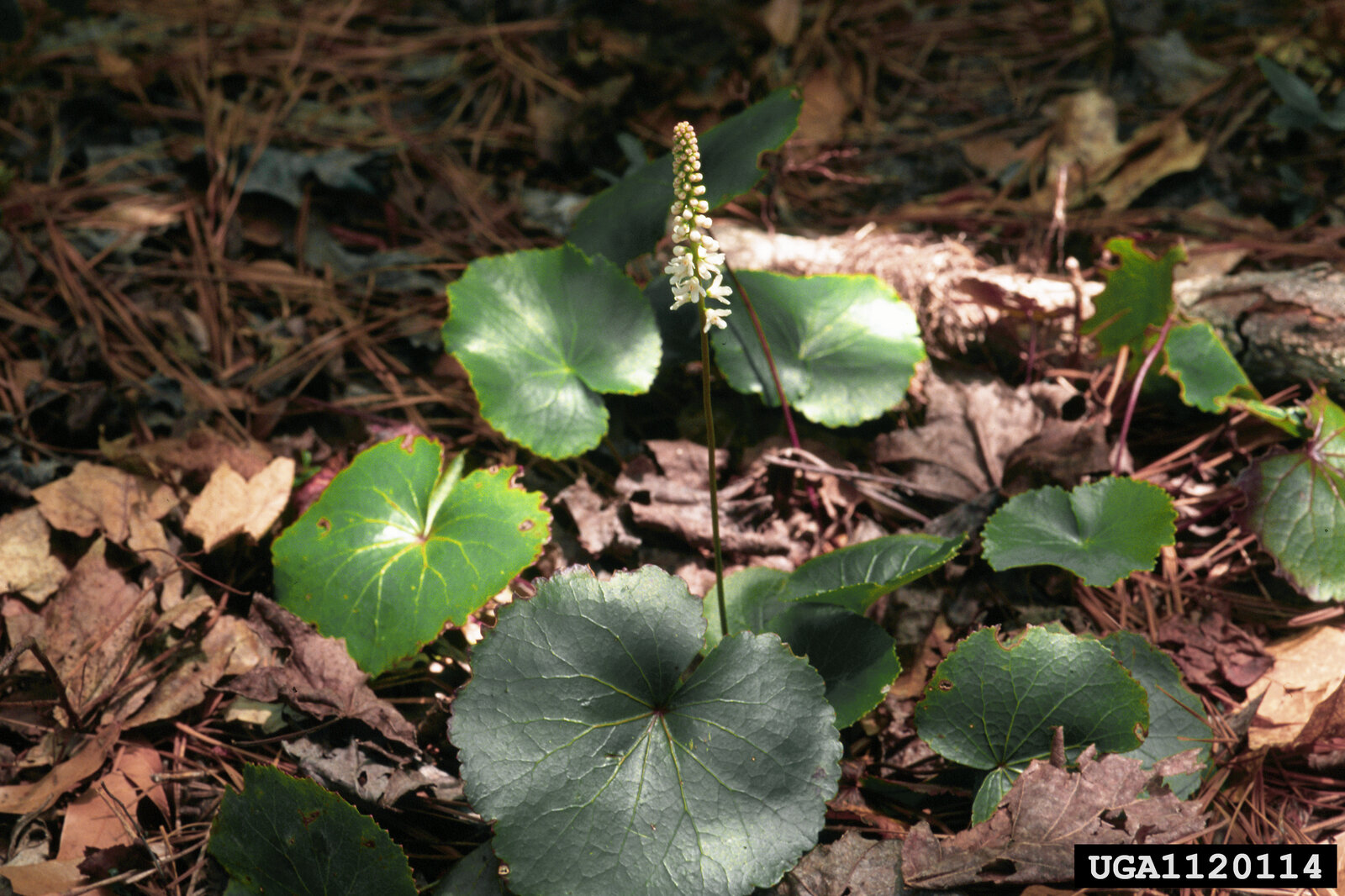
Galax
Galax urceolata
A southern Appalachian endemic that ranges into the Cumberland Plateau on acidic, well-drained soils. Rounded, glossy evergreen leaves form a basal rosette that turns burgundy in fall and persists through winter. A tall white flower spike rises from the center in early summer. Heavily harvested for the floral trade in some adjacent states.
Status: Native; locally common; harvest-pressured regionally.
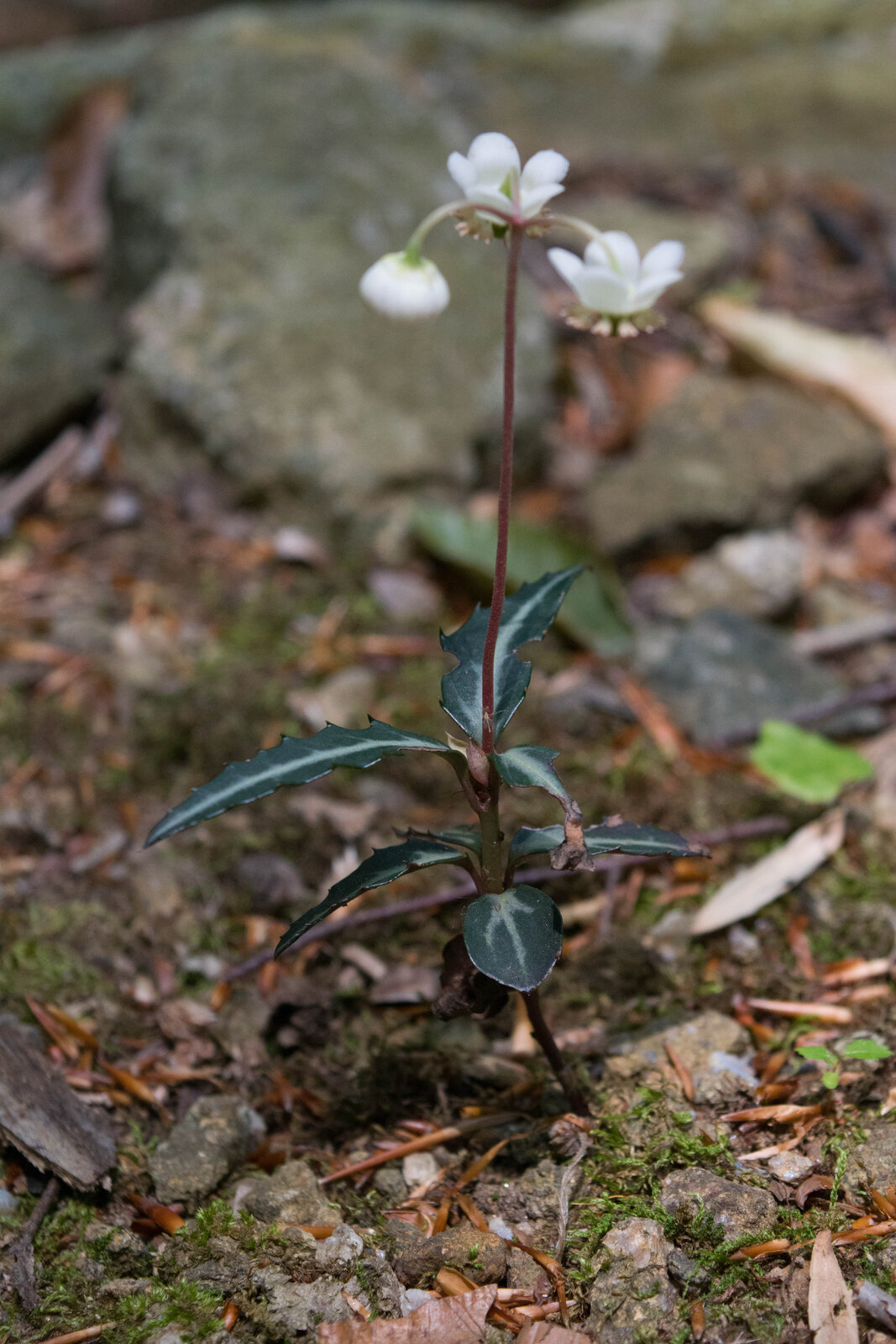
Spotted wintergreen
Chimaphila maculata
Also called striped pipsissewa. Whorls of dark-green evergreen leaves are striped down the midvein with a pale white-green band that gives the plant its common name. Small white-to-pink five-petaled flowers nod from a short stalk in midsummer. A reliable indicator of mature acid plateau soil.
Status: Native; common on plateau forests.
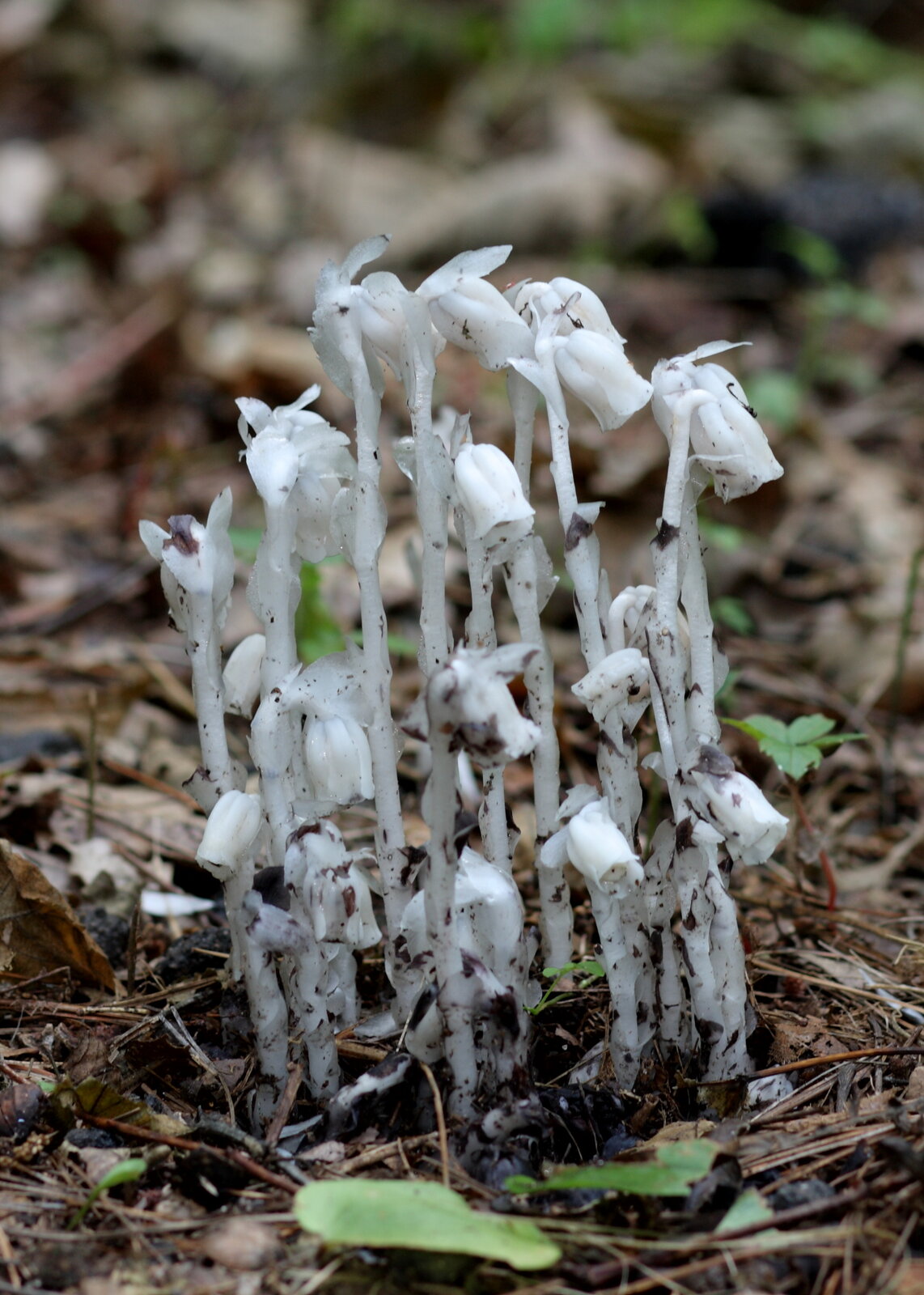
Indian pipe
Monotropa uniflora
A ghost-white plant with no chlorophyll, parasitic on soil fungi that are themselves mycorrhizal partners of forest trees. Each stem holds a single nodding flower that becomes erect after pollination and fruiting. Most often appears in late summer and early fall after rain. Turns black on drying. The whole population in a stand can erupt overnight.
Status: Native; widespread; fungus-dependent.
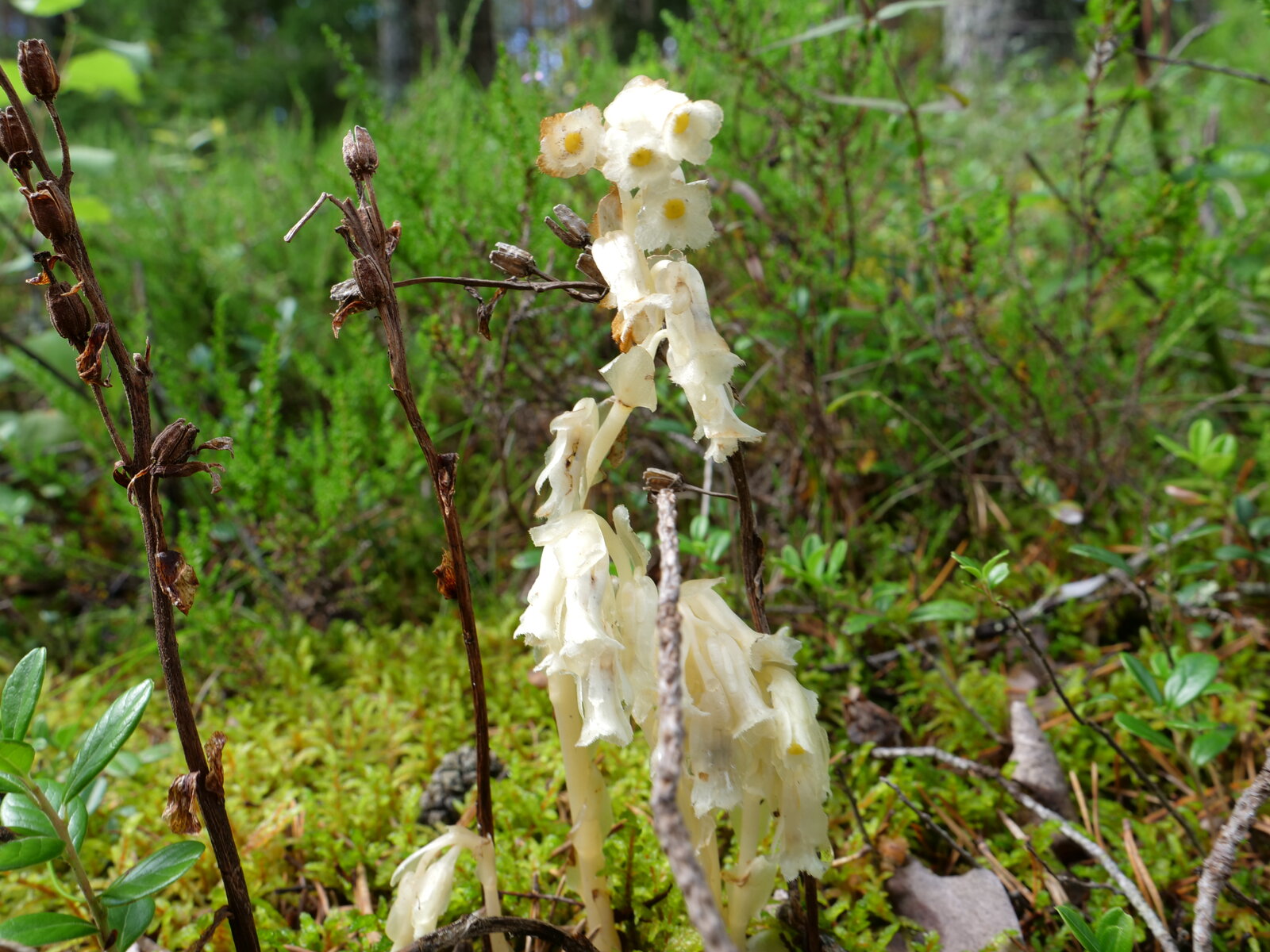
Pinesap
Hypopitys monotropa
A close relative of Indian pipe with the same chlorophyll-free, fungus-dependent strategy, but with multiple flowers per stem and a yellow-to-pink-orange color rather than pure white. Less abundant in Marion than Indian pipe; favors pine-oak-heath stands on the plateau caprock.
Status: Native; uncommon; fungus-dependent.
Bluets, partridgeberry, miterwort, and chickweed
A miscellany of small woodland forbs that don't fit neatly into the larger subgroups but share a low-stature, ground-cover habit. Bluets, partridgeberry, and miterwort are common in cove forest at every elevation; star chickweed is the woodland representative of a genus more familiar from gardens and open country.
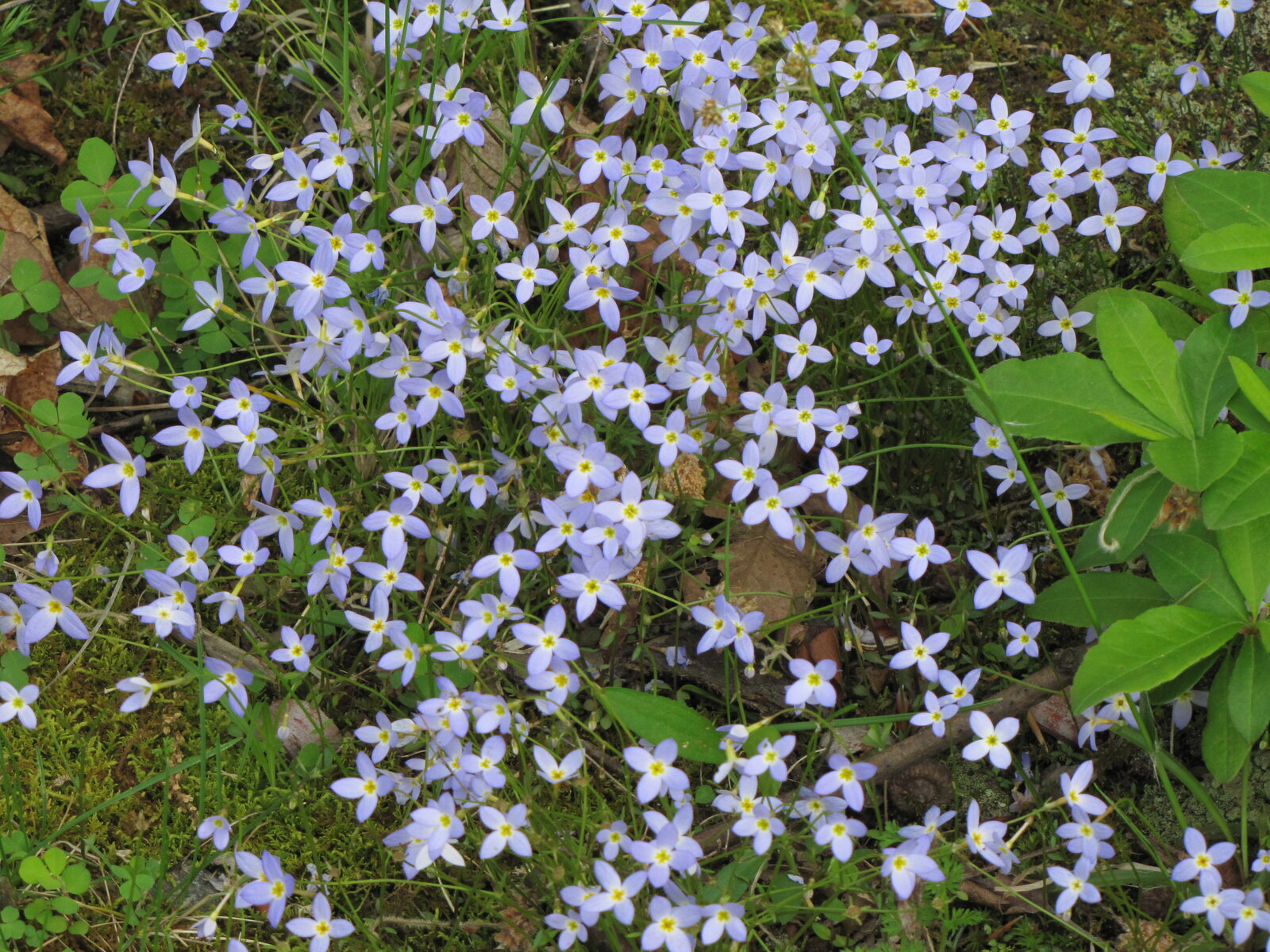
Bluets
Houstonia caerulea
Tiny four-petaled pale-blue flowers with yellow centers, on thread-thin stems, often forming wispy carpets in spring on lawns, woodland edges, and rocky openings. Also called Quaker ladies. The smallest forb that anyone reliably notices.
Status: Native; abundant.
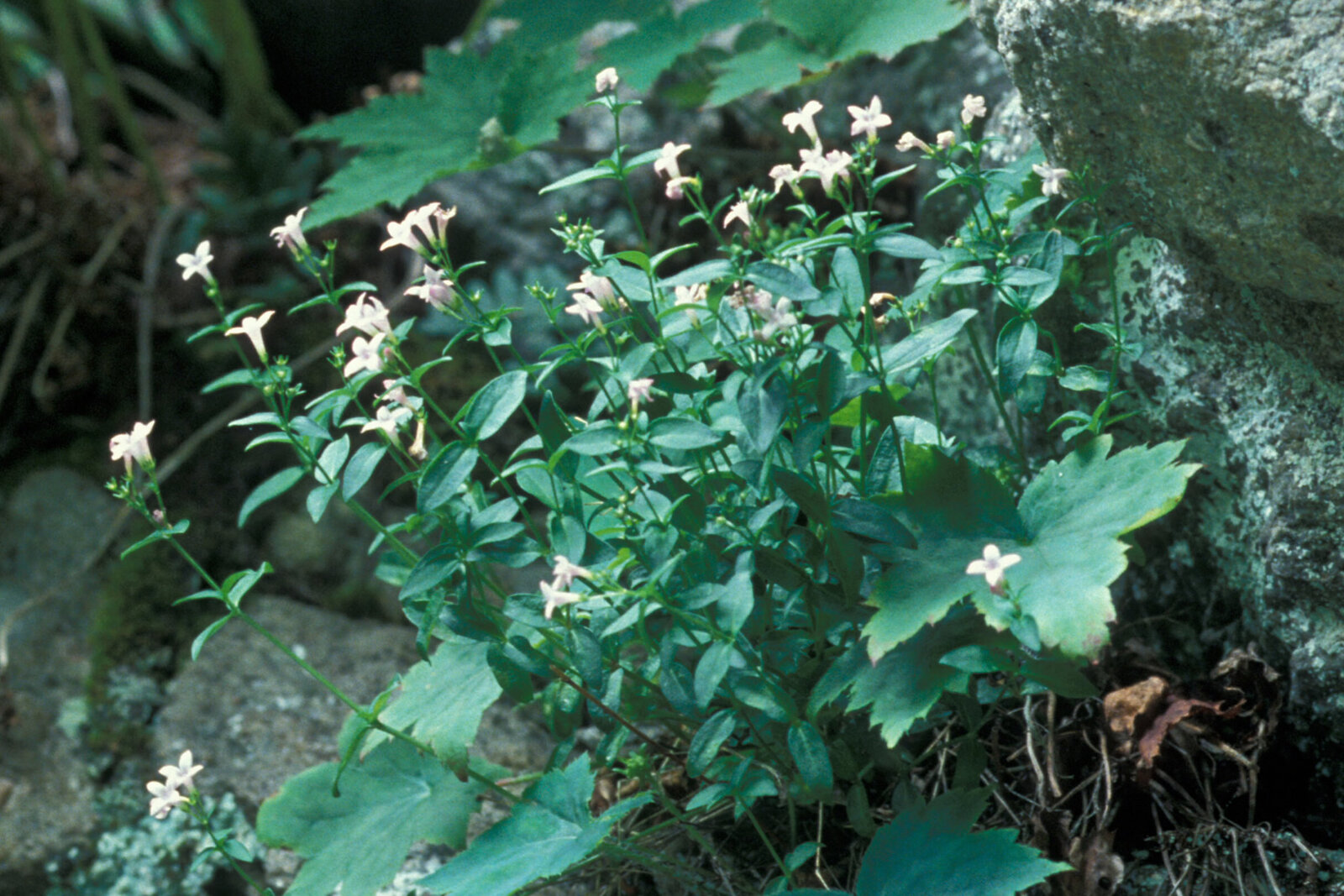
Mountain bluets
Houstonia purpurea
A larger, more upright relative of common bluets, with clustered purple-to-white four-petaled flowers in late spring on dry, rocky woodland slopes. More tolerant of full sun than H. caerulea; favors plateau-rim openings and rocky bluffs.
Status: Native; common on dry ridges.
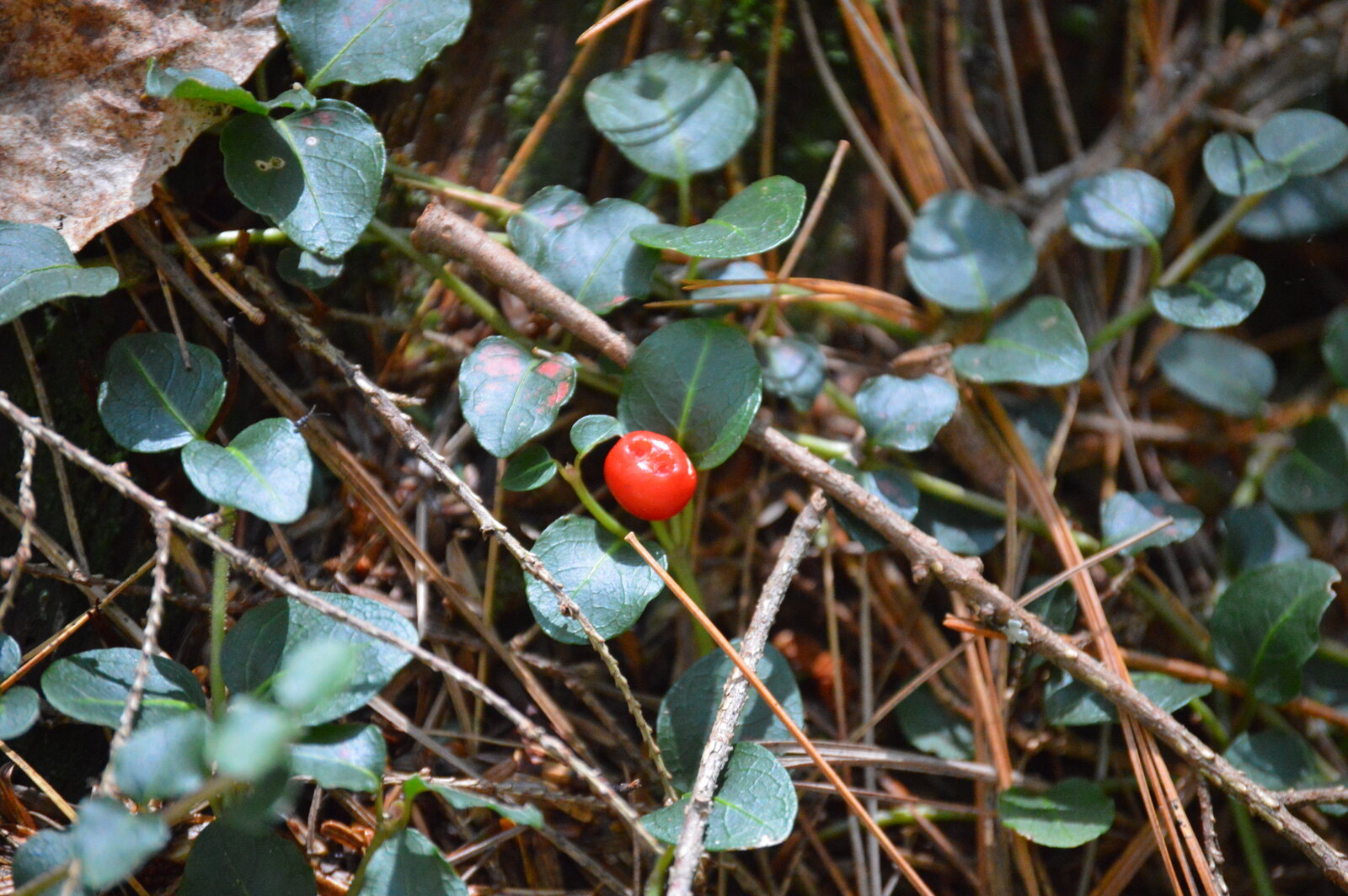
Partridgeberry
Mitchella repens
A trailing evergreen ground cover with small paired round leaves marked with a pale midvein. Paired white tubular flowers in summer fuse at the base to produce a single red berry that persists through winter. The berry is mildly sweet but tasteless. A reliable indicator of mature, undisturbed cove or plateau forest.
Status: Native; common in cove forests.
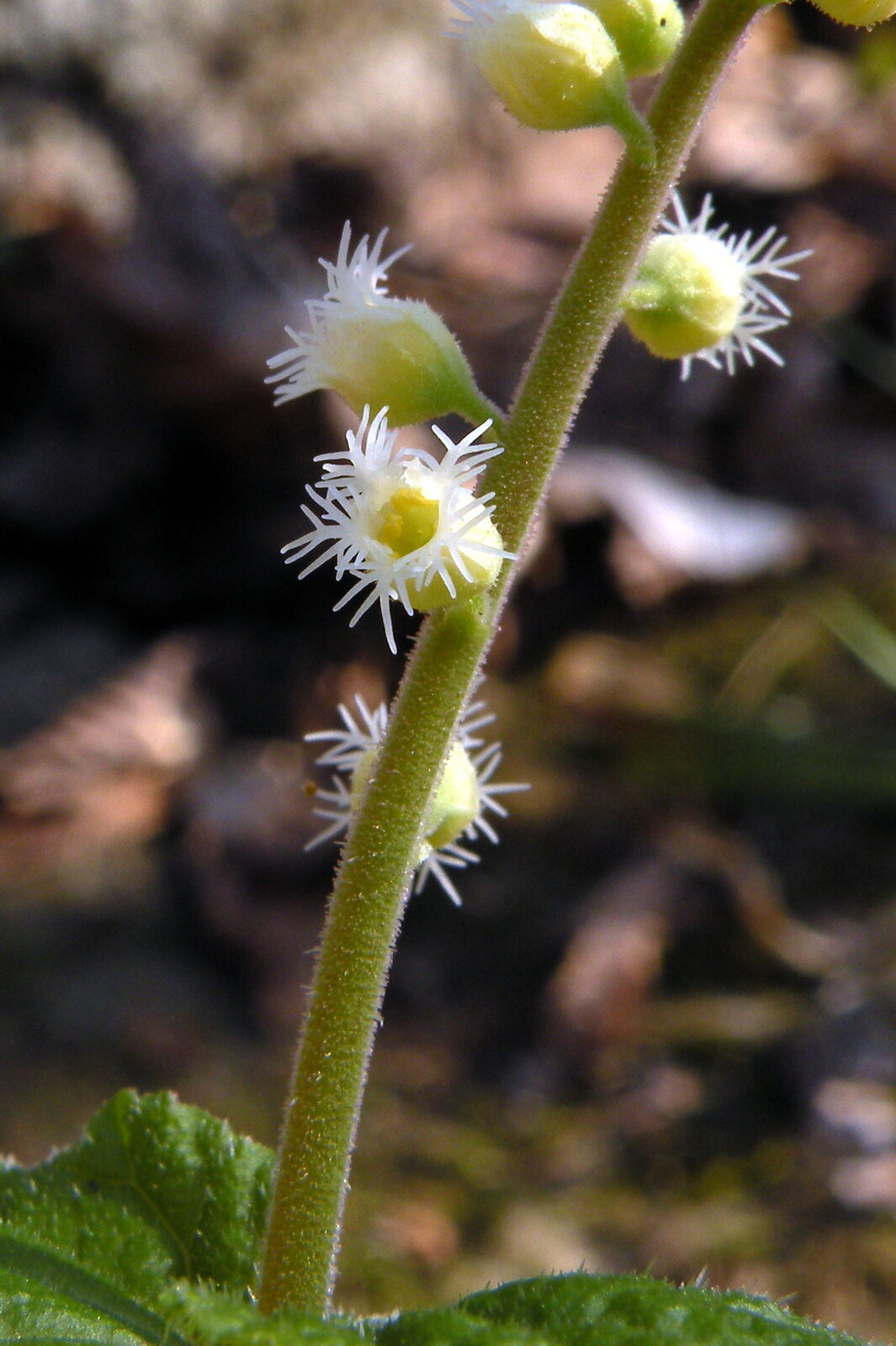
Miterwort
Mitella diphylla
Also called bishop's cap. A delicate spike of small white flowers, each with snowflake-like fringed petals, rises above a pair of opposite stem leaves and a basal rosette in April and May. Favors limestone-influenced cove ledges and damp bluff bases. Easy to overlook because the flowers are so small; rewarding under a hand lens.
Status: Native; locally distinctive on calcareous ledges.
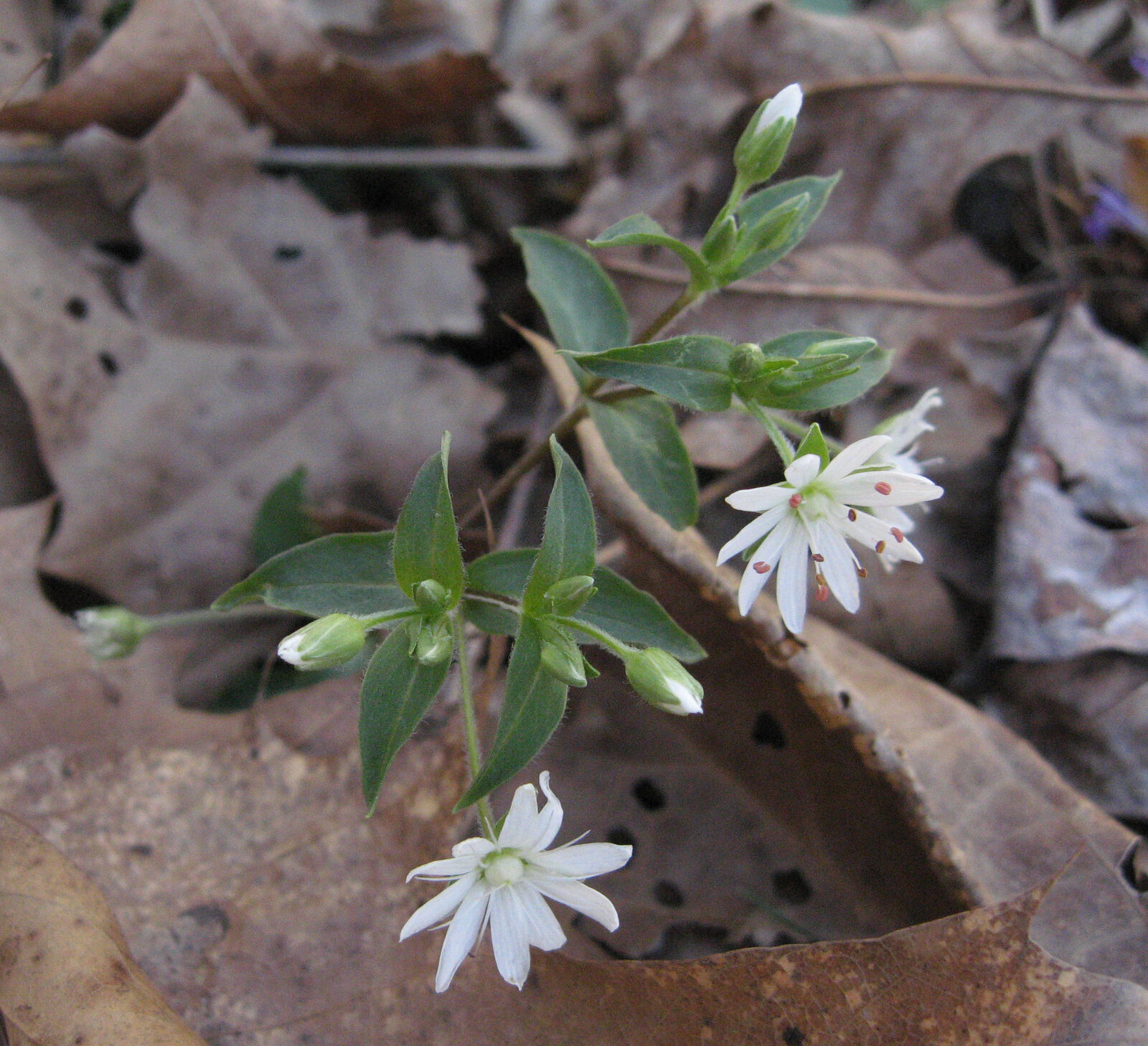
Star chickweed
Stellaria pubera
A rich-cove forb with five deeply notched white petals that look at a glance like ten petals. Larger and showier than the introduced common chickweeds of disturbed ground. Forms loose drifts on the cove floor in April and May.
Status: Native; common in rich coves.
Other woodland forbs
A final set of woodland forbs that fill out the seasonal cycle without fitting cleanly into the family-based subgroups. Most are common, widespread, and easy to overlook in passing; together they round out the cove and slope understory through every month of the growing season.
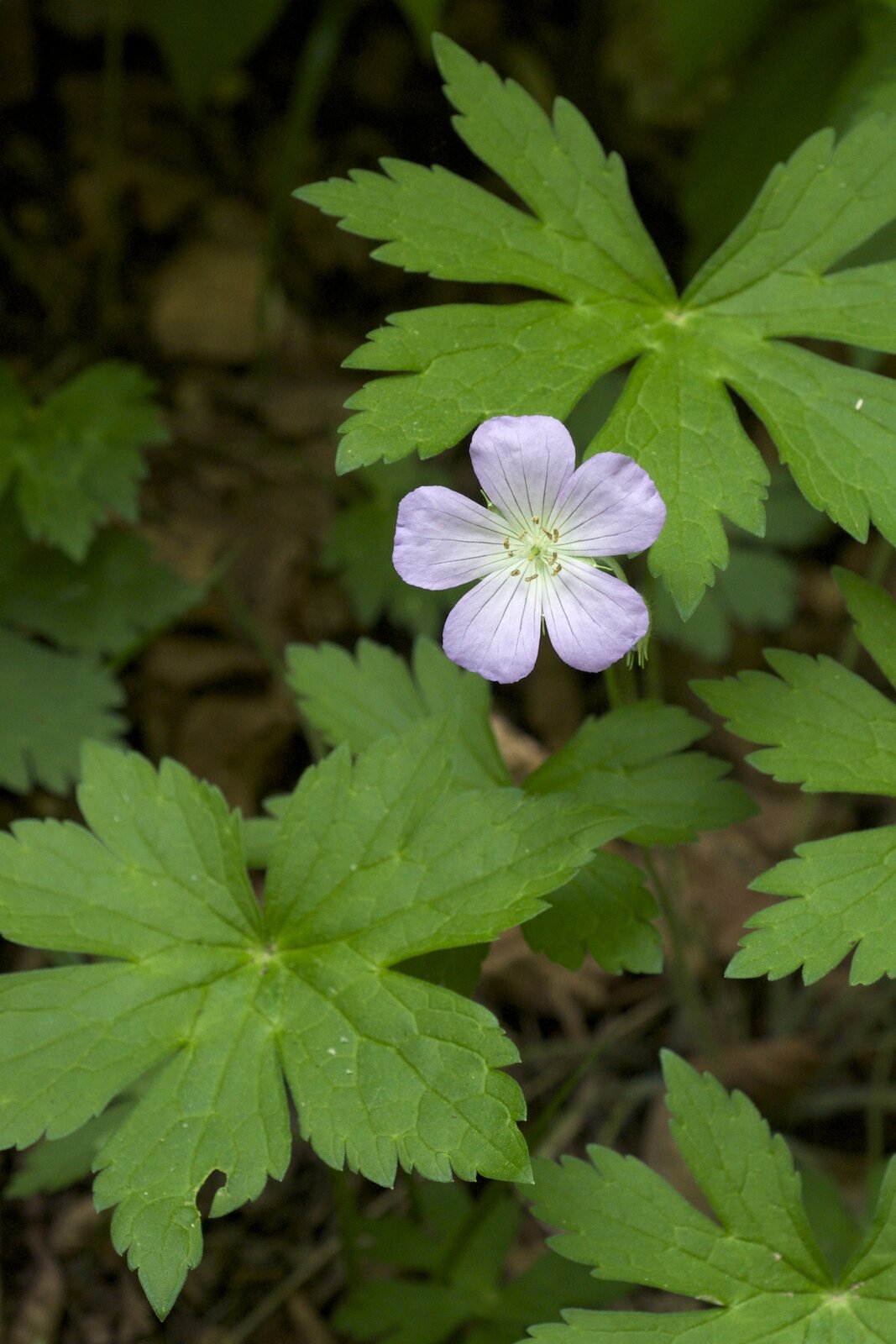
Wild geranium
Geranium maculatum
Five pink-purple petals on a stalked flower above palmately divided leaves; common in rich cove woods, woodland edges, and limestone-influenced slopes in May. After flowering, the seed capsule splits explosively, flinging seeds several feet from the parent plant.
Status: Native; common in cove forests.
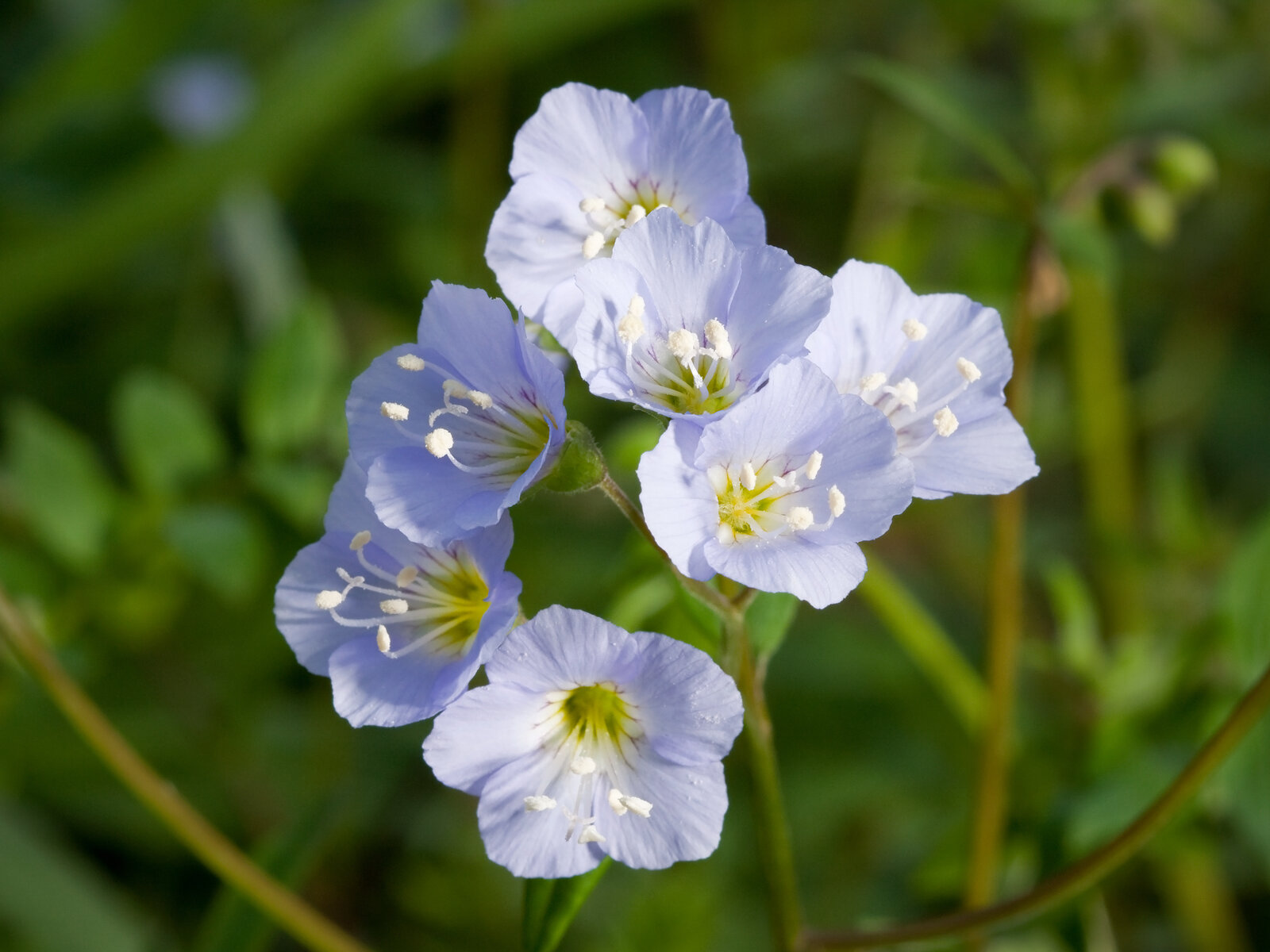
Jacob's ladder
Polemonium reptans
Named for the pinnately compound leaves that look like the rungs of a ladder. Pale-blue bell-shaped flowers in loose clusters in April. Favors rich, mesic cove soils, often under sugar maple and basswood. Low-growing (typically a foot tall) compared to its open-country relatives.
Status: Native; uncommon; rich coves.
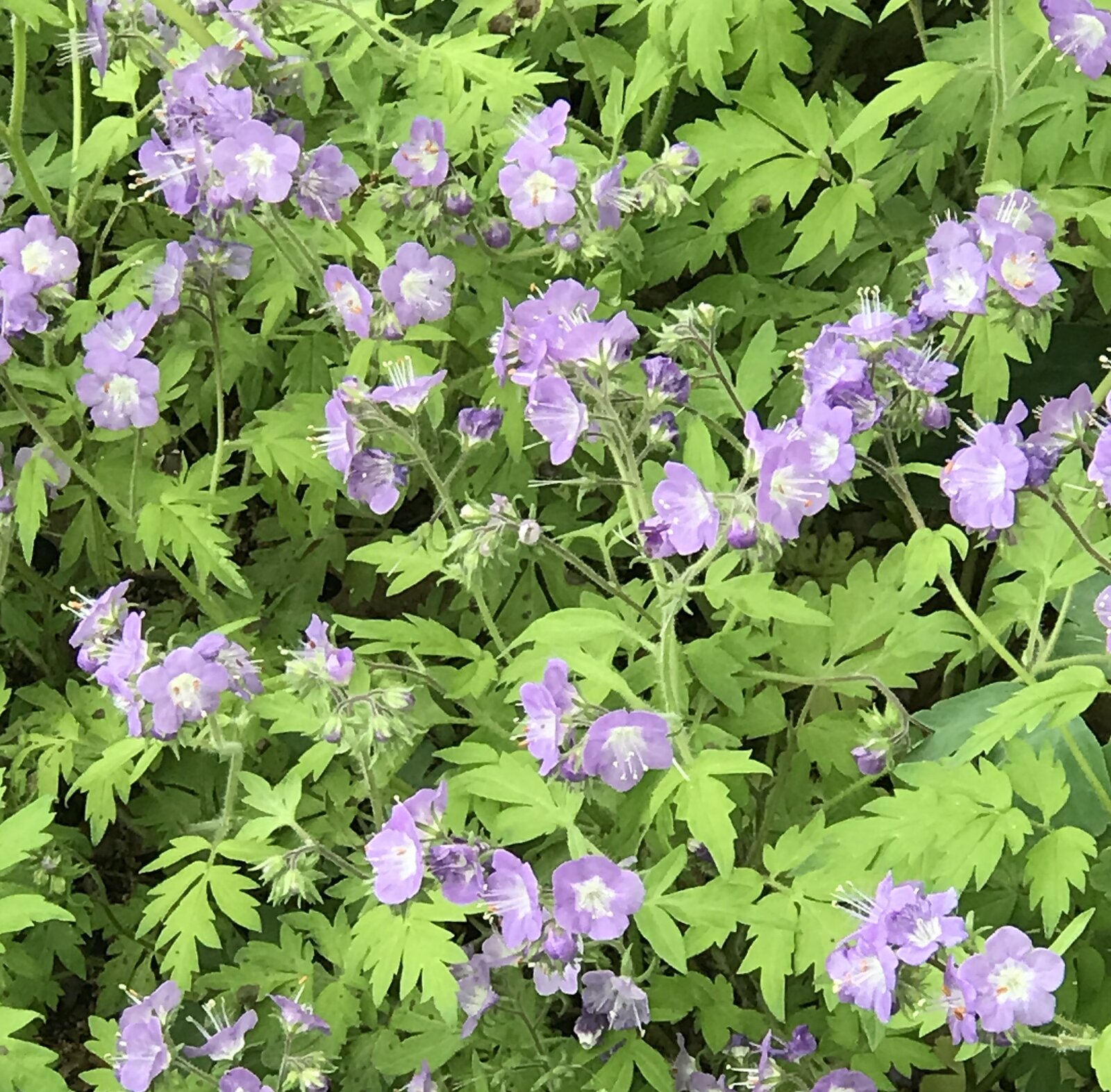
Forked phacelia
Phacelia bipinnatifida
A two-year biennial with deeply pinnately lobed leaves and pale-blue, five-petaled flowers in branched clusters in April and May. Locally abundant on calcareous cove slopes; uncommon on acid plateau soils.
Status: Native; locally distinctive on calcareous soils.
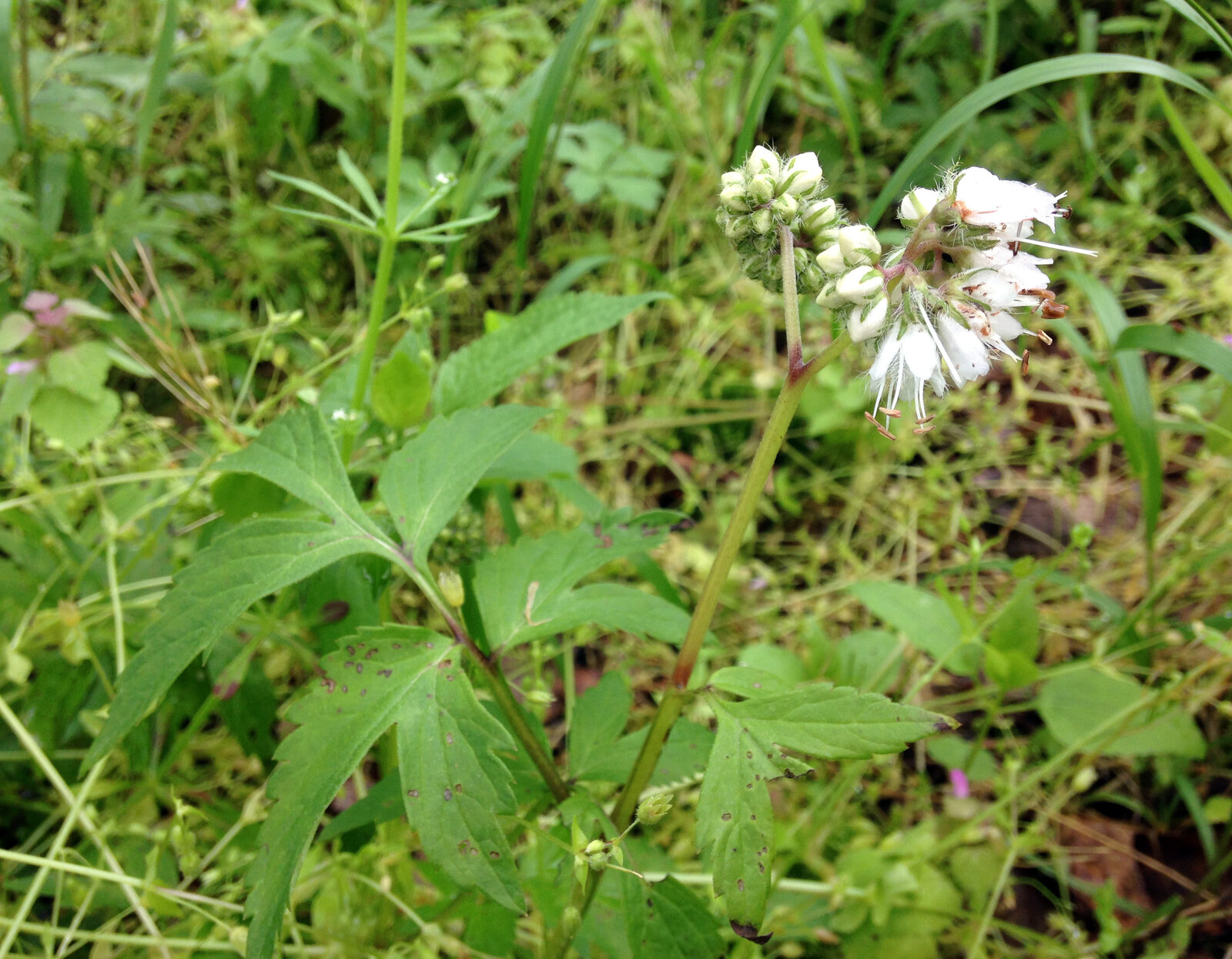
Virginia waterleaf
Hydrophyllum virginianum
Distinctive leaves marked with pale-green to white blotches that look like water stains, the source of the genus name. Pale-violet to white five-petaled flowers in tight clusters in May. A reliable indicator of rich, neutral cove soil.
Status: Native; common in rich coves.
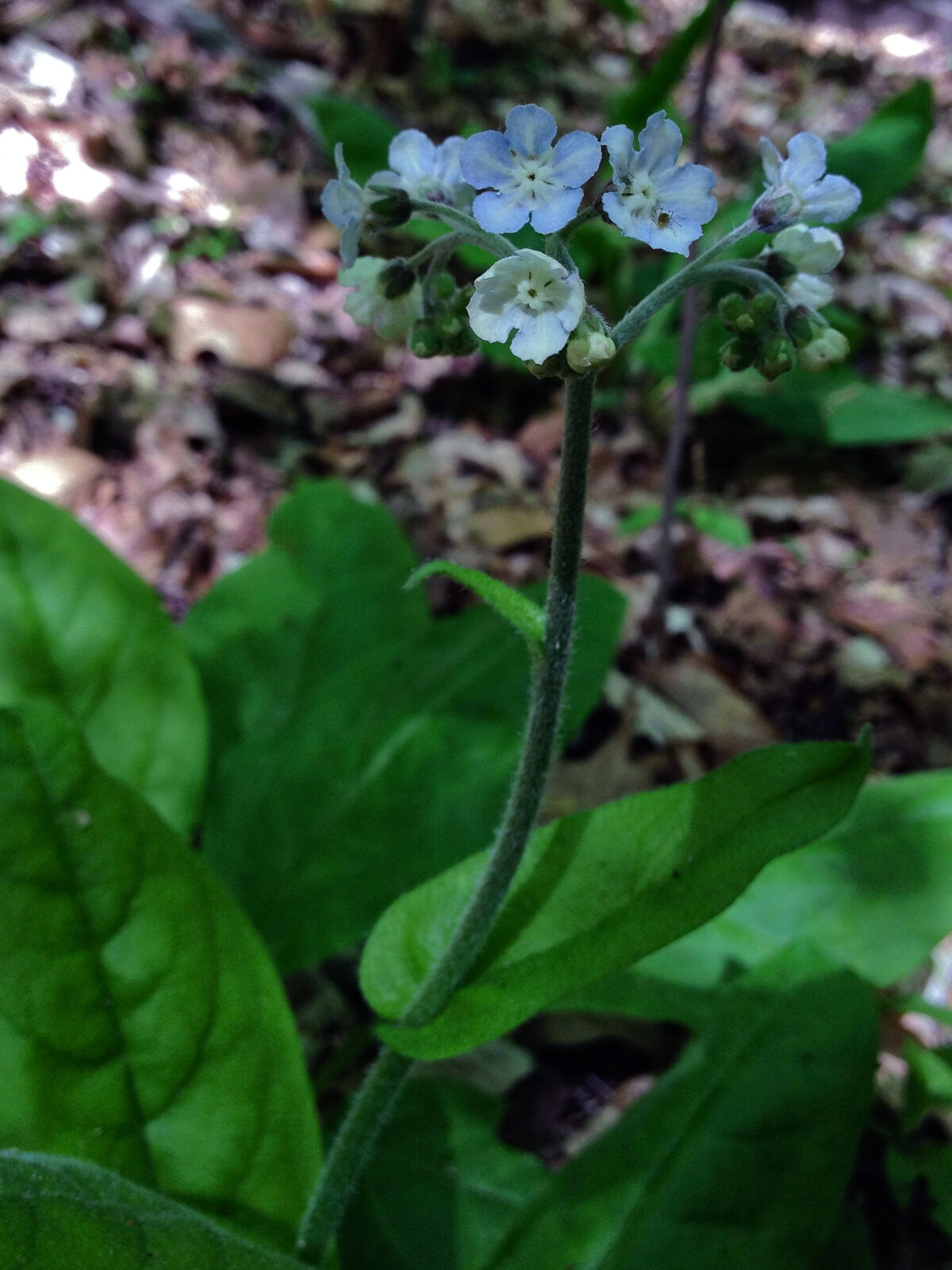
Wild comfrey
Cynoglossum virginianum
A borage-family forb with pale-blue, five-lobed flowers in May and clasping leaves up the stem (the leaf bases wrap around the stem). The bristly nutlets stick to clothing and animal fur for dispersal. Common on dry-mesic woodland slopes; less abundant than its non-native relative comfrey (Symphytum).
Status: Native; common.
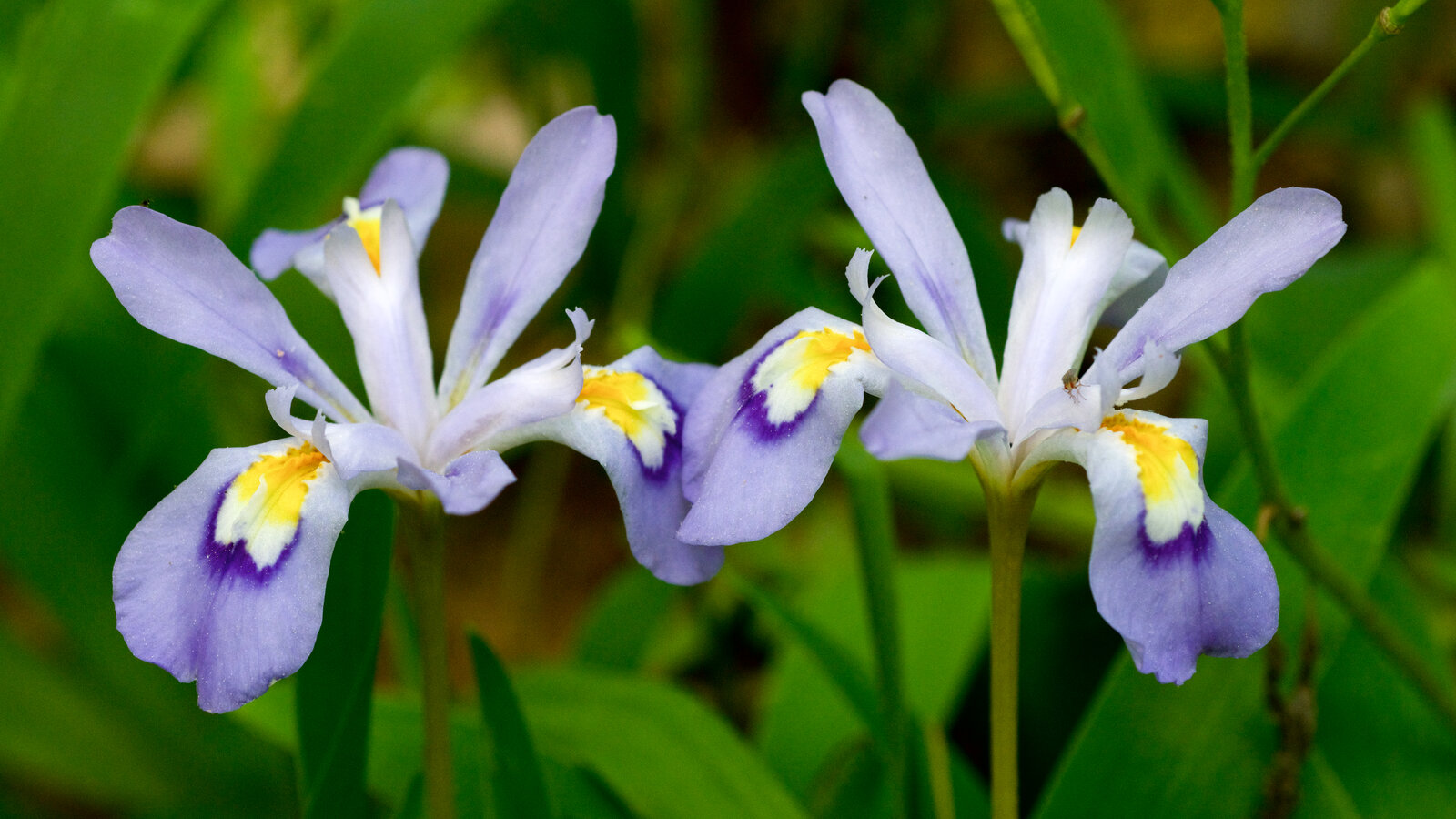
Dwarf crested iris
Iris cristata
A low-growing native iris of rich, mesic cove forest. The pale-blue to lavender flowers have characteristic yellow-orange "crests" on the falls (lower petals) where most iris species have beards. Forms slow-spreading rhizome colonies.
Status: Native; common in rich coves.
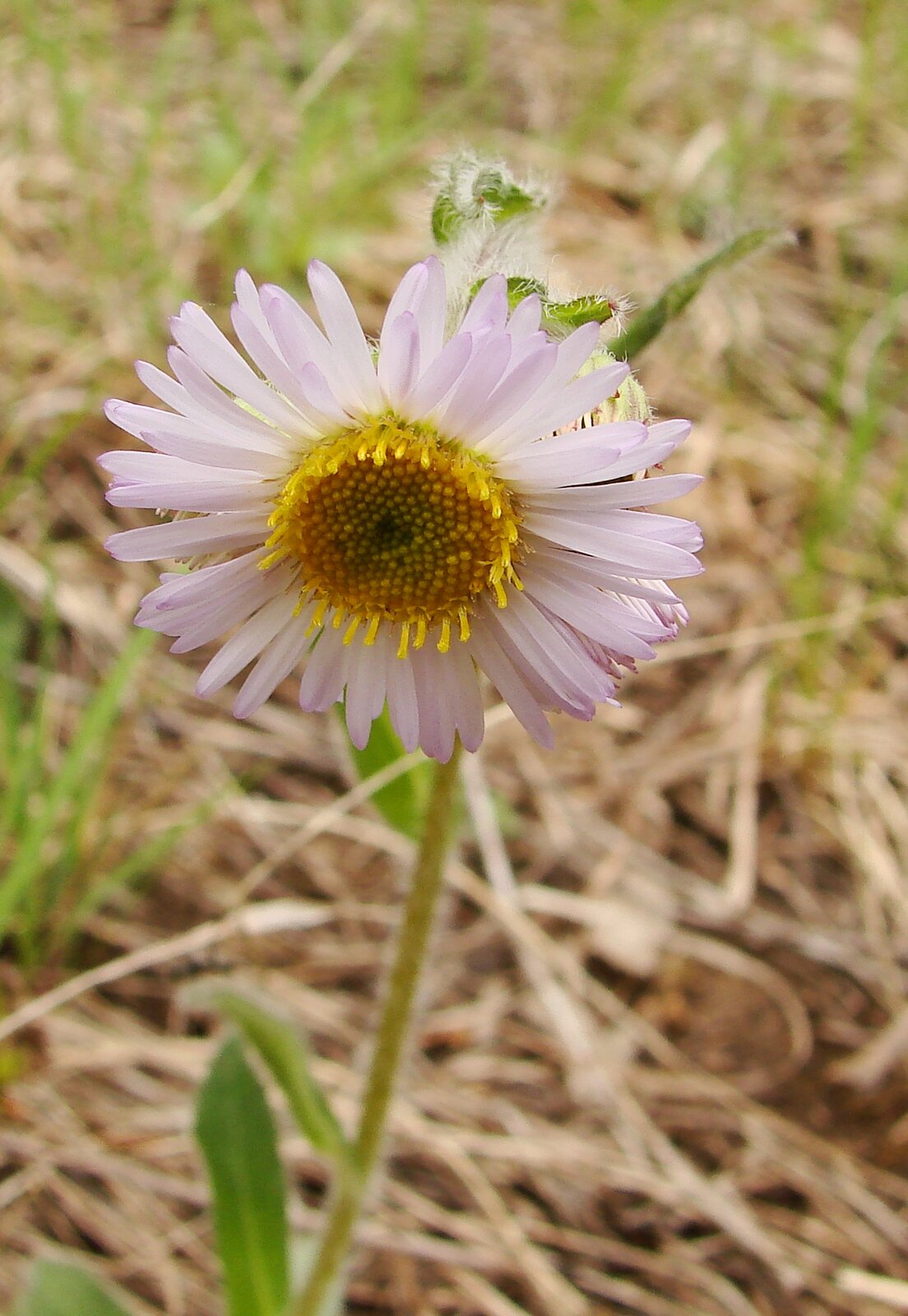
Robin's plantain
Erigeron pulchellus
A daisy-family forb with white to pale-pink ray flowers in April and May, on a tall stalk above a basal rosette of toothed leaves. Common on dry-mesic woodland slopes and open-canopy oak-hickory rises. Persists in cleared old-field pockets that are reverting to forest.
Status: Native; common.
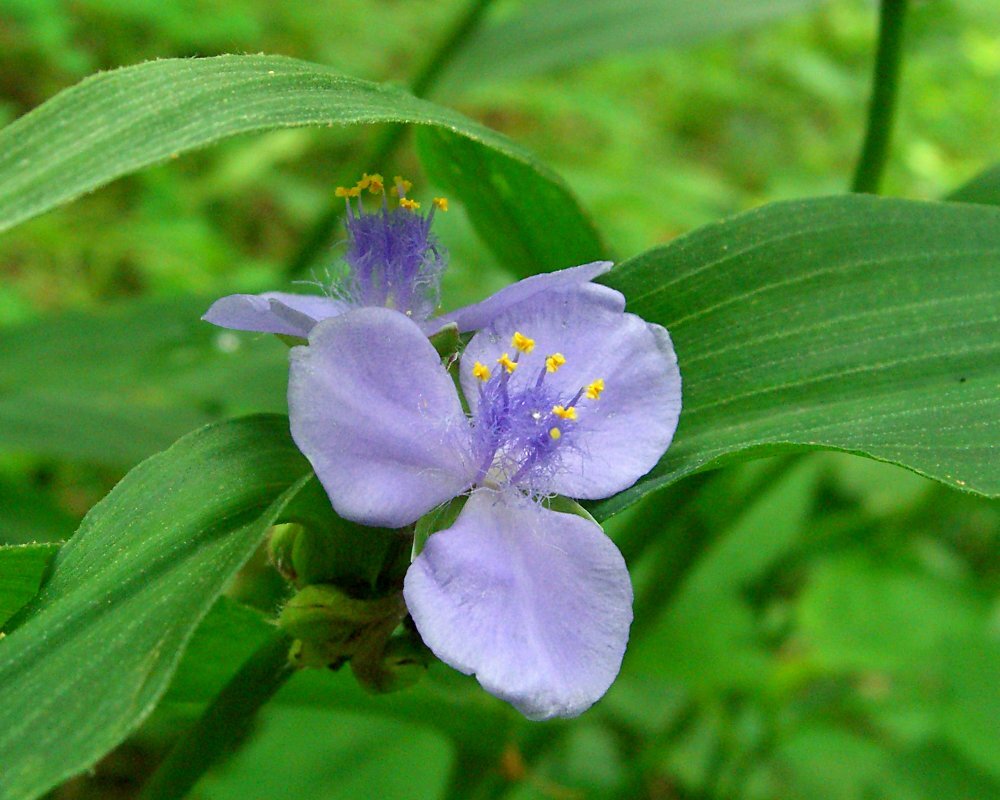
Zigzag spiderwort
Tradescantia subaspera
A woodland spiderwort with three-petaled blue-purple flowers and a stem that zigzags strongly between leaf nodes. Each flower opens for a single morning and dissolves into jelly by afternoon, but a colony produces a long succession of new flowers from May into July. Less common in Marion than the open-country T. virginiana and T. ohiensis.
Status: Native; uncommon; cove margins.
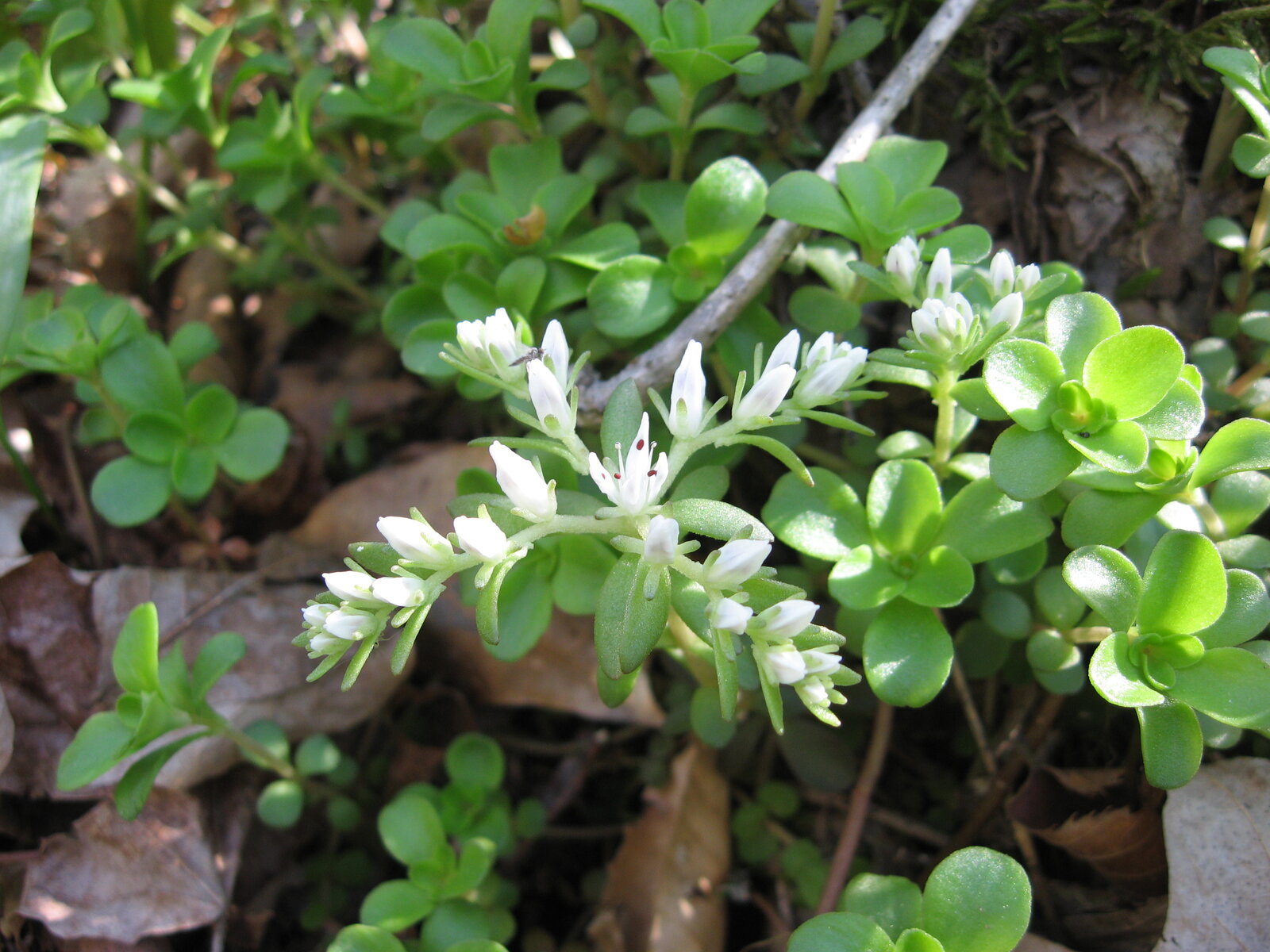
Woodland stonecrop
Sedum ternatum
A succulent woodland forb with whorls of three round, fleshy leaves and small white star-shaped flowers in May. Favors mossy boulders, rotting logs, and shaded ledges in cove forest. The native counterpart of the cultivated rock-garden sedums.
Status: Native; common on rocky cove sites.
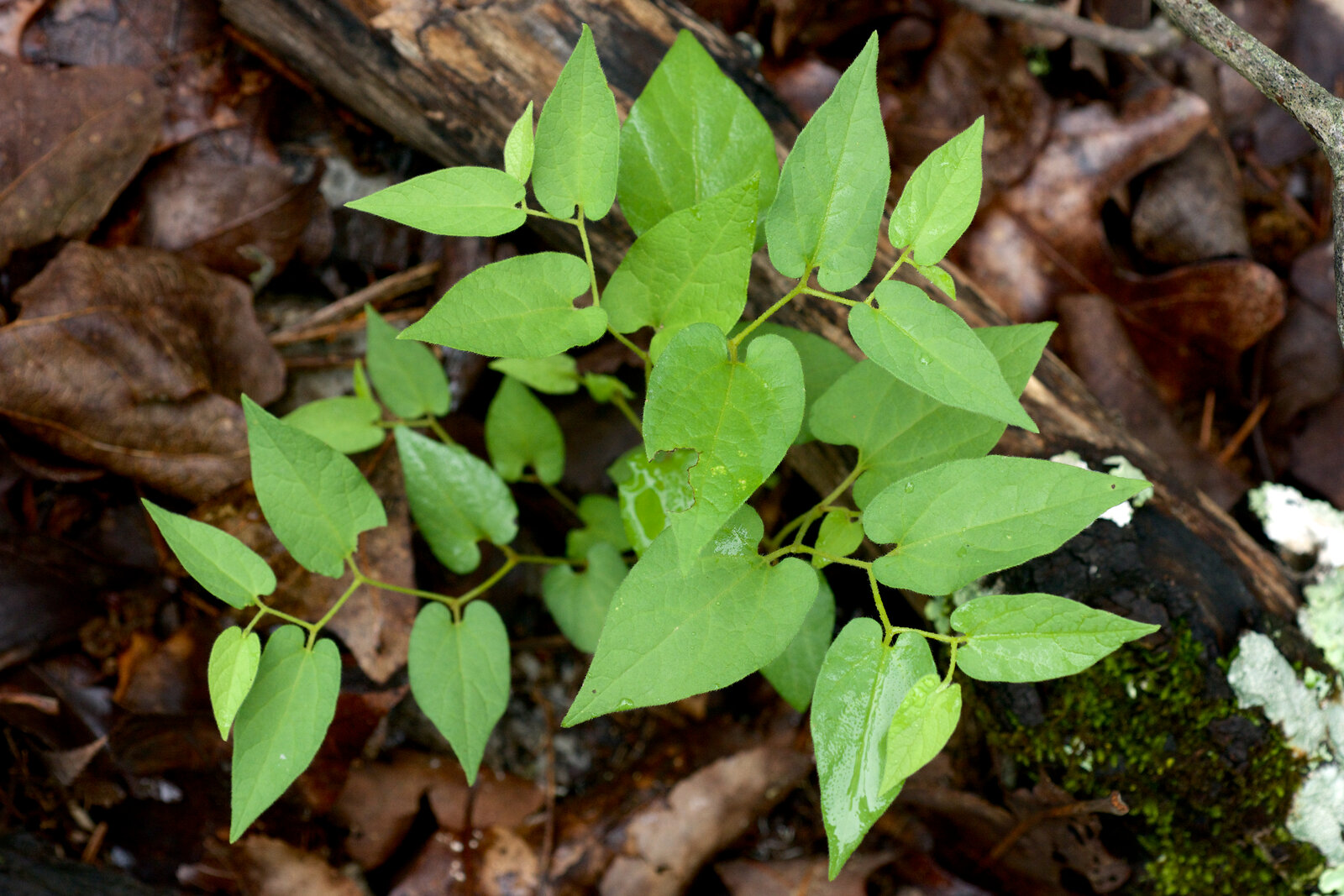
Virginia snakeroot
Endodeca serpentaria
A small, slender forb with heart-shaped leaves and a curiously bent maroon flower hidden near the ground (the same family as wild ginger and Hexastylis). Used historically as a snakebite remedy (the basis for the common name), though the plant contains aristolochic acids and is toxic. Recently moved from Aristolochia to the segregate genus Endodeca.
Status: Native; uncommon.
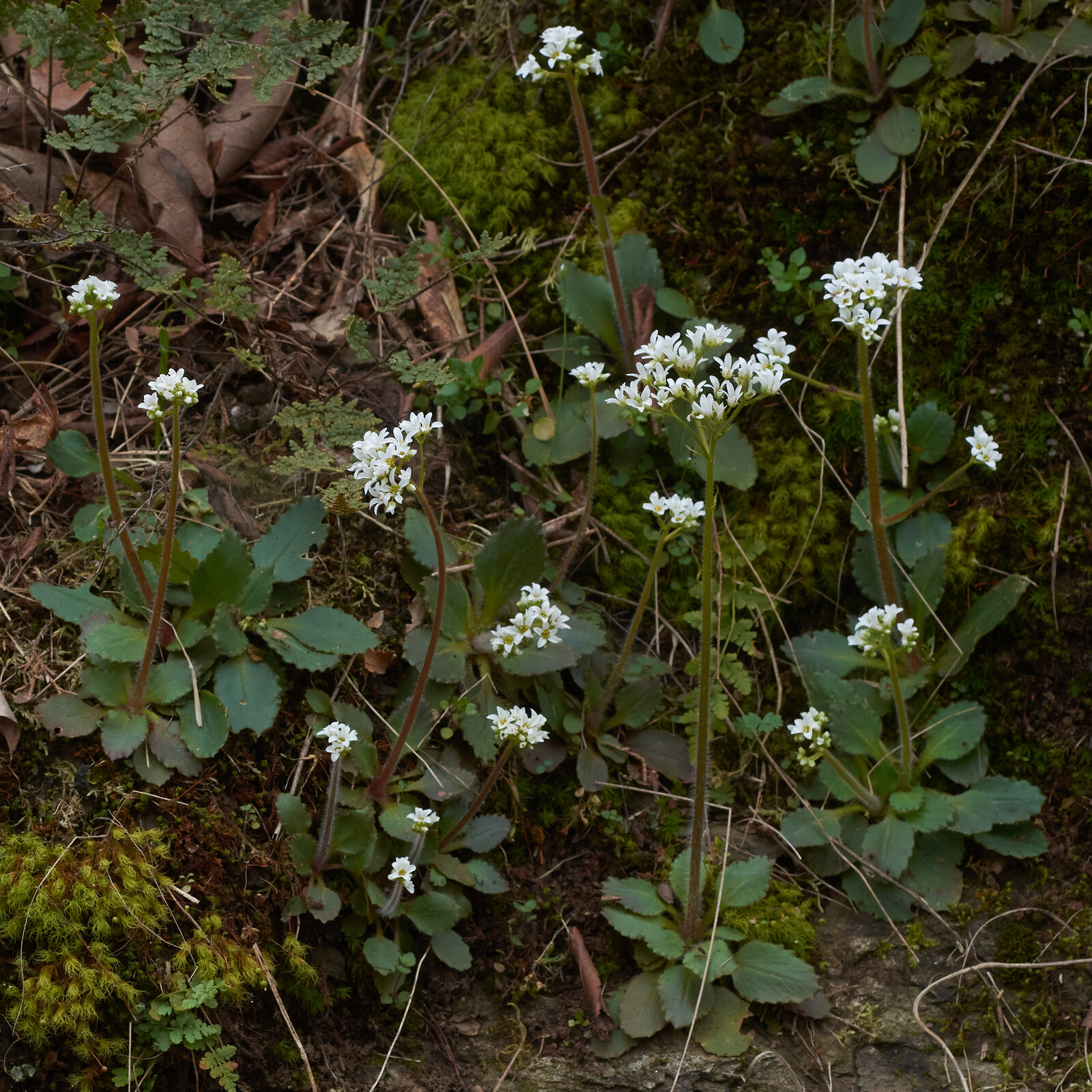
Early saxifrage
Micranthes virginiensis
A basal rosette of small toothed leaves on a rocky ledge sends up a tall, branched flowering stalk in March or April with sprays of small white five-petaled flowers. Favors crevices in limestone-influenced bluffs and rocky cove ledges. Recently moved from Saxifraga to Micranthes.
Status: Native; common on rocky ledges.
Fire pink and the rocky-rim wildflowers
Open rocky woods along the plateau edge and limestone-influenced slopes host a small set of forbs that don't neatly group with either the cove-floor wildflowers or the limestone-bluff specialists below. Fire pink (Silene virginica) is the headline species, a hummingbird-pollinated red flower of thin-soiled openings. Most of these species also appear at lower density in cove and slope habitats, but the rocky-rim openings are where they reach peak abundance.
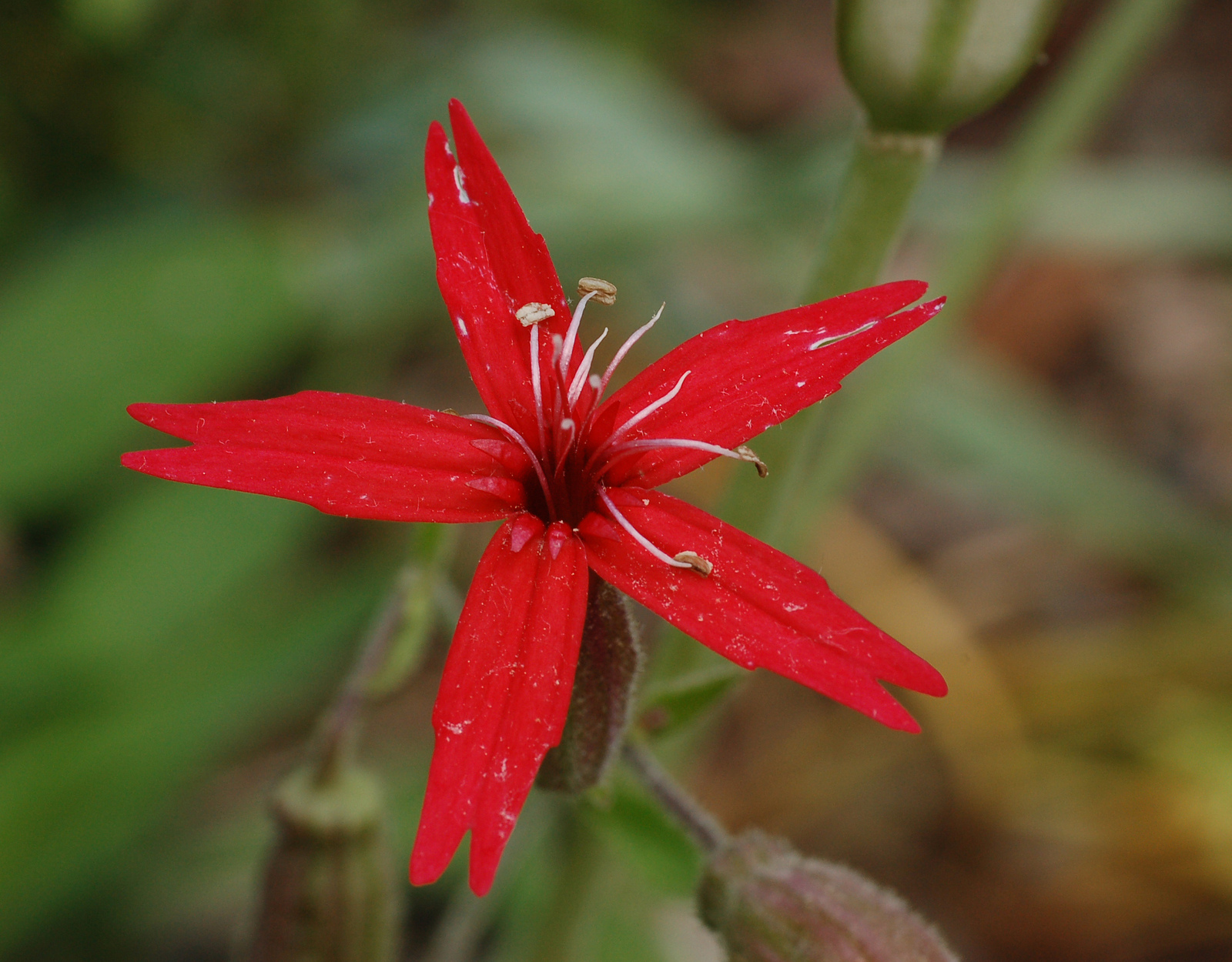
Fire pink
Silene virginica
Not pink at all, but a vivid scarlet. The five notched petals (the source of the family name Caryophyllaceae, the pinks) are pollinated almost exclusively by ruby-throated hummingbirds, whose northward migration coincides with peak bloom in April and May. Favors open rocky woods and limestone-influenced thin-soiled slopes.
Status: Native; common on rocky slopes.
The wildflower groups below leave the cove and slope understory and pick up the open-country meadow, the limestone-bluffscape glade, and the streambank and wetland-edge habitats. They include Tennessee's state wildflower (passionflower), several federally and state-listed plants, and a long list of common roadside and field species that anyone living in Marion will already know on sight. Bloom periods stretch from April (the lyre-leaf sage and partridge pea pioneers) through October (the late asters and bottle gentian).
Milkweeds and the dogbane allies
Marion's milkweeds (Asclepias) are the host plants of monarch butterflies and a long list of other specialist insects. Eight Asclepias species and the closely related Indian-hemp (Apocynum cannabinum) cover habitats from full-sun roadside cuts to wet meadows to glade openings. Look for the rounded umbel flower clusters of the field species and the narrow whorled leaves of the glade specialists.
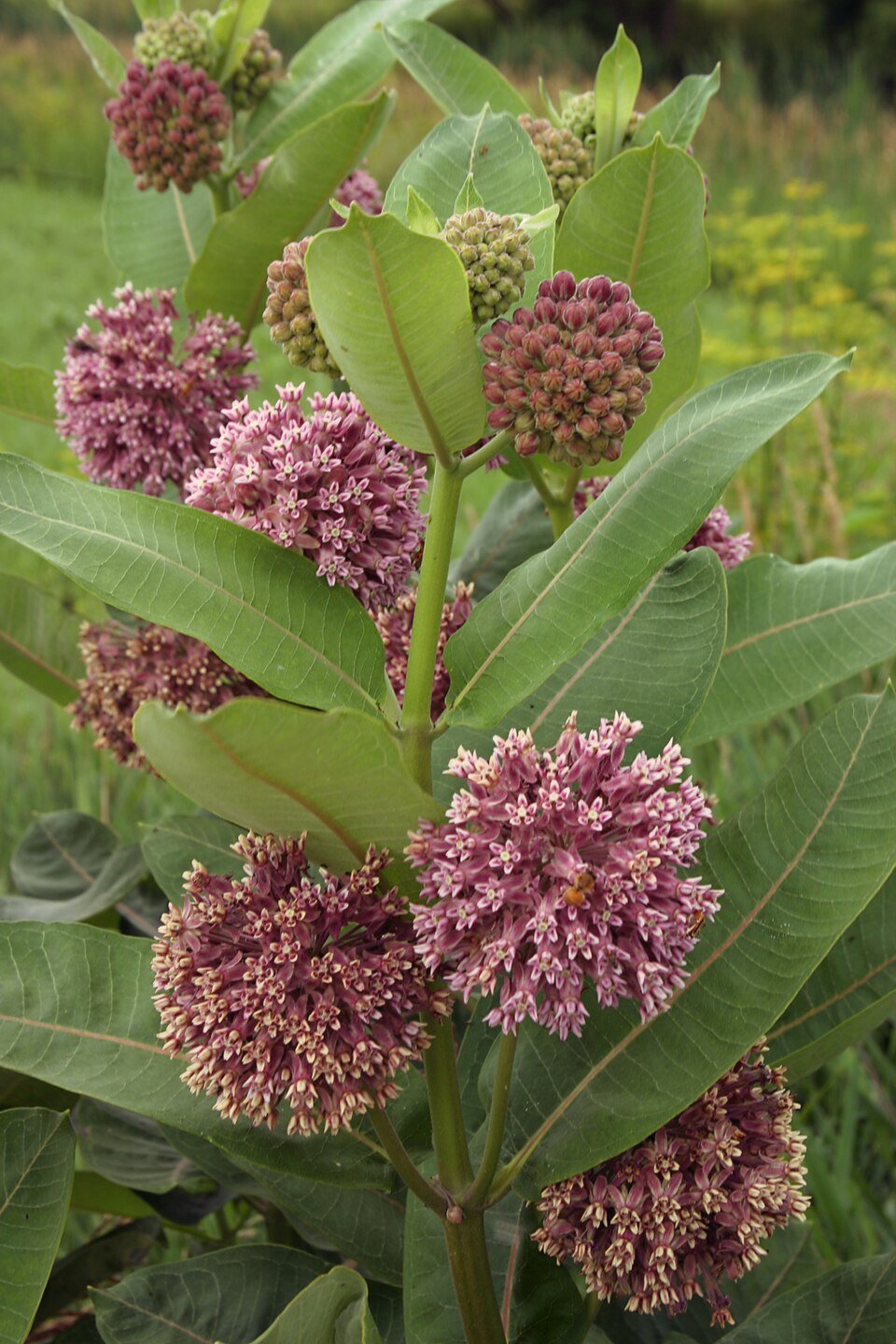
Common milkweed
Asclepias syriaca
The most widely encountered milkweed of Marion's old fields, fencerows, and roadbanks. Pinkish-purple flowers in rounded umbel clusters bloom from June into August above broad opposite leaves; the seedpods open in autumn to release silk-tufted seeds the wind carries miles. Common milkweed is the primary host plant for monarch butterfly larvae across the eastern United States, and milkweed-cardenolide compounds in its sap make monarch caterpillars unpalatable to most predators.
Status: Native; common in old fields and roadsides.
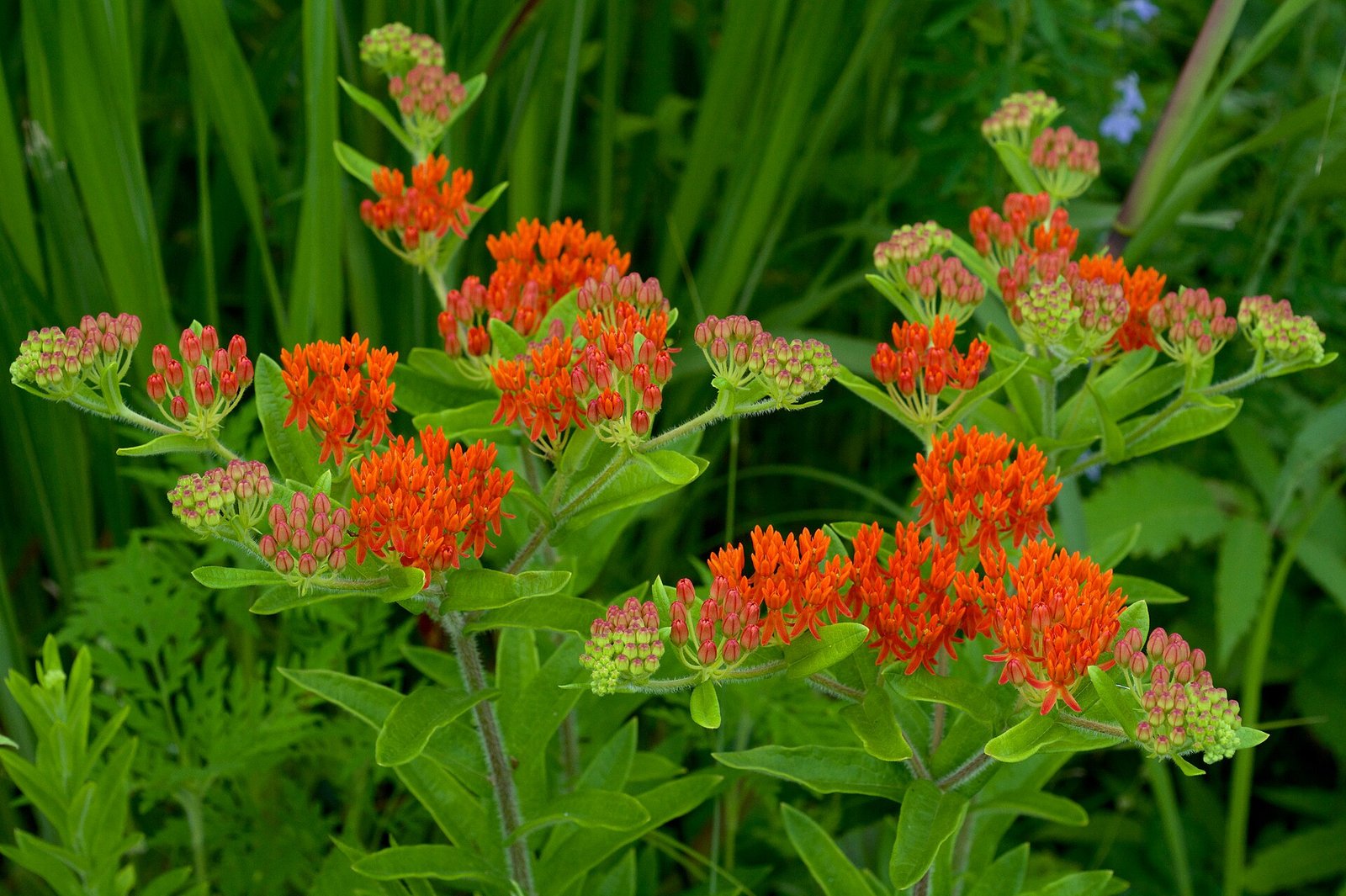
Butterfly milkweed
Asclepias tuberosa
The brightest of Marion's milkweeds, with vivid orange flat-topped clusters in June and July on a foot-tall plant. Unlike the other milkweeds, butterfly milkweed has alternate (not opposite) leaves and lacks the milky sap the family is named for. Favors dry, sunny old fields and rocky open slopes. Heavily worked by butterflies, native bees, and wasps; one of the showiest natives in the Marion roadside.
Status: Native; common on dry sunny banks.
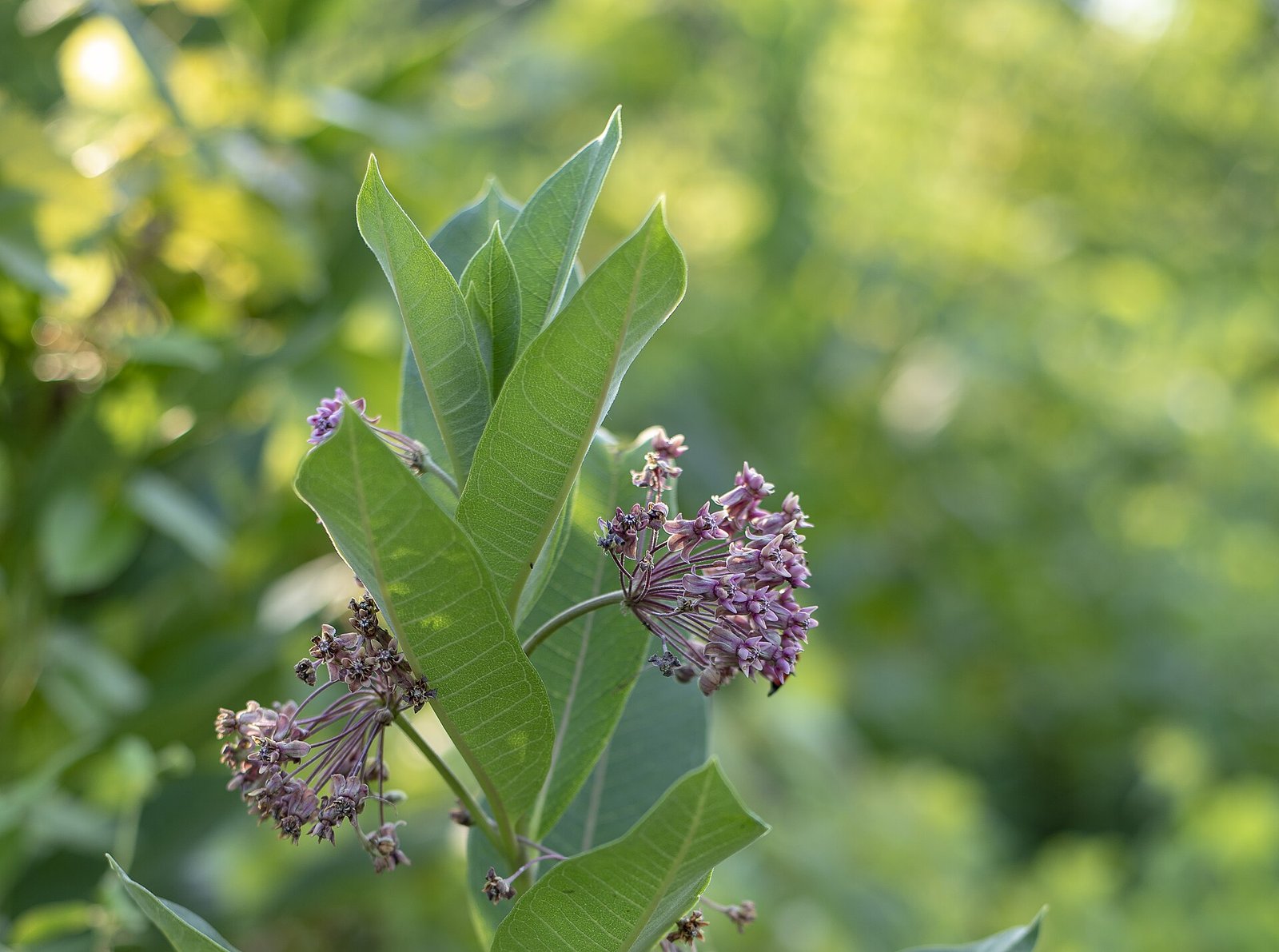
Swamp milkweed
Asclepias incarnata
The wetland milkweed of Marion's stream margins, ditch edges, and pond shores. Tall (three to five feet) with narrow pointed leaves and clusters of rose-pink flowers in July and August. Like its open-field relatives, it is a monarch host plant; unlike them, it tolerates and prefers seasonally saturated soils. Field-grown stems hold their leaves bluish-green; in deep shade the plant grows lanky and produces few flowers.
Status: Native; common in wet meadows and stream margins.
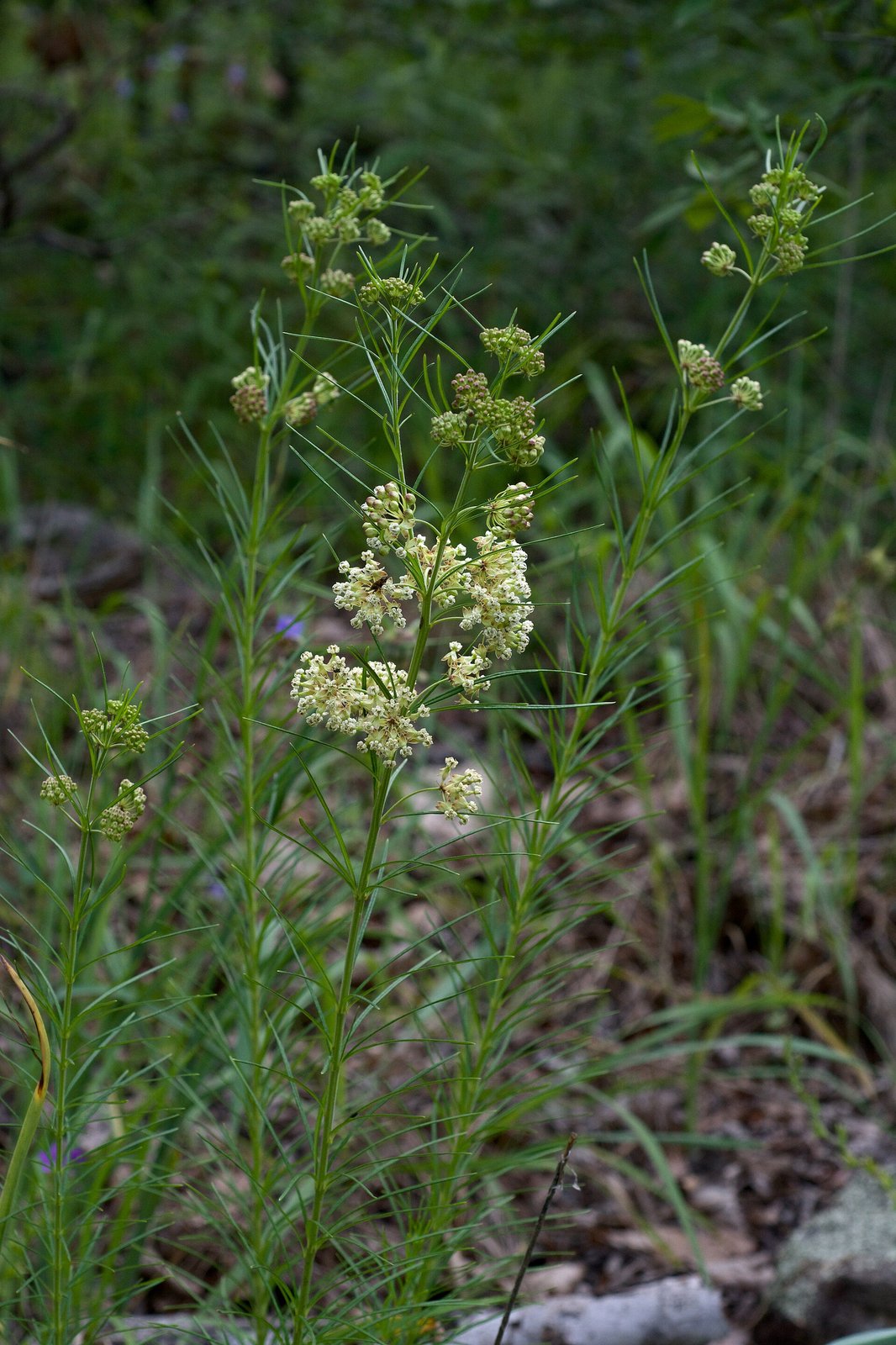
Whorled milkweed
Asclepias verticillata
A slender milkweed of dry, thin-soiled openings: limestone glades, cedar barrens, and roadside cuts. Easily recognized by the thread-like leaves arranged in whorls of three to six along an unbranched stem two feet tall. Small white flower clusters in late July and August. The narrow leaves and dry-soil tolerance distinguish it at a glance from the broader-leaved meadow species.
Status: Native; common in dry openings.
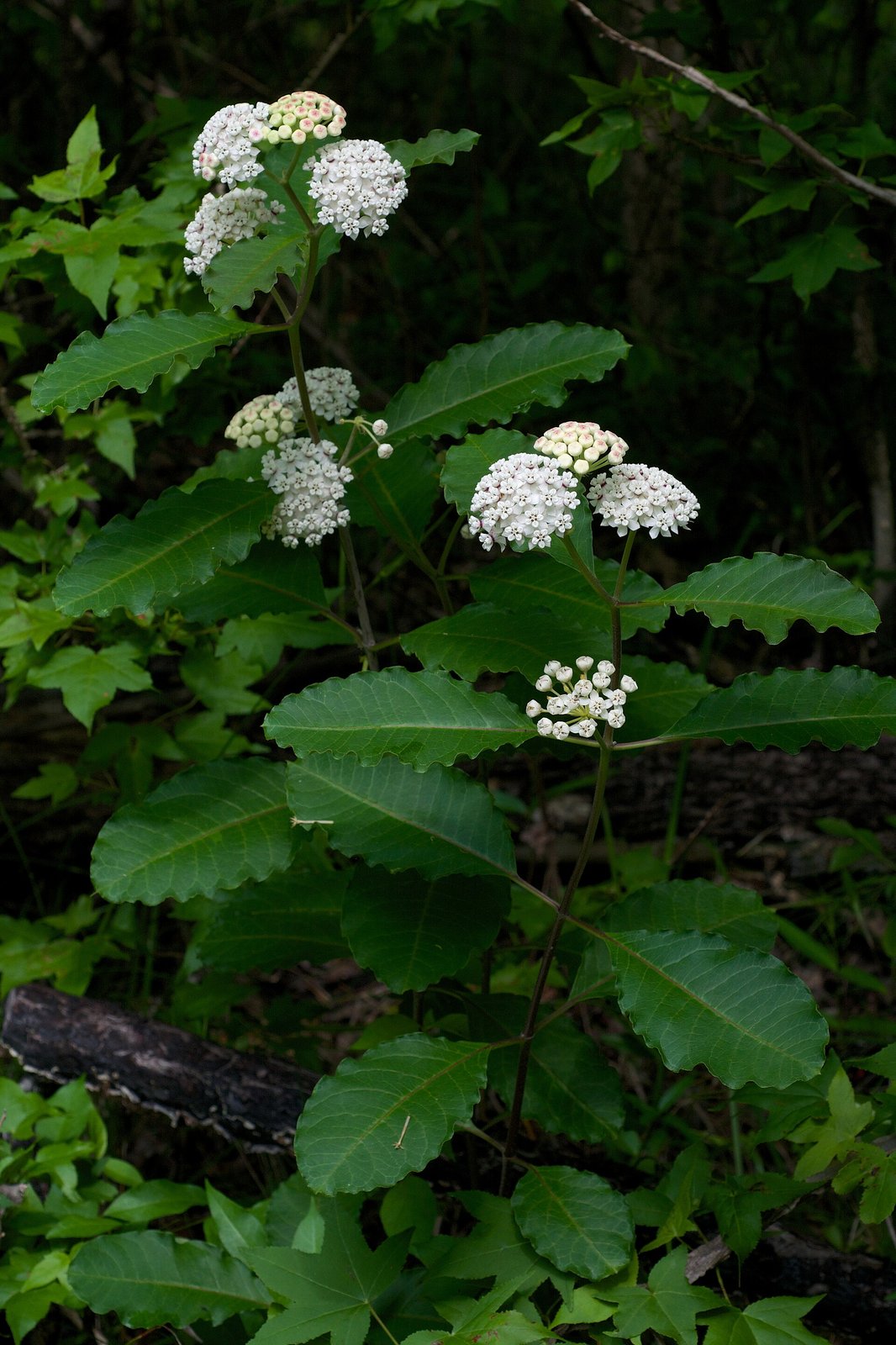
Red-ring milkweed
Asclepias variegata
Also called white milkweed. The flower clusters are rounded balls of small white flowers, each flower with a faint reddish ring at the base of the corolla (the source of the common name). Two- to three-foot plant of dry-mesic woodland edges and slope openings, generally in partial shade. Less common in Marion than the open-field milkweeds but a regular sight along trail edges in oak-hickory woods.
Status: Native; common on woodland edges.
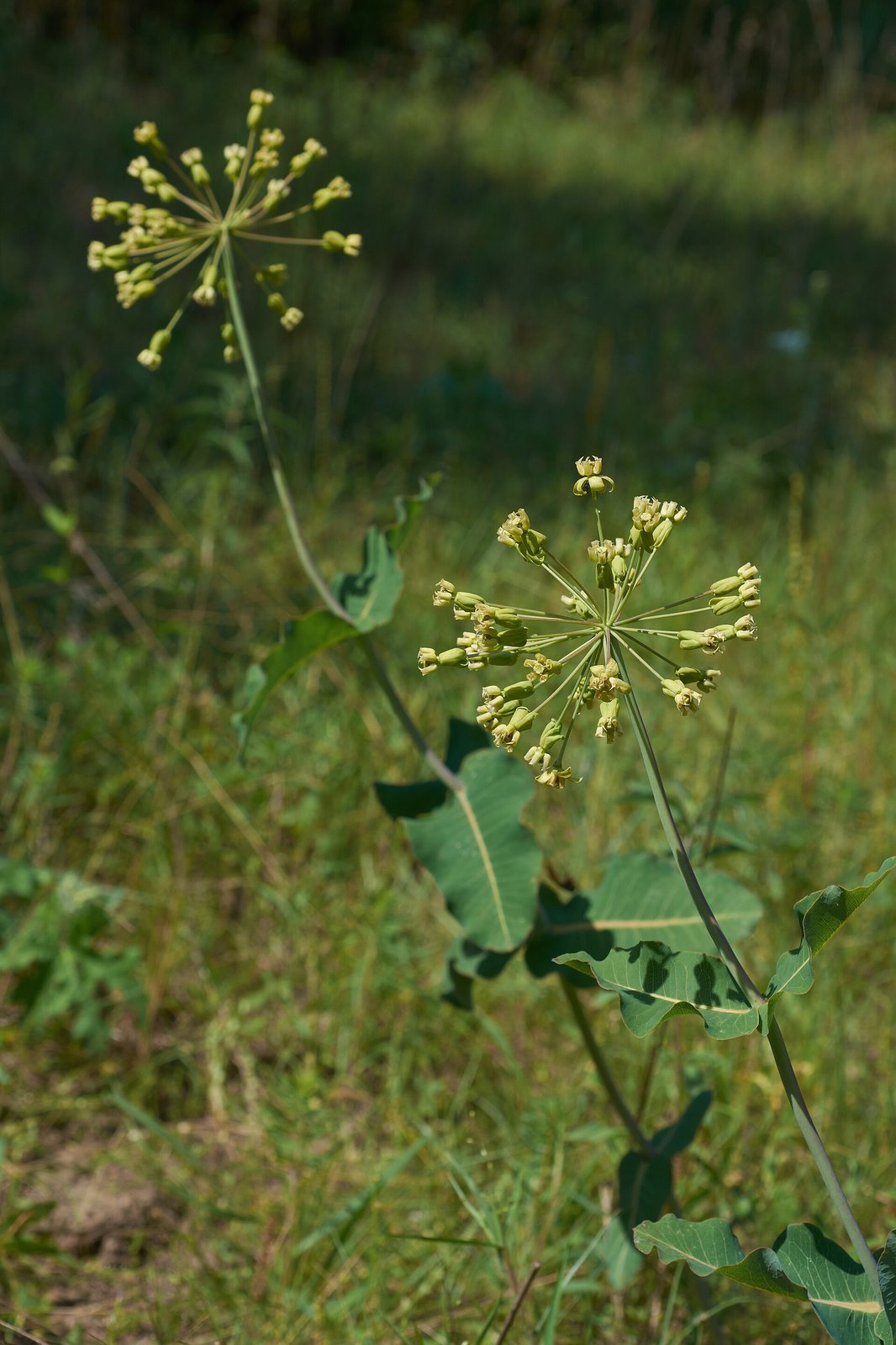
Clasping milkweed
Asclepias amplexicaulis
A milkweed of dry sandy or thin-soiled openings on sandstone caprock. The broad opposite leaves clasp the stem at their bases (the source of the species name) and have a wavy margin. Loose pinkish-green flower clusters in late May and June. Less abundant in Marion than the showier butterfly and common milkweeds but a reliable indicator of well-drained openings on the plateau.
Status: Native; locally distinctive in dry openings.
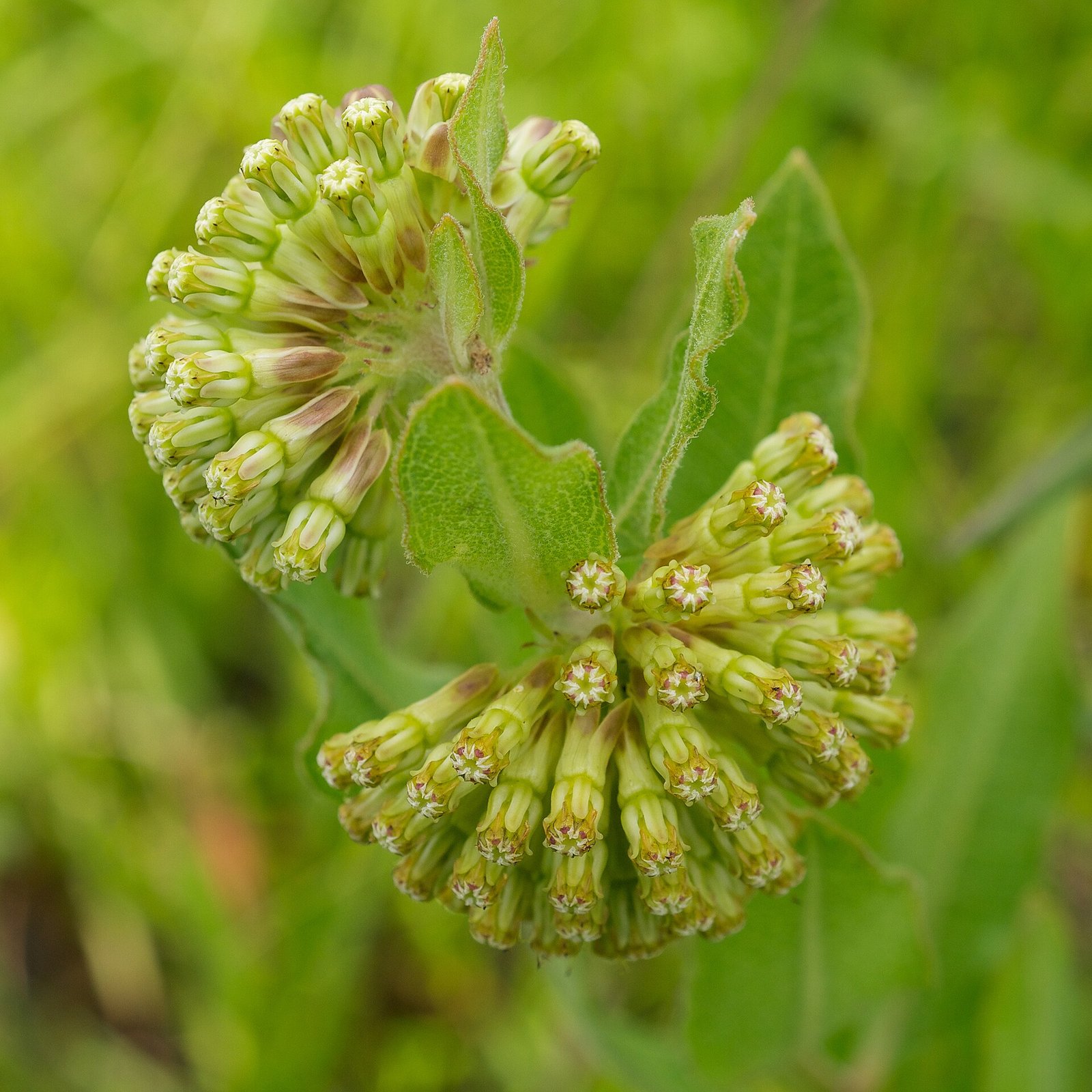
Green milkweed
Asclepias viridiflora
Also called glade milkweed. A short, sprawling milkweed of cedar glades and limestone barrens with greenish-white rounded flower clusters in June and July. The yellowish-green flower color makes it easy to overlook against the dry-grass background of glade openings; once spotted it is unmistakable. A glade-association indicator species in Tennessee.
Status: Native; locally distinctive in glades.
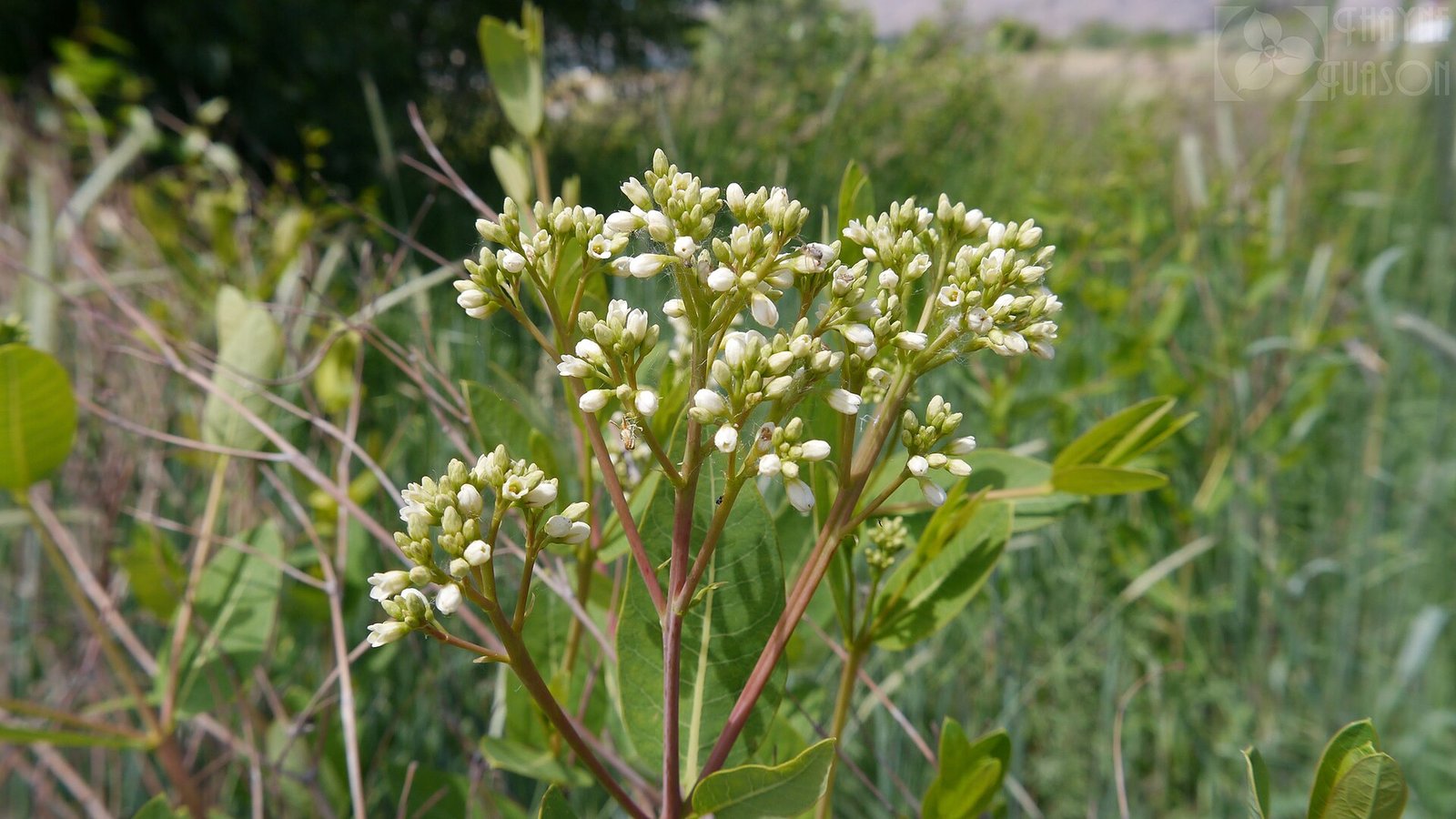
Indian-hemp
Apocynum cannabinum
A close milkweed-family relative of the Asclepias milkweeds. Reddish stems, opposite oval leaves, and clusters of small greenish-white flowers in early summer; the plant exudes the same milky white sap as the milkweeds when broken. Cherokee and other regional indigenous communities used the strong, fibrous stems for cordage, fishing line, and woven goods, and the plant's English name reflects that use. Common along old roadbeds and field edges.
Status: Native; common on roadbanks.
Goldenrods of field and roadside
Goldenrods (Solidago) are the dominant late-summer composites of Marion's open country. Roughly a dozen species occur in the county; the seven below are the most reliable in roadside, old-field, and dry-meadow habitats. Goldenrod is insect-pollinated and is not the cause of hay fever, which comes from the wind-pollinated ragweeds (Ambrosia) blooming at the same time.
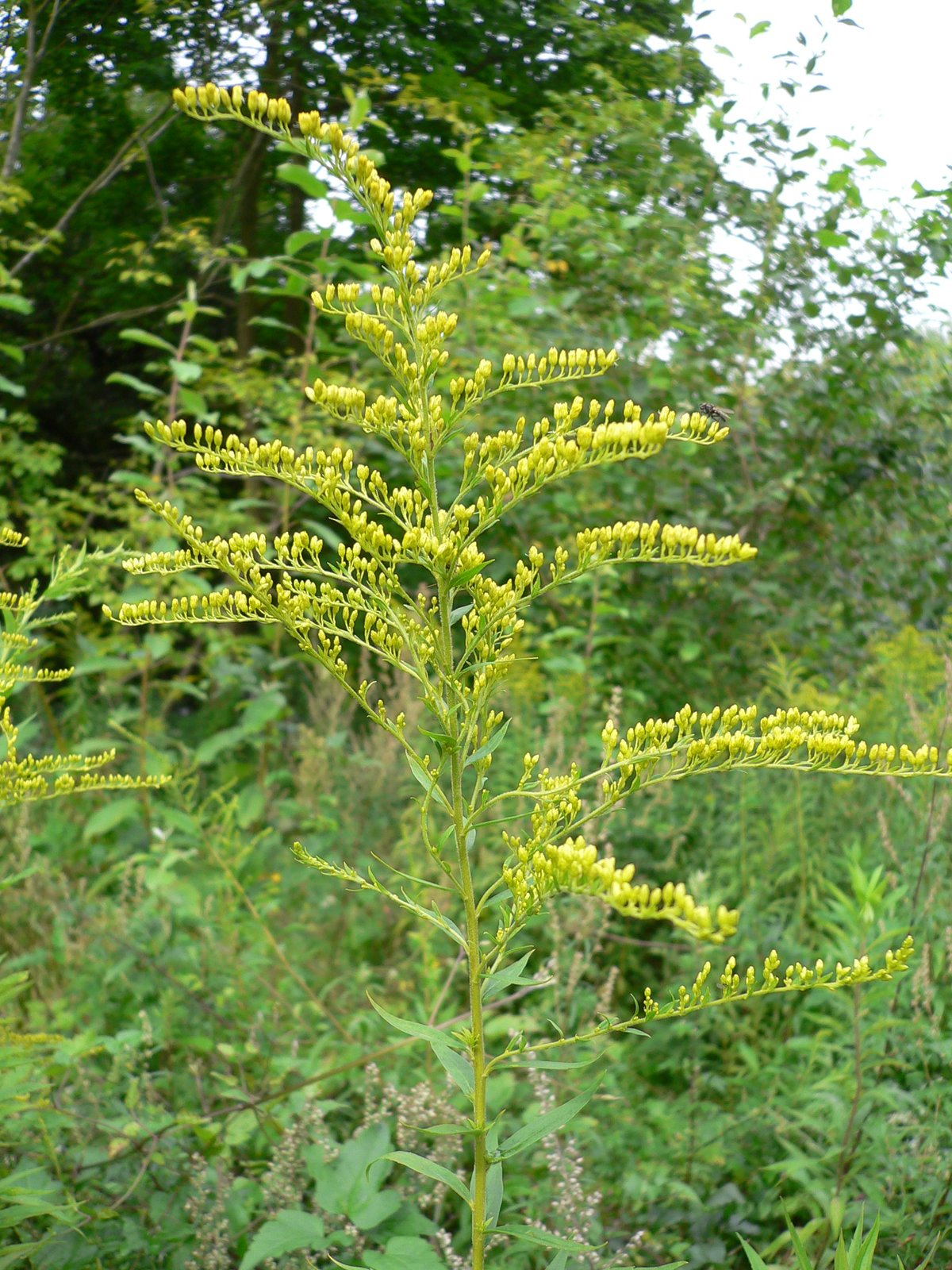
Canadian goldenrod
Solidago canadensis
The most familiar field-and-roadside goldenrod across eastern North America, including Marion's old fields, fencerows, and ditches. A tall (three to six foot) plant with a one-sided plume of small yellow flowers from August into October. Spreads by underground rhizomes and forms dense colonies; one of the dominant late-summer composites of the southern Cumberland Plateau roadscape.
Status: Native; abundant in old fields.
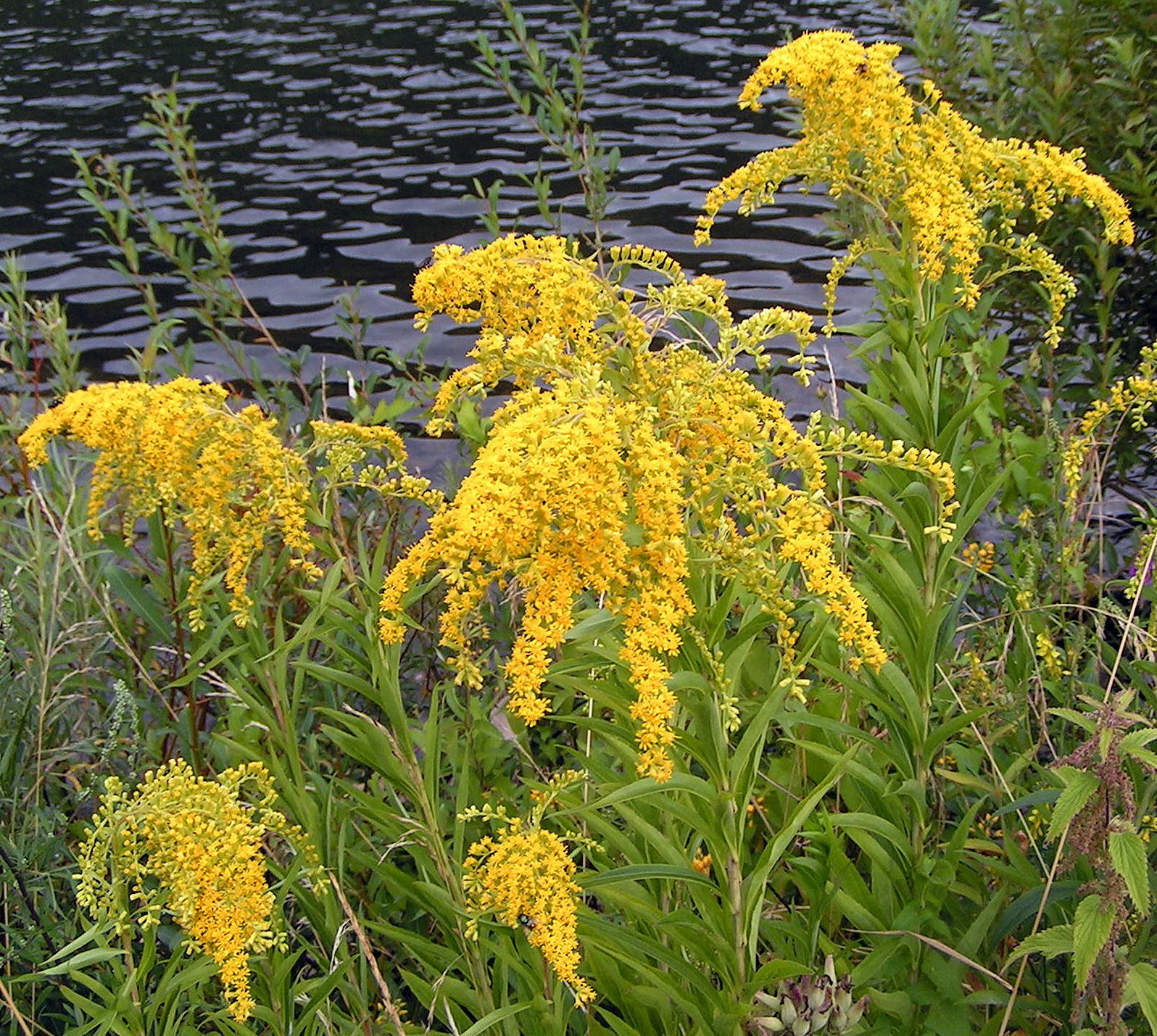
Late goldenrod
Solidago gigantea
A tall goldenrod (up to seven feet) of moist meadows and stream-edge openings. Closely resembles Canadian goldenrod but the stem is hairless and often blue-tinged, and the plume tends to be larger and more open. Blooms from August into September. Like other large-plume goldenrods, attracts a long list of native bees, butterflies, and beetles in late summer.
Status: Native; common in moist meadows.
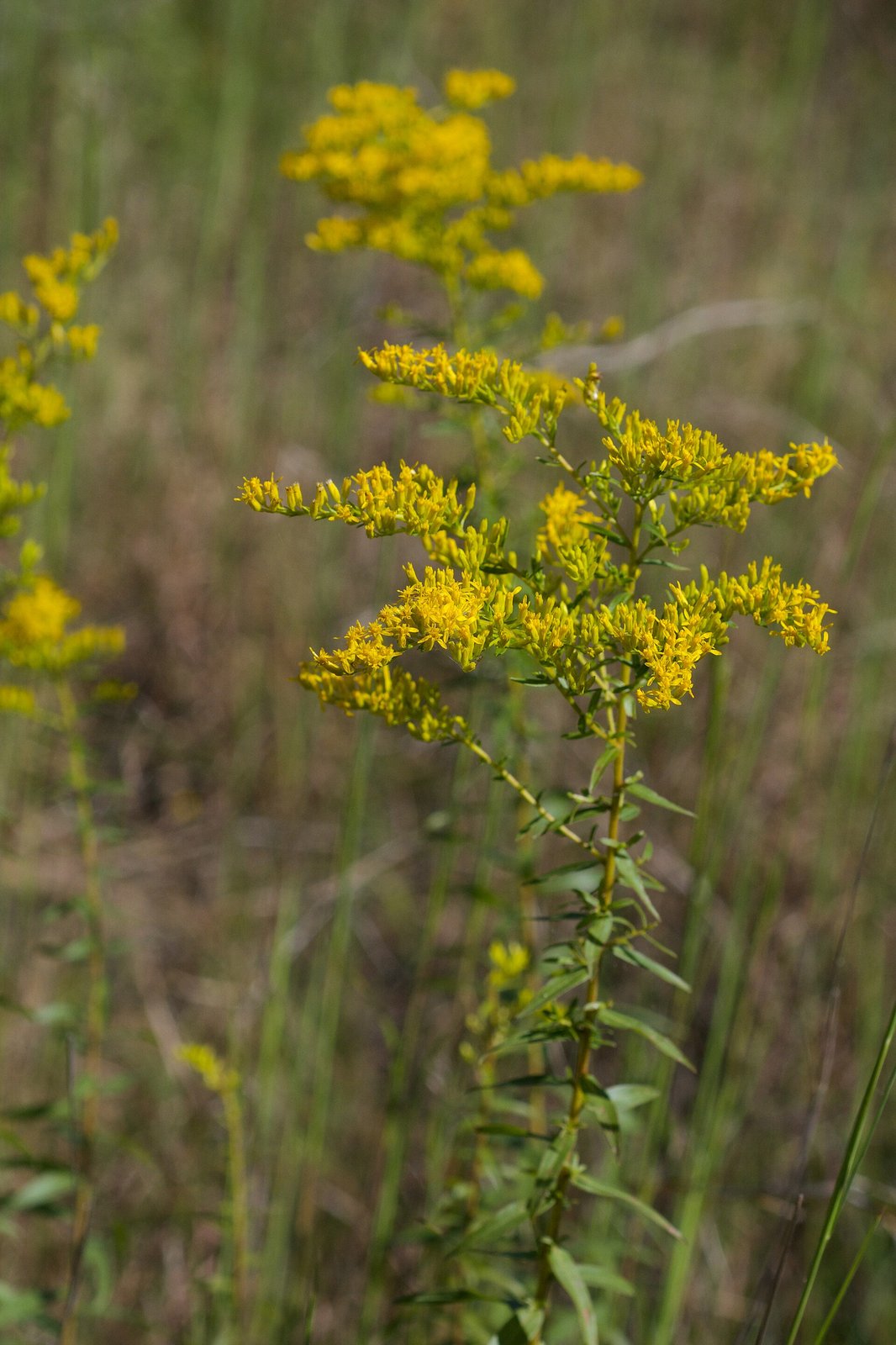
Anise-scented goldenrod
Solidago odora
A two- to three-foot goldenrod of dry openings and pine-oak edges, distinguished by the strong anise scent of its crushed leaves (the source of the common name). The leaves are narrow, untoothed, and dotted with translucent oil glands when held to light. Used historically to brew goldenrod tea after the Boston Tea Party, when colonial American tea supplies were cut off; the practice continued in Appalachian folk medicine well into the twentieth century.
Status: Native; common on dry plateau openings.
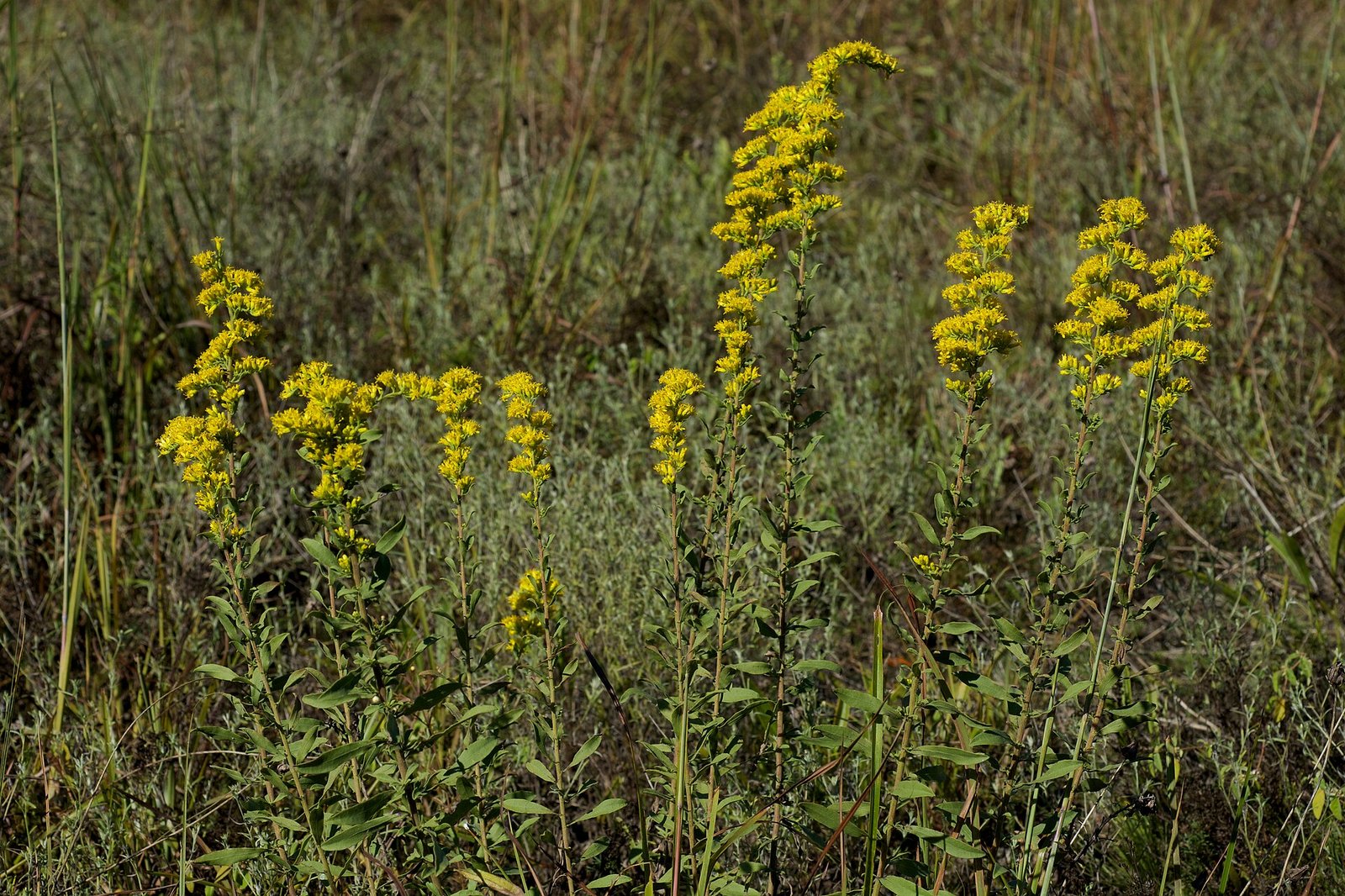
Grey goldenrod
Solidago nemoralis
A short (one- to two-foot) goldenrod of dry, thin-soiled openings. The lower leaves are spoon-shaped and the whole plant has a fine grey-green hairy texture (the source of the common name). The flower plume arches to one side, like a small version of Canadian goldenrod. A good indicator of dry, sterile soil; tolerates conditions that the bigger meadow goldenrods avoid.
Status: Native; common on dry banks.
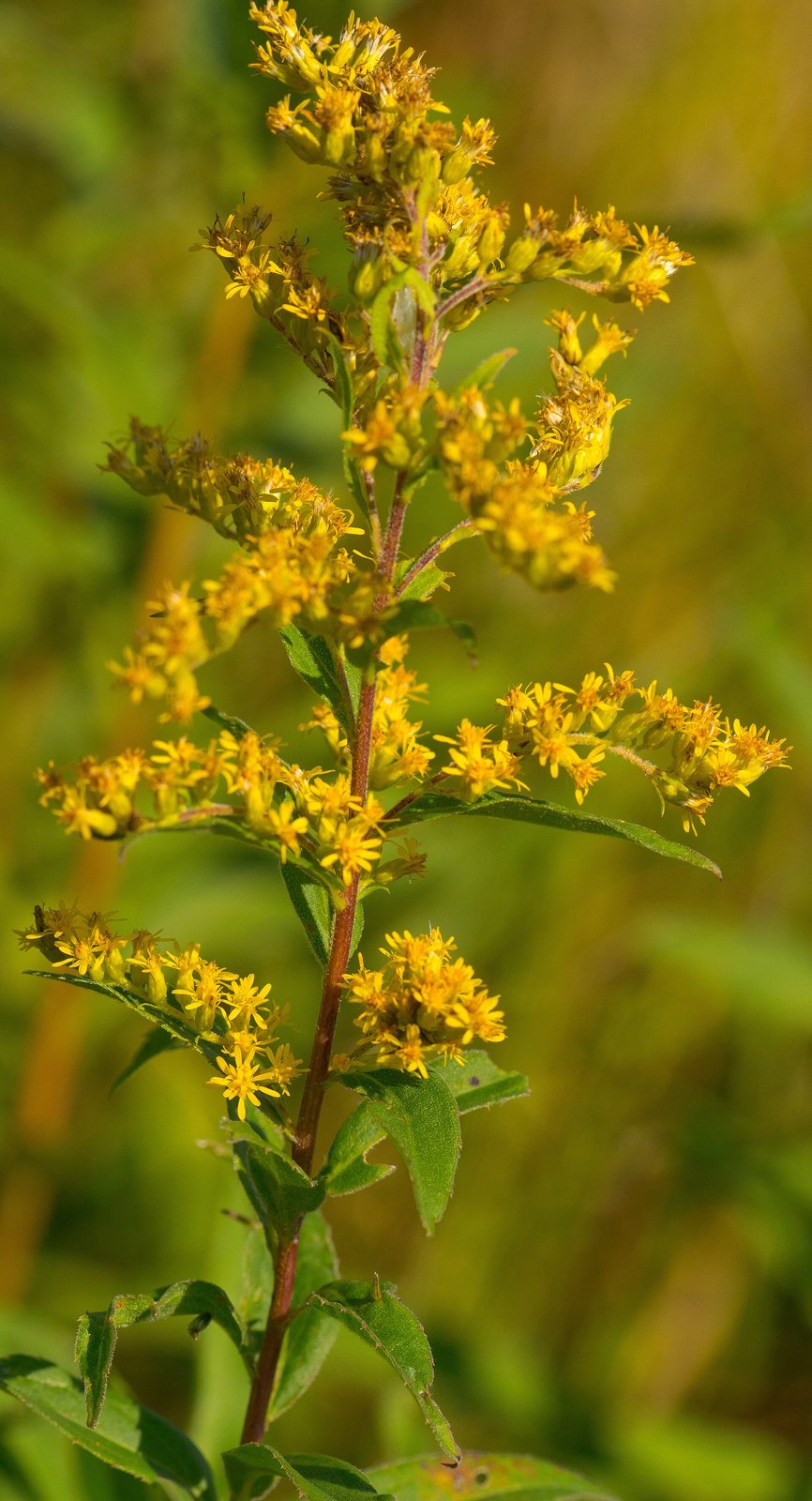
Showy goldenrod
Solidago speciosa
A robust goldenrod of meadows and prairie openings, distinguished by the upright (rather than one-sided) cylindrical flower plume. Stems are smooth and reddish; leaves are firm and oval. One of the more striking goldenrods in bloom and a frequent roadside element on the Sequatchie Valley side of Marion in early autumn.
Status: Native; locally common in meadows.
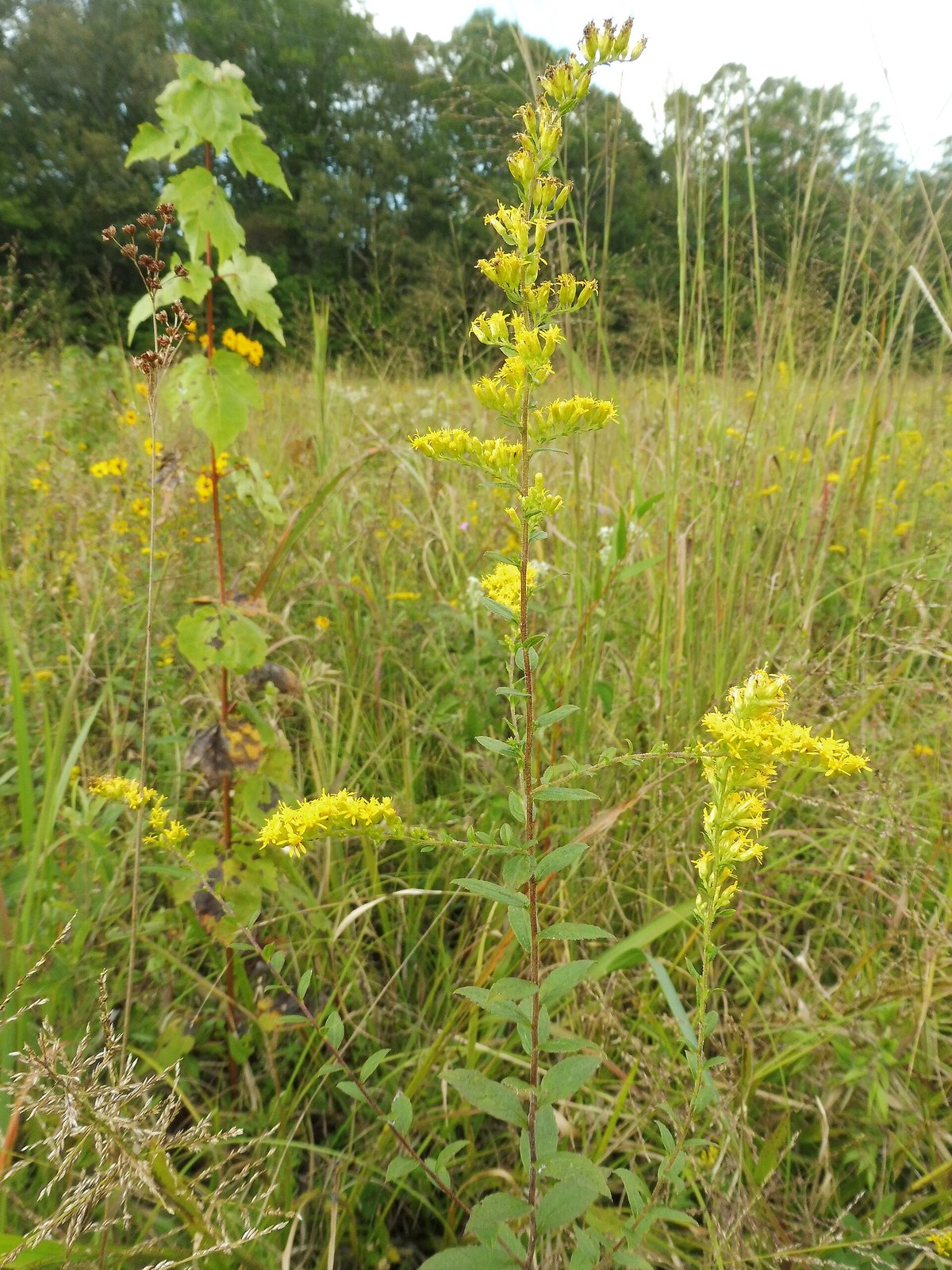
Wrinkleleaf goldenrod
Solidago rugosa
A medium-sized goldenrod (three to four feet) of moist old fields and ditch edges, named for the strongly veined, almost wrinkled leaves. The flower plume arches gracefully to one side. Common along roadside drainageways through Marion in September; one of the latest native composites to bloom each year.
Status: Native; common in moist old fields.
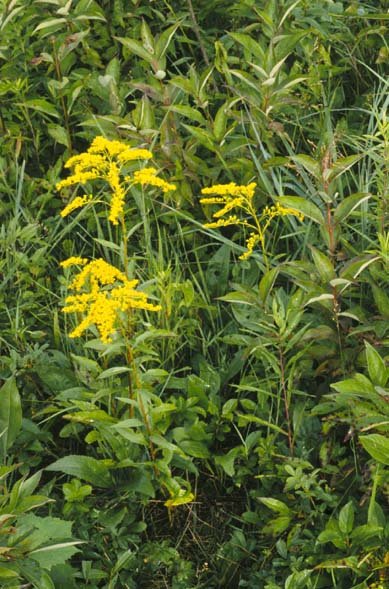
Early goldenrod
Solidago juncea
The earliest of Marion's roadside goldenrods, often beginning to bloom in late July before the more familiar Canadian and Late goldenrods get going. Smooth-stemmed and three to four feet tall with a one-sided arching plume. Lower leaves are larger and toothier than the upper leaves; the lower leaves are gone by the time the plant flowers.
Status: Native; common on dry roadbanks.
Open-country asters
The asters (Symphyotrichum and segregate genera) bloom in waves through late summer and autumn. The five species below are the most commonly encountered in Marion's old fields and roadside cuts; the cove-forest white wood aster and heart-leaved aster are filed under the woodland forb subgroups above.
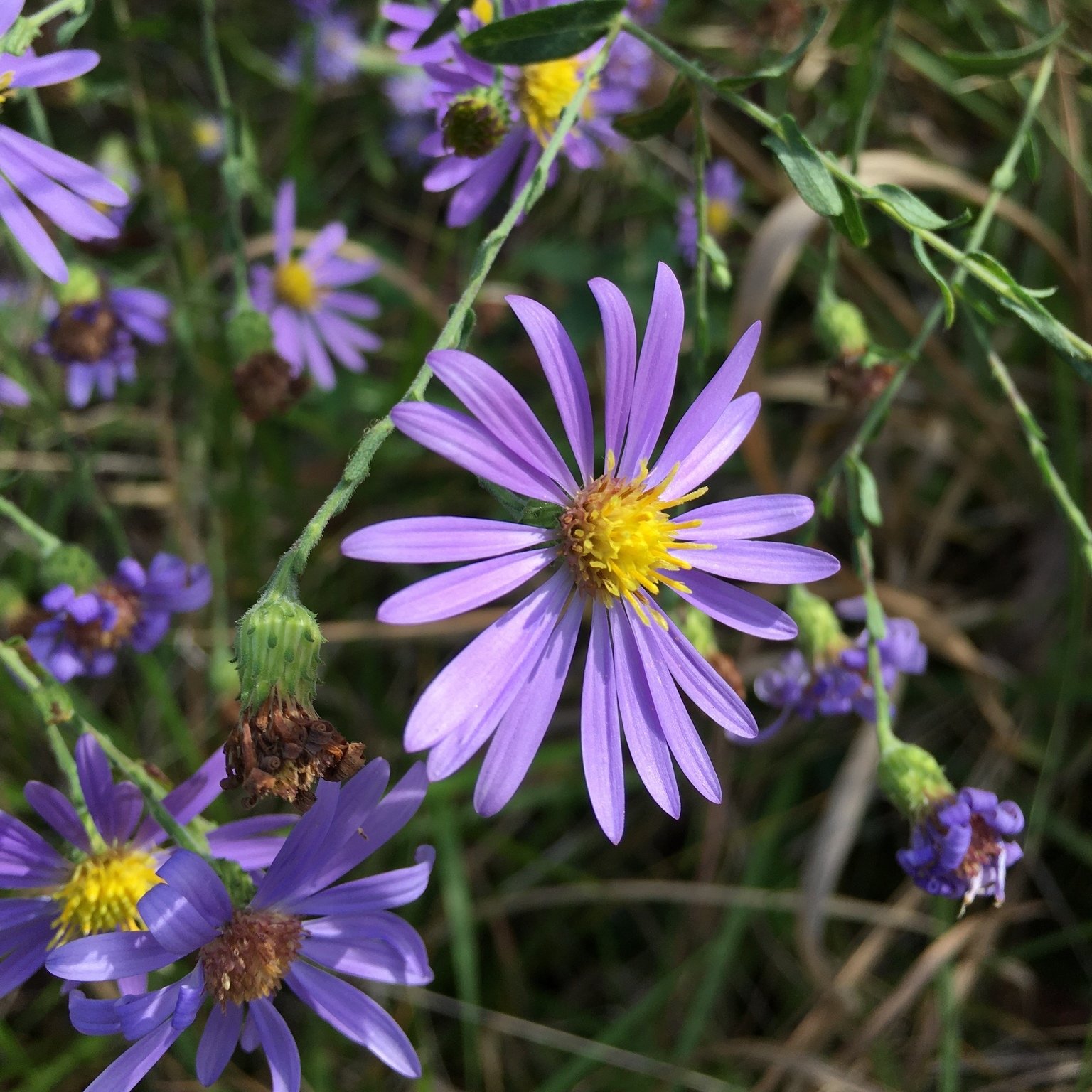
Late purple aster
Symphyotrichum patens
A late-blooming open-country aster (September into October) with deep blue-purple ray flowers and clasping leaves whose bases wrap around the stem. Two to three feet tall on dry sunny banks and roadside openings; one of the showiest of Marion's field asters in autumn.
Status: Native; common on dry banks.
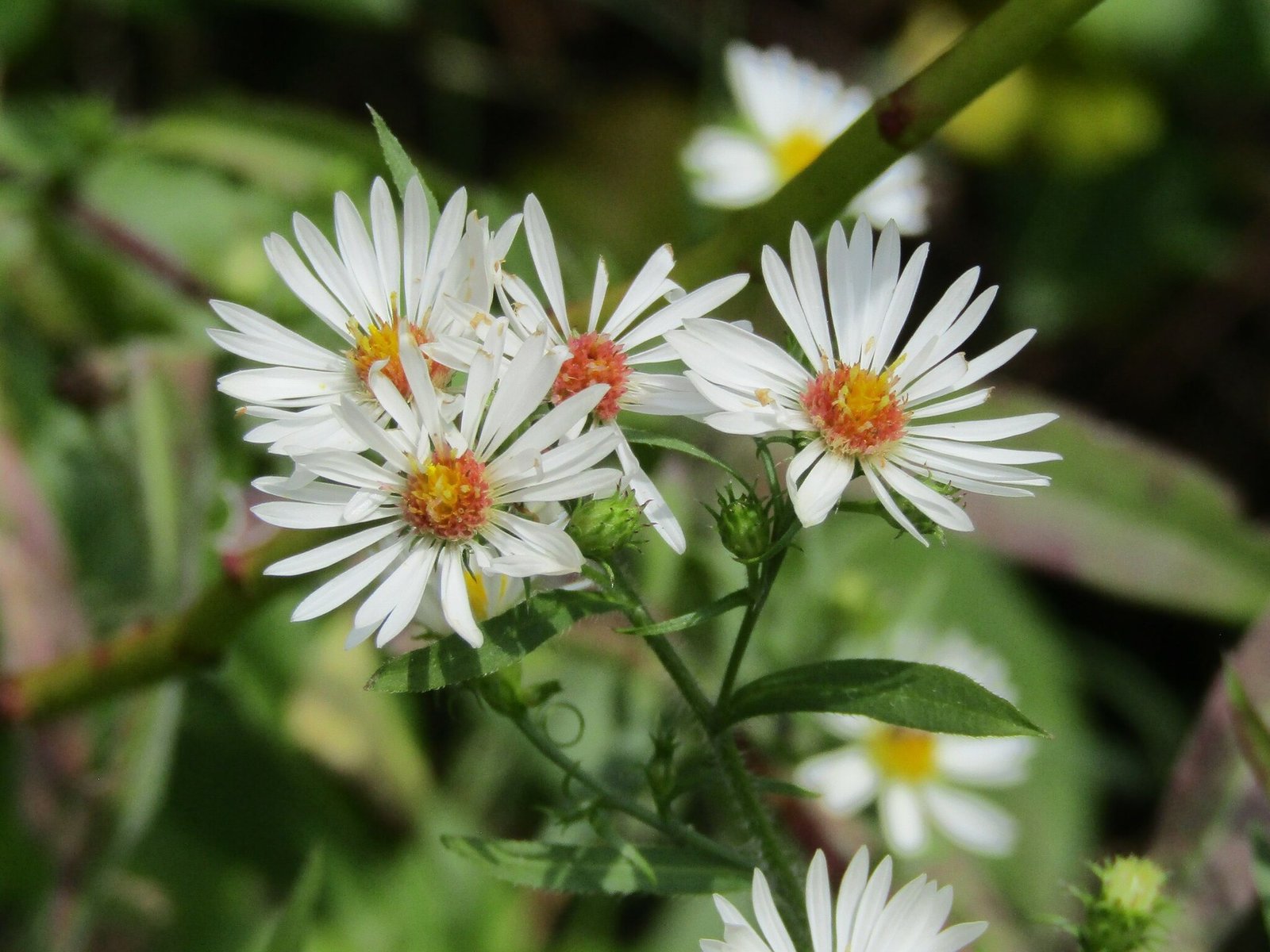
Frost aster
Symphyotrichum pilosum
A bushy field aster covered in profuse small white-rayed flowers in October, often persisting into the first frost. The stems and leaves are densely hairy (the source of the species name pilosum). One of the most abundant open-country asters in the Marion roadside; can dominate old fields after a wet summer.
Status: Native; common in old fields.
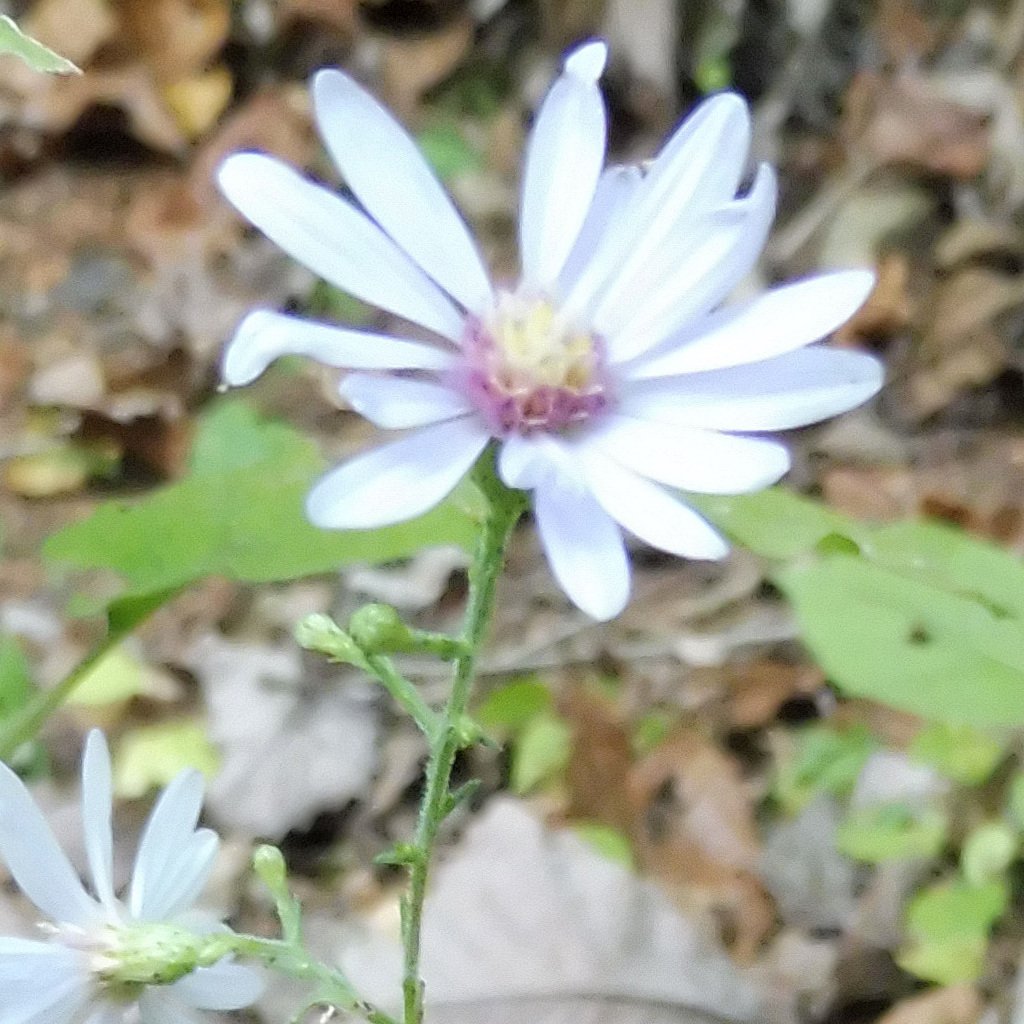
Short's aster
Symphyotrichum shortii
An aster of woodland edges and limestone-influenced openings on the Sequatchie Valley slopes. The basal leaves are arrow-shaped (broad and notched at the base) on long winged petioles; the upper leaves taper to short stalks. Pale lavender ray flowers in September and October. Named for Charles Wilkins Short, a nineteenth-century Kentucky botanist.
Status: Native; common on calcareous slopes.
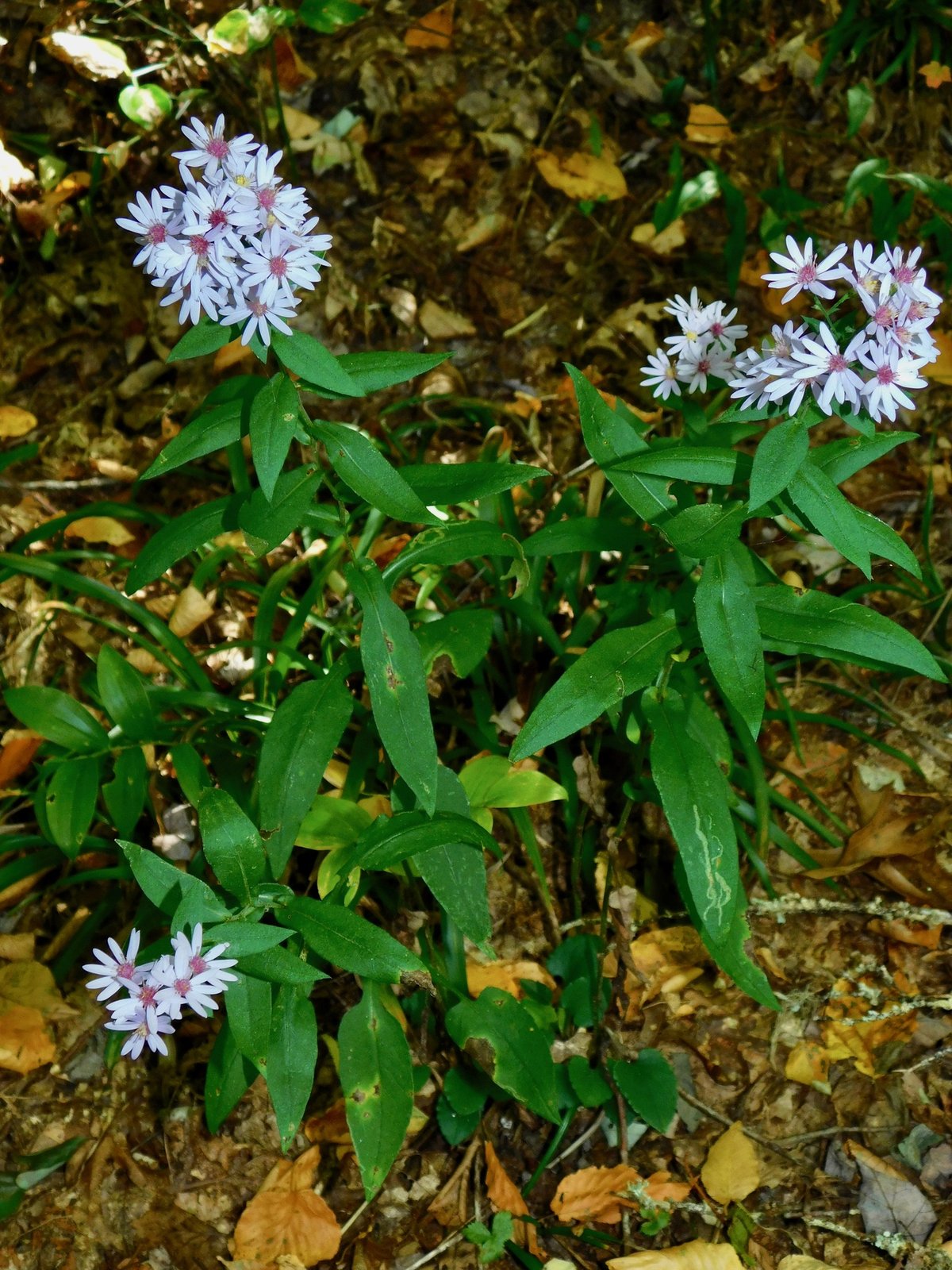
Wavy-leaved aster
Symphyotrichum undulatum
An aster of dry, open oak-hickory woods and ridge openings. The middle and upper stem leaves clasp the stem, with a winged petiole and a noticeably wavy margin (the source of the species name). Pale violet ray flowers in autumn, on a two- to three-foot plant. Common in Marion's drier upland forest openings.
Status: Native; common in dry woodland openings.
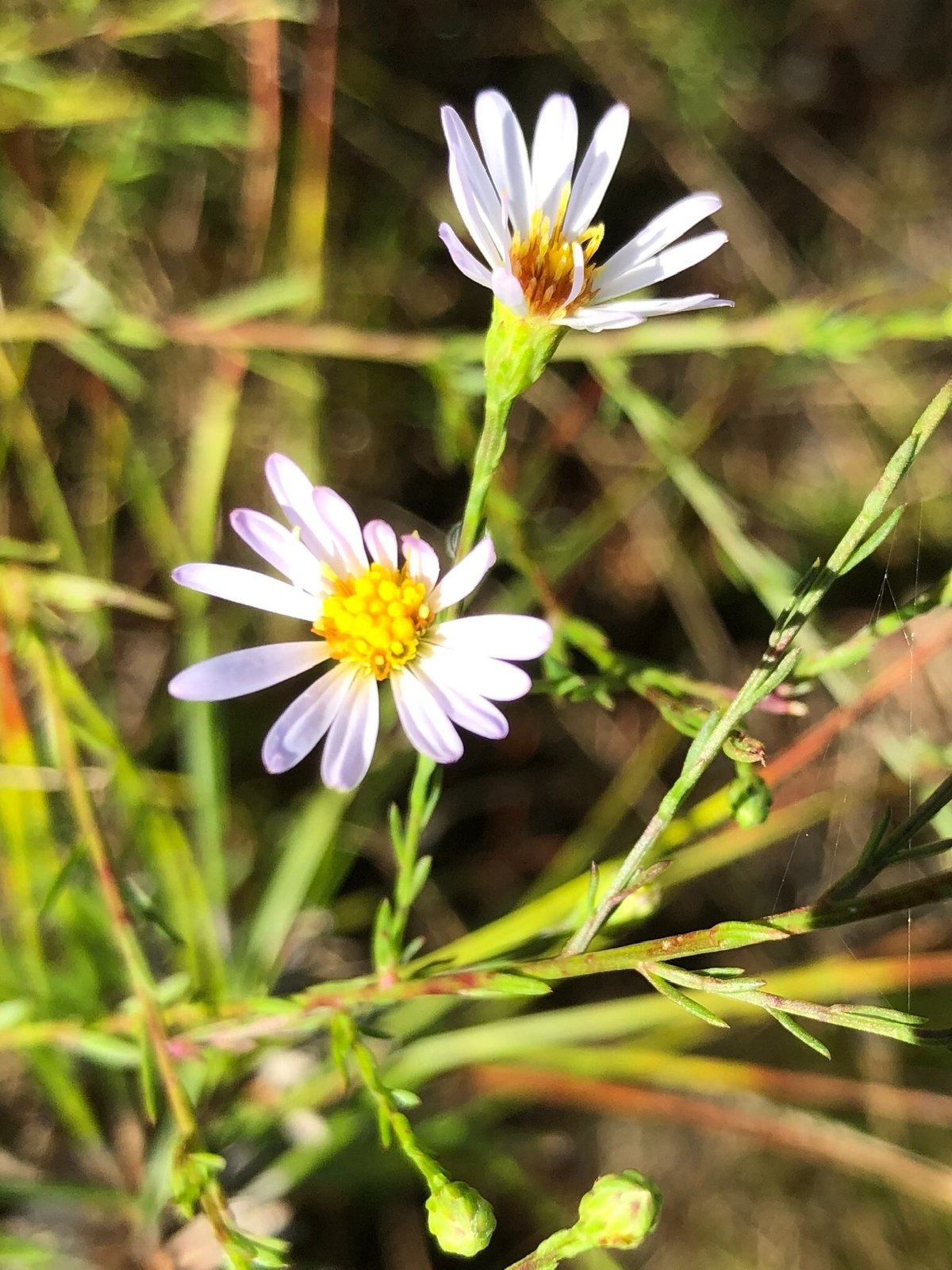
Bushy aster
Symphyotrichum dumosum
A many-branched aster with small pale-blue ray flowers loosely scattered across a dense bushy form, often taking up an entire ditch edge. Common in Marion's roadside drainages and moist field corners in September and October. One of the easier asters to identify by its overall bushy habit even before flowers open.
Status: Native; common on roadside drainages.
Coneflowers, sunflowers, and the open-country composites
The big yellow composites of Marion's roadsides and field edges. Black-eyed Susan and the brown-eyed cousin are the most familiar; the woodland sunflower (already filed under woodland forbs) is the small-flowered shaded relative of the field sunflowers below. The Helianthus complex hybridizes where habitats overlap, so close-leaf inspection is needed to separate them in the field.
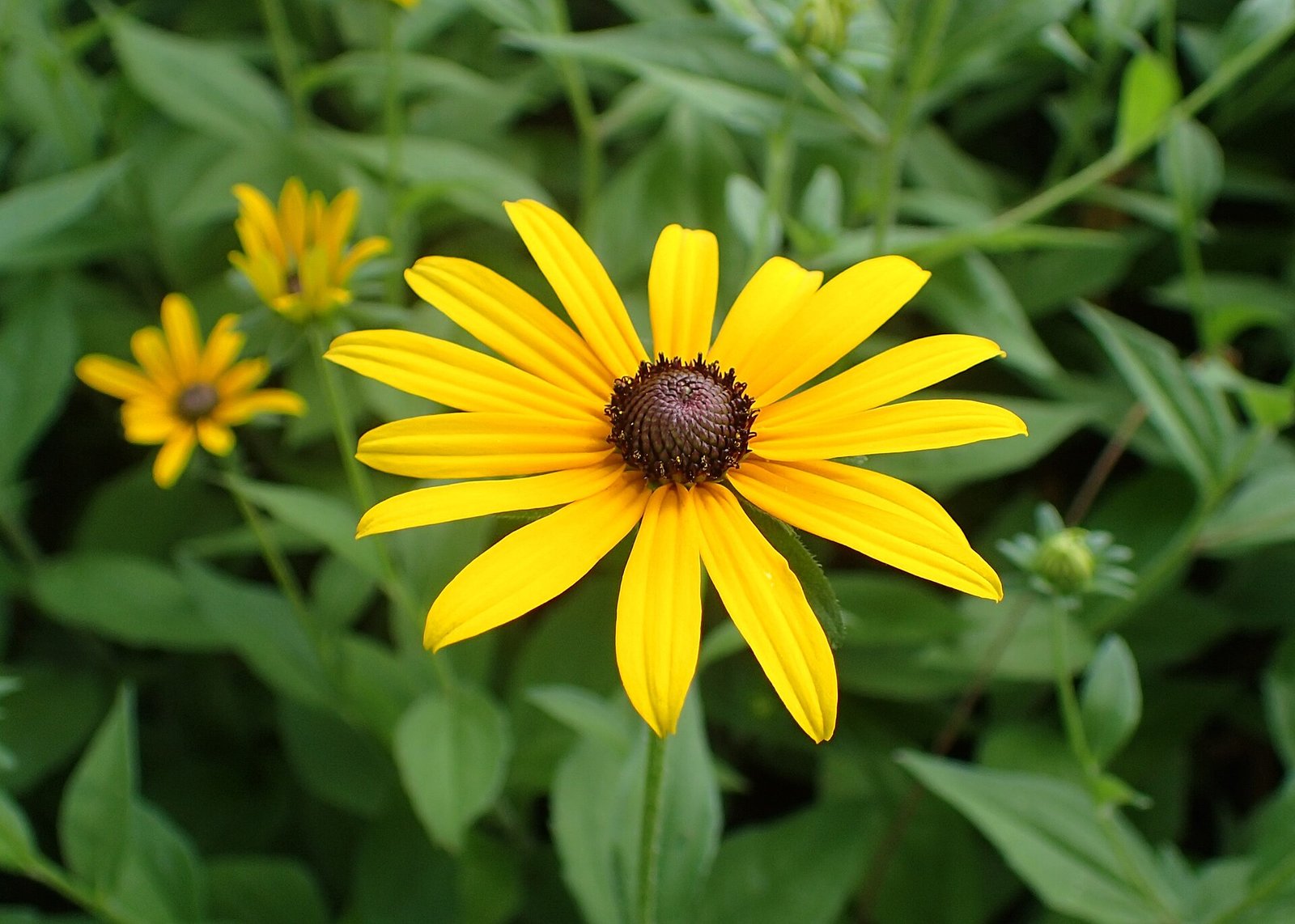
Black-eyed Susan
Rudbeckia hirta
Marion's most familiar field composite. A two- to three-foot biennial or short-lived perennial with golden-yellow ray flowers and a dark brown central disk, blooming from June into September. Common along roadsides, in old fields, and on disturbed ground; one of the first natives to recolonize a cleared site. Often planted as a cultivated wildflower; persists from those plantings indefinitely.
Status: Native; abundant in fields.
Brown-eyed Susan
Rudbeckia triloba
A close cousin of black-eyed Susan, distinguished by smaller flower heads borne in profusion on a much-branched plant three to five feet tall. The lower leaves are three-lobed (the source of the species name triloba). Favors moist old fields, ditch edges, and woodland clearings; blooms August into October.
Status: Native; common in moist openings.
Cutleaf coneflower
Rudbeckia laciniata
A tall (five- to nine-foot) coneflower of moist meadows, stream margins, and partly shaded ditch banks. The deeply lobed and divided leaves give it the common name. The yellow ray flowers droop slightly around a green-yellow central cone that is taller than the disk in the typical Rudbeckias. The double-flowered horticultural form was widely planted as 'golden glow' in nineteenth-century gardens.
Status: Native; common in moist meadows.
Hairy sunflower
Helianthus hirsutus
A native field-and-roadside sunflower three to five feet tall, distinguished by stiff hairs on the stems and the rough sandpapery upper leaf surface. Yellow ray flowers August into September. One of several morphologically similar woodland-edge sunflowers that need close-leaf inspection to separate; the bristly stem is the most reliable field mark for hairy sunflower.
Status: Native; common on woodland edges.
Thinleaf sunflower
Helianthus decapetalus
A woodland-edge sunflower with thinner, smoother leaves than the rough-leaved field sunflowers and typically ten ray flowers per head (the source of the species name). Three to five feet tall, blooming July into September. Favors slope openings, trail edges, and partly shaded roadbanks rather than full-sun fields.
Status: Native; common on shaded edges.
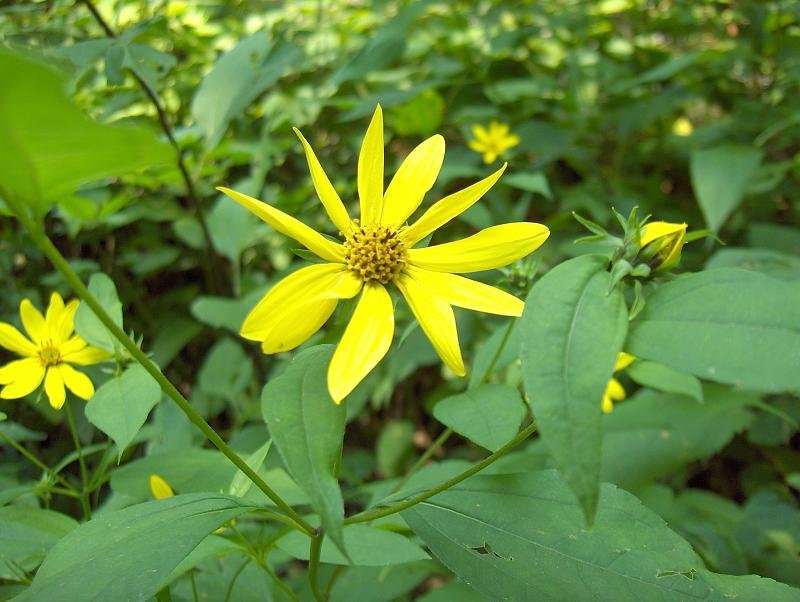
Rough sunflower
Helianthus strumosus
Another field-and-edge native sunflower, distinguished by its paler, glaucous (waxy-bloom) leaf undersides and smooth-textured stems. Three to five feet tall with yellow ray flowers in July and August. The Sunflower complex in Marion has nearly a dozen Helianthus species that hybridize where their habitats overlap; rough sunflower is one of the easier ones to key by leaf undersides alone.
Status: Native; common on woodland edges.
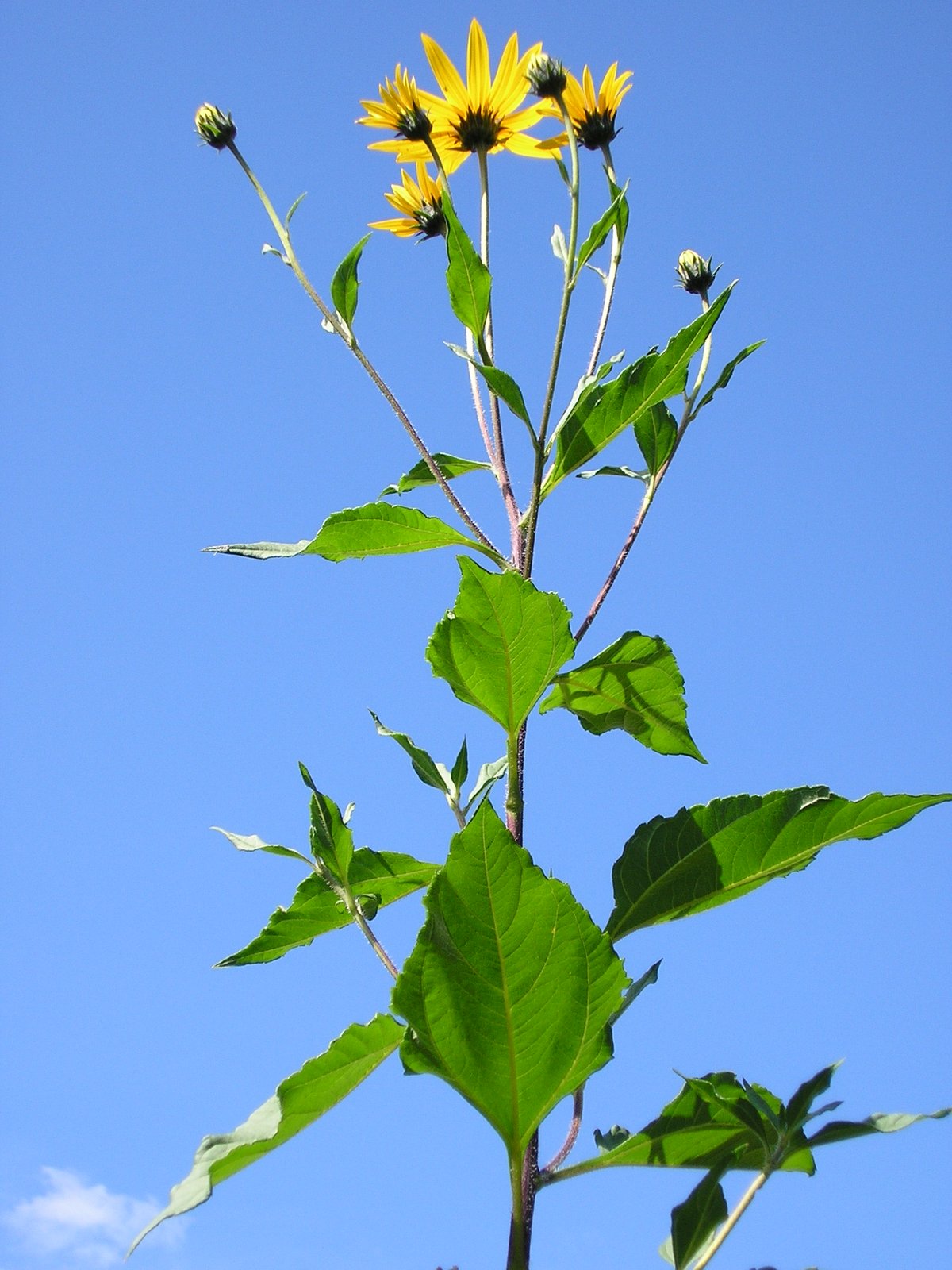
Jerusalem artichoke
Helianthus tuberosus
A tall (six- to ten-foot) sunflower of moist old fields, ditch banks, and stream margins. Pre-Columbian Indigenous peoples of eastern North America cultivated the species for its underground tubers, which French colonists took back to Europe in the seventeenth century; it remains a minor crop today. The 'Jerusalem' in the name has nothing to do with the city, deriving from the Italian girasole (sunflower) misheard by English speakers.
Status: Native; common in moist openings.
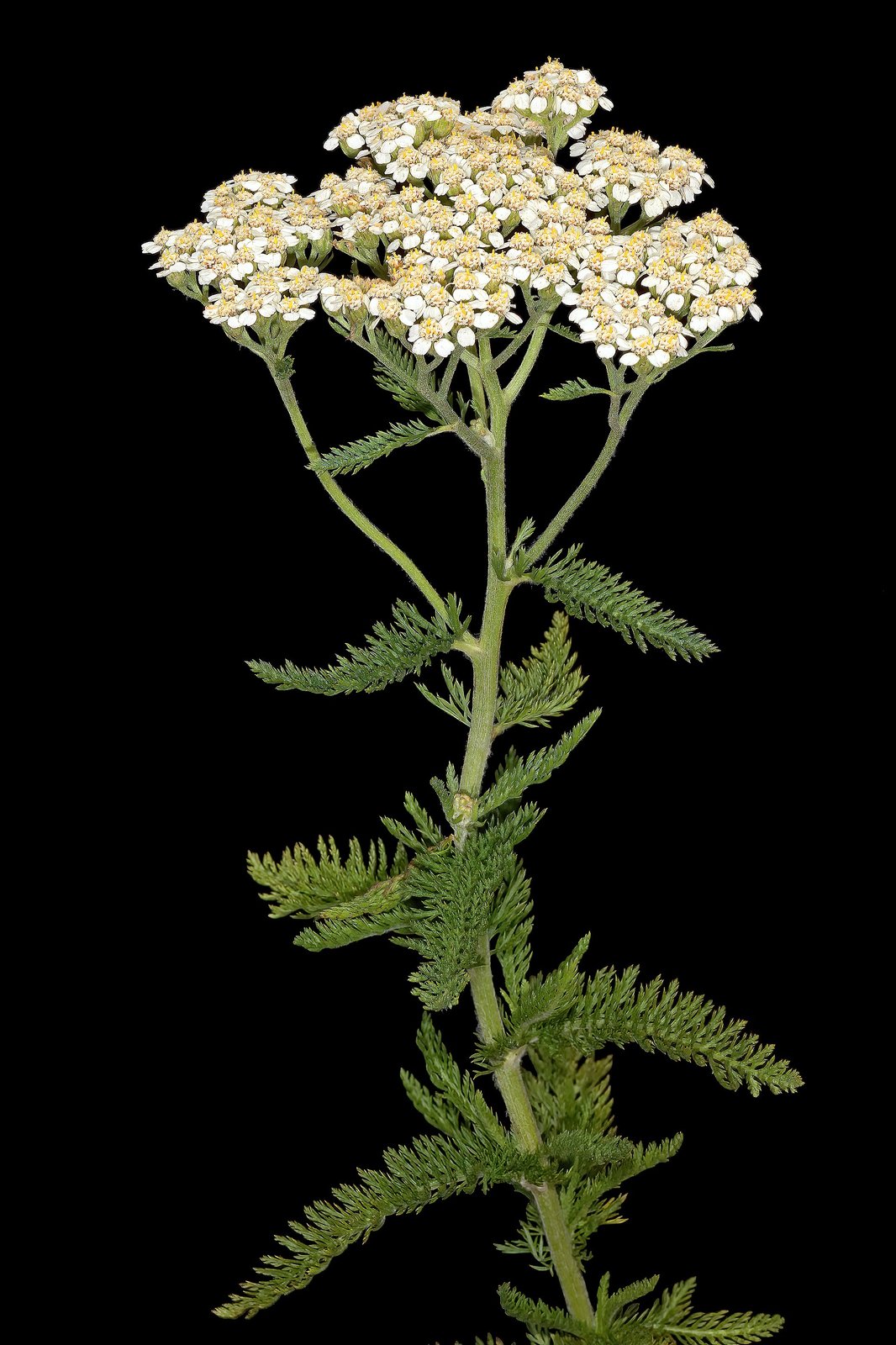
Yarrow
Achillea millefolium
A finely divided fern-like-leaved composite with flat-topped clusters of small white flowers from June into August. Yarrow is one of the few native plants of Marion's roadside that has a circumboreal distribution (also native to Europe and Asia). Used since classical antiquity as a wound-staunching herb (the genus name commemorates the Greek hero Achilles, who reportedly used it to treat his soldiers' wounds).
Status: Native; common on dry banks.
Joe-Pye-weeds, bonesets, and ironweed
The Joe-Pye-weeds (Eutrochium) and bonesets (Eupatorium) are the late-summer giants of Marion's wet meadows and ditch margins. Botanists split them out of Eupatorium in the early 2000s, so older Marion field guides still list them all under that genus. Giant ironweed (Vernonia gigantea), in the same composite tribe, is included here as a fellow tall, late-blooming wet-meadow species.
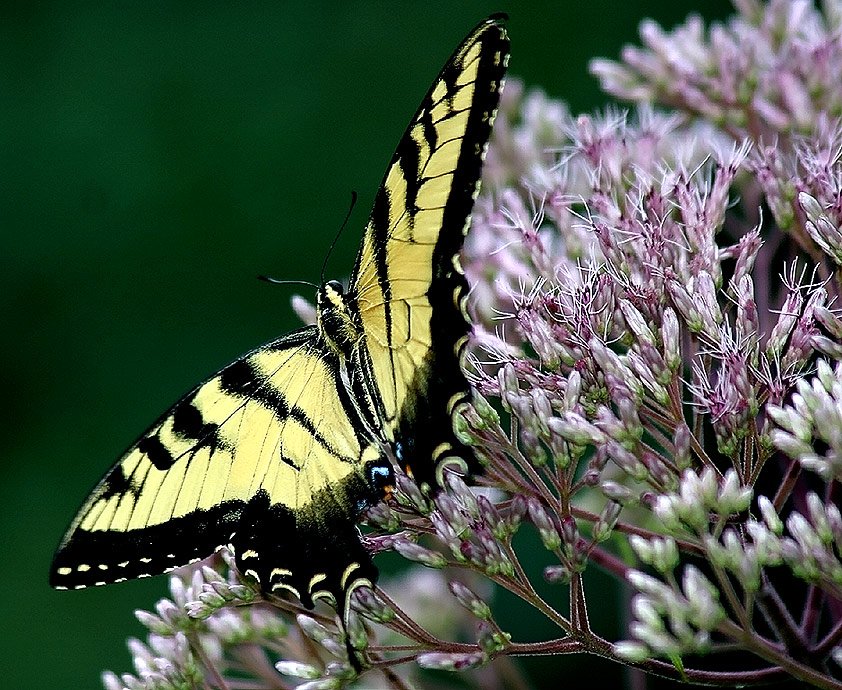
Hollow-stemmed Joe-Pye-weed
Eutrochium fistulosum
A wetland-margin giant six to ten feet tall with whorls of four to seven lance-shaped leaves at each stem node and a large rounded cluster of pinkish-purple flowers in August. The stem is hollow (the species name fistulosum means tubular or pipe-like). Common along stream banks, ditch lines, and seep openings on the plateau and through the Sequatchie Valley.
Status: Native; common in wet meadows.
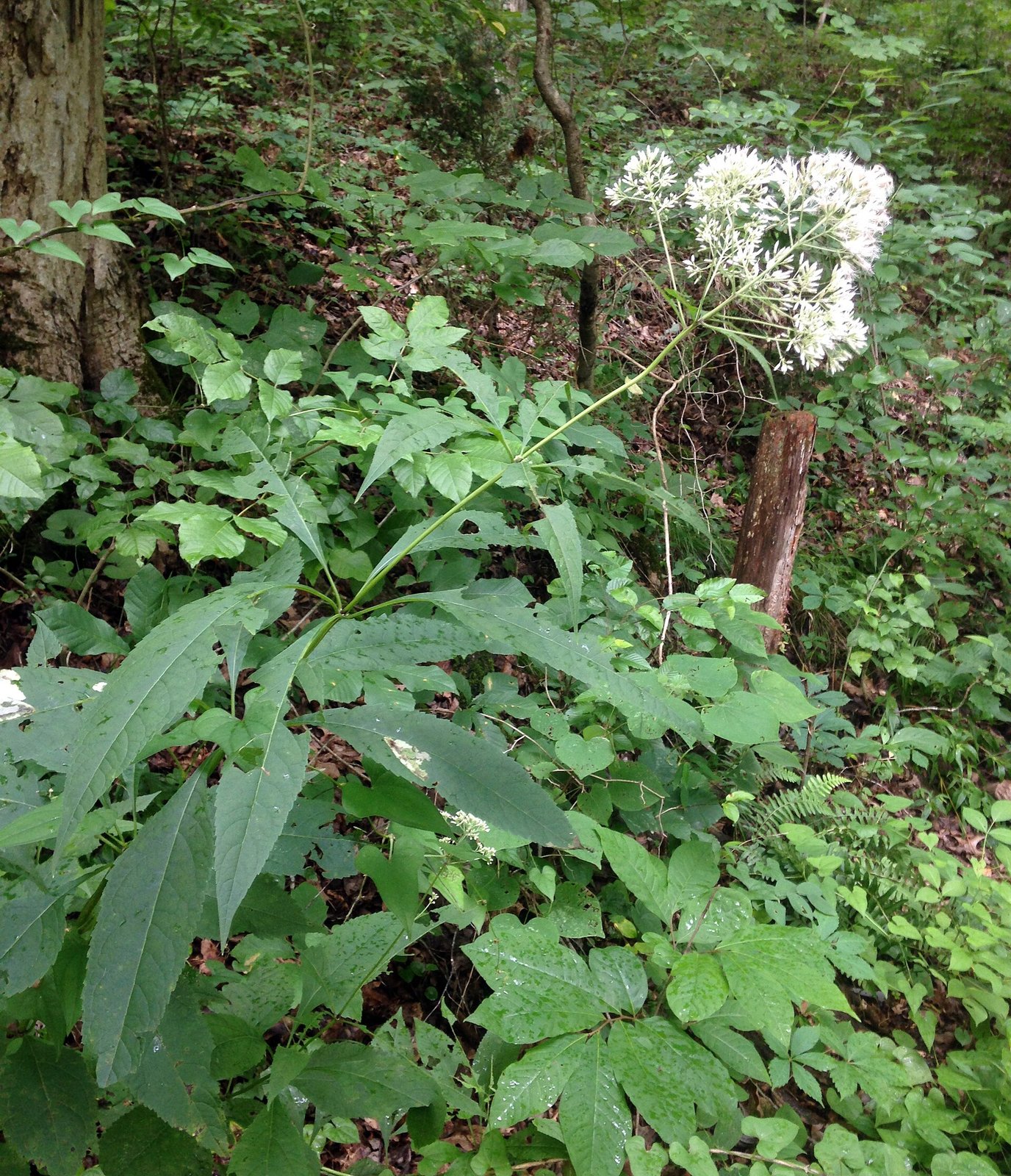
Sweet Joe-Pye-weed
Eutrochium purpureum
A close cousin of hollow-stemmed Joe-Pye, distinguished by a solid (not hollow) stem and a vanilla-like scent in the foliage when crushed. Whorls of three to four leaves per node; pink to dusty-pink flower clusters in August. Favors woodland edges and partly shaded slopes rather than the full-sun wet meadows of E. fistulosum.
Status: Native; common on shaded slopes.
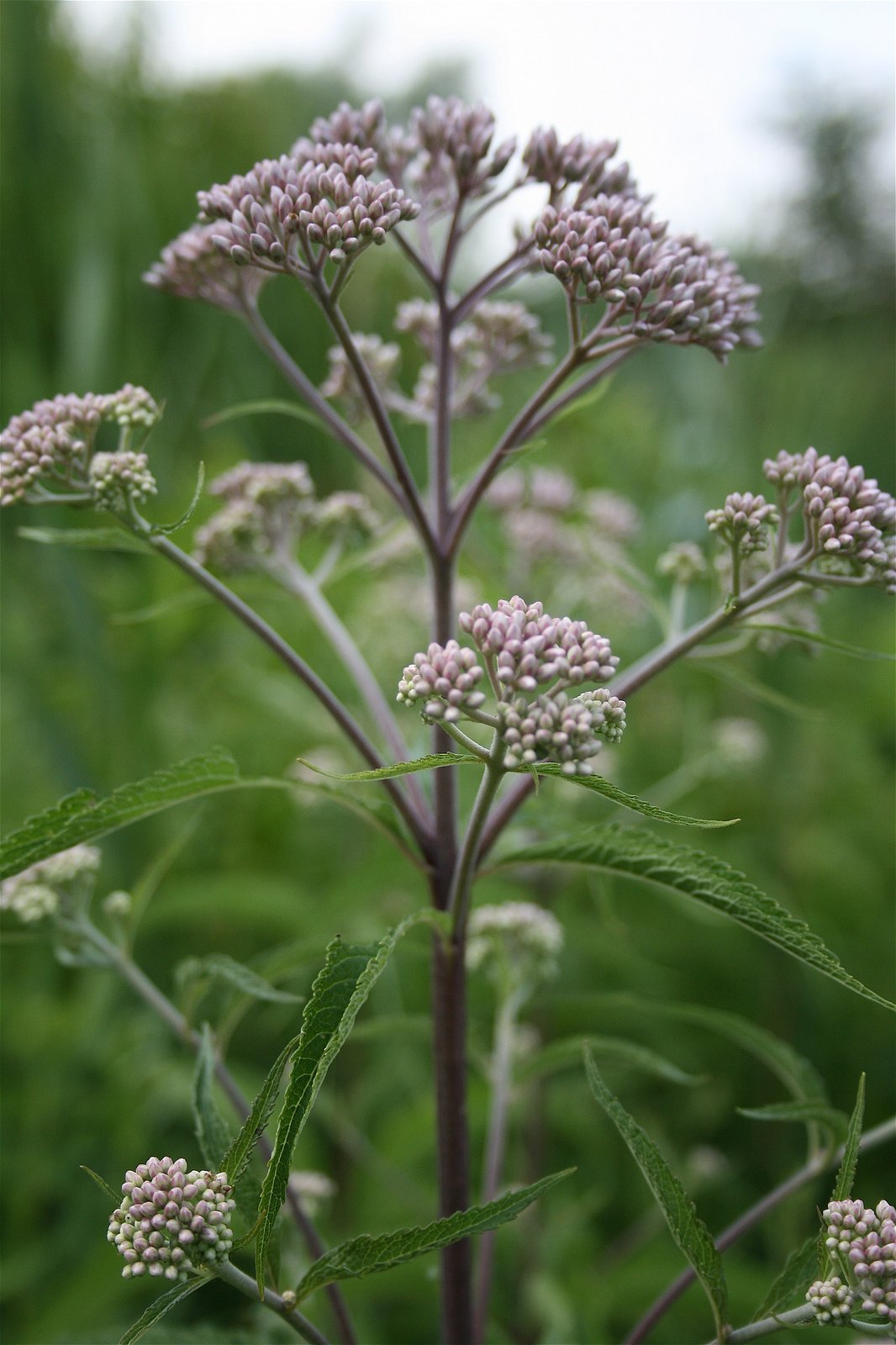
Spotted Joe-Pye-weed
Eutrochium maculatum
Distinguished from the other Joe-Pye-weeds by purple-spotted (mottled) stems. Five to seven feet tall with whorls of four to five leaves per node. Pink flower clusters in August on flat-topped (rather than rounded) inflorescences. Less abundant in Marion than the hollow-stemmed and sweet Joe-Pyes; favors the wettest seeps and open marsh edges.
Status: Native; locally common in wet meadows.
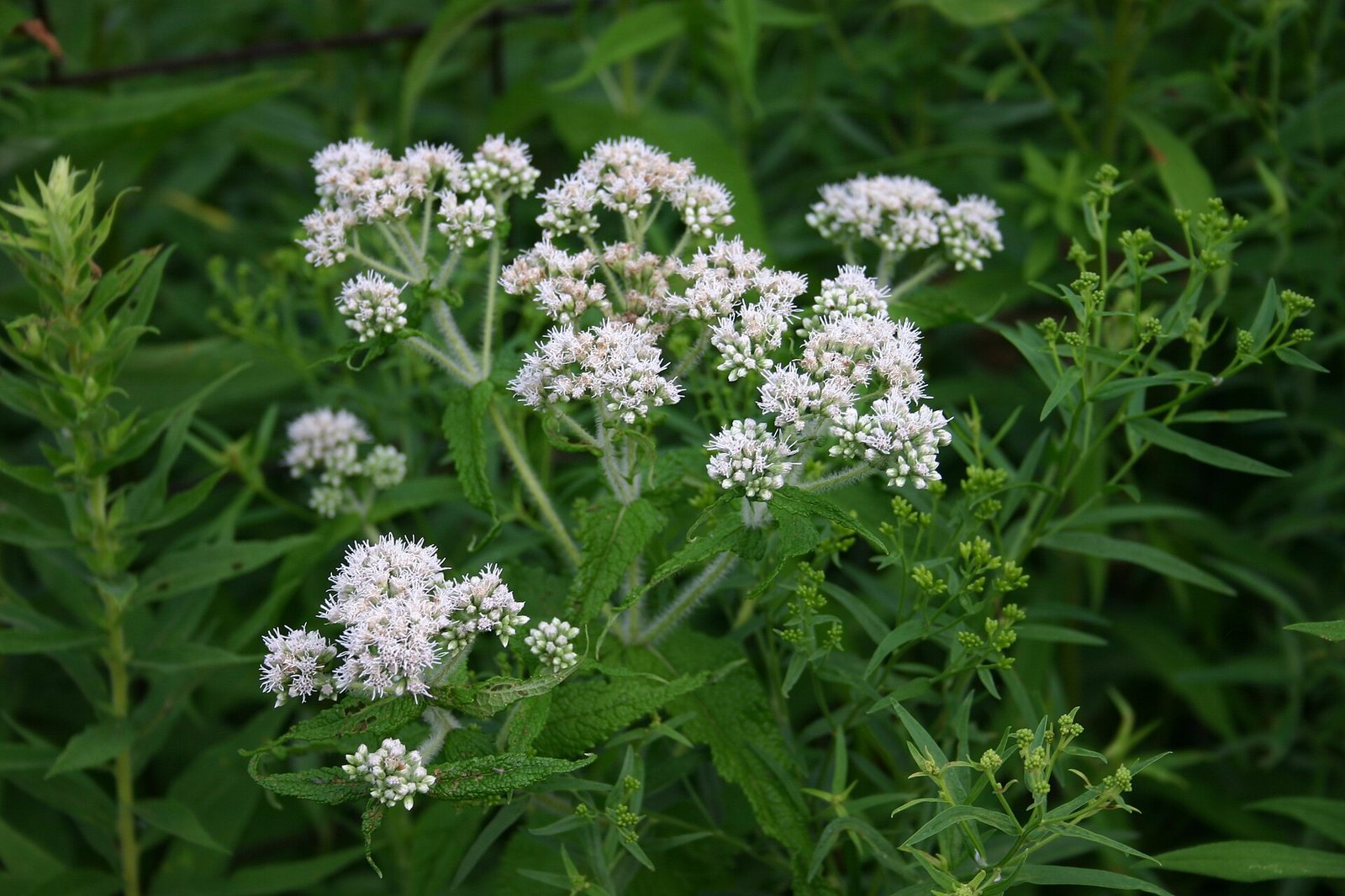
Common boneset
Eupatorium perfoliatum
Distinguished from the Joe-Pyes and other Eupatoriums by leaves that fuse around the stem so the stem appears to perforate a single double-pointed leaf at each node (the species name perfoliatum means through-the-leaf). Flat-topped clusters of small white flowers in late summer. Common in wet meadows, ditch banks, and old-field seep margins. Used in eastern Appalachian folk medicine for fevers (its common name comes from its use in 'break-bone fever,' an old name for dengue).
Status: Native; common in wet meadows.
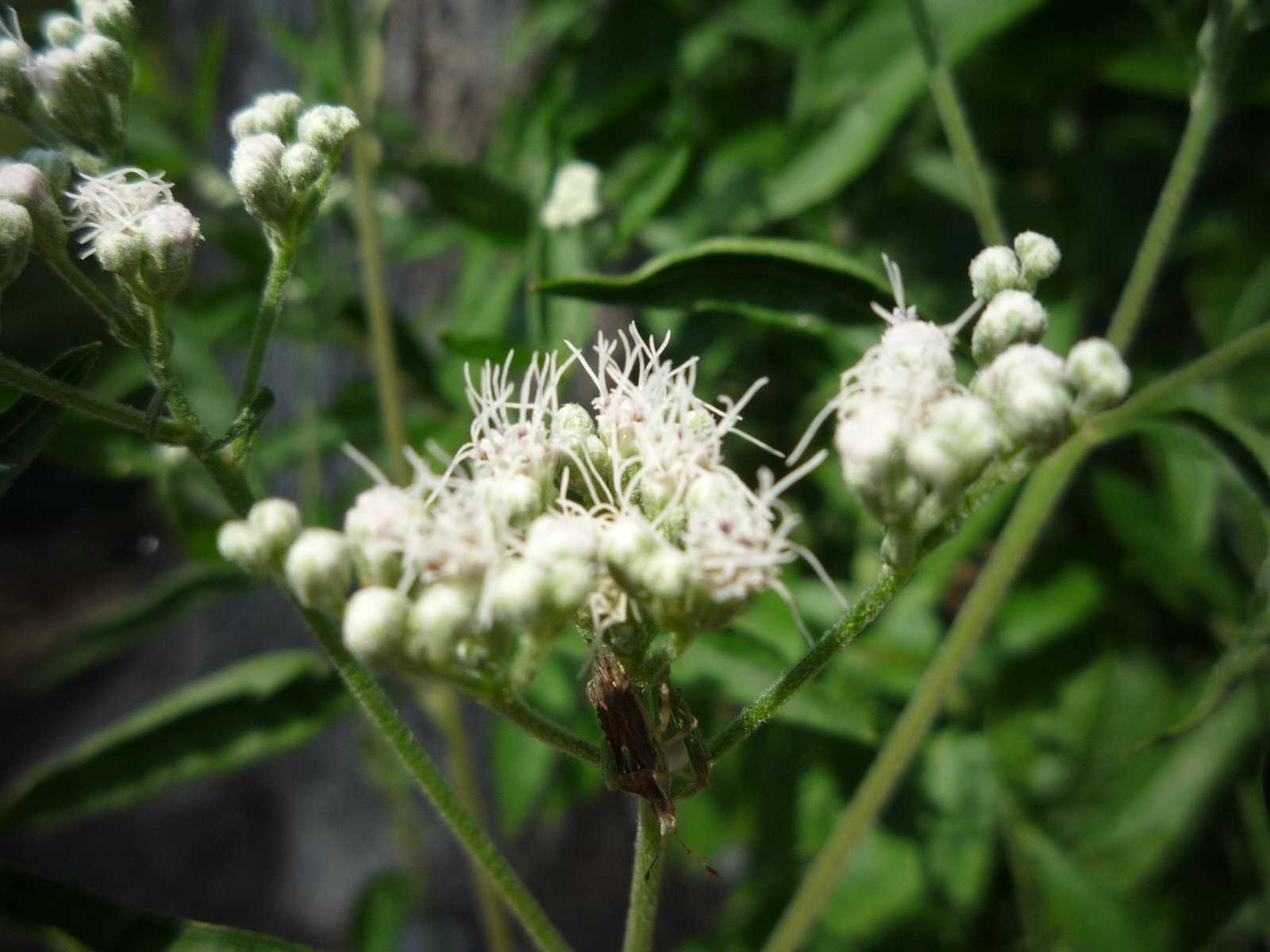
Late-flowering thoroughwort
Eupatorium serotinum
A tall (four- to seven-foot) thoroughwort with branched plumes of small fluffy white flowers from late August through October. The leaves are simply toothed and short-stalked. One of the latest-blooming composites of Marion's roadside; provides important late-season nectar for migrating monarchs and resident pollinators heading into autumn dormancy.
Status: Native; common on roadsides.
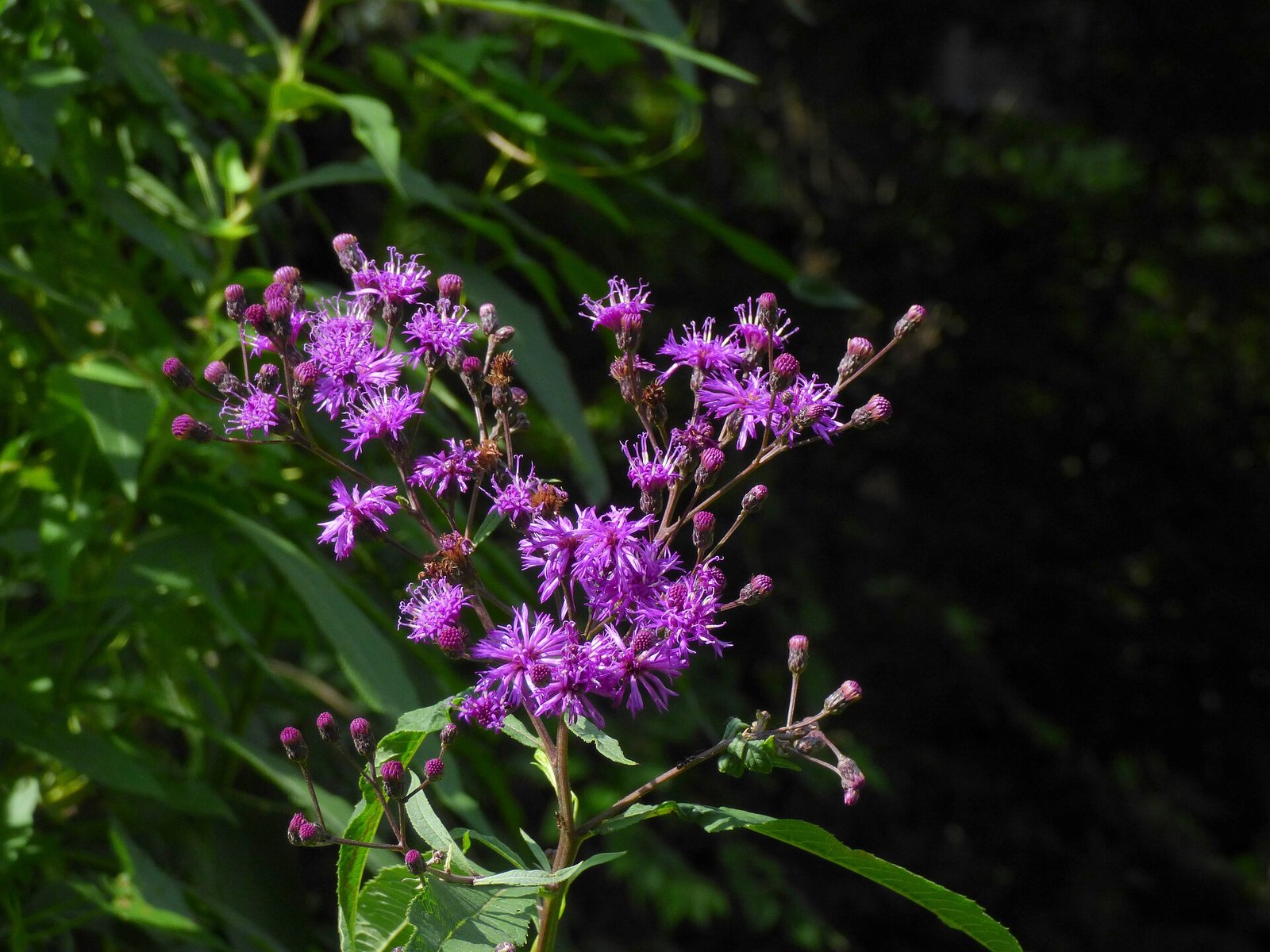
Giant ironweed
Vernonia gigantea
A six- to eight-foot composite topped by deep magenta-purple flat-topped flower clusters in August. The deep saturated purple is unique among Marion's late-summer roadside composites and unmistakable from a distance. Common in moist old fields and ditch banks across the county. The genus name commemorates English botanist William Vernon, and the plant's common name reflects its iron-strong, hard-to-pull stems.
Status: Native; common in moist old fields.
Tickseeds and blazing stars
The tickseeds (Coreopsis) are bright yellow rays of dry meadows and roadside cuts; the blazing stars (Liatris) are upright purple spikes that open from the top down. Both genera are well-represented in Tennessee's roadside-seeding programs and supply much of the yellow and purple of Marion's mid-summer roadside palette.
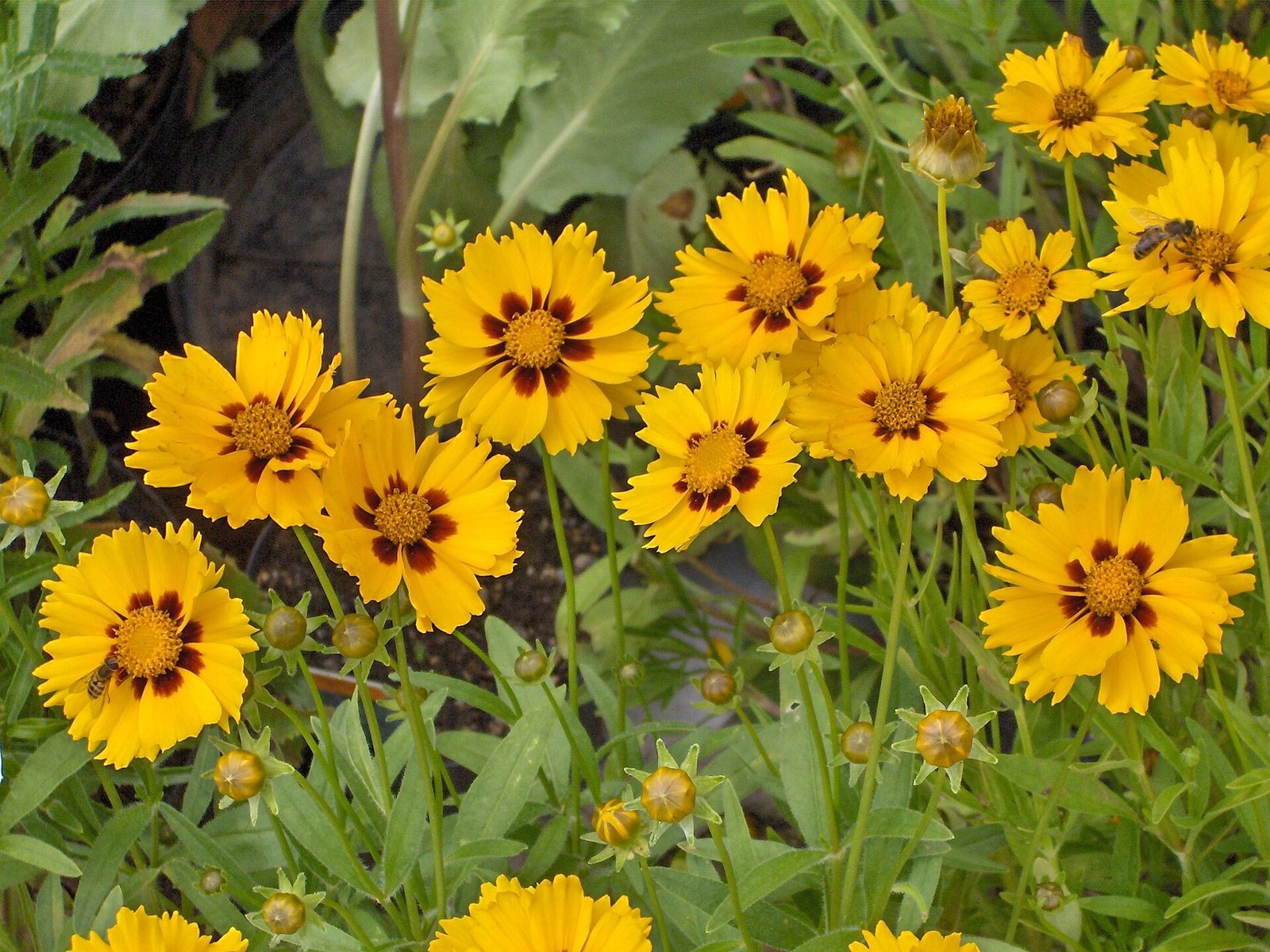
Lance-leaf tickseed
Coreopsis lanceolata
A bright golden-yellow tickseed of dry meadows and roadside cuts, with characteristically toothed petal tips that look like the petal has been cut by pinking shears. Two-foot perennial blooming May into July. Widely planted as a cultivated wildflower and naturalized along Tennessee Department of Transportation roadside seedings; a foundational native to Marion's spring meadow palette.
Status: Native; common on dry roadbanks.
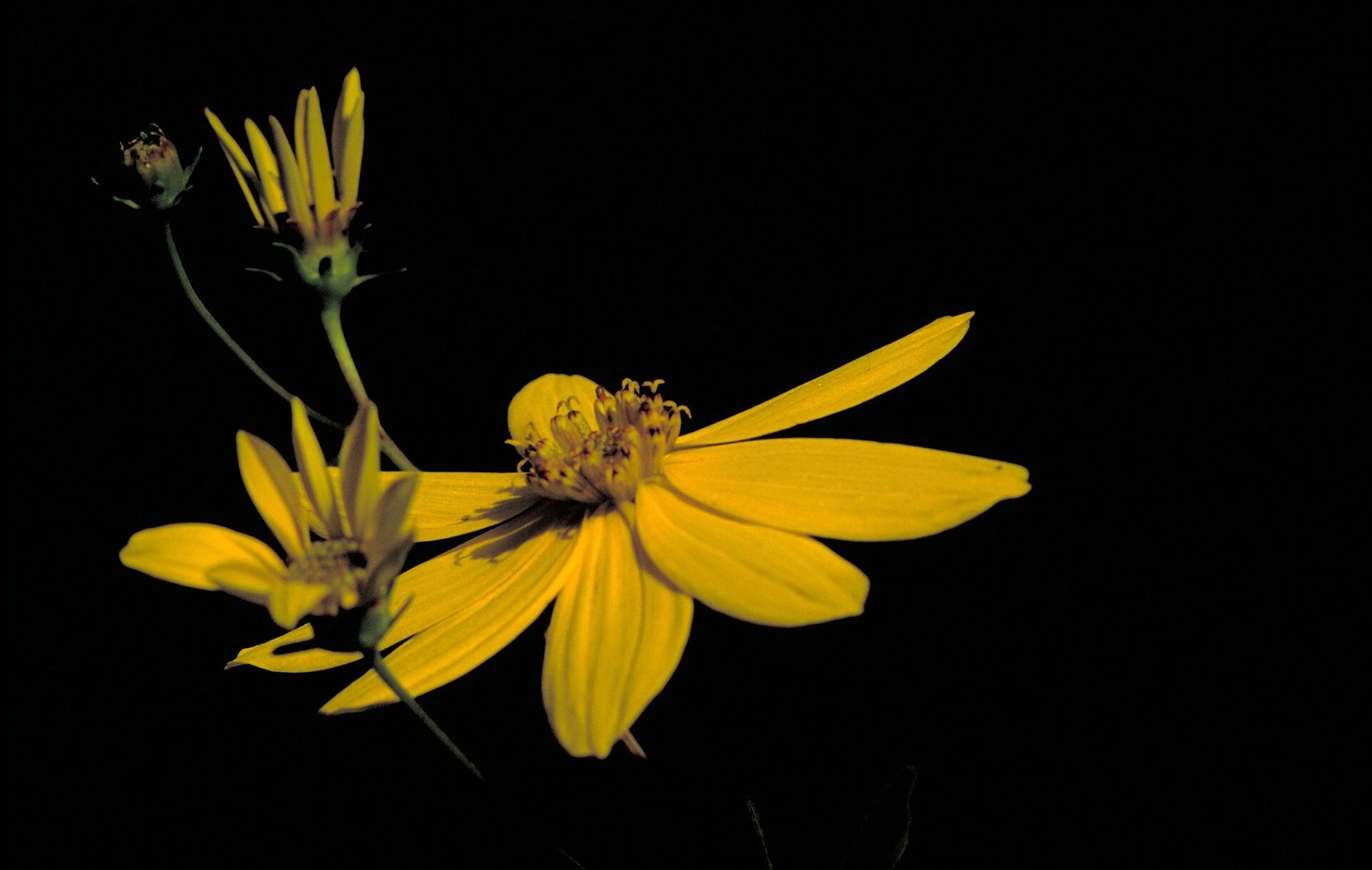
Greater tickseed
Coreopsis major
A two- to three-foot tickseed of dry oak openings and pine-oak edges, distinguished by leaves arranged in apparent whorls of six (actually three opposite leaves each divided into three deep segments). Bright yellow ray flowers in June and July. Common in Marion's drier upland forest openings.
Status: Native; common in dry upland openings.
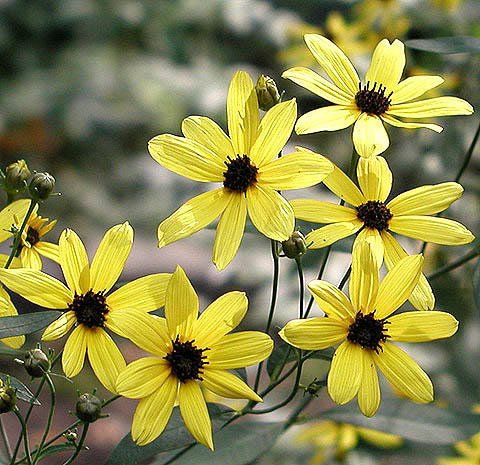
Tall tickseed
Coreopsis tripteris
The tallest of Marion's native tickseeds, reaching seven to nine feet in moist meadows and ditch banks. The leaves are trifoliate (three leaflets) and emit a faint anise scent when crushed. Yellow ray flowers in August. Less abundant than the other Coreopsis species but striking when it is found, towering over its meadow neighbors.
Status: Native; locally distinctive in moist meadows.
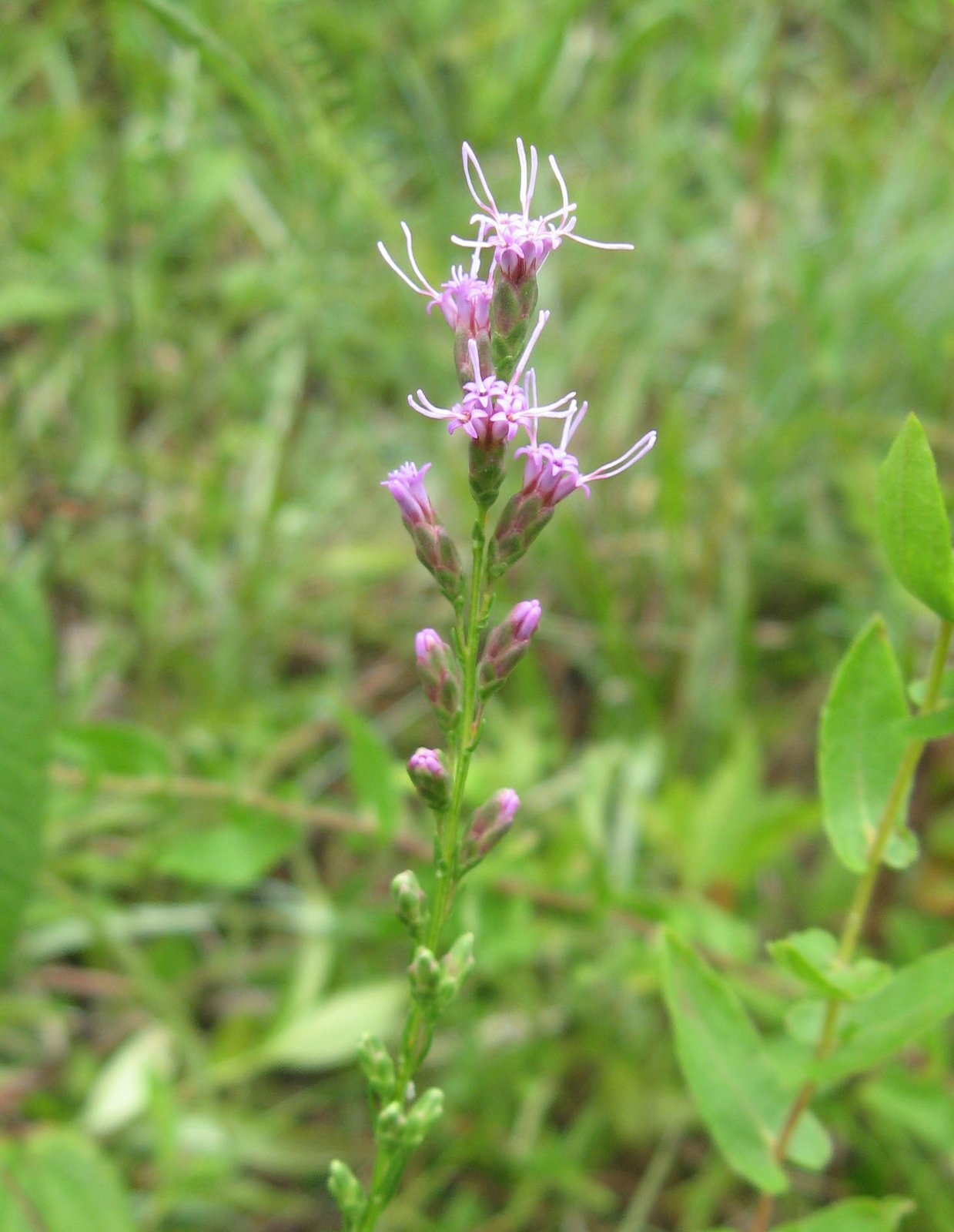
Small-head blazing-star
Liatris microcephala
A small-flowered blazing-star of cedar glades, sandstone outcrops, and thin-soiled openings. The grass-like leaves crowd the lower stem; the slender flower spike opens from the top down (the reverse of most spike-flowered plants). One of the iconic species of southeastern limestone and sandstone glade communities and a regular sight on the rocky openings along the Sequatchie Valley scarp.
Status: Native; locally distinctive on glades and outcrops.
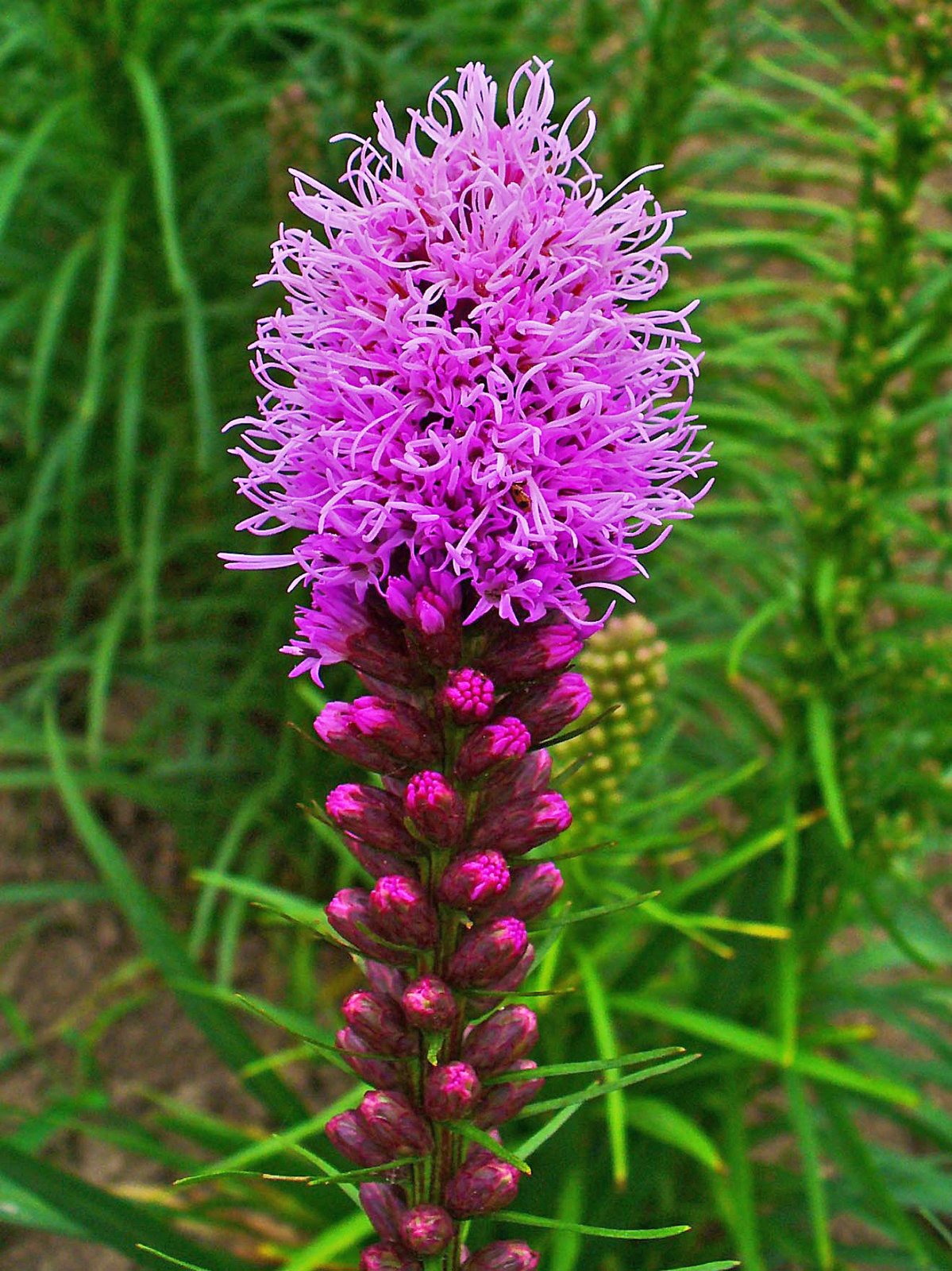
Dense blazing-star
Liatris spicata
A tall (three- to five-foot) blazing-star with a dense unbranched spike of bright purple flower heads opening from the top down in late July through September. The most cultivated of the native Liatris species and widely planted in pollinator gardens across Tennessee. Native populations occupy moist meadows and prairie openings; widely escaped from plantings along Marion roadsides.
Status: Native; common in moist meadows.
Mints, mountain mints, and the bee balms
Marion's mint family (Lamiaceae) is anchored by wild bergamot, the mountain mints, and the lyre-leaf sage of dry openings. All have squared stems, opposite leaves, and tubular two-lipped flowers, and all support a long list of native bees, wasps, and butterflies. Pollinator surveys consistently rank the mountain mints (Pycnanthemum) among the most-visited native genera in eastern North America.
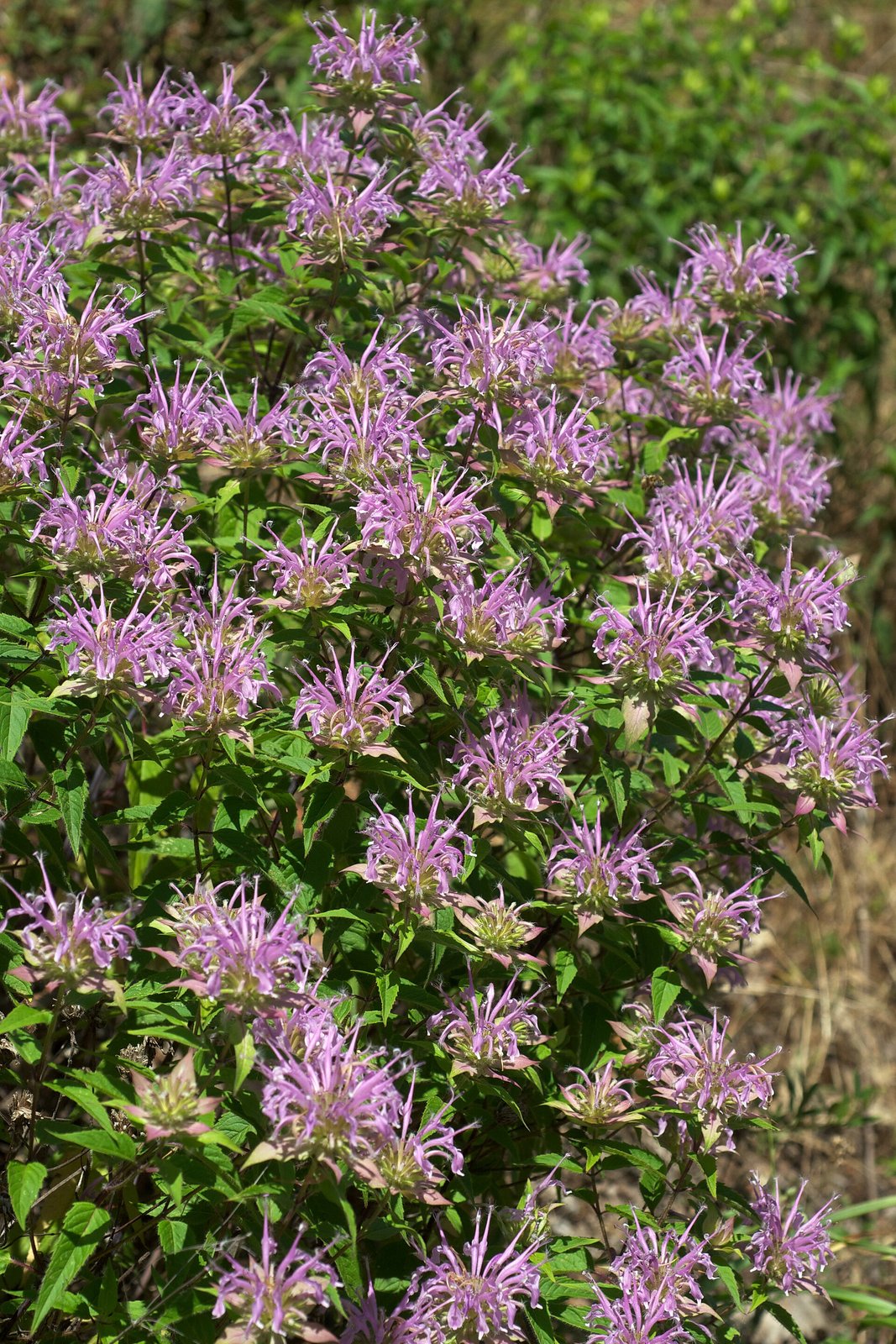
Wild bergamot
Monarda fistulosa
Marion's most common native beebalm, two to four feet tall with aromatic leaves and rounded heads of lavender tubular flowers in June and July. Common in old fields, ridge openings, and roadside cuts. The crushed leaves smell strongly of oregano-thyme; Indigenous and pioneer peoples brewed the leaves into a medicinal tea for sore throats and colds, and the species supplies the natural compound thymol.
Status: Native; common in dry meadows.
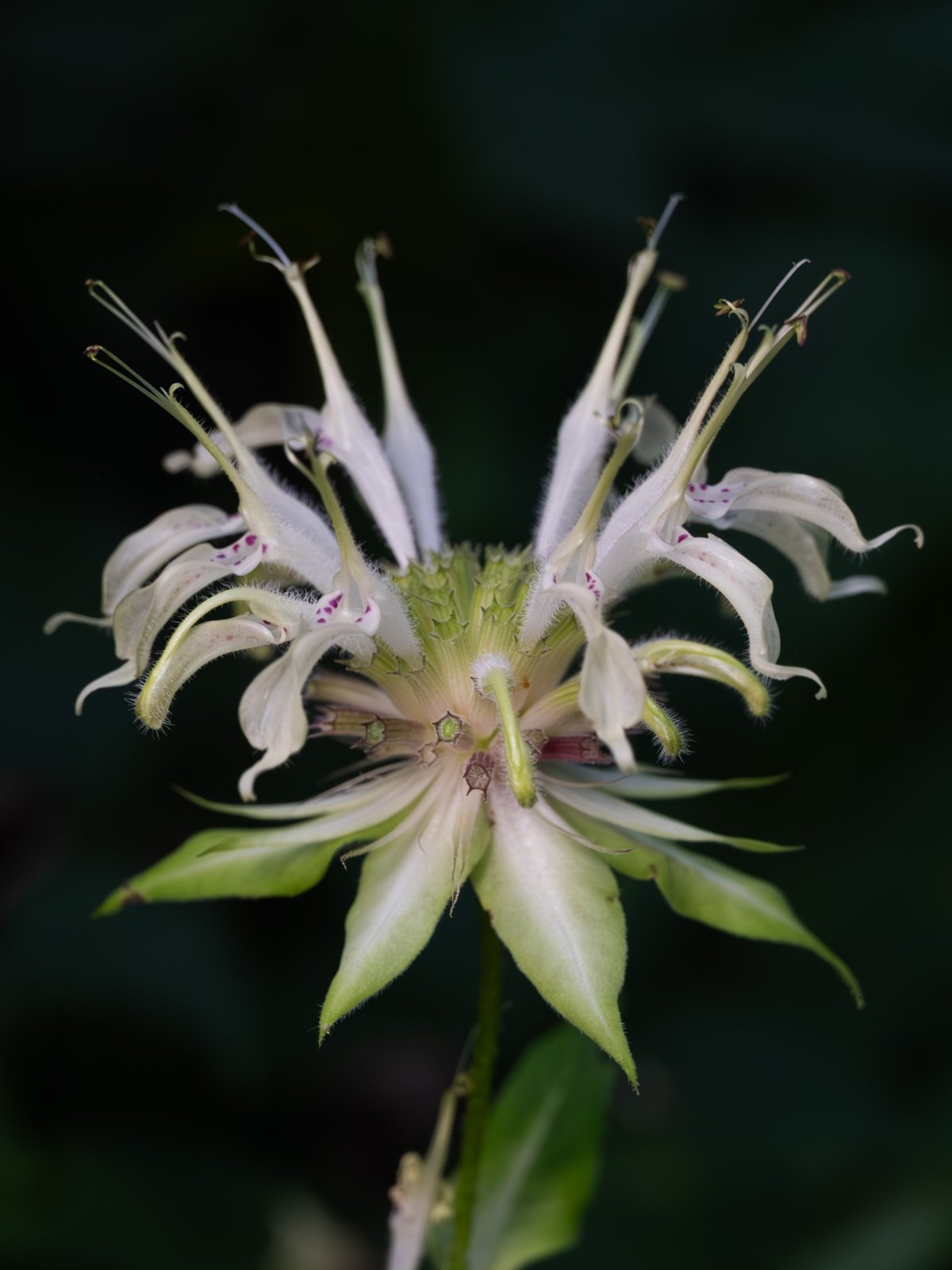
White bergamot
Monarda clinopodia
A close cousin of wild bergamot with pale-cream to white flower heads (rather than lavender) and a slightly woodier, less ramified stem. Favors partly shaded woodland edges and rocky cove margins on the plateau. Less common in Marion than wild bergamot but a regular sight in mid-summer along trail corridors.
Status: Native; locally common on woodland edges.
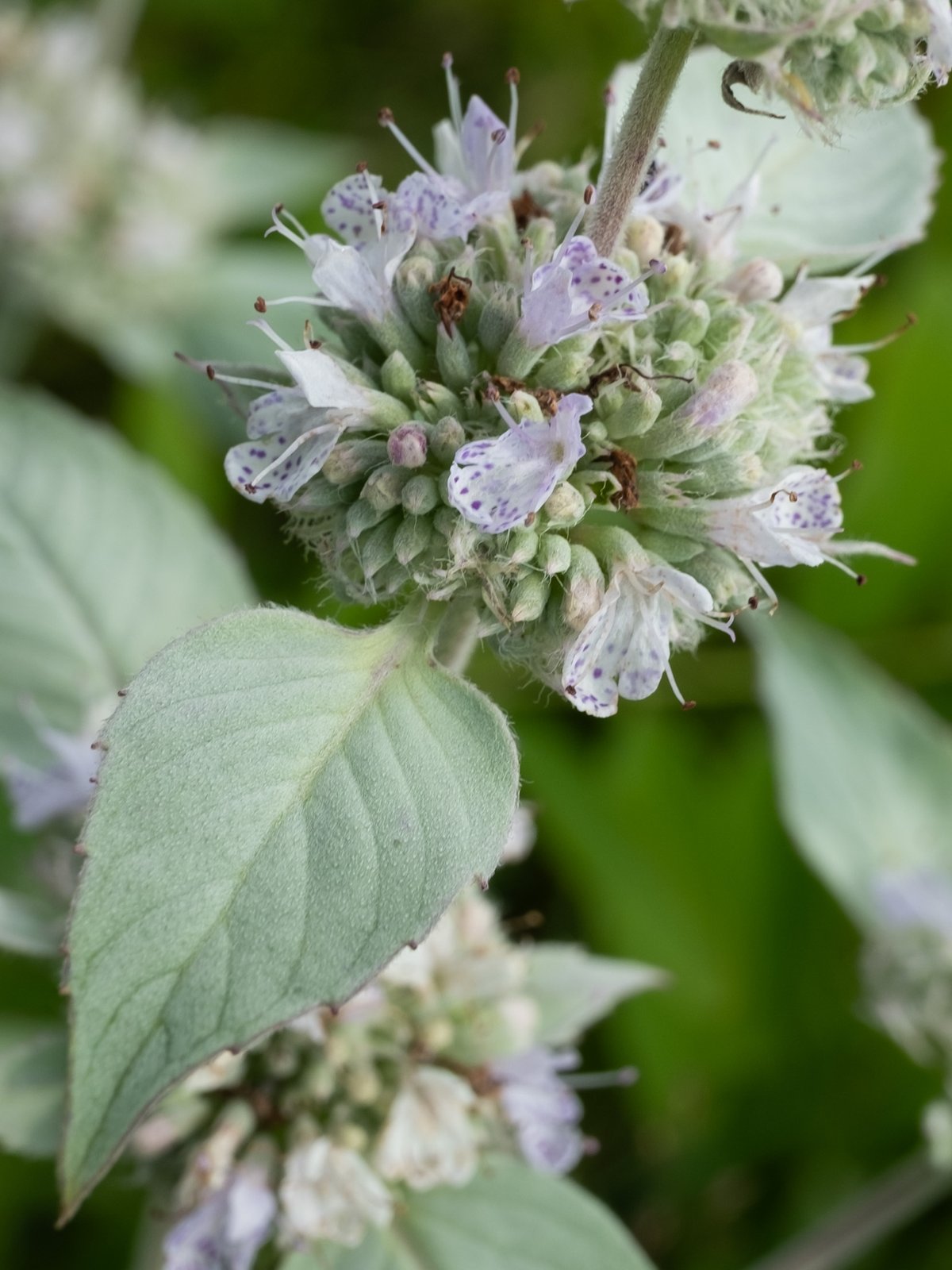
Hoary mountain mint
Pycnanthemum incanum
A two- to three-foot mountain mint with the upper leaves dusted silvery white (the source of the species name incanum, hoary). Tight clusters of tiny pale flowers in July and August. Pollinator surveys in the southeastern United States consistently rank Pycnanthemum as one of the most-visited native genera by bees and wasps. Common in dry-mesic woodland edges and ridge openings.
Status: Native; common on woodland edges.
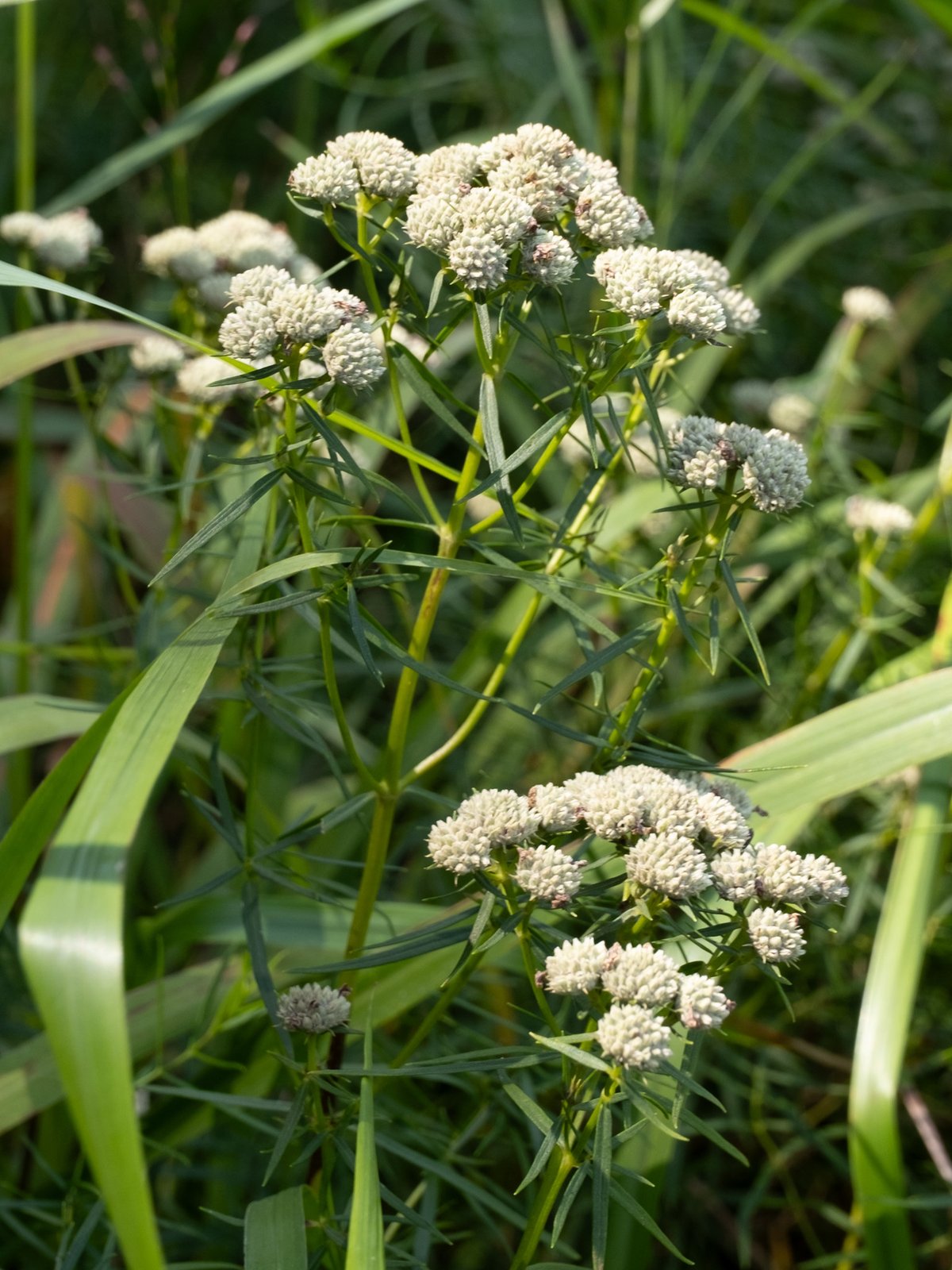
Narrow-leaf mountain mint
Pycnanthemum tenuifolium
Distinguished from hoary mountain mint by very narrow, thread-like leaves on a finely branched plant two to three feet tall. The same insect-pollinator value applies. Favors dry meadows and roadside openings rather than woodland edges. The crushed foliage has the same mint-pennyroyal scent as the broader-leaved relatives.
Status: Native; common in dry meadows.
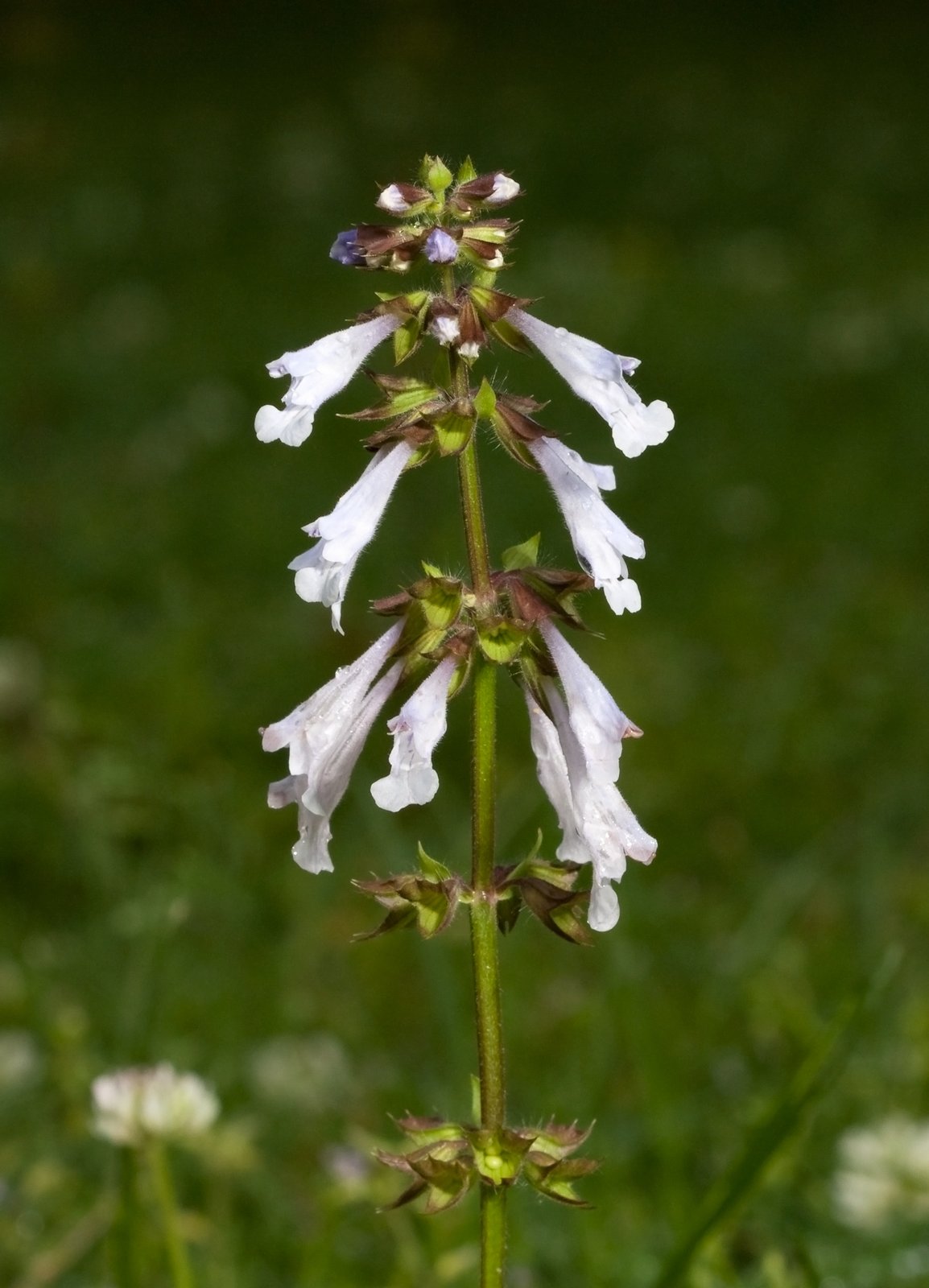
Lyre-leaf sage
Salvia lyrata
A native sage of dry old fields, lawn margins, and trail edges with a basal rosette of distinctive lyre-shaped (deeply lobed) leaves and tall stems of pale-blue tubular flowers in April and May. Often blooms in lawn corners that are not mown closely; one of the most common spring native flowers along Marion roadsides.
Status: Native; common on dry banks.
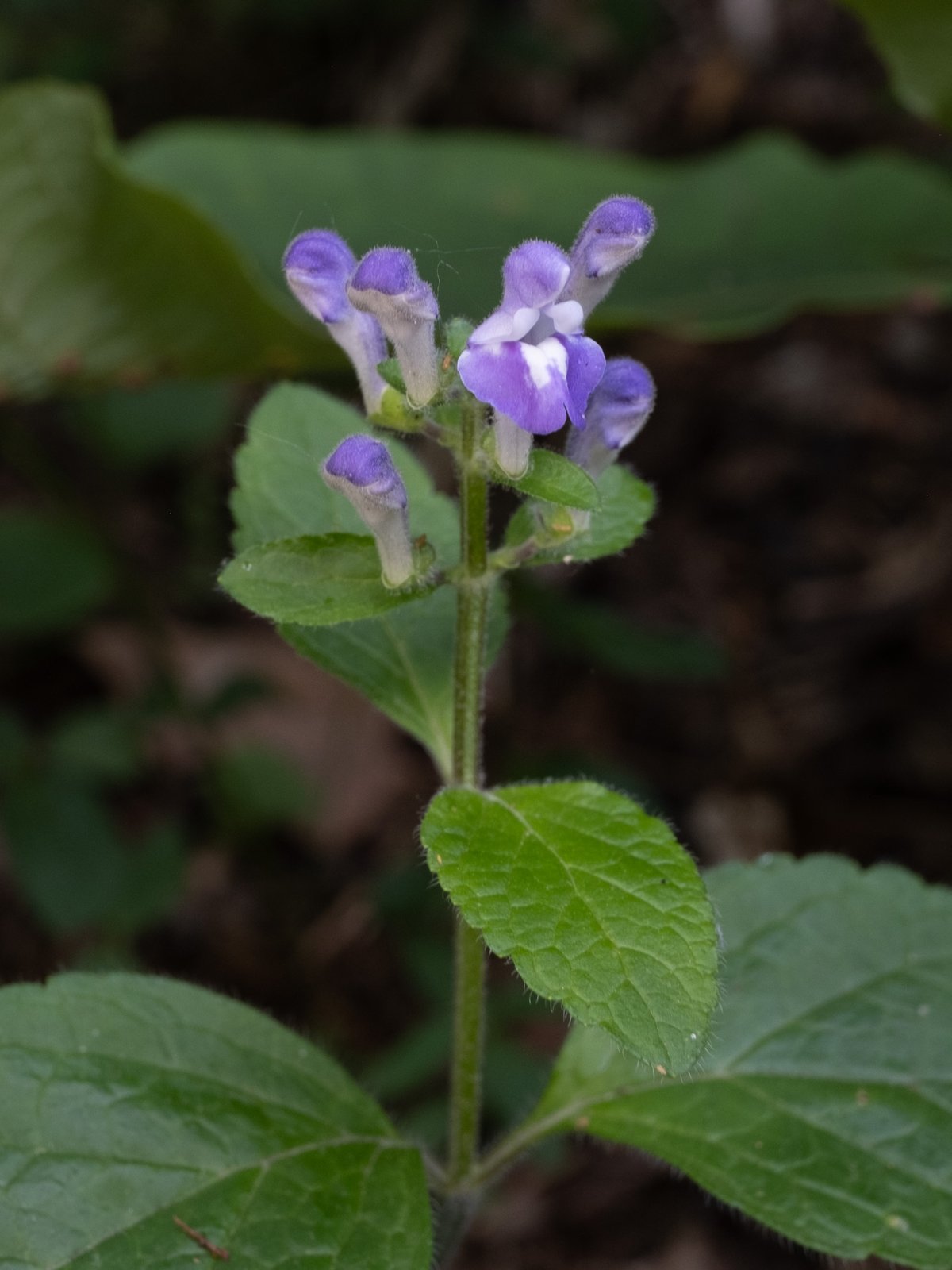
Hairy skullcap
Scutellaria elliptica
A small skullcap (one to two feet) of dry-mesic woodland slopes and ridge openings, distinguished by softly hairy stems and leaves and pairs of blue tubular flowers in May and June. Like all Scutellarias, the calyx (the cup that holds the flower) has a small protruding crest that gives the genus its common name (the cap of a Roman soldier).
Status: Native; common on woodland slopes.
Beardtongues and vervains
The beardtongues (Penstemon) and vervains (Verbena) are paired here as small-flowered upright forbs of dry meadows and roadside cuts. The beardtongues take their common name from a tuft of hairs on the lower lip of their tubular flowers that helps direct visiting bees toward the pollen.
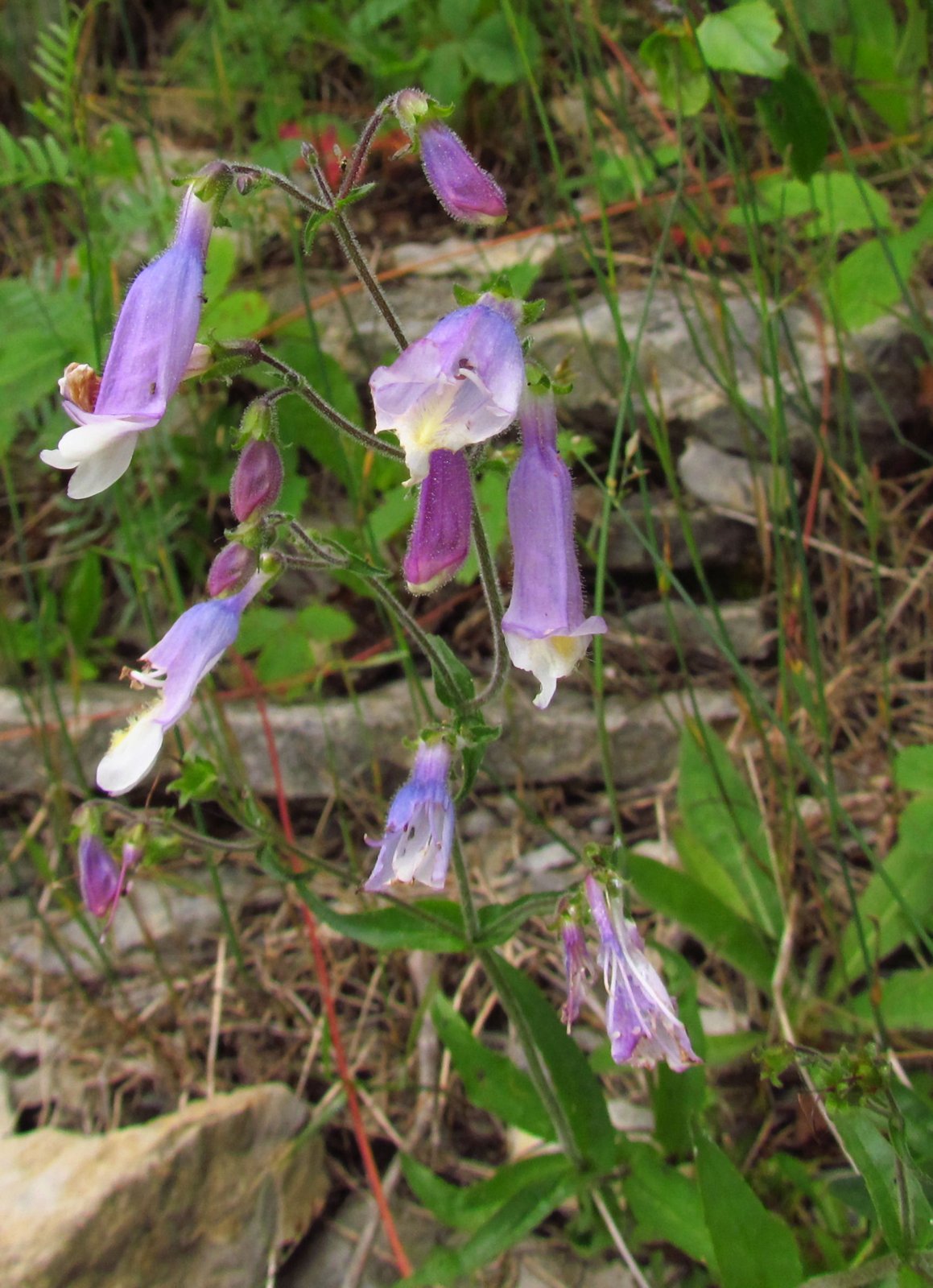
Hairy beardtongue
Penstemon hirsutus
A foot-tall beardtongue with hairy stems and pale-violet tubular flowers held in tight clusters in May and June. The lower lip of the flower has a tuft of yellow hairs (the 'beard tongue' the genus is named for) that helps direct visiting bees toward the pollen. Common on dry meadows and roadside cuts on calcareous soils.
Status: Native; common on dry banks.
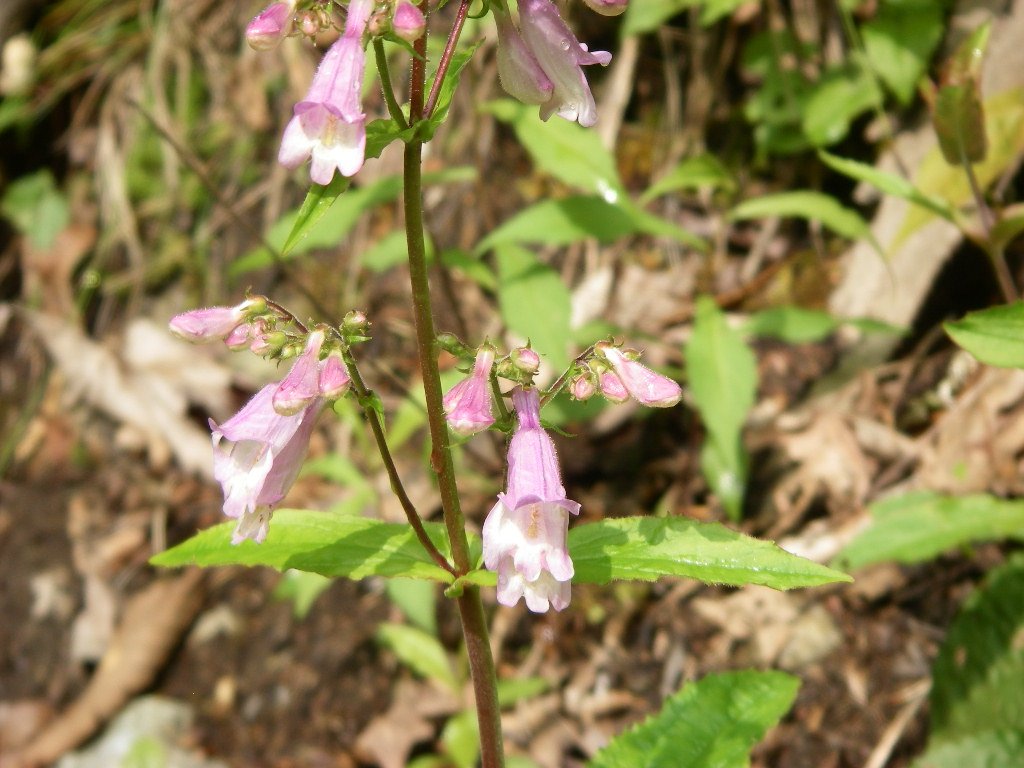
Gray beardtongue
Penstemon canescens
A foot- to two-foot beardtongue with grayish-green densely hairy foliage (the source of the species name canescens, becoming gray) and pale-violet tubular flowers in May. Favors dry-mesic open woodlands and ridge openings; common on the southeastern Cumberland Plateau.
Status: Native; common on dry openings.
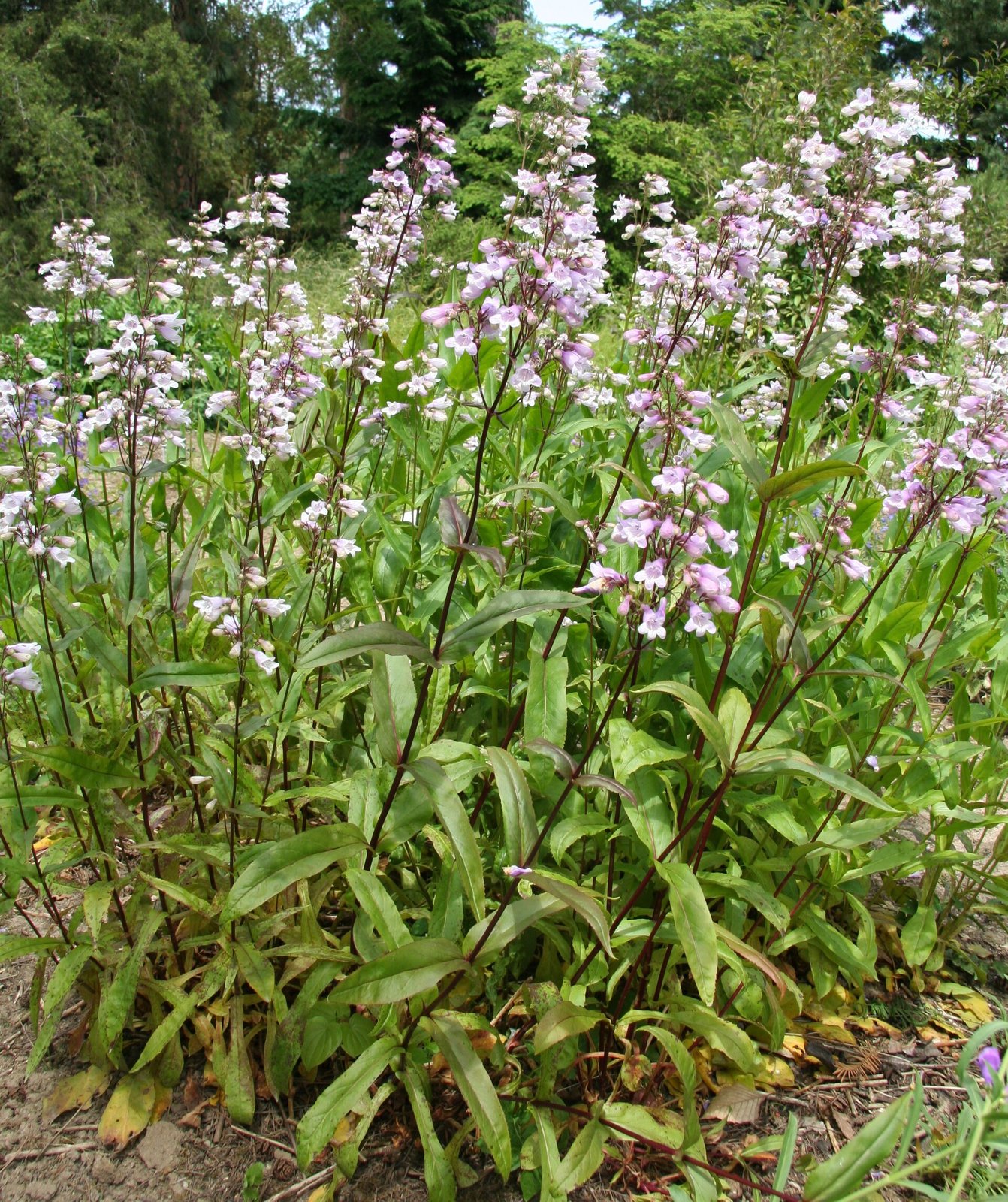
Smooth beardtongue
Penstemon laevigatus
A two-foot beardtongue with smooth (hairless) stems and leaves and pale-pink to nearly white tubular flowers in May. Favors moist meadow edges and open woodland borders. The smooth foliage is the easiest field mark to separate it from the other beardtongues of Marion's roadside.
Status: Native; common in moist meadow edges.
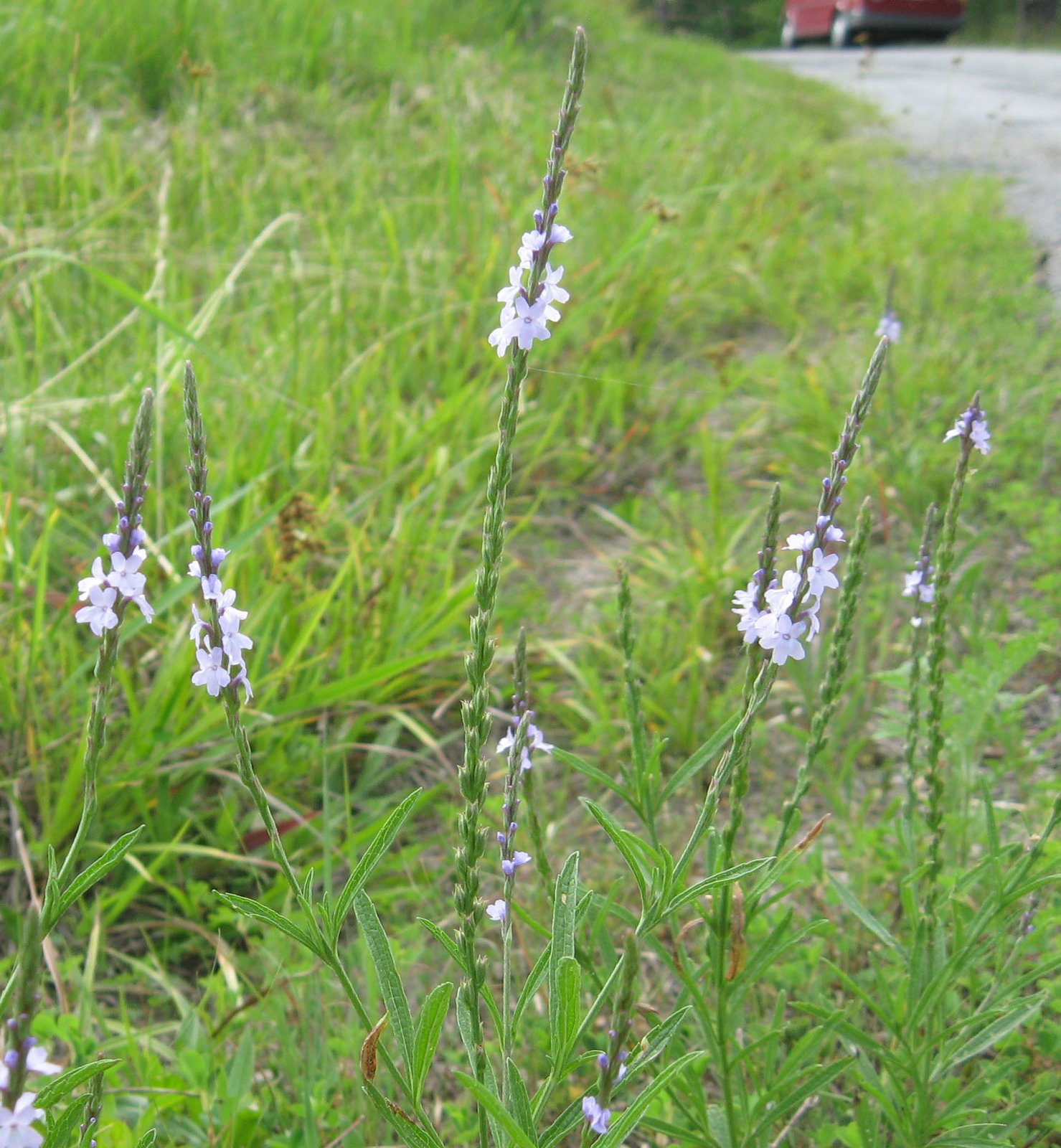
Narrow-leaf vervain
Verbena simplex
A short (one- to two-foot) vervain of dry meadows and limestone openings, with narrow lance-shaped leaves and slender unbranched spikes of small lavender flowers from May into August. Less common in Marion than blue vervain but reliably present on dry calcareous slopes and old fields with thin soils.
Status: Native; locally common on dry openings.
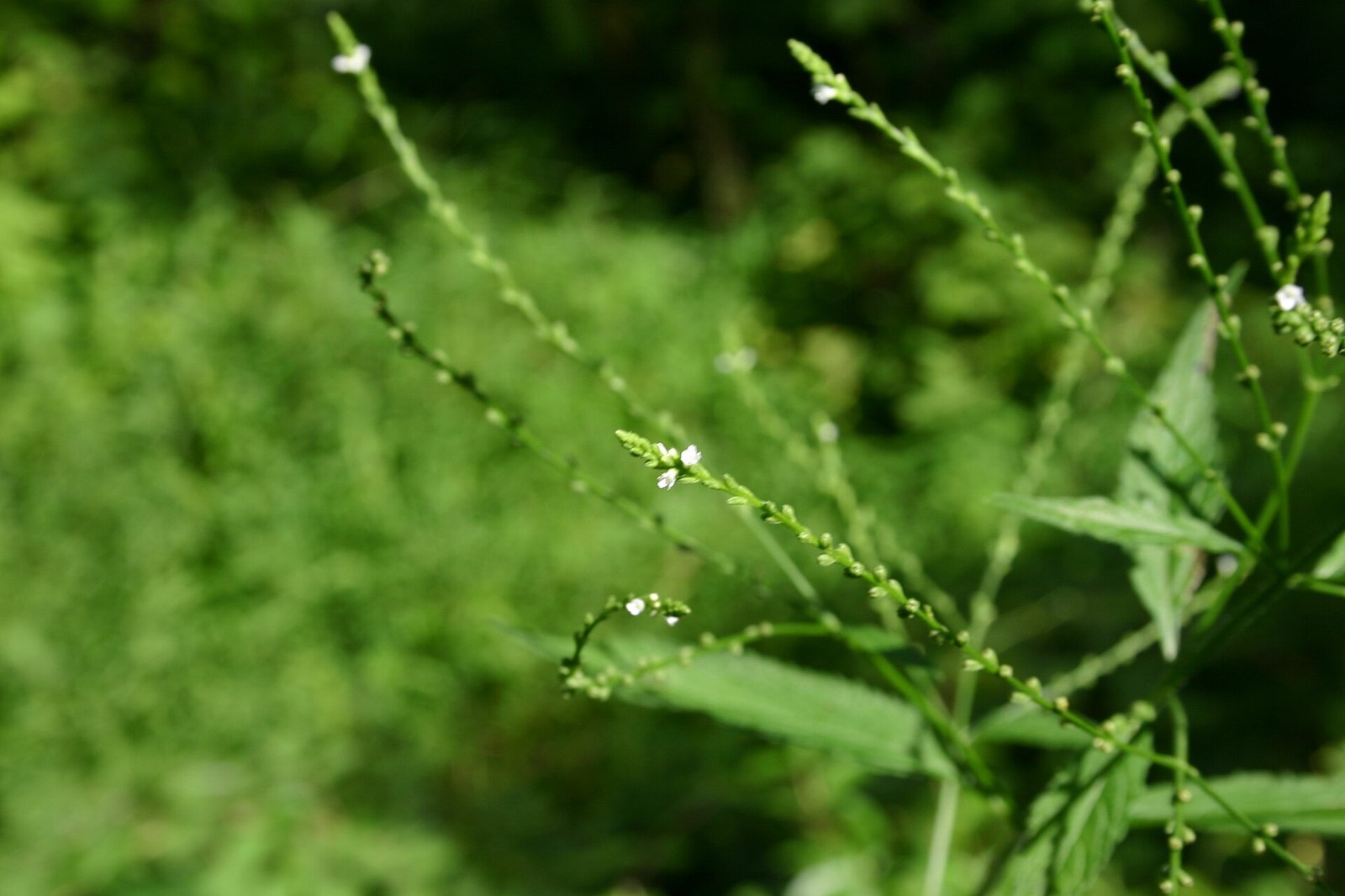
White vervain
Verbena urticifolia
A three- to five-foot vervain of moist openings and ditch banks with widely branched candelabra-like flower spikes of tiny white flowers from June into September. The leaves resemble nettle leaves (the source of the species name urticifolia, nettle-leaved) but without the stinging hairs. Common in old-field corners and stream margins across Marion.
Status: Native; common in moist meadows.
Fleabanes, thistles, pussytoes, and ragworts
A grouping of small-headed composites and the spiny thistles. The native thistles below are not the same as the introduced bull and Canada thistles; native species are important pollinator plants for bumblebees and swallowtail butterflies and a critical food source for goldfinches. The two ragworts (Packera) below were until recently filed in the genus Senecio; older field guides still use the older name.
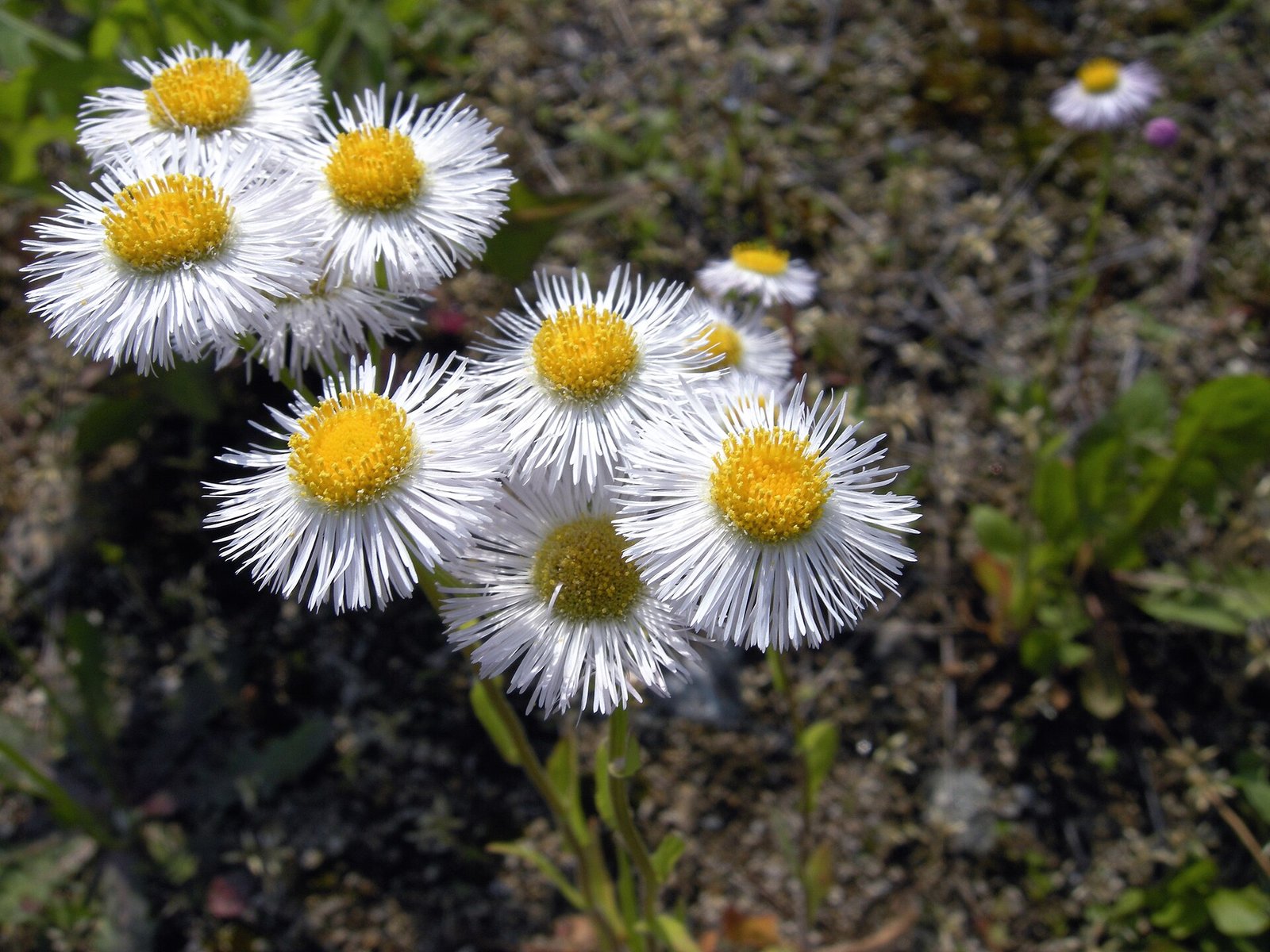
Daisy fleabane
Erigeron annuus
An annual fleabane two to four feet tall with profuse small white-rayed flower heads in June and July. The numerous narrow ray florets (often more than fifty per head) distinguish it from the daisy proper. Common in old fields, gardens, and disturbed roadside ground; one of the first composites to flower each summer.
Status: Native; abundant in old fields.
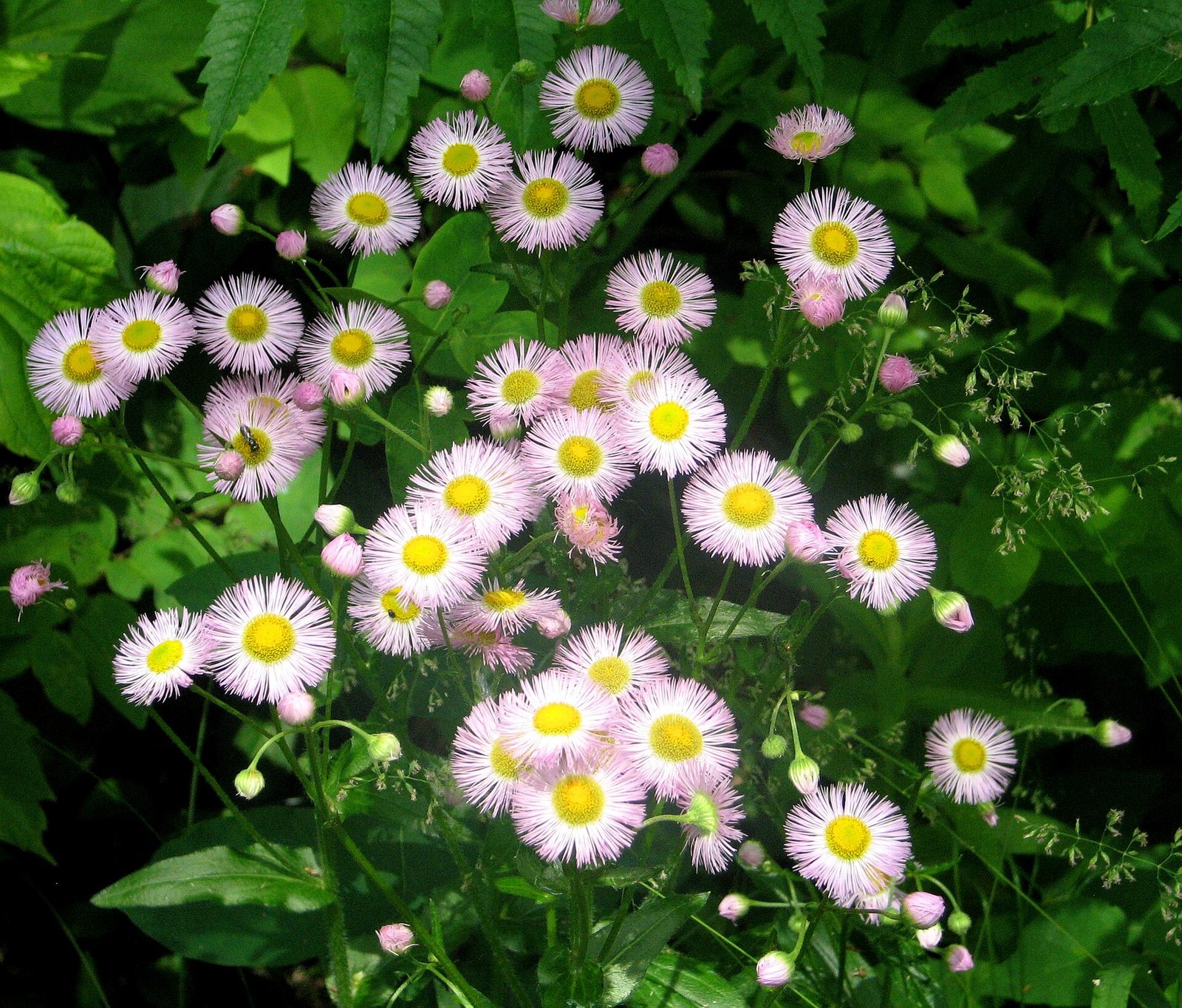
Philadelphia fleabane
Erigeron philadelphicus
A spring-blooming fleabane (April through June) two feet tall with very narrow pale-pink to white ray florets surrounding a yellow disk. The upper leaves clasp the stem (the easiest field mark separating it from daisy fleabane). Common in moist meadows, ditches, and old-field edges.
Status: Native; common in moist meadows.
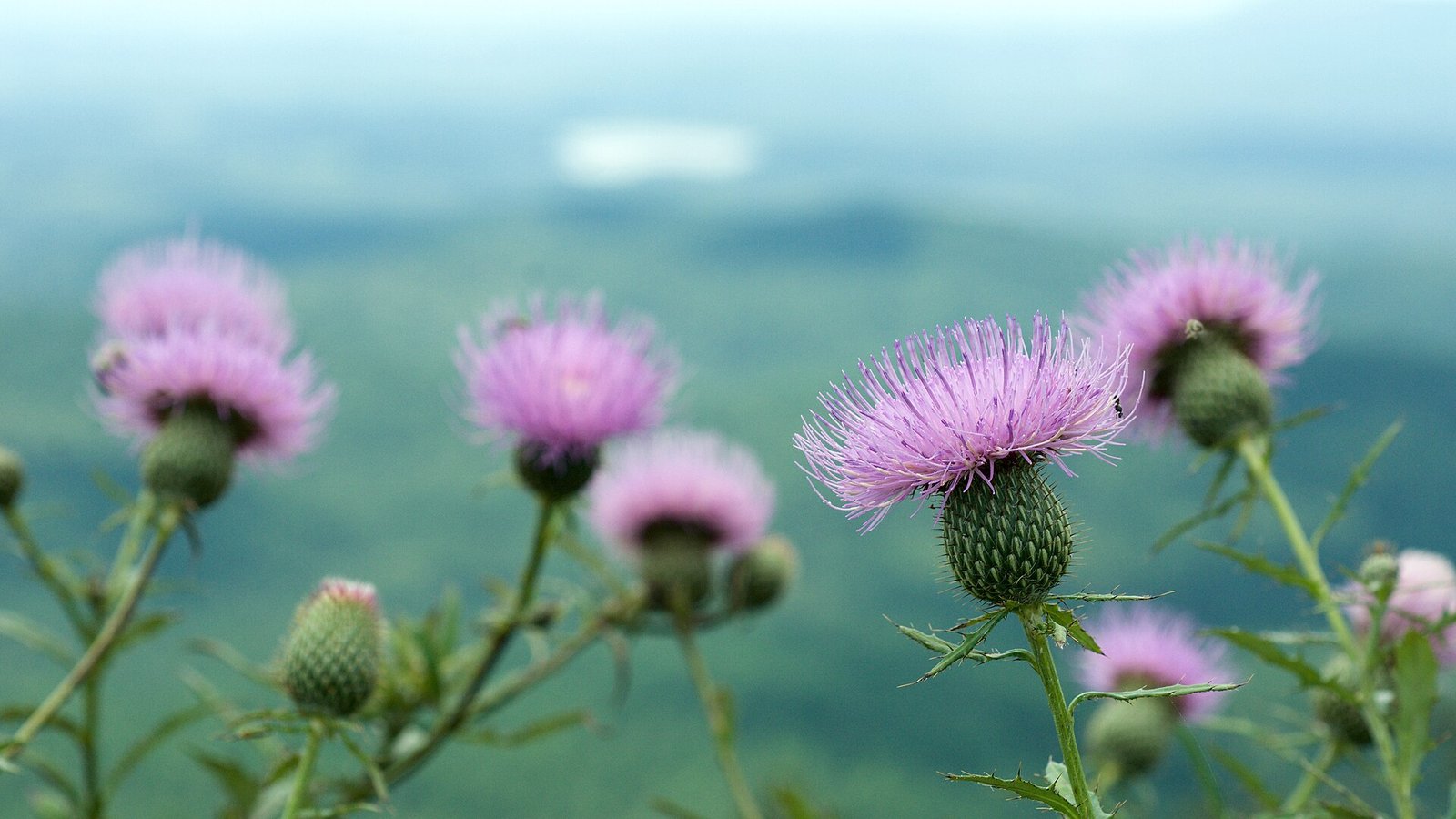
Tall thistle
Cirsium altissimum
A six- to ten-foot native thistle of woodland edges and old fields, distinguished from the introduced bull thistle by its taller stature and undivided (not deeply lobed) leaves whose undersides are densely white-felted. Rosy-purple flower heads in August and September are heavily worked by bumblebees, swallowtail butterflies, and goldfinches (which use the seed silk for nesting material).
Status: Native; common on woodland edges.
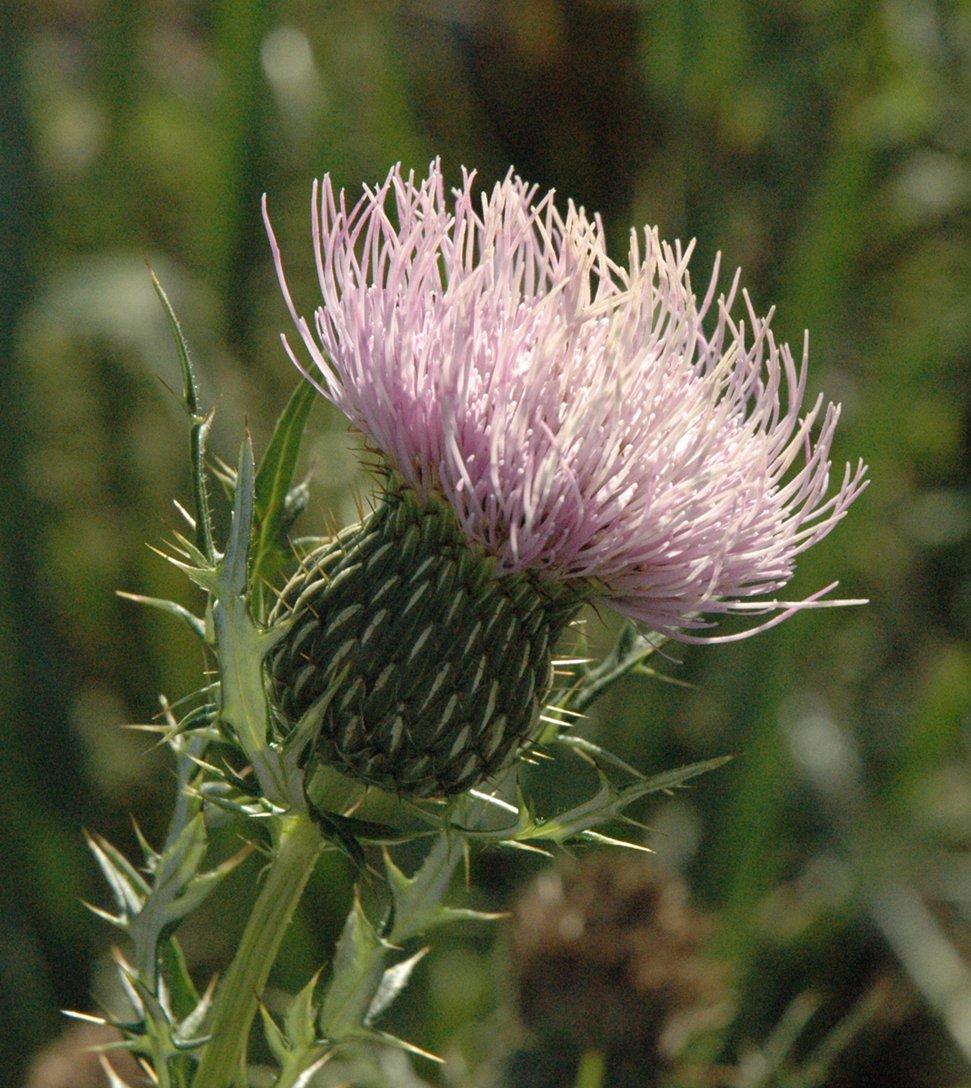
Field thistle
Cirsium discolor
A four- to seven-foot native thistle of old fields and roadside openings. The leaves are deeply pinnately lobed (similar to bull thistle) but the undersides are densely white-felted (the source of the species name discolor, of two colors). Rose-purple flower heads in August and September. Native and an important pollinator plant; not the same as the invasive bull and Canada thistles.
Status: Native; common in old fields.
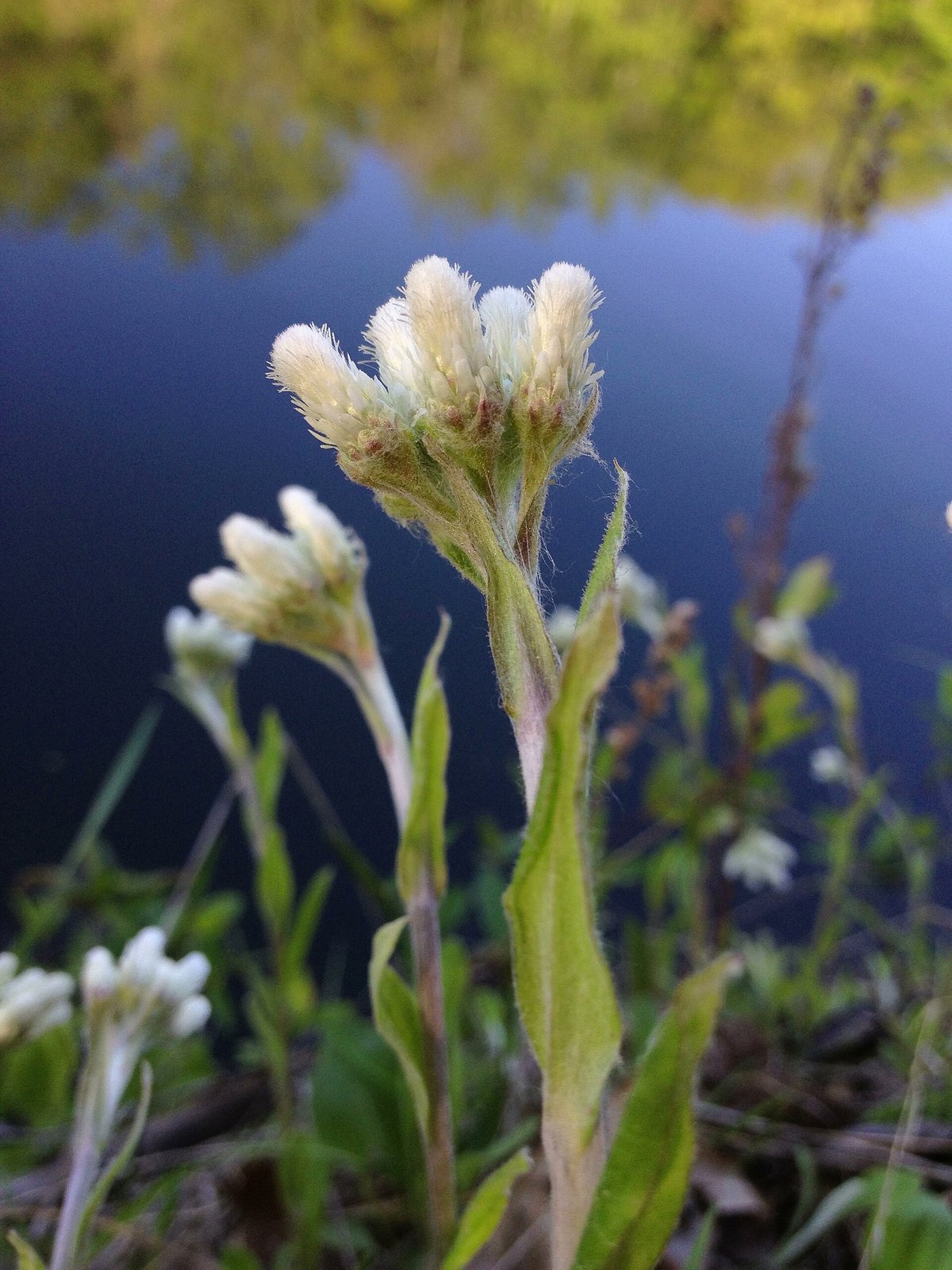
Pussytoes
Antennaria plantaginifolia
A small ground-hugging composite that forms colonies of silvery basal leaves on dry ridges and old-field openings. Sends up six-inch flowering stems in April with small fuzzy white flower clusters that look like a row of cat toes (the source of the common name). Reproduces partly by apomixis (seed without fertilization), which is unusual among native composites.
Status: Native; common on dry ridges.
Golden ragwort
Packera aurea
A foot-tall woodland-edge composite with bright yellow ray flowers in April and May above a basal rosette of heart-shaped, long-stalked leaves. Spreads by underground rhizomes to form colonies in moist woodland openings, stream margins, and seep meadows. The genus was recently split out of Senecio; older Marion field guides still list it as Senecio aureus.
Status: Native; common in moist woodland edges.
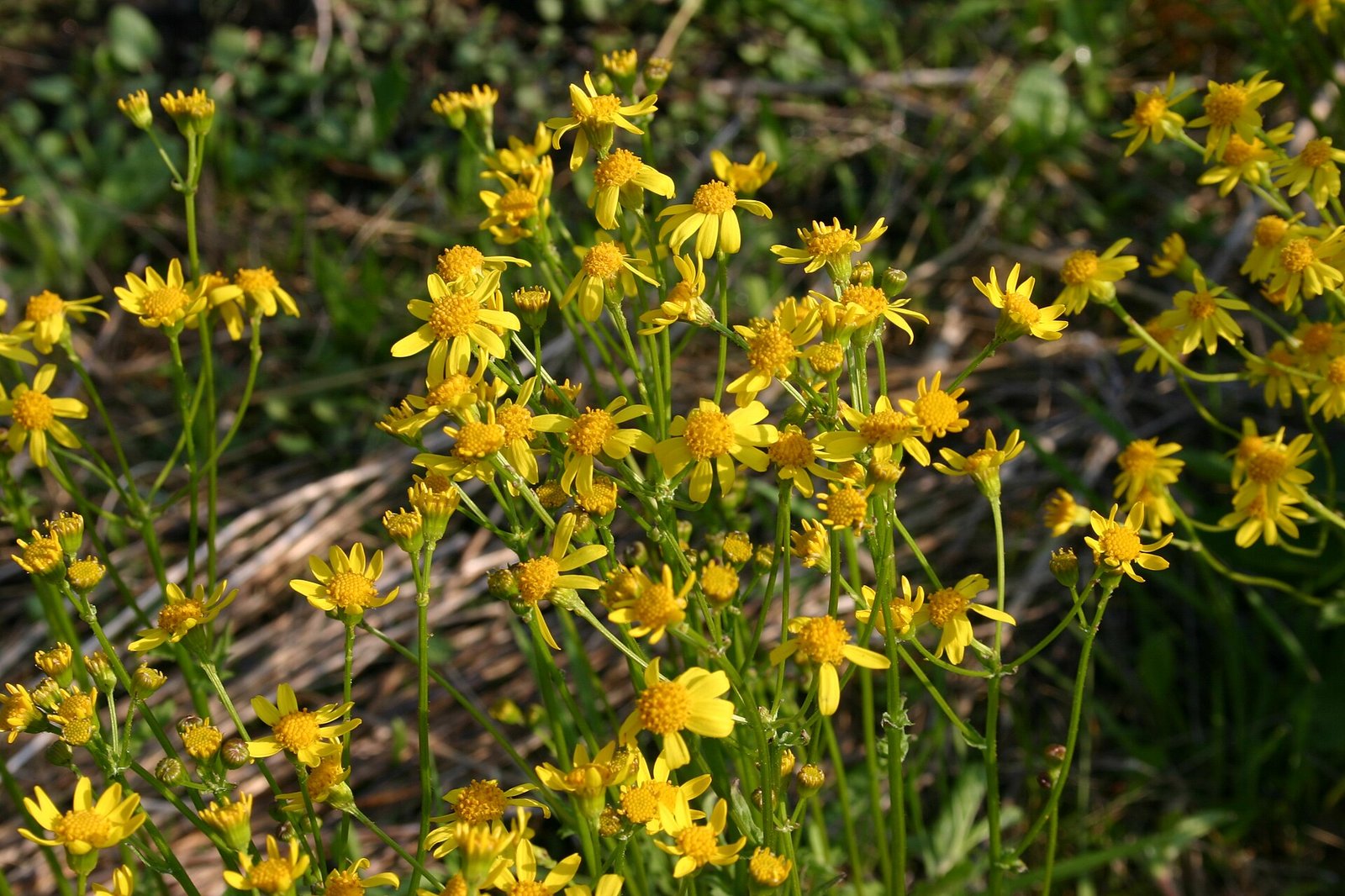
Roundleaf ragwort
Packera obovata
A close cousin of golden ragwort, distinguished by rounded (rather than heart-shaped) basal leaves and a preference for limestone-influenced slopes and ledges rather than moist meadow margins. Yellow ray flowers in April and May. Common on the Sequatchie Valley side of Marion where calcareous bedrock comes near the surface.
Status: Native; common on calcareous slopes.
Passionflower, evening primroses, and other field forbs
A grouping of the headline open-country forbs that don't fit cleanly into the larger family groups. Passionflower is Tennessee's official state wildflower; the evening primroses are largely night-blooming moth-pollinated specialists with one exception (the day-blooming sundrops); partridge pea is a roadside legume that fixes nitrogen and stabilizes soil in disturbed cuts.
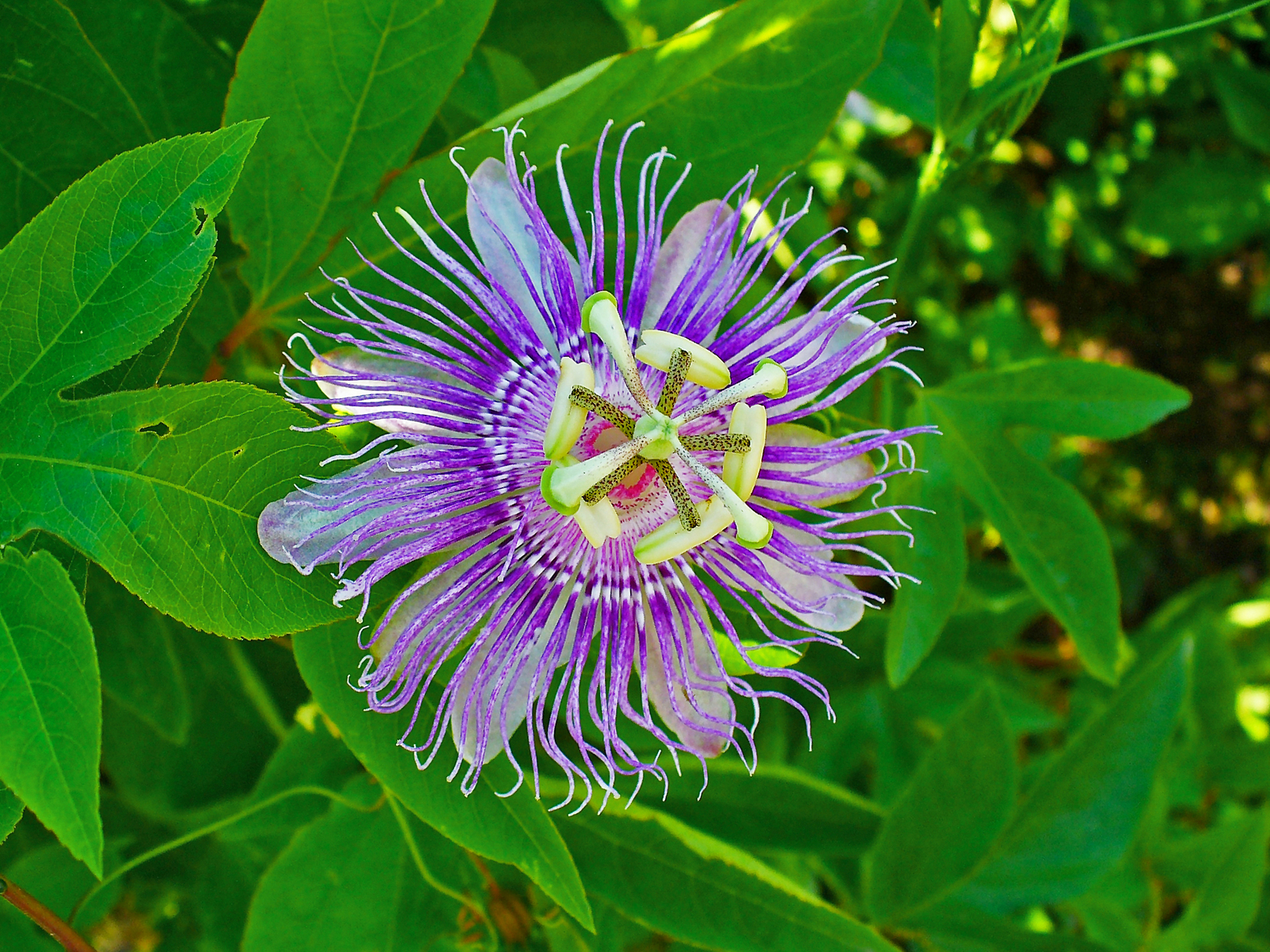
Passionflower
Passiflora incarnata
Tennessee's official state wildflower, also called maypop. The intricate purple-and-white flower has a fringed crown of filaments radiating from the center and five stamens arranged like a cross above the pistil; seventeenth-century Spanish missionaries read elements of the crucifixion into its flower structure, which gave the plant the name. Scrambles over fencerows and old-field edges across Marion June through September. The yellow fruits that follow, about the size of a hen's egg, give the plant its 'maypop' folk name (they pop when stepped on). The leaves are the larval host plant for gulf fritillary butterflies, whose northern range edge has expanded into southern Tennessee in recent decades.
Status: Native; common on roadsides; Tennessee state wildflower.
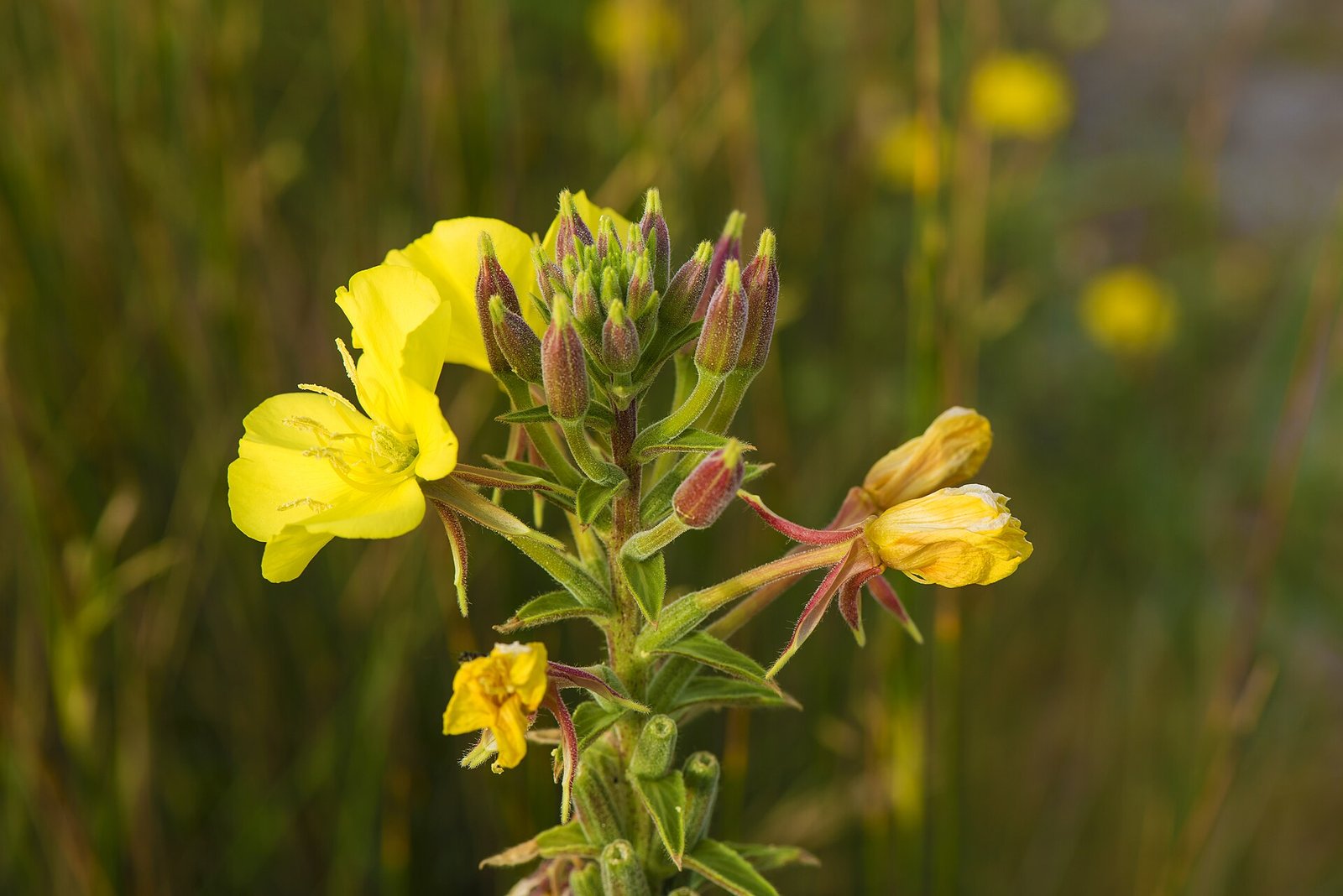
Common evening primrose
Oenothera biennis
A biennial that forms a basal rosette in its first year and a four- to six-foot flowering stalk in its second. Pale-yellow four-petaled flowers open in late afternoon and remain open through the night, attracting moth pollinators. Common on roadsides, old fields, and disturbed ground throughout Marion. The seeds yield evening primrose oil, used pharmaceutically and in cosmetics.
Status: Native; common on disturbed ground.
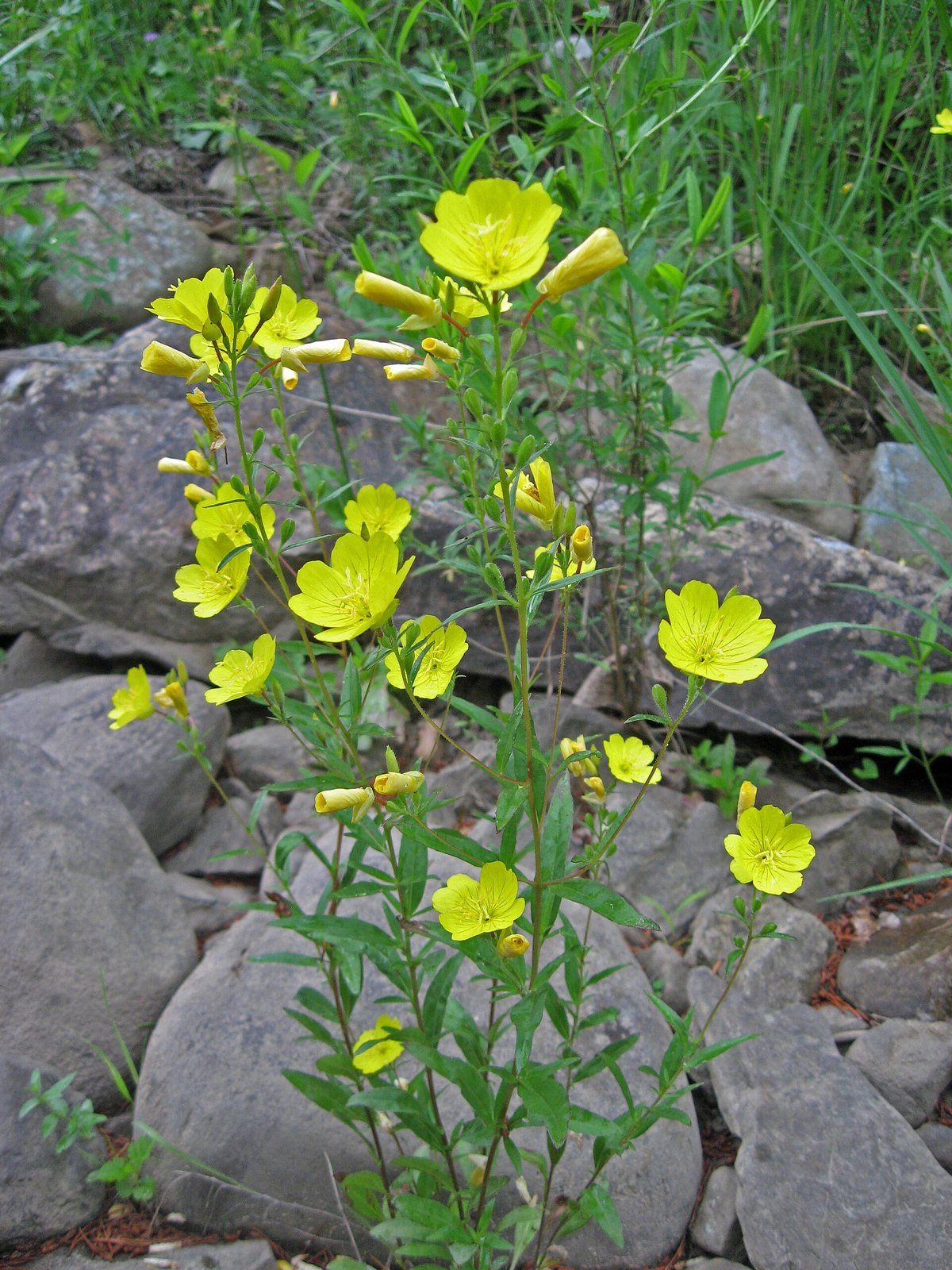
Narrow-leaf evening primrose
Oenothera fruticosa
Also called sundrops. A perennial evening primrose two feet tall with narrow leaves and bright yellow four-petaled flowers that bloom by day rather than at night. Common on dry meadows and roadbanks in May and June. One of the most striking yellows in Marion's late-spring open-country palette.
Status: Native; common on dry meadows.
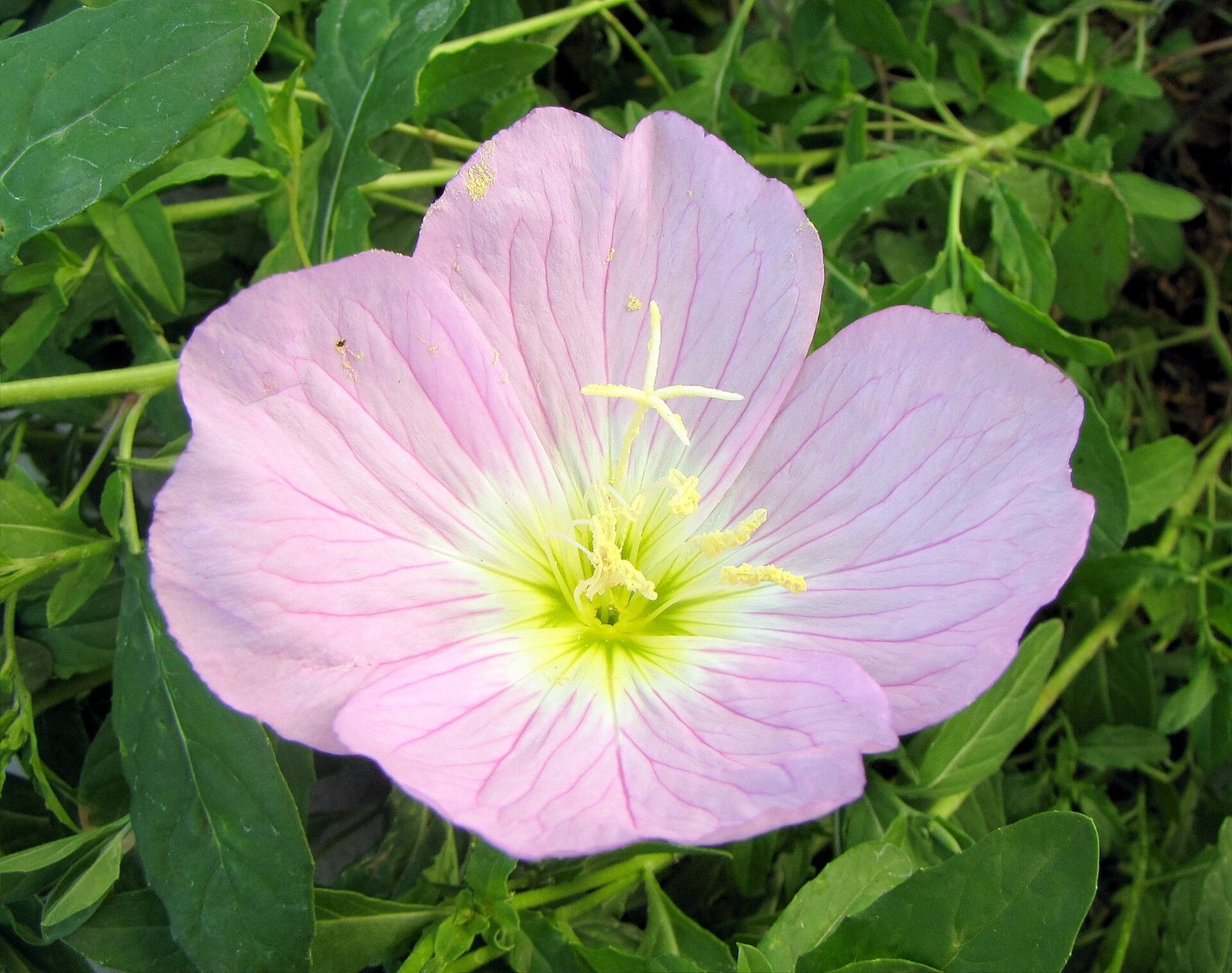
Showy evening primrose
Oenothera speciosa
A low spreading evening primrose with large pale-pink (occasionally white) four-petaled flowers that open in the morning. Spreads aggressively by underground rhizomes and forms colonies along roadside cuts. Native to the central United States and naturalized into Tennessee through highway-seeding programs and garden escapes; widely established in Marion's roadside seed mixes.
Status: Native; common on roadsides.
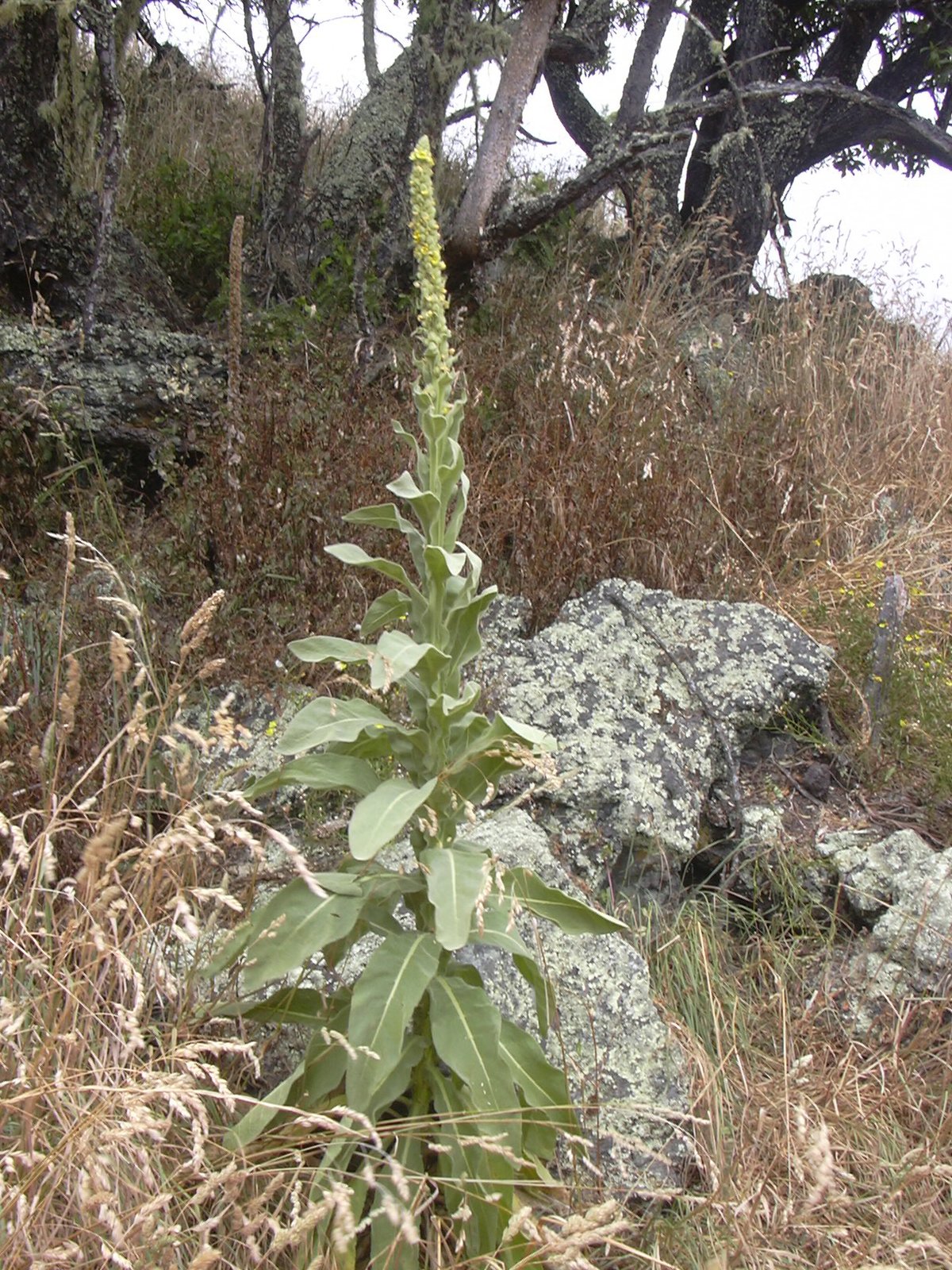
Common mullein
Verbascum thapsus
A non-native biennial with a six-foot flowering stalk holding small yellow five-petaled flowers and a basal rosette of large fuzzy felt-textured leaves. Introduced from Europe in colonial times; widely established on disturbed ground, gravel roadsides, and old-field margins. Used historically as a torch (the dried stalks dipped in tallow) and in folk medicine for chest complaints.
Status: Introduced; common on disturbed ground.
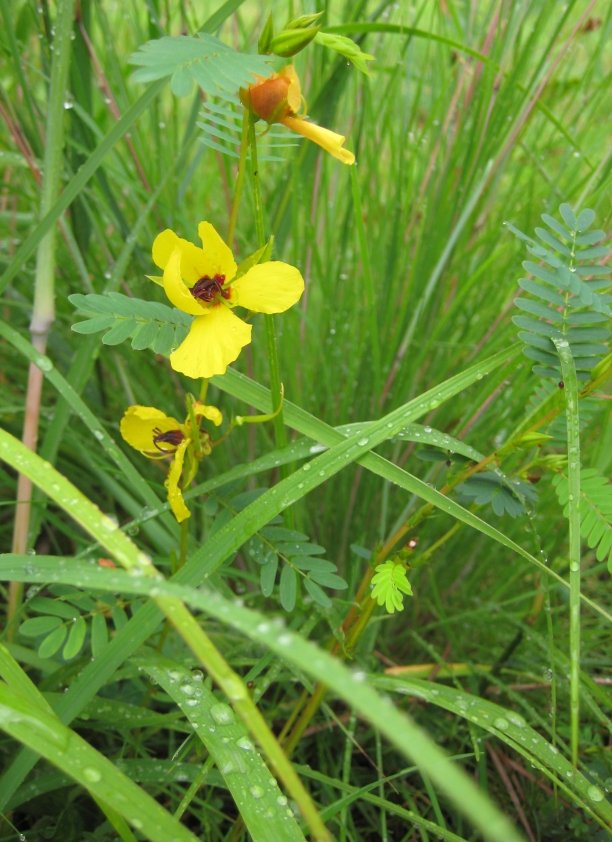
Partridge pea
Chamaecrista fasciculata
An annual legume one to two feet tall with feathery pinnate leaves and bright yellow flowers with a small red dot at the base of each of the five petals. Common on dry roadside cuts and disturbed openings July into September. Like other legumes, fixes atmospheric nitrogen through bacterial symbionts in root nodules; valued in highway-seed mixes for soil rehabilitation.
Status: Native; common on dry banks.
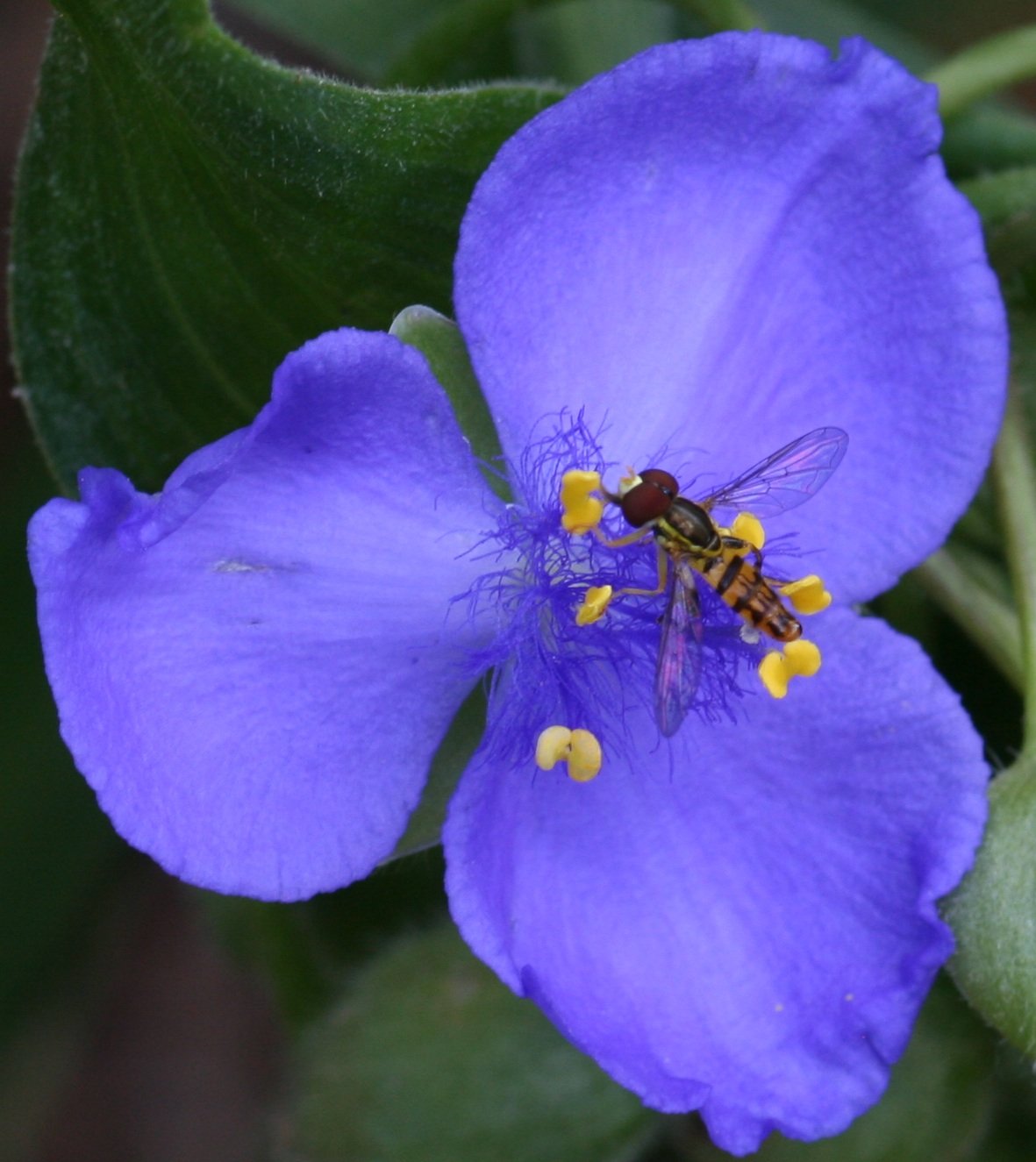
Virginia spiderwort
Tradescantia virginiana
A spiderwort of meadows, roadsides, and old-field corners with three-petaled blue-violet flowers in April through June. Each flower opens for a single morning and dissolves into watery jelly by afternoon, but a colony produces successive flowers over a long bloom window. Distinguished from the woodland zigzag spiderwort by upright (not zigzag) stems and full-sun habitat preference.
Status: Native; common on roadbanks.
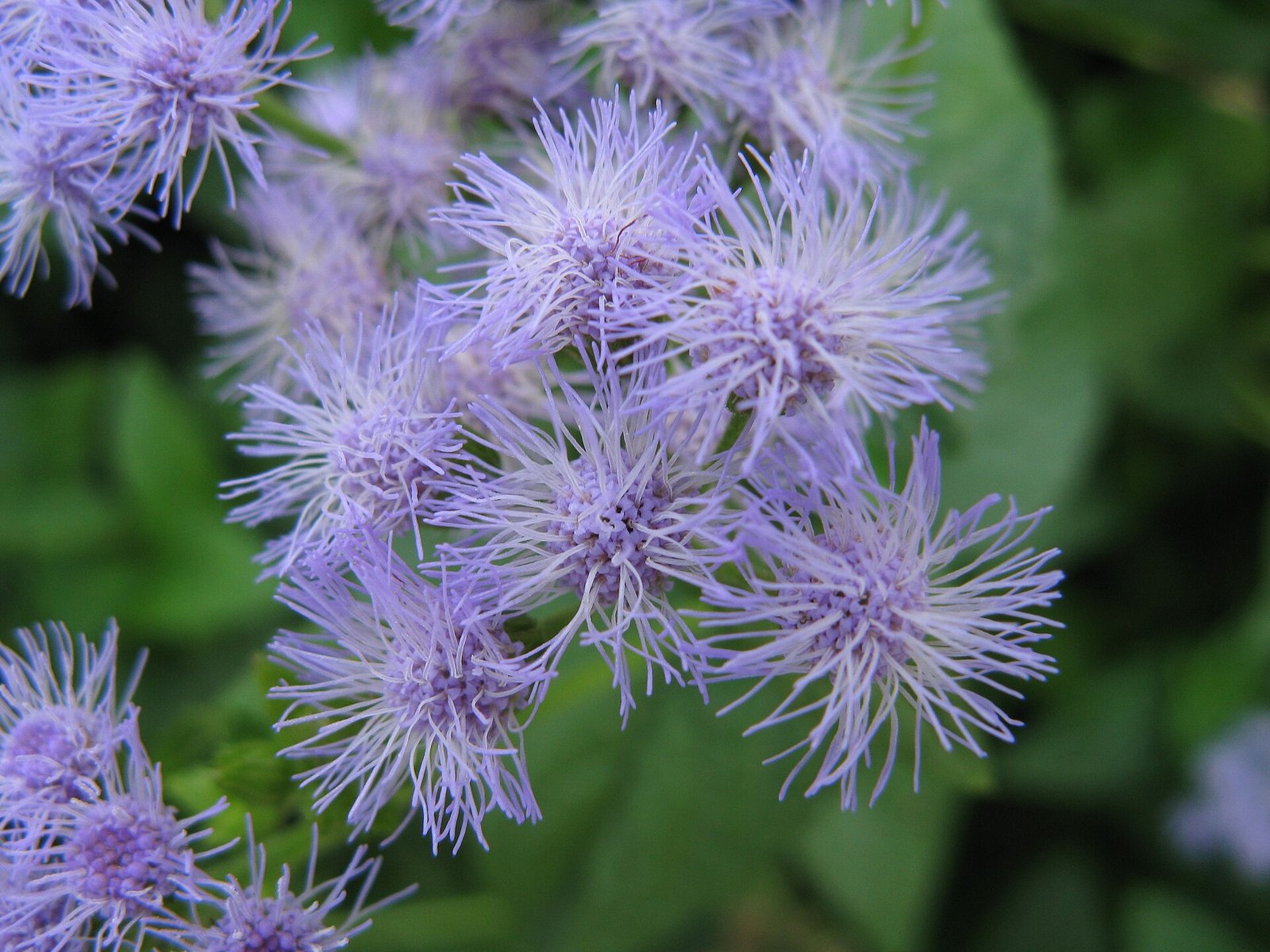
Blue mistflower
Conoclinium coelestinum
A two-foot perennial with flat-topped fluffy clusters of small lavender-blue flowers in late August and September. Common in moist roadside corners, ditch lines, and old-field edges. The fluffy flower head looks like a wild ageratum (the cultivated annual it is closely related to) and is heavily worked by butterflies in early autumn.
Status: Native; common in moist roadside corners.
Gentians and rose pinks
The gentian family is sparsely represented in Marion but worth a careful look. Both bottle gentian and striped gentian have flowers that never open fully and rely on bumblebee force-pollination; rose pink (Sabatia) is the showy gentian-family member of summer roadsides.
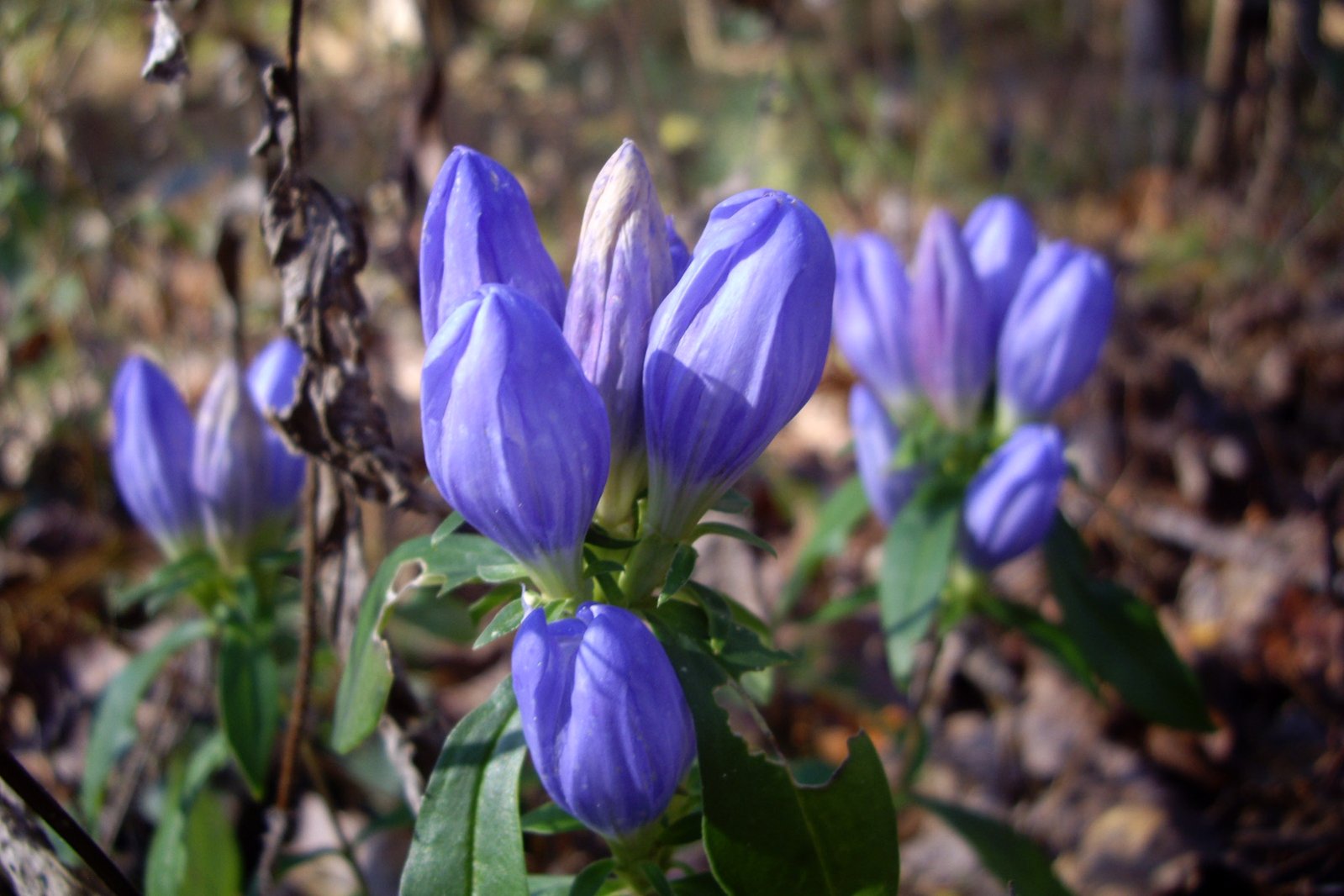
Bottle gentian
Gentiana saponaria
A foot-tall gentian of moist meadows and seep margins with pale-blue flowers shaped like closed bottles, never opening fully. Bumblebees are the principal pollinators; they pry the petal tips apart and force their way into the flower. Blooms in September and October. One of the latest-flowering native forbs in Marion's wet-meadow flora.
Status: Native; locally common in seep meadows.
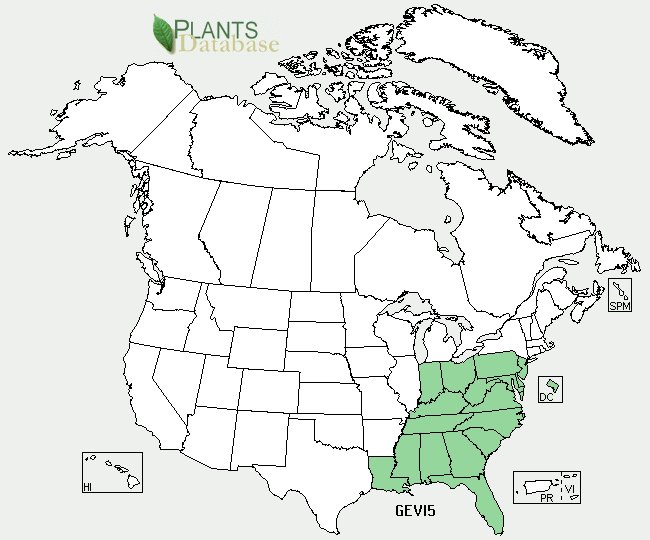
Striped gentian
Gentiana villosa
A two-foot gentian of dry-mesic woodland edges with pale yellowish-green flowers striped internally with violet lines. Like bottle gentian, the flowers do not open fully and rely on forced bumblebee pollination. Blooms September into October on partly shaded slopes and trail margins. Less common in Marion than bottle gentian but present in the right habitat.
Status: Native; locally distinctive on woodland edges.
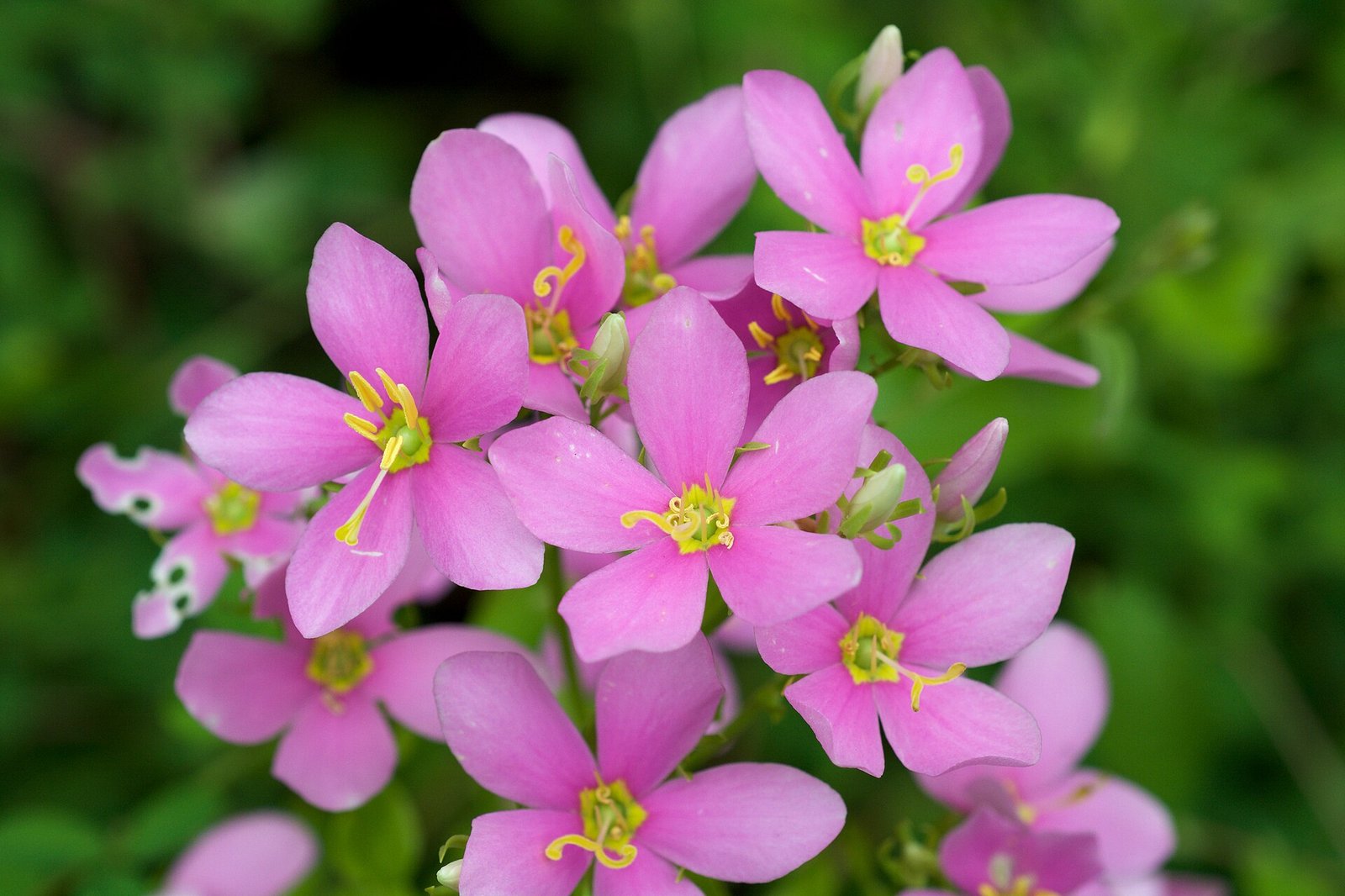
Rose pink
Sabatia angularis
A native gentian-family biennial with bright pink five-petaled flowers in July and August. The stem is distinctly four-angled (the source of the species name). One of the most striking summer wildflowers of Marion's old fields and roadside openings. The flower's center carries a yellow star outlined in red, an unmistakable mark.
Status: Native; locally common in moist meadows.
Limestone bluffs on the Tennessee River Gorge slopes and in the Sequatchie Valley, plus the cedar glades and sandstone caprock openings of the plateau itself, support flora distinct from both the cove forest and the open meadows. The cards below cover the headline native species of those rocky openings; the walking-fern-and-friends complement of the limestone bluffscape lives with the ferns under Session 6 of this expansion.
Large-flowered skullcap and the limestone-bluff mints
Limestone bluffs on the Tennessee River Gorge slopes and in the Sequatchie Valley support a flora distinct from the acidic plateau caprock. The most signal species is large-flowered skullcap (Scutellaria montana), a federally threatened mint endemic to the Tennessee, Georgia, and Alabama border country; Marion's gorge holds one of its largest known populations. The bluff-loving heart-leaf skullcap is the Sequatchie Valley counterpart on calcareous slopes.
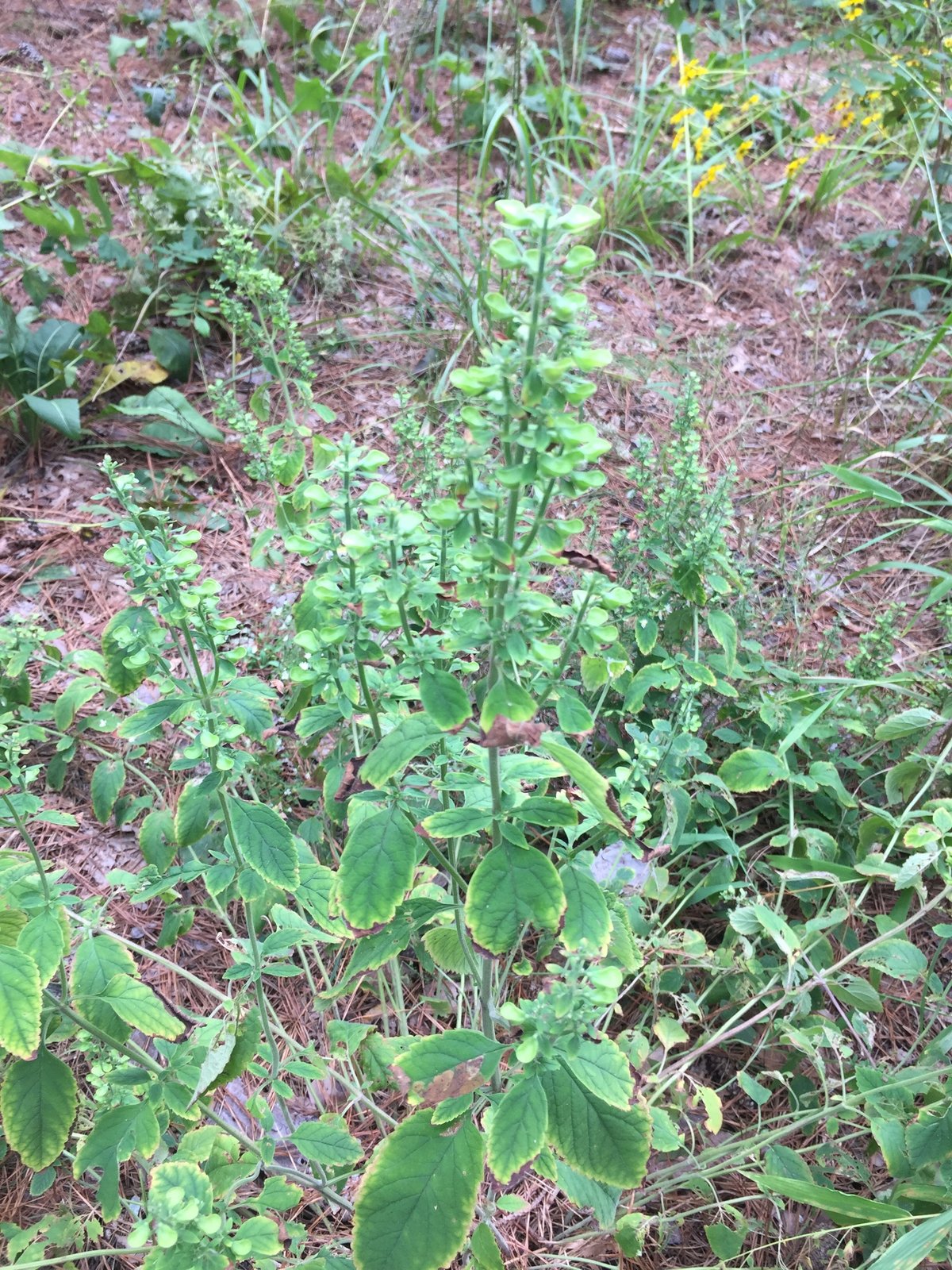
Large-flowered skullcap
Scutellaria montana
A federally threatened mint-family endemic of a small region along the Tennessee, Georgia, and Alabama border. Marion County's Tennessee River Gorge holds one of the largest known populations; the species was federally listed as endangered in 1986 and reclassified to threatened in 2002 after Tennessee River Gorge Trust land conservation and private-landowner easements grew the gorge population from around fifty known plants to more than forty thousand. Pairs of large blue-violet tubular flowers in May above oval opposite leaves on a foot-tall plant. Treated in greater detail on the endemic and notable species page.
Status: Native; federally threatened; endemic to TN/GA/AL.
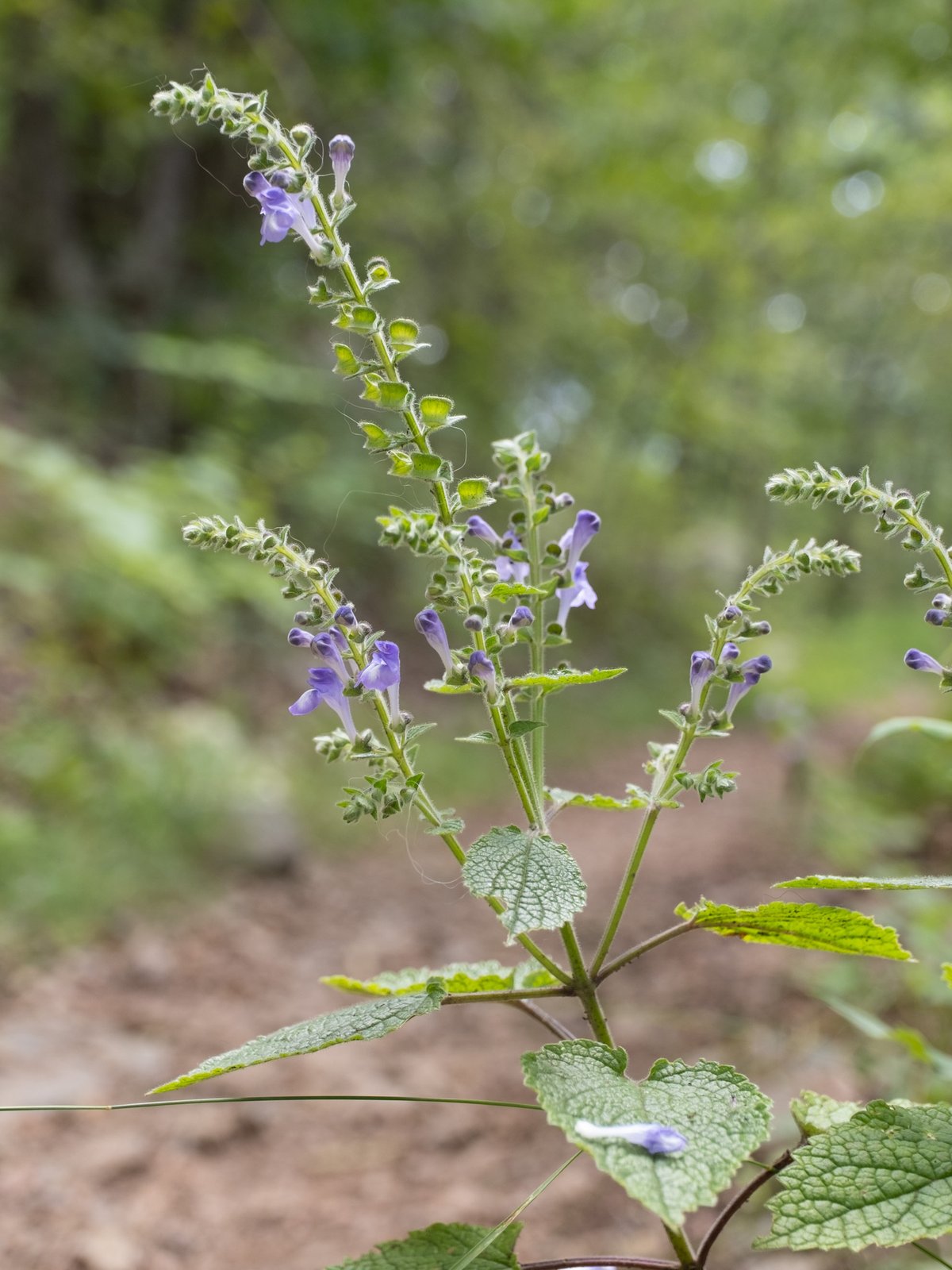
Heart-leaf skullcap
Scutellaria ovata
A foot- to two-foot skullcap of limestone-influenced slopes and rocky woodland openings with heart-shaped (rather than oval) leaves and a tall terminal spike of blue tubular flowers in June. Common on the Sequatchie Valley side of Marion where calcareous bedrock comes near the surface; the limestone-bluff complement to the gorge-side S. montana.
Status: Native; common on calcareous slopes.
Rosinweeds, alumroots, and the glade composites
The cedar glade and limestone-bluffscape openings of Marion (and the broader southern Cumberland Plateau) support a small but distinctive flora that is found almost nowhere else. Cumberland rosinweed (Silphium brachiatum) is endemic to the Cumberland Plateau region of Tennessee, Alabama, and Georgia; small-flower alumroot (Heuchera parviflora) is a vertical-bluff specialist; Maryland golden-aster is the headline yellow of the dry sandstone caprock openings.
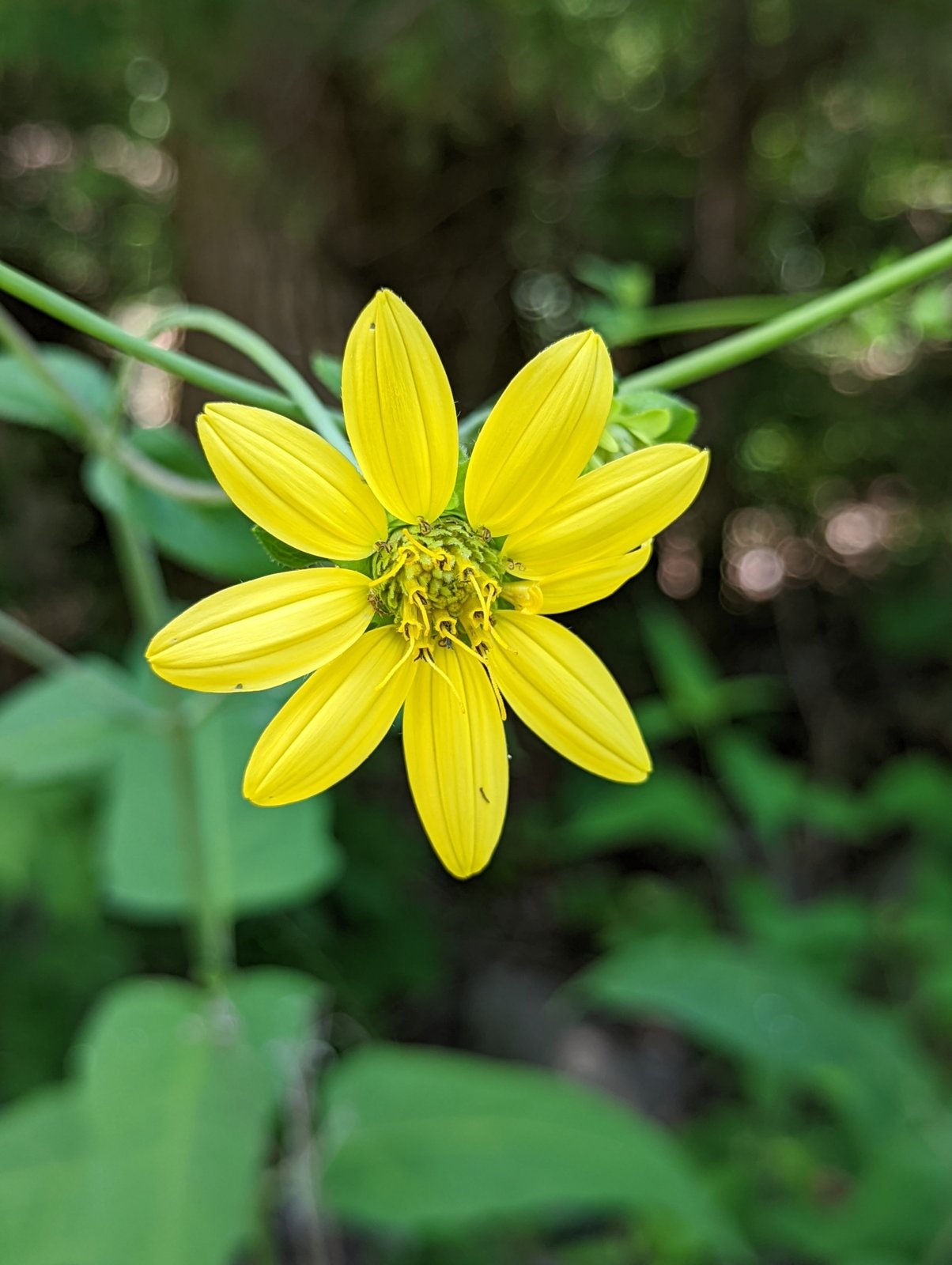
Cumberland rosinweed
Silphium brachiatum
A Tennessee state-endangered Silphium endemic to the Cumberland Plateau region of Tennessee, Alabama, and Georgia. Marion County is within its small native range; the Tennessee-Kentucky Plant Atlas confirms the species at the county level. Yellow rough-textured ray flower heads on a four- to six-foot stem with broad opposite leaves. Favors limestone-influenced glade openings and dry oak-hickory edges. Treated as a Marion-confirmed endemic feature species per the Plant Atlas Marion record.
Status: Native; TN state-endangered; Cumberland Plateau endemic.
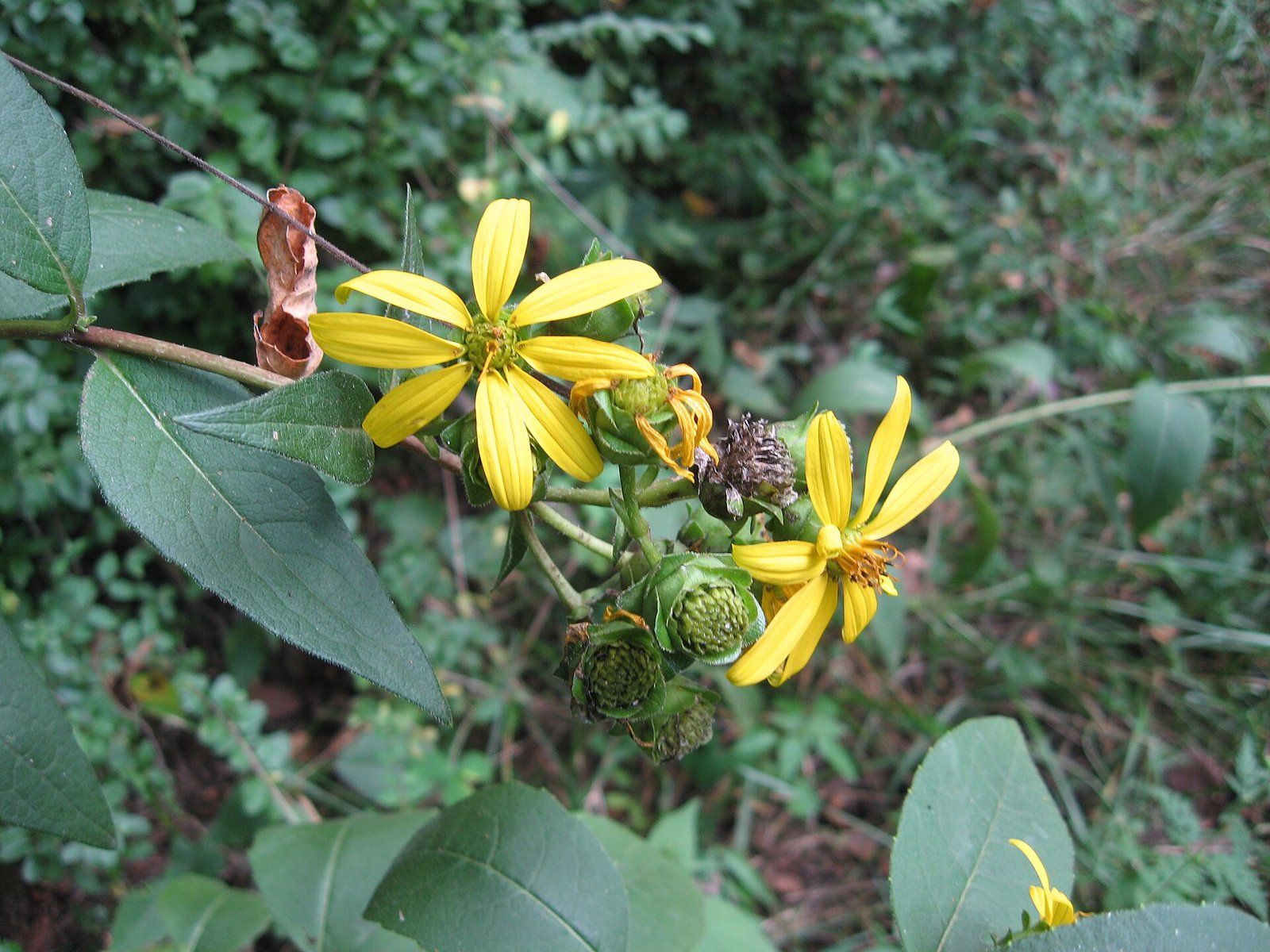
Starry rosinweed
Silphium asteriscus
A three- to five-foot Silphium of dry-mesic openings and limestone glades with bright yellow ray flower heads in July and August. The leaves are rough and sandpapery (the genus is named for the resinous gum exuded from broken stems and roots, used as chewing gum by Indigenous peoples). Common on calcareous slopes and ridge openings on the Sequatchie Valley side of Marion.
Status: Native; common on calcareous openings.
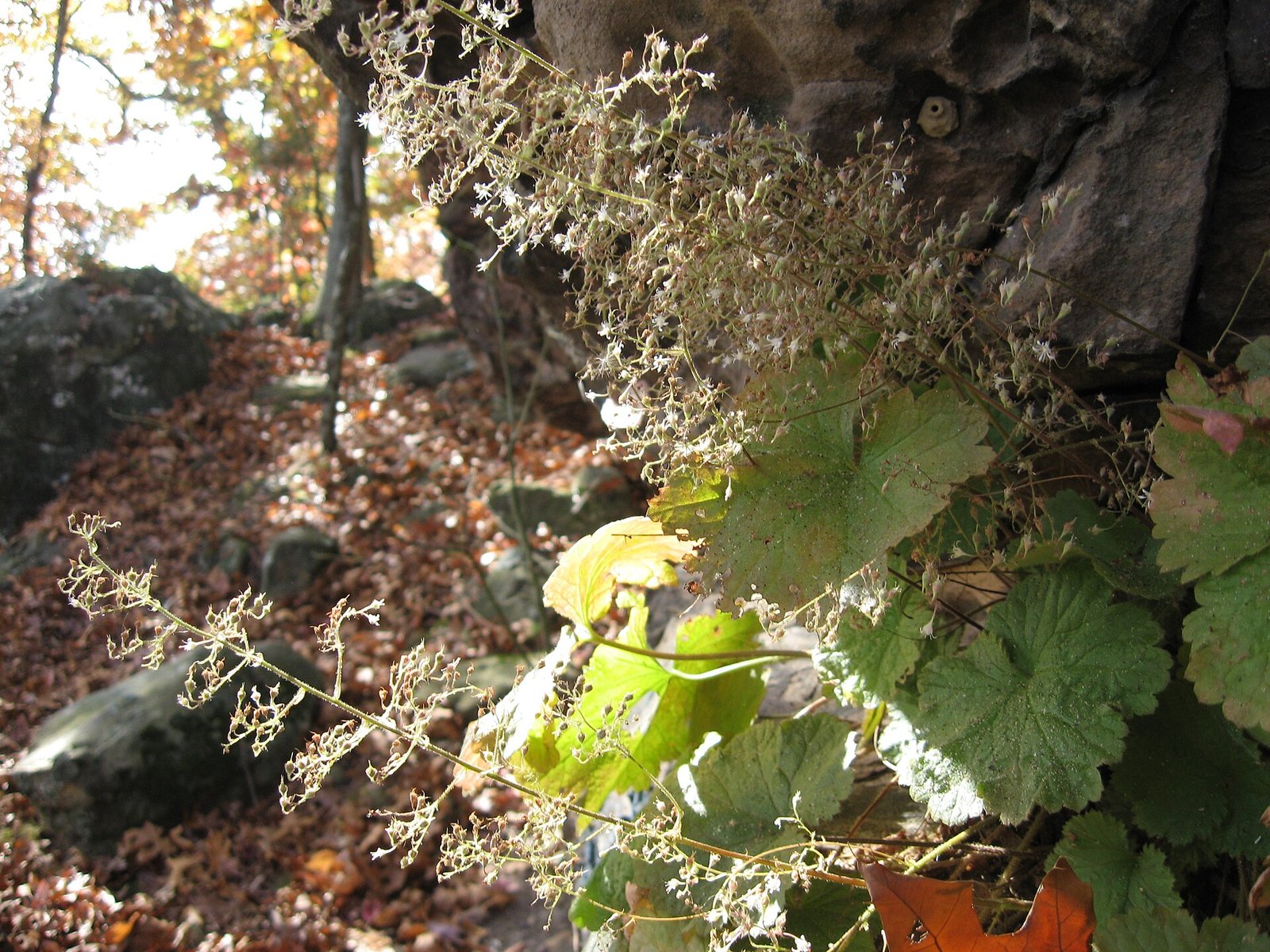
Small-flower alumroot
Heuchera parviflora
A bluffscape-specialist alumroot of vertical limestone walls, ledges, and rock-house overhangs. Smaller-flowered than the more common H. americana with finer flower clusters above a basal rosette of rounded leaves. Marion's Tennessee River Gorge has the right habitat for this species; populations are scattered across the southeastern United States on similar limestone bluffscape habitats.
Status: Native; locally distinctive on bluffscape.
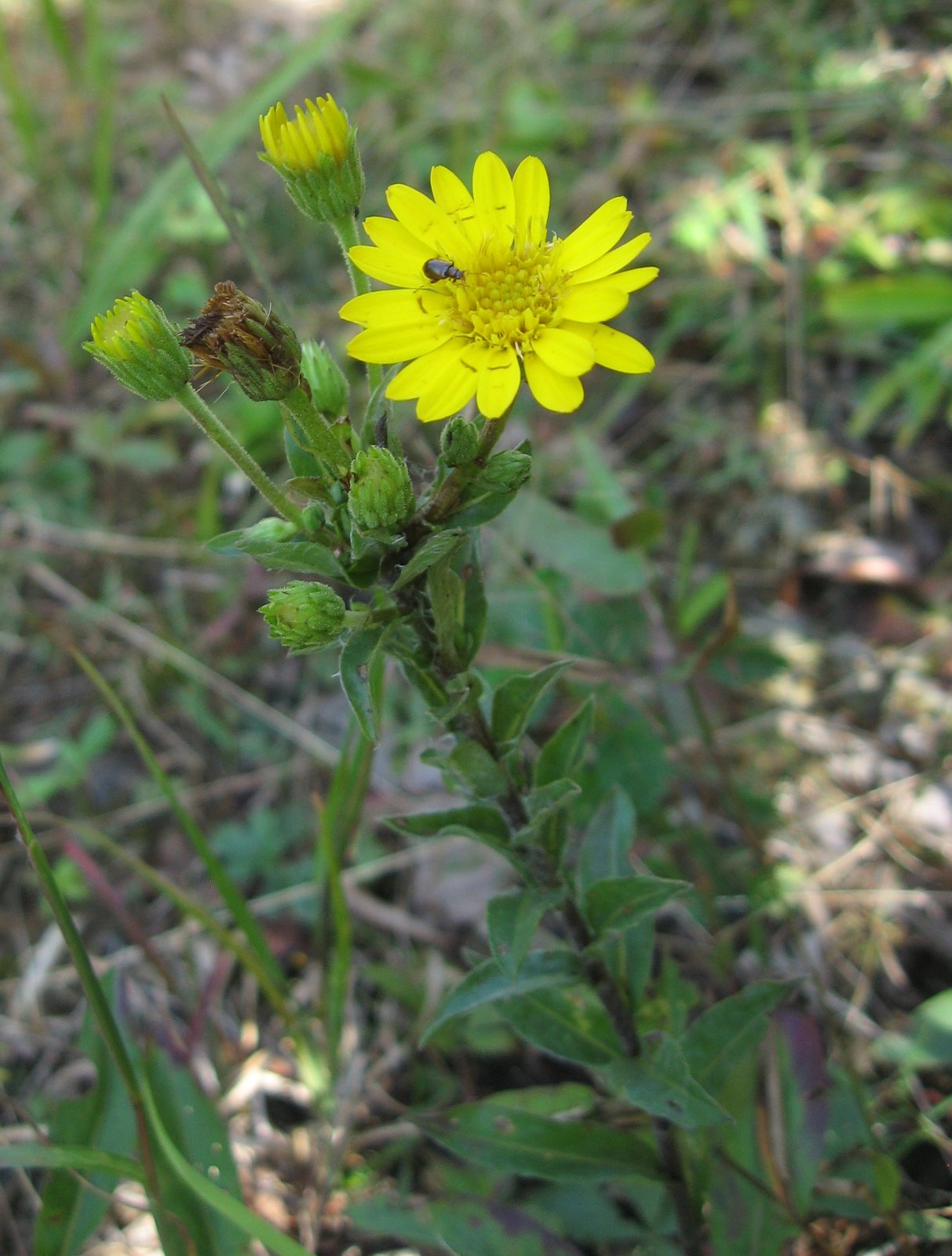
Maryland golden-aster
Chrysopsis mariana
A two-foot composite of dry sandstone openings, ridge balds, and pine-oak edges with bright yellow ray flower heads in August and September. The young foliage is silky-hairy. One of the iconic species of southeastern dry-soil openings; common on the plateau caprock side of Marion above the gorge.
Status: Native; common on dry sandstone openings.
Marion's riparian and wetland-margin flora threads the Sequatchie River bottomlands, the small streams that drop off the plateau into the Tennessee River Gorge, the Nickajack Lake coves, and the beaver ponds and seep meadows of the cove drainages. Cardinal flower's vivid red lights up the August streamside; the lobelias, monkey-flowers, and turtleheads form a connected complex of two-lipped bumblebee-pollinated forbs; and the emergent aquatics anchor the still-water margins.
Cardinal flower and the lobelias
The lobelias (Lobelia) split the wet-meadow palette between hummingbird-pollinated red (cardinal flower, already cardded under the rocky-rim subgroup above) and bumblebee-pollinated blue (great blue lobelia). Cardinal flower's bloom in August and September coincides with peak ruby-throated hummingbird abundance in southern Tennessee; the tubular flower is too narrow for most bees and is built for hovering hummingbird beaks. Indian tobacco is the small annual roadside lobelia, easily overlooked but common.
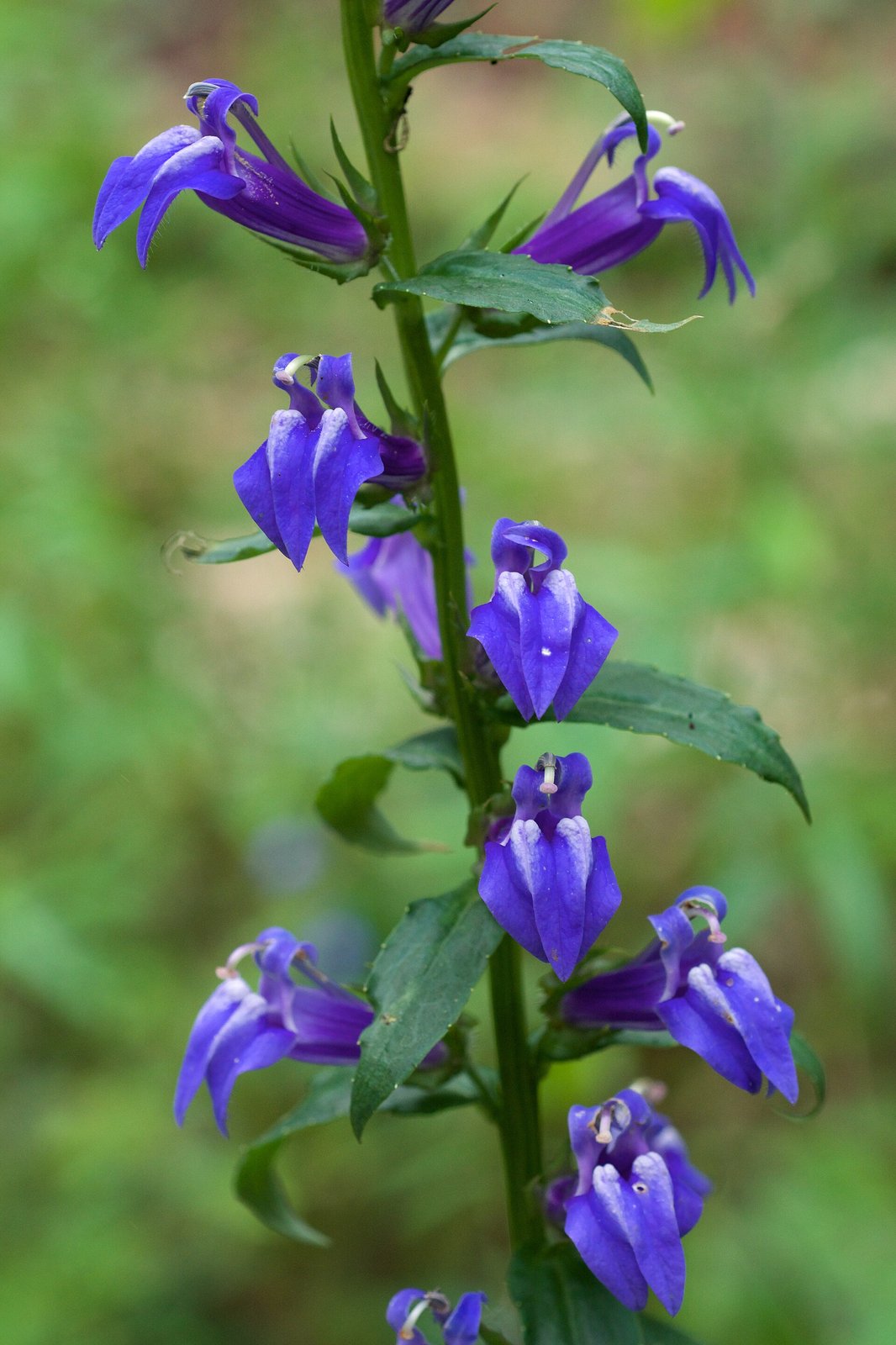
Great blue lobelia
Lobelia siphilitica
A two- to three-foot lobelia of stream margins and seep meadows with vivid blue tubular flowers in a tall spike from August into September. The blue counterpart of cardinal flower, often growing alongside it on the same wet ground; visited by long-tongued bees and bumblebees rather than by hummingbirds. The species name reflects an obsolete eighteenth-century claim that the plant cured syphilis.
Status: Native; common in moist meadows.
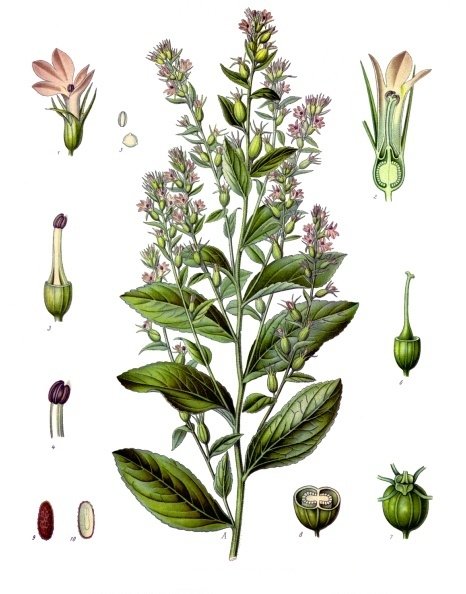
Indian tobacco
Lobelia inflata
A foot- to two-foot annual lobelia with small pale-blue tubular flowers and characteristic inflated seed capsules along the upper stem (the source of the species name inflata). Common on roadside cuts and old-field edges across Marion. Indigenous peoples of eastern North America smoked the dried leaves; the plant contains the alkaloid lobeline, a respiratory stimulant historically used in pharmaceuticals.
Status: Native; common on disturbed ground.
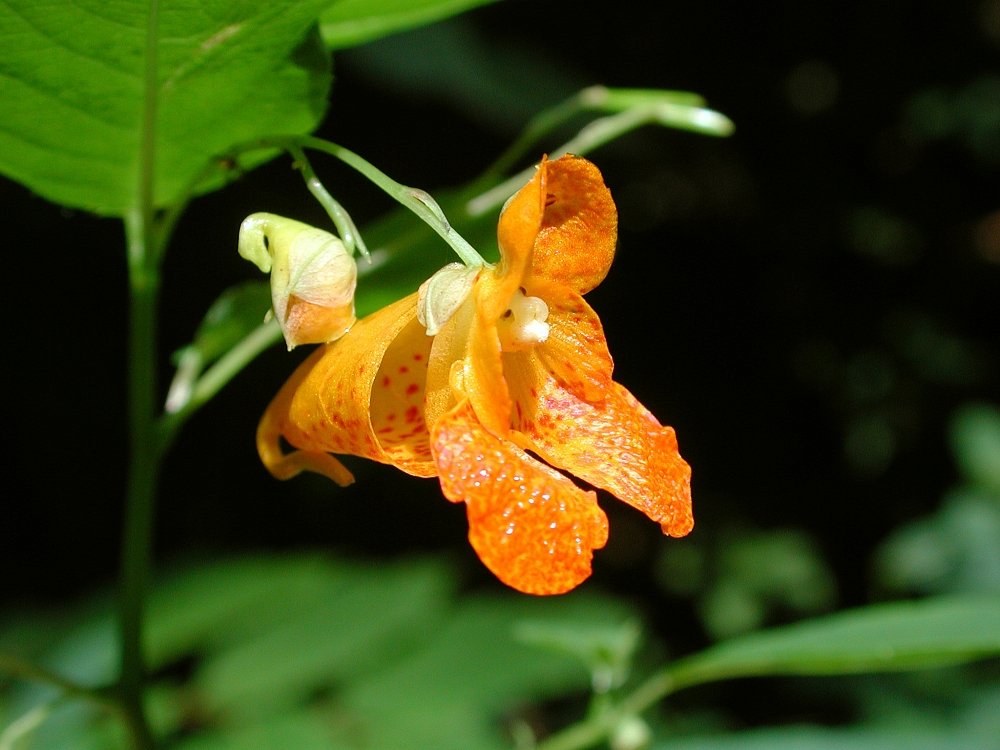
Orange jewelweed
Impatiens capensis
An annual jewelweed of moist shady ground in late summer with orange tubular flowers spotted with red-brown. The seed capsules split explosively at a touch, flinging seeds several feet from the parent (the source of the folk name touch-me-not). The crushed succulent stems were used in Appalachian folk medicine to relieve poison-ivy rash and stinging-nettle stings. Common along Marion's stream margins and seep meadows.
Status: Native; common in damp shaded ground.
Monkey-flowers and turtleheads
Three flowers grouped here for their two-lipped tubular structure: the monkey-flowers (Mimulus) and white turtlehead (Chelone). All three depend on bumblebee pollination, with the bee forcing its way into the closed flower lips. White turtlehead is the larval host for the Baltimore checkerspot butterfly, a rare colonial species at the southern edge of its range in southern Tennessee.
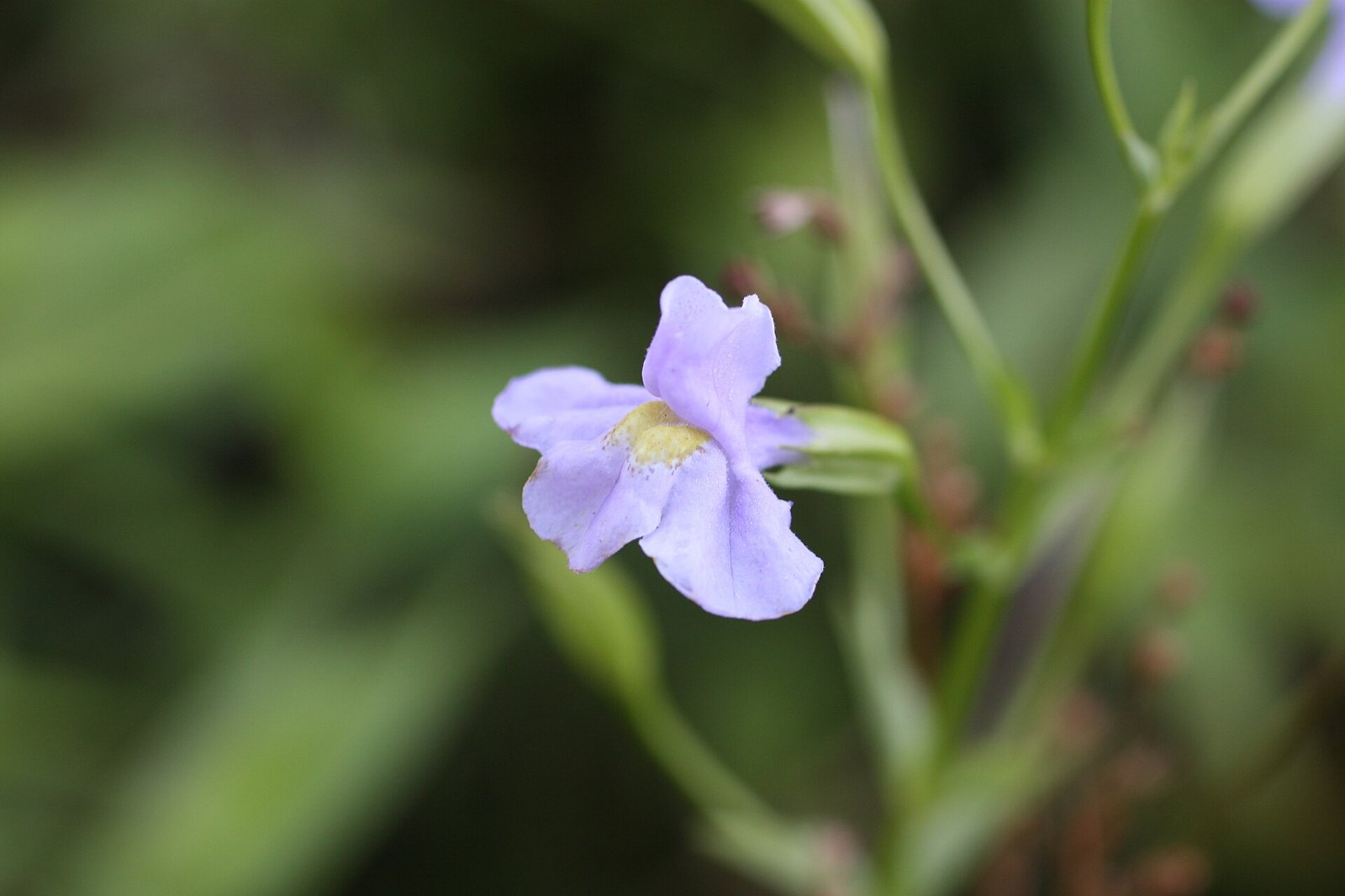
Monkey-flower
Mimulus ringens
A two- to three-foot wetland forb with paired blue-violet two-lipped tubular flowers in the leaf axils from June through September. The flower's two-lipped shape is said to resemble a smiling monkey face (the source of the genus name). Favors stream banks and the edges of beaver ponds and oxbow remnants along the Tennessee River and lower Sequatchie.
Status: Native; common along stream margins.
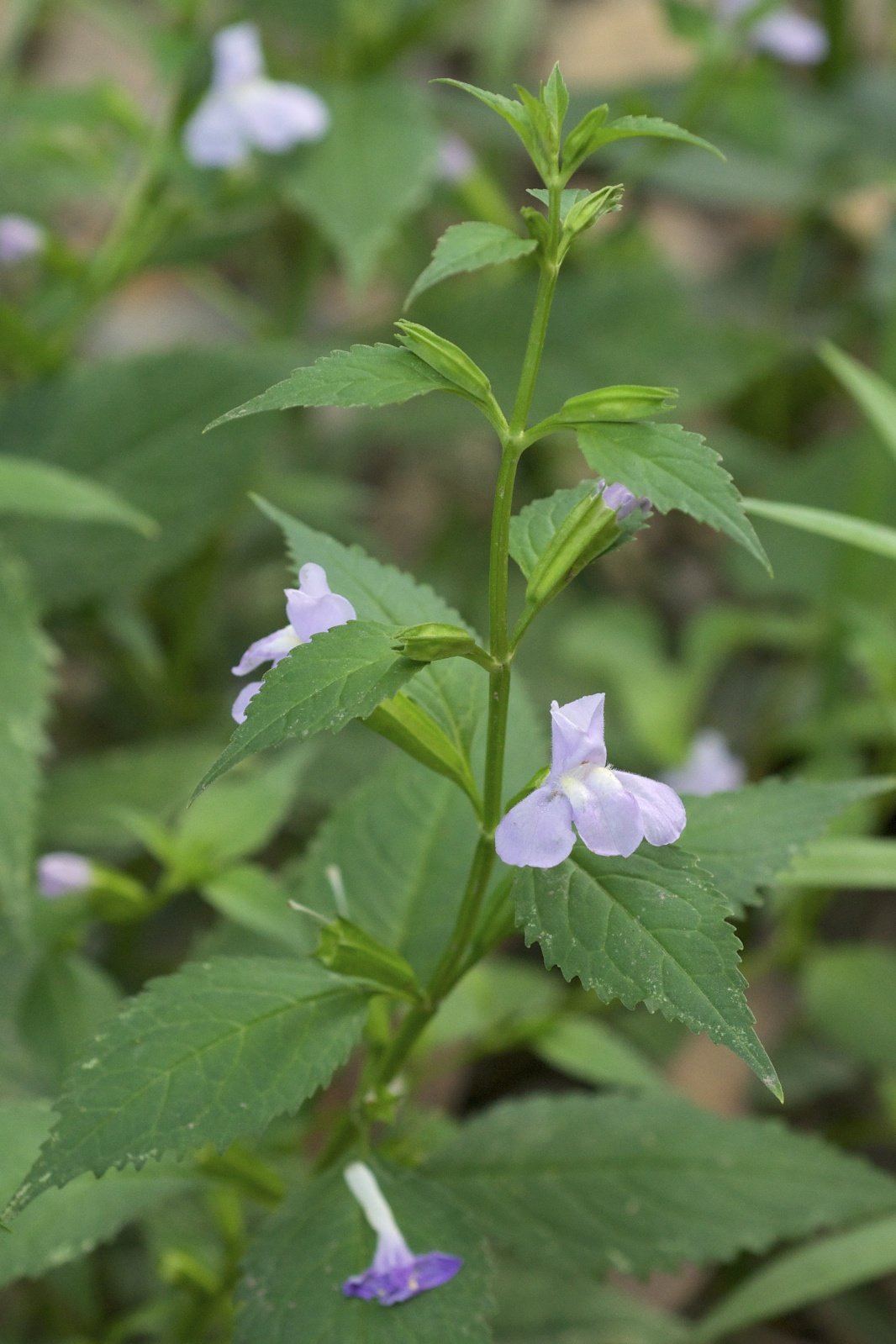
Sharp-wing monkey-flower
Mimulus alatus
A close cousin of monkey-flower, distinguished by stems with a thin wing of green tissue running along each angle (the source of the species name alatus, winged). Pale-violet flowers in the leaf axils. Less common in Marion than M. ringens; favors sandy stream margins and seep openings.
Status: Native; locally common on stream margins.
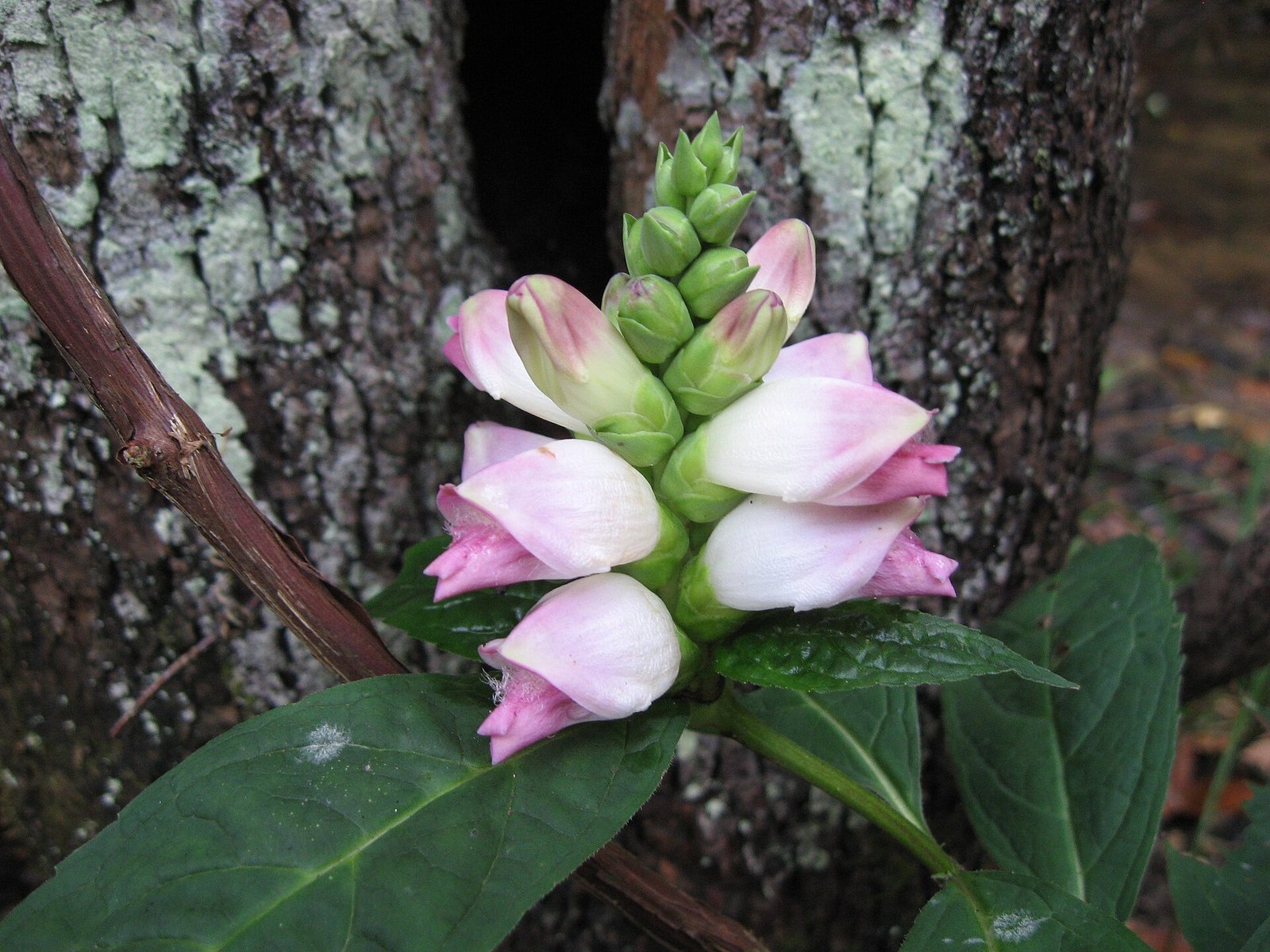
White turtlehead
Chelone glabra
A two- to three-foot wetland forb with creamy-white tubular flowers held in tight terminal clusters; each flower's two-lipped shape resembles a turtle's head with its mouth slightly open (the source of the common name). Bumblebees pry the lips apart and force their way in to reach the nectar. The plant is the larval host for the rare Baltimore checkerspot butterfly. Common in seep meadows and wet thickets across Marion.
Status: Native; common in wet meadows.
Lizard's tail, water willow, and the wetland-edge forbs
The wetland-edge specialists of Marion's stream margins, beaver-pond shores, and Tennessee River sloughs. American water willow forms dense streambed colonies along the rocky-bottomed reaches of the Sequatchie and Battle Creek; lizard's tail tolerates more standing water; eastern rose mallow holds the title of Marion's largest native flower. Butterweed sheets entire bottomland fields yellow in early April.
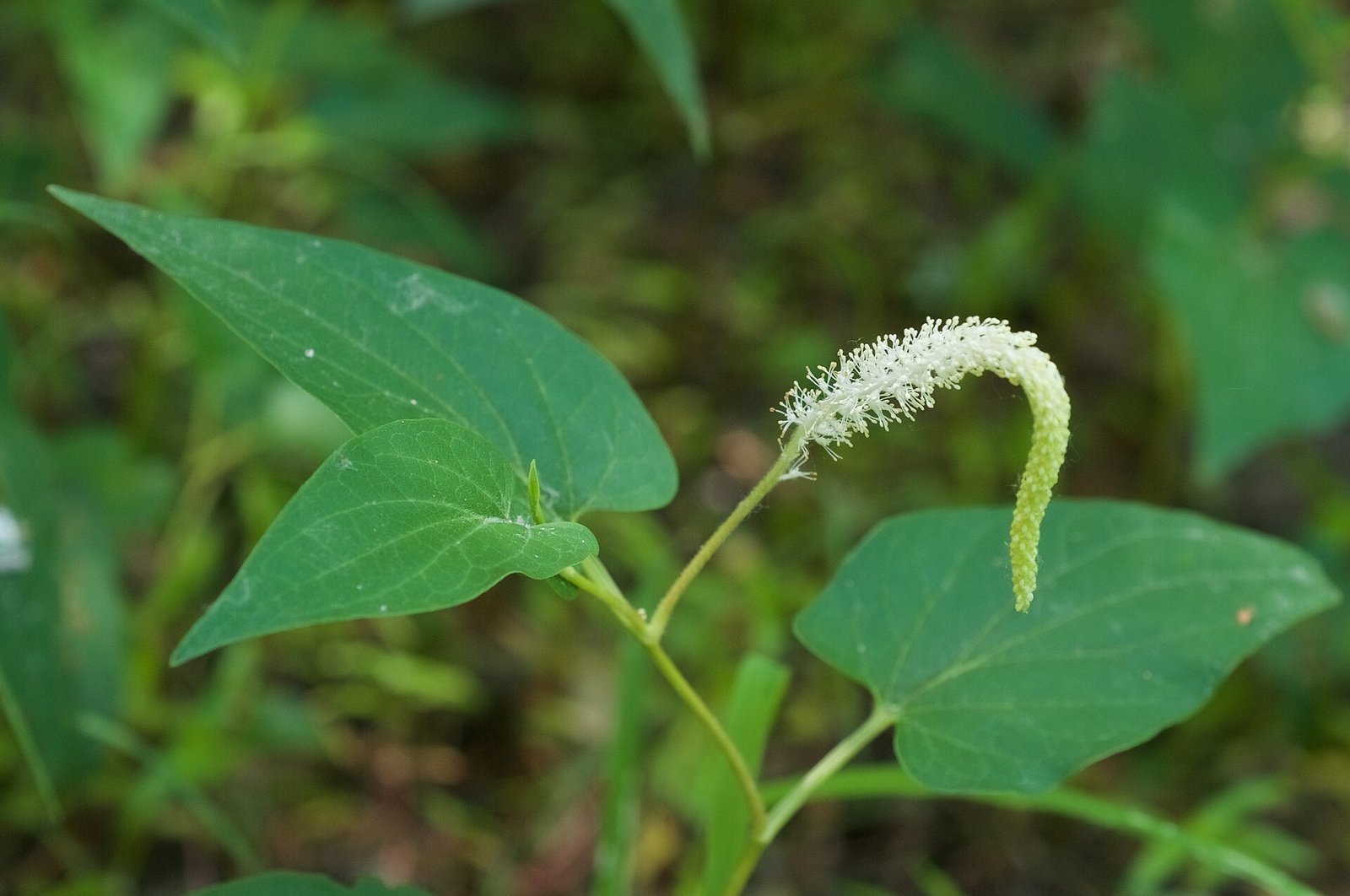
Lizard's tail
Saururus cernuus
A wetland herb with heart-shaped leaves and arching white flower spikes that taper to a curled tip resembling a lizard's tail (the source of the common name and the family name Saururaceae, lizard-tail). Forms dense colonies along the edges of slow streams, oxbows, and beaver ponds. Common in the bottomland sloughs along the Tennessee River and lower Sequatchie.
Status: Native; common in wet thickets.
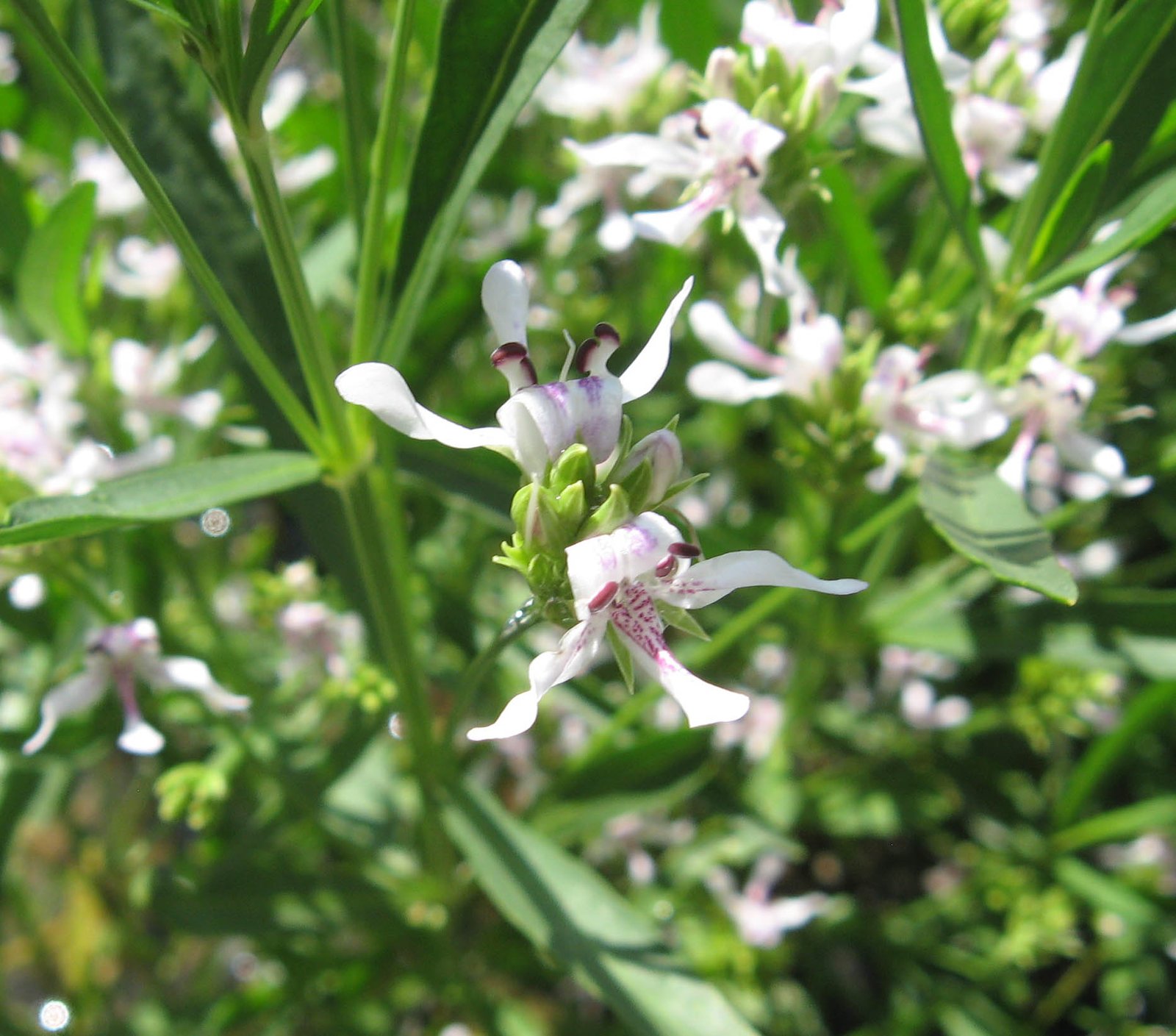
American water willow
Justicia americana
A foot-tall emergent perennial that forms dense streambed colonies along Marion's rocky-bottomed streams and shallow river margins, including stretches of the Sequatchie River and lower Battle Creek. Lance-shaped willow-like leaves on stems that root from the nodes; small white flowers spotted with violet that resemble miniature orchids. The plant tolerates regular flooding and stabilizes streambed gravels.
Status: Native; common along stream margins.
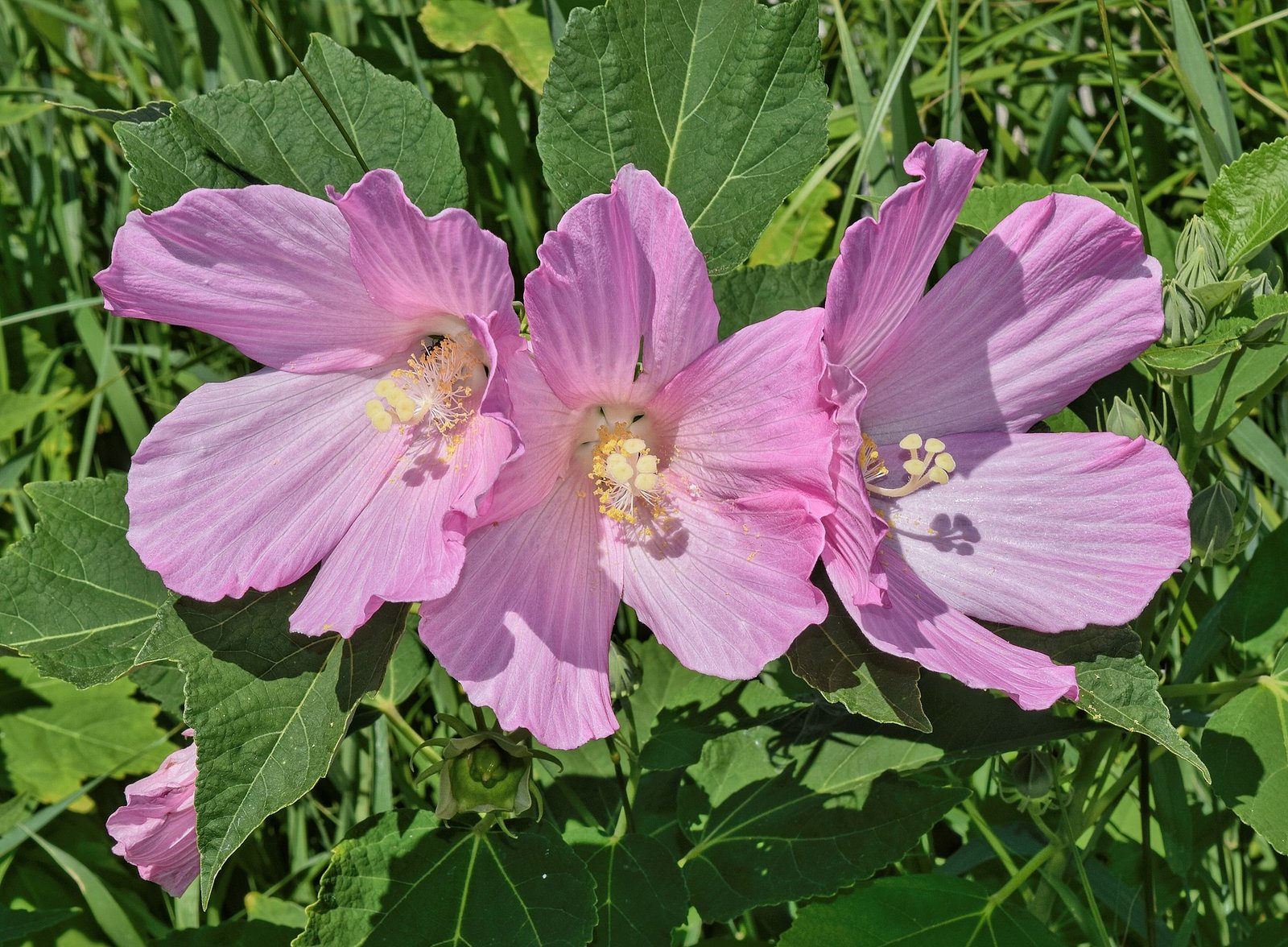
Eastern rose mallow
Hibiscus moscheutos
A four- to six-foot wetland hibiscus with very large (six-inch-wide) pale-pink to white flowers, each flower lasting only a single day. Favors the wettest meadow edges, marshy ditch banks, and slough margins. The largest native flower in Marion's wetland flora; closely related to the cultivated tropical hibiscus but fully cold-hardy.
Status: Native; locally distinctive in marshes.
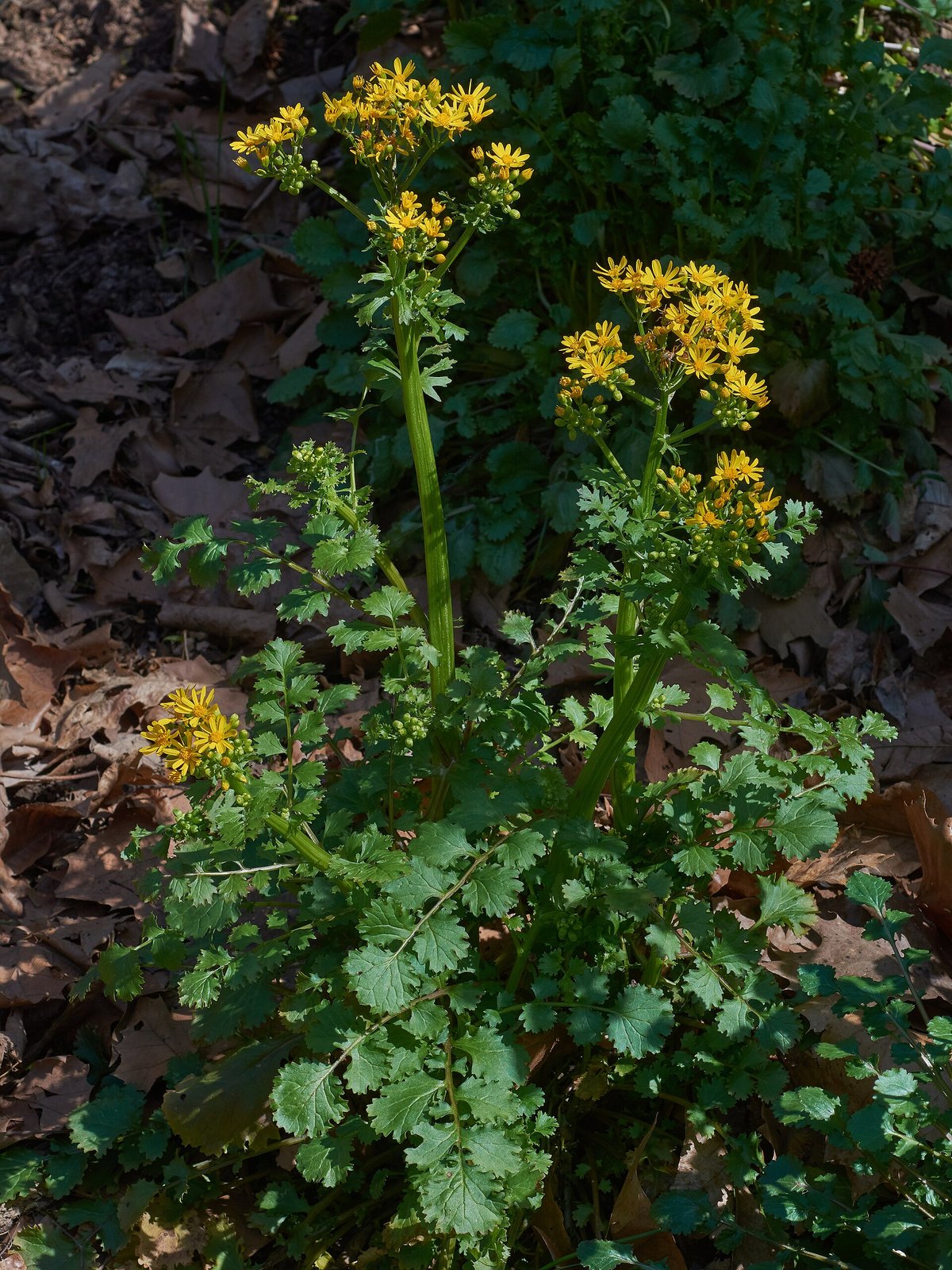
Butterweed
Packera glabella
A two- to three-foot annual ragwort of moist bottomlands and floodplain edges with bright yellow flat-topped flower clusters in April and May. The hollow stems and pinnately divided leaves distinguish it from the rhizomatous golden ragwort and roundleaf ragwort of woodland edges. Can carpet entire bottomland fields in a yellow flush in early spring along the Sequatchie and Tennessee bottomlands.
Status: Native; common in floodplains.
Pickerelweed, arrowheads, and emergent aquatics
The emergent aquatics of Marion's still-water margins (Nickajack Lake coves, beaver ponds, slough edges, slow stretches of the Sequatchie). Pickerelweed and the arrowheads (Sagittaria) provide cover for fish fry and amphibians and stabilize muddy substrates. Duck-potato's starchy tubers were a staple food for many Indigenous peoples of eastern North America.
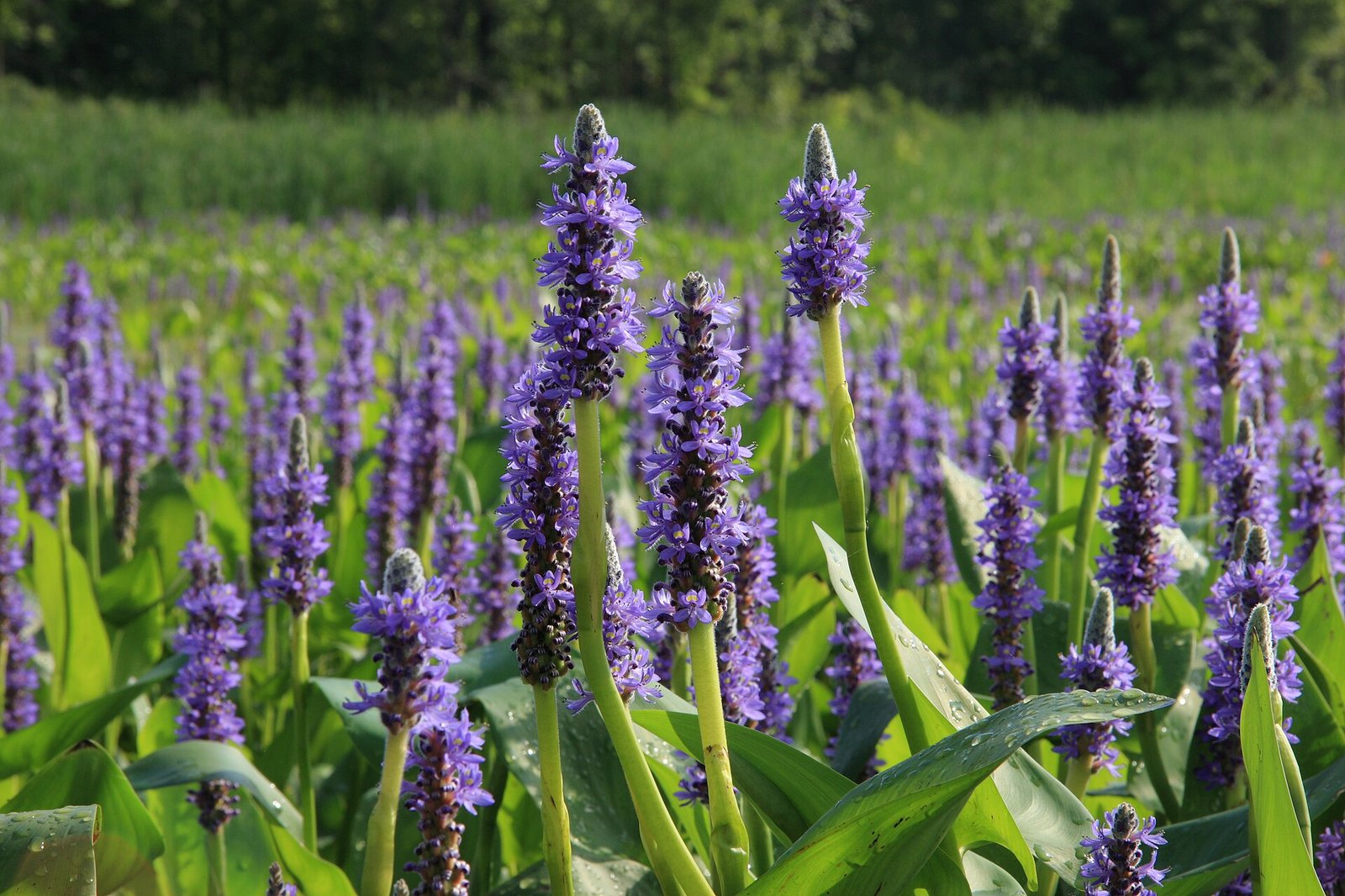
Pickerelweed
Pontederia cordata
A shallow-water emergent perennial with arrowhead-shaped leaves above the waterline and a dense spike of small blue tubular flowers from June into September. The most striking emergent in Marion's still-water margins (Nickajack Lake coves, slough edges, beaver-pond shallows). Forms dense colonies that stabilize muddy substrates and provide cover for fish fry and amphibians.
Status: Native; common in still-water margins.
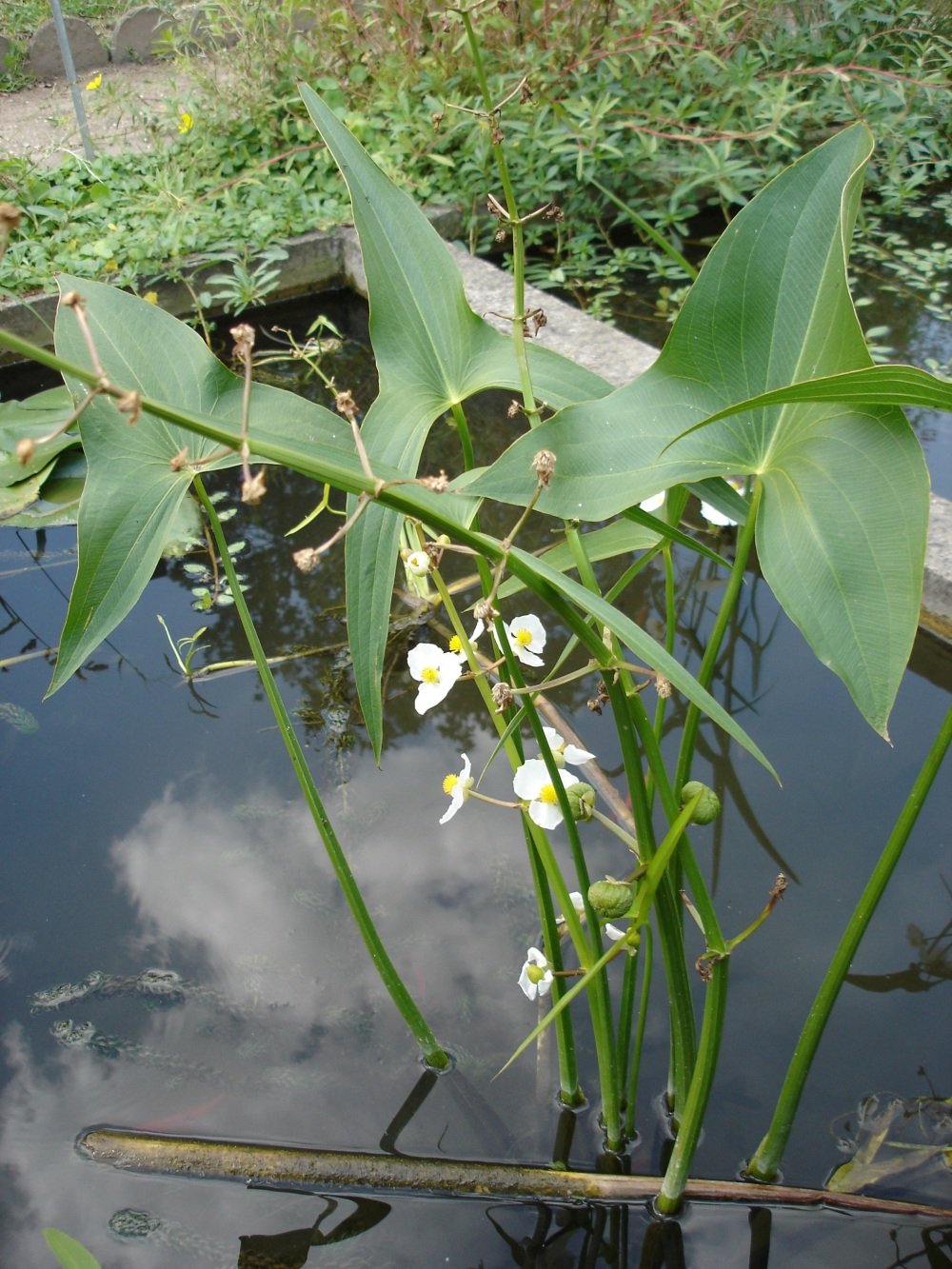
Duck-potato
Sagittaria latifolia
A shallow-water emergent with broad arrowhead-shaped leaves and three-petaled white flowers in whorls of three on a tall flowering stalk. The roots produce starchy tubers that were a staple food for many Indigenous peoples of eastern North America (the source of the common names duck-potato and wapato). Common in slow-water margins along the lower Sequatchie and Nickajack Lake coves.
Status: Native; common in still-water margins.
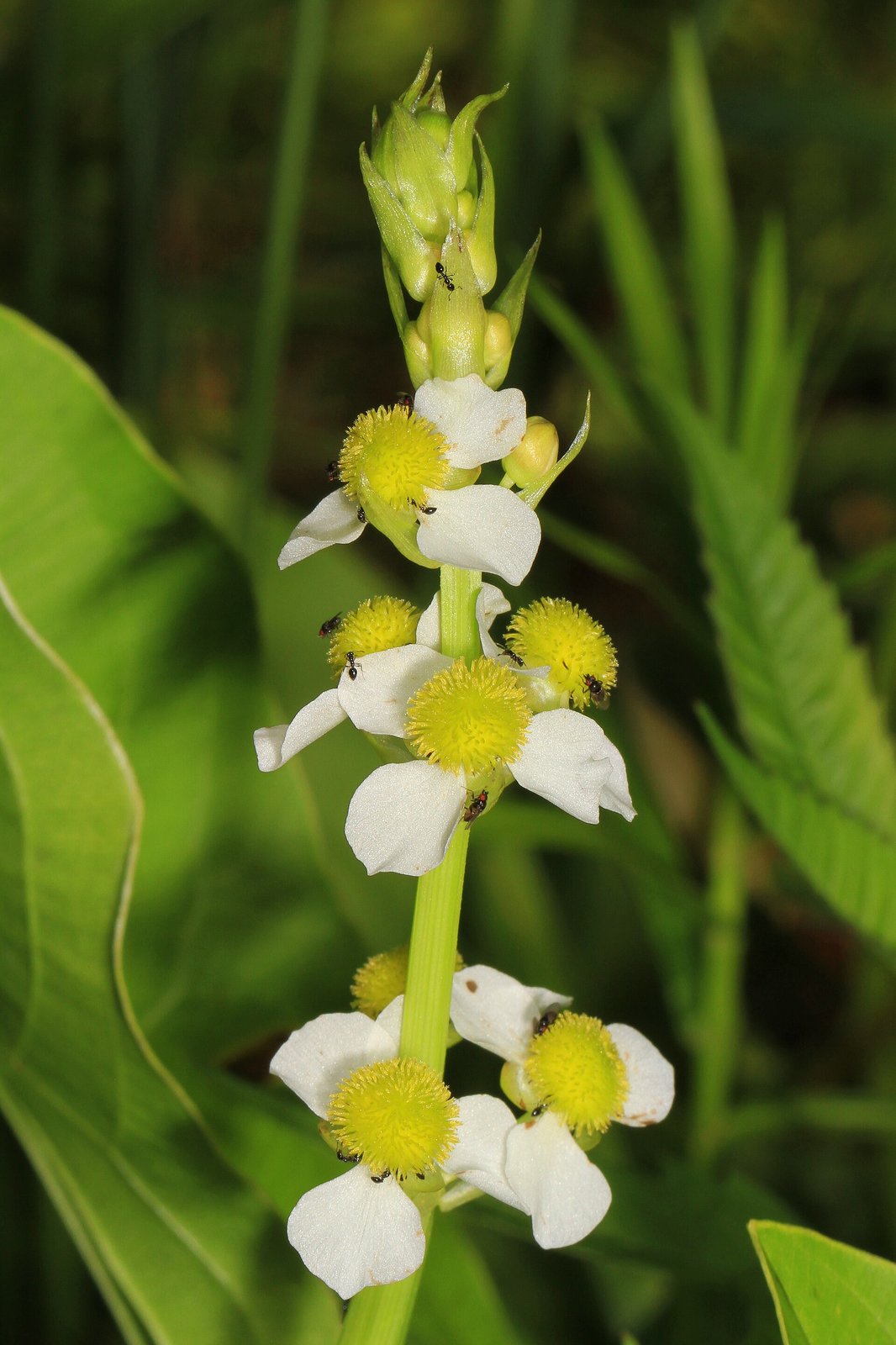
Long-beak arrowhead
Sagittaria australis
A close cousin of duck-potato distinguished by narrower, more sharply pointed arrowhead leaves and a long-beaked seed (the source of the common name). Less common than S. latifolia in Marion's still-water margins but present along the slower stretches of the Sequatchie and in beaver ponds.
Status: Native; locally common in slow waters.
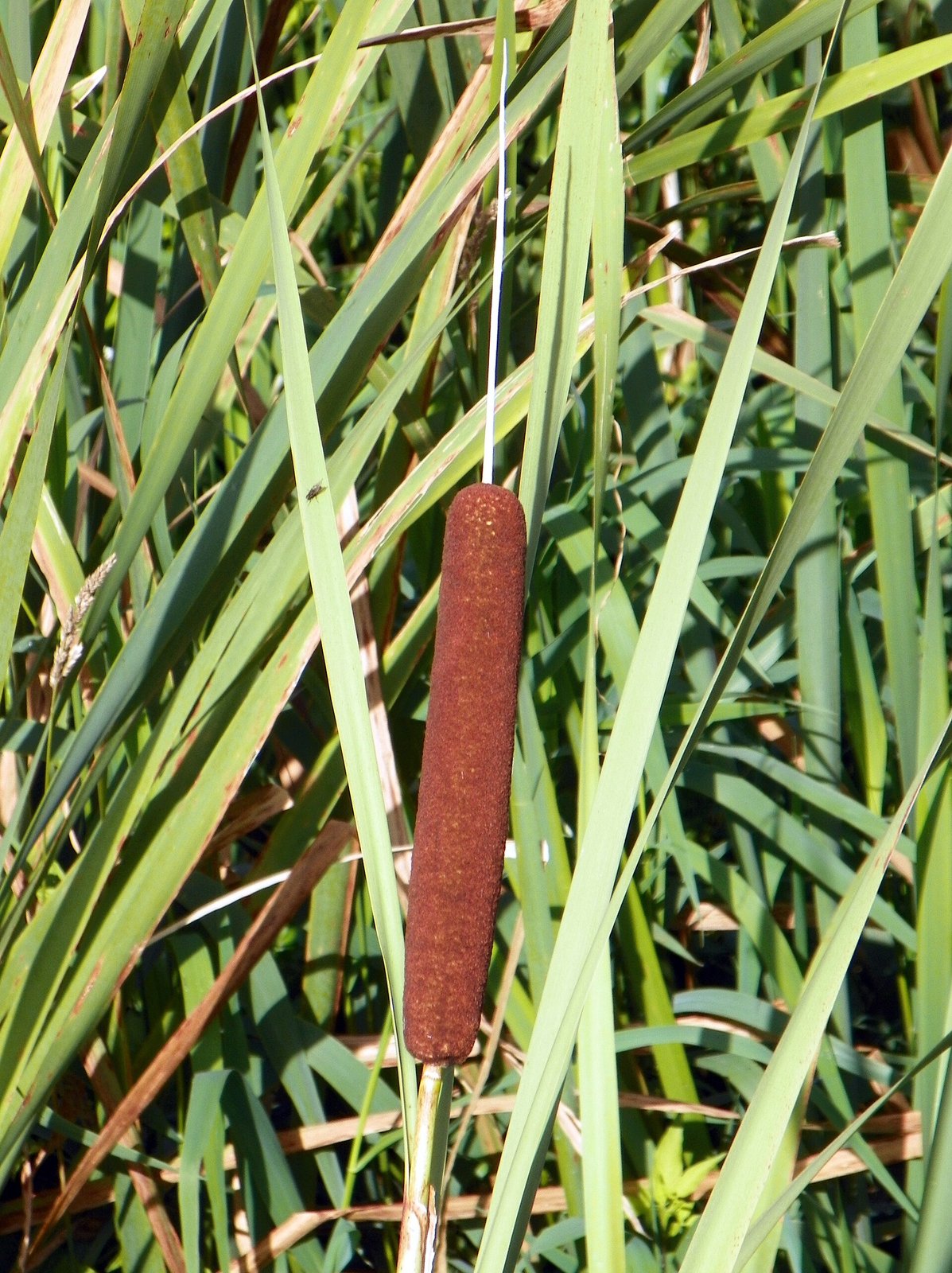
Broadleaf cattail
Typha latifolia
The familiar marsh cattail of Marion's beaver-pond margins, slough edges, and roadside ditch impoundments. Tall flat strap-shaped leaves and a dense brown cylindrical flowering spike that releases wind-borne seeds in autumn. Native and common; sometimes confused with the more aggressive narrow-leaved cattail (T. angustifolia) and their hybrid T. ×glauca, both of which are less common here.
Status: Native; common in marsh margins.
Swamp sunflower, bluestar, and other wetland forbs
A short grouping of late-blooming and early-blooming wetland forbs: swamp sunflower carries the September-October yellow that the field sunflowers don't reach into wet meadows; eastern bluestar provides the May blue of bottomland creek margins; swamp smartweed handles the slow-water edges through summer and autumn.
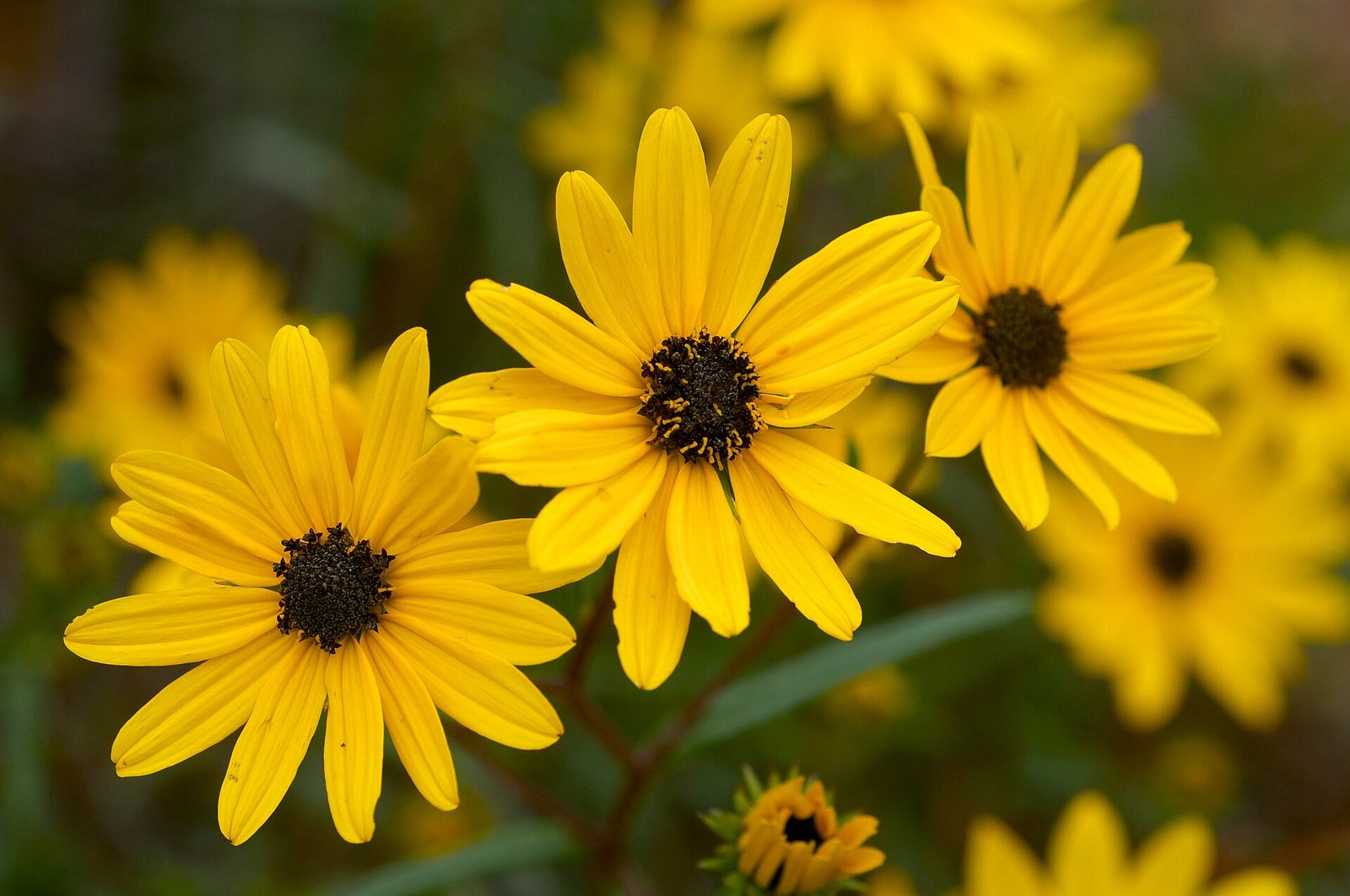
Swamp sunflower
Helianthus angustifolius
A four- to seven-foot wetland sunflower with narrow grass-like leaves and bright yellow ray flowers in late September and October. Favors wet meadows, seep openings, and the edges of beaver ponds. One of the latest-blooming native composites of Marion's wetland flora; provides important late-season nectar for migrating monarchs.
Status: Native; locally common in wet meadows.
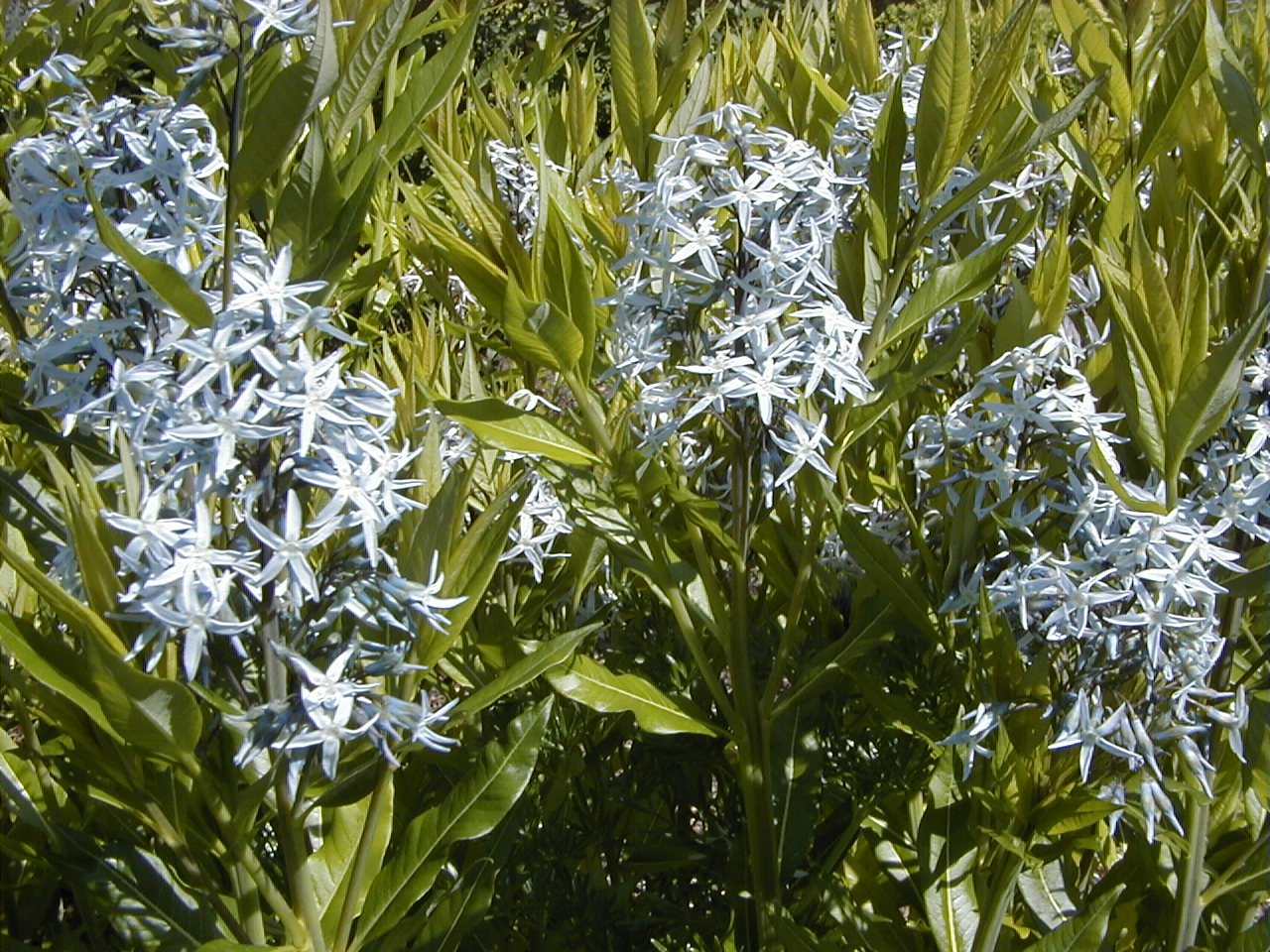
Eastern bluestar
Amsonia tabernaemontana
A two- to three-foot perennial of moist bottomland margins and shaded creek banks with clusters of pale-blue star-shaped flowers in May and willow-like leaves that turn bright yellow in autumn. A milkweed-family relative (close to dogbane and Apocynum) with the same milky white sap when broken. Increasingly planted as a native ornamental but reliably present in Marion's wetland edges where it is native.
Status: Native; common in moist bottomlands.
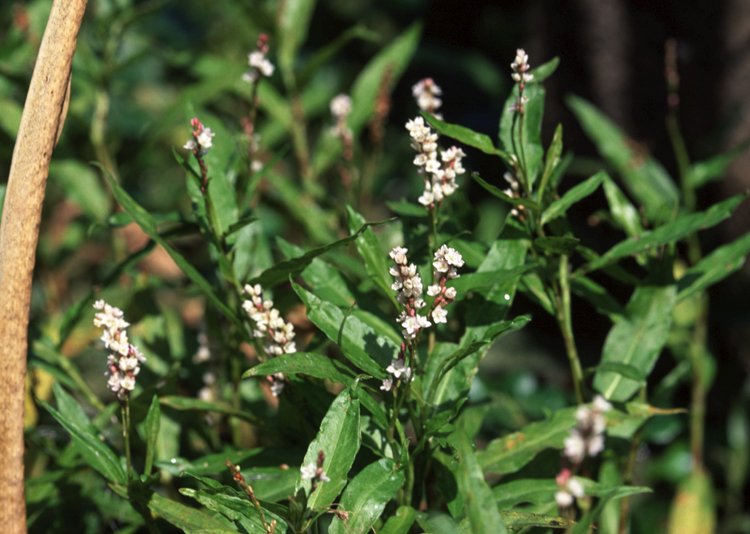
Swamp smartweed
Persicaria hydropiperoides
A wetland Persicaria of slow-water edges, swamp margins, and roadside ditches with dense pink flower spikes from July into October. The lance-shaped leaves often have a chevron-shaped purple blotch in the center. One of several morphologically similar smartweeds in Marion's wetland flora; the chevron-blotched leaves help distinguish it from the introduced lady's-thumb and pale smartweeds.
Status: Native; common in slow-water edges.
Limestone bluffs, ledges, and the endemic bluffscape
Limestone bluffs on the Tennessee River Gorge slopes and in the Sequatchie Valley support a flora distinct from the acidic plateau caprock. Calcium-loving species thrive on the calcareous ledges and seep walls, including the federally threatened large-flowered skullcap (Scutellaria montana), the Cumberland Plateau-endemic Cumberland rosinweed (Silphium brachiatum), and a long roster of forbs and ferns adapted to vertical and near-vertical rock faces. The headline mints, rosinweeds, and saxifrages of the bluffscape are cardded under the Wildflowers and woodland forbs H2 above; the bluff-loving ferns (walking fern, ebony spleenwort, and their friends) are cardded under Spleenworts and the limestone-bluff ferns in the fern roster below. Large-flowered skullcap is treated in greater detail on the endemic and notable species page.
Wetlands and riparian woods
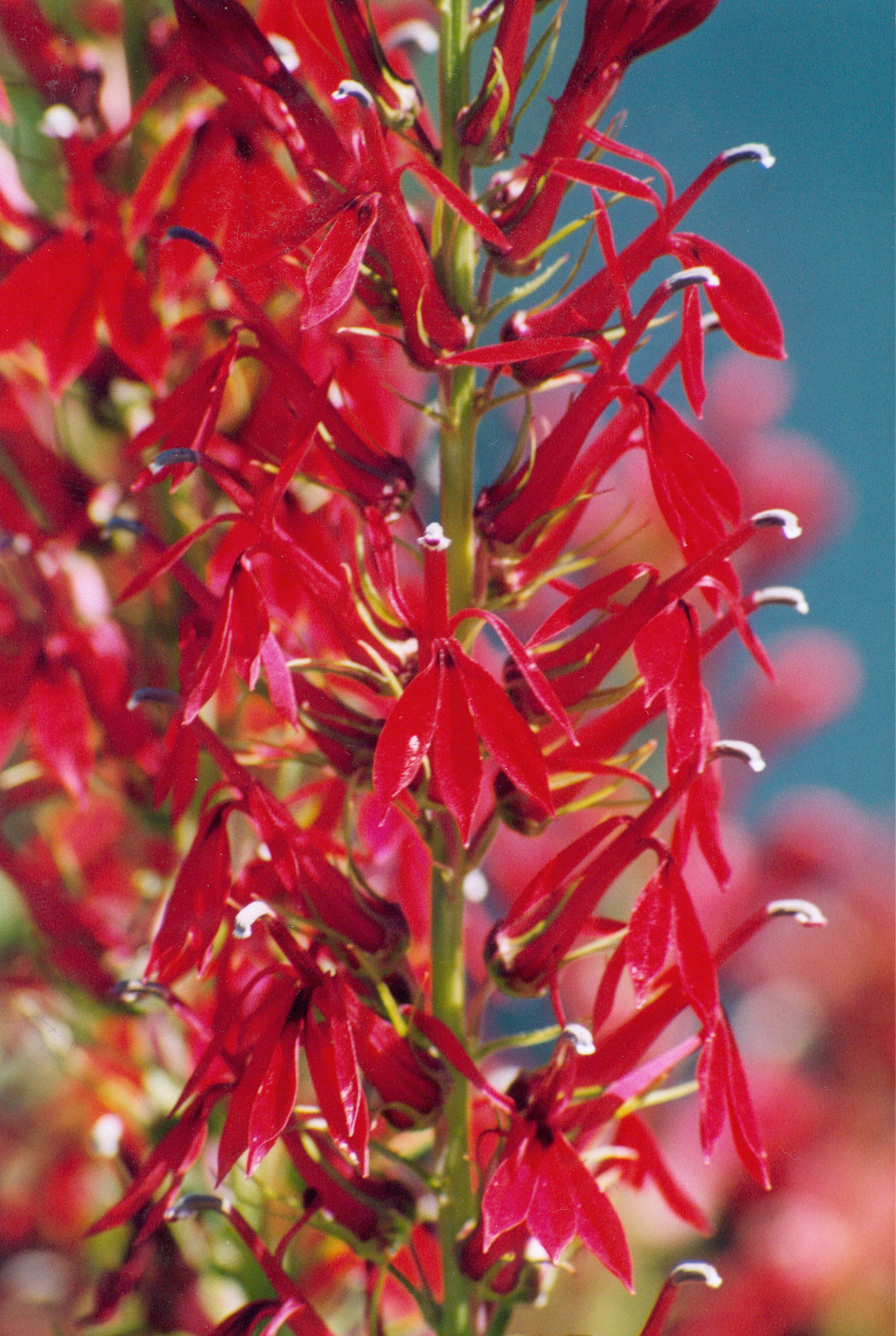
Along the Sequatchie River, Battle Creek, the Little Sequatchie, and the small streams that drop off the plateau into the Tennessee River Gorge, a riparian forest of sycamore (Platanus occidentalis), river birch (Betula nigra), black willow (Salix nigra), and silver maple (Acer saccharinum) lines the banks. Sycamore bark peels in camouflage plates of white, cream, and pale green; large trees are easy to pick out from a distance on a winter ridgeline.
The wet-meadow and stream-margin forb community of cardinal flower, great blue lobelia, jewelweeds, monkey-flowers, turtleheads, water willow, and lizard's tail is cardded under the Wildflowers and woodland forbs H2 above. The emergent aquatics of the still-water margins (pickerelweed, the arrowheads, broadleaf cattail) are in the same H2 under Pickerelweed, arrowheads, and emergent aquatics.
A note on bald cypress (Taxodium distichum): the historical native range of bald cypress on the Tennessee River reaches only to the lower valley near Chattanooga or below. Where it appears in Marion County today it is a planted tree, not native flora. Sources vary on the exact northern limit of its native range, but the plateau and upper gorge are generally considered outside it.
Ferns, lycophytes, and horsetails of the plateau and gorge
Marion County's pteridophyte flora is rich for the latitude, with roughly fifty native ferns and fern allies (lycophytes and horsetails) documented across the cove hardwood forest, the acidic sandstone caprock, the calcareous limestone bluffs of the Tennessee River Gorge, and the wet seeps and stream margins that thread through both. The vascular ferns reproduce by alternation of two free-living generations: the familiar leafy "sporophyte" plant produces spores that grow into a tiny, often microscopic, free-living "gametophyte," which in turn produces the egg and sperm that fuse to become the next sporophyte. Almost every Marion fern below is identified at the sporophyte stage; the gametophyte is rarely seen by anyone but specialists.
The cove-floor ferns (Christmas fern, the wood ferns, the lady ferns, maidenhair, and the beech ferns) are reliable indicators of rich, mesic, near-neutral soil and are used as marker species in regional vegetation classifications. The limestone-bluff ferns (walking fern, the calcareous spleenworts, hart's-tongue, bristle fern, southern maidenhair, purple cliffbrake) hold the calcareous bluffs of the Tennessee River Gorge and the Sequatchie Valley slopes; the acid-rock ferns (mountain spleenwort, lobed and Bradley's spleenworts, the lip ferns, rock polypody) hold the sandstone caprock and the dry plateau outcrops. Wet ground holds the cinnamon and royal ferns, the sensitive fern, the chain ferns, and the climbing fern. The clubmosses, spikemosses, and horsetails are scattered through the cove-floor and stream-margin communities and are often missed by visitors who look only for "ferns."
Walking fern is the headliner of the limestone bluffscape and a useful symbol of how Marion's fern flora fits the underlying geology: the calcareous limestone of the gorge and the acid sandstone of the caprock hold completely different fern communities, with very little overlap, separated sometimes by less than a few hundred vertical feet of rock. The cards below are arranged by family and morphology rather than habitat, but the habitat tags in each Status line let visitors cross-reference back to a specific terrain on the ground.
Wood ferns, shield ferns, and bladder ferns
The Dryopteridaceae, Cystopteridaceae, and allied families dominate the cove-floor fern guild. Most are tuft-forming evergreens or winter-deciduous clump ferns of rich, mesic forest. The wood ferns (Dryopteris) and shield ferns (Polystichum) are the easiest to identify, with bipinnate fronds and prominent round sori; the bladder ferns (Cystopteris) and cliff ferns (Woodsia) are smaller, more delicate, and favor rocky habitats. Christmas fern is by far the most abundant fern in Marion County and the easiest to identify in January woods.
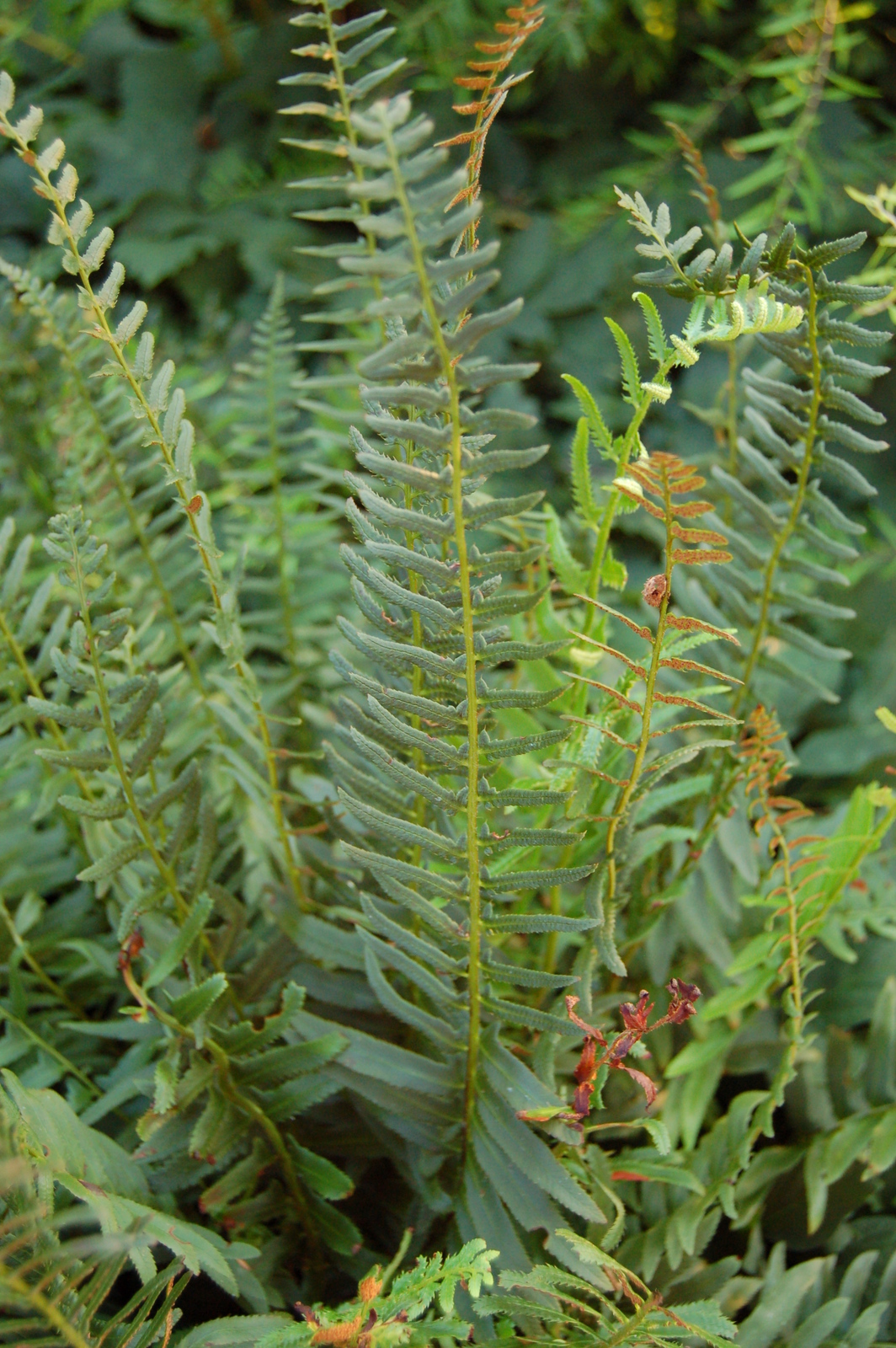
Christmas fern
Polystichum acrostichoides
The most abundant evergreen fern in Marion County. Each pinna is shaped like a Christmas stocking, with a small ear-shaped lobe at the base where the leaflet attaches to the stem. Fertile pinnae at the frond tip are noticeably narrower than sterile pinnae and carry rounded sori on the underside in late summer. The fern stays green through winter, which is what makes it the easiest fern to pick out in January coves.
Status: Native; abundant on cove slopes, mesic uplands, and the floors of the Tennessee River Gorge.
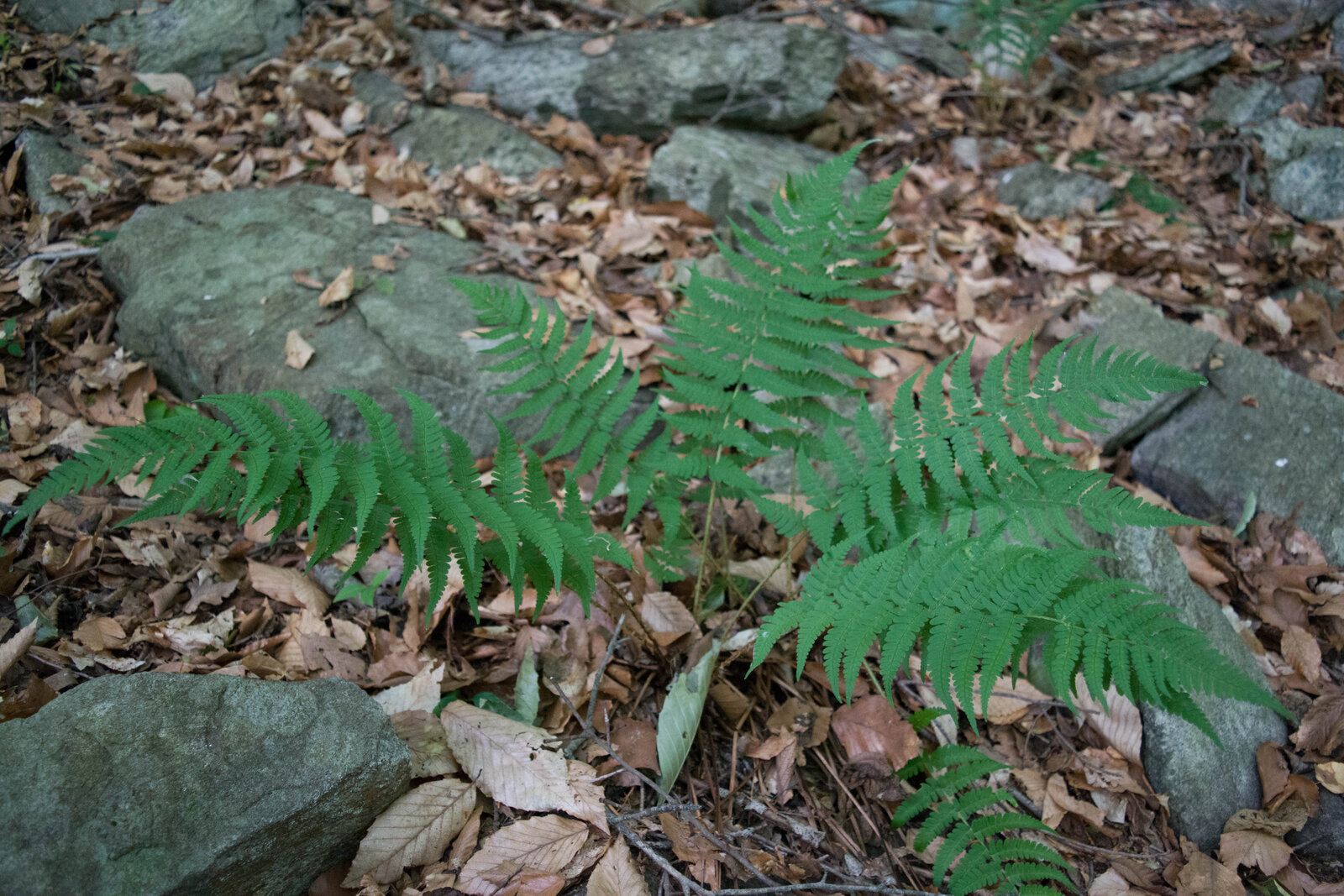
Marginal wood fern
Dryopteris marginalis
A leathery evergreen wood fern of rocky upland slopes, sandstone caprock seams, and the upper margins of cove forests. The diagnostic feature is the position of the sori, which sit on the very margin of each pinnule rather than along the midrib as in most other wood ferns. Fronds are bluish-green, twice-pinnate, and held in a tight crown that stays standing through winter.
Status: Native; common on rocky upland slopes and plateau edges.
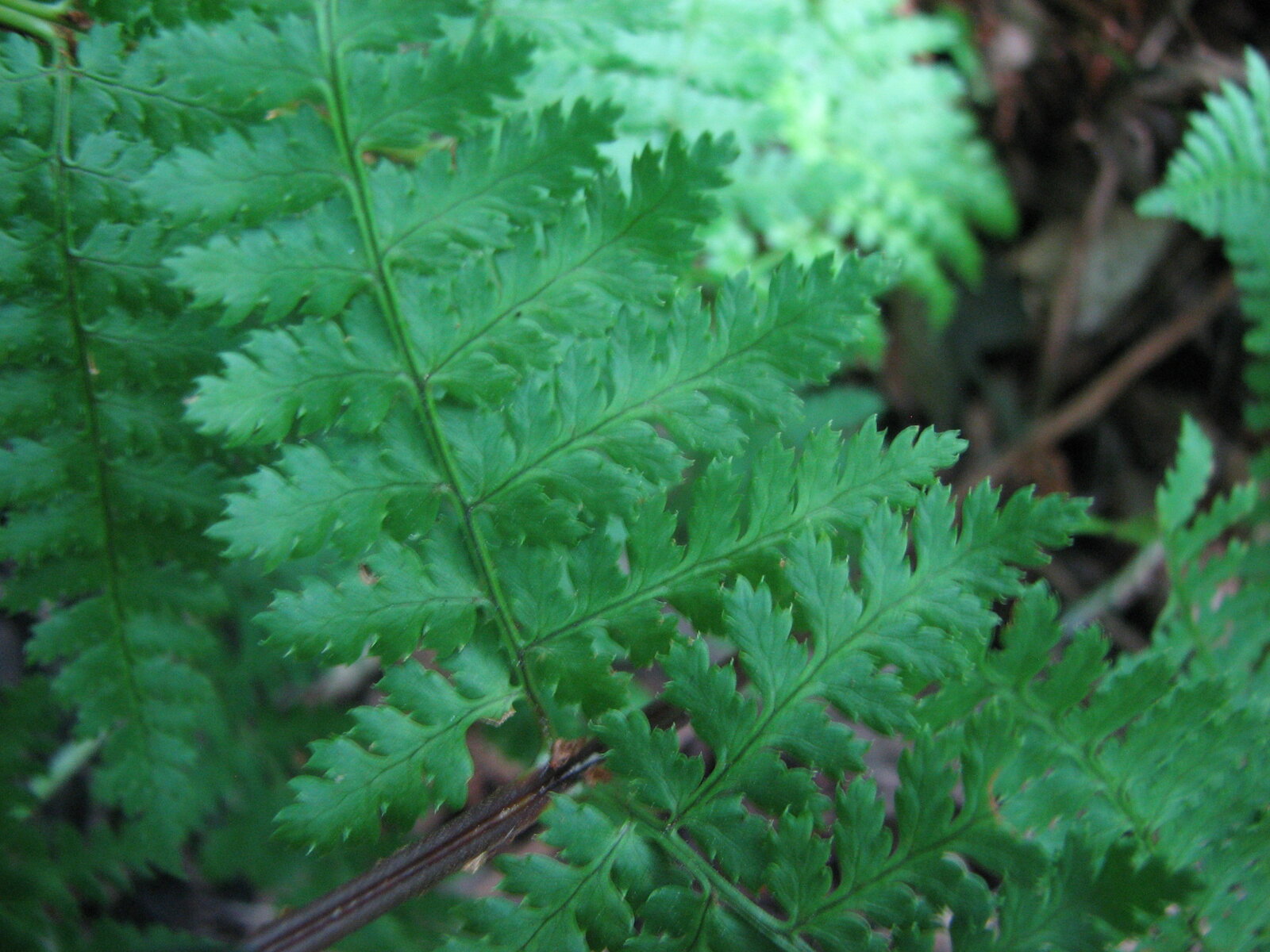
Fancy fern
Dryopteris intermedia
Also called intermediate wood fern. A delicate, finely divided evergreen of rich cove floors and shaded rockhouses. The fronds are more lacy and feathery than marginal wood fern, with a distinctive dark gland on the innermost basal pinnule of the lowest pinna pair (visible with a hand lens) that separates it from look-alikes. One of the parent species of the log fern hybrid below.
Status: Native; common in cove forests and shaded rocky woods.
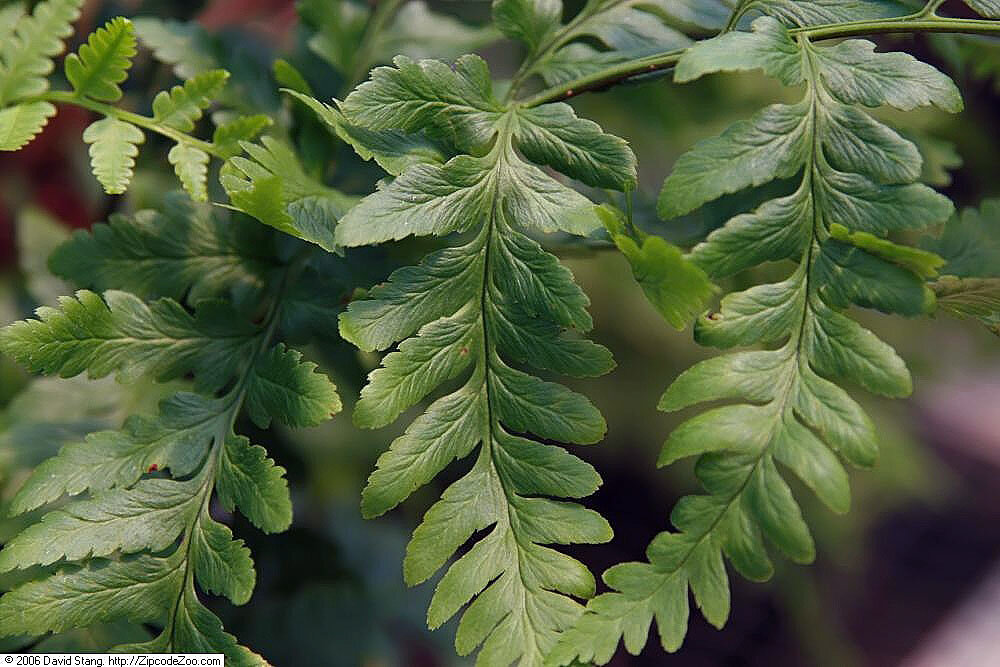
Log fern
Dryopteris celsa
A large wood fern of low, wet cove floors and the bases of rotting logs, where the species name comes from. Fronds reach four feet, longer than the other Marion Dryopteris. The species is an allopolyploid hybrid (descended from a cross between D. goldiana and D. ludoviciana) and is uncommon enough across the southern Appalachians to draw fern hunters when found.
Status: Native; uncommon in low cove floors and wooded swamps.
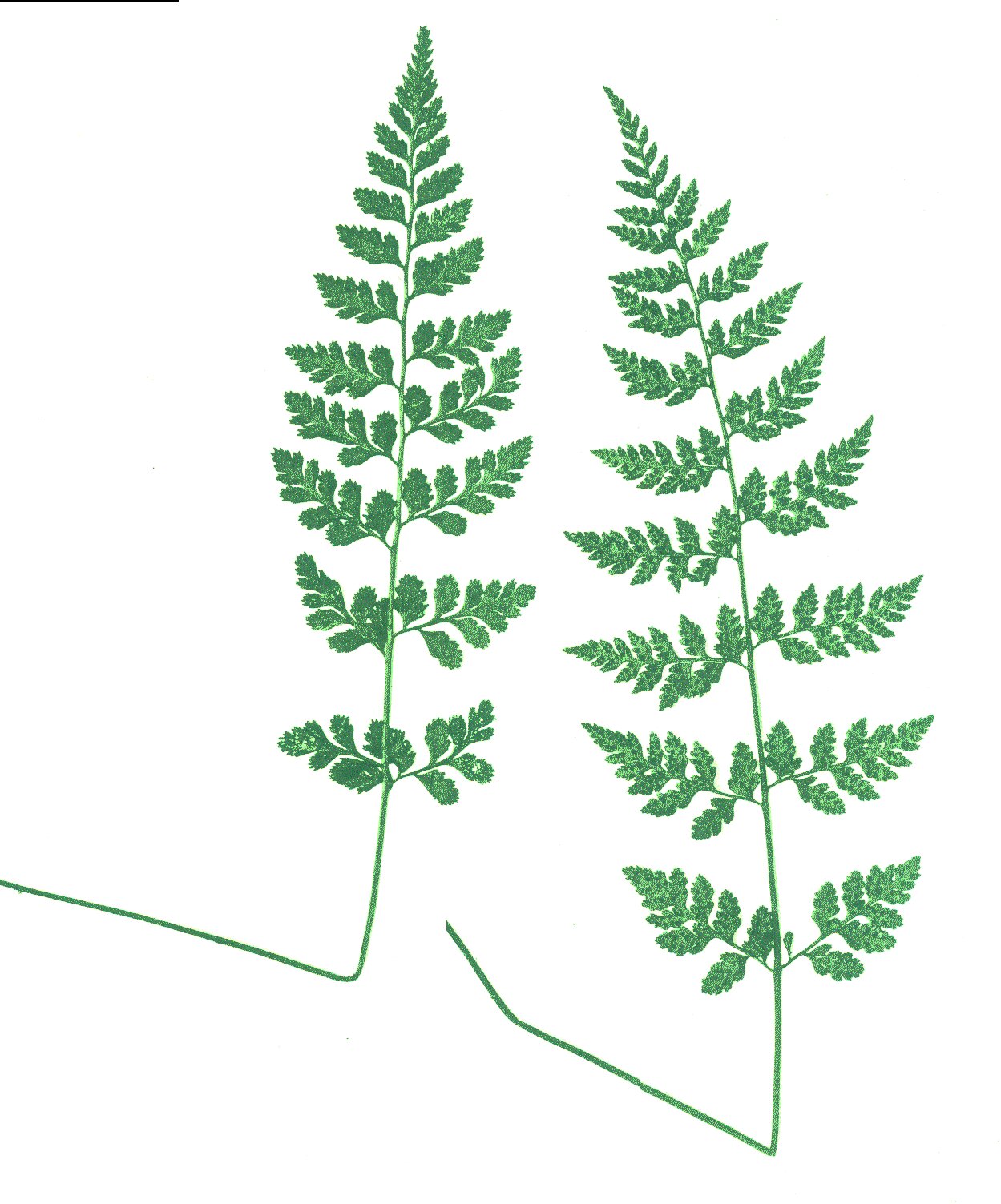
Lowland bladder fern
Cystopteris protrusa
A small, delicate, deciduous fern of rich cove floors. Fronds are bipinnate with thin translucent tissue, and the protruding rhizome tip (the source of the species name "protrusa") sits ahead of the frond cluster on the leaf litter, distinguishing this species from the brittle fern below. Emerges in early spring and is one of the first ferns to unfurl on a cove slope.
Status: Native; common in rich cove forests.
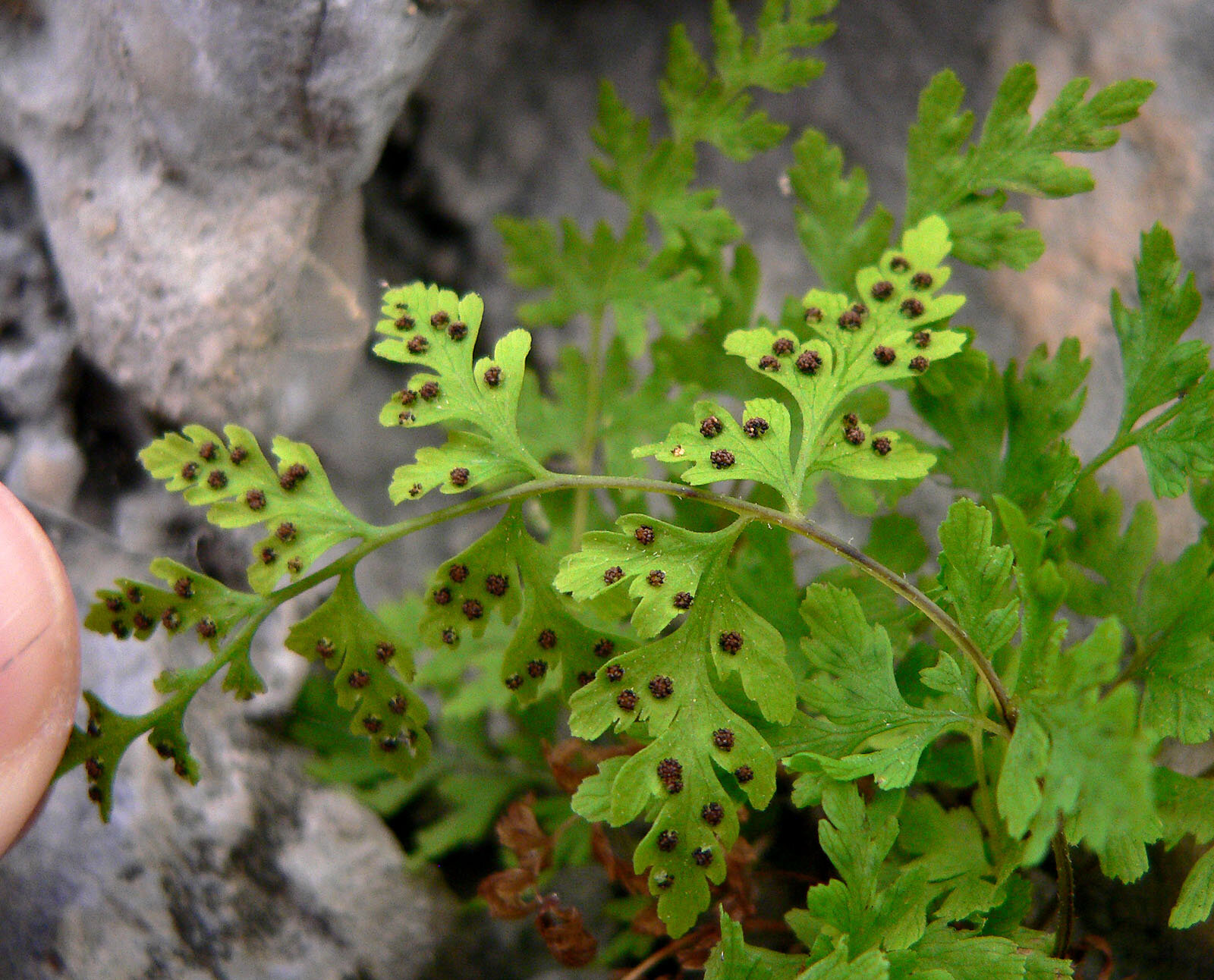
Brittle fern
Cystopteris fragilis
A small bladder fern of shaded calcareous rocks, ledges, and seep walls. The stipe is brittle and snaps easily under pressure, which is the source of the species epithet. Fronds are bipinnate, more delicate than the lowland bladder fern, and grow in scattered clusters rather than colonies. Common on the calcareous bluffs of the Tennessee River Gorge.
Status: Native; common on shaded calcareous rocks and ledges.
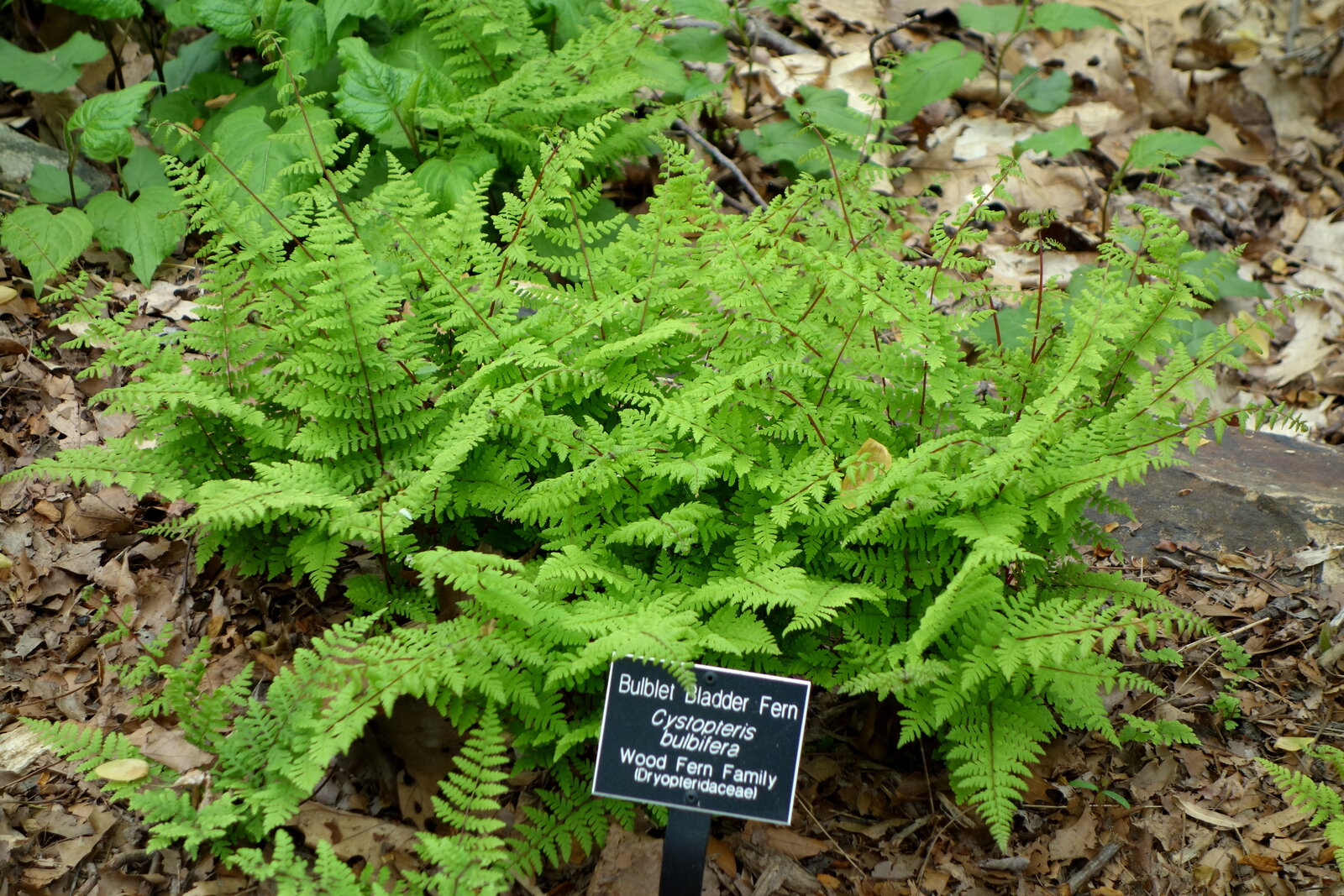
Bulblet bladder fern
Cystopteris bulbifera
The longest of the bladder ferns, with arching fronds that can reach three feet and taper to a slender drip tip. Small green bulblets form on the underside of the rachis and drop to the substrate, where they sprout new plants, an unusual mode of vegetative reproduction among ferns. Strongly tied to calcareous wet walls, dripping seeps, and shaded limestone ledges.
Status: Native; locally common on calcareous seep walls and limestone ledges.
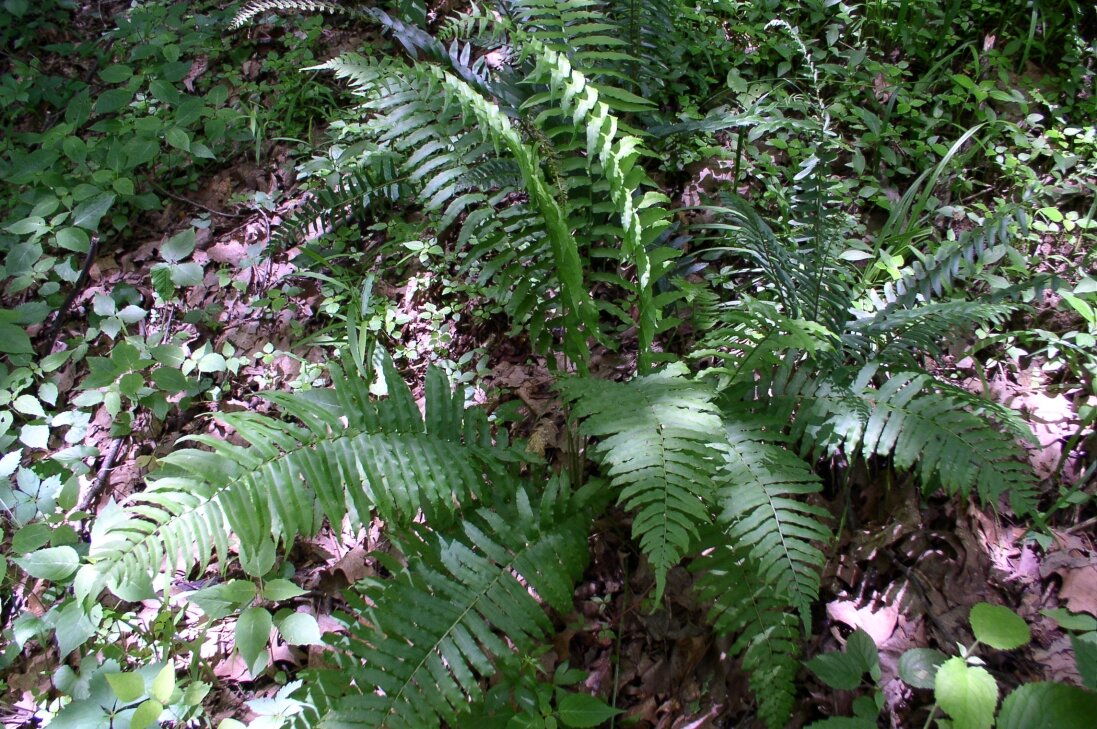
Narrowleaf gladefern
Homalosorus pycnocarpos
A tall, distinctive fern of rich cove floors with a sword-shaped, once-pinnate frond and long narrow pinnae that lack secondary division. The frond shape is unlike any other Marion fern, which makes ID straightforward where it occurs. Formerly placed in Diplazium and Athyrium before the family Diplaziopsidaceae was recognized.
Status: Native; uncommon in rich cove forests.
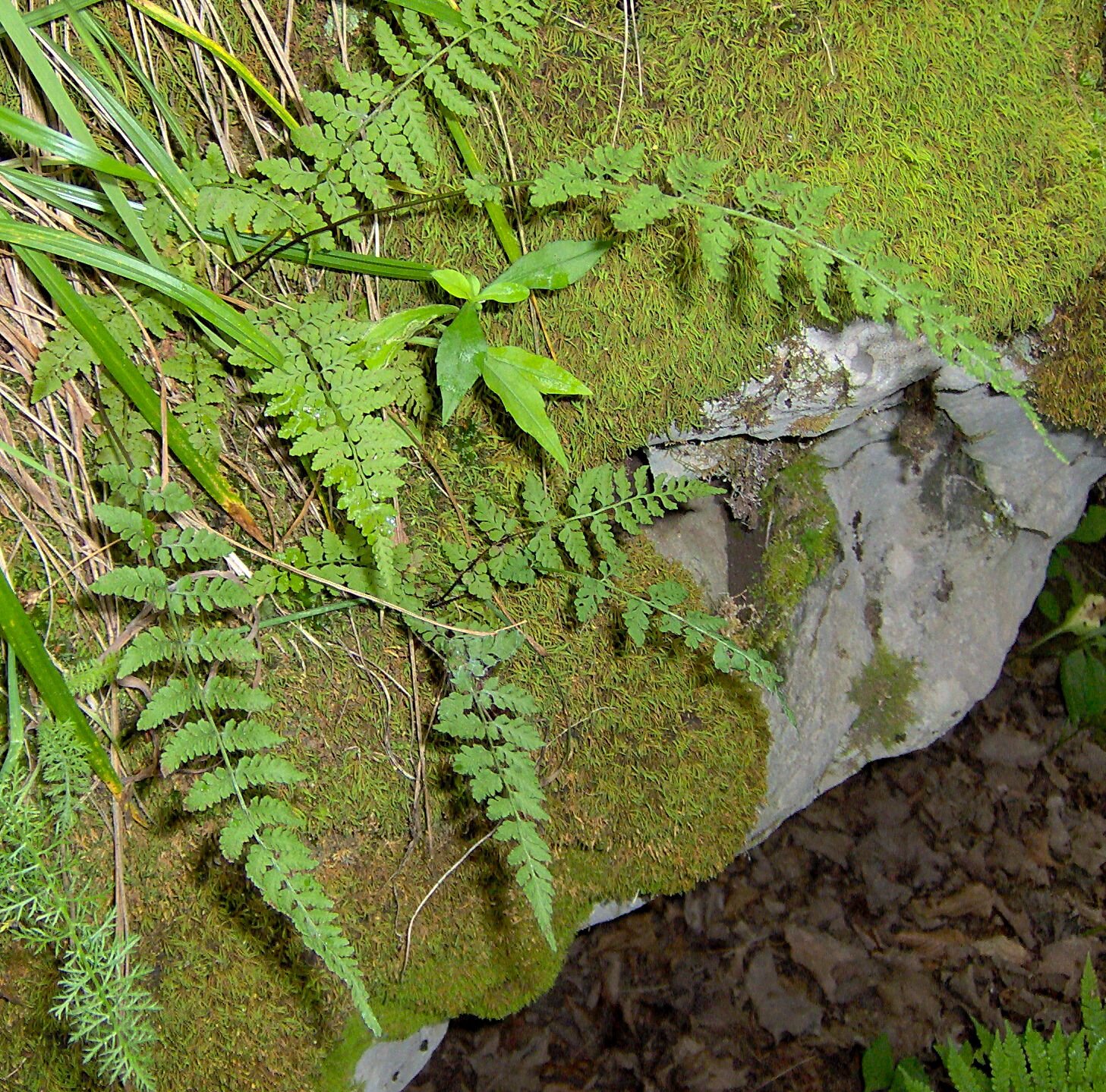
Blunt-lobe cliff fern
Woodsia obtusa
A small tufted fern of shaded rock faces, ledges, and rocky cove slopes. Fronds are once-pinnate-pinnatifid with blunt-tipped pinnules and a stipe covered in pale scales near the base. Common on the sandstone caprock and Tennessee River Gorge limestone outcrops; tolerates seasonally dry conditions better than most other Marion ferns.
Status: Native; common on shaded rock faces.
Lady fern and silvery glade fern
Two large, deciduous ferns of rich cove floors with finely divided, lacy fronds. Both belong to the Athyriaceae and were historically grouped under Athyrium. They are the bright-green fern silhouettes most visible on a cove slope in midsummer.
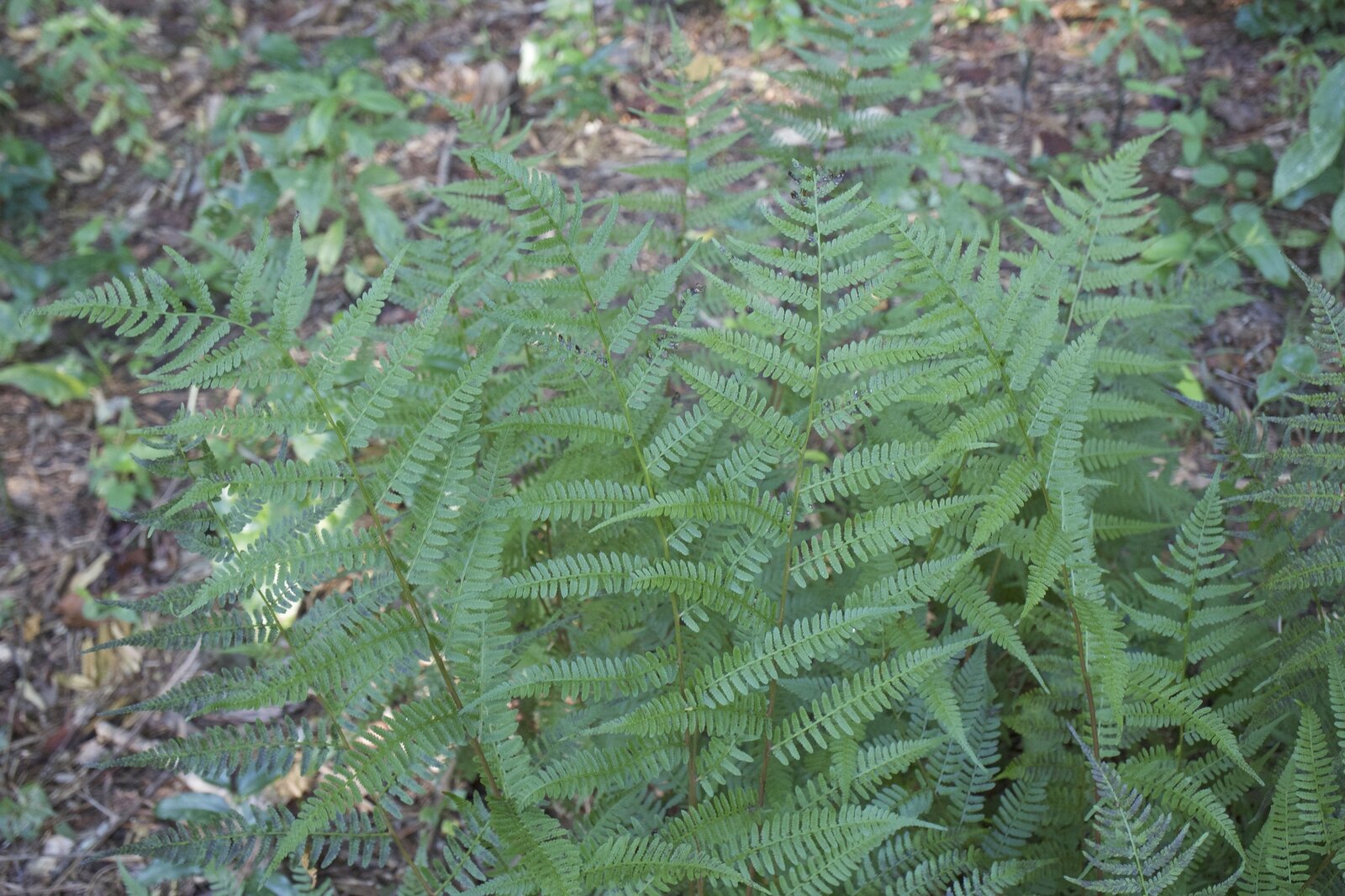
Southern lady fern
Athyrium asplenioides
A graceful, finely divided fern of rich cove floors, stream banks, and shaded openings. Fronds are bipinnate to tripinnate with a reddish or straw-colored stipe and elongate, hooked sori (J-shaped or horseshoe-shaped) along the pinnules. Distinct from the silvery glade fern below by its more finely divided fronds and pinker stipe.
Status: Native; common in rich coves and stream margins.
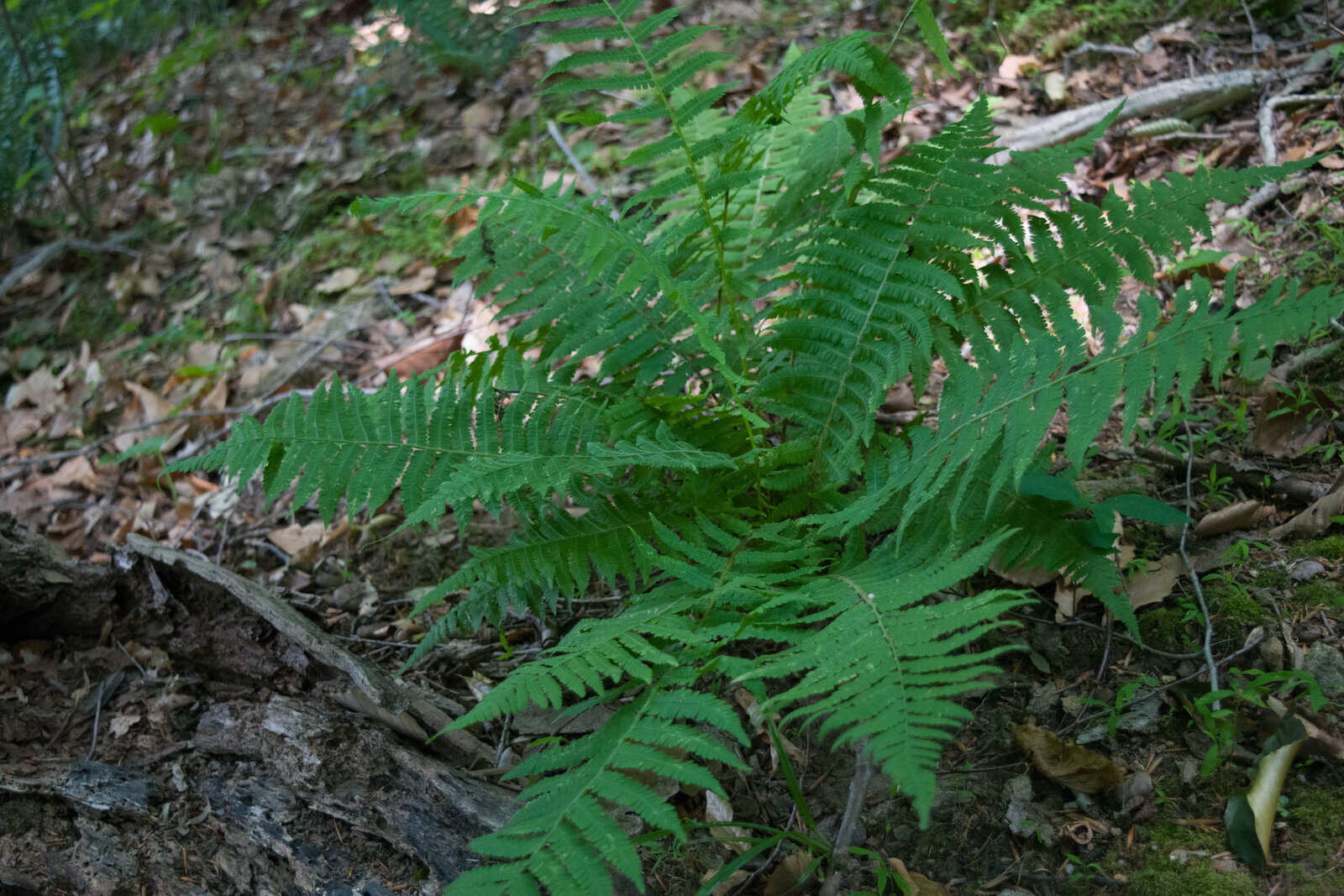
Silvery glade fern
Deparia acrostichoides
A tall deciduous fern of rich cove floors, named for the conspicuous linear sori on the frond underside that take on a silvery sheen as the indusia mature. Fronds are once-pinnate-pinnatifid with relatively coarse pinnae compared to the lady fern. Often grows alongside lady fern in the same cove, and the silvery undersurface is the easiest field cue.
Status: Native; common in rich cove forests.
Sensitive fern and the chain ferns
Three ferns of wet ground, all with distinctive dimorphic fronds (separate fertile and sterile fronds with very different shapes). The sensitive fern is named for how quickly the fronds collapse after the first frost. The chain ferns get their name from the chain-like rows of sori arranged along the veins.
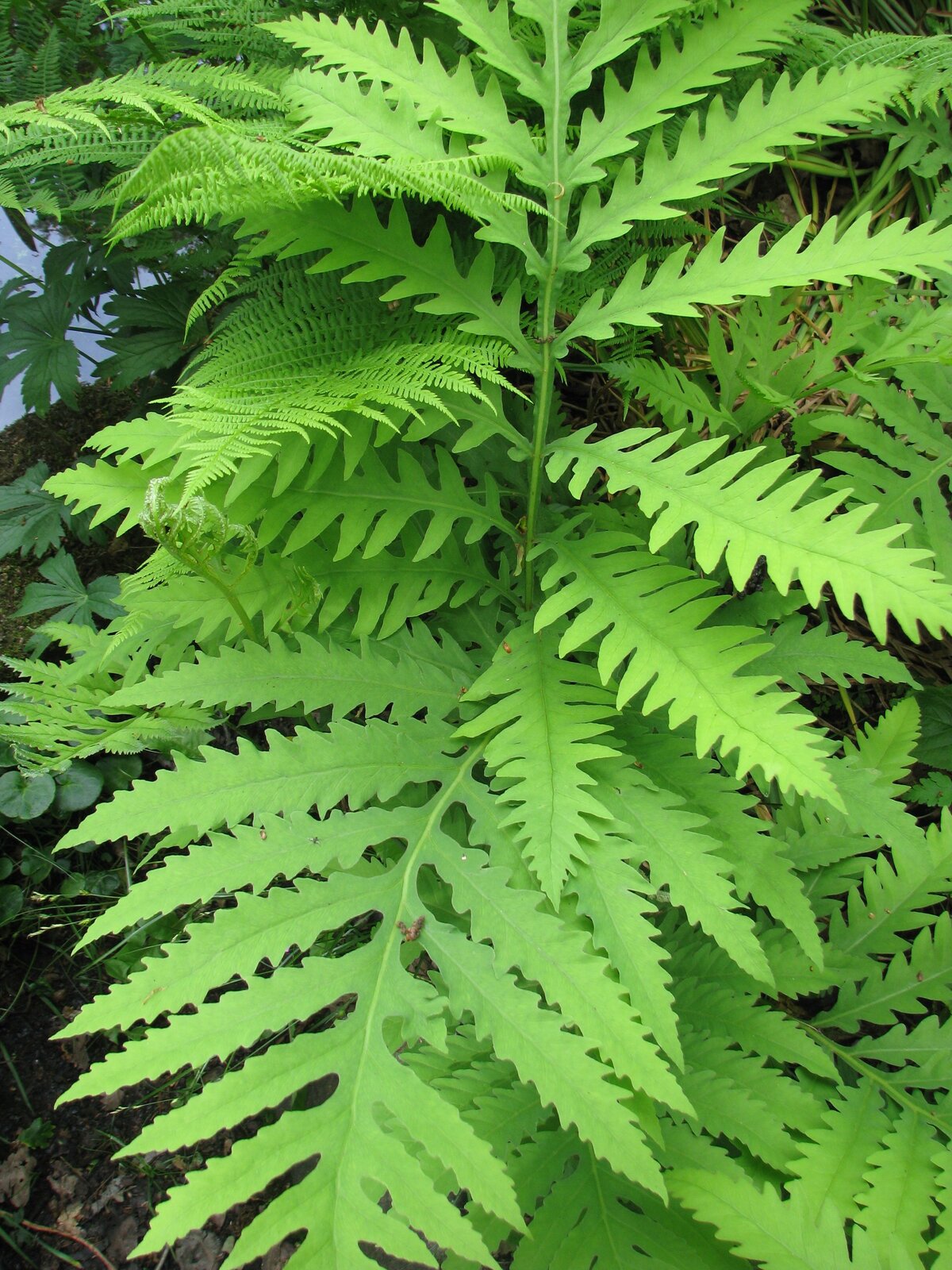
Sensitive fern
Onoclea sensibilis
A coarse, deciduous fern of wet meadows, stream banks, and seepy roadside ditches. The sterile frond is broadly pinnatifid with wavy-edged pinnae connected by a winged rachis, unlike any other Marion fern. A separate fertile frond emerges in late summer as a stiff brown spike covered in bead-like sporangial clusters that persist through winter. The common name refers to how quickly the sterile fronds wilt at the first frost.
Status: Native; common in wet meadows and stream margins.
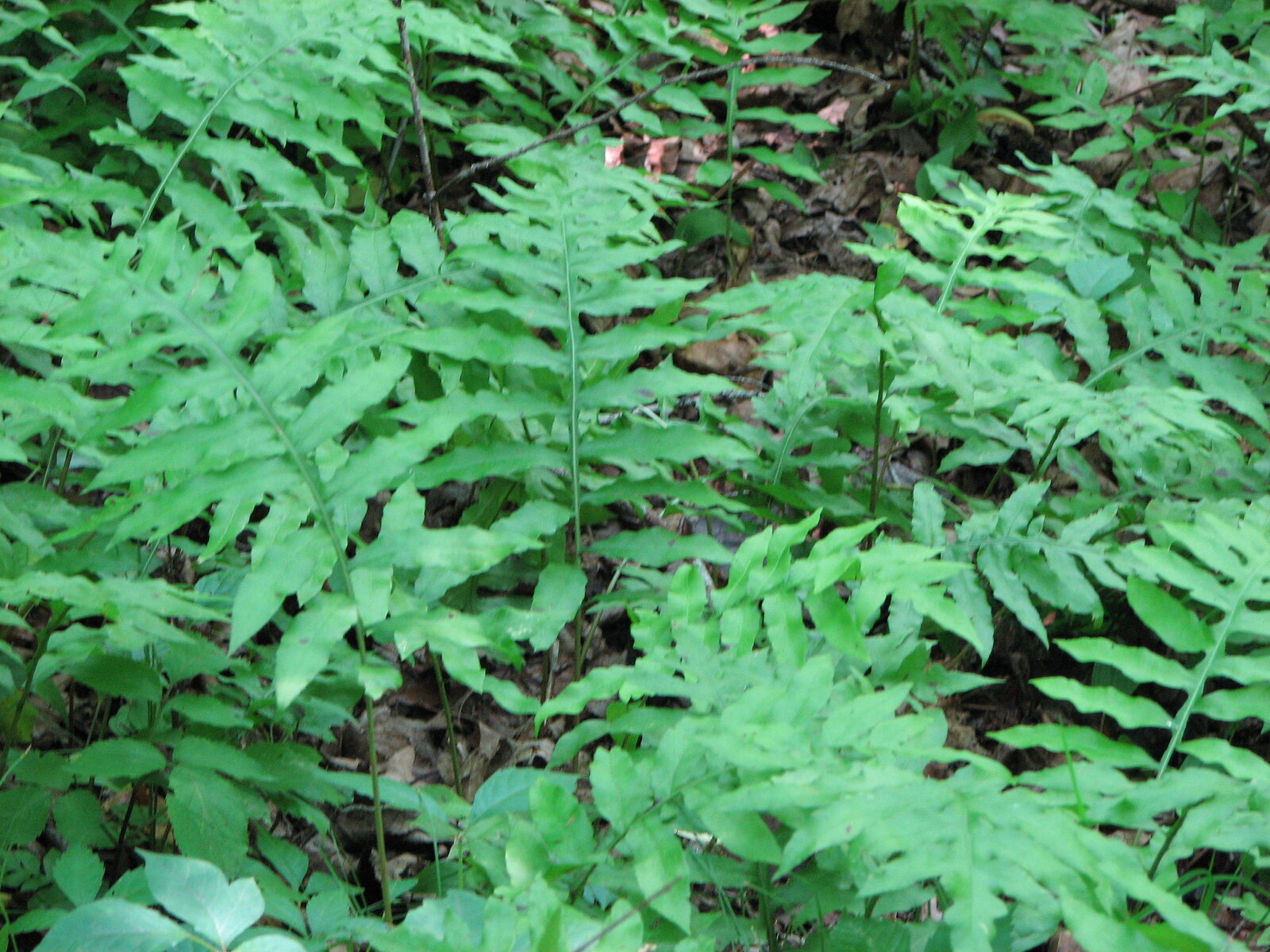
Netted chain fern
Woodwardia areolata
A wetland fern with broad, glossy, pinnatifid sterile fronds that look superficially like sensitive fern. The two are easily separated by the venation: netted chain fern has a fine net-like venation pattern on the pinnae (visible against the light), while sensitive fern has free-branching veins. A separate fertile frond emerges in summer with the chain-like sori arranged along the midrib of each pinna.
Status: Native; locally common in wet woods and seepy hollows.
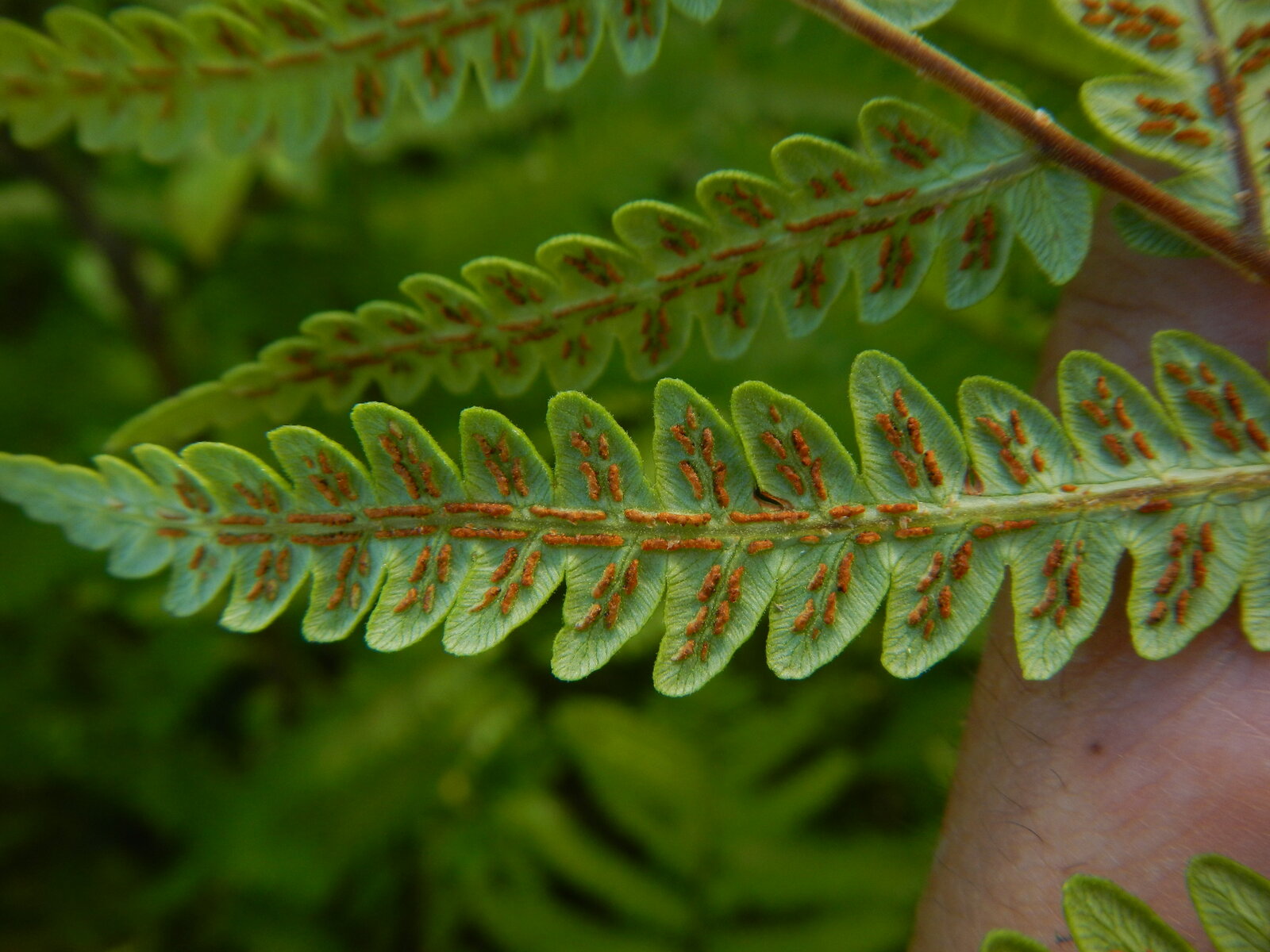
Virginia chain fern
Anchistea virginica
A tall (up to four feet) wetland fern of seepy bogs, sphagnum margins, and acid swamps. Fronds are once-pinnate-pinnatifid with the chain-like sori arranged in two rows along the costa on the underside of each pinnule. Marion records are scattered; the species reaches its inland limit on the Cumberland Plateau and is state-listed as a species of special concern. Formerly placed in Woodwardia.
Status: Native; state special-concern (S2), G-rank G5. Rare in plateau seeps and acid swamps.
Spleenworts and the limestone-bluff ferns
The genus Asplenium reaches its richest diversity in the Marion-county-area Cumberland Plateau and Tennessee River Gorge, where calcareous limestone bluffs, sandstone overhangs, and shaded rock faces support a dozen-plus species and natural hybrids in a small space. Walking fern (Asplenium rhizophyllum) is the headliner of the limestone bluffscape: it puts down roots wherever the tip of an arching frond touches mossy limestone, producing daughter plants that, over many seasons, "walk" the colony across a ledge face. The other spleenworts split cleanly along rock chemistry, with mountain spleenwort and lobed spleenwort holding the acid sandstone outcrops and walking fern, black-stem spleenwort, and Bradley's spleenwort holding the calcareous limestone. The federally threatened hart's-tongue fern reaches its only southern Appalachian foothold in deep limestone sinkholes nearby. Two other limestone-bluff specialists, the Appalachian bristle fern and the gametophyte-only Appalachian shoestring fern, join the spleenworts in this group.
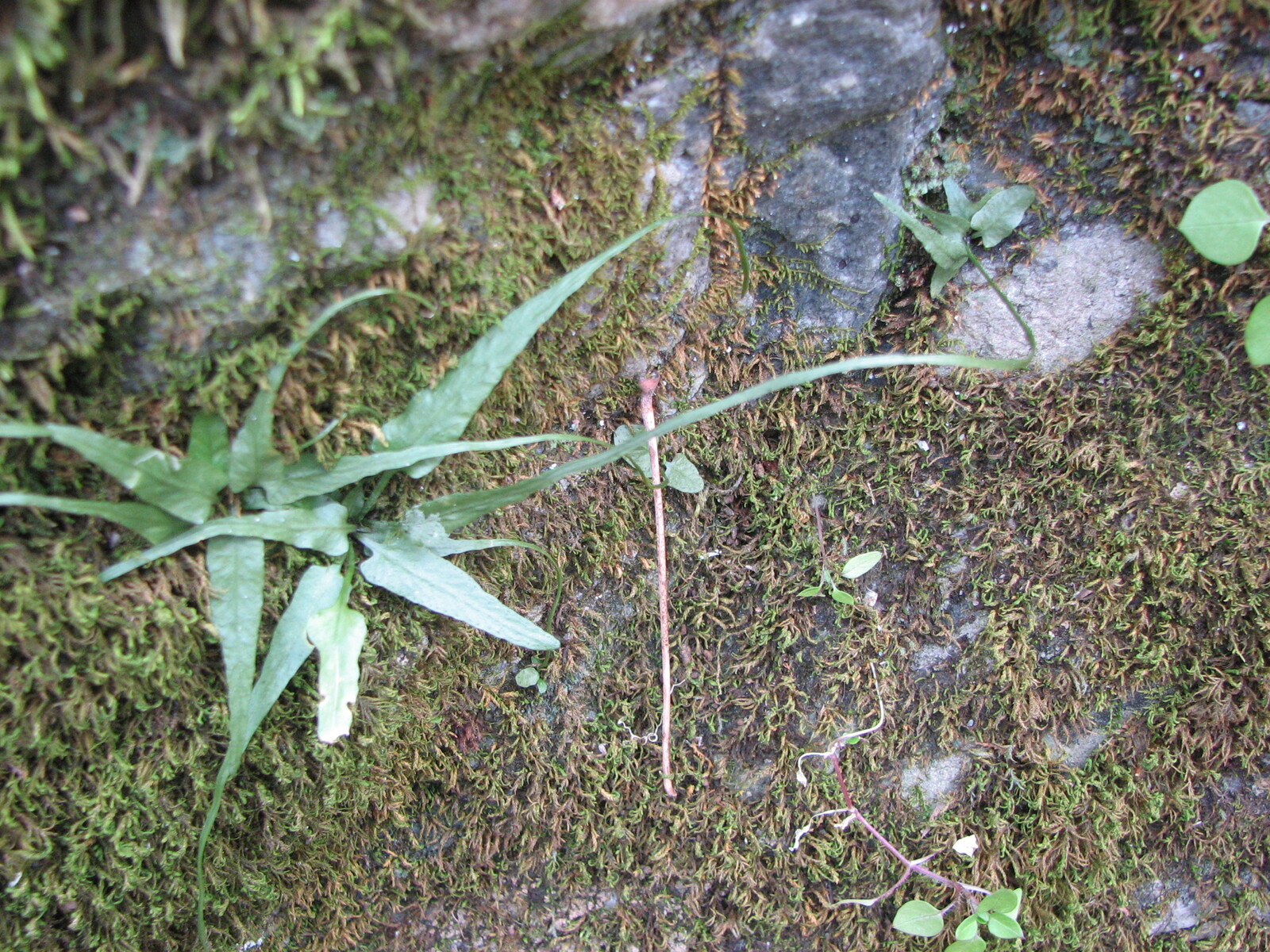
Walking fern
Asplenium rhizophyllum
The headliner of the limestone bluffscape. Long, narrow, undivided fronds taper to whip-like tips that root wherever they touch mossy limestone, producing daughter plants that gradually carry the colony across a ledge. Fronds rarely exceed twelve inches but the colonies are sometimes several feet across after decades of "walking." Strictly tied to shaded calcareous rock; absent from the acid sandstone caprock above.
Status: Native; locally distinctive on shaded limestone bluffs and ledges.
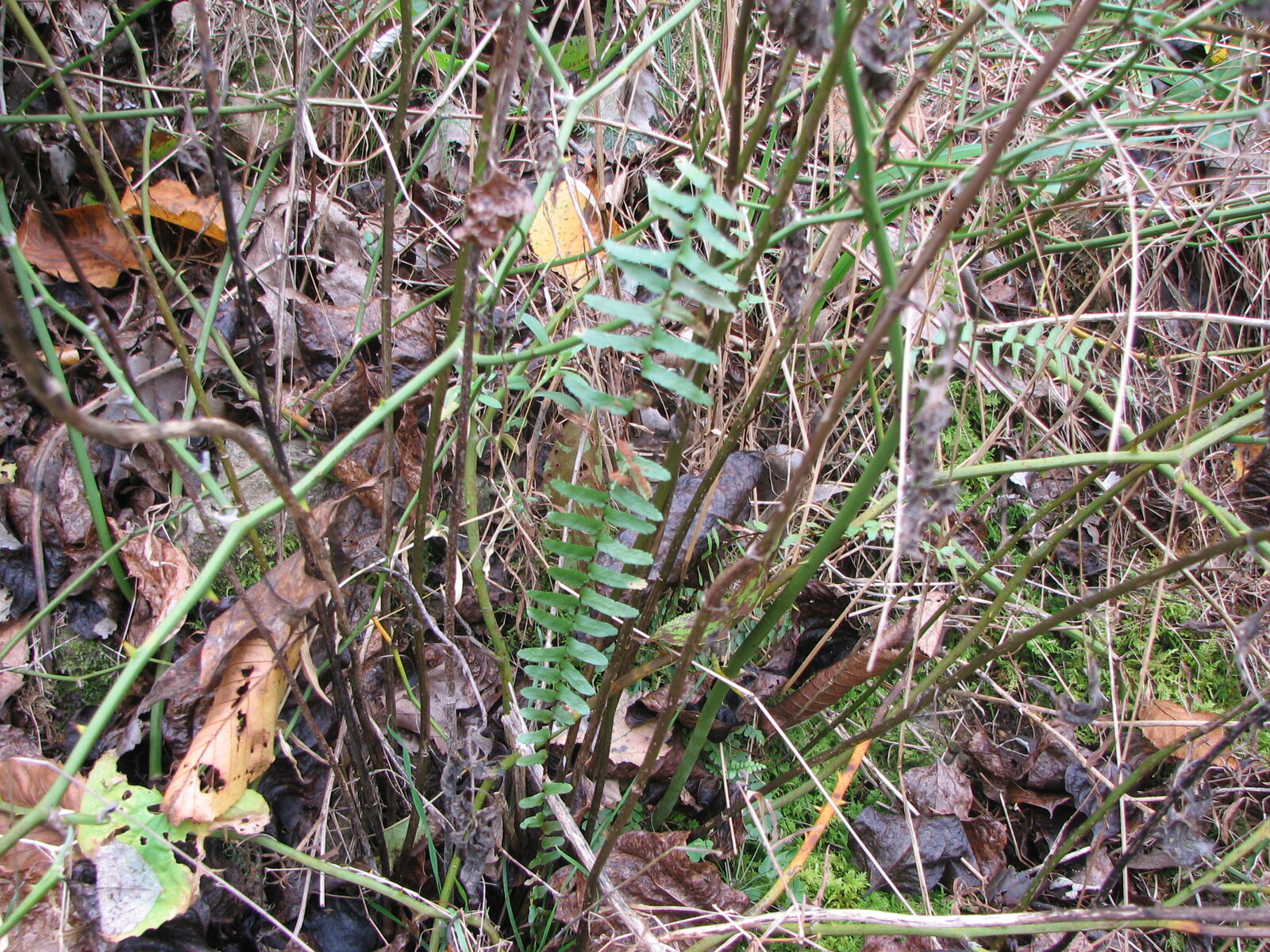
Ebony spleenwort
Asplenium platyneuron
The most widespread Marion spleenwort, common on shaded rocky slopes, mossy banks, and old stone walls. The stipe is dark glossy reddish-brown to black ("ebony") and the once-pinnate frond is asymmetric, with each pinna offset slightly upward from the one below. Fertile fronds stand erect while sterile fronds spread outward, a useful field cue.
Status: Native; common across shaded slopes and ledges.
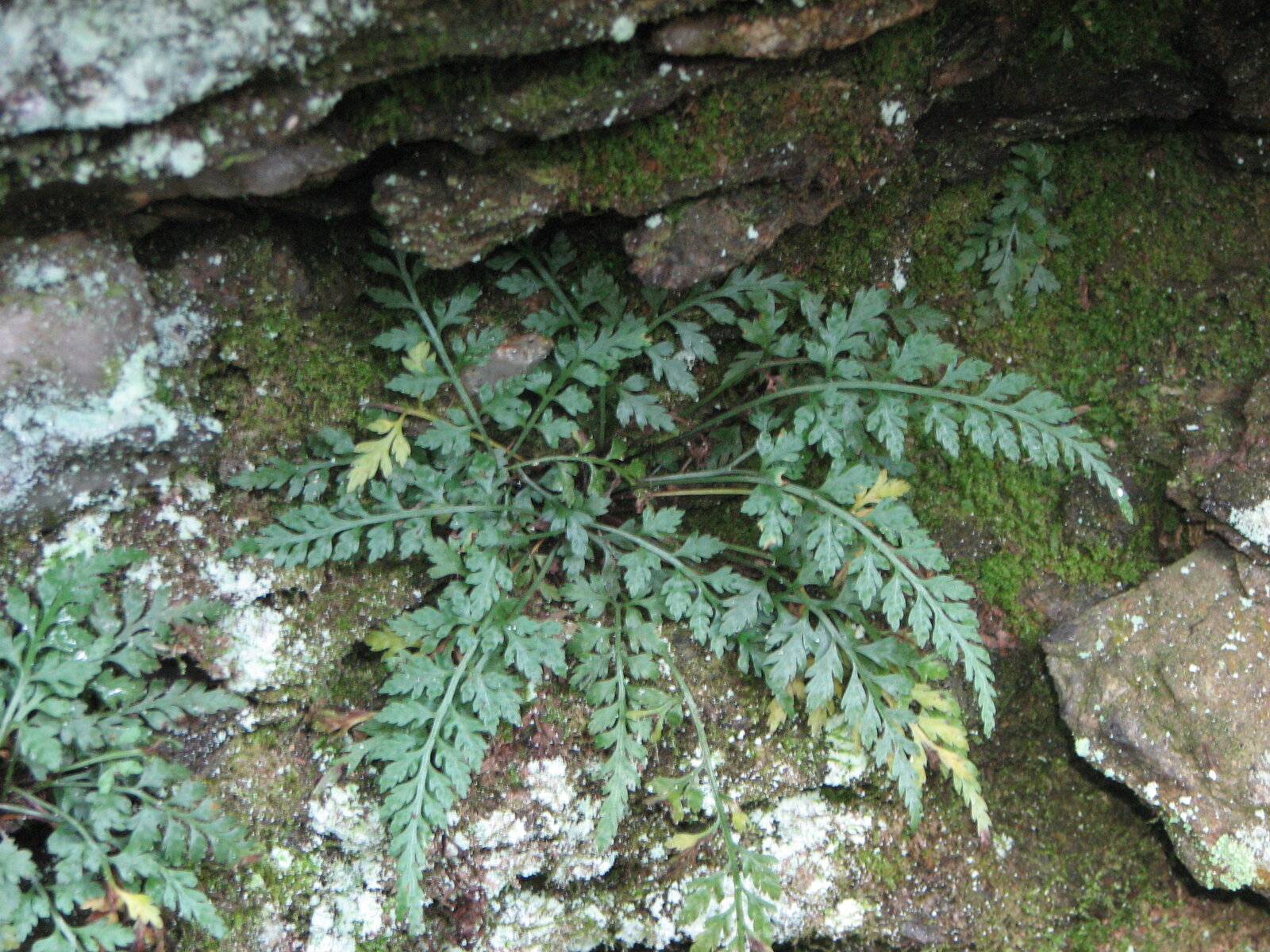
Mountain spleenwort
Asplenium montanum
A small spleenwort wedged into the cracks of shaded acid sandstone outcrops, almost exclusively. Fronds are bipinnate with widely spaced pinnae, dark-blue-green, and rarely exceed four inches. The plant is one of the parent species of several hybrid spleenworts including the lobed spleenwort and Bradley's spleenwort below.
Status: Native; uncommon on shaded acid sandstone.
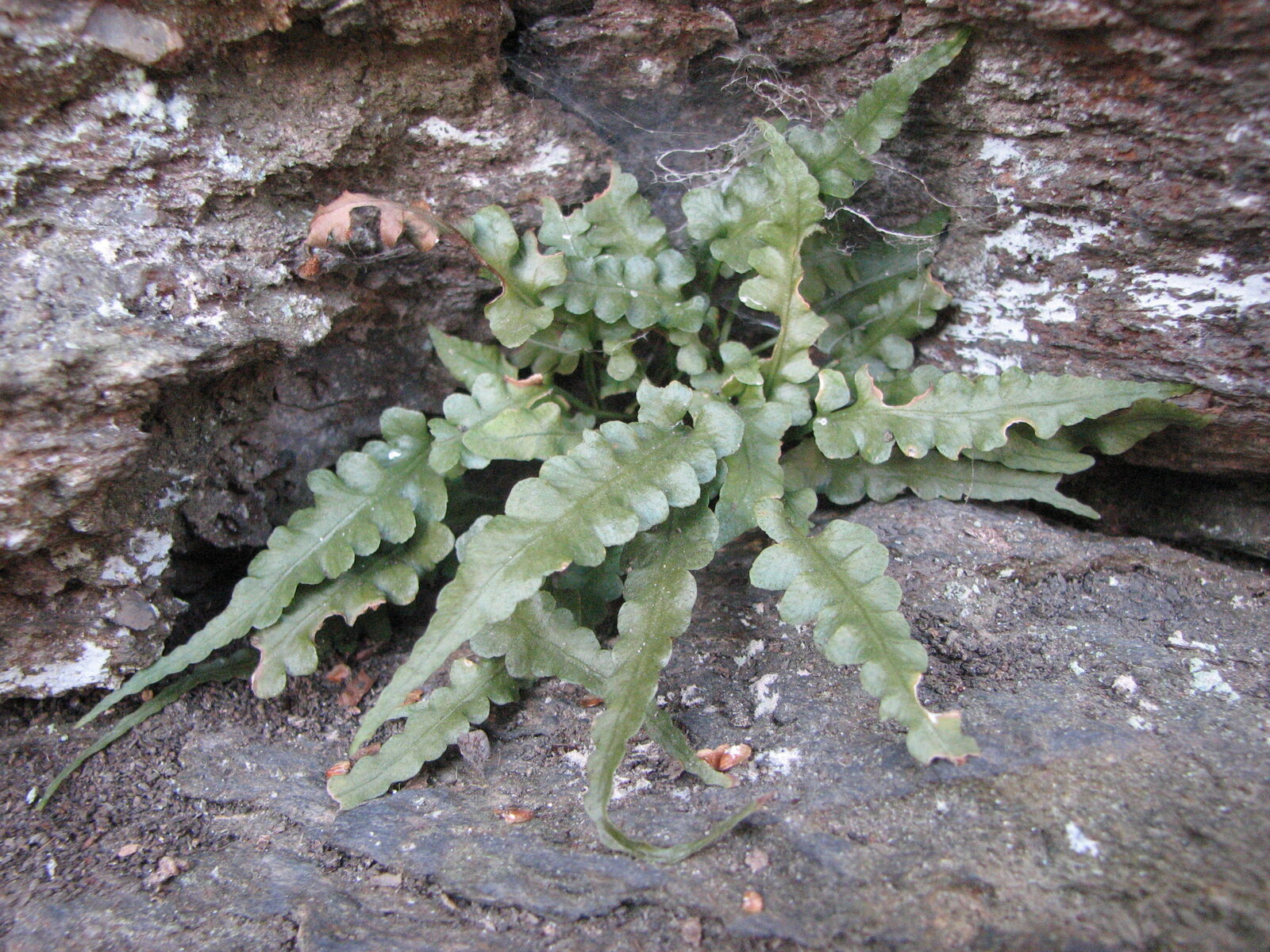
Lobed spleenwort
Asplenium pinnatifidum
A natural hybrid (mountain spleenwort × walking fern) that has stabilized into a fertile species. Fronds are intermediate between the parents: lobed-pinnatifid rather than fully pinnate, with a tapered tip that sometimes tries to root like its walking-fern parent. Occurs on acid sandstone where the mountain spleenwort grows, never on the calcareous bluffs.
Status: Native; uncommon on acid sandstone outcrops.
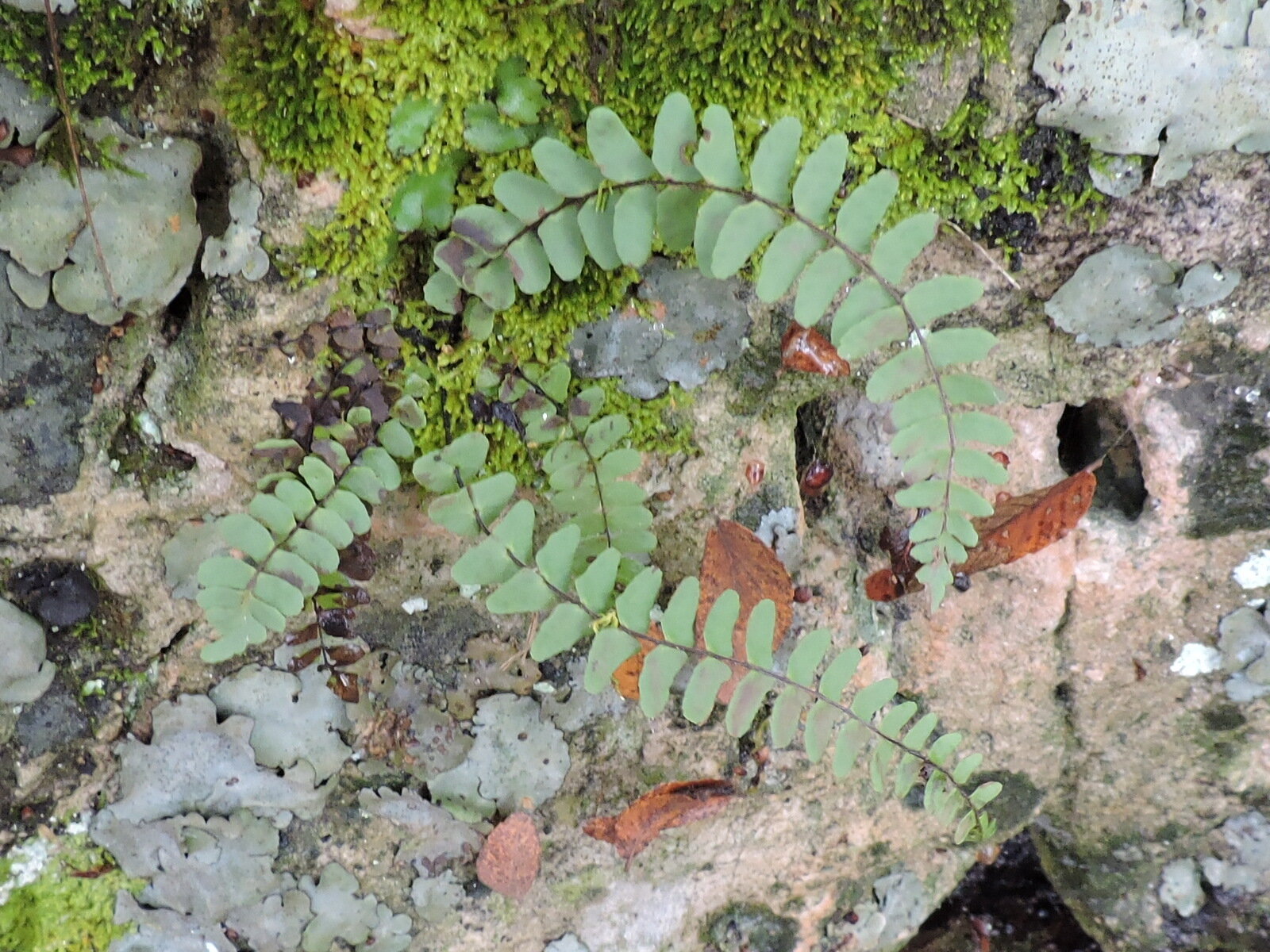
Black-stem spleenwort
Asplenium resiliens
A small evergreen spleenwort of shaded calcareous rock and limestone ledges. Resembles ebony spleenwort but with a darker, more wiry stipe extending into the rachis, opposite (not alternate) pinnae, and a more upright habit. Strictly calcicolous, marking the limestone face where ebony spleenwort marks the more general rocky slope.
Status: Native; uncommon on shaded calcareous rock.
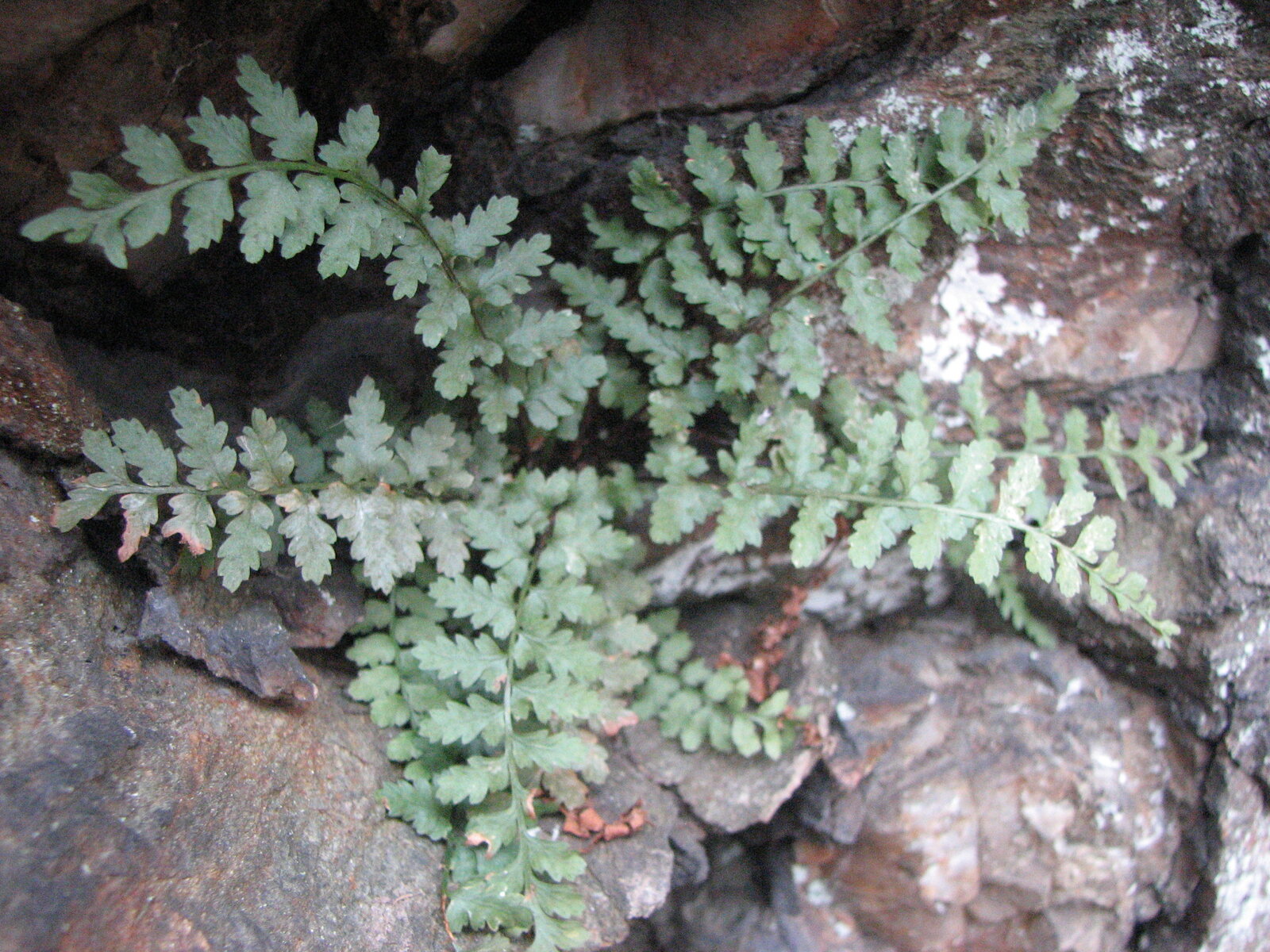
Bradley's spleenwort
Asplenium bradleyi
Another stabilized fertile hybrid of the Marion spleenwort complex (mountain spleenwort × ebony spleenwort). Fronds are once-pinnate with deeply lobed pinnae, dark stipe, and a tapering tip. Restricted to shaded acid sandstone outcrops where both parents occur, which is exactly the kind of habitat the Marion plateau caprock provides.
Status: Native; uncommon on acid sandstone outcrops.
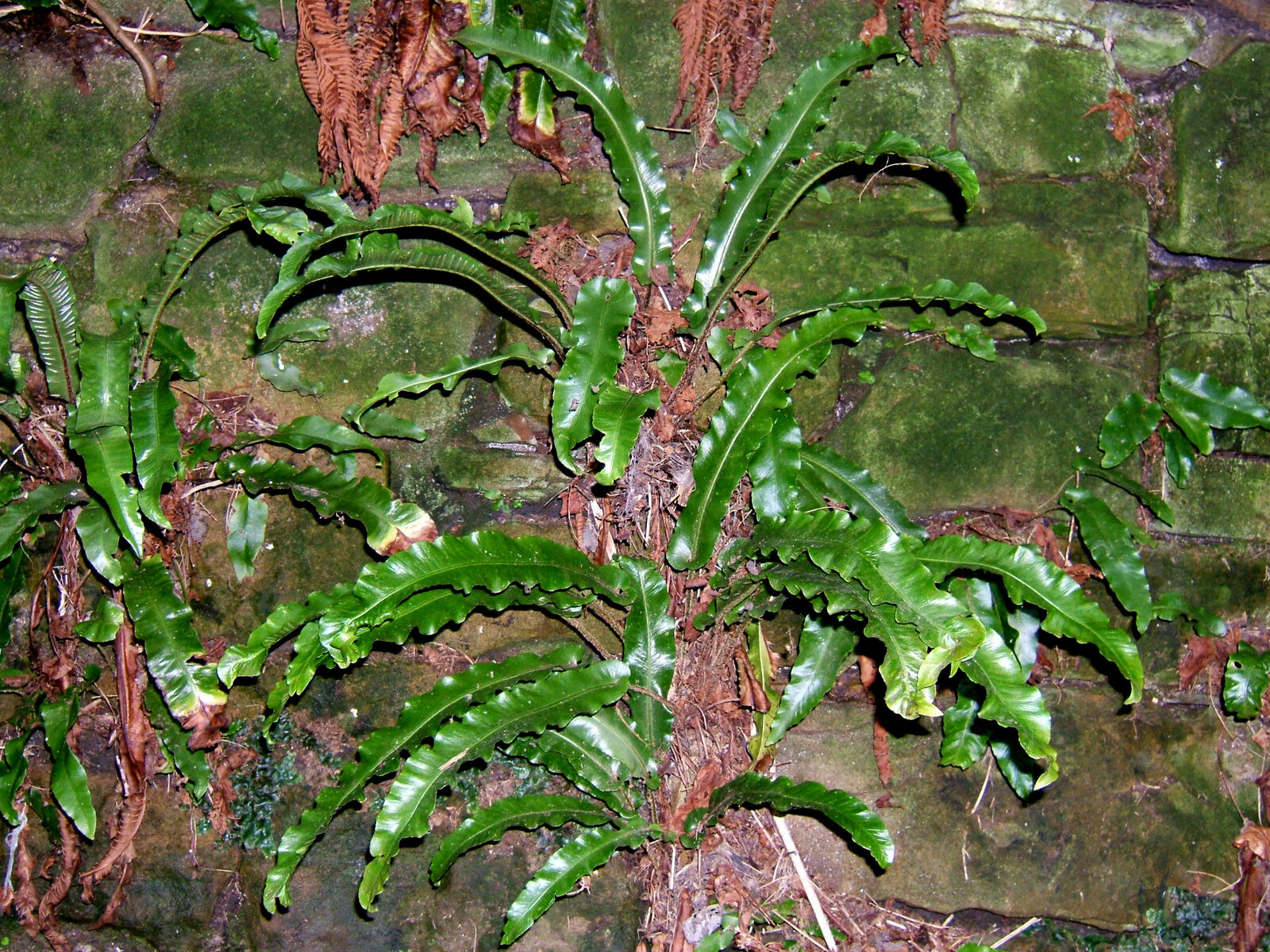
American hart's-tongue fern
Asplenium scolopendrium var. americanum
A federally threatened fern of deep, cool limestone sinkholes. The variety americanum is restricted to the eastern United States and is genetically distinct from the European hart's-tongue. Fronds are bright-green, strap-shaped, undivided, and held in a basal rosette, completely unlike any other Marion fern. Tennessee holds the first North American discovery of the variety (1849) and the species reaches the southern Cumberland Plateau in scattered limestone-sinkhole pockets; specific Marion records sit at the southern edge of the variety's range.
Status: Native; federally threatened (var. americanum). Confined to deep limestone sinkholes.
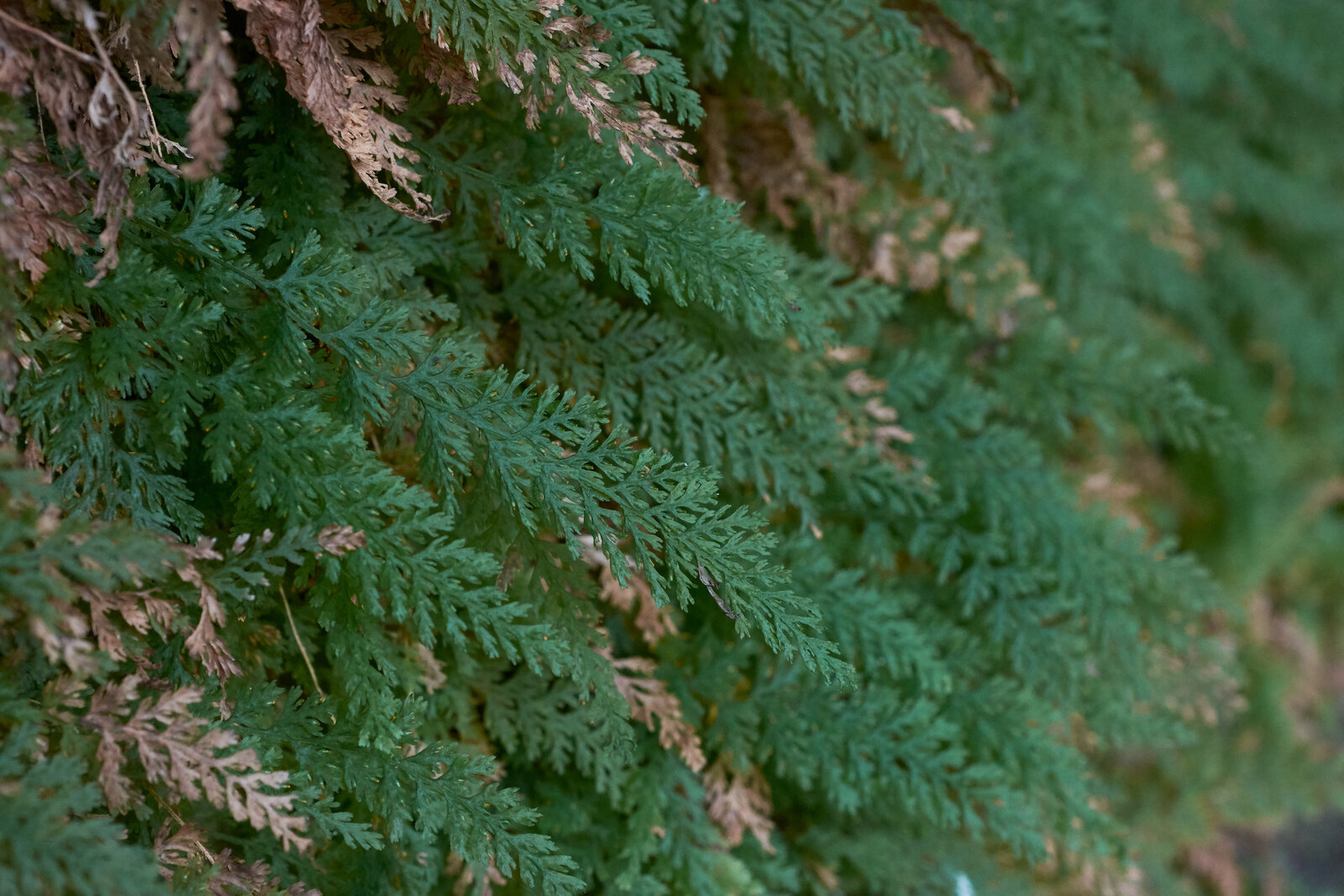
Appalachian bristle fern
Vandenboschia boschiana
A filmy-fern, the only North American representative of a family otherwise concentrated in tropical cloud forests. The translucent, one-cell-thick fronds form dark mats on the back walls of shaded rockhouses and behind seep waterfalls, where humidity stays high year-round. The Sewanee Domain checklist records the species along the Franklin/Marion plateau escarpment; presence on the Marion-county side is consistent with available rockhouse habitat but is logged as a carry-forward record.
Status: Native; state-threatened (S1S2), G4. Strictly tied to rockhouses and damp shaded overhangs.
Cinnamon and royal ferns
The Osmundaceae are a small, ancient fern family with a fossil record reaching back into the Permian. Two species occur in Marion. Both are tall, deciduous, and tied to wet ground: seepy hollows, stream margins, and the wet edges of plateau heath. Both bear separate fertile fronds or fertile pinnae rather than sori on the underside of the regular leaf.
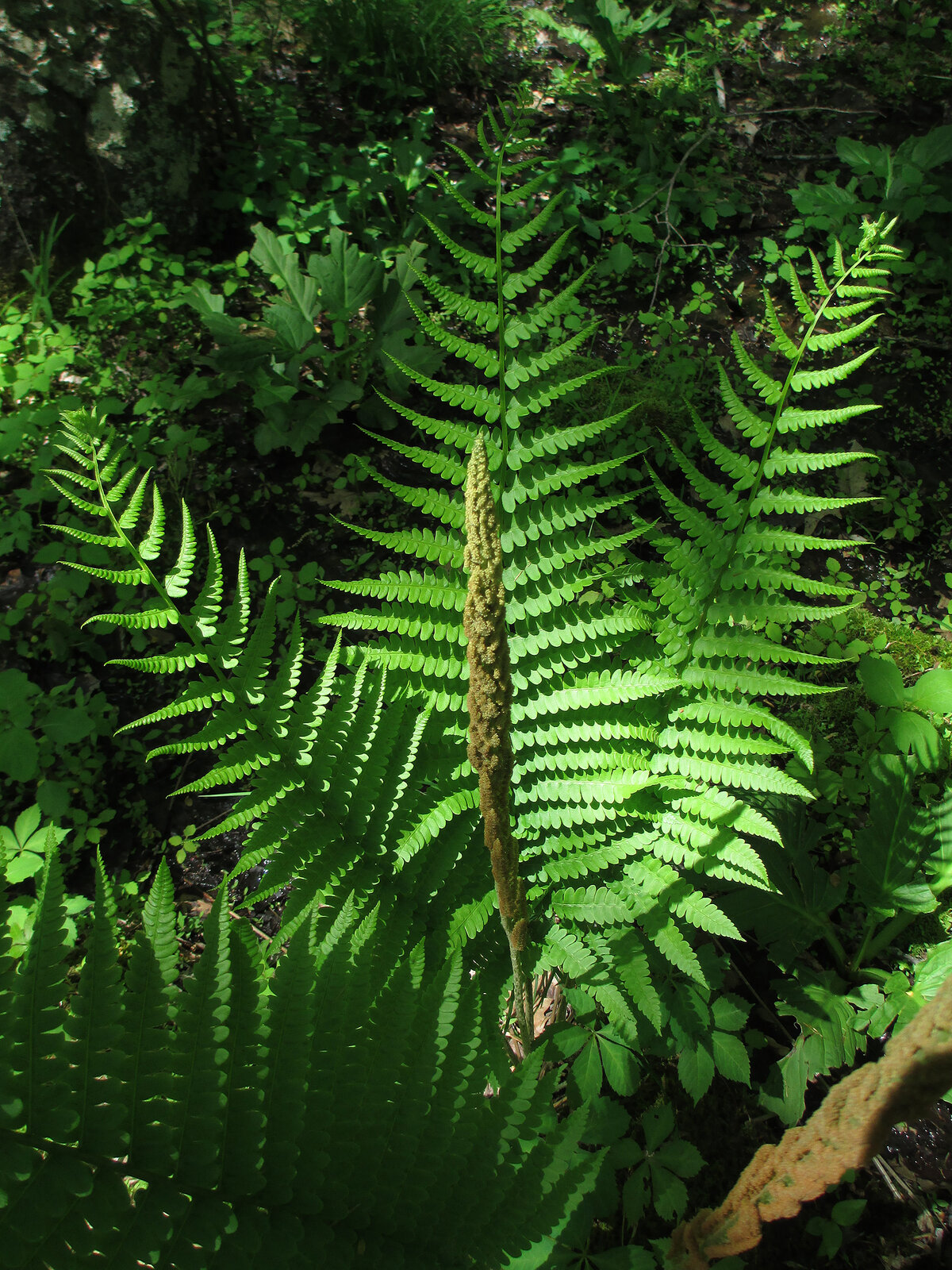
Cinnamon fern
Osmundastrum cinnamomeum
A tall, vase-shaped fern of seepy hollows, stream margins, and the wet edges of plateau heath. In April, a separate fertile frond emerges in the center of the crown, covered top to bottom in cinnamon-colored sporangia that look like a russet candle standing among the green sterile fronds. The fertile frond withers by midsummer, leaving the sterile fronds to carry on. Once placed in Osmunda; recent phylogenies separate it into its own genus.
Status: Native; locally common in wet hollows and seeps.
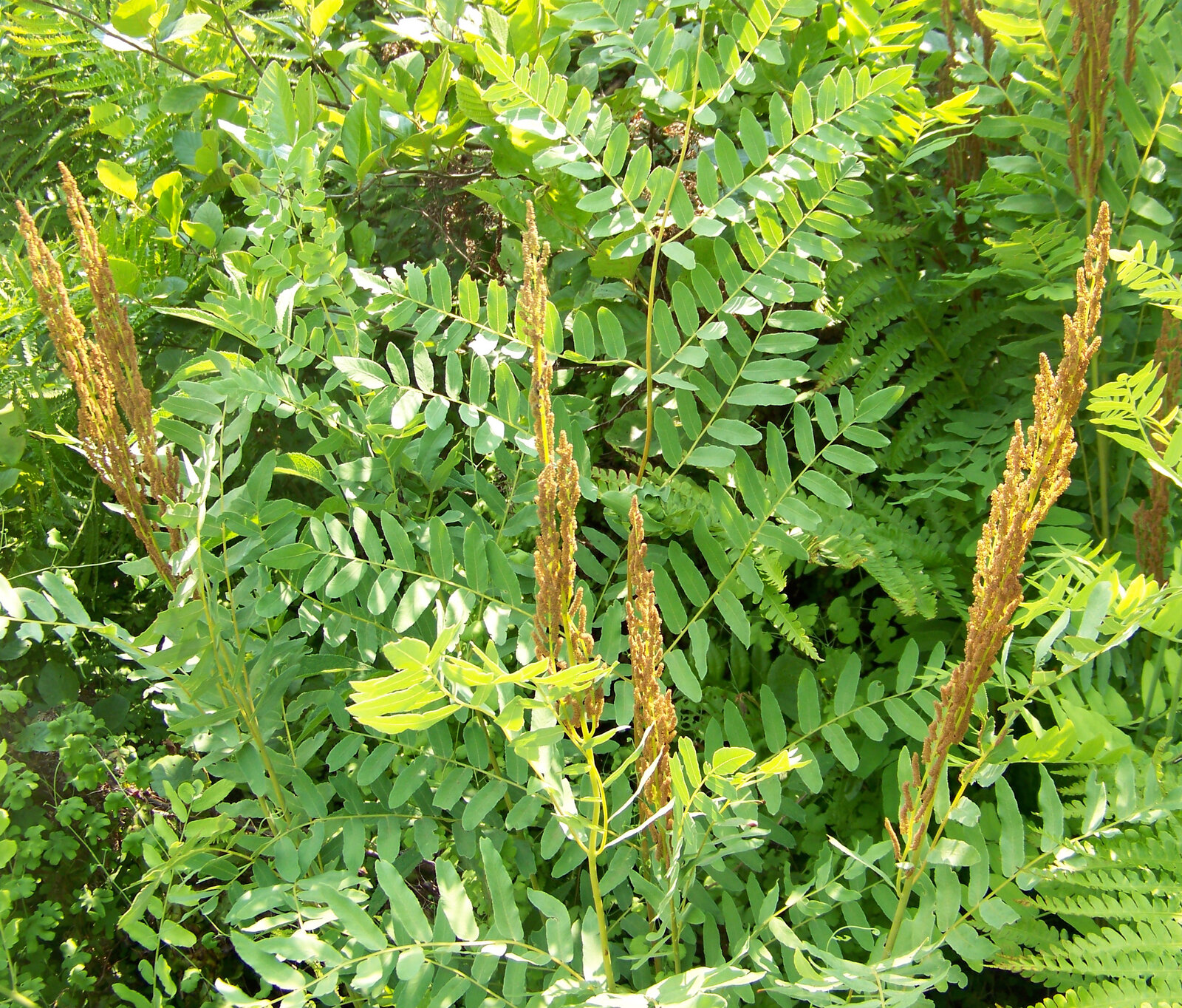
Royal fern
Osmunda spectabilis
One of the most unusual-looking ferns of the region. The fronds are twice-divided with widely-spaced, locust-leaf-like pinnules that look almost more like a flowering shrub than a fern. Fertile pinnae form a beadlike panicle at the tip of the frond ("the crown") rather than on a separate frond. Reaches six feet in the right wet pockets, mostly along sluggish stream margins and seepy bog edges. The North American taxon is now segregated from the European O. regalis as O. spectabilis.
Status: Native; locally common in seepy wet ground.
Hay-scented and bracken
Two large, deciduous ferns of the Dennstaedtiaceae that form colonies rather than discrete crowns. Both spread aggressively by rhizome and can dominate large areas of dry-mesic forest after a disturbance.
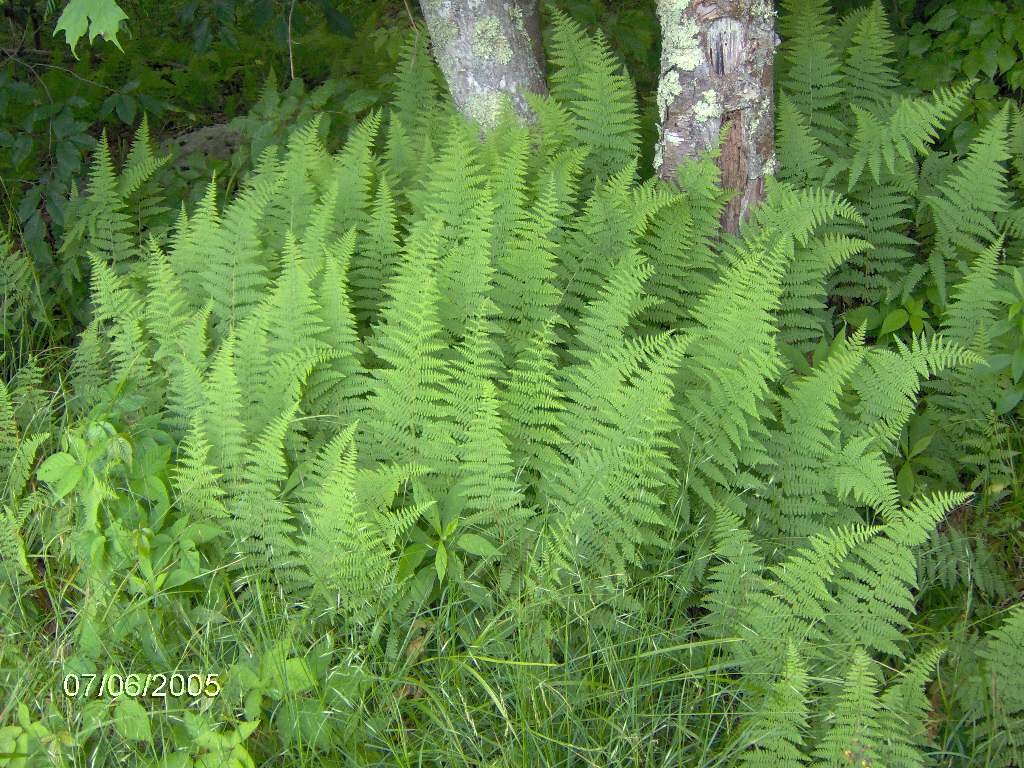
Hay-scented fern
Dennstaedtia punctilobula
A pale yellow-green, finely divided fern that forms dense, knee-high colonies on acid soils, especially in old fields and the openings of plateau heath. Crushing a frond releases a sweet hay-like scent (the source of the common name) from glandular hairs along the rachis. The species spreads aggressively by rhizome and can suppress tree seedling regeneration in deer-browsed forests where it dominates. Formerly placed in Dennstaedtia; current treatments segregate it into Sitobolium.
Status: Native; locally abundant on acid soils and in plateau openings.
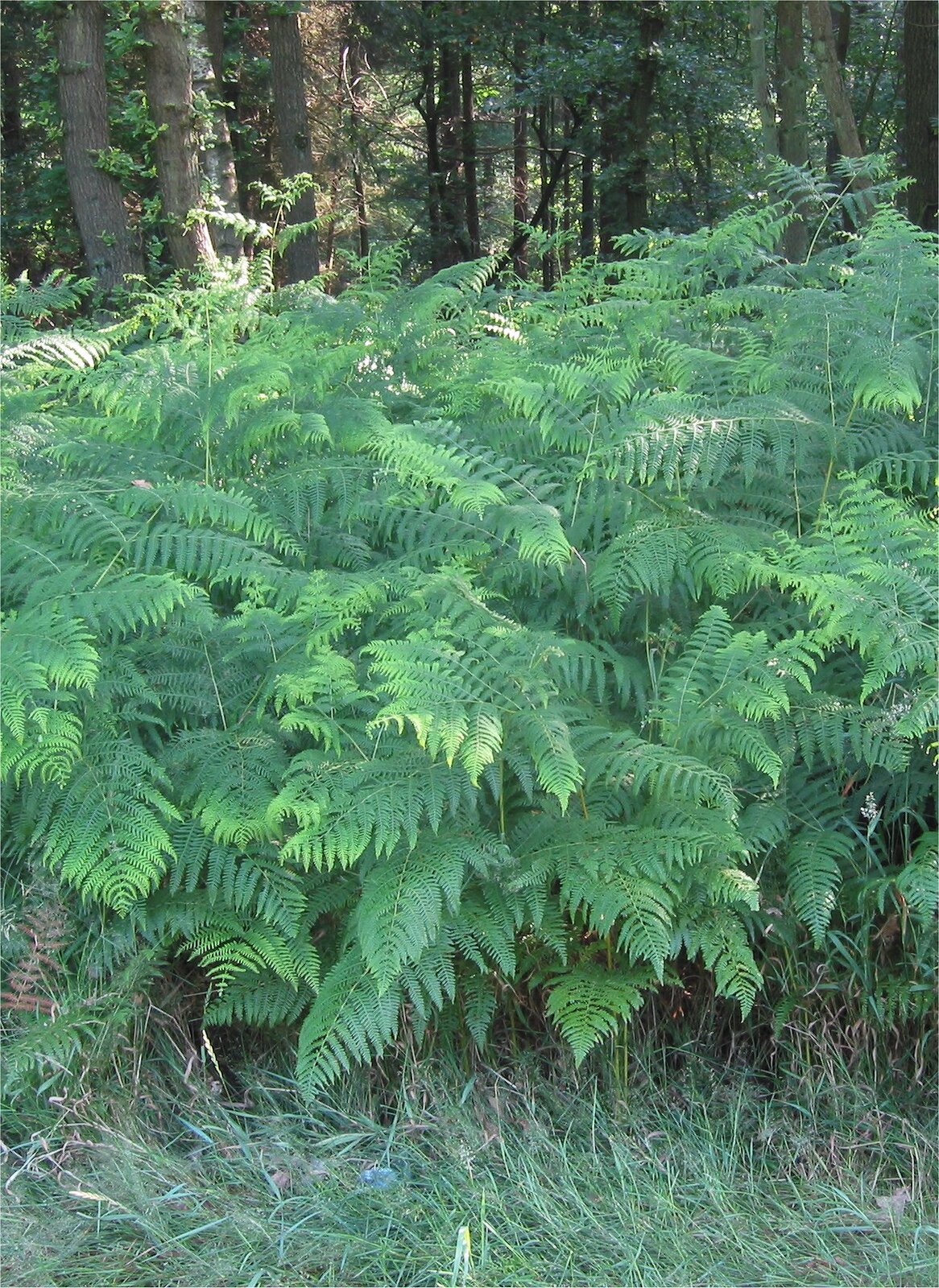
Bracken fern
Pteridium aquilinum
A cosmopolitan colonial fern, possibly the most widespread vascular plant in the world. Fronds are coarse, leathery, and roughly triangular, held high on a long stipe so the frond plane sits well above the surrounding ground vegetation. Forms dense stands in open woods, old fields, and burned-over plateau heath; tolerates fire as a survival strategy and often expands after a burn. The plant contains the carcinogenic glycoside ptaquiloside and is not edible, despite the historical reputation of "fiddleheads."
Status: Native; abundant in open woods, old fields, and burned plateau heath.
Maidenhair, lip ferns, and cliffbrakes
The Pteridaceae are the rock-face specialists. Most are small, drought-tolerant, with leathery or hairy fronds adapted to the seasonally-dry surfaces of sandstone caprock, limestone outcrop, and shaded ledge. The maidenhair ferns (Adiantum) are the exception: they hold more delicate fronds in shaded mesic seeps and cove floors.
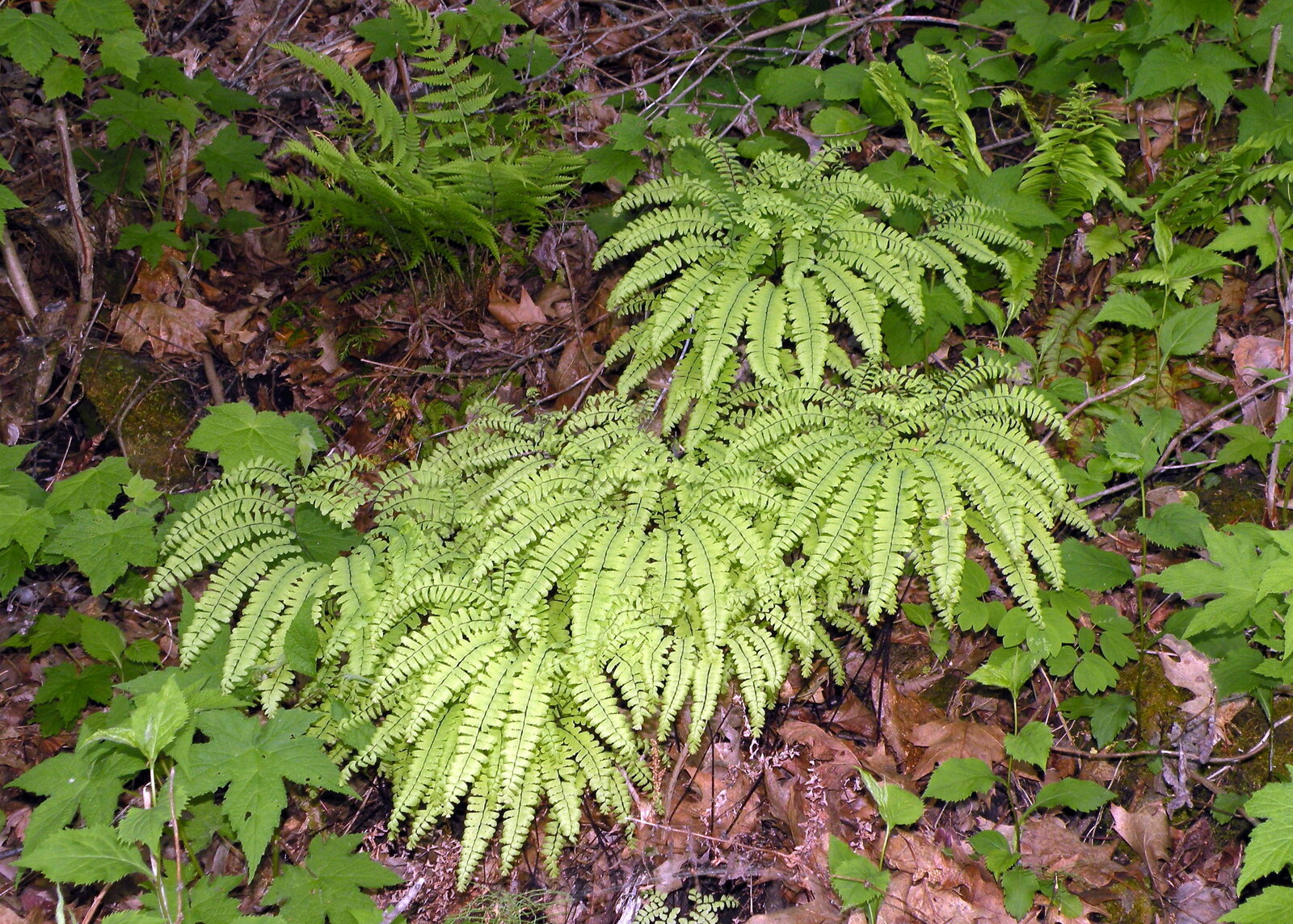
Northern maidenhair fern
Adiantum pedatum
On shaded cove slopes, this fern unfurls fan-shaped whorls of thin-textured pinnules on dark, wiry, almost-black stems. Maidenhair is a reliable indicator of rich, near-neutral cove soil and is used as a marker species for mesic cove forest in regional vegetation classifications. The "pedatum" of the species name refers to the bird-foot arrangement of the frond axes, which split into five to nine arching branches at the top of the stipe.
Status: Native; common in rich cove forests; cove-mesic indicator.
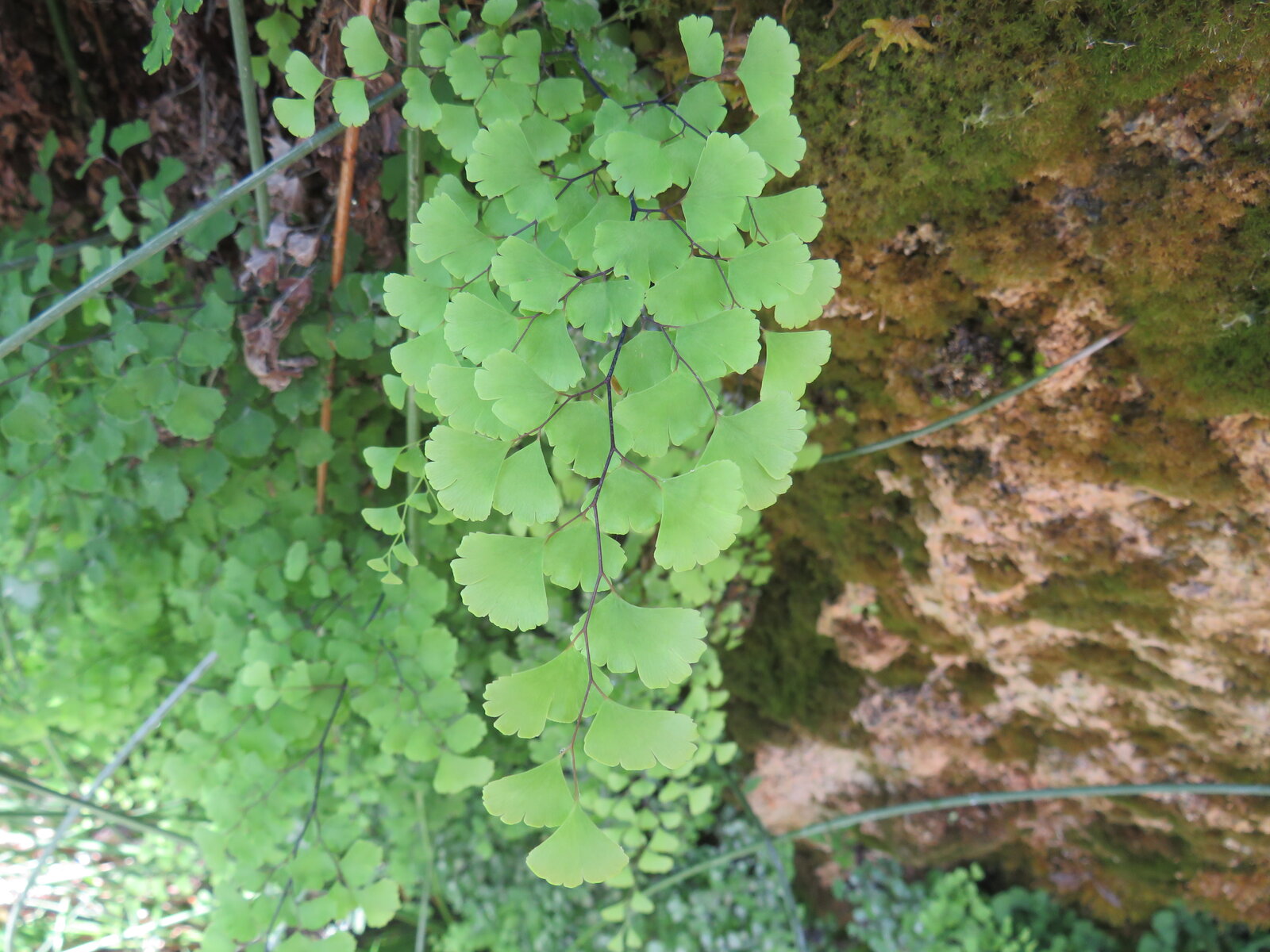
Southern maidenhair fern
Adiantum capillus-veneris
A pendant-frond maidenhair of dripping calcareous wet walls and shaded limestone seeps. Fronds are thin and lax, with fan-shaped pinnules and the same dark wiry stipe of the northern species, but the whole frond hangs rather than standing erect. Marion records sit in seepy limestone-bluff pockets along the Tennessee River Gorge, near the inland limit of the species' otherwise more coastal-plain distribution.
Status: Native; uncommon on shaded calcareous wet walls.
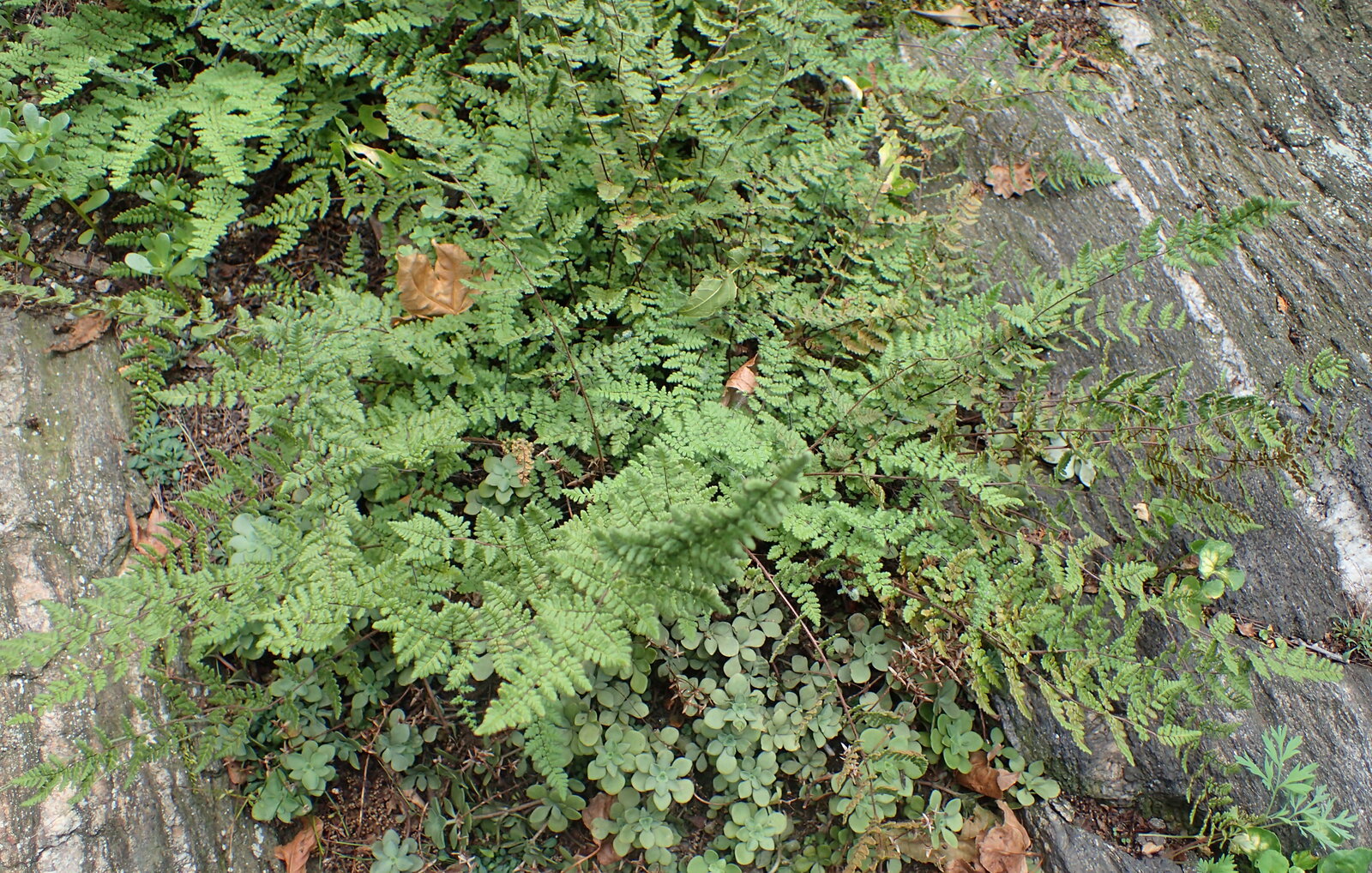
Hairy lip fern
Myriopteris lanosa
A small, xeric, rock-crevice fern of shaded sandstone and limestone outcrops. The fronds are densely hairy on both surfaces and curl tightly during drought, expanding when wet. Fronds rarely exceed eight inches and the colonies tuck into the same rock seams that hold the spleenworts. Formerly Cheilanthes lanosa; current treatments place this and related species in Myriopteris.
Status: Native; uncommon on shaded rock outcrops.
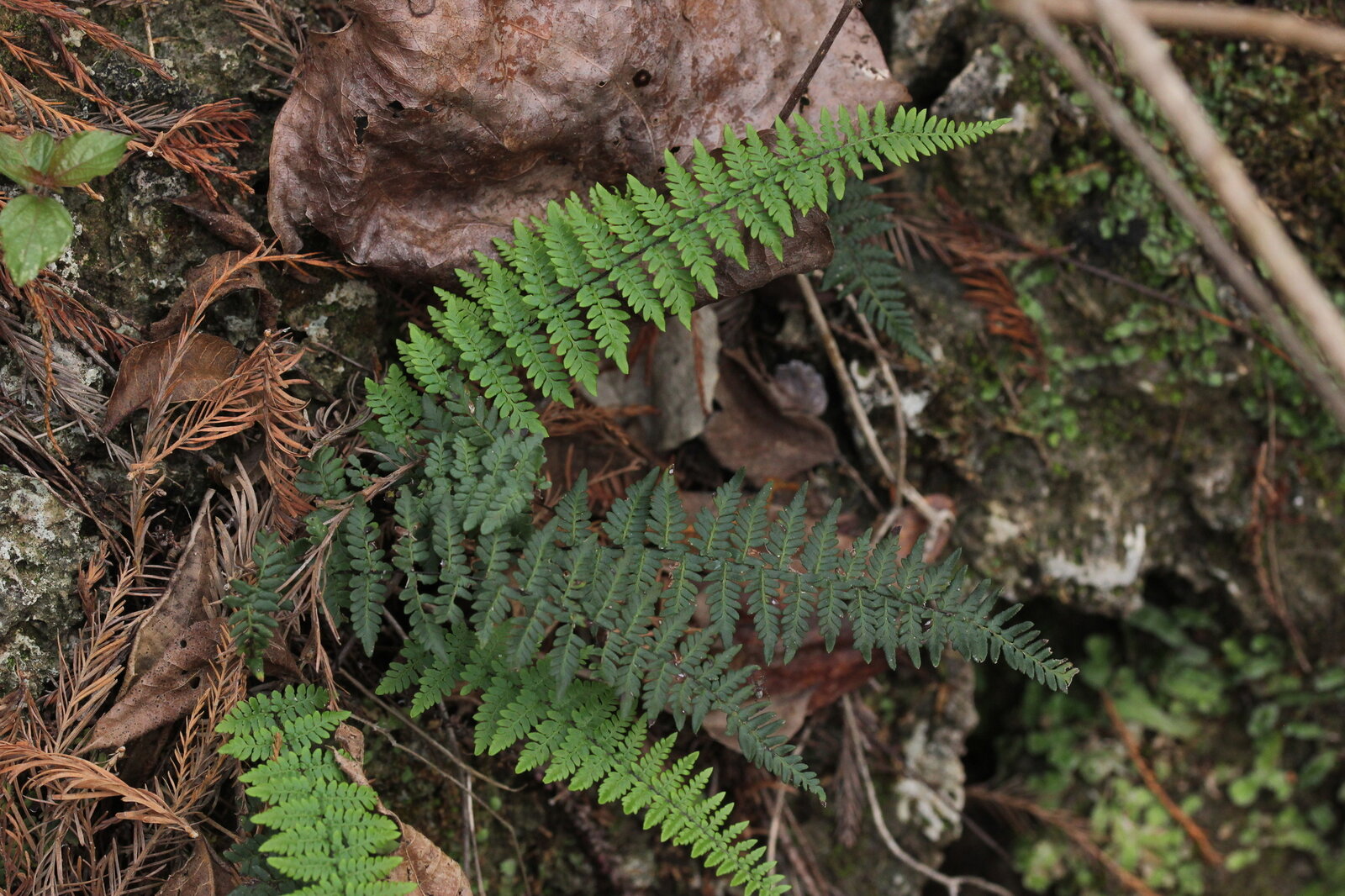
Alabama lip fern
Myriopteris alabamensis
A small calcareous-outcrop fern with finely divided once-pinnate fronds and a glossy black stipe. Closely tied to limestone glades and shaded calcareous ledges. Reaches the northern limit of its range in middle Tennessee and is scarce on the Cumberland Plateau itself but present in the calcareous valley pockets.
Status: Native; uncommon on calcareous outcrops.
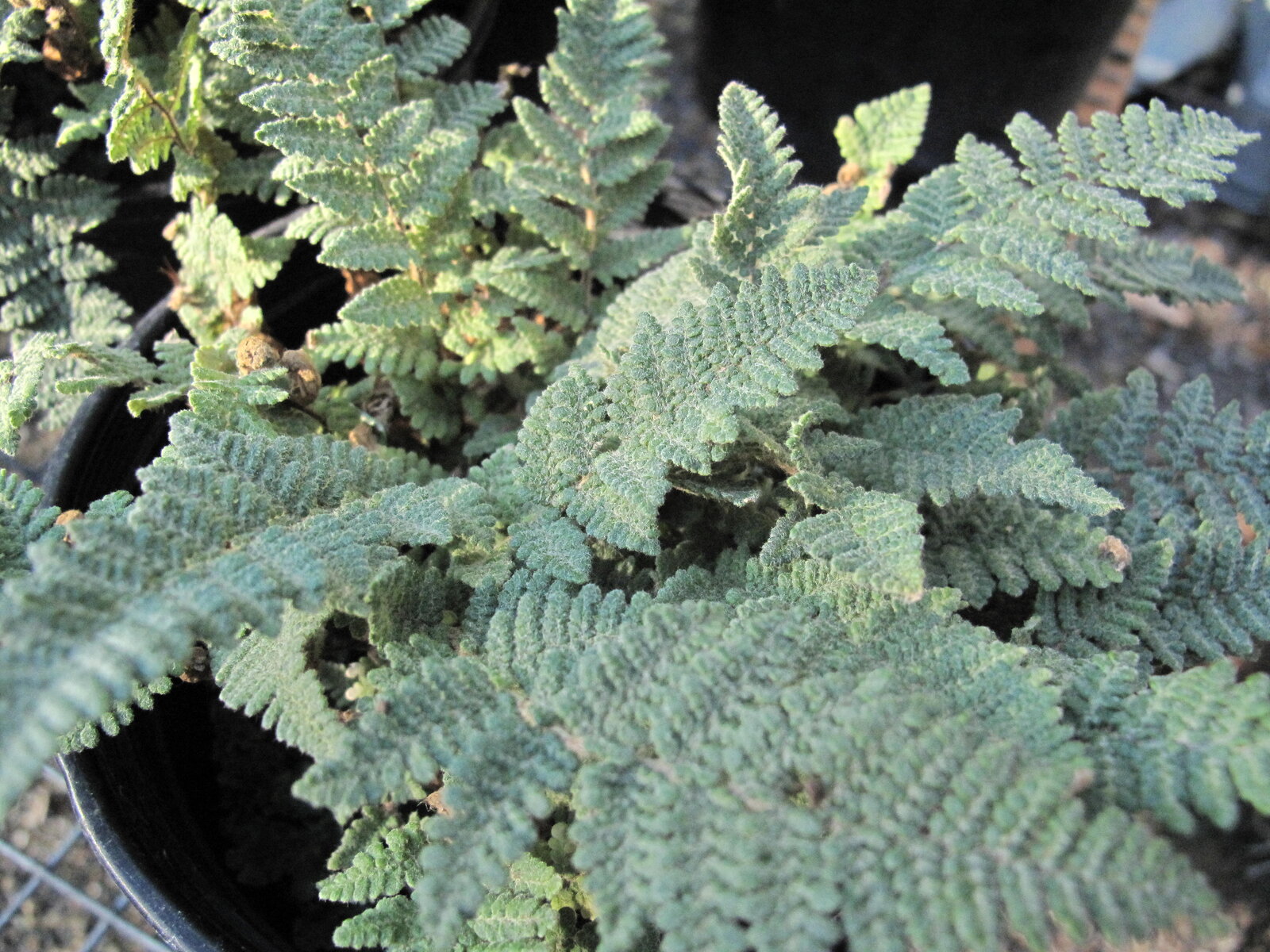
Woolly lip fern
Myriopteris tomentosa
The most thickly tomentose of the Marion lip ferns. The underside of each pinnule is felted with dense white hairs that protect the spore tissue from drying out during summer drought. Common on open sandstone outcrops, where the woolly fronds curl tightly in dry weather and unfurl after a soaking rain.
Status: Native; common on dry sandstone outcrops.
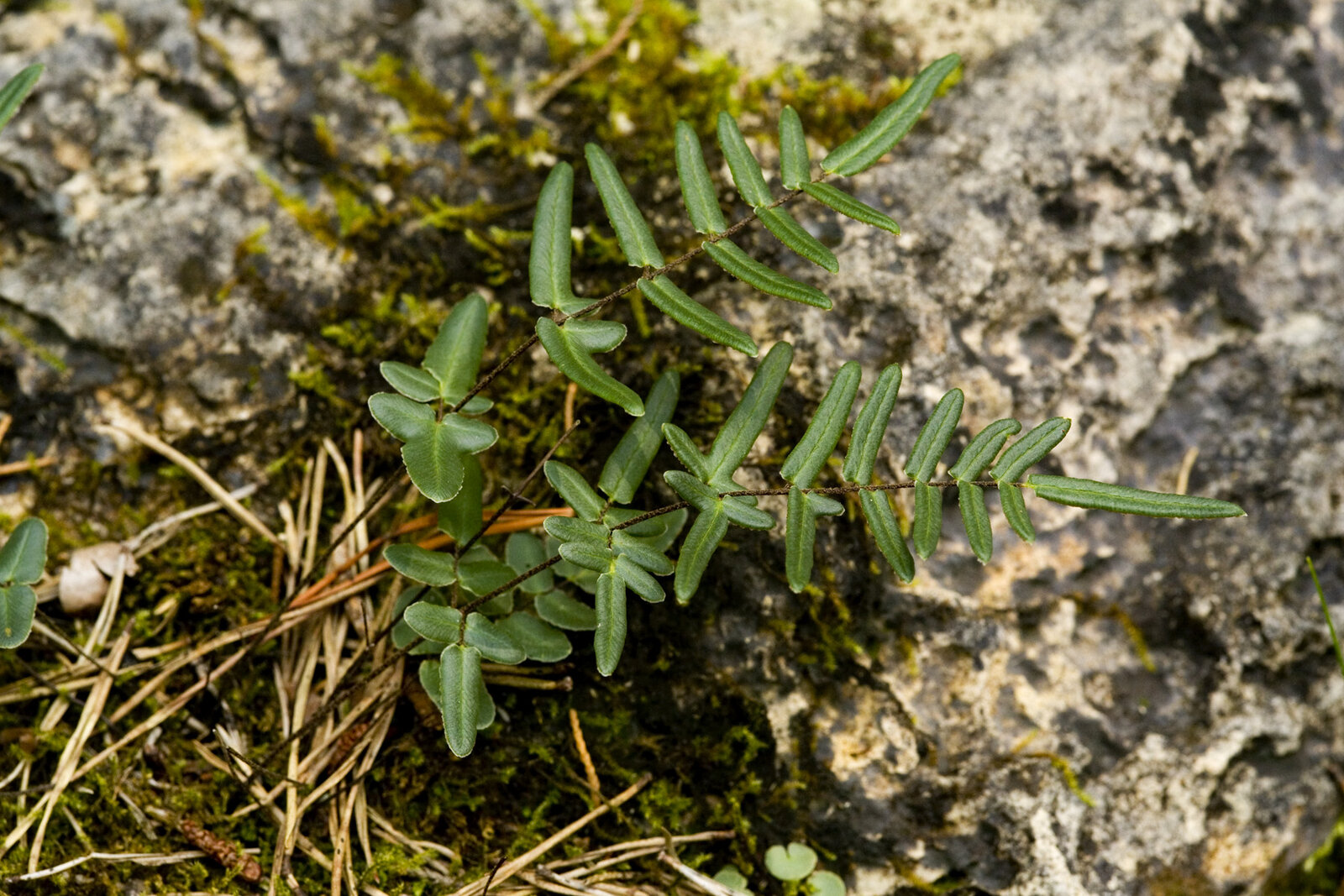
Purple cliffbrake
Pellaea atropurpurea
A leathery blue-gray fern of dry limestone outcrops and rocky calcareous ledges. The "purple" of the name comes from the dark purple-black stipe and rachis, which contrast with the gray-green pinnae. Tolerates drought better than most Marion ferns and is one of the few that holds an exposed south-facing limestone ledge through summer.
Status: Native; locally common on dry limestone outcrops.
Polypody ferns
Small evergreen ferns with simple pinnatifid fronds (deeply lobed but not fully divided) on creeping rhizomes. Rock polypody and Appalachian polypody form mossy mats on shaded sandstone boulders; resurrection fern grows as an epiphyte on hardwood bark and survives long dry spells by curling up tightly until the next rain.
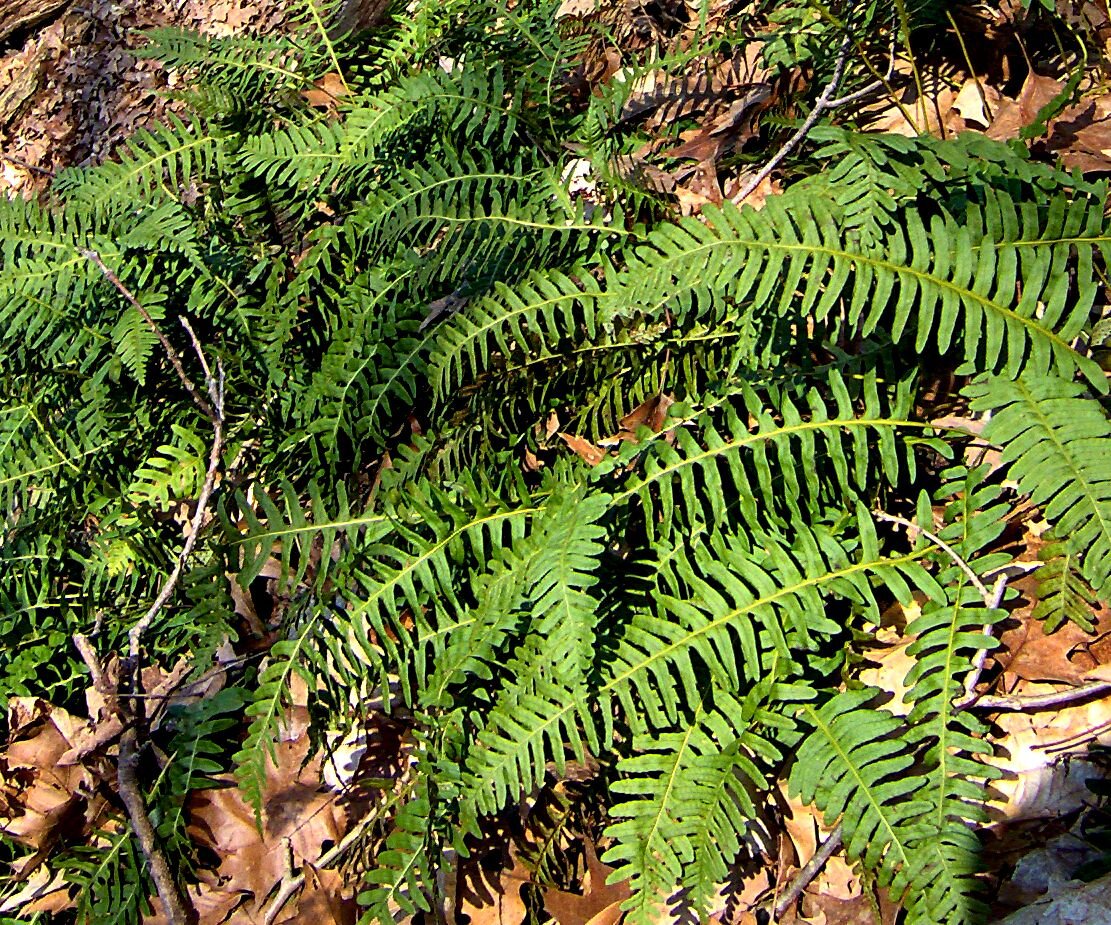
Rock polypody
Polypodium virginianum
A small evergreen fern of shaded sandstone boulders and rocky cove edges. Fronds are pinnatifid (deeply lobed almost to the midrib), thick-textured, and held in dense colonies on creeping rhizomes that crawl across moss-covered rock. Sori are round, prominent, and arranged in two rows along the underside of each lobe. One of the most reliable winter-green plants of the plateau caprock.
Status: Native; common on shaded sandstone boulders.
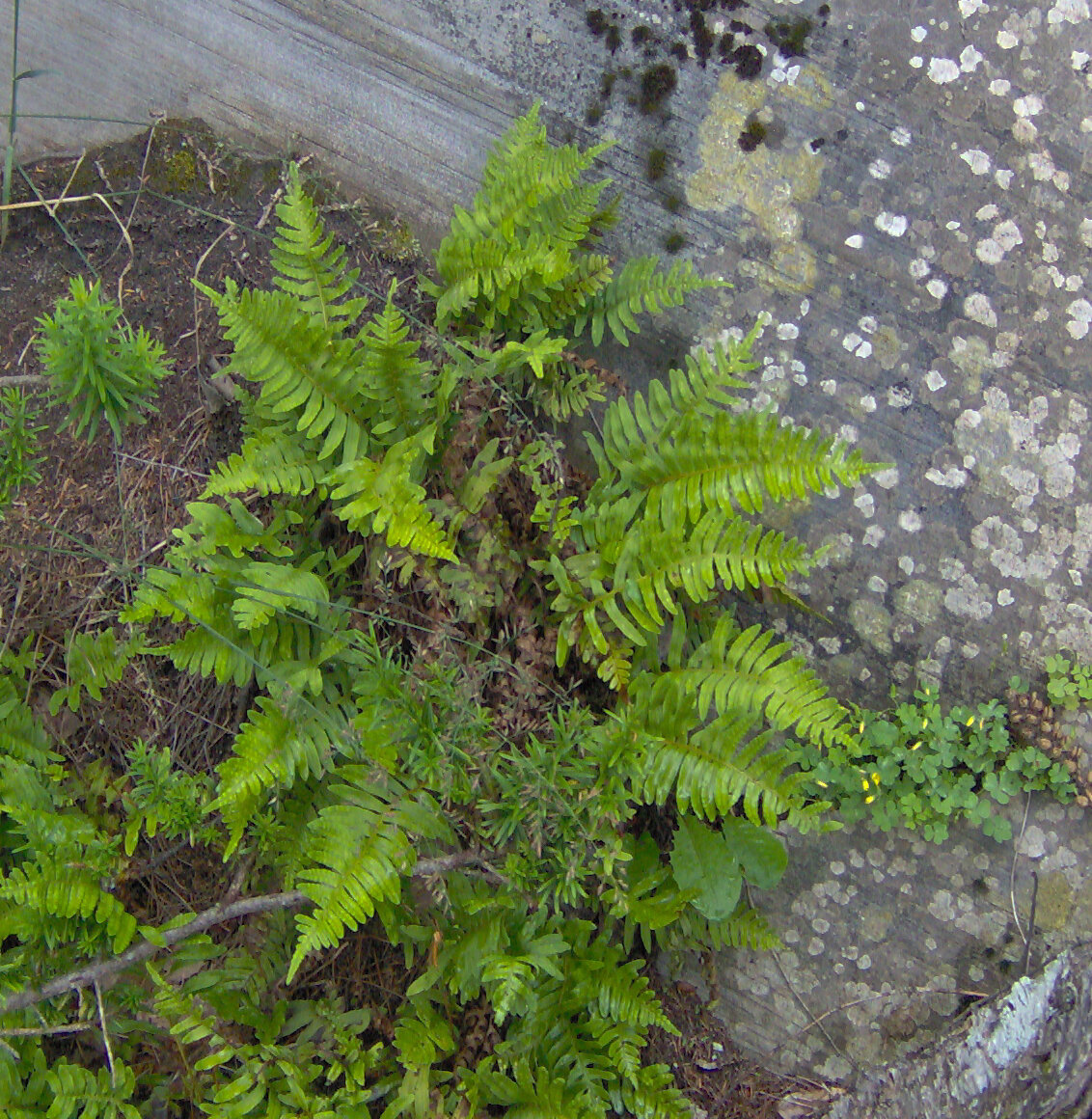
Appalachian polypody
Polypodium appalachianum
A cryptic species in the rock-polypody complex, separated from P. virginianum by chromosome count and by subtle differences in sporangial hairs and frond shape (Appalachian polypody fronds taper more uniformly to the tip while rock polypody fronds are widest near the middle). Often grows alongside its sister species; many older Marion records do not separate the two.
Status: Native; locally common on shaded sandstone boulders.
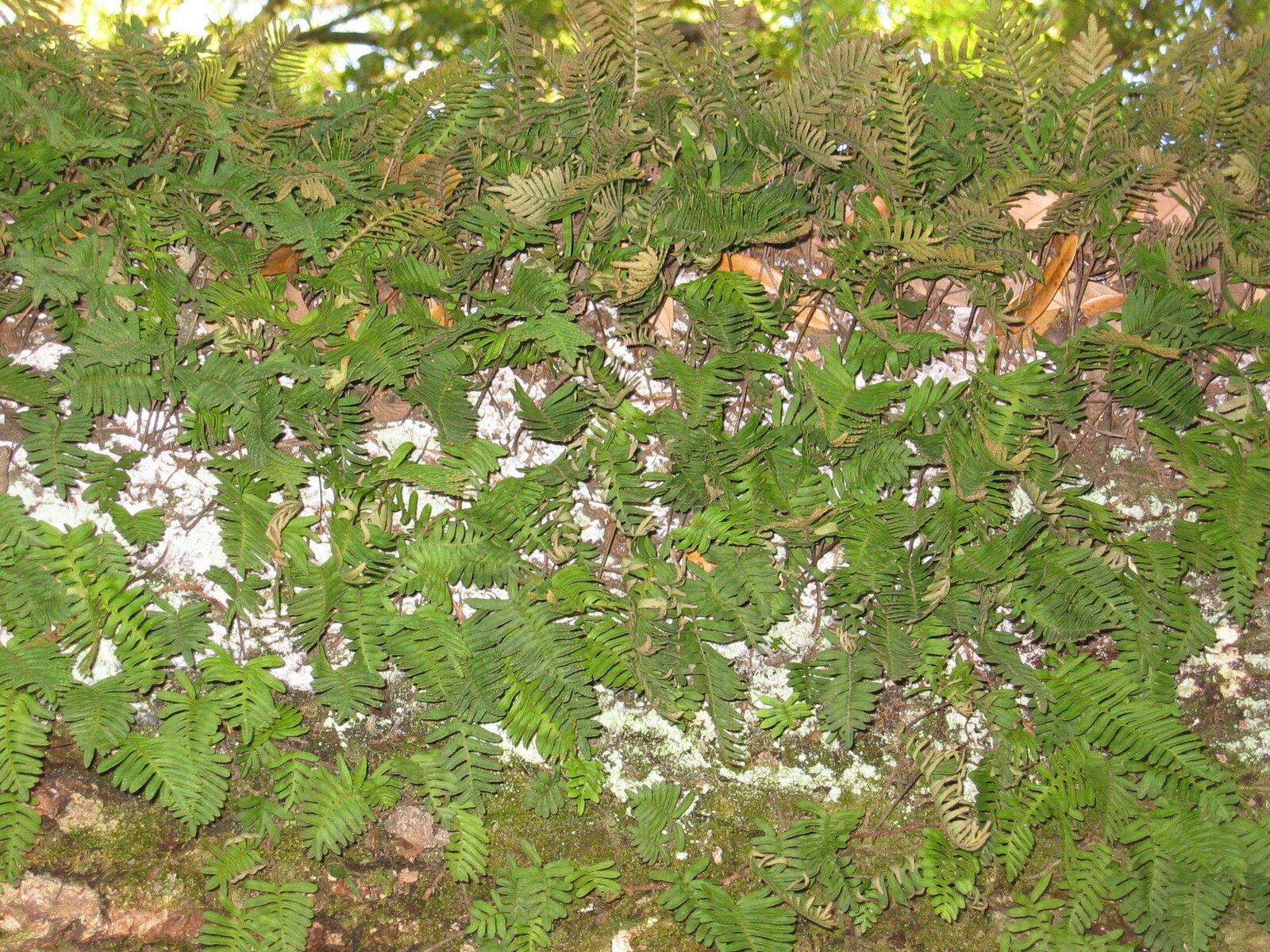
Resurrection fern
Pleopeltis polypodioides
An epiphytic fern that grows in mats on the upper sides of hardwood limbs and trunks, especially old white oaks, post oaks, and live oaks where any persist. During dry weather the fronds curl tightly and turn brown, looking dead; within hours of a soaking rain they unfurl green again. The "resurrection" cycle can repeat for decades on the same colony. Common on the lower Cumberland Plateau and the Tennessee River Gorge slopes; formerly placed in Polypodium.
Status: Native; locally common as an epiphyte on hardwood bark.
Beech ferns and New York fern
Two delicate, deciduous ferns of acid cove floors, plateau slopes, and shaded glade margins. Both are members of the Thelypteridaceae and have a soft, lacy frond texture that distinguishes them from the leathery wood ferns.
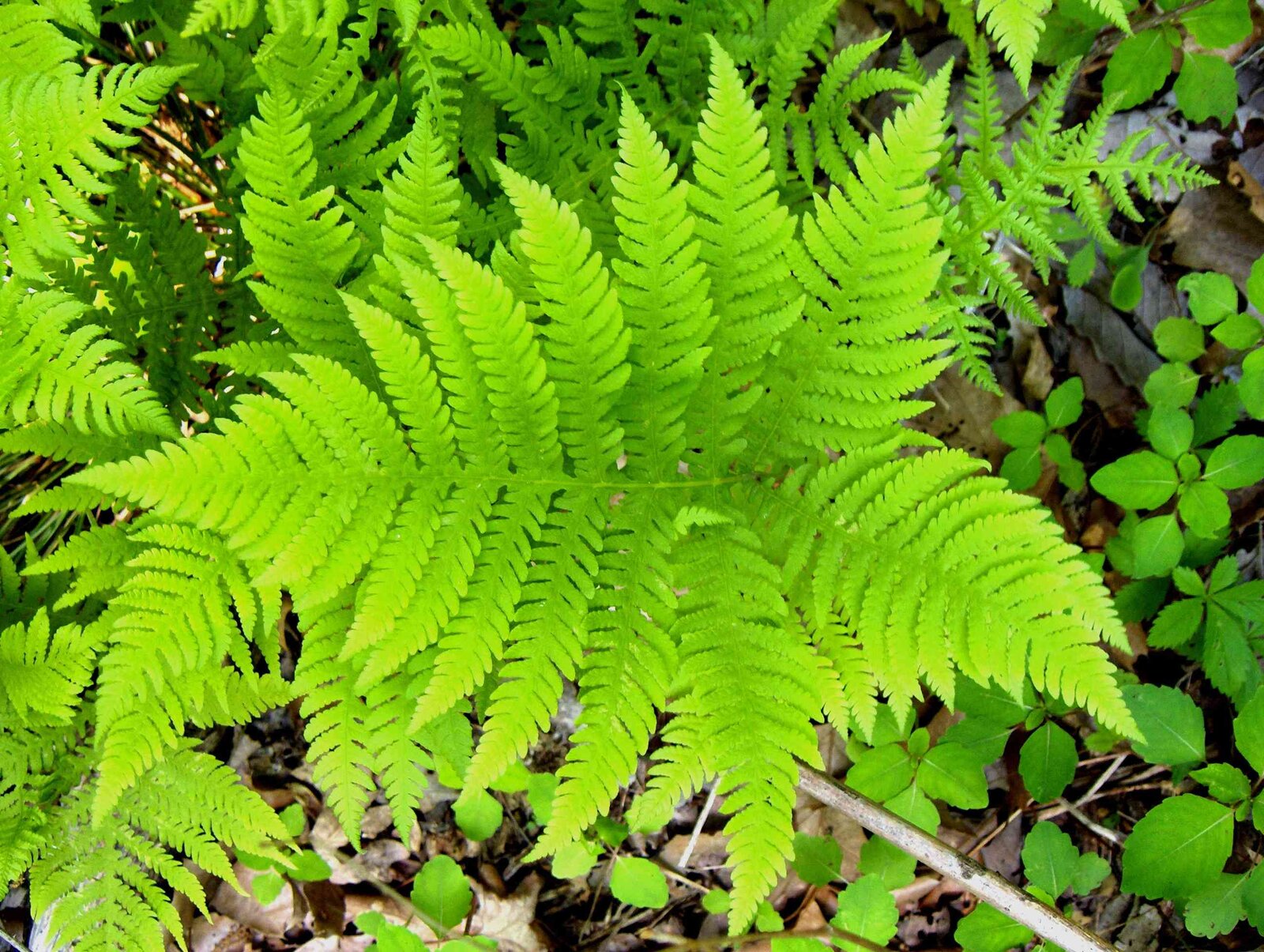
Broad beech fern
Phegopteris hexagonoptera
A delicate triangular fern of rich acid cove floors. The lowest pinna pair flares outward to give the frond a distinctively broad, almost-hexagonal silhouette, which is the easiest field cue. The rachis is winged between pinnae, an unusual feature among Marion ferns. Fronds emerge in late spring and yellow off in early fall.
Status: Native; common in rich cove forests.
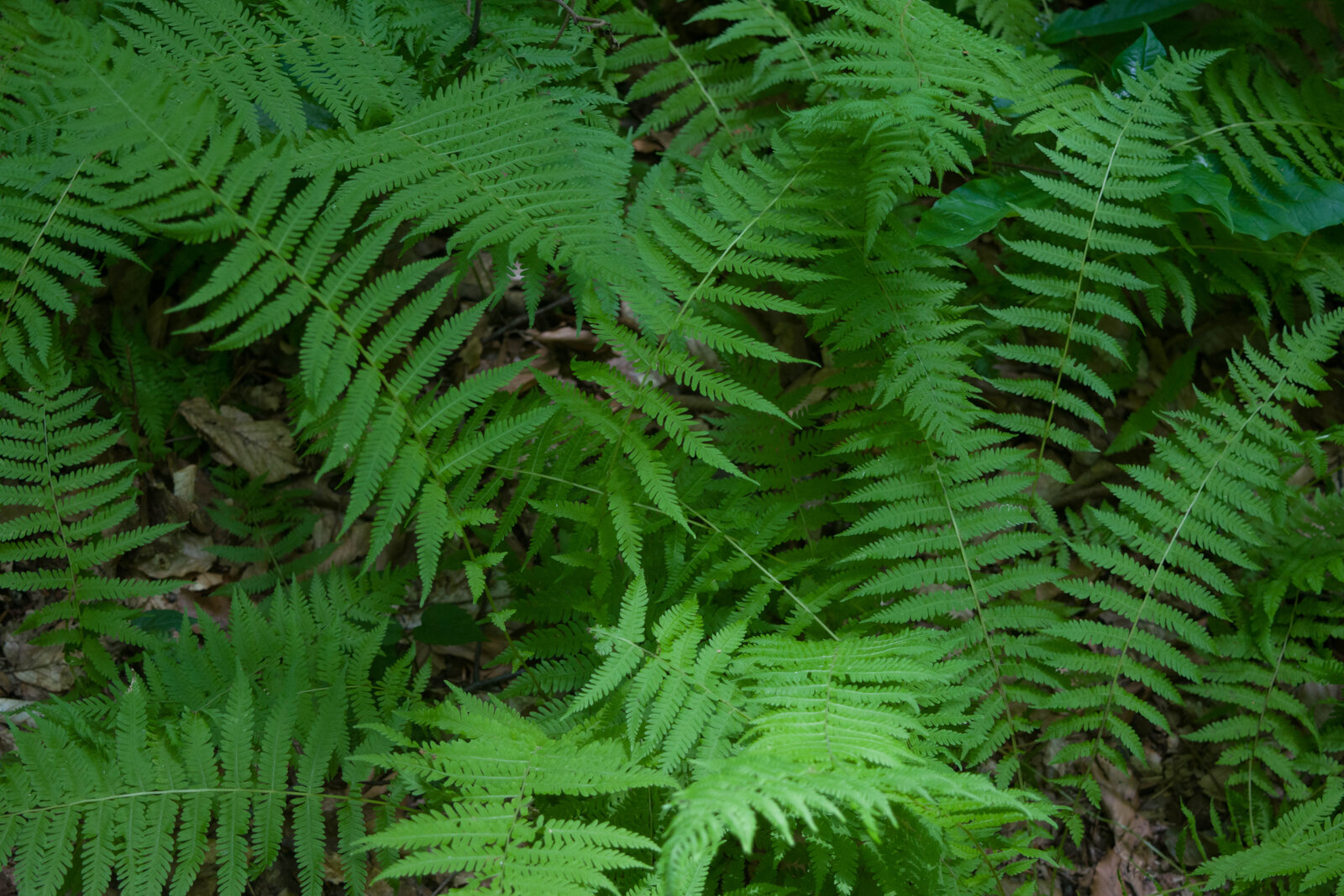
New York fern
Amauropelta noveboracensis
A pale-green, finely divided fern of moist plateau slopes and acid cove floors. The diagnostic feature is the frond shape, which tapers to a point at both ends, top and bottom, unlike the wood ferns and shield ferns whose fronds taper only at the tip. A widely-circulated memory aid is that New Yorkers "burn the candle at both ends." Forms knee-high colonies on the right slope. Formerly Thelypteris noveboracensis.
Status: Native; common on moist plateau slopes.
The climbing fern
One of the most unusual ferns of the eastern United States: a true climbing fern with a twining rachis that winds up through shrubs and small trees. Its only North American representative is the species below, restricted to acid woodland margins on the Cumberland Plateau and Coastal Plain.
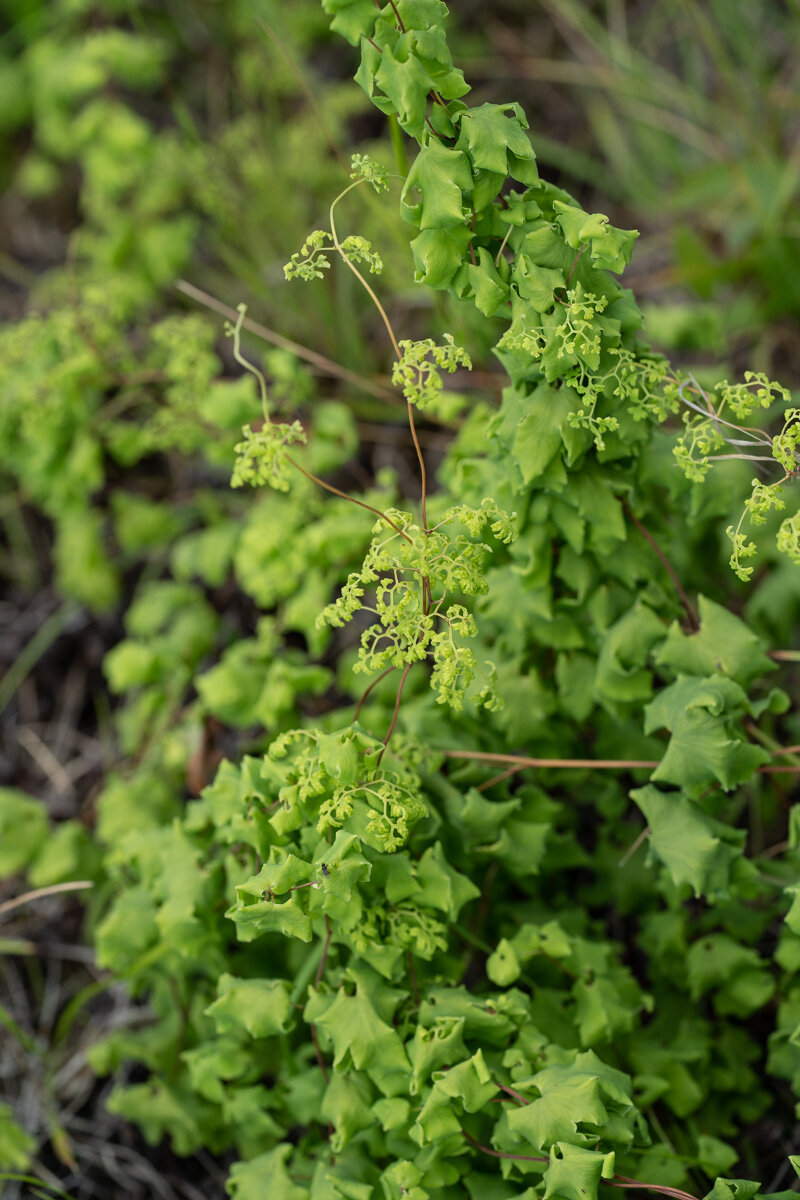
American climbing fern
Lygodium palmatum
A true vining fern, with an indeterminate rachis that twines through low shrubs and small trees, reaching up to ten feet on a good climb. Each "frond" is technically a single leaf that keeps growing year after year. Sterile pinnae are palmately lobed (the source of the species name palmatum) and the fertile pinnae form a contracted, finger-like cluster at the top of the climb. Restricted to acid plateau woodland margins and seepy heath openings; never abundant where it does occur.
Status: Native; uncommon on acid plateau woodland margins.
Grape ferns, rattlesnake fern, and adder's-tongues
The Ophioglossaceae are the most ancient lineage of living vascular plants, with a fossil record reaching back into the Devonian. Each plant produces a single combined leaf that splits into a sterile lower segment (the "leaf") and a fertile upper spike or panicle (the "fruit"). The grape ferns and rattlesnake fern carry a paniculate fertile spike with grape-like clusters of sporangia; the adder's-tongues carry a single linear spike.
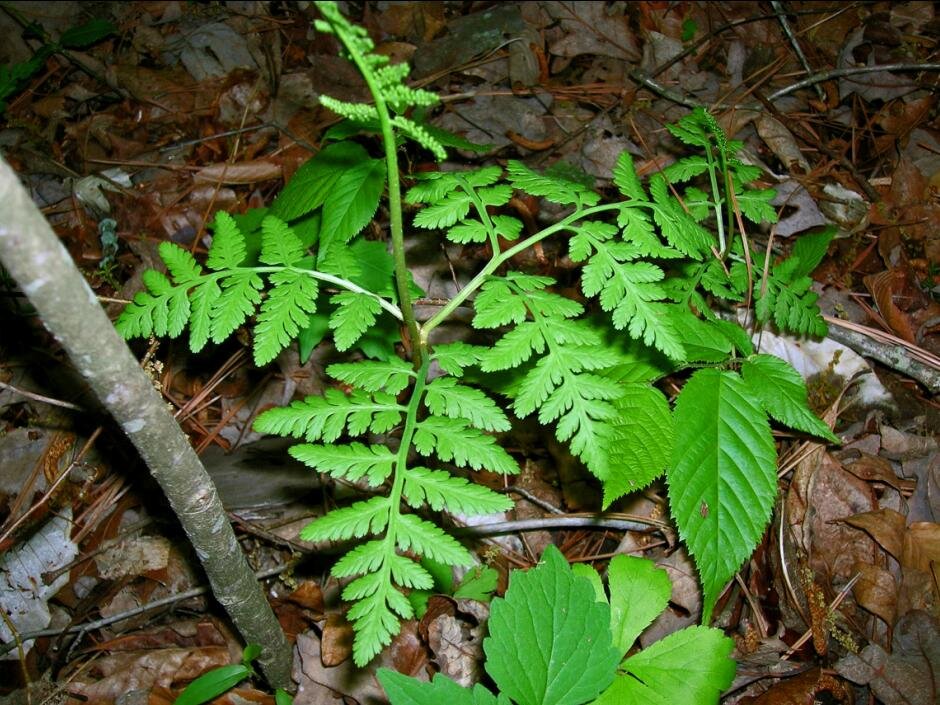
Rattlesnake fern
Botrypus virginianus
A delicate, deciduous Ophioglossaceae of rich cove floors. A single shared stalk holds a soft, finely divided, triangular sterile blade on one side and a slender fertile spike on the other, with the fertile spike rising above the sterile blade like a rattler's tail (the source of the common name). The whole plant withers by midsummer and does not return until the following spring. Formerly Botrychium virginianum; the larger-statured species are now placed in Botrypus.
Status: Native; common on rich cove floors.
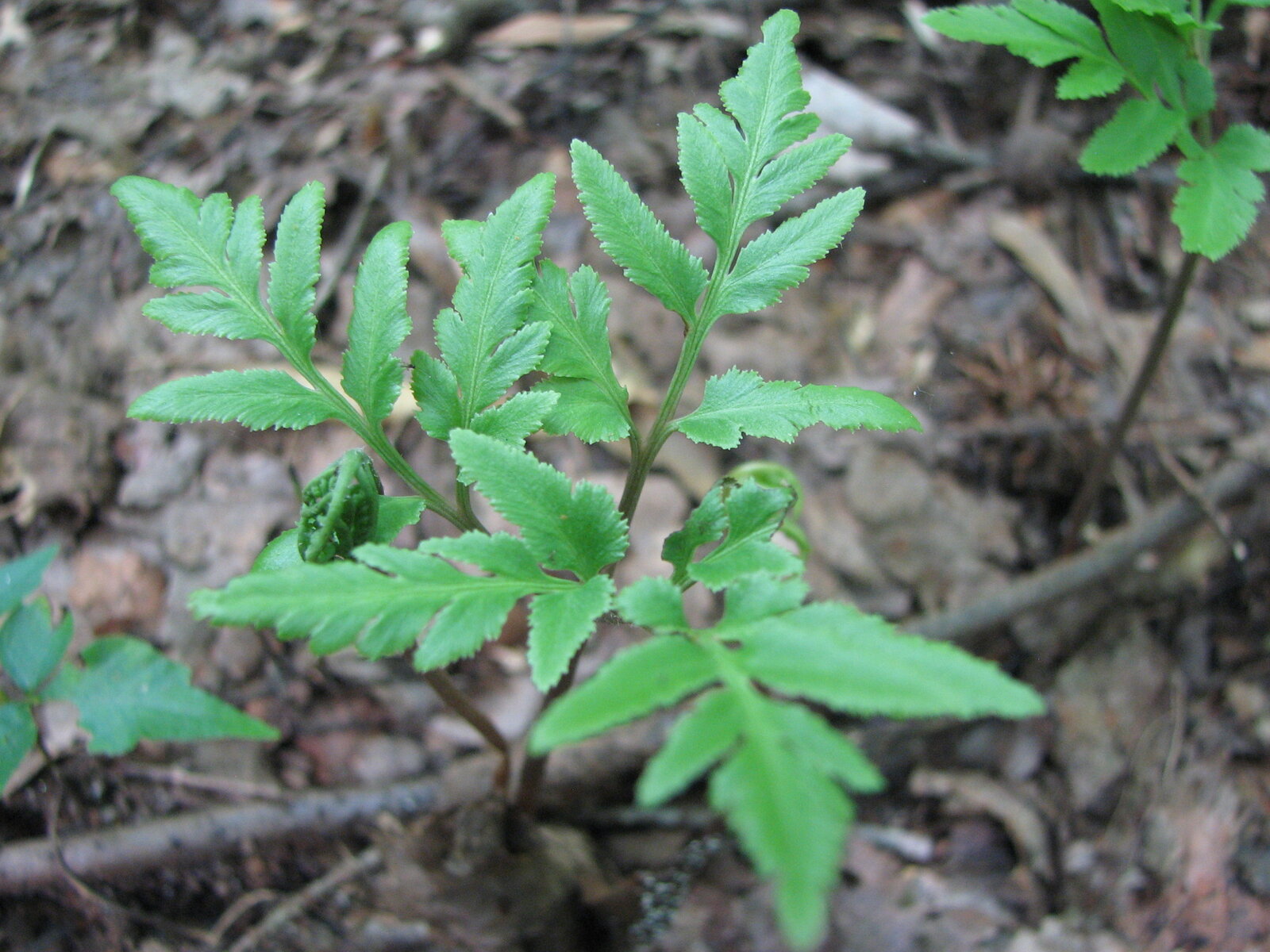
Sparse-lobe grape fern
Sceptridium biternatum
A small evergreen grape fern of dry, acidic, sandy soils on the plateau and in old-field margins. The sterile pinna is leathery, ternate (three-parted), and lies near the ground; the fertile spike rises in late summer with grape-cluster-like sporangia. Distinguished from the dissected grape fern below by the more sparsely lobed sterile pinna. Formerly Botrychium biternatum.
Status: Native; common in dry acid woods and old-field margins.
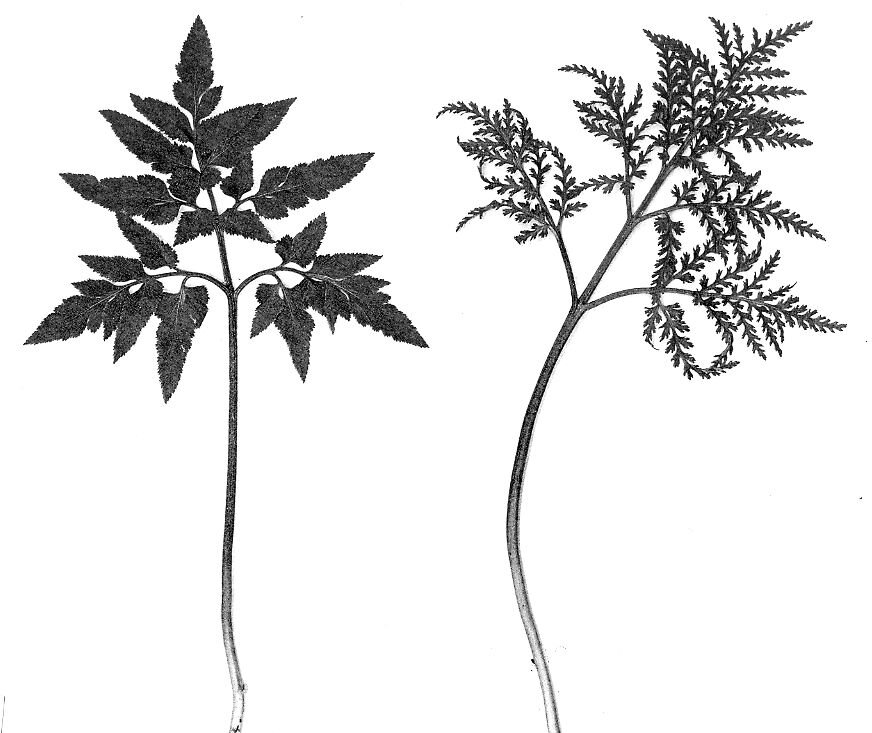
Dissected grape fern
Sceptridium dissectum
An evergreen grape fern with a more deeply divided sterile pinna than the sparse-lobe species above. Some plants are so finely cut they look almost feathery; others are intermediate. The sterile pinna often turns bronze or reddish in winter, which is one of the easier field cues in January. Occurs on similar dry-acid soils as the sparse-lobe species and the two often grow together.
Status: Native; common in dry acid woods.
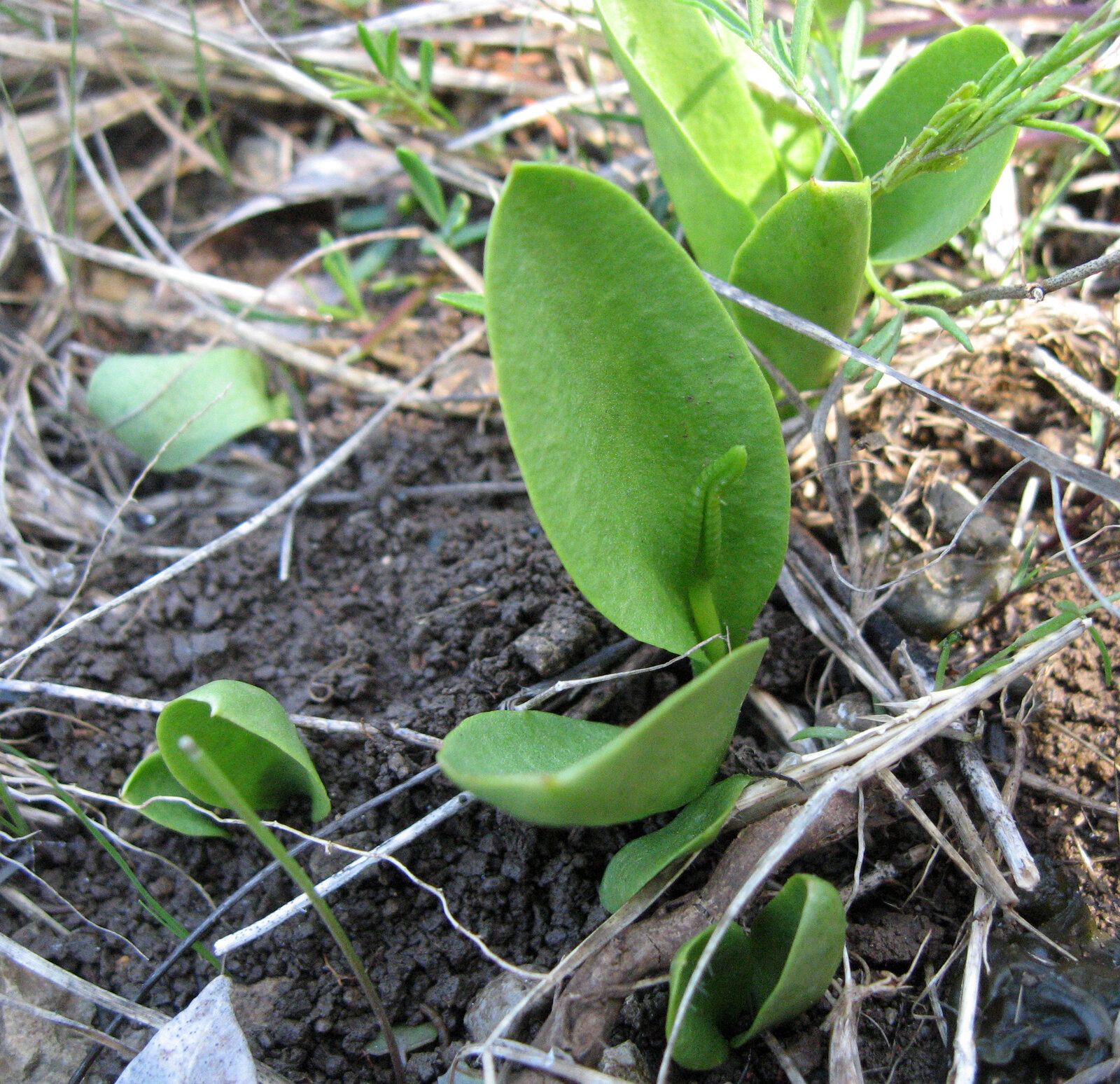
Limestone adder's-tongue
Ophioglossum engelmannii
A small, distinctive adder's-tongue of cedar glades, calcareous outcrops, and shallow-soil limestone openings. Each plant carries a single fleshy oval sterile leaf at ground level with a tall linear fertile spike (the source of the "tongue" name) bearing two ranks of yellow sporangia. Strictly tied to calcareous shallow-soil habitats; the related southern adder's-tongue (O. pycnostichum), formerly treated within O. vulgatum in the broad sense, also occurs in Marion in shaded cove conditions where it goes largely unnoticed.
Status: Native; locally common in cedar glades and shallow-soil limestone openings.
Clubmosses and spikemosses
The lycophytes are the oldest still-living lineage of vascular land plants, branching off the main vascular-plant evolutionary trunk in the Silurian. Marion supports five species across three families. All are small, evergreen, and bear sporangia in distinct cones ("strobili") at the tips of fertile shoots. Older taxonomies lumped most of them in Lycopodium; current treatments split the genus.
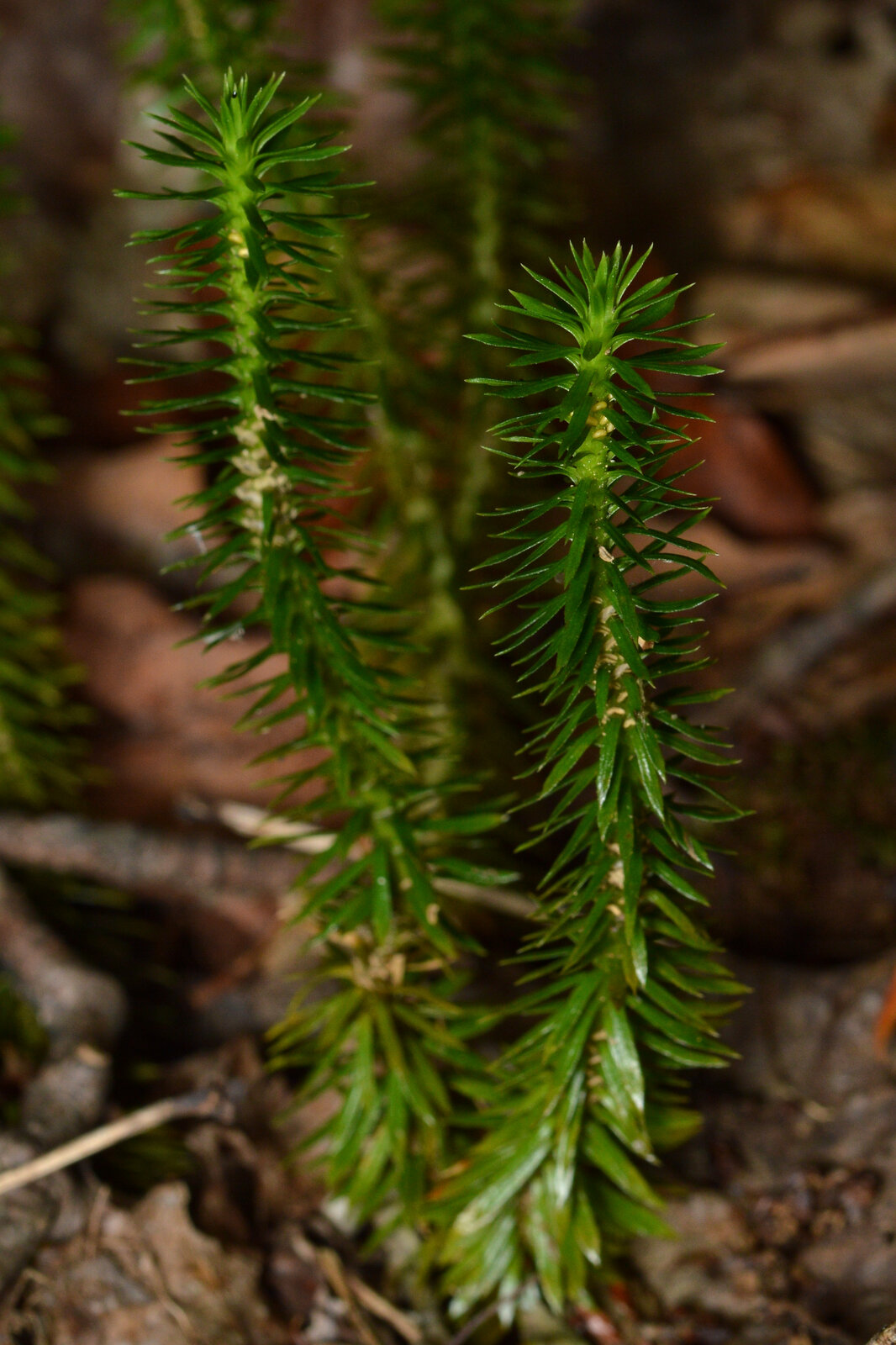
Shining clubmoss
Huperzia lucidula
A small upright clubmoss of moist, shaded, acid cove floors and stream banks. Shoots are six to ten inches tall, glossy-leaved, and produce small gemmae (vegetative propagules) in the leaf axils that drop off to start new plants nearby, supplementing the sporangia that develop in the upper leaf axils. Family Huperziaceae in current treatments; older keys placed it in Lycopodium.
Status: Native; common in shaded cove forests.
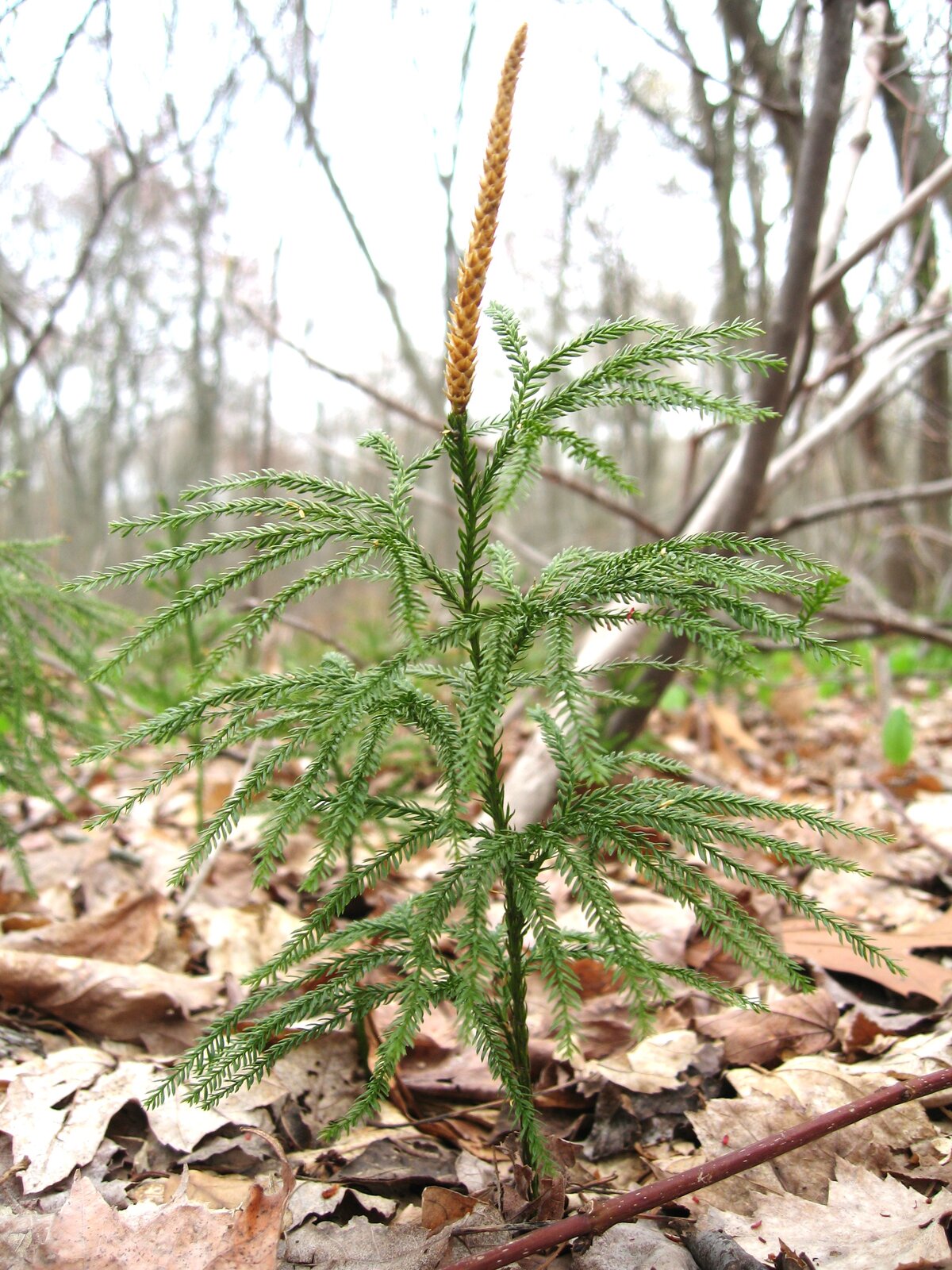
Flat-branched clubmoss
Dendrolycopodium obscurum
Also called princess pine. Small evergreen upright shoots six to ten inches tall, branched in the upper half to give a miniature conifer-tree silhouette. A long horizontal rhizome runs underground, sending up scattered erect shoots that can form a loose colony across a forest floor. Fertile strobili rise as long stalks at the top of upright shoots in late summer.
Status: Native; common in acid cove floors and plateau woods.
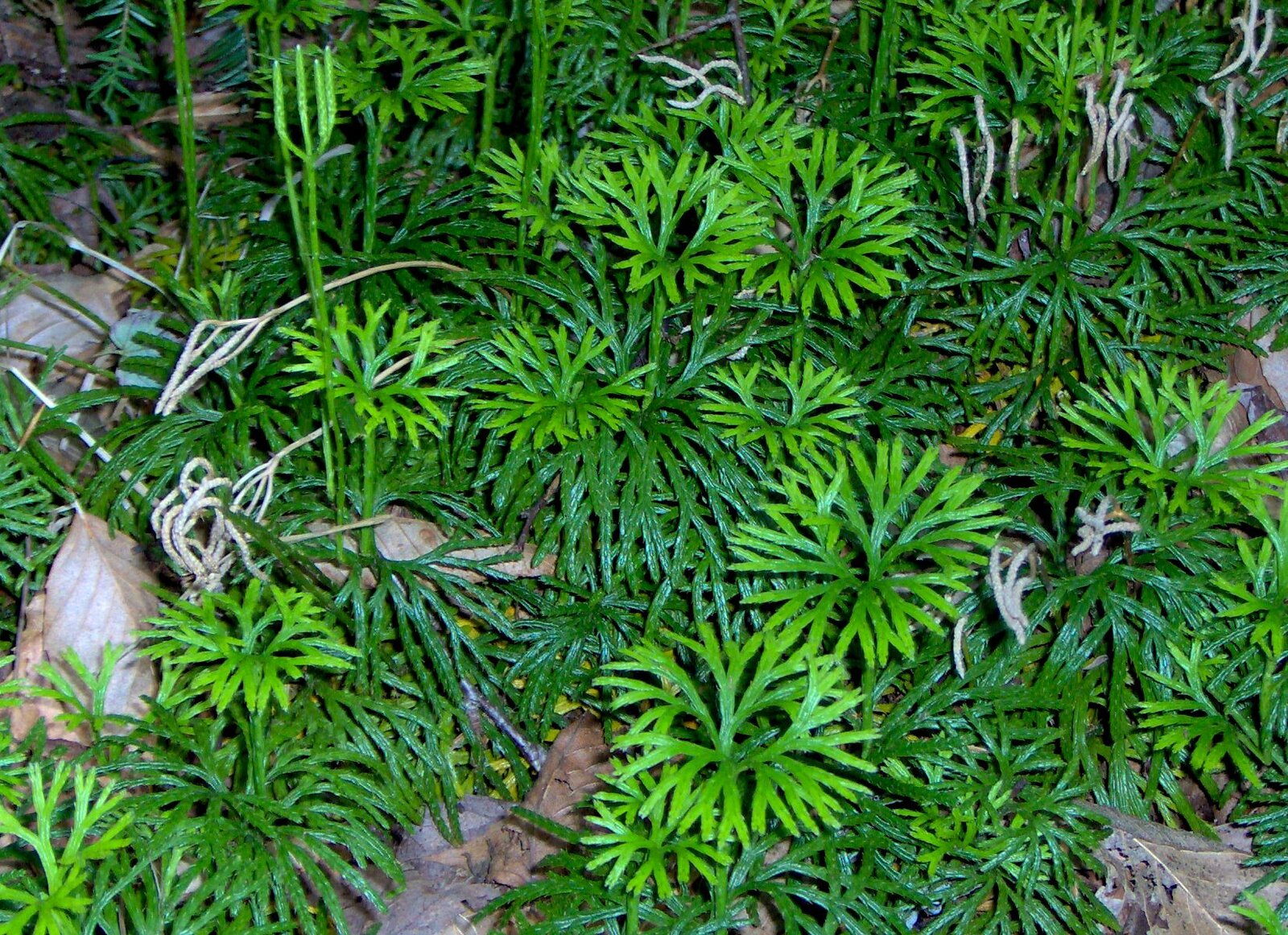
Southern running cedar
Diphasiastrum digitatum
A horizontal-creeping clubmoss whose fan-like sprays cover the ground in dry acidic woods and old-field margins. The flattened branches resemble a tiny cedar tree pressed flat against the leaf litter, the source of the common name. Long fertile stalks rise above the prostrate sprays in late summer, bearing four to six finger-like ("digitate") strobili at the tip. Formerly Lycopodium digitatum.
Status: Native; common in dry acid woods.
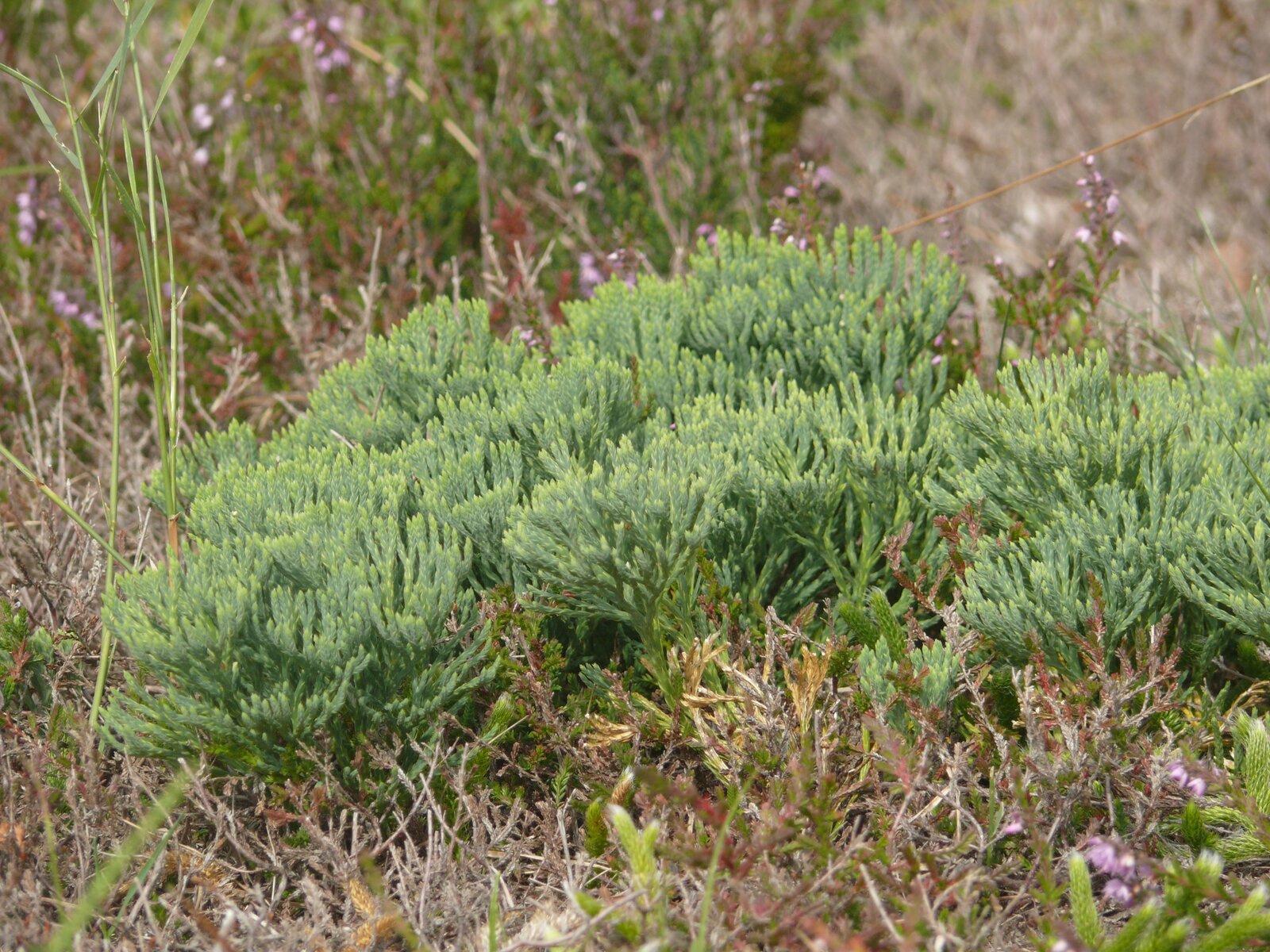
Blue ground cedar
Diphasiastrum tristachyum
A closely related clubmoss with distinctively glaucous blue-green shoots (the "blue" of the common name) on a deeply buried horizontal rhizome. Fertile stalks carry three (rarely more) strobili at the tip, the source of the species epithet tristachyum. Less common than the running cedar but turns up in the same dry acid woods on the plateau.
Status: Native; uncommon in dry acid woods.
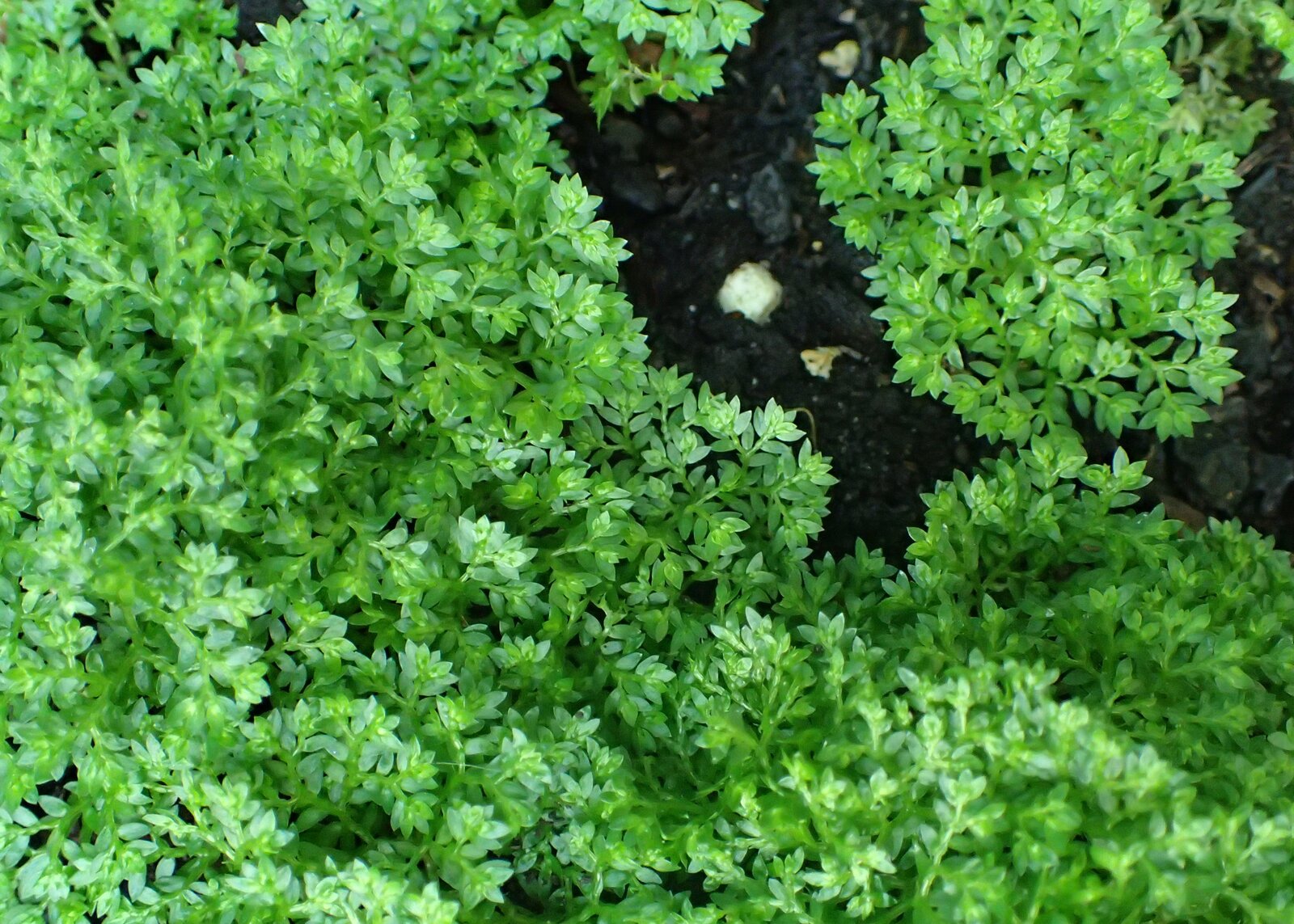
Meadow spikemoss
Lycopodioides apodum
A small, low-growing spikemoss of damp shaded soils, stream banks, and the wet edges of cove openings. Shoots are flat against the ground with two ranks of small flat leaves, and the fertile shoots end in four-sided strobili. The plant looks more like a moss than a vascular plant at first glance, but careful inspection shows the small leaves are arranged in four ranks rather than the radial-symmetry of moss shoots. Formerly Selaginella apoda.
Status: Native; locally common on damp shaded soils.
Horsetails and scouring rushes
Equisetum is the only surviving genus of a once-diverse plant lineage (Equisetales) that dominated late Paleozoic swamps. Two species occur in Marion. Both have hollow, jointed, silica-rich stems with whorls of tiny scale-like leaves at each node, an unmistakable architecture.
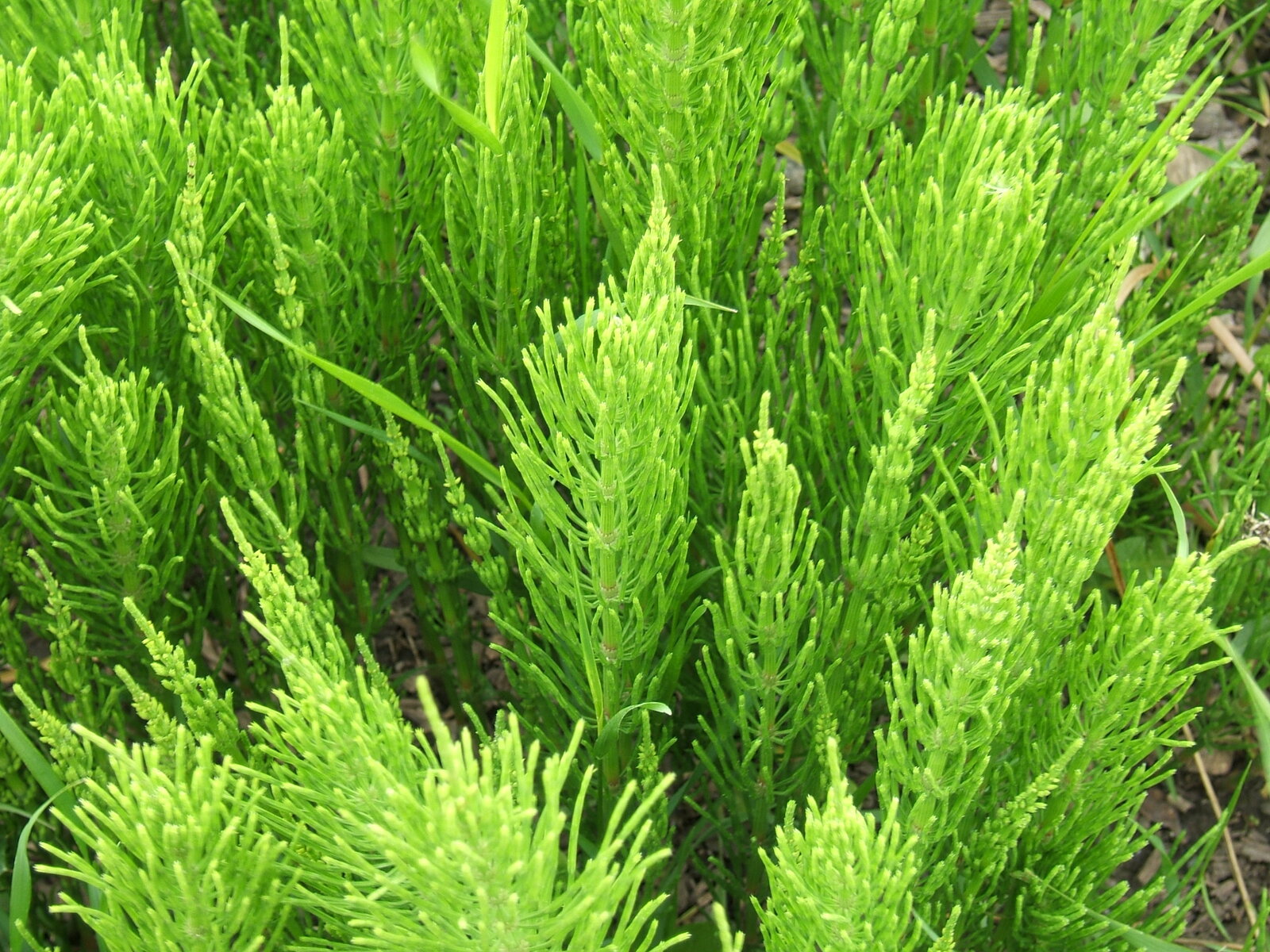
Field horsetail
Equisetum arvense
A dimorphic horsetail: in early spring, a pale, unbranched, beige fertile stem rises from the rhizome, bears a single terminal cone, then withers. After the fertile stem dies, the green sterile stems emerge with whorls of needle-like branches at each node, giving the plant a miniature pine-tree silhouette. Forms persistent rhizomatous colonies in stream banks, roadside ditches, and disturbed wet ground.
Status: Native; common in moist disturbed ground.
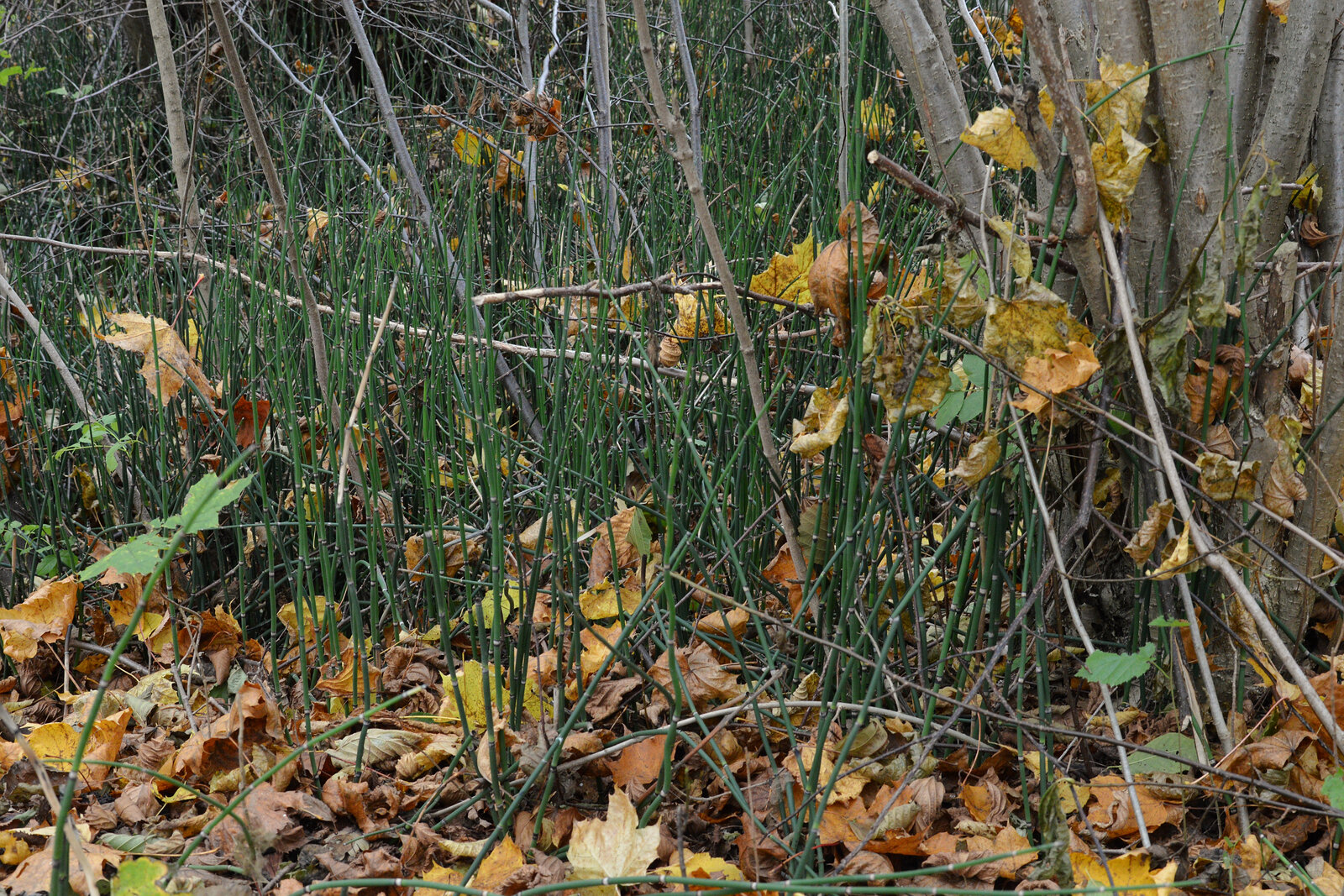
Scouring rush
Equisetum hyemale
A monomorphic horsetail with stiff, evergreen, unbranched green stems that stand a meter tall in dense colonies. Each stem has a dark band at every node and is rich in silica, hard enough to be used historically as fine sandpaper (the source of the "scouring" name). Bears a small terminal cone at the tip of fertile stems in summer. Common along sandy stream banks and seepy hollows.
Status: Native; common in moist sandy soils and stream banks.
Mosses, liverworts, and the plateau bryophyte community
Beneath the ferns sits a layer the casual visitor rarely notices but that ecologists call out as one of the southern Cumberland Plateau's most species-rich communities: the bryophytes. Mosses, liverworts, and a few hornworts cover the back walls of every shaded rockhouse, the bark of every cove hardwood, the upper surface of every rotting log on a cove floor, and the seeps and stream banks of every plateau gorge head. The Cumberland Plateau and adjacent Tennessee Cumberlands are recognized in regional bryological surveys as a North American hotspot for non-vascular plant diversity, with the deep shaded gorges providing the cool, humid microclimates these species need.
A comprehensive bryophyte inventory for Marion alone would run to several hundred species and is beyond the scope of a general-audience reference. The cards below introduce the five most visitor-recognizable taxa visitors are likely to see on a typical hike: the tall haircap moss of acid plateau caprock, the cushion-forming pincushion moss, the peat-forming sphagnum of the few plateau bogs, the snakeskin-textured thalloid liverwort of seep walls, and the tree-shaped American tree moss of stream banks. Anyone who wants to go deeper can use these as a gateway into the regional bryological literature.
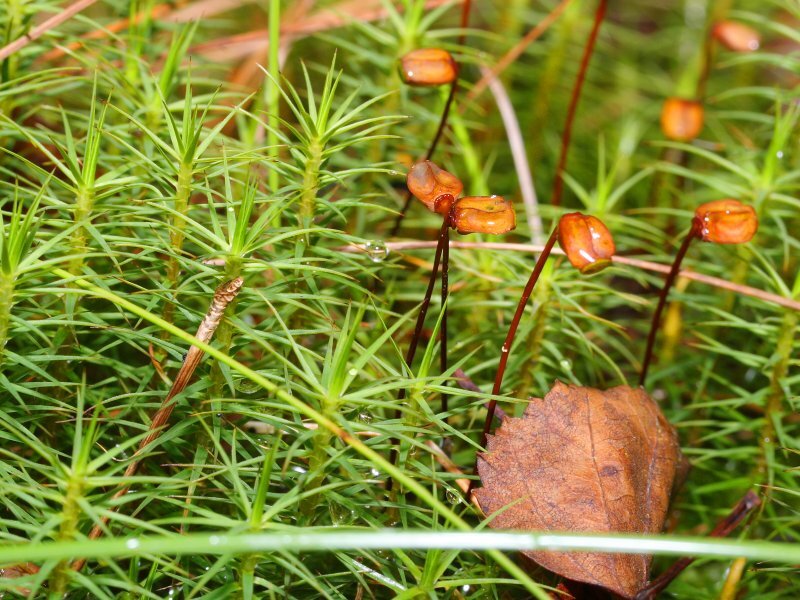
Common haircap moss
Polytrichum commune
A tall, robust acrocarpous moss whose individual shoots stand two to four inches tall, forming low cushions on acid soil and the upper surface of sandstone caprock. The leaves are stiff, lance-shaped, and turn outward at right angles to the stem when dry, giving the colony a bristly silhouette (the "haircap" of the common name comes from the hairy calyptra that covers the developing sporophyte capsule). One of the easiest mosses to identify by silhouette alone.
Status: Native; common on acid soils and the plateau caprock.
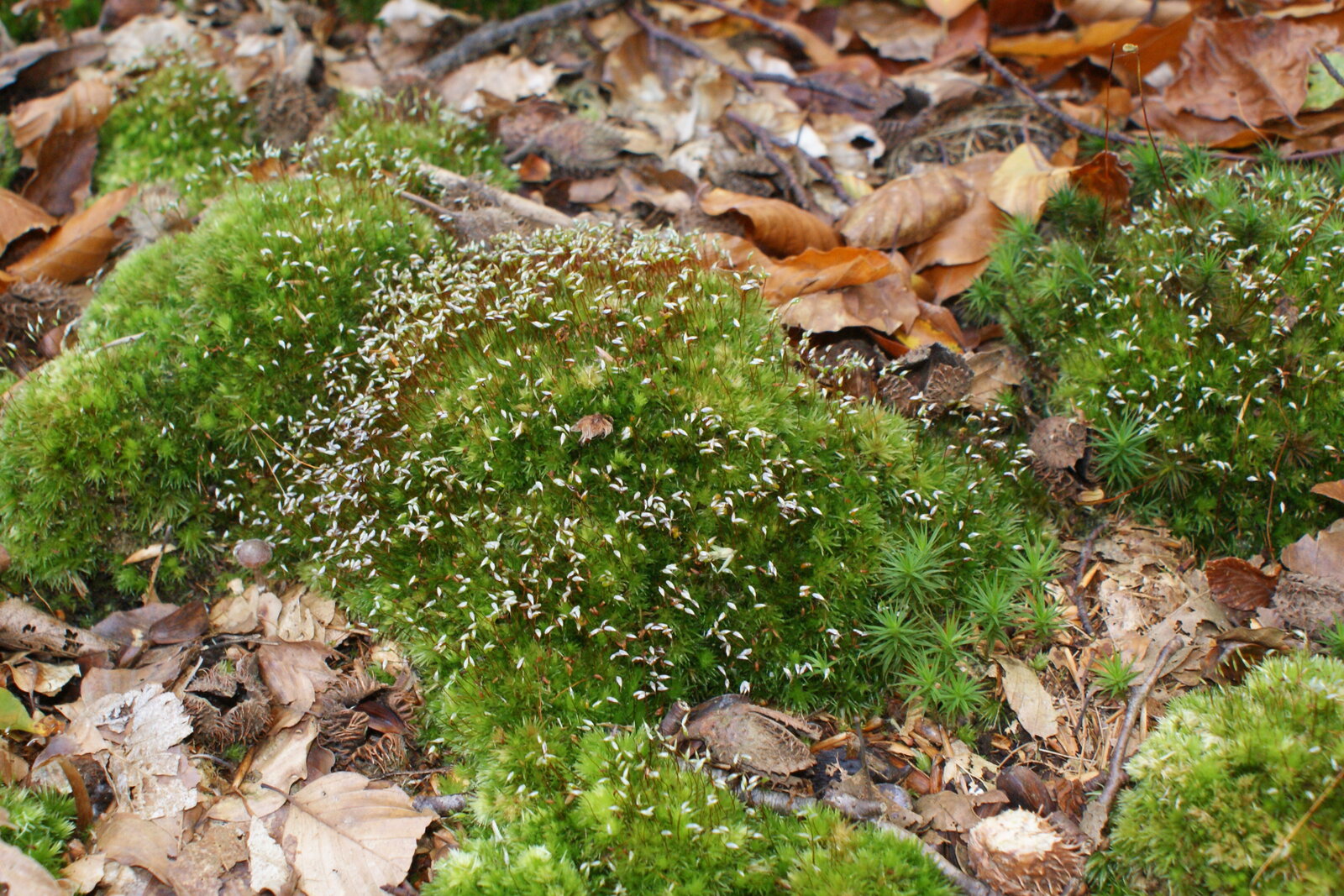
Pincushion moss
Leucobryum glaucum
A distinctive cushion-forming moss with thick, succulent-looking, whitish-green leaves arranged in dense rounded mounds on acid soil. The cushions can reach a foot across and several inches tall, holding water like a sponge well after the surrounding leaf litter has dried out. The pale color comes from large dead water-storage cells (hyalocysts) in the leaf interior, which scatter light and give the colony its grey-green sheen.
Status: Native; common on acid soils in cove and plateau woods.
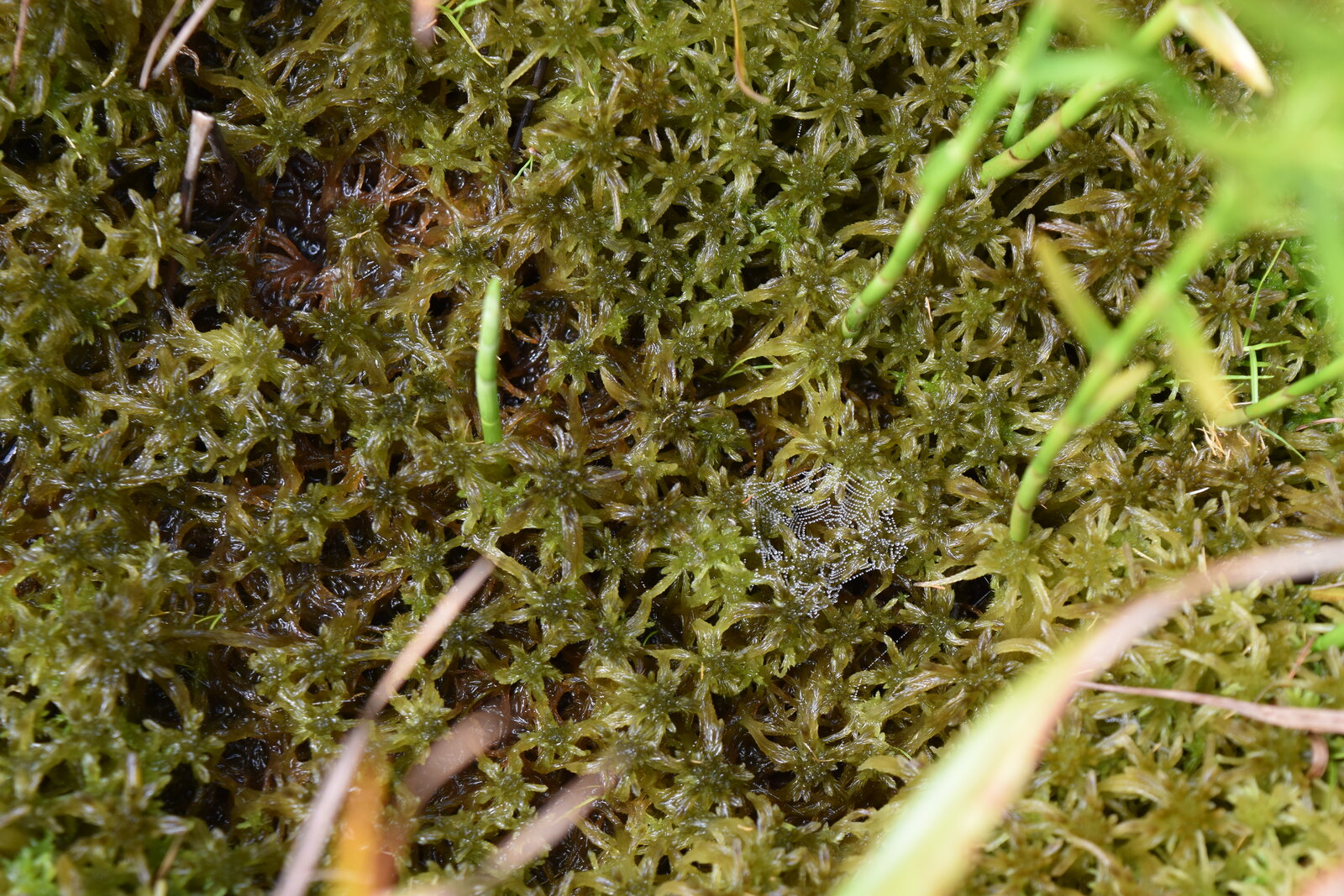
Sphagnum (peat moss)
Sphagnum spp.
A genus rather than a single species: several Sphagnum species occur in the scattered acidic plateau bogs and the seepy hollows along plateau heath. Sphagnum cells are exceptional water-holders, and the colonies acidify their substrate enough to slow decomposition, accumulating peat over decades. Sphagnum bogs are uncommon on the southern Cumberland Plateau, which is mostly too well-drained, but a handful of small examples persist around plateau gorge heads and a few abandoned beaver dams.
Status: Native; uncommon in the few plateau bogs and seepy hollows.
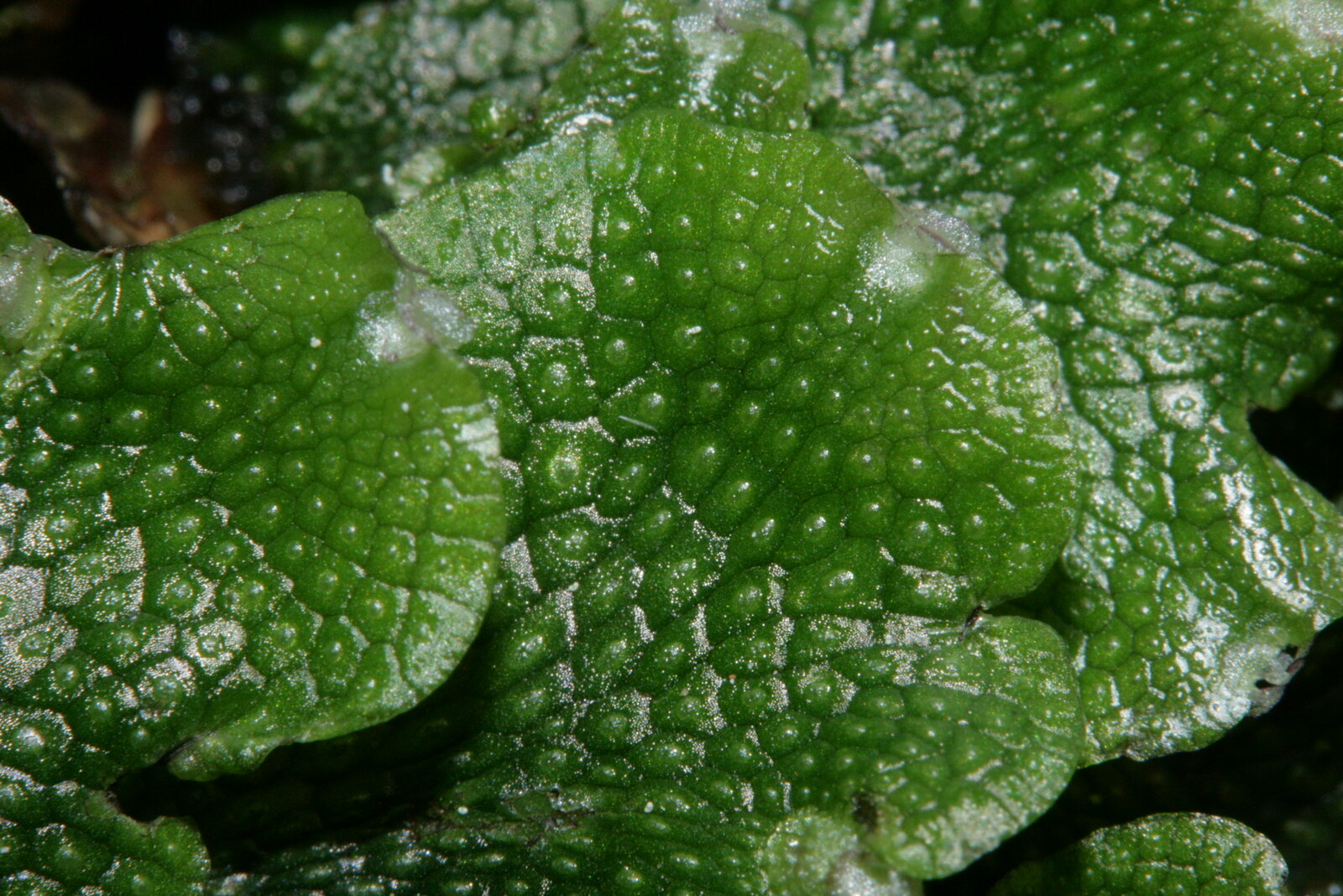
Snakeskin liverwort
Conocephalum salebrosum
A large thalloid liverwort whose flat green ribbon covers wet seep walls and shaded stream banks. The thallus surface is divided into a hexagonal pattern of "air chambers" (each with a central pore) that resembles snakeskin to the naked eye, the source of the common name. Releases a mild eucalyptus-like scent when crushed. Conocephalum salebrosum is the more northerly cryptic species in a complex that was formerly all called C. conicum.
Status: Native; common on seep walls and shaded wet stream banks.
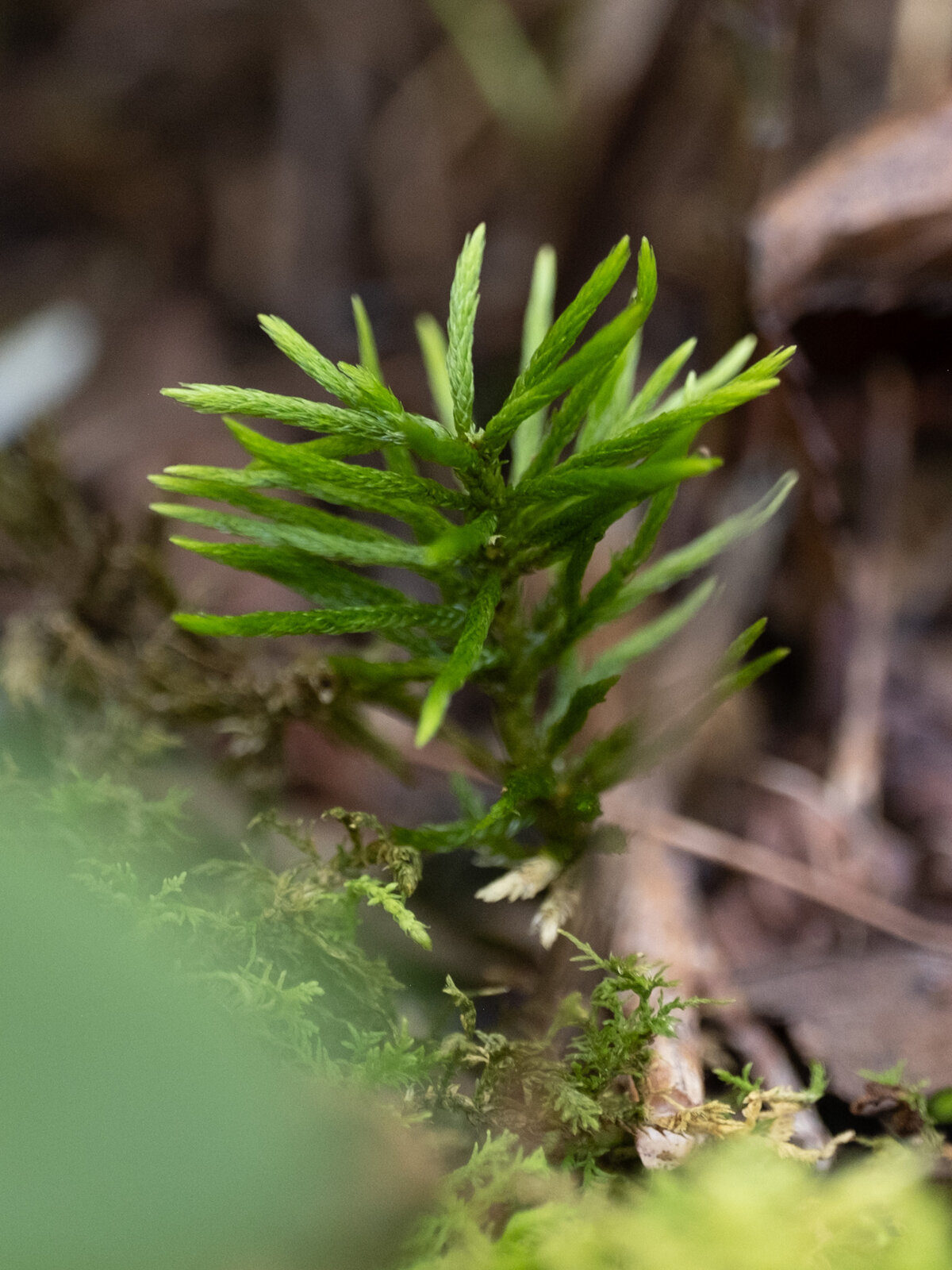
American tree moss
Climacium americanum
A distinctive pleurocarpous moss whose individual shoots take a miniature-tree shape: a single bare "trunk" rises an inch or two from a creeping rhizome, then bears a crown of feathery branches at the top. The architecture is unlike any other Marion bryophyte and makes the species easy to recognize from across a stream bank. Common in wet shaded cove forests and along the moss-covered margins of small creeks.
Status: Native; common in wet cove forests and stream margins.
Orchids
Marion County's woods host at least seventeen native orchid species, all protected under Tennessee law. Orchids rely on specific mycorrhizal fungi for germination and establishment; nearly all require years to decades to reach flowering size from seed. Digging a wild orchid almost always kills the plant because the root-fungus symbiosis cannot survive transplantation. Tennessee law prohibits collecting any native orchid from public or private land without a permit. If you find one, photograph it and leave it where it grows.
Slipper orchids
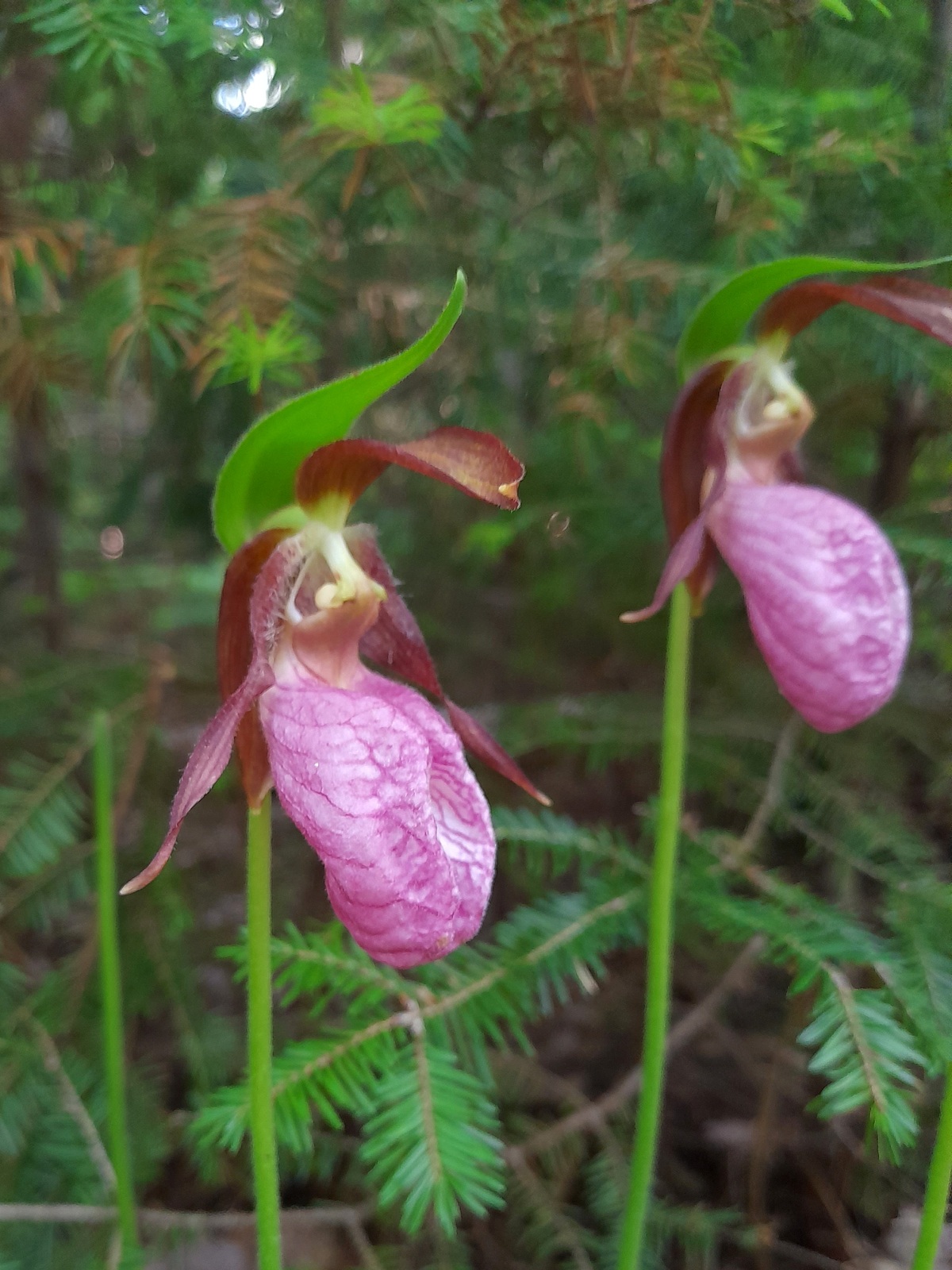
Pink lady's slipper
Cypripedium acaule
The most frequently encountered orchid in Marion County, scattered through acidic pine-oak-heath forests on the plateau caprock. The inflated pink pouch sits atop a leafless stem between two parallel-veined basal leaves. Pollinators enter through a frontal slit, become temporarily trapped, and exit past the stigma and pollen masses, ensuring outcrossing. Individual plants may live thirty to fifty years before first flowering. Blooms April to May.
Status: Native. State listed endangered and commercially exploited (TDEC). Locally uncommon on acidic plateau soils.
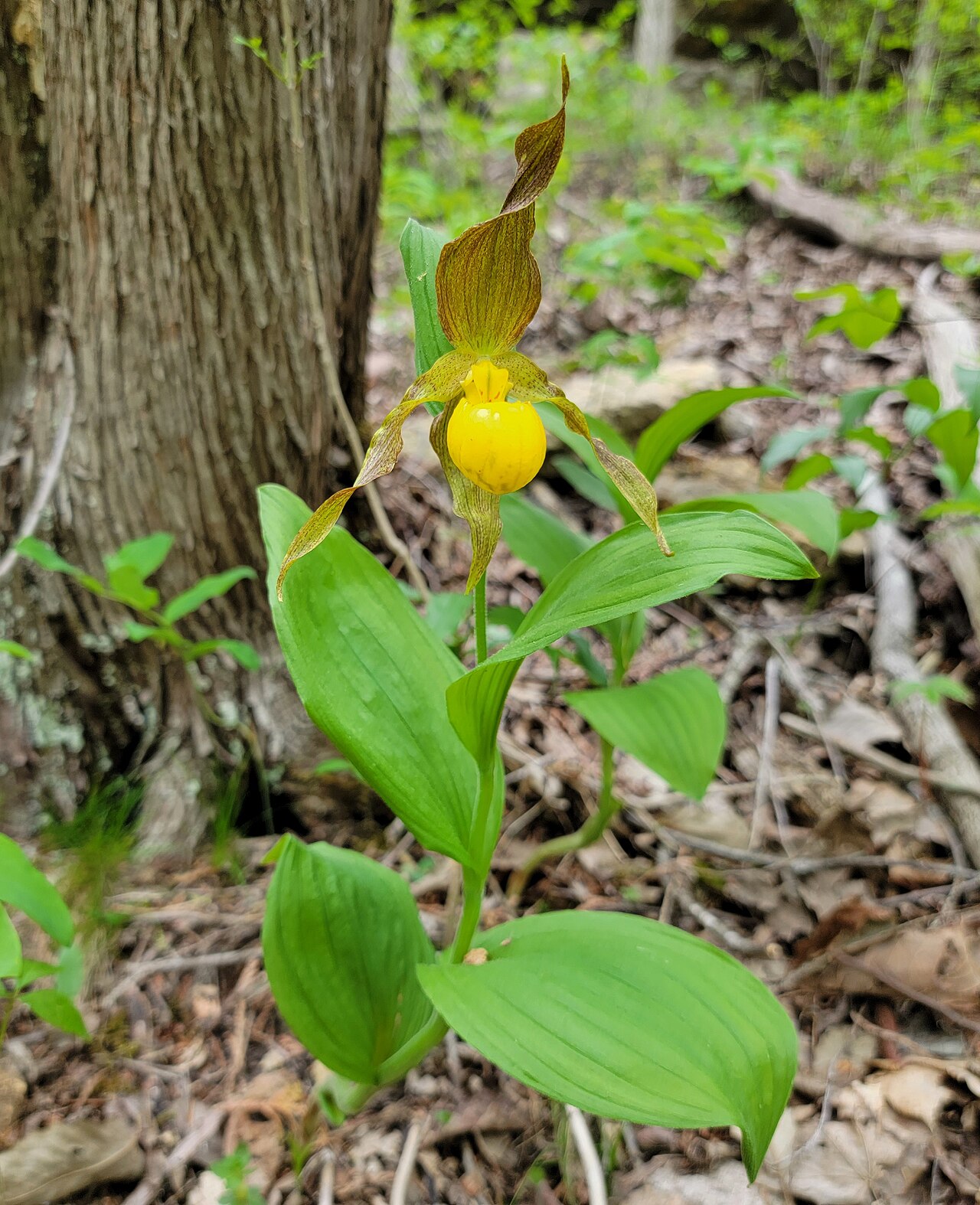
Yellow lady's slipper
Cypripedium parviflorum
Prefers richer, more neutral soils than the pink lady's slipper and is rarer in Marion County. Grows on limestone-influenced gorge slopes and cove floors where soil pH reaches into the mid-6s. The bright yellow pouch and twisted lateral petals distinguish it from its pink relative. Blooms April to June.
Status: Native. Uncommon in Marion; confirmed by TN-KY Plant Atlas Marion County record.
Ladies'-tresses and rattlesnake plantains
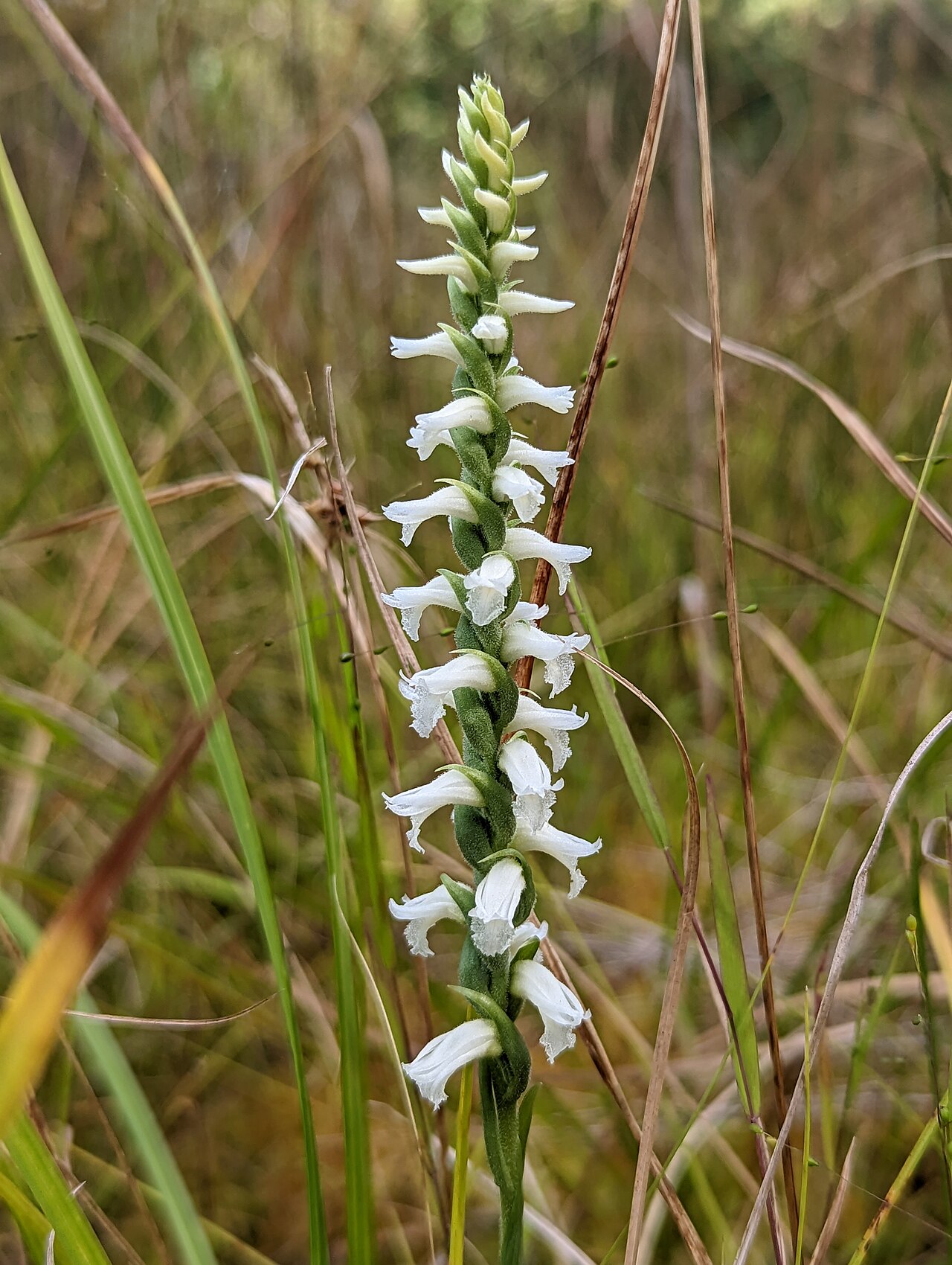
Nodding ladies'-tresses
Spiranthes cernua
A fall-blooming orchid with small white flowers arranged in a spiraling column. Grows in moist meadows, seepage slopes, and open woodlands. The flowers nod downward and emit a faint vanilla fragrance attractive to bumblebees. Among the most common Spiranthes across the eastern United States. Blooms September to November.
Status: Native. Recorded on the southern Cumberland Plateau (Sewanee Domain checklist).
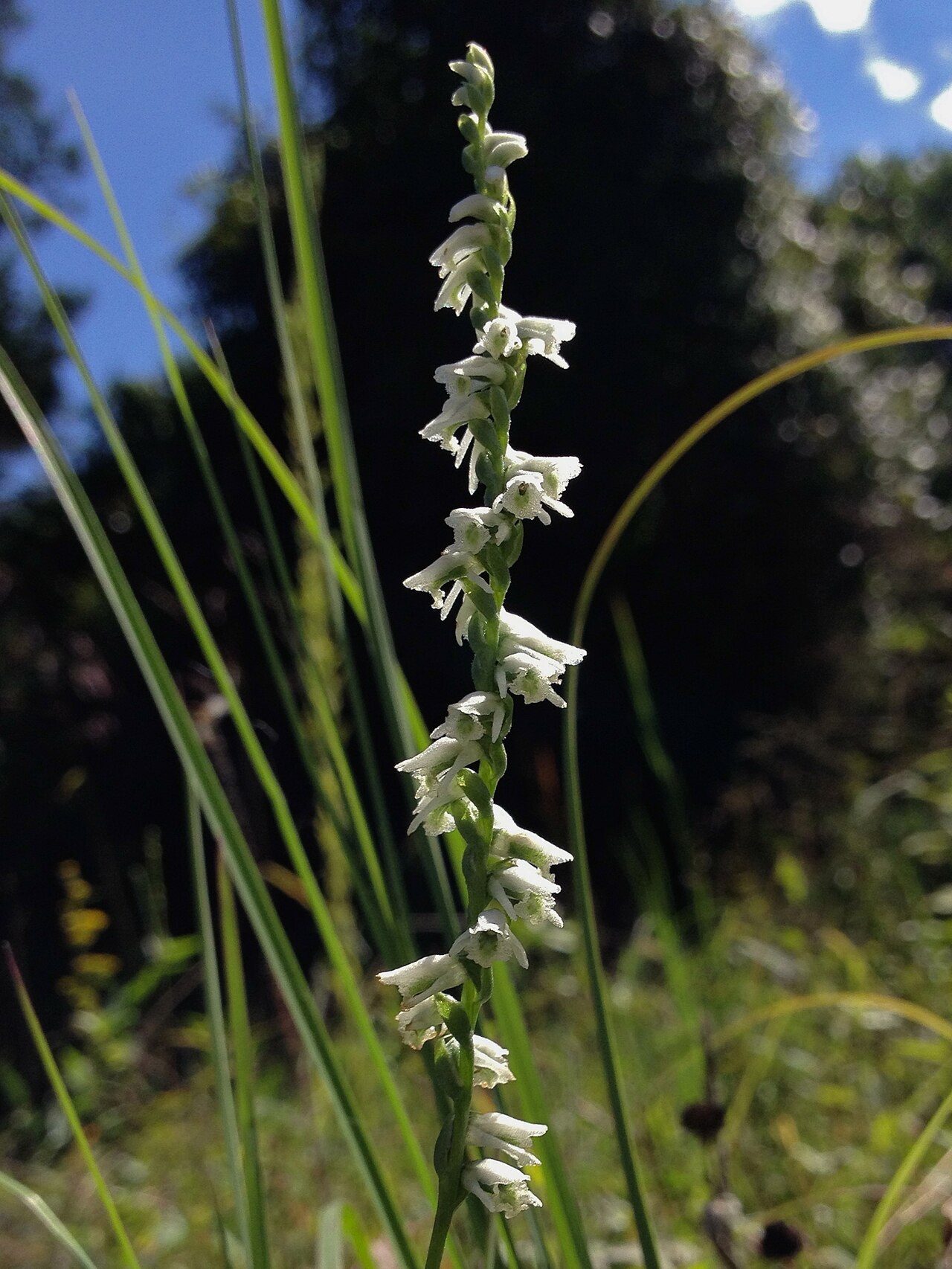
Slender ladies'-tresses
Spiranthes lacera
A delicate summer-blooming ladies'-tresses with a single spiral of tiny white flowers on a slender stem. Favors dry, open ground: old fields, roadsides, thin-soil glades, and open oak woodlands. Often the first orchid to colonize disturbed ground. Blooms June to August.
Status: Native. Recorded on the southern Cumberland Plateau (Sewanee Domain checklist).
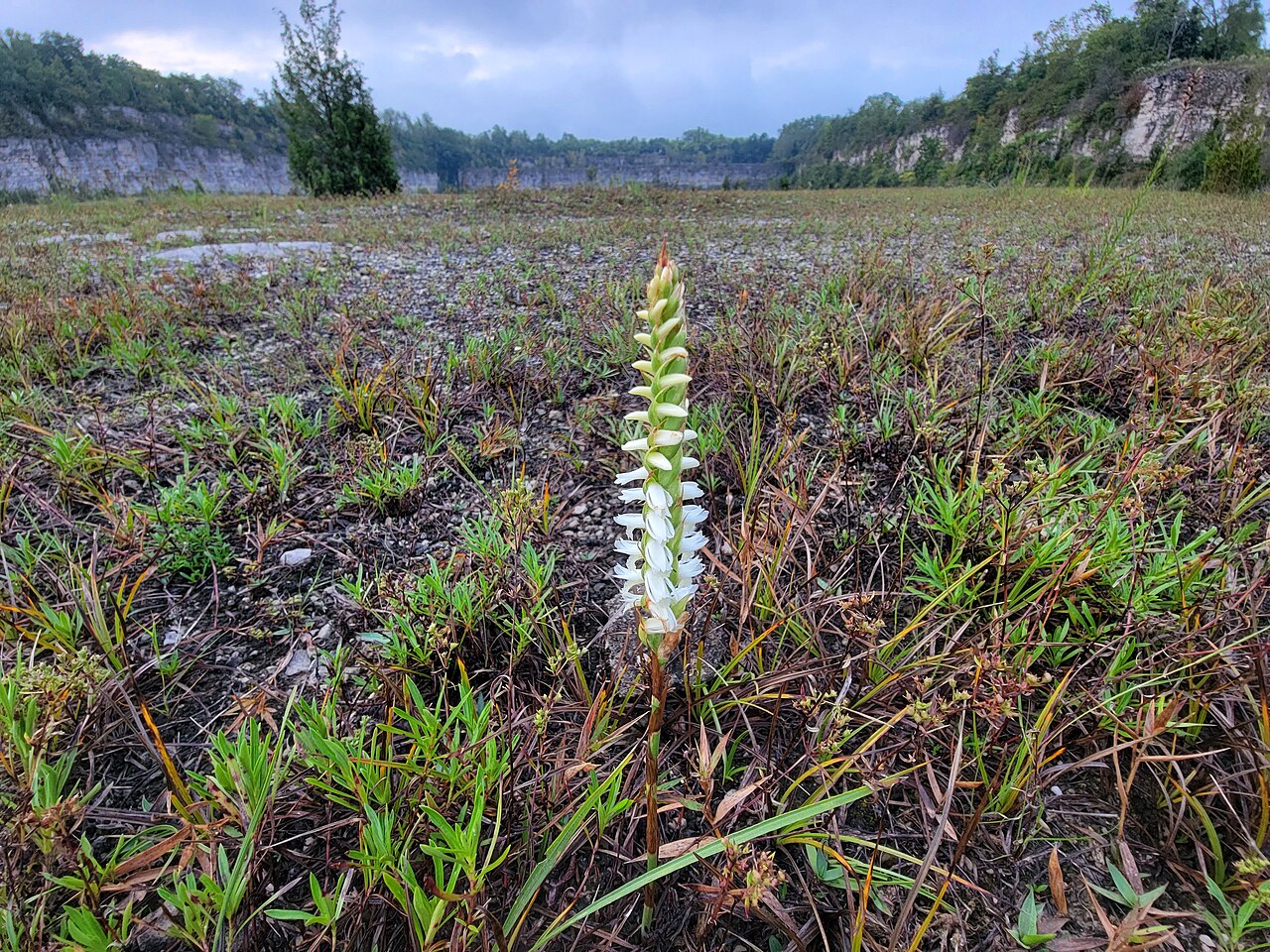
Great Plains ladies'-tresses
Spiranthes magnicamporum
A late-fall orchid of calcareous prairies and open limestone barrens, with a dense spike of creamy-white flowers that smell of coumarin (fresh-cut hay). The species reaches the eastern edge of its range in the Tennessee Valley, where it grows in remnant glade and prairie patches on alkaline substrates. Blooms October to November.
Status: Native. TN-KY Plant Atlas Marion County record. State-endangered (TDEC); S1, G3G4.
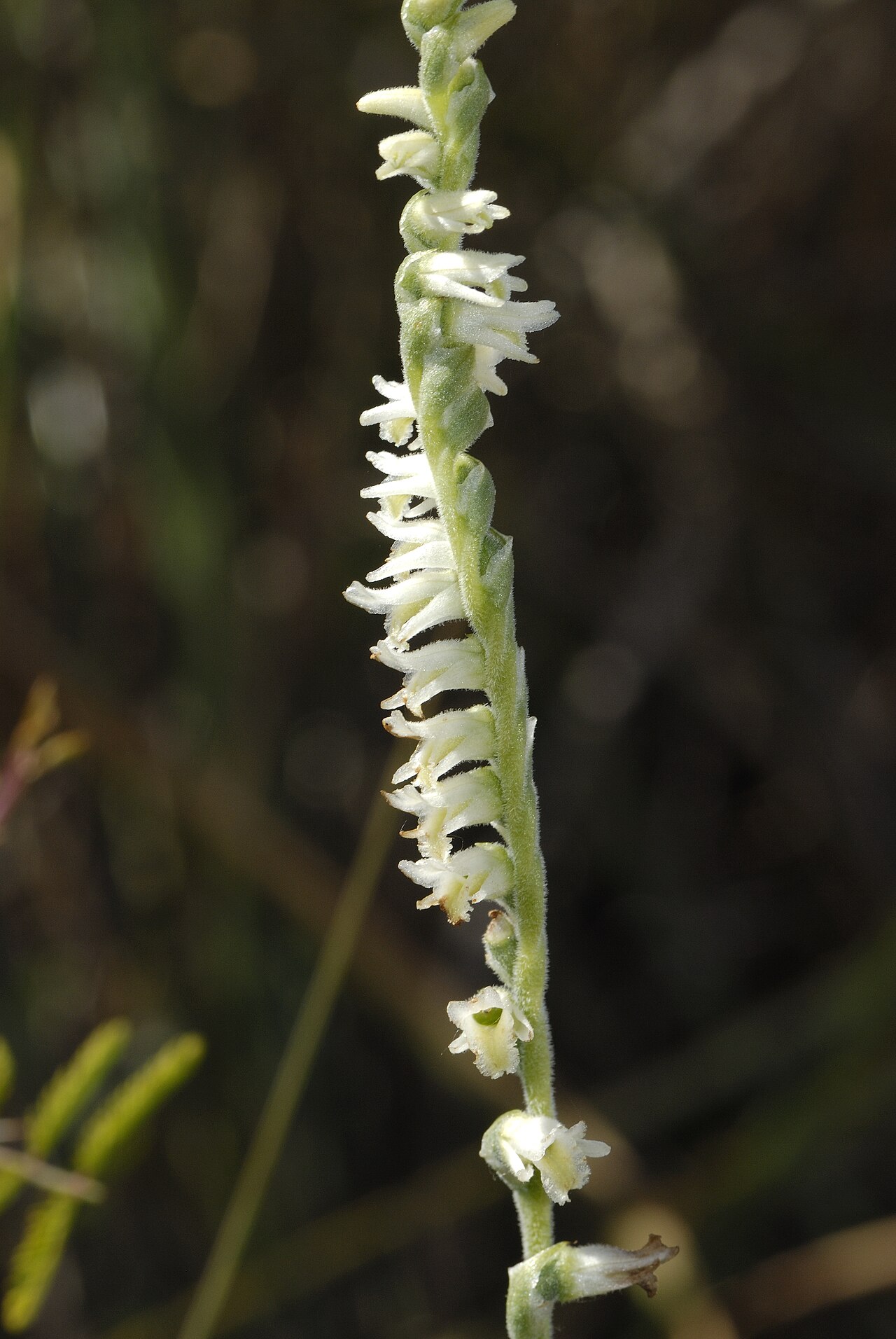
Spring ladies'-tresses
Spiranthes vernalis
Unlike its fall-blooming relatives, this species flowers from late spring into early summer. Grows in moist meadows, roadsides, and open pinelands. The flowers are arranged in a single tight spiral and are covered with fine hairs giving the spike a pubescent appearance. Blooms May to July.
Status: Native. TN-KY Plant Atlas Marion County record.
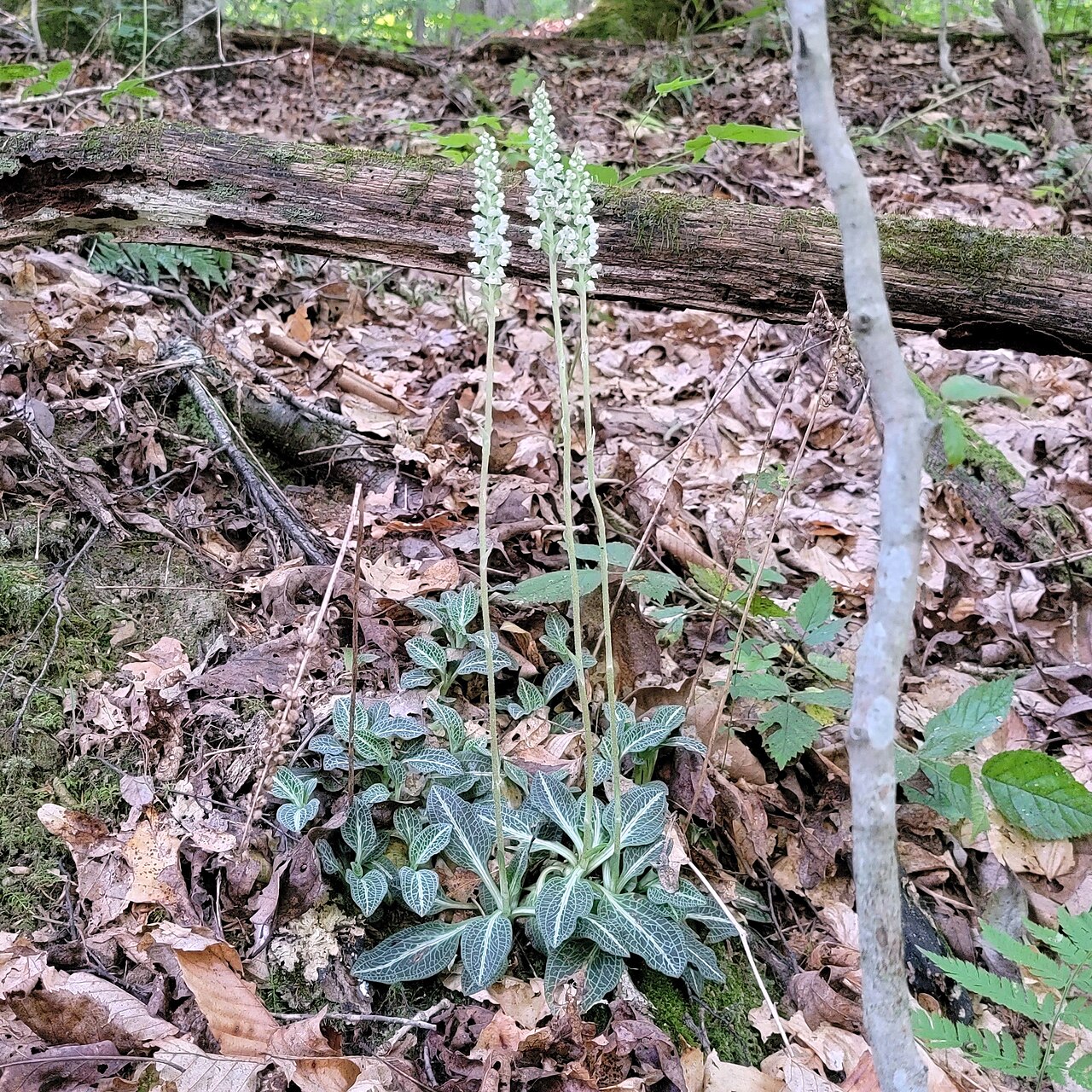
Downy rattlesnake plantain
Goodyera pubescens
More often noticed for its leaves than its flowers. A basal rosette of dark evergreen leaves marked with a bold white net-venation pattern said to resemble the skin of a rattlesnake. The white flower spike rises in late summer but is small and easily overlooked. Common in dry to mesic oak-hickory and pine-oak woods on acidic soils across Marion's plateau.
Status: Native. Common, widespread. TN-KY Plant Atlas Marion County record.
Woodland orchids
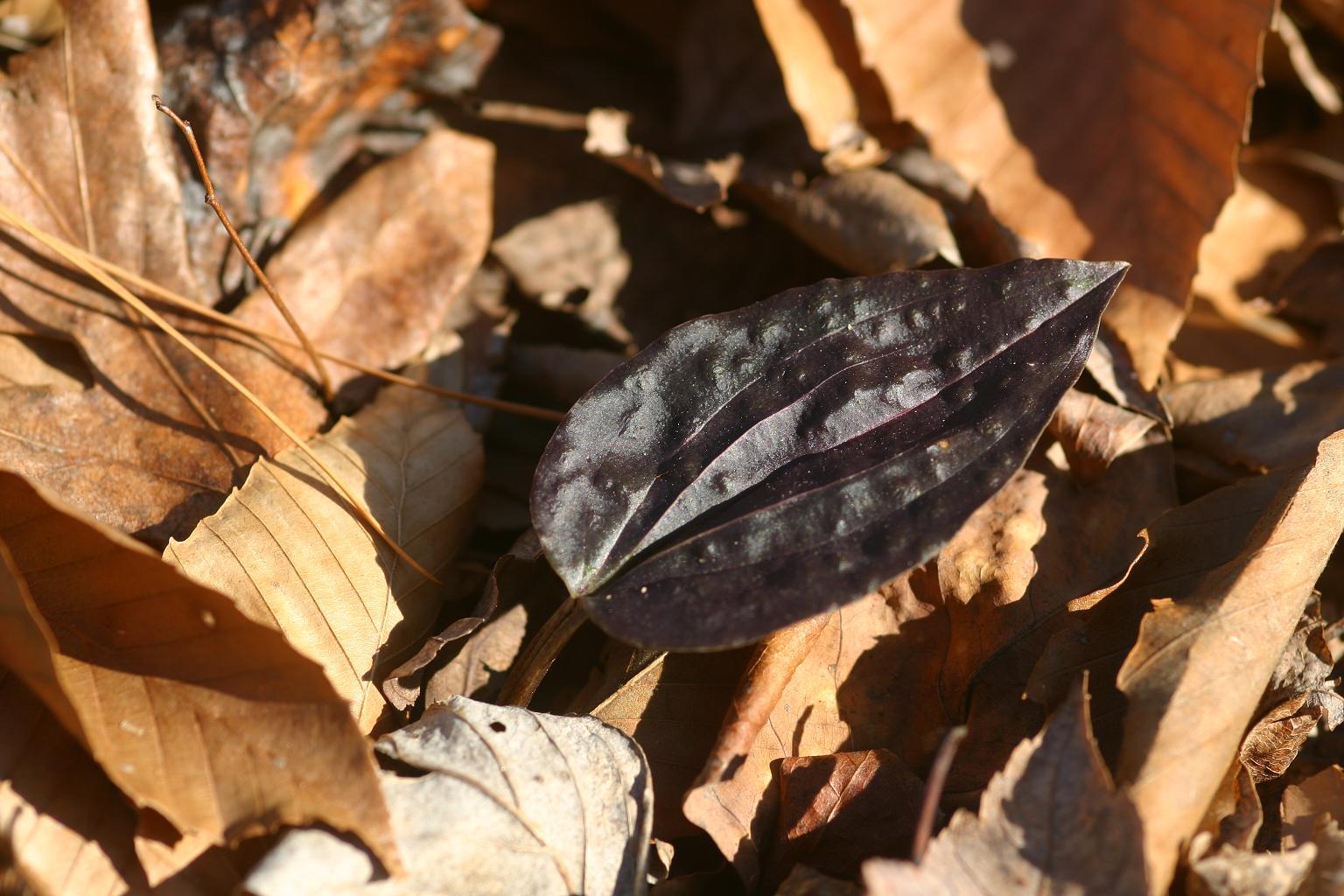
Cranefly orchid
Tipularia discolor
The oddest of Marion's orchids. Through winter, a single pleated leaf lies flat on the forest floor, green above and deep purple below. The leaf withers before the plant flowers, so by July and August the wispy pale orchid spike rises with no leaf attached. The name comes from the individual flowers, which resemble tiny long-legged craneflies. More common than hikers realize; it simply goes unnoticed. Blooms July to August.
Status: Native. Common, widespread in mesic woods. TN-KY Plant Atlas Marion County record.
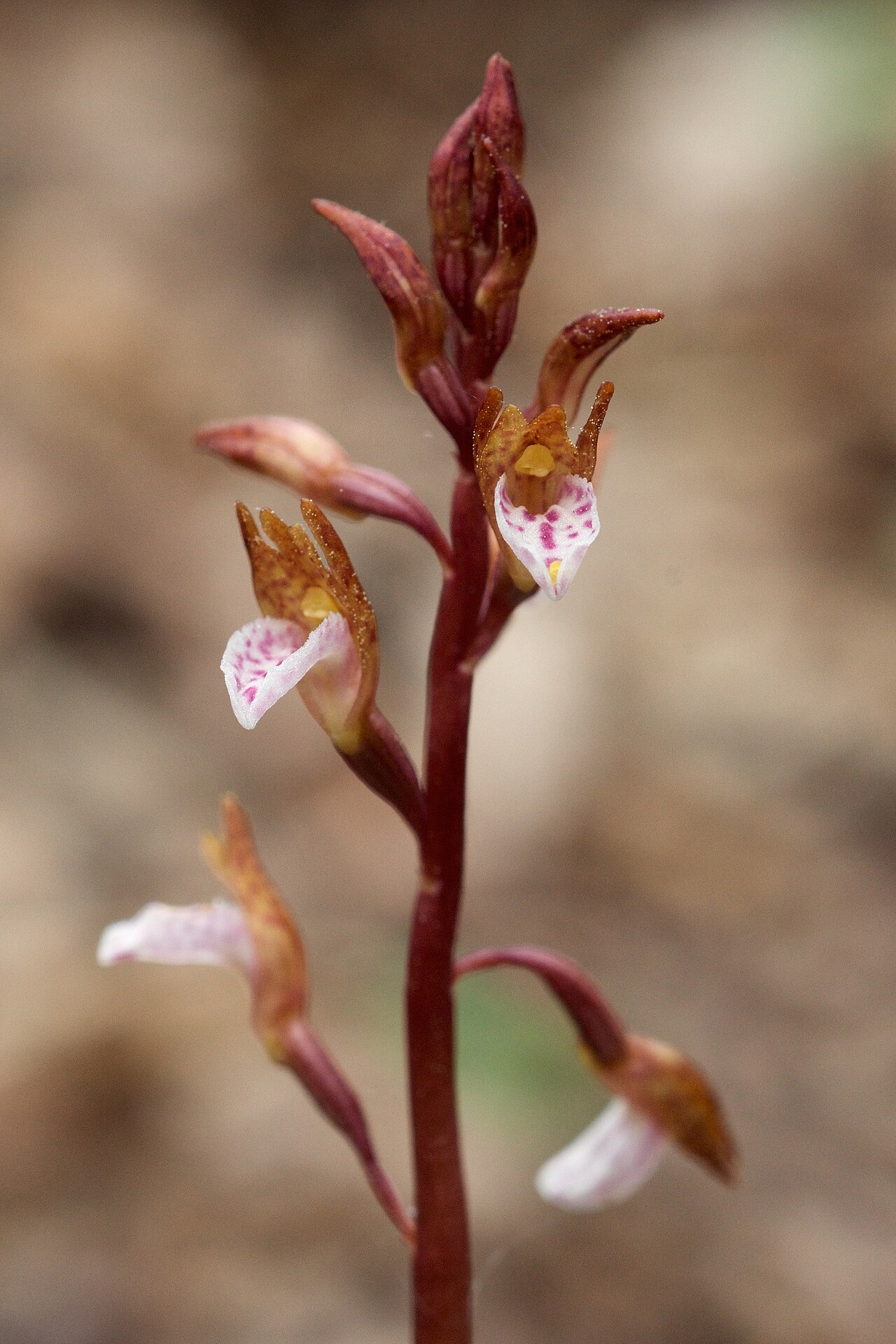
Spring coralroot
Corallorhiza wisteriana
A mycoheterotrophic orchid that has no green leaves and no chlorophyll, deriving all nutrition from fungi associated with tree roots. The stem emerges from the leaf litter as a reddish-brown stalk topped with small spotted flowers. Named for its coral-shaped underground rhizome. Blooms March to May in rich deciduous woods.
Status: Native. TN-KY Plant Atlas Marion County record.
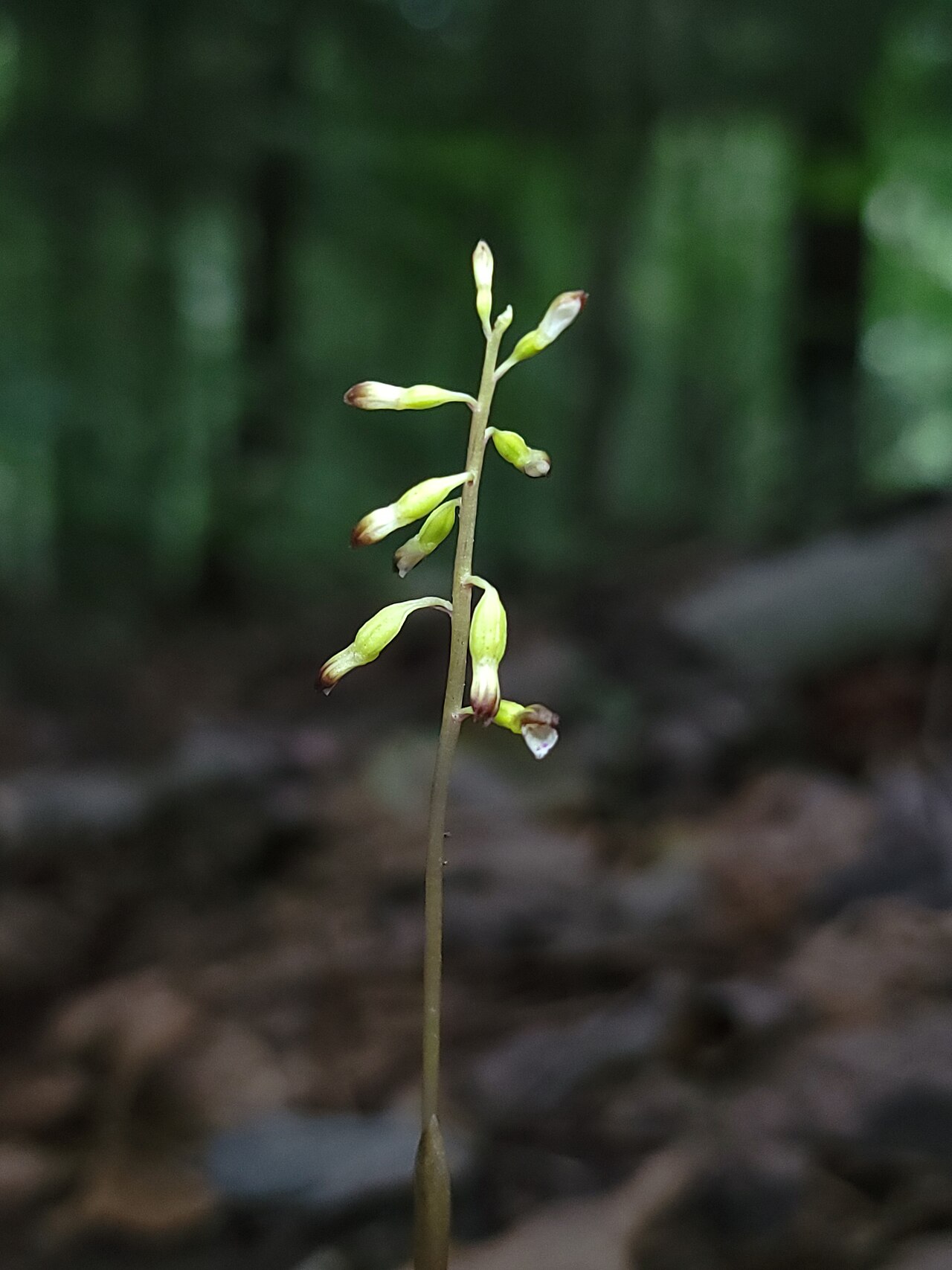
Autumn coralroot
Corallorhiza odontorhiza
A fall-blooming counterpart to the spring coralroot, equally leafless and mycoheterotrophic. The flowers are often cleistogamous (self-pollinating without ever opening), making them even harder to spot than other coralroots. A slender purplish-brown stalk rising from the leaf litter in September or October is the only visible sign. Recorded on the southern Cumberland Plateau (Sewanee Domain checklist).
Status: Native. Uncommon; recorded regionally but not yet confirmed by Atlas county-level data for Marion.
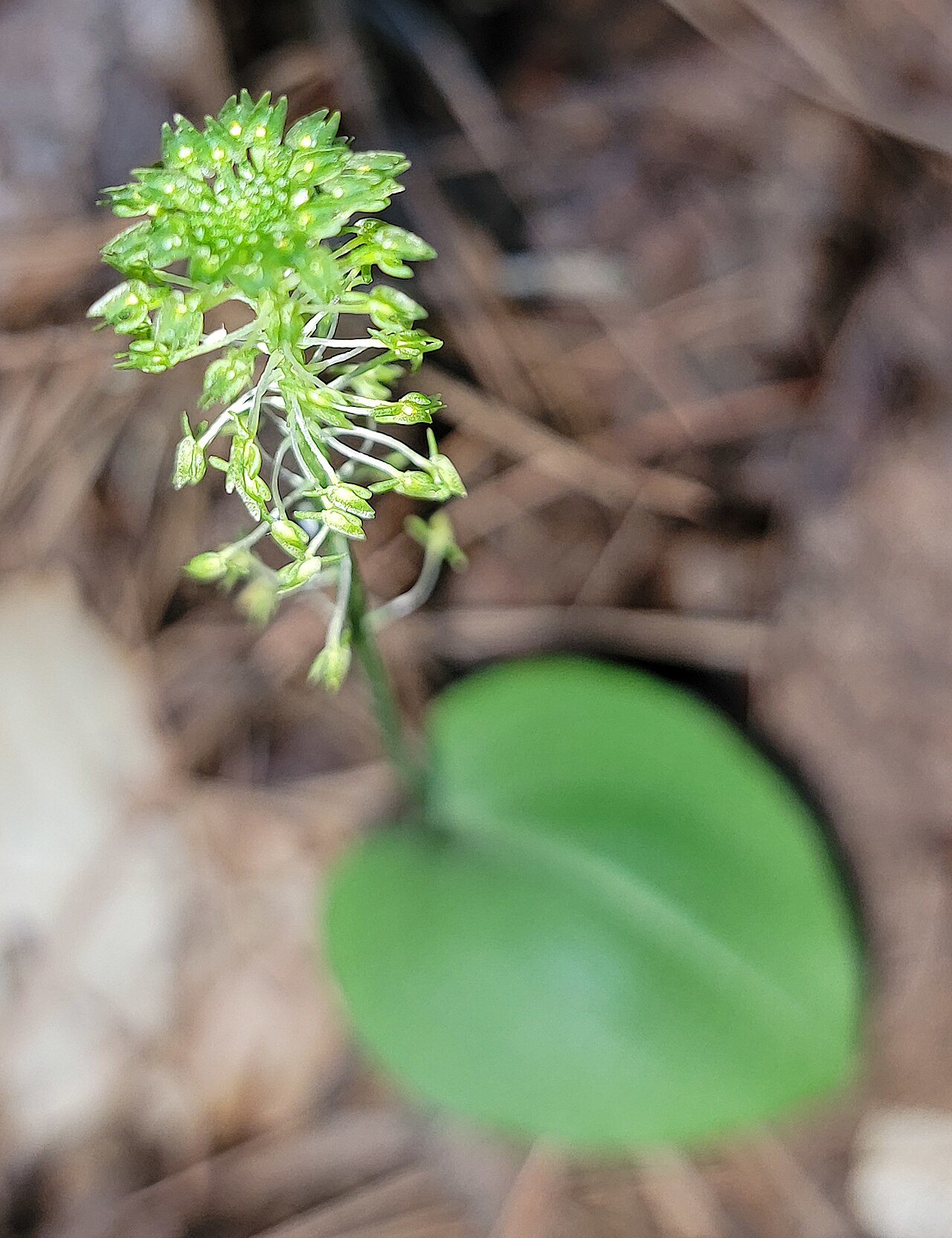
Green adder's-mouth
Malaxis unifolia
One of the smallest and most easily overlooked orchids. A single oval leaf clasps the stem partway up; above it, a dense spike of minute green flowers no larger than a pinhead. Grows in moist, shaded, acidic woodland humus. The entire plant may stand only three to six inches tall. Blooms June to August.
Status: Native. TN-KY Plant Atlas Marion County record.
Fringed orchids
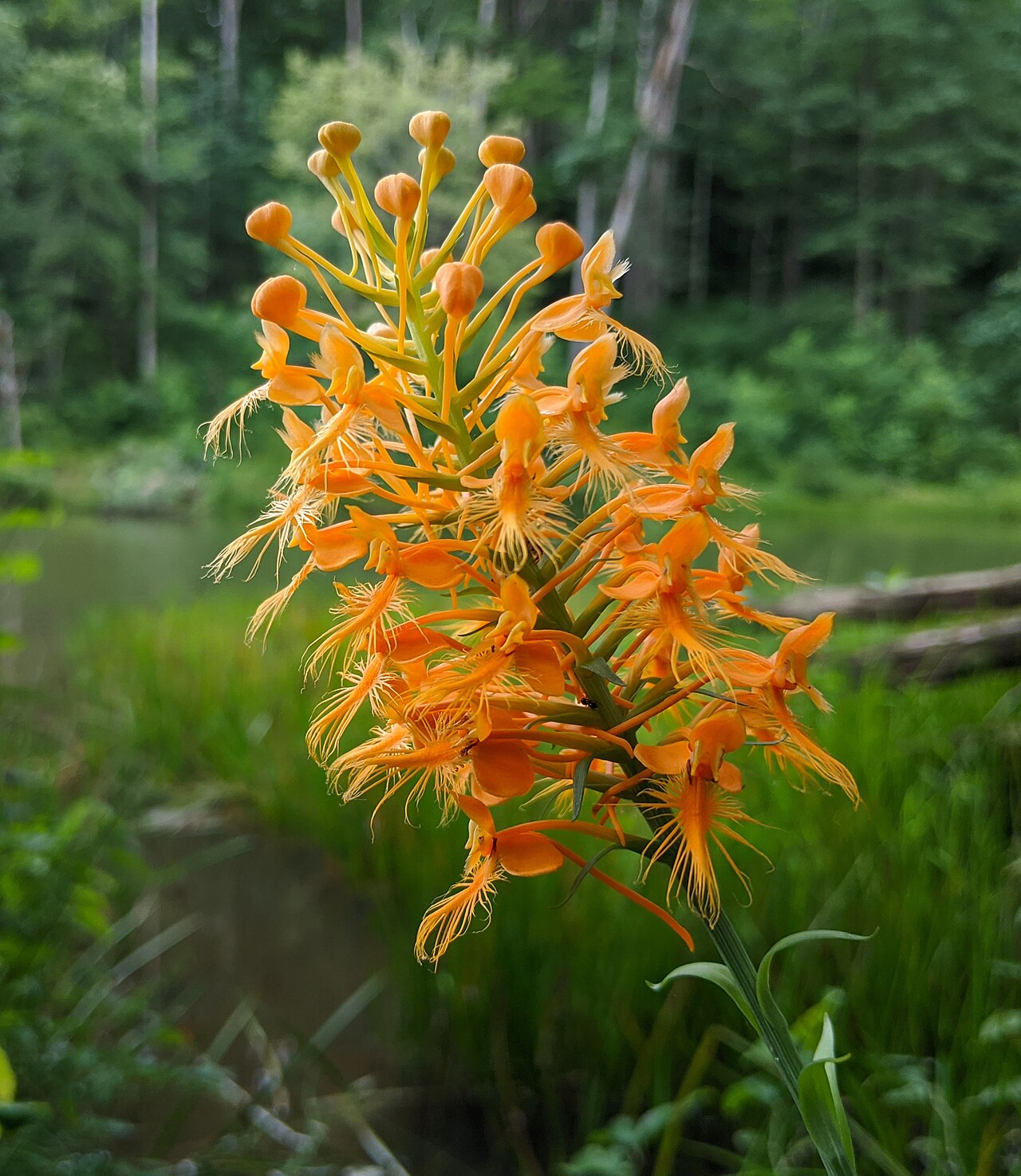
Yellow fringed orchid
Platanthera ciliaris
Among the showiest native orchids, with a dense cluster of bright orange-yellow flowers whose lip petals are deeply fringed into thread-like segments. Grows in moist, acidic, open woodlands, seepage bogs, and wet meadows on the plateau. The long nectar spur restricts pollination to long-tongued butterflies. Blooms July to September.
Status: Native. TN-KY Plant Atlas Marion County record.
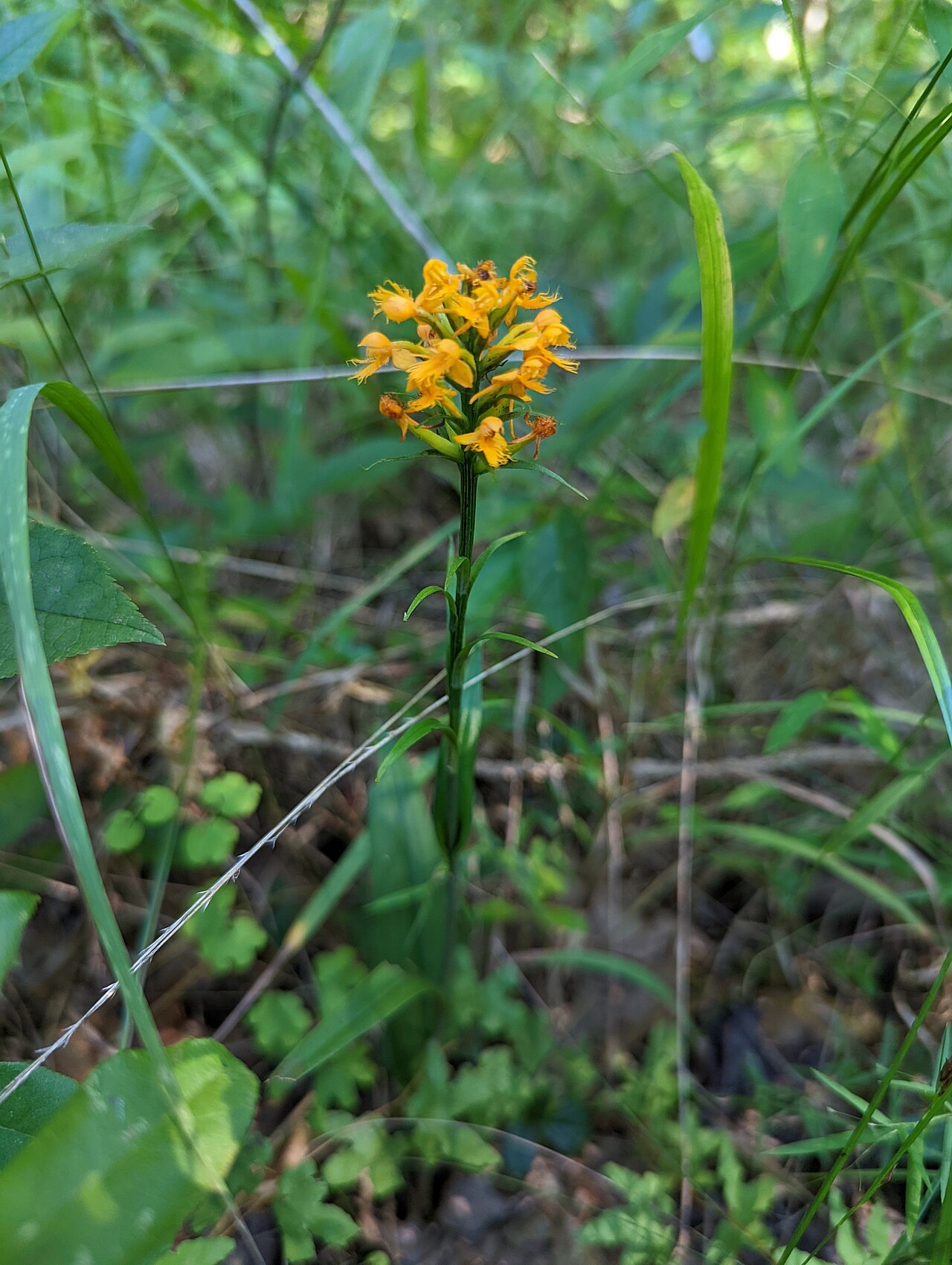
Yellow crested orchid
Platanthera cristata
Smaller and more delicate than the yellow fringed orchid, with a shorter, more compact flower spike and more finely fringed lip. Grows in wet, acidic, sandy or peaty soils in open pine-oak savannas and seepage areas. Distinguished from P. ciliaris by the shorter nectar spur and smaller overall flower size. Blooms July to August.
Status: Native. TN-KY Plant Atlas Marion County record. State special-concern (TDEC); S2S3, G5.
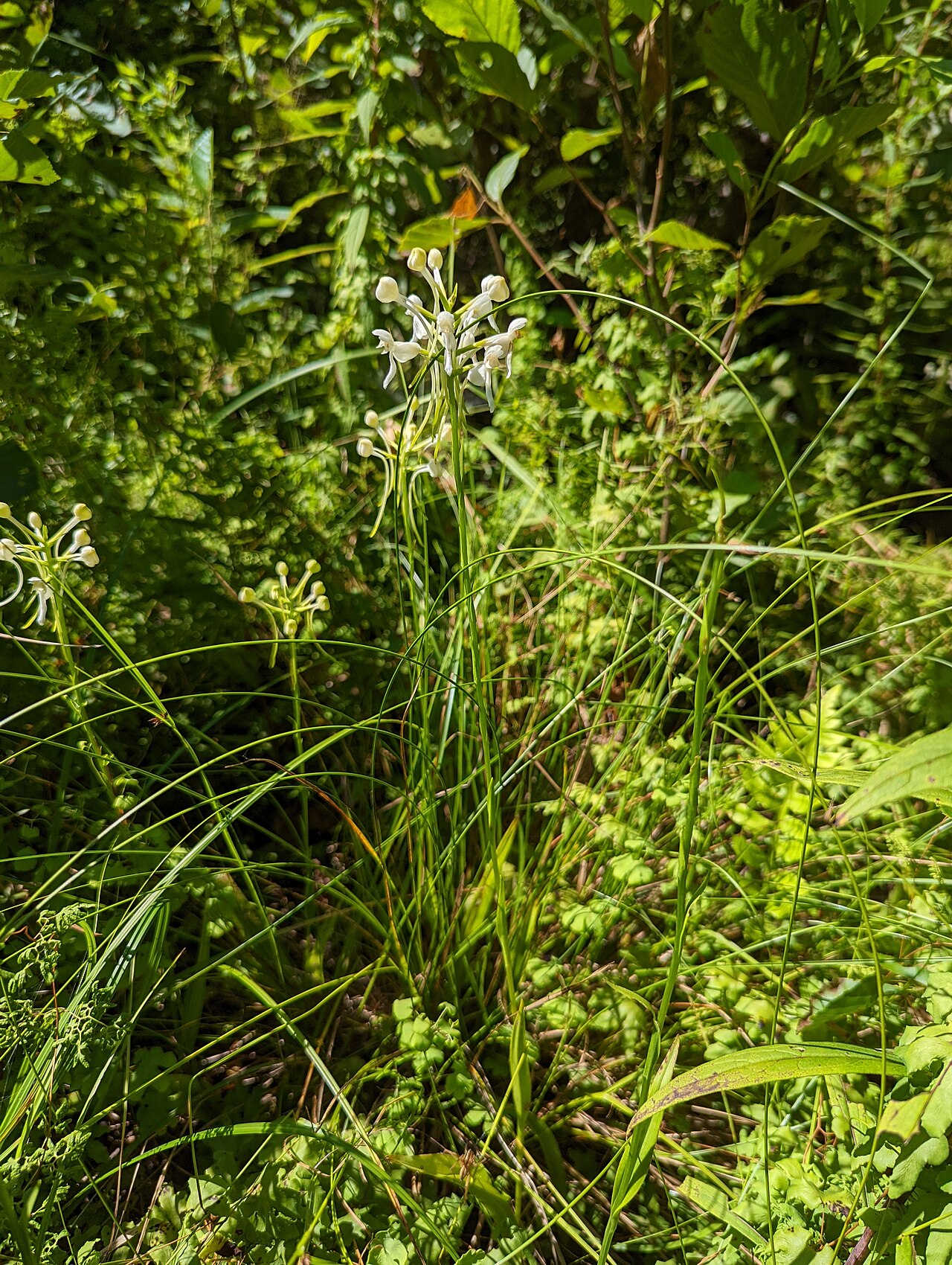
White fringeless orchid
Platanthera integrilabia
Also called monkey-face orchid for the shape of the unfringed lip petal. A rare bog orchid of sandstone seepage areas on the Cumberland Plateau. Unlike its fringed relatives, the lip is entire (not fringed), broad, and pure white. Depends on specific bog-seep hydrology maintained by intact sandstone aquifers. Blooms August to September.
Status: Native. TN-KY Plant Atlas Marion County record. Federally endangered; state-endangered (TDEC); S2S3, G2.
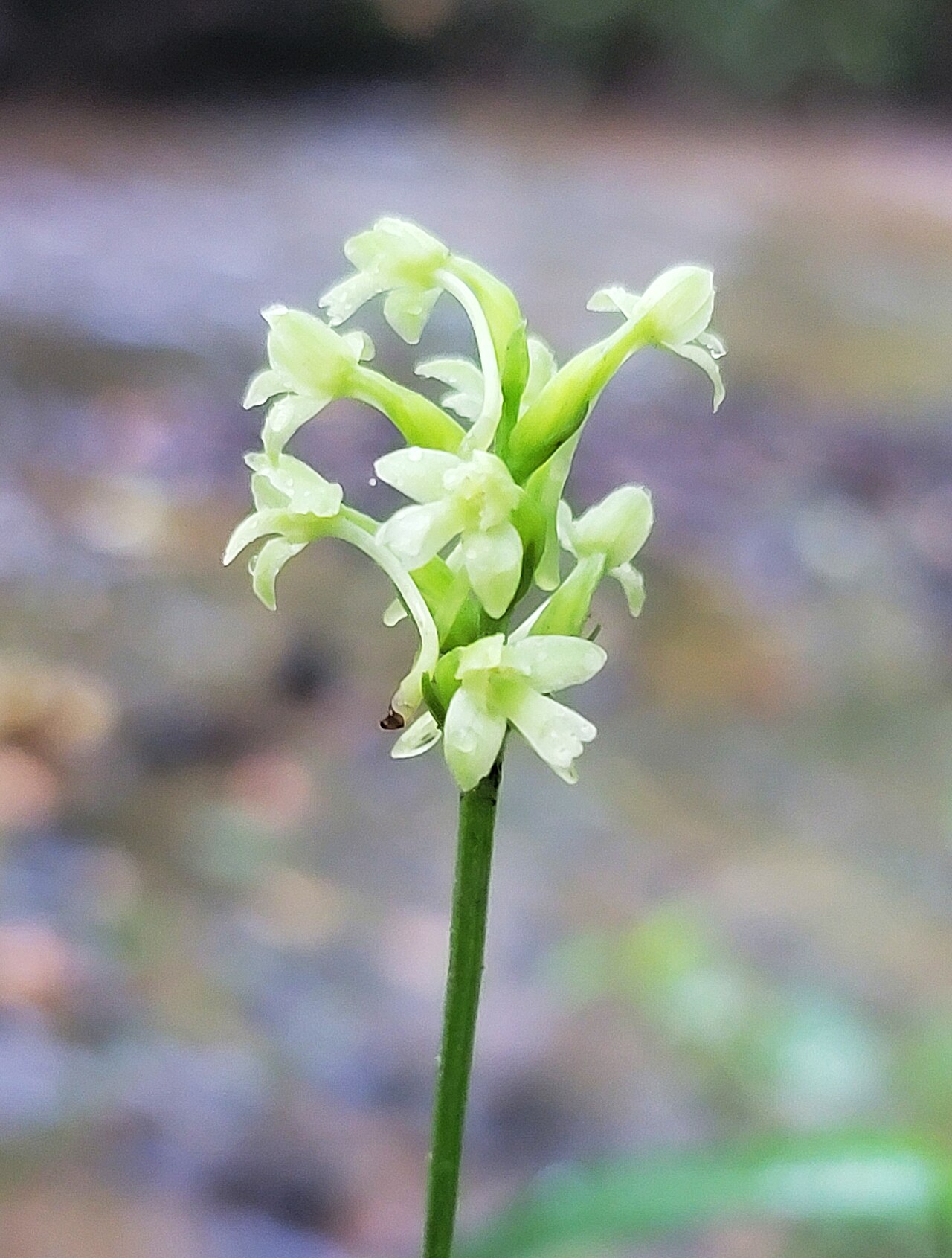
Green woodland orchid
Platanthera clavellata
A small, easily overlooked orchid of moist, shaded stream banks and seepage areas. The pale greenish-white flowers are loosely arranged along a short spike, each with a blunt spur. A single leaf clasps the stem near the base. Common in suitable habitat but rarely noticed by casual hikers. Blooms June to September.
Status: Native. TN-KY Plant Atlas Marion County record.
Other notable monocots
Beyond orchids, grasses, sedges, and the spring wildflowers treated above (trilliums, bellworts, trout lilies, Solomon's seals), Marion County supports dozens of monocot species across a range of families. The arums, irises, spiderworts, wild lilies, and climbing monocots below round out the county's non-grass monocot diversity.
Arums and woodland monocots
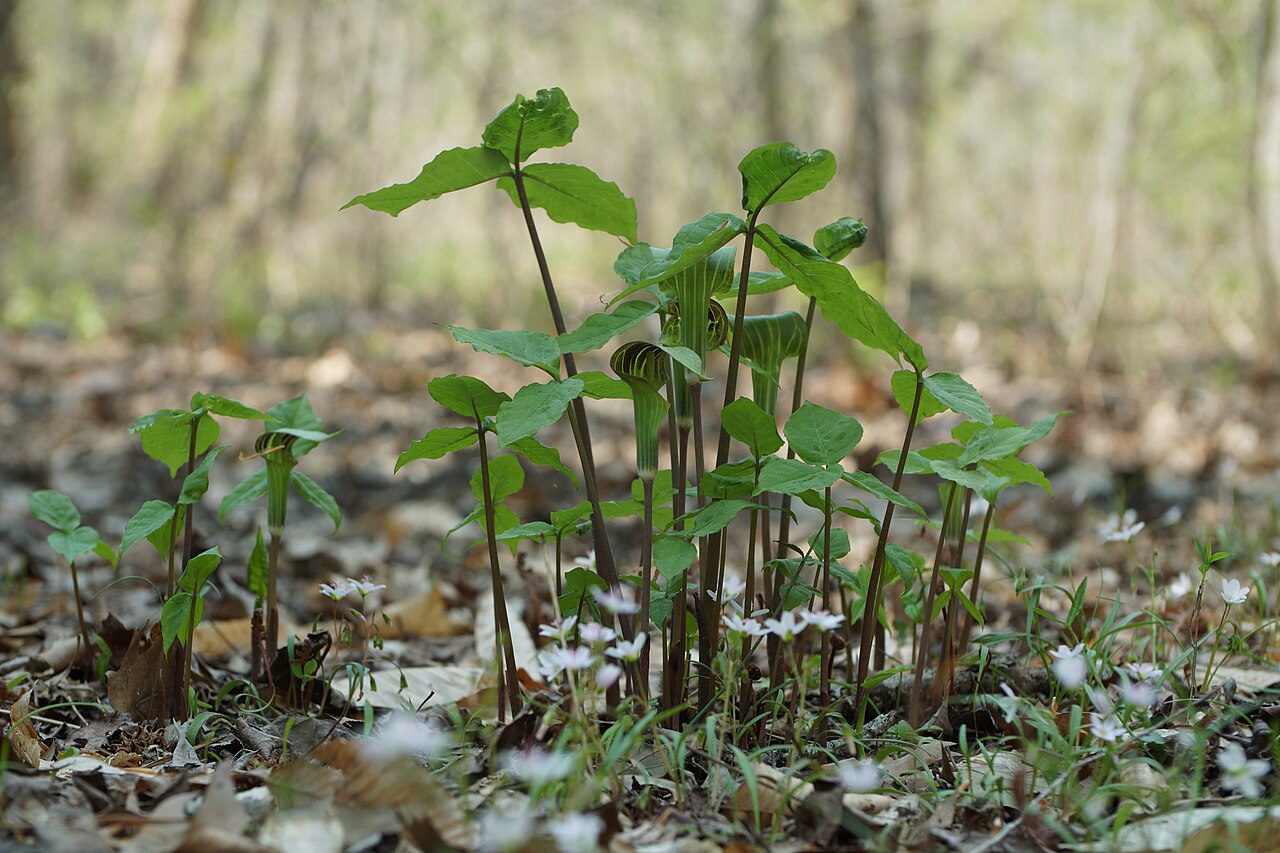
Jack-in-the-pulpit
Arisaema triphyllum
One of the most recognizable spring woodland plants: a hooded spathe (the "pulpit") arches over a club-shaped spadix (the "Jack"). Found in moist cove-hardwood forests and stream bottoms across Marion County. The plant is sequentially hermaphroditic, changing sex from male to female as it gains energy reserves over multiple years. Bright red berry clusters appear in fall. Blooms April to June.
Status: Native. Common, widespread. TN-KY Plant Atlas Marion County record.
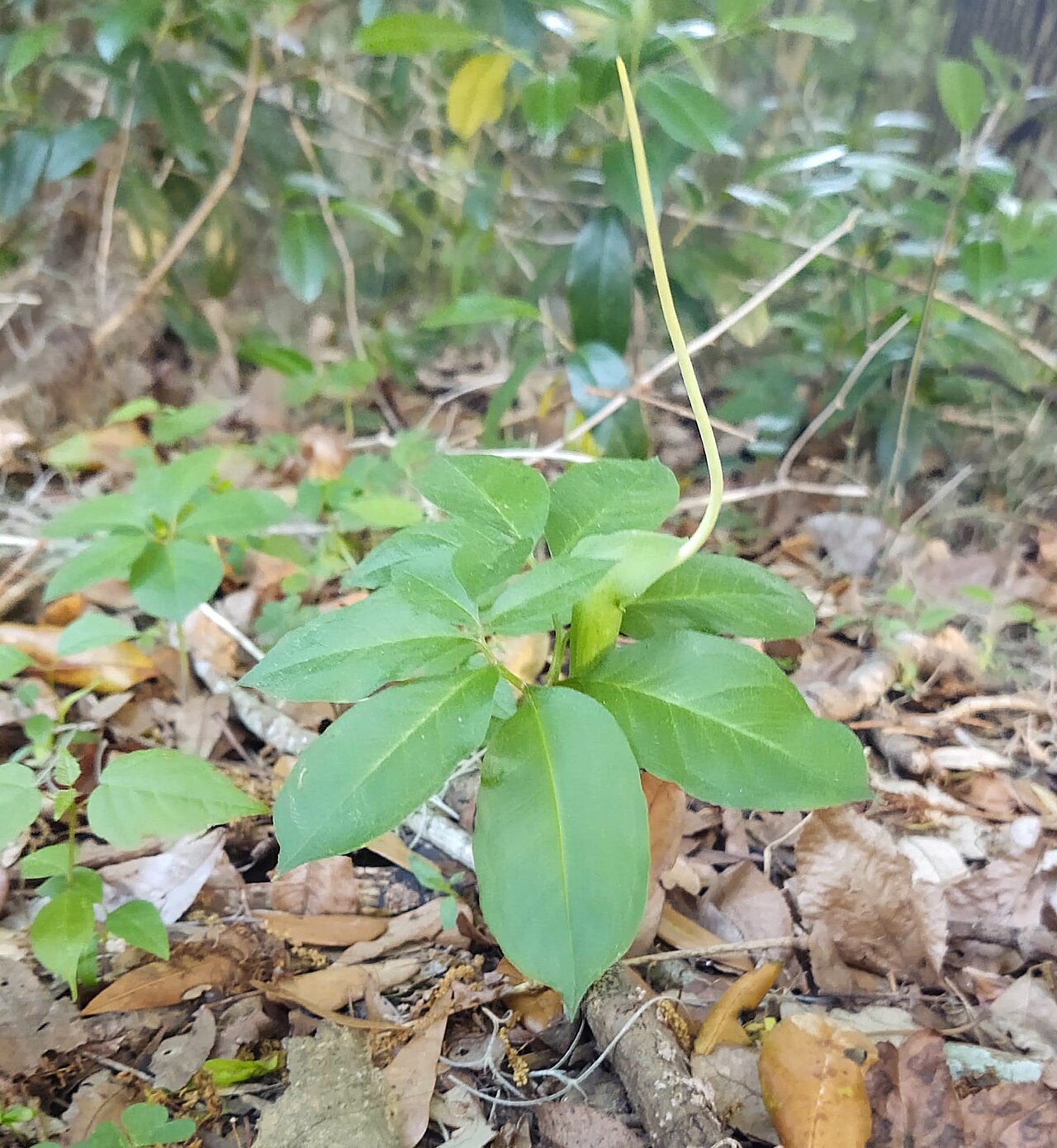
Green dragon
Arisaema dracontium
The jack-in-the-pulpit's less common relative, distinguished by a single compound leaf with seven to fifteen leaflets (rather than two three-parted leaves) and a spadix that extends far beyond the narrow green spathe like a dragon's tongue. Favors rich, moist bottomland soils and floodplain forests. Blooms May to June.
Status: Native. TN-KY Plant Atlas Marion County record.
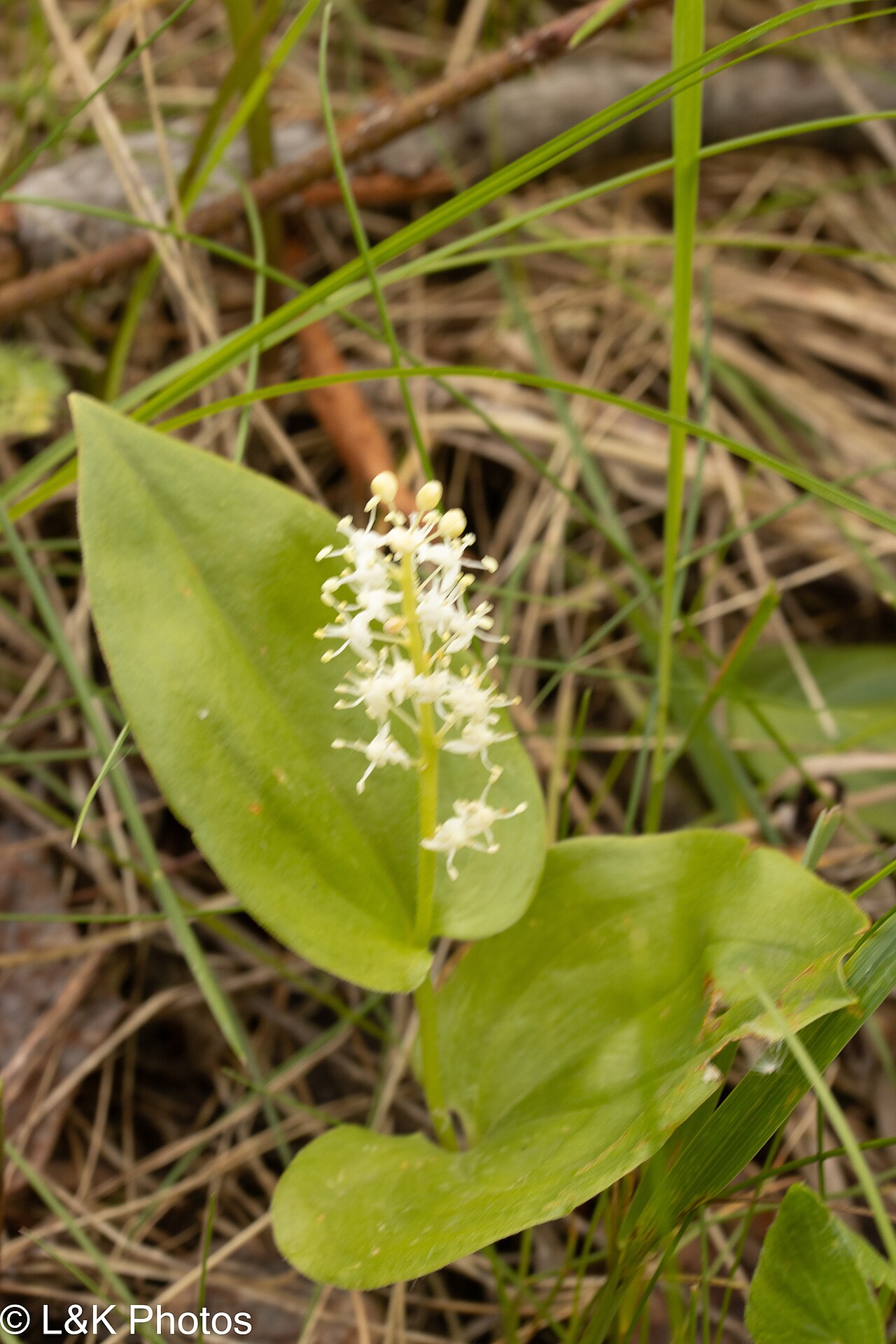
Canada mayflower
Maianthemum canadense
A diminutive woodland groundcover, rarely over six inches tall, with two or three heart-shaped leaves and a terminal cluster of tiny white four-petaled flowers in late spring. Spreads by rhizome to form dense colonies on the acidic, humus-rich soils of the plateau's northern-hardwood pockets. Speckled red berries follow in summer. Blooms May to June.
Status: Native. TN-KY Plant Atlas Marion County record.
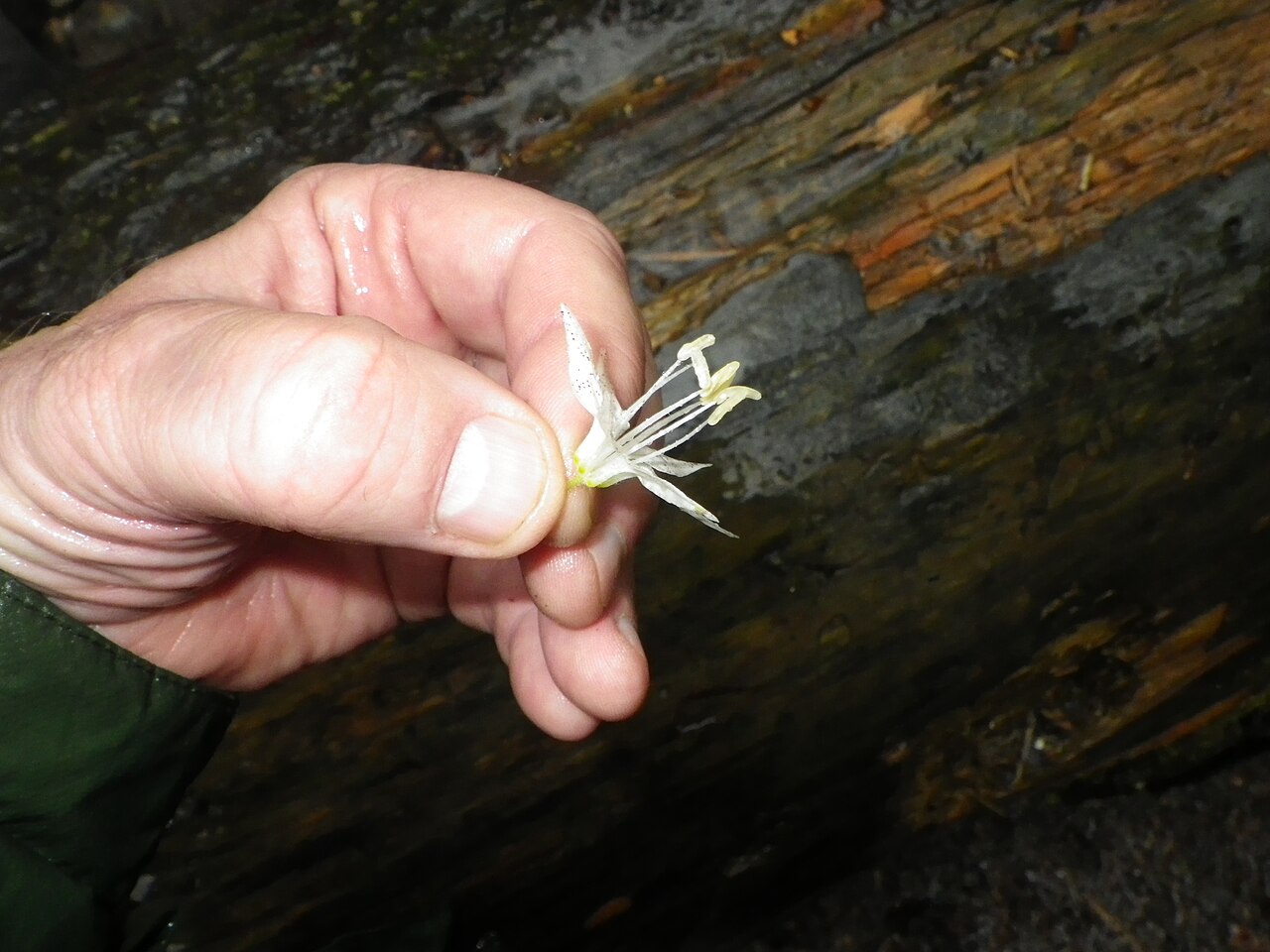
Spotted mandarin
Prosartes maculata
A southern Appalachian endemic whose creamy flowers hang beneath forking branches and are speckled with fine purple spots visible only at close range. Grows in moist, rich cove forests alongside yellow mandarin (P. lanuginosa), from which it is distinguished by the spotted tepals and more pubescent leaves. Blooms April to May.
Status: Native. TN-KY Plant Atlas Marion County record.
Native lilies and allies
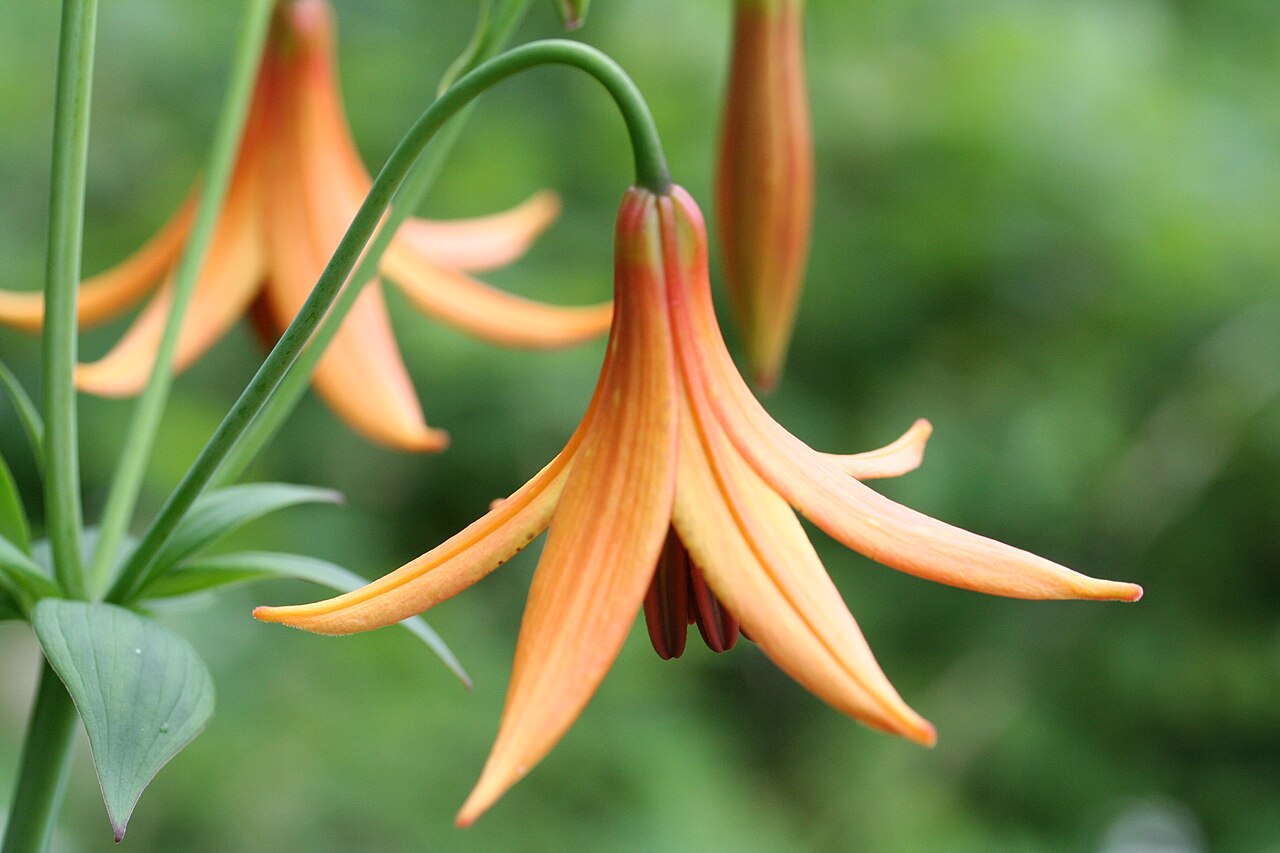
Canada lily
Lilium canadense
A tall native lily (three to five feet) with whorled leaves and nodding, bell-shaped yellow to orange flowers spotted with brown. Grows in moist meadows, stream margins, and open woodlands. One of the few true native lilies documented for Marion County. Blooms June to July.
Status: Native. Locally rare. TN-KY Plant Atlas Marion County record.
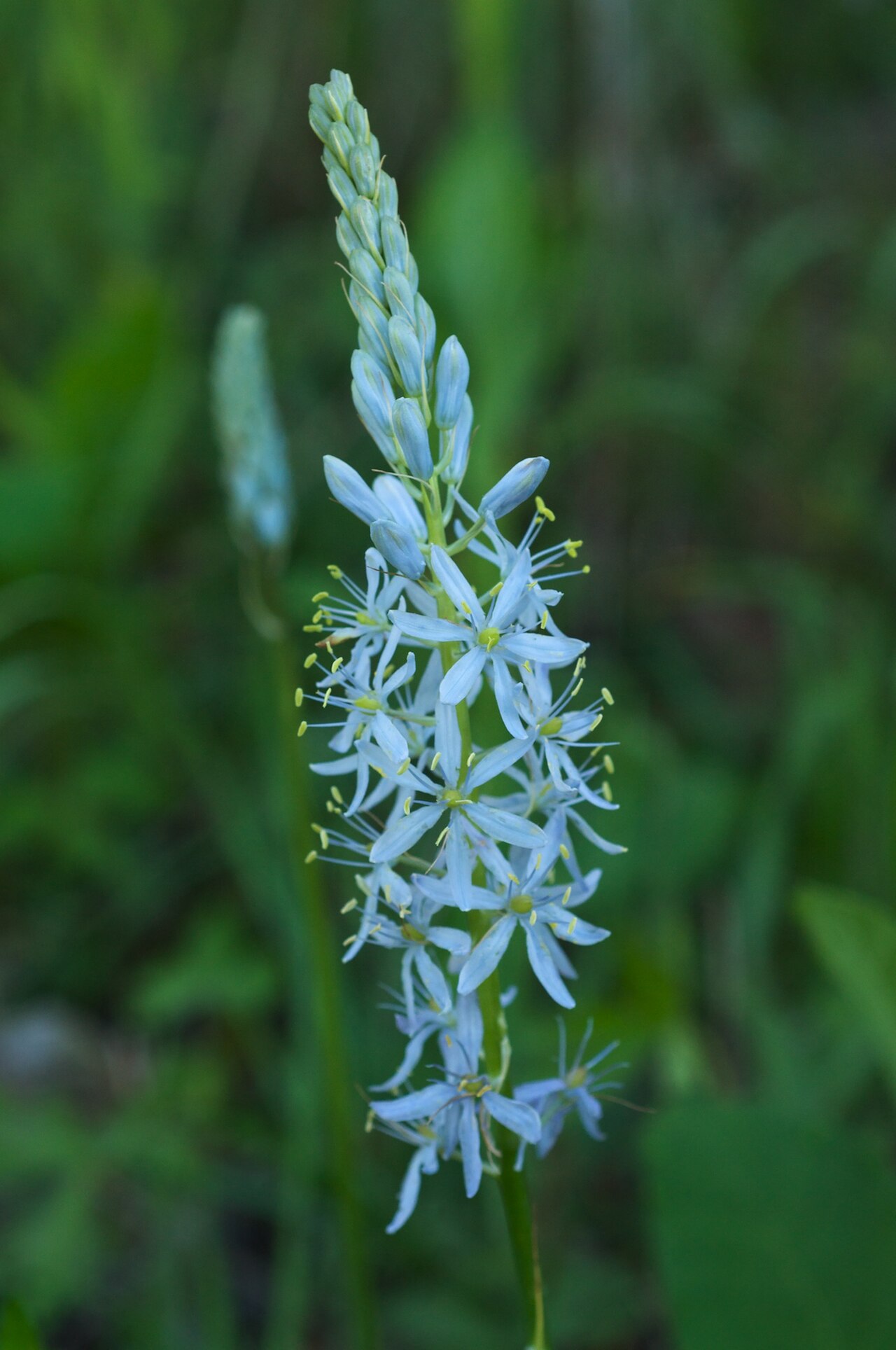
Wild hyacinth
Camassia scilloides
A spring-blooming bulb of moist, open, calcareous woodlands and limestone glades. Pale blue to white star-shaped flowers open in sequence up a tall scape above grass-like basal leaves. Grows on the limestone-influenced valley floor and gorge slopes. Blooms April to May.
Status: Native. TN-KY Plant Atlas Marion County record.
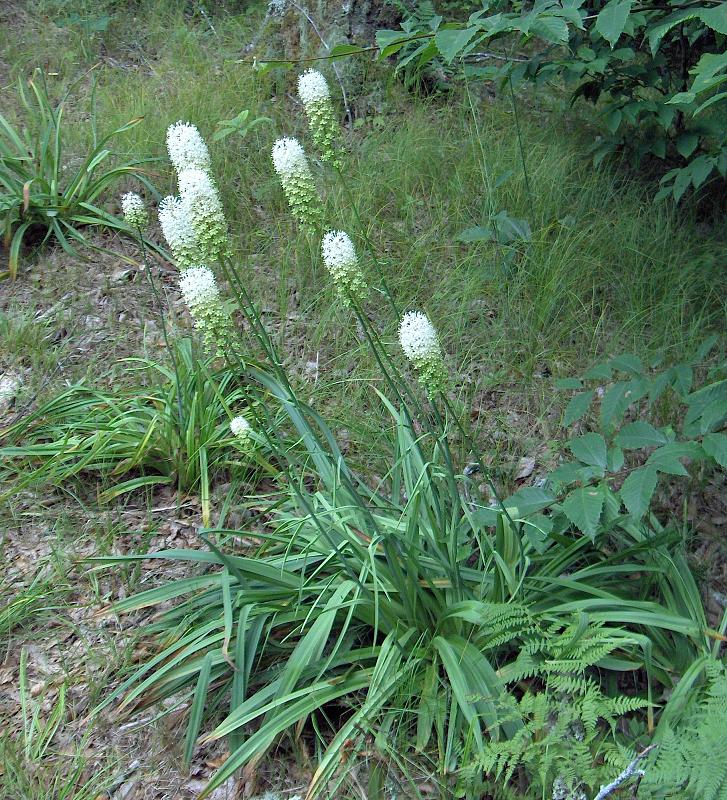
Fly poison
Amianthium muscitoxicum
Named for the toxicity of its bulb, which was historically mashed and mixed with sugar to kill flies. A dense terminal raceme of white flowers tops a stalk rising one to three feet from a rosette of basal grass-like leaves. All parts are highly toxic to livestock and humans. Grows in moist, acidic, open woods and mountain meadows on the plateau. Blooms May to July.
Status: Native. TN-KY Plant Atlas Marion County record.
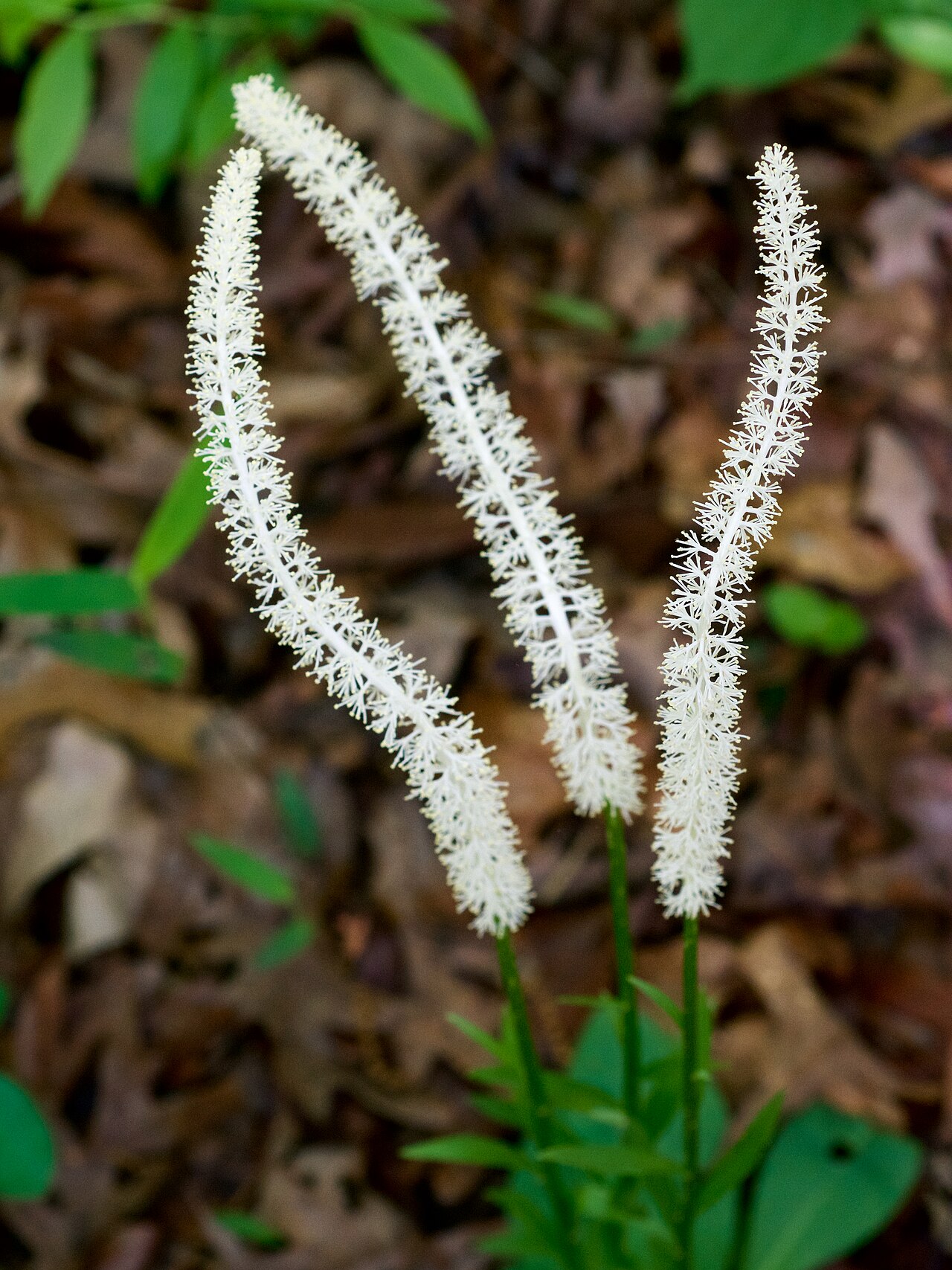
Devil's bit
Chamaelirium luteum
Also called fairy wand. A dioecious plant (separate male and female individuals): the male produces a tall, gracefully arching spike of tiny white staminate flowers; the female's spike is shorter and stouter with pistillate flowers that mature into small capsules. The name "devil's bit" refers to the abruptly truncated rhizome, as if bitten off. Grows in moist to dry woodlands across the plateau and valley slopes. Blooms May to June.
Status: Native. TN-KY Plant Atlas Marion County record.
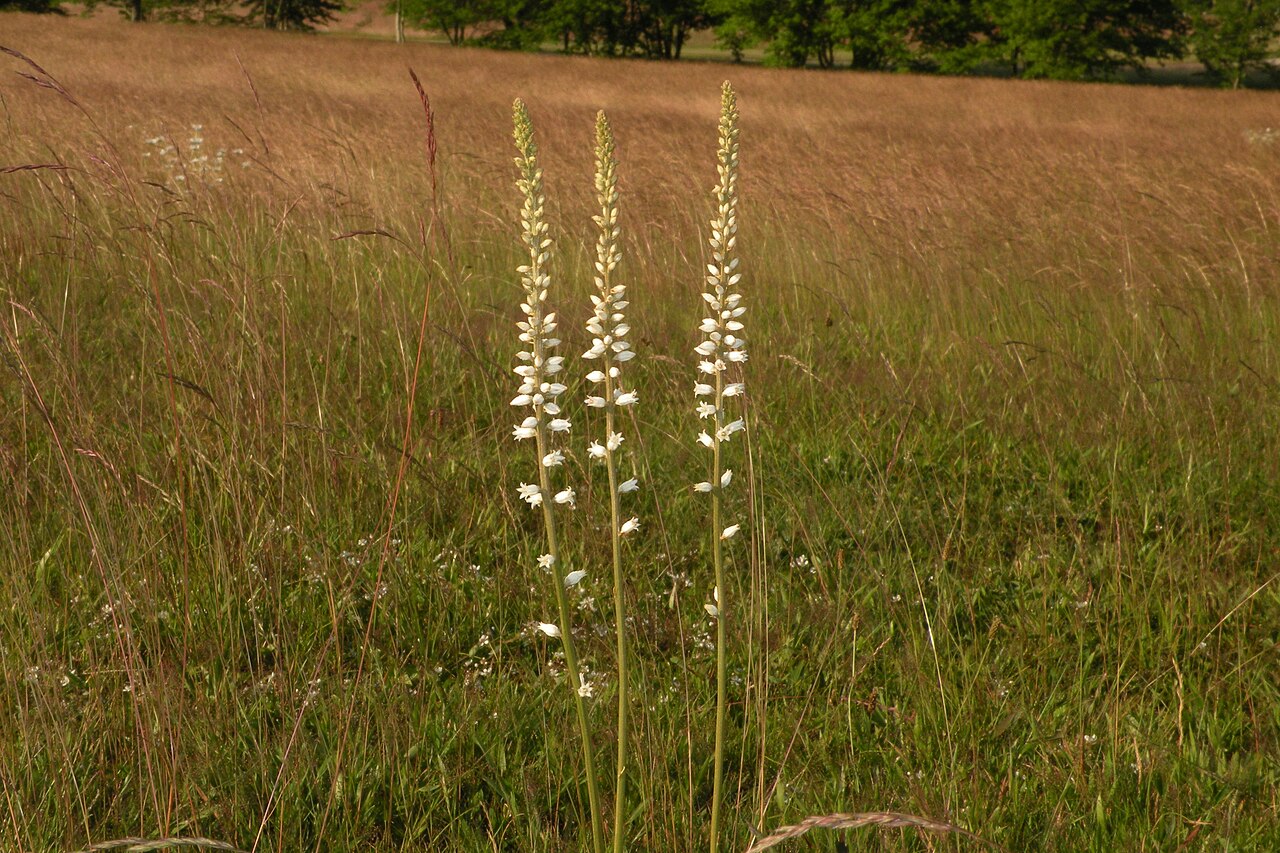
Colic root
Aletris farinosa
A wand-like stalk of white tubular flowers with a distinctive mealy (farinose) texture, rising from a rosette of pale yellowish-green basal leaves. The common name reflects traditional medicinal use for digestive complaints. Grows in moist, acidic, open pine-oak woods, roadsides, and seepage areas. Blooms May to July.
Status: Native. TN-KY Plant Atlas Marion County record.
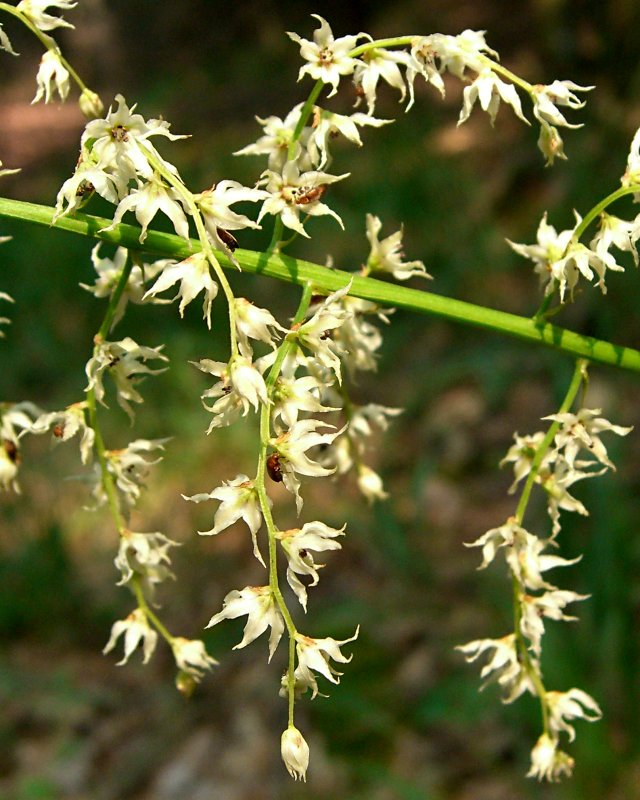
Eastern featherbells
Stenanthium gramineum
A tall (two to five feet), grass-leaved perennial with an elegant drooping panicle of tiny white to greenish flowers that gives the plant its "featherbells" name. Grows in moist, rich, open woods, seeps, and streamside bluffs on the plateau. The inflorescence can be over a foot long, arching gracefully. Blooms June to September.
Status: Native. TN-KY Plant Atlas Marion County record.
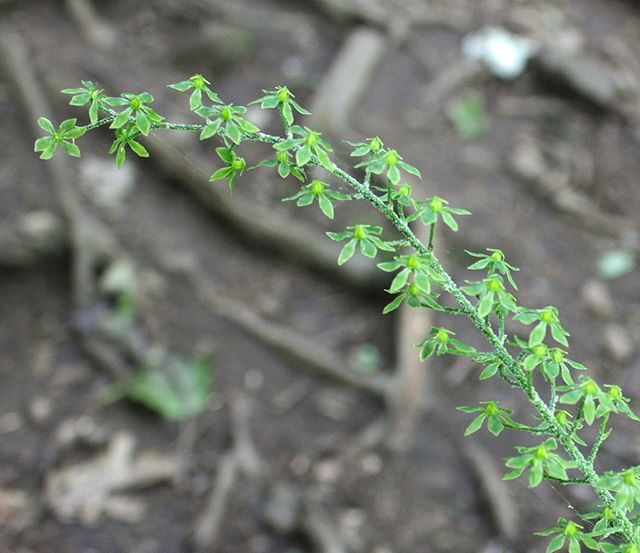
Appalachian bunchflower
Melanthium parviflorum
A tall (three to five feet) perennial of rich cove forests and moist mountain slopes, with broad pleated leaves and a branching terminal panicle of small greenish to cream flowers. Related to the more widespread Virginia bunchflower but smaller-flowered and more strictly Appalachian in distribution. All parts toxic if ingested. Blooms June to August.
Status: Native. TN-KY Plant Atlas Marion County record.
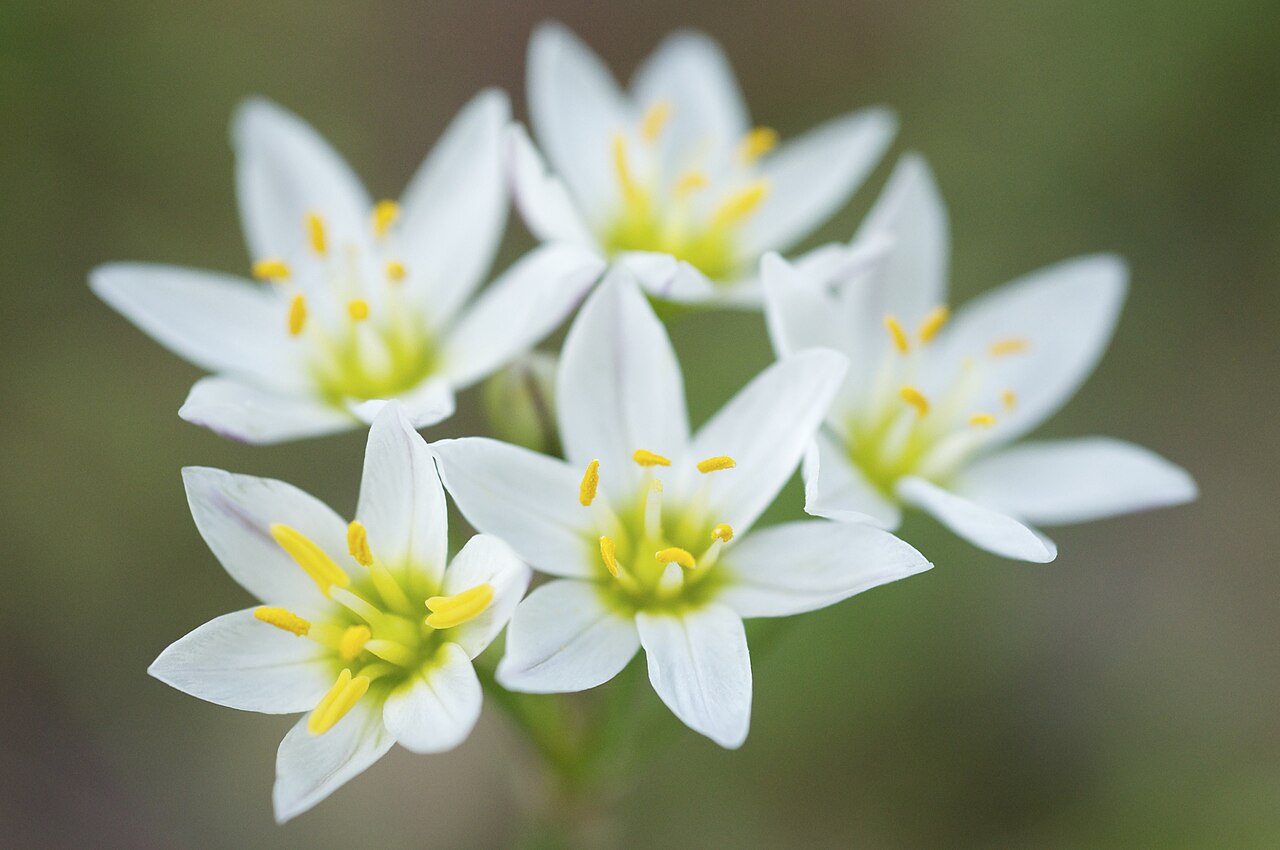
Crow poison
Nothoscordum bivalve
A small bulbous plant resembling wild garlic but without the onion smell. White six-petaled flowers cluster at the top of a slender scape above narrow basal leaves. Despite the common name, the plant is not strongly toxic; the name may reflect confusion with genuinely poisonous look-alikes. Grows in open, dry to mesic grasslands and thin-soil areas. Blooms March to May.
Status: Native. TN-KY Plant Atlas Marion County record.
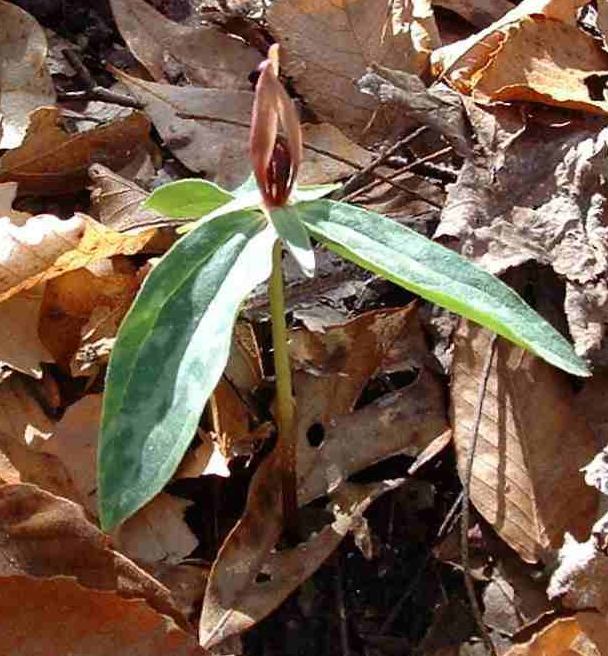
Lance-leaf trillium
Trillium lancifolium
A sessile trillium distinguished by its narrow, lance-shaped, strongly mottled leaves (much narrower than those of sweet Betsy or sessile trillium). The dark maroon flower sits directly on the leaf whorl. A Coastal Plain and lower Piedmont species that reaches the western edge of its range in the Tennessee Valley, where it grows on rich, calcareous bluff soils. Blooms March to April.
Status: Native. TN-KY Plant Atlas Marion County record. State-endangered (TDEC); S1, G3.
Irises and blue-eyed grasses
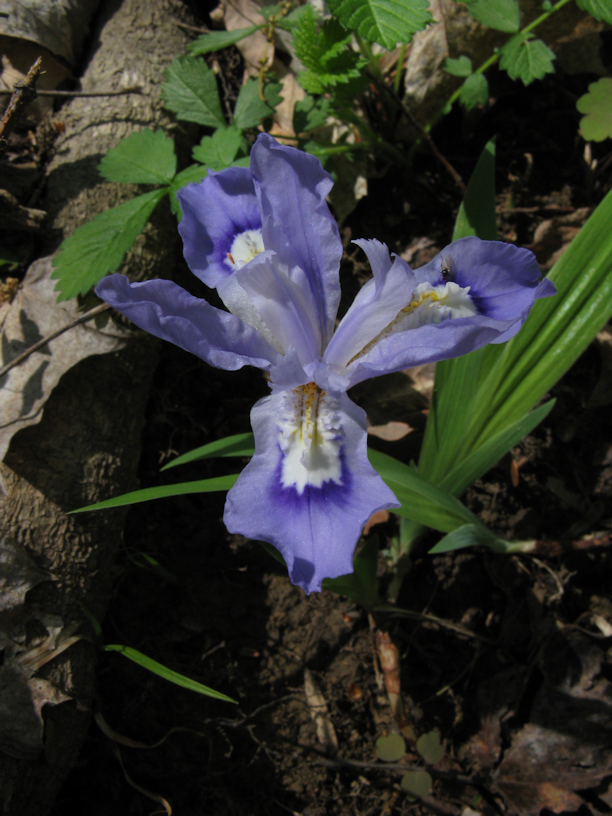
Dwarf crested iris
Iris cristata
A low-growing (three to six inches) native iris that forms spreading colonies by rhizome along wooded stream banks and moist, shaded slopes. The pale blue-violet flowers have a distinctive yellow-orange crest on the falls (the three downward-curving petals). One of the showiest spring wildflowers on the southern Cumberland Plateau. Blooms April to May.
Status: Native. Common, widespread. TN-KY Plant Atlas Marion County record.
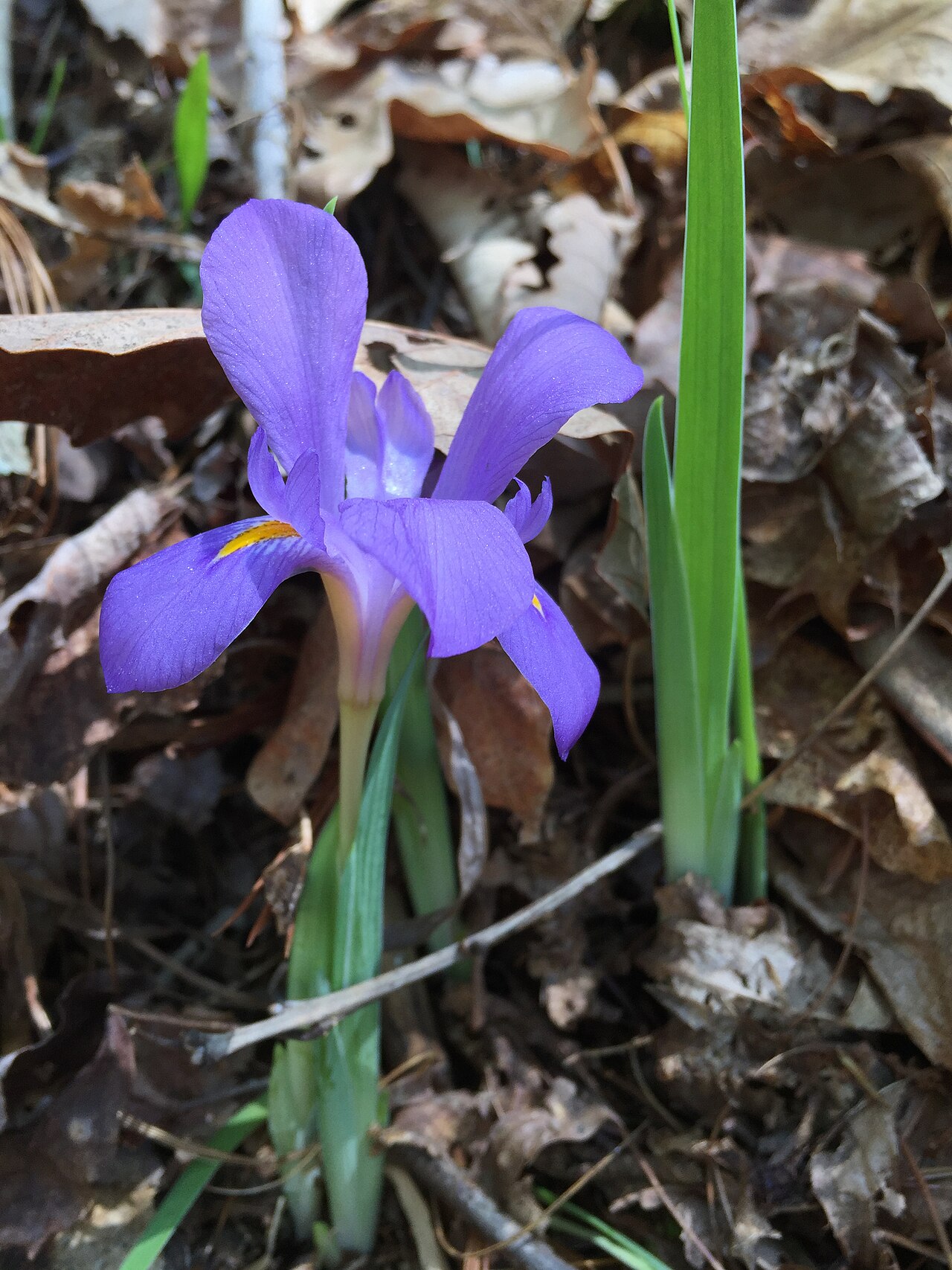
Upland dwarf iris
Iris verna
Similar in stature to the dwarf crested iris but adapted to drier, more acidic soils. The flowers are violet-blue with an orange-yellow signal patch on the falls (a flat blaze rather than a raised crest). Grows in dry pine-oak woods and acidic slopes where the dwarf crested iris does not thrive. Blooms April to May.
Status: Native. TN-KY Plant Atlas Marion County record.
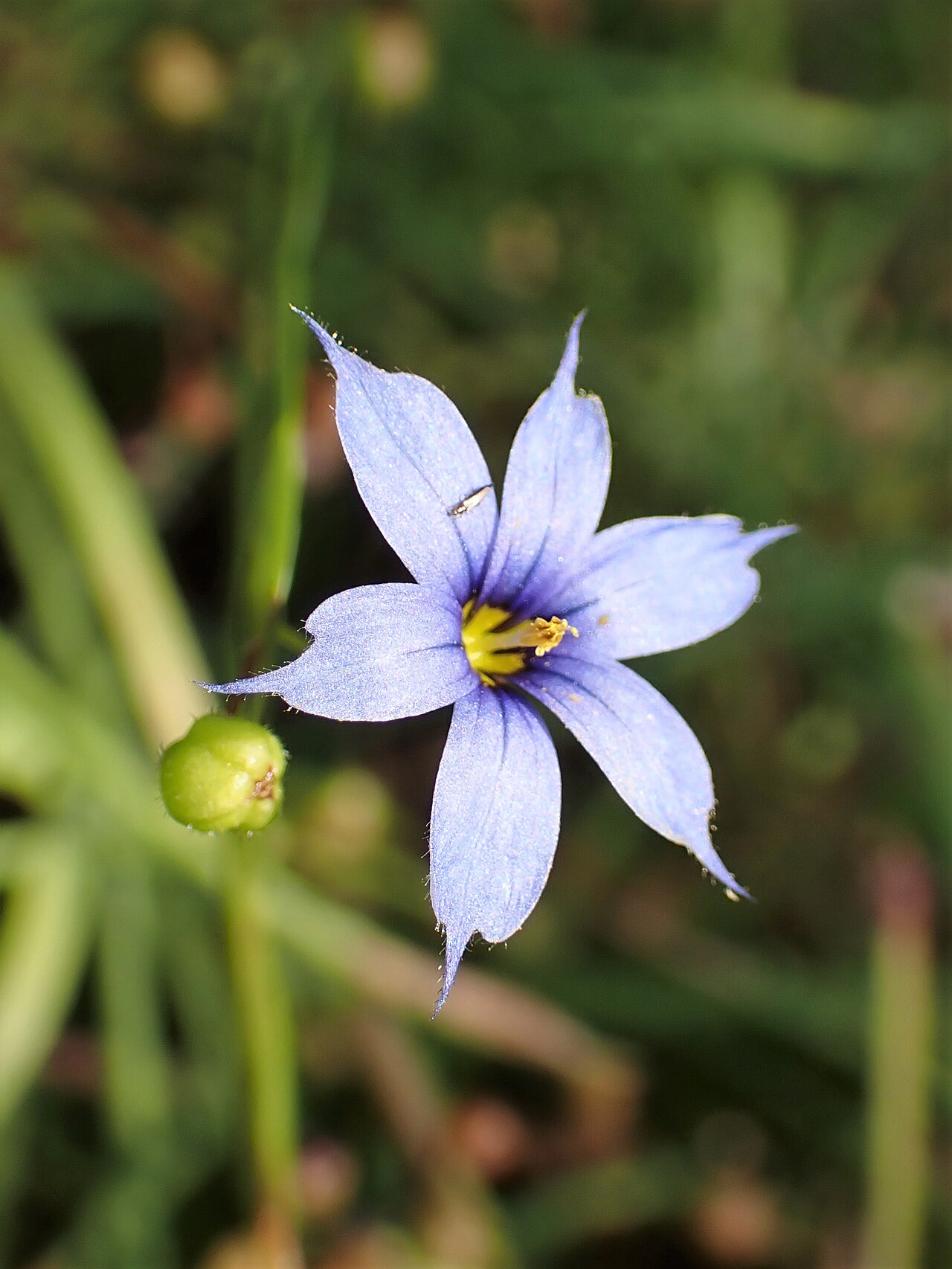
Blue-eyed grasses
Sisyrinchium spp.
Despite the name, blue-eyed grasses are not grasses but small irises with flat, grass-like leaves and dainty six-petaled blue to violet flowers (each petal tipped with a tiny point). At least four species grow in Marion County: narrow-leaf (S. angustifolium), white (S. albidum), eastern (S. atlanticum), and Nash's (S. nashii). They grow in moist to dry open meadows, roadsides, and thin-soil glades. Blooms April to June.
Status: Native. Common, widespread. TN-KY Plant Atlas Marion County records.
Spiderworts and dayflowers
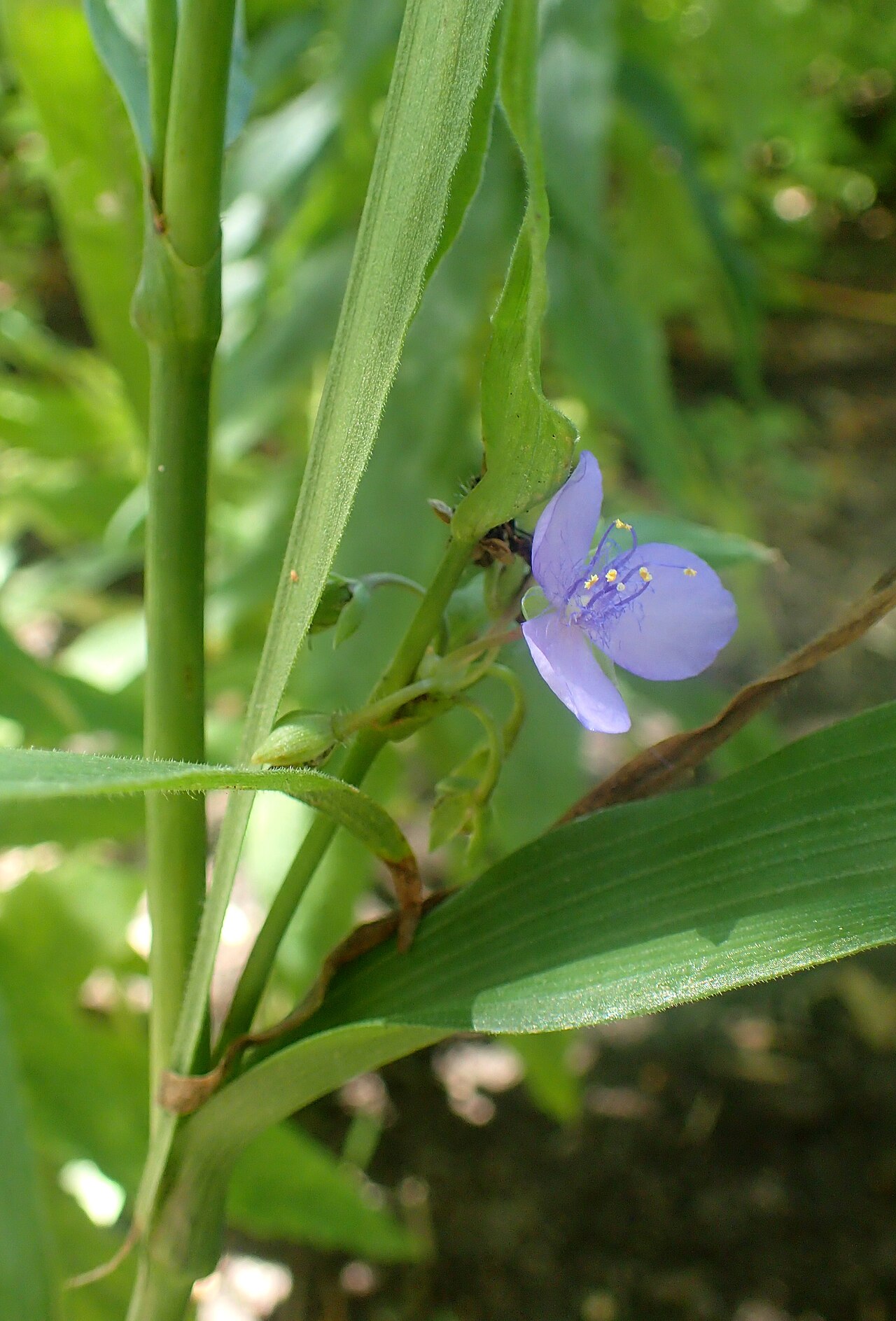
Zigzag spiderwort
Tradescantia subaspera
The largest native spiderwort (two to three feet), with a distinctively zigzag stem and clusters of blue-violet three-petaled flowers. Each flower lasts only a single morning, wilting by afternoon, but the cluster produces new blooms daily for weeks. Grows in rich, mesic woods and shaded rocky slopes. Blooms May to July.
Status: Native. TN-KY Plant Atlas Marion County record.
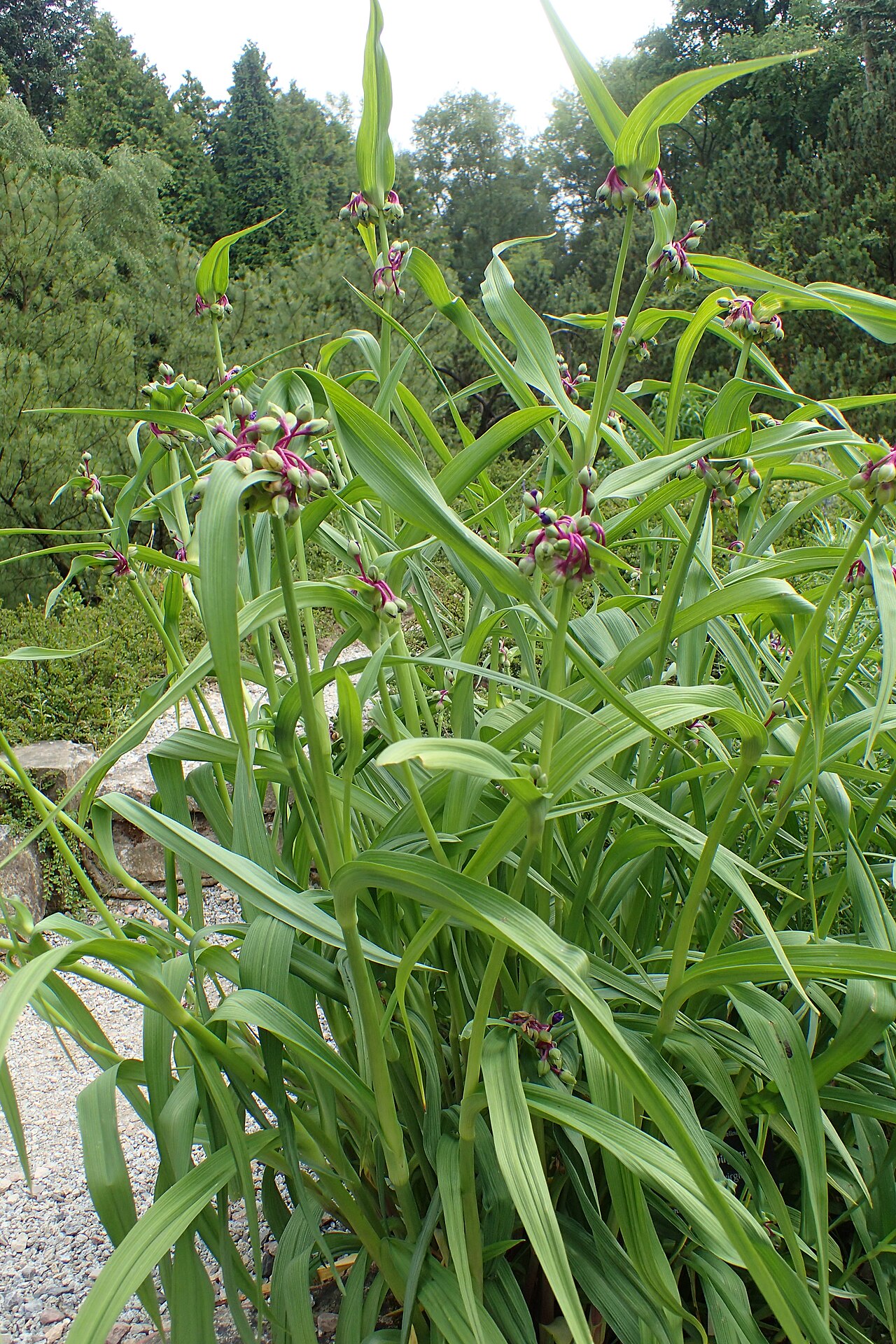
Virginia spiderwort
Tradescantia virginiana
A slightly smaller spiderwort of drier, more open habitats: roadsides, old fields, woodland edges, and thin-soil clearings. Flowers are typically bright blue-purple with fuzzy blue filament hairs (the "spiderweb" that gives the genus its common name). The sap is mucilaginous and stretches into threads when a stem is broken. Blooms April to July.
Status: Native. TN-KY Plant Atlas Marion County record.
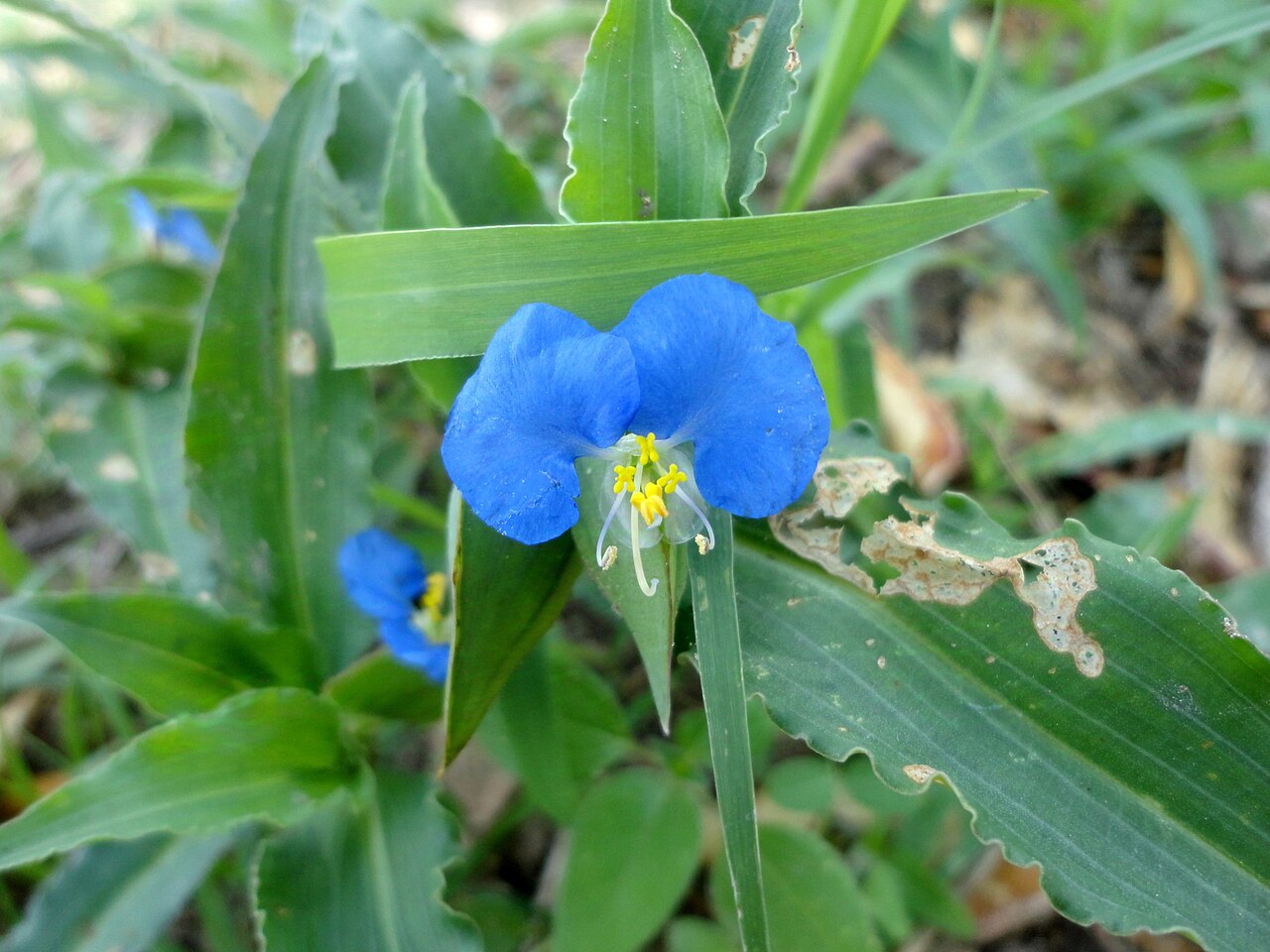
Whitemouth dayflower
Commelina erecta
A native dayflower with two large blue upper petals and one tiny white lower petal (hence "whitemouth"). Each flower opens for a single morning. Grows in dry, sandy, or rocky open ground, thin-soil clearings, and limestone outcrops. Distinguished from the introduced Asiatic dayflower (C. communis) by the erect habit and preference for drier sites. Blooms June to October.
Status: Native. TN-KY Plant Atlas Marion County record.
Other notable monocots
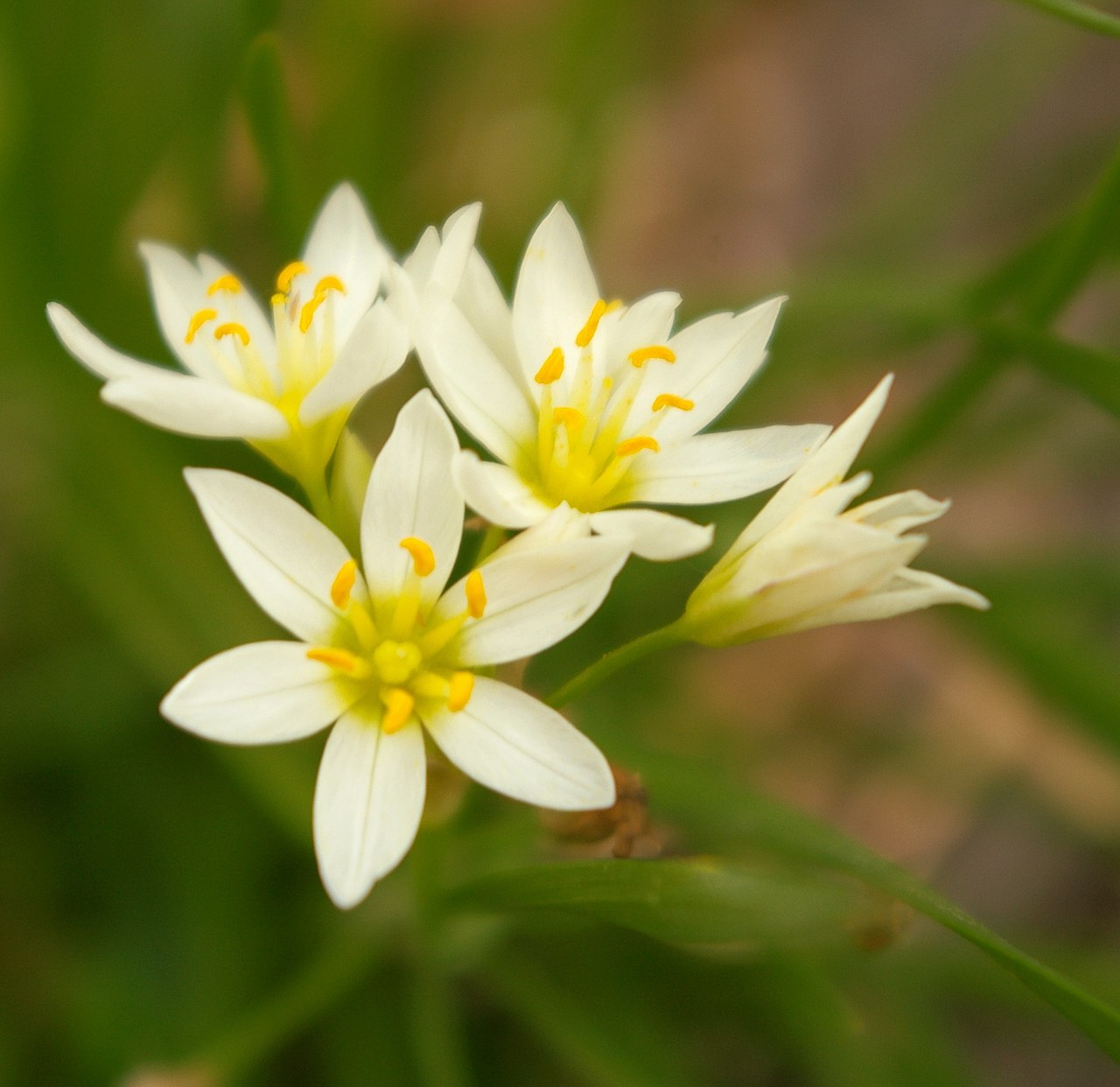
Meadow garlic
Allium canadense
A native wild onion with flat, grass-like basal leaves and a terminal umbel of pink-white flowers (or bulbils, or both). The entire plant smells of onion when crushed. Grows in moist meadows, open woods, and disturbed ground. Used as a food plant by Cherokee and other indigenous peoples. Blooms May to June.
Status: Native. Common, widespread. TN-KY Plant Atlas Marion County record.
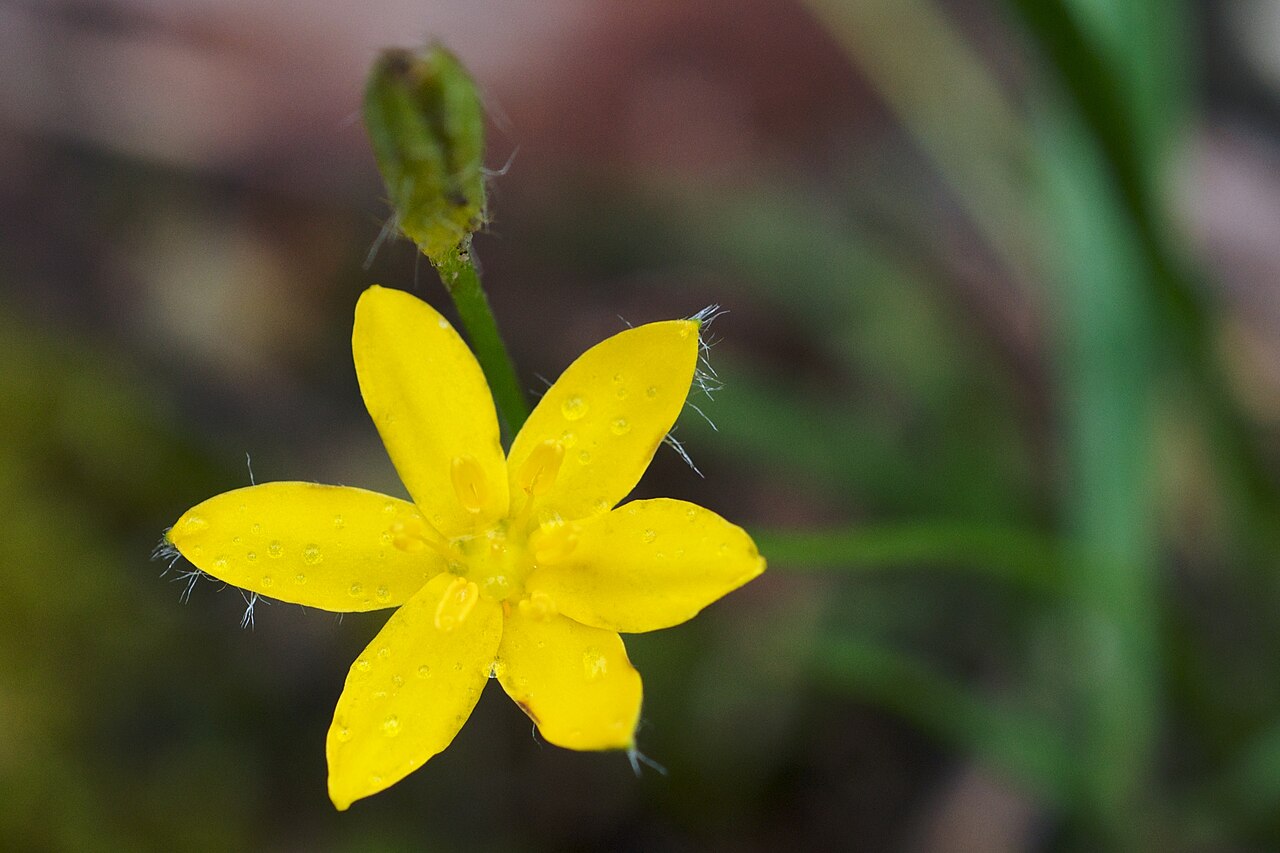
Eastern yellow star-grass
Hypoxis hirsuta
A tiny bulbous perennial with narrow, hairy, grass-like leaves and bright yellow six-pointed star-shaped flowers that open in sun and close in shade. Often overlooked in mowed lawns and open meadows where it persists at ground level. Grows in dry to moist, open, acidic ground. Blooms March to June.
Status: Native. Common, widespread. TN-KY Plant Atlas Marion County record.
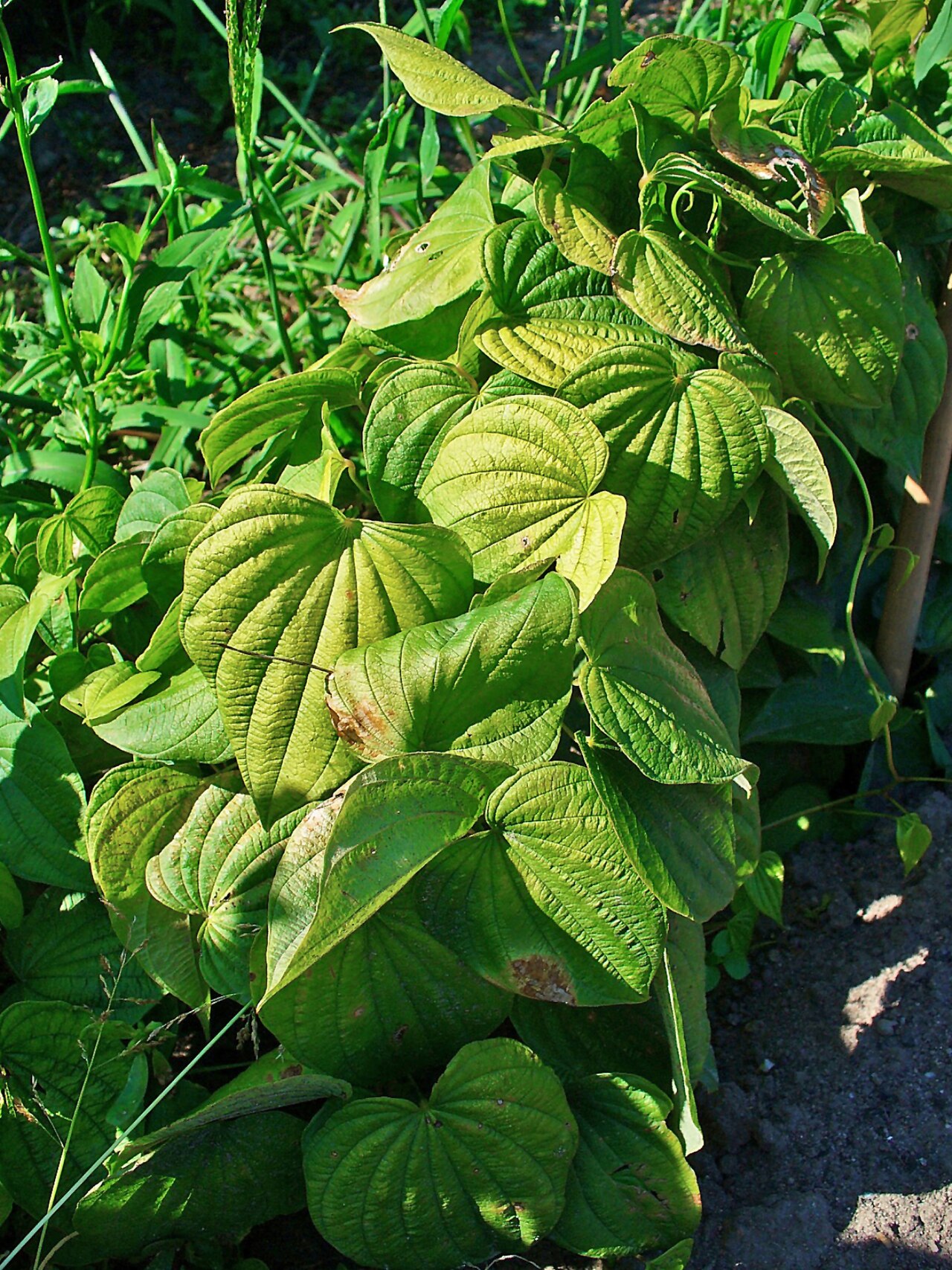
Wild yam
Dioscorea villosa
A twining herbaceous vine with prominently veined, heart-shaped alternate leaves. Climbs through understory shrubs along stream banks and in moist woods. The small greenish-yellow flowers are inconspicuous; the three-winged papery seed capsules are more visible in fall. The tuberous root was used medicinally by indigenous peoples and later commercially as a precursor in steroid synthesis. Blooms May to June.
Status: Native. TN-KY Plant Atlas Marion County record.
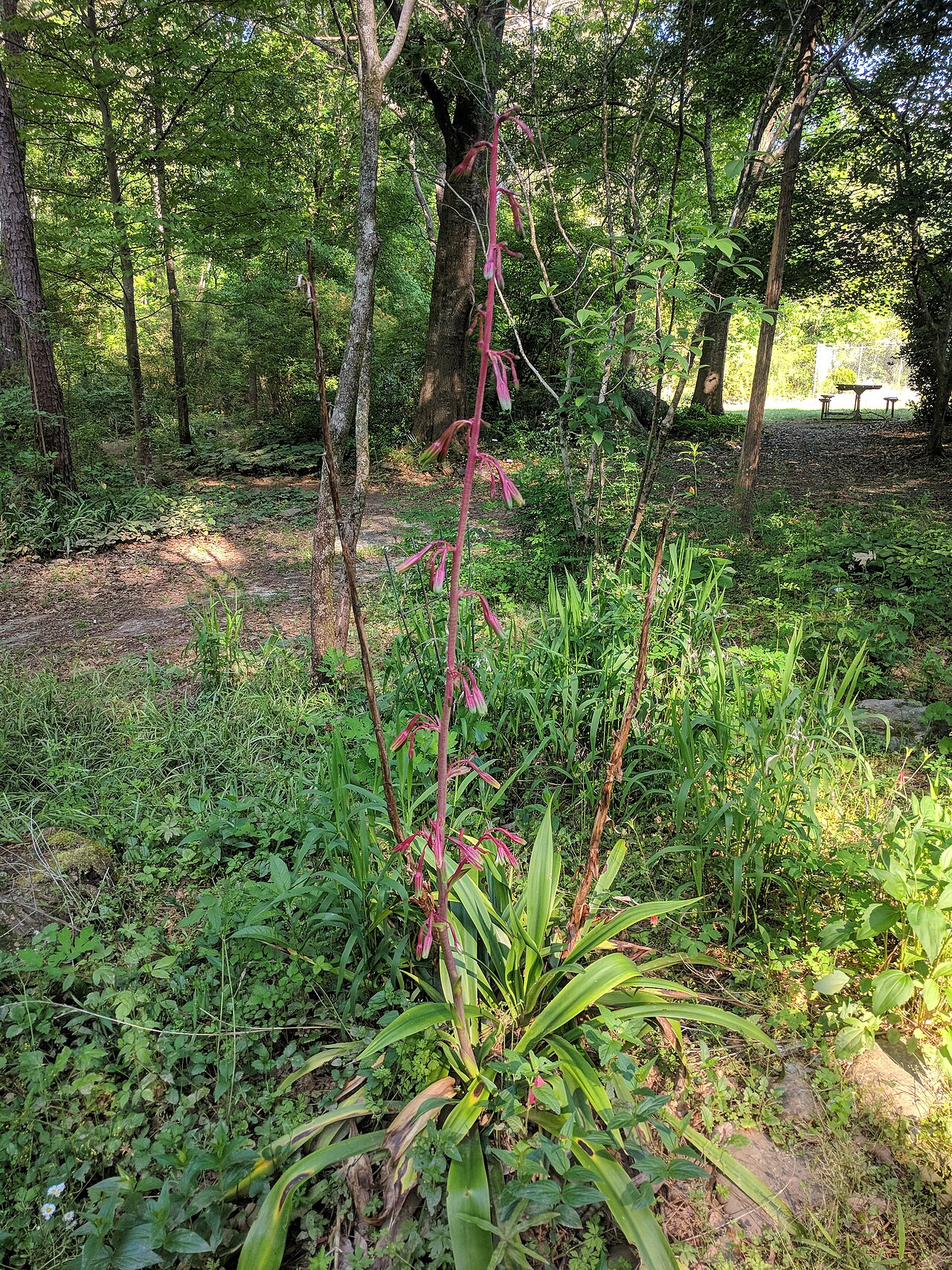
False aloe
Agave virginica
A rosette of fleshy, strap-shaped leaves from which a tall (three to six feet) flowering stalk emerges in summer, bearing tubular greenish-yellow flowers pollinated by moths. The only member of the agave family native to the eastern United States. Grows on dry, rocky, limestone bluffs and thin-soil glades in the Tennessee River Gorge and valley margins. Blooms June to August.
Status: Native. TN-KY Plant Atlas Marion County record.
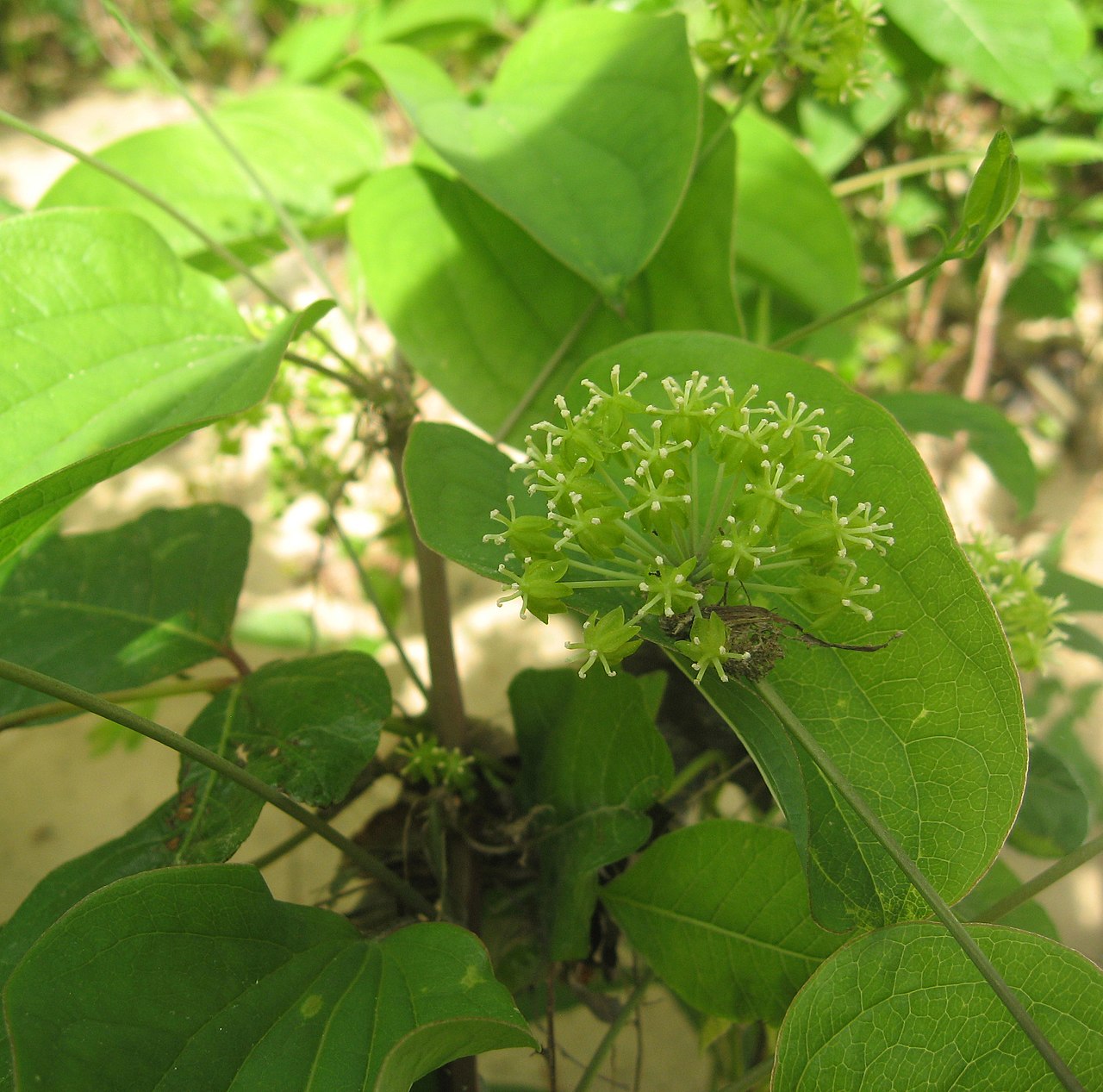
Smooth carrionflower
Smilax herbacea
An herbaceous (non-woody) climbing Smilax that dies back to the ground each winter, unlike the thorny evergreen greenbriers in the same genus. The spherical flower umbels smell of rotting meat to attract fly pollinators, earning the "carrionflower" name. Climbs by tendrils through moist woodland understory. Blooms May to June.
Status: Native. TN-KY Plant Atlas Marion County record.
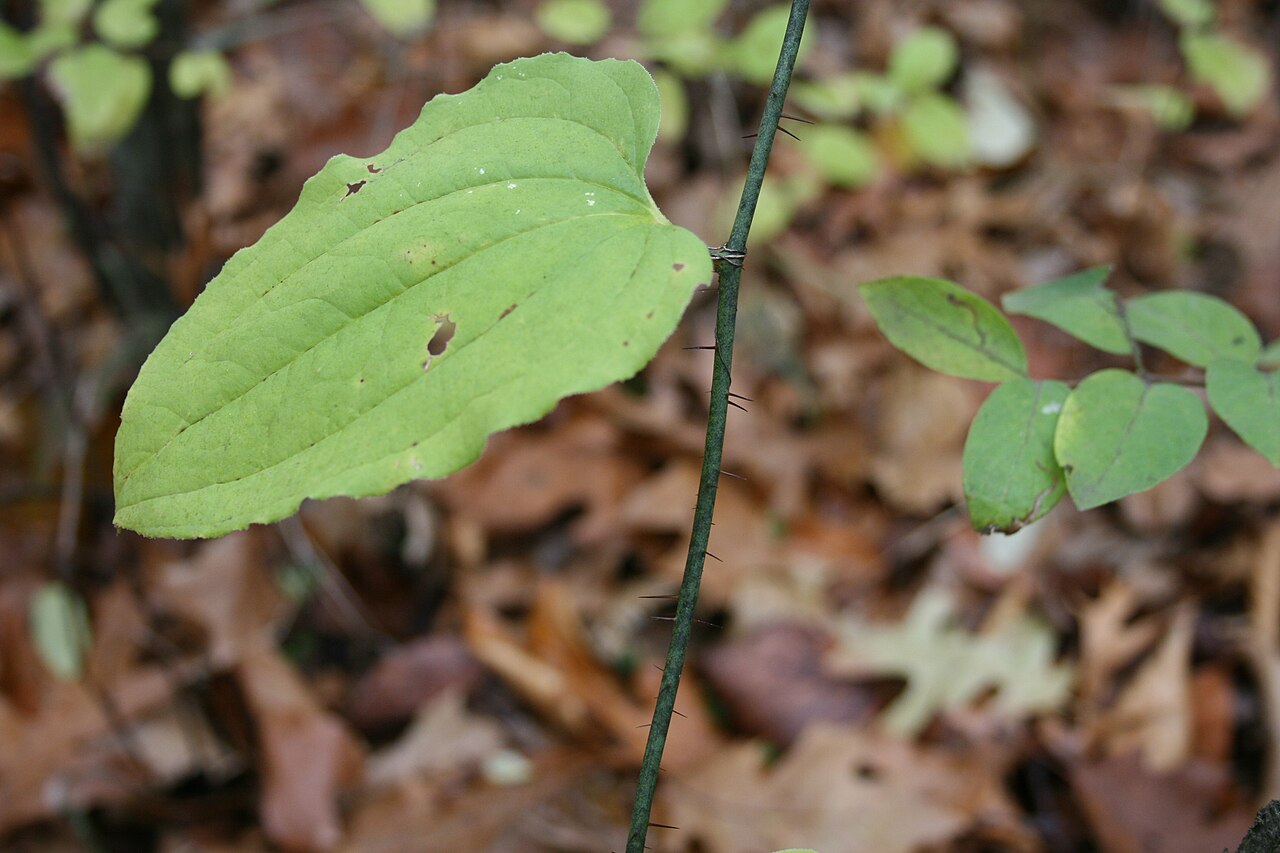
Bristly greenbrier
Smilax hispida
Distinguished from other woody greenbriers by the dense covering of dark, needle-like bristles on the lower stem (rather than scattered thorns). A high-climbing woody vine of moist bottomlands and rich woods. The blue-black berries are an important winter food for birds. Also known as S. tamnoides. Climbs to thirty feet or more in floodplain canopies.
Status: Native. TN-KY Plant Atlas Marion County record.
Grasses, sedges, and rushes
Marion County's grasslands, forest floors, wetlands, and roadsides support nearly three hundred species in the grass family (Poaceae), sedge family (Cyperaceae), and rush family (Juncaceae). These graminoids form the structural backbone of every open and semi-open habitat in the county: broomsedge colors abandoned pastures copper in autumn, woodland sedges carpet the cove-hardwood understory, and soft rush rings every farm pond and roadside ditch. The cards below highlight the ecologically distinctive, conservation-listed, and visitor-recognizable species. The roughly two hundred additional graminoid species documented for the county are catalogued in the TN-KY Plant Atlas Marion County records.
River cane (Arundinaria gigantea), the county's most historically significant grass, has its own dedicated section below: River cane and canebrakes.
Native bamboos (cane)
Three species of Arundinaria, the only bamboos native to North America, are documented in Marion County. Giant cane is treated in the River cane and canebrakes section below. The two smaller species, hill cane and switch cane, occupy different habitats and are less well known.
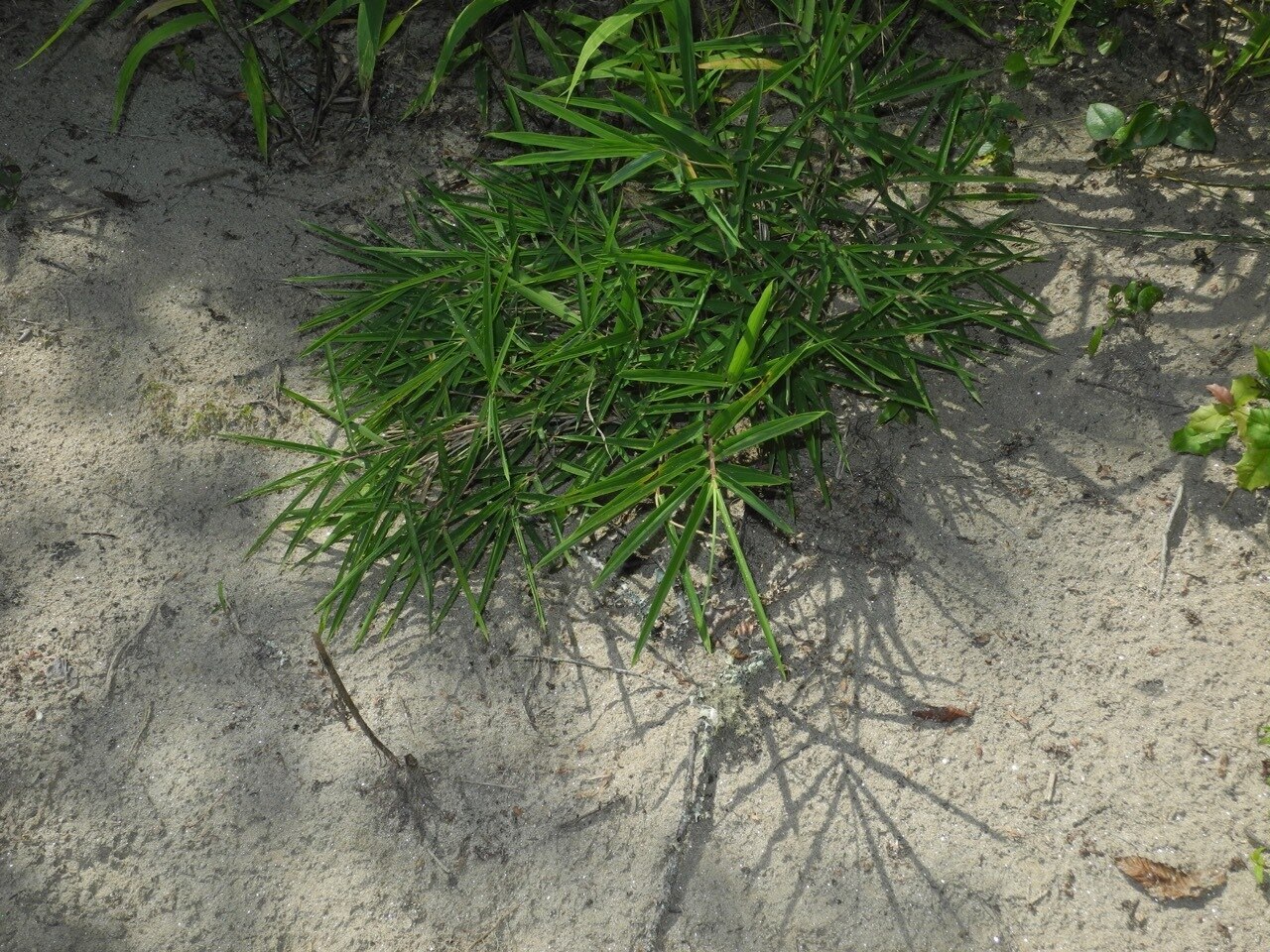
Hill cane
Arundinaria appalachiana
Described as a distinct species only in 2006, hill cane is a smaller bamboo of upland acidic forests on the Cumberland Plateau and southern Appalachians. It typically grows three to five feet tall in the understory of oak-hickory and mixed-hardwood slopes, shorter and more slender-stemmed than giant cane. The species was long lumped with A. gigantea until molecular and morphological work separated it. Documented in Marion County via the TN-KY Plant Atlas.
Status: Native. TN-KY Plant Atlas Marion County record.
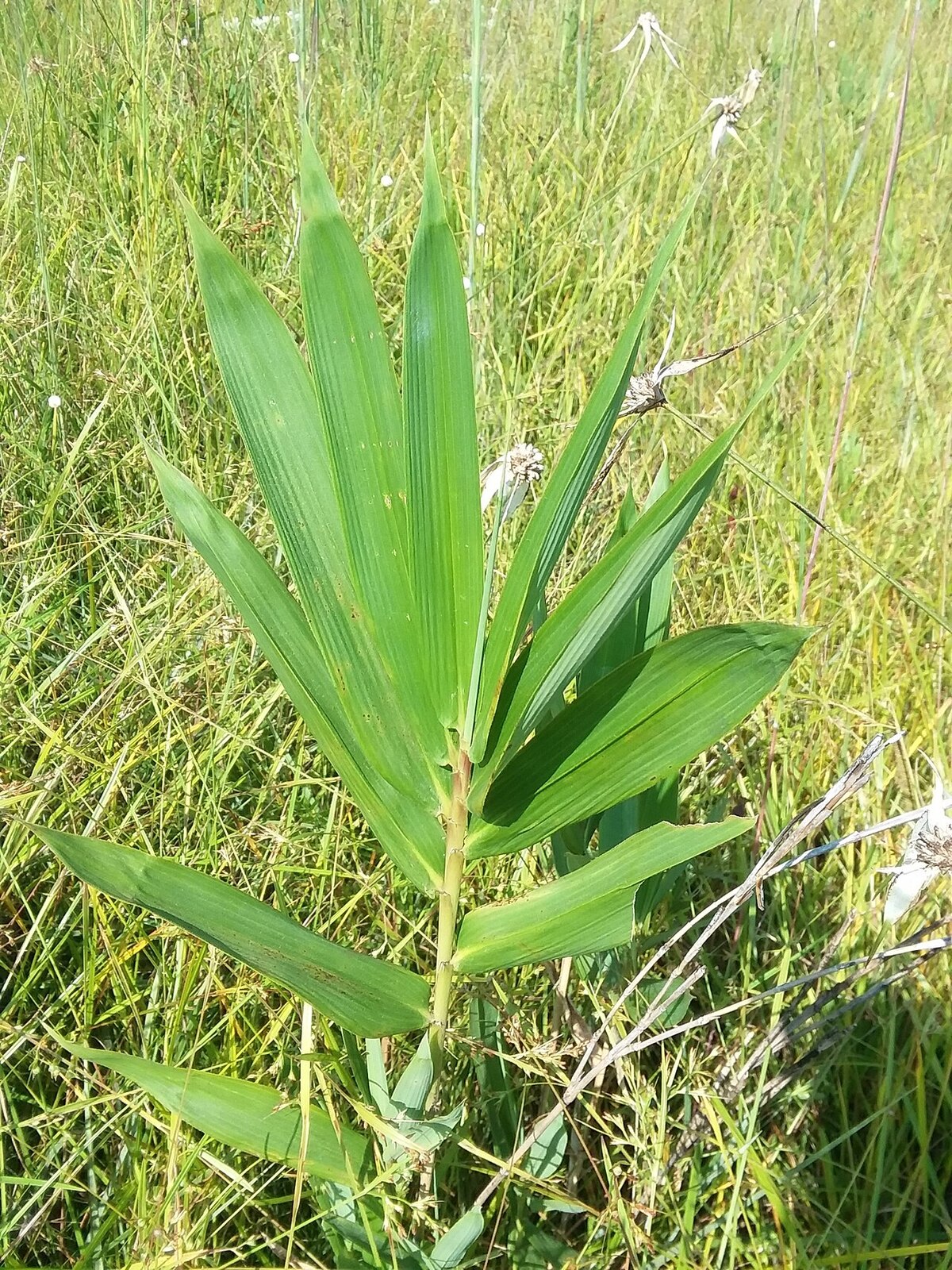
Switch cane
Arundinaria tecta
The third native bamboo, switch cane occupies wetter sites than hill cane, typically stream margins and low-lying bottomland forests. It grows three to eight feet tall and spreads by rhizomes into dense patches. The common name refers to the historical use of its slender culms as switches. Switch cane favors acidic, sandy, or peaty soils in the Coastal Plain and lower elevations of the southern Appalachians. Documented in Marion County via the TN-KY Plant Atlas.
Status: Native. TN-KY Plant Atlas Marion County record.
Tallgrass prairie remnants
Before European settlement, scattered openings on the Cumberland Plateau and Sequatchie Valley floor supported tallgrass prairie species now more associated with the Great Plains. These warm-season bunch grasses persist in Marion County on thin-soiled limestone glades, powerline rights-of-way, and roadside remnants where fire or mowing prevents woody encroachment. Little bluestem and indiangrass are the most visible; big bluestem and switchgrass occur in smaller pockets.
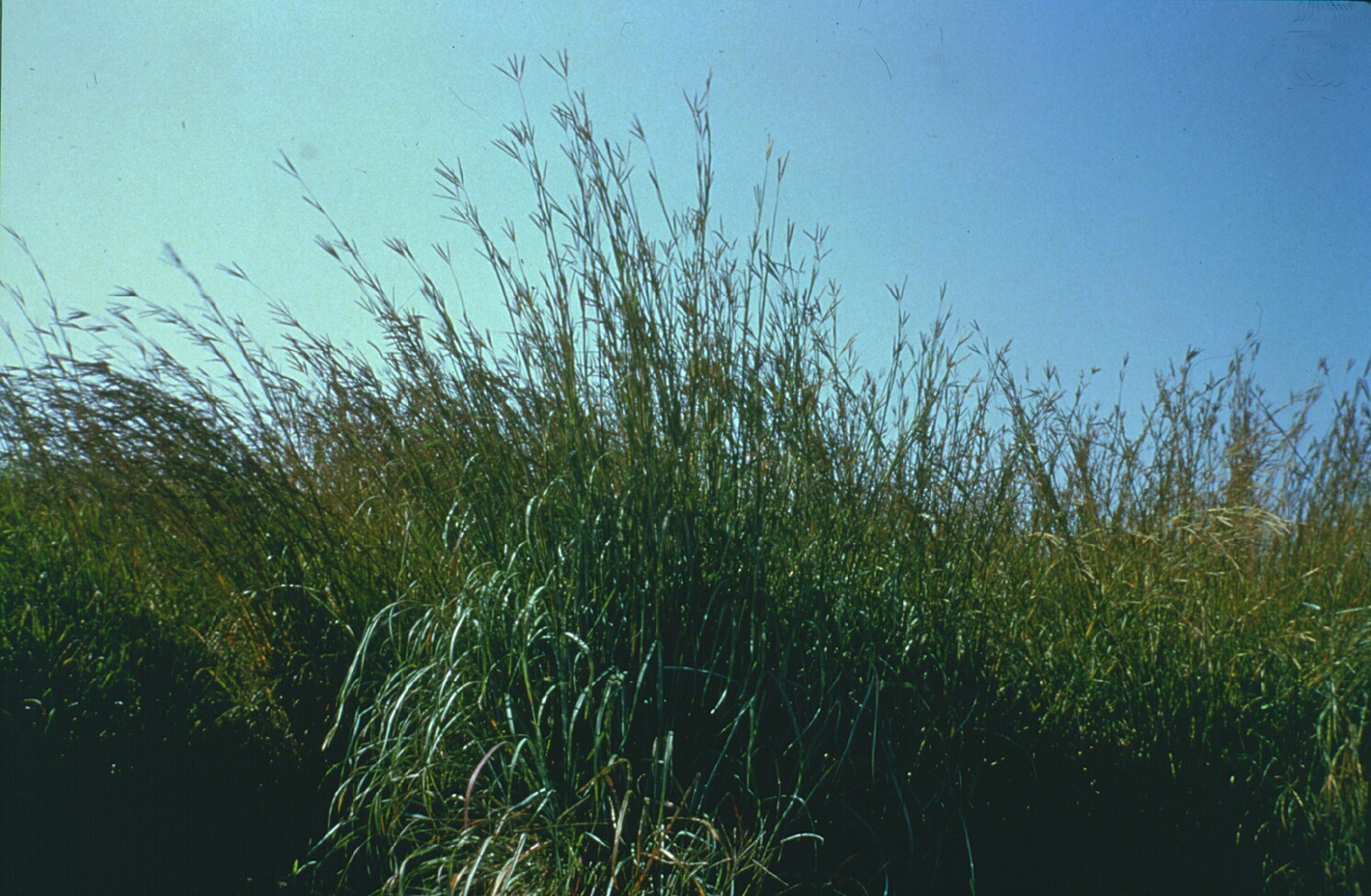
Big bluestem
Andropogon gerardii
The iconic tallgrass prairie dominant, big bluestem can reach eight feet in a good growing season. Its three-parted seed head, often described as a turkey foot, is the quickest field mark. The stems turn a distinctive coppery blue at the base in late summer, giving the species its common name. In Marion County, big bluestem persists in thin-soiled openings on the plateau rather than in continuous prairie stands. Documented on the Sewanee Domain checklist for the Franklin-Marion county boundary area.
Status: Native. Sewanee Domain checklist.
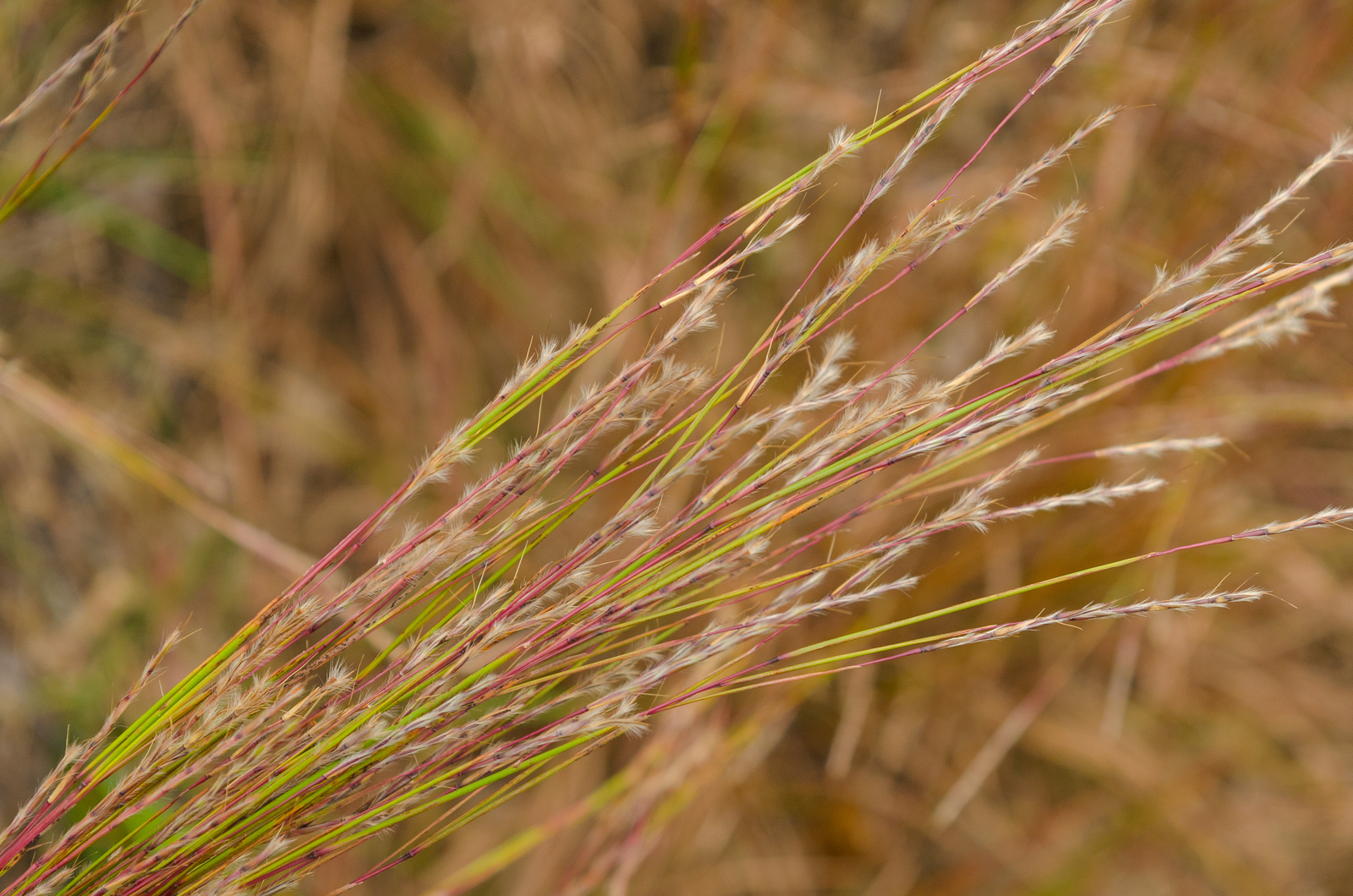
Little bluestem
Schizachyrium scoparium
The most widespread native warm-season grass on the Cumberland Plateau, little bluestem forms dense bunches one to four feet tall on dry, rocky, or thin-soiled sites. Its autumn display is striking: the foliage turns deep copper to bronze, and fluffy white seed plumes catch low-angle sunlight along roadsides and glade edges. Little bluestem is a strong indicator of remnant native grassland. Documented in Marion County via the TN-KY Plant Atlas.
Status: Native. TN-KY Plant Atlas Marion County record.
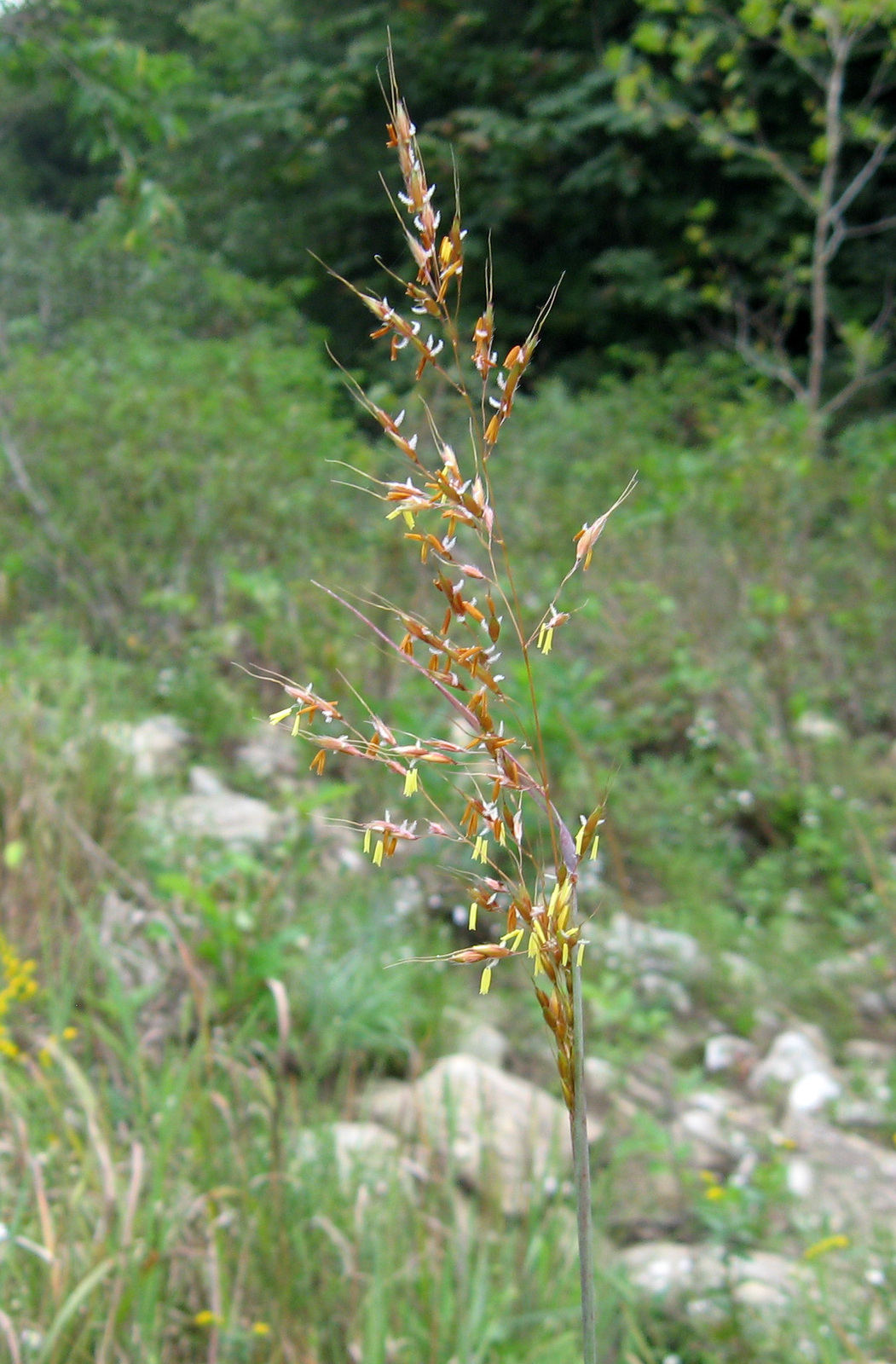
Yellow indiangrass
Sorghastrum nutans
A tall warm-season grass reaching three to eight feet, indiangrass produces showy golden-bronze plumes in September and October. It is a signature companion of big bluestem in remnant prairie openings on the Cumberland Plateau. The species name nutans ("nodding") refers to the gracefully arching seed heads. Documented in Marion County via the TN-KY Plant Atlas.
Status: Native. TN-KY Plant Atlas Marion County record.
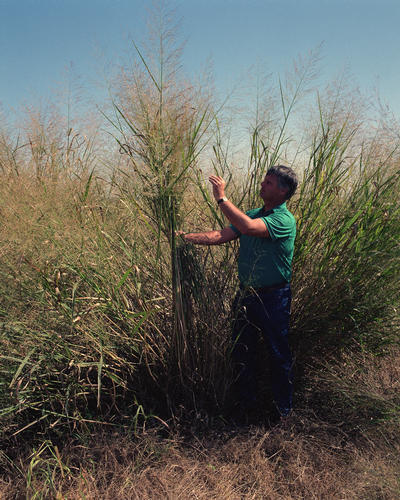
Switchgrass
Panicum virgatum
A robust warm-season grass that grows three to six feet tall in open ground, switchgrass tolerates a wide range of soils from dry limestone to wet bottomland. It spreads by short rhizomes into sod-forming stands. Switchgrass has received national attention as a potential cellulosic biofuel crop, but in Marion County it is primarily a component of remnant native grasslands and restored prairie plantings. Documented in Marion County via the TN-KY Plant Atlas.
Status: Native. TN-KY Plant Atlas Marion County record.
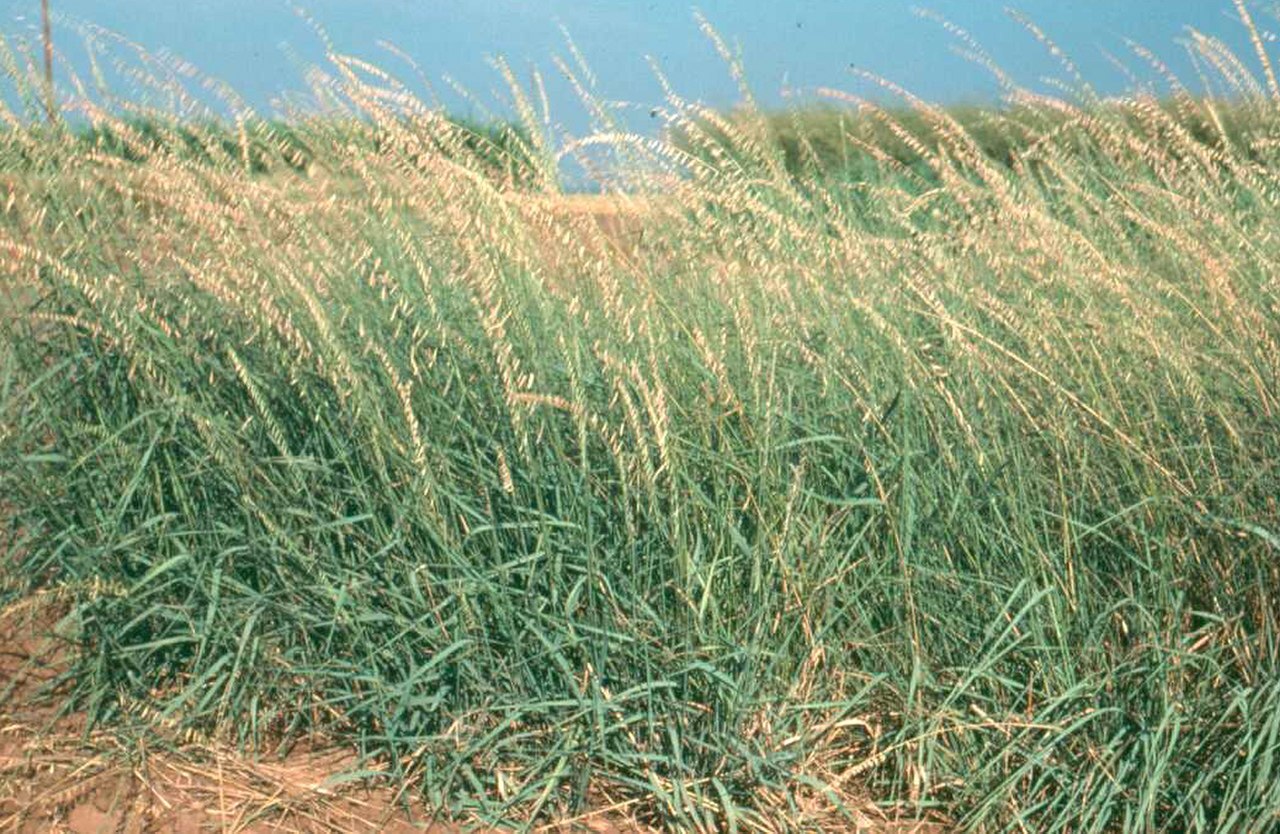
Sideoats grama
Bouteloua curtipendula
A distinctive warm-season grass with small oat-like spikelets that hang from one side of the stem, producing a zigzag silhouette. In the Great Plains, sideoats grama is a dominant shortgrass prairie species; in Marion County it is uncommon, found on dry limestone barrens and cedar glade margins on the plateau. The one-sided seed arrangement is the quickest field mark. Documented in Marion County via the TN-KY Plant Atlas.
Status: Native. TN-KY Plant Atlas Marion County record.
Broomsedge and old-field grasses
When a Marion County pasture goes fallow, broomsedge is typically the first native grass to reclaim it. These warm-season bunch grasses dominate the abandoned-pasture succession stage between bare ground and woody encroachment, turning whole hillsides orange-bronze in autumn and winter.
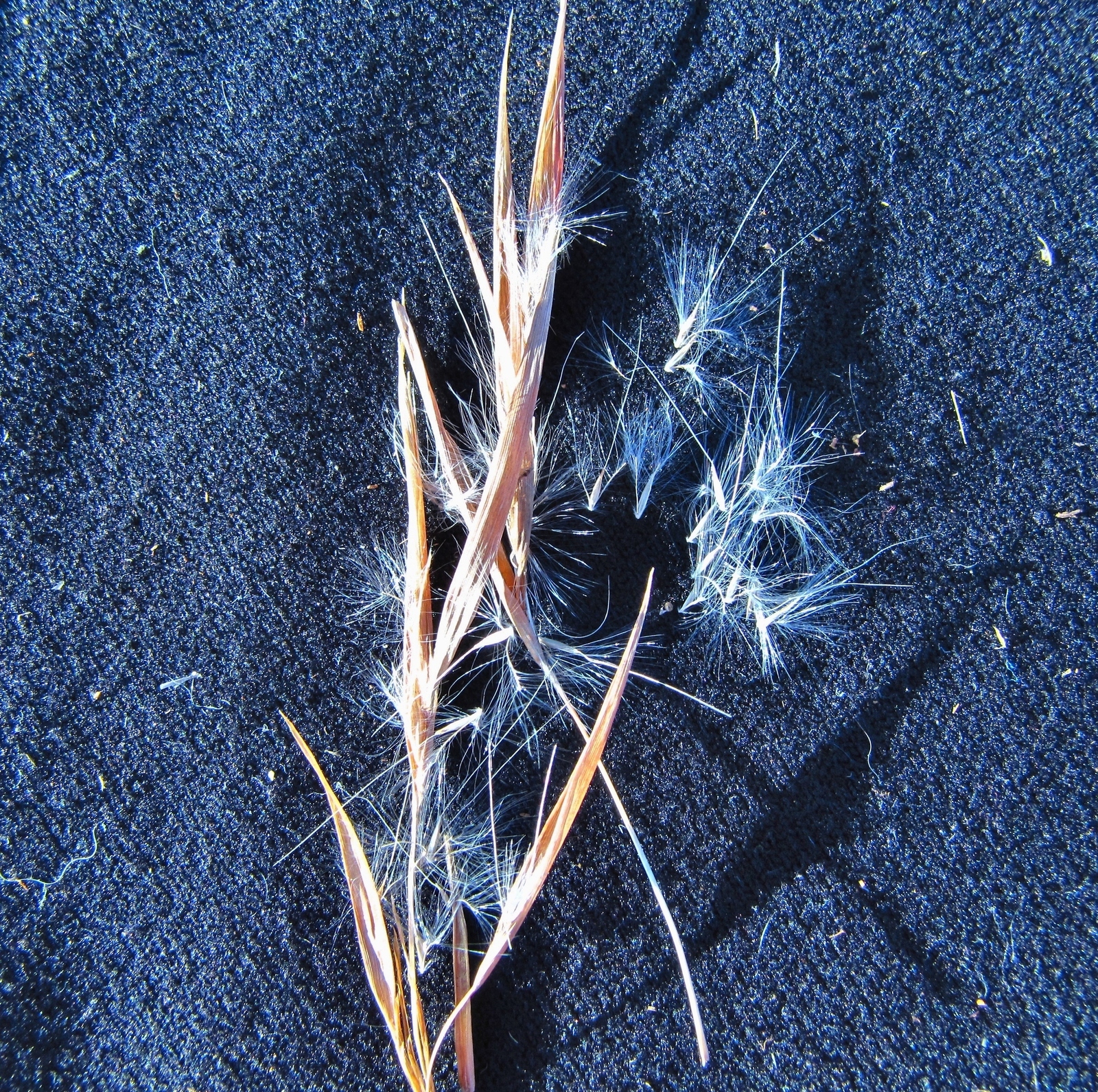
Broomsedge
Andropogon virginicus
Despite the name, broomsedge is a grass, not a sedge. It is the most visible native grass in Marion County, turning whole fields, roadsides, and powerline cuts a distinctive tawny copper from October through March. Broomsedge thrives on poor, acidic, low-fertility soils, and its dominance in a field is often read as a sign that the soil has been depleted by overgrazing or repeated hay cutting. The fluffy white seed plumes emerge in fall and persist through winter. Historically, bundles of dried broomsedge were tied together to make brooms.
Status: Native. TN-KY Plant Atlas Marion County record.
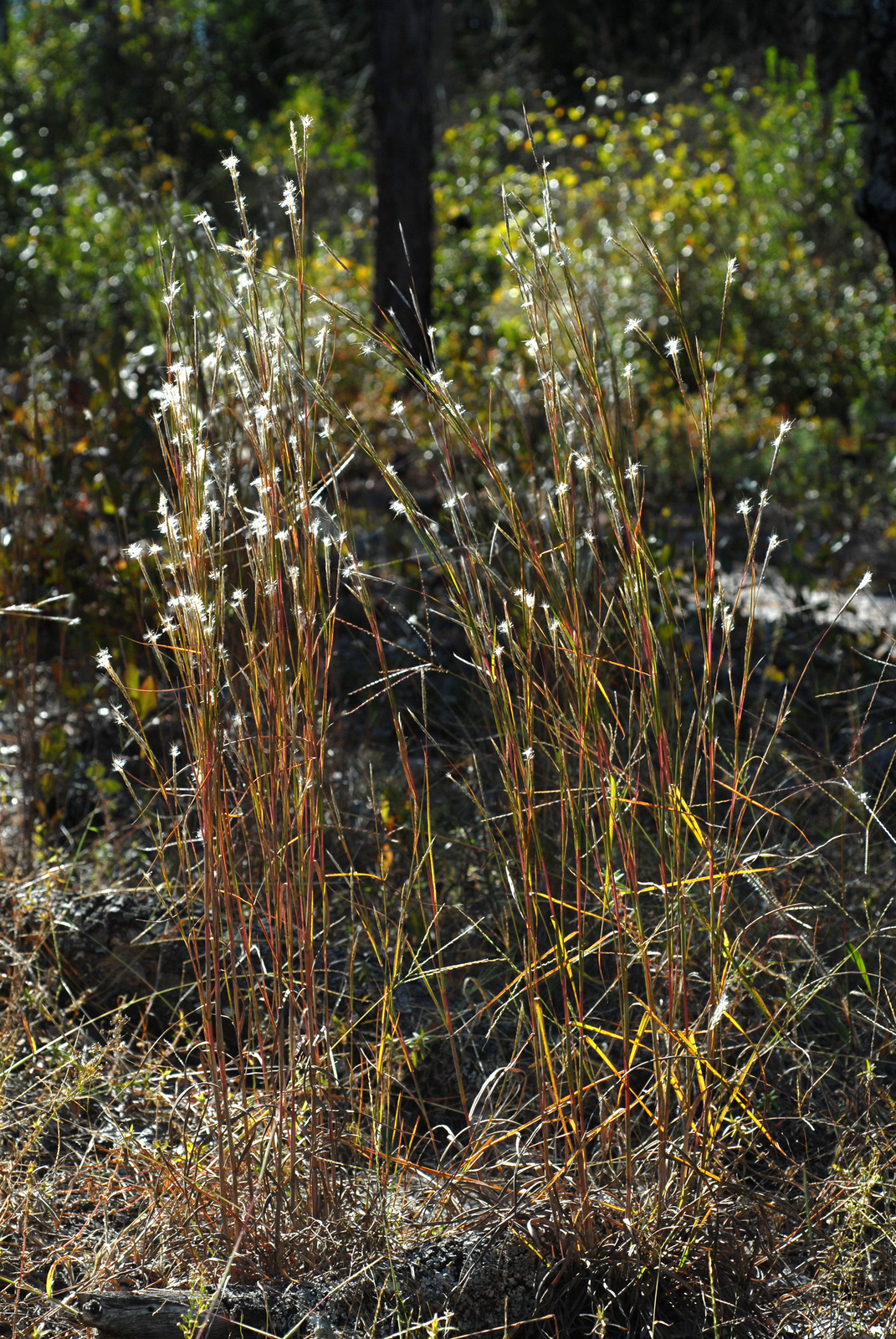
Splitbeard bluestem
Andropogon ternarius
A close relative of broomsedge, splitbeard bluestem is distinguished by its paired, silvery white, densely bearded seed heads that split apart at maturity, catching sunlight along dry roadsides and open woods in autumn. It favors sandy or rocky acidic soils on the plateau. The effect of a backlit stand in October is striking. Documented in Marion County via the TN-KY Plant Atlas.
Status: Native. TN-KY Plant Atlas Marion County record.
Poverty oatgrass
Danthonia spicata
A low-growing native bunch grass of dry, nutrient-poor, rocky or sandy soils on the plateau. The leaves characteristically curl inward when dry, giving the plant a wiry appearance. The compact seed head bears a few short-awned spikelets. Poverty oatgrass often grows alongside broomsedge in old fields and on exposed sandstone outcrops. Documented in Marion County via the TN-KY Plant Atlas.
Status: Native. TN-KY Plant Atlas Marion County record.
Cool-season pasture and lawn grasses
The most common grasses in Marion County by acreage are not native. European cool-season grasses, introduced for pasture and hay, dominate the valley floors and lower slopes. Tall fescue alone probably covers more Marion County ground than any single native species. These grasses are green in spring and fall, brown and dormant in summer heat, the opposite cycle of the native warm-season grasses above.
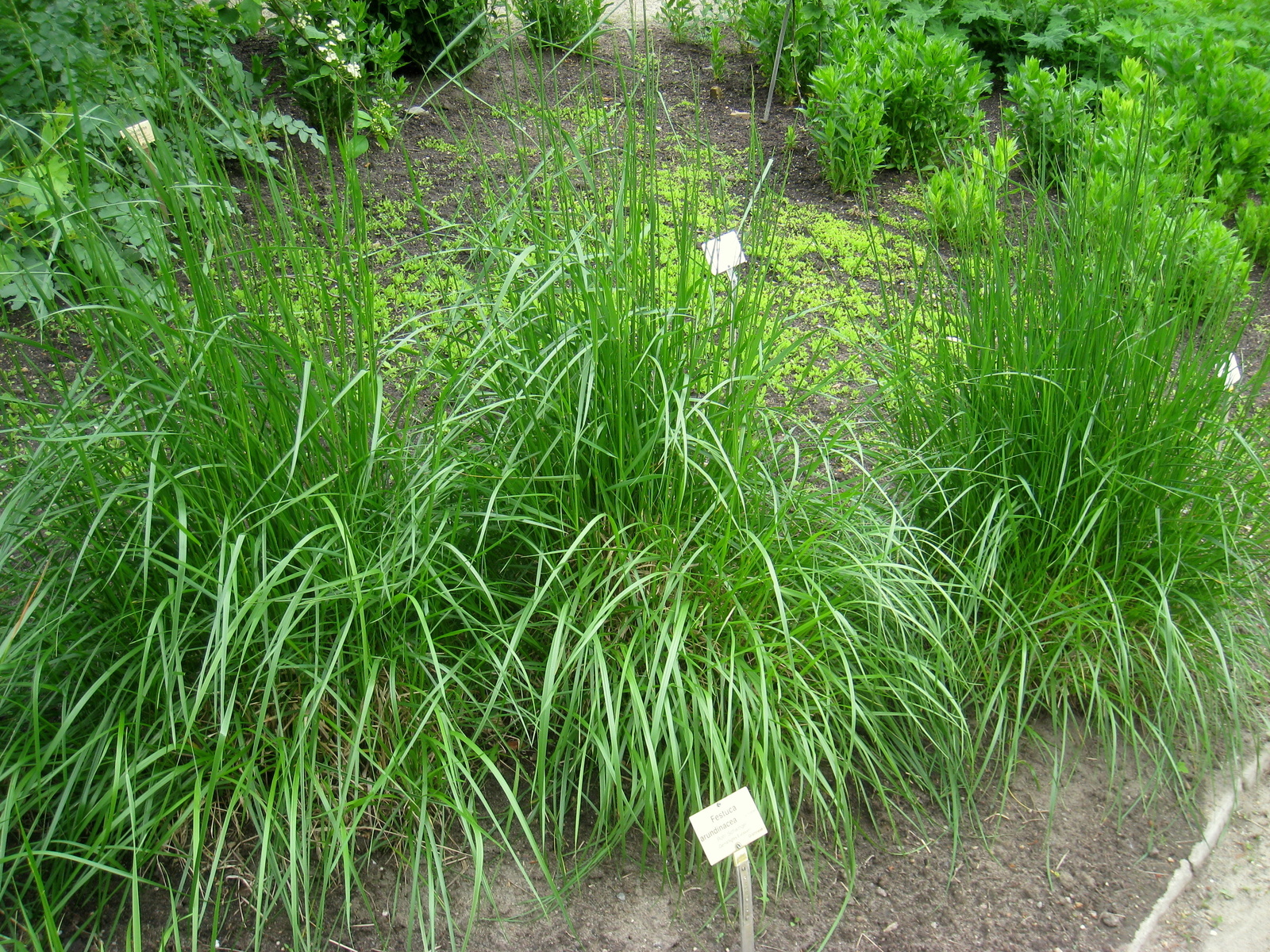
Tall fescue
Schedonorus arundinaceus (syn. Festuca arundinacea)
The dominant pasture grass of Marion County and most of the upper South. Tall fescue was widely planted across Tennessee from the 1940s onward for its durability, tolerance of poor soils, and year-round green cover. Most stands carry an endophytic fungus (Epichloë coenophiala) that increases the plant's drought tolerance but can cause fescue toxicosis in cattle during summer heat. Replacement with "novel endophyte" fescue varieties has been a major agricultural-extension initiative in Tennessee since the 2000s.
Status: Introduced. TN-KY Plant Atlas Marion County record.
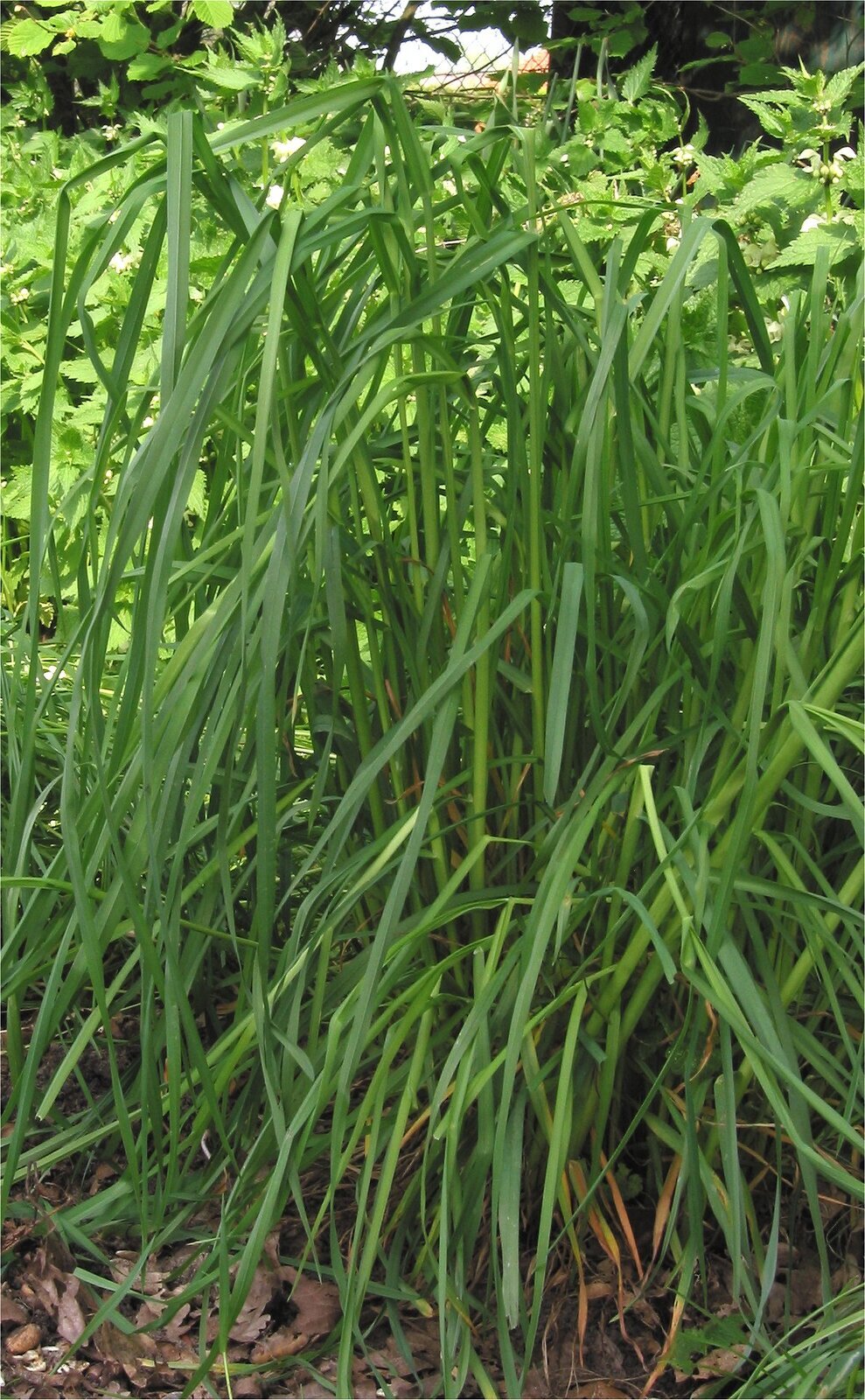
Orchardgrass
Dactylis glomerata
A European bunch grass widely planted for hay and pasture in Marion County, orchardgrass is recognized by its dense, one-sided flower clusters and blue-green foliage. It tolerates shade better than most pasture grasses and persists along woodland edges, fence rows, and old orchards (hence the name). Orchardgrass is a common component of Marion's hay mixtures alongside tall fescue.
Status: Introduced. TN-KY Plant Atlas Marion County record.
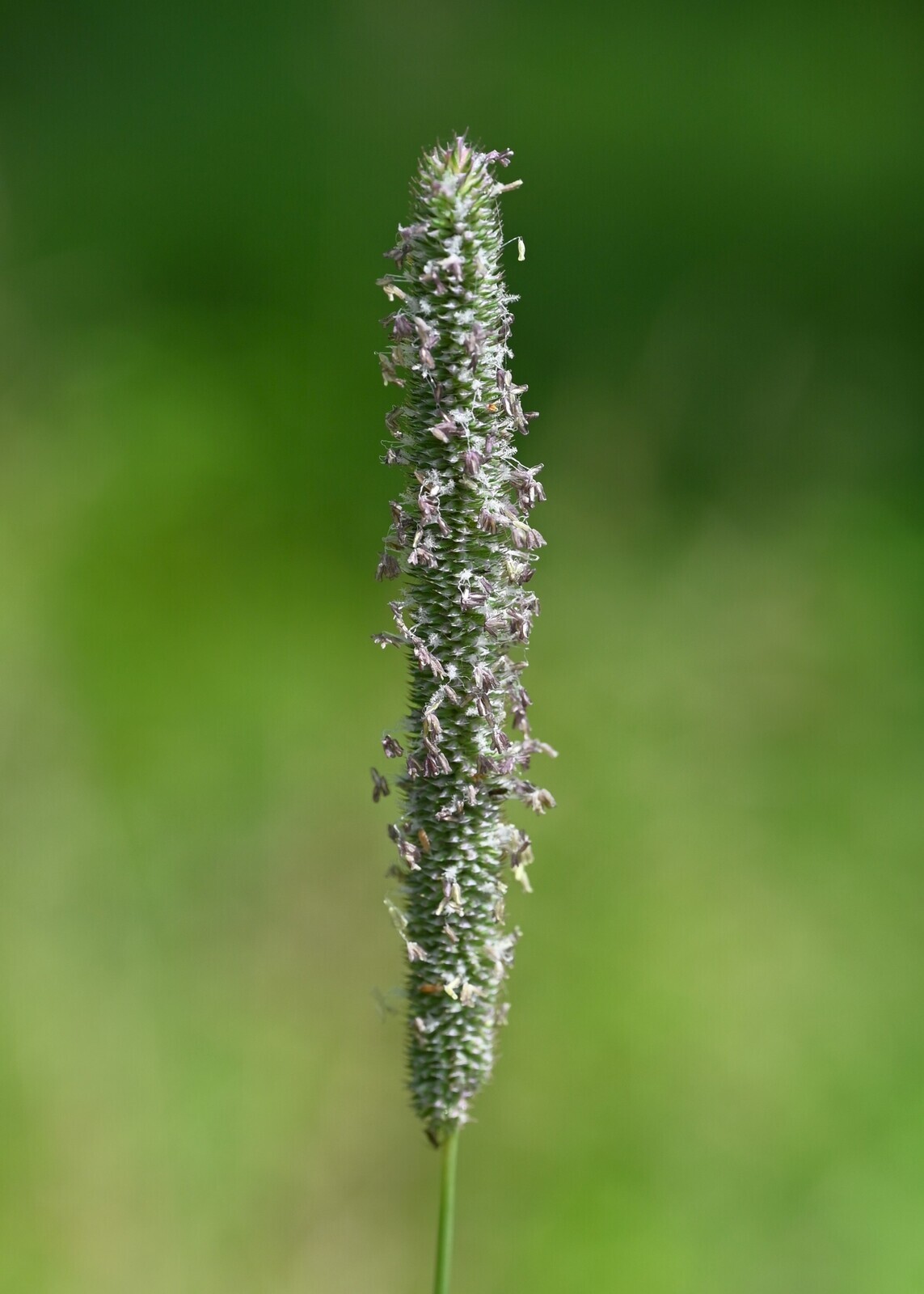
Timothy
Phleum pratense
Recognized by its dense, cylindrical, cat-tail-like seed head, timothy is a European hay grass that has been planted in the region since the colonial era. It is the preferred hay for horses. In Marion County, timothy is less dominant than tall fescue but persists in hay fields, roadsides, and old farmsteads, especially at higher elevations on the plateau where cooler conditions suit it.
Status: Introduced. TN-KY Plant Atlas Marion County record.
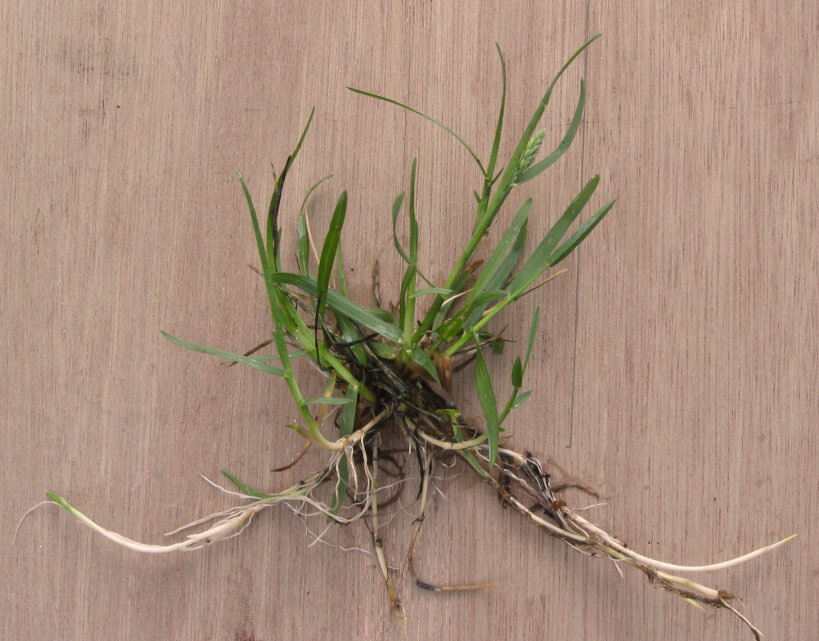
Kentucky bluegrass
Poa pratensis
The classic lawn grass of the upper South, Kentucky bluegrass spreads by rhizomes into dense, fine-textured sod. Despite its name, the species originated in Eurasia and was already widespread in eastern North America by the time European botanists first cataloged it. In Marion County, it is found in managed lawns, parks, and cool shaded roadsides rather than in wild habitats.
Status: Introduced (origin debated). TN-KY Plant Atlas Marion County record.
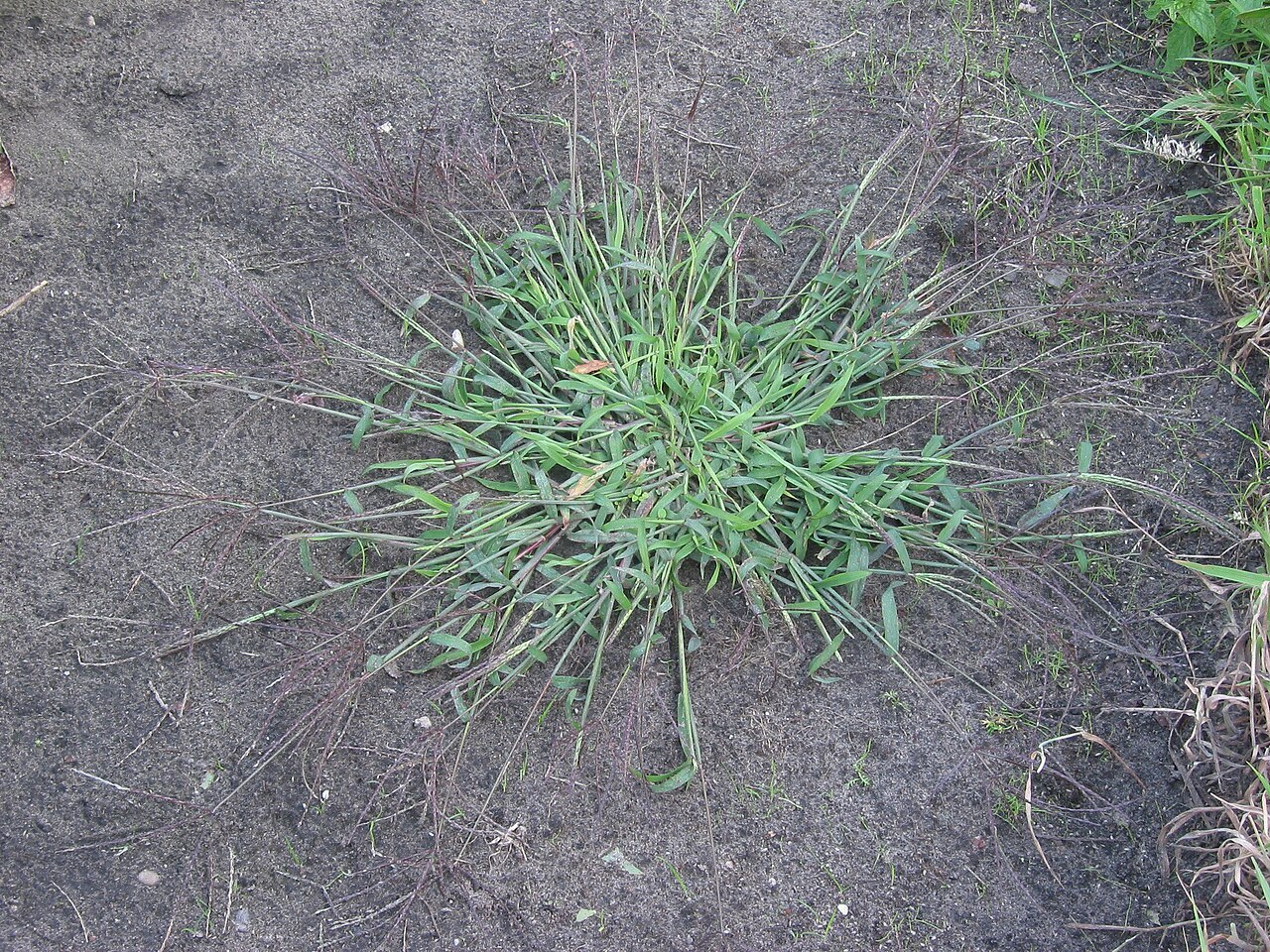
Hairy crabgrass
Digitaria sanguinalis
The bane of every lawn in Marion County, crabgrass is an introduced warm-season annual that germinates in late spring and spreads flat along the ground, rooting at the nodes. Its finger-like seed spikes radiate from a single point at the top of the stem. Crabgrass thrives in the summer heat that sends cool-season lawn grasses dormant, filling every thin spot with coarse, light-green growth.
Status: Introduced. TN-KY Plant Atlas Marion County record.
Woodland grasses
Several native grasses are adapted to the shaded understory of Marion County's cove-hardwood and mesic forests. These shade-tolerant species are less conspicuous than the open-field grasses but ecologically important as ground cover in undisturbed forest.
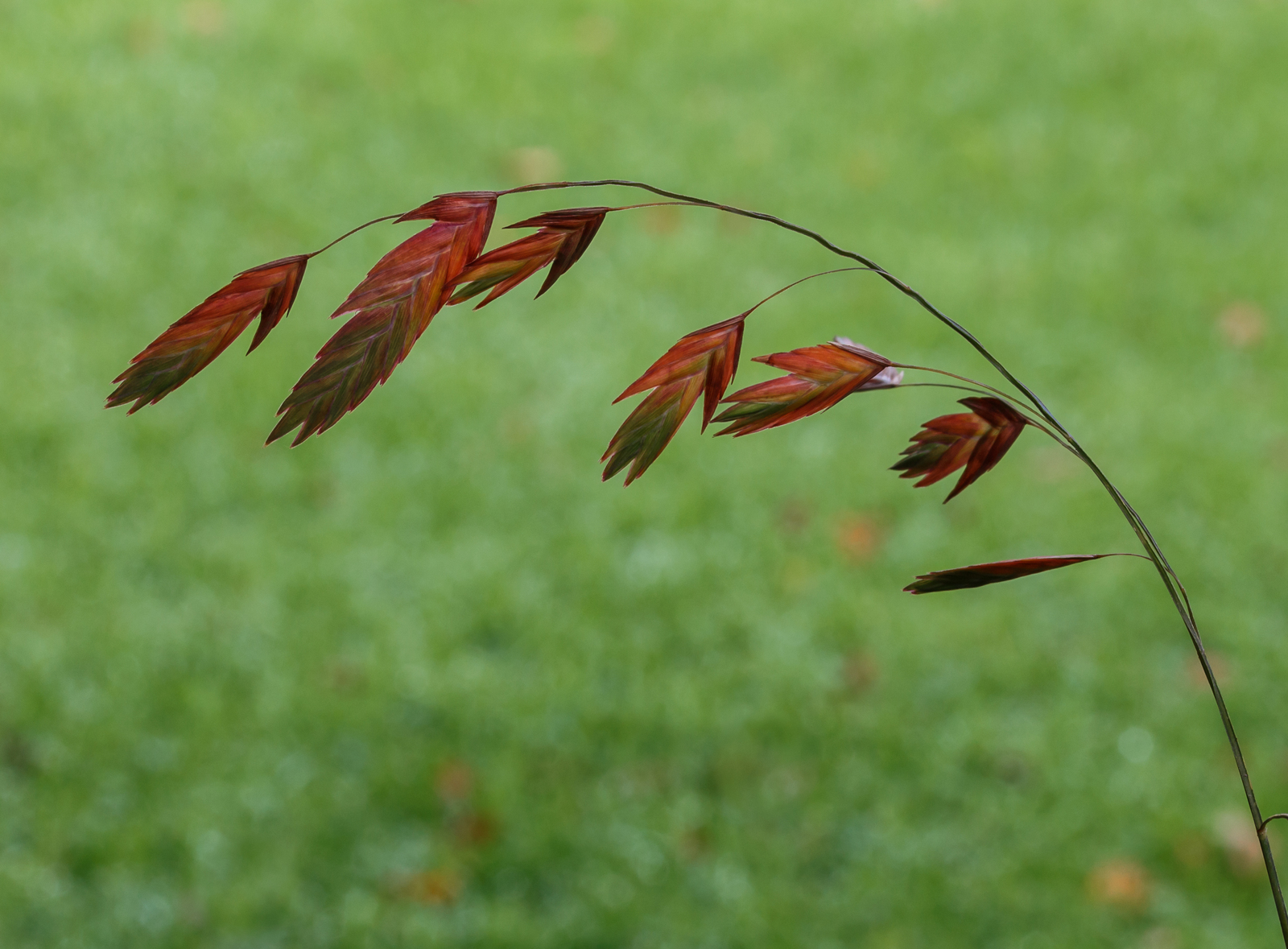
River oats
Chasmanthium latifolium (syn. Uniola latifolia)
One of the most ornamental native grasses, river oats produces flat, dangling, oat-like seed heads on arching stems two to four feet tall. The seed heads start green in summer, turn bronze in fall, and persist through winter. It grows in moist, shaded sites along streams and in rich bottomland woods. River oats is widely planted as a landscape ornamental, but in Marion County it is a genuinely native component of riparian forest edges.
Status: Native. TN-KY Plant Atlas Marion County record.
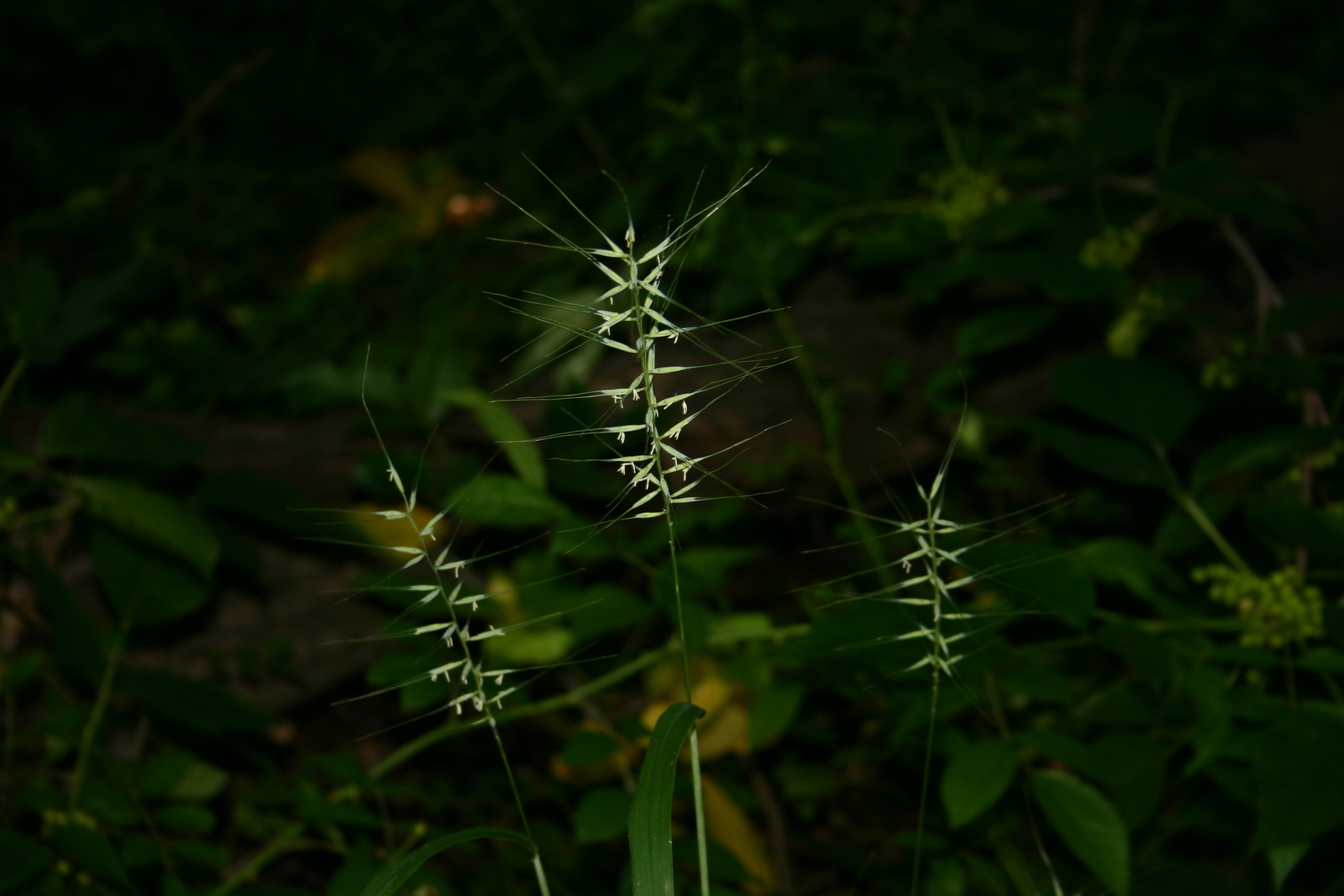
Eastern bottlebrush grass
Elymus hystrix (syn. Hystrix patula)
Named for its bristly seed head that resembles a bottle brush, this woodland grass grows two to four feet tall in the understory of rich, moist hardwood forests. The spikelets spread widely at maturity, giving the inflorescence a spiky, open appearance unlike any other grass in the county. A good indicator of undisturbed mesic forest. Documented in Marion County via the TN-KY Plant Atlas.
Status: Native. TN-KY Plant Atlas Marion County record.
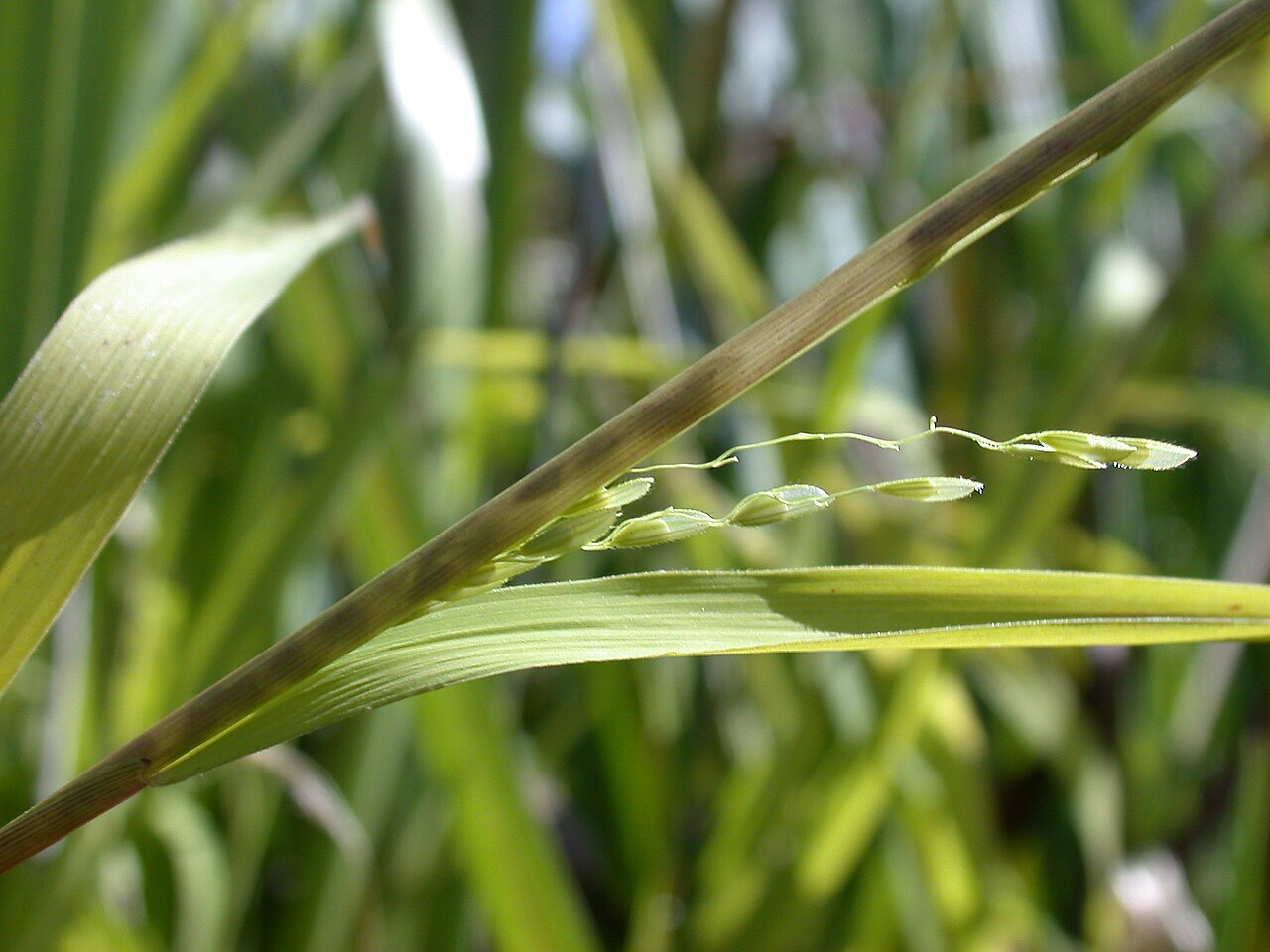
Rice cutgrass
Leersia oryzoides
A native wetland grass of stream margins and muddy shorelines, rice cutgrass gets its name from two features: the spikelets resemble tiny rice grains (it is in the same tribe as cultivated rice), and the leaf margins are finely serrated, sharp enough to cut skin. It grows two to four feet tall in standing water or saturated soil. The delicate, open panicle often appears late in the season, sometimes remaining partly enclosed in the leaf sheath.
Status: Native. TN-KY Plant Atlas Marion County record.
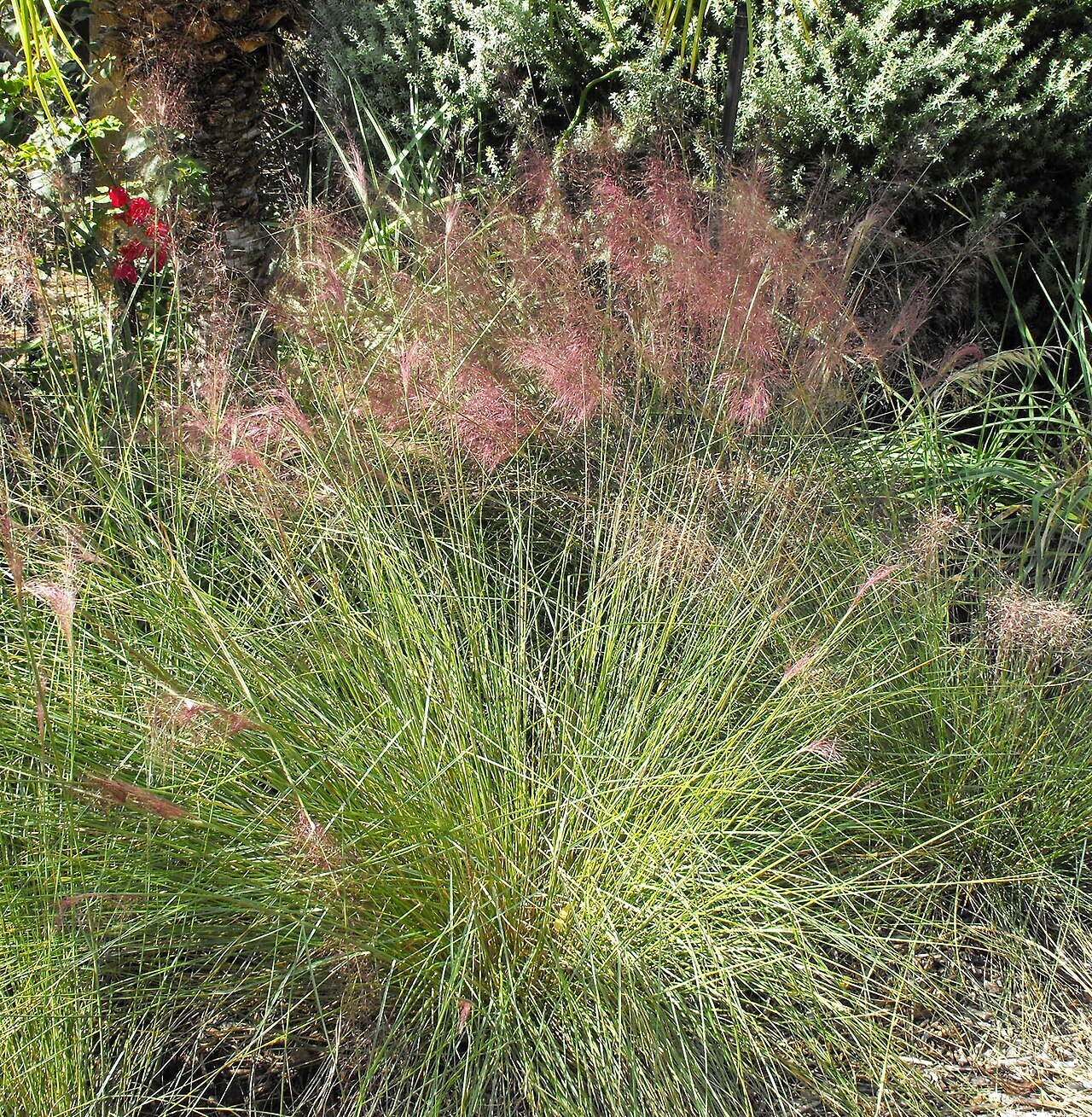
Hairawn muhly
Muhlenbergia capillaris
One of the most visually striking native grasses, hairawn muhly produces billowing clouds of pink to purple inflorescences in October that seem to float above the foliage. The airy seed heads are made up of thousands of hair-fine branches bearing tiny spikelets. In Marion County, it grows on dry, rocky, or sandy sites on the plateau, including limestone glades and open woodland edges. Widely planted as a landscape ornamental across the Southeast.
Status: Native. TN-KY Plant Atlas Marion County record.
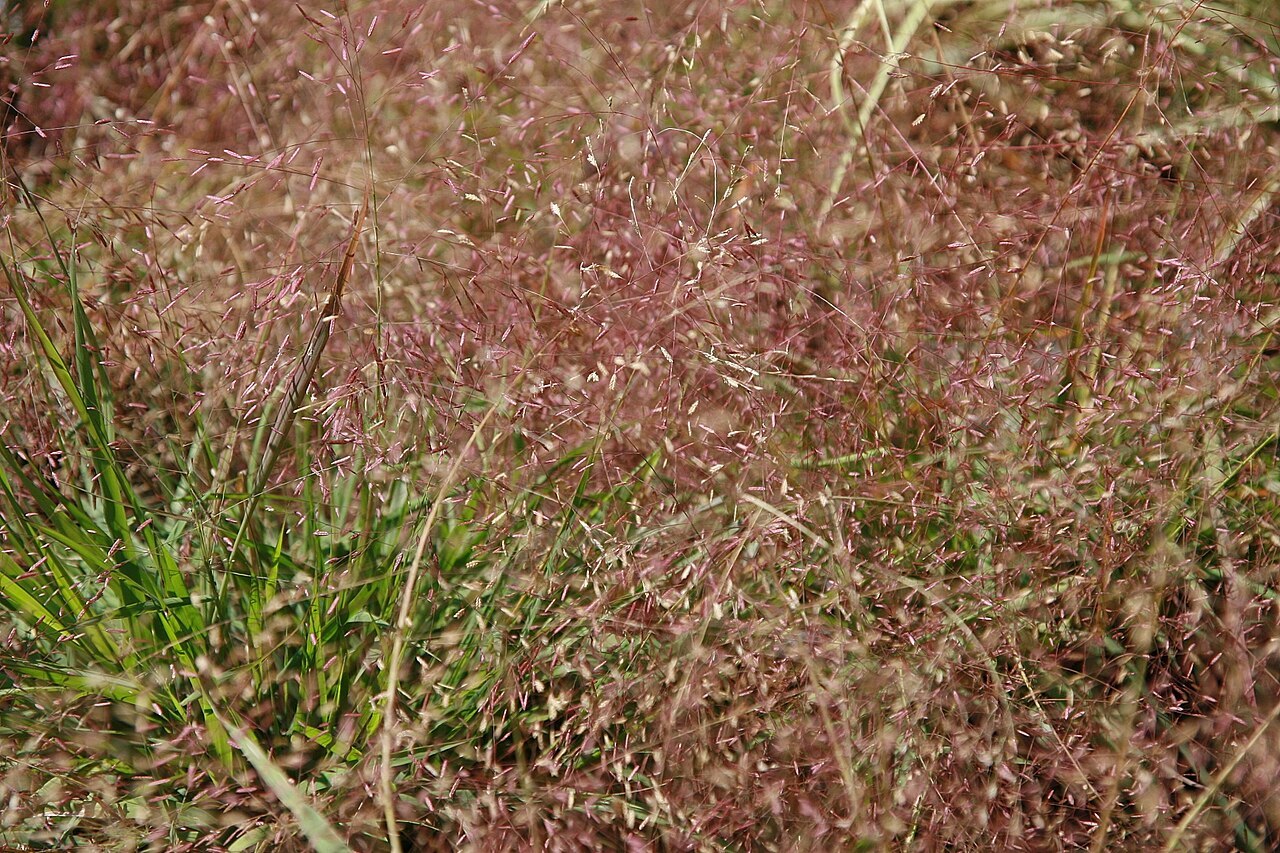
Purple lovegrass
Eragrostis spectabilis
A native warm-season bunch grass that produces a broad, diffuse, reddish-purple panicle in late summer. The mature inflorescence often breaks free from the plant and tumbles across fields and roadsides as a tumbleweed. Purple lovegrass favors dry, sandy, or gravelly soils, and is a common roadside grass across the plateau. The purple haze of a field in August is unmistakable.
Status: Native. TN-KY Plant Atlas Marion County record.
Woodland sedges
The genus Carex is the largest plant genus in Marion County, with at least seventy species documented in the TN-KY Plant Atlas. Sedges are distinguished from grasses by their triangular stems (the mnemonic "sedges have edges") and from rushes by their three-ranked leaves and lack of a visible flower. Most are small, inconspicuous plants of the forest floor, but together they form a critical component of the cove-hardwood understory. The cards below highlight a representative subset; the full Carex roster is catalogued in the TN-KY Plant Atlas Marion County records.
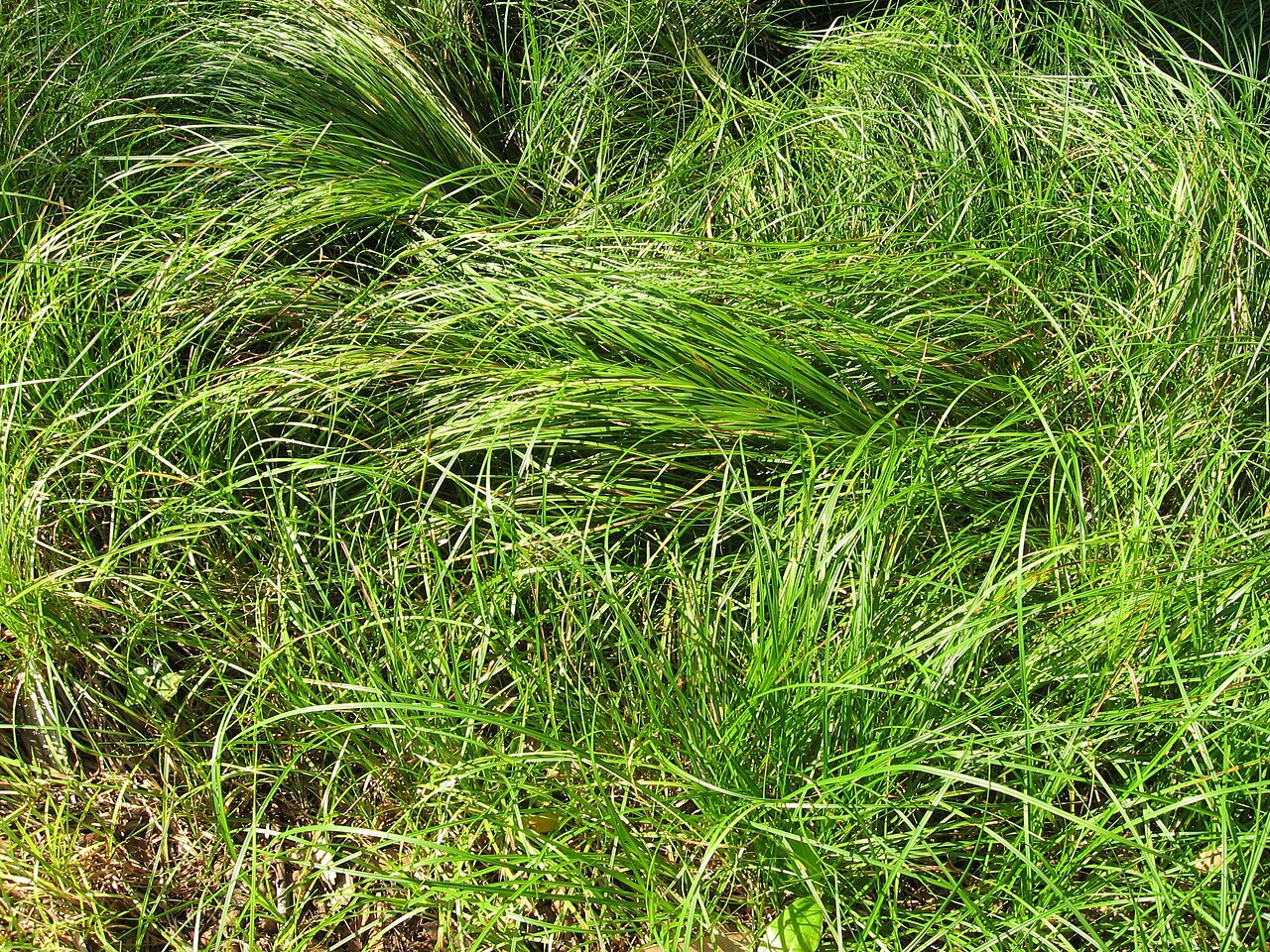
Pennsylvania sedge
Carex pensylvanica
The most common ground-cover sedge on dry to mesic oak-hickory forests of the Cumberland Plateau, Pennsylvania sedge forms low, dense, grass-like mats six to twelve inches tall. It spreads by rhizomes and can carpet large areas of forest floor under an open canopy. Increasingly used as a native lawn alternative in shaded landscapes. One of the earliest sedges to flower, producing inconspicuous spikes in April.
Status: Native. TN-KY Plant Atlas Marion County record.
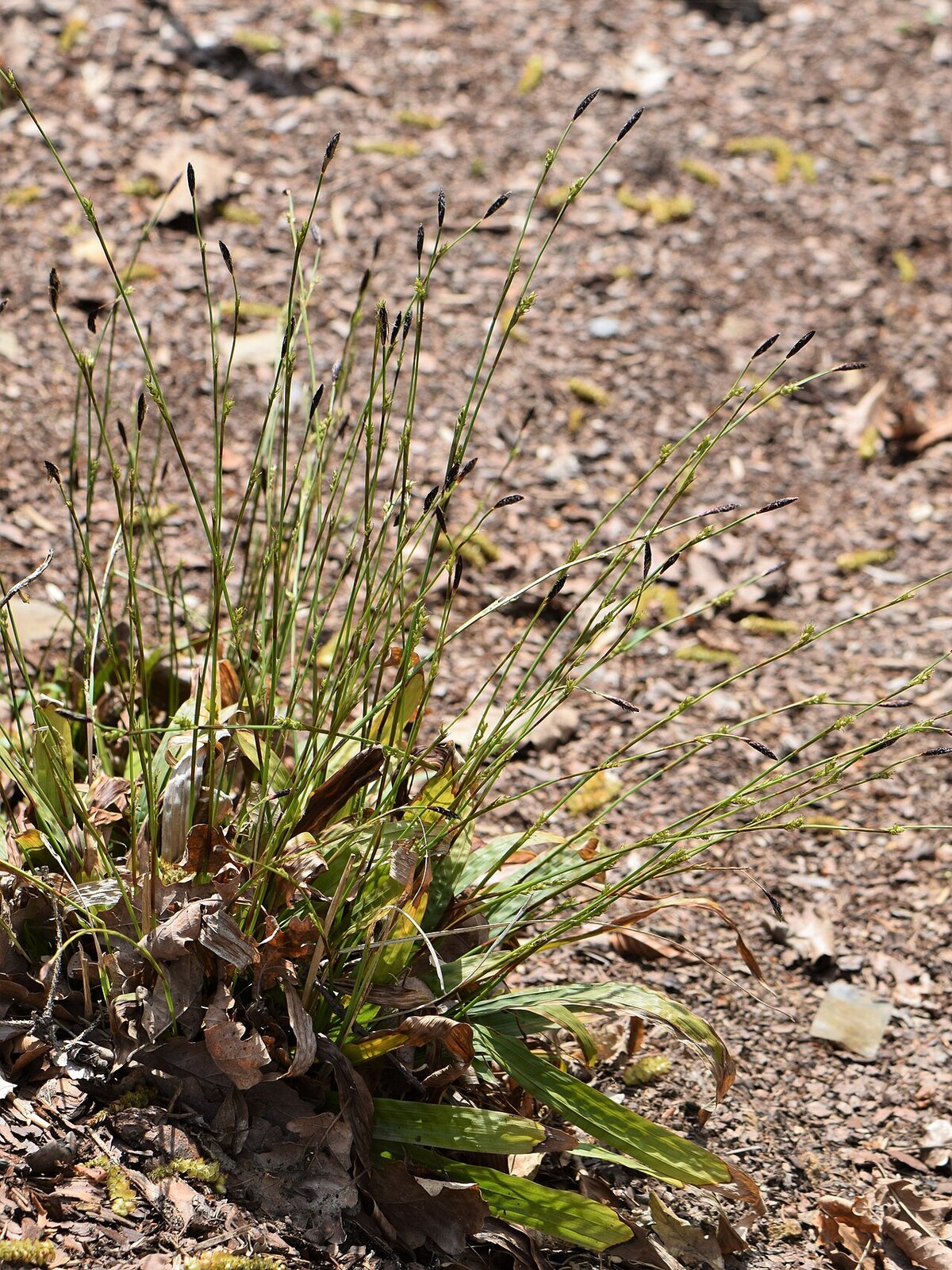
Plantain-leaved sedge
Carex plantaginea
One of the few sedges a non-botanist might notice, plantain-leaved sedge has unusually broad, strap-like evergreen leaves that look more like a hosta than a typical sedge. It forms rosettes on the floor of rich, moist hardwood forests and is a good indicator of undisturbed, high-quality cove habitat. The reddish-purple flowering stems appear in early spring before the canopy closes. Documented in Marion County via the TN-KY Plant Atlas.
Status: Native. TN-KY Plant Atlas Marion County record.
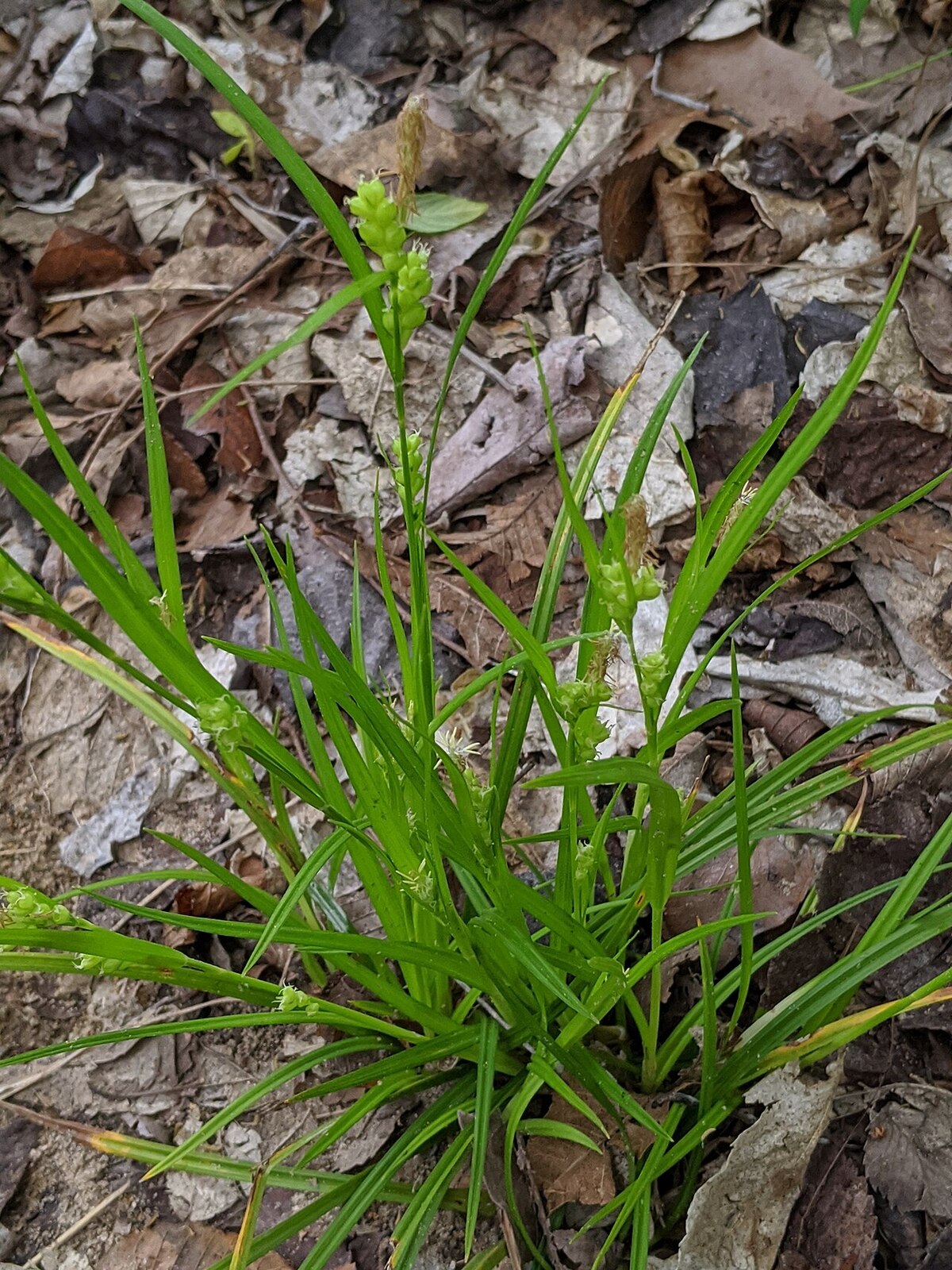
Eastern woodland sedge
Carex blanda
One of the most widespread and tolerant woodland sedges in eastern North America, C. blanda grows in a wide range of forest types from dry oak-hickory to moist bottomland. It forms loose tufts six to eighteen inches tall with relatively broad leaves. Often found along trail edges and in the transitional zone between forest and clearing. A reliable "background sedge" that a visitor is more likely to walk past than to notice.
Status: Native. TN-KY Plant Atlas Marion County record.
Wetland sedges and rushes
Every farm pond, roadside ditch, and stream margin in Marion County supports a community of wetland-obligate sedges and rushes. These species stabilize saturated soils, filter runoff, and provide cover for amphibians and invertebrates.
Soft rush
Juncus effusus
The most recognizable rush in Marion County, soft rush forms dense, round clumps of smooth, dark green, cylindrical stems one to four feet tall at the edges of ponds, ditches, and wet pastures. The flower cluster appears to burst from the side of the stem (actually a lateral inflorescence with a bract that continues the line of the stem). Rushes are distinguished from sedges by their round stems and from grasses by their six-parted flowers. Soft rush is a cosmopolitan wetland species found on every continent except Antarctica.
Status: Native. TN-KY Plant Atlas Marion County record.
Path rush
Juncus tenuis
A small, wiry rush six to twenty inches tall that thrives on compacted soils along trails, paths, roadsides, and the edges of gravel driveways. Path rush tolerates foot traffic better than almost any native plant, and its presence along a packed-dirt trail is so reliable that it serves as a field mark for the trail itself. The stems are flattened at the base, and the small brownish flowers cluster near the top.
Status: Native. TN-KY Plant Atlas Marion County record.
Woolgrass
Scirpus cyperinus
Despite the name, woolgrass is a bulrush (family Cyperaceae). It grows three to five feet tall in wet meadows, pond margins, and roadside ditches, producing large, drooping, woolly brown seed clusters in late summer that are unmistakable at a distance. The "wool" is a mass of fine, reddish-brown bristles surrounding each seed. Woolgrass is a colonizer of disturbed wet ground and often appears around new ponds and detention basins.
Status: Native. TN-KY Plant Atlas Marion County record.
Blunt spike-rush
Eleocharis obtusa
A small wetland sedge six to eighteen inches tall, blunt spike-rush has a single rounded spikelet at the tip of each leafless stem. It forms dense colonies in shallow standing water, muddy pond edges, and seasonal pools. Spike-rushes are distinguished from true rushes by their single terminal spikelet and from other sedges by their lack of conventional leaves (all photosynthesis occurs in the round stems). Common and widespread.
Status: Native. TN-KY Plant Atlas Marion County record.
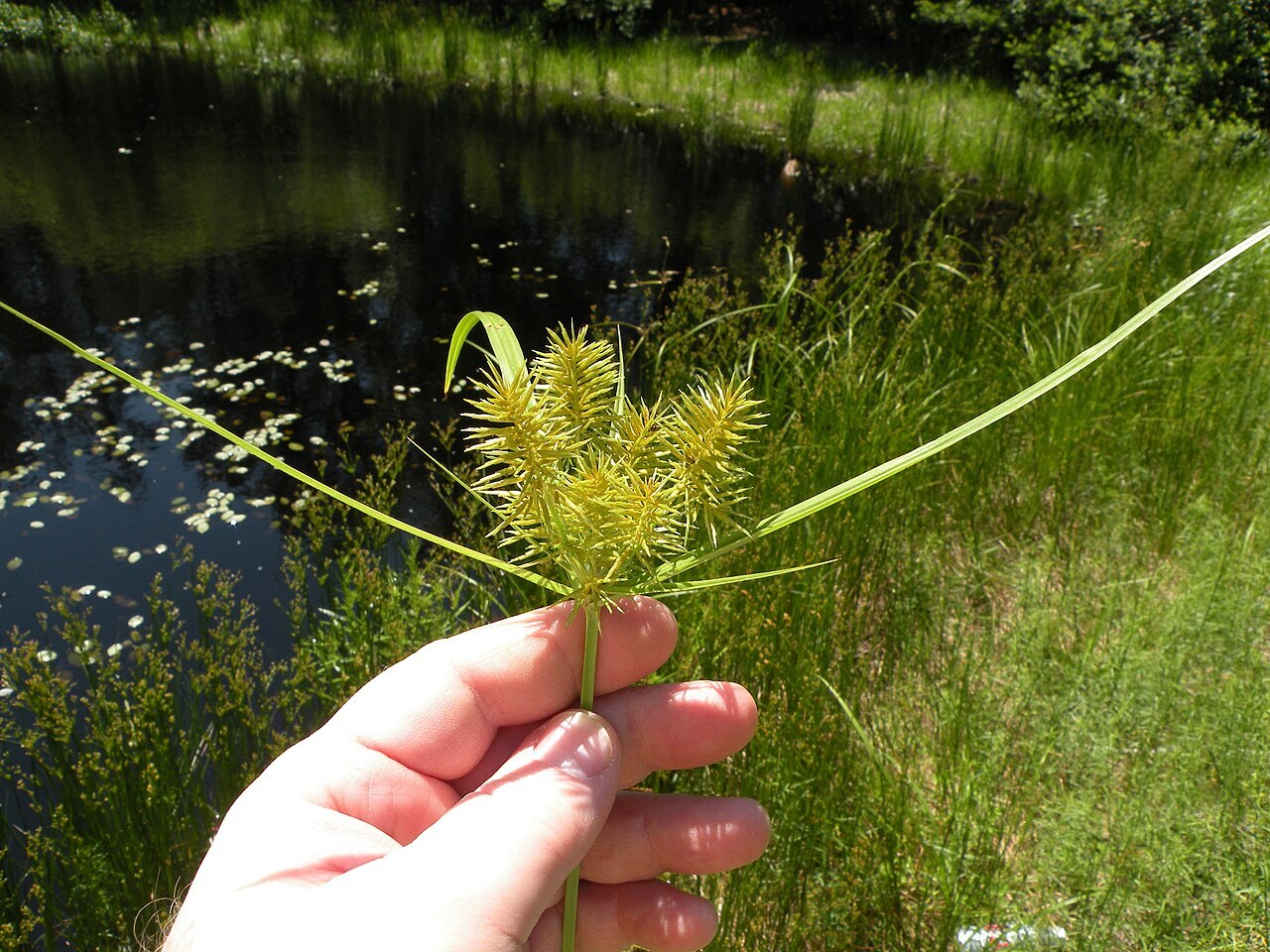
Straw-colored flatsedge
Cyperus strigosus
The most common flatsedge in Marion County, straw-colored flatsedge grows one to three feet tall in wet to moist open ground, ditches, and disturbed areas. The umbrella-like cluster of yellowish spikelets at the top of the stem, subtended by long, leaf-like bracts, is the typical Cyperus look. Flatsedges are distinguished from other sedges by their flattened spikelets arranged in fan-like clusters. Marion County supports at least fifteen Cyperus species.
Status: Native. TN-KY Plant Atlas Marion County record.
Conservation-listed graminoids
Several grasses, sedges, and rushes in Marion County carry state conservation listings from the TDEC 2025 Rare Plant List. These species are typically restricted to specific microhabitats on the Cumberland Plateau or in the Sequatchie Valley.
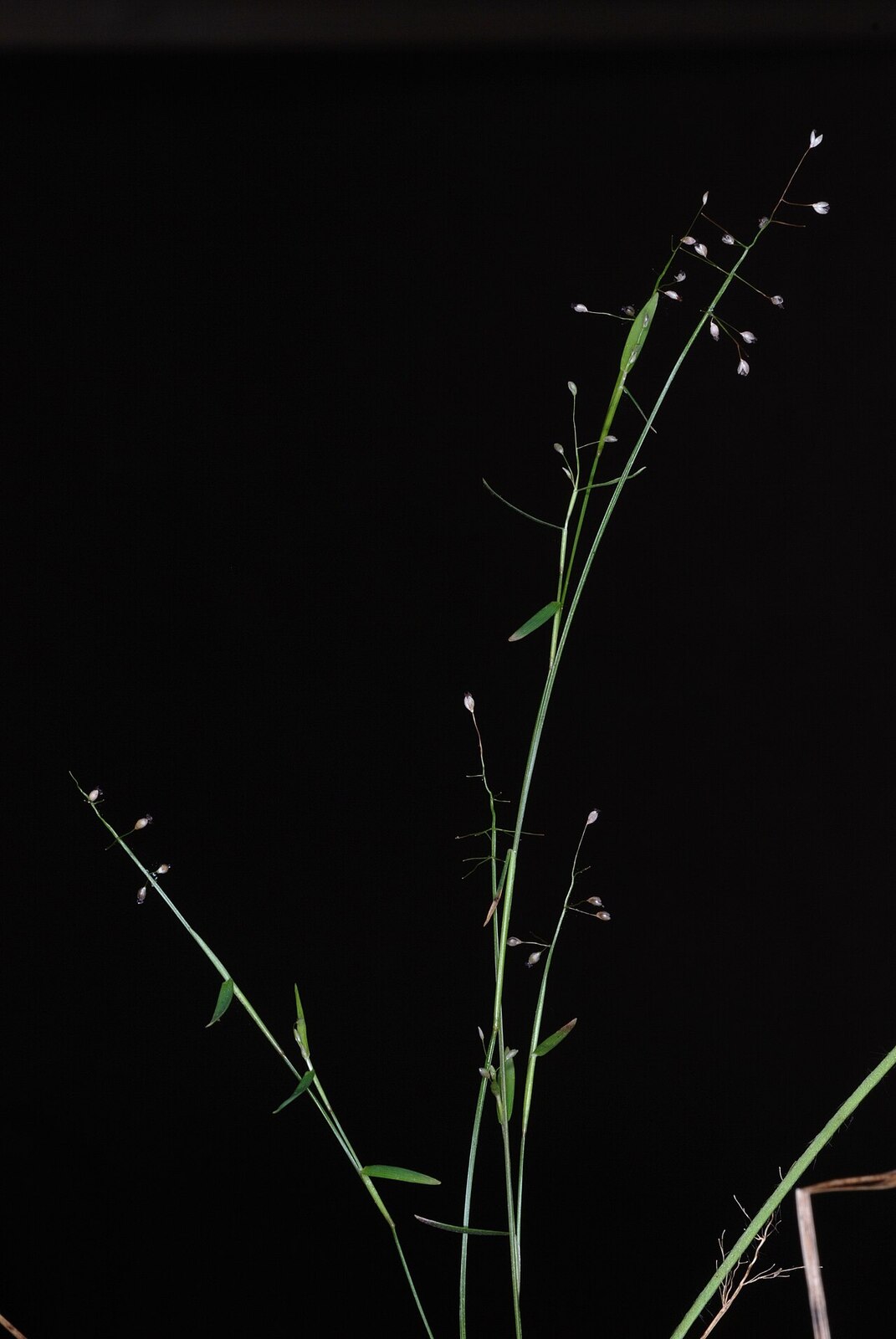
Small-leaf witchgrass
Dichanthelium ensifolium
A small, slender panic grass of acidic bogs and moist, sandy, open ground. In Tennessee, small-leaf witchgrass is state-endangered with an S-rank of S1, meaning it is critically imperiled with five or fewer known occurrences in the state. It is documented in the Cumberland Plateau and Eastern Ridge and Valley physiographic provinces per the TDEC rare plant list.
Status: Native. TN state-endangered (S1, G4T3?). TN-KY Plant Atlas Marion County record.
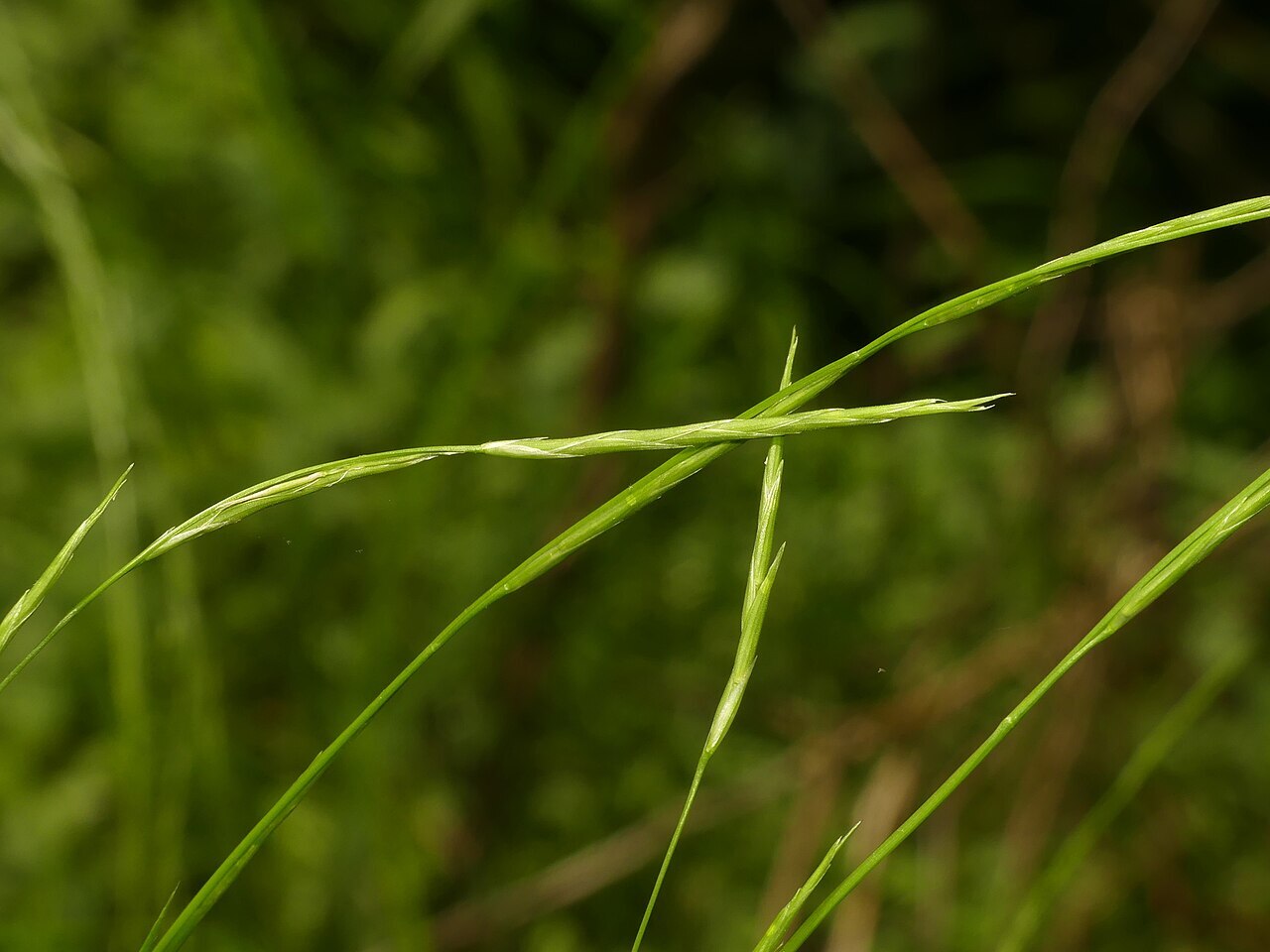
Creeping mannagrass
Glyceria acutiflora
A wetland grass of shallow water and muddy pond margins, creeping mannagrass has a semi-aquatic growth habit, with stems that root at the nodes and float or creep across the water surface. In Tennessee, it is listed as special-concern with an S-rank of S2, meaning it is imperiled. Documented in the Cumberland Plateau and Eastern Ridge and Valley physiographic provinces per the TDEC rare plant list.
Status: Native. TN special-concern (S2, G5). TN-KY Plant Atlas Marion County record.
Invasive grass headliners
Two invasive grasses rank among the most ecologically damaging non-native plants in Marion County. Both are rated as severe threats by the Tennessee Invasive Plant Council. Additional invasive grasses are treated in the Invasive species and ecological threats section below.
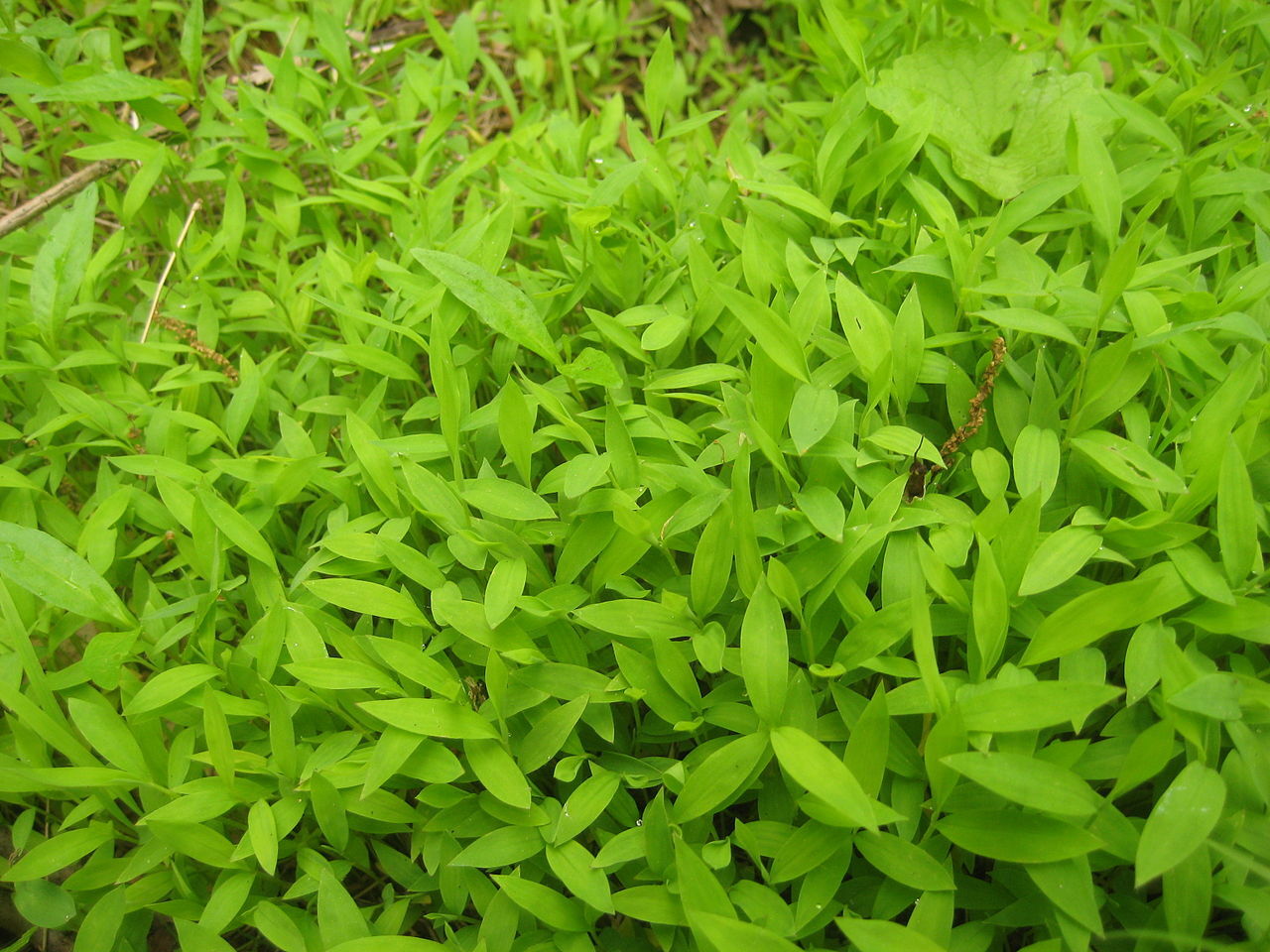
Japanese stiltgrass
Microstegium vimineum
The single most damaging invasive grass in Marion County's forests. Japanese stiltgrass is a shade-tolerant annual that forms dense, smothering mats on the forest floor, along trails, stream banks, and roadsides. It resembles a miniature bamboo, with pale green, lance-shaped leaves along a wiry, branching stem. A single plant can produce hundreds of seeds that remain viable in the soil for years. Stiltgrass displaces native wildflowers and woodland sedges, fundamentally altering the forest understory. Rated a TN-IPC severe-threat exotic. It spreads readily along trails, stream corridors, and logging roads.
Status: Introduced, invasive. TN-IPC severe-threat exotic. TN-KY Plant Atlas Marion County record.
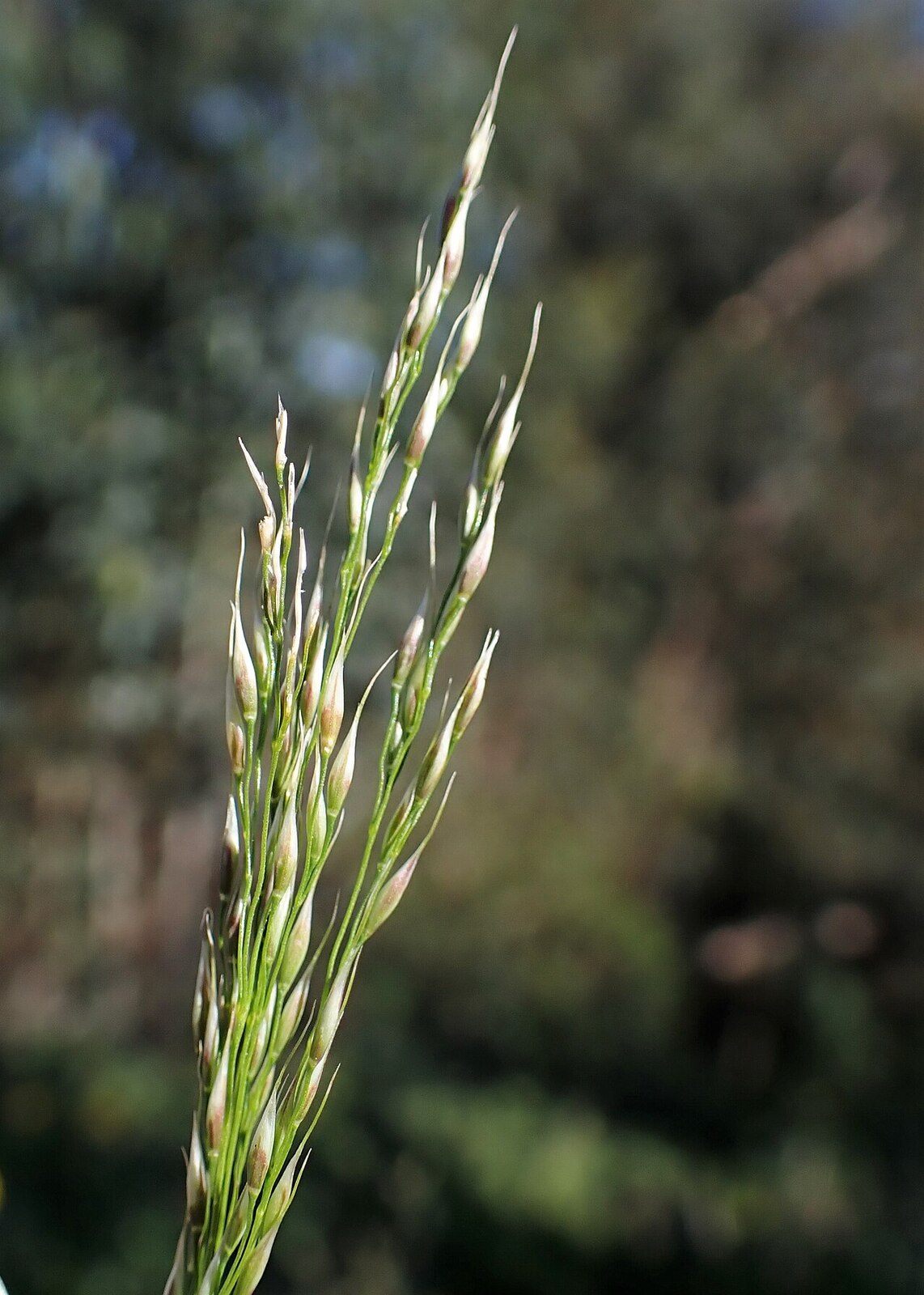
Johnsongrass
Sorghum halepense
A tall (three to eight feet), coarse, rhizomatous grass that dominates roadsides, field edges, and disturbed ground across Marion County. Johnsongrass was introduced in the 1800s as a forage crop and rapidly became one of the most troublesome agricultural weeds in the Southeast. It spreads aggressively by both seed and thick, fleshy rhizomes that can regenerate from small fragments. The large, open, reddish-purple panicle is distinctive. Rated a TN-IPC severe-threat exotic.
Status: Introduced, invasive. TN-IPC severe-threat exotic. TN-KY Plant Atlas Marion County record.
Fungi
Marion County's mixed-hardwood forests and calcareous creek bottoms support a diverse fungal community. The county's position at the junction of the Cumberland Plateau, the Sequatchie Valley, and the Tennessee River Gorge creates a range of habitats for fungi, from the moist cove-hardwood ravines where morels and chanterelles thrive to the dry plateau-rim oaks that partner with boletes and russulas underground. Fungi are not plants; they form their own kingdom, but convention keeps them on the flora page alongside the lichens (which are themselves fungal-algal partnerships).
A caution on foraging: several of the most deadly mushrooms in North America grow in Marion County's woods and lawns, including the destroying angel and the death cap. No rule of thumb (color, habitat, odor, whether animals eat it) reliably separates harmless from lethal species. The only safe approach is confident identification to species using multiple diagnostic features. When in doubt, do not eat.
Morels
Morels are the best-known spring mushroom in Marion County's hardwood forests. They appear in April, usually after soil temperatures hit the mid-50s Fahrenheit and following spring rains. Local lore associates morel flushes with blooming mayapple and redbud. True morels have a honeycomb-patterned cap joined directly to the stem, and the entire mushroom is hollow from the stem base up through the tip of the cap when sliced lengthwise.
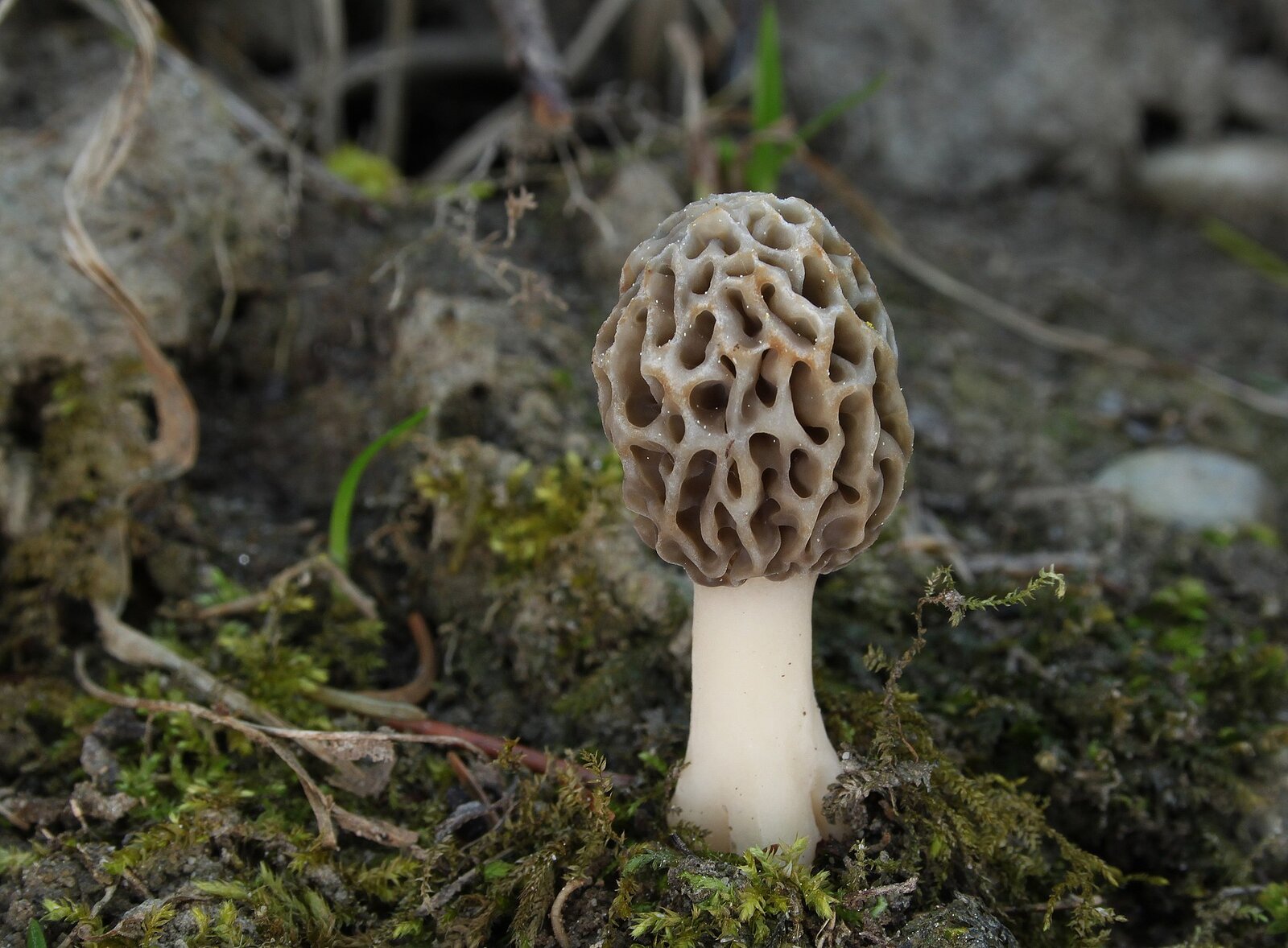
Yellow morel
Morchella esculenta
A common spring mushroom of Marion County's oak-hickory and cove-hardwood forests. Fruits in April after warm spring rains, often near tuliptree, ash, and old apple trees. The honeycomb cap is fused directly to the stem, and the interior is completely hollow when sliced lengthwise.
Status: Native.
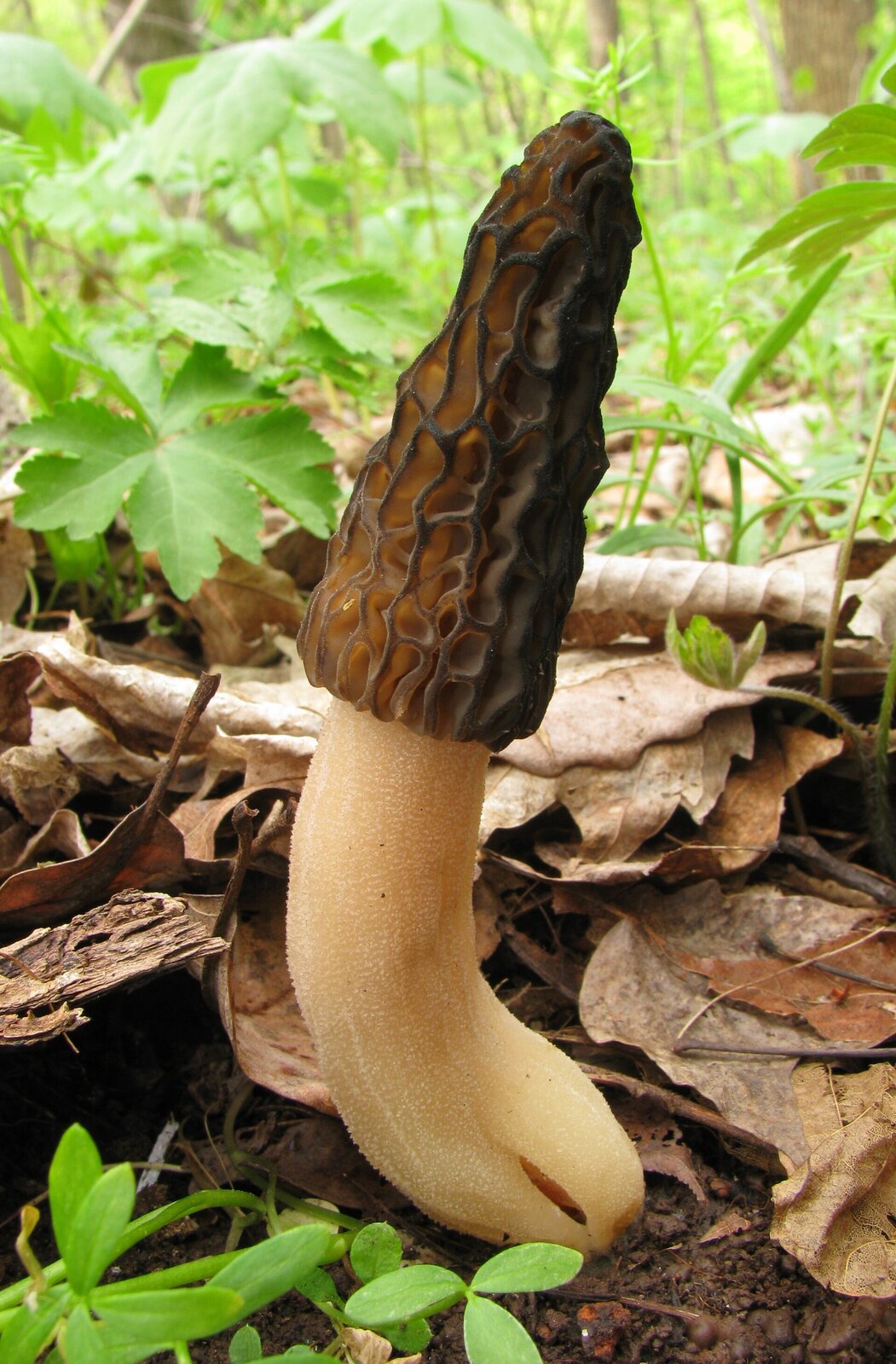
Black morel
Morchella angusticeps
Fruits slightly earlier than the yellow morel, often on sandy or recently disturbed soil at the edges of hardwood stands. The cap ridges darken to near-black at maturity while the pits remain pale, giving a distinctive grid pattern.
Status: Native.
Chanterelles and trumpets
Golden chanterelles and their relatives fruit in summer in Marion County's oak-hickory woods, forming mycorrhizal partnerships with the dominant hardwoods. They are solid, egg-yolk yellow to orange, and have blunt, shallow forking ridges on the underside rather than sharp plate-like gills.
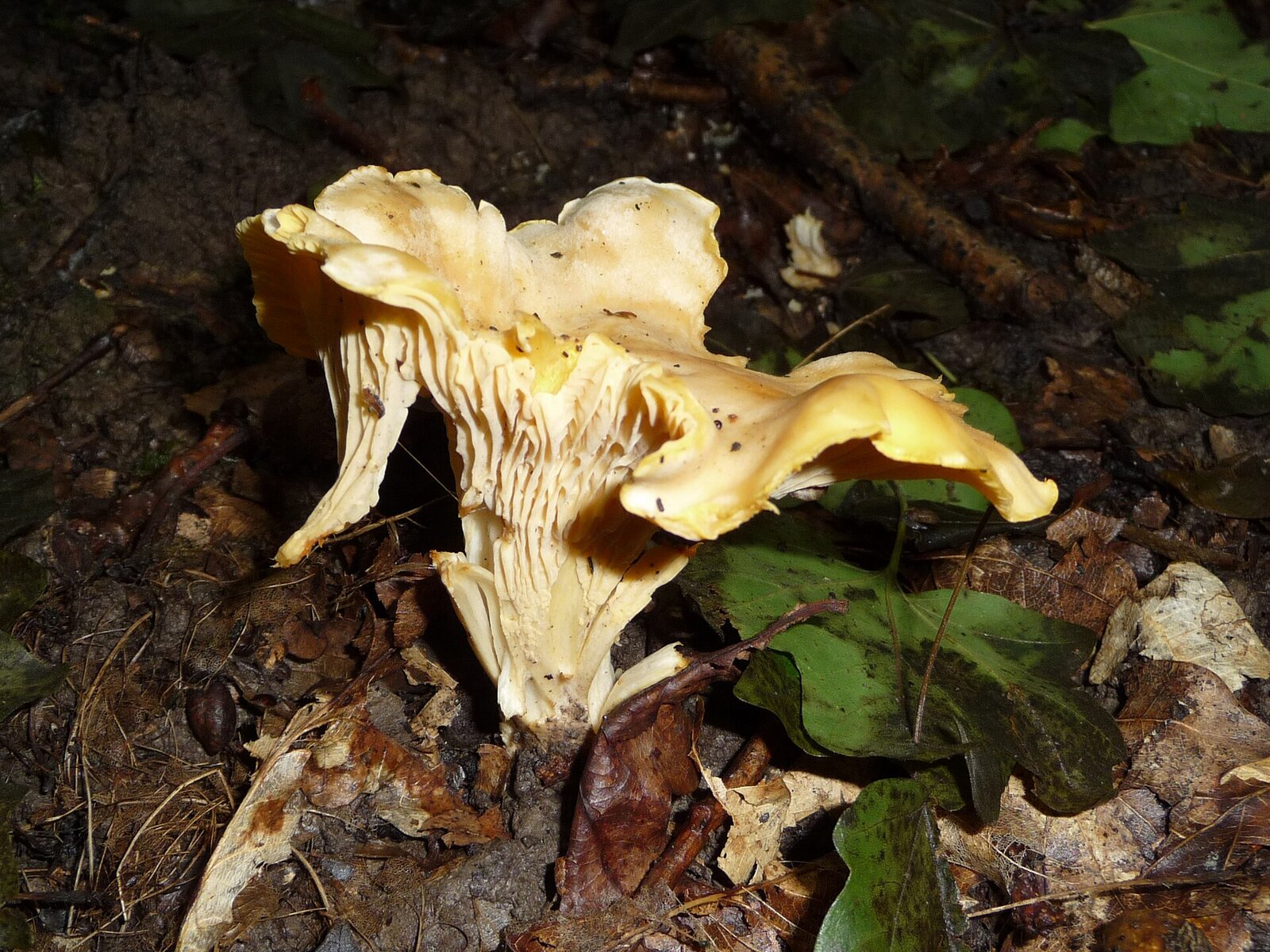
Golden chanterelle
Cantharellus cibarius
A signature summer mushroom of Marion County's oak-hickory forests, fruiting from June through September. Mycorrhizal with oaks and hickories. The underside has blunt, forking ridges, not sharp gills. Egg-yolk yellow throughout, with a faint apricot aroma.
Status: Native.
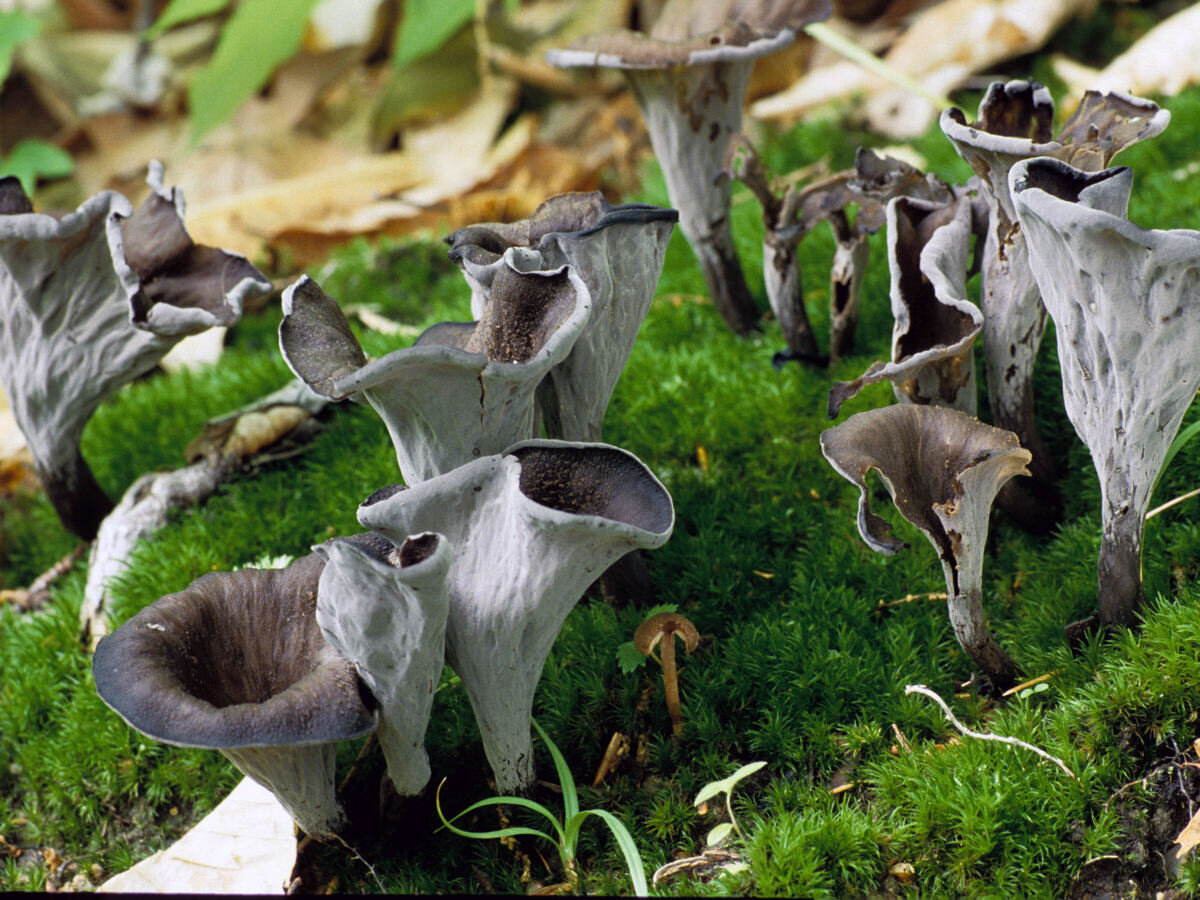
Black trumpet
Craterellus fallax
The chanterelle's somber cousin, fruiting in midsummer in oak-hickory woods on slopes and near streams. Nearly black, funnel-shaped, with a smooth to slightly wrinkled underside. Easy to overlook against dark leaf litter.
Status: Native.
Boletes and tooth fungi
Boletes are fleshy mushrooms with a sponge-like pore surface under the cap instead of gills. Marion County's oak-hickory and mixed-hardwood forests support a range of bolete species, from the prized king bolete to several mycorrhizal partners of the dominant canopy trees.
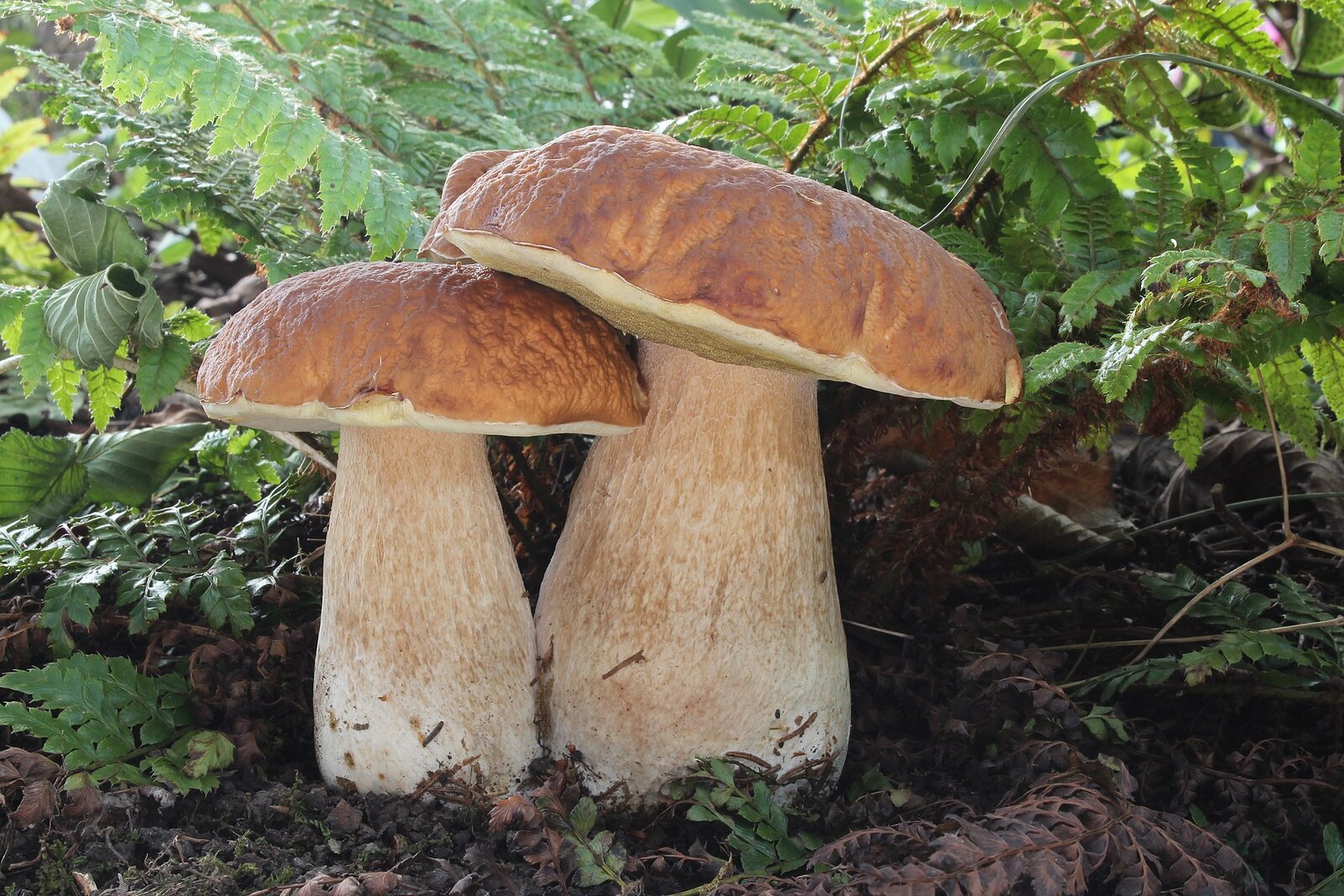
King bolete
Boletus edulis
A well-known mushroom mycorrhizal with oaks and hemlock across the Cumberland Plateau. The thick white stem, brown cap, and spongy white-to-olive pore surface are diagnostic. Fruits in late summer and fall.
Status: Native.
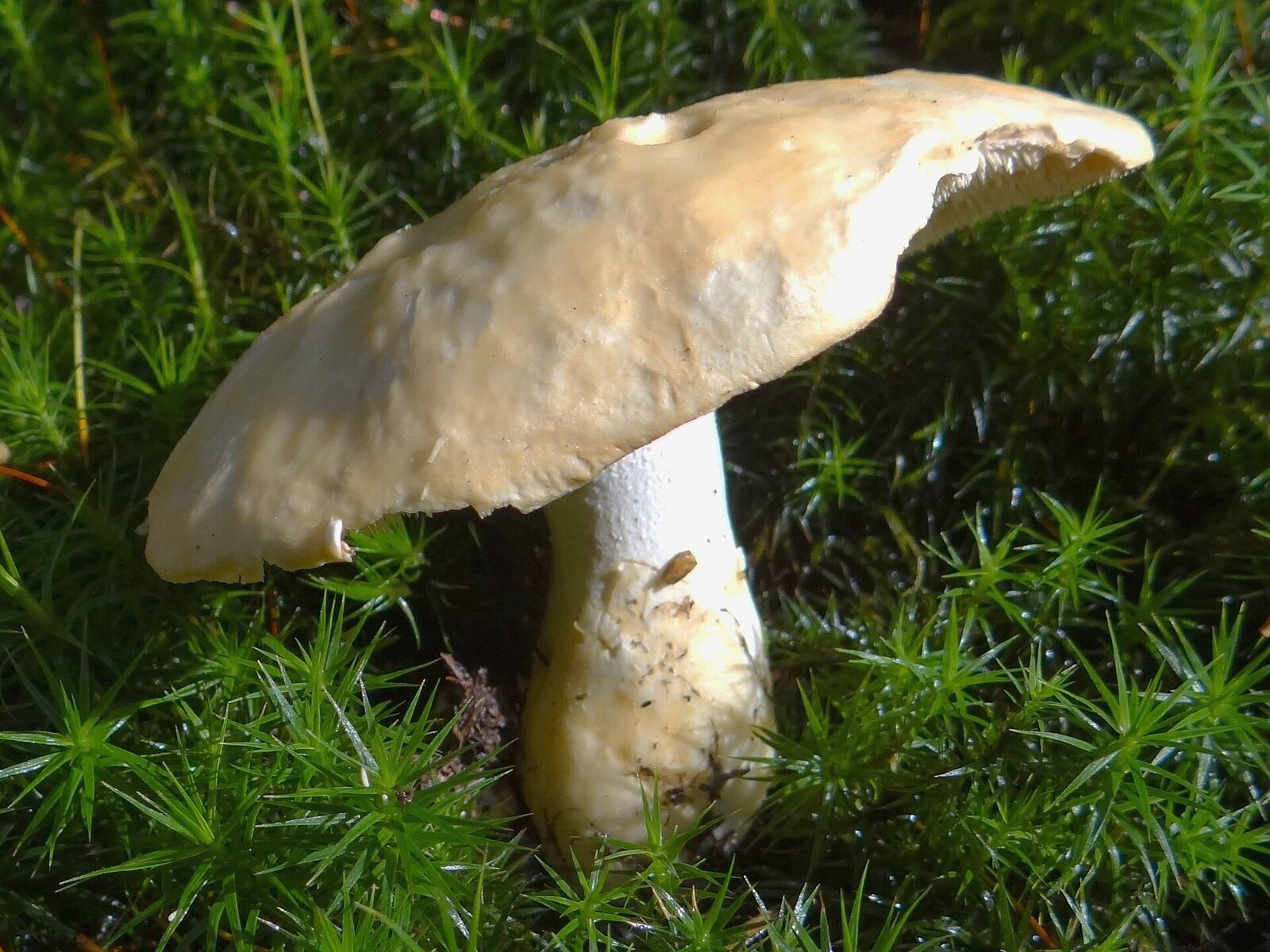
Hedgehog mushroom
Hydnum repandum
A mycorrhizal mushroom recognized by the tiny spines (teeth) hanging from the underside of the cap instead of gills or pores. Pale orange to cream. Fruits in fall in oak-hickory and mixed-hardwood forests.
Status: Native.
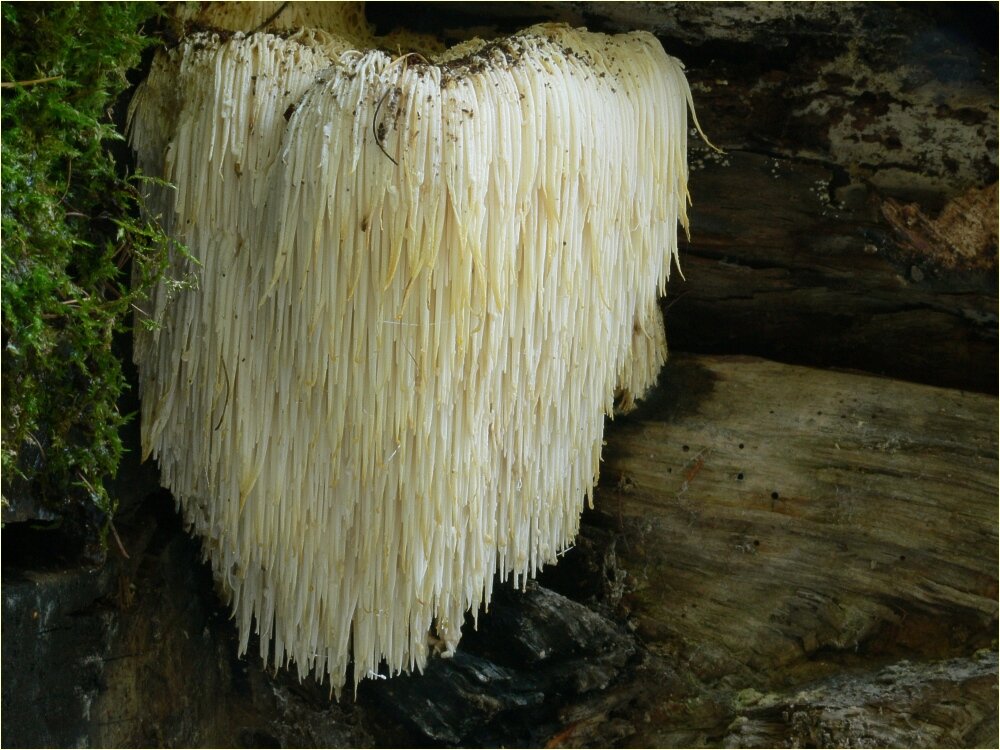
Lion's mane
Hericium erinaceus
A striking white, icicle-like mushroom that fruits on dead and dying hardwoods, especially oaks and beeches. The cascading spines are unmistakable. Studied as a subject of medicinal research.
Status: Native.
ID gotcha: true morel vs. false morel
ID gotcha: true morel vs. false morel
False morels (Gyromitra esculenta and relatives) can kill. They contain monomethylhydrazine, a chemical used as rocket fuel. False morels are not hollow inside: when sliced lengthwise, the cap is filled with solid, brain-like tissue wrinkled into convolutions rather than a honeycomb pattern. The cap also typically hangs free of the stem, unlike the joined cap-to-stem of a true morel. If the cross-section is not hollow, do not eat it.
False morel
Gyromitra esculenta
Dangerously toxic. The wrinkled, brain-like cap is filled with solid tissue when sliced, unlike the hollow interior of a true morel. Contains gyromitrin, which metabolizes to monomethylhydrazine. Found in spring in sandy coniferous and mixed-hardwood forests.
Status: Native. Deadly toxic, do not eat.
Beefsteak morel
Gyromitra brunnea
A large false morel that fruits near decaying hardwoods in spring. The reddish-brown, brain-shaped cap can reach dinner-plate size. Like other Gyromitra species, contains hydrazine toxins and should not be eaten.
Status: Native. Toxic.
ID gotcha: chanterelle vs. jack-o-lantern
ID gotcha: chanterelle vs. jack-o-lantern
The jack-o-lantern mushroom (Omphalotus illudens) grows on stumps and buried roots, often in clusters, and is bright orange, not true golden-yellow. Jack-o-lanterns have true gills (thin, sharp, plate-like), not forking ridges. They are toxic and will cause severe gastrointestinal illness, though they are not typically lethal. Chanterelles grow singly or scattered from soil, not in clumps. Memorize the gill test: forks and ridges mean chanterelle, sharp plates mean jack-o-lantern.
Jack-o-lantern mushroom
Omphalotus illudens
Toxic. Grows in dense clusters on stumps and buried roots, often around oaks. Bright orange with true, sharp, plate-like gills. The gills glow faintly green in total darkness (bioluminescence). Causes severe nausea and vomiting if eaten.
Status: Native. Toxic, bioluminescent.
Deadly Amanita and other toxic species
Marion County also holds some of the most dangerous mushrooms in North America. The Amanita genus includes both deadly species and the iconic fly agaric. All share a key structural feature: a cup-like volva at the base where the mushroom emerged from its universal veil. When in doubt, do not eat.
Eastern destroying angel
Amanita bisporigera
One of the most poisonous mushrooms in the world. Pure white at every stage, with free gills, a skirt-like ring on the stem, and a sac-like volva buried at the base. Ingestion of a single fruiting body can cause fatal liver failure; amatoxins are not destroyed by cooking.
Status: Native. Deadly toxic.
Death cap
Amanita phalloides
Responsible for most fatal mushroom poisonings worldwide. The olive-green to yellowish cap, white gills, and prominent volva at the base are diagnostic. Mycorrhizal with oaks and other hardwoods. Spreading in eastern North America and documented in the southern Appalachians.
Status: Native. Deadly toxic.
Destroying angel
Amanita virosa
A close relative of the eastern destroying angel, equally deadly. Pure white throughout with a shaggy stem, membranous ring, and prominent volva. Mycorrhizal with oaks and hickories in Marion County's hardwood forests.
Status: Native. Deadly toxic.
Fly agaric
Amanita muscaria
The iconic red-and-white-spotted mushroom of fairy tales. Mycorrhizal with conifers and birches on the Cumberland Plateau. Toxic, causing delirium and gastrointestinal distress, but rarely fatal to adults. The white warts on the cap are remnants of the universal veil.
Status: Native. Toxic, hallucinogenic.
False parasol
Chlorophyllum molybdites
The most common cause of mushroom poisoning in the southeastern United States. Grows in lawns, parks, and pastures, often in fairy rings. Closely resembles the harmless-looking parasol mushrooms but has green spore prints. Causes severe gastrointestinal illness.
Status: Native. Toxic.
Deadly galerina
Galerina marginata
A small, inconspicuous brown mushroom that grows on rotting wood and contains the same lethal amatoxins as the destroying angel. Often mistaken for honey mushrooms or other harmless-looking wood-decomposing species. The ring on the stem and growth on wood are key features.
Status: Native. Deadly toxic.
Wood-decomposers and bracket fungi
Marion County's mixed-hardwood forests produce a steady supply of dead and downed wood, fueling a diverse community of saprotrophic fungi. Many bracket (shelf) fungi are perennial, adding a new layer of pore tissue each growing season, and a single conk can persist for decades.
Chicken of the woods
Laetiporus sulphureus
A bright orange and yellow bracket fungus that parasitizes living oaks in summer and early fall, causing brown heart rot. Young specimens have a texture reminiscent of chicken breast, the source of the common name. Can reach several feet across.
Status: Native.
Hen of the woods
Grifola frondosa
Also called maitake. Appears at the base of living or recently dead oaks in September and October. Each fruiting is a rosette of overlapping gray-brown fan-shaped caps that can grow to the size of a bushel basket and weigh tens of pounds.
Status: Native.
Turkey tail
Trametes versicolor
One of the most common saprotrophic fungi in the world, found on dead hardwood logs and stumps year-round. The thin, flexible brackets show concentric zones of brown, tan, gray, and blue, resembling a wild turkey's tail. Subject of ongoing medicinal research.
Status: Native. Medicinal research interest.
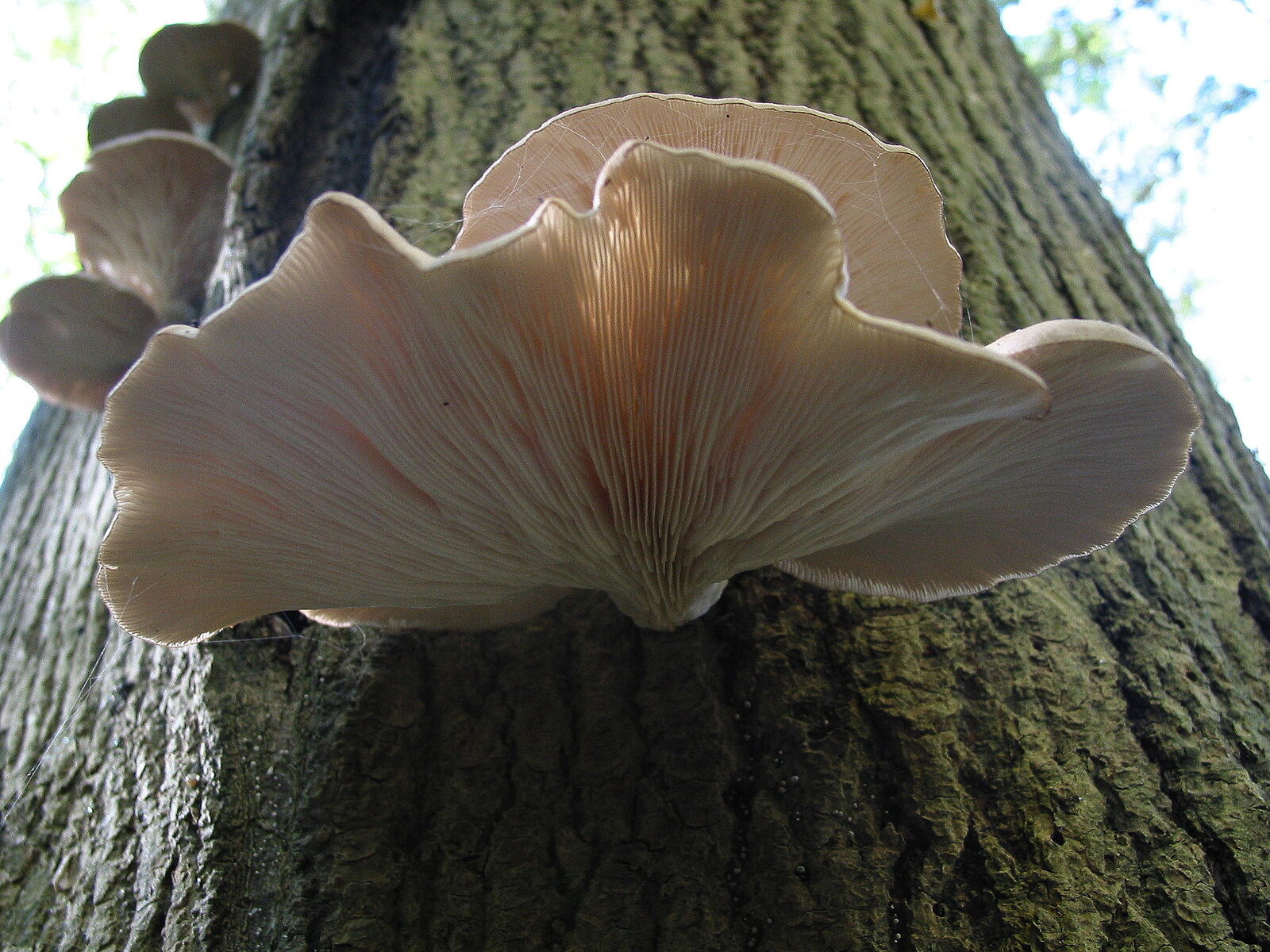
Oyster mushroom
Pleurotus ostreatus
A common saprotroph on dead and dying hardwoods, fruiting in overlapping shelf-like clusters. White to pale gray with a short, off-center stem. Widely cultivated. Can fruit year-round in mild weather.
Status: Native.
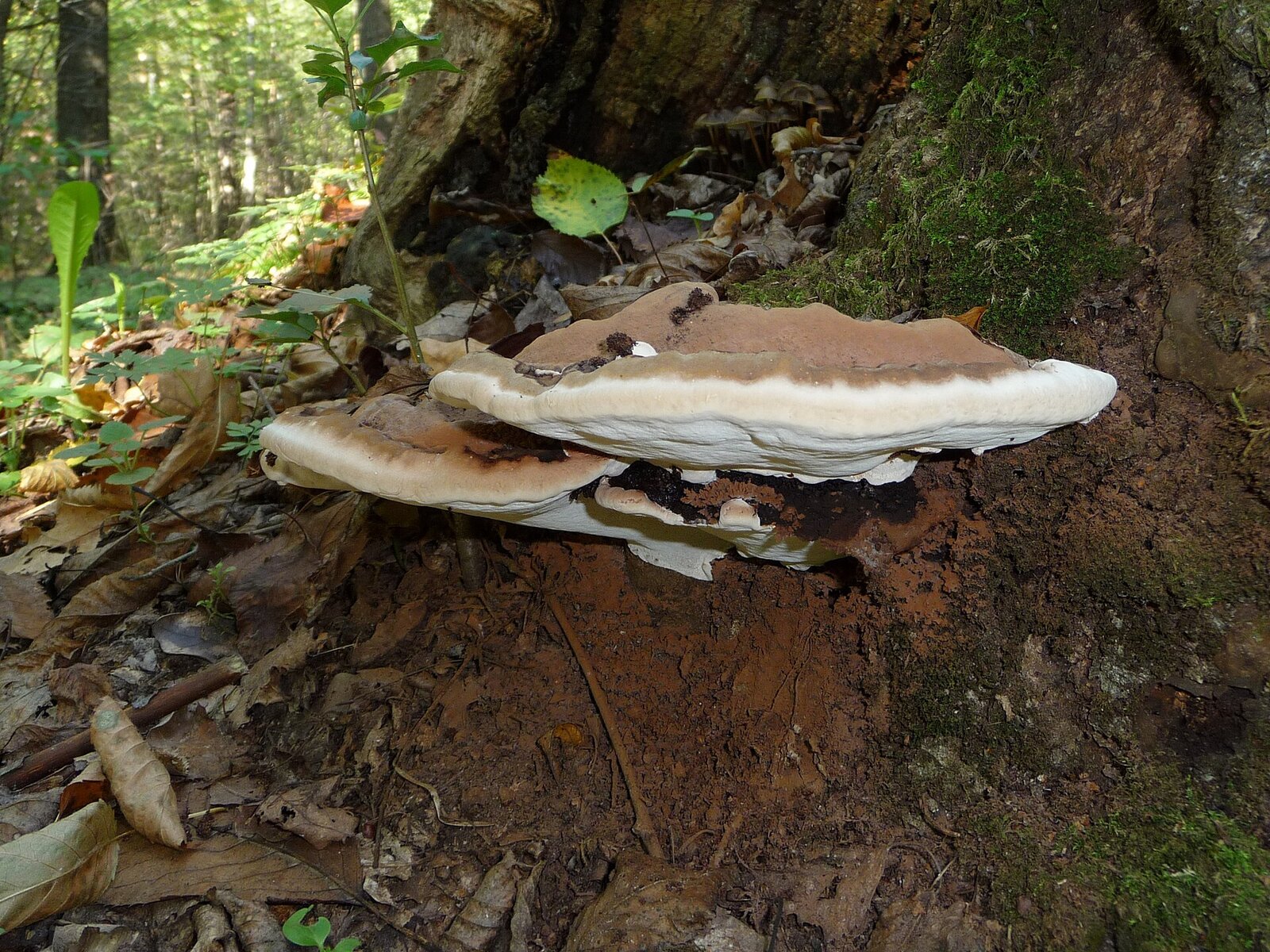
Artist's conk
Ganoderma applanatum
A perennial bracket fungus that forms large, flat, woody conks on dead hardwoods. The white pore surface bruises brown instantly when scratched, making it a natural drawing surface. Individual conks can persist for years, adding a new pore layer each season.
Status: Native. Wood-decomposer.
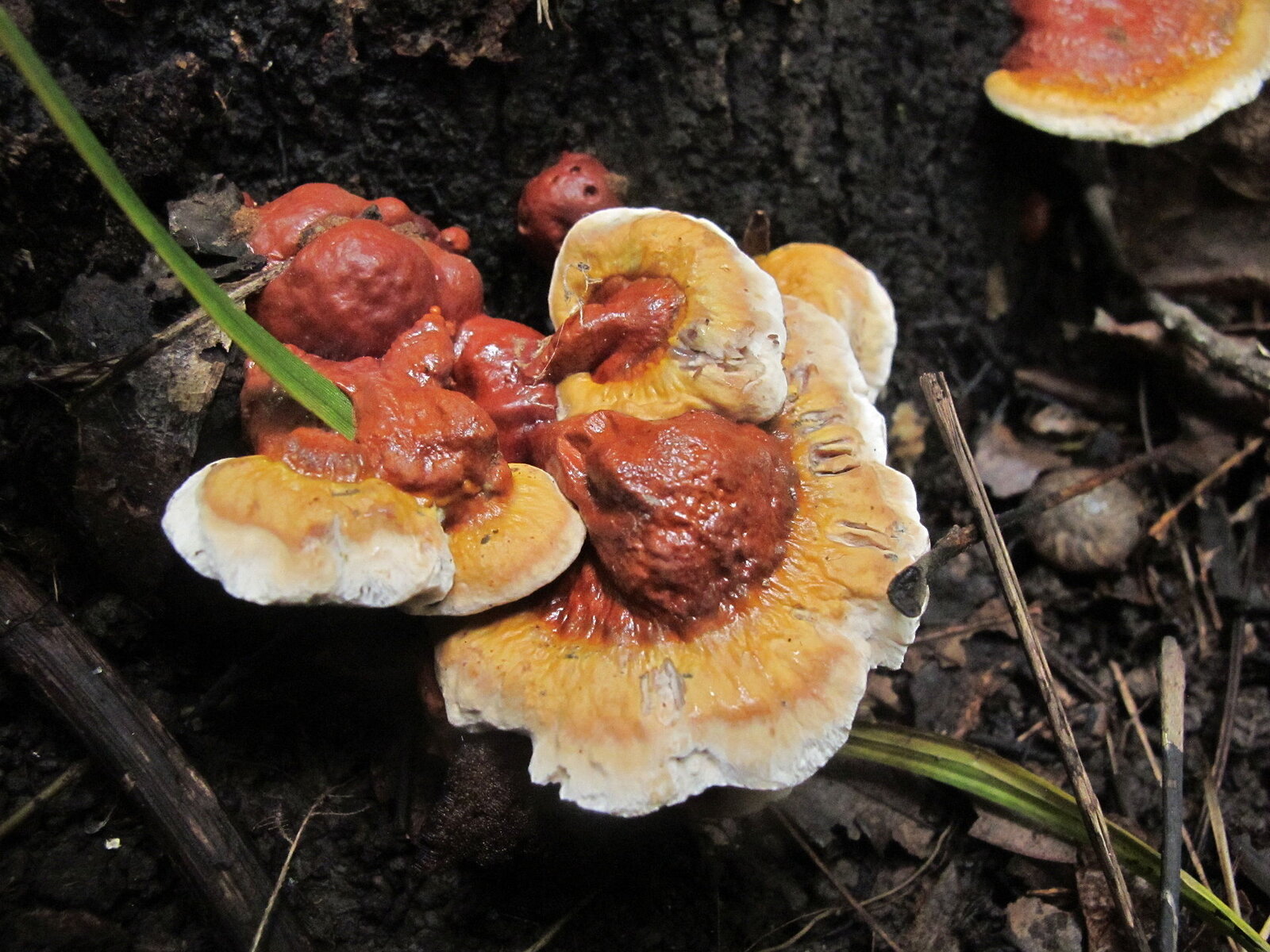
Eastern reishi
Ganoderma sessile
The eastern North American species of reishi, a bracket fungus with a distinctive varnished, reddish-brown surface. Grows on dead and dying hardwoods, especially oaks and maples. The subject of extensive traditional and modern medicinal research.
Status: Native. Medicinal research interest.
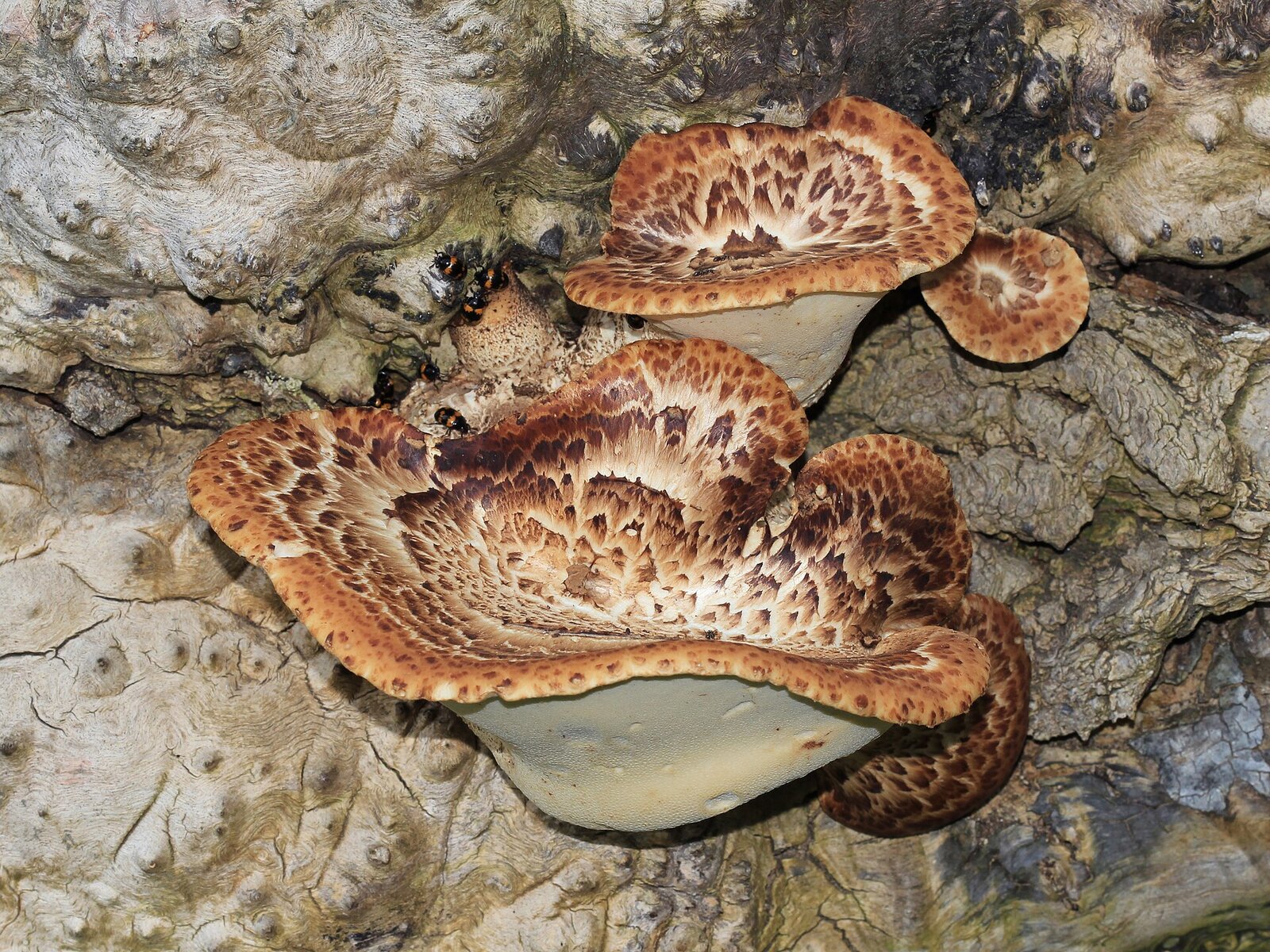
Dryad's saddle
Polyporus squamosus
Also called pheasant back for the feather-like brown scales on its pale cap. A large bracket fungus that fruits in spring on dead and dying hardwoods, especially elm. Older specimens become tough and woody.
Status: Native.
Cinnabar polypore
Pycnoporus cinnabarinus
A vivid red-orange bracket fungus on dead hardwoods, unmistakable for its cinnabar color. Small, thin, and leathery. One of the few polypores whose color alone is nearly diagnostic.
Status: Native. Wood-decomposer.
False turkey-tail
Stereum ostrea
Closely resembles the true turkey-tail but lacks pores on the underside; the lower surface is smooth. Color bands are similar but tend toward more orange and brown. Common on dead hardwood logs and stumps throughout Marion County.
Status: Native. Wood-decomposer.
Birch polypore
Fomitopsis betulina
A smooth, white to tan bracket fungus found exclusively on birch trees. Once used as a stropping material for razor blades and carried by the Iceman Otzi for possible medicinal purposes. Present on yellow birch in Marion County's moist cove forests.
Status: Native. Wood-decomposer.
Split-gill fungus
Schizophyllum commune
One of the most widely distributed fungi on Earth, found on dead and downed wood across every habitat in Marion County. The tiny, fan-shaped, hairy white caps have gills that split lengthwise along their edges, a unique feature that gives the species its name.
Status: Native. Wood-decomposer, cosmopolitan.
Bitter oyster
Panellus stipticus
A small, tough, fan-shaped mushroom that grows in dense clusters on dead hardwood logs and stumps. Inedible due to its acrid taste. Eastern North American populations are bioluminescent: the mycelium and gills glow faintly green in total darkness.
Status: Native. Bioluminescent, inedible.
Mycorrhizal partners of the hardwood forest
Many of Marion County's fungi form mycorrhizal partnerships with the dominant canopy trees, trading soil nutrients for sugars. The russulas, milkcaps, and boletes that fruit in summer and fall are the visible evidence of a vast underground network connecting the roots of oaks, hickories, and beeches to their fungal partners.
Indigo milkcap
Lactarius indigo
One of the most visually striking mushrooms in eastern forests. The entire fruiting body is indigo blue, and it exudes bright blue latex when the gills are cut or broken. Mycorrhizal with oaks and pines.
Status: Native.
Voluminous-latex milkcap
Lactarius volemus
A robust milkcap that exudes copious white latex when the gills are broken. Mycorrhizal with oaks and other hardwoods. The orange-brown cap, white latex, and fishy odor at maturity are diagnostic.
Status: Native.
Short-stemmed brittlegill
Russula brevipes
A large, white russula that fruits partially buried in leaf litter under oaks and hickories. One of the most common Russula species in eastern hardwood forests. The cap often collects leaf debris, making it easy to overlook.
Status: Native. Mycorrhizal.
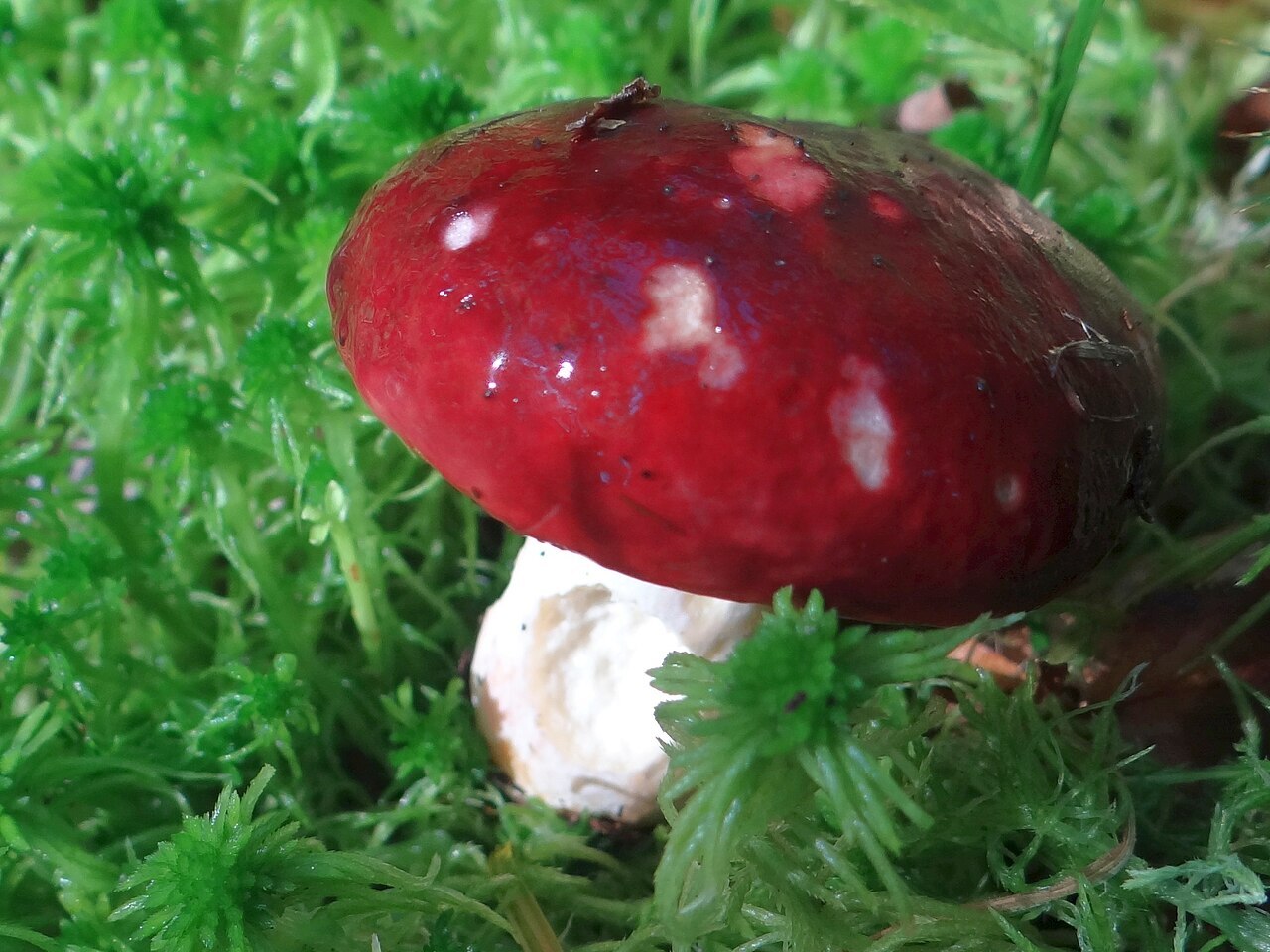
The sickener
Russula emetica
Named for the nausea and vomiting it causes when eaten raw. The bright scarlet cap, pure white stem and gills, and brittle flesh are diagnostic. Mycorrhizal with conifers on the Cumberland Plateau. The acrid taste when a tiny piece is touched to the tongue is an immediate identification cue.
Status: Native. Toxic, mycorrhizal.
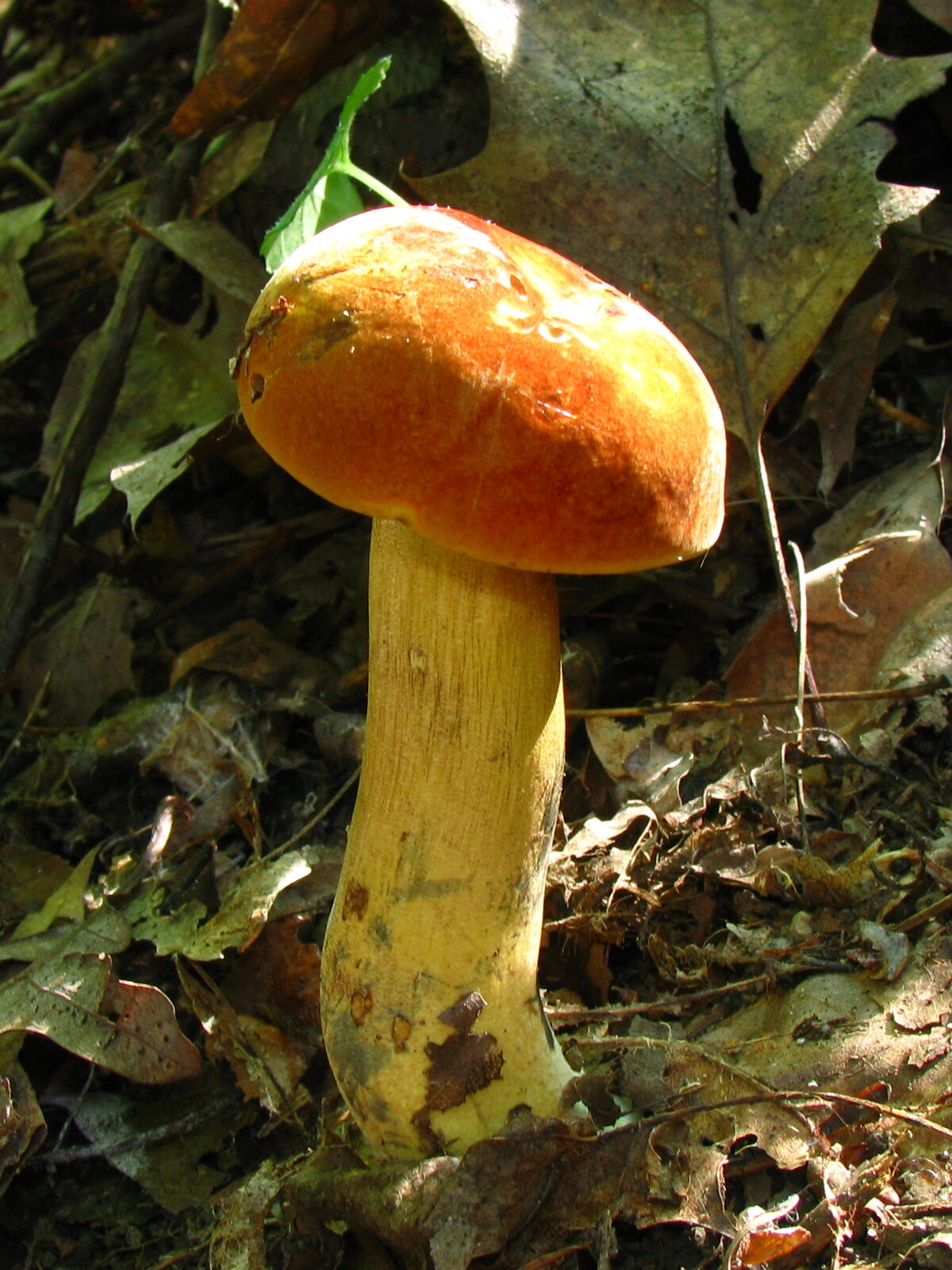
Lurid bolete
Boletus subluridellus
A bolete whose flesh stains vivid blue within seconds when cut or bruised. Mycorrhizal with oaks in Marion County's hardwood forests. The dramatic blue staining reaction alarms beginners but is not itself a reliable indicator of toxicity.
Status: Native. Mycorrhizal.
Bitter bolete
Tylopilus felleus
A common look-alike for the king bolete, distinguished by a pink pore surface at maturity and an intensely bitter taste. The brown cap, reticulated stem, and bolete form are all similar to B. edulis, but one taste of the raw flesh settles the identification instantly.
Status: Native. Inedible (bitter), mycorrhizal.
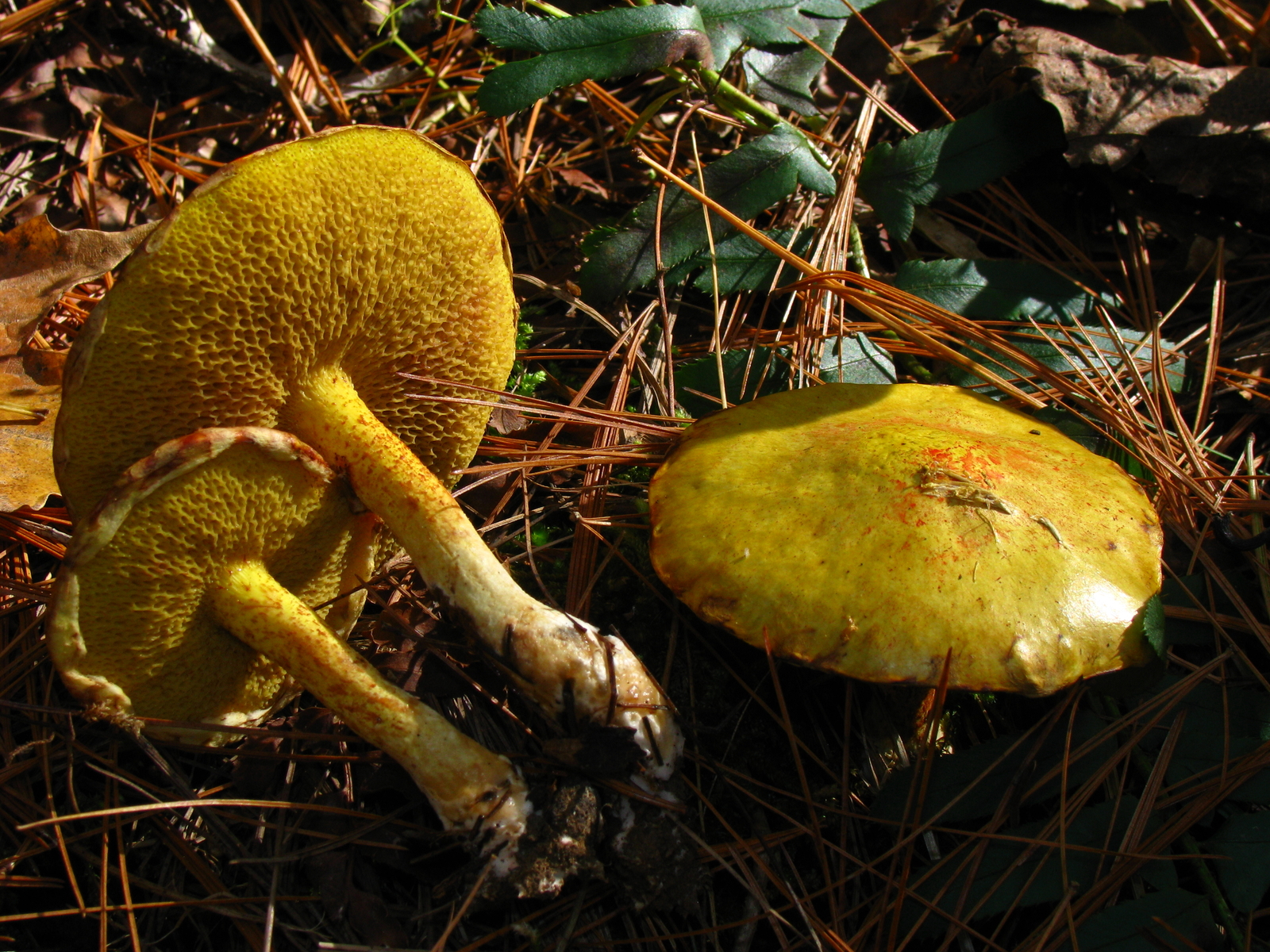
Chicken-fat suillus
Suillus americanus
A slimy, bright yellow bolete exclusively mycorrhizal with eastern white pine. The sticky cap, small pores, and growth under five-needle pines are diagnostic.
Status: Native. Mycorrhizal with eastern white pine.
Bleeding tooth fungus
Hydnellum peckii
One of the most visually arresting fungi in the forest, producing beads of bright red guttation fluid on its white surface when young, giving it the appearance of a bleeding tooth or strawberry dripping cream. Mycorrhizal with conifers on the plateau. Inedible.
Status: Native. Mycorrhizal, inedible.
Puffballs, earthstars, and visually distinctive saprobes
Marion County's forests and pastures support a range of fungi that do not produce the familiar cap-and-stem form. Puffballs release their spores through a hole in the top; earthstars split open like a star; jelly fungi take gelatinous or ear-like forms; and cup fungi offer some of the most vivid colors on the winter and spring forest floor.
Giant puffball
Calvatia gigantea
Can grow to basketball size or larger in late summer and fall, appearing in pastures, meadow edges, and open woods. The interior is white and firm when young, yellowing and turning olive-green as the spores develop.
Status: Native.
Common puffball
Lycoperdon perlatum
A small, club-shaped puffball covered in tiny spines that leave a net-like pattern when they fall away. Widespread on forest floors and disturbed soil. Releases a cloud of olive-brown spores when the skin is punctured at maturity.
Status: Native.
Earthstar
Geastrum saccatum
A puffball relative whose outer layer splits into star-shaped rays that fold back to elevate the central spore sac above the leaf litter. Found on forest floors in oak-hickory woods, especially in dry years. The spore sac releases a puff of spores when struck by a raindrop.
Status: Native. Saprotrophic.
Scarlet elf cup
Sarcoscypha austriaca
One of the earliest fungi to fruit in Marion County, appearing in late winter and early spring on decaying sticks and branches in moist, shaded ravines. The vivid scarlet cups are unmistakable against the brown leaf litter.
Status: Native. Saprotrophic.
Witches' butter
Tremella mesenterica
A bright yellow, brain-like jelly fungus found on dead branches of hardwoods year-round. Actually a parasite on the mycelium of other fungi (Peniophora species) that are decomposing the wood. Dries to an inconspicuous orange film in dry weather and rehydrates after rain.
Status: Native. Mycoparasite.
Wood ear
Auricularia americana
A jelly-like, ear-shaped saprotroph on dead hardwoods, especially elder and maple. Rubbery when fresh, drying to a hard, dark crust that rehydrates after rain. Closely related to the Asian wood ear used in Chinese cuisine.
Status: Native. Saprotrophic.
Other notable gilled mushrooms
Beyond the headliners and the deadly Amanitas, Marion County's forests, lawns, and pastures support a range of gilled mushrooms that visitors are likely to notice.
Honey mushroom
Armillaria mellea
Both a saprotroph and a parasite, causing root rot in hardwoods. Grows in dense clusters at the base of living and dead trees. Causes gastrointestinal distress in some people even when thoroughly cooked. The mycelium produces bioluminescent "foxfire" on rotting wood.
Status: Native. Pathogenic.
Shaggy mane
Coprinus comatus
Also called lawyer's wig. A tall, white, cylindrical mushroom found in lawns, roadsides, and disturbed ground. The cap has shaggy, upturned scales. Deliquesces rapidly into an inky black liquid within hours of maturity.
Status: Native.
Fairy ring mushroom
Marasmius oreades
Produces the classic fairy ring pattern in lawns and pastures: a circle of mushrooms at the expanding edge of an underground mycelial mat. Small, tan, and tough, with widely spaced gills. The rings expand outward by a few inches each year.
Status: Native. Saprotrophic.
Scarlet caterpillar club
Cordyceps militaris
An entomopathogenic fungus that parasitizes buried moth and butterfly pupae, sending up a bright orange club-shaped fruiting body from the soil. The stalk is studded with tiny pimple-like bumps (perithecia) that release spores. Found in moist woods in late summer and fall.
Status: Native. Entomopathogen.
Lichens
Lichens are composite organisms formed by a fungal partner (the mycobiont) and one or more photosynthetic partners (green algae or cyanobacteria). They colonize surfaces that few other organisms can occupy: bare rock, tree bark, fence posts, and thin soil on exposed outcrops. Marion County's varied substrates, from acidic sandstone on the Cumberland Plateau caprock to calcareous limestone in the Sequatchie Valley, support a rich lichen flora spanning all three major growth forms: foliose (leaf-like), fruticose (shrubby or pendant), and crustose (crust-like).
Many lichens are sensitive to air quality and are used worldwide as biological indicators of atmospheric pollution. The presence of species like lungwort lichen and bushy beard lichen on Marion County's forests is evidence of relatively clean air compared to more urbanized parts of the Tennessee Valley.
Foliose lichens
Foliose (leaf-like) lichens are the most conspicuous group on Marion County's trees and rocks. Each thallus is a composite organism: a fungal partner providing structure and a photosynthetic partner (green algae or cyanobacteria) providing sugars. Many foliose lichens are sensitive to air quality and serve as biological indicators of atmospheric pollution.
Common greenshield
Flavoparmelia caperata
The most common foliose lichen on hardwood bark in Marion County. Bright yellow-green when moist, pale gray-green when dry. The upper surface has a wrinkled, ridged texture. Tolerant of moderate air pollution, making it one of the last lichens to disappear in degraded air.
Status: Native. Common, widespread.
Hammered shield lichen
Parmelia sulcata
A gray foliose lichen with a network of white lines (pseudocyphellae) on the upper surface that give it a hammered-metal appearance. Common on hardwood bark and rock. Moderately pollution-tolerant.
Status: Native. Common.
Powdered ruffle lichen
Parmotrema perforatum
A large, loosely attached foliose lichen with broad, ruffled lobes and a powdery surface of soredia along the lobe margins. Grows on bark and occasionally rock in moist, shaded habitats.
Status: Native. Locally common.
Speckled shield lichen
Punctelia rudecta
A medium-sized gray foliose lichen with white pseudocyphellae (breathing pores) dotting the upper surface. Very common on hardwood bark in eastern forests. The white speckling distinguishes it from otherwise similar Parmelia species.
Status: Native. Common, widespread.
Lungwort lichen
Lobaria pulmonaria
A large, conspicuous foliose lichen historically used in folk medicine for lung ailments (its lobed, ridged surface was thought to resemble lung tissue). Requires clean air and old-growth or mature forests. Its presence is a strong indicator of good air quality and forest continuity.
Status: Native. Air-quality indicator, becoming rare.
Dog lichen
Peltigera canina
A large, ground-dwelling foliose lichen that grows among mosses on calcareous soil and rock. The gray-brown upper surface and distinctive white veins with brown rhizines on the underside are diagnostic. Contains cyanobacteria as its photosynthetic partner, enabling nitrogen fixation.
Status: Native. Terricolous, nitrogen-fixing.
Common orange lichen
Xanthoria parietina
A bright orange to yellow-orange foliose lichen found on calcareous rock, concrete, and nutrient-enriched bark. One of the most nitrogen-tolerant lichens, thriving near bird perches, livestock operations, and agricultural runoff. Common on limestone outcrops in the Sequatchie Valley.
Status: Native. Nitrogen-tolerant.
Tube lichen
Hypogymnia physodes
A foliose lichen with pale gray, inflated, hollow lobes that grow on bark and twigs in cool, moist forests. Common on both hardwoods and conifers on the Cumberland Plateau. Moderately pollution-tolerant.
Status: Native. Common on plateau.
Fruticose lichens
Fruticose (shrubby or pendant) lichens hang from branches, rise from soil, or form upright stalks topped with colorful apothecia. Many are sensitive to air pollution and are among the first organisms to disappear when air quality degrades.
Bushy beard lichen
Usnea strigosa
Pale green pendant tufts hanging from hardwood branches in moist forests. The central cord visible when the thallus is gently pulled apart distinguishes Usnea from similar-looking algae. A strong air-quality indicator; declining across the Southeast as atmospheric nitrogen increases.
Status: Native. Air-quality indicator.
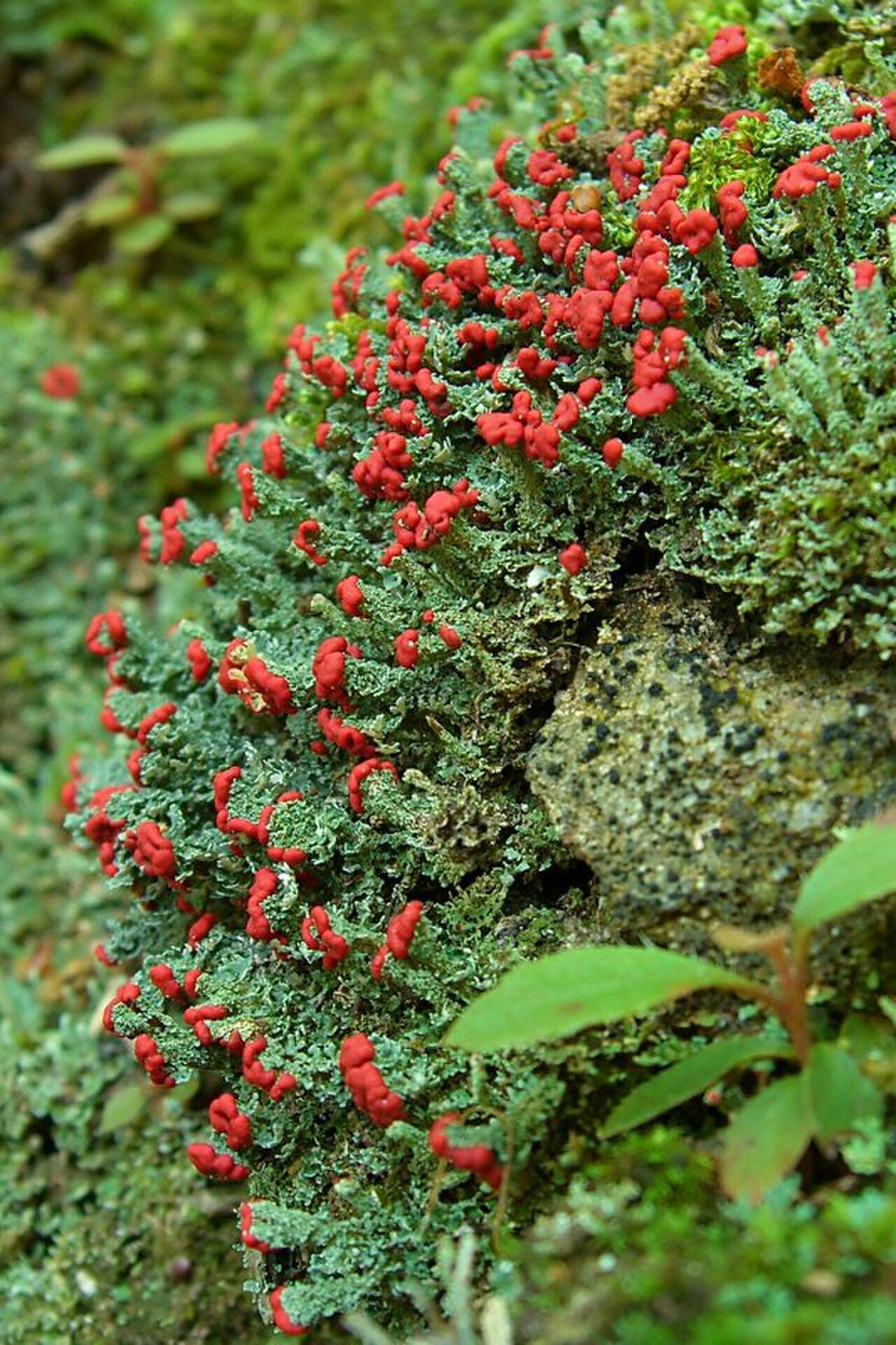
British soldiers
Cladonia cristatella
Named for the bright red apothecia (fruiting bodies) atop pale green stalks, resembling the red coats of British soldiers. Grows on rotting wood, humus, and acidic soils. One of the most easily recognized lichens for beginners.
Status: Native. Distinctive, widespread.
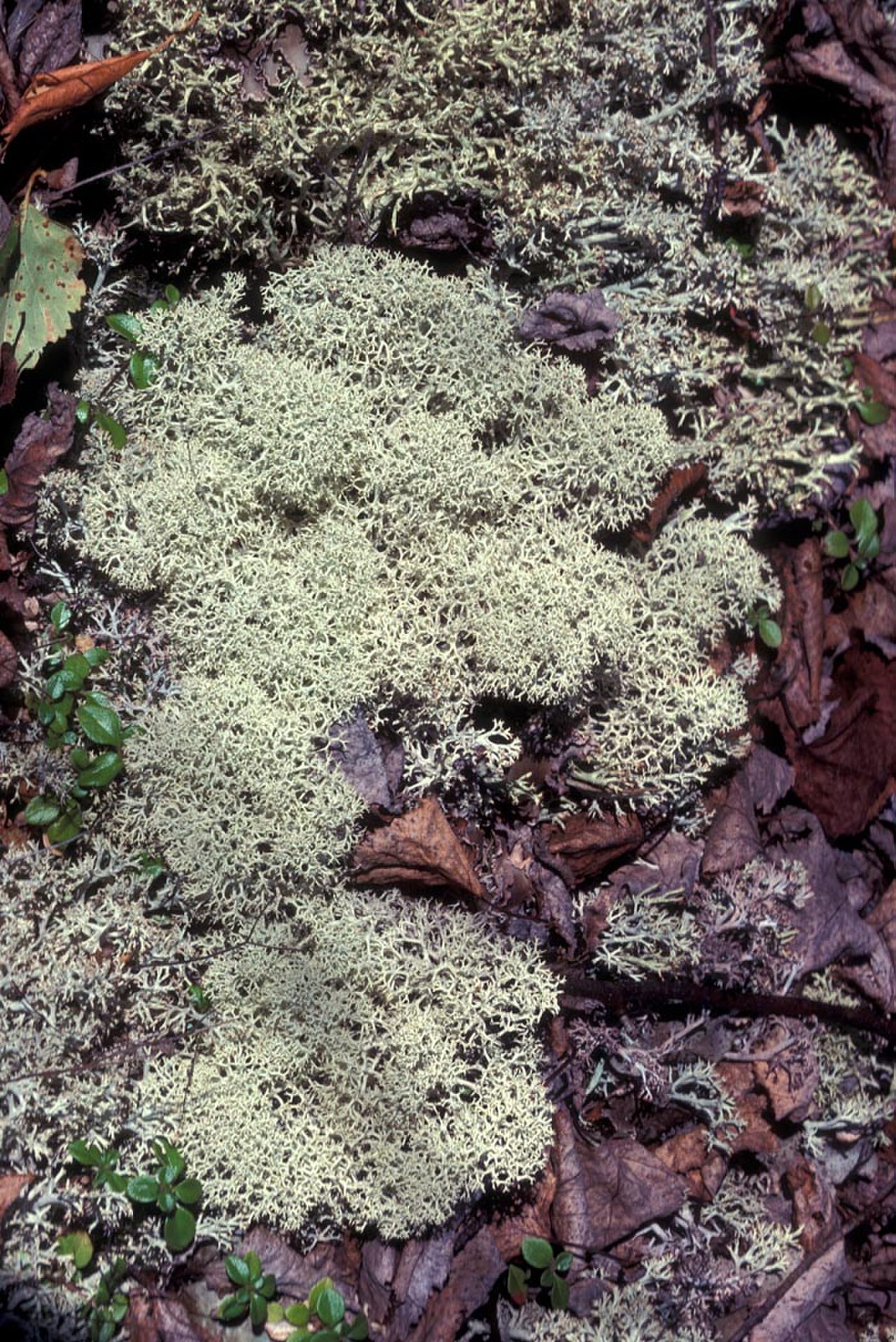
Reindeer lichen
Cladonia rangiferina
A ground-dwelling fruticose lichen that forms dense, spongy mats on dry, acidic sandstone outcrops and thin soils on the Cumberland Plateau caprock. The repeatedly branched, antler-like thallus is pale gray-green. An important food source for caribou in boreal regions, though in Marion County it serves primarily as a soil stabilizer.
Status: Native. Ground-cover, plateau specialist.
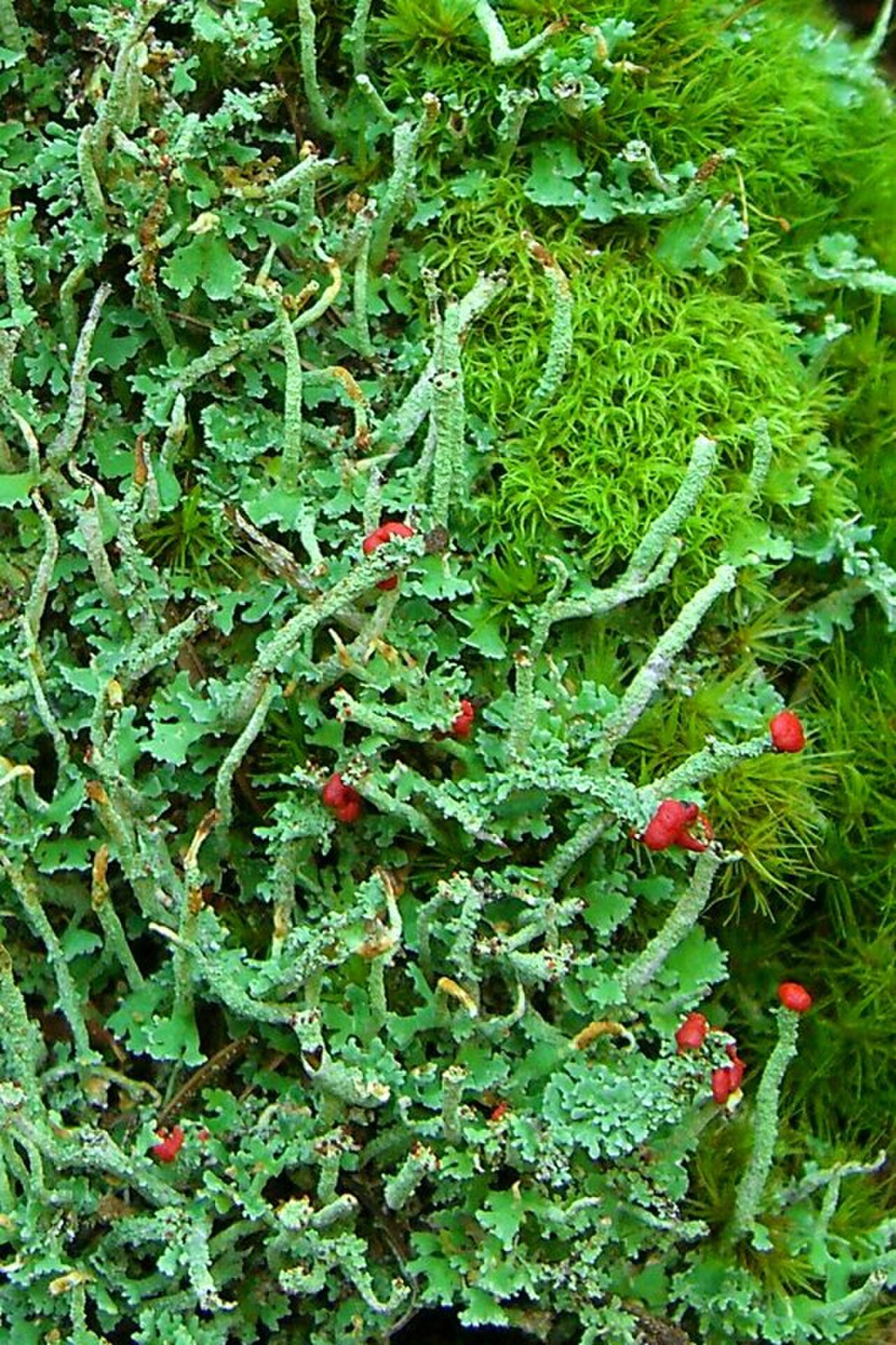
Lipstick lichen
Cladonia macilenta
Similar to British soldiers but with smaller, more scattered red apothecia on slender, mealy stalks. Found on rotting wood and acidic bark in moist forests. The red pigment is rhodocladonic acid.
Status: Native. Locally common.
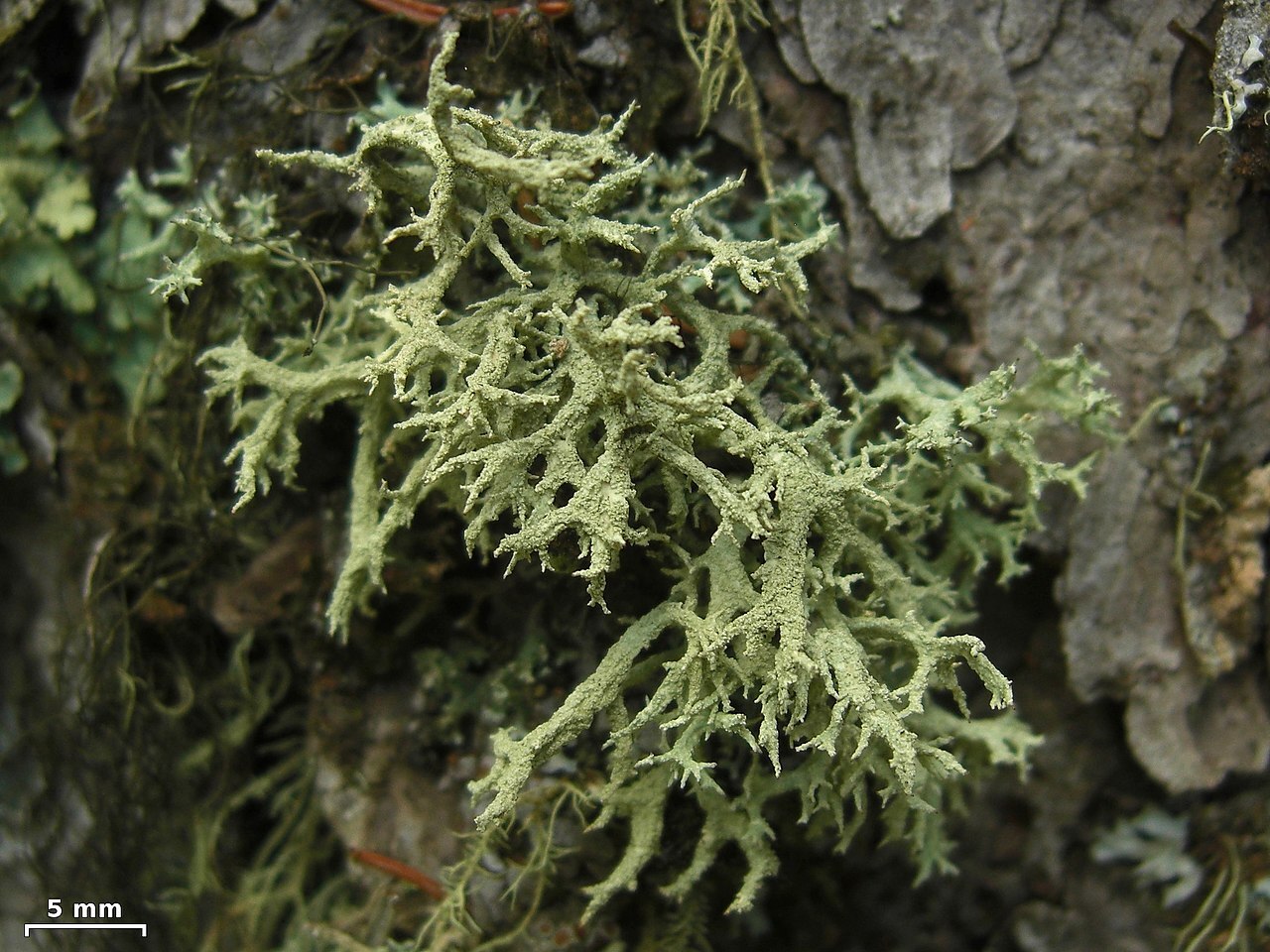
Boreal oakmoss
Evernia mesomorpha
A pendant fruticose lichen with flattened, strap-like branches, pale green above and white beneath. Grows on hardwood and conifer branches in cool, moist forests. Related to the European oakmoss used in perfumery.
Status: Native. Cool-forest associate.
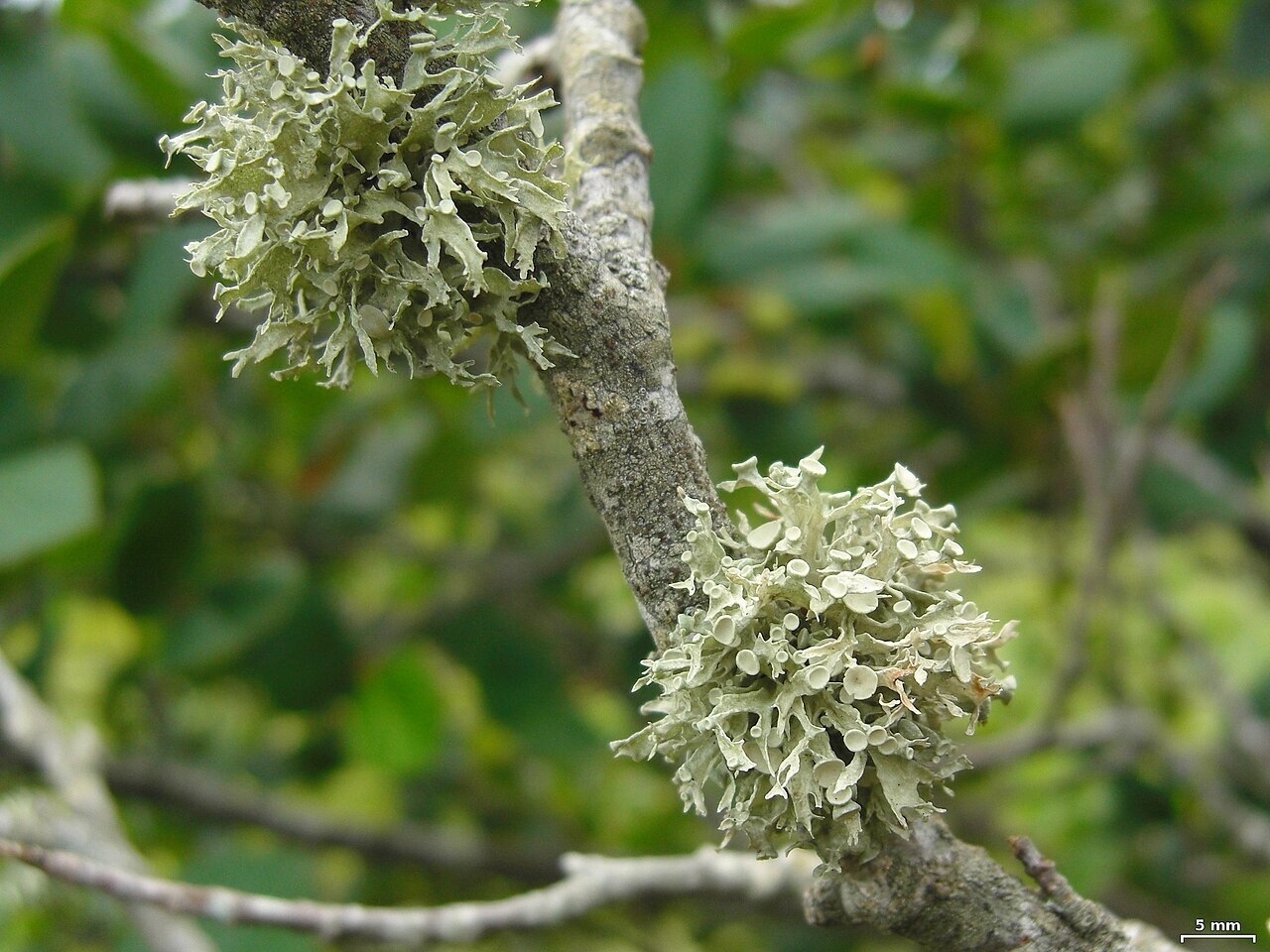
American cartilage lichen
Ramalina americana
A pendant fruticose lichen with flattened, strap-like branches that hang from hardwood twigs. Pale yellow-green with a slightly cartilaginous texture. Common in open, well-lit forest edges and isolated trees.
Status: Native. Locally common.
Crustose lichens
Crustose lichens grow as thin crusts tightly appressed to rock and bark, often appearing to be part of the substrate itself. Though less conspicuous than their foliose and fruticose relatives, they are the most species-rich lichen group and often the first colonizers of bare rock.
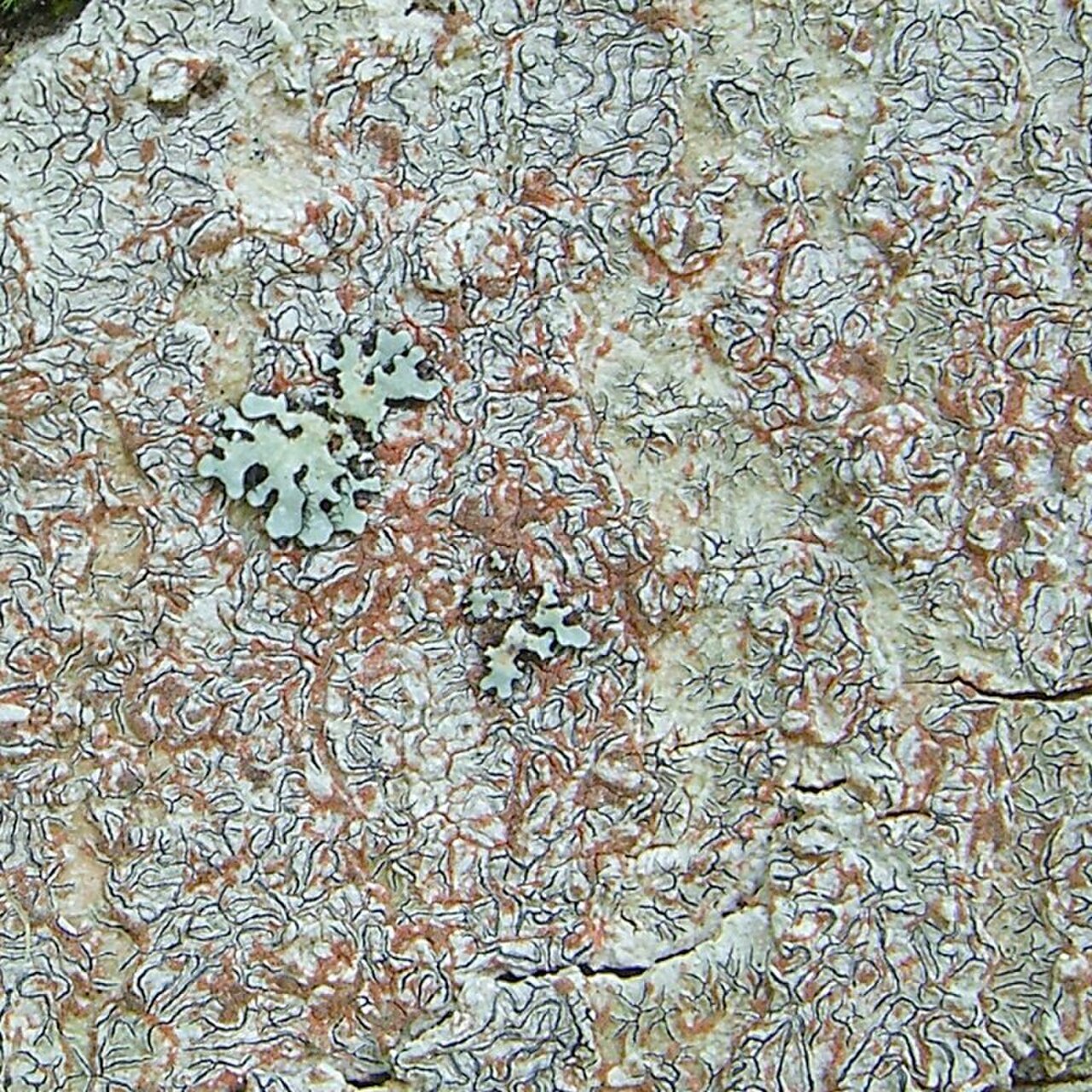
Script lichen
Graphis scripta
One of the most distinctive crustose lichens, producing narrow, curving, hieroglyph-like apothecia (fruiting structures) on smooth bark of subcanopy trees like beech, holly, and musclewood. The "writing" on the bark is unmistakable once recognized.
Status: Native. Distinctive, common on smooth bark.
River cane and canebrakes
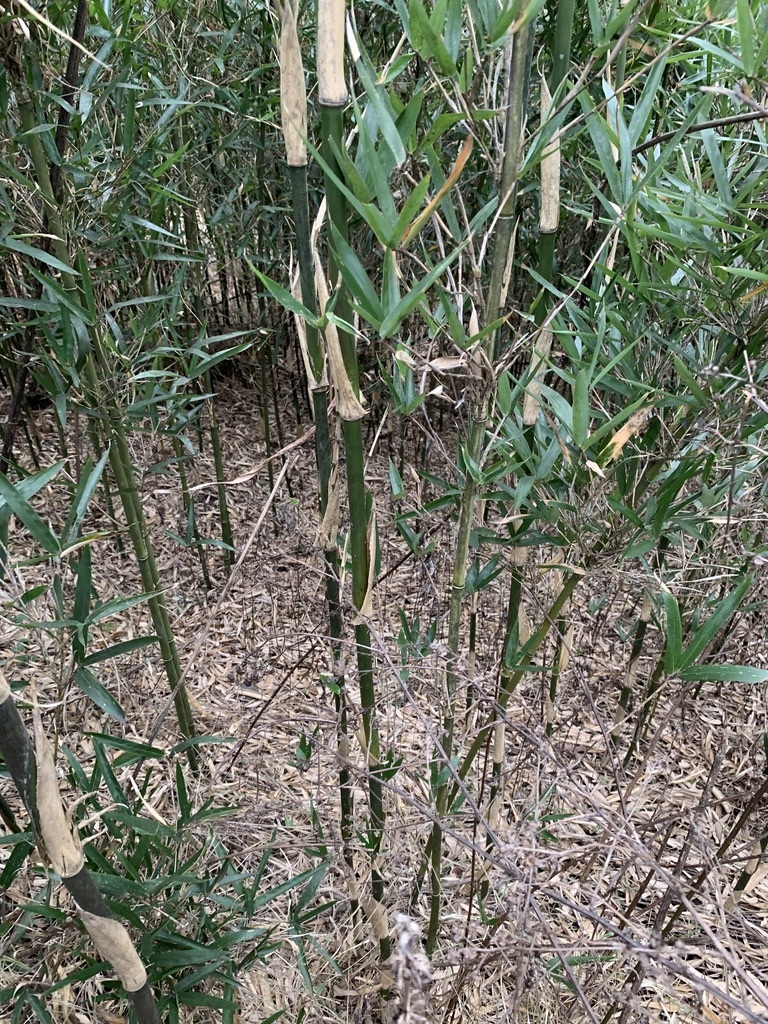
River cane (Arundinaria gigantea) is the only bamboo native to North America and the largest of the three Arundinaria species documented in Marion County (the two smaller species, hill cane and switch cane, are carded under Native bamboos in the grasses section above). Before European settlement, solid canebrakes covered large portions of the Tennessee River and Sequatchie River bottoms, growing twenty to thirty feet tall in continuous stands that early travelers described as more difficult to cross than any other landscape in the region. The Cherokee used cane for arrow shafts, blowguns, baskets, fish traps, and roofing material. Cane's fibrous root network stabilized riverbanks and filtered sediment from runoff.
By 1900, most Marion County canebrakes had been cleared for pasture and cropland. The plant rarely flowers, and when it does, the flowering canes typically die back. Giant cane reproduces primarily through rhizomes, and without active replanting, cleared canebrakes do not self-restore over human time scales. Across the southeastern United States, an estimated 98 percent of historic canebrake habitat has been lost to agriculture, development, and fire suppression.
Since the early 2000s, the Tennessee River Gorge Trust has been replanting cane on gorge-slope bottomlands as part of its riparian restoration program. TRGT's canebrake restoration involves transplanting rhizome divisions into prepared streamside plots on protected land within the Tennessee River Gorge, where the trust manages over 10,000 acres. Small recovered patches now grow on several TRGT properties along the gorge. The work is slow by nature: cane stands expand outward from planted rhizomes at a pace of roughly one to two feet per year, and a dense canebrake takes decades to re-establish from transplant stock.
Canebrake restoration matters beyond the cane itself. Intact canebrakes filter agricultural and stormwater runoff, stabilize stream banks against erosion, and provide thermal cover for aquatic species in adjacent waterways. Several bird species are canebrake specialists whose populations track cane cover directly: Swainson's warbler nests almost exclusively in dense cane understory, and the hooded warbler and Kentucky warbler use canebrake margins as breeding habitat. Restoring cane in the Tennessee River Gorge supports the broader suite of rare and sensitive species that the gorge's mixed-mesophytic forests harbor.
State symbols and open-country species
Tennessee's state wildflower is passionflower (Passiflora incarnata), and the state cultivated flower is iris (genus Iris; the cultivated form is the European bearded iris, not the native woodland species). Both are common on Marion roadsides through the warm season. The state wildflower is cardded under Passionflower, evening primroses, and other field forbs in the wildflower H2 above. The wider open-country forb roster (milkweeds, goldenrods, asters, sunflowers, ironweeds, Joe-Pye-weeds, blazing stars, fleabanes, thistles, beardtongues, vervains, evening primroses, mountain mints, and the gentian-family pinks) is also cardded in that H2; the smaller dwarf crested iris (Iris cristata) of cove woods is cardded under Other woodland forbs in the same section.
Invasive species and ecological threats
Marion County's native plant communities face ongoing pressure from non-native invasive species and forest pests. The Tennessee Invasive Plant Council (TN-IPC) classifies invasive plants into three tiers: severe threat, significant threat, and lesser threat. Several of Marion's worst invaders arrived through deliberate government-backed introductions in the early and mid twentieth century; others escaped from ornamental plantings or arrived as unintentional stowaways.
Invasive woody plants are carded in their respective group sections above: invasive trees (tree-of-heaven, mimosa, white mulberry, princesstree), invasive shrubs (Chinese privet, Amur honeysuckle, autumn olive, multiflora rose, and sixteen others), invasive vines (Japanese honeysuckle, oriental bittersweet, English ivy, Chinese wisteria, and others), and invasive grasses (Japanese stiltgrass, Johnson grass). The cards below cover the major invasive herbaceous forbs and aquatic plants not treated in those sections, followed by the forest pests and pathogens that have reshaped Marion's canopy.
Invasive herbaceous plants
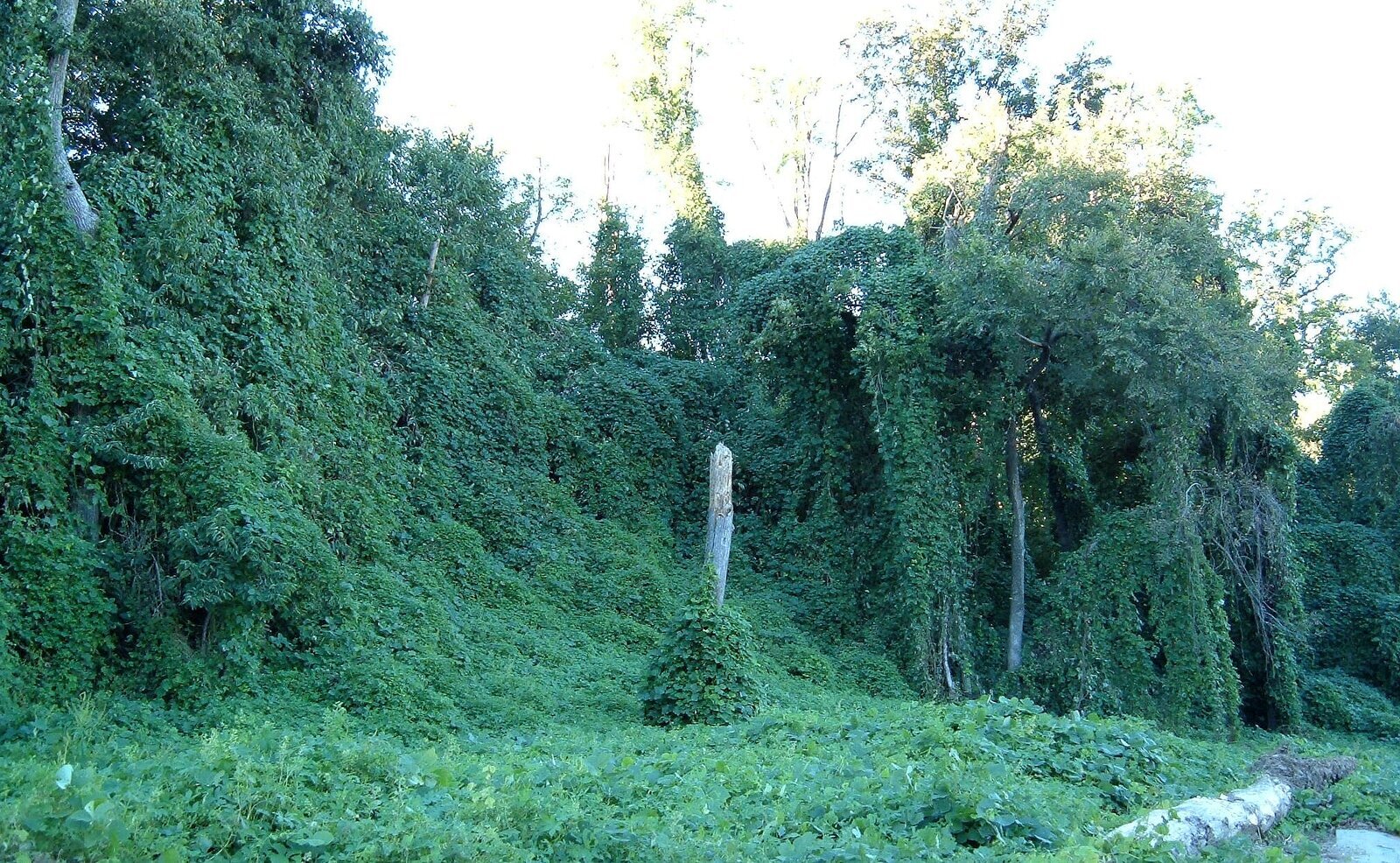
Kudzu
Pueraria montana var. lobata
The vine that ate the South. Kudzu was brought from Japan to the 1876 Philadelphia Centennial Exposition, promoted in the 1930s by the Soil Conservation Service for erosion control on badly eroded Southern farmland, and paid to farmers as a plant-and-hold cover crop into the 1950s. It climbs over forest edges, power poles, abandoned buildings, and roadbanks at up to a foot per day in summer. Purple pea-like flowers with a grape-soda scent bloom in August. Kudzu is hard to kill because its deep taproots can reach fifteen feet down; the only reliable control is repeated cutting and herbicide treatment over several seasons. Marion County roadsides, power-line corridors, and abandoned lots carry heavy kudzu cover.
Status: Introduced; TN-IPC severe-threat invasive.
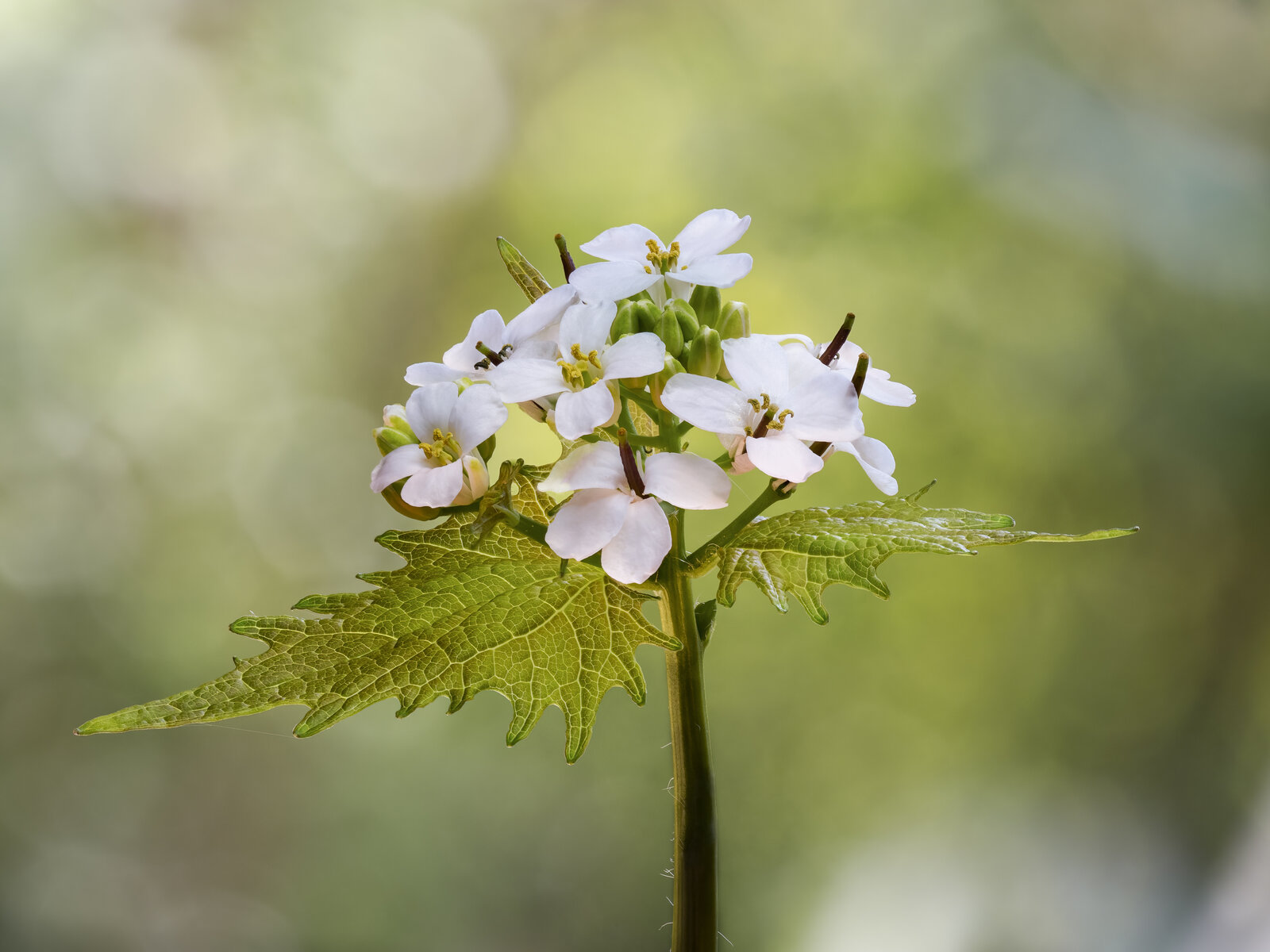
Garlic mustard
Alliaria petiolata
A biennial herb of the mustard family that invades deciduous-forest understories, displacing spring ephemerals like trilliums, bloodroot, and wild ginger. Garlic mustard produces allelopathic compounds that disrupt the mycorrhizal fungi native wildflowers depend on, making its impact worse than simple competition for light. The plant forms dense first-year rosettes that overwinter, then bolts to two to three feet with small white four-petaled flowers in April and May. Crushed leaves smell of garlic. Per the Tennessee Invasive Plant Council, garlic mustard is a severe-threat exotic in Tennessee.
Status: Introduced; TN-IPC severe-threat invasive.
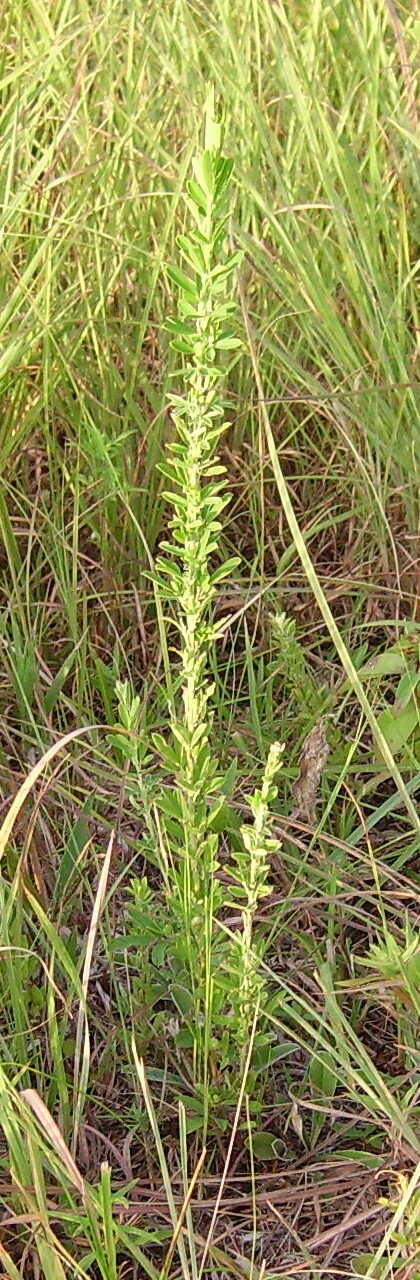
Chinese bush-clover
Lespedeza cuneata
A perennial legume introduced from Asia for erosion control and wildlife forage in the 1930s and 1940s. Grows in dense, wiry stands up to five feet tall along Marion County roadsides, old fields, and power-line corridors, crowding out native warm-season grasses and wildflowers. The narrow wedge-shaped trifoliate leaves are distinctive. Once established, Chinese bush-clover is extremely difficult to eradicate because of its deep root system and prolific seed production. Per the Tennessee Invasive Plant Council, it is a severe-threat exotic.
Status: Introduced; TN-IPC severe-threat invasive.
Aquatic invasive plants
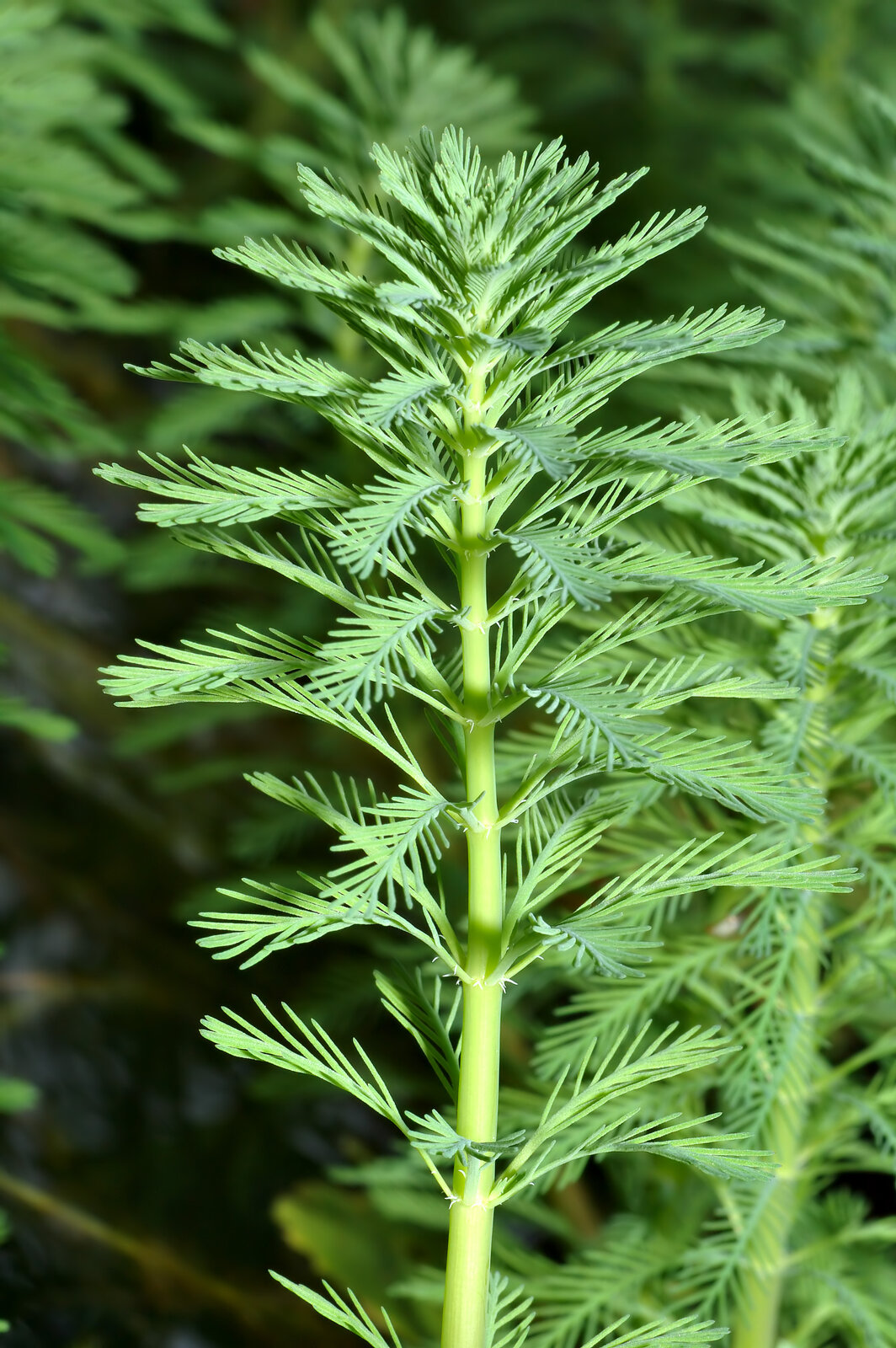
Parrot feather
Myriophyllum aquaticum
A South American aquatic plant with feathery, bright-green emergent leaves arranged in whorls around the stem. Parrot feather forms dense mats in slow-moving water, clogging waterways and displacing native aquatic vegetation. It spreads entirely by vegetative fragmentation; a single stem fragment can establish a new colony. Per the Tennessee-Kentucky Plant Atlas, it is documented in Marion County. The Tennessee Invasive Plant Council classifies it as a significant-threat exotic.
Status: Introduced; TN-IPC significant-threat invasive.
Forest pests and pathogens
Three non-native insects and one fungal pathogen have reshaped Marion County's forest canopy in the last century. Two more pathogens are documented elsewhere in Tennessee and may reach the county in the coming years. The host trees are carded in their respective sections above; the cards below cover the pests and pathogens themselves.
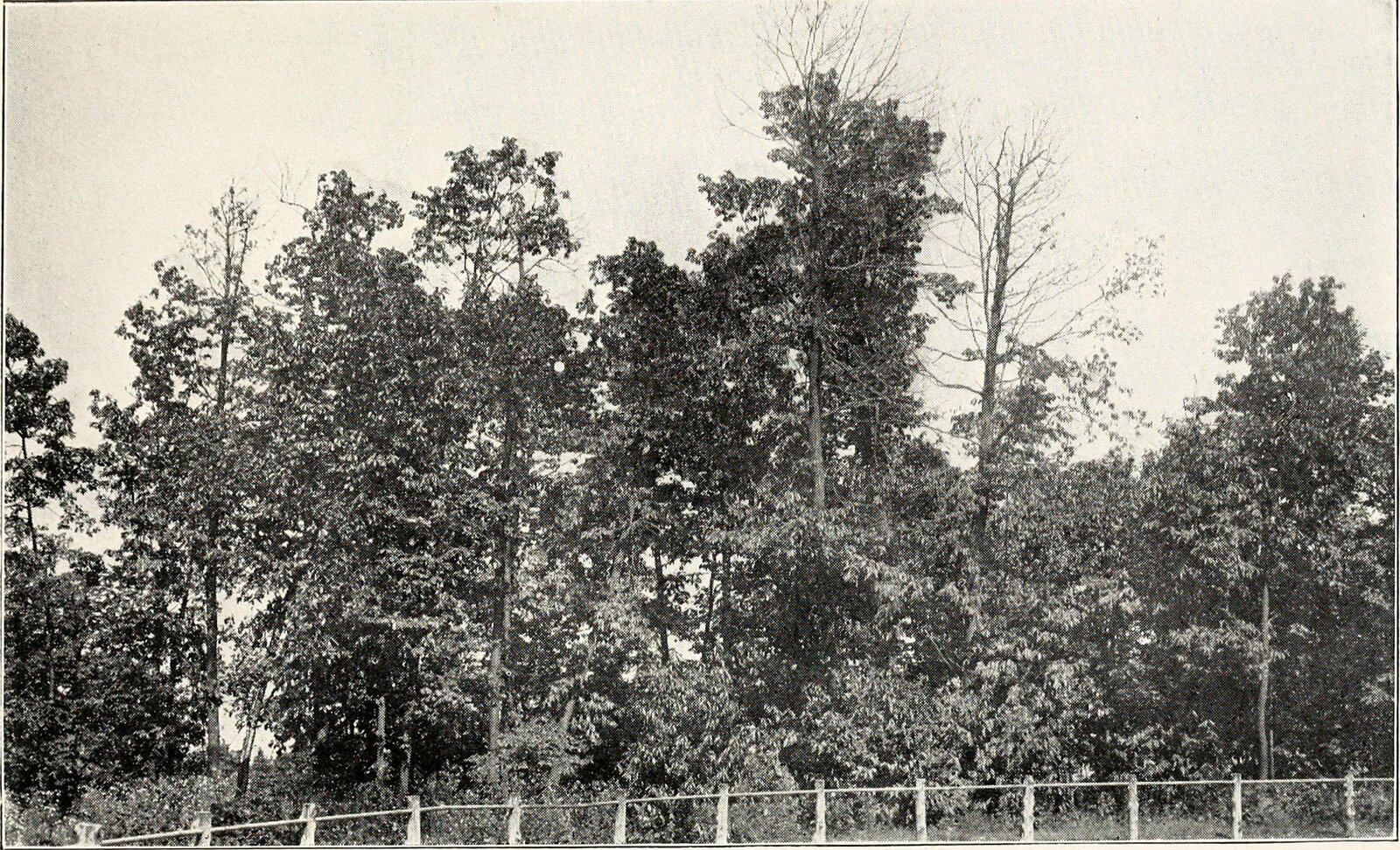
Chestnut blight
Cryphonectria parasitica
An Asian bark fungus first detected in the United States at the Bronx Zoo in 1904. Chestnut blight reached Tennessee in the mid-to-late 1920s and had killed virtually every mature American chestnut (Castanea dentata) on the Cumberland Plateau by the mid-1930s. Before the blight, American chestnut made up an estimated one in four canopy trees in the Southern Appalachian and Cumberland Plateau forests; its loss was the largest ecological disruption in eastern North American forest history. The fungus enters through bark wounds, forms orange-brown cankers that girdle the trunk, and kills the tree above the canker. Root systems survive and send up new sprouts, but these are reinfected before reaching reproductive maturity. The American Chestnut Foundation (TACF) and the University of Tennessee at Chattanooga's Chattanooga Chestnut Tree Project are working to develop blight-resistant hybrids for Cumberland Plateau reforestation.
Status: Introduced fungal pathogen. Host species: American chestnut.
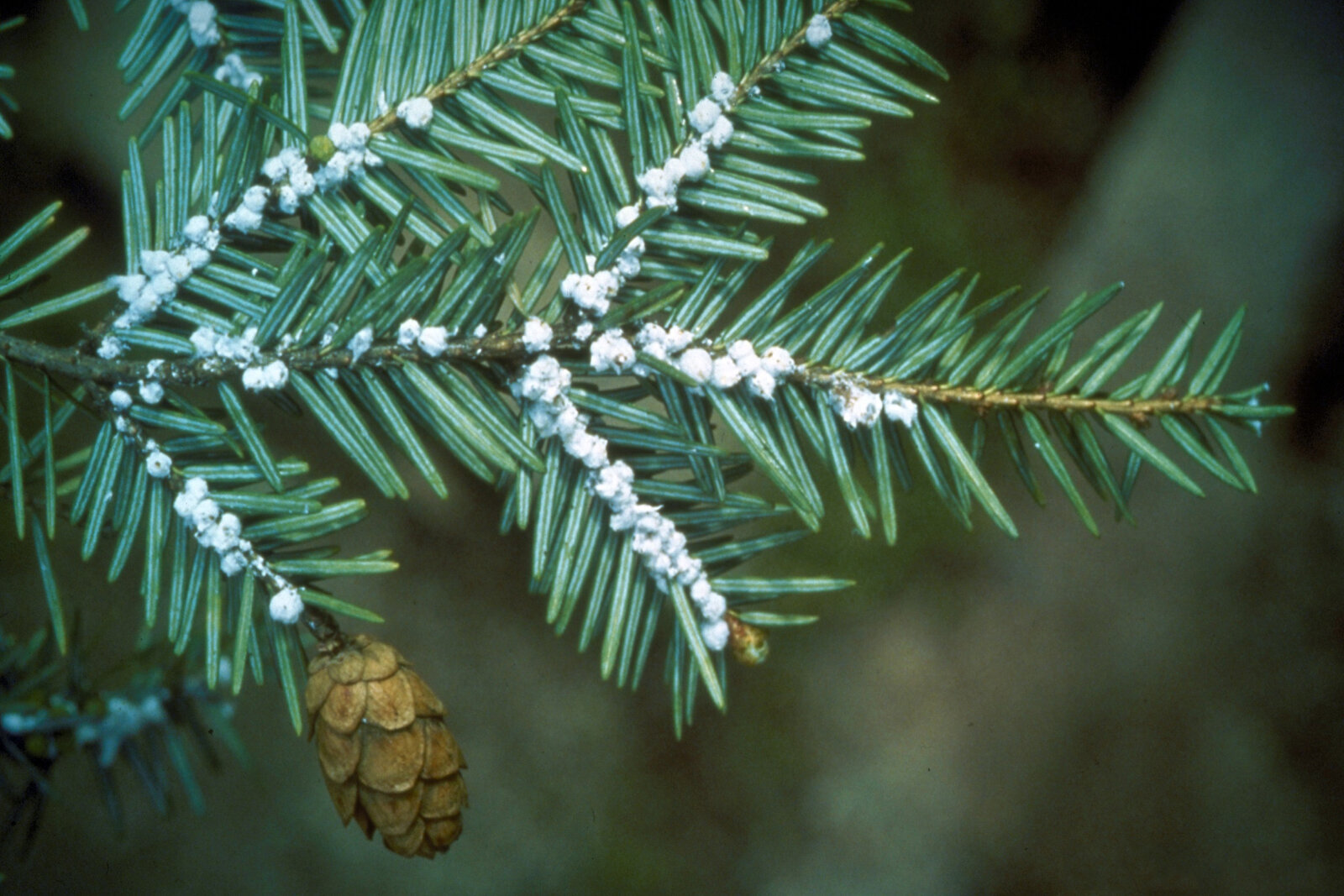
Hemlock woolly adelgid
Adelges tsugae
A tiny, sap-feeding insect from East Asia, identified by the white, cotton-like egg sacs it leaves at the base of hemlock needles. Hemlock woolly adelgid was confirmed in Tennessee in 2002 and detected in South Cumberland State Park, within Marion County, in 2012. The adelgid feeds on the starch reserves at the base of needles, weakening and eventually killing the tree over three to ten years. As of 2026, 36 of Tennessee's 37 counties with native eastern hemlock are infested. Soil-injection treatment with imidacloprid began in the South Cumberland area in 2013, treating every hemlock ten inches in diameter or larger within 300 feet of major drains. Each treatment provides up to seven years of protection. The Tennessee Hemlock Conservation Partnership has designated Hemlock Conservation Areas at South Cumberland and Savage Gulf.
Status: Introduced insect pest. Confirmed in Marion County, 2012. Host species: eastern hemlock.
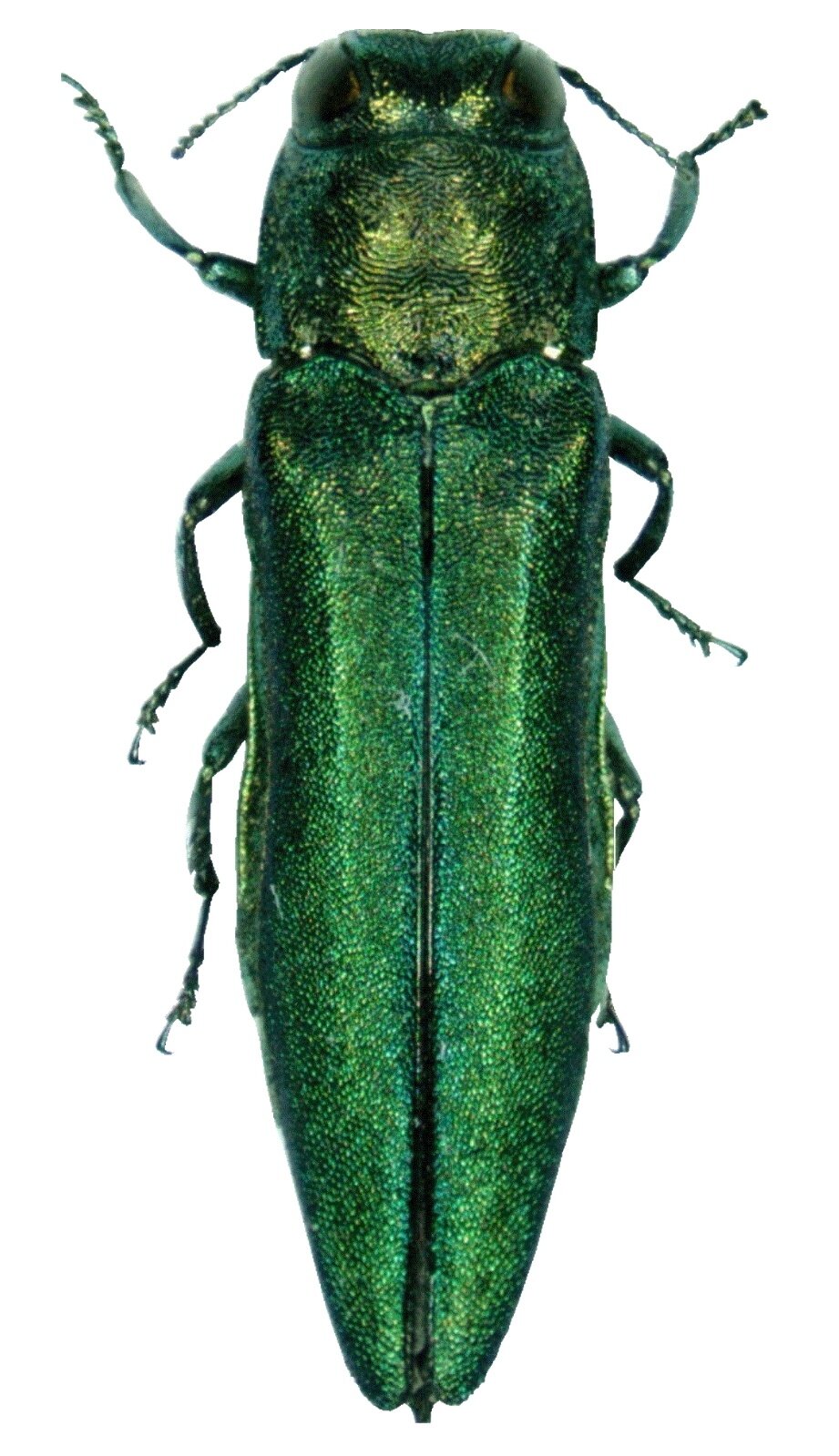
Emerald ash borer
Agrilus planipennis
A metallic-green wood-boring beetle native to eastern Asia. First detected in the United States near Detroit in 2002 and in Tennessee at a Knox County truck stop on I-40 in July 2010. The larvae feed in S-shaped galleries under the bark of ash trees, disrupting the flow of water and nutrients and killing the tree within two to four years of infestation. Per a UT-TSU Extension bulletin by Marion County Extension Agent Matthew Deist, emerald ash borer is confirmed in Marion County. As of 2025, 66 Tennessee counties have confirmed infestations. The majority of green ash and white ash across Marion County have been killed or are in decline.
Status: Introduced insect pest. Confirmed in Marion County. Host species: green ash, white ash.
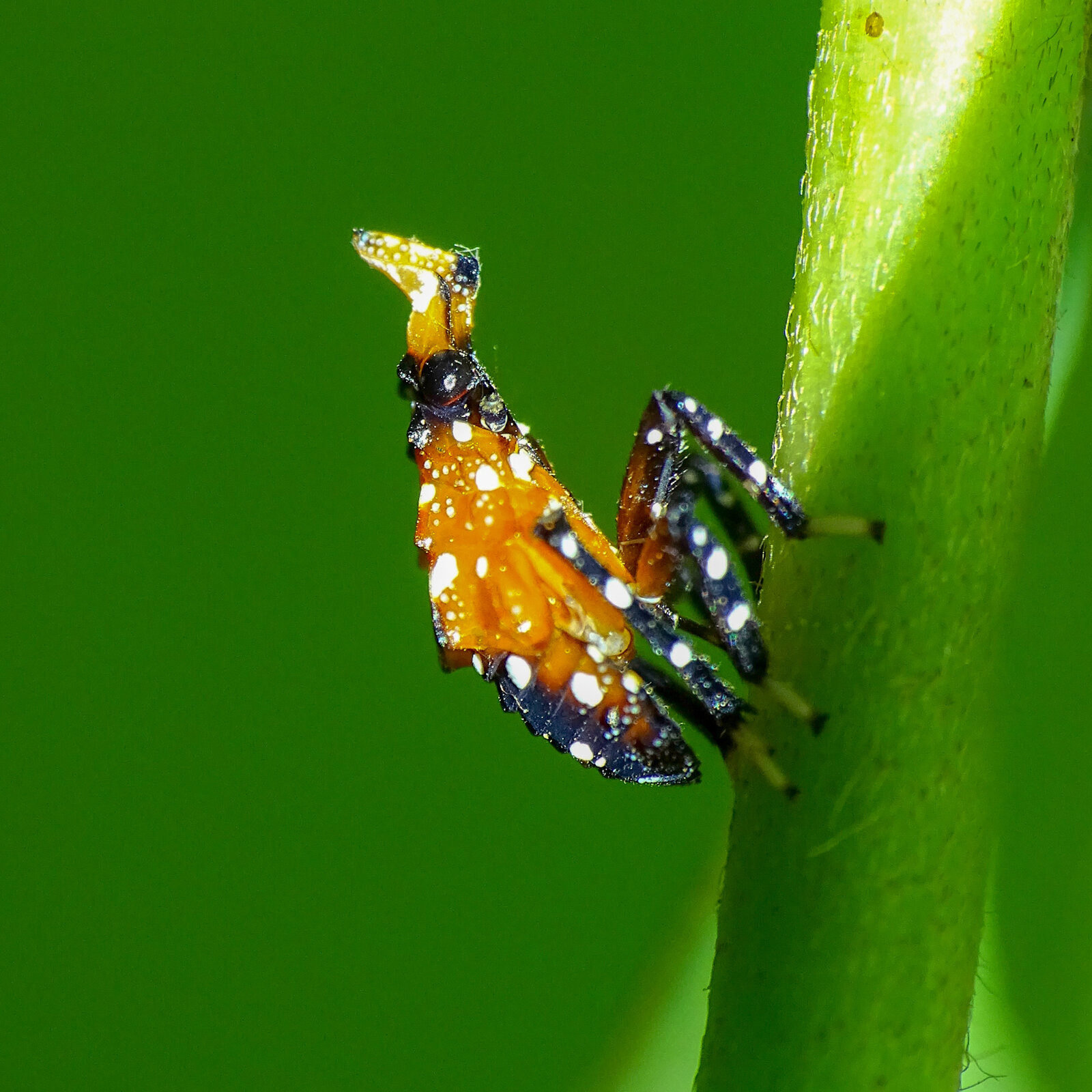
Spotted lanternfly
Lycorma delicatula
A large planthopper native to China, first detected in the United States in Berks County, Pennsylvania, in 2014. The spotted lanternfly feeds on sap from more than seventy host species but preferentially targets tree-of-heaven (Ailanthus altissima), grapevines, and hardwood trees. Adults are distinctive: gray forewings with black spots and bright red hindwings with white and black bands. First confirmed in Tennessee in September 2023 in Davidson and Wilson counties. By 2025, adjacent Hamilton County had confirmed detections, making Marion County a likely near-term arrival point given its abundant tree-of-heaven corridors along roads and disturbed areas.
Status: Introduced insect pest. Not yet confirmed in Marion County; confirmed in adjacent Hamilton County as of 2025.
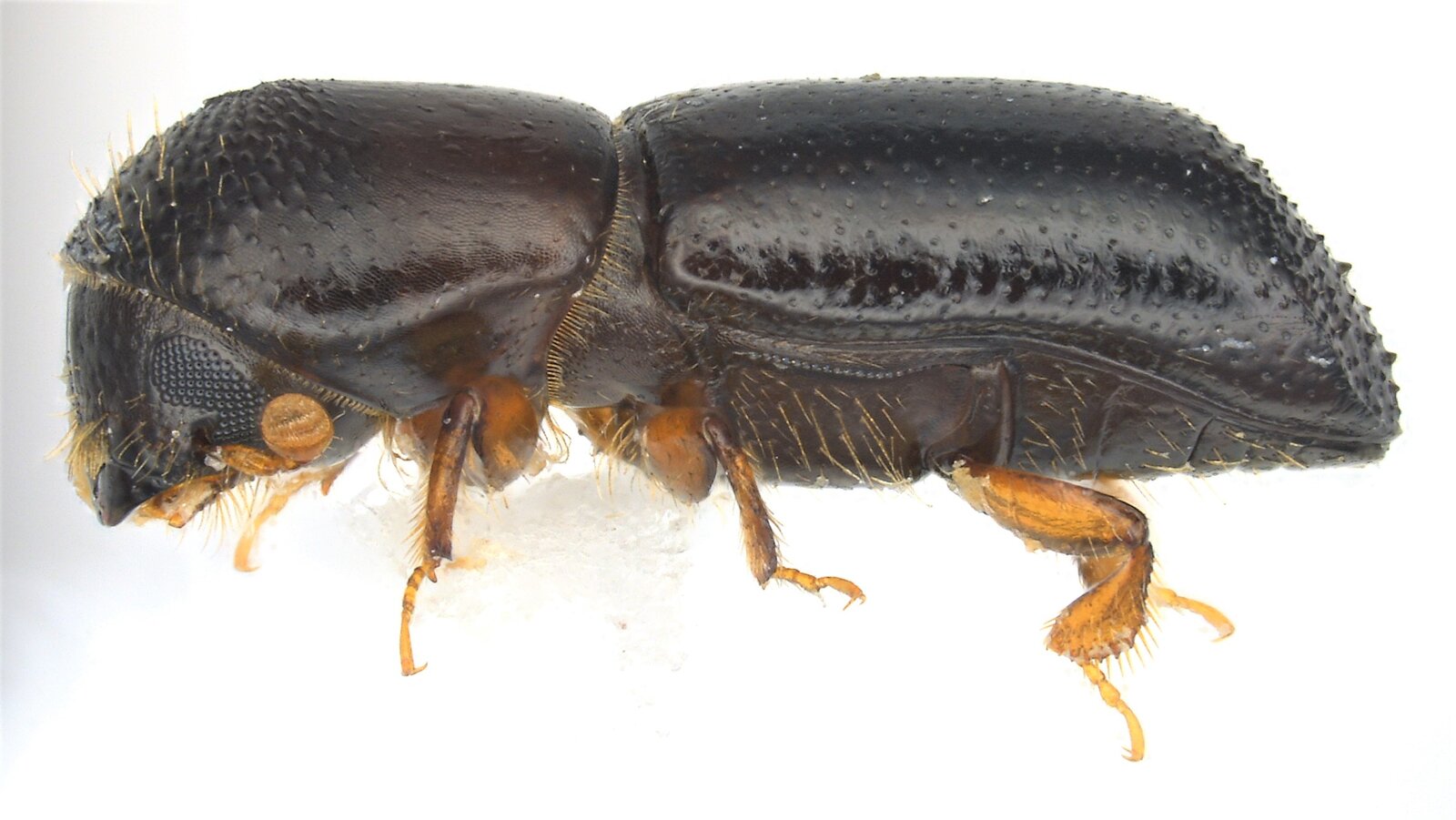
Laurel wilt
Raffaelea lauricola (fungus), vectored by Xyleborus glabratus (beetle)
A lethal vascular wilt disease of plants in the laurel family (Lauraceae), caused by a fungus carried by the redbay ambrosia beetle. The beetle bores into the sapwood and introduces the fungus, which clogs the tree's water-conducting vessels; infected trees wilt and die within weeks to months. First detected in Tennessee in 2019 in Dickson and Montgomery counties on sassafras trees (Sassafras albidum). By 2023, twenty-three Tennessee counties had confirmed infections, concentrated in north-central and eastern Tennessee. Laurel wilt has not yet been confirmed in Marion County, but sassafras is common across the county's disturbed sites and forest edges, and the beetle's westward spread across the state makes arrival a concern.
Status: Introduced fungal pathogen vectored by introduced beetle. Not yet confirmed in Marion County; in Tennessee since 2019.
Where to see Marion County flora
- Prentice Cooper State Forest: 24,686 acres on the plateau above the Tennessee River Gorge. Excellent for oak-hickory upland, sandstone rim heath, and cove hardwood along the escarpment.
- Foster Falls Small Wild Area & Fiery Gizzard Trail: mountain laurel, hemlock cove forest, and rockhouse ferns along the plateau escarpment.
- Tennessee River Gorge Trust lands: large-flowered skullcap, canebrake restoration sites, cove hardwoods.
- Coppinger Cove: spring ephemerals and rich cove forest along the Little Sequatchie headwaters.
- Cumberland Trail (Tennessee River Gorge segment): rim heath, sandstone outcrops, long overlooks.
Related
Fauna & Wildlife of Marion County →
Endemic & Notable Species →
Tennessee River Gorge →
The Sequatchie Valley →
Foster Falls & Denny Cove →
Sources
- Tennessee-Kentucky Plant Atlas
- TDEC Division of Natural Areas (Natural Heritage Inventory Program)
- USDA PLANTS Database
- Tennessee River Gorge Trust
- Prentice Cooper State Forest — Tennessee Division of Forestry
- Federal Register: Reclassification of Scutellaria montana (2002)
- USDA APHIS — Hemlock Woolly Adelgid
- USDA APHIS — Emerald Ash Borer
- Tennessee Department of Agriculture — Plant Pests and Quarantines
- Tennessee Invasive Plant Council
- The American Chestnut Foundation
- iNaturalist — Marion County, Tennessee