Last updated: April 28, 2026
- Location: Cedar Avenue, downtown block #3 of South Pittsburg, on two 25-by-140-foot lots
- Built: 1920 to 1921 for R. F. M. Kirkpatrick
- Architect and builder: Reece B. Patton, local architect, South Pittsburg
- Opened: Friday, July 29, 1921 as the Imperial Theatre, manager O. C. Ogg
- Opening film: Tank Town Follies (silent), starring South Pittsburg native Jobyna Ralston
- Renamed the Palace: November 14, 1924, after sale by Ogg to H. G. Jenkins
- First sound film: Carnation Kid, 1929
- Western Electric sound system installed: reopened August 18, 1931
- Renamed the Princess: July 2, 1934, under Cumberland Amusement Company management; opening feature Sadie McKee with Joan Crawford
- Last film as the Princess: 1963
- Reopened as the Valley Cinema: October 29, 1976; closed within a few years
- Roof collapsed: 1999
- City of South Pittsburg purchased the building: 1999
- Restoration architect: Frank Sparkman & Associates, hired 2001 (firm continuity through Sparkman & Associates Architects, Inc.)
- Restored building reopened: 2014
- NRHP status: Contributing structure within the South Pittsburg Historic District (district listed October 25, 1990)
- Steward: South Pittsburg Historic Preservation Society in partnership with the City of South Pittsburg
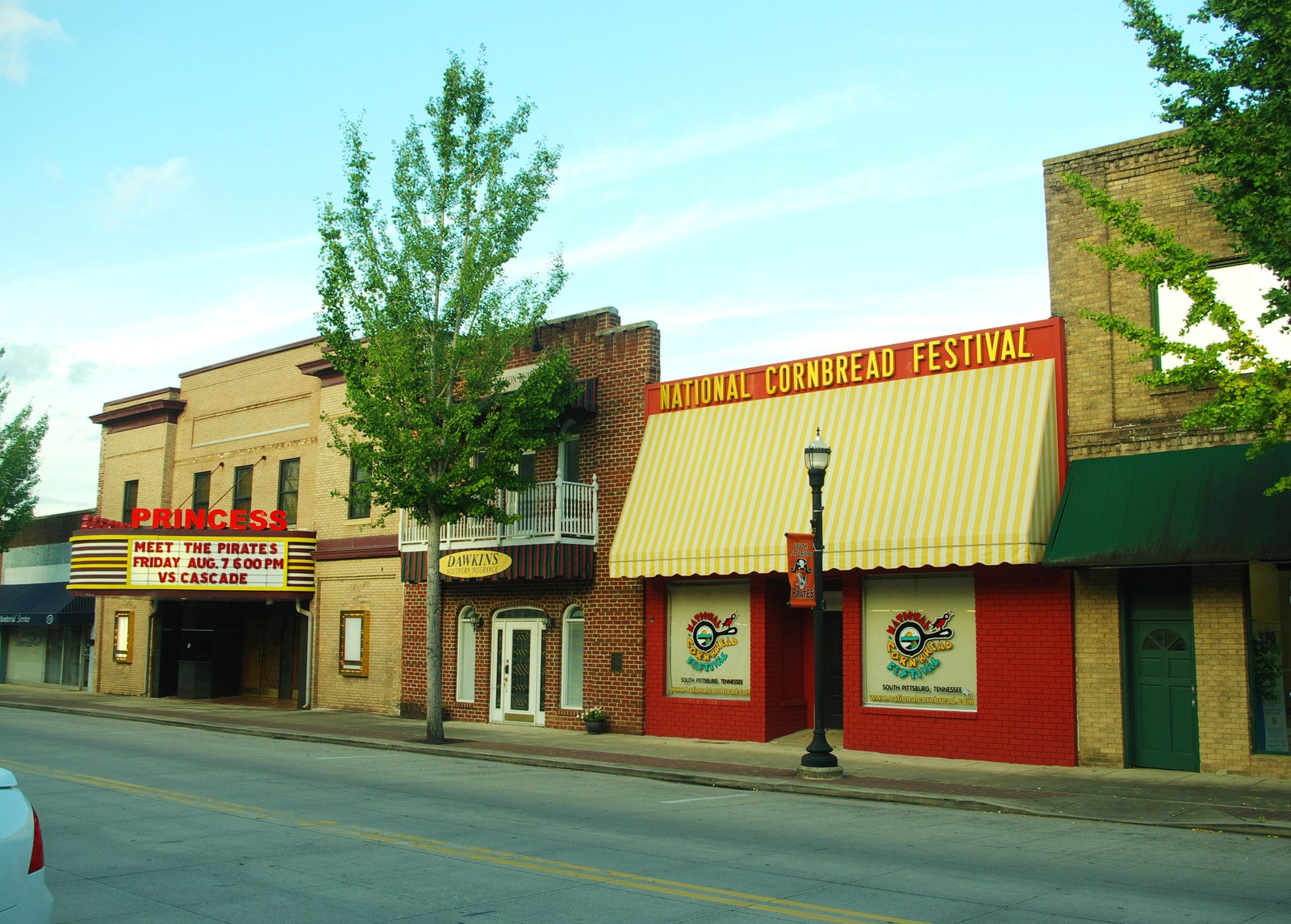
The Princess Theatre on Cedar Avenue in South Pittsburg opened on July 29, 1921 as the Imperial, ran under three successive names through the silent, sound, and color-film eras, closed in 1963 under pressure from drive-in competition and television, was briefly revived as the Valley Cinema between 1976 and the early 1980s, and then sat vacant until a catastrophic roof collapse in 1999 nearly demolished the structure. The City of South Pittsburg purchased the building that same year, and the South Pittsburg Historic Preservation Society (SPHPS) led the restoration that reopened the theater to the public in 2014. The Princess is a contributing structure within the South Pittsburg Historic District on the National Register of Historic Places, and its survival is among the most visible downtown preservation projects in Marion County.
South Pittsburg before the Princess (1908 to 1921)
South Pittsburg had a working motion-picture theater operating in the city as early as 1908, well before the Imperial Theatre building was constructed. The identity of that earlier venue is not preserved in the SPHPS narrative, but the audience was already there: the city had a peak-industrial population of roughly 3,500 people anchored by the Tennessee Coal, Iron and Railroad-era foundries, the Dixie Portland Cement plant at Richard City, and the rail and river-freight workforce that depended on them. Two of those foundry-and-cement-plant workers went on to become silent-screen names. Tom Mix, who would star in dozens of early westerns through the 1920s, worked at the Dixie Portland Cement plant at Richard City as supervisor of labor and horses and a Marion County deputy in the plant's opening years, before leaving for Hollywood. Jobyna Ralston, a native of South Pittsburg, became one of the leading ladies of the silent era and would star in many of the films that played at the Imperial after it opened. The town's connection to the early film industry, and the absence of a purpose-built picture house, were the conditions that led R. F. M. Kirkpatrick to acquire the Cedar Avenue lots in 1920.
The Imperial Theatre (1921 to 1924)
In February 1920, Kirkpatrick acquired two 25-by-140-foot lots fronting Cedar Avenue in downtown block #3 of South Pittsburg. Construction began that year on a two-story brick building designed and built by local architect Reece B. Patton. The Imperial Theatre opened for business on Friday, July 29, 1921, under the management of O. C. Ogg. The opening feature was the silent motion picture Tank Town Follies, starring South Pittsburg's own Jobyna Ralston, in a programming choice that linked the new building directly to the town's most prominent connection to early Hollywood. Patronage was strong from the opening, drawing audiences from across the industrial neighborhoods of the city and from Bridgeport across the Alabama line.
The Imperial ran under Ogg's management for three years before he sold the operation to H. G. Jenkins in 1924.
The Palace Theatre and the transition to sound (1924 to 1934)
Jenkins's first move was to rebrand the building. The Palace Theatre opened the week commencing Friday, November 14, 1924, with the sixth chapter of the movie serial Beast of Paradise. The new name reflected the early-1920s national fashion for ornate downtown picture-house identities and signaled the change in ownership.
In September 1929, the Palace entered a programming partnership with the new Jackson Theater at Bridgeport, Alabama, six miles south. Both theaters showed the same films on the same days, allowing Jenkins to negotiate stronger terms with the regional distributors and giving moviegoers in the lower Sequatchie Valley a single, coordinated week of programming. The two theaters retained their separate names and audiences but operated as a small two-house chain. Later that year the Palace screened its first film with sound, Carnation Kid, drawing crowds curious about the novelty of synchronized dialogue.
In August 1931, Jenkins closed the Palace briefly to install a new Western Electric sound system, the same equipment then running at Chattanooga's flagship Tivoli Theater, and to replace the seats. The Palace formally reopened on August 18, 1931, with the new sound system and new seats in place. The transition to sound, a substantial capital investment for a small-town theater of the period, completed the building's adaptation from the silent-film era to the talking-picture industry.
The Princess Theatre (1934 to 1963)
In April 1934, the general manager of the Cumberland Amusement Company, R. T. Hill, announced that his company had acquired the Palace. The Cumberland Amusement Company operated a chain of roughly a dozen theaters across middle and east Tennessee, and absorbing the South Pittsburg house into that circuit gave the building access to better booking terms and chain-level marketing. The company closed the theater on June 1, 1934 for one month while it carried out extensive repairs and remodeling: a modern sound system, a new lighting system, new cushioned seats, a new larger screen, and a new front and marquee.
Under the management of Herman McDowell, the rebuilt theater reopened as the Princess Theatre on Monday night, July 2, 1934. The opening feature was Sadie McKee, starring Joan Crawford, accompanied by the Pathe News reel and the cartoon Willie Whopper. The reopening date is the most often-cited founding date in local memory, and "Princess Theatre" became and stayed the building's identity for the rest of its mid-20th-century life.
Around 1947, the building's facade was painted in Art-Deco colors and a new neon-lighted marquee was added; the interior walls were sheathed in homosote wallboard and painted in matching Art-Deco fashion. The 1947 facade is substantially the one that survives today on the restored building. A photograph dated June 1, 1947 is the period reference image used by SPHPS during the restoration.
Beyond the nightly film schedule, the Princess also hosted touring stage acts during the mid-century run. The official Princess Theatre history credits the stage with appearances from Bill Monroe, the Carter Sisters, and other early country and bluegrass figures during this period, when the regional theater circuit could still draw nationally known performers into a small Tennessee town.
Through the late 1940s and early 1950s the Princess employed a small staff documented in the donor-photograph collection of Jack A. Ellis, who worked at the theater as a projectionist from 1948 to 1953. Ellis began as a ticket-taker and doorman, changing the marquee board roughly five times a week, and was photographed on November 21, 1948 in projectionist training under Benton Summers, the theater's full-time projectionist. The 1950s projection booth was operated by Ollie Vernon "Mutt" Turner, husband of Rachel Caves Turner and father of three children, including Charlene Turner Hudson, who donated additional photographs from the Ellis-Turner era to SPHPS. Other named staff include Rosalia "Rosie" Raulston Whitworth, who worked the ticket booth in 1948. A young South Pittsburg boy photographed in front of the theater around 1948 to 1949, Bob Sherrill, would later serve as mayor of South Pittsburg.
Films advertised on the marquee in the donor-photograph set place the Princess squarely within the late-1940s Hollywood mainstream: June Bride (Bette Davis, June 27, 1949), Tenth Avenue Angel, High Wall, and Her Husband's Affair all ran in this period. The theater showed the Pathe News, the cartoons, and a single evening main feature, with the marquee changing several times a week, in the rhythm of a small-town single-screen neighborhood movie house.
After several ownership changes through the 1950s and early 1960s, the Princess closed in 1963. Two factors were chiefly responsible. The South-Port Drive-In theater near Bridgeport, opened a few years before, had captured the teenage and young-adult audience that made up most of the Princess's ticket sales. Television had then arrived in earnest: by 1963 most South Pittsburg households owned at least one set, and Chattanooga was broadcasting three network-affiliate stations. Regular evening entertainment had moved into the living room, and the small Cedar Avenue movie house could not compete on either price or convenience. The Princess closed for what was understood at the time to be the last time.
The Valley Cinema interlude (1976 to early 1980s)
The building sat dark for thirteen years. In 1976, Jim Trippe of Fort Payne, Alabama bought the old Princess Theatre, updated its equipment, and undertook the repairs needed to reopen it as a family theater. The Valley Cinema opened on Friday, October 29, 1976, with a screening of Ode To Billie Joe, starring Robby Benson and Glynnis O'Connor. Admission was one dollar for children under twelve and two dollars for everyone older. A late-1970s photograph in the SPHPS archive shows the marquee advertising The Shaggy D.A., a Disney release from December 17, 1976, in the Valley Cinema's first season.
The revival was short. The Valley Cinema closed within a few years; the early-1980s last-film date that has long anchored local memory of the theater's "final closure" refers specifically to this Trippe-era second run, not to the 1963 closure of the original Princess. After Trippe's operation ended the building received no further restorations and very little maintenance. A church rented the structure briefly in the 1990s for worship services and then moved on as the deterioration of the interior worsened.
Roof collapse and rescue (1998 to 1999)
By 1998, decades of leaks had rotted the wooden roof rafters. Architecture students from the University of Tennessee at Knoxville photographed the interior that year, capturing the stage area and the balcony before the structural failure that followed; their photographs were given to the South Pittsburg City Commission as part of the early effort to preserve the historic structure, with the negatives later deposited at Sparkman & Associates Architects, Inc. In 1999, the rafters finally gave way and the roof collapsed into the building. A portion of the north brick wall, no longer braced by the roof, began leaning toward collapse.
Officials condemned the structure. The path of least resistance was to raze the building and clear the parcel for a downtown parking lot. A group of concerned South Pittsburg citizens organized instead to save it, and the City of South Pittsburg purchased the theater from its Alabama-based owners (Trippe-era successors) that same year. The city appointed a commission of officials and citizens to develop a restoration plan and a fundraising strategy. That commission evolved over the following years into the independent nonprofit South Pittsburg Historic Preservation Society, the organization that has since taken responsibility for both the Princess and the Chapel on the Hill.
Restoration (2000 to 2014)
The restoration unfolded across roughly fifteen years in a sequence of stabilization, structural rebuilding, and finishing phases.
In April 2000, the Society photographed the interior to document baseline conditions: the collapsed balcony with a small Bobcat tractor clearing debris, the failed roof above, the stage and the rear wall. Cleanup proceeded through the summer of 2000; photographs from that summer show the cleared shell looking toward the front entrance and the rear stage area. In December 2000, photographer Beenea Hyatt documented contract workers reconstructing the failed north brick wall, which had separated and begun leaning to the point of likely collapse. New metal ceiling rafters were hung in place during the spring of 2001. In March 2001, restoration architect Frank Sparkman was photographed on site discussing the construction drawings with SPHPS members Ed Elliott, Doris Durham, and Mary Jane Brown; the rear wall, judged unsalvageable, was being removed.
The next phase, between 2003 and 2004, completed the new roof, repaired the facade and marquee, and rebuilt the rear wall. In April 2003, SPHPS chairman Dennis Lambert photographed the facade still wearing its old paint, with the marquee held in place by temporary supports after its weight, originally held by three wall anchors, had begun to pull the center wall toward Cedar Avenue. Removing the marquee weight was the precondition for any masonry repair, and saved both the marquee and the facade. By August 2003, the old facade paint was being stripped from the brick and the failing center wall was being removed for rebuilding. By January 2004, the rebuilt center wall was nearing completion and the paint-removal process was finished. The Society's Frank Sparkman & Associates design documents, the four hundred theater seats and two projectors that had been acquired during the early phase, and additional grants and private donations carried the project through the rest of the decade.
Restoration spending crossed one hundred thousand dollars in direct preservation costs by the early 2000s and continued upward through the 2010s as the building was finished out for live performance and screening use. A partnership with Lodge Manufacturing, the cookware foundry one block away, produced a heritage cookbook whose proceeds were channeled into the restoration; the Society also reprinted the 1899 South Pittsburg Hustler newspaper and sold copies as a fundraiser. The annual Christmas Tour of Homes and the Society's Trash and Treasure sale supported the work alongside the cookbook revenues.
Renovation work was completed in 2014. The restored Princess Theatre was unveiled to the public that August in coverage that included a feature in the Chattanooga Times Free Press tracing the project from the 1999 roof collapse through the 2014 reopening. The restored building is operated as a community auditorium for live music, country and bluegrass performances, classic film series, theater productions, school programs, recitals, awards ceremonies, and business conferences.
The Princess today
The restored theater is bookable for public and private events through SPHPS in partnership with the city. The marquee runs in its 1947 Art-Deco configuration, the rebuilt brick walls carry the load of the new metal-rafter roof, and the four-hundred-seat auditorium is in regular use. The theater hosts a calendar of live music, comedy, classic film screenings, and community programming, and its operating model, like the Chapel on the Hill's, depends on rental and event revenue rather than a single endowment. The building is one of three SPHPS Cedar Avenue restoration successes, alongside the Chapel and the surrounding South Pittsburg Historic District streetscape, and the most visible downtown preservation project in the county.
Related
About South Pittsburg →
About the Chapel on the Hill (also restored by SPHPS) →
About Lodge Cast Iron (whose cookbook partnership funded part of the restoration) →
Festivals and Fairs →
People of Marion County →
Sources
- South Pittsburg Historic Preservation Society — Princess Theatre history (Dennis Lambert narrative, December 12, 2004; covers 1908 prior theater, R. F. M. Kirkpatrick acquisition, Reece B. Patton design, July 29, 1921 Imperial opening, O. C. Ogg, H. G. Jenkins purchase 1924, Palace November 14, 1924 reopening, September 1929 Jackson Theater partnership, Carnation Kid, Western Electric sound system August 18, 1931, R. T. Hill / Cumberland Amusement Company April 1934 acquisition, July 2, 1934 Princess opening with Sadie McKee, 1947 Art-Deco facade, 1963 closure, 1976 Jim Trippe / Valley Cinema with Ode To Billie Joe, 1999 roof collapse, City of South Pittsburg purchase)
- SPHPS — Our Projects: Princess Theatre (1947 marquee photograph, Jack A. Ellis 1948-1953 projectionist, Benton Summers full-time projectionist, Ollie Vernon "Mutt" Turner 1950s projectionist, Rosalia "Rosie" Raulston Whitworth ticket booth, Bob Sherrill youth photo, marquee titles June Bride, High Wall, Tenth Avenue Angel, Her Husband's Affair, late-1970s Valley Cinema The Shaggy D.A., restoration progress photos 1998 through 2004 including Beenea Hyatt December 2000 north-wall reconstruction, March 2001 Frank Sparkman with Ed Elliott / Doris Durham / Mary Jane Brown, April 2003 Dennis Lambert facade, August 2003 paint removal and center wall, January 2004 center wall completion)
- SPHPS — Vintage Princess pictures donated by Jack A. Ellis and Charlene Turner Hudson (June 27, 1949 marquee photograph, projection-booth and ticket-booth interior shots, McDowell-family photographs)
- The Princess Theatre — History (official site, post-2014 operating history)
- Chattanooga Times Free Press — South Pittsburg unveils refurbished Princess Theatre (August 16, 2011)
- Princess Foundation — September 2009 announcement that Frank Sparkman & Associates was retained for restoration design
- Cinema Treasures — Princess Theatre, South Pittsburg, TN
- Wikipedia — Jobyna Ralston (South Pittsburg native who starred in Tank Town Follies, the Imperial's opening film)
- Wikipedia — Tom Mix (silent-film western star who worked at the Penn-Dixie cement plant in South Pittsburg before Hollywood)