Last updated: May 6, 2026
- Name on the National Register: Kelly's Ferry Road and Cemetery (the road and cemetery are listed together as a single property)
- NRHP reference number: 06001037, listed November 15, 2006
- NRHP framework: Chickamauga & Chattanooga Civil War-Related Sites in Georgia and Tennessee, Multiple Property Submission
- Location: On a bluff above the former Tennessee River ferry landing, west of Kelly's Ferry Road, near Guild in western Marion County
- USGS quad: Wauhatchie 7.5-minute quadrangle; coordinates 35.037° N, 85.426° W
- Area: Approximately 3 acres
- Recorded memorials: 142 (as of 2026, per Find a Grave)
- Date range: 1838 (Margaret M. Kelly) to 1980 (Alexander Anderson); approximately 142 years of recorded use
Setting
Kelly's Ferry Cemetery sits on a bluff above the south bank of the Tennessee River in western Marion County, west of Kelly's Ferry Road, near the present community of Guild. The bluff overlooks the bend where the river swings around the foot of Raccoon Mountain as it leaves the Tennessee River Gorge. The cemetery occupies about three acres of higher ground that sat well above the level of the river even in flood, which is the reason it survived two 20th-century impoundments while almost everything else in the small ferry community did not.
The 1913 completion of Hales Bar Dam downstream raised the Tennessee to a pool elevation that flooded the lowest portions of the ferry landing. The 1967 completion of TVA's Nickajack Dam, which replaced Hales Bar, raised the river to its modern pool of about 633 feet above sea level, drowning the rest of the landing and the bottomland farmsteads along the former ferry road. The cemetery on its bluff sat above both pool elevations and remains the only above-water remnant of the settlement that gave the crossing its name.
National Register listing
Kelly's Ferry was added to the National Register of Historic Places on November 15, 2006, under reference number 06001037. The property is named "Kelly's Ferry Road and Cemetery" and treats the road and the burial ground as a single nominated resource. It is the only individually listed cemetery on the National Register in Marion County. The listing was prepared under the multiple-property framework Chickamauga and Chattanooga Civil War-Related Sites in Georgia and Tennessee, which addresses Civil War landscape and commemoration features in Hamilton and Marion counties in Tennessee and Walker and Catoosa counties in Georgia that lie outside the boundary of the Chickamauga and Chattanooga National Military Park.
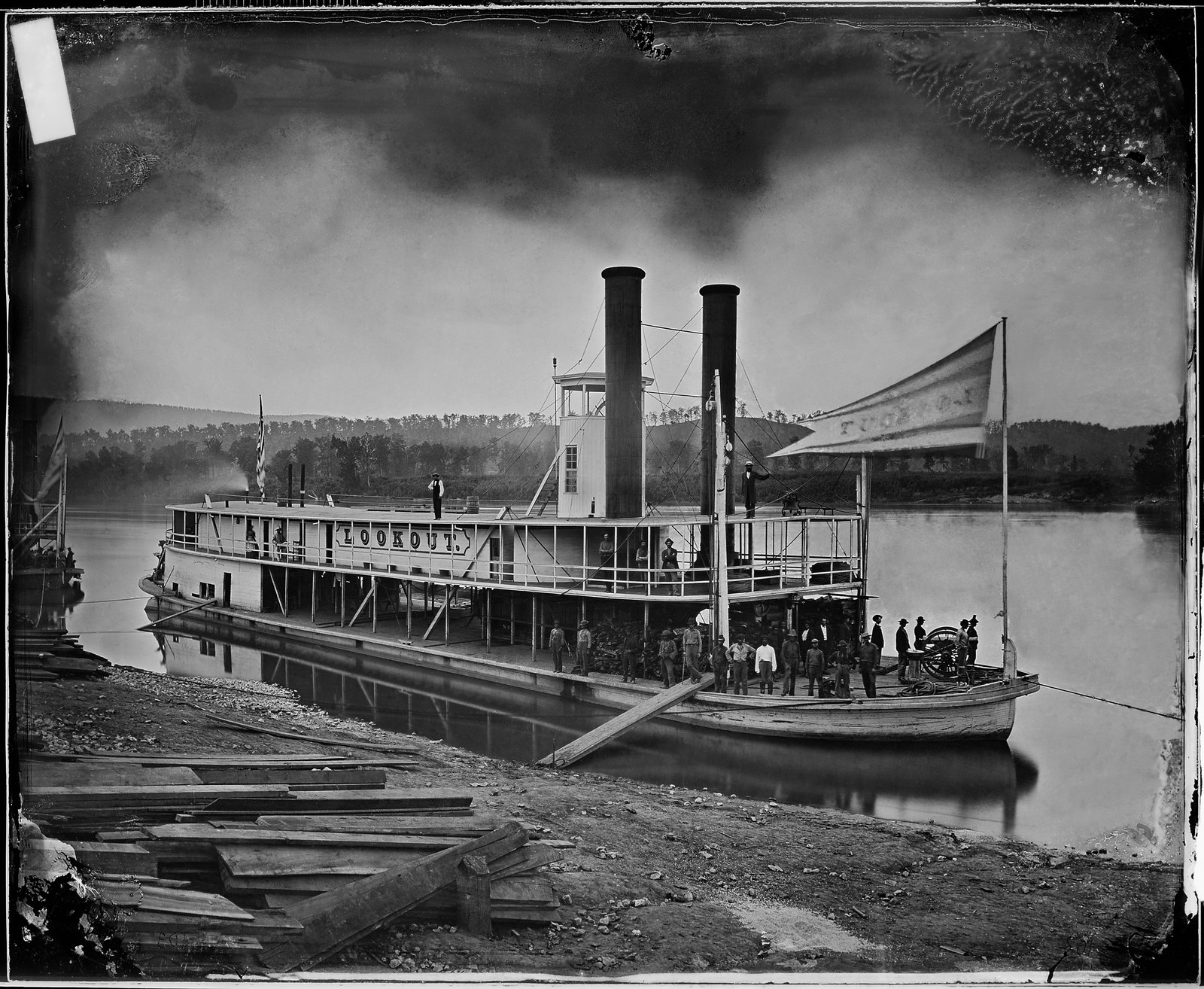
The road carried the wagon haul of the Cracker Line in late October 1863, the supply route that broke the Confederate siege of Chattanooga. Steamboats brought rations from Bridgeport, Alabama, the railhead about forty-five river miles downstream, to the Kelly's Ferry landing; from there teamsters drove wagons up over Raccoon Mountain and down to Brown's Ferry and a pontoon bridge into the besieged town. The road and the bluff cemetery above it together preserve the physical landscape of that operation in a way that the inundated landing itself no longer can.
Founding and the Kelly family
The cemetery was established by John Kelly on his own land. Kelly was born in Greenbrier, Virginia, on June 2, 1779, the son of Captain Alexander Kelly of the Greenbrier and East Tennessee militias. He married Nancy Mayo of North Carolina in Monroe County, Tennessee. The Kellys came down the Tennessee River to Marion County in 1808, first settling on land that later passed to the Lamb family in adjoining Bledsoe County. They moved to Jasper around 1820 and then in 1838 moved again to the river bluff that took the family name. The earliest dated burial in the cemetery, that of Margaret M. Kelly on October 25, 1838, comes from the same year as the family's arrival, and the burial of the founder himself in 1845 anchored the ground for the next century and a half of use.
Kelly was a Whig in politics and one of Marion County's most active early public men. He served as the first clerk of the Marion County Circuit Court, as a justice of the peace, and as a delegate to the 1834 Tennessee Constitutional Convention. He was granted a state charter in 1826 to build a turnpike from the Sequatchie Valley to Ross's Landing, the trading post that became Chattanooga, and he built the first bridge across the Sequatchie River the same year. He was a federal contractor for clearing obstructions in the Tennessee River, helped organize Olive Branch Lodge, Free and Accepted Masons, at Jasper, and was a Cumberland Presbyterian. The Kelly farm and ferry, like most of the working landscape of the antebellum Tennessee Valley, was built and maintained by enslaved people; Kelly was a slaveholder of considerable means.
Earliest burials
The earliest dated interment in the cemetery is Margaret M. Kelly, born in Jasper on September 15, 1820, who died on October 25, 1838, at the age of eighteen. Her burial in the family's first year on the bluff opened the ground that became the community burying place. The 1845 burial of John Kelly himself, at age sixty-six, joined her, and his wife Nancy Mayo Kelly followed in October 1857, at about eighty.
The earliest cohort of burials traces directly to the founder's household. Several of his daughters and sons-in-law are interred here under the Hall, Mayo, and Newsom surnames; the five Hall-family memorials and the single Mayo entry preserve the marriages of the first generation of Marion County Kellys to neighboring families. Many of the founder's other children and grandchildren left the county or scattered. One son, Major William J. Kelly (born 1823), became one of the Sequatchie Valley's principal civil engineers and laid out the town of Kimball when it was platted. Another son, Alexander Kelly (1803 to 1878), took charge of the ferry and held twenty-five enslaved people on the family land before serving on the federal board of claims at the close of the Civil War. Alexander's son, Judge John G. Kelly (born 1832), served as a Union scout under Rosecrans and Thomas during the war, became the first mayor of South Pittsburg, and sat as Marion County judge from 1894. The cemetery preserves the founding generation; the dispersal of the descendants across the county and beyond is one reason later Kelly memorials in the cemetery are relatively few.
Dominant families
The Find a Grave roster of one hundred forty-two memorials is dominated not by the Kellys but by the families that filled in the small community on and around the ferry landing across the late nineteenth and twentieth centuries. The largest single surname presence is the Anderson family with about twenty memorials, followed by the Sexton family with sixteen and the Hartman family with eleven. The Newsom and Nichols families each have ten, the McNabb family has nine, and the Powers, Wilcox, Hall, Hicks, Boatwright, and Foster families each have between four and seven. The Kellys themselves account for only three direct-surname memorials, with additional descendants in the cemetery under their married names.
The pattern is the inverse of what an outsider might expect: the family that gave the ferry and the cemetery its name supplied the founding generation but is not the dominant presence in the modern roster. The cemetery instead reflects the small late-nineteenth and twentieth-century settlement of farmers, river workers, and ferrymen who lived along the road through the years when the ferry still ran. The latest dated burial in the roster is Alexander Anderson, born March 14, 1889, and died January 29, 1980, at age ninety: his death falls almost three decades after the ferry itself was retired in 1952 and thirteen years after Nickajack Dam drowned the landing.
Survival above the impoundments
The cemetery's National Register significance rests on more than the Cracker Line haul road. Three Cherokee detachments crossed or camped near this stretch of the river during the forced removal of 1838, and the ferry-bluff site preserves a piece of the river-corridor landscape used by the Lower Towns of Nickajack and Running Water before their destruction in the 1794 Nickajack Expedition. The 1860s wagon road, the antebellum settlement, and the fragmentary archaeological deposits of the ferry community are all registered together in the nominated property.
Because the ferry landing itself was drowned by Hales Bar in 1913 and finally inundated by Nickajack in 1967, the bluff cemetery is the principal physical surface on which the community's history can still be read. Artifacts recovered from the ferry site by state archaeologists, including Civil War-era infantry buttons, lead bullets of Colt, Spencer, and Sharps types, a buckle, a spoon, fragments of a harmonica, and oil-lamp parts, are held by the Tennessee State Library and Archives and document the ferry's wartime use even though the structures themselves are gone. The cemetery and its road are what visitors can still walk.
Related
About Kelly's Ferry →
The Cracker Line, October 1863 →
Civil War in Marion County →
Cemeteries of Marion County →
Hales Bar Dam →
Tennessee River Gorge →
Sources
- Find a Grave — Kelly's Ferry Cemetery (142 memorials)
- Wikipedia — Kelly's Ferry Cemetery
- National Register of Historic Places — Kelly's Ferry Road and Cemetery (ref. 06001037)
- TNGenWeb — Marion County Cemeteries on USGS Maps (Wauhatchie quadrangle)
- TNGenWeb — Goodspeed biographical sketches of the Kelly family
- Tennessee Encyclopedia — Marion County
- Wikimedia Commons — Kelly's Ferry artifacts (Tennessee State Library and Archives)