Last updated: April 23, 2026
Marion County's cemeteries mark the full arc of its documented history: family burial grounds on the earliest land grants, Civil War graves at Sweeten's Cove, the fenced church yards of the oldest Primitive Baptist and Cumberland Presbyterian congregations, the industrial-era plots of the coal and iron towns, and the partially submerged family plots along the Tennessee River Gorge that were not relocated when TVA closed Nickajack Dam in 1967. One cemetery is listed on the National Register of Historic Places in its own right, and several more lie within NRHP-listed historic districts. TNGenWeb's Marion County cemetery list catalogs over one hundred burial grounds county-wide; this page covers the handful whose documented history extends beyond the stones themselves.
Kelly's Ferry Cemetery (NRHP 2006)
Kelly's Ferry Cemetery sits on the south bank of the Tennessee River in western Marion County, at the site of the vanished ferry community of the same name. The cemetery and the associated road were added to the National Register of Historic Places on November 15, 2006 (ref. #06001037). It is the only NRHP-listed cemetery in Marion County.
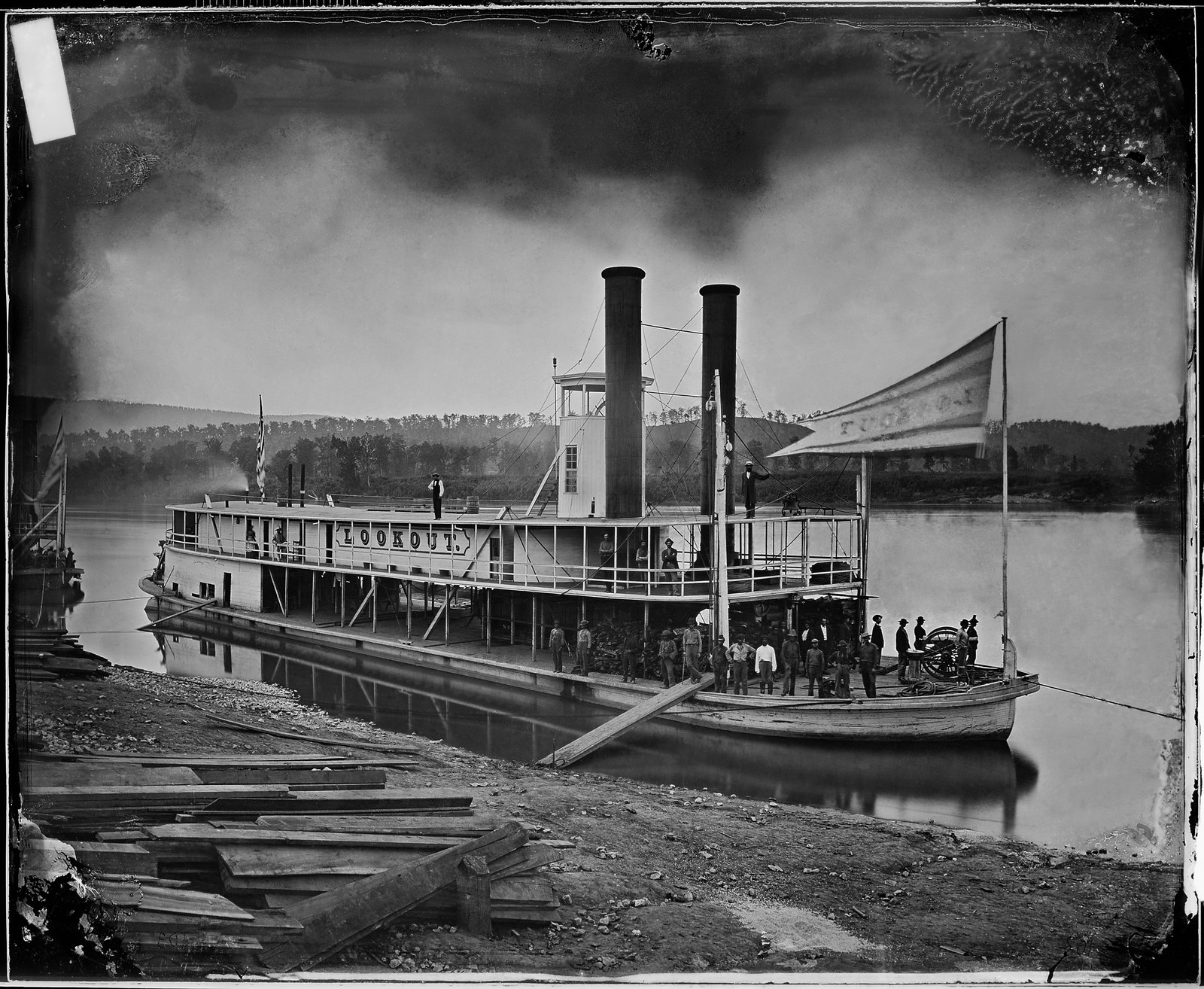
The earliest known burial dates to 1838, four decades before Marion County's industrial-era cemeteries were laid out. John Kelly (1779–1845), the first clerk of the Marion County Circuit Court and operator of the original ferry, is buried in the cemetery along with several generations of the Kelly family and other early settlers of the Kelly's Ferry community. The ferry ran from the early 1800s until 1952 and carried rations upriver during the late-October 1863 Cracker Line operation that broke the Confederate siege of Chattanooga. The cemetery is the principal surviving physical marker of the settlement; the ferry house, stores, and landings are gone.
Read more about Kelly's Ferry →
Bean-Roulston Cemetery, Sweeten's Cove
The Bean-Roulston Cemetery on the hillside above Sweeten's Cove Primitive Baptist Church is the burial ground for the two founding families of the cove and for roughly twenty Confederate soldiers killed in the Battle of Sweeden's Cove on June 4, 1862. The Union victory cost two Federal killed and seven wounded; the Confederate dead were collected by local residents after the engagement and buried together in the cove cemetery. Their names were not preserved, and the graves remain unidentified to this day.
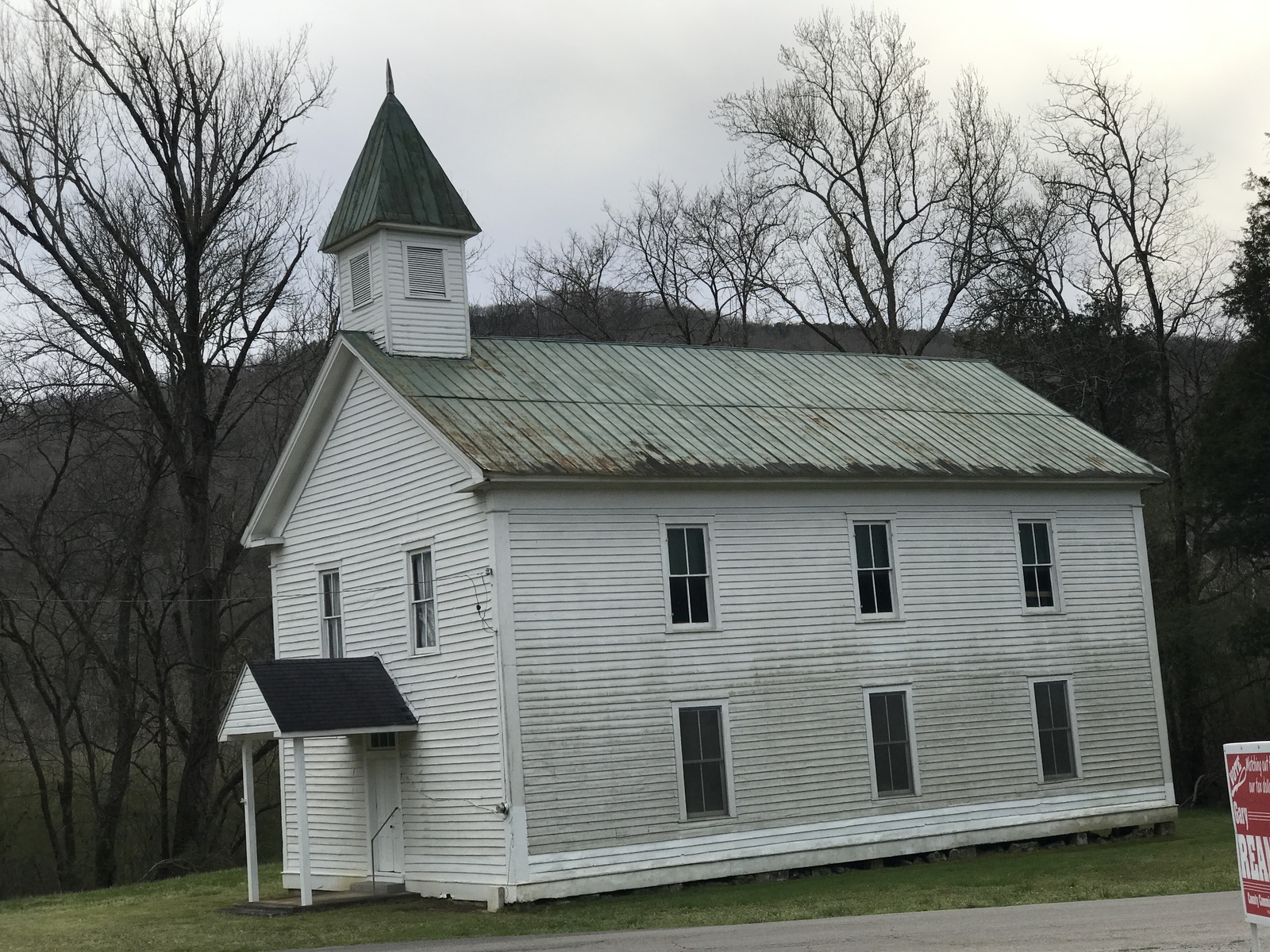
The cemetery is adjacent to the Sweeten's Cove Primitive Baptist Church (organized circa 1821 as Union Primitive Baptist, renamed in 1834), whose current 1853 Greek Revival meeting house was added to the National Register on June 30, 1983 (ref. #83003050). Samuel Raulston (1775–1831), one of the cove's founders, is buried here. The cemetery also holds generations of the Bean/Beene family whose 1808 arrival in the cove is traditionally cited as Marion County's earliest Anglo-American settlement.
Long Cemetery #2 at Mullins Cove
The Long family cemetery in Mullins Cove, also known as Long Cemetery #2, is the most visible of Marion County's partially submerged burial grounds. Henry Long (1782–1875) and Zilpha Long (1792–1860), the founders of Mullins Cove between 1807 and 1811, are buried in the family cemetery along with several generations of their descendants.
The Hales Bar Dam impoundment in 1913 raised the Tennessee River in Mullins Cove to approximately 629 feet above sea level, reaching the lower edge of the cemetery. TVA's closure of Nickajack Dam in 1967 raised the pool to approximately 633 feet and placed additional graves under water. TVA did not relocate the cemetery before inundation. As of the 1990s and 2000s, three Long family tombstones, marking graves of Henry, Moses, and Sarah Long, remained visible above the water line roughly 70 yards offshore, where Dry Creek empties into the lake. Local paranormal tourism literature has layered folklore onto the site, but the documented cemetery history is itself a reminder that the Tennessee River Gorge shoreline was settled before it was impounded.
McKendree and the Jasper Methodist cemeteries
The McKendree Methodist Episcopal Church at 503 Betsy Pack Drive in Jasper, built in 1875 and added to the National Register on November 21, 1978 (ref. #78002607), has a small adjacent burial ground containing late-19th-century graves of the Methodist congregation. The original 1875 building now houses Faith Baptist Church; the Methodist congregation relocated to 106 Highway 150 in Jasper. Jasper Cemetery proper and the Jasper United Methodist Church burial ground hold generations of the town's principal families, including members of the Pack family descended from Betsy Pack, the Cherokee reservee whose 640-acre grant became the Jasper townsite.
Ebenezer Cumberland Presbyterian cemetery
The cemetery at Ebenezer Cumberland Presbyterian Church off Griffith Highway, about three miles from Jasper, contains graves dating to the congregation's 1830 founding. The church (added to the NRHP June 15, 2020) sits on land donated by John and Mary Oats Hoge, and members of the Hoge family, the congregation's first pastor Elisha Blevins, and church founder John Kelly are buried in the surrounding grounds. The 1854 and 1909 tornadoes that destroyed successive church buildings did not destroy the cemetery; the burial ground survives as the congregation's longest-continuous physical record.
Chapel on the Hill, South Pittsburg
The sandstone Chapel on the Hill in South Pittsburg, built 1888–1889 on a lot at the east end of 11th Street, has a small cemetery adjacent to the building containing graves of the Primitive Baptist congregation organized on November 20, 1886. The chapel is part of the South Pittsburg Historic District on the National Register. The building passed to the City of South Pittsburg in 2001 and is preserved by the city in partnership with the South Pittsburg Historic Preservation Society.
Historic Black cemeteries of South Pittsburg
Under Tennessee's segregation laws, South Pittsburg's Black community was buried separately from the white community throughout the industrial era. The historic Black cemeteries of South Pittsburg are less thoroughly documented online than the white congregations' grounds and have not been individually listed on the National Register. Burial records for congregations such as Mt. Bethlehem Baptist Church, Randolph Chapel M.E. Church, and the historic Black First Baptist, A.M.E., and A.M.E. Zion congregations are held partially in church records and partially at the Tennessee State Library and Archives. A full inventory of Black burial grounds in the county has not been compiled in a single published source.
Industrial-era town cemeteries
The coal and iron boom of the 1870s onward produced Marion County's larger municipal cemeteries. South Pittsburg Cemetery, on the hillside north of the historic district, holds the graves of the city's founding generation, including members of the Lodge, Kellermann, and Richard Hardy families. Whitwell Cemetery contains the graves of miners and their families from the company-town era, including those killed in the December 8, 1981 No. 21 Mine explosion. Coal towns at Victoria, Inman, Orme, and Needmore each maintained cemeteries, some still in use and others overgrown. Inventories of plateau-community cemeteries are collected on the TNGenWeb Marion County cemetery page.
Cherokee burial context
The Cherokee Lower Towns of Nickajack and Running Water occupied the Tennessee River Gorge through the late 18th century, and Cherokee burial grounds existed throughout the county before the 1794 Nickajack Expedition and the subsequent forced removal. Many sites have been disturbed or lost to river impoundment, road construction, and more than two centuries of plow and pasture. The Kelly's Ferry Cemetery NRHP nomination addresses some of this context, as do the Nickajack Cave and Tennessee River Gorge coverage. No named Cherokee cemetery in Marion County has been documented in publicly accessible records in the way the later Anglo-American family and church grounds have been. The Shellmound mound site near the mouth of the gorge is Mississippian, predating the Cherokee period, and has also been affected by river impoundment.
Keeping track
The TNGenWeb Marion County cemetery list (sites.rootsweb.com/~tnmario2/marcem.html) is the most complete publicly available inventory of the county's burial grounds, though the list is incomplete for some of the smaller family plots on the plateau and the less-documented historic Black cemeteries. The Find a Grave database includes photographs and transcriptions of headstones for a growing number of Marion County cemeteries, entered by volunteers. Neither source is exhaustive. The Tennessee State Library and Archives holds church-register and WPA cemetery records that fill some of the gaps, particularly for the late-19th-century Methodist and Cumberland Presbyterian congregations.
Related
Religious History →
About Kelly's Ferry →
About Sweeten's Cove →
About Mullins Cove →
Sources
- Wikipedia — Kelly's Ferry Cemetery
- Find a Grave — Kelly's Ferry Cemetery
- TNGenWeb — Cemeteries of Marion County, Tennessee
- Wikipedia — Primitive Baptist Church of Sweeten's Cove
- Wikipedia — Ebenezer Cumberland Presbyterian Church
- Wikipedia — McKendree Methodist Episcopal Church
- The Cemetery Detective — The Submerged Cemetery at Mullins Cove
- South Pittsburg Historic Preservation Society — Chapel on the Hill
- Tennessee Secretary of State — Genealogical Fact Sheets About Marion County
- Tennessee Encyclopedia — Marion County