Last updated: August 5, 2026
- Cherokee name: Tsiyu Gansini, “he is dragging his canoe”
- Born: c. 1738; son of the peace chief Attakullakulla and Nionne Ollie
- Role: war leader of the Chickamauga Cherokee, 1777–1792; founder of the Five Lower Towns
- Headquarters: Running Water Town, in present-day Marion County, from 1782
- Died: February 29 or March 1, 1792 (sources differ), at Running Water
- Grave: unmarked; believed to lie near Haletown, in ground now under Nickajack Lake
No figure of the eighteenth century is more closely bound to the ground that became Marion County than Dragging Canoe. For the last decade of his life his political and military capital stood at Running Water Town on the county's stretch of the Tennessee River; the war he led made the river gorge the most contested ground in the trans-Appalachian Southeast; and when he died, at the height of his power, he was buried in ground the county's lake now covers. Raulston and Livingood call him one of the most widely known figures ever to call the Sequatchie region home: feared and yet respected, in their words, in accordance with the honor code of the frontier. This page gathers his whole story; the pages on the Cherokee Lower Towns and the Chickamauga Wars carry the fuller history of the towns and the war he led.
The walkout at Sycamore Shoals (1775)
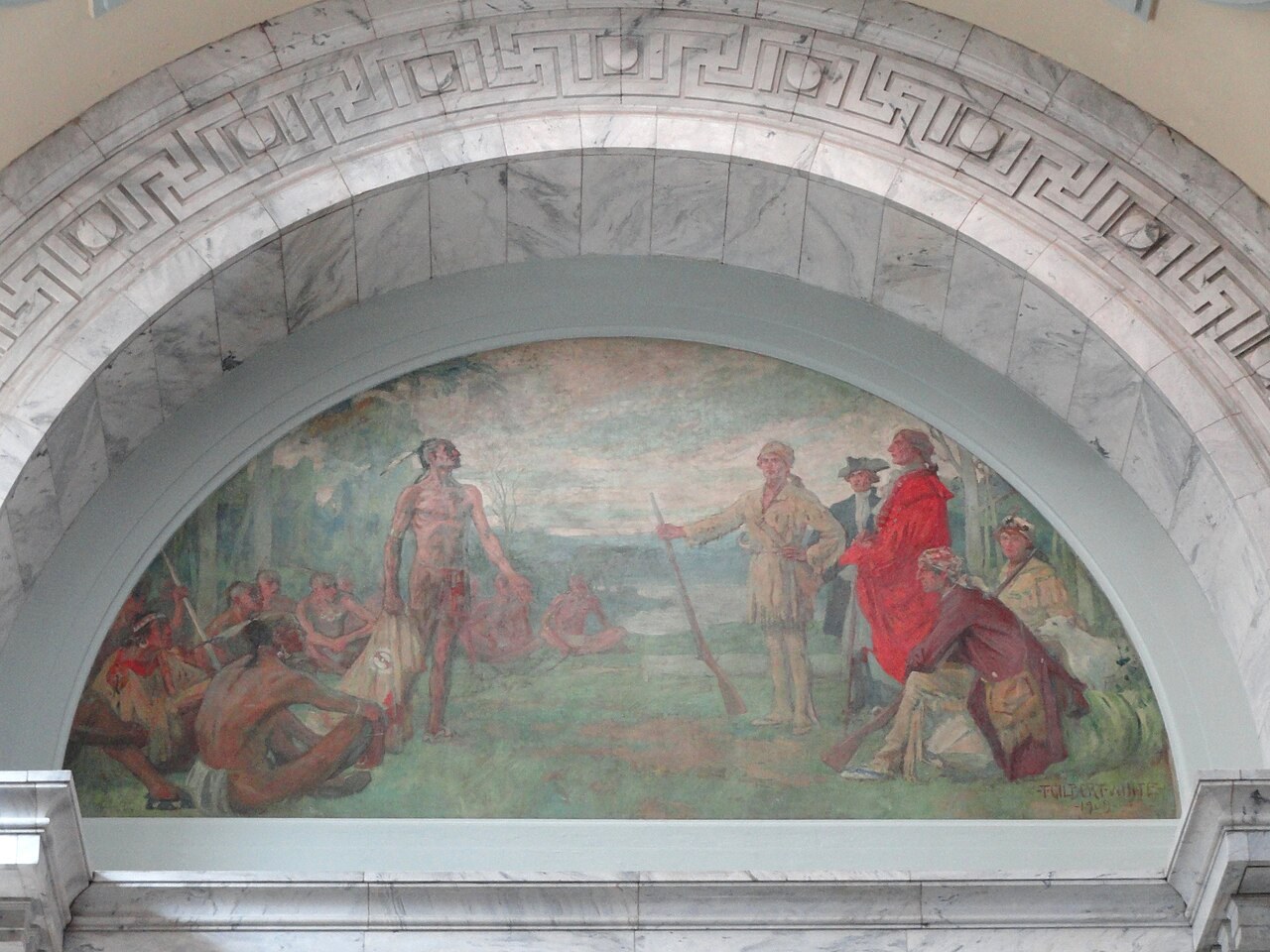
Dragging Canoe enters recorded history in opposition. At the Treaty of Sycamore Shoals in March 1775, the Transylvania Company of Judge Richard Henderson bought some twenty million acres of Cherokee hunting ground, most of Kentucky and Middle Tennessee, from the older Cherokee leadership for goods worth about ten thousand pounds. Dragging Canoe, then in his late thirties and the son of the negotiator Attakullakulla, spoke against the sale, walked out of the negotiation, and warned that the ceded country would become “a dark and bloody ground.” The warning entered American frontier legend; the refusal behind it shaped the next twenty years. When the Revolution opened the following year he led Cherokee forces against the Watauga and Holston settlements, and when the older leadership sued for peace and ceded more land in 1777, he refused the treaties altogether.
Secession and war (1777–1782)
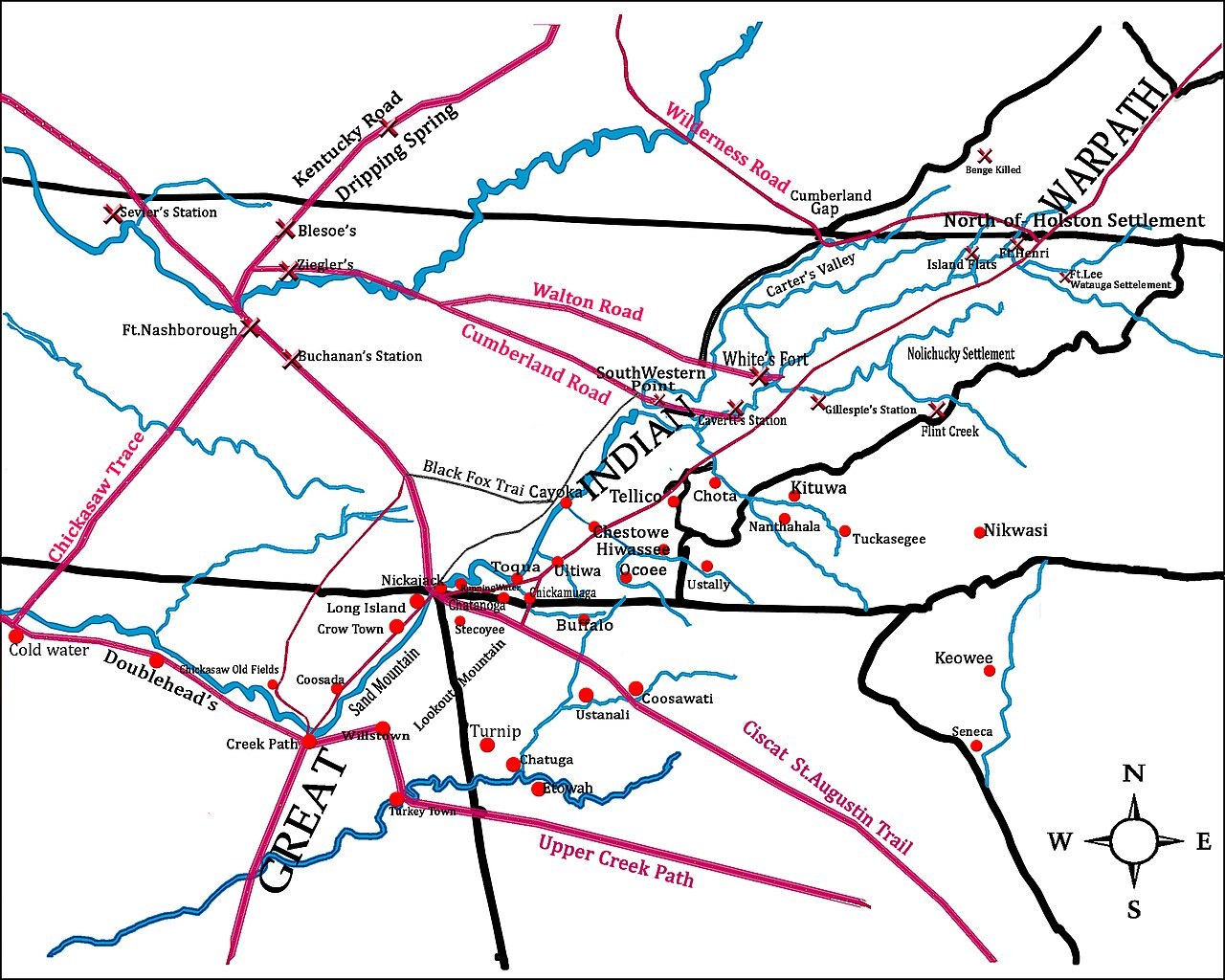
In the spring of 1777 Dragging Canoe led his followers out of the Cherokee Nation's political mainstream and south to a cluster of new towns on Chickamauga Creek, near present-day Chattanooga. Americans named the faction the Chickamauga after the creek; per Raulston and Livingood his following passed a thousand warriors by the end of 1778, drawing dissident Cherokee, Creek allies, Shawnee visitors, and white Loyalists. Evan Shelby's Virginia militia burned the Chickamauga Creek towns in April 1779, but the faction rebuilt on the same ground and kept recruiting. The raid had shown how exposed the creek towns were, and in 1782 Dragging Canoe led a second removal, west past Lookout Mountain into the bottomlands and cave country of the Tennessee River gorge. Because the Muscogee (Creek) still claimed that territory, he sent his brother Little Owl to seek their approval, which was immediately given. The new settlements of Running Water, Nickajack, Long Island Town, Crow Town, and Lookout Mountain Town became the Five Lower Towns, and two of them stood in what is now Marion County.
The Lower Towns years (1782–1792)
From Running Water, Dragging Canoe ran a war that reached from Virginia to Georgia and west to the Cumberland. The position was, per Raulston and Livingood, a natural bastion: the defile of the Narrows guarded the land approaches, the canyon's rapids gave the towns control of the river, and the supply line south to Creek country and Spanish Pensacola kept his warriors armed after British support fell away. He coordinated Creek, Shawnee, and Cherokee forces, dealt with British and then Spanish agents through the trader John McDonald, and welcomed the Shawnee band that brought a young Tecumseh to Running Water. Later writers sometimes called him “The Savage Napoleon”; the epithet says more about his enemies' respect than about the man, but the military record behind it was real. American expeditions in 1779, 1782, and 1788 all failed to reach the Lower Towns: the 1788 Martin expedition was twice repulsed at Lookout Mountain, and Dragging Canoe answered it with a great victory celebration at Running Water. The war he ran was not gentle: raiding parties brought back captives, enslaved people, and horses, and the frontier answered atrocity with atrocity. The site's Chickamauga Wars page traces that cycle on both sides.
Death at the height of his power (1792)
Dragging Canoe's last night was a celebration. On February 28, 1792, per Raulston and Livingood, he and a party from Running Water attended a great celebration at neighboring Lookout Mountain Town, where The Glass, Turtle at Home, Richard Justice, and other Chickamauga warriors were staging a scalp dance. The festivities ran for hours, and at length the dancers added the Eagle Tail dance in honor of their war chief, a spectacular dance consecrated to the Great Spirit that went on throughout the night. The following day Dragging Canoe died, reportedly of exhaustion; the Tennessee Encyclopedia gives the date as February 29 in one entry and March 1 in another, and both dates circulate in the literature. The council of the Five Lower Towns chose his nephew John Watts the Younger to succeed him, and the war went on for two and a half more years, until the Nickajack Expedition destroyed the river towns in September 1794.
The grave under the lake
He was buried with tribal ceremonies from Running Water Town. Raulston and Livingood place the unmarked grave near Haletown, where U.S. Highway 41 crosses the Tennessee River, in ground now submerged by the waters of Nickajack Lake; the Tennessee Historical Commission's Running Water Town marker on U.S. 64 at Haletown records the same tradition: “Dragging Canoe, the great chief, is buried near there.” The lake that covers the site rose behind Nickajack Dam in 1967. There is no monument at the grave itself, and there cannot be; the marker on the highway above the water is the closest thing the county has, and it stands within sight of the pass where his capital stood.
Legacy
Dragging Canoe lost his war. Within three years of his death the Lower Towns were ashes, their people scattered, and the valley open to the settlement that became Marion County in 1817. What he built outlived the loss. He held together, for fifteen years, the most sustained Native resistance the young United States faced in the Southeast, and he proved that a confederation of nations could fight the frontier to a standstill, a lesson Tecumseh, who rode out of Running Water as a young man, carried north to the alliance he built a generation later. Historians treat Dragging Canoe as the model for that pan-tribal resistance. In the county whose ground holds his capital, his last celebration, and his grave, his name belongs at the head of the story.
Related
The Cherokee Lower Towns →
The Chickamauga Wars, 1776–1794 →
The Nickajack Expedition, 1794 →
Nickajack and Running Water →
Haletown & Guild →
His entry on the People page →
Sources
- J. Leonard Raulston and James Weston Livingood, Sequatchie: A Story of the Southern Cumberlands (Knoxville: University of Tennessee Press, 1974), chapter 3, pp. 33–36 (Sycamore Shoals, the 1777 secession, and the 1,000-warrior strength of 1778), and chapter 4, pp. 39–42 (the 1782 relocation, Little Owl's mission, the natural bastion, and the raid economy), pp. 44–45 (the Spanish supply line), and pp. 51–52 (the final celebration, his death and burial near Haletown, and the succession of John Watts).
- Wikipedia — Dragging Canoe
- Tennessee Encyclopedia — Dragging Canoe
- Native History Association — Dragging Canoe
- Historical Marker Database — Running Water Town (Tennessee Historical Commission marker 2B 5)