Last updated: August 5, 2026
- Type: Former Cherokee Lower Towns
- Active: 1782–1794
- Location: Tennessee River at Nickajack Cave and Running Water Creek
Nickajack and Running Water were two of the Five Lower Towns, the southern stronghold of the Chickamauga Cherokee, founded under the leadership of Dragging Canoe in 1782 and destroyed in 1794. They occupied the part of the Tennessee River Gorge that lies in modern Marion County and were among the most important indigenous towns in the region during the late 18th century. Both were destroyed in the Nickajack Expedition of September 1794, an event that ended Cherokee military resistance east of the Mississippi and opened the Sequatchie Valley and surrounding lands to American settlement.
Setting
Both towns sat deep in the Tennessee River Gorge, in what is now the southeastern corner of Marion County. Nickajack occupied the flat at the mouth of Nickajack Cave, on the south side of the river just below the great U-bend of the gorge. Running Water lay about three miles upstream, per Raulston and Livingood, at the mouth of the creek of the same name below modern Whiteside, on ground that today sits under the backwaters of Nickajack Lake. The surrounding country, Raccoon Mountain on the north, Sand Mountain on the south, the Cumberland escarpment rising to the west, funneled river traffic through narrow bottoms and rapids, including "The Suck," which made the gorge a natural choke-point and the towns a natural base from which to attack river travelers. The name Nickajack derives from a Cherokee name, Ani-Kusati-yi, recorded in several spellings in early treaties and traveler accounts and read by some scholars as a reference to the Koasati people of the river town of Chiaha; Running Water translates the Cherokee Amo-yeli-egwa, the name of the creek.
Before the Lower Towns
Dragging Canoe's Chickamauga were not the first people to use this stretch of the gorge. Archaeological evidence from Nickajack Cave and the surrounding riverbanks documents a sequence of Indigenous occupation running back to the late Archaic period (roughly 3000 to 1000 BC), followed by Woodland and then Mississippian communities along the river flats. The cave was a shelter, a hunting camp, and a mineral source for thousands of years, and the U-bend of the river drew fishing camps and longer-lived villages tied into the wider Mississippian trade world between roughly AD 900 and 1600. By the time European traders began moving through the region in the 18th century, the immediate gorge was Cherokee country, specifically part of the Overhill Cherokee orbit before the 1770s; the Shellmound village site a short distance west, with its massive mound and associated burial ground, is the most visible surviving evidence of that deep pre-Chickamauga presence along the river in Marion County.
Why Dragging Canoe came here (1777–1782)
As American settlement pushed into the Overhill Cherokee country in eastern Tennessee during the 1770s, a faction of Cherokee led by Dragging Canoe rejected the treaties being signed by older Cherokee leaders. This faction, which Americans called the Chickamauga Cherokee, initially established towns along Chickamauga Creek near modern Chattanooga. Those towns were attacked by Virginia militia in 1779 and rebuilt, but the raid had shown how exposed they were. In 1782, per Raulston and Livingood, Dragging Canoe relocated his followers further downriver to a more defensible area west of Lookout Mountain, founding the Five Lower Towns:
- Nickajack, in modern Marion County, at the mouth of Nickajack Cave
- Running Water, in modern Marion County, along Running Water Creek
- Lookout Mountain Town, in modern Dade County, Georgia
- Long Island, in modern Jackson County, Alabama
- Crowtown, in modern Jackson County, Alabama
John McDonald and the Scottish connection
John McDonald, a Scottish trader who emigrated to Charleston, South Carolina, in 1766, established a trading post near South Chickamauga Creek around 1770 and was appointed assistant superintendent of Indian Affairs for the British. After his original settlement was destroyed, McDonald relocated to the Five Lower Towns and made Running Water his base of operations, supplying Dragging Canoe and other Chickamauga leaders with British goods. McDonald's daughter Mollie McDonald married Daniel Ross; their son John Ross, born in 1790, became the Cherokee principal chief in 1828.
What the towns were like
Nickajack and Running Water were substantial communities by late-18th-century Southeastern standards, home to Cherokee, Creek, Shawnee, escaped enslaved Black people, dissidents, and at times renegade whites. They functioned as bases for raids on American settlements as far away as the Cumberland settlements near Nashville.
Running Water was Dragging Canoe's seat and the political and war council center of the Chickamauga. Nickajack, situated more advantageously on the river at the crossing of the Federal Road from Athens to Nashville, had greater commercial importance. A ferry at Nickajack was operated by Turtle-at-Home, Dragging Canoe's brother. Over time, Nickajack eclipsed Running Water in regional importance.
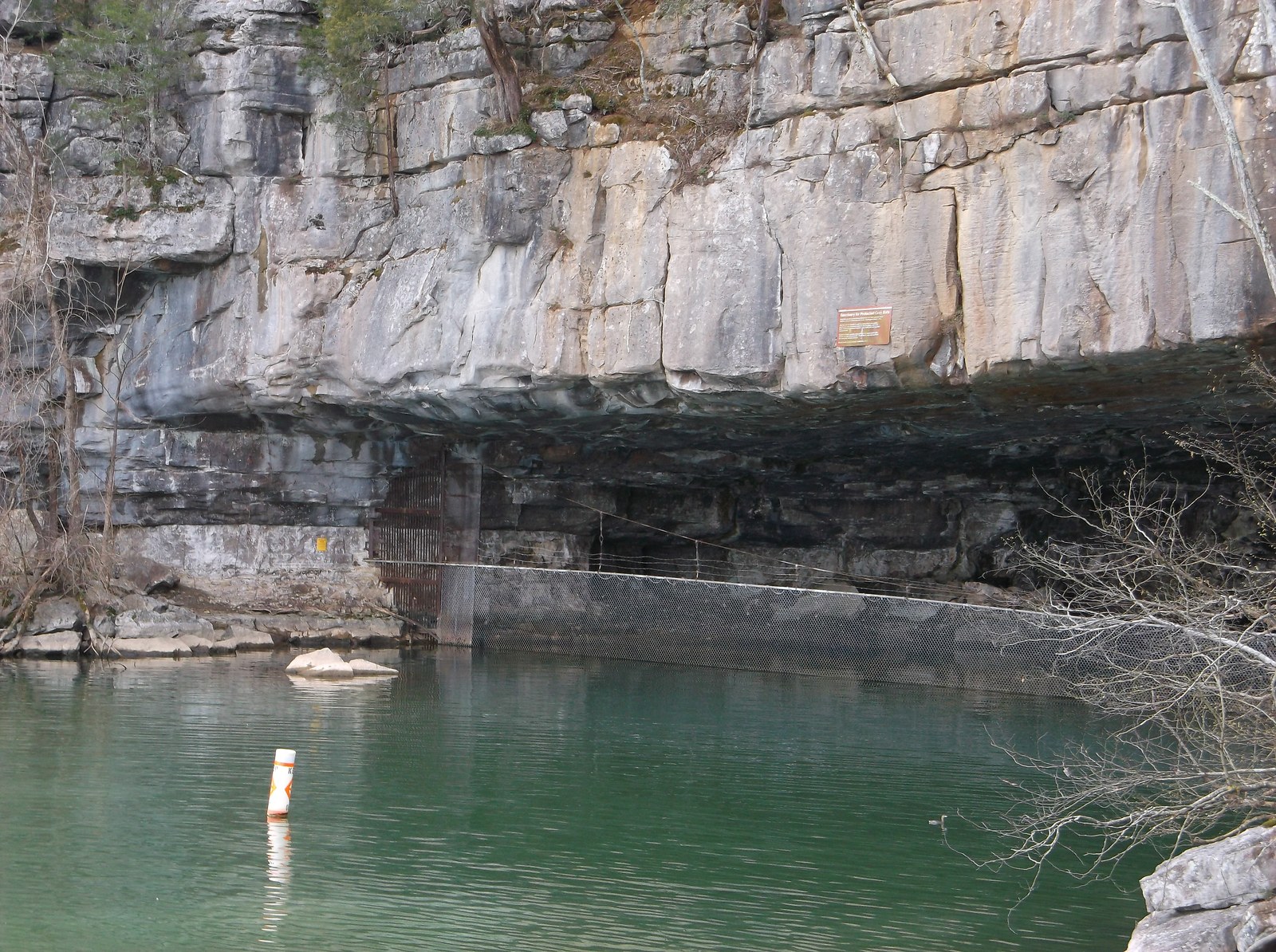
Nickajack Cave was centrally important: its entrance, roughly 140 feet wide and 50 feet high, served as a refuge and as a source of saltpeter for gunpowder. The cave was a spiritually significant landscape feature long before European contact.
The Chickamauga Wars (1776-1794)
For nearly two decades these towns anchored Cherokee resistance to American settlement. Raids by Chickamauga warriors and counter-raids by American militia defined frontier life in what is now Tennessee, northern Alabama, and northwest Georgia.
Dragging Canoe's death (1792)
Dragging Canoe died at Running Water on February 29, 1792, reportedly from exhaustion after an all-night celebration of a new alliance with the Creek and Choctaw. Sources vary on the exact date: the Tennessee Encyclopedia gives February 29 in its entry on the Chickamaugas and March 1 in its separate entry on Dragging Canoe, and both dates circulate in the broader historical literature. His hand-picked successor, John Watts (also called "Young Tassel"), was formally elected war chief in May 1792. Bloody Fellow, another prominent Chickamauga leader, was in Philadelphia at the time of Dragging Canoe's death, negotiating treaty terms with President Washington. After 1792, Watts led military operations while Bloody Fellow pursued diplomacy.
Joseph Brown's captivity
In May 1788, James Brown and his family were traveling by boat from Long Island on the Holston toward the Cumberland settlements. At Williams Island (near modern Chattanooga), Bloody Fellow let them pass but sent word ahead. At Nickajack, a party of roughly 40 warriors under the Cherokee leader John Vann boarded the boat, killing James Brown, two older sons, and five other men. Mrs. Brown and the surviving children, including young Joseph Brown, were taken prisoner and distributed among different families. The Breath, Nickajack's headman, was angered by the killings and adopted Joseph into his own family. Joseph lived among the Chickamauga for about a year before his release through a prisoner exchange, gaining detailed knowledge of the towns and surrounding terrain.
The Nickajack Expedition (September 13, 1794)
On September 13, 1794, a Southwest Territory militia of about 550 men under Major James Ore, guided by Joseph Brown, crossed Monteagle Mountain and attacked the Lower Towns. Brown's knowledge of the mountain passes made the surprise assault possible. Nickajack was burned first; Running Water was burned the same day. About 70 Cherokee were killed; only three Americans were wounded.
The raid was legally unauthorized: Tennessee's frontier leaders had acted without explicit federal approval. But it was decisive. Chickamauga resistance collapsed. Within two months, Cherokee chiefs Hanging Maw (Upper Cherokee) and John Watts (Lower Cherokee/Chickamauga) met with Governor William Blount at the Treaty of Tellico Blockhouse on November 8, 1794. The Lower Cherokee recognized the boundaries established in the earlier Treaty of Holston, prisoner exchanges were arranged, and hostilities formally ceased. No major new land cession was required beyond confirming existing boundaries. The Chickamauga Wars (1776-1794) were over.
What remained
Nickajack the town was not rebuilt. The cave, however, stayed in use. In 1800, a man named James Ore, reported in some sources as the same militia major who had led the 1794 expedition, began mining saltpeter at the cave with Cherokee permission, and the operation continued through the War of 1812. During the Civil War the Confederate Nitre and Mining Bureau reworked the cave for gunpowder, with illustrations of the operation appearing in Harper's Weekly (February 6, 1864) and Frank Leslie's Illustrated Newspaper (January 23, 1864). Federal troops occupied the area in late 1863 or early 1864 and shut the works down. The loss of Nickajack, one of the largest saltpeter caves the Confederacy operated, was a serious blow to Southern gunpowder production.
Commercial tours of the cave began by 1872, reached by steamboat from Chattanooga. In the 1940s Leo Lambert, who also developed Ruby Falls, operated Nickajack as a show cave before shutting it down by the late 1940s.
With the completion of Nickajack Dam on December 14, 1967, the mouth of the cave and the sites of the former towns were partially flooded by Nickajack Lake. The reservoir raised water levels 25 to 30 feet inside the cave entrance, leaving the above-water portion roughly 140 feet wide by 20 to 25 feet high. The cave entrance is today gated to protect an endangered gray bat colony and is managed as a Tennessee Wildlife Resources Agency wildlife refuge; the colony can be viewed from a TVA observation platform at the Maple View recreation area. Nothing of the original town structures remains above water.
Notable figures
- Dragging Canoe (c. 1738-1792), Cherokee war leader; founded the Lower Towns in 1779 and led the Chickamauga resistance until his death at Running Water.
- John Watts ("Young Tassel"), Dragging Canoe's successor as war chief from 1792 to 1794.
- John McDonald (c. 1747 to c. 1824), Scottish trader and British agent; made Running Water his base and supplied the Chickamauga. Grandfather of Cherokee principal chief John Ross through his daughter Mollie McDonald Ross.
- The Breath, headman of Nickajack who adopted captive Joseph Brown.
- Joseph Brown, former captive of the Chickamauga; his knowledge of the terrain made the 1794 expedition possible.
- Major James Ore, commander of the militia that destroyed the towns; reportedly the same James Ore who returned to mine saltpeter at Nickajack Cave beginning in 1800.
Modern significance
The destruction of Nickajack and Running Water is a foundational event in the history of Marion County. Every later story, the 1817 formation of the county, the Jasper land purchase from Betsy Pack, the industrial era, the modern communities, stands on what happened here in 1794. The site is commemorated today in place names (Nickajack Cave, Nickajack Lake, Nickajack Dam), in the New Hope and South Pittsburg vicinity, and in historical markers along the Tennessee River.
Related
The Cherokee Lower Towns →
Chiaha and the Koasati →
The Native American trails and the Old Creek Crossing →
The Chickamauga Wars, 1776–1794 →
The Nickajack Expedition, September 1794 →
The Trail of Tears through Marion County →
The TVA era in Marion County →
Nickajack Cave, Lake & Dam →
People of Marion County →
Sources
- Tennessee Encyclopedia — Chickamaugas
- Tennessee Encyclopedia — Dragging Canoe
- Tennessee Encyclopedia — John McDonald
- Tennessee Encyclopedia — John Ross
- Tennessee Encyclopedia — Marion County
- Wikipedia — Nickajack Expedition
- Wikipedia — Nickajack Cave
- Wikipedia — John Watts (Cherokee chief)
- Wikipedia — Tellico Blockhouse
- Dragging Canoe — Native History Association
- Much Tennessee history happened at Nickajack Cave — The Tennessee Magazine
- J. Leonard Raulston and James Weston Livingood, Sequatchie: A Story of the Southern Cumberlands (Knoxville: University of Tennessee Press, 1974), p. 39 (the 1782 relocation and the towns' locations on the river) and pp. 48–49 (the 1788 attack on the Brown family boat and Joseph Brown's year in captivity).