Last updated: April 27, 2026
- Earliest organized congregation: Union / Sweeten's Cove Primitive Baptist, circa 1821
- Oldest surviving building: Sweeten's Cove Primitive Baptist meeting house, 1853 (NRHP 1983)
- First Cumberland Presbyterian in the Sequatchie Valley: Ebenezer, circa 1830
- Oldest surviving Methodist building: McKendree Methodist Episcopal, 1875 (NRHP 1978)
- National Register churches: McKendree Methodist Episcopal (1978), Sweeten's Cove Primitive Baptist (1983), Whitwell Cumberland Presbyterian (2018), Ebenezer Cumberland Presbyterian (2020)
Marion County's religious landscape took shape in the 1820s through the 1840s, when scattered Primitive Baptist, Cumberland Presbyterian, and Methodist congregations organized along the Sequatchie Valley and the Battle Creek bottomlands. The late-19th-century coal and iron boom added Baptist and Methodist congregations in the industrial towns of South Pittsburg, Whitwell, and Richard City, and segregated Black congregations grew alongside them. Several of the oldest buildings survive and are listed on the National Register of Historic Places. Today the county remains heavily Baptist, Methodist, and Pentecostal, with Cumberland Presbyterian and independent holiness congregations also represented.
Oldest congregations
Three of the earliest confirmed organized congregations in what is now Marion County are Union Primitive Baptist in Sweeten's Cove, established around 1821 and renamed Sweeten's Cove Primitive Baptist in 1834; Ebenezer Cumberland Presbyterian near Jasper, organized about 1830 on land donated by John and Mary Oats Hoge and believed to have been the first Cumberland Presbyterian church in the Sequatchie Valley; and Cheekville Cumberland Presbyterian, organized 1842 and renamed Whitwell Cumberland Presbyterian in 1878 when the town itself was renamed.
Primitive Baptist presence
The Primitive Baptist tradition has been in Marion County since its first decade. The Primitive Baptist Church of Sweeten's Cove, organized around 1821 in the Sequatchie Valley about seven miles north of South Pittsburg, is one of the oldest continuously documented congregations in the county. It was originally called Union Primitive Baptist and took the Sweeten's Cove name in 1834. The current Greek Revival meeting house was completed in 1853 and was added to the National Register of Historic Places on June 30, 1983 (NRHP ref. no. 83003050). The congregation's early history is tied to the Beene (Bean) and Raulston (Roulston) families, whose descendants are buried in the nearby Bean-Roulston Cemetery. A handwritten minute book covering 1821 to 1904 is held in Special Collections at the University of Tennessee at Chattanooga.
A second Primitive Baptist building, the “Chapel on the Hill” in South Pittsburg, is also preserved. That congregation organized on November 20, 1886 in a frame schoolhouse, with members carrying letters of standing from the older Sweeten's Cove and Jasper Primitive Baptist congregations. Construction of the sandstone building began in 1888 under contractor Angus McRae of Sewanee and was completed in spring 1889, using stone quarried at Sewanee and hauled to the site by horse-drawn wagons. Owen Russell Beene transferred the property to trustees on May 17, 1889. The congregation operated for ninety years and dissolved in 1979 due to declining membership; ownership reverted to Beene's heirs and was conveyed to the City of South Pittsburg in 2001. The building is part of the South Pittsburg Historic District on the National Register of Historic Places, was incorporated into the Southeast Tennessee Heritage Religious Trail in December 2007, and is now restored as a public events space rented for weddings and receptions to support its maintenance fund.
Cumberland Presbyterian history
The Cumberland Presbyterian Church, founded in Dickson County, Tennessee in 1810, reached the Sequatchie Valley within about twenty years. Ebenezer Cumberland Presbyterian, organized circa 1830 about three miles from Jasper on Griffith Highway, was founded by Elisha Blevins and John Kelly and is believed to have been the first Cumberland Presbyterian congregation in the valley.
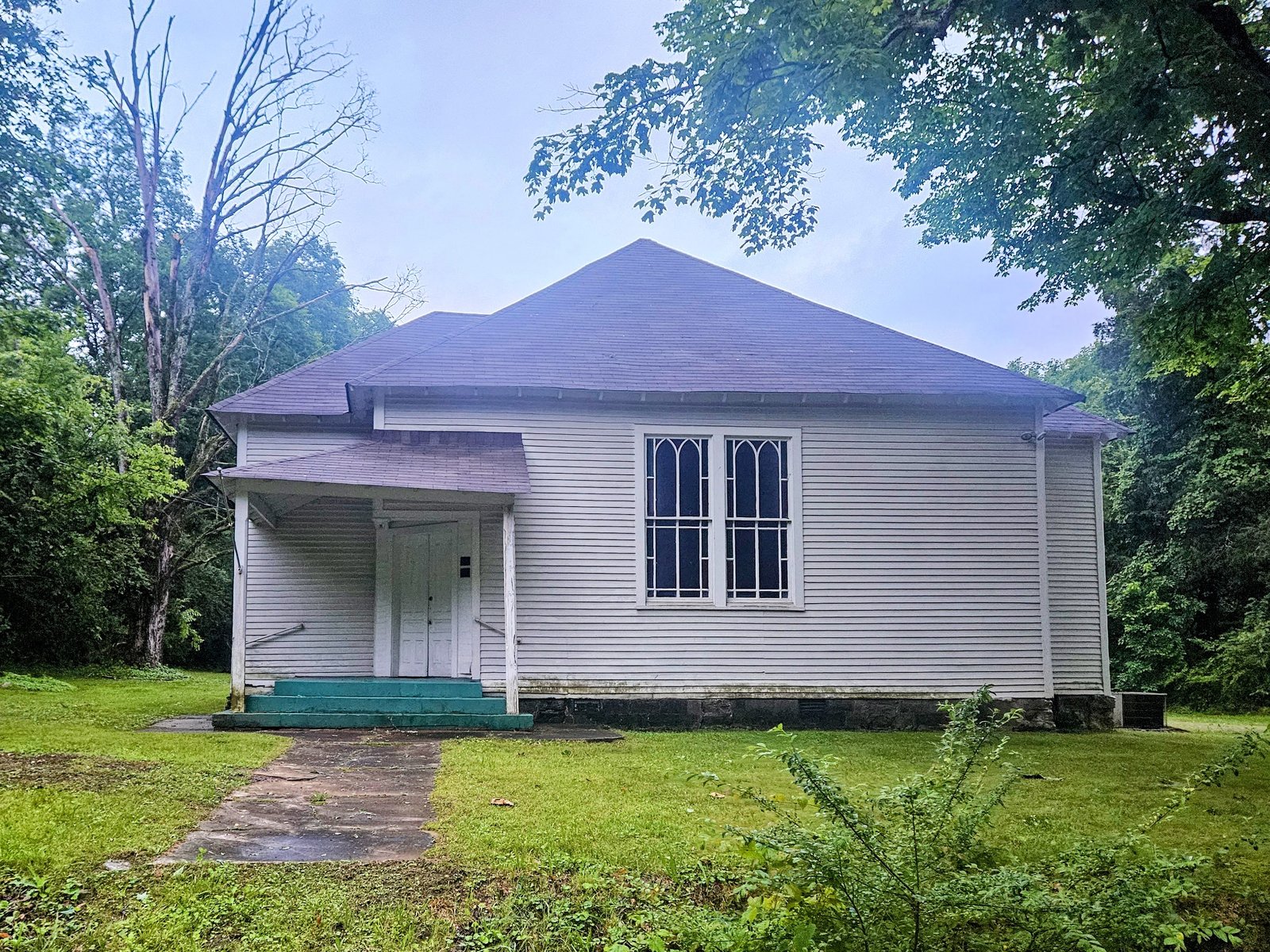
The original building was destroyed by a storm described at the time as a "cyclone" (almost certainly a tornado) in 1854, and a replacement was destroyed by another such storm in 1909. After the 1909 storm, members salvaged a pot-bellied stove and pews from the wreckage. The present building dates to roughly 1914. Its architecture is vernacular, with pointed stained glass windows, a pyramidal (hipped) roof, a roughly square form, and a corner entry that the National Register nomination describes as "atypical of most churches in Tennessee." The interior retains the original pews and stove. Church session minutes from 1889 to 1918 are preserved in the WPA records at the Tennessee State Library and Archives (Record Group #107, Roll 57). Ebenezer was added to the National Register of Historic Places on June 15, 2020. Read more about the Ebenezer community →
In the north end of the county, Cheekville Cumberland Presbyterian organized in 1842 and was renamed Whitwell Cumberland Presbyterian in 1878 when the community took on its new name.
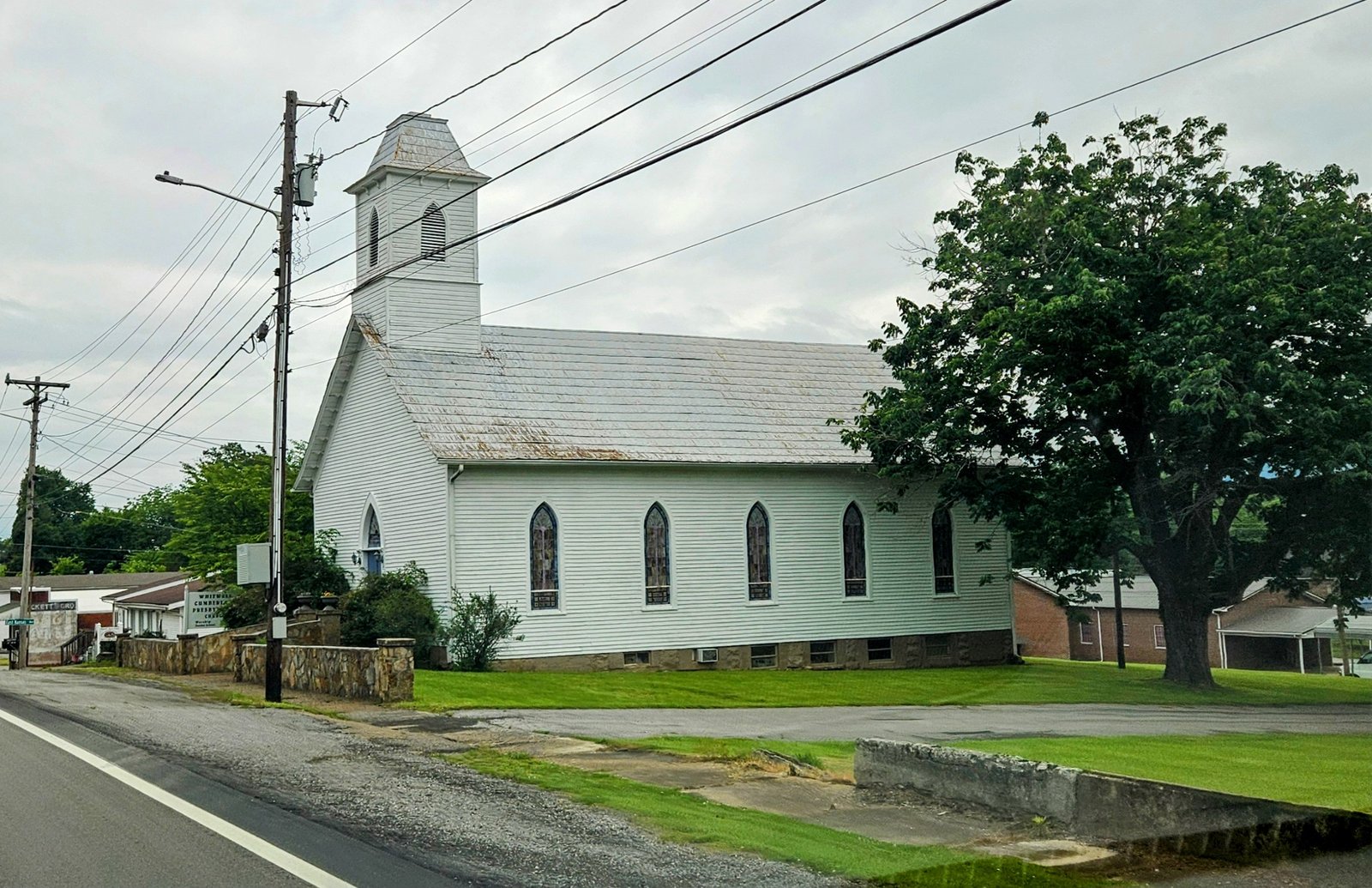
The present Gothic Revival frame building was constructed around 1892 at 876 South Main Street in Whitwell. Its exterior features arched windows, a gable-front rectangular plan, weatherboard siding with distinctive decorative notching, a central square belfry, and a pressed tin ribbed scalloped shingle roof. The interior retains original wood pews, pulpit, and hardwood floors. As of 2018, the congregation had fewer than ten members and shared a pastor with two other Cumberland Presbyterian churches. The building was added to the National Register of Historic Places on November 26, 2018.
South Pittsburg also had a Cumberland Presbyterian congregation in the late 19th and early 20th centuries. Their 1891 sanctuary at the corner of Holly Avenue and 6th Street was a frame meeting house that anchored Cumberland Presbyterian witness in the industrial town. The building was destroyed by fire on December 1, 1929, and the congregation did not rebuild on the site; the lot has since been redeveloped.
Methodist history
Methodism spread into the Sequatchie Valley and the Battle Creek area during the mid-1800s through the itinerant circuit-rider system common to the Tennessee frontier. The oldest surviving Methodist building in the county is the McKendree Methodist Episcopal Church, built in 1875 at 503 Betsy Pack Drive in Jasper. The church was named after Bishop William McKendree, the first American-born bishop of the Methodist Church. More recently known as McKendree United Methodist Church, the congregation relocated to 106 Highway 150, and the historic 1875 building now houses Faith Baptist Church. McKendree Methodist Episcopal Church was added to the National Register of Historic Places on November 21, 1978 (NRHP ref. no. 78002607). A Methodist church was also active in South Pittsburg by 1888 (it hosted the founding meeting of South Pittsburg First Baptist on January 23, 1888), and a Methodist Episcopal Church was standing at Magnolia Avenue and 3rd Street in South Pittsburg by 1911. Methodist congregations also operated in smaller communities throughout the valley and on the plateau, and the Pine Grove Cemetery in Jasper carries headstones with M.E. Church South inscriptions confirming the Southern Methodist presence in the county through the late nineteenth century.
Baptist congregations in the industrial towns
The 1870s and 1880s coal and iron boom added new Baptist congregations in the industrial towns. First Baptist Church of South Pittsburg was founded January 23, 1888, with its first meeting held in the local Methodist church. First Baptist Church of Whitwell marked 100 years of ministry in 1993, indicating a founding date around 1893. Mount Moriah Primitive Baptist Church, in the New Hope community, has church records dating from 1888 to 1916, preserved at the Tennessee State Library and Archives. Sulphur Spring M.E. Church South, also in Marion County, has a church register covering 1887 to 1928, held in the WPA church records at TSLA (Roll 57).
Pentecostal and holiness traditions
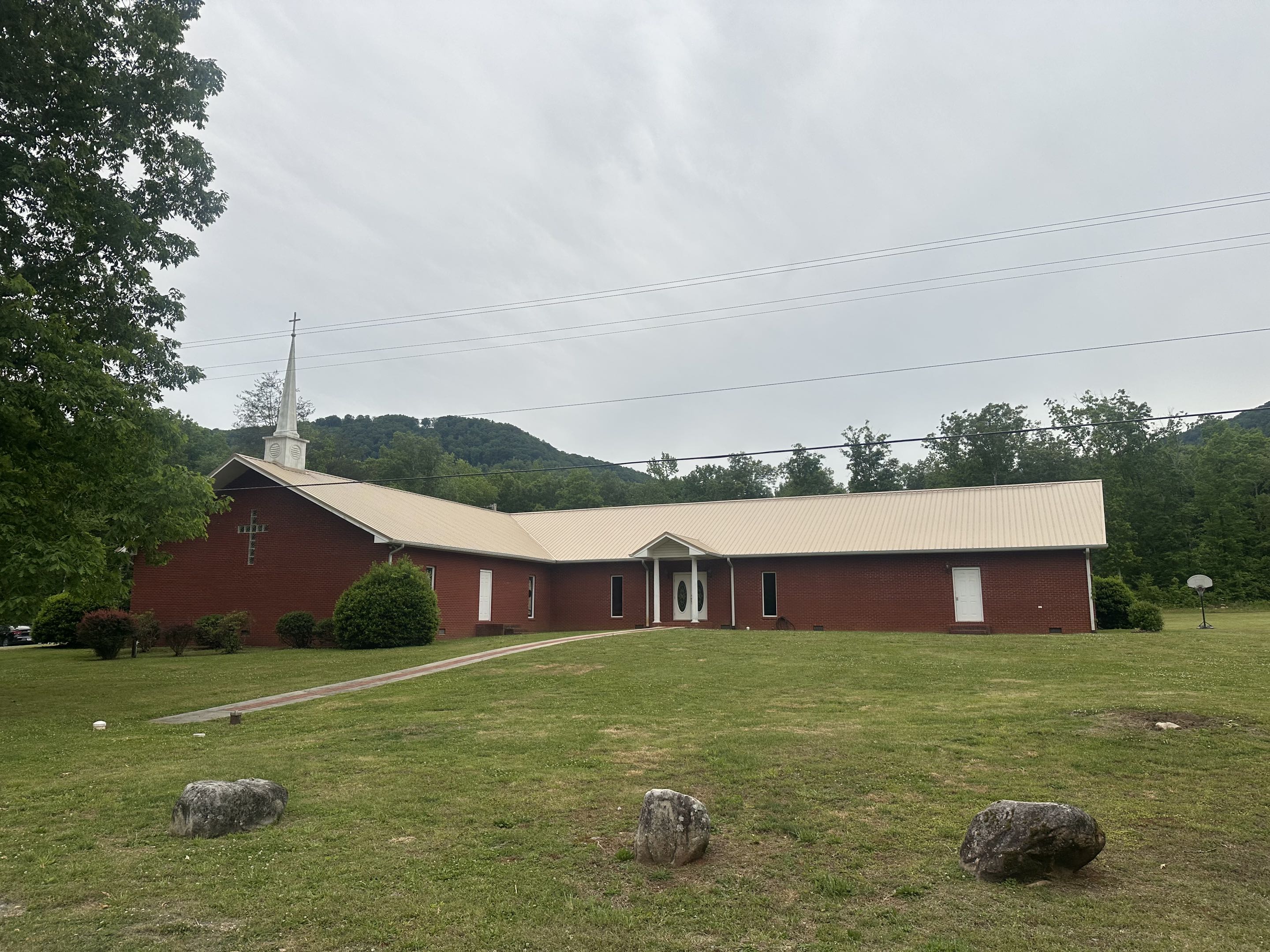
Twentieth-century Pentecostal and holiness traditions, rooted in the Methodist revival movement and the 1901 Topeka outpouring, spread widely on the Cumberland Plateau and remain a significant denominational presence in Marion County today. According to the Tennessee Encyclopedia, the holiness and Pentecostal movements became the most significant denominational competition to the Baptist, Methodist, Presbyterian, and Church of Christ traditions in Tennessee during the twentieth century. Cumberland Mountain Church of God, at 4902 Mount Olive Road on the plateau above Whitwell, was founded in 1935 and is one of the older documented Pentecostal congregations in the county, affiliated with the Church of God (Cleveland, Tennessee). Several other independent Pentecostal and holiness congregations are active in Marion County today.
Historic Black churches
Before desegregation, South Pittsburg had a robust Black community organized around several churches, concentrated in the area bounded by Cedar Avenue, 2nd Avenue, and Laurel Street. Documented historic Black congregations in South Pittsburg include:
- Mt. Bethlehem Baptist Church, still active at 103 Elm Avenue, South Pittsburg
- Randolph Chapel M.E. Church (Methodist Episcopal), which hosted the Odd Fellows' annual Thanksgiving service in the early 1900s
- A First Baptist Church, a congregation distinct from the white First Baptist
- An A.M.E. church and an A.M.E. Zion church
In 1910, Marion County had 2,289 Black residents, about 12 percent of the population, and these churches were the main social, educational, and civic anchors of that community through the segregation era. The surrounding congregations were the core community that raised money to build, rebuild, and sustain McReynolds High School, the county's first Black high school, which opened in 1917 and moved into its 22-room purpose-built campus in 1921. Funding for the school came from county funds, the Julius Rosenwald Fund, and local donations. The Black History of Marion County page places these congregations in the broader context of Black community life from Reconstruction through the present.
Regional religious influence
Just over the county line in Grundy County, the Monteagle Sunday School Assembly has shaped regional Protestant life since 1882. The Tennessee Sunday School Convention chartered the Assembly on October 16, 1882 as a Chautauqua-model summer assembly for training Sunday School teachers. The first session opened July 17, 1883, with more than a thousand attendees. The Tennessee Coal and Railroad Company and town founder John Moffat each contributed a $5,000 grant, and the railroad donated about 1,100 acres. The Assembly was soon recognized as the southern headquarters of the Chautauqua Literary and Scientific Circle and remains one of only a handful of original Chautauqua-lineage assemblies still active. Its influence, drawing visitors and speakers to the southern Cumberland Plateau, spilled into Marion County via the Monteagle Mountain I-24 corridor.
Why it still matters
The oldest surviving meeting houses, Sweeten's Cove Primitive Baptist, Whitwell Cumberland Presbyterian, Ebenezer Cumberland Presbyterian, and the Chapel on the Hill, anchor a religious history that is older than the county government itself. The post-industrial churches of South Pittsburg, Whitwell, and Richard City mark the second wave of settlement, and the Black congregations of South Pittsburg preserved community identity and education through segregation. Marion County's religious institutions are among the longest-standing continuous organizations in the county.
Church burial grounds and cemeteries
The earliest congregations left their longest-continuous physical record not in their buildings, many of which have burned, blown down in tornadoes, or been rebuilt, but in their cemeteries. Sweeten's Cove Primitive Baptist, Ebenezer Cumberland Presbyterian, McKendree Methodist, Whitwell Cumberland Presbyterian, and the Chapel on the Hill all have associated burial grounds that predate their current buildings. The Kelly's Ferry Cemetery in western Marion County, the only NRHP-listed cemetery in the county, contains burials from the congregation that worshipped at the Kelly's Ferry community before it disappeared under 20th-century river impoundment. Read more about Marion County cemeteries →
Related
Churches of Marion County →
Chapel on the Hill (South Pittsburg) →
Cemeteries of Marion County →
About Sweeten's Cove →
About Jasper →
About Whitwell →
About McReynolds High School →
Black History of Marion County →
The Civil Rights Era in Marion County →
Sources
- Wikipedia — Primitive Baptist Church of Sweeten's Cove
- UTC Special Collections — Minutes of Sweeten's Cove Primitive Baptist Church, 1821 to 1904
- Wikipedia — Whitwell Cumberland Presbyterian Church
- Wikipedia — Ebenezer Cumberland Presbyterian Church
- Cumberland Presbyterian Church — Ebenezer added to National Register
- Jasper First Baptist Church — Our History
- First Baptist Church of South Pittsburg
- South Pittsburg Historic Preservation Society — Chapel on the Hill
- Wikipedia — McReynolds High School
- HMdb — McReynolds High School Historical Marker
- Mt. Bethlehem Baptist Church, South Pittsburg
- Tennessee Encyclopedia — Religion
- Tennessee Encyclopedia — Marion County
- Tennessee Secretary of State — Genealogical Fact Sheets About Marion County
- Tennessee Encyclopedia — Monteagle Sunday School Assembly
- Wikipedia — Monteagle Sunday School Assembly
- Wikipedia — McKendree Methodist Episcopal Church
- TSLA — Church Records in the Tennessee State Library and Archives