Last updated: April 28, 2026
- Type: Family-name hamlet on South Pittsburg Mountain
- Named for: The Raulston family, prominent in Marion County since the early 19th century
- Location: South Pittsburg Mountain, near present-day South Pittsburg Municipal Park
- Notable Raulstons: John T. Raulston (1868–1956), the Scopes Trial judge; Sam Polk Raulston, judge
- Civil War sites: Federal fortifications at Tom Ellis's old home place and on Red Cut Hill
- Pioneer cemetery: South Pittsburg Mountain pioneer cemetery near Whitacre Point, with graves dating to 1829
Raulstontown is a hamlet on South Pittsburg Mountain just above the city of South Pittsburg, in the southwestern part of Marion County. The community takes its name from the Raulston family, one of the county's prominent 19th- and 20th-century legal and civic families. The hamlet's most-remembered son is John T. Raulston, the federal-style state judge born here in 1868 who presided over the 1925 Scopes Trial in Dayton, Tennessee. During the Civil War, the same Raulston-family ground saw federal fortifications at Tom Ellis's old home place and on the nearby Red Cut Hill, and the South Pittsburg Mountain pioneer cemetery near Whitacre Point, with graves dating to 1829, marks the early-settlement footprint of the Raulston-family cluster.
Setting
South Pittsburg Mountain is the local name for the western shoulder of Walden's Ridge as it descends to the Tennessee River at the South Pittsburg site. The ridge rises sharply from the river bottom, and Raulstontown sits on the upper slope above the city, reached today by Raulstontown Road. The hamlet is not a single crossroads but a scatter of family homesteads strung along the mountain road, with the present-day South Pittsburg Municipal Park on the lower slope serving as the modern civic anchor for the area. Whitacre Point, the bluff overlooking the river that gave its name to the post-Civil-War mining stake the British investors developed into South Pittsburg, is north-east of Raulstontown along the same ridge.
The mountain ground was settled early. The pioneer cemetery on South Pittsburg Mountain near Whitacre Point holds graves dating to 1829, eight years before Marion County's first court moved from Cheekville to Jasper, and a generation before British capital arrived to build the iron town below. The Raulstons were among the early-settler families clustered along the mountain road, and their multi-generational hold on this ground is what gave the hamlet its name.
Civil War: fortifications above the river
Raulstontown's strategic value during the Civil War came from its commanding position above the river crossing at South Pittsburg. Federal forces operating in the lower Tennessee River corridor between 1862 and 1864 used the high ground above the future city to watch the Bridgeport, Alabama crossing and the Battle Creek mouth, both critical choke points on the supply line into Chattanooga. Period accounts preserved in the South Pittsburg Historic Preservation Society's history of the city record federal earthworks and rifle pits at Tom Ellis's old home place at Raulstontown and on the adjacent Red Cut Hill, the cut where a wagon road and later the Nashville, Chattanooga & St. Louis Railway crossed the mountain.
These positions were not the major engagements of the regional Civil War record. The nearby Fort McCook on Battle Creek and the Confederate works on Sand Mountain across the river were larger. The Raulstontown and Red Cut Hill works were watching positions and supply-line guards, occupied intermittently by Union cavalry and infantry detachments during the long stretch of federal control of the lower river that followed the Federal seizure of Bridgeport in the summer of 1862. The Tom Ellis home site is no longer marked; Red Cut Hill remains identifiable on modern topographic maps along the old NC&StL grade.
The Raulston family
The Raulston family appears in Marion County records from the 1820s onward, with the first generations clustered on South Pittsburg Mountain alongside the Ellis family, the Whitacre family, and other early settlers of the high ground above the river. The family produced several generations of attorneys and judges, two of whom carried the name into statewide and national prominence.
Sam Polk Raulston served as a Marion County judge in the late 19th and early 20th centuries; he is buried in the county and is named in the Tennessee Encyclopedia among the notable jurists associated with Marion. His career, like his family's broader legal practice, was anchored at South Pittsburg, where the Raulstons kept law offices through the iron-and-foundry era.
John T. Raulston, the Scopes Trial judge
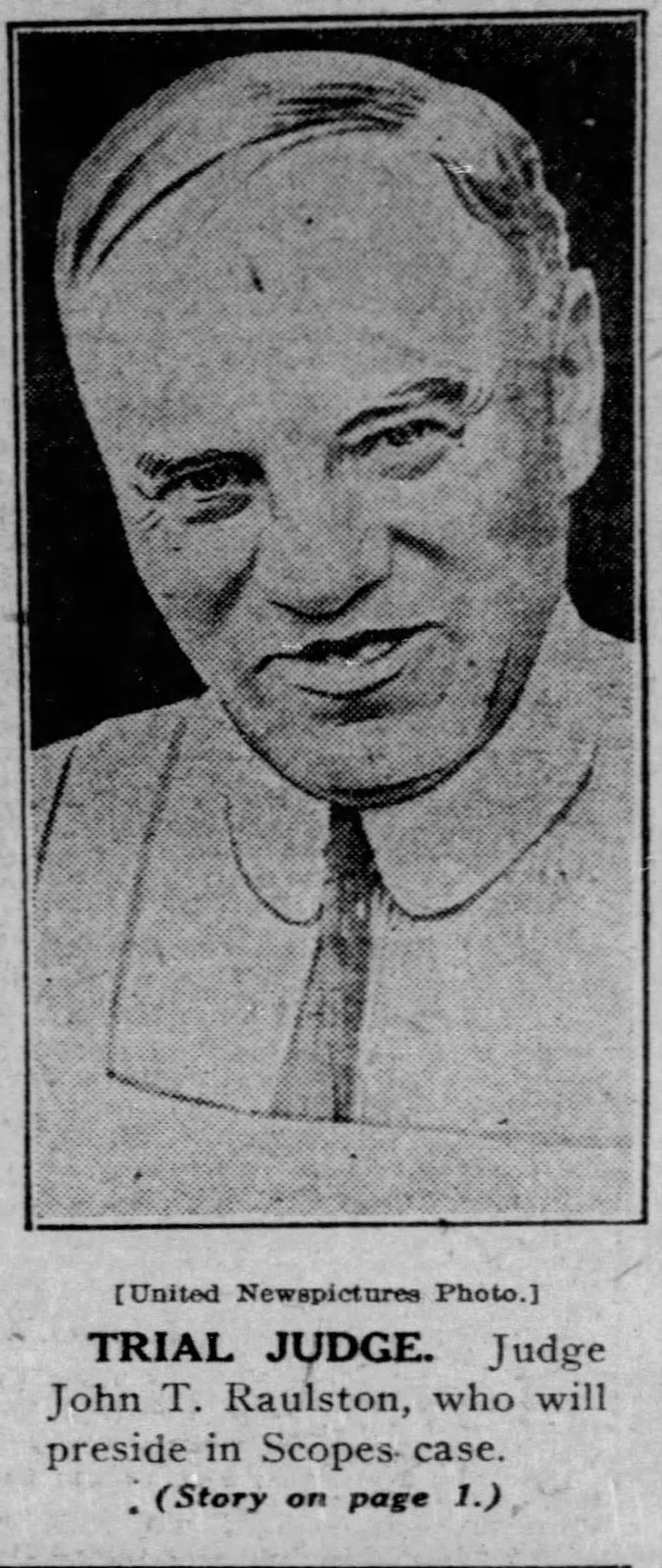
John Tate Raulston (September 22, 1868 – July 11, 1956) is the most-remembered figure connected to Raulstontown. He was born on a small farm in Marion County to William Doran Raulston and Comfort Matilda Tate, attended country schools and then U.S. Grant University (later Tennessee Wesleyan College) and the University of Chattanooga, read law in the office of William D. Spear at Jasper, and was admitted to the bar in 1896. In 1918 he was elected judge of the Eighteenth Tennessee Circuit, which included Rhea County, and in that role presided over the 1925 trial of John Scopes, the Dayton high-school teacher prosecuted under Tennessee's anti-evolution Butler Act.
The Scopes Trial drew national press coverage, with William Jennings Bryan leading the prosecution and Clarence Darrow leading the defense. Raulston opened each day's proceedings with prayer, barred testimony from theology and natural-science experts as inadmissible, ruled that Scopes was on trial rather than the Butler Act itself, and cited Darrow for contempt after a heated exchange (later dropped when Darrow apologized). Concerned the weight of the crowd would collapse the courthouse floor, Raulston moved the trial outside to the courthouse lawn. Scopes was convicted and fined $100; the Tennessee Supreme Court reversed the conviction on a technicality. The broader Butler Act remained on Tennessee's books until 1967, but the trial itself entered the cultural canon of the 20th-century United States and was fictionalized in the play and films Inherit the Wind, where Raulston appears as Judge Merle Coffey.
Raulston was defeated for re-election to his judgeship in 1926. He lectured on the legal aspects of fundamentalism, ran unsuccessfully for governor of Tennessee as a Republican, and practiced law with the firm Raulston, Raulston, and Swafford until retiring in 1952. Late in life he modified his stance and said the state should not restrict science education. He died in South Pittsburg on July 11, 1956 at the age of 87, and is buried at Cumberland View Cemetery in Kimball in Marion County, not at the Raulstontown family ground. More about John T. Raulston on the people page →
The South Pittsburg Mountain pioneer cemetery
The pioneer cemetery on South Pittsburg Mountain near Whitacre Point is the closest thing the hamlet has to a documented institutional anchor. Graves date from 1829 forward, predating Marion County's relocation of the seat to Jasper by a decade and the British-capital iron-town development at South Pittsburg by nearly five decades. The cemetery sits on the mountain shoulder above the city, on ground the Raulston family and their early-settler neighbors used as a community burying ground from the first generation of permanent settlement onward. The South Pittsburg Historic Preservation Society's history of the city names this cemetery as the principal evidence of pre-industrial settlement on the mountain.
Present day
Raulstontown remains a small named place on present-day road and weather maps, identified by Raulstontown Road, the road that gives the hamlet its name. The hamlet has no separate civic infrastructure; municipal services come up the mountain from South Pittsburg, and the population is scattered along the road network rather than concentrated at any single crossroads. Property listings at addresses such as 1130 Raulstontown Road appear regularly in regional real-estate databases, preserving the place name as a present-day mailing address even though the hamlet has no incorporated identity. The Raulston name and the family's legal-history footprint are the principal civic legacies the hamlet still carries.
Related
South Pittsburg →
John T. Raulston on the people page →
Civil War in Marion County →
Fort McCook on Battle Creek →
Other named places in Marion County →
Sources
- Wikipedia — John T. Raulston (Scopes Trial judge)
- Find a Grave — John Tate Raulston (1868–1956)
- Britannica — John Raulston (American judge)
- Famous Trials — Judge John T. Raulston (Scopes biography)
- Marion County News — South Pittsburg 150th Celebration history (Raulstontown, Tom Ellis's old home, Red Cut Hill, Civil War fortifications) [archived May 2023]
- South Pittsburg Historic Preservation Society — SPHistory1 (early settlement and the South Pittsburg Mountain pioneer cemetery)
- Tennessee Encyclopedia — Marion County (Raulston family, county jurists)