Last updated: April 23, 2026
- Type: Unincorporated rural community and named locality
- Location: About three miles from Jasper along Griffith Highway, in the Sequatchie Valley
- Anchor institution: Ebenezer Cumberland Presbyterian Church (organized ca. 1830; present building ca. 1914)
- NRHP listing: Ebenezer Cumberland Presbyterian Church, June 15, 2020 (NRHP 100004698)
Ebenezer is a rural community in the Sequatchie Valley just north of Jasper, tied closely to the congregation of the same name. The church, organized around 1830 on land donated by John and Mary Oats Hoge, is believed to have been the first Cumberland Presbyterian congregation in the Sequatchie Valley. A small cluster of farms, a long-running school, and a handful of scattered homes have shared the Ebenezer name ever since. Today the surrounding valley floor is mostly agricultural land and cattle pasture, with the church building and its cemetery as the most enduring public landmarks.
Setting
Ebenezer occupies the flat bottomland of the Sequatchie Valley about three miles north of Jasper, strung along Griffith Highway between the town limits and the community of Sequatchie. The Cumberland Plateau escarpment rises to the west, with Griffith Creek draining down into the valley from the plateau rim; the main Sequatchie River runs along the eastern side of the community. Soils here are deep and heavy river-bottom alluvium, good for corn and cattle, and the community has always been more a stretch of connected farms than a compact village. The church building at 3040 Griffith Highway and its cemetery are the main landmarks on the ground. The name Ebenezer, from the Hebrew for "stone of help," comes from the Cumberland Presbyterian congregation organized on this ground around 1830 on land donated by early Anglo-American settlers John and Mary Oats Hoge, and it has traveled with the farming community ever since.
The valley floor here carried long Indigenous use before the Hoge land grant. Archaeological sites along the Sequatchie River and at the mouth of Griffith Creek document Archaic and Woodland occupation, and the bottomland fell within the Mississippian agricultural world between about AD 900 and 1600. By the late 18th century the valley was part of the Chickamauga (Lower) Cherokee homeland, and Cherokee households continued to hold land in the valley after 1794; under the Treaty of 1819 several took 640-acre reservations nearby, and the remaining Cherokee community was forcibly removed along the Trail of Tears in 1838. The Cherokee Nation continues today as a sovereign nation headquartered in Oklahoma.
The church and its congregation
The Cumberland Presbyterian denomination was born in the same revival waters that produced Tennessee's first common schools and circuit-riding churches. Ebenezer Cumberland Presbyterian was organized around 1830 on land across the road from the present church building, on property donated by John and Mary Oats Hoge. It is believed to have been the first Cumberland Presbyterian church in the Sequatchie Valley, and the denomination spread to Whitwell, Dunlap, and the rest of the valley within about twenty years.
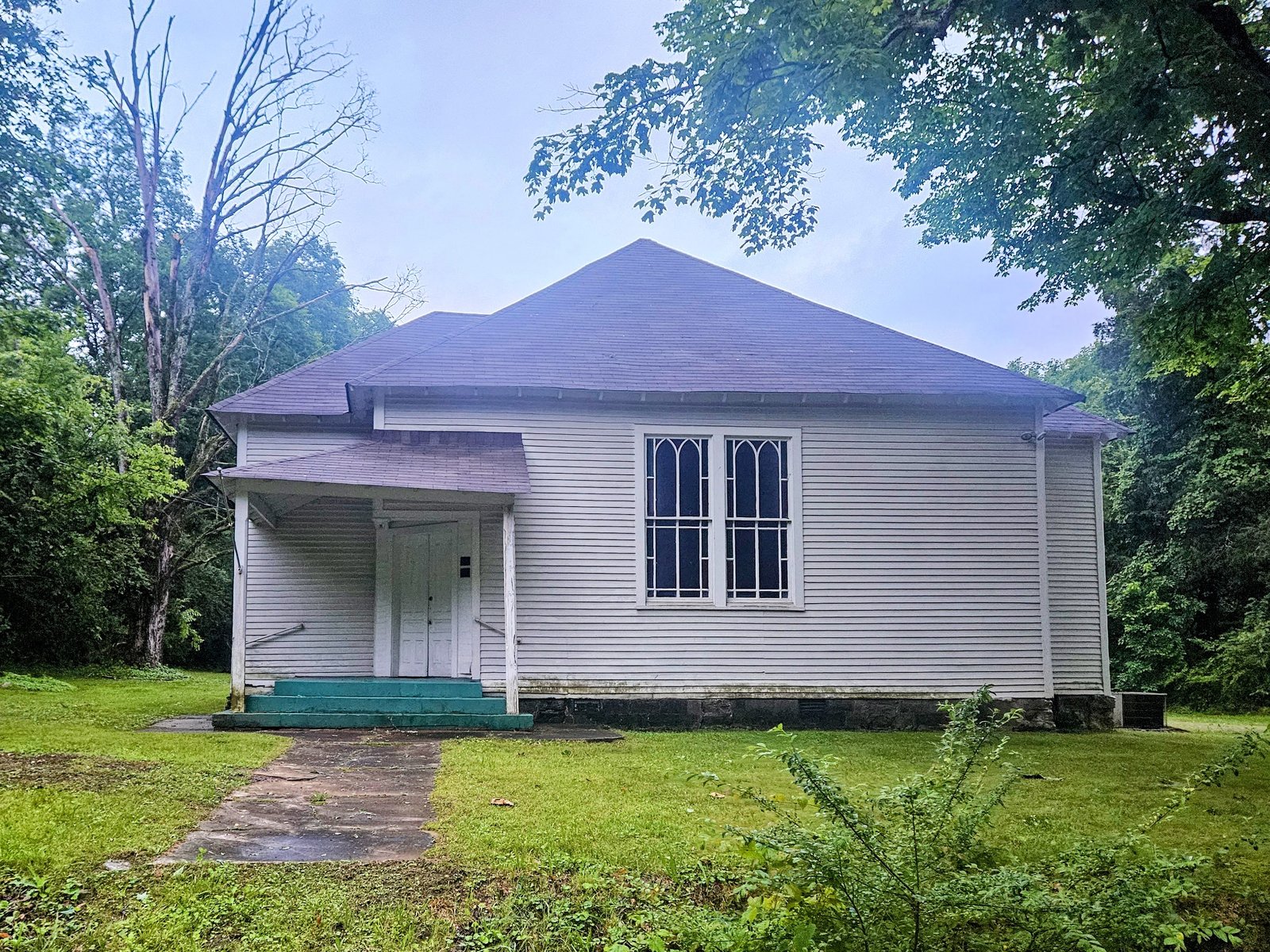
The congregation has lost its building twice. In 1854 and again in 1909, the church was destroyed by what local newspaper accounts variously described as cyclones, hurricanes, and tornados. The present building, constructed around 1914, is built in a vernacular style with pointed stained-glass windows that suggest Gothic Revival detailing, and is unusual in Tennessee for its pyramidal roof atop a roughly square plan with a corner entry. Congregants saved the pot-bellied stove and pews from the second destroyed building and reinstalled them in the 1914 replacement, where they remain in use.
Ebenezer Cumberland Presbyterian Church was listed on the National Register of Historic Places on June 15, 2020.
Ebenezer School
Ebenezer School served the farming families of the community through the era of one-room and small community schools. It appears in the TNGenWeb Marion County schools roster and in Nonie Webb's in-progress catalog Old Schools, Teachers, & Students of Marion Co., Tennessee, where it is flagged as the subject of a forthcoming school-history book. Exact opening and closing dates for the Ebenezer school building are not confirmed in available public sources; like most of the county's rural schools, it would have consolidated into the Marion County Schools district between roughly 1940 and the early 1960s. See the historical schools page →
The Hoge family and the land
John and Mary Oats Hoge donated the land for the original Ebenezer church building around 1830, placing them among the earliest Anglo-American settler families in the north Sequatchie Valley end of Marion County. Church records from 1889 to 1918 include Hoge family records going back to 1794, which suggests continuity between the community's founding families and the valley's first-generation Anglo-American settlers. A fuller account of the surname lines in the valley is on the first settlers page.
Present-day Ebenezer
Ebenezer today is a residential and agricultural community along Griffith Highway between Jasper and the Sequatchie community, with the church building (3040 Griffith Highway) and its cemetery as the most visible public landmarks. Students attend schools in the Marion County Schools district. The county's historical marker program recognizes the church as a site of local significance.
Related
Religious history of Marion County →
Historical schools of Marion County →
First settlers of Marion County →
Jasper →
Sequatchie community →
Sources
- Wikipedia — Ebenezer Cumberland Presbyterian Church
- Cumberland Presbyterian Church — Ebenezer added to National Register
- Tennessee Encyclopedia — Cumberland Presbyterian Church
- Cumberland Presbyterian Historical Foundation — Tennessee Churches
- TNGenWeb Marion County — Old Schools (Ebenezer School listed)