Last updated: April 28, 2026
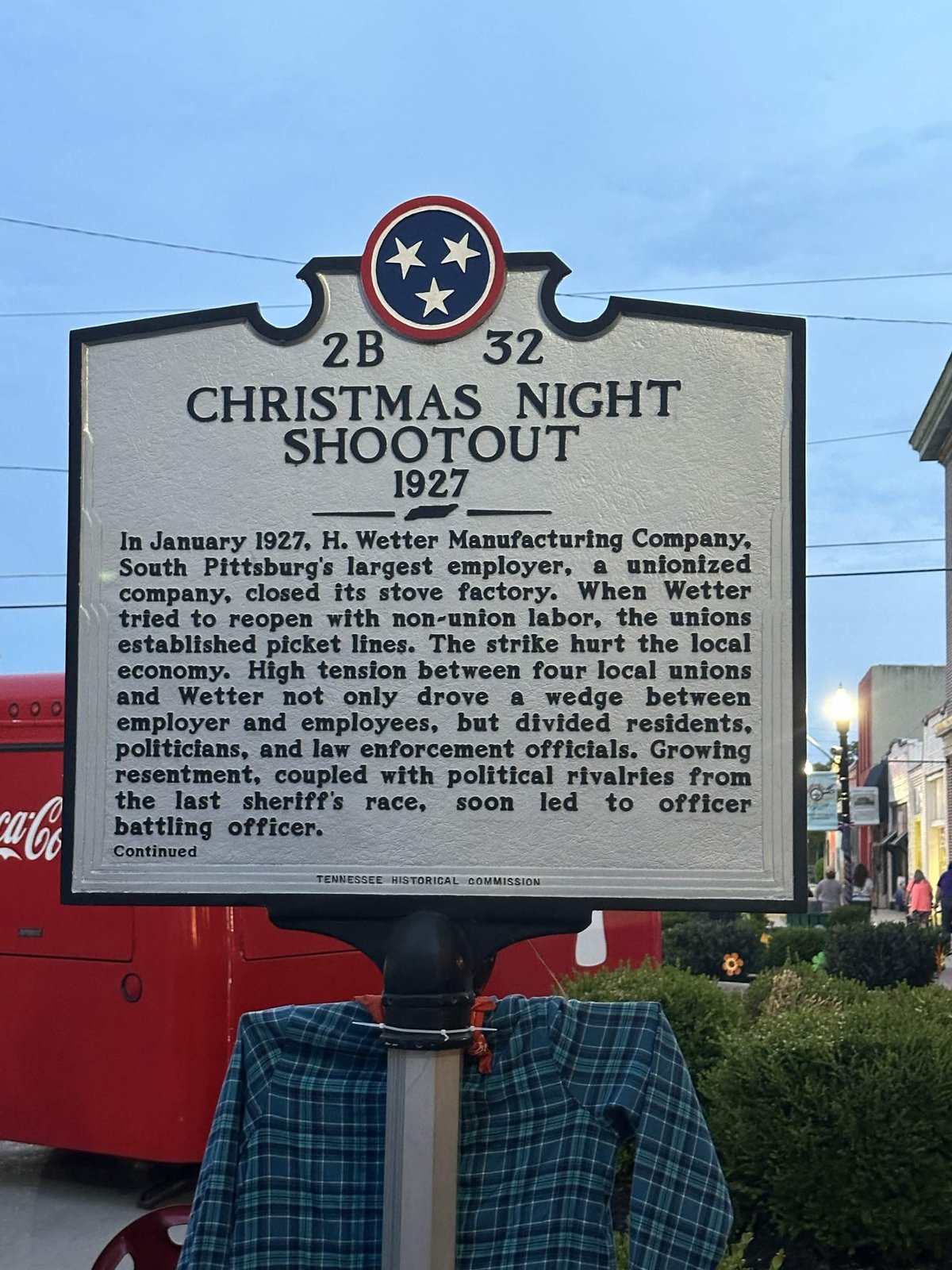
On the night of December 25, 1927, between nine and ten o'clock, six law-enforcement officers were shot down on Cedar Avenue in downtown South Pittsburg. Marion County Sheriff George Washington "Wash" Coppinger, his deputy, the South Pittsburg chief of police, two city marshals, and a guard at the H. Wetter Manufacturing Company stove plant all died in a single exchange of gunfire that the local South Pittsburg Hustler called, in its January 5, 1928 lead headline, “SIX OFFICERS SLAIN IN GUN BATTLE HERE ON CHRISTMAS NIGHT.” Three more men were wounded. By the next morning, the city was under Tennessee National Guard patrol on Governor Henry H. Horton's orders. The shootout was the climax of an eight-year labor dispute at the Wetter plant that had divided the town's residents, politicians, and law-enforcement officials, and is preserved today on a Tennessee Historical Commission marker at the corner of Cedar and Third.
The H. Wetter Manufacturing plant
The stove factory at the heart of the dispute had a long Marion County history. Per Wikipedia's history of the United States Stove Company, it opened in June 1886 as the South Pittsburg branch of the Perry Stove Company, an Albany, New York manufacturer that John S. Perry began in 1843 and reorganized as Albany Stove Works in 1869. More than five hundred men were hired into the new South Pittsburg foundry along the Tennessee River. The plant suffered a fire and a boiler explosion in its early years but reopened and grew. In 1891 management signed a national trade agreement with the International Molders Union of North America, and South Pittsburg became a heavily unionized industrial town, with most of the foundry workforce belonging to the Molders Union; Local 165 at South Pittsburg was one of the largest and oldest locals of the Molders Union in the South.
In 1902, a Memphis-based competitor, the H. Wetter Manufacturing Company, lost its primary factory to fire. Rather than rebuild, the company bought the South Pittsburg facility and merged its production into the existing plant. From 1902 until 1929, the South Pittsburg foundry operated under the H. Wetter Manufacturing name. By the 1920s the plant was the largest employer in the town, and a substantial share of the working-age adults in South Pittsburg drew weekly pay from the foundry. The Wetter plant ran along Cedar Avenue and was the visible spine of South Pittsburg's industrial economy.
The eight-year labor dispute
H. Wetter's owners brought to South Pittsburg an anti-union management posture that sat in direct conflict with the strong shop the Molders Union had built under Perry. Through the 1920s and early 1930s the foundry was the site of roughly eight years of bitter labor disputes in which the unions fought to preserve the union shop, mandatory union membership for production work at the plant, while management pressed for the open shop, voluntary membership. The conflict produced litigation in the state courts at Jasper and in the federal district court at Chattanooga. From 1925 onward, a coordinated push by stove manufacturers across Tennessee aimed to break union shops in the southern stove industry, and the South Pittsburg conflict became part of that regional fight.
The dispute reshaped local politics. In the 1926 Marion County sheriff's election, Wash Coppinger, a pro-union candidate, defeated the open-shop candidate Ben Parker in what Chattanooga columnist Jerry Summers later described as a “bitter and hostile” contest. The race had begun as a fight over how aggressively the sheriff's office should pursue moonshine-still raids in the Sequatchie Valley, but it quickly absorbed the stove-company labor dispute. After losing the sheriff's race, Parker was hired as South Pittsburg city marshal, bringing the two principals of the 1926 contest into adjacent law-enforcement roles within the same small town. The Tennessee Historical Commission marker at the shootout site frames the political dimension plainly: “Growing resentment, coupled with political rivalries from the last sheriff's race, soon led to officer battling officer.”
Through 1926 and into 1927, picket-line confrontations, injunctions, and statewide legal maneuvering kept the foundry in turmoil. After a costly two-month strike, Wetter recognized one of the unions whose picket line had not been enjoined under the federal injunction; union workers and their supporters refused to cross the picket and the operation was severely affected. The owner publicly announced that he was moving one of the company's plants to Gadsden, Alabama, citing “poor labor conditions” in South Pittsburg. The conflict's tensions were not resolved by any of these moves.
January 1927: lockout and reopening
The Tennessee Historical Commission marker, in the verbatim text on its first side, records the trigger for the year leading to the shootout. In January 1927, “H. Wetter Manufacturing Company, South Pittsburg's largest employer, a unionized company, closed its stove factory. When Wetter tried to reopen with non-union labor, the unions established picket lines. The strike hurt the local economy. High tension between four local unions and Wetter not only drove a wedge between employer and employees, but divided residents, politicians, and law enforcement officials.” Local 165 of the Molders Union was one of the four locals at the Cedar Avenue plant; per Jerry Summers, it was also the largest and oldest local of the Molders Union in the entire South.
The picket lines held through the spring, summer, and fall. By Christmas Eve 1927, the dispute had not been settled. The marker text continues: “Growing resentment, coupled with political rivalries from the last sheriff's race, soon led to officer battling officer.”
Christmas night, December 25, 1927
The shootout took place on the corner of Cedar Avenue and Third Street in downtown South Pittsburg, between roughly nine and ten in the evening. The local newspaper, the South Pittsburg Hustler, ran the contemporary account in its edition of Thursday, January 5, 1928. Its opening sentence places the gunfight in the immediate aftermath of a Christmas night cantata at the Cumberland Presbyterian Church: “Scarcely had the echoes of the carol rendered Christmas night in the sacred cantata at the Cumberland Presbyterian church in this city faded into the foothills of the Cumberland, when a volley of gun shots rang out upon the down-town streets that took a toll of six lives and wounded several, among whom were numbered some of Marion county's best citizens.” The Hustler placed the shooting on Cedar Avenue between the Hotel Robert E. Lee and Williamson's Pharmacy, the same block where the Tennessee Historical Commission marker now stands.
The verbatim text on side B of the 2014 Tennessee Historical Commission marker summarizes the outcome: “The gunfight on Christmas night of 1927 at Third Street and Cedar Avenue left six officers dead and several injured, bringing national attention to the city. Dead were Sheriff G. Washington Coppinger, Deputy Lorenza A. Hennessey, City Marshalls Benjamin Parker and Ewing Smith, and Wetter guard Oran H. LarRowe. Police Chief James Connor died the next day. Governor Henry H. Horton dispatched the National Guard to curtail additional violence.” The contemporary Hustler article gives the same roster, with names and titles slightly differently rendered, and adds the names of the wounded.
The officers killed
The six men who died, drawing from the Tennessee Historical Commission marker text, the January 1928 South Pittsburg Hustler account, and the Officer Down Memorial Page, were:
- Sheriff George Washington “Wash” Coppinger (October 1, 1859 to December 25, 1927). Served as Marion County sheriff across multiple terms beginning with his 1918 election; won re-election in the 1926 contest against Ben Parker. Buried near the entrance of the Bean-Roulston Graveyard in Sweeden's Cove.
- Deputy Sheriff L. A. Hennessey. The contemporary South Pittsburg Hustler identifies him only by initials. The Tennessee Historical Commission marker, dedicated in 2014, gives his given names as Lorenza A.; the Officer Down Memorial Page entry and several earlier summaries on the South Pittsburg Historic Preservation Society's pages give them as Langford A. Sources differ on the deputy's given name.
- Chief of Police James Connor (the Hustler spells the surname “Conner”), described in the contemporary article as “Chief of Police James Conner, who was also a deputy under Coppinger.” The Tennessee Historical Commission marker records that he died the day after the shootout.
- Ewing Smith. The Tennessee Historical Commission marker lists him as a city marshal alongside Benjamin Parker; the contemporary South Pittsburg Hustler account refers to him as a special policeman. The two designations diverge in the documentary record and have not been reconciled to a single, dated role in the surviving record.
- Benjamin Parker. The Coppinger-vs-Parker 1926 sheriff's election principal who, after losing, took a South Pittsburg city law-enforcement post. Killed alongside the man who had defeated him at the polls in the previous year's election. As with Smith, the marker calls him a city marshal and the contemporary Hustler calls him a special policeman; the documentary record does not reconcile the two.
- Special Policeman / Wetter guard O. H. Larowe. The marker spells the name “LarRowe,” the Hustler as “Larowe.”
The men wounded
The South Pittsburg Hustler, in its January 5, 1928 account, names three men who received “slight wounds” in the exchange: John Holden, Lafayette Nelson, and Charles Tidman. Their roles in the shootout are not specified in the contemporary article. No further biographical detail on the three has surfaced in the publicly accessible Marion County sources.
The National Guard at South Pittsburg
The shootout fell on a Sunday night, and by Monday morning South Pittsburg city authorities had appealed to Governor Henry H. Horton in Nashville for help. Horton dispatched troops of the Tennessee National Guard from Chattanooga to South Pittsburg under the command of Lieutenant Colonel Buchholtz; the Hustler's January 5, 1928 account describes the Guard taking up street patrols immediately on arrival. Jerry Summers's later Chattanoogan column gives the troop strength as fifty soldiers for “several days.” By the time the Hustler went to press eleven days after the shootout, “only ten of the guard under Capt. W. A. Myers remain on duty. Col. Buchholtz with his other men having returned to Chattanooga.”
A surviving Marion County primary source, the journal of South Pittsburg native Luvenia Frances Bloss Pace (born 1917), describes the Guard's presence in memoir terms a generation later. Pace was about ten years old in late 1927 and writing as an adult, recalled “tanks, trucks, and soldiers all around” the foundry; townspeople afterward, she wrote, would say to anyone from South Pittsburg, “Oh, you had to call out the National Guard!” Pace also recalled memories that the period brought to the town's children: a plot, foiled before it was lit, to drain the municipal water tower and pour gasoline around the foundry; a threat to kidnap the mayor's blonde daughter, who was the same age and build as Pace herself, prompting an army escort for the daughter and a parental walking escort for Pace; and an anti-union editorial that her father, T. J. Bloss, wrote for the local paper, after which a union threatened to harm Bloss and he went to stay with his sister in Birmingham, Alabama, until tensions cooled. The Bloss family ran a hardware store in South Pittsburg, and Bloss wrote for the paper as an occasional editorialist rather than as a printer or full-time editor. Pace's account is a memoir, with the imprecisions and conflations that memoir invites; the marker text confirms the Guard deployment but does not corroborate the tank, gasoline, or kidnap-threat details, which rest on Pace's recollection alone. The journal also does not pin a date to the editorial-and-Birmingham episode, which the journal places in a later section of Pace's narrative; whether it falls inside the December 1927 sequence or in a subsequent resurgence of the dispute is not resolved by the source.
The new sheriff and the H. Wetter closure
On the Monday following the shootout, the Marion County Court convened at Jasper with ten of its fourteen members present and unanimously elected Turner Coppinger, son of the slain sheriff and his chief deputy, as the new Marion County sheriff. He was sworn in by County Court Clerk W. T. Hornsby and took charge of the office immediately; the Hustler noted that “the promotion of Turner Coppinger from the office of chief deputy to that of sheriff has met with universal satisfaction.” The Coppinger family's role in Marion County law enforcement continued: T. E. Coppinger served as sheriff in 1928 and 1934, extending the family's tenure in the office through the Depression years.
The H. Wetter Manufacturing Company itself did not survive the labor crisis. In 1929, two years after the shootout, H. Wetter was forced to close the South Pittsburg plant. In 1930, a group of local businessmen led by S. L. Rogers reorganized the operation and reopened it as the United States Stove Company, the name the foundry has borne ever since. United States Stove operated on the original Cedar Avenue site until production ceased there in 1977; the Cedar Avenue building was razed in spring 2003. The company continues to manufacture residential wood and pellet stoves at a successor plant on Industrial Park Road in South Pittsburg, owned by the Rogers family in the third and fourth generations of leadership.
What is and isn't documented
The South Pittsburg shootout is unusually well preserved in primary sources for a small-town Tennessee labor incident. The contemporary South Pittsburg Hustler account fixes the place, the time, the names of the dead and wounded, and the deployment of the National Guard. The Tennessee Historical Commission marker, the product of a four-year preparation and approval process by the South Pittsburg Historic Preservation Society, gives the canonical official summary and the explicit framing of the political and union background. Wikipedia's entry on the United States Stove Company places the shootout in the corporate succession from Perry Stove Works to H. Wetter to U.S. Stove. The Bloss journal on RootsWeb gives a memoir from one South Pittsburg child who lived through it.
The principal academic treatment is an article by Middle Tennessee State University scholars Barbara S. Haskew and Robert B. Jones, titled Labor Strike in the Southern Stove Industry: Shootout at South Pittsburg, and published in the Winter 2004 issue of the Tennessee Historical Quarterly. (The article was written, per Jerry Summers's 2019 Chattanoogan column, in 2001.) Haskew and Jones presented the substance of the article at a public event at the South Pittsburg Senior Center on September 11, 2005, attended by some 120 people, including descendants of those killed and the then-current Marion County Sheriff Bo Burnette; an eight-minute documentary based on the presentation was produced by John Lynch. The Haskew-Jones article is the most detailed scholarly treatment of the labor history that produced the shootout, but it sits behind a paywall in the Tennessee Historical Quarterly archive and has not been excerpted online; until it is consulted directly, the underlying labor grievance, beyond the union-shop versus open-shop framing on the marker, is not in the publicly available publicly available record.
Several specifics remain unresolved or are in tension across sources. The marker gives Lorenza A. Hennessey as the deputy's full name; the Officer Down Memorial Page records him as Langford A. Hennessey, and the contemporary Hustler article gives only the initials “L. A.” The marker spells the Wetter guard's surname “LarRowe,” the Hustler as “Larowe.” The chief of police's surname is “Connor” on the marker and on most modern summaries, and “Conner” in the contemporary Hustler. Jerry Summers, writing from his own legal-history vantage in 2019, noted that “some parts of [the narrative] are disputed by descendants of those involved.” The Bloss journal details, the tanks, the gasoline plot, the kidnapping threat, are memoir and have not been confirmed against contemporary military or municipal records. None of these uncertainties affects the basic outline that the marker, the Hustler, and the academic article all agree on, but each is a thread that a deeper archival pass into the Chattanooga Times or Nashville Banner back files for late December 1927 and January 1928, or into the Tennessee National Guard deployment records, would help to settle.
Civic memory
For most of the twentieth century, the Christmas Night Shootout circulated in Marion County as local memory and as the contemporary South Pittsburg Hustler account. The Haskew-Jones research, written in 2001 and published in the Winter 2004 Tennessee Historical Quarterly, moved the story into formal scholarship. The September 11, 2005 Senior Center presentation, sponsored by the South Pittsburg Historic Preservation Society and chaired by SPHPS chairman Bob Hookey, brought the story back into the town's public life: more than a hundred attendees, descendants of the dead, photographs from 1927 newspapers, videotape of the lecture for later use at MTSU, lemonade and homemade cookies, and the granddaughter of Sheriff Wash Coppinger leafing through a copy of the original Hustler account.
The Tennessee Historical Commission marker, marker number 2B-32, was approved in late 2013 after a four-year application by the South Pittsburg Historic Preservation Society. The Tennessee Department of Transportation delivered the marker on June 16, 2014. The dedication ceremony took place at 2:00 p.m. CDT on Sunday, July 20, 2014, at the Senior Center on Elm Avenue, moved indoors from the Cedar-and-Third intersection because of forecast thunderstorms. About 125 people attended. Bob Hookey opened the ceremony; SPHPS member Bob Sherrill gave acknowledgements; Dr. Barbara Haskew delivered the keynote on the research that had produced the THQ article. SPHPS chairman Hookey and SPHPS historian Dennis Lambert unveiled the marker. Families of the dead were photographed behind it. After the indoor ceremony, Hookey and Lambert moved the marker to its permanent post at Cedar Avenue and Third Street, where it stands today. The South Pittsburg Heritage Museum, open during the dedication and staffed that day by SPHPS member Katherine Brown, holds shootout artifacts in its broader local-history collection. The Marion County Coppinger family is the namesake of Coppinger Cove on the plateau escarpment above the Sequatchie Valley, the place name preserving the family's long association with the county.
Related
Labor history of Marion County →
South Pittsburg foundries: Perry, Wetter, Blacklock →
About South Pittsburg →
About Coppinger Cove →
Prohibition-era Marion County →
Sheriff G. W. “Wash” Coppinger →
The Marion County Sheriff →
Sources
- HMdb — Christmas Night Shootout 1927 historical marker (verbatim text of marker 2B-32, sides A and B)
- South Pittsburg Historic Preservation Society — Marker 2B-32 page
- South Pittsburg Hustler, Thursday, January 5, 1928, “SIX OFFICERS SLAIN IN GUN BATTLE HERE ON CHRISTMAS NIGHT” (transcribed by SPHPS)
- South Pittsburg Historic Preservation Society — Labor Dispute Presentation, September 11, 2005
- South Pittsburg Historic Preservation Society — 1927 Christmas Night Shootout Marker Dedication, July 20, 2014
- Jerry Summers, “Christmas Night Massacre In South Pittsburg In 1927,” The Chattanoogan, September 13, 2019
- Wikipedia — United States Stove Company (Perry Stove to H. Wetter to U.S. Stove succession)
- RootsWeb / TNGenWeb — Luvenia Frances Bloss Pace journal (memoir of the strike, the National Guard, and T. J. Bloss's anti-union editorial)
- Officer Down Memorial Page — Sheriff George Washington Coppinger
- Officer Down Memorial Page — Deputy Sheriff Langford A. Hennessey
- Barbara S. Haskew and Robert B. Jones, “Labor Strike in the Southern Stove Industry: Shootout at South Pittsburg,” Tennessee Historical Quarterly, Winter 2004 (cited as the principal academic treatment; not directly consulted for this page)