Last updated: August 1, 2026
- First European contact: Hernando de Soto's expedition, June 1540
- Three Spanish entradas: De Soto (1540), soldiers of Tristan de Luna (1560), and the men of Juan Pardo (1566–1567)
- First English exploration: James Needham and Gabriel Arthur, from Virginia into eastern Tennessee, 1673
- The French claim: Marquette and Joliet descend the Mississippi in 1673; La Salle claims the whole valley for France within a decade
- Where: the Tennessee River reach below the mouth of the Sequatchie, around the Native American town of Chiaha
- Outcome: no lasting settlement; the region stayed under Native American control for another century and more
- Recorded in: the journals of De Soto's party, the 1939 De Soto Expedition Commission report, the chronicles of the Pardo expeditions, and the trader Abraham Wood's account of the 1673 expedition
More than two centuries before the first permanent European settlers reached the Sequatchie Valley, three Spanish expeditions passed through the Tennessee River country around what is now Marion County. They were the earliest Europeans known to enter the region. None of them stayed. They were hunting for gold, for silver, and for a route to the riches of Mexico, and when the valley yielded none of those, they moved on and left it to the Native American nations who lived there. What they left instead were the first written descriptions of the land and its people, and a set of geographic puzzles that historians are still working out. A century after the Spanish gave up, the English and the French arrived in the same year, 1673, opening the imperial rivalry that would hang over the valley until 1763. The fullest published account for the Sequatchie country is in Sequatchie: A Story of the Southern Cumberlands (1974), by J. Leonard Raulston and James Weston Livingood, and this page follows their narrative alongside the expedition chronicles. For the river-island town at the center of the Spanish visits, and the long debate over exactly where it stood, see Chiaha.
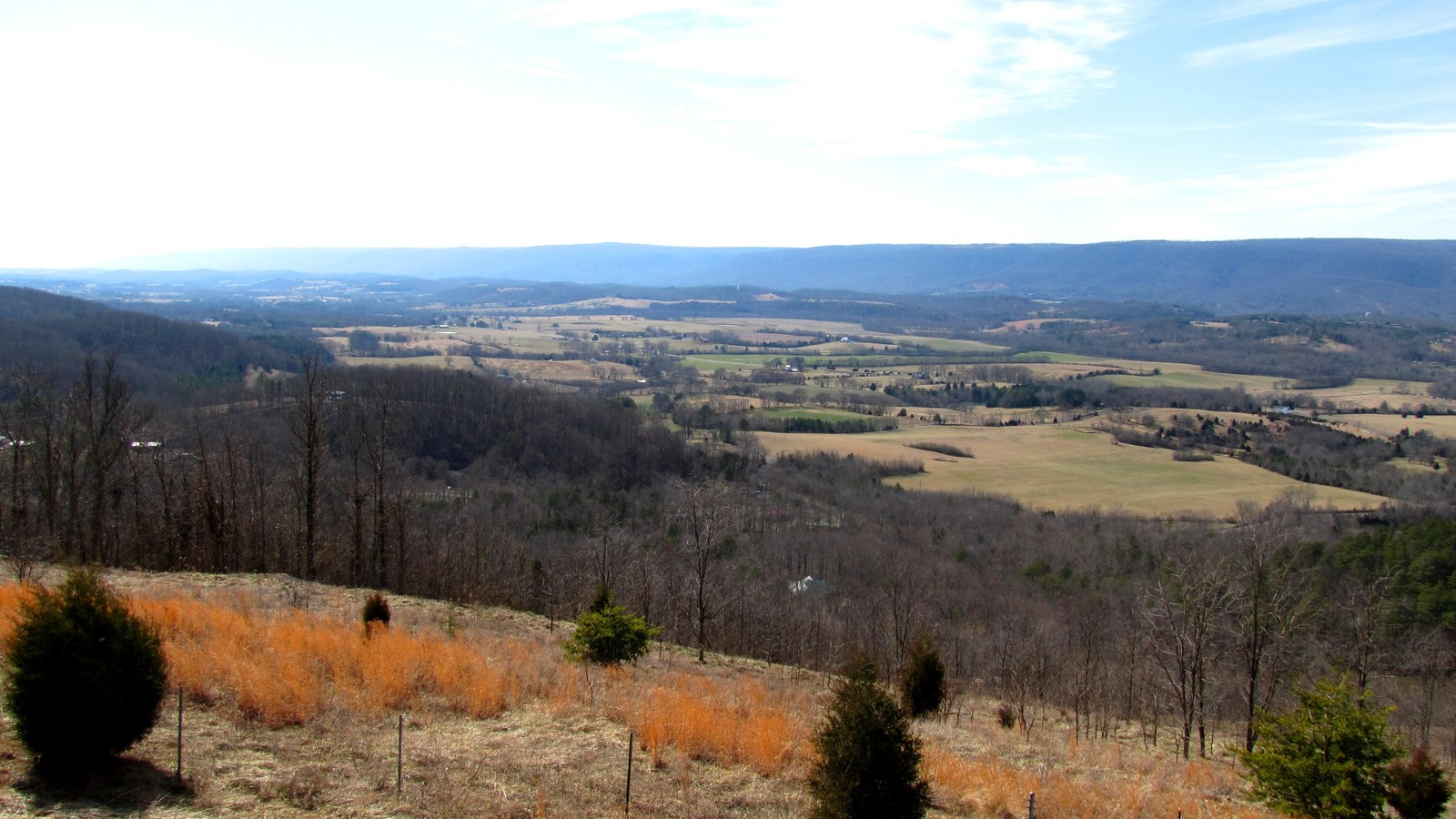
De Soto's entrada, 1540
In June of 1540 a column of roughly seven hundred Spaniards under Hernando de Soto reached the Native American town of Chiaha, on an island in the Tennessee River a short distance below the future site of Chattanooga. De Soto, fresh from the Spanish conquest of Peru and serving as governor of Cuba, held a royal commission to explore and settle Florida, a name that then covered a vast and vaguely bounded stretch of the Southeast. His priests, horsemen, and foot-soldiers had marched up from the Florida coast through swamp and forest, and according to Raulston and Livingood they entered the Tennessee Valley along the headwaters of the Hiwassee River, east of the Sequatchie, then struck overland past the site of Chattanooga to the river and the town.
The Spaniards rested at Chiaha for about a month to refresh their horses, which had arrived, in one chronicler's words, "greatly fatigued, having worked hard and eaten little." Scouts rode out in search of gold and found none. The same chronicler recorded that the townspeople spent days with the Spaniards "in peace," swimming and competing with them, until De Soto's demand for women drove the people to flee into the countryside before relations were patched up. It was at Chiaha, the account adds, that the expedition "first found fenced villages," the palisaded towns of the Mississippian Southeast. On Monday, June 28, 1540, De Soto led his band out of the area and on toward the Mississippi River, which his expedition would reach the following year, and toward his own death on its banks in 1542.
Tracing De Soto's path from the cramped and contradictory journals of his men has occupied historians for generations. In 1939, on the four-hundredth anniversary of the expedition, a federal commission led by the Smithsonian ethnologist John R. Swanton published the Final Report of the United States De Soto Expedition Commission, which routed the Spaniards down the Tennessee River through the Sequatchie country. Later scholars, working with better archaeology, have proposed very different paths; one widely cited reconstruction by Charles M. Hudson turns the expedition south into Georgia rather than down the Tennessee. Because the town of Chiaha anchors the route, the disagreement over where De Soto walked is bound up with the disagreement over where Chiaha stood, a puzzle taken up in detail on the Chiaha page.
Luna's soldiers, 1560
Twenty years after De Soto, a second body of Spaniards reached the river. In 1560 a detachment from the expedition of Tristan de Luna y Arellano, operating out of the Coosa chiefdom in what is now northern Georgia and Alabama, marched north to the Tennessee River valley. According to the Tennessee Encyclopedia, recent research places these soldiers "in the vicinity of Marion County," where they visited the main town of the chiefdom of the Napochies, a Native American people whose towns stood along this stretch of the Tennessee. Luna's larger venture, an attempt to plant a Spanish colony on the Gulf coast and run a road into the interior, collapsed in hunger and mutiny, and the soldiers who had seen the upper Tennessee withdrew with it. The Napochies visit is the earliest documented European contact with the immediate Marion County area after De Soto, predating the Cherokee era here by two full centuries.
Pardo and the fort at Chiaha, 1566–1567
A quarter of a century after De Soto, Spain tried again to fix a hold on the interior. Between 1566 and 1568, Juan Pardo led two expeditions inland from the Spanish coastal base of Santa Elena, in present-day South Carolina, charged with making alliances with Native nations, finding an overland route toward Mexico, and spreading Christianity. Pardo's men built a string of small forts across the interior, and some of them reached Chiaha, the same river town where De Soto had rested, which Pardo's chroniclers also called Lameco and Solameco. There, Raulston and Livingood write, the Spaniards built a fort and left a corporal and thirty soldiers to hold it.
One member of the expedition, Juan de la Vandera, set down in 1567 the most admiring description any of these visitors left of the country. Chiaha, he wrote, was "rich and broad land, a big place, surrounded by pretty rivers," with "many small towns, all surrounded by rivers" and "leagues of very fine land, of many grapes." In the end, he concluded, "it is an angelic land." The praise did not save the garrison. Pardo's forts in the interior did not last: in 1568 the Native nations turned on the scattered garrisons, killing all but one of the roughly 120 soldiers Pardo had left behind and burning every fort. The post at Chiaha was abandoned and destroyed with the rest, and with it ended the brief moment when a Spanish flag flew over the Tennessee River reach below the Sequatchie.
Needham and Arthur: the English reach Tennessee, 1673
A century passed before the next newcomers arrived, and when they came, they came from two directions in the same year. In 1673 the Virginia trader Abraham Wood sent James Needham and Gabriel Arthur southwest from Fort Henry on an expedition that became the first recorded English exploration into eastern Tennessee, reaching the river towns of the Overhill country. Needham was killed on a return journey by a member of the trading party he traveled with; Arthur, Wood's young indentured servant, survived adoption into the town he had reached and lived nearly a year among its people before making his way home. Per Raulston and Livingood, a limited Virginia trade with the Cherokee followed, though the Virginians soon faced competition from the newly organized colony of Carolina, whose merchants would come to dominate the deerskin trade out of Charleston. That trade, and the century-long Anglo-French contest it fed, is taken up on the Contest for the Land page.
The French claim: Marquette, Joliet, and La Salle
In the same season, the fur trader Louis Joliet and Father Jacques Marquette came down the Mississippi River from the Great Lakes carrying the banners of Louis XIV, and within a decade Robert Cavelier de la Salle had descended to the river's mouth and claimed the entire Mississippi Valley for France. In Raulston and Livingood's account, La Salle read the Tennessee River shrewdly: it was a route leading toward the newly planted English settlements on the Atlantic coast, and the European trade goods he saw among the river nations convinced him the English connection was already made. He feared the Tennessee would be used to draw off French trade, and the French answer was a chain of posts around the interior: a trading station at the “French Lick” near present-day Nashville, Fort Toulouse at the site of Montgomery, Alabama, and the Gulf cities of Biloxi, Mobile, and New Orleans. No French post is documented in the Sequatchie country itself, though the empire's mapmakers would later sketch a fort at Long Island that may never have risen off the paper.
What the Spanish left behind
The entradas changed nothing about who held the land. No Spaniard settled here, no mission endured, and the Native nations of the river kept the country for another two hundred years, with the Cherokee coming to dominate the area through the 1700s and early 1800s. What the Spanish did leave was a thin scatter of evidence in the ground. At Hampton Place on Moccasin Bend, on the Tennessee River just upstream toward Chattanooga, archaeologists have found two late Mississippian towns that yielded Spanish artifacts, the physical trace of these expeditions passing among the river towns. The names the Spaniards wrote down, garbled through interpreters, are nearly all that survives of the towns themselves.
The deeper mark the explorers left was on the historical record rather than the land. Their journals are the first written words about the Sequatchie country, the first outside description of its people and its river, and the starting point for everything historians have since tried to reconstruct about who lived here on the eve of recorded history. For the long argument over where, exactly, the town they all visited actually stood, see Chiaha; for the deep Native American past the Spanish glimpsed at its very end, see In the Beginning.
Related
Chiaha: Burns Island, Williams Island, and the lost town De Soto found →
The Contest for the Land, 1673–1775 →
The Native American trails and the Old Creek Crossing →
In the Beginning: the first peoples of the Sequatchie country →
The Cherokee Lower Towns →
The first settlers →
Sources
- J. Leonard Raulston and James Weston Livingood, Sequatchie: A Story of the Southern Cumberlands (Knoxville: University of Tennessee Press, 1974), chapter 2, "Visitors and the Land," pp. 13–15, and chapter 3, "Whose Land?," pp. 26–27 (Needham and Arthur, the French claim, and the French posts).
- Wikipedia — Abraham Wood (the 1673 Needham and Arthur expedition, Needham's death, and Arthur's year among the river towns).
- Tennessee Encyclopedia — Marion County (the 1560 Luna expedition and the Napochies).
- Wikipedia — Hernando de Soto (the 1939 De Soto Expedition Commission and later route reconstructions).
- Wikipedia — Juan Pardo (the 1566–1568 expeditions and the destruction of the forts in 1568).
- Wikipedia — Moccasin Bend (Hampton Place and the Spanish artifacts).