Last updated: April 23, 2026
- Person: Johnny Cash (1932–2003)
- Year: 1967
- Place: Nickajack Cave, Marion County, Tennessee
- Primary source: Cash: The Autobiography (1997, with Patrick Carr)
- Key context: The story does not appear in Cash's earlier autobiography, Man in Black (1975)
One of the most frequently repeated stories in the life of Johnny Cash is set in Marion County, Tennessee. In his 1997 autobiography, Cash described crawling deep into Nickajack Cave in October 1967, at the lowest point of a decade-long addiction to amphetamines and barbiturates, intending to die. In total darkness, he wrote, he experienced a spiritual awakening that led him back out of the cave and toward recovery. The account has become inseparable from the cultural memory of both the singer and the cave. It is also, as later biographers have documented, a story with significant unresolved questions about its literal accuracy.
Cash's addiction (late 1950s to 1967)
Cash's drug use began in the late 1950s. Like many touring musicians of the era, he started taking amphetamines to stay awake through grueling schedules of one-night performances across the country. The stimulants kept him alert on long drives and through back-to-back shows, but they also made sleep impossible. To counteract the amphetamines, Cash turned to barbiturates, particularly Equanil (meprobamate), creating a cycle of uppers and downers that deepened over the years.
By the mid-1960s, Cash's addiction had become severe and public. On October 4, 1965, a narcotics squad arrested him in El Paso, Texas, after finding 688 Dexedrine capsules and 475 Equanil tablets hidden inside his guitar case. The arrest made national news.
That same year brought other visible consequences. Cash was ejected from the Grand Ole Opry after smashing 51 footlights with his microphone stand in a fit of drug-fueled aggression. He wrecked his Cadillac, breaking his nose and jaw in the crash. His first marriage, to Vivian Liberto, ended in divorce in 1966.
By 1967, Cash's weight had dropped to around 150 pounds on his six-foot-one frame. He was in and out of jails and hospitals, canceling performances regularly, and widely regarded in Nashville as a man destroying himself.
The cave visit: Cash's account
In Cash: The Autobiography, written with Patrick Carr and published in 1997, Cash described what happened next. In early October 1967, he drove from Nashville to Nickajack Cave in Marion County. Nickajack was then a vast limestone cavern, its main entrance approximately 140 feet wide and 50 feet high, located along the Tennessee River near the community of Shellmound.
Cash wrote that he entered the cave alone, carrying a flashlight, and crawled steadily inward for hours. He was not exploring. He intended to go deep enough that he could never find his way back out. When the flashlight batteries died, he lay down in total darkness and waited to die.
What happened next, in Cash's telling, was a spiritual experience. He later wrote:
"I became conscious of a very clear, simple idea: I was not in charge of my destiny. I was not in charge of my own death."
Cash described a feeling of "utter peace, clarity and sobriety" and a conviction that God had not abandoned him. Rather than dying in the cave, he felt his way along the walls and ceiling, following air currents, until he eventually found the entrance again. Outside, he wrote, his mother Carrie Cash and June Carter were waiting for him with a basket of food. They had somehow known where he had gone.
What followed: June Carter and recovery
After the cave episode, Cash's account describes a turning point. June Carter and her parents, Maybelle and E.J. Carter, moved into Cash's home in Hendersonville, Tennessee, to help him through withdrawal. They flushed his pills, monitored him constantly, and kept him fed.
By November 11, 1967, Cash performed sober for the first time in over a decade. The recovery was not instant or complete. Cash struggled with relapses throughout his life. But the trajectory of his career changed decisively in this period.
On February 22, 1968, Cash proposed to June Carter on stage at the London Gardens in London, Ontario. She accepted. They married a week later, on March 1, 1968, in Franklin, Kentucky. (Kentucky allowed same-day marriage licenses and ceremonies; Tennessee required a waiting period.)
Two weeks earlier, on January 13, 1968, Cash had recorded his landmark live album At Folsom Prison at Folsom State Prison in California. The album, released in May 1968, reached number one on the Billboard country chart and revived his commercial career.
A disputed narrative
The Nickajack Cave story is powerful, and Cash told it consistently in interviews and writings from the 1990s onward. However, several details have drawn scrutiny from biographers and people close to Cash.
The 1975 autobiography omission
Cash published his first autobiography, Man in Black, in 1975, only eight years after the events he later described. That book discusses his addiction and recovery at length but does not mention Nickajack Cave. The cave narrative first appeared in Cash: The Autobiography in 1997, thirty years after the supposed event.
Robert Hilburn's findings
Music journalist Robert Hilburn, in his 2013 biography Johnny Cash: The Life, raised two significant challenges to the story as Cash told it.
First, Hilburn examined the timeline of TVA's Nickajack Dam construction. TVA closed the dam's gates on December 15, 1967, permanently flooding the cave entrance. However, construction work on the dam was ongoing throughout 1967. Hilburn argued that by fall 1967, when Cash placed his visit, the cave may already have been inaccessible or heavily restricted due to the construction activity in the immediate area.
Second, Hilburn documented that Cash was still using pills at the time of the Folsom Prison concert in January 1968. If the cave experience occurred in October 1967 and produced the clean break Cash described, the timeline does not fully align with other evidence about Cash's drug use in that period.
Marshall Grant's doubts
Marshall Grant, Cash's bassist and a member of the Tennessee Two (later the Tennessee Three), also expressed skepticism about the cave story. Grant had been close to Cash throughout the 1960s and was familiar with the daily realities of Cash's addiction. His doubts, reported in multiple sources, added weight to the questions raised by Hilburn.
How to read the story
The scholarly and biographical consensus is more complicated than the popular version. The spiritual turning point was real in its effect on Cash's life. His recovery, though uneven, did begin in this period, and his marriage to June Carter, his renewed faith, and the artistic resurgence that followed are well documented. What remains uncertain is whether the specific cave narrative is a literal account of a single event, a compression of multiple experiences, or a story shaped by decades of memory and retelling. It is best understood as Cash's own theological framework for his recovery: the story he chose to tell about how he came back from the edge.
Nickajack Cave today
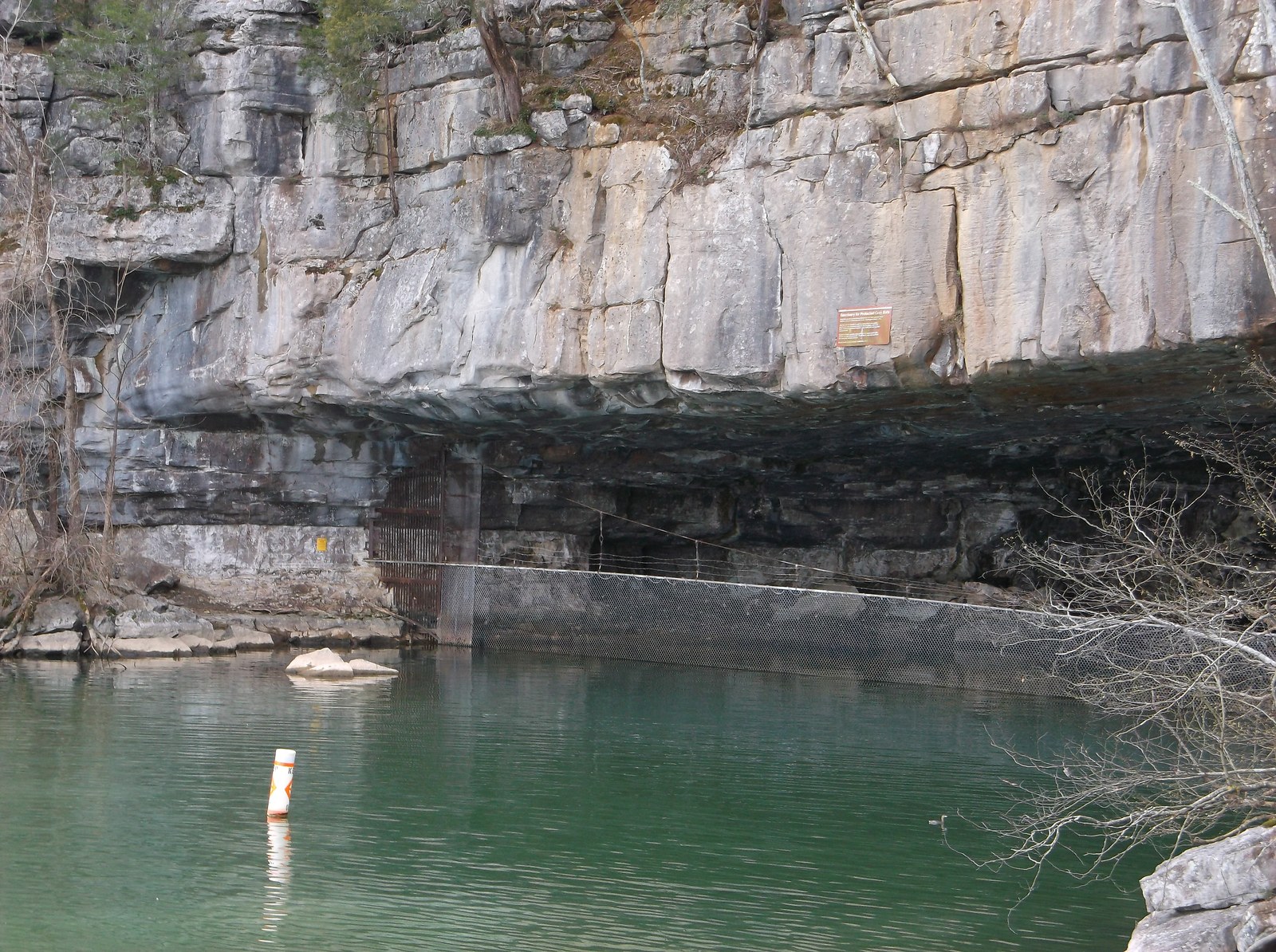
The cave that figures in Cash's story no longer exists in the form he would have known. When TVA closed Nickajack Dam's gates on December 15, 1967, the rising waters of Nickajack Lake flooded the cave's massive entrance. The opening, once 140 feet wide and 50 feet high, now sits behind 25 to 30 feet of water.
The flooding had ecological consequences. At least two species found nowhere else on Earth were exterminated: the pseudoscorpion Microcreagris nickajackensis and the ground beetle Pseudanophthalmus nickajackensis. Both were endemic to the cave system and had no known populations elsewhere.
Today, the cave is protected as critical habitat for a colony of more than 100,000 gray bats (Myotis grisescens), a federally endangered species. The cave entrance is gated and closed to human entry. Visitors can view the cave from a TVA observation platform across Nickajack Lake.
The cave is also central to the history of the Cherokee Lower Towns of Nickajack and Running Water, which occupied this stretch of the Tennessee River in the late eighteenth century. Read more about Nickajack & Running Water →
How the story circulates today
The Nickajack Cave episode has become a fixture of Johnny Cash biographical material across documentary film, memoir, and scholarly work. The 2005 biographical film Walk the Line does not dramatize the cave episode directly, but the James Mangold-directed narrative structure compresses the same 1967 recovery arc into the lead-up to the 1968 Folsom Prison concert. Ken Burns' 2019 PBS documentary series Country Music includes the cave story in its episode on Cash. More recent country-music journalism, including the Marty Stuart-anchored American Epic and retrospective Cash features in Rolling Stone and No Depression, treats the episode as a signature Cash moment with attendant caveats about its literal documentation. The story's role in Marion County culture is less about what happened in the cave than about what the cave has become in Cash's own telling and in the memory of the region.
Sources
- Wikipedia: Johnny Cash
- Wikipedia: Nickajack Cave
- Wikipedia: Nickajack Dam
- Johnny Cash's Struggle with Addiction (FHE Health)
- The Day That Johnny Cash Survived Death and Found God (Our American Stories)
- Much Tennessee History Happened at Nickajack Cave (The Tennessee Magazine)
- Review: Johnny Cash: The Life by Robert Hilburn (Kirkus Reviews)
- Johnny Cash with Patrick Carr, Cash: The Autobiography (San Francisco: HarperSanFrancisco, 1997)
- Johnny Cash, Man in Black (Grand Rapids: Zondervan, 1975)
- Robert Hilburn, Johnny Cash: The Life (New York: Little, Brown and Company, 2013)