Last updated: May 26, 2026
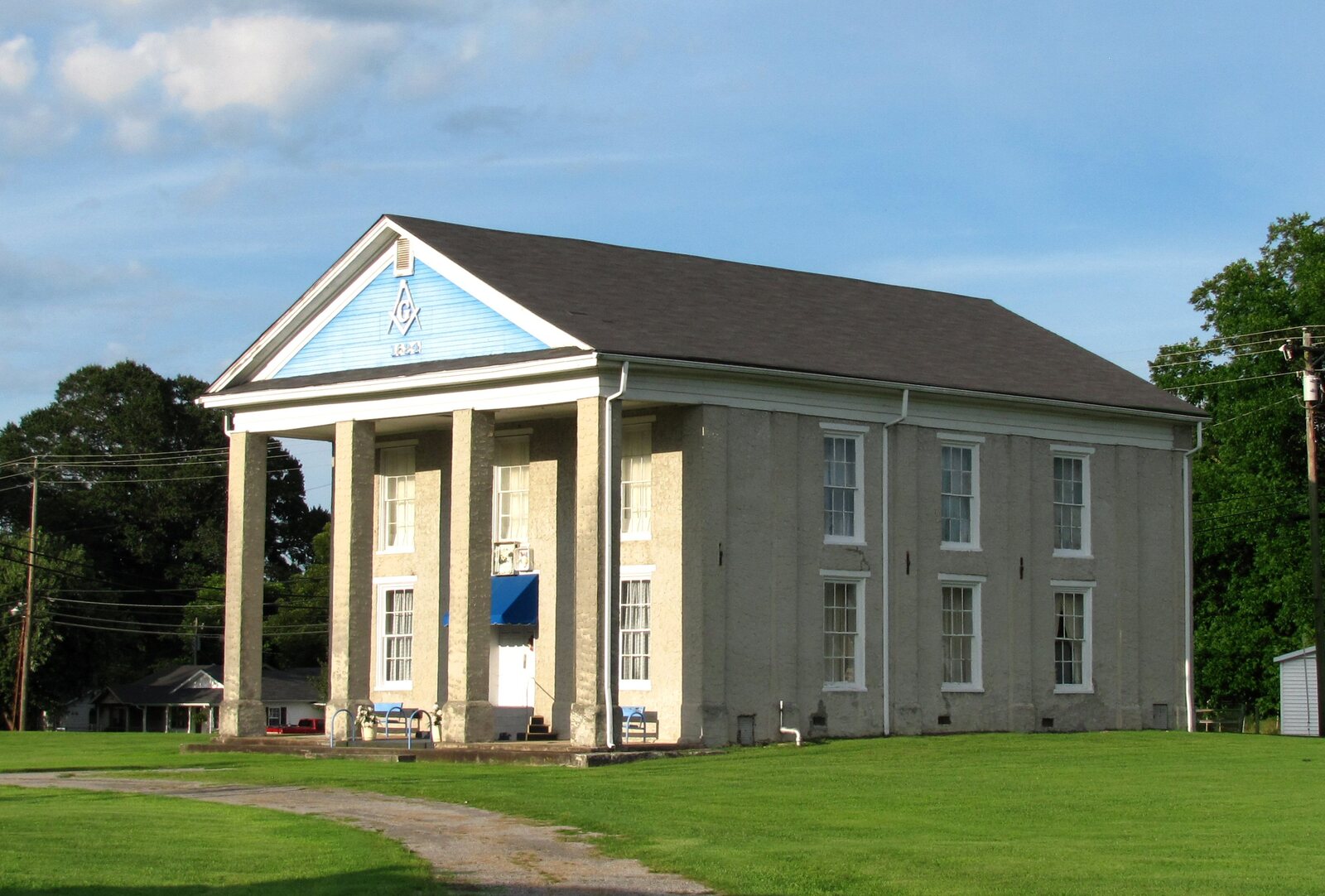
- Chartered: 1826, Tennessee Acts of 1826, Chapter 15 (sections 1 through 6 organize the Samuel Houston Academy and seat trustees)
- Founding chairman of the Board of Trustees: John Kelly, Marion County's first county clerk and the namesake of Kellysville
- Lottery authorized for academy benefit: Acts of 1829 to 1830, Chapter 156
- Trustees authorized to place academy funds in bank stock: Acts of 1833, Chapter 303 (Planters Bank stock)
- Current building: 1857, Greek Revival
- Address: 204 Academy Street, Jasper, TN
- Civil War use: Field hospital for both Federal and Confederate forces; site of secession-era county meetings (1861)
- Sale authorized: Private Acts of 1925, Chapter 134 (Marion County Board of Education authorized to sell the academy property)
- Current use: Olive Branch Masonic Lodge #297, F&AM
- Named for: Sam Houston (1793 to 1863), Tennessee governor 1827 to 1829, later President of the Republic of Texas
Sam Houston Academy was Marion County's first county academy and the first school established in Jasper. The Tennessee General Assembly chartered the institution as the Samuel Houston Academy in 1826, sat its founding Board of Trustees with Marion County's first county clerk John Kelly as chairman, and underwrote the early operating capital through a state-authorized lottery in 1829 and a bank-stock placement in 1833. The Greek Revival building that still stands on Academy Street was constructed in 1857. The building served as a hospital for both Federal and Confederate forces during the Civil War, was sold by the Marion County Board of Education in 1925, and today houses Olive Branch Masonic Lodge #297. The institution is unrelated to the Sam Houston Schoolhouse State Historic Site in Blount County; the two share only their namesake.
Founding (1826)
The Tennessee Acts of 1826, Chapter 15, established the Samuel Houston Academy as the county academy for Marion County, to be located on a site near Jasper. The legislation followed the broader 1806 Cession Act framework, which had required Tennessee to set aside land in each new county for the support of an academy. At the time, no public common-school system existed in Tennessee; that would not arrive until after the constitutional reforms of 1834 and 1835. County academies like Sam Houston Academy were the primary means of formal education in rural Tennessee through the antebellum period, supported by a mix of state-authorized lotteries, tuition fees, public-land receipts, and trustee-controlled investments.
The 1826 charter named a Board of Trustees and a chairman to govern the new institution. Marion County's John Kelly, recorded in the Tennessee Acts as "Samuel Houston Academy Trustee" and "Chairman of Samuel Houston Academy Board of Trustees" in the same 1826 chapter, took the chair. Kelly was a central figure of Marion County's early civic government in this period: he had been Marion County's lottery manager in 1825, was the county clerk by 1827 (with the Marion County community of Kellysville named for him in the same year), was authorized to build a Sequachee River mill dam in 1827, served as a turnpike road commissioner in 1831, and was named a Tennessee Railroad Commissioner in 1835. The academy's founding governance was therefore embedded directly in Marion County's earliest civic and infrastructure leadership.
The academy was named for Sam Houston, who had taught school in Blount County before entering politics, was elected to Congress from Tennessee in 1823, and was elected the sixth Governor of Tennessee in 1827 (serving from October 1, 1827 to April 16, 1829), a year after the academy received its charter. Houston was a prominent and rising figure in Tennessee politics at the moment the academy was named, and a Freemason, a connection that may have influenced both the original naming and the building's eventual transition to Masonic use after 1925. The academy is separate from the later Sam Houston Schoolhouse State Historic Site in Blount County, which preserves the small Maryville-area log building where Houston himself taught in 1812; the two institutions share only their namesake and have no direct organizational continuity.
Operating capital and the 1829 lottery
County academies in early-19th-century Tennessee depended on a patchwork of operating revenues. The Samuel Houston Academy was no exception. The General Assembly successively expanded the academy's funding tools:
- Acts of 1829 to 1830, Chapter 156 authorized a lottery for the benefit of the Samuel Houston Academy. State-authorized lotteries were a standard antebellum-era school finance mechanism, used here to capitalize the academy in advance of the eventual construction of a permanent building.
- Acts of 1833, Chapter 303 authorized the trustees of Samuel Houston Academy to place academy funds in the stock of the Planters Bank, an early Tennessee state-chartered bank. The bank-stock authorization gave the trustees a legally protected channel for endowment-style investment of accumulated lottery, tuition, and gift revenues.
- Tuition payments by Marion County families and small public-land receipts under the broader 1806 Cession Act framework filled the gap between the lottery proceeds and the operating expenses.
Curriculum and student life
Per Logan Carmichael's Sequatchie Valley Now history of Marion County education, Sam Houston Academy's program covered the standard classical-and-practical mix of antebellum Tennessee county academies: Latin, rhetoric, arithmetic, geography, penmanship, and moral philosophy. The classical subjects were preparation for the small minority of students who would go on to a college or to one of the licensed professions, while penmanship and arithmetic served the broader population of farm families who needed practical numeracy and a usable hand for deeds, contracts, and correspondence. Students balanced their academy work with farm labor on a seasonal rhythm; attendance was heaviest in the winter months when fewer hands were needed in the fields, and lighter in spring planting and fall harvest.
The 1857 building
The current Greek Revival academy building was constructed in 1857, roughly thirty years after the institution's chartering. Greek Revival was the dominant architectural form for Tennessee civic and educational buildings by the 1850s, and the academy's choice of style placed it within the same architectural conversation as the county's antebellum courthouses and church buildings. The structure stands on Academy Street, just off the Jasper public square, a location that placed it at the civic center of the county seat. Whether the 1857 structure replaced an earlier academy building on the same site, or was the first permanent building for the institution after thirty years of leased or temporary quarters, is not clear from the surviving records.
The Civil War
The academy's central location in Jasper made it a natural gathering place during the secession crisis and the war that followed. Per the SeeMidTN account of the building, it "hosted county meetings about secession and served as a hospital for both Federal and Confederate Civil War forces." Jasper changed hands repeatedly between 1862 and 1865, sitting near the contested Cracker Line supply route up the Tennessee River and on the rail-and-road corridor between Bridgeport, Alabama and Chattanooga, and the academy building served whichever side held the town at the moment.
The decline of the academy model and the 1925 sale
As Tennessee's public school system expanded in the late 19th century, the private and semi-public academy model gave way to county-run common schools and, eventually, public high schools. By the early 1900s, the Pryor Institute had become the dominant school in Jasper, and in 1910 Marion County purchased the Pryor Institute building to establish Marion County High School. The Sam Houston Academy building's role in formal education had ended by then.
In 1925, the Tennessee General Assembly passed Private Acts of 1925, Chapter 134, authorizing the Marion County Board of Education to sell the property in Jasper known as the Samuel Houston Academy. By that point the building had already been adapted for use as a Masonic lodge, and the 1925 sale was the formal disposition of the title rather than a change in the building's working occupant.
Olive Branch Masonic Lodge #297
The building has served as the home of Olive Branch Masonic Lodge #297, F&AM since the early 20th century. The lodge has continued to maintain the building at 204 Academy Street, Jasper, ever since. The street name, Academy Street, is the most visible trace of the academy's presence in Jasper's civic geography; the original 1826 chartering act and the 1857 construction date are documented in the Tennessee Acts and in regional architectural surveys cited below.
The old academy building stands directly adjacent to the present-day Marion County Board of Education offices, placing Marion County's earliest school within sight of the central office that runs its modern public-school district. Academy Street, the academy building, and the school district's central office sit within a single short stretch of downtown Jasper.
Related
About the Pryor Institute (later Jasper academy that succeeded Sam Houston) →
About Marion County High School (the 1910 successor in the Pryor building) →
About the town of Jasper →
About the Civil War in Marion County (the academy's hospital era) →
Sources
- SeeMidTN — Sam Houston Academy, Jasper, TN (1857 Greek Revival building, secession-era county meetings, Federal/Confederate hospital use, current Olive Branch Lodge occupancy)
- Marion County TN — Museums and Memorials (current building use as Olive Branch Masonic Lodge #297)
- UT County Technical Assistance Service — Marion County Education / Schools Historical Notes (Tennessee Acts of 1826 Chapter 15 chartering, Acts of 1829 to 1830 Chapter 156 lottery authorization, Acts of 1833 Chapter 303 Planters Bank stock authorization, Private Acts of 1925 Chapter 134 sale authorization)
- Tennessee State Library and Archives — Acts of Tennessee 1796 to 1850 names index, letter K (John Kelly as Samuel Houston Academy trustee and chairman in Acts of 1826 Chapter 15 sections 1 and 4; Kelly's broader Marion County civic offices including 1825 lottery manager, 1827 county clerk and Kellysville namesake, 1827 mill-dam authorization, 1831 turnpike commissioner, 1835 railroad commissioner)
- Tennessee Encyclopedia — Elementary and Secondary Education (the broader county-academy framework under which Sam Houston Academy was chartered)
- Wikimedia Commons — Jasper Masonic Hall photograph (the 1857 Greek Revival academy building in its present Masonic-lodge configuration)
- Wikipedia — Sam Houston (the 1827 to 1829 Tennessee Governor for whom the academy was named)
- Tennessee Encyclopedia — Sam Houston Schoolhouse (the unrelated Blount County state historic site preserving the 1812 log schoolhouse where Houston taught; cited here only to distinguish it from the Marion County academy)
- Marion County Historical Society — The Story of Marion County, Its People and Places (1990, multi-volume) (physical access required)
- Logan Carmichael, “Lessons Through the Generations: The History of Education in Marion County,” Sequatchie Valley Now, May 26, 2026 (the academy's curriculum: Latin, rhetoric, arithmetic, geography, penmanship, and moral philosophy, with students balancing schoolwork and farm labor)